

Global Hydrogen Energy Infrastructure Market Size and Forecast – 2026 To 2033
The Global Hydrogen Energy Infrastructure Market is estimated to be valued at USD 10.42 Bn in 2026 and is expected to reach USD 20.28 Bn by 2033, growing at a compound annual growth rate (CAGR) of 9.98% from 2026 to 2033. This growth reflects expanding investments in hydrogen production, storage, transportation, and distribution infrastructure to support industrial decarbonization and cleaner energy systems. The development of interconnected hydrogen networks is creating opportunities for pipeline operators, engineering contractors, and infrastructure equipment suppliers.
In March 2025, Fluxys announced the commencement of construction of Belgium's first-phase open-access hydrogen pipeline network, connecting the industrial port areas of Antwerp and Ghent through the Kallo–Zelzate corridor. The project, with its initial phase targeted for completion in 2026, aims to facilitate hydrogen transportation between producers and industrial consumers, supporting the development of integrated hydrogen supply networks.
Key Takeaways of the Global Hydrogen Energy Infrastructure Market
- Hydrogen Pipelines are estimated to grow at a 10.4% CAGR during 2026–2033 and capture 25.6% of the global hydrogen energy infrastructure market in 2026. Their commercial value lies in dependable, high-volume delivery to industrial clusters without recurring road-haulage costs. In December 2025, GASCADE made approximately 400 km of converted German gas pipelines available for hydrogen transmission.
- Equipment and Hardware are expected to register an indicative 9.6% CAGR during 2026–2033, accounting for 63.5% of the global hydrogen energy infrastructure market in 2026. Electrolyzers, compressors, storage vessels and metering equipment represent substantial upfront procurement commitments and determine installation readiness. In March 2026, thyssenkrupp nucera signed a contract to supply 300 MW of alkaline electrolyzer equipment for Moeve’s Onuba project in Spain.
- Energy Storage is projected to achieve an indicative 11.5% CAGR over 2026–2033, representing 38.9% of application revenue in global hydrogen energy infrastructure market. Converting surplus renewable electricity into storable hydrogen creates a dispatch option when generation and peak demand diverge, particularly for utilities. In January 2026, Duke Energy Florida unveiled its DeBary system combining electrolysis, hydrogen storage and turbine generation.
- North America is estimated to expand at an 8.7% CAGR over 2026–2033 while commanding 34.5% of the global hydrogen energy infrastructure market in 2026. Its advantage rests on established industrial hydrogen users, existing transmission assets and contracts that justify infrastructure upgrades. In October 2025, Air Liquide announced nearly US$ 50 million for pipeline, compression and distribution improvements serving Texas refiners.
- Asia Pacific is projected to record an indicative 12.6% CAGR during 2026–2033 while contributing 28.1% of global hydrogen energy infrastructure market revenue in 2026. Its acceleration should come from coordinating industrial hydrogen supply with freight corridors and local refueling access. In April 2025, Sinopec launched a 1,150-km hydrogen trucking route across western China, supported by four purpose-built refueling stations.
Segmental Insights
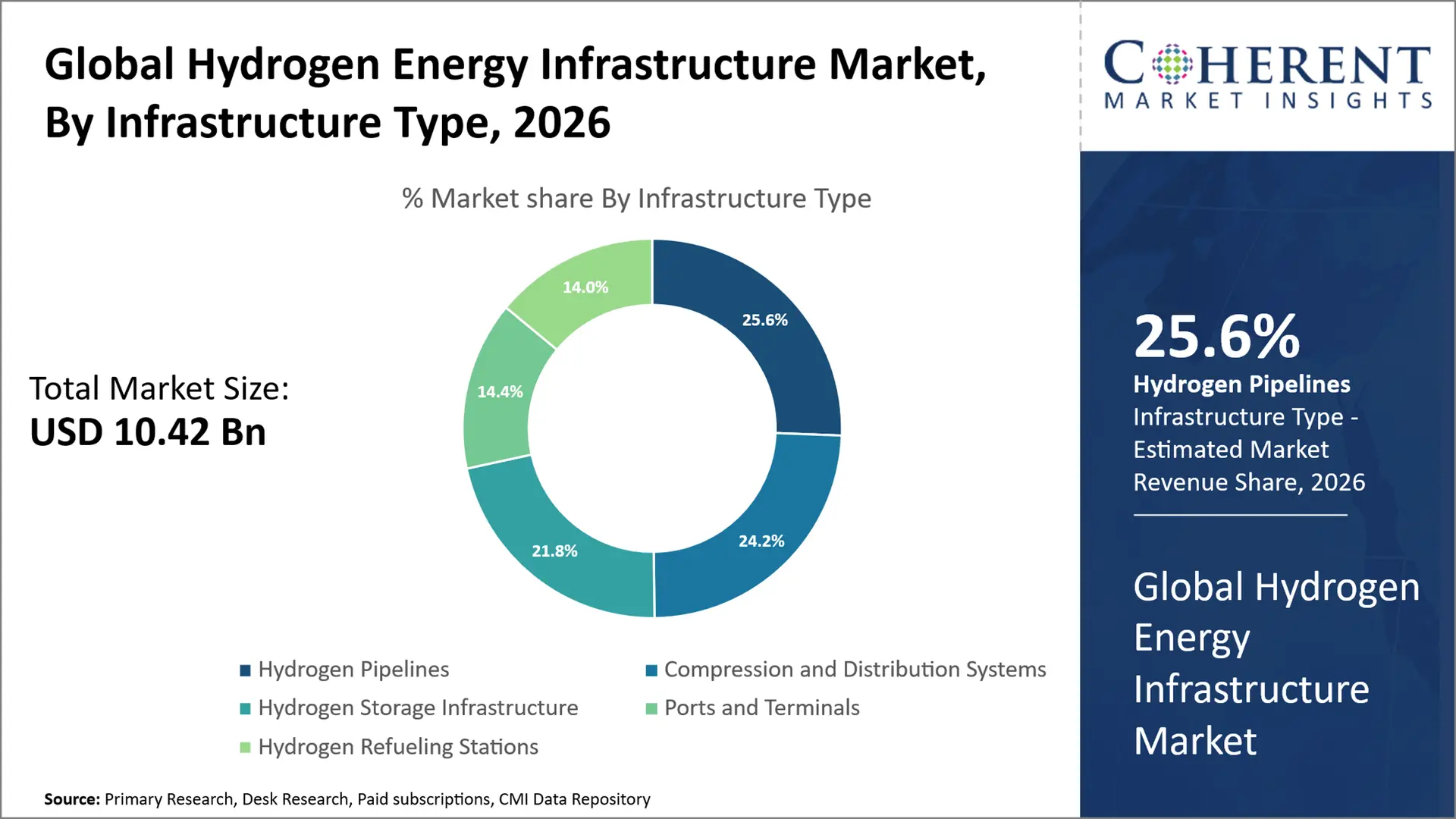
Why Do Hydrogen Pipelines Dominate the Global Hydrogen Energy Infrastructure Market?
Hydrogen Pipelines are expected to account for 25.6% of the global hydrogen energy infrastructure market in 2026, reflecting their importance in connecting hydrogen production facilities with industrial consumption clusters. Chemical manufacturers and refineries require predictable delivery capacity, making dedicated transmission corridors important for long-term supply agreements. Network operators can also improve asset utilization by incorporating multiple industrial customers through strategically positioned connection points. Pipeline engineering, inspection and network integration providers see opportunities in repurposing suitable gas transmission assets. ONTRAS completed the conversion of a 25-kilometer natural gas pipeline between Bad Lauchstädt and Leuna, Germany, in April 2025 and confirmed it was ready for hydrogen transport. This development is a case study in the ability of existing transmission corridors to enable industrial hydrogen connectivity, while also providing opportunities for new network connections.
- Current Industry Events of 2026
- Market Size Estimation
- Regional Breakdown
- Competitive Landscape
- Customer Intelligence
- Segmental Analysis
- Pricing Analysis
- Key Market Drivers, Challenges & Future Trends
- Customized Insights Section
Why Do Equipment and Hardware Represent the Largest Component Category in the Global Hydrogen Energy Infrastructure Market?
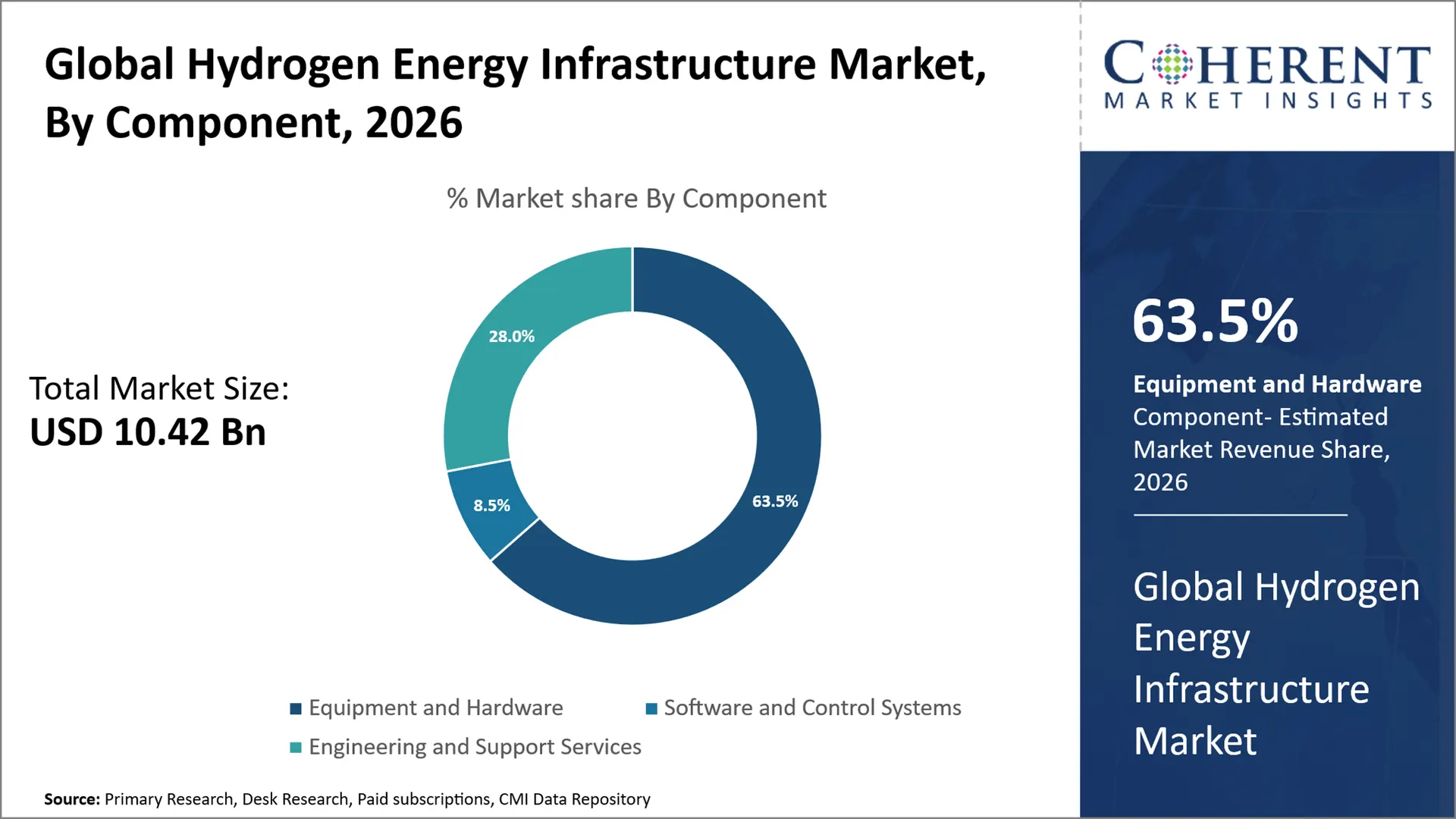
Equipment and Hardware are expected to represent 63.5% of the global hydrogen energy infrastructure market in 2026, reflecting the specialized physical systems required for hydrogen handling, containment, and distribution. Infrastructure developers focus on modular transport equipment, certified valves, protective assemblies, and high-pressure vessels that meet stringent operational demands. When choosing equipment, transport compatibility, inspection intervals, maintenance accessibility and hydrogen carrying capacity are becoming more and more a consideration. These requirements create differentiation opportunities for manufacturers with integrated engineering and production capabilities. In October 2026, Hexagon Purus launched HyCarrier, a modular Type 4 container for distribution of hydrogen by road, rail and inland waterway transport at working pressures up to 380 bar. Multimodal setup is how equipment manufacturers can improve distribution flexibility and meet the operational requirements and maintenance costs of industrial hydrogen suppliers.
Why Does Energy Storage Dominate the Application Category of the Global Hydrogen Energy Infrastructure Market?
Energy Storage is expected to dominate the global hydrogen energy infrastructure market with a 38.9% share by 2026, thus highlighting the need for reliable hydrogen inventories for industrial users with continuous production cycles. To underwrite dependable supply contracts, storage facilities must demonstrate reliable withdrawal performance, acceptable hydrogen purity, and containment integrity. These technical requirements present opportunities for developers of underground storage, cavern engineering specialists and gas treatment equipment suppliers. In December 2024, EWE announced the completion of its HyCAVmobil research project in Rüdersdorf, Germany, where a 500-cubic-metre underground salt cavern underwent hydrogen injection and withdrawal testing. The project demonstrated safe storage and limited changes in hydrogen purity, providing technical evidence for larger storage developments and supporting future investment in hydrogen storage infrastructure, subject to commercial and regulatory feasibility.
Current Events and their Impact
Current Event | Description and Its Impact |
European Union Hydrogen and Gas Market Package – May 2024 |
|
United States Clean Hydrogen Tax Credit Revision – July 2025 |
|
United Kingdom Hydrogen Infrastructure Funding Commitment – June 2025 |
|
Global Hydrogen Energy Infrastructure Market Dynamics
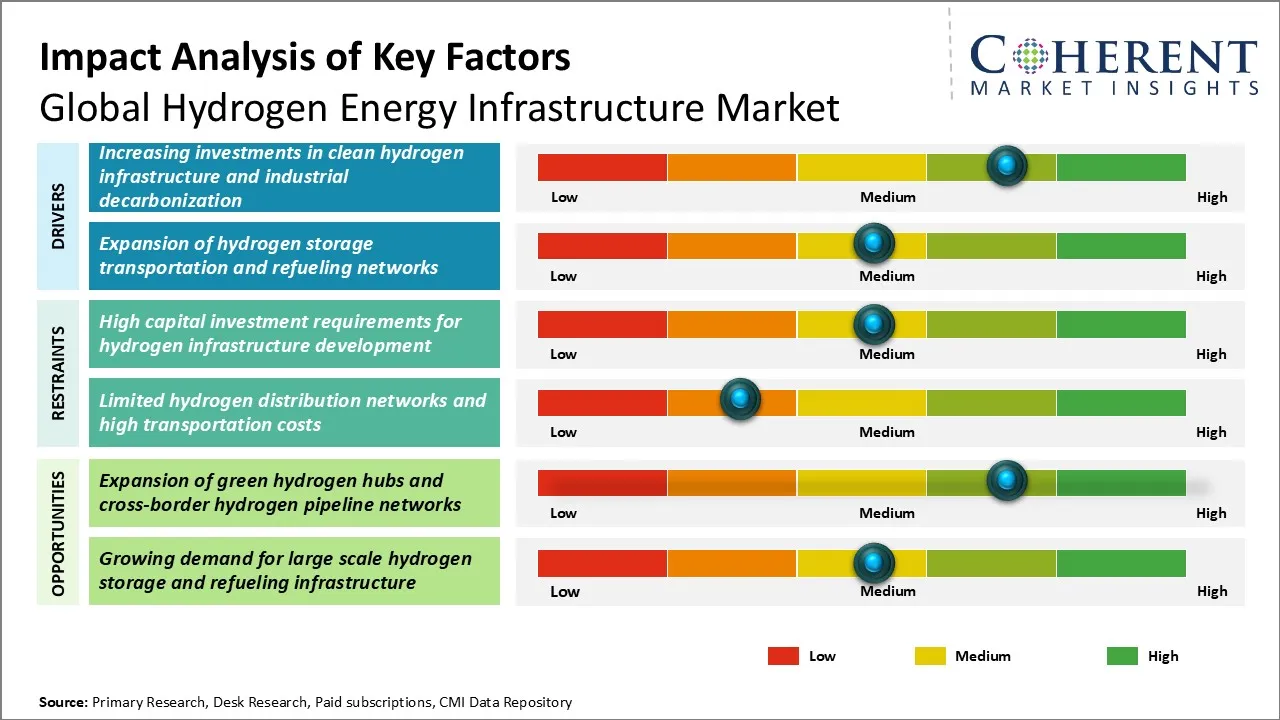
Key Market Drivers
- Increasing investments in clean hydrogen infrastructure and industrial decarbonization: Public funding and industrial decarbonization commitments are strengthening the investment case for hydrogen distribution, compression, and storage infrastructure. Financing of hydrogen production allows industrial users and infrastructure builders to consider long-term delivery contracts, thus supporting the availability of future supply. The beneficiaries will be the equipment manufacturers and engineering contractors as the projects move to funded construction. In January 2026, the European Climate,, Infrastructure and Environment Executive Agency confirmed that six renewable hydrogen projects had signed grant agreements totaling USD 303.23million, to support the future supply of hydrogen to industrial and transport users.
- Expansion of hydrogen storage, transportation and refueling networks: Coordinated hydrogen distribution and refueling networks are improving fuel availability for commercial fleets and creating repeatable infrastructure-service opportunities. Refueling facilities near existing transport depots maximize the use of stations and justify the investment in hydrogen delivery logistics, pressure regulation and dispensing equipment. Shared facilities give infrastructure operators the capacity to accommodate different types of vehicles. H2 MOBILITY and Rhein-Neckar-Verkehr have opened a public hydrogen station in Ludwigshafen, Germany, in December 2025. The station provides refueling for busses and other commercial vehicles at 350 bar and 700 bar.
Emerging Market Trends
- Transition Toward Hydrogen Quality Traceability and Digital Custody-Transfer Verification: The procurement of hydrogen infrastructure is moving toward greater documentation of fuel quality, delivery conditions and accuracy of custody transfer. With network operators becoming more dependent on inter-connected facilities, they require compatible measurement systems capable of monitoring hydrogen purity, pressure conditions and quantities transferred. This opens up possibilities for industrial software vendors, test labs, and instrumentation suppliers offering integrated verification systems. Standardized data exchange and auditable hydrogen quality records may become important commercial requirements during the forecast period, especially when industrial consumers purchase hydrogen from multiple suppliers operating through shared infrastructure.
- Shift Toward Performance-Based Infrastructure Operation and Availability Guarantees: The buyers of hydrogen infrastructure will likely seek operational availability rather than equipment assessment based on initial capital costs. To maintain continuous hydrogen delivery, compression systems, dispensing equipment and storage withdrawal facilities must be reliable. It may incentivize suppliers to offer performance-based service contracts, maintenance-inclusive contracts, and availability guaranties. Manufacturers of specialized equipment with existing service capabilities may have a competitive advantage, whereas suppliers unable to provide support for long-term operational responsibilities may experience greater pricing pressure and more rigorous contractual qualification requirements.
Key Market Restraints
- Hydrogen Compatibility Requirements Increase Retrofit Complexity: Converting conventional gas infrastructure for hydrogen service requires detailed assessments of material compatibility, pressure containment, sealing systems, and operational safety. The risks of hydrogen-assisted cracking and leakage may require component replacement or other inspection measures. Such requirements can hamper the economic benefits of reusing existing infrastructure and complicate retrofit budgeting, especially when asset condition and design documentation are incomplete.
- Infrastructure Siting Constraints Delay Project Execution: Reliable delivery vehicles, electricity connections and suitable land are needed for the operation of hydrogen storage facilities, compression installations and distribution terminals. Industrial sites may face long development schedules due to complex permitting conditions or lack of utility capacity. This could lead to higher engineering and financing costs for infrastructure developers before construction starts, potentially impacting the timing of equipment orders and the project’s economics.
Regional Insights
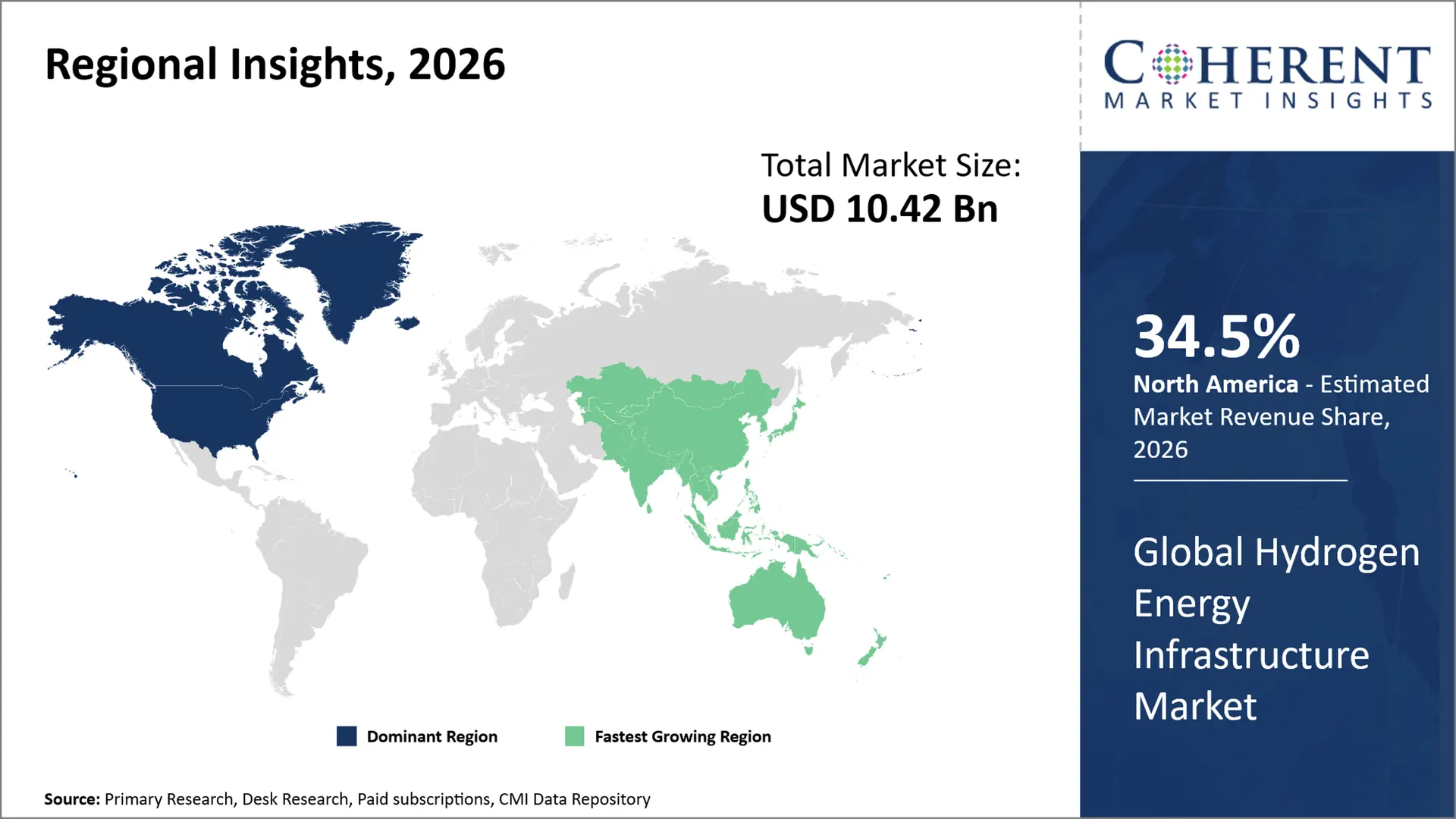
Why Does North America Dominate the Global Hydrogen Energy Infrastructure Market?
North America is projected to capture 34.5% of the global hydrogen energy infrastructure market by 2026, bolstered by its established industrial hydrogen supply chains, extensive gas-processing expertise, and dedicated infrastructure contractors. Hydrogen use in refining, chemicals and industrial manufacturing, along with investment in dedicated transportation infrastructure, is a positive for the region. Canada is also developing integrated hydrogen supply models that connect production, liquefaction and downstream distribution. In March 2025, the Government of Canada announced $49 million in support of HTEC’s proposed hydrogen liquefaction facility in North Vancouver. The project will process 15 tons a day of industrial by-product hydrogen to be delivered to fueling stations in British Columbia and Alberta. These integrated developments strengthen regional hydrogen supply capabilities and equipment procurement opportunities.
Why Is Asia Pacific Emerging as the Fastest-Growing Region in the Global Hydrogen Energy Infrastructure Market?
Asia Pacific is expected to account for 28.1% of the global hydrogen energy infrastructure market in 2026 and to emerge as the fastest growing regional market by 2033. The growth reflects increasing investment in renewable hydrogen production plants near existing industrial consumption sites. In Australia, electrolyzer installation can be paired with ammonia production, while hydrogen projects in the region are boosting demand for water treatment, compression and handling equipment. The Australian Renewable Energy Agency said in July 2026 Orica had made a final investment decision on its Hunter Valley Hydrogen Hub. The project will use 50 MW of renewable-powered electrolysis to produce hydrogen for ammonia production. These industrially anchored developments make investments in hydrogen infrastructure more commercially viable to support.
Global Hydrogen Energy Infrastructure Market Outlook for Key Countries
Why Is the U.S. a Key Market for the Global Hydrogen Energy Infrastructure Market?
The U.S. remains an important hydrogen energy infrastructure market due to its existing industrial hydrogen consumption, local engineering capabilities and investment in the fuel-cell transportation infrastructure. The demand for industrial hydrogen handling systems is driven by the needs of refining and chemical manufacturing support, while transportation applications present opportunities for specialized dispensing and station maintenance equipment. Infrastructure developers are increasingly being pressed to demonstrate operational reliability and station use to justify additional investment. In August 2026, the California Energy Commission approved its investment plan for the Clean Transportation Program for 2026–2027, including US$15 million set aside for hydrogen refueling infrastructure. This targeted funding provides opportunities for station developers, equipment makers and maintenance providers. The commercial success will depend on having a reliable supply of hydrogen, on operating efficiently and on matching the infrastructure that is put in place to the demand from customers.
Why Is Japan Important in the Global Hydrogen Energy Infrastructure Market?
Japan is a key global hydrogen energy infrastructure market for strategic reasons: its industrial decarbonization strategy includes imported low-carbon hydrogen derivatives and dedicated receiving infrastructure. Domestic energy companies and manufacturers need reliable international supply agreements, which presents opportunities for port handling facilities, storage equipment and industrial fuel distribution systems. Reducing the cost gap between conventional fuels and lower carbon alternatives is a key element of the country’s commercial approach. In February 2026, the Japan Organization for Metals and Energy Security approved price-gap subsidies for JERA’s plan to supply certified low-carbon ammonia. The arrangement supports planned imports of ammonia from Louisiana for use in Japan for power generation and in industry. These mechanisms can improve investment certainty for infrastructure to transport hydrogen derivatives, although ammonia infrastructure is different from assets that directly transport hydrogen.
Why Does China Support Growth in the Global Hydrogen Energy Infrastructure Market?
China is a major contributor to the development of the global hydrogen energy infrastructure market due to its huge industrial manufacturing base, domestic equipment supply capacity and integrated regional energy planning. Industrial clusters provide potential offtakers for hydrogen compression, storage and distribution systems and local production of components can enable competitive tendering of projects. The government is increasingly tying the growth of hydrogen infrastructure to particular uses in industry and transport. China approved 5 city clusters to carry out 4-year pilot programs on hydrogen application in October 2026, covering equipment development, industrial projects, fuel-cell vehicles and the construction of refueling stations. The effort provides a framework for coordinated deployment and evaluation of infrastructure. The further implementation of approved projects may create additional business for local equipment suppliers and engineering contractors.
Why Is Germany a Strategic Country in the Global Hydrogen Energy Infrastructure Market?
Germany is strategically positioned in terms of chemical production, steel making, industrial engineering and cross-border energy interconnections. These sectors need infrastructure that can deliver hydrogen reliably, while meeting demanding technical and regulatory standards. The German infrastructure planning also aims at connecting centers of industrial consumption with future locations for hydrogen production and import. In October 2024, the Federal Network Agency approved a national hydrogen backbone network comprising roughly 9,040 kilometers of pipelines, to be rolled out in phases up to 2032. The planned investment amounts to about USD 21.18 billion. This regulatory achievement establishes a clear pathway for future network development, opening up possible avenues for engineering contractors, pipeline equipment makers, and industrial connection providers as projects get the go-ahead for investment.
Why Is South Korea an Important Growth Market for the Global Hydrogen Energy Infrastructure Market?
South Korea’s capabilities in automotive manufacturing, advanced port operations and industrial logistics network create opportunities for the global hydrogen energy infrastructure market. The country’s hydrogen strategy is increasingly connecting transport applications to localized production, storage and industrial energy infrastructure. Its main ports are suitable for connecting hydrogen handling facilities with commercial vehicle operations and dispersed power generation. Hyundai Motor Group announced in November 2025 a multilateral agreement with Pyeongtaek City and other stakeholders to build hydrogen-based port infrastructure. The proposed program would include power generation by fuel cells, hookups for hydrogen supply and future sites for refueling. Depending on the implementation and commercial feasibility of projects this could open up opportunities for port infrastructure developers, stationary fuel-cell system suppliers and hydrogen distribution specialists.
Hydrogen Infrastructure Investment and Commercialization Landscape
Infrastructure Development Area | Investment and Market Focus | Commercial Development Status | Business Implications |
Industrial Hydrogen Supply Agreements | Long term supply & infrastructure capacity agreements with refineries, chemical manufacturers and steel producers | Contract structures that evolve with the project | Improves financing prospects for operators of hydrogen pipeline, storage and distribution. Guaranties future use of infrastructure. |
Financing of the hydrogen infrastructure project | Public-private investments, Infrastructure funds, Project debt and government-backed finance mechanisms | Project-specific financing models; bankability a key challenge | Offers opportunities for infrastructure investors and developers with credible revenue contracts and clearly apportioned construction risks. |
Hydrogen Import & Export Logistics | Development of port handling facilities, import terminals and connections to industrial consumption centers | Early commercial development and staged project planning | Enables cross-border hydrogen trade and generates investment opportunities for terminal operators, logistics providers and infrastructure developers. |
Hydrogen Infrastructure Siting and Land Use | Land acquisition, environment clearances, safety approvals and industrial zoning requirements | Regulatory structures and approval times vary by region | Influences project execution schedules, development expenditure and the commercial attractiveness of proposed infrastructure sites. |
Models of Ownership and Operation of Hydrogen Infrastructure | third-party ownership of infrastructure, shared industrial facilities, long-term operating concessions, joint ventures | Several commercial models under review and implementation | It allows infrastructure developers to spread their investment exposure while creating recurring revenue opportunities through contracted capacity and operating services. |
Hydrogen Distribution Pricing and Capacity Utilization | Capacity reservation fees, transportation tariffs, storage fees and hydrogen handling service agreements | Commercial pricing mechanisms remain project and market specific. | Demonstrates revenue stability and asset profitability. Forces operators to secure predictable utilization prior to committing large amounts of capital. |
How Are Modular Hydrogen Conversion and Inland Supply Hubs Creating New Growth Opportunities in the Global Hydrogen Energy Infrastructure Market?
The development of modular hydrogen receiving and conversion sites provides an opportunity to serve industrial customers outside of established hydrogen transmission corridors. Smaller chemical manufacturers, specialty metal processors and inland logistics facilities may need reliable supplies of hydrogen, but without enough demand to justify dedicated pipeline connections.
Modular receiving hubs that integrate hydrogen carrier unloading, ammonia cracking or liquid organic hydrogen carrier dehydrogenation, purification, compression and controlled distribution could be used by the infrastructure providers to solve this.
Commercial opportunities would be created in equipment leasing, hydrogen handling services, local supply contracts and maintenance agreements. Suppliers need to show conversion efficiency, hydrogen purity, safe handling procedures and compatibility with customer operating requirements.
Carrier-specific engineering expertise, environmental permitting capabilities and reliable hydrogen supply arrangements will be needed for market entry. Specialist technology providers and integrated industrial gas suppliers will probably be better placed than stand-alone equipment vendors. To be commercialized successfully, the company will need to find enough customers that are concentrated and limit operating costs that are related to conversion.
Market Players, Key Development, and Competitive Landscape
Key Developments
- In October 2025, Burckhardt Compression secured an order to supply its UP! Detect condition-monitoring solution alongside a hydrogen compressor for the H2CAST Etzel storage project in Germany. The contract highlights the commercial integration of predictive maintenance capabilities into hydrogen equipment, supporting better asset monitoring and operational reliability.
- In June 2025, RWE Gas Storage West launched a binding tender for available storage capacity at its Gronau-Epe hydrogen storage facility in Germany. The development demonstrates the movement toward commercially contracted underground storage services, creating opportunities for industrial customers seeking future hydrogen withdrawal flexibility and contractual storage access.
- In April 2025, Plug Power announced the commissioning of the Hidrogenii joint venture's hydrogen liquefaction facility in Louisiana, designed to process up to 15 metric tons per day. The installation strengthens liquid hydrogen distribution capability by converting an existing industrial hydrogen supply into a transportable product for downstream customers.
Competitive Landscape
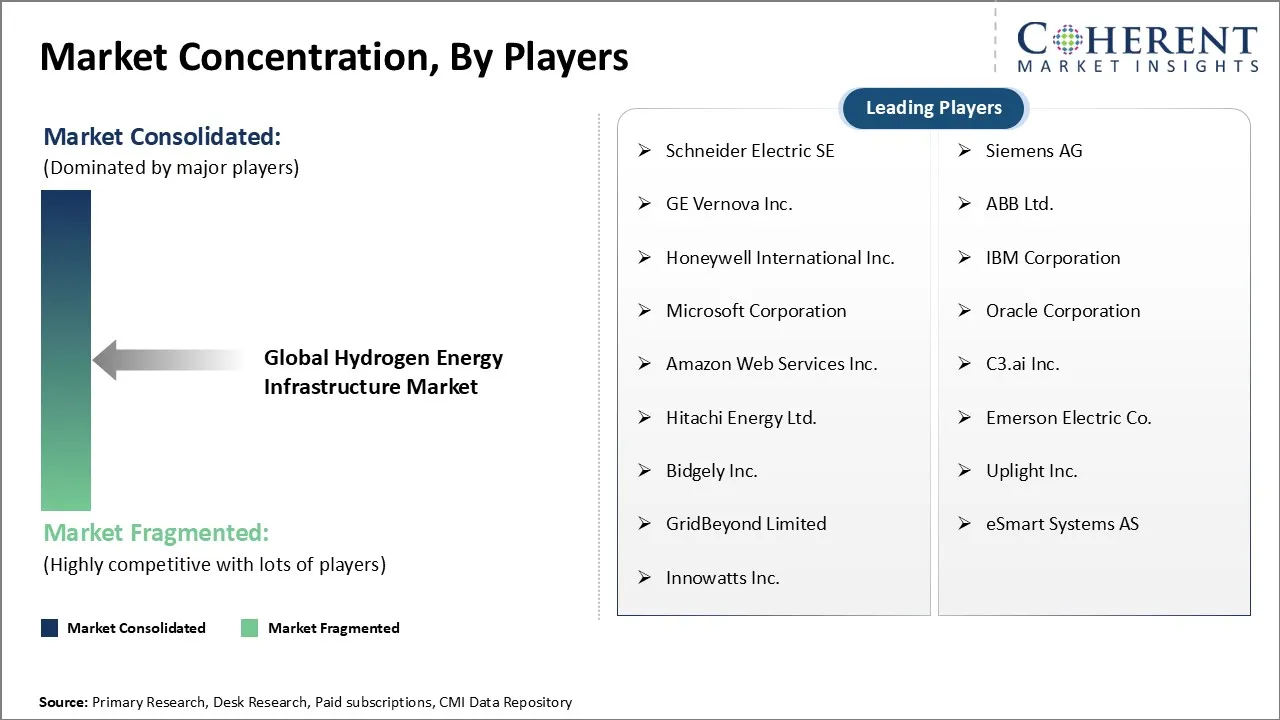
The global hydrogen energy infrastructure market is moderately fragmented and includes industrial gas companies, pipeline operators, engineering contractors, equipment manufacturers, and specialized technology suppliers. The competition revolves around infrastructure reliability, hydrogen-specific engineering expertise, lifecycle costs, and execution capabilities. Large integrated companies benefit from established industrial relationships, while regional contractors and specialist manufacturers compete on customized systems, localized technical support and specialized equipment certification.
Key competitive parameters include
- Equipment Reliability: Supplier qualification criteria include consistent compressor performance, validated containment systems and reliable hydrogen dispensing.
- Economics of Lifecycle: Buyers increasingly look at electricity use, maintenance, replacement cycles, and overall installed costs.
- Manufacturing Capabilities: Production quality, component traceability and repeatable factory testing all influence project acceptance.
- Regulatory Compliance: Suppliers must show compliance with relevant pressure equipment, hazardous area and hydrogen safety requirements.
- System Integration: Reduced commissioning complexity through compatibility of valves, compressors, storage vessels, metering equipment and control systems.
- Service Network Coverage: The availability of qualified technicians and replacement parts in the region builds customer confidence.
- Technical Customization: Different equipment configurations are possible according to pressure ratings, flow capacities, hydrogen purity requirements, and installation environments.
Market Report Scope
Hydrogen Energy Infrastructure Market Report Coverage | |||
Report Coverage | Details | ||
Base Year | 2025 | Market Size in 2026: | USD 10.42 Bn |
Historical Data For: | 2020 To 2024 | Forecast Period: | 2026 To 2033 |
Forecast Period 2026 To 2033 CAGR: | 9.98% | 2033 Value Projection: | USD 20.28 Bn |
Geographies covered: |
| ||
Segments covered: |
| ||
Companies covered: | Schneider Electric SE, Siemens AG, GE Vernova Inc., ABB Ltd., Honeywell International Inc., IBM Corporation, Microsoft Corporation, Oracle Corporation, Amazon Web Services Inc., C3.ai Inc., Hitachi Energy Ltd., Emerson Electric Co., Bidgely Inc., Uplight Inc., GridBeyond Limited, eSmart Systems AS, Innowatts Inc. | ||
Growth Drivers: |
| ||
Restraints & Challenges: |
| ||
Analyst Opinion (Expert Opinion)
- The global hydrogen energy infrastructure market leadership is likely to shift toward companies capable of coordinating infrastructure development, engineering acceptance, and commercial operation within a unified delivery structure. Equipment specifications alone may become less influential as customers evaluate commissioning accountability and long-term contractual exposure. Businesses that can manage interfaces between multiple infrastructure owners while maintaining independent operational standards may secure stronger customer relationships and more defensible margins.
- Industrial hydrogen users may be more involved directly in the ownership of infrastructure rather than being dependent on independently developed supply networks. Joint ventures between infrastructure investors and industrial buyers could change the financing, allocation and pricing of capacity. This will favor developers that can negotiate shared investment structures, transparent operating responsibilities and longterm capacity rights, and put pressure on speculative merchant infrastructure projects.
- Infrastructure providers should focus on hydrogen-ready components, flexible equipment configurations and verifiable commissioning procedures. Projects with realistic operational requirements and identifiable industrial consumption should receive more attention. To protect margins, companies should have disciplined procurement, localize critical maintenance capabilities, and have clear contractual allocation of performance risks. We should be cautious about making large infrastructure investments for which there is no clear credible path to utilization, especially where regulatory approvals or critical utility connections have not been obtained.
Speak to the analyst
Want personalized insights?
Take the findings above to one of our principal consultants, or have the report rebuilt around the segments, geographies and competitors you actually track.
Market Segmentation
- Infrastructure Type Insights (Revenue, USD Bn, 2021 - 2033)
- Hydrogen Pipelines
- Compression and Distribution Systems
- Hydrogen Storage Infrastructure
- Ports and Terminals
- Hydrogen Refueling Stations
- Component Insights (Revenue, USD Bn, 2021 - 2033)
- Equipment and Hardware
- Software and Control Systems
- Engineering and Support Services
- Application Insights (Revenue, USD Bn, 2021 - 2033)
- Energy Storage
- Industrial Applications
- Mobility and Transportation
- Other Applications
- End User Insights (Revenue, USD Bn, 2021 - 2033)
- Utilities and Energy Companies
- Manufacturing Industries
- Oil and Gas Companies
- Transportation Operators
- Port Authorities and Logistics
- Other End Users
- Project Type Insights (Revenue, USD Bn, 2021 - 2033)
- New Infrastructure Development
- Existing Infrastructure Upgrades
- Regional Insights (Revenue, USD Bn, 2021 - 2033)
- North America
- U.S.
- Canada
- Latin America
- Brazil
- Argentina
- Mexico
- Rest of Latin America
- Europe
- Germany
- U.K.
- Spain
- France
- Italy
- Russia
- Rest of Europe
- Asia Pacific
- China
- India
- Japan
- Australia
- South Korea
- ASEAN
- Rest of Asia Pacific
- Middle East
- GCC Countries
- Israel
- Rest of Middle East
- Africa
- South Africa
- North Africa
- Central Africa
- North America
- Key Players Insights
- Schneider Electric SE
- Siemens AG
- GE Vernova Inc.
- ABB Ltd.
- Honeywell International Inc.
- IBM Corporation
- Microsoft Corporation
- Oracle Corporation
- Amazon Web Services Inc.
- C3.ai Inc.
- Hitachi Energy Ltd.
- Emerson Electric Co.
- Bidgely Inc.
- Uplight Inc.
- GridBeyond Limited
- eSmart Systems AS
- Innowatts Inc.
Sources
Primary Research Interviews
- Hydrogen pipeline operators, storage developers, and refueling station operators
- EPC contractors, hydrogen equipment manufacturers, and infrastructure investors
Stakeholders
- Hydrogen infrastructure developers, industrial gas suppliers, and energy companies
- Pipeline operators, port authorities, logistics providers, and equipment manufacturers
End-use Sectors
- Oil and gas refining, chemicals, steel, and industrial manufacturing
- Utilities, renewable energy storage, transportation, and port logistics
Regulatory and Industry Bodies
- U.S. Department of Energy (DOE)
- European Commission and Agency for the Cooperation of Energy Regulators (ACER)
- International Energy Agency (IEA)
- International Renewable Energy Agency (IRENA)
Databases
- IEA Hydrogen Production and Infrastructure Projects Database
- European Hydrogen Observatory and U.S. Energy Information Administration (EIA)
- Eurostat, UN Comtrade, and national energy statistics databases
- Hydrogen infrastructure investment, project capacity, and operational datasets
Magazines and Journals
- International Journal of Hydrogen Energy
- Hydrogen Insight
- Renewable and Sustainable Energy Reviews
- Fuel Cells Bulletin
Associations
- Hydrogen Council
- Hydrogen Europe
- Fuel Cell & Hydrogen Energy Association (FCHEA)
- International Association for Hydrogen Safety (HySafe)
Public Domain Sources
- Hydrogen pipeline, storage, terminal, and refueling infrastructure project data
- Infrastructure investments, capacity additions, and project commissioning announcements
- Government funding, hydrogen transportation costs, and industrial offtake agreements
Key Standards and Regulations
- ASME B31.12 – Hydrogen Piping and Pipelines
- ISO 19880-1 – Gaseous Hydrogen Refueling Stations
- ISO 14687 – Hydrogen Fuel Quality Specifications
- Regulation (EU) 2024/1789 – Internal Markets for Renewable Gas, Natural Gas, and Hydrogen
Proprietary Elements
- CMI Data Analytics Tool and proprietary research repository, supplemented by infrastructure project tracking, primary interviews, investment analysis, equipment pricing, capacity utilization assessment, and competitive intelligence.
Get access to 250+ pages report
Every segment, forecast, competitor profile and data table behind the analysis above — available for instant download.
- ESOMAR Member
- ISO 9001:2015 Certified
- D-U-N-S Registered
- GDPR & CCPA Compliant
Frequently Asked Questions
The CAGR of global hydrogen energy infrastructure market is projected to be 9.98% from 2026 to 2033.
The global hydrogen energy infrastructure market is estimated to be valued at USD 10.42 billion in 2026 and is expected to reach USD 20.28 billion by 2033.
The report covers infrastructure investment activity, project development, regulatory frameworks, competitive intelligence, and country-level market analysis to support strategic business decisions.
The report looks at hydrogen infrastructure projects that have been announced, are under construction and are operating. It focuses on development progress, investment priorities and commercial implications.
Market findings are assessed through primary research, industry interviews, secondary research, company disclosures, and data triangulation to improve reliability and consistency.
The report helps infrastructure developers, equipment suppliers and investors assess market entry strategies, identify potential partners, benchmark competitors and prioritize investment decisions.
Increasing investments in clean hydrogen infrastructure and industrial decarbonization, along with the expansion of hydrogen storage, transportation, and refueling networks, are the major factors driving the growth of the global hydrogen energy infrastructure market.