

Global Industrial Energy Harvesting Wireless Sensors Market Size and Forecast – 2026-2033
The global industrial energy harvesting wireless sensors market is expected to grow from USD 1.05 Bn in 2026 to USD 2.65 Bn by 2033, registering a compound annual growth rate (CAGR) of 7.2% from 2026 to 2033. The global industrial energy harvesting wireless sensors market is driven by rising adoption of predictive maintenance across manufacturing facilities. On January 29, 2025, INX International Ink Co. completed a venture capital investment in AssetWatch, a leading condition monitoring and predictive maintenance organization based in Columbus, Ohio. INX participated in AssetWatch’s USD 40 million Series B round of financing which was led by Wellington Management.
Key Takeaways of the Global Industrial Energy Harvesting Wireless Sensors Market
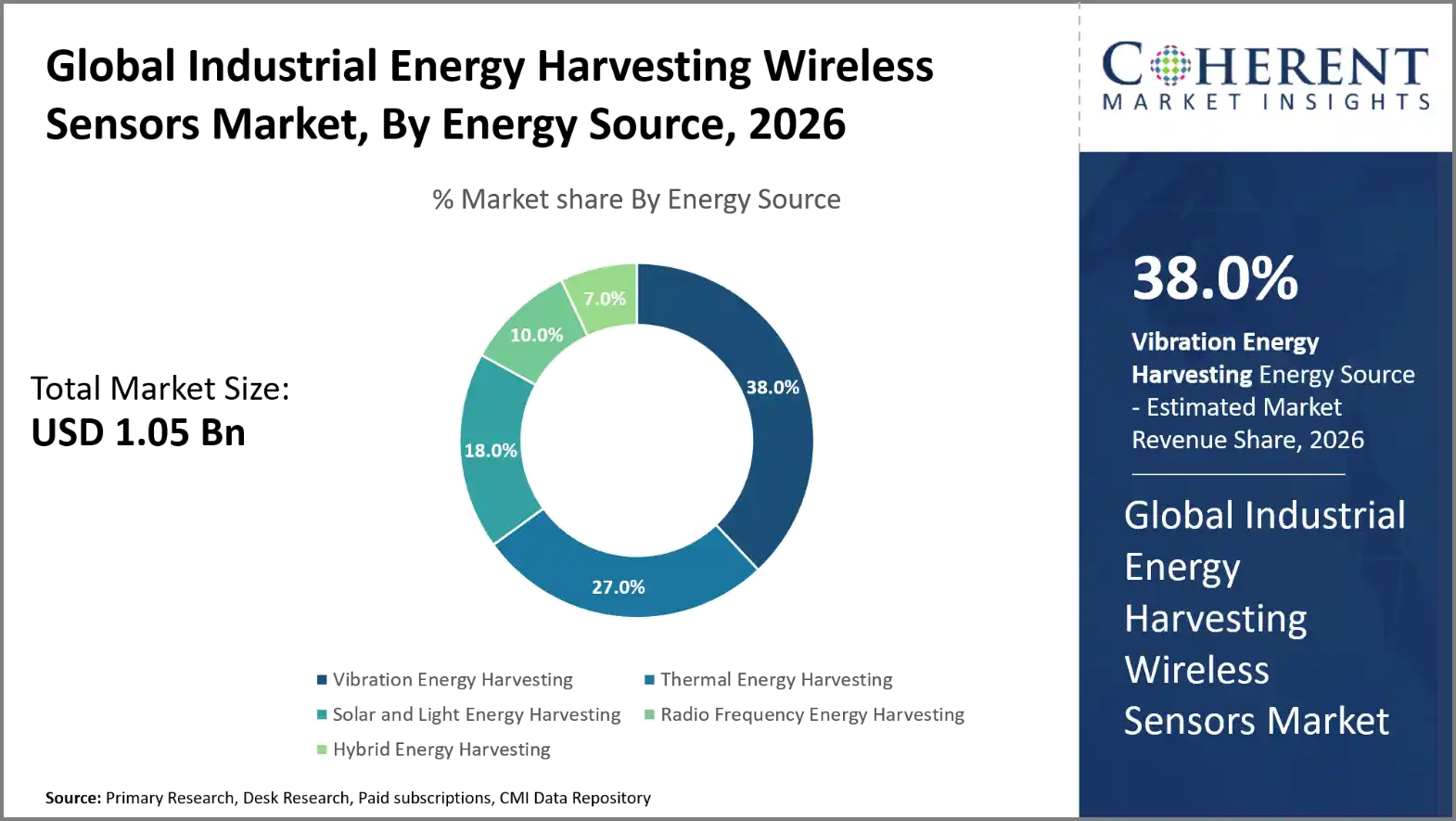
- The Vibration Energy Harvesting segment is expected to account for 38.0% of the global industrial energy harvesting wireless sensors market share in 2026. Increasing need for continuous monitoring in remote industrial locations is driving the growth of the segment. On September 18, 2025, I-care inaugurated a high-technology manufacturing facility in Mons, Belgium. The company designed the facility to strengthen production autonomy for its Wi-care predictive maintenance sensors.
- The Temperature Sensors segment is estimated to capture 26.0% of the market share in 2026. Growing investments in smart factories and connected industrial equipment is majorly driving the growth of the segment. On April 23, 2026, Solvay expanded its industrial digitalization agreement with IMI for connected equipment monitoring. The company had installed over 5,000 sensors across 25 manufacturing sites in 11 countries.
- The Bluetooth Low Energy segment is estimated to capture 34.0% of the market share in 2026. Demand for reduced maintenance costs in distributed sensor networks is driving the growth of the segment. On June 1, 2026, Emerson announced its Synchros Industrial Internet of Things platform for wireless industrial asset monitoring. The platform uses WirelessHART connectivity to extend equipment visibility across existing facilities.
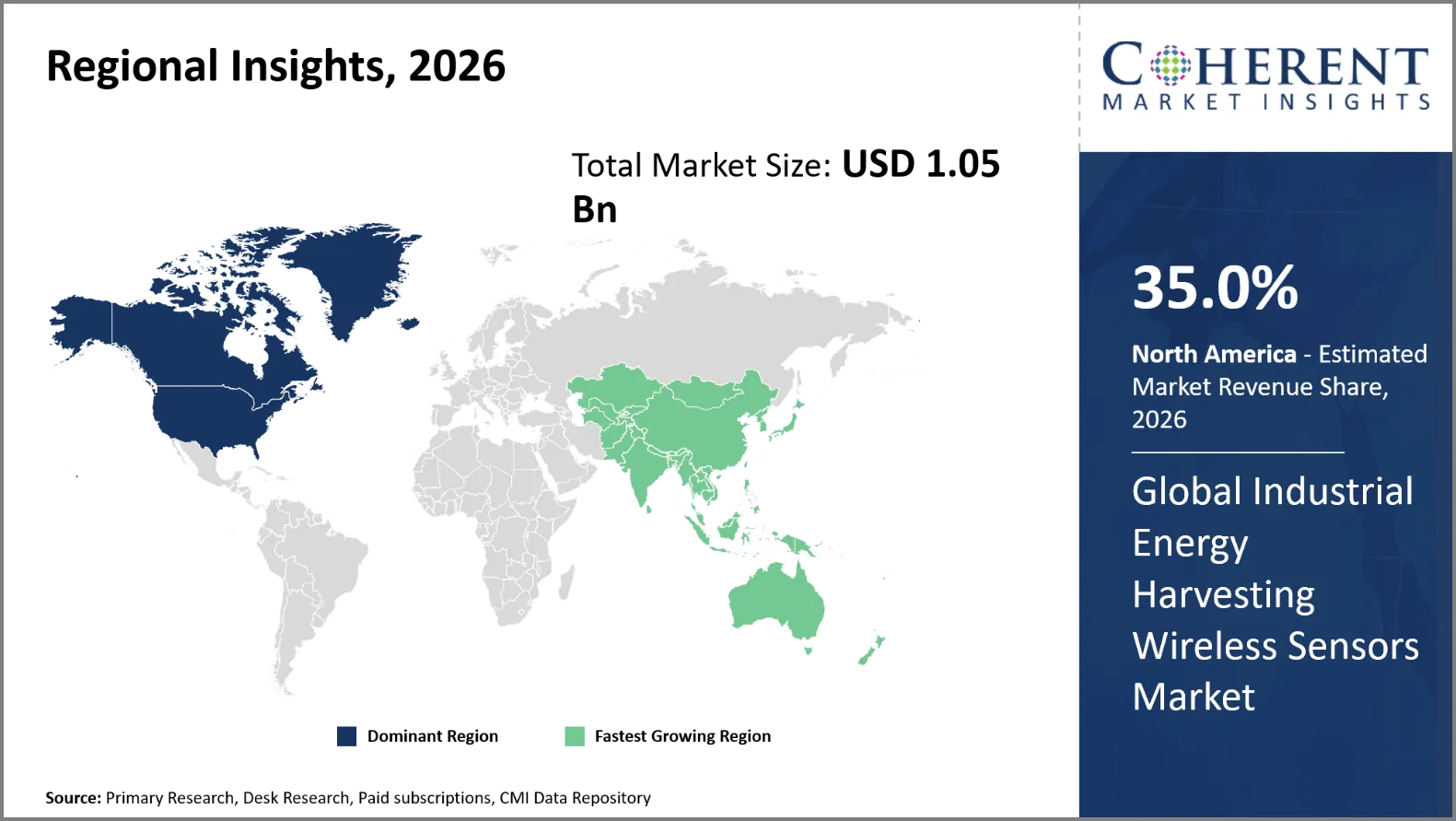
- North America is expected to dominate the industrial energy harvesting wireless sensors market in 2026 with a market share of 35.0%. Expansion of battery-free sensors in hazardous industrial environments in North America is driving the growth of the regional market. On May 8, 2026, Erbessd Instruments launched Phantom Gen 4. The wireless vibration sensor received ATEX and IECEx certifications for hazardous industrial environments.
- Asia Pacific is expected to account for 31.0% share in 2026. Growing emphasis on Industrial Energy Development of hybrid energy harvesting technologies for industrial applications in Asia Pacific is driving the growth of the regional market. On February 14, 2025, Sumitomo Heavy Industries partnered with Nifco to demonstrate EnOcean energy-harvesting sensors in heavy industrial environments.
Segmental Insights
Why Does Vibration Energy Harvesting Dominate the Global Industrial Energy Harvesting Wireless Sensors Market?
The vibration energy harvesting segment is expected to account for 38.0% of the global industrial energy harvesting wireless sensors market share in 2026. Vibration energy harvesting is dominant because industrial machineries are usually vibrating during normal operation. These vibrations are a ready supply of energy to power wireless sensors. The piezoelectric and electromagnetic converters turn mechanical movements into useful electrical energy. There are broad prospects for implementation in manufacturing plants, power stations and processing units. This system allows for ongoing monitoring of devices without frequent battery changes. It also decreases the maintenance cost and wiring needs in harsh industrial situations. Fraunhofer Institute for Integrated Circuits has demonstrated vibration-powered solutions for autonomous industrial wireless sensors.
On March 12, 2025, Mouser Electronics announced the availability of TE Connectivity’s 85x1N and 89x1N wireless vibration sensors. These sensors support industrial monitoring applications involving pumps, gearboxes, turbines, and oil and gas equipment.
- Current Industry Events of 2026
- Market Size Estimation
- Regional Breakdown
- Competitive Landscape
- Customer Intelligence
- Segmental Analysis
- Pricing Analysis
- Key Market Drivers, Challenges & Future Trends
- Customized Insights Section
Why is Temperature Sensors the Most Preferred Sensor Type?
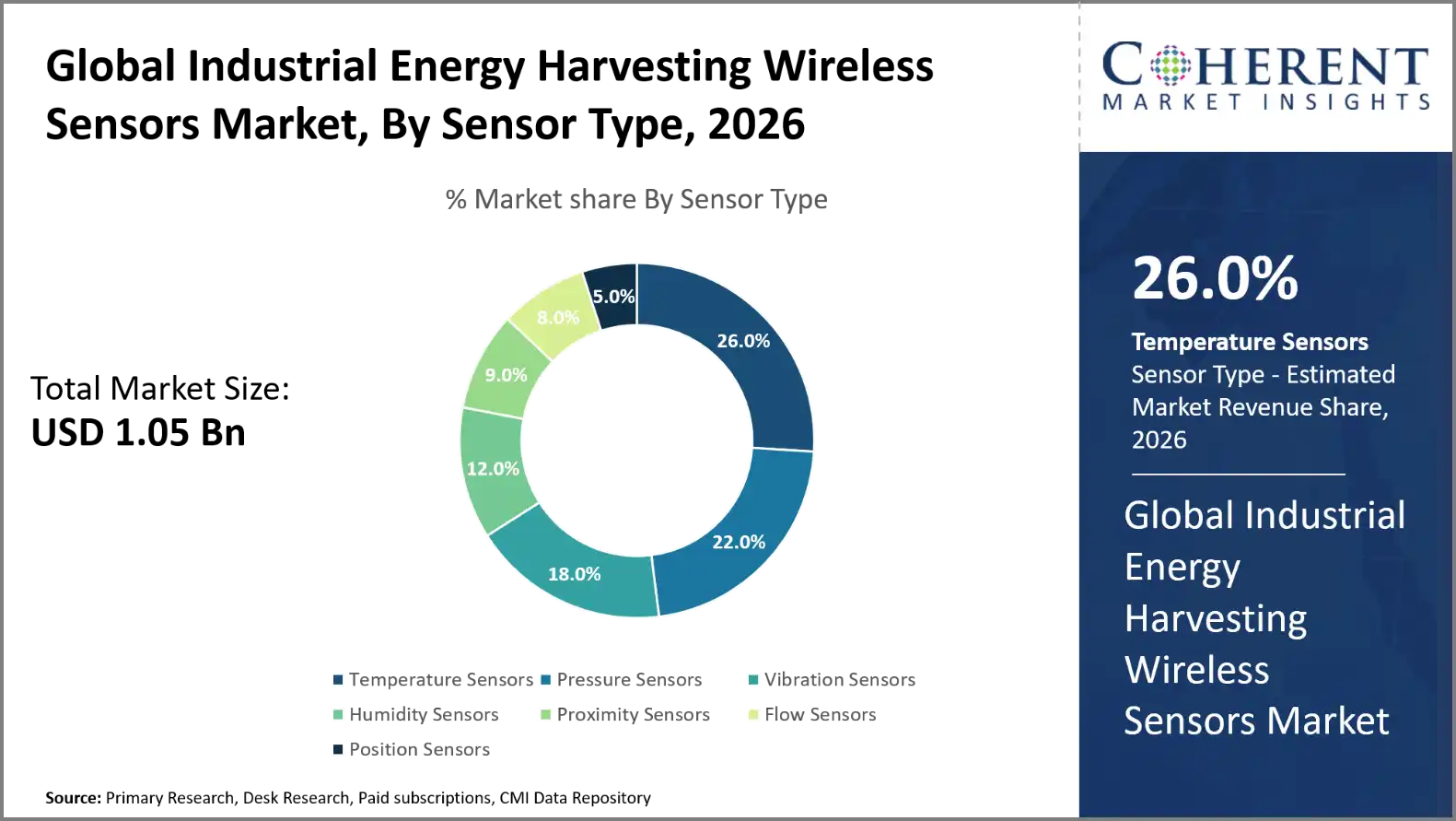
The temperature sensors segment is expected to account for 26.0% of the global industrial energy harvesting wireless sensors market share in 2026. Temperature sensors are extensively preferred for temperature monitoring for protecting the equipment and operational efficiency. Thermal monitoring is critical for industrial motors, pumps, transformers and processing equipment. High temperatures can signal insulation breakdown, friction, overload and other device malfunctions. Wireless temperature sensors enable remote monitoring across difficult-to-access industrial installations. Their relatively simple measurements require limited processing and communication resources. This makes them suitable for energy-constrained wireless sensor networks. Temperature monitoring also allows for preventative maintenance and early detection of problematic operating circumstances.
On May 19, 2026, Voith introduced OnSens.SmarTemp, a self-powered wireless temperature monitoring system for industrial fluid couplings. The solution uses integrated Peltier elements to harvest energy from temperature differences. It continuously monitors fluid temperatures in equipment such as conveyors, crushers, and shredders.
Bluetooth Low Energy Dominates the Global Industrial Energy Harvesting Wireless Sensors Market
The Bluetooth low energy segment is expected to account for 34.0% of the global industrial energy harvesting wireless sensors market share in 2026. Bluetooth Low Energy dominates because industrial energy harvesting sensors require highly efficient wireless communication. Its low-power communication architecture helps conserve limited harvested electrical energy. BLE offers reliable data transmission between sensors, gateways and industrial monitoring systems. It works with smartphones, laptops and commercial gateways, so it's easy to integrate with other systems. Manufacturers also benefit from the compact hardware and various connectivity options. BLE is suitable for temperature, humidity and other periodic industrial monitoring applications. These qualities make it well suited for battery assisted and energy harvesting wireless sensor deployments.
On August 13, 2026, microsensys introduced their TELID 700 Bluetooth Low Energy sensor ecosystem for industrial condition monitoring. The sensors immediately detect temperature, humidity, pressure, inclination and vibration at industrial assets.
Current Events and their Impact
Current Events | Description and its Impact |
European Union Cyber Resilience Act (Regulation (EU) 2024/2847) |
|
European Union Radio Equipment Directive (Directive 2014/53/EU) |
|
Industrial Energy Harvesting Wireless Sensors Market Dynamics
Market Drivers
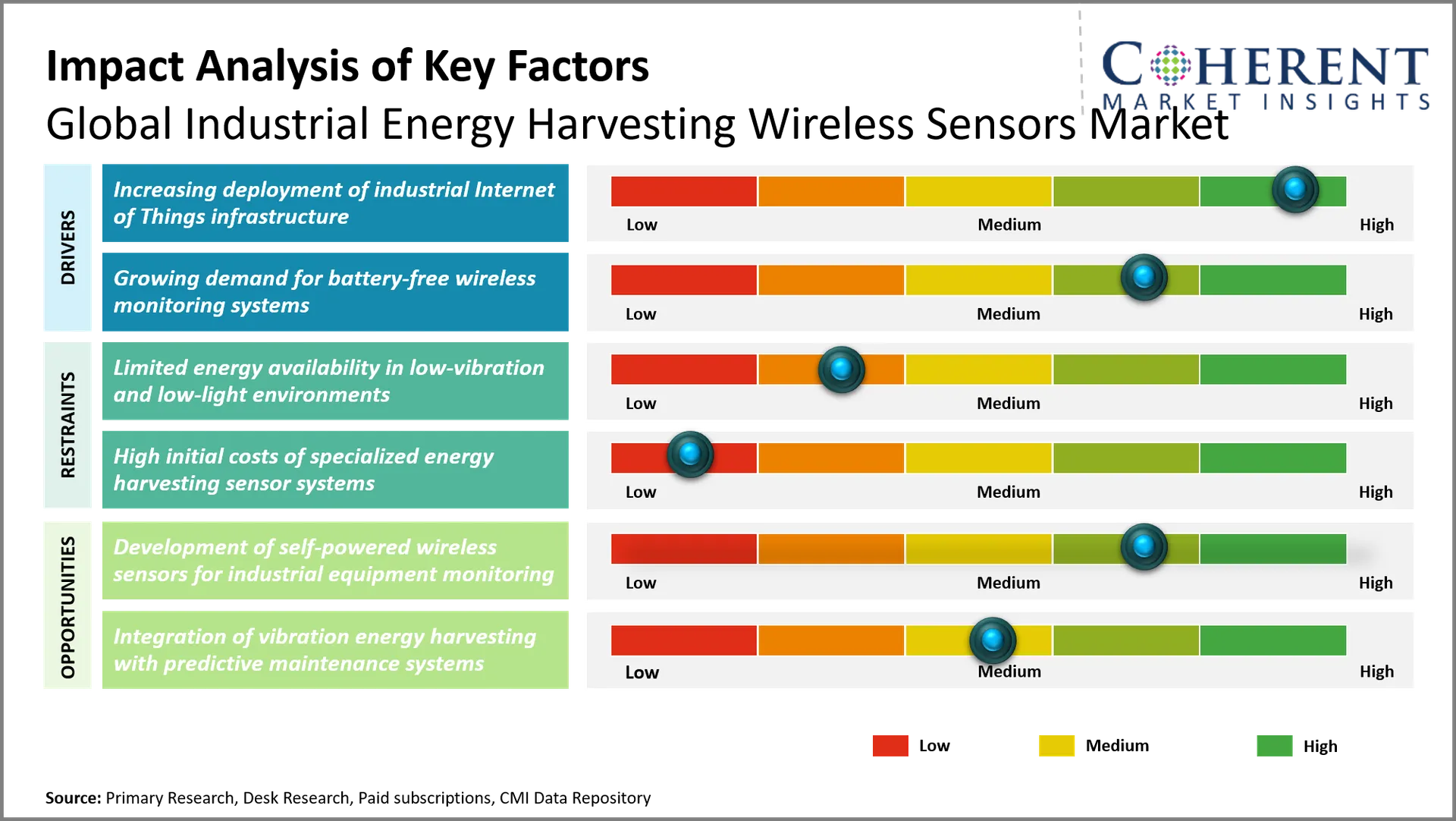
- Increasing deployment of industrial Internet of Things infrastructure: Increasing deployment of Industrial Internet of Things infrastructure is driving demand for industrial energy harvesting wireless sensors. Manufacturing companies are linking machinery, production lines and monitoring equipment to centralized industrial networks. These interconnected systems need continuous data collecting from motors, pumps, compressors and processing equipment. Energy-harvesting wireless sensors enable autonomous monitoring without the need for significant electrical connections or frequent battery replacement. These integrations help diagnose equipment status in real time, predict maintenance and optimize operational efficiencies. The need from industrial operators for scalable sensor networks for geographically spread production sites is growing. Bluetooth Low Energy and WirelessHART are examples of wireless communication technologies that offer connectivity to a variety of industrial monitoring applications. Growing investment in smart factories and connected infrastructure is driving demand for self-powered industrial sensor solutions.
- On February 19, 2026, NTT DATA, a global leader in AI, digital business and technology services, announced that Cargill, a global food, agricultural and industrial leader, is transforming operations across its manufacturing and processing facilities with the successful deployment of NTT DATA’s Private 5G network across 50 sites globally.
- Growing demand for battery-free wireless monitoring systems: Growing demand for battery-free wireless monitoring systems is driving the use of industrial energy harvesting wireless sensors. Manufacturing plants are asking to be able to monitor equipment all the time, without having to change the battery too often. Maintenance costs, replacement down-time and electronic waste are generated by conventional battery-powered sensors. Energy harvesting systems transform ambient vibrations, temperature variations and electromagnetic phenomena into electrical energy. These systems are used for independent monitoring of motors, pumps, compressors and industrial production equipment. Wireless sensors that do not require batteries further reduce the need for maintenance in dangerous and hard-to-reach locations. More and more industrial operators are implementing predictive maintenance tactics to avoid unexpected equipment breakdowns. These operational benefits are fueling demand for self-powered wireless sensor networks in manufacturing, energy and process industries.
- On February 27, 2025, Greatech announced the Sensoco Loomair Solar, a wireless carbon dioxide sensor powered by light. The device combines Epishine’s indoor solar cells with e-peas’ energy harvesting power management technologies. It supports the communication protocols Mioty, Wireless M-Bus, LoRa and Sigfox.
Emerging Trends
- Integration of Artificial Intelligence with Self-Powered Wireless Sensors: Industrial sensor makers are integrating AI into energy-harvesting devices to improve equipment diagnosis, detect abnormal operating conditions, and optimize predictive maintenance in automated production environments.
- Impact: Intelligent analytics enhance fault detection accuracy, decrease wasteful inspections and enable industrial operators prioritize maintenance tasks using continually collected equipment performance data.
- Relevance to the market: Manufacturers of energy-efficient sensors with edge processing capabilities can benefit from this trend. Sensors on industrial motors can draw power from vibrations and can detect failing bearings without the usual battery changes.
- Rapid Transition Toward Methane-Fueled Rocket Engines: Manufacturers are creating hybrid harvesting systems that combine vibration, thermal, solar, and electromagnetic energy sources to increase power availability under various industrial operating circumstances.
- Impact: Multi-source harvesting increases energy reliability, decreases reliance on specific ambient energy sources and enables extended sensor operational times in extreme industrial conditions.
- Relevance to the market: Hybrid harvesting is beneficial for sites with variable energy conditions. An example is the combination of thermoelectric and vibration harvesting that can allow autonomous monitoring of industrial motors and rotating machinery.
Regional Insights
Why is North America a Strong Market for Industrial Energy Harvesting Wireless Sensors?
North America is expected to account for a market share of 35.0% in 2026. Industrial energy harvesting implementation in oil sands, mining, power generation and sophisticated manufacturing in North America. Canada's oil sands operations provide opportunities for vibration-powered monitoring of heavy extraction equipment. Researchers demonstrated wireless sensor networks using vibration energy harvested directly from oil sands screening equipment. The University of Quebec in Abitibi-Témiscamingue has also studied piezoelectric energy management for industrial wireless sensors. In the U.S., KCF Technologies commercialized vibration-powered monitoring technologies for industrial equipment. Everactive has reported more than 20,000 batteryless sensors operating across industrial environments. These developments strengthen regional demand for autonomous industrial monitoring.
Why Does Asia Pacific Industrial Energy Harvesting Wireless Sensors Market Exhibit High Growth?
Asia Pacific is expected to register the fastest growth with a CAGR of 8.0% over the forecast period. It is projected to account for 31.0% of the global industrial energy harvesting wireless sensors market in 2026. The region has the benefit of a lot of electronics manufacturing, industrial machinery making and investment in autonomous factory infrastructure. The research environment in the region is progressing with hybrid energy harvesting systems that integrate thermal and mechanical energy sources. A 2024 study showed a combined triboelectric-thermoelectric generator for industrial conditions. Its system achieved maximum conversion efficiency of 37.2% and powered Bluetooth environmental sensing. The research involved institutions from China, South Korea, and the U.S. Such developments demonstrate opportunities for battery-independent environmental monitoring. Growing semiconductor production and industrial automation further encourage localized sensor innovation and deployment.
Global Industrial Energy Harvesting Wireless Sensors Market Outlook for Key Countries
Why is U.S. Emerging as a Major Hub in the Industrial Energy Harvesting Wireless Sensors Market?
The U.S. market benefits from established industrial sensor manufacturers and strong commercialization of predictive maintenance technologies. Pennsylvania-based KCF Technologies developed SmartDiagnostics wireless monitoring products for industrial machinery. Its systems harvest mechanical energy from equipment loads, enabling battery-free monitoring. The technology also supports dynamic vibration analysis and industrial equipment diagnostics. KCF reported that SmartDiagnostics product sales began in 2012. Everactive provides another important example through its proprietary energy-harvesting system-on-chip technology. Its industrial sensors operate using harvested light or heat without conventional batteries. These developments strengthen domestic capabilities in self-powered industrial monitoring.
Is China the Next Growth Engine for the Industrial Energy Harvesting Wireless Sensors Market?
China draws advantage from large-scale coal mining, heavy machinery production and modernization of industrial equipment. These industries need continual surveillance under high vibration working conditions. Researchers have devised a self-powered wireless condition monitoring system for coal industrial equipment. The system includes mechanical vibration harvesting, wireless sensor networking and monitoring software. Experimental results indicated a communication range of 30 meters and the maximum gathered output power of 378 milliwatts. This method solves the problem of battery replacement in mining plants. The push to modernize China’s industrial automation and equipment creates new potential for domestic energy-autonomous monitoring systems.
Germany Industrial Energy Harvesting Wireless Sensors Market Analysis and Trends
Germany benefits from advanced mechanical engineering, industrial automation, and specialized research into maintenance-free sensor technologies. The Fraunhofer Institute for Microelectronic Circuits and Systems developed ECoMoS for energy-autonomous industrial condition monitoring. Its sensor nodes measure temperature and mechanical fluctuations across manufacturing equipment. The system supports wireless communication with a base station located up to 50 meters away. The Fraunhofer Institute for Integrated Circuits also developed BlueTEG Pipe for industrial temperature-difference harvesting. Its thermoelectric system can generate over 200 microwatts with a temperature difference of just two Kelvin. These developments support industrial sensor integration.
Japan Industrial Energy Harvesting Wireless Sensors Market Analysis and Trends
Japan’s market advantages include precision manufacturing, the development of industrial electronics and research into autonomous infrastructure monitoring. In 2025, the New Energy and Industrial Technology Development Organization chose a research project on electret-based vibration energy harvesting. The project combines micro-electromechanical vibration generators with wireless power transferring technology. Its objective includes developing autonomous monitoring sensors for infrastructure structures and associated equipment. These sensors target continuous monitoring of reinforcement corrosion, concrete cracking, temperature, moisture, and salinity. Such applications create opportunities for energy-autonomous monitoring across industrial facilities and infrastructure installations.
South Korea Industrial Energy Harvesting Wireless Sensors Market Analysis and Trends
South Korea benefits from semiconductor manufacturing, power generation, and advanced electronic materials research. The Korea Advanced Institute of Science and Technology has developed self-powered wireless carbon dioxide monitoring technology. The system captures fine vibrations generated by industrial equipment and pipelines using an inertia-driven triboelectric nanogenerator. Under the vibration circumstances, the researchers were able to generate a consistent 0.5 milliwatts of power. The electricity harvested is used to supply a carbon dioxide sensor and a Bluetooth Low Energy communication module. This development creates opportunities for autonomous emissions monitoring across industrial facilities. Growing research into intelligent sensing supports further domestic technology commercialization.
Global Industrial Energy Harvesting Wireless Sensors Market - Energy Harvesting Technologies by Output Power, Efficiency, And Industrial Suitability
Energy Harvesting Technology | Power Density | Conversion Efficiency | Industrial Suitability |
Piezoelectric vibration harvesting | 3 µW–1.4 mW per device | Approximately 25-50% | Motors, pumps, compressors, vibrating machinery, and rotating equipment |
Electromagnetic vibration harvesting | 4–46 µW per device | Device-dependent; no universal efficiency range | Large motors, industrial rotating machinery, conveyors, and heavy equipment |
Thermoelectric harvesting | 40 µW–10 mW/cm³ | Approximately 0.1-3% | Industrial motors, furnaces, pipelines, turbines, and hot processing equipment |
Photovoltaic harvesting | 10–100 µW/cm² indoors; 10–30 mW/cm² outdoors | Approximately 10-25% | Factory lighting environments, outdoor installations, warehouses, and remote facilities |
Radio-frequency harvesting | 0.08 nW–1 µW/cm² | Approximately 30-88% rectifier conversion efficiency | Ultra-low-power sensors, asset identification, and locations with dedicated RF transmitters |
How is Development of Self-Powered Wireless Sensors for Industrial Equipment Monitoring Creating New Growth Opportunities in the Industrial Energy Harvesting Wireless Sensors Market?
Development of self-powered wireless sensors is creating opportunities for specialized monitoring of equipment operating in inaccessible industrial environments. Researchers are creating piezoelectric and triboelectric generators that harvest vibrations from machinery to generate electricity for powering autonomous sensing. For example, the Korea Advanced Institute of Science and Technology showed a vibration-powered carbon dioxide monitoring system with Bluetooth Low Energy connection. These advancements extend applications beyond classical vibration monitoring to include detection of industrial pollutants. Manufacturers can create integrated sensor packages that combine energy harvesting with environmental measurement and wireless transmission. This opens the door for component suppliers, industrial automation firms and sensor makers targeting autonomous monitoring of pipelines, rotating gear and processing equipment.
On June 4, 2025, ReVibe Energy announced the launch of Anura SB1, a sensor bridge that provides real-time wireless data using Modbus TCP/IP to Siemens, Allen-Bradley, Aveva, Seeq and other systems. The Anura SB1 combined with ReVibe's high-performance self-powered VS1 sensors removes the necessity for expensive wired installations and unreliable battery-powered sensors. This plug-and-play technology offers 24/7 maintenance-free monitoring of vibrating screens and feeds, delivering dependable data into industrial control platforms for operators.
Market Players, Key Development, and Competitive Landscape
Key Developments
- On June 10, 2026, Mouser Electronics, Inc. announced that is shipping the new ATM34/e system-on-chip (SoC) from Atmosic Technologies. The ATM34/e SoCs offer extremely low-power Bluetooth 6.0 SoCs with an energy-harvesting option, designed to extend battery life for industrial IoT sensor devices found in asset tracking and tags, remote monitors, and security applications.
- On October 9, 2025, NanoMalaysia Berhad, an agency under the Ministry of Science, Technology and Innovation (MOSTI), in strategic collaboration with Enhance Track Sdn Bhd and Universiti Tenaga Nasional (UNITEN), officially launched its Wireless-Powered IoT Battery Water Level Sensor (BWLS) System at the National Innovation and Commercialization Expo (NICE) 2025.
- On June 24, 2025, Energous Corporation, a leader in over-the-air (OTA) wireless power networks, announced the launch of the e-Sense tag, a battery-free, maintenance-free wireless sensor for location and temperature monitoring in retail, supply chain, and logistics environments.
Competitive Landscape
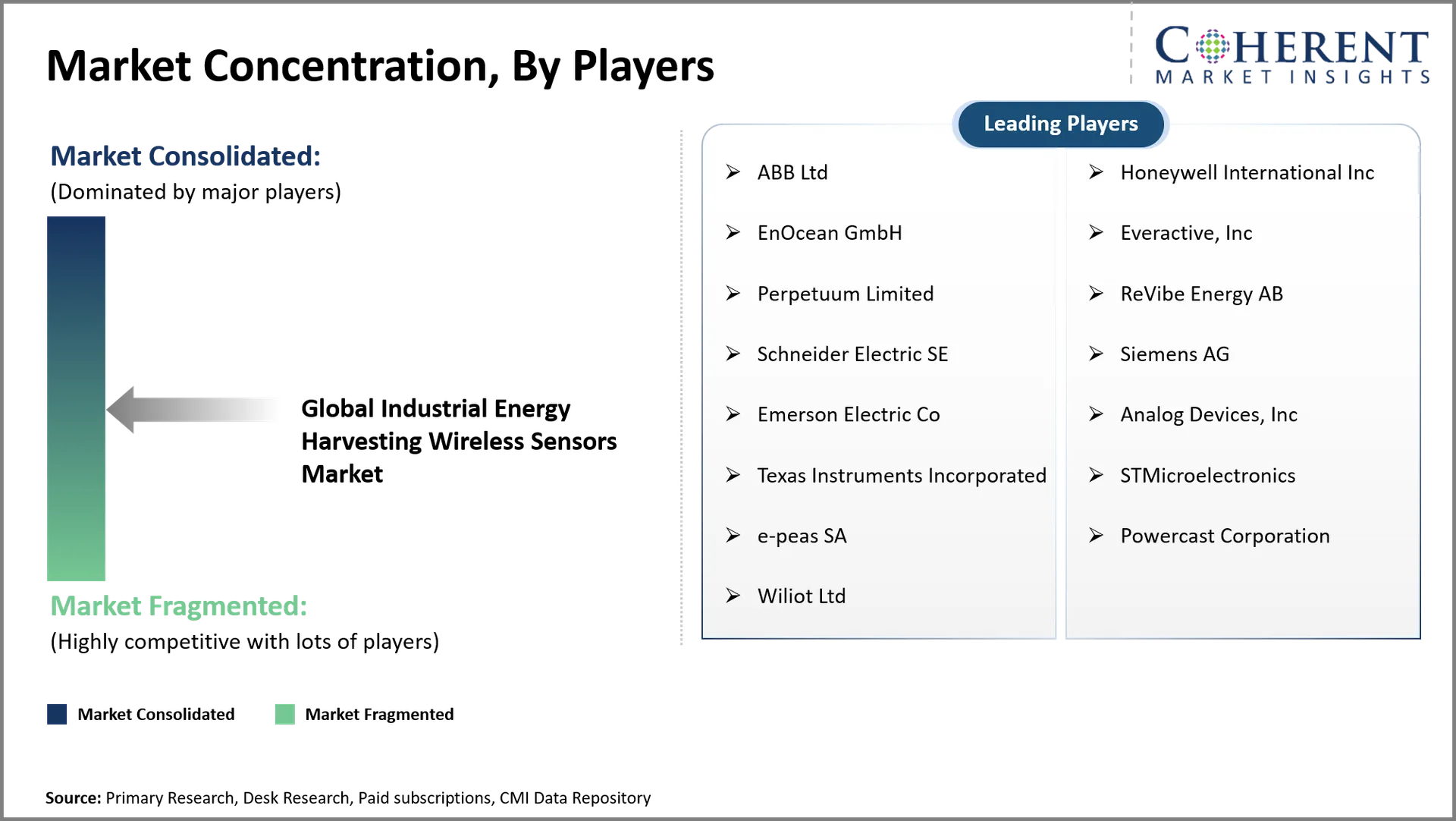
The global industrial energy harvesting wireless sensors market features specialized sensor developers and semiconductor manufacturers. Everactive differentiates itself by delivering batteryless industrial monitoring platforms based on proprietary ultra-low-power electronics. Applications include monitoring steam traps and diagnostics of rotating machinery. KCF Technologies specializes in SmartDiagnostics solutions for vibration-based condition monitoring of industrial machinery. EnOcean GmbH is a developer of self-powered wireless modules and energy collecting systems. Powercast Corporation is developing radio frequency wireless power solutions to be used with battery-free sensors. STMicroelectronics and Texas Instruments Incorporated are heating up the battle in low-power semiconductor components and power management technology. Leading players prioritize harvesting efficiency, wireless interoperability, compact sensor designs, and industrial application-specific solutions.
Top Manufacturers and Notable Products in the Industrial Energy Harvesting Wireless Sensors Market
Manufacturer | Notable Product | Key features |
Everactive | PKS3000 | Batteryless wireless sensor compute node, simultaneous photovoltaic and thermoelectric energy harvesting, sub-GHz wake-up receiver, wireless wake-up range up to 1 km, ARM Cortex-M0+ processor |
EnOcean | STM 550 | Self-powered multisensor, indoor solar energy harvesting, temperature and humidity measurement, acceleration sensing, magnetic contact monitoring, wireless communication |
ReVibe Energy | VS1 vibration sensor with Anura SB1 | Electromagnetic vibration energy harvesting, battery-free operation, industrial vibration monitoring, wireless data transmission, integration with SCADA systems |
ENCORTEC | ENCORTEC Industry | Vibration energy harvesting, self-powered wireless equipment monitoring, industrial asset health analysis, cloud-based monitoring, predictive maintenance |
ESCOM | ViBT-es S | Thermoelectric energy harvesting, wireless vibration and temperature monitoring, three-axis vibration measurement, battery-free operation, industrial equipment monitoring |
Market Report Scope
Global Industrial Energy Harvesting Wireless Sensors Market Report Coverage | |||
Report Coverage | Details | ||
Base Year | 2025 | Market Size in 2026: | USD 1.05 Bn |
Historical Data For: | 2020 To 2024 | Forecast Period: | 2026 To 2033 |
Forecast Period 2026 To 2033 CAGR: | 7.2% | 2033 Value Projection: | USD 2.65 Bn |
Geographies covered: |
| ||
Segments covered: |
| ||
Companies covered: | ABB Ltd, Honeywell International Inc, EnOcean GmbH, Everactive, Inc, Perpetuum Limited, ReVibe Energy AB, Schneider Electric SE, Siemens AG, Emerson Electric Co, Analog Devices, Inc, Texas Instruments Incorporated, STMicroelectronics, e-peas SA, Powercast Corporation, Wiliot Ltd | ||
Growth Drivers: |
| ||
Restraints & Challenges: |
| ||
Analyst Opinion (Expert Opinion)
- The future of industrial energy harvesting wireless sensors will increasingly depend on autonomous operation and application-specific power management. Industrial operators will prioritize sensors capable of monitoring equipment without scheduled battery replacement. Vibration harvesting should remain important for rotating machinery, compressors, pumps, and industrial motors. Thermoelectric harvesting offers opportunities around furnaces, pipelines, boilers, and high-temperature processing equipment. Hybrid harvesting architectures will become attractive where individual ambient energy sources fluctuate. Manufacturers combining reliable energy conversion, wireless communication, and durable industrial packaging will strengthen their competitive positions.
- The strongest opportunities will emerge in vibration-powered condition monitoring across China, Germany, and the U.S. These countries offer substantial industrial machinery, automotive manufacturing, and process engineering applications. Temperature monitoring presents another attractive opportunity around semiconductor fabrication, power generation, and chemical processing. For setups demanding simple connectivity and low communication overhead, Bluetooth Low Energy-based sensors are a good choice. Suppliers could consider specific solutions for steam traps, motor bearings, industrial pumps and remote pipeline monitoring, for example. They give a more apparent operational advantage than generic sensor deployments.
- Market participants should focus on selling whole energy autonomous sensing platforms rather than collecting components themselves. Energy converters, power management integrated circuits, sensor elements, and wireless communication modules should be integrated throughout product development. Companies should validate performance at actual machine vibration frequencies and industrial temperature conditions. Working with industrial automation integrators can speed up deployments in existing production plants. Manufacturers must also give energy assessments specific to the installation and predictable maintenance parameters. Differentiation will increasingly depend on dependable sensor operation, interoperability, and measurable reductions in maintenance interventions.
Speak to the analyst
Want personalized insights?
Take the findings above to one of our principal consultants, or have the report rebuilt around the segments, geographies and competitors you actually track.
Market Segmentation
- Energy Source Insights (Revenue, USD Billion, 2021 - 2033)
- Vibration Energy Harvesting
- Thermal Energy Harvesting
- Solar and Light Energy Harvesting
- Radio Frequency Energy Harvesting
- Hybrid Energy Harvesting
- Sensor Type Insights (Revenue, USD Billion, 2021 - 2033)
- Temperature Sensors
- Pressure Sensors
- Vibration Sensors
- Humidity Sensors
- Proximity Sensors
- Flow Sensors
- Position Sensors
- Connectivity Type Insights (Revenue, USD Billion, 2021 - 2033)
- Bluetooth Low Energy
- WirelessHART
- Zigbee
- Wi-Fi
- LoRaWAN
- Proprietary Industrial Wireless Protocols
- Application Insights (Revenue, USD Billion, 2021 - 2033)
- Predictive Maintenance
- Equipment Condition Monitoring
- Process Monitoring
- Asset Tracking
- Environmental Monitoring
- Structural Health Monitoring
- Energy Management
- End User Insights (Revenue, USD Billion, 2021 - 2033)
- Manufacturing
- Oil and Gas
- Power Generation
- Mining
- Chemical and Petrochemical
- Automotive
- Aerospace
- Water and Wastewater
- Regional Insights (Revenue, USD Billion, 2021 - 2033)
- North America
- U.S.
- Canada
- Latin America
- Brazil
- Argentina
- Mexico
- Rest of Latin America
- Europe
- Germany
- U.K.
- Spain
- France
- Italy
- Russia
- Rest of Europe
- Asia Pacific
- China
- India
- Japan
- Australia
- South Korea
- ASEAN
- Rest of Asia Pacific
- Middle East
- GCC Countries
- Israel
- Rest of Middle East
- Africa
- South Africa
- North Africa
- Central Africa
- North America
- Key Players Insights
- ABB Ltd
- Honeywell International Inc
- EnOcean GmbH
- Everactive, Inc
- Perpetuum Limited
- ReVibe Energy AB
- Schneider Electric SE
- Siemens AG
- Emerson Electric Co
- Analog Devices, Inc
- Texas Instruments Incorporated
- STMicroelectronics
- e-peas SA
- Powercast Corporation
- Wiliot Ltd
Sources
Primary Research Interviews
- Industrial Wireless Sensor Manufacturers
- Energy Harvesting Technology Providers
- Industrial Automation & IoT Solution Providers
- Industrial End-User Enterprises (Oil & Gas, Manufacturing, Utilities)
Magazines
- Sensors Magazine
- Industrial Equipment News (IEN)
- Wireless Design & Development Magazine
- Automation World
Journals
- Journal of Industrial Electronics (IEEE)
- Energy Harvesting and Systems Journal
- Journal of Sensors and Actuator Networks
Associations
- Industrial Internet Consortium (IIC)
- Wireless Industrial Networking Alliance (WINA)
- International Society of Automation (ISA)
- Energy Harvesting Society
Public Domain Sources
- U.S. Department of Energy (DOE) – Energy Efficiency & Renewable Energy Reports
- International Energy Agency (IEA) – Industrial Energy Reports
- European Commission – Smart Industry & IoT Publications
- National Institute of Standards and Technology (NIST) – Wireless Sensor Standards
Proprietary Elements
- CMI Data Analytics Tool
- Proprietary CMI Existing Repository of Information for the Last 10 Years
Get access to 250+ pages report
Every segment, forecast, competitor profile and data table behind the analysis above — available for instant download.
- ESOMAR Member
- ISO 9001:2015 Certified
- D-U-N-S Registered
- GDPR & CCPA Compliant
Frequently Asked Questions
The global industrial energy harvesting wireless sensors market is expected to stand at USD 1.05 Bn in 2026 and is expected to reach USD 2.65 Bn by 2033.
The CAGR of the global industrial energy harvesting wireless sensors market is projected to be 7.2% from 2026 to 2033.
Increasing deployment of industrial Internet of Things infrastructure and Growing demand for battery-free wireless monitoring systems are the major factors driving the growth of the global industrial energy harvesting wireless sensors market.
Limited energy availability in low-vibration and low-light environments and High initial costs of specialized energy harvesting sensor systems are the major factors hampering the growth of the global industrial energy harvesting wireless sensors market.
In terms of energy source, vibration energy harvesting segment is estimated to dominate the market revenue share in 2026.
Industrial energy harvesting wireless sensors are devices that convert ambient energy into electricity for autonomous sensing and wireless communication.
They continuously collect equipment performance data that helps identify developing faults before unexpected breakdowns occur.