

Global Industrial Power Supply Market Size and Forecast – 2026 To 2033
The global industrial power supply market is expected to grow from USD 13.50 Bn in 2026 to USD 21.30 Bn by 2033, registering a compound annual growth rate (CAGR) of 5.9% from 2026 to 2033. The global industrial power supply market is driven by growing semiconductor manufacturing capacity. On January 26, 2025, Micron Technology, Inc. announced plans to build an advanced wafer fabrication facility inside the company’s current NAND manufacturing site in Singapore. This new facility represents a planned investment of approximately USD 24 billion over 10 years and is designed to ultimately provide 700,000 square feet of cleanroom space.
Key Takeaways of the Global Industrial Power Supply Market
- The AC to DC Converter segment is expected to account for 47.0% of the global industrial power supply market share in 2026. Expansion of electric vehicle production, automotive components and charging infrastructure is driving the growth of the segment. On June 24, 2026, Tenneco announced the completion of its fully automated Monroe Full Active suspension actuators production line at its Suzhou facility in China.
- The Up to 500 W segment is estimated to capture 38.0% of the market share in 2026. Rising demand for energy-efficient switching power supplies is majorly driving the growth of the segment. On September 10, 2025, Infineon Technologies AG introduced a 12-kW reference design for high-performance power supply units for AI data centers and server applications.
- The Industrial Automation segment is estimated to capture 26.0% of the market share in 2026. Increasing factory modernization and smart manufacturing investments is driving the growth of the segment. On May 4, 2026, Siemens announced it has reached USD 1 billion in domestic manufacturing investments to support American industry, infrastructure and transportation over the past five years.
- North America is expected to dominate the industrial power supply market in 2026 with a market share of 35.0%. Growth of renewable energy and grid modernization projects in North America is driving the growth of the regional market. In April 2025, AES secured a USD 700 million revolving credit facility for 2 gigawatts of clean-energy generation and storage projects. The financing covers nine U.S. states, including Arizona, California, Colorado, Maine, Michigan, New York, Rhode Island, Utah, and Virginia.
- Asia Pacific is expected to account for 29.0% share in 2026. Rising demand for reliable power conversion in industrial equipment in Asia Pacific is driving the growth of the regional market. On July 2, 2025, MEAN WELL announced the release of the XTR three-phase DIN rail power supply in 240 W, 480 W and 960 W variants. The products target industrial automation, power infrastructure, renewable energy equipment, and semiconductor fabrication.
Segmental Insights
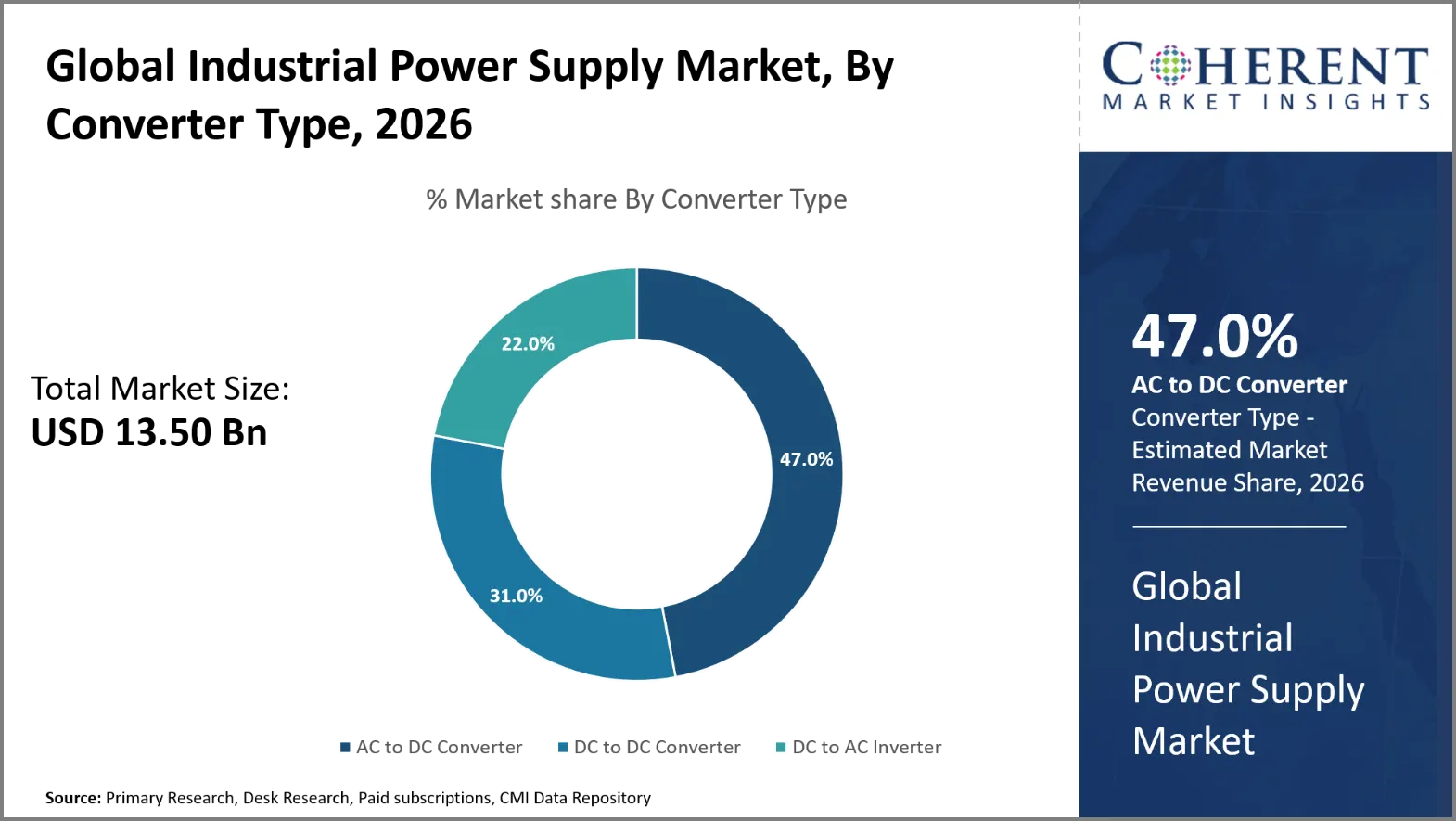
Why Does AC to DC Converter Dominate the Global Industrial Power Supply Market?
The AC to DC converter segment is expected to account for 47.0% of the global industrial power supply market share in 2026. AC to DC converters dominate because industrial facilities commonly receive alternating-current utility power. Industrial equipment needs regulated direct current electricity from electronic components. Programmable logic controllers, sensors, actuators, and communication systems commonly operate using DC power. Industrial automation therefore creates consistent demand for AC to DC conversion. Modern converters also offer great efficiency, compact construction, voltage regulation and protective features. These features make for dependable operation in manufacturing equipment and industrial control systems.
On May 20, 2026, Delta announced the launch of their 2026 flagship DIN rail industrial power supply, the DIN Pro Series and the DIN Eco Series on May 20, 2026. The two series are available in widths down to 30 mm for optimal utilization of space in control cabinets. Reliable operation in rugged industrial environments and uninterrupted power for precise production lines are ensured by cold start capability down to -40°C and SEMI F47 certification for semiconductor equipment immunity.
- Current Industry Events of 2026
- Market Size Estimation
- Regional Breakdown
- Competitive Landscape
- Customer Intelligence
- Segmental Analysis
- Pricing Analysis
- Key Market Drivers, Challenges & Future Trends
- Customized Insights Section
Why is Up to 500 W the Most Preferred Output Power?
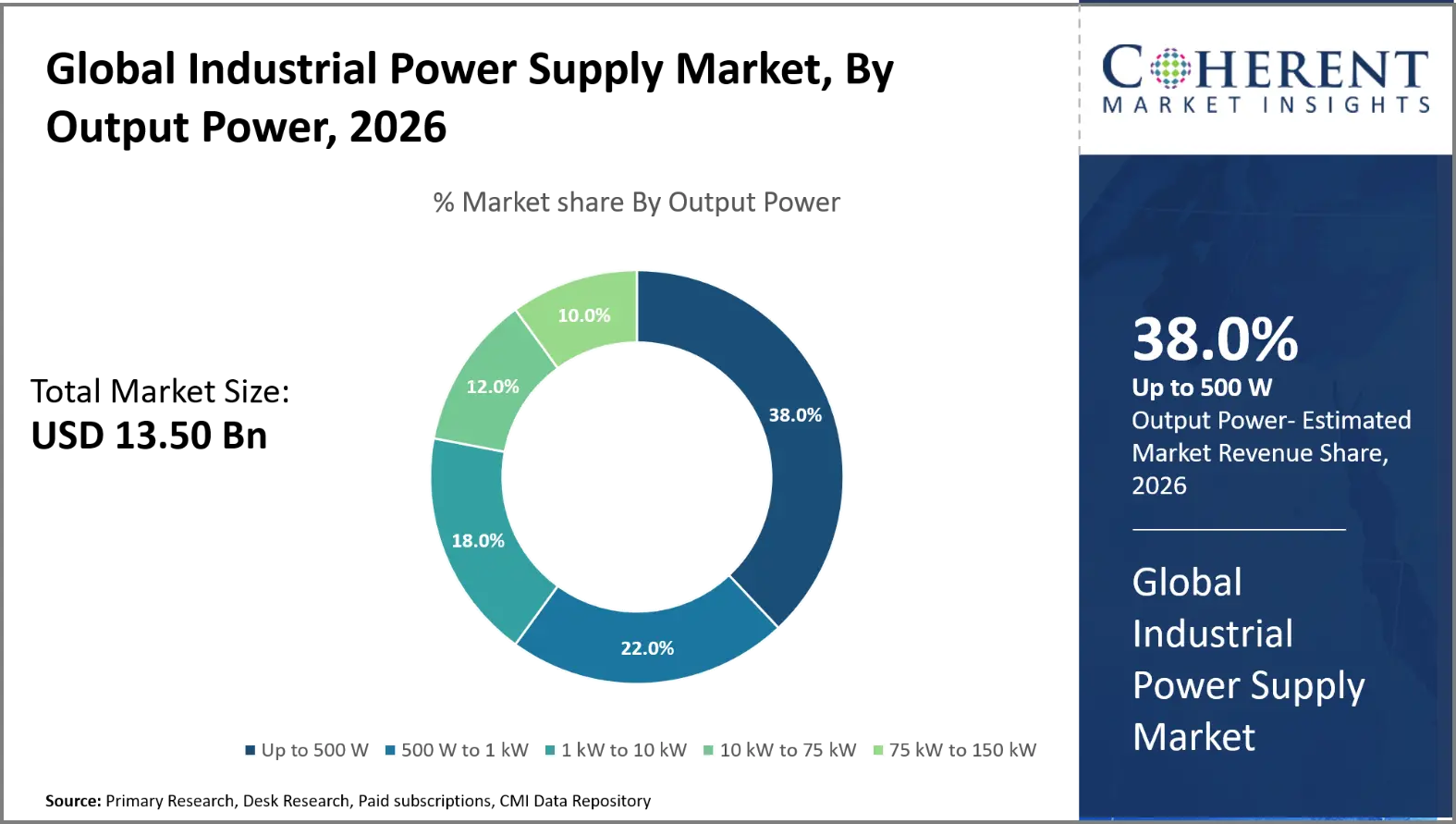
The up to 500 W segment is expected to account for 38.0% of the global industrial power supply market share in 2026. Power sources up to 500 W are preferred as many industrial control systems require modest power levels. They can be used to power programmable logic controllers, sensors, relays, communication modules, and control components. 24 V DC power is supplied to all control cabinets by most industrial equipment. The moderate power ratings also make for compact equipment designs and efficient use of cabinet space. Lower-capacity supplies tend to run cooler and take up less room for installation. These features make the section suited for several industrial automation applications. For example, Carlo Gavazzi has upgraded its SPDL DIN rail power supply series to include a 480 W version in 2025. SPDL480: 24 V DC output, 20 A current rating. It is 45 mm wide thus it saves a lot of room on the control panel. Its 45-millimeter width enables substantial control-panel space savings. Efficiency reaches 95%, while integrated protection covers overload, overvoltage, short circuits, and overtemperature.
Industrial Automation Dominates the Global Industrial Power Supply Market
The industrial automation segment is expected to account for 26.0% of the global industrial power supply market share in 2026. Industrial automation dominates because automated machinery requires stable and continuous electrical power. Reliable power supply are required for programmable logic controllers, sensors, actuators, motors and industrial networks. These automation components are coupled to industrial power sources which keep the DC voltage controlled. Increasingly, manufacturing facilities are turning to automated production systems to improve consistency and control in their operations. Protection of automation equipment against voltage fluctuations, overloads and short circuits is also required. Therefore, industrial power supplies remain vital components in automated production and process-control contexts. Phoenix Contact has launched the TRIO DC UPS for use in machine construction in April 2025. The small system combines a switched-mode power supply and an uninterruptible power supply. saves control cabinet space and increases power availability during interruptions.
Current Events and their Impact
Current Events | Description and its Impact |
China - GB 20943-2025 |
|
European Union - Commission Regulation (EU) 2025/2052 |
|
Industrial Power Supply Market Dynamics
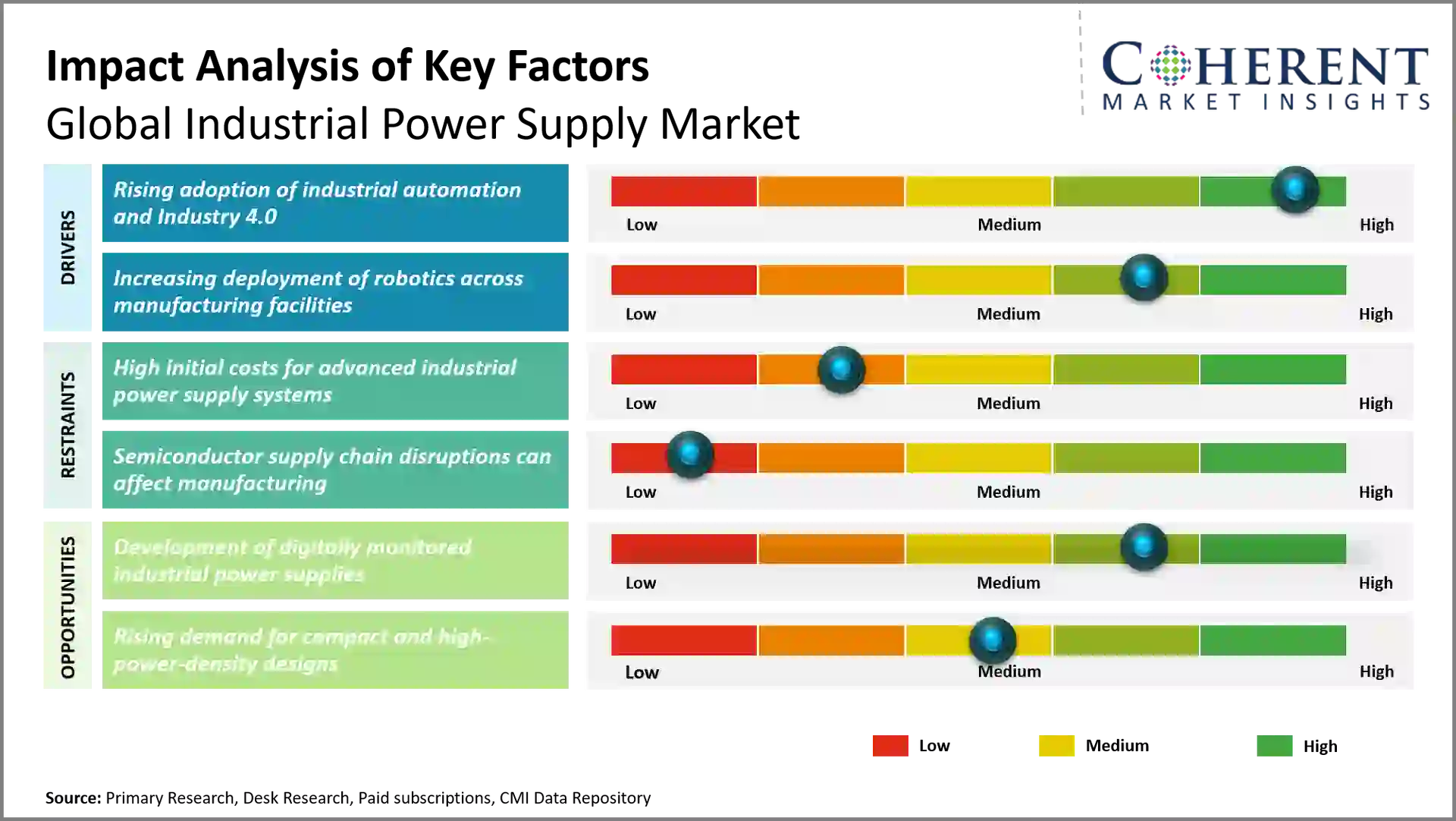
Market Drivers
- Rising adoption of industrial automation and Industry 4.0: The increasing use of industrial automation and Industry 4.0 boosts demand for reliable industrial power supplies. Manufacturing facilities increasingly connect programmable logic controllers, sensors, actuators, drives, and industrial communication systems. These connected components require stable and regulated DC power for continuous operation. Industry 4.0 architectures also increase the number of electrically powered monitoring and control devices. High-end power supplies have overload protection, voltage monitoring, remote diagnostics, and communication functions. Such requirements lead manufacturers to implement greater power performance power supply in automated production environments. As a result, the pattern confirms the ongoing demand for AC to DC converters and industrial power supply systems.
- On March 9, 2026, ABB announced plans to invest a further USD 75 million in India in 2026 to substantially grow its manufacturing footprint and research & development capabilities. This investment together with its spend of USD 35 million in 2025 is proof of ABB’s commitment to scale up its local-for-local approach in India.
- Increasing deployment of robotics across manufacturing facilities: The increasing deployment of robotics across manufacturing facilities creates additional demand for dependable industrial power supplies. Stable electrical power is necessary for the controllers, sensors, servo systems, communication modules and auxiliary equipment of industrial robots. Robotic systems are being integrated more and more into automated welding, assembly, material handling and packaging applications. These installations require power sources that can sustain continuous operation in challenging industrial environments. Robotics further increases the number of connected control components in production situations. Thus, robotic cell producers and the supporting automation infrastructure need power supply that are compact, efficient and reliable.
- On February 5, 2025, Doosan Robotics announced that it has signed a memorandum of understanding (MOU) with VRNJ, a robotic system integrator in Thailand, for the sale of 300 collaborative robots. Under the MOU, Doosan Robotics will supply 300 units across its four collaborative robot series over the next two years, with an initial order of 60 units already confirmed.
Emerging Trends
- AI-Enabled Power Management: Artificial intelligence is rapidly enabling predictive monitoring, fault detection, and adaptive power management in industrial power supplies. These features assist recognize abnormal operating conditions, manage energy consumption, and avoid unplanned equipment downtime across increasingly linked manufacturing environments.
- Higher Power Density Designs: Manufacturers are building compact power supplies that give more output power in smaller installation footprints. Improved thermal management, advanced semiconductor materials, and optimized circuit layouts allow for increased power density, while yet maintaining efficiency and operational reliability.
- Digitalized Power Supply Monitoring: The trend for industrial power supplies is toward digital interfaces for real-time monitoring of voltage, current, temperature and operating status. These features enable centralized equipment management, predictive maintenance, remote diagnostics and increased visibility across distributed industrial automation systems.
- Integration With Industrial Networks: Power supplies are more and more integrating communication capabilities with industrial automation networks and control platforms. Network connectivity also provides remote configuration, diagnostic information, alarm management and coordinated power management across complex industrial systems and connected production settings.
Regional Insights
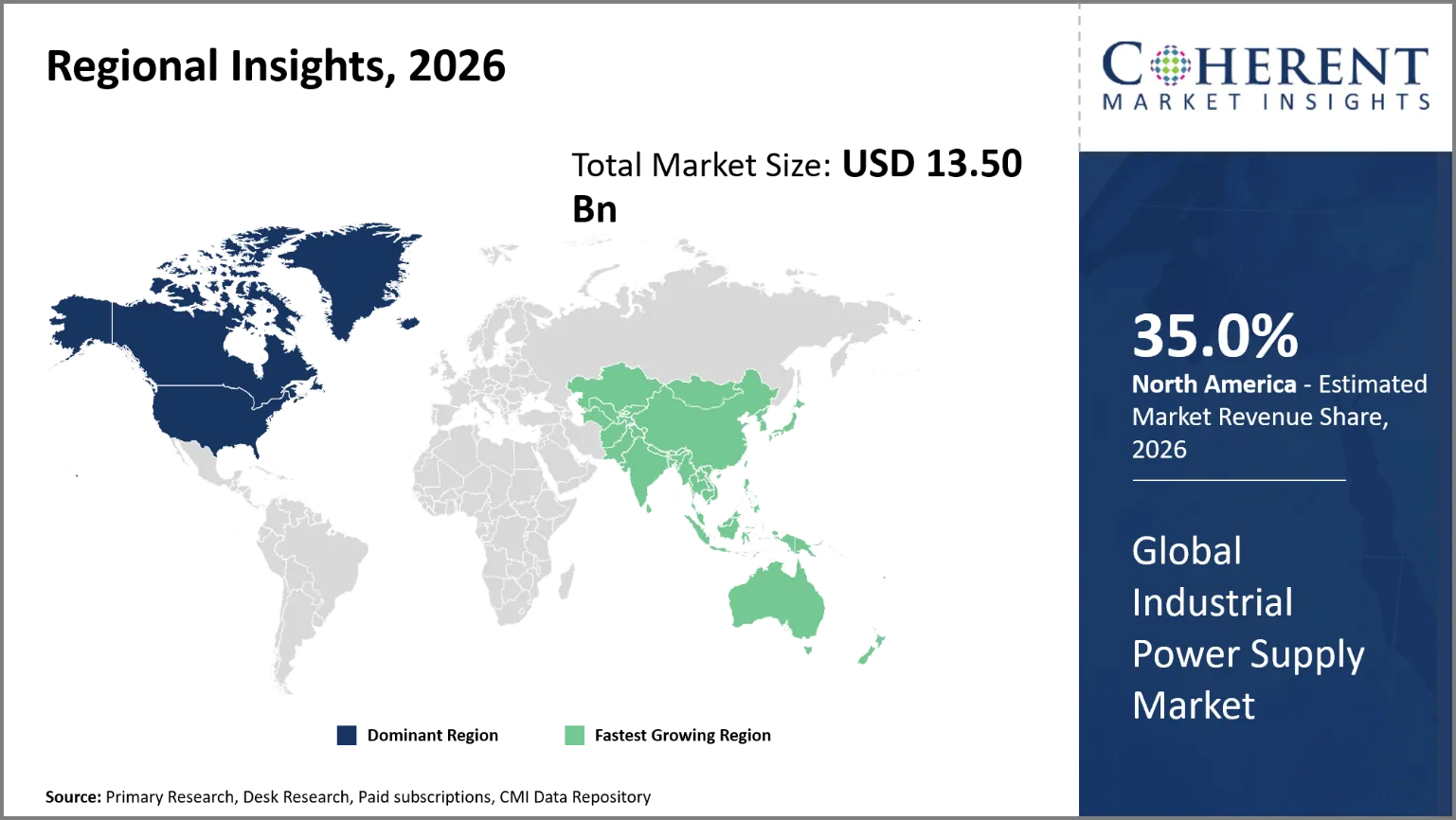
Why is North America a Strong Market for Industrial Power Supply?
North America is expected to account for a market share of 35.0% in 2026. North America benefits from reshoring of electronics, semiconductor, battery, and advanced manufacturing capacity. In 2025, manufacturing in the U.S. received a total of USD 121.8 billion in foreign investment expenditures. Mexico also promotes the regional automation through car manufacture and nearshoring. In 2025, Canada’s industrial robot population grew by over 4,000 units, a 5% year-over-year increase. The growth of the semiconductor manufacturing industry is offering further opportunities for controlled and reliable electrical infrastructure. They need power for the fabrication equipment, the cleanroom systems, the industrial controls and the automated material handling. Regional investments in advanced manufacturing therefore support demand for industrial power conversion equipment across factories and production facilities.
Why Does Asia Pacific Industrial Power Supply Market Exhibit High Growth?
Asia Pacific is expected to register the fastest growth with a CAGR of 6.8% over the forecast period and is projected to account for 29.0% of the global industrial power supply market in 2026. The region benefits from concentrated semiconductor, electronics, automotive, and robotics manufacturing ecosystems. Investment in semiconductor equipment continues strong throughout China, South Korea, Japan, Taiwan and Southeast Asia. Global spending on front-end fab equipment is projected to hit $110 billion in 2025. Several of the biggest investment schemes are located in nations in the Asia Pacific. China is the top regional investor in semiconductor equipment, South Korea increased its manufacture of sophisticated memory and Japan is still a major manufacturing center for robotics. These operations demand stable power sources for fabrication tools, robotic systems, automated inspection instruments, and high-precision electronics production lines.
Global Industrial Power Supply Market Outlook for Key Countries
Why is U.S. Emerging as a Major Hub in the Industrial Power Supply Market?
The U.S. is witnessing a rush of manufacturing investment in semiconductors, batteries, electronics and key minerals. Foreign investment in U.S. manufacturing was USD 121.8 billion in 2025. Greenfield investment expenditures in electronics manufacturing were USD 2.0 billion. California, Texas, and Arizona received particularly significant investment flows. Semiconductor fabs and battery plants require extensive power infrastructure for automated production equipment. Hyundai Steel announced a USD 5.8 billion Louisiana steel mill. Korea Zinc announced a USD 7.4 billion Tennessee polymetallic smelter. These initiatives provide more potential for industrial power supplies for heavy industrial processes.
Is China the Next Growth Engine for the Industrial Power Supply Market?
China has broad automation in the production of electronics, automobiles, industrial, and semiconductors. In 2025 the country represented 59% of all industrial robots installed worldwide. China's manufacturers installed about 295,000 industrial robots throughout the year. China also remained the leading location for investment in semiconductor equipment in 2025. Semiconductor equipment spending was projected at USD 38 billion. These manufacturing activities require substantial deployment of power supplies for robots, programmable logic controllers, sensors, inspection equipment, and semiconductor production tools. Factory automation therefore creates diversified demand across low-power control supplies and higher-capacity industrial systems.
Germany Industrial Power Supply Market Analysis and Trends
Germany benefits from advanced automotive manufacturing and sophisticated factory automation. The country operated 278,881 industrial robots in 2024, according to Germany Trade and Invest. Robot density reached 449 units per 10,000 manufacturing employees. Automotive manufacturers are investing in electric and hybrid drive production. Battery manufacturing also requires new automated production processes and equipment. Germany had 453 foreign direct investment projects in automation and robotics from 2019 to 2024. These changes are creating demand for reliable power sources to support robotic production cells, battery equipment, sensors, drives and industrial control systems.
Japan Industrial Power Supply Market Analysis and Trends
Japan has the advantage of its mature robotics ecosystem and precise manufacturing capability. In 2025, Japanese firms brought in 36,219 industrial robots. Japan continued to be the second largest industrial robot market in Asia. The country also has a big presence in semiconductor manufacturing with around USD 14 billion spending on fab equipment in 2025. Robotic systems and precision production equipment used by automotive, electronics, machinery, and semiconductor firms require reliable electricity. Japan's solid base of robotics suppliers also helps the use of specialized industrial power supply. Demand is particularly connected with automated assembly, inspection, material handling, and semiconductor fabrication applications.
South Korea Industrial Power Supply Market Analysis and Trends
South Korea benefits from intensive semiconductor, display, battery, and automotive manufacturing. The country's top ten manufacturing industries planned approximately USD 87.70 billion of investment during 2025. Semiconductor companies increased investment toward advanced memory technologies supporting artificial intelligence applications. South Korea also installed 30,000 industrial robots in South Korea in 2025. The semiconductor equipment spending is estimated to reach USD 21.5 billion in 2025. These investments need dependable electricity for fabrication equipment, robotic handling systems, automated inspection, battery production lines and advanced packaging facilities.
Global Industrial Power Supply Market - Adoption of DIN Rail-Mounted Power Supplies by Region (2025)
Region | Adoption Share |
Asia Pacific | 35.9% |
Europe | 32.0% |
North America | 21.0% |
Latin America | 5.0% |
Middle East and Africa | 6.1% |
How is Development of Digitally Monitored Industrial Power Supplies Creating New Growth Opportunities in the Industrial Power Supply Market?
Digitally monitored industrial power supply are opening up prospects by providing real-time visibility of voltage, current, temperature, load status and fault states. For example, the Siemens SITOP PSU8600 offers digital interaction with automation systems and diagnostic data on individual output channels. QUINT POWER offer signaling and diagnostic functions for preventive function monitoring. These capabilities help producers to recognize overloads, output variations and impending failures before production disruptions occur. Digital monitoring provides centralized power management of scattered control cabinets. As factories shift to linked production systems, suppliers can differentiate not just on traditional power conversion performance, but on communication interfaces, predictive diagnostics, and condition-based maintenance capabilities.
On February 10, 2026, OMRON announced the launch of the S8AS2 smart power supply, an innovative and compact solution that integrates DC power supply, electronic circuit protection and real-time monitoring in a single, panel-mountable unit. The S8AS2 is developed for factory automation and industrial control panels to help decrease panel area requirements, wiring complexity and downtime.
Market Players, Key Development, and Competitive Intelligence
Key Developments
- On September 10, 2026, TDK Corporation launched the TDK-Lambda TPF12500-385 series of non-isolated three-phase power supplies delivering up to 13.1 kW, with a nominal rating of 12.5 kW. With a regulated output voltage of 385 Vdc and an efficiency of 97.5 %, the series is designed for Distributed Power Architectures (DPA) and is capable of providing power to isolated high voltage DC-DC converters or DC Microgrids.
- On September 11, 2025, Delta Electronics, a leading provider of power management and smart green solutions, announced the expansion of its manufacturing site in Krishnagiri, Tamil Nadu, India. Spread across 95 acres with over 3,800 employees, the Krishnagiri campus, currently consisting of four large-scale factory buildings, is a major manufacturing hub for Delta.
- On July 7, 2025, Schneider Electric announced its plan to develop a manufacturing facility for its Schneider Electric IT Business at Horizon Industrial Park Hosur, near Shoolagiri, Tamil Nadu, India. Spread across 500,000 square feet, the new facility aims to enhance Schneider Electric’s capabilities in manufacturing, sales, and trading of battery management products including uninterruptible power supply systems, power distribution units, cooling products, and other electronic accessories.
Competitive Landscape
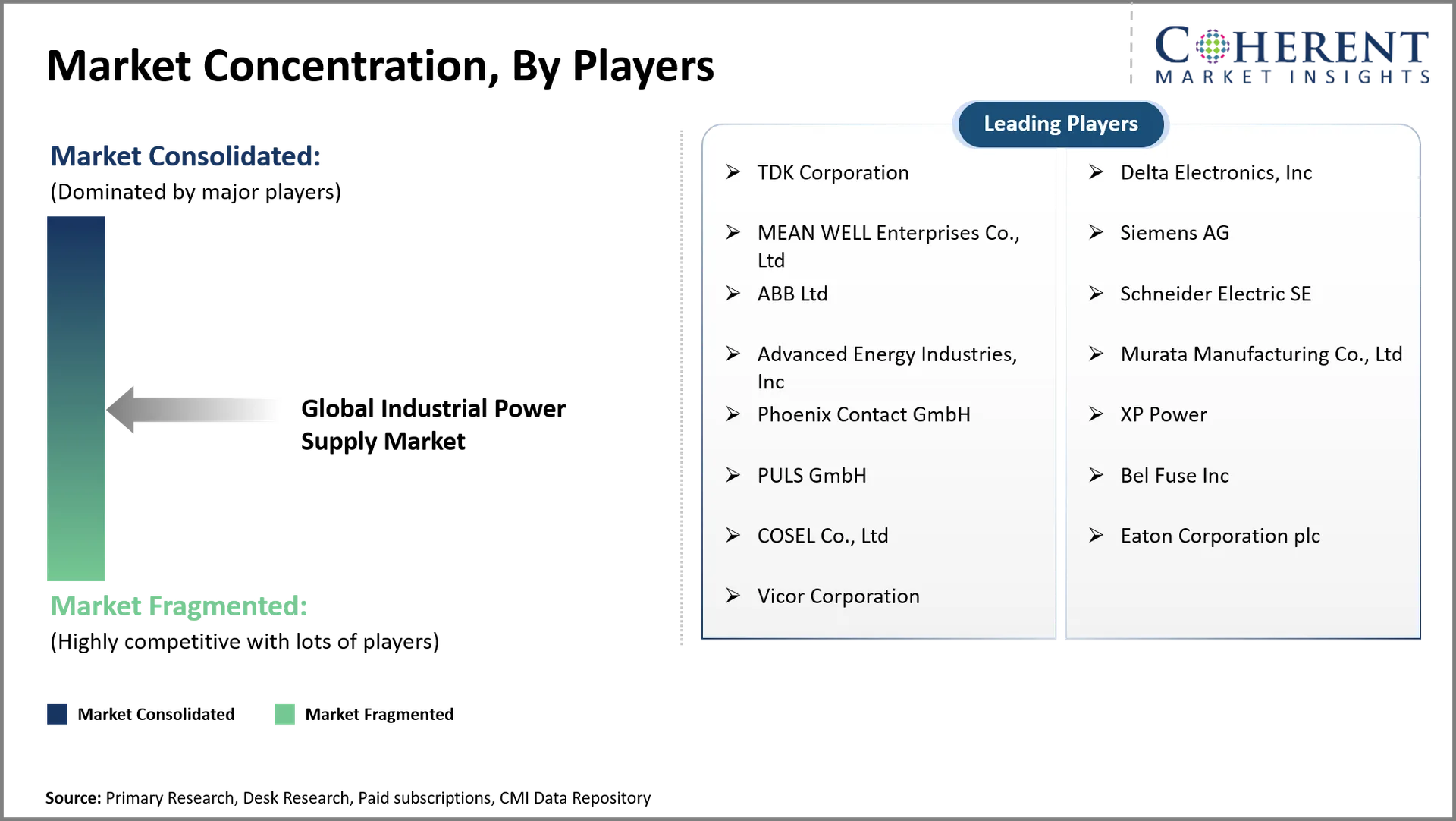
The competitive landscape centers on Siemens, Phoenix Contact, ABB, Schneider Electric, and TDK Lambda. Siemens focuses on integrated SITOP power systems supporting industrial automation, diagnostics, and reliable 24 V DC distribution. Communicative QUINT POWER supply with IO-Link, PROFINET, EtherNet/IP, EtherCAT and Modbus communication are a specialty of Phoenix Contact. It tracks the current, voltage, anomalies, events and service life. ABB is developing synchronized electrical infrastructure and real-time power orchestration for industrial sites. Schneider Electric is focused on linked power management for automation systems. TDK Lambda is focused on compact, highly efficient supplies for demanding equipment. Competition is therefore shifting toward integrated monitoring, connectivity, redundancy, and application-specific power management.
Market Report Scope
Global Industrial Power Supply Market Report Coverage | |||
Report Coverage | Details | ||
Base Year | 2025 | Market Size in 2026: | USD 13.50 Bn |
Historical Data For: | 2020 To 2024 | Forecast Period: | 2026 To 2033 |
Forecast Period 2026 To 2033 CAGR: | 5.90% | 2033 Value Projection: | USD 21.30 Bn |
Geographies covered: |
| ||
Segments covered: |
| ||
Companies covered: | TDK Corporation, Delta Electronics, Inc, MEAN WELL Enterprises Co., Ltd, Siemens AG, ABB Ltd, Schneider Electric SE, Advanced Energy Industries, Inc, Murata Manufacturing Co., Ltd, Phoenix Contact GmbH, XP Power, PULS GmbH, Bel Fuse Inc, COSEL Co., Ltd, Eaton Corporation plc, Vicor Corporation | ||
Growth Drivers: |
| ||
Restraints & Challenges: |
| ||
Analyst Opinion (Expert Opinion)
- The future of industrial power supplies will increasingly center on digitally connected power infrastructure rather than standalone conversion equipment. Communicative supplies can expose voltage, current, temperature, service-life, and event information directly within automation networks. Phoenix Contact already integrates QUINT POWER with IO-Link and multiple industrial communication protocols. This direction should strengthen demand for supplies combining conversion, diagnostics, redundancy, and network communication within one architecture.
- The strongest opportunity should emerge in digitally monitored 24 V DC supplies for industrial automation, robotics, semiconductor equipment, and advanced manufacturing. China, Japan, South Korea, Germany, and the U.S. represent particular prospects for application because of their concentrated manufacturing of automation and electronics. Suppliers should concentrate on smaller designs, increased power density, predictive diagnostics and native industrial-network connectivity. Integrated controller power supply will help meet the demand for more and more software-defined manufacturing systems.
- To get forward, players need to build full power management ecosystems, rather than compete solely on efficiency or output ratings. This is made possible by Phoenix Contact through the integration of QUINT POWER, CAPAROC, DC UPS, communication interfaces and monitoring software. Manufacturers should also enhance their cybersecurity compliance, flexible product platforms, redundancy capabilities and application-specific designs. Early integration with industrial software platforms and programmable logic controllers can translate into more customer lock-in and recurring service opportunities.
Speak to the analyst
Want personalized insights?
Take the findings above to one of our principal consultants, or have the report rebuilt around the segments, geographies and competitors you actually track.
Market Segmentation
- Converter Type Insights (Revenue, USD Billion, 2021 - 2033)
- AC to DC Converter
- DC to DC Converter
- DC to AC Inverter
- Output Power Insights (Revenue, USD Billion, 2021 - 2033)
- Up to 500 W
- 500 W to 1 kW
- 1 kW to 10 kW
- 10 kW to 75 kW
- 75 kW to 150 kW
- Application Insights (Revenue, USD Billion, 2021 - 2033)
- Industrial Automation
- Semiconductor Manufacturing
- Automotive
- Aerospace and Defense
- Energy and Utilities
- Telecommunications
- Robotics
- Others
- Regional Insights (Revenue, USD Billion, 2021 - 2033)
- North America
- U.S.
- Canada
- Latin America
- Brazil
- Argentina
- Mexico
- Rest of Latin America
- Europe
- Germany
- U.K.
- Spain
- France
- Italy
- Russia
- Rest of Europe
- Asia Pacific
- China
- India
- Japan
- Australia
- South Korea
- ASEAN
- Rest of Asia Pacific
- Middle East
- GCC Countries
- Israel
- Rest of Middle East
- Africa
- South Africa
- North Africa
- Central Africa
- North America
Sources
Primary Research Interviews
- Industrial Power Supply Manufacturers & OEMs
- Power Electronics Engineers & System Integrators
- Industrial Automation Solution Providers
- Energy & Utilities Sector Procurement Executives
Magazines
- Power Electronics News
- Electronic Design Magazine
- Industrial Equipment News (IEN)
- Electrical Apparatus Magazine
Journals
- IEEE Transactions on Power Electronics
- Journal of Power Sources (Elsevier)
- International Journal of Electrical Power & Energy Systems
Associations
- Power Sources Manufacturers Association (PSMA)
- International Electrotechnical Commission (IEC)
- National Electrical Manufacturers Association (NEMA)
- Electronics Components Industry Association (ECIA)
Public Domain Sources
- U.S. Department of Energy (DOE) – Industrial Power & Energy Reports
- International Energy Agency (IEA) – Industrial Electrification Data
- European Commission – Energy Efficiency & Industrial Power Directives
- World Bank – Industrial Infrastructure & Energy Investment Reports
Proprietary Elements
- CMI Data Analytics Tool
- Proprietary CMI Existing Repository of Information for the Last 10 Years
Get access to 250+ pages report
Every segment, forecast, competitor profile and data table behind the analysis above — available for instant download.
- ESOMAR Member
- ISO 9001:2015 Certified
- D-U-N-S Registered
- GDPR & CCPA Compliant
Frequently Asked Questions
The global industrial power supply market is expected to stand at USD 13.50 Bn in 2026 and is expected to reach USD 21.30 Bn by 2033.
The CAGR of the global industrial power supply market is projected to be 5.9% from 2026 to 2033.
Rising adoption of industrial automation and Industry 4.0 and Increasing deployment of robotics across manufacturing facilities are the major factors driving the growth of the global industrial power supply market.
High initial costs for advanced industrial power supply systems and Semiconductor supply chain disruptions can affect manufacturing are the major factors hampering the growth of the global industrial power supply market.
In terms of converter type, AC to DC converter segment is estimated to dominate the market revenue share in 2026.
An industrial power supply converts electrical energy into regulated power for machinery, automation equipment, control systems, and industrial electronics.
Industry 4.0 increases connected equipment deployment, creating demand for power supplies with monitoring, diagnostics, and communication capabilities.