

Global Industrial Tape Market Size and Forecast – 2026 To 2033
The Global Industrial Tape Market is estimated to be valued at USD 82.43 Bn in 2026 and is expected to reach USD 125.59 Bn by 2033, exhibiting a compound annual growth rate (CAGR) of 6.2% from 2026 to 2033. Market expansion is supported by industrial manufacturing growth and the transition toward lightweight assembly methods across the automotive, electronics, and construction applications.
Industrial tapes provide bonding, electrical insulation, masking, surface protection, vibration control, and temporary component fixation while reducing dependence on screws, rivets, and liquid adhesives. In September 2025, LINTEC reported record-high sales of semiconductor-related adhesive tapes and equipment, as well as multilayer ceramic capacitor tapes, supported by global AI investment and demand for high-performance electronic devices. This demonstrates the growing commercial importance of specialized process tapes in advanced electronics manufacturing.
Key Takeaways of the Global Industrial Tape Market
- Packaging tapes are expected to hold 32.6 % of the global industrial tape market in 2026 because carton sealing is a repeat-purchase requirement across manufacturing, warehousing, retail fulfillment, and export logistics. Their compatibility with manual and automated dispensers also supports high-volume consumption. In July 2025, 3M highlighted Scotch Performance Paper Box Sealing Tape 570 for automated dispensing and recycling-oriented carton closure.
- Polypropylene is expected to account for 29.8 % of the market share in 2026, supported by its favorable strength-to-weight ratio, moisture resistance, printability, and suitability for cost-efficient, high-speed carton sealing. Biaxially oriented polypropylene also enables thin gauges without sacrificing dependable handling. In September 2023, IPG introduced its 170e carton sealing tape using recycled film while retaining manual and automated application performance.
- Acrylic segment are expected to capture 45.1 % of the market share in 2026 because converters and buyers value resistance to ultraviolet exposure, aging, temperature variation, and long service periods. The chemistry also suits packaging, electronics, automotive, and construction applications requiring stable bonds. In April 2024, tesa launched the 4965 Original Next Gen using biomass-balanced acrylic monomers while preserving established performance.
- Asia Pacific is expected to account for 42.8 % of the global industrial tape market in 2026, reflecting its concentrated electronics, semiconductor, automotive, appliance, packaging, and manufacturing supply chains. Regional buyers also benefit from extensive converting capacity and proximity to large-volume production clusters. In July 2024, SEKISUI CHEMICAL announced expanded SELFA UV-tape capacity in Japan and a semiconductor-materials R&D base in Taiwan.
- Europe is expected to represent 22.9 % of the market share in 2026 and emerge as the fastest-growing region as manufacturers redesign tape constructions for recyclability, lower material intensity, cleaner chemistry, and compliance-ready packaging. This creates replacement opportunities across converting and carton-sealing portfolios. In February 2025, the EU Packaging and Packaging Waste Regulation entered into force, setting manufacturing, composition, reuse, recovery, and recyclability requirements.
- Circular-by-Design Portfolios Supporting Material Recovery Goals: Tape producers are moving sustainability decisions upstream into backing selection, adhesive formulation, liners, coating processes, and end-of-life compatibility. This changes competition from isolated eco-friendly products to portfolio-level material engineering. Suppliers that can document performance equivalence, converter efficiency, and recycling compatibility will gain stronger positions with multinational buyers, while slower competitors may face reformulation costs, qualification delays, and reduced access to specification-led contracts.
- Automation-Ready Tape Systems for High-Speed Packaging Lines: Industrial customers increasingly assess tape together with dispensers, case sealers, robotic applicators, sensors, and quality-control workflows rather than as a standalone consumable. This favors suppliers capable of engineering consistent unwind, predictable adhesion, machine compatibility, and technical service. Product strategy will therefore shift toward application-specific systems, creating opportunities for equipment partnerships, recurring service revenue, and deeper integration with customers’ packaging and assembly operations.
Segmental Insights
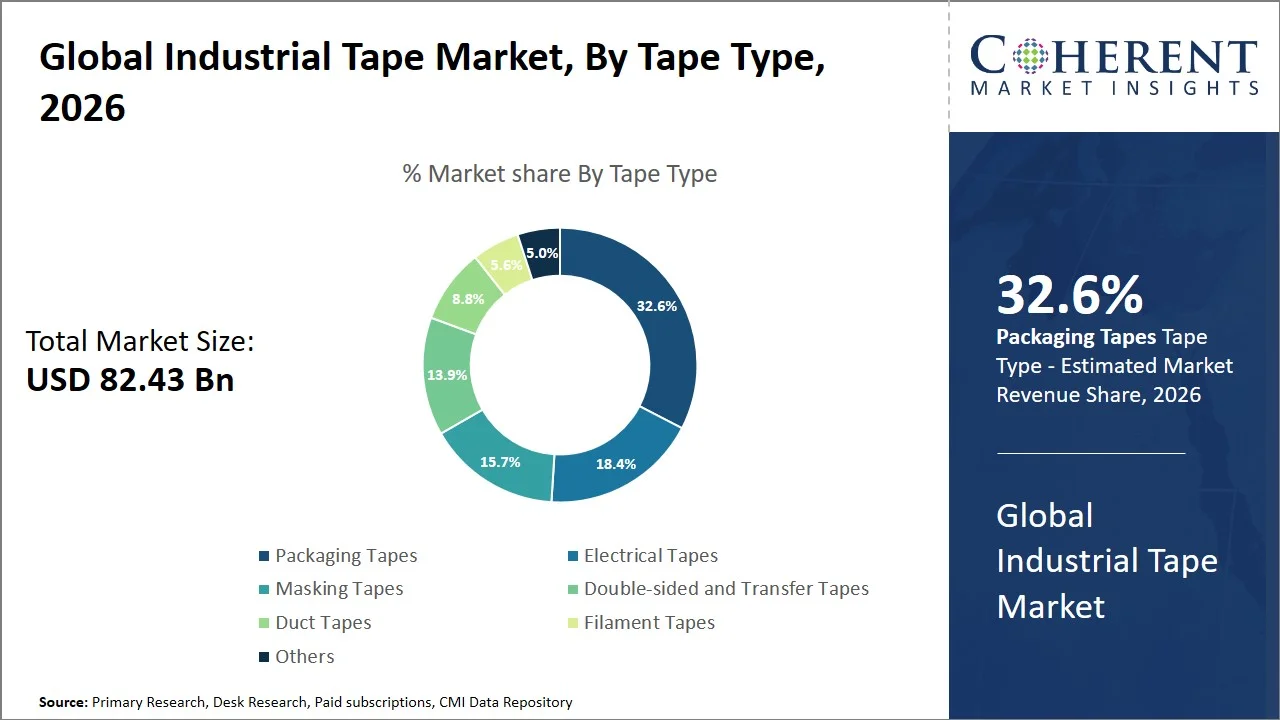
Why Do Packaging Tapes Dominate the Global Industrial Tape Market?
Packaging tapes are expected to hold 32.6% of the global industrial tape market in 2026 because they function as recurring production consumables rather than one-time capital inputs. Corrugated-box sealing across food, beverages, appliances, industrial components, pharmaceuticals, and e-commerce creates repeat order volumes tied directly to shipment throughput. Standardized widths, roll lengths, and dispenser compatibility allow converters to manufacture at scale and distributors to maintain broad inventories. Buyers also value dependable tack on recycled cartons, resistance to handling stress, and compatibility with manual or automated case sealers. This gives manufacturers opportunities to differentiate through recycled content, printed identification, tamper evidence, and line-efficiency support instead of competing solely on price. In August 2024, Shurtape introduced three packaging tapes manufactured with 90% post-consumer recycled polyester, including grades designed for automated sealing, recycled cartons, and cold-temperature distribution.
- Current Industry Events of 2026
- Market Size Estimation
- Regional Breakdown
- Competitive Landscape
- Customer Intelligence
- Segmental Analysis
- Pricing Analysis
- Key Market Drivers, Challenges & Future Trends
- Customized Insights Section
Why Does Polypropylene Represent the Largest Backing Material in the Global Industrial Tape Market?
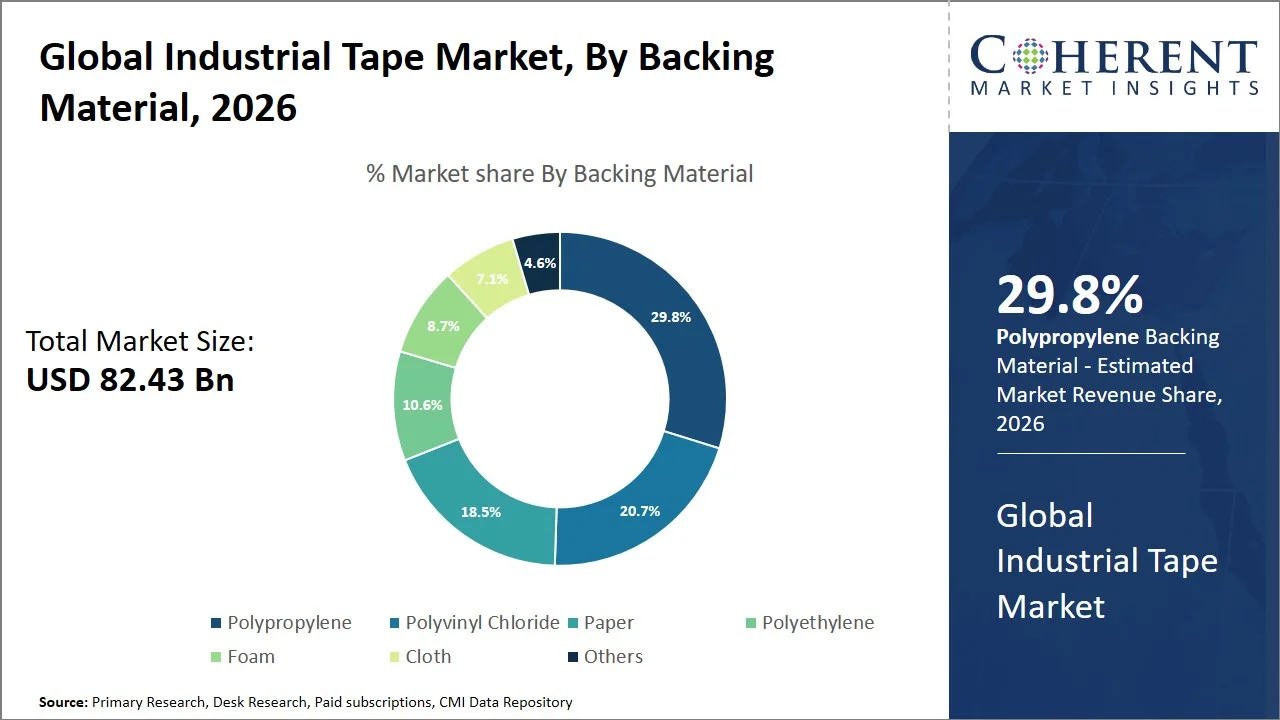
Polypropylene is expected to represent 29.8% of the backing material category in the global industrial tape market in 2026 because biaxially oriented polypropylene combines low weight, tensile strength, moisture resistance, and economical high-volume processing. Its smooth surface supports printing and controlled adhesive coating, while thin gauges help tape producers reduce material use per roll. These characteristics make polypropylene particularly suitable for carton sealing, bundling, labeling, and general industrial packaging where buyers require consistent unwind and dependable performance at high application speeds. A global base of resin suppliers, film extruders, coaters, slitters, and converters further supports availability across price tiers. Suppliers that secure advanced film grades can improve yield, offer thinner products, and respond faster to sustainability specifications. In March 2025, Innovia Films opened a USD 79.75 million specialty-film line in Germany with annual capacity of 35,000 tons for thin-gauge, enhanced-property, and recycled-content BOPP films.
Why Does Acrylic Dominate the Adhesive Type Category of the Global Industrial Tape Market?
Acrylic segment are expected to account for 45.1% of the adhesive type category in the global industrial tape market in 2026 because they provide a balanced performance profile across indoor and outdoor industrial conditions. Formulators can adjust tack, peel strength, shear resistance, removability, and substrate compatibility through water-based, solvent-based, and UV-curable systems. This versatility supports packaging, graphics, electronics, appliances, construction materials, and durable component assembly without requiring a separate chemistry for every operating environment. Acrylic systems also retain performance under ultraviolet exposure, humidity, aging, and temperature variation, reducing replacement risk for buyers specifying longer service life. For manufacturers, the segment enables broad product platforms and application-specific upgrades through coating and formulation expertise. In August 2024, Henkel presented hot-melt, water-based, UV, and solvent-based acrylic pressure-sensitive adhesives for tapes, labels, and graphics, including solutions compatible with post-consumer recycling processes.
Current Events and their Impact
Current Event | Description and Its Impact |
EU Batteries Regulation Began Applying – February 2024 |
|
U.S. EPA Methylene Chloride Rule – April 2024 |
|
UK Plastic Packaging Tax Rate Update – February 2026 |
|
Global Industrial Tape Market Dynamics
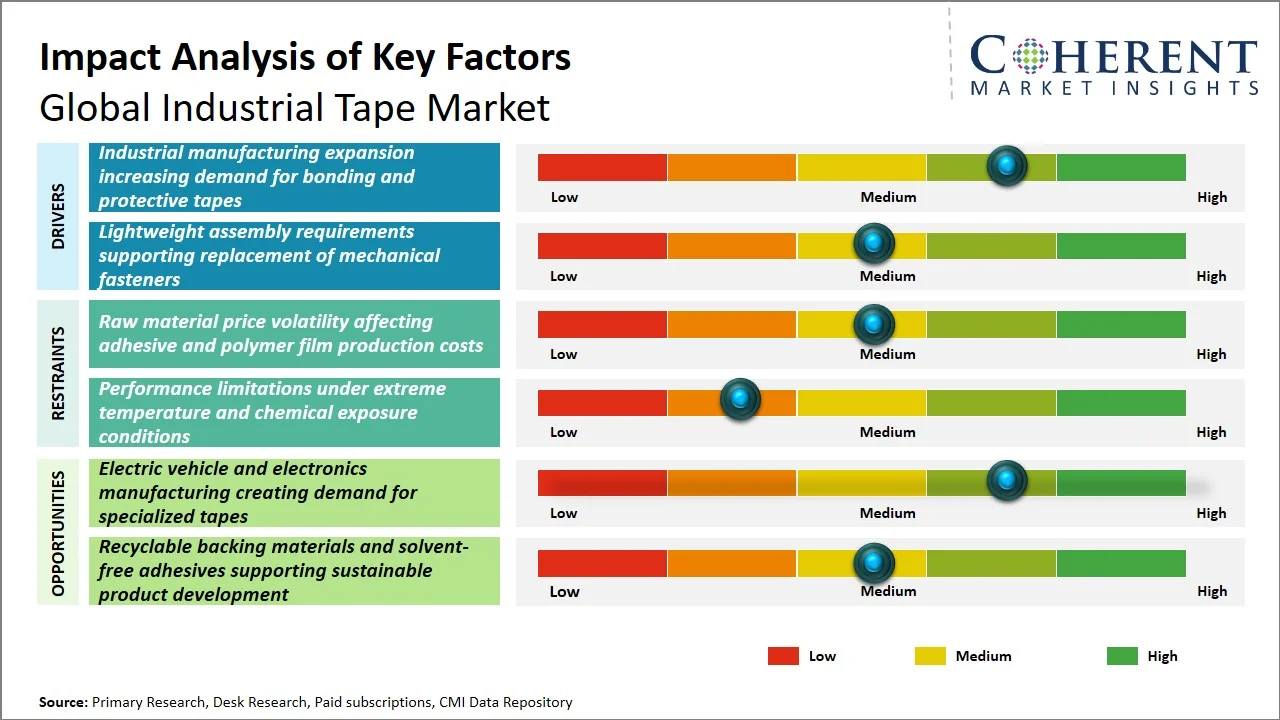
Key Market Drivers
- Industrial Capacity Expansion Broadens Recurring Tape Consumption: Expansion in industrial manufacturing drives tape consumption across multiple production stages, including surface protection during fabrication, electrical insulation in equipment, masking for coating processes, cable bundling, component mounting, and final shipment preparation. Unlike capital equipment, these products are replenished as output increases, giving tape converters and distributors recurring volume linked to factory utilization. Electrical-equipment, data-center, machinery, appliance, and transportation manufacturers also require qualified grades that tolerate heat, abrasion, dielectric stress, and automated application. This favors suppliers with broad technical portfolios, regional slitting capacity, and dependable inventory. In March 2025, Siemens unveiled new and expanded electrical-product factories in Texas and California through a USD 285 million investment that more than doubled its U.S. production capacity for equipment serving industrial facilities, construction, and AI data centers. The expansion enlarges the addressable manufacturing base for electrical, protective, masking, and assembly tapes.
- Lightweight Engineering Accelerates Fastener-to-Tape Conversion: Lightweight assembly requirements are shifting tape selection from an auxiliary purchasing decision to an engineering choice. High-bond and double-sided tapes can distribute stress across a wider surface than screws or rivets, join dissimilar materials, remove drilling steps, and preserve smooth exterior finishes. They also provide immediate handling strength without the curing time associated with many liquid systems, supporting shorter takt times and cleaner workstations. Automotive, renewable-energy, appliance, electronics, and transportation OEMs benefit through lower part counts and simplified assembly, while converters gain opportunities in precision die-cut formats and application-specific laminates. In April 2025, Avery Dennison introduced a solar-panel bonding portfolio covering frame mounting, cell fixation, insulation, cable fixation, and junction-box mounting. The company stated that these pressure-sensitive tapes can replace mechanical fastening methods with thinner, lighter constructions while distributing bonding forces more evenly across panel substrates.
Emerging Market Trends
- Multifunctional Tape Constructions Consolidate Assembly Steps: Industrial tapes are increasingly engineered to combine bonding, insulation, thermal management, vibration damping, flame protection, or sealing within one converted component. This helps OEMs reduce material count, assembly space, validation work, and installation time across batteries, electronics, appliances, and machinery. Suppliers with multilayer design and testing capabilities can command higher value, while commodity producers face greater margin pressure.
- Precision-Converted Components Replace Standard Rolls: OEM purchasing is shifting from standard tape rolls toward die-cut gaskets, tabs, frames, insulation shapes, and laminated parts designed for direct assembly. This increases the demand for rotary die-cutting, laser cutting, cleanroom conversion, prototyping, and kitting. Converters offering tight tolerances and rapid design changes can secure longer-term programs, while distributors relying only on stock rolls may lose relevance.
Regional Insights
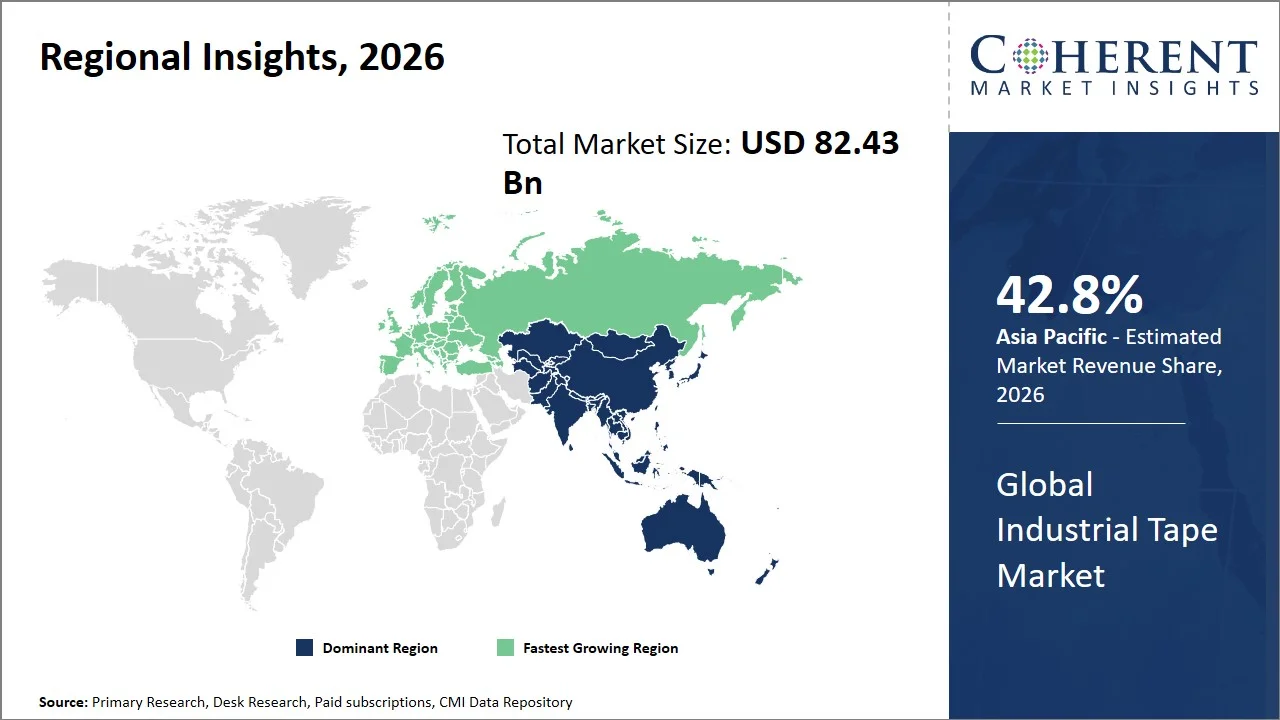
Why Does Asia Pacific Dominate the Global Industrial Tape Market?
Asia Pacific is expected to hold 42.8% of the global industrial tape market in 2026 because the region combines large-scale electronics, semiconductor, automotive, appliance, packaging, and export-manufacturing ecosystems. Industrial tapes are consumed throughout these value chains for component fixation, electrical insulation, surface protection, masking, splicing, and carton sealing. Dense supplier networks for polypropylene films, acrylic adhesives, release liners, coating, and die-cut conversion also shorten lead times and support cost-efficient customization. Japan and South Korea strengthen demand for advanced electronics tapes, while China, India, and Southeast Asia provide high-volume industrial and logistics consumption. In December 2025, Nitto announced a USD 0.24 billion factory investment in Japan to expand capacity for electrical-release tape, transparent adhesive sheets, and component-fixing tapes used in next-generation devices, demonstrating continued regional investment in higher-value tape technologies.
Why is Europe Emerging as the Fastest-Growing Region in the Global Industrial Tape Market?
Europe is expected to represent 22.9% of the global industrial tape market in 2026 and expand at the fastest pace as manufacturers shift toward lighter assemblies, repairable products, recyclable packaging, and lower-emission production. Automotive electrification, renewable-energy equipment, aerospace engineering, building renovation, and automated packaging are increasing the specification of acrylic, foam, transfer, masking, and electrical tapes. European buyers also place greater emphasis on documented material composition, process efficiency, removability, and compatibility with recycling streams, favoring suppliers with application laboratories and customized converting capabilities. Growth is therefore likely to be value-led rather than based only on roll volumes. In September 2024, Lohmann inaugurated a new production facility in Gdansk, Poland, doubling its production space and strengthening its agile European manufacturing network, which improves responsiveness for technically demanding bonding applications.
Global Industrial Tape Market Outlook for Key Countries
Why is the U.S. a Key Market for the Global Industrial Tape Market?
The U.S. is a key market for industrial tape because it combines substantial parcel-shipping activity with advanced aerospace, automotive, electronics, construction, maintenance, and general manufacturing demand. Packaging tapes benefit from automated fulfillment centers and recurring carton-sealing requirements, while double-sided, foam, masking, duct, and electrical tapes serve assembly, repair, insulation, and surface-protection tasks. Buyers frequently require consistent unwind, machine compatibility, traceable quality, and application-specific performance, encouraging suppliers to pair tape portfolios with dispensers, converting, testing, and technical support. The country’s broad distributor network also enables rapid access to both standard and specialty products. In May 2026, the U.S. Census Bureau reported first-quarter e-commerce sales of USD 326.7 billion, up 9.8% year over year and equal to 16.9% of total retail sales, supporting sustained consumption of carton-sealing and fulfillment tapes.
Why is India Important in the Global Industrial Tape Market?
India is becoming increasingly important in the global industrial tape market as domestic electronics, automotive, food processing, construction, consumer goods, and parcel-delivery operations scale. High-volume users rely on polypropylene packaging tape, PVC electrical tape, masking tape, and duct tape, while local electronics and mobility investments are creating additional demand for thermal-management, insulation, protection, and precision die-cut bonding products. Competitive labor and converting costs support localized slitting, printing, laminating, and custom fabrication, helping suppliers serve both national buyers and export-oriented factories. Distribution through industrial dealers and e-commerce channels further widens product availability beyond major manufacturing clusters. In April 2025, India’s Ministry of Electronics and Information Technology notified the Electronics Components Manufacturing Scheme with an outlay of USD 238.85 Mn, reinforcing component localization and expanding the addressable base for process and electrical tapes.
Why Does China Support Growth in the Global Industrial Tape Market?
China supports growth in the global industrial tape market through its unmatched concentration of automotive, electronics, appliances, machinery, construction materials, packaging, and export-oriented manufacturing. The country offers integrated access to polymer films, paper backings, adhesive chemicals, release materials, coating lines, and high-volume converting, allowing producers to compete on price, scale, and application customization. Demand extends from carton sealing and masking to wire-harness wrapping, battery insulation, display assembly, surface protection, and semiconductor processing. Large domestic production runs also justify automated tape application and specialized die-cut components, raising consumption per manufacturing site. In January 2026, China’s State Council reported that 2025 automobile output reached 34.531 million units, increasing 10.4% from 2024. This production scale directly supports recurring use of electrical, foam, acrylic, masking, and protection tapes across vehicle and component assembly.
Why is Germany a Strategic Country in the Global Industrial Tape Market?
Germany is a strategic country for the global industrial tape market because its automotive, mechanical engineering, electronics, renewable-energy, printing, and construction industries purchase technically qualified bonding and protection products. Manufacturers use industrial tapes for cable-harness wrapping, battery-module insulation, lightweight joining, vibration control, masking, mounting, and temporary process fixation. Strict OEM validation, durability expectations, and chemical-compliance requirements favor premium acrylic, foam, transfer, and electrical tapes supported by laboratory testing and application engineering. Germany also functions as an export base for machinery and vehicles, extending tape demand into components manufactured for international supply chains. In March 2026, Coroplast Group opened a new production site in Schönebeck after investing approximately USD 28.48 million, expanding capacity for high-performance acrylic adhesive tapes and targeting new applications in high-voltage battery manufacturing and electronics.
Why is Brazil an Important Growth Market for the Global Industrial Tape Market?
Brazil is an important growth market for industrial tapes because its automotive, food and beverage, agribusiness, household-products, construction, and regional distribution sectors generate broad packaging and maintenance requirements. Packaging tapes support the movement of processed foods, consumer goods, spare parts, and agricultural inputs, while masking, duct, electrical, and double-sided tapes serve vehicle assembly, repairs, building work, and industrial fabrication. The country’s geographic scale and long transport routes increase the value of dependable carton closure and load protection. Import costs and currency exposure can also encourage local converting, inventory holding, and distributor partnerships for frequently used grades. In January 2026, ANFAVEA reported that Brazil produced 2.644 million vehicles in 2025, up 3.5%, while vehicle exports increased 32.1%, supporting tape demand across assembly plants, component suppliers, and export packaging operations.
Technology Adoption Landscape in the Global Industrial Tape Market
Technology | Adoption Level | Key Application Area | Business Impact |
Water-based acrylic pressure-sensitive adhesive coating | High | Packaging, construction membranes, graphics, and general industrial bonding | Supports broad substrate compatibility and lower solvent-handling requirements while enabling large-scale coating. |
Hot-melt pressure-sensitive adhesive coating | High | Carton sealing, bundling, foam bonding, and general-purpose mounting | Enables fast coating speeds, immediate tack, competitive processing costs, and high-volume production. |
Solvent-free UV-cured acrylic coating | Medium | Durable bonding, electronics, automotive interiors, and specialty industrial tapes | Reduces drying energy and solvent recovery needs while supporting controlled, high-performance adhesive properties. |
Precision rotary die-cutting and multilayer lamination | High | Gaskets, insulation shapes, battery components, appliance parts, and electronic assemblies | Converts rolls into installation-ready parts, lowers assembly labor, and supports application-specific premium pricing. |
Machine-vision web inspection and coat-weight control | Medium | Adhesive coating, film lamination, printing, and release-liner inspection | Improves defect detection, dimensional consistency, yield, and traceability for qualified industrial applications. |
How are Energy-Storage and Power-Electronics Applications Creating New Growth Opportunities in the Global Industrial Tape Market?
Battery-energy storage systems, power electronics, fast-charging hardware, and data-center electrical infrastructure create an underdeveloped opportunity for tapes that manage several failure risks simultaneously. Suppliers can develop thin, die-cut constructions for dielectric isolation, thermal-interface fixation, busbar protection, flame barriers, cell spacing, cable retention, and enclosure sealing. The commercial opportunity is strongest where buyers currently assemble multiple films, pads, coatings, and mechanical clips, because a validated tape stack can simplify installation and reduce part handling. Capturing this space requires more than adhesive formulation. Participants need electrical-breakdown testing, thermal-aging capability, flame and chemical-resistance data, clean conversion, traceable lots, and engineering support during customer qualification. Regional converting near battery, switchgear, inverter, and server-equipment plants will also matter because programs involve frequent design revisions. Established material suppliers have an advantage in test infrastructure, while specialist converters can win through rapid prototyping and complex geometries. Vertically integrated partnerships between adhesive formulators, film producers, and precision converters are likely to create the most defensible offerings.
Market Players, Key Development, and Competitive Intelligence
Key Developments
- In September 2024, Mactac launched the Macbond 481 Series and Macbond LS55 Series industrial tapes. The portfolios address medium- and high-surface-energy materials as well as difficult low-surface-energy substrates, with applications spanning gaskets, electronics, automotive components, appliances, acoustic panels, and general fabrication. This is important for the global industrial tape market because it broadens converter access to differentiated transfer and double-sided tape constructions without requiring separate suppliers for each substrate class.
- In February 2024, Rogers Corporation launched DeWAL Plasma X plasma-spray masking tape. The single-ply silicone-rubber and glass-cloth construction was developed for plasma spraying, flame spraying, grit blasting, and other high-temperature surface-treatment processes. This is important for the global industrial tape Market because it expands the value of masking tape beyond painting into technically demanding aerospace, turbine, repair, and industrial-coating operations where clean removal and process-time reduction influence purchasing.
- In February 2024, Saint-Gobain Tape Solutions announced the integration of production sites in Poland and Germany and capability upgrades in Belgium, Germany, and Italy. The company also outlined investments in solvent-free UV-cured acrylic technology and solvent-recovery processes. This is important for the global industrial tape market because a broader European production network can improve coating flexibility, reduce lead times, and support industrial customers requiring regionally manufactured technical tapes and responsive application service.
Competitive Landscape
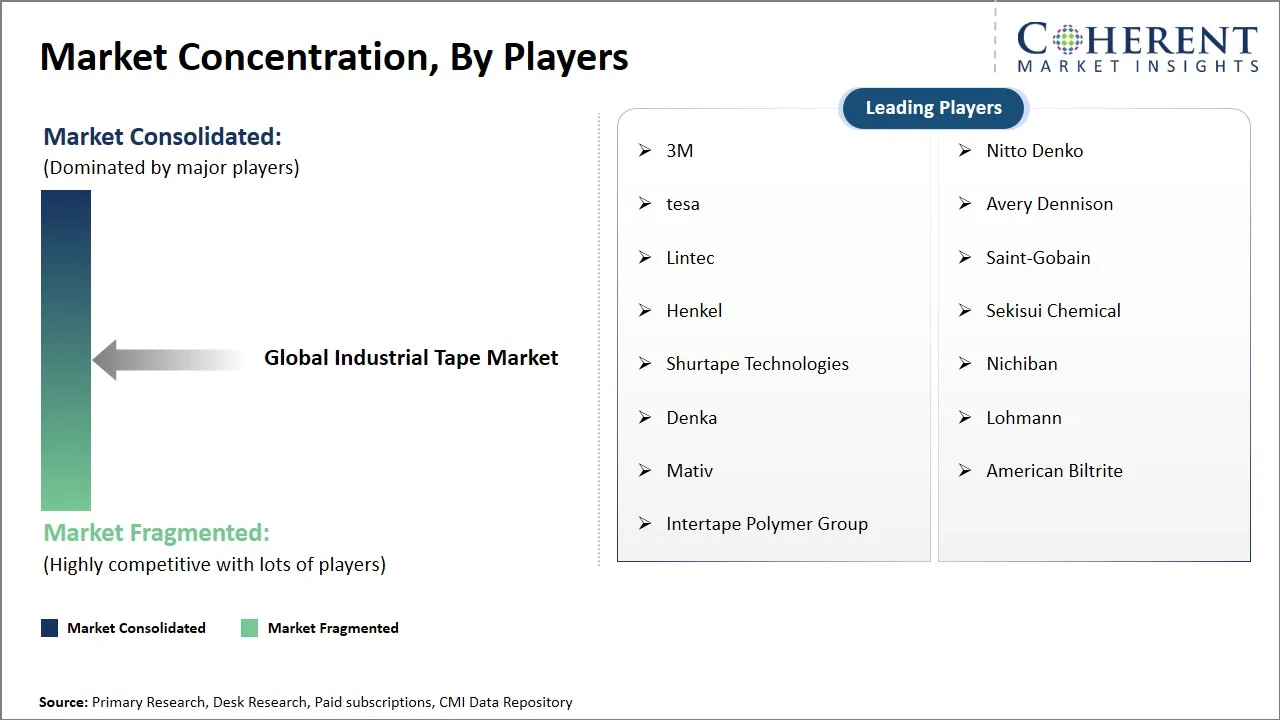
The global industrial tape market is moderately fragmented, combining diversified material-science corporations, specialist adhesive-tape coaters, precision converters, regional packaging-tape producers, and private-label suppliers. Global companies compete through proprietary adhesive chemistry, qualification data, multinational supply capability, and application engineering. Regional participants remain influential in commodity products and customized converting because proximity improves delivery speed, order flexibility, and customer support. Competition increasingly reflects performance within the customer’s production process rather than roll price alone.
Key focus areas Include
- OEM qualification and technical documentation: Verified peel, shear, dielectric, aging, temperature, and chemical-resistance data improve access to specification-led contracts.
- Bonding performance on difficult substrates: Reliable adhesion to polypropylene, polyethylene, foams, powder-coated metals, and composites remains a key differentiator.
- Precision-converting capability: Die-cutting, lamination, printing, cleanroom processing, and kitting create higher-value customer relationships.
- Manufacturing continuity: Multiple coating lines, regional warehousing, dual sourcing, and stable lead times reduce disruption risk for industrial buyers.
- Application-level economics: Suppliers increasingly compete on labor savings, scrap reduction, throughput, and rework avoidance rather than unit price.
- Compliance and traceability: Chemical declarations, batch records, certifications, and change-control procedures influence supplier approval.
- Channel and service reach: Industrial distributors provide availability, while direct technical teams support complex OEM and tier-supplier programs.
Market Report Scope
Industrial Tape Market Report Coverage
| Report Coverage | Details | ||
|---|---|---|---|
| Base Year: | 2025 | Market Size in 2026: | USD 82.43 Bn |
| Historical Data for: | 2020 To 2024 | Forecast Period: | 2026 To 2033 |
| Forecast Period 2026 to 2033 CAGR: | 6.2% | 2033 Value Projection: | USD 125.59 Bn |
| Geographies covered: |
| ||
| Segments covered: |
| ||
| Companies covered: | 3M, Nitto Denko, tesa, Avery Dennison, Lintec, Saint-Gobain, Henkel, Sekisui Chemical, Shurtape Technologies, Nichiban, Denka, Lohmann, Mativ, American Biltrite, Intertape Polymer Group | ||
| Growth Drivers: |
| ||
| Restraints & Challenges: |
| ||
Analyst Opinion (Expert Opinion)
- The global industrial tape market leadership will increasingly depend on managing long-term industrial supply programs rather than maximizing spot sales of individual rolls. Buyers are likely to consolidate approved suppliers, negotiate structured raw-material adjustments, and expect inventory support across several plants. Companies with disciplined contract management, regional stocking, and consistent change-control procedures will gain an advantage over producers that compete only through catalogue breadth or temporary price reductions.
- Direct-to-part adhesive deposition and digitally controlled dispensing could challenge pre-coated tapes in low-volume assemblies with complex geometries. Tape suppliers should not treat these processes solely as competing technologies. Hybrid offerings that combine deposited adhesives with die-cut insulation, protection, or reinforcement layers may become commercially important. Participants able to recommend the correct bonding process rather than automatically promoting tape will preserve stronger customer influence.
- Manufacturers should prioritize difficult-substrate bonding, reliable low-VOC chemistry, liner reduction, regional raw-material redundancy, and faster customer qualification. Investment should concentrate on applications where performance data and converting expertise protect margins. Companies should avoid excessive expansion in undifferentiated commodity capacity, particularly when product pricing remains exposed to polymer, energy, freight, and release-liner volatility. Partnerships with local converters and equipment integrators can improve market access without duplicating fixed assets.
Speak to the analyst
Want personalized insights?
Take the findings above to one of our principal consultants, or have the report rebuilt around the segments, geographies and competitors you actually track.
Market Segmentation
- Tape Type Insights (Revenue, USD Bn, 2021 - 2033)
- Packaging Tapes
- Electrical Tapes
- Masking Tapes
- Double-sided and Transfer Tapes
- Duct Tapes
- Filament Tapes
- Others
- Backing Material Insights (Revenue, USD Bn, 2021 - 2033)
- Polypropylene
- Polyvinyl Chloride
- Paper
- Polyethylene
- Foam
- Cloth
- Others
- Adhesive Type Insights (Revenue, USD Bn, 2021 - 2033)
- Acrylic
- Rubber
- Silicone
- Polyurethane
- Others
- End-use Industry Insights (Revenue, USD Bn, 2021 - 2033)
- Packaging
- Automotive and Transportation
- Electrical and Electronics
- Building and Construction
- General Manufacturing and Assembly
- Aerospace
- Others
- Regional Insights (Revenue, USD Bn, 2021 - 2033)
- North America
- U.S.
- Canada
- Latin America
- Brazil
- Argentina
- Mexico
- Rest of Latin America
- Europe
- Germany
- U.K.
- Spain
- France
- Italy
- Russia
- Rest of Europe
- Asia Pacific
- China
- India
- Japan
- Australia
- South Korea
- ASEAN
- Rest of Asia Pacific
- Middle East
- GCC Countries
- Israel
- Rest of Middle East
- Africa
- South Africa
- North Africa
- Central Africa
- North America
- Key Players Insights
- 3M
- Nitto Denko
- tesa
- Avery Dennison
- Lintec
- Saint-Gobain
- Henkel
- Sekisui Chemical
- Shurtape Technologies
- Nichiban
- Denka
- Lohmann
- Mativ
- American Biltrite
- Intertape Polymer Group
Sources
Primary Research Interviews
- Industrial tape manufacturers, adhesive formulators, backing-material suppliers, converters, distributors, and private-label producers
- Procurement, production, product development, quality, regulatory, supply-chain, marketing, and sales executives
- Buyers from packaging, automotive, electronics, construction, aerospace, and general manufacturing industries
Stakeholders
- Packaging, electrical, masking, double-sided, duct, filament, foam, and specialty tape manufacturers
- Acrylic, rubber, silicone, and polyurethane adhesive suppliers
- Polypropylene, PVC, paper, polyethylene, foam, cloth, release-liner, and coating-material producers
- Coaters, slitters, laminators, printers, die-cut converters, distributors, testing laboratories, and applicator suppliers
End-use Sectors
- Packaging and logistics
- Automotive and transportation
- Electrical and electronics
- Building and construction
- General manufacturing, aerospace, appliances, renewable energy, and industrial maintenance
Regulatory and Government Bodies
- U.S. EPA, OSHA, U.S. Department of Commerce, and U.S. Census Bureau
- European Commission, ECHA, UK HSE, and HM Revenue & Customs
- Bureau of Indian Standards, DGFT, China SAMR, Japan METI, and national customs authorities
Databases
- UN Comtrade, ITC Trade Map, WTO, World Bank, Eurostat, and OECD
- USITC DataWeb, U.S. Census Bureau, India DGCI&S, China Customs, and Japan Customs
- Company filings, trade databases, distributor catalogues, and procurement platforms
Journals and Industry Publications
- International Journal of Adhesion and Adhesives
- Journal of Adhesion Science and Technology
- The Journal of Adhesion
- Polymer Testing
- Adhesives & Sealants Industry
- Packaging Europe and Converting Quarterly
Associations and Trade Bodies
- Pressure Sensitive Tape Council
- Afera – The European Adhesive Tape Association
- The Adhesive and Sealant Council
- FINAT
- FEICA
- Japan Adhesive Tape Manufacturers Association
- Flexible Packaging Association
Public Domain Sources
- Government manufacturing, trade, construction, automotive, electronics, packaging, and customs records
- Company reports, technical data sheets, safety data sheets, patents, certifications, product catalogues, and press releases
- Distributor websites, converter listings, procurement portals, and B2B platforms
Key Standards and Regulations
- ASTM and ISO standards for peel adhesion, shear strength, tack, tensile strength, thickness, and temperature resistance
- UL and IEC requirements for dielectric strength, flame resistance, and electrical safety
- EU REACH, CLP, RoHS, VOC, chemical-handling, and worker-exposure regulations
- Packaging recyclability, recycled-content, plastic-tax, extended producer responsibility, and waste-management rules
- Automotive, aerospace, construction, and electronics OEM performance specifications
Proprietary Elements
- CMI Data Analytics Tool, Proprietary CMI Existing Repository of information for last 10 years.
Get access to 250+ pages report
Every segment, forecast, competitor profile and data table behind the analysis above — available for instant download.
- ESOMAR Member
- ISO 9001:2015 Certified
- D-U-N-S Registered
- GDPR & CCPA Compliant
Missing comfort of reading report in your local language? Find your preferred language:
Transform your Strategy with Exclusive Trending Reports
Frequently Asked Questions
The CAGR of the global industrial tape market is projected to be 6.2% from 2026 to 2033.
The global industrial tape market is estimated to be valued at USD 82.43 billion in 2026 and is expected to reach USD 125.59 billion by 2033.
Industrial manufacturing expansion increasing demand for bonding and protective tapes and lightweight assembly requirements supporting replacement of mechanical fasteners are the major factors driving the growth of the global industrial tape market.
Industrial tapes are widely used for bonding, insulation, masking, sealing, surface protection, mounting, vibration control, and component fixation.
Packaging, automotive and transportation, electrical and electronics, building and construction, general manufacturing, and aerospace are the major end-use industries.
Acrylic adhesives are widely used because they provide durable bonding, weather resistance, temperature stability, and reliable performance across diverse industrial applications.
Raw material price volatility affecting adhesive and polymer film production costs and performance limitations under extreme temperature and chemical exposure conditions are the major factor hampering the growth of global industrial tape market.