

Global Industrial Wireless Automation Market Forecast – 2026 To 2033
The global industrial wireless automation market is expected to grow from USD 3.25 Bn in 2026 to USD 6.90 Bn by 2033, registering a compound annual growth rate (CAGR) of 7.5% from 2026 to 2033. The global industrial wireless automation market is driven by rising smart factory investments. On March 25, 2025, Schneider Electric announced that it is planning to invest over USD 700 million in its U.S. operations through 2027. The company’s investments support the country’s focus on bolstering the nation’s energy infrastructure to power AI growth, boost domestic manufacturing, and strengthen energy security.
Key Takeaways of the Global Industrial Wireless Automation Market
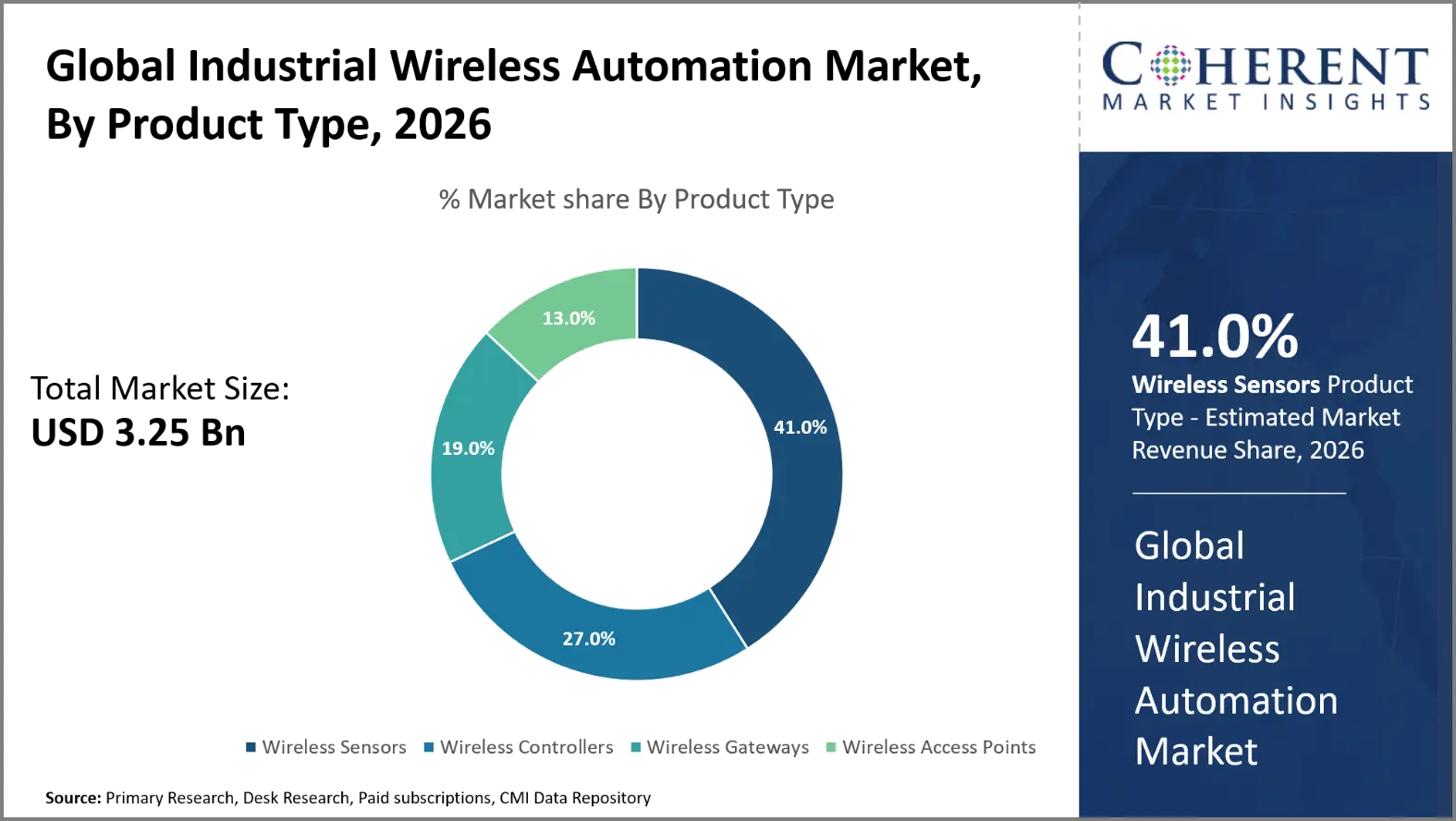
- The Wireless Sensors segment is expected to account for 41.0% of the global industrial wireless automation market share in 2026. Demand for flexible factory connectivity is driving the growth of the segment. On February 12, 2025, Ericsson deployed Private 5G at Jaguar Land Rover's Solihull manufacturing facility. The network connects vision systems, Internet of Things sensors, and production tools.
- The Process Industries segment is estimated to capture 54.0% of the market share in 2026. Increasing private 5G deployment is majorly driving the growth of the segment. On January 6, 2026, CIMPOR activated Ericsson Private 5G across three Portuguese cement plants. The deployment covers Alhandra, Loulé, and Souselas facilities.
- The Wi-Fi segment is estimated to capture 31.0% of the market share in 2026. Reduction in industrial cabling requirements is driving the growth of the segment. In April 2026, Belden demonstrated its BRS-5G industrial switch at Hannover Messe 2026. The concept uses private 5G for deterministic factory-floor communication.
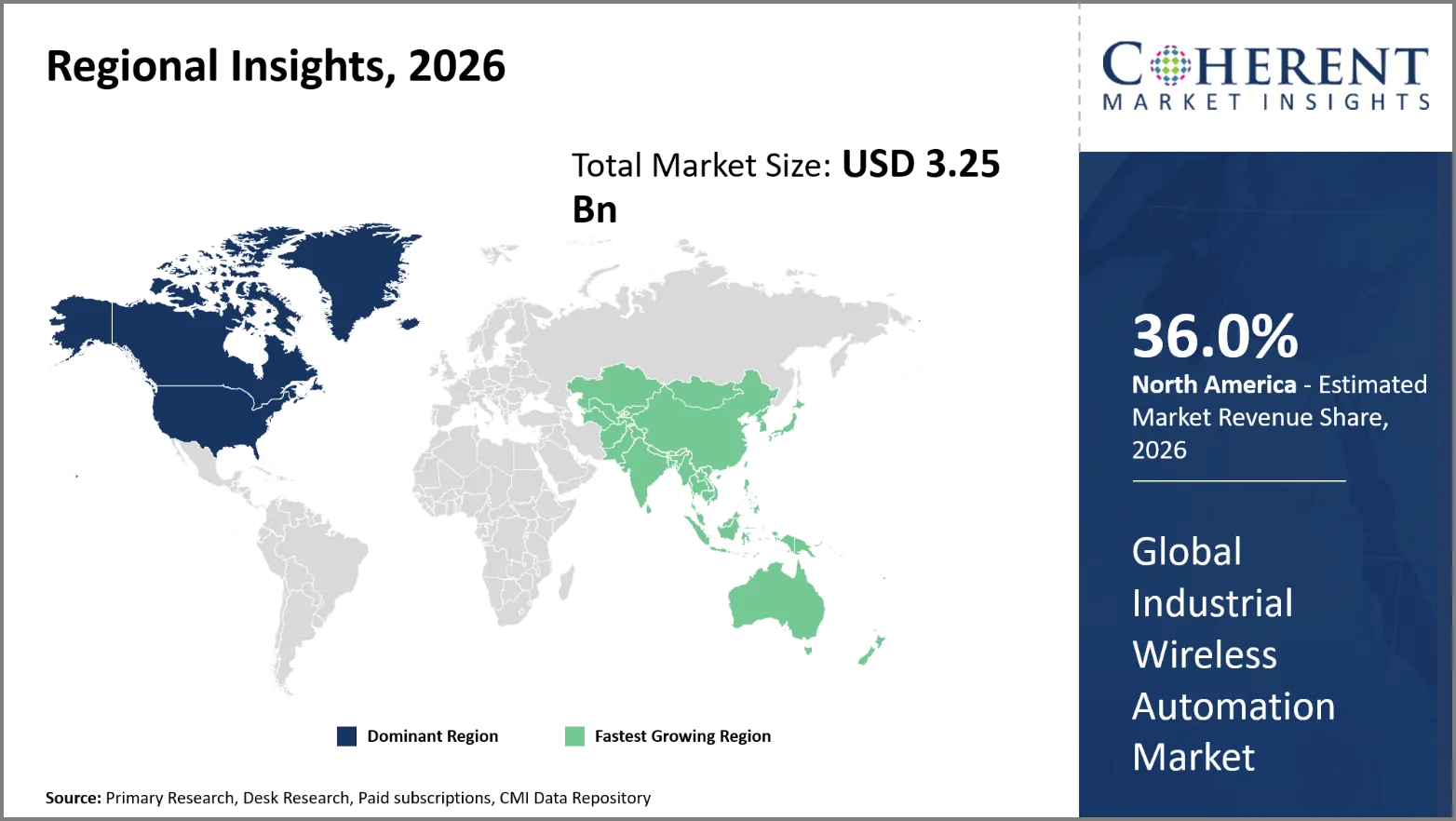
- North America is expected to dominate the industrial wireless automation market in 2026 with a market share of 36.0%. Growing predictive maintenance adoption in North America is driving the growth of the regional market. On April 30, 2025, AssetWatch, Inc., the fast-growing leader of end-to-end predictive maintenance and condition monitoring solutions, announced the close of its Series C funding round, raising USD 75 million led by Viking Global Investors.
- Asia Pacific is expected to account for 27.0% share in 2026. Growing emphasis on wireless condition monitoring in Asia Pacific is driving the growth of the regional market. On September 30, 2025, MSA Safety launched its FieldServer ProtoNode Gateway across the Asia Pacific region. The gateway provides cloud-connected monitoring for fixed gas and flame detection systems.
Segmental Insights
Why Does Wireless Sensors Dominate the Global Industrial Wireless Automation Market?
The wireless sensors segment is expected to account for 41.0% of the global industrial wireless automation market share in 2026. Wireless sensors prevail due to the flexibility in monitoring distributed industrial assets. They lessen the amount of wiring and make installation in hard-to-reach spots easier. Wireless sensors allow to measure temperature, pressure, vibration, flow, and equipment condition. They also allow for continuous data collecting for predictive maintenance plans. Battery-powered designs can be deployed autonomously in remote industrial regions. They are scalable, so manufacturers can add monitoring sites without making major changes to their infrastructure. Wireless sensors also make brownfield modernization possible when new wiring could disrupt existing processes.
On May 29, 2025, Fluke Reliability and Treon announced a strategic alliance to provide a dependable connectivity environment with enhanced wireless condition monitoring and industrial asset diagnostics. Fluke Reliability and Treon are combining their AI and data expertise to improve predictive maintenance, maximize uptime, and showcase the ROI of customers’ reliability programs, driving innovation in condition monitoring.
- Current Industry Events of 2026
- Market Size Estimation
- Regional Breakdown
- Competitive Landscape
- Customer Intelligence
- Segmental Analysis
- Pricing Analysis
- Key Market Drivers, Challenges & Future Trends
- Customized Insights Section
Why is Process Industries the Most Preferred Industry Type?
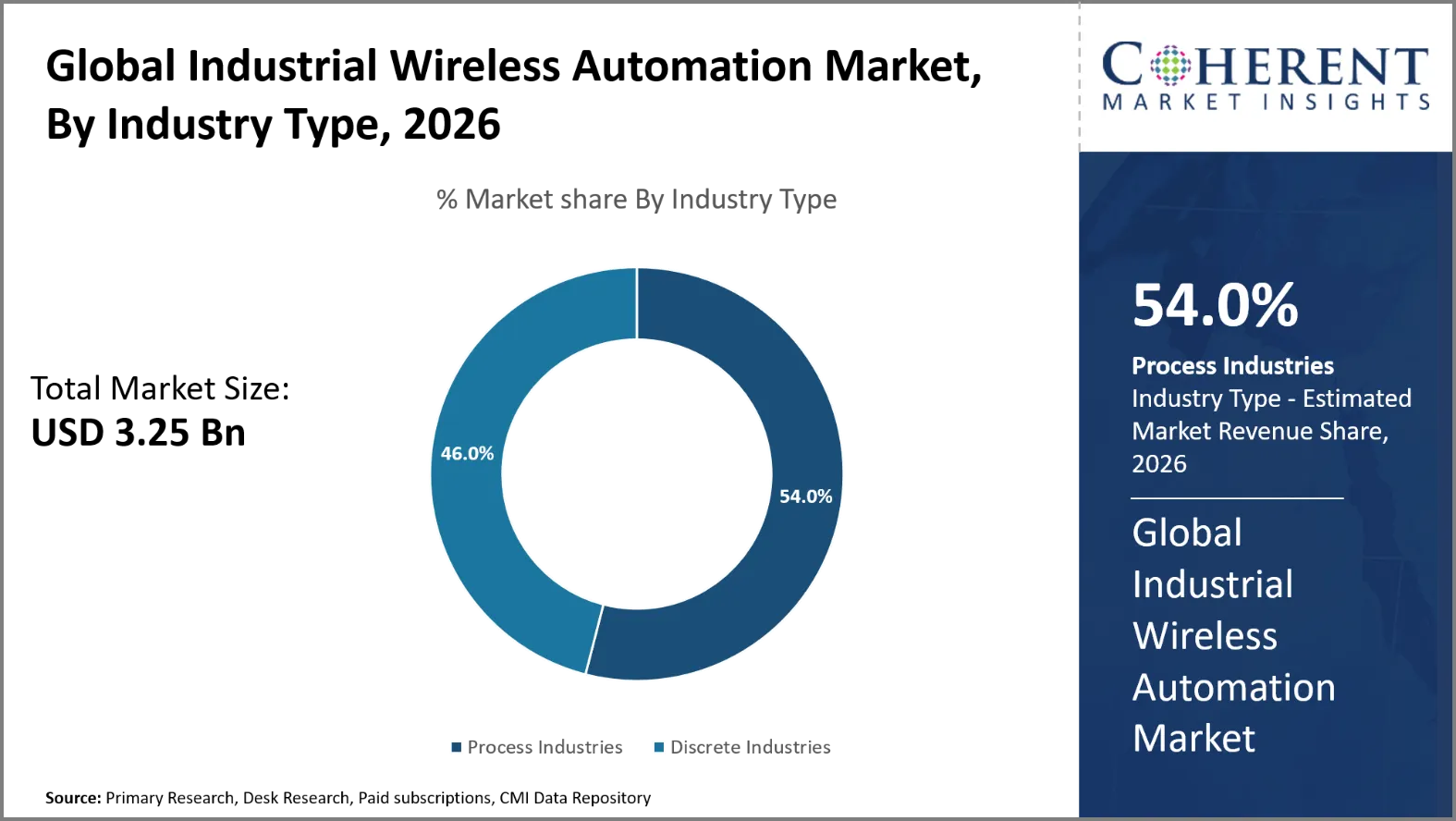
The process industries segment is expected to account for 54.0% of the global industrial wireless automation market share in 2026. Process industries strongly prefer wireless automation because production assets often operate across large and complex facilities. Power facilities, chemical factories and oil refineries have large pipelines, tanks, pumps and rotating machinery. Wireless gadgets can track those assets without having to lay miles of communication wires. They also make it easier to extend instruments over remote or hazardous places. Wireless condition monitoring enables predictive maintenance by constantly monitoring the status of assets. Operators can spot excessive temperatures, pressures, vibrations and flow conditions earlier. Wireless systems also limit disruption during plant modification and maintenance activities. For instance, in July 2026, SRF Limited augmented its WirelessHART monitoring at the Dahej specialty chemicals factory in Gujarat, India. The company uses wireless instruments across nitrogen, instrument air, cooling water, and chilled water systems.
Wi-Fi Dominates the Global Industrial Wireless Automation Market
The Wi-Fi segment is expected to account for 31.0% of the global industrial wireless automation market share in 2026. Wi-Fi remains dominant because it provides mature infrastructure and broad compatibility across industrial environments. Industrial facilities already have a wealth of Wi-Fi expertise and network infrastructure to support it. Modern industrial Wi-Fi systems offer faster throughput and better durability than older models. They support mobile devices, industrial computers, sensors, cameras, and automation systems in the linked facility. Wi-Fi also allows real time monitoring and data-heavy industrial applications. Equipment makers offer broad interoperability with existing Wi-Fi standards. This enables industrial operators to add wireless connectivity without having to deploy entirely new network architectures.
On February 27, 2026, Phoenix Contact announced the expansion of its industrial wireless range with new access points from the WLAN 2300 series supporting Wi-Fi 6 functionalities according to IEEE 802.11ax. They enable the creation of efficient and strong WLAN networks with up to 100 devices per virtual access point interface.
Current Events and their Impact
Current Events | Description and its Impact |
European Union Cyber Resilience Act |
|
European Union Network and Information Security Directive |
|
Industrial Wireless Automation Market Dynamics
Market Drivers
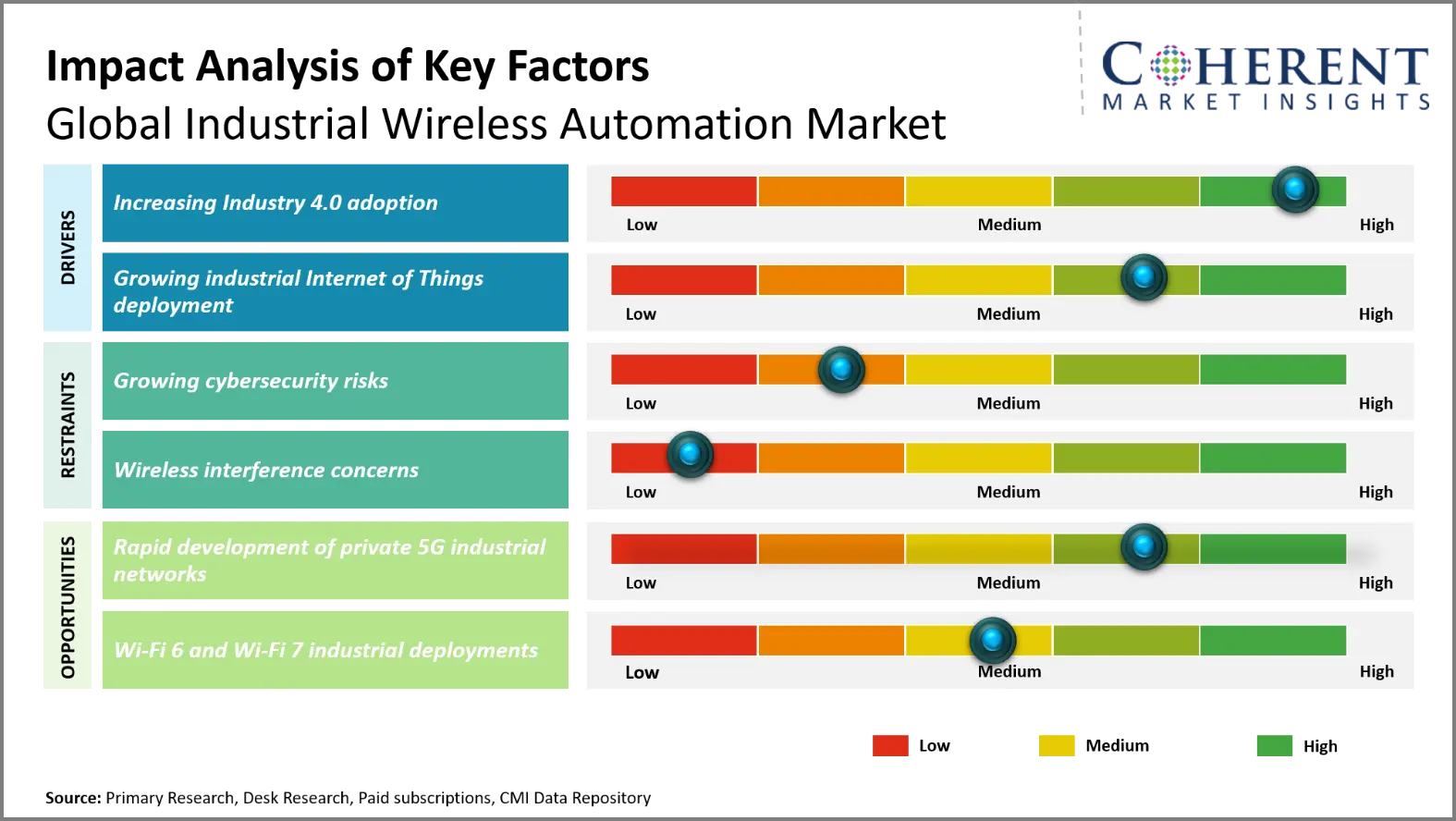
- Increasing Industry 4.0 adoption: Growing adoption of Industry 4.0 is driving demand for linked industrial automation infrastructure. Manufacturers are embedding sensors, robotics, analytics, edge computing and automated control systems. Wireless connectivity enables flexible communication between equipment, sensors, controllers, and corporate platforms. It lowers the cabling required in production environments that are often modified. Wireless automation can also be used to monitor equipment in real time, as well as optimize production. Manufacturers can scale connected operations with minimal infrastructure changes.
- On June 11, 2025, Siemens and NVIDIA announced the expansion of their relationship to advance the next phase of industrial AI and digitalization and enable the factory of the future. NVIDIA’s partnership with Siemens is bringing NVIDIA AI and accelerated computing to the world’s leading enterprises and opening new opportunities for the next wave of industrial AI.
- Growing industrial Internet of Things deployment: The number of connected industrial devices is growing due to the growing deployment of Industrial Internet of Things. Factories are linking sensors, machines, gateways, energy systems and monitoring devices. Wireless communication provides connectivity to geographically distributed and hard-to-wire industrial assets. This allows the collecting of operating data on an ongoing basis for analytics and maintenance choices. Industrial IOT solutions can merge wireless sensor data with edge computing. This combination enhances the visibility of equipment and helps in faster reactions to abnormal operating situations.
- On June 22, 2026, ArcelorMittal announced it has entered into a strategic relationship with Amazon Web Services (AWS) to drive industrial automation throughout its global operations with advanced cloud, artificial intelligence and edge technologies. The partnership puts AWS cloud and AI capabilities directly into ArcelorMittal’s manufacturing operations, opening up prospects for greater optimization and improvements in safety, asset reliability and energy efficiency.
Emerging Trends
- Private 5G Industrial Networks: Manufacturers are using private 5G networks for low latency industrial communications. These networks allow for mobile robotics, interconnected machines, self-driving cars and real-time monitoring. Their specialized design provides better control over network performance, security, device connection and operational reliability.
- Artificial Intelligence-Enabled Wireless Monitoring: Industrial wireless platforms are using more and more artificial intelligence to monitor equipment and spot anomalies. Wireless sensors continuously gather operational data that allows predictive maintenance models to spot upcoming equipment issues. This trend increases the reliability of the assets and reduces unexpected production interruptions.
- Edge Computing Integration: Industrial wireless networks are increasingly integrating edge computing with industrial equipment. Local processing decreases communication latencies and wasteful data transmission. This design allows for faster machine responses, real-time analytics, autonomous operations, and dependable monitoring in bandwidth-constrained industrial environments.
- Wireless Time-Sensitive Networking: Wireless time-sensitive networking is gaining maturity for applications where deterministic industrial communication is required. Accurate timing skills combined with wireless communication to enable coordinated machinery and demanding automation procedures. This breakthrough can provide wireless access to applications typically served by wired industrial networks.
Regional Insights
Why is North America a Strong Market for Industrial Wireless Automation?
North America is expected to account for a market share of 36.0% in 2026. North America is advancing industrial wireless automation through private cellular networks and flexible factory connectivity. Rockwell Automation and Nokia tested private 5G for EtherNet/IP industrial control applications. Their trial used Citizens Broadband Radio Service spectrum and achieved zero connection faults during three-hour testing. The system connected GuardLogix controllers with distributed FLEX 5000 input-output modules. Private 5G also supports automated guided vehicles, autonomous mobile robots, and untethered industrial assets. Siemens expanded its private 5G infrastructure into the U.S. market during 2026. The company introduced a Citizens Broadband Radio Service radio unit for industrial deployments. These developments are accelerating wireless connectivity across manufacturing and logistics facilities.
Why Does Asia Pacific Industrial Wireless Automation Market Exhibit High Growth?
Asia Pacific is expected to register the fastest growth with a CAGR of 8.3% over the forecast period and projected to account for 27.0% of the global industrial wireless automation market in 2026. Asia Pacific is expanding industrial wireless automation through smart manufacturing programs and private 5G deployments. In 2025, Rockwell Automation examined over 1,500 manufacturers across 17 countries. The poll examined China, Japan, India, and South Korea. Thailand’s AIS and Alliance Laundry Systems linked 300+ manufacturing devices using 5G mmWave. The setup allowed for the real-time capture of machine data and video surveillance. China is also building 5G plants across the manufacturing industries. Midea operates a 5G-connected washing-machine factory with 2,500 connected devices. These deployments are strengthening demand for industrial wireless sensors, automated guided vehicles, machine vision, and connected production systems.
Global Industrial Wireless Automation Market Outlook for Key Countries
Why is U.S. Emerging as a Major Hub in the Industrial Wireless Automation Market?
The U.S. industrial wireless automation market is being shaped strongly by private 5G and Citizens Broadband Radio Service spectrum. Rockwell Automation and Nokia validated private 5G for real-time EtherNet/IP communication. Their testing connected GuardLogix safety controllers with distributed FLEX 5000 input-output systems. The trial recorded zero connection faults during three hours of testing. Siemens expanded its private 5G portfolio into the U.S. during 2026. Its new Citizens Broadband Radio Service radio unit targets manufacturing, pharmaceuticals, food processing, intralogistics, and heavy industry. Private 5G also supports autonomous mobile robots and connected workers. These applications are strengthening demand for dedicated wireless industrial networks.
Is China the Next Growth Engine for the Industrial Wireless Automation Market?
China is leading the way in industrial wireless automation with a massive rollout of 5G factories and initiatives for connected production. Midea has 2,500 linked 5G devices in its washing-machine factory in Jingzhou. The system offers automated logistics, robotics, production monitoring and quality inspection based on artificial intelligence. Hotel Star has swapped its traditional Wi-Fi network for private 5G for industrial operations. Its deployment enables automated guided vehicles, coupled cameras, data collecting and recognition of images. The private 5G infrastructure for Hotel Star was supplied by China Mobile and ZTE. These deployments reflect increasing Chinese demand for wireless connectivity to enable real-time production data, mobile equipment, machine vision and automated material handling.
Germany Industrial Wireless Automation Market Analysis and Trends
Industry 4.0 research, private 5G and distributed infrastructure projects put Germany on top of industrial wireless automation. Siemens and O2 Telefónica will launch an integrated 5G network slicing solution for water utilities in 2025. A pilot customer in North Rhine-Westphalia began testing the technology. The solution addresses distributed water facilities requiring long-distance connectivity. Germany also hosts the 5G Ericsson Industrial Communications Demonstrator at RWTH Aachen. The demonstrator enables low-latency wireless communication between production machines and logistics processes. Germany's industrial wireless development therefore extends beyond factories into utilities and production research. These applications strengthen demand for deterministic connectivity, wireless sensors, and industrial network virtualization.
Japan Industrial Wireless Automation Market Analysis and Trends
Japan is strengthening industrial wireless automation through government-backed post-5G technology development. The Ministry of Economy, Trade and Industry identifies smart factories and autonomous driving among major post-5G industrial applications. Japan's program supports development of post-5G communication systems and related semiconductor technologies. The initiative also seeks domestic capabilities for advanced semiconductor manufacturing technologies. Japanese manufacturers are therefore positioned to integrate advanced wireless connectivity with robotics, factory automation, and precision production. Rockwell Automation’s 2025 manufacturing study, surveyed Japan as one of the manufacturing countries. These projects provide prospects for industrial wireless networks enabling robotics, connected machinery, factory analytics and high-density sensor settings.
South Korea Industrial Wireless Automation Market Analysis and Trends
South Korea is expanding industrial wireless automation through semiconductor, automotive, shipbuilding, and precision manufacturing initiatives. The Ministry of Science and Information and Communication Technology is developing technologies for autonomous precision manufacturing. The program targets sensor-based equipment data, robotic behavior data, and factory-level operational data. Initial applications focus on automobiles, precision manufacturing, and shipbuilding. South Korea also appears among the manufacturing countries assessed in Rockwell Automation's 2025 smart manufacturing research. These endeavors require broad sensor connectivity which can be provided by industrial wireless networks. The country’s robust semiconductor ecosystem also drives the demand for dependable wireless monitoring in highly automated production environments.
Global Industrial Wireless Automation Market - Industrial Wireless Gateway Shipments by Technology (2025)
Wireless Gateway Technology | Estimated Shipments in Million Units | Share of Shipments |
Cellular 4G and 5G | 3.89 | 35.5% |
Wi-Fi | 2.83 | 25.8% |
WirelessHART and ISA100.11a | 2.29 | 20.9% |
LPWAN | 1.40 | 12.8% |
Other Technologies | 0.55 | 5.0% |
How is Rapid Development of Private 5G Industrial Networks Creating New Growth Opportunities in the Industrial Wireless Automation Market?
Rapid private 5G deployment is creating opportunities for industrial wireless automation by enabling dedicated connectivity for demanding factory applications. Rockwell Automation and Nokia demonstrated private 5G connectivity for EtherNet/IP industrial control systems. Their testing connected GuardLogix controllers with distributed FLEX 5000 input-output modules. Siemens expanded private 5G infrastructure into the U.S. and seven additional countries during 2026. Its industrial offering includes Citizens Broadband Radio Service equipment for factories and intralogistics operations. Private 5G can also support automated guided vehicles, autonomous mobile robots, machine vision, and connected workers. These deployments create new demand for industrial routers, wireless sensors, edge devices, network management software, and secure industrial gateways.
On February 18, 2026, NTT DATA announced that Cargill, a global food, agricultural and industrial leader, is transforming operations across its manufacturing and processing facilities through the successful deployment of NTT DATA’s Private 5G network across 50 sites globally. The initiative is enabling a connected workplace strategy and supports the deployment of robotics, with additional sites planned for completion in 2026.
Market Players, Key Development, and Competitive Intelligence
Key Developments
- On May 20, 2026, Emerson announced the release of its Emerson Synchros Industrial Internet of Things (IIoT) platform, a new suite of technologies that expands asset health visibility and improves maintenance decisions through a flexible wireless architecture designed for rapid deployment across existing facilities.
- On April 13, 2026, Belden Inc., a leading global provider of complete connection solutions, announced it is showcasing a demonstration of the world's first 5G industrial switch specifically designed for use on the factory floor. The BRS-5G industrial switch powered by Qualcomm Technologies will be unveiled as a concept at Hannover Messe, 2026, the world’s leading trade fair for the manufacturing industry.
- On March 25, 2025, Moxa Inc. announced the launch of its next-generation 64-bit Arm-based computers, UC-3400A and UC-4400A Series featuring industry-leading dual-wireless, 5G/LTE, and Wi-Fi 6, connectivity. Built around an Arm Cortex-A53 quad-core processor and featuring dual-wireless connectivity, these computers are rigorously tested to ensure reliable RF performance and deliver exceptional performance in industrial IoT applications.
Competitive Landscape
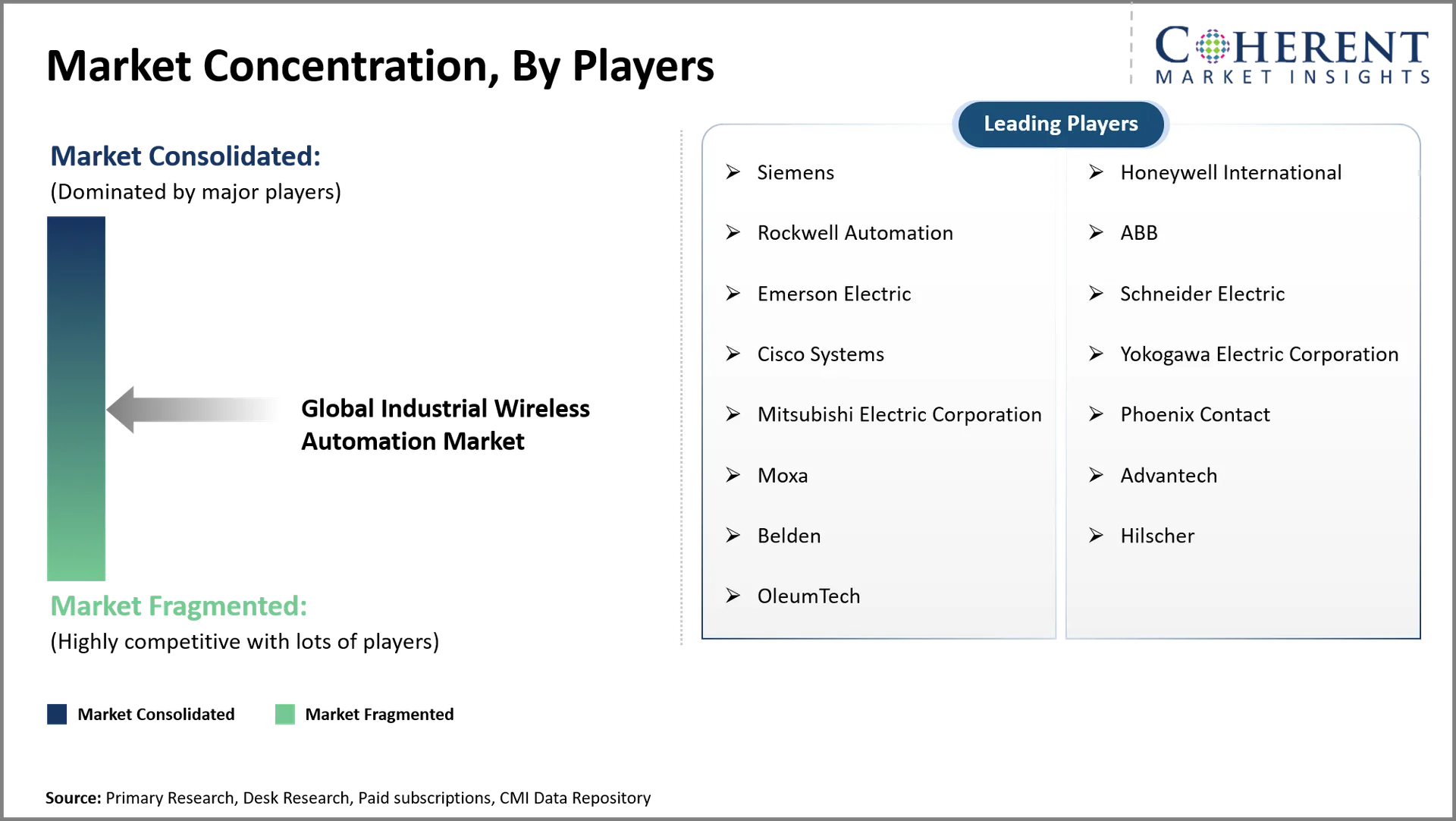
The competitive landscape centers on automation vendors combining wireless infrastructure with existing control ecosystems. Siemens is pursuing an end-to-end strategy spanning private 5G, routers, edge computing, and industrial protocols. Its 2026 expansion added private 5G infrastructure across eight additional countries. The company also added Citizens Broadband Radio Service equipment for U.S. industrial customers. Its routers support PROFINET and PROFIsafe communication for automation and safety applications. Siemens partnered with Palo Alto Networks to strengthen private 5G cybersecurity for operational technology environments. Rockwell Automation is focusing on real-time EtherNet/IP communication over private 5G through its Nokia collaboration.
Top Manufacturers and Notable Products in Industrial Wireless Automation
Manufacturer | Notable Product | Key features |
Siemens | SCALANCE W Industrial Wireless LAN | Wi-Fi 6, up to 1,201 Mbit/s, seamless roaming, PROFINET and PROFIsafe, wireless redundancy |
Emerson Electric | Wireless 1410S Gateway | WirelessHART mesh networking, over 99% data reliability, Ethernet and serial connectivity, supports up to 500 devices per antenna |
Phoenix Contact | WLAN 2300 Series | Wi-Fi 6/6E, 6 GHz support, up to 2,400 Mbps, fast roaming, WPA3, IEC 62443-4-1 security |
ABB Ltd. | AWIN GW120 | WirelessHART, support for up to 100 devices, ModbusTCP and HART-IP, Zone 2 suitability, 128-bit AES encryption |
Moxa Inc. | AIG-302 Series | LTE connectivity, MQTT, Modbus, Azure IoT Edge, Secure Boot, IEC 62443-4-2 Security Level 2 |
Market Report Scope
Global Industrial Wireless Automation Market Report Coverage | |||
Report Coverage | Details | ||
Base Year | 2025 | Market Size in 2026: | USD 3.25 Bn |
Historical Data For: | 2020 To 2024 | Forecast Period: | 2026 To 2033 |
Forecast Period 2026 To 2033 CAGR: | 7.50% | 2033 Value Projection: | USD 6.90 Bn |
Geographies covered: |
| ||
Segments covered: |
| ||
Companies covered: | Siemens, Honeywell International, Rockwell Automation, ABB, Emerson Electric, Schneider Electric, Cisco Systems, Yokogawa Electric Corporation, Mitsubishi Electric Corporation, Phoenix Contact, Moxa, Advantech, Belden, Hilscher, OleumTech | ||
Growth Drivers: |
| ||
Restraints & Challenges: |
| ||
Analyst Opinion (Expert Opinion)
- The future of industrial wireless automation will shift toward integrated wireless control architectures. Private 5G will become particularly important where mobile machinery requires predictable connectivity. Industrial Ethernet protocols will increasingly operate across wireless infrastructure instead of remaining exclusively wired. Edge computing will also move closer to machines as factories generate larger volumes of operational data. Siemens already combines private 5G routers with edge runtime capabilities for local processing. This direction indicates stronger convergence between connectivity, automation control, cybersecurity, and computing.
- The largest opportunities should emerge around private 5G infrastructure, wireless industrial sensors, and autonomous mobile equipment. Automotive, intralogistics, pharmaceuticals, and process manufacturing offer especially attractive applications. Germany and the U.S. should remain important for advanced industrial 5G deployments. China should provide substantial opportunities through large-scale smart factory modernization. Applications requiring mobile robots, flexible production layouts, and real-time machine communication should attract particularly strong investment. Siemens already targets automotive, food, pharmaceutical, and intralogistics applications with flexible private 5G systems.
- Market participants must differentiate with whole industrial solutions, not only connection hardware. Vendors should mix private 5G, industrial routers, edge computing, cybersecurity and automation software. The support of PROFINET, EtherNet/IP, OPC UA and security protocols will drive the customer adoption. Companies should also develop migration architectures supporting existing wired and Wi-Fi infrastructure. Siemens already promotes phased private 5G deployment alongside existing networks. Cybersecurity partnerships should become another competitive differentiator as wireless networks connect safety-critical equipment.
Speak to the analyst
Want personalized insights?
Take the findings above to one of our principal consultants, or have the report rebuilt around the segments, geographies and competitors you actually track.
Market Segmentation
- Product Type Insights (Revenue, USD Billion, 2021 - 2033)
- Wireless Sensors
- Wireless Controllers
- Wireless Gateways
- Wireless Access Points
- Industry Type Insights (Revenue, USD Billion, 2021 - 2033)
- Process Industries
- Discrete Industries
- Technology Type Insights (Revenue, USD Billion, 2021 - 2033)
- Wi-Fi
- 5G and Private 5G
- WirelessHART
- ISA100
- Zigbee
- Bluetooth
- Others
- Application Insights (Revenue, USD Billion, 2021 - 2033)
- Manufacturing
- Oil and Gas
- Utilities
- Pharmaceuticals
- Logistics
- Petrochemicals
- Water and Wastewater
- Regional Insights (Revenue, USD Billion, 2021 - 2033)
- North America
- U.S.
- Canada
- Latin America
- Brazil
- Argentina
- Mexico
- Rest of Latin America
- Europe
- Germany
- U.K.
- Spain
- France
- Italy
- Russia
- Rest of Europe
- Asia Pacific
- China
- India
- Japan
- Australia
- South Korea
- ASEAN
- Rest of Asia Pacific
- Middle East
- GCC Countries
- Israel
- Rest of Middle East
- Africa
- South Africa
- North Africa
- Central Africa
- North America
Sources
Primary Research Interviews
- Industrial Automation Engineers & OEM Manufacturers
- Wireless Technology Solution Providers & System Integrators
- Process Industry End-Users (Oil & Gas, Chemical, Manufacturing)
- Industrial IoT & Connectivity Consultants
Magazines
- Control Engineering Magazine
- Automation World
- Industrial Equipment News (IEN)
- Manufacturing Today
Journals
- IEEE Transactions on Industrial Informatics
- Journal of Industrial Automation and Soft Computing
- International Journal of Wireless Information Networks
Associations
- International Society of Automation (ISA)
- Wireless Industrial Networking Alliance (WINA)
- Industrial Internet Consortium (IIC)
- Automation Federation
Public Domain Sources
- U.S. Department of Energy – Industrial Wireless Technology Reports
- European Commission – Industry 4.0 & Digital Automation Publications
- International Telecommunication Union (ITU) – Wireless Standards & Data
- National Institute of Standards and Technology (NIST)
Proprietary Elements
- CMI Data Analytics Tool
- Proprietary CMI Existing Repository of Information for the last 10 years
Get access to 250+ pages report
Every segment, forecast, competitor profile and data table behind the analysis above — available for instant download.
- ESOMAR Member
- ISO 9001:2015 Certified
- D-U-N-S Registered
- GDPR & CCPA Compliant
Frequently Asked Questions
The global industrial wireless automation market is expected to stand at USD 3.25 Bn in 2026 and is expected to reach USD 6.90 Bn by 2033.
The CAGR of the global industrial wireless automation market is projected to be 7.5% from 2026 to 2033.
Increasing Industry 4.0 adoption and Growing industrial Internet of Things deployment are the major factors driving the growth of the global industrial wireless automation market.
Growing cybersecurity risks and Wireless interference concerns are the major factors hampering the growth of the global industrial wireless automation market.
In terms of product type, wireless sensors segment is estimated to dominate the market revenue share in 2026.
Industrial wireless automation connects machines, sensors, controllers, and monitoring systems without extensive physical cabling.
Wireless sensors continuously capture vibration, temperature, pressure, and other equipment conditions for maintenance analysis.