

Global Industrial Communication Market Size and Forecast – 2026-2033
Coherent Market Insights estimates that the global industrial communication market is expected to reach USD 23 Bn in 2026 and will expand to USD 35 Bn by 2033, registering a CAGR of 6% between 2026 and 2033.
Key Takeaways of the Industrial Communication Market
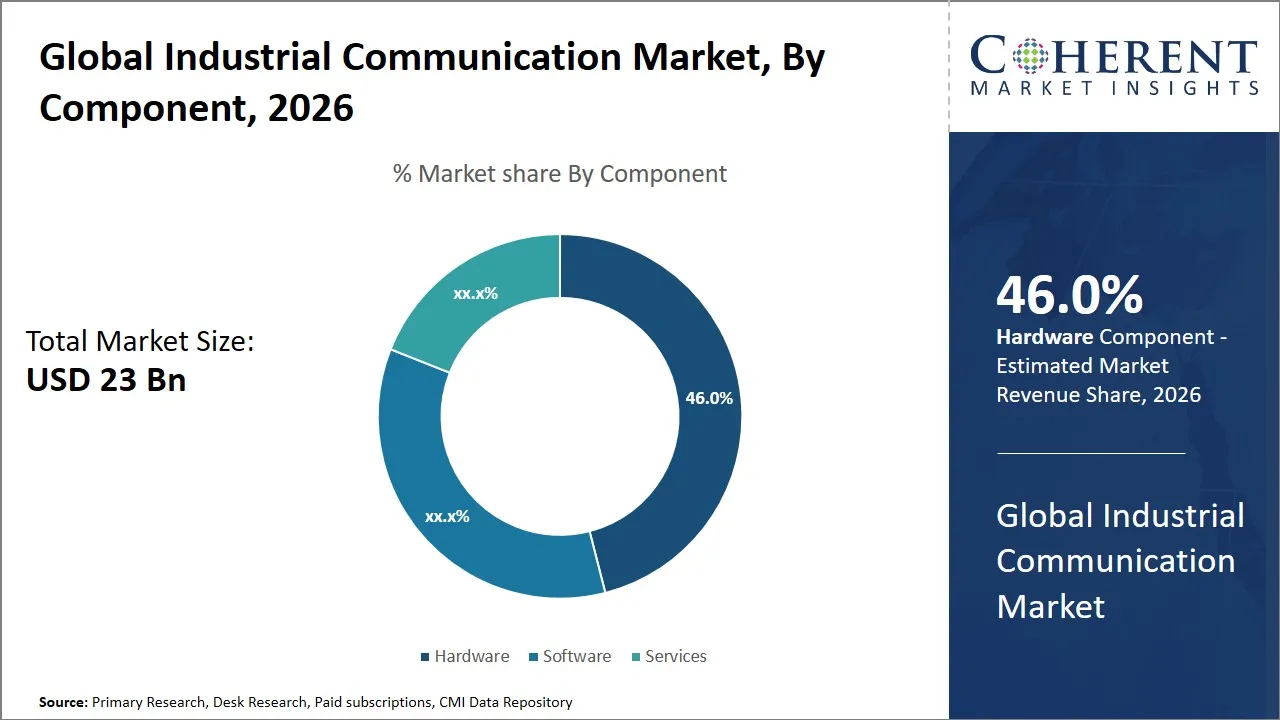
- The hardware segment is expected to account for 46% of the industrial communication market share in 2026.
- The fieldbus segment is estimated to capture 42% of the market share in 2026.
- The automotive segment is projected to hold 33% of the global industrial communication market share in 2026.
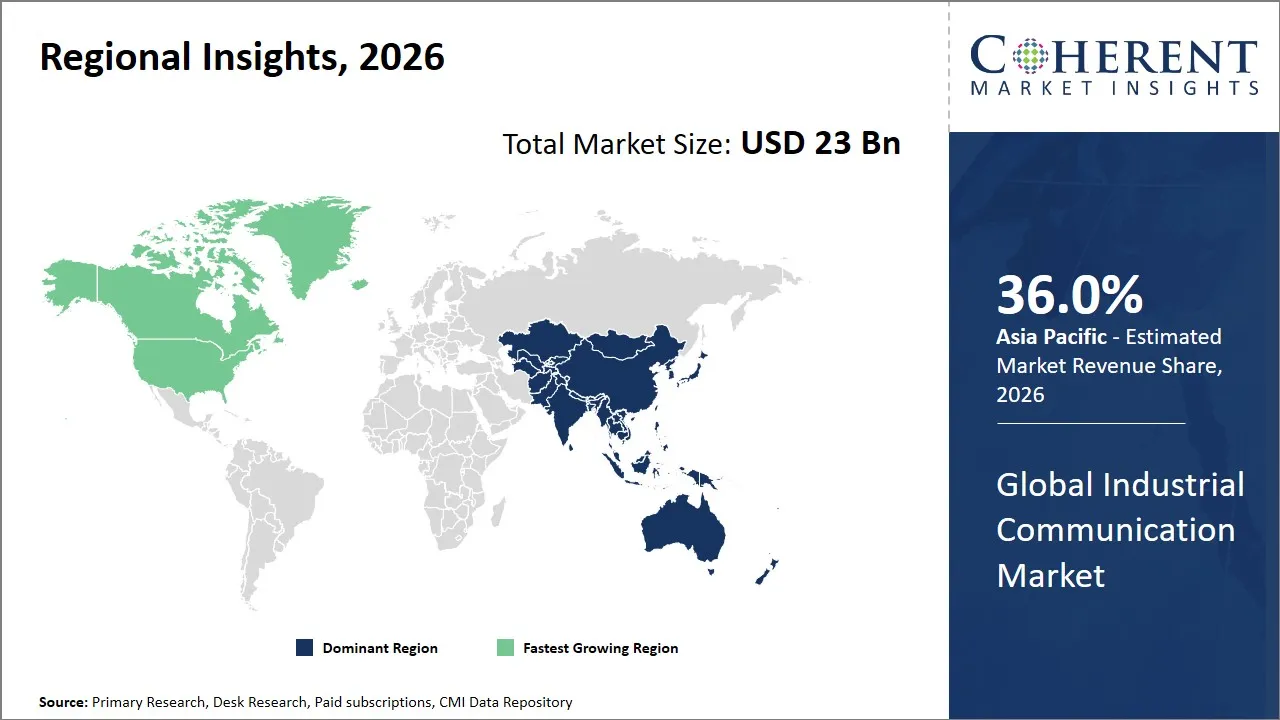
- Asia Pacific will dominate the industrial communication market in 2026 with an estimated 36% share
- North America will hold 25% share in 2026 and is expected to record the fastest growth over the forecast period.
Current Events and Its Impact
Current Events | Description and its Impact |
Siemens and NVIDIA Partnership Expansion |
|
Segmental Insights
- Current Industry Events of 2026
- Market Size Estimation
- Regional Breakdown
- Competitive Landscape
- Customer Intelligence
- Segmental Analysis
- Pricing Analysis
- Key Market Drivers, Challenges & Future Trends
- Customized Insights Section
Why Does the Hardware Segment Dominate the Global Industrial Communication Market in 2026?
The hardware segment is expected to account for 46.0% of the global industrial communication market share in 2026. The growth can be attributed to its foundational role in ensuring reliable and efficient data transmission in industrial environments. Found across factories and plants, equipment like routers, gateways, and sensors supports essential data flow within industrial operations. Because environments involve extreme temperatures, dust, or vibration, durability becomes a central factor in selecting components. Instead of convenience, performance under pressure shapes design choices. Long-term function matters more than initial cost when conditions challenge reliability.
For instance, on October 21, 2025, Rockwell Automation, Inc unveiled an exciting lineup of new technologies debuting at Automation Fair 2025. The line-up includes ControlLogix 5590 Controllers, EtherNet/IP In-cabinet Solution, M100 Electronic Motor Starter and PointMax I/O, Bulletin 5034 among others.
(Source: rockwellautomation.com)
Fieldbus Segment Dominates the Global Industrial Communication Market
The fieldbus segment is expected to account for 42.0% of the global industrial communication market share in 2026. Primarily, expansion stems from consistent availability along with trust built through years of use in factory automation systems. At its center, Fieldbus functions like a steady stream of information - exchanging messages between devices throughout industrial locations. Notable is its history: consistent reactions happen precisely when needed, maintaining processes that rely on exact moments. Because of this reliability, it stays commonly used even as fresh options appear.
Why is Automotive the Most Crucial End User in the Industrial Communication Market?
The automotive segment is expected to account for 33.0% of the market share in 2026. Driven by automation efforts, industry attention has shifted toward smarter systems. With digital tools becoming more central, operations rely on seamless data flow across factory floors. As electric and self-driving vehicle development advances, internal network speed gains importance. For intricate assembly processes, timing accuracy depends heavily on stable connections. Reliable communication supports synchronization where delays cannot be tolerated.
Industrial Cybersecurity Readiness Gap
Indicator | Approx. Value |
Organizations at “Mature” cybersecurity readiness | 4% |
Organizations anticipating disruption from cyber incidents | 71% expect disruption in next 12–24 months |
Percentage experiencing AI-related security incidents | 86% faced AI-related security incidents |
Organizations confident employees understand AI threats | 49% |
Workforce gap – cybersecurity professionals globally | ~4.76 million professionals short |
Organizations with necessary cyber talent | 14% report having needed talent to meet objectives |
Skills gap impact on security risk | ~59–58% say skills gaps significantly affect security |
Industrial/OT readiness for emerging threats | 14% fully prepared |
Industrial facilities with advanced ICS-aware controls | 13% have advanced controls |
Industrial orgs with full ICS Cyber Kill Chain visibility | 12.6% |
Operational disruptions from cyber incidents reported by industrial orgs | >20% report cyber incidents; 40% cause disruption |
Cybersecurity as an industrial business concern | 37% cite cyber risk as top obstacle |
Industrial workforce skill shortage cited as top challenge | 42% report skilled workforce shortage |
Regional Insights
Asia Pacific Industrial Communication Market Analysis and Trends
The Asia Pacific region is projected to lead the market with a 36% share in 2026. Growth stems from swift industrial advances, city development, along with broader manufacturing reach - especially within China, India, Japan, and parts of Southeast Asia. Driven by state strategies to renew industry, programs including "Made in China 2025" and "Make in India" encourage uptake of digital communication tools designed to lift output and streamline operations. Large-scale production networks now merge with rising automation trends, networked devices, plus intelligent plant systems, accelerating momentum. From another angle, affordable production expenses paired with better connectivity frameworks pull both local and overseas funding, expanding commercial possibilities. Key players such as Siemens AG, ABB Ltd., Mitsubishi Electric Corporation, and Huawei Technologies supply specialized data transmission methods suited to regional demands, adding sustained force behind market rise.
For instance, on July 25, 2024, Cisco and Rockwell Automation announced a collaboration to propel digital transformation of the industrial market in the Asia Pacific, Japan and Greater China region. The announcement was made as the two companies signed a Memorandum of Understanding (MOU) on the same.
(Source: rockwellautomation.com)
North America Industrial Communication Market Analysis and Trends
The North America region is expected to exhibit the fastest growth in the market contributing 25% share in 2026. The growth can be attributed to its well-established industrial ecosystem, advanced manufacturing infrastructure, and strong technological adoption. Despite slower growth elsewhere, this area stands out due to long-established markets where public policies actively encourage modern production technologies. Innovation continues without pause, guided by major firms based in countries such as the U.S. and Canada focused on automated systems and data exchange methods.
Firms including Rockwell Automation, Honeywell International Inc., and Cisco Systems operate widely across North America, shaping progress in network connectivity for factories through wired and wireless upgrades. Progress unfolds steadily, backed by strict compliance rules and well-developed physical networks that uphold reliable connections within industrial settings. Security and efficiency remain central, supported by frameworks designed to maintain seamless information flow across facilities.
Global Industrial Communication Market Outlook for Key Countries
Why is the U.S. Emerging as a Major Hub in the Industrial Communication Market?
Across many areas including car making, flight technology, and power systems, modern automated tools are commonly used throughout the U.S. economy. Firms such as Rockwell Automation and Honeywell shape progress through new approaches to network connectivity, radio-based links, while also improving defenses against digital threats within production environments. Steady movement forward arises from ongoing funding directed at testing novel approaches, supported by government plans encouraging linked production sites and modern operational techniques. Within this setting, an advantage persists in the way equipment shares data throughout fabrication stages.
Is China the Next Growth Engine for the Industrial Communication Market?
Change is visible in China’s industrial communications landscape, driven by persistent upgrades to manufacturing setups combined with a gradual shift toward automation. Within sprawling production regions, government-supported digital programs create openings for modern network systems to emerge. Companies such as Huawei and Siemens contribute significantly, offering strong connection platforms, specialized Ethernet structures, and 5G-enabled models supporting real-time data exchange on shop floors. Improved output becomes evident once these tools become part of routine workflows. Expansion persists while foundational systems adjust to evolving needs.
Germany Industrial Communication Market Analysis and Trends
Still ahead in Europe’s industrial communication sector, Germany draws strength from advanced manufacturing rooted in exacting engineering practices along with automated systems. Supported by national strategies including “Industry 4.0,” a robust network of industrial operations thrives across the region. Innovation moves forward through firms like Siemens AG and Phoenix Contact, instrumental in shaping communication protocols such as PROFINET together with wireless industrial networks. Because of these developments, high-level automation capabilities remain within reach on the world stage.
India Industrial Communication Market Analysis and Trends
Change shapes India's industrial communication sector, driven by rising spending and updates within industries such as car production, medicine making, and factory operations. Support from national programs, including the push behind "Make in India," along with work on transport and energy systems, encourages wider use of connected tools in factories. Firms such as ABB and Honeywell now play larger roles here, introducing systems meant to improve links between machines and output levels - handling outdated setups as well as fresh builds. Growth unfolds steadily, shaped less by sudden leaps and more by gradual integration into daily industrial routines.
Japan Industrial Communication Market Analysis and Trends
High reliability in industrial communications defines Japan's approach, shaped by exacting standards in manufacturing, robotic systems, and automated processes. Because of close cooperation among major industrial groups and tech developers, new communication methods emerge alongside connected device networks. Leading firms such as Mitsubishi Electric Corporation work closely with partners like Yokogawa Electric Corporation, advancing tools essential for complex production environments. These efforts sustain Japan’s position in automation progress without relying on exaggerated claims or fleeting trends.
Market Players, Key Development, and Competitive Intelligence
Key Developments
- On January 13, 2026, Siemens announced the acquisition of ASTER Technologies. This strategic move integrates ASTER’s advanced "shift-left" design for test (DFT) functionality directly into Siemens' Xpedition software and Valor software, part of the Siemens Xcelerator portfolio of industry software, establishing an unparalleled, comprehensive portfolio for electronic systems design.
- On November 12, 2025, Rockwell Automation, Inc. announced the launch of SecureOT solution suite, a comprehensive industrial cybersecurity offering designed to help manufacturers and critical infrastructure protect critical operations and build secure environments.
- On October 24, 2025, Siemens and rhobot.ai announced the next step in their collaboration with the commercial availability of their advanced AI solution for manufacturing.
Top Strategies Followed by Global Industrial Communication Market Players
Player Type | Strategic Focus | Example |
Established Market Leaders | Business Collaboration MOU Signing and Program Launch | On February 19, 2025, Cisco announced that it launched software-defined manufacturing, and has Memorandum of Understanding (MoU) with Rockwell Automation to launch a ‘Digital Skills for Industry’ skilling program.
|
Mid-Level Players | Business Acquisition | On November 17, 2025, HMS Networks AB announced the signing of an agreement with Molex to acquire part of their Industrial Solutions Business, consisting of several strategic assets. |
Small-Scale Players | Belden Product Launch | On November 20, 2025, Belden Inc., a leading global provider of complete connection solutions, announced the launch of new products designed to enhance performance, security and reliability across automation and smart infrastructure environments. |
Market Report Scope
Industrial Communication Market Report Coverage
| Report Coverage | Details | ||
|---|---|---|---|
| Base Year: | 2025 | Market Size in 2026: | USD 23 Bn |
| Historical Data for: | 2020 To 2024 | Forecast Period: | 2026 To 2033 |
| Forecast Period 2026 to 2033 CAGR: | 6% | 2033 Value Projection: | USD 35 Bn |
| Geographies covered: |
| ||
| Segments covered: |
| ||
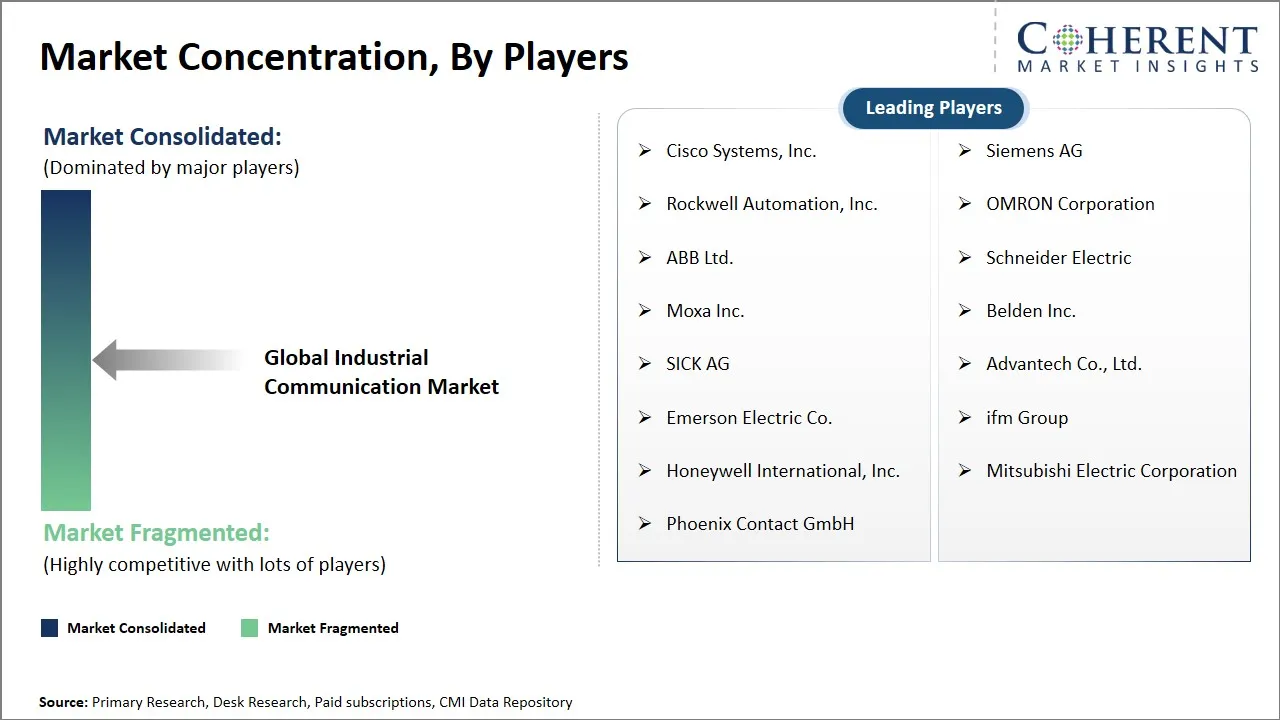
| Companies covered: | Cisco Systems, Inc., Siemens AG, Rockwell Automation, Inc., OMRON Corporation, ABB Ltd., Schneider Electric, Moxa Inc., Belden Inc., SICK AG, Advantech Co., Ltd., Emerson Electric Co., ifm Group, Honeywell International, Inc., Mitsubishi Electric Corporation, and Phoenix Contact GmbH | ||
| Growth Drivers: |
| ||
| Restraints & Challenges: |
| ||
Global Industrial Communication Market Dynamics
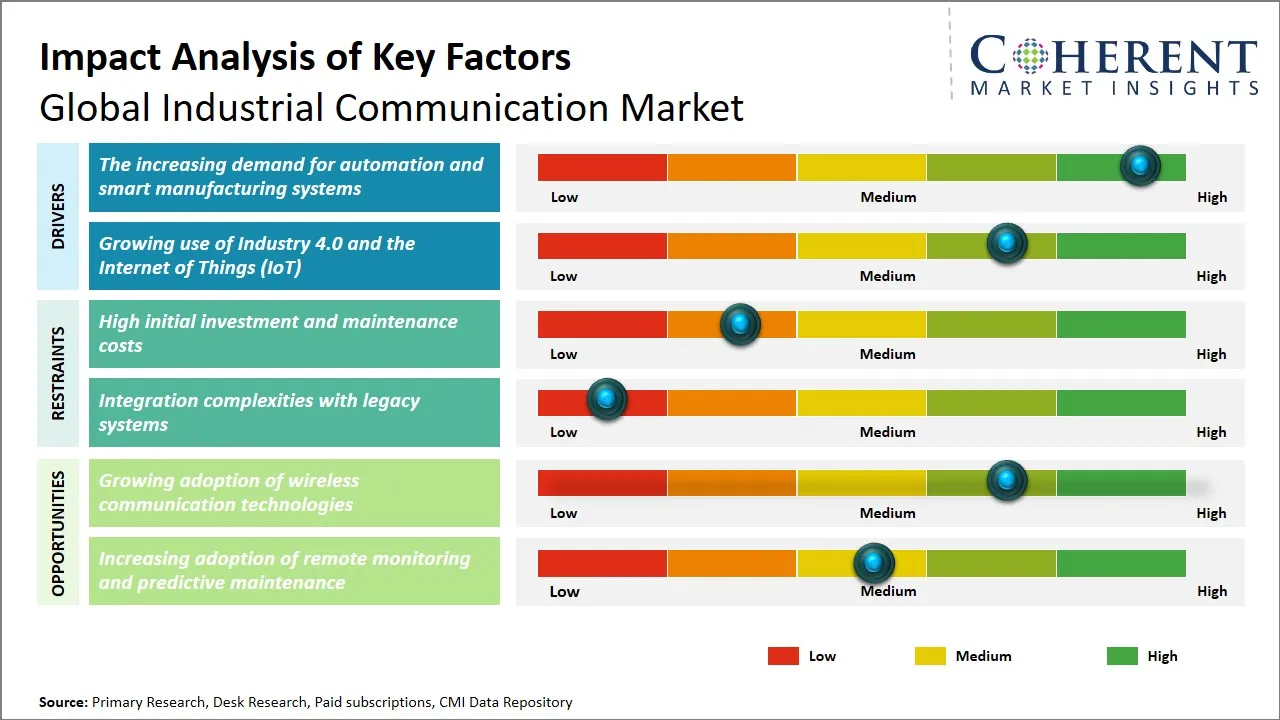
Global Industrial Communication Market Driver - The Increasing Demand for Automation and Smart Manufacturing Systems
The accelerating shift towards automation and smart manufacturing is a critical driver fueling the expansion of the industrial communication market. Industrial sectors are increasingly adopting advanced automation technologies to enhance operational efficiency, reduce downtime, and improve product quality. From machine to sensor, information flows best when strong links exist across factory systems. As factories adopt smarter methods, ways of staying connected - like wired industrial networks, radio-based signals, or internet-linked devices - take on larger roles. These paths allow constant observation, early warnings before failures, and adjustments during operations. Where once delays were common, now timing improves through steady digital contact.
For instance, on October 31, 2025, Samsung Electronics announced plans to create a new AI Megafactory in collaboration with NVIDIA, marking a major milestone in the company’s efforts to lead the global paradigm shift toward AI-driven manufacturing. By deploying more than 50,000 NVIDIA GPUs, AI will be embedded throughout Samsung’s entire manufacturing flow, accelerating development and production of next-generation semiconductors, mobile devices and robotics.
(Source: news.samsung.com)
Global Industrial Communication Market Opportunity - Growing Adoption of Wireless Communication Technologies
Despite older methods still being present, movement toward wireless infrastructure have become noticeable within industry communication networks. Because flexibility matters more now, businesses choose alternatives to fixed wiring, options like Wi-Fi or Zigbee gain ground slowly. Alongside these shifts, newer 5G setups begin appearing where speed and responsiveness count. Without reliance on cords, machines share information instantly under updated frameworks. Remote oversight becomes possible when signals travel freely through air instead of lines. Efficiency gains emerge not from novelty but from steady, uninterrupted flow of updates between devices.
For instance, on April 22, 2024, Phoenix Contact announced the extension of its industrial network portfolio with WLAN client modules in accordance with the Wi-Fi 6 (IEEE 802.11ax) technology standard. The new modules in the WLAN 1000 series support WLAN gross data rates up to 2,402 Mbps at 160 MHz bandwidth.
(Source: phoenixcontact.com)
Analyst Opinion (Expert Opinion)
- The global industrial communication market is entering a phase of accelerated modernization as industries prioritize digitalization, automation, and real-time data exchange. A shift toward digital manufacturing has manufacturers focusing on stable, fast, secure data flow. With automation expanding, reliance grows on networked devices operating without delay or disruption. Instead of older methods, many now adopt Ethernet solutions built for industrial demands. Wireless options appear more frequently wherever flexibility matters most. As machines generate vast data, processing near the source reduces delays significantly. Interconnection at the edge supports smoother coordination across production lines. Systems must work together seamlessly, prompting upgrades to unified standards.
- Despite persistent hurdles like cyber threats and outdated equipment compatibility, progress continues. Investment flows steadily into intelligent production systems, power oversight, and modernized facilities worldwide. Security-conscious providers emphasizing adaptability and uniform protocols position themselves ahead. Shifts unfold as connectivity moves beyond mere support toward shaping how operations withstand disruption. Decisions increasingly rely on information flow made possible through these networks. Growth expectations stay firm over time. What was once background now influences core performance.
Speak to the analyst
Want personalized insights?
Take the findings above to one of our principal consultants, or have the report rebuilt around the segments, geographies and competitors you actually track.
Market Segmentation
- Component Insights (Revenue, USD Billion, 2021 - 2033)
- Hardware
- Software
- Services
- Communication Protocol Insights (Revenue, USD Billion, 2021 - 2033)
- Fieldbus
- Industrial Ethernet
- Wireless
- End User Insights (Revenue, USD Billion, 2021 - 2033)
- Automotive
- Aerospace and Defense
- Food and Beverages
- Electrical and Electronics
- Pharmaceuticals and Medical Devices
- Oil and Gas
- Others
- Regional Insights (Revenue, USD Billion, 2021 - 2033)
- North America
- U.S.
- Canada
- Latin America
- Brazil
- Argentina
- Mexico
- Rest of Latin America
- Europe
- Germany
- U.K.
- Spain
- France
- Italy
- Russia
- Rest of Europe
- Asia Pacific
- China
- India
- Japan
- Australia
- South Korea
- ASEAN
- Rest of Asia Pacific
- Middle East
- GCC Countries
- Israel
- Rest of Middle East
- Africa
- South Africa
- North Africa
- Central Africa
- North America
- Key Players Insights
- Cisco Systems, Inc.
- Siemens AG
- Rockwell Automation, Inc.
- OMRON Corporation
- ABB Ltd.
- Schneider Electric
- Moxa Inc.
- Belden Inc.
- SICK AG
- Advantech Co., Ltd.
- Emerson Electric Co.
- ifm Group
- Honeywell International, Inc.
- Mitsubishi Electric Corporation
- Phoenix Contact GmbH
Sources
Primary Research Interviews
- Industrial Automation Engineers
- Communication Protocol Specialists
- Manufacturing Plant Managers
- Industrial IoT Solution Providers
Databases
- Industrial Automation Database
- Manufacturing Technology Database
- Industrial Communication Standards Database (IEEE)
- Global Industrial Equipment Database
Magazines
- Control Engineering Magazine
- Automation World
- Industrial Ethernet Book
- Manufacturing Automation
Journals
- IEEE Transactions on Industrial Informatics
- Journal of Manufacturing Systems
- Industrial Communication Networks Journal
Newspapers
- Industrial Equipment News
- Manufacturing Business Technology
- Automation News
- Plant Engineering News
Associations
- Industrial Internet Consortium (IIC)
- Open DeviceNet Vendor Association (ODVA)
- PROFIBUS & PROFINET International
- Ethernet Industrial Protocol Association
Public Domain Sources
- Government Industrial Statistics Portals
- International Electrotechnical Commission (IEC) Standards
- Industrial Communication White Papers
- Manufacturing Industry Research Publications
Proprietary Elements
- CMI Data Analytics Tool
- Proprietary CMI Existing Repository of information for last 8 years
Get access to 250+ pages report
Every segment, forecast, competitor profile and data table behind the analysis above — available for instant download.
- ESOMAR Member
- ISO 9001:2015 Certified
- D-U-N-S Registered
- GDPR & CCPA Compliant
Missing comfort of reading report in your local language? Find your preferred language:
Transform your Strategy with Exclusive Trending Reports
Frequently Asked Questions
The global industrial communication market is expected to stand at USD 23 Bn in 2026 and is expected to reach USD 35 Bn by 2033.
The CAGR of global industrial communication market is projected to be 6% from 2026 to 2033.
The increasing demand for automation and smart manufacturing systems and growing use of Industry 4.0 and the Internet of Things (IoT) are the major factors driving the growth of the global industrial communication market.
High initial investment and maintenance costs and integration complexities with legacy systems are the major factors hampering the growth of the global industrial communication market.
In terms of component, hardware is estimated to dominate the market revenue share in 2026.
Edge computing processes brings data closer to machines, reducing latency.
OPC UA is a standardized protocol for secure and interoperable data exchange.