

Global Industrial Wireless TSN Gateway Market Size and Forecast – 2026 to 2033
The global industrial wireless TSN gateway market is expected to grow from USD 420.0 Mn in 2026 to USD 1,350.0 Mn by 2033, registering a compound annual growth rate (CAGR) of 18.1% from 2026 to 2033. The global industrial wireless TSN gateway market is driven by Rising deployment of private 5G networks in factories. On May 27, 2026, TERAGO Inc. announced the successful deployment of an Ericsson Private 5G network in collaboration with Ericsson Enterprise Wireless Solutions at the McMaster Manufacturing Research Institute (MMRI).
Key Takeaways of the Global Industrial Wireless TSN Gateway Market
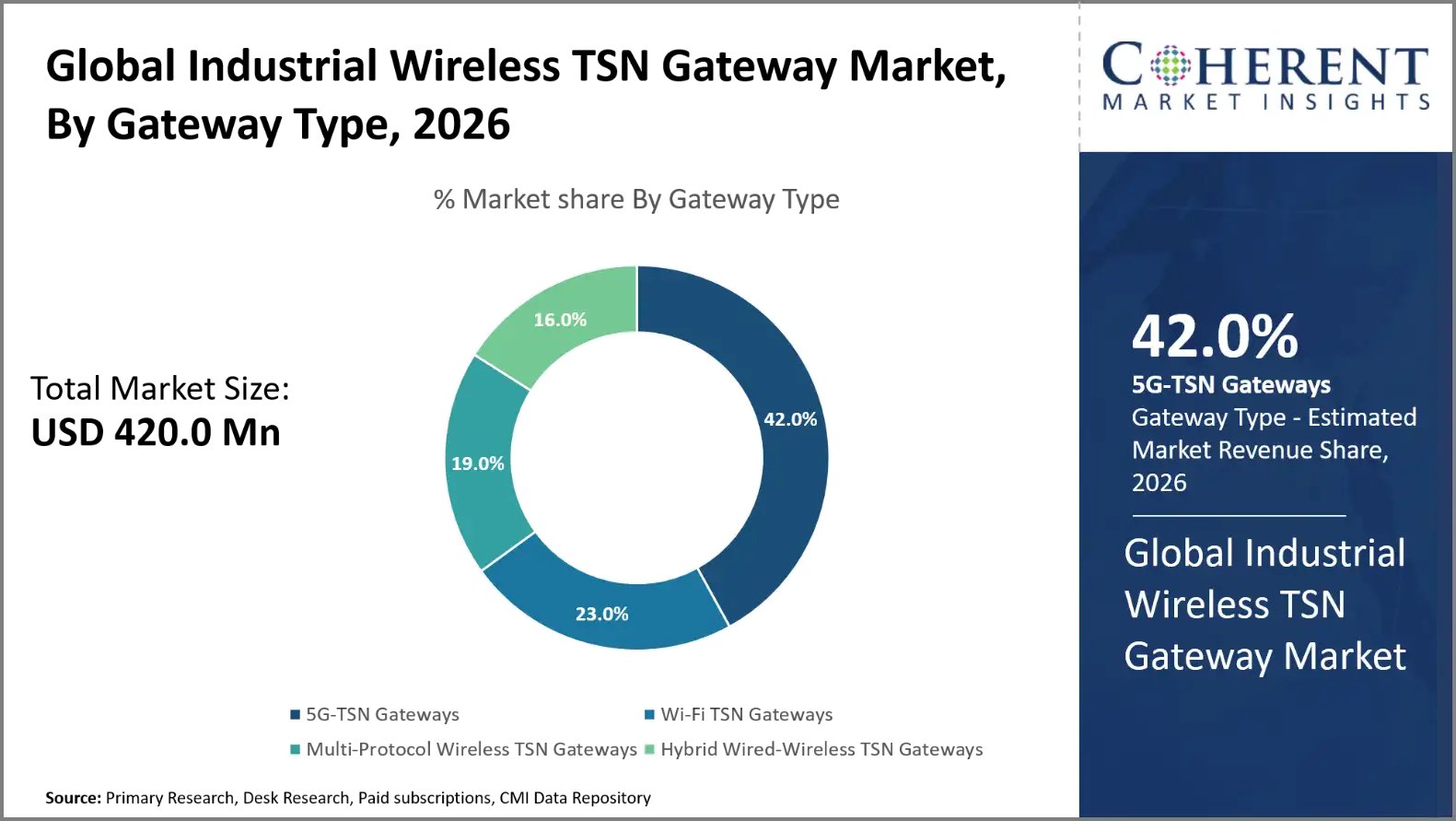
- The 5G-TSN Gateways segment is expected to account for 42.0% of the global industrial wireless TSN gateway market share in 2026. Increasing integration of autonomous mobile robots in manufacturing is driving the growth of the segment. On my 8, 2025, ForwardX Robotics announced that 435 autonomous mobile robots were operating at Chery Automobile's Dalian manufacturing facility. The deployment supports internal logistics across multiple automotive production workshops.
- The Hardware segment is estimated to capture 51.0% of the market share in 2026. Growing demand for real-time machine synchronization is majorly driving the growth of the segment. On January 14, 2026, ISL Networks announced plans to demonstrate an industrial 5G-TSN system at Smart Factory Expo 2026. The solution was jointly developed with Finnish 5G core technology company Cumucore.
- The Remote Connectivity Gateways segment is estimated to capture 39.0% of the market share in 2026. Expansion of industrial Internet of Things infrastructure is majorly driving the growth of the segment. On February 19, 2026, NTT DATA announced successful private 5G deployments across 50 Cargill manufacturing and processing sites globally. The infrastructure supports connected workers, industrial robotics, and operational data access.
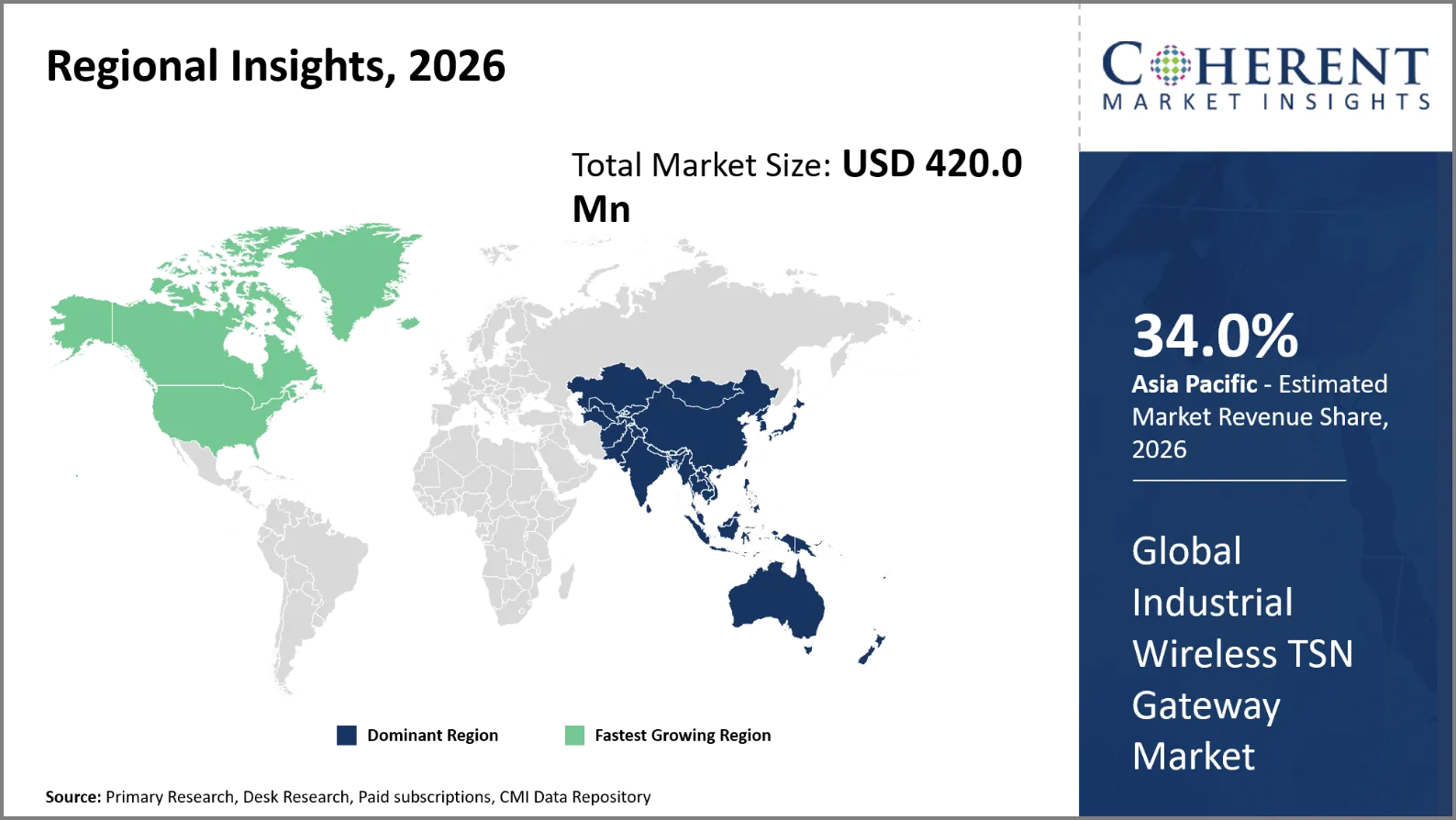
- Asia Pacific is expected to dominate the industrial wireless TSN gateway market in 2026 with a market share of 34.0%. Increasing adoption of TSN-enabled smart factory infrastructure in Asia Pacific is driving the growth of the regional market. On December 15, 2025, Advantech received CC-Link IE Field and CC-Link IE TSN Class A certifications for its industrial connectivity products. These certifications strengthen interoperability between factory automation equipment and support synchronized communication across smart manufacturing systems.
- North America is expected to account for 30.0% share in 2026 and is projected to record the fastest growth over the forecast period. Development of edge computing-enabled industrial gateways in North America is driving the growth of the regional market. On June 9, 2025, Rockwell Automation introduced its OptixEdge industrial gateway for processing machine data locally. The solution connects with FactoryTalk Optix software to collect, analyze, and transmit operational information.
Segmental Insights
Why Does 5G-TSN Gateways Dominate the Global Industrial Wireless TSN Gateway Market?
The 5G-TSN gateways segment is expected to account for 42.0% of the global industrial wireless TSN gateway market share in 2026. 5G-TSN gateways are widely used because manufacturers need deterministic communication, ultra-low latency, and reliable wireless connectivity. These gateways merge fifth-generation mobile networks with Time-Sensitive Networking capabilities. They allow for synchronous communication between industrial robots, automated production line and mobile machines. Their wireless topology lowers the need for massive industrial cabling. It also features variable manufacturing layouts and real-time coordination between connected equipment. Growing investments in smart manufacturing and Industrial Internet of Things infrastructure drive their adoption.
On June 3, 2025, Fraunhofer Institute FOKUS, in partnership with Deutsche Telekom AG and MediaTek Inc. successfully integrated TSN standards into a 5G test network. A complete end-to-end TSN system for private 5G networks is provided, spanning from the software-based core network through the radio access network (RAN) to the user equipment. It is suitable for applications requiring deterministic data packet communication, such as robot control in factory shopfloors.
- Current Industry Events of 2026
- Market Size Estimation
- Regional Breakdown
- Competitive Landscape
- Customer Intelligence
- Segmental Analysis
- Pricing Analysis
- Key Market Drivers, Challenges & Future Trends
- Customized Insights Section
Why is Hardware the Most Crucial Component?
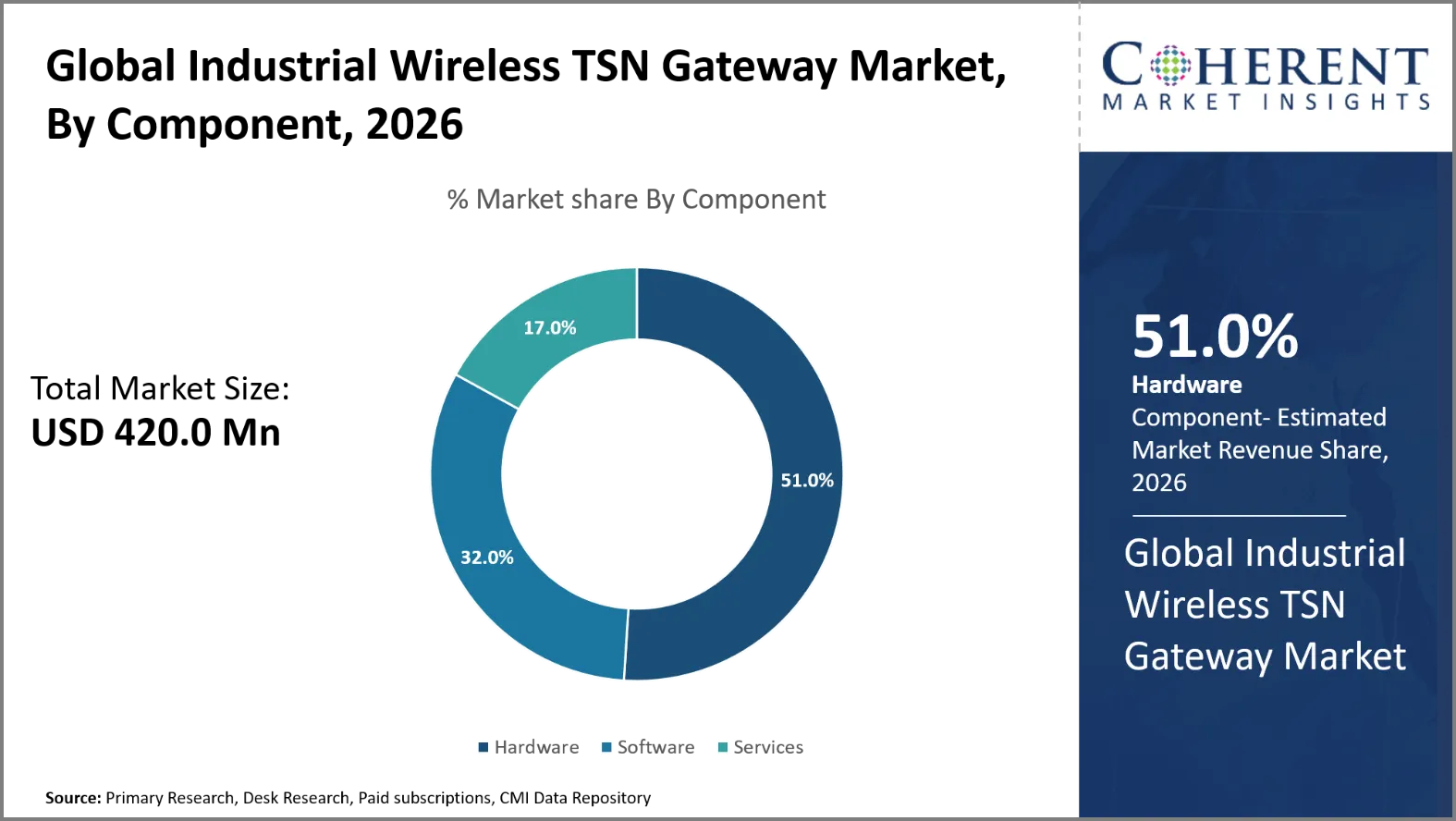
The hardware segment is expected to account for 51.0% of the global industrial wireless TSN gateway market share in 2026. The most important component is hardware, since the industrial wireless TSN connection needs special physical infrastructure. Gateways require powerful CPUs, wireless communication modules, Ethernet ports and synchronization components. These characteristics provide reliable packet delivery and predictable network behavior. Industrial grade hardware can also tolerate harsh operating environments including temperature variations and electromagnetic interference. Advanced hardware makes the network more reliable, more secure and compatible with existing automation technology. Connected industrial devices are also increasingly being deployed which drives demand for hardware.
On March 4, 2025, Telit Cinterion announced the introduction of its FE990D and FN990D 5G modules and data cards. Both models are equipped with Qualcomm X85 and X82 5G modem-radio technologies. They support 3GPP Release 18 and artificial intelligence-assisted traffic prioritization. These modules provide high-performance wireless connectivity for industrial equipment and gateway manufacturers.
Remote Connectivity Gateways Dominates the Global Industrial Wireless TSN Gateway Market
The remote connectivity gateways segment is expected to account for 39.0% of the global industrial wireless TSN gateway market share in 2026. Remote connectivity gateways dominate because modern industrial facilities increasingly require centralized monitoring and distributed equipment management. These gateways connect equipment, sensors, and control systems located in different geographic locations to industrial networks. They allow operators to remotely monitor manufacturing activity and troubleshoot equipment. They eliminate the need for maintenance and allow for faster operating choices. Remote connectivity is also good for offshore installations, mining activities, utilities, and major manufacturing units. Demand for remote connection gateways is driven by increasing usage of connected industrial infrastructure.
On July 28, 2025, Helios Technologies, under its Enovation Controls business, launched the Atlas Connect Gateway. The gateway allows equipment manufacturers to access operational data, send remote commands and update field equipment software. It also offers remote diagnostics and real-time system intelligence.
Current Events and their Impact
Current Events | Description and its Impact |
European Union Cyber Resilience Act, 2024 Regulation (EU) 2024/2847 |
|
European Union Radio Equipment Directive Cybersecurity Requirements Commission Delegated Regulation (EU) 2022/30 |
|
Industrial Wireless TSN Gateway Market Dynamics
Market Drivers
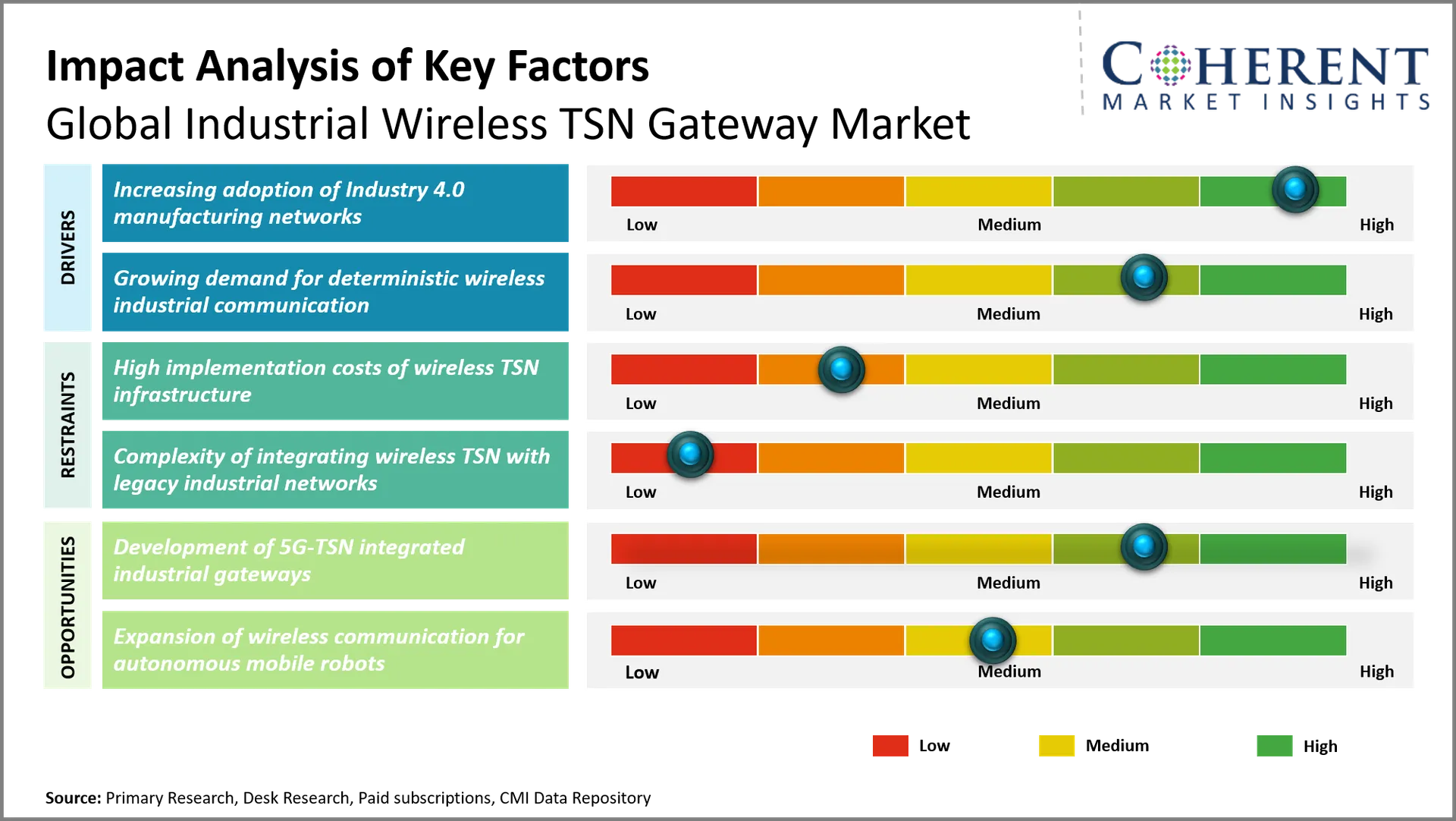
- Increasing adoption of Industry 4.0 manufacturing networks: Demand for industrial wireless TSN gateways is driven by the increasing adoption of Industry 4.0 manufacturing networks. Producers are networking industrial robots, automated machines, sensors and production control systems together. These interconnected environments demand dependable communication among scattered equipment. Wireless TSN gateways enable synchronized data sharing and flexible manufacturing layouts. They also eliminated the need for heavy industrial cabling. Investments are growing in smart factories, predictive maintenance and autonomous manufacturing, driving the usage of gateways.
- On February 12, 2025, Cumucore announced it is revolutionizing industrial automation with Time-Sensitive Networking (TSN) over 5G, delivering wireless connectivity equal to wired networks. Traditional Ethernet systems are limited in mobility, but Wi-Fi is not deterministic.
- Growing demand for deterministic wireless industrial communication: Industrial automation requires increasingly predictable communication with controlled latency and minimum packet loss. Traditional wireless networks usually do not meet the requirements of time-critical industrial applications. Industrial Wireless TSN Gateways integrate wireless connectivity with Time-Sensitive Networking functionalities. They allow coordinated communication between robotic systems, automated guided vehicles and machine-control equipment. These gateways enhance the coordination of mobile and stationary industrial devices. The increasing use of autonomous industrial systems is driving more need for deterministic wireless communication infrastructure.
- On June 3, 2026, STRATUM 9 announced its industrial-grade DECT NR+ gateway for mobile real-time applications. The gateway connects DECT NR+ wireless networks to existing Ethernet infrastructure. It has scheduled wireless access to guaranty predictable latency for mobile industrial systems.
Emerging Trends
- Rising Development of Reusable High-Thrust Propulsion Technologies: Industrial manufacturers are incorporating private 5G networks with Time-Sensitive Networking to facilitate synchronized wireless communication, mobile robotics, autonomous vehicles, and flexible production settings.
- Impact: The integration increases the reliability of communication, eliminates cabling and supports the coordinated operation of mobile gear and stationary automation equipment.
- Relevance to the market: Companies such as Siemens and Moxa are creating industrial 5G connection solutions, which strengthens the potential for gateways that offer deterministic wireless communication.
- Growing adoption of multi-protocol industrial wireless gateways: Gateway manufacturers are supporting multiple industrial communication protocols to facilitate seamless connectivity between legacy machinery, modern automation systems, wireless sensors, and cloud-connected industrial platforms.
- Impact: Multi-protocol compatibility allows integration of industrial networks, minimizes equipment replacement needs, and enhances communication across heterogeneous manufacturing systems.
- Relevance to the market: Demand for flexible connection across Ethernet, serial interfaces, and cellular networks is seen in Moxa and Belden industrial gateway portfolios.
Regional Insights
Why is Asia Pacific a Strong Market for Industrial Wireless TSN Gateway?
Asia Pacific is expected to account for a market share of 34.0% in 2026. The Asia Pacific region is benefitting from heavy smart manufacturing investment and rising enterprise 5G rollouts. Thailand shows industrial connectivity adoption with AIS and Alliance Laundry Systems. They have 300+ devices connected over 5G mmWave at their manufacturing plant. Another example of growth provided by Indonesia is the smart manufacturing collaboration by Telkomsel and Pegatron in Batam. According to GSMA, manufacturing is the biggest potential winner of regional 5G industrial applications. These advances generate potential for gateways that support synchronized machinery, industrial sensors and automated production equipment. Regional manufacturers increasingly require dependable wireless infrastructure for connected factory operations.
Why Does North America Industrial Wireless TSN Gateway Market Exhibit High Growth?
North America, registering the fastest growth with a CAGR of 19.2% over the forecast period, is projected to account for 30.0% of the global industrial wireless TSN gateway market in 2026. The region benefits from industrial private network deployments and growing demand for wireless factory modernization. In August 2024, the U.S. National Institute of Standards and Technology announced research on an industrial private 5G testbed. Its research is centered on deterministic wireless distribution for production control, logistics tracking and heavy machinery management. John Deere also deployed private 5G connectivity at its Davenport Works manufacturing plant in Iowa. The plant is over 2.2 million square feet and runs eight production lines. These advances present opportunities for gateways to support mobile equipment, industrial control and dependable wireless communication.
Global Industrial Wireless TSN Gateway Market Outlook for Key Countries
Why is China Emerging as a Major Hub in the Industrial Wireless TSN Gateway Market?
China benefits from government-backed 5G manufacturing development and widespread industrial internet integration. The Ministry of Industry and Information Technology selected another 400 5G manufacturing projects in 2024. These projects included 39 industrial sectors, with investment of more than USD 3.29 billion. They are used for equipment maintenance, production efficiency management, problem diagnostics and coordinated industrial activities. It also stated that it had over 15,000 industrial internet projects integrating 5G technology. These advances lead to demand for gateways between industrial controllers, sensors and automated production equipment.
Is U.S. the Next Growth Engine for the Industrial Wireless TSN Gateway Market?
In the U.S. market, there are advantages to private sector investment in cellular infrastructure at big industrial production sites. Hitachi Rail launched a private 5G network in September 2025 at its advanced manufacturing site in Hagerstown, Maryland. GlobalLogic and Ericsson put in the network across around 307,000 square feet. The infrastructure enables industrial automation, worker safety, digital twin, and sophisticated inspection applications. The rollout is indicative of the growing need for dependable wireless connectivity throughout the various intricacies of manufacturing floors. These expenditures are creating opportunities for gateways that integrate industrial Ethernet, wireless connectivity and time-sensitive data delivery.
Germany Industrial Wireless TSN Gateway Market Analysis and Trends
Germany has industrial campus networks, high-end robotics and research on wireless manufacturing interoperability. In February 2024, Kontron commissioned a commercial 5G campus network at its manufacturing and warehouse sites in Augsburg. The deployment uses an integrated 5G standalone core for secure industrial connectivity. Separately, Deutsche Telekom introduced commercial 26 GHz millimeter-wave services for industrial customers in June 2024. Its demonstration connected autonomous industrial machines and robots at Berlin's Werner-von-Siemens Centre. These developments encourage demand for gateways supporting high-capacity wireless communication and industrial network integration.
Japan Industrial Wireless TSN Gateway Market Analysis and Trends
Japan is also benefiting from the digitalization of automobile factories and research into continuous wireless connection for moving industrial equipment. In November 2024, the National Institute of Information and Communications Technology, NEC, Tohoku University, and Toyota Motor East Japan demonstrated their SRF wireless platform. Testing was carried out in the Miyagi Ohira plant of Toyota Motor East Japan. The technology enables the automated guided vehicle to move easily from public cellular networks to the local 5G. This will prevent communication loss when equipment is moving. Such developments strengthen opportunities for gateways supporting network redundancy, mobility management, and continuous industrial data transmission.
South Korea Industrial Wireless TSN Gateway Market Analysis and Trends
South Korea benefits from semiconductor manufacturing, advanced automotive production, and industrial private 5G innovation. Samsung Electronics and Hyundai Motor Company performed an industrial Reduced Capability testing on private 5G in February 2025. The development followed private 5G deployment at Hyundai's Ulsan manufacturing facility. The plant produces approximately 6,000 vehicles daily. Reduced Capability technology allows more efficient communication of lesser complexity industrial devices. These improvements present prospects for tiny wireless gateways that connect sensors, production equipment and mobile industrial devices.
Global Industrial Wireless TSN Gateway Market - 5G Modem-Integrated TSN Gateways (Kontron)
Metric | Value/Data | Technical significance |
Gateway manufacturer | Kontron | Industrial gateway supplier |
Product | KCell | Industrial 5G cellular gateway |
Cellular generation | 5G NR | High-speed wireless connectivity |
3GPP release | Release 17 | Supports advanced 5G network capabilities |
5G standalone download | Up to 4.95 Gbps | High-speed downstream communication |
5G standalone upload | Up to 550 Mbps | Industrial data transmission |
5G bandwidth | 200 MHz downlink, 100 MHz uplink | Available channel bandwidth |
MIMO configuration | 4×4 downlink, 2×2 uplink | Multiple-antenna communication |
Modulation | 256QAM | Higher spectral efficiency |
How is Development of 5G-TSN Integrated Industrial Gateways Creating New Growth Opportunities in the Industrial Wireless TSN Gateway Market?
Development of 5G-TSN integrated industrial gateways presents prospects for solving synchronization problems in wireless machine-control settings. The gateways integrate 5G connectivity with IEEE 802.1AS time synchronization and IEEE 802.1Qbv planned traffic features. The integration allows firms to choreograph robotic welding, precise assembly and mobile manufacturing equipment without substantial fixed cabling. 5G systems and industrial TSN architectures are being integrated under the 5G-ACIA partnership. Time-aware scheduling, seamless handover, deterministic traffic management are ways for gateway makers to differentiate their solutions. These features enable applications in automotive production, semiconductor fabrication and flexible manufacturing cells with synchronized wireless control.
In February 2025, Cumucore reported an end-to-end 5G-TSN implementation involving Intel and Kontron. The architecture integrated a Network-Side TSN Translator with the 5G User Plane Function. A Device-Side TSN Translator connected the industrial endpoint.
Market Players, Key Development, and Competitive Landscape
Key Developments
- On May 26, 2026, Lantronix Inc. announced the launch of its new NTC-550 Series ruggedized industrial IoT gateways, which combine ultra-fast 5G connectivity and networking with the robust performance of Wi-Fi, serial and I/O interfaces for use in the rapidly growing market of remote, challenging and off-grid environments.
- On April 13, 2026, Belden Inc. announced it is showcasing a groundbreaking demonstration of the world's first 5G industrial switch specifically designed for use on the factory floor. The BRS-5G industrial switch powered by Qualcomm Technologies will be unveiled as a concept at Hannover Messe, the world’s leading trade fair for the manufacturing industry.
- On February 24, 2026, Murata Manufacturing Co., Ltd, SoftBank Corp. and CC-Link Partner Association (CLPA) successfully demonstrated TSN over 5G, a technology that enables Time-Sensitive Networking (TSN) over a 5G network. This marks the world’s first successful demonstration of TSN over 5G conducted by a mobile network operator.
Competitive Landscape
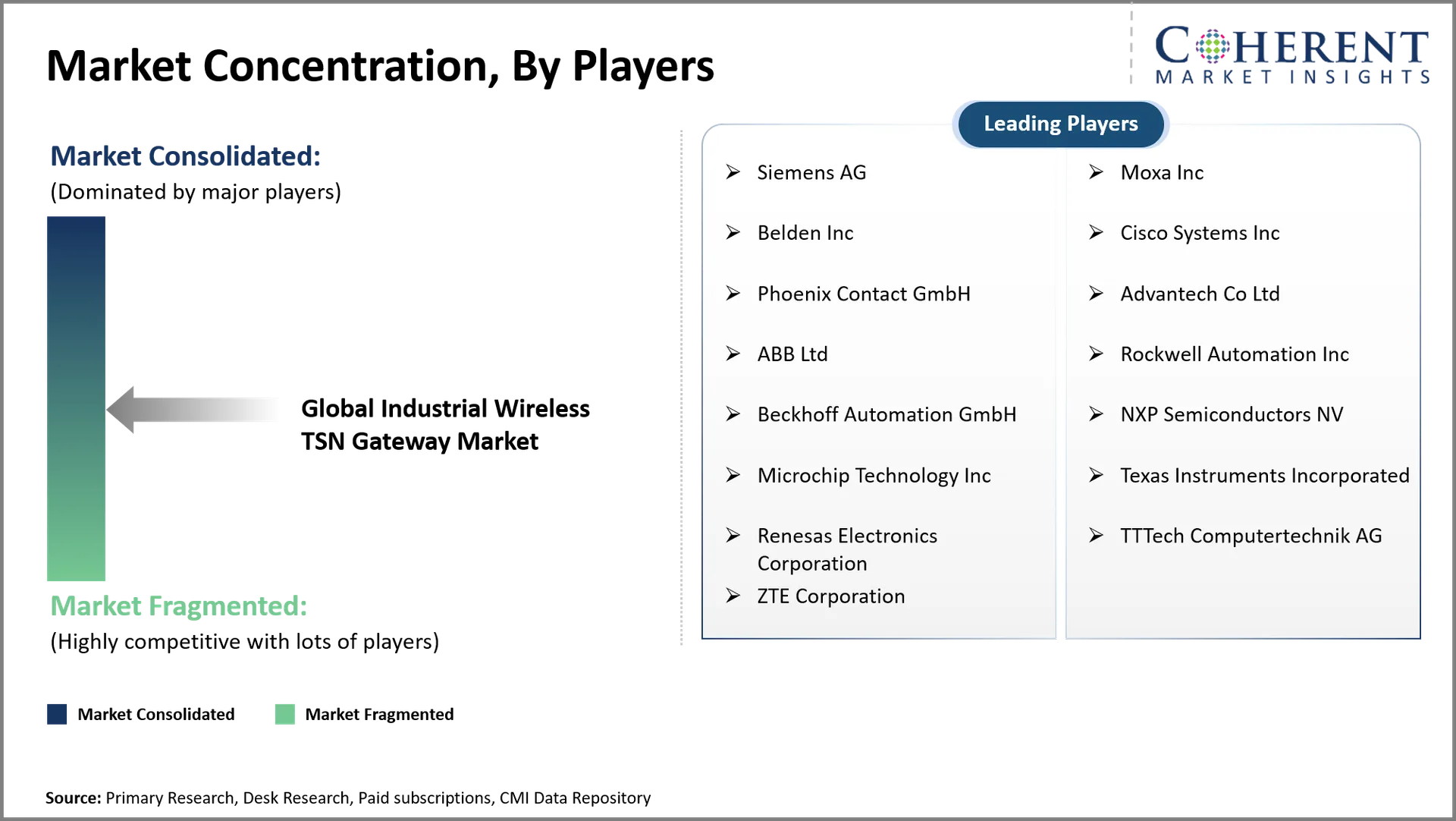
The global industrial wireless TSN gateway market features established automation companies and specialized industrial networking suppliers. Siemens AG focuses on private 5G infrastructure, industrial routers, and integrated automation connectivity. Its SCALANCE MUB852-1, MUM853-1 and MUM856-1 routers are designed for mobile machinery and industrial applications. Moxa Inc. stands out with its TSN-enabled networking equipment, interoperability and competence in industrial communication. The TSN-G5000 series enables deterministic Ethernet networking, and its partnership with industrial technology partners helps to improve ecosystem compatibility. Belden Inc. focuses on industrial networking using its Hirschmann portfolio, with a focus on rugged connection, network stability and industrial Ethernet integration. Cisco Systems, Inc. targets private 5G infrastructure and enterprise connectivity for manufacturing, logistics, and industrial mobility. Its strategy combines wireless networking with existing enterprise infrastructure. These companies compete through industrial protocol compatibility, cybersecurity, synchronization accuracy, and integration capabilities.
Top Manufacturers and Notable Products in the Industrial Wireless TSN Gateway Market
Manufacturer | Notable Product | Key features |
Kontron | KCell 5G Gateway | 5G Release 17, optional TSN support, 4.95 Gbps download, dual 2.5 Gigabit Ethernet ports, integrated VPN, DIN-rail mounting |
Moxa | CCG-1510-T | Private 5G connectivity, dual SIM, serial-to-5G conversion, Ethernet-to-5G conversion, dual Gigabit Ethernet, wide-temperature operation |
Siemens | SCALANCE MUM853-1 and MUM856-1 | Industrial private 5G connectivity, secure communications, mobile equipment connectivity, industrial network integration |
Teltonika Networks | TRB501 Industrial 5G Gateway | 5G Release 16, 2.5 Gbps Ethernet, carrier aggregation, Modbus, DNP3, DLMS, remote management |
Cumucore | TSN over 5G Platform | Network-side and device-side TSN translators, IEEE 802.1AS synchronization, 5G LAN, Ethernet PDU sessions, centralized network configuration |
Market Report Scope
Global Industrial Wireless TSN Gateway Market Report Coverage | |||
Report Coverage | Details | ||
Base Year | 2025 | Market Size in 2026: | USD 420.0 Mn |
Historical Data For: | 2020 To 2024 | Forecast Period: | 2026 To 2033 |
Forecast Period 2026 To 2033 CAGR: | 18.10% | 2033 Value Projection: | USD 1,350.0 Mn |
Geographies covered: |
| ||
Segments covered: |
| ||
Companies covered: | Siemens AG, Moxa Inc, Belden Inc, Cisco Systems Inc, Phoenix Contact GmbH, Advantech Co Ltd, ABB Ltd, Rockwell Automation Inc, Beckhoff Automation GmbH, NXP Semiconductors NV, Microchip Technology Inc, Texas Instruments Incorporated, Renesas Electronics Corporation, TTTech Computertechnik AG, ZTE Corporation | ||
Growth Drivers: |
| ||
Restraints & Challenges: |
| ||
Analyst Opinion (Expert Opinion)
- The future of the industrial wireless TSN gateway industry will depend on integrating deterministic networking with flexible wireless infrastructure. Standalone wireless connectivity will increasingly require coordination with industrial control systems. Gateway manufacturers will need to deliver predictable packet scheduling, precise clock synchronization, and uninterrupted communication during device mobility. Hybrid 5G-TSN architectures will become particularly important for production environments combining stationary machinery and autonomous equipment. Product differentiation will increasingly depend on interoperability, cybersecurity, and industrial-grade reliability.
- The maximum opportunity will emerge in 5G-TSN integrated hardware gateways, particularly for automotive manufacturing, semiconductor fabrication, and intralogistics automation. China, Germany, South Korea, and the U.S. offer attractive opportunities because of their specialized manufacturing ecosystems. Automotive factories require synchronized robotic operations and autonomous material handling. Semiconductor facilities need precise equipment coordination and uninterrupted communication. Intralogistics operators need reliable communication across moving vehicles and automated storage. Manufacturers should pay attention to gateways with support for IEEE 802.1AS synchronization, IEEE 802.1Qbv scheduling and 5G standalone connection.
- Players should concentrate on relationships with industrial automation manufacturers, private 5G operators and semiconductor networking providers. They should design gateways that are compatible with PROFINET, OPC UA, EtherNet/IP and Modbus TCP. Product differentiation can be driven by investment in hardware-level synchronization, secure firmware and redundant wireless connectivity. Before commercial releases, companies have to demonstrate interoperability with programmable logic controllers and industrial robots. Regional engineering support and application specific settings help speed up customer acceptance. Suppliers should also develop migration solutions connecting legacy wired equipment with emerging wireless TSN infrastructure.
Speak to the analyst
Want personalized insights?
Take the findings above to one of our principal consultants, or have the report rebuilt around the segments, geographies and competitors you actually track.
Market Segmentation
- Gateway Type Insights (Revenue, USD Million, 2021 - 2033)
- 5G-TSN Gateways
- Wi-Fi TSN Gateways
- Multi-Protocol Wireless TSN Gateways
- Hybrid Wired-Wireless TSN Gateways
- Component Insights (Revenue, USD Million, 2021 – 2033)
- Hardware
- Software
- Services
- Primary Function Insights (Revenue, USD Million, 2021 - 2033)
- Remote Connectivity Gateways
- Protocol Conversion Gateways
- Deterministic Synchronization Gateways
- Edge Computing Gateways
- Secure Access Gateways
- Deterministic Capability Insights (Revenue, USD Million, 2021 - 2033)
- Standard Low-Latency Communication
- Time-Synchronized Communication
- Deterministic Scheduled Communication
- Redundant Deterministic Communication
- Application Insights (Revenue, USD Million, 2021 - 2033)
- Discrete Manufacturing Control
- Process Industry Monitoring
- Warehouse Logistics
- Mobile Robot Communication
- Industrial Machine Coordination
- End User Insights (Revenue, USD Million, 2021 - 2033)
- Automotive Manufacturing
- Electronics and Semiconductor Manufacturing
- Aerospace Manufacturing
- Food and Beverage Manufacturing
- Pharmaceutical Manufacturing
- Energy and Utilities
- Regional Insights (Revenue, USD Million, 2021 - 2033)
- North America
- U.S.
- Canada
- Latin America
- Brazil
- Argentina
- Mexico
- Rest of Latin America
- Europe
- Germany
- U.K.
- Spain
- France
- Italy
- Russia
- Rest of Europe
- Asia Pacific
- China
- India
- Japan
- Australia
- South Korea
- ASEAN
- Rest of Asia Pacific
- Middle East
- GCC Countries
- Israel
- Rest of Middle East
- Africa
- South Africa
- North Africa
- Central Africa
- North America
- Key Players Insights
- Siemens AG
- Moxa Inc
- Belden Inc
- Cisco Systems Inc
- Phoenix Contact GmbH
- Advantech Co Ltd
- ABB Ltd
- Rockwell Automation Inc
- Beckhoff Automation GmbH
- NXP Semiconductors NV
- Microchip Technology Inc
- Texas Instruments Incorporated
- Renesas Electronics Corporation
- TTTech Computertechnik AG
- ZTE Corporation
Sources
Primary Research Interviews
- Industrial Automation Equipment Manufacturers
- TSN Gateway Solution Providers & System Integrators
- Industrial IoT & Network Infrastructure Specialists
- End-User Industry Representatives (Manufacturing, Oil & Gas, Energy)
Magazines
- Control Engineering Magazine
- Industrial Automation Magazine
- IEEE Spectrum
- Automation World
Journals
- IEEE Transactions on Industrial Informatics
- Journal of Network and Computer Applications
- International Journal of Industrial Automation and Robotics
Associations
- Industrial Internet Consortium (IIC)
- IEEE Standards Association (IEEE SA)
- PROFIBUS & PROFINET International (PI)
- International Society of Automation (ISA)
Public Domain Sources
- U.S. Department of Energy – Industrial Technology Reports
- European Commission – Digital Industry & Automation Policy Reports
- National Institute of Standards and Technology (NIST) – Networking Standards Documentation
- IEEE 802.1 TSN Standards Working Group Publications
Proprietary Elements
- CMI Data Analytics Tool
- Proprietary CMI Existing Repository of Information for the Last 10 Years
Get access to 250+ pages report
Every segment, forecast, competitor profile and data table behind the analysis above — available for instant download.
- ESOMAR Member
- ISO 9001:2015 Certified
- D-U-N-S Registered
- GDPR & CCPA Compliant
Frequently Asked Questions
The global industrial wireless TSN gateway market is expected to stand at USD 420.0 Mn in 2026 and is expected to reach USD 1,350.0 Mn by 2033.
The CAGR of the global industrial wireless TSN gateway market is projected to be 18.1% from 2026 to 2033.
Increasing adoption of Industry 4.0 manufacturing networks and Growing demand for deterministic wireless industrial communication are the major factors driving the growth of the global industrial wireless TSN gateway market.
High implementation costs of wireless TSN infrastructure and Complexity of integrating wireless TSN with legacy industrial networks are the major factors hampering the growth of the global industrial wireless TSN gateway market.
In terms of gateway type, 5G-TSN gateways segment is estimated to dominate the market revenue share in 2026.
An industrial wireless TSN gateway connects wireless networks with deterministic industrial communication systems.
Its primary function is maintaining synchronized, predictable data communication between connected industrial devices.