
Global Iron and Steel Market Size and Forecast – 2026 To 2033
The Global Iron and Steel Market is estimated to be valued at USD 1,985.68 Bn in 2026 and is expected to reach USD 2,588.5 Bn by 2033, growing at a compound annual growth rate (CAGR) of 3.86% from 2026 to 2033. Market expansion is supported by urbanization, infrastructure investments, and continued steel consumption across construction, automotive, and industrial manufacturing. Steel producers are also modernizing production facilities to improve operating efficiency, product quality, and supply reliability.
In September 2026, Nippon Steel announced that U. S. Steel Kosice in Slovakia had approved an investment of approximately USD 1.01 Bn in a new electric arc furnace and air separation unit, with furnace operations expected to begin in 2030. This investment highlights the industry's transition toward more efficient, lower-emission steelmaking technologies and its focus on long-term manufacturing competitiveness.
Key Takeaways of the Global Iron and Steel Market
- Steel Products are projected to grow at an estimated CAGR of 3.9% during 2026–2033 and account for 95.8% of the global iron and steel market in 2026. Their strength, formability, and broad industrial applications support greater commercial use than cast iron. In March 2026, Jindal Steel completed its Angul expansion, doubling the plant's steelmaking capacity to 12 million tonnes annually.
- Carbon and Non-Alloy Steel, with an estimated CAGR of 3.6% during 2026–2033, is expected to represent 76.2% of the steel grade segment in global iron and steel market. Its competitive processing costs and dependable structural performance make it a standard choice for reinforcement bars and general fabrication. In January 2026, Nucor confirmed that its new rebar micro-mill in Lexington, North Carolina, had commenced operations during 2025.
- Flat Steel Products (Sheets, Plates, Coils, etc.) could register an estimated CAGR of 4.2% during 2026–2033, capturing 48.5% of the product form segment in global iron and steel market. Sheet and coil formats enable efficient stamping, forming, and protective coating for automotive and appliance manufacturers. In August 2025, Tata Steel dispatched its first galvanized coils from the new continuous galvanizing line at Kalinganagar, strengthening the supply of coated automotive steel.
- Asia Pacific is projected to advance at an estimated CAGR of 3.7% during 2026–2033 while retaining 59.2% of the global iron and steel market in 2026. China's established manufacturing ecosystem and India's industrial investment sustain regional production and consumption. In August 2026, India's Ministry of Steel reported that finished steel output reached 54.3 million tonnes during April–July, demonstrating substantial manufacturing throughput.
- Europe, forecast to achieve the fastest regional CAGR of approximately 4.8% during 2026–2033, is expected to secure 21.6% of the global iron and steel market in 2026. Its growth prospects reflect modernization of aging mills and demand for lower-emission steel. In February 2026, ArcelorMittal confirmed a USD 1.45 Bn electric arc furnace investment at Dunkirk, France, with startup planned for 2029.
Segmental Insights
Why Do Steel Products Dominate the Global Iron and Steel Market?
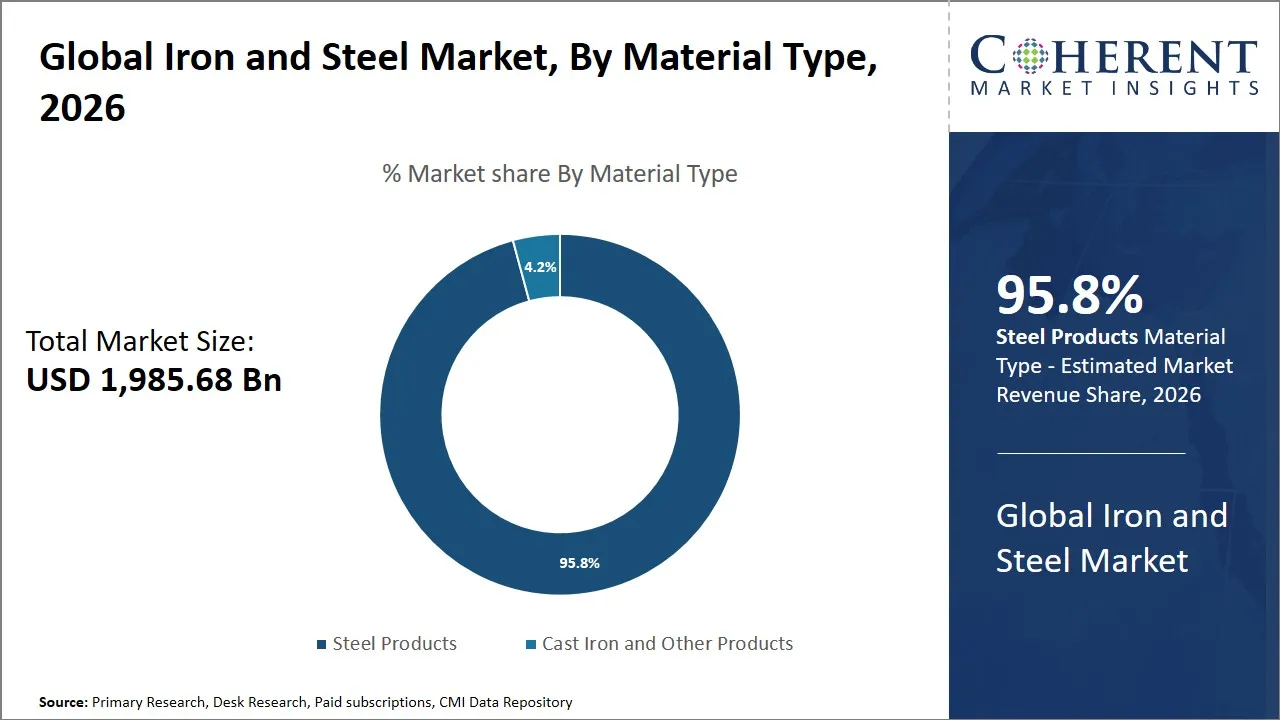
Steel Products are expected to hold 95.8% of the global iron and steel market in 2026, supported by their adaptability to standardized manufacturing and fabrication requirements. Unlike cast iron, steel offers greater ductility and can be rolled, welded, or formed into components requiring dependable mechanical performance. Industrial equipment manufacturers, engineering contractors, and metal fabricators prefer steel for machine frames, storage systems, and fabricated assemblies. Established rolling infrastructure and standardized material specifications also enable manufacturers to supply large orders with consistent quality. In May 2025, JSW Steel reported annual saleable steel sales of 26.452 million tonnes for FY2024–25, demonstrating the commercial scale of finished steel supply. Such production capabilities strengthen procurement reliability and support long-term supply agreements with industrial customers.
- Current Industry Events of 2026
- Market Size Estimation
- Regional Breakdown
- Competitive Landscape
- Customer Intelligence
- Segmental Analysis
- Pricing Analysis
- Key Market Drivers, Challenges & Future Trends
- Customized Insights Section
Why Do Carbon and Non-Alloy Steel Represent the Largest Steel Grade Segment in the Global Iron and Steel Market?
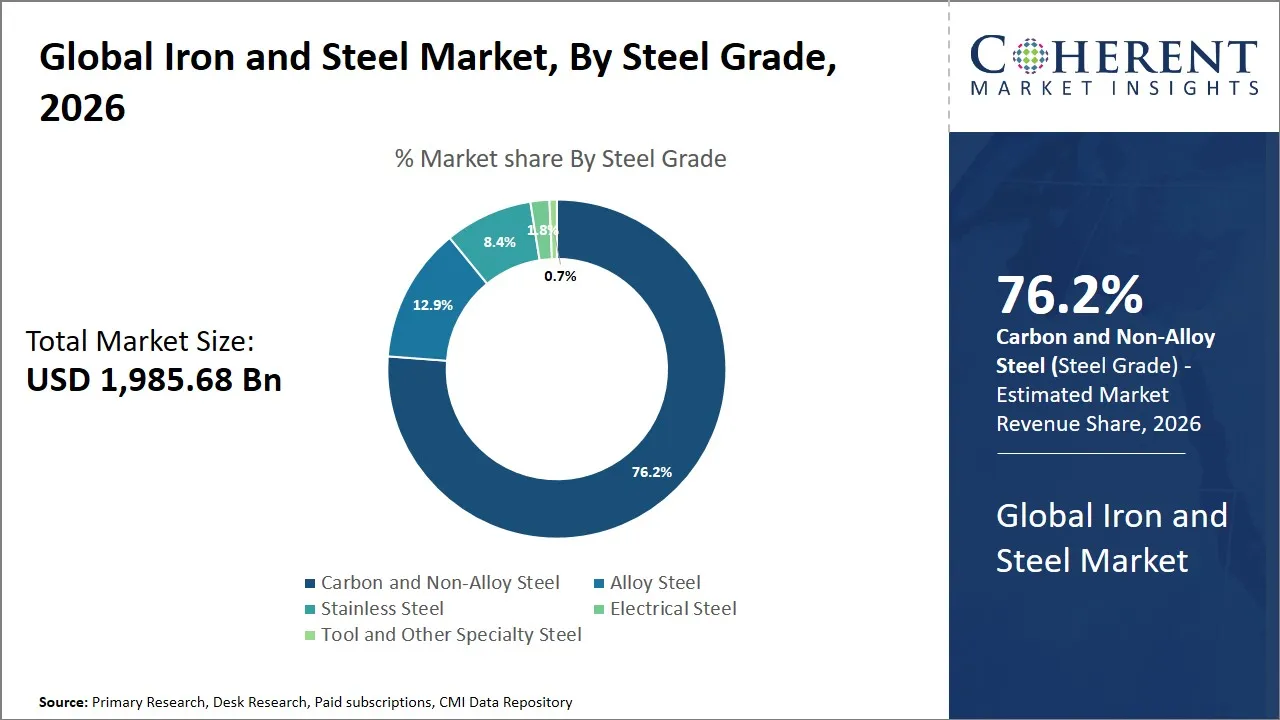
Carbon and Non-Alloy Steel is projected to capture 76.2% of the steel grade segment in 2026, reflecting its favorable production economics and compatibility with established manufacturing processes. Its standardized chemical composition allows manufacturers to produce commonly specified grades without relying heavily on expensive alloying elements. Agricultural equipment producers, fastener manufacturers, and general engineering businesses benefit from its machinability and availability in standard dimensions. Steelmakers can also maintain efficient production schedules, while distributors benefit from consistent inventory turnover. In October 2025, Commercial Metals Company reported increased merchant product shipments compared with the previous year, supported by improved supply from its Arizona 2 micro mill to West Coast customers. This development highlights the commercial advantages of regional manufacturing capacity and accessible standard-grade steel products.
Why Do Flat Steel Products (Sheets, Plates, Coils, etc.) Dominate the Product Form Segment of the Global Iron and Steel Market?
Flat Steel Products (Sheets, Plates, Coils, etc.) are expected to account for 48.5% of the product form segment in 2026, primarily because continuous rolling and downstream processing enable efficient production of precisely dimensioned materials. Manufacturers of industrial enclosures, ventilation systems, metal containers, and fabricated equipment depend on consistent sheet thickness and surface quality. Coil-based processing also supports automated cutting, slitting, and forming operations, helping manufacturers improve material utilization and reduce handling costs. In July 2025, thyssenkrupp Steel initiated the ramp-up of its modernized hot strip mill and new continuous casting facilities in Duisburg, Germany, following an investment of approximately USD 894.24 million. The modernization is designed to improve dimensional precision, production flexibility, and material quality, strengthening the competitiveness of flat steel suppliers serving specification-intensive industrial applications.
Current Events and their Impact
Current Event | Description and Its Impact |
January 2026 – European Union Implements Definitive Carbon Border Adjustment Mechanism (CBAM) |
|
June 2026 – U.S. Revises Section 232 Steel Import Tariff Provisions |
|
July 2026 – United Kingdom Introduces Revised Steel Import Quotas and Tariffs |
|
Global Iron and Steel Market Dynamics
Key Market Drivers
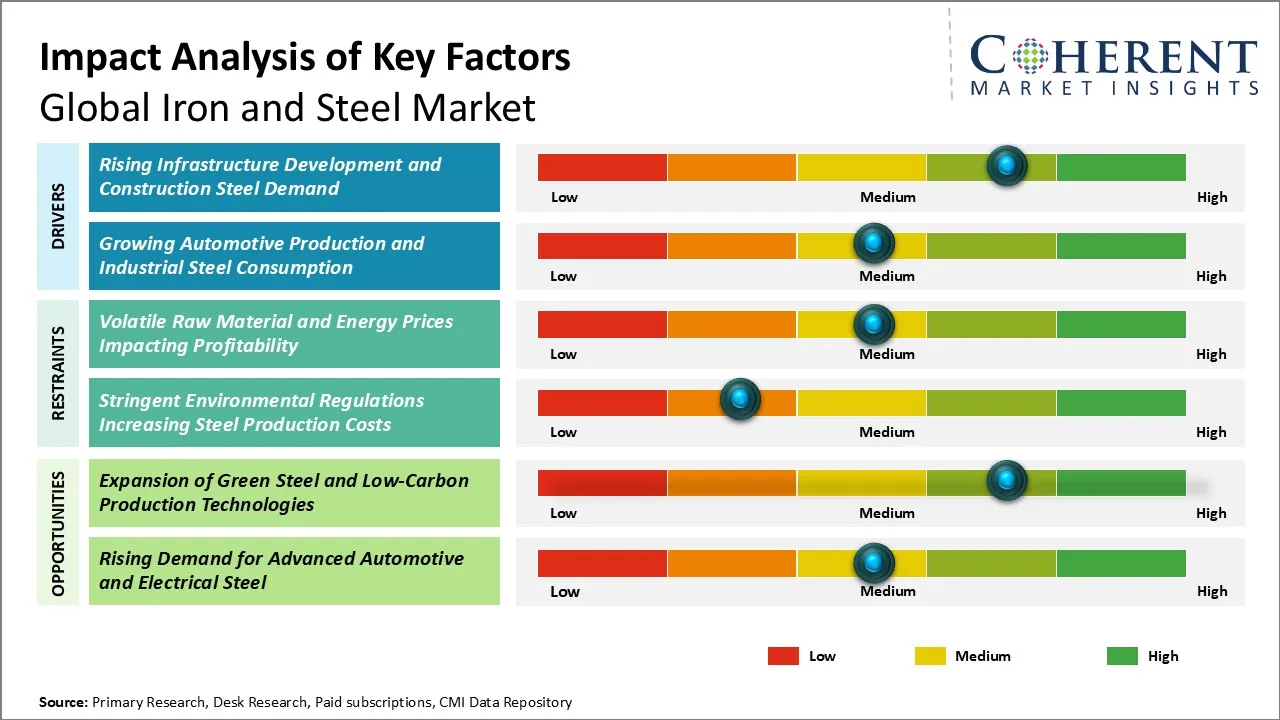
- Rising Infrastructure Development and Construction Steel Demand: Public infrastructure investment strengthens demand for structural steel, reinforcement bars, plates, and engineered components used in transportation and civil construction. Bridge replacements, railway modernization, and industrial infrastructure projects generate multiyear procurement requirements, improving order visibility for steel producers, fabricators, and distributors. In April 2026, the U.S. Department of Transportation announced a USD 600 million investment to rebuild the Delaware River Bridge connecting Pennsylvania and New Jersey. Such commitments support long-term steel procurement planning, manufacturing utilization, and opportunities for suppliers capable of meeting demanding structural specifications.
- Growing Automotive Production and Industrial Steel Consumption: Automotive manufacturers place exacting demands on steel chemistry, surface quality, gauge consistency, and delivery timing as vehicle production expands and model platforms diversify. This supports orders for qualified coil suppliers and specialist processors while encouraging regional production where imported materials create supply risks. In August 2025, Hyundai Motor Group increased its planned U.S. investment to USD 26 billion, including expanded vehicle manufacturing capacity and a new Louisiana steel mill. Linking upstream steelmaking to vehicle assembly can shorten supply routes and improve purchasing stability for automotive manufacturers.
Emerging Market Trends
- Increasing Adoption of Flexible Steel Pricing and Procurement Contracts: Steel contracting is gradually shifting toward more explicit allocation of raw material and conversion cost risks. Buyers increasingly need clarity on how energy, scrap, alloys, and processing charges affect delivered prices, especially when purchase orders extend beyond short production cycles. Producers offering transparent adjustment formulas may secure longer customer commitments without absorbing every input cost fluctuation. Steel service centers could gain a stronger role in managing smaller customers' price exposure, while mills dependent on inflexible quotations may face margin volatility and contract renegotiations.
- Growing Integration of Digital Traceability into Steel Procurement: Procurement decisions are beginning to include verifiable information about steel origin, processing history, and product-level environmental attributes alongside mechanical specifications. Manufacturers that can connect batch records with testing results and lifecycle documentation may become preferred suppliers for customers managing complex production networks. This shift will reward mills with reliable data governance, accredited verification, and interoperable customer systems. Traders unable to provide traceable material histories may lose access to demanding accounts, making documentation quality an increasingly important part of steel's commercial value.
Regional Insights
Why Does Asia Pacific Dominate the Global Iron and Steel Market?
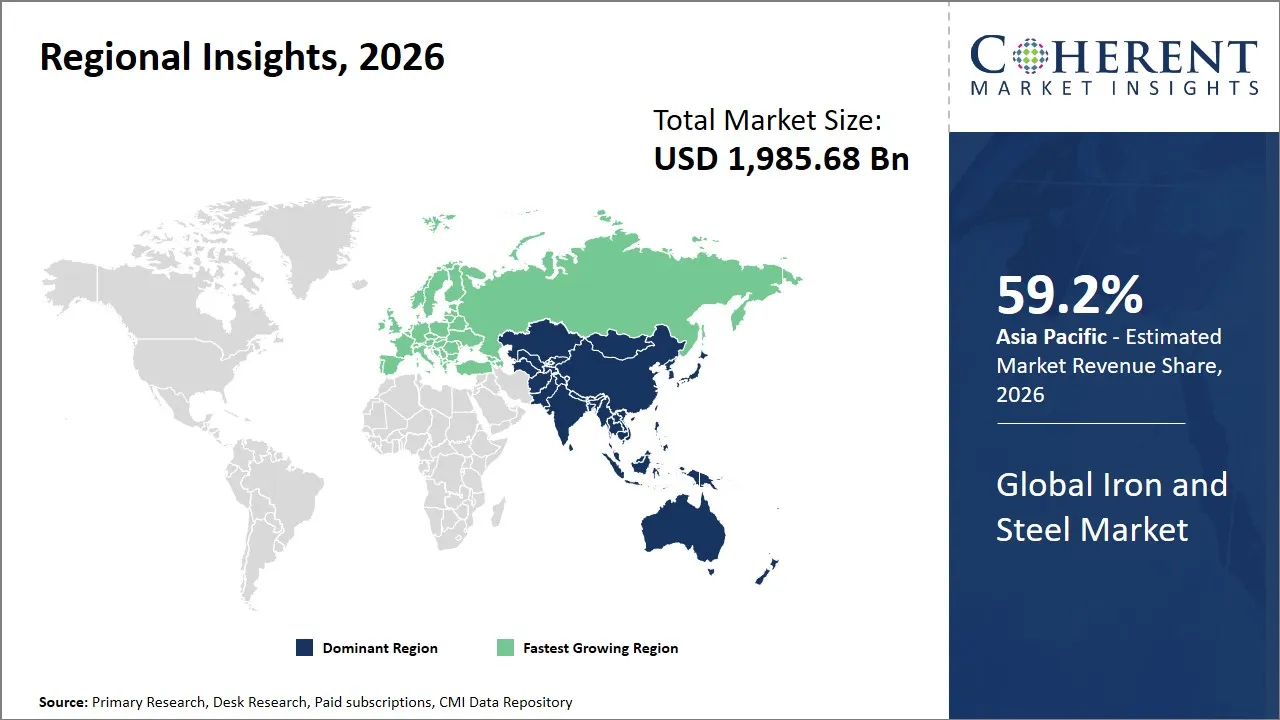
Asia Pacific is projected to account for 59.2% of the global iron and steel market in 2026, reflecting the concentration of primary steelmaking, industrial processing, and manufacturing supply chains across the region. Large integrated mills operate alongside electric furnace producers, giving industrial buyers access to numerous product grades and delivery options. Shipbuilding, equipment manufacturing, and export-oriented fabrication underpin demand beyond residential construction. Established iron ore and coking coal trade routes also support high-volume production, although weaker property investment in some markets remains a constraint. In January 2026, the World Steel Association reported that Asia and Oceania produced 1,324.5 million tonnes of crude steel during 2025. This production indicator illustrates regional manufacturing scale rather than market revenue. Suppliers with efficient logistics and specialized finishing capabilities are better positioned to convert regional production capacity into profitable contracts.
Why Is Europe Emerging as the Fastest-Growing Region in the Global Iron and Steel Market?
Europe is expected to hold 21.6% of the global iron and steel market in 2026 and is identified in the supplied forecast as its fastest-growing region. Growth opportunities center on replacing conventional steelmaking capacity with products that customers can source under increasingly strict carbon requirements. Producers are assessing hydrogen-based reduction, renewable electricity, and longer-term industrial supply contracts to justify expensive plant conversions. In June 2026, Sweden-based Stegra completed a EUR 1.4 billion financing round for its planned low-emission steel facility in Boden. This commitment highlights investment interest in alternative steelmaking despite substantial capital and execution risks. Europe's projected growth will depend on plant commissioning schedules, affordable energy, and customers' willingness to purchase verified lower-emission materials. Weak conventional steel output and import competition remain important challenges to this outlook.
Global Iron and Steel Market Outlook for Key Countries
Why Is the U.S. a Key Market for the Global Iron and Steel Market?
The U.S. remains a strategically important market for iron and steel because it combines established domestic steelmaking with large industrial buyers requiring certified, predictable supplies. Electric arc furnace mills and integrated producers serve different product requirements, while service centers provide processed materials close to customers. Energy equipment, commercial vehicles, and industrial maintenance generate replacement demand alongside new capital projects. In August 2026, the American Iron and Steel Institute reported that domestic steel mill shipments reached 91 million net tons in 2025, increasing from the previous year. This demonstrates substantial steel consumption supported by established manufacturing networks. Producers offering flexible production schedules and reliable regional distribution may benefit from customers seeking shorter lead times. Import competition and volatile input costs will continue to influence steel pricing and operating margins.
Why Is India Important in the Global Iron and Steel Market?
India's importance in the global iron and steel market rests on the increasingly technical requirements of domestic transportation, defense, and capital equipment industries. Steel procurement is moving beyond basic structural grades toward products requiring tighter tolerances, performance testing, and dependable local qualification. Domestic mills can benefit by expanding finishing capabilities and collaborating with public-sector buyers whose specifications are difficult to satisfy through standard imports. In September 2026, Steel Authority of India Limited reported the first dispatch of domestically developed Vande Bharat train wheels and highlighted new steel products supplied to industrial customers. This demonstrates progress in higher-value manufacturing rather than simply greater furnace output. Investments in rolling technology, product approval, and specialized metallurgy could help Indian suppliers retain more downstream value while strengthening domestic supply-chain resilience and reducing dependence on selected imported components.
Why Does China Support Growth in the Global Iron and Steel Market?
China continues to influence the global iron and steel market through its extensive rolling, fabrication, and machinery manufacturing networks. However, domestic property-sector weakness and intense competition are encouraging greater attention to production discipline and product quality. Steel producers serving industrial equipment, shipbuilding, and precision manufacturing may be better positioned than mills heavily exposed to conventional construction materials. In September 2025, China's Ministry of Industry and Information Technology and four other authorities issued a steel-sector stabilization plan for 2025–2026, addressing industrial performance and structural adjustment. The initiative highlights government attention to balancing production conditions and industrial competitiveness. China's future commercial importance will increasingly depend on the quality, composition, and destination of its steel products, alongside production volumes. Manufacturers offering specialized grades may achieve greater resilience against domestic pricing pressures.
Why Is Germany a Strategic Country in the Global Iron and Steel Market?
Germany holds an important position in the global iron and steel market through its demanding customer base in industrial machinery, precision components, and engineered equipment. German buyers assess steel by grade, dimensional tolerance, and increasingly, auditable production characteristics. This encourages mills to invest in laboratory testing, third-party verification, and consistent material documentation. In September 2025, Salzgitter announced that production routes covering flat steel, heavy plate, beams, and profiles had received classifications under the Low Emission Steel Standard, following independent verification. Such classifications can help industrial purchasers compare environmental performance and meet internal procurement requirements. Germany's commercial advantage therefore rests on connecting metallurgical expertise with credible product documentation and specialized processing capabilities. High electricity costs and competitive imports remain material constraints on the long-term viability of domestic steel production.
Why Is Brazil an Important Growth Market for the Global Iron and Steel Market?
Brazil presents growth opportunities in the global iron and steel market because its mining, agricultural equipment, and industrial maintenance activities require locally available steel in varied forms. A substantial domestic iron ore base supports primary production, but steelmakers still face fluctuations in import prices, electricity costs, and regional consumption. In June 2026, Brazilian producer Gerdau announced an agreement to acquire additional ownership in the Dona Francisca hydroelectric operation, with completion subject to applicable conditions. The proposed transaction would strengthen access to self-generated electricity, illustrating how energy procurement affects steelmaking competitiveness. Controlling conversion costs is particularly important when serving buyers who can switch between domestic and imported steel. Investment in reliable energy supply and regional distribution could improve customer retention and profitability without depending entirely on higher steel consumption.
Innovation, Production & Manufacturing Landscape in the Global Iron and Steel Market
Technology | Primary Application | Adoption Landscape | Commercial Impact |
Blast Furnace–Basic Oxygen Furnace (BF–BOF) | Primary iron and steel production using iron ore, coke, and oxygen-based refining | Established production route at integrated steel mills | Supports large-scale output and established steel grades, although energy requirements and emissions exposure create modernization pressure. |
Electric Arc Furnace (EAF) | Steelmaking using scrap, direct reduced iron, and electricity | Established technology with selective capacity expansion | Provides feedstock flexibility and potentially lower emissions, depending on electricity and metallic inputs, while increasing exposure to power and scrap costs. |
Hydrogen-Ready Direct Reduced Iron (DRI) | Production of metallic iron without conventional blast furnace smelting | Natural gas-based DRI is commercial; hydrogen-based deployment remains at an earlier stage | Offers an alternative metallic feedstock for steelmaking, but its economics depend on suitable ore, affordable hydrogen, and supporting infrastructure. |
Thin-Slab Continuous Casting and Direct Rolling | Conversion of liquid steel into finished flat products through integrated casting and rolling | Commercially established, with continued efficiency improvements | Reduces intermediate handling and reheating requirements, improving throughput and cost competitiveness where product specifications permit. |
AI-Enabled Process Control and Digital Twins | Monitoring furnace operations, temperature, chemistry, yield, and equipment performance | Expanding deployment across digitally equipped steel plants | Improves operational visibility and defect prevention, while requiring reliable plant data, automation integration, and skilled operators. |
Secondary Metallurgy and Vacuum Degassing | Refinement of chemical composition, inclusion control, and dissolved gas removal | Widely established for higher-specification steel production | Enables consistent mechanical properties and cleaner steel grades, supporting applications with demanding performance and qualification requirements. |
How Is Expanding Demand for High-Performance Electrical Steel Creating New Growth Opportunities in the Global Iron and Steel Market?
The expanding need for high-performance electrical steel presents an attractive opportunity beyond conventional construction and automotive grades. Grain-oriented electrical steel is essential for efficient transformer cores, while non-grain-oriented grades serve motors, generators, and electrified industrial equipment.
Customers increasingly evaluate magnetic losses, coating durability, and consistency during precision stamping rather than purchasing solely by tonnage. Suppliers can capture value by developing thin-gauge processing, specialized annealing, insulation coatings, and application-specific testing capabilities.
Partnerships with transformer manufacturers, motor producers, and specialized stamping businesses can shorten product qualification cycles and create recurring contracts. However, entering this segment requires substantial process control, metallurgical expertise, stringent inspection, and access to suitable feedstock.
Integrated producers have advantages in capital investment and chemistry control, whereas specialist processors can compete in slitting, laminations, and tailored finishing. Companies should prioritize customer qualification before commissioning dedicated capacity, because poor magnetic performance or inconsistent surface quality can outweigh an attractive selling price.
Market Players, Key Development, and Competitive Intelligence
Key Developments
- In October 2025, JFE Steel began deploying cyber-physical systems across seven sintering facilities in Japan. The models are intended to stabilize feed quality, improve productivity, and reduce emissions. Predictive control could improve blast furnace input consistency without requiring complete replacement of existing steelmaking assets.
- In June 2025, SSAB signed a technology supply contract with Danieli for its planned Luleå mini-mill in Sweden, incorporating electric arc furnaces, secondary metallurgy, and strip rolling. The integrated configuration could improve specialty steel manufacturing efficiency while supporting a planned transition away from blast furnace operations.
- In May 2025, Outokumpu expanded commercial production of stainless steel powder into aerospace applications, delivering an initial batch for additive manufacturing. This creates access to high-specification component markets beyond conventional rolled steel, although the referenced aerospace application remained subject to prototype validation.
Competitive Landscape
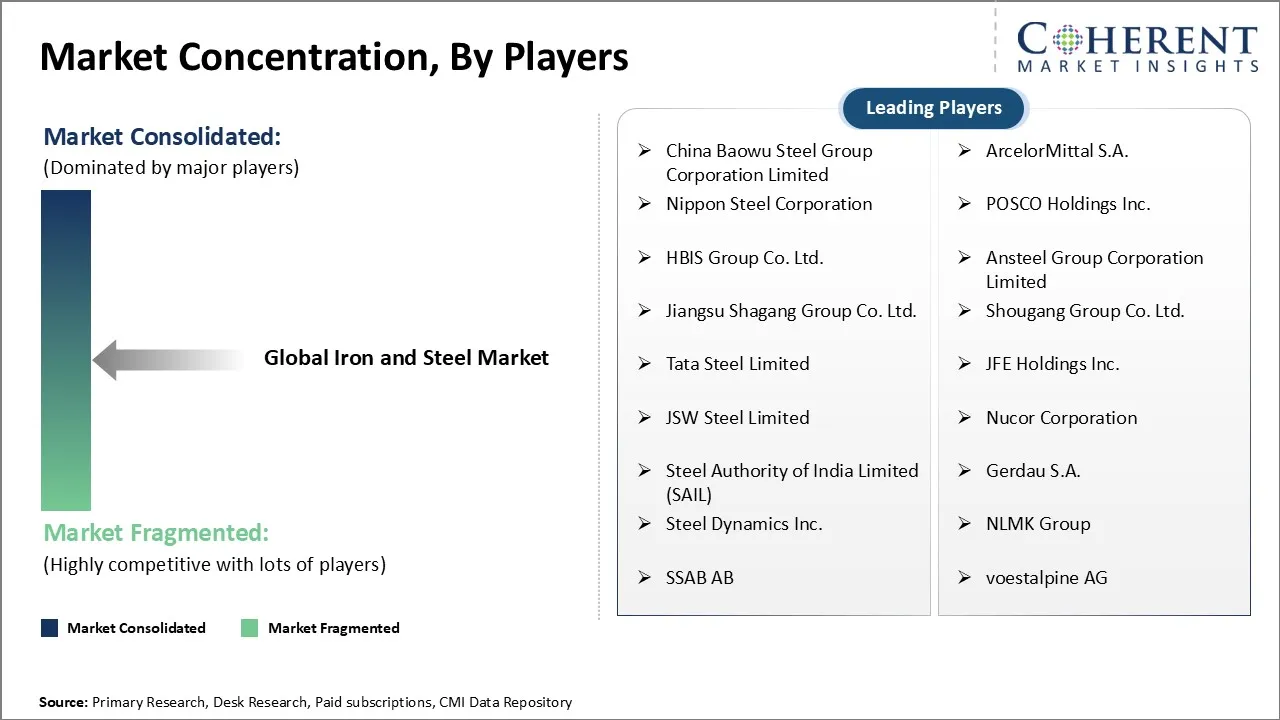
The global iron and steel market remains fragmented across countries and product categories, despite the substantial capacity controlled by major integrated groups. Large producers compete on cost efficiency, metallurgy, and contract reliability, while regional mills, foundries, and specialist processors serve localized specifications. Competitive resilience increasingly depends on consistent quality, disciplined capacity utilization, customer approvals, and the ability to manage energy, raw material, and freight costs.
Key competitive factors include
- Production Cost Efficiency: Optimizing furnace utilization, energy consumption, and raw material conversion costs.
- Metallurgical Quality: Maintaining chemical consistency, dimensional accuracy, and controlled mechanical properties.
- Manufacturing Integration: Coordinating melting, casting, rolling, and finishing operations to reduce production losses.
- Supply Chain Reliability: Securing iron ore, metallurgical coal, alloys, and scrap through diversified procurement arrangements.
- Quality Certification: Meeting applicable ASTM, EN, ISO, and customer-specific material requirements.
- Distribution and Logistics: Improving regional warehouse coverage, delivery reliability, and access to ports and rail infrastructure.
- Customer Technical Support: Providing grade selection assistance, material testing documentation, and application-specific processing expertise.
Market Report Scope
Global Iron and Steel Market Report Coverage | |||
Report Coverage | Details | ||
Base Year | 2025 | Market Size in 2026: | USD 1,985.68 Bn |
Historical Data For: | 2020 To 2024 | Forecast Period: | 2026 To 2033 |
Forecast Period 2026 To 2033 CAGR: | 3.86% | 2033 Value Projection: | USD 2,588.5 Bn |
Geographies covered: |
| ||
Segments covered: |
| ||
Companies covered: | China Baowu Steel Group Corporation Limited, ArcelorMittal S.A., Nippon Steel Corporation, POSCO Holdings Inc., HBIS Group Co. Ltd., Ansteel Group Corporation Limited, Jiangsu Shagang Group Co. Ltd., Shougang Group Co. Ltd., Tata Steel Limited, JFE Holdings Inc., JSW Steel Limited, Nucor Corporation, Steel Authority of India Limited (SAIL), Gerdau S.A., Steel Dynamics Inc., NLMK Group, SSAB AB, voestalpine AG | ||
Growth Drivers: |
| ||
Restraints & Challenges: |
| ||
Analyst Opinion (Expert Opinion)
- The global iron and steel market commercial leadership is likely to depend increasingly on the ability to switch production between different grades and order profiles without excessive conversion losses. Mills that coordinate melting schedules, rolling capacity, and finishing arrangements more effectively could earn stronger margins than competitors relying primarily on high production volumes. Flexible manufacturing networks may therefore become more commercially valuable than isolated capacity additions.
- Industrialized construction and robotic fabrication could shift a greater share of steel value creation from primary mills toward manufacturers of ready-to-install structural assemblies. This transition may challenge traditional sellers of standard bars and sections while favoring businesses capable of supplying engineered, precision-fabricated components. Steel producers that develop closer relationships with fabrication specialists could gain access to project specifications earlier in the purchasing cycle.
- Steel manufacturers should prioritize energy security, efficient material conversion, and disciplined capital allocation rather than pursuing capacity growth without confirmed customer commitments. Investments in reliable raw material sourcing, flexible production assets, and localized processing capabilities can improve resilience against price fluctuations and supply disruptions. Producers should also avoid excessive dependence on highly cyclical commodity grades and evaluate expansion projects against realistic utilization, financing, and regulatory risks.
Speak to the analyst
Want personalized insights?
Take the findings above to one of our principal consultants, or have the report rebuilt around the segments, geographies and competitors you actually track.
Market Segmentation
- Material Type Insights (Revenue, USD Bn, 2021 - 2033)
- Steel Products
- Cast Iron and Other Products
- Steel Grade Insights (Revenue, USD Bn, 2021 - 2033)
- Carbon and Non-Alloy Steel
- Alloy Steel
- Stainless Steel
- Electrical Steel
- Tool and Other Specialty Steel
- Product Form Insights (Revenue, USD Bn, 2021 - 2033)
- Flat Steel Products (Sheets, Plates, Coils, etc.)
- Long Steel Products (Bars, Rods, Beams, Sections, etc.)
- Pipes and Tubes
- Castings and Forgings
- Other Iron and Steel Products
- Steel Production Technology Insights (Revenue, USD Bn, 2021 - 2033)
- Basic Oxygen Furnace (BOF)
- Electric Arc Furnace (EAF)
- Other Steelmaking Technologies
- End User Insights (Revenue, USD Bn, 2021 - 2033)
- Building and Infrastructure
- Mechanical and Industrial Equipment
- Automotive
- Metal Products Manufacturing
- Shipbuilding, Railways and Other Transportation
- Domestic Appliances
- Electrical Equipment
- Distribution Channel Insights (Revenue, USD Bn, 2021 - 2033)
- Direct Manufacturer Sales
- Steel Service Centers
- Independent Traders and Distributors
- Regional Insights (Revenue, USD Bn, 2021 - 2033)
- North America
- U.S.
- Canada
- Latin America
- Brazil
- Argentina
- Mexico
- Rest of Latin America
- Europe
- Germany
- U.K.
- Spain
- France
- Italy
- Russia
- Rest of Europe
- Asia Pacific
- China
- India
- Japan
- Australia
- South Korea
- ASEAN
- Rest of Asia Pacific
- Middle East
- GCC Countries
- Israel
- Rest of Middle East
- Africa
- South Africa
- North Africa
- Central Africa
- North America
Sources
Primary Research Interviews
- Iron and steel manufacturers, integrated steel mills, and foundries
- Steel processors, rolling mills, and raw material suppliers
- Steel distributors, industrial buyers, and industry experts
Stakeholders
- Iron ore, coking coal, scrap, and ferroalloy suppliers
- Steel manufacturers, fabricators, and service centers
- Construction, automotive, machinery, and industrial equipment manufacturers
- Steel traders, distributors, EPC contractors, and end users
End-use Sectors
- Building and infrastructure
- Automotive and transportation
- Mechanical and industrial equipment
- Metal products and electrical equipment
- Shipbuilding, railways, and domestic appliances
Regulatory and Industry Bodies
- World Steel Association (worldsteel)
- U.S. Department of Commerce
- European Commission
- Ministry of Steel, Government of India
- International Organization for Standardization (ISO)
- ASTM International
- Bureau of Indian Standards (BIS)
Databases
- Company annual reports and investor presentations
- World Steel Association production and consumption statistics
- UN Comtrade iron and steel trade datasets
- OECD steel production capacity databases
- Eurostat and U.S. Geological Survey (USGS) datasets
- Steel pricing, raw material costs, capacity, and trade databases
Magazines and Journals
- Ironmaking & Steelmaking
- ISIJ International
- Steel Research International
- Metallurgical and Materials Transactions B
- Iron & Steel Technology
- Steel Times International
Associations
- World Steel Association (worldsteel)
- American Iron and Steel Institute (AISI)
- European Steel Association (EUROFER)
- Indian Steel Association (ISA)
- Association for Iron & Steel Technology (AIST)
- South East Asia Iron and Steel Institute (SEAISI)
Public Domain Sources
- Global crude steel production, consumption, and trade statistics
- Steel capacity utilization, pricing, and raw material trends
- Infrastructure investments and industrial steel consumption
- BOF, EAF, DRI, and low-carbon steelmaking developments
- Steel import tariffs, carbon regulations, and trade policies
- Manufacturing investments, capacity expansions, and technology developments
Key Standards and Regulations
- ISO 630 – Structural steel specifications
- ASTM A36/A36M – Carbon structural steel
- ASTM A615/A615M – Deformed and plain carbon-steel bars for concrete reinforcement
- EN 10025 – Hot-rolled structural steel products
- IS 2062 – Hot-rolled medium and high tensile structural steel
- Regulation (EU) 2023/956 – Carbon Border Adjustment Mechanism (CBAM)
- Section 232, U.S. Trade Expansion Act – Steel import measures
Proprietary Elements
- CMI Data Analytics Tool
- Proprietary CMI repository containing 10+ years of iron and steel industry intelligence covering production capacity, steel pricing, raw material costs, consumption trends, steelmaking technologies, trade flows, regulatory developments, and competitive intelligence.
Get access to 250+ pages report
Every segment, forecast, competitor profile and data table behind the analysis above — available for instant download.
- ESOMAR Member
- ISO 9001:2015 Certified
- D-U-N-S Registered
- GDPR & CCPA Compliant
Frequently Asked Questions
The CAGR of global iron and steel market is projected to be 3.86% from 2026 to 2033.
The global iron and steel market is estimated to be valued at USD 1,985.68 Bn in 2026 and is expected to reach USD 2,588.5 Bn by 2033.
Infrastructure development, construction activity, growing automotive production, and increasing industrial steel consumption are the major factors driving the growth of the global iron and steel market.
Volatile Raw Material and Energy Prices Impacting Profitability and Stringent Environmental Regulations Increasing Steel Production Costs are the major factors hampering the growth of global iron and steel market.
In terms of material type, steel products are estimated to dominate the market revenue share in 2026.
China Baowu Steel Group Corporation Limited, ArcelorMittal S.A., Nippon Steel Corporation, POSCO Holdings Inc., HBIS Group Co. Ltd., Ansteel Group Corporation Limited, Jiangsu Shagang Group Co. Ltd., Shougang Group Co. Ltd., Tata Steel Limited, JFE Holdings Inc., JSW Steel Limited, Nucor Corporation, Steel Authority of India Limited (SAIL), Gerdau S.A., Steel Dynamics Inc., NLMK Group, SSAB AB, voestalpine AG are the major players.
Asia Pacific is expected to lead the global iron and steel market in 2026.