

Global Irrigation Controllers Market Size and Forecast – 2026 To 2033
The global irrigation controllers market is expected to grow from USD 2.30 Bn in 2026 to USD 5.75 Bn by 2033, registering a compound annual growth rate (CAGR) of 5.7% from 2026 to 2033. Growing agricultural productivity requirements drives the market growth. On February 11, 2025, Netafim announced the launch of its patented Hybrid Dripline system, the world’s first and only integral dripline with a built-in outlet. This proprietary technology brings together the benefits of integral and on-line dripper systems into a unified leak-free, clog-resistant and labor-saving solution for growers around the globe.
Key Takeaways of the Global Irrigation Controllers Market
- The Smart Controllers segment is expected to account for 44.0% of the global irrigation controllers market share in 2026. Expansion of greenhouse farming is driving the growth of the segment. On December 18, 2025, Fabe-Agro began developing a 100-hectare greenhouse project in Poland. Construction is planned in phases between 2025 and 2028. The project represents Fabe-Agro's first major horticultural venture.
- The Drip or Trickle Irrigation segment is estimated to capture 53.0% of the market share in 2026. Growing adoption of weather-based scheduling is majorly driving the growth of the segment. On September 29, 2025, Toro introduced the new Eagle Plus Series, a commercial-grade irrigation controller designed for centralized, internet-based irrigation management.
- The Wi-Fi segment is estimated to capture 38.0% of the market share in 2026. Increasing integration with farm management platforms is expanding controller functionality driving the segment growth. In April 2025, Netafim and Treetoscope expanded their digital farming partnership. Treetoscope’s plant-sensing technology is being integrated into GrowSphere. The integration provides real-time plant water-status information and irrigation recommendations.
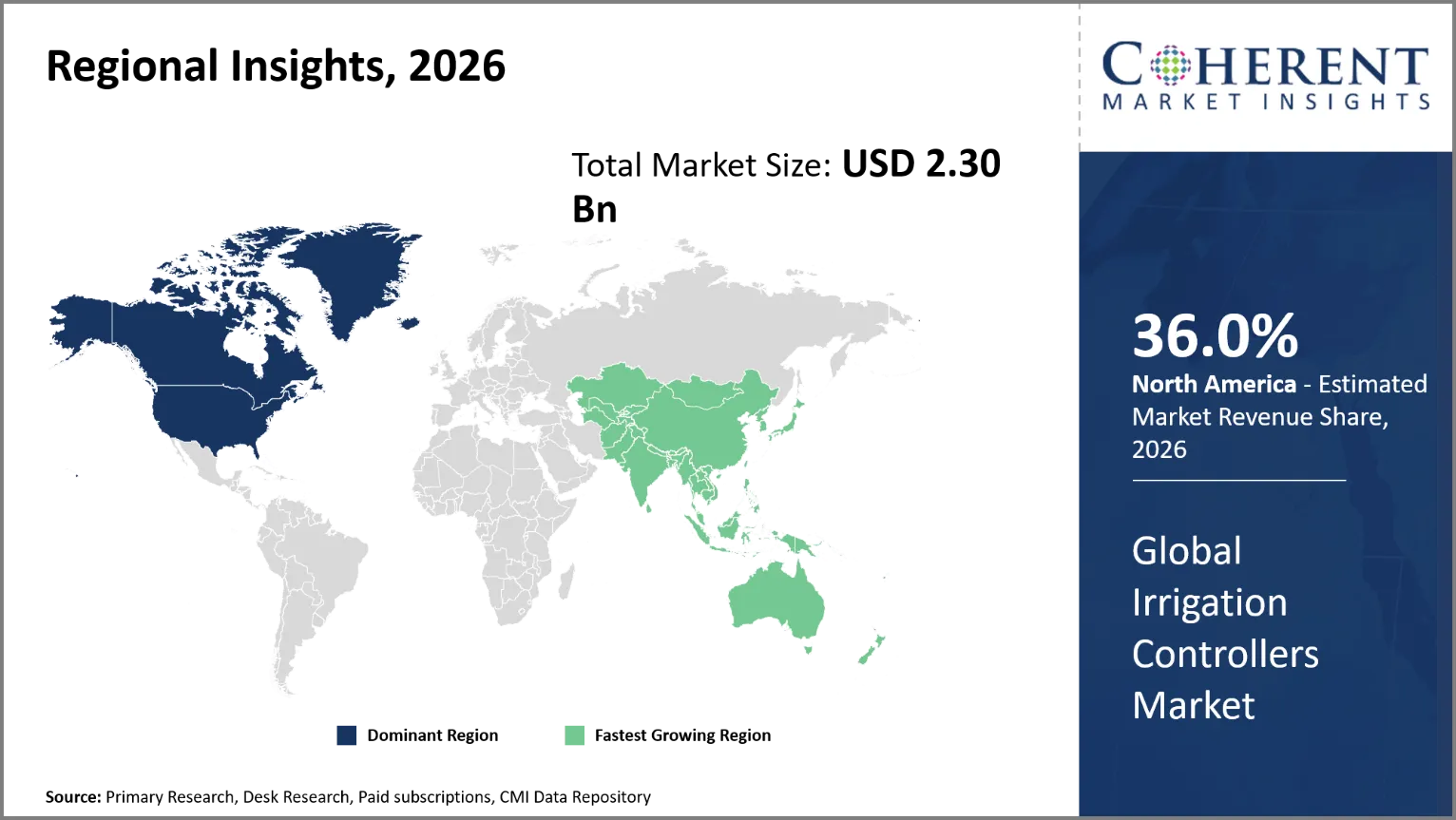
- North America is expected to dominate the irrigation controllers market in 2026 with a market share of 36.0%. Development of solar powered controllers for remote farms in North America is driving the growth of the regional market. On May 12, 2025, Verdi Technologies introduced its next-generation Block Controller. The wireless controller automates agricultural valves and pumps without permanent wiring.
- Asia Pacific is expected to account for 28.0% share in 2026. Growth of cloud connected irrigation management platforms in Asia Pacific is driving the growth of the regional market. On January 30, 2026, Fasal announced the launch of FasalJet and FasalJet Pro, irrigation and fertigation automation products, which automate precision-sensitive operations for farmers.
Segmental Insights
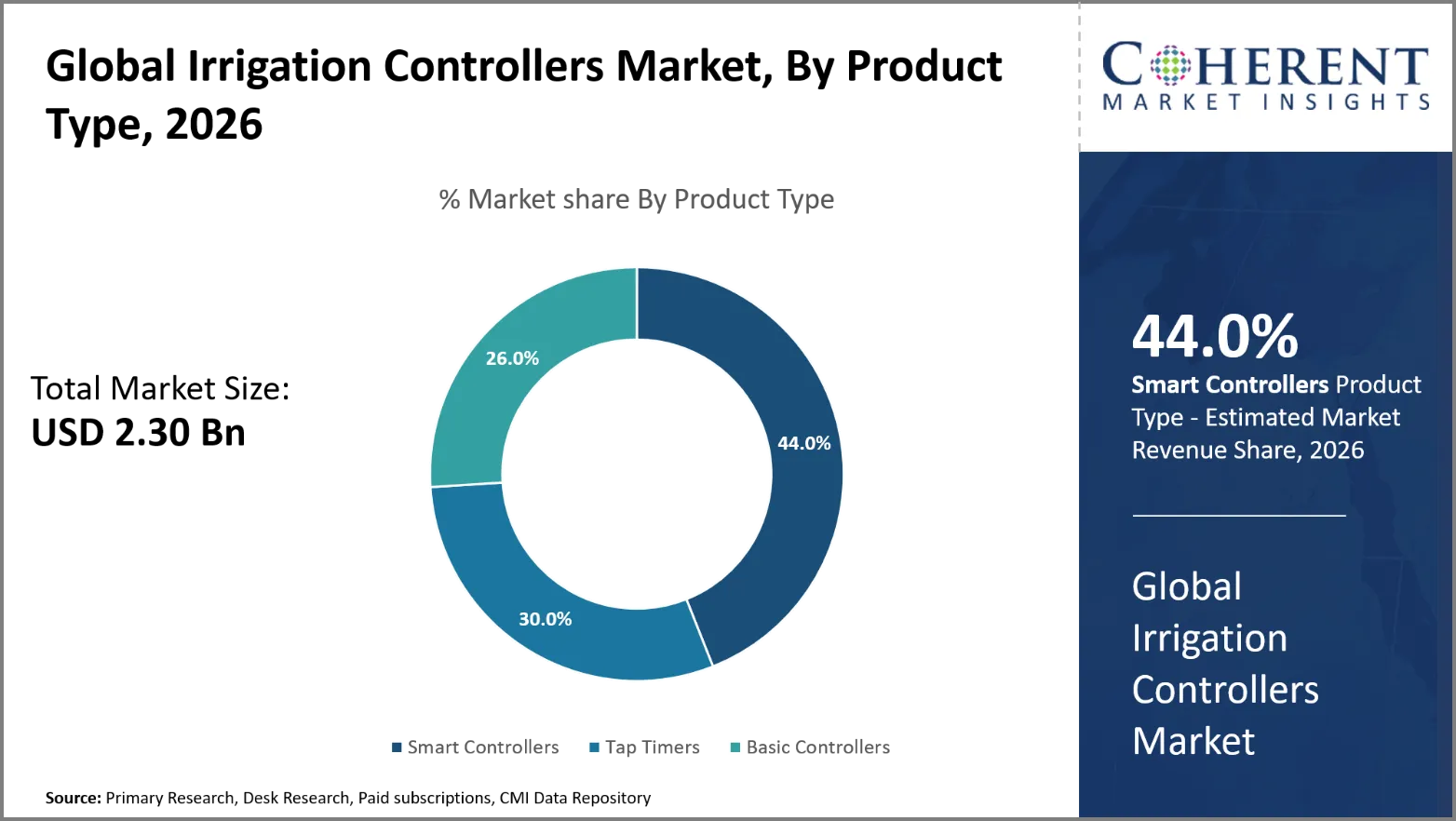
Why Does Smart Controllers Dominate the Global Irrigation Controllers Market?
The smart controllers segment is expected to account for 44.0% of the global irrigation controllers market share in 2026. Smart controllers change watering schedules according to weather, soil moisture and landscape needs. The U.S. Environmental Protection Agency considers these methods water-efficient irrigation technologies. They help to minimize over-watering, which increases efficiency while protecting the health of the plants. WaterSense labeled controllers, when placed correctly, can cut irrigation water use by between 15% and 30%. It’s this water-saving capabilities that helps drive acceptance among residential, commercial and landscape users. In February 2026, Hunter Industries introduced the MCC Controller. The controller targets larger commercial irrigation installations requiring scalable control. Hunter also continues developing Hydrawise for Internet-connected irrigation management. These developments strengthen demand for remotely managed smart irrigation controllers.
- Current Industry Events of 2026
- Market Size Estimation
- Regional Breakdown
- Competitive Landscape
- Customer Intelligence
- Segmental Analysis
- Pricing Analysis
- Key Market Drivers, Challenges & Future Trends
- Customized Insights Section
Why is Drip or Trickle Irrigation the Most Preferred Irrigation Type?
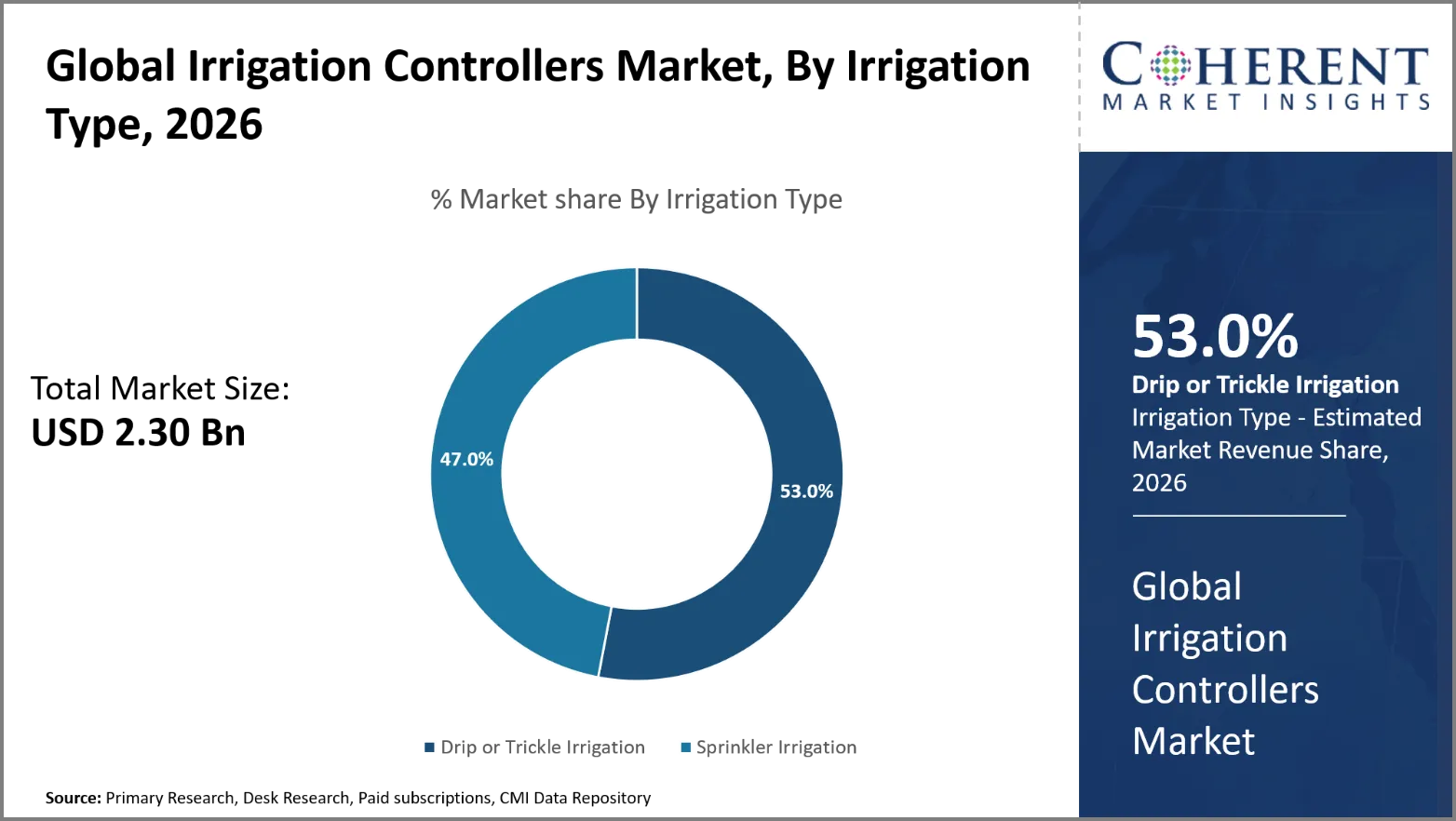
The drip or trickle irrigation segment is expected to account for 53.0% of the global irrigation controllers market share in 2026. Drip irrigation applies water directly at or near the roots of plants, which minimizes evaporation, runoff, and oversaturating the soil. The Food and Agriculture Organization recognizes localized irrigation as one of the efficient ways of applying water. Small volume, frequent treatments help keep moisture levels at or near the root zone. This method helps in saving of water especially in the agricultural areas where there is scarcity of water. Its precise application also enables efficient fertilizer application and enhanced crop output. On December 10, 2025, Toro announced the launch of Toro Aqua-Traxx Azul REvive, a revolutionary new drop tape made with recycled resins to promote circularity in agricultural plastics. It’s specifically intended for growers and ag enterprises who want to reduce their environmental footprint without sacrificing performance.
Wi-Fi Dominates the Global Irrigation Controllers Market
The Wi-Fi segment is expected to account for 38.0% of the global irrigation controllers market share in 2026. Wi-Fi connectivity enables irrigation controllers to connect directly with mobile applications and smart home systems. Mobile control is a convenience feature identified by the U.S. Environmental Protection Agency on connected irrigation controllers. Remote irrigation scheduling monitoring and watering adjustments can be made based on changing landscape conditions. Wi-Fi also provides connection with weather information, enabling more responsive watering scheduling. This combination of remote accessibility, automation and connection increases the adoption for home and business users. For instance, Rain Bird added the RC2 Wi-Fi Controller and Rain Bird 2.0 App to its smart Wi-Fi controller range. Mobile control, remote access, weather changes and smart-home connectivity are all included in the 2025 product guide. Weather delays forecast for rain, wind or freezing temperatures can stop irrigation. The platform also has seasonal adjustability and cycle-and-soak capabilities.
Current Events and their Impact
Current Events | Description and its Impact |
European Water Resilience Strategy, European Union |
|
European Union Water Reuse Regulation, Regulation 2020/741 |
|
Irrigation Controllers Market Dynamics
Market Drivers
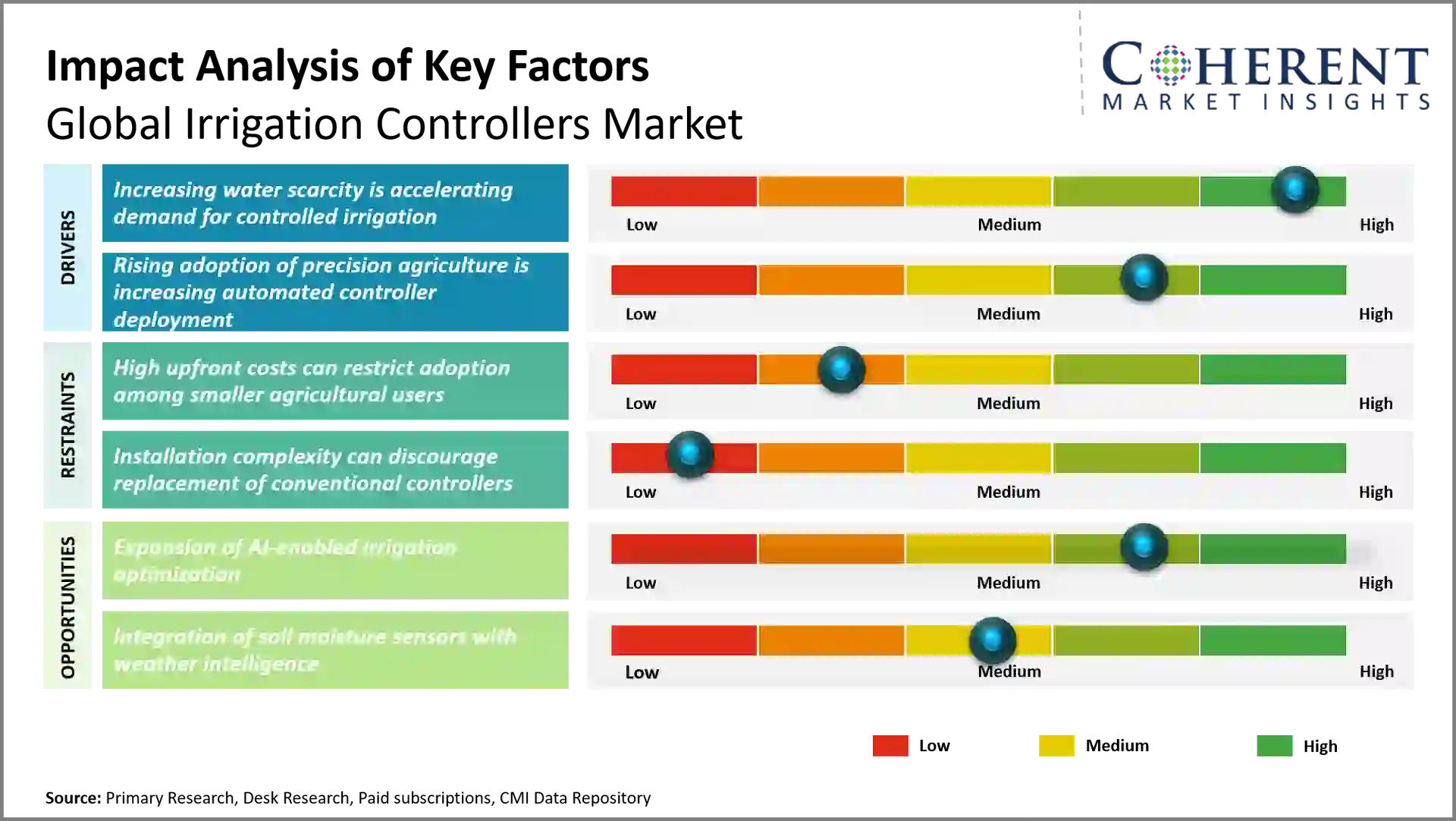
- Increasing water scarcity is accelerating demand for controlled irrigation: With water becoming more-scarce, farmers need to use their water more efficiently and waste less of it. The Food and Agriculture Organization estimates that more than 60% of irrigated land is located in areas of high or very high-water stress. Climate change is also increasing the risk of drought and evaporation, which increases the need for irrigation. Automated controllers help manage irrigation timing and quantities based on crop and environmental variables. The need for controlled irrigation systems is growing rapidly because to the necessity for precision water management. In its 2025 micro-irrigation update, Netafim pointed to water scarcity as a serious agricultural concern. The company specialized in drip irrigation for accurate water supply to the root zone. Netafim also displayed methods to minimize evaporation, runoff and overwatering. This increases the need for controlled irrigation in water-stressed agricultural areas.
- Rising adoption of precision agriculture is increasing automated controller deployment: Precision agriculture is spurring farmers to utilize sensors, data analytics and automated equipment for resource management. Automation is a key element of digital agriculture, the U.S. Department of Agriculture states. Precision irrigation can increase the accuracy of application by knowing when and where the crops need water. This is rising demand for automated irrigation controllers that work with sensors and decision-support systems. On February 27, 2025, John Deere unveiled the next generation perception system, an autonomous precision upgrade kit for select tractor models, bringing autonomy to tillage labor. The new perception system consists of 16 cameras placed on the roof of the tractor cab, providing a full 360-degree vision around the tractor and the tillage tool.
Emerging Trends
- AI-Enabled Irrigation Optimization: Artificial intelligence is being progressively integrated with irrigation systems for predictive scheduling and resource management. These systems are designed to modify watering decisions according to weather, soil moisture and crop circumstances.
- IoT-Based Remote Irrigation Management: The IoT connectivity allows the controllers to connect with the management platforms and field sensors in real time. This tendency favors remote monitoring, automated adjustments and quicker responses to changing field conditions.
- Greater Integration of Soil Moisture Sensors: Soil moisture sensors are becoming increasingly useful to avoid excessive irrigation when circumstances of soil moisture are appropriate. The U.S. Environmental Protection Agency acknowledges these technologies for their ability to help improve water-efficient irrigation scheduling.
- Expansion of Weather Responsive Controllers: Weather responsive controllers are increasingly using local weather information to adjust irrigation time, frequency and volumes. The U.S. Environmental Protection Agency continues supporting certified weather-based controllers through its WaterSense program.
Regional Insights
Why is North America a Strong Market for Irrigation Controllers?
North America is expected to account for a market share of 36.0% in 2026. It has large scale irrigated agriculture and a well-established smart landscaping system. U.S. farms irrigated 53.1 million acres in 2023. 50.1% irrigated acreage was in California, Nebraska, Arkansas, Texas and Idaho. The U.S. also has more than 28 million homes with in-ground sprinklers. WaterSense controllers can save households up to 15,000 gallons annually. In Canada, the 2021 agricultural census identified 959,526 hectares of irrigated land. These characteristics lend itself to weather-based controllers, soil-moisture controls and automated scheduling. Western drought and groundwater constraints further strengthen demand for precise irrigation management.
Why Does Asia Pacific Irrigation Controllers Market Exhibit High Growth?
Asia Pacific is expected to register the fastest growth with a CAGR of 6.5% over the forecast period. The region is projected to account for 28.0% of the global irrigation controllers market in 2026. Asia Pacific benefits from enormous irrigated agriculture and accelerating smart-farming deployment. Food and Agriculture Organization data identifies China and India among the leading irrigated-cropland countries. Japan is expanding smart-agriculture infrastructure because its agricultural workforce is expected to decline sharply. Japanese infrastructure programs include automatic water-management systems and groundwater-level controls. Australia is advancing automated irrigation monitoring using soil-water, plant, and weather sensors. India has already brought over 115 lakh hectares under micro-irrigation. These developments create strong opportunities for controllers combining sensors, connectivity, automation, and irrigation scheduling.
Global Irrigation Controllers Market Outlook for Key Countries
Why is U.S. Emerging as a Major Hub in the Irrigation Controllers Market?
The U.S. irrigation controllers market benefits from enormous irrigated agriculture and accelerating smart-farming market benefits strongly from residential sprinkler replacement and water-efficiency programs. The U.S. Environmental Protection Agency estimates over 28 million homes have in-ground sprinkler systems. Many systems still depend on clock-based scheduling rather than environmental conditions. WaterSense controllers can save an average household up to 15,000 gallons annually. In 2023, the U.S. Department of Agriculture recorded 53.1 million irrigated acres on 212,714 farms. California has 7.8 million acres of irrigated land, followed by Nebraska with 7.3 million acres. The blend allows for domestic improvements and large-scale agriculture automation.
Is China the Next Growth Engine for the Irrigation Controllers Market?
China benefits from its exceptionally large irrigated agricultural base and increasing water-efficiency requirements. Some 52% of China’s croplands are irrigated, according to the Food and Agriculture Organization. Therefore, irrigation is still needed to keep crops productive in the main agricultural areas. Groundwater dependency also increases pressure for improved scheduling and controlled application. Henan Province uses large amounts of groundwater, according to Food and Agriculture Organization data. Smart irrigation controllers can coordinate pumps, valves, sensors, and programmed schedules across agricultural fields. China’s broader smart-agriculture development further supports connected irrigation technologies. Controller demand is therefore increasingly linked with water conservation, automated field management, and precision farming.
Australia Irrigation Controllers Market Analysis and Trends
Australia benefits from strong demand for irrigation efficiency because agricultural production faces recurring water constraints. Government research found that irrigation monitoring can combine soil-water, plant-condition, and weather information. The same research identified automated control from water sources through individual fields. These capabilities support controllers that automatically adjust irrigation according to field conditions. Agricultural water-use efficiency is particularly important across major irrigated production regions. Periodic irrigation audits can also identify energy and uniformity problems affecting farm productivity. Consequently, Australian adoption is strongly supported by sensor-based monitoring, automated scheduling, and operational efficiency requirements.
Japan Irrigation Controllers Market Analysis and Trends
Japan benefits from irrigation controller adoption because of labor shortages and accelerating agricultural automation. Japan’s Ministry of Agriculture, Forestry and Fisheries expects agricultural workers to decline substantially over coming decades. The government is therefore promoting smart-agriculture technologies to maintain production with fewer workers. Agricultural infrastructure projects include automatic water-management valves and groundwater-level control systems. These systems reduce manual intervention in field water management. Remote control and automatic scheduling can therefore address Japan’s specific labor constraint. Controller adoption is additionally supported by Japan’s broader integration of robotics, sensors, and automated agricultural equipment.
India Irrigation Controllers Market Analysis and Trends
India benefits from large-scale government support for micro-irrigation and farm-level water efficiency. The Per Drop More Crop scheme has covered over 115 lakh hectares by July 2026. The Government of India provides 55% assistance to small and marginal farmers. Other farmers receive 45% financial assistance for eligible micro-irrigation installations. The scheme has supported 46.37 lakh hectares using drip irrigation and 50.60 lakh hectares using sprinklers. Between FY 2016 and FY 2021, irrigation coverage rose from 49.3% to 55% of the gross cultivated area. These programs produce a high need for controllers that can support drip, sprinkler and precision irrigation. (Source: Press Information Bureau)
Global Irrigation Controllers Market - Weather-Based Controller Adoption by Region (2025)
Region | Weather-Based Controller Adoption |
North America | 58% |
Europe | 52% |
Asia Pacific | 44% |
Latin America | 36% |
Middle East and Africa | 32% |
Global Average | 45% |
How is Expansion of AI-Enabled Irrigation Optimization Creating New Growth Opportunities in the Irrigation Controllers Market?
AI-enabled optimization of irrigation opens up new possibilities for growth, transforming controllers from fixed schedule devices to predictive decision systems. The United States Department of Agriculture is creating algorithms based on weather, soil moisture, crop models and remote sensing. An AI irrigation system based on plant electrophysiological signals reduces water consumption by at least 10% by 2025. A 2025 smart irrigation study also found that predictive algorithms and real-time sensors reduced water consumption by 30%. These advances lead to a need for controllers to process sensor data and automatically adjust irrigation. They also enable options for software-enabled controllers, subscription analytics, predictive maintenance and variable-rate irrigation. Another option for deployment is a 2025 smart-irrigation project in India from the Food and Agriculture Organization that is focused on water efficiency.
On April 16, 2025, Phytech announced the release of its AI Advisor for irrigation management. The new AI Advisor (for area and plot views) gives a clear, short summary of the status of a plot or area, highlighting patterns, stress signals, and specific categories (such as variety level trends).
Market Players, Key Development, and Competitive Intelligence
Key Developments
- On August 11, 2025, Netafim announced the introduction of Mega-PULSAR, a unique full-coverage pulsing sprinkler technology developed to protect orchards from intensifying heatwaves and severe heat stress. This rollout marks the latest addition to Orbia Netafim’s portfolio of extreme weather mitigation solutions and is specifically tailored to help growers of high-value subtropical crops.
- On February 5, 2025, Toro announced an exclusive partnership with TerraRad that will lead to the introduction of a first-of-its-kind software tool for precision irrigation control. The new Spatial Adjust software from Toro will integrate exclusively with the Toro Lynx Central Control platform. Toro’s exclusive partnership with TerraRad is expected to pave the way for innovative technology solutions.
Competitive Landscape
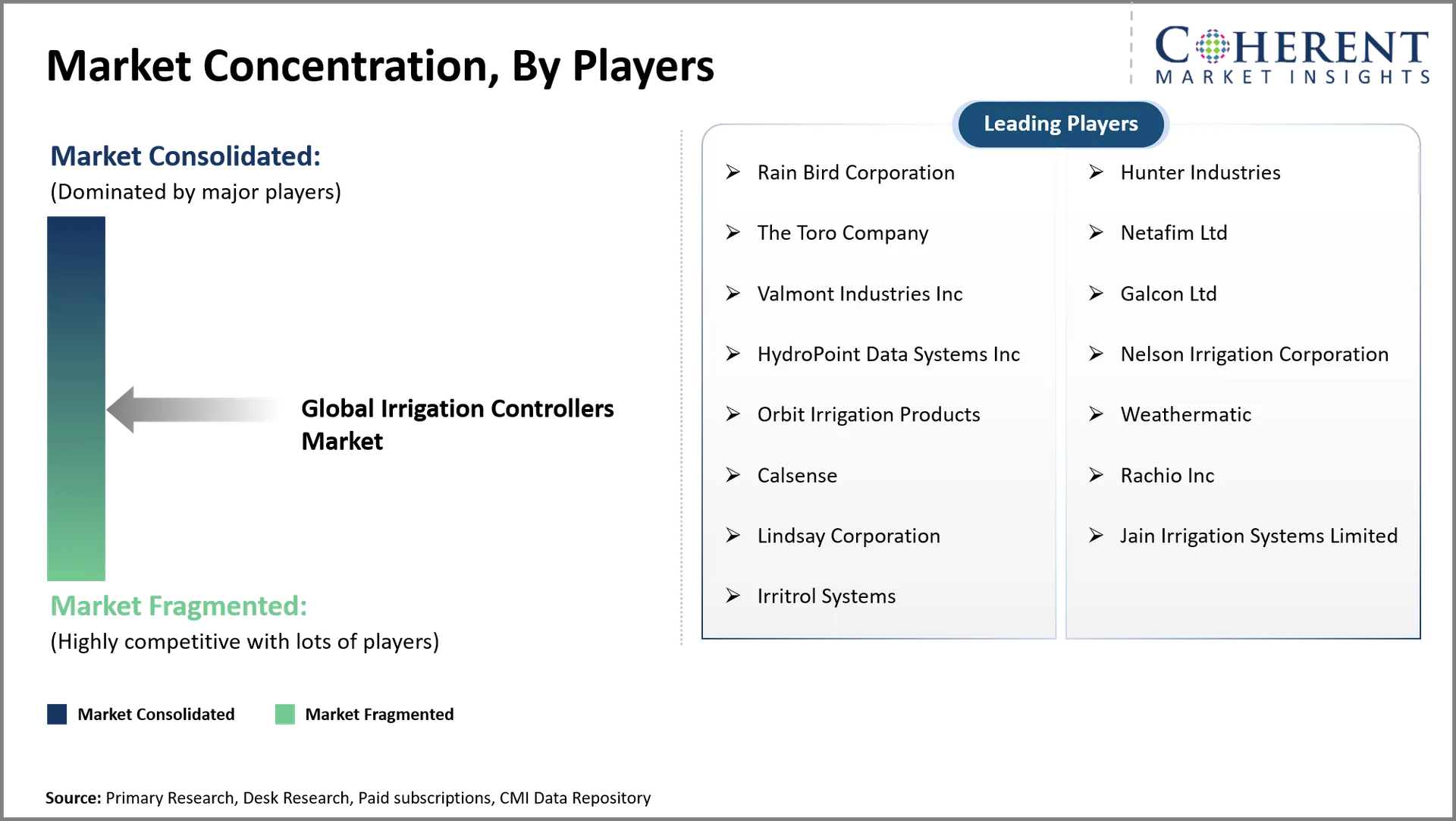
The competitive landscape is led by Rain Bird Corporation, Hunter Industries, The Toro Company, and Netafim. Rain Bird is expanding connected management through its Rain Bird 2.0 App and IQ4 Central Control. IQ4 includes weather-based adjustments, evapotranspiration intelligence, diagnostics and multi-controller administration. Hunter Industries is concentrating on its Hydrawise-enabled controllers for residential, business and professional users. The Predictive Watering system changes watering times based on local weather predictions. The Toro Company puts special focus on precision control for golf courses and big landscapes. The Lynx Smart Module offers one-second irrigation control and remote system management. Netafim focuses strongly on agricultural automation and fertigation. Its GrowSphere system connects controllers, sensors, cloud software, and mobile management. GrowSphere MAX supports 256 valves, multiple mainlines, and more than 100 sensors.
Global Irrigation Controllers Market Report Coverage | |||
Report Coverage | Details | ||
Base Year | 2025 | Market Size in 2026: | USD 2.30 Bn |
Historical Data For: | 2020 To 2024 | Forecast Period: | 2026 To 2033 |
Forecast Period 2026 To 2033 CAGR: | 5.70% | 2033 Value Projection: | USD 5.75 Bn |
Geographies covered: |
| ||
Segments covered: |
| ||
Companies covered: | Rain Bird Corporation, Hunter Industries, The Toro Company, Netafim Ltd, Valmont Industries Inc, Galcon Ltd, HydroPoint Data Systems Inc, Nelson Irrigation Corporation, Orbit Irrigation Products, Weathermatic, Calsense, Rachio Inc, Lindsay Corporation, Jain Irrigation Systems Limited, Irritrol Systems | ||
Growth Drivers: |
| ||
Restraints & Challenges: |
| ||
Analyst Opinion (Expert Opinion)
- The future of irrigation controllers will center on autonomous, sensor-driven irrigation decisions. Controllers will increasingly combine soil moisture, weather, flow, crop, and valve data. Netafim already connects these functions through GrowSphere and NetBeat platforms. The strongest opportunity should emerge in agricultural smart controllers supporting complex multi-zone irrigation. Controllers managing hundreds of valves can address orchards, greenhouses, and large open-field farms.
- The highest geographic opportunity should develop across India, China, Australia, and water-stressed U.S. agricultural regions. India offers particularly strong opportunities around drip irrigation automation and government-supported micro-irrigation infrastructure. Australia provides opportunities for sensor-linked controllers addressing variable soil moisture and water availability. China offers substantial potential for connected controllers across large irrigated agricultural areas. U.S. opportunities remain strong in residential replacement and professional landscape management.
- Players should differentiate through interoperability rather than selling controllers as standalone hardware. Controllers should support multiple sensor types, communication protocols, pumps, valves, and irrigation networks. Remote diagnostics can reduce technician visits and improve maintenance efficiency. Rain Bird already provides controller mapping, diagnostics, reporting, and multi-site management through IQ4. Hunter Industries uses contractor-focused management tools within Hydrawise. Companies should therefore prioritize retrofit compatibility, predictive automation, cybersecurity, and subscription-based software services.
Speak to the analyst
Want personalized insights?
Take the findings above to one of our principal consultants, or have the report rebuilt around the segments, geographies and competitors you actually track.
Market Segmentation
- Product Type Insights (Revenue, USD Billion, 2021 - 2033)
- Smart Controllers
- Tap Timers
- Basic Controllers
- Irrigation Type Insights (Revenue, USD Billion, 2021 - 2033)
- Drip or Trickle Irrigation
- Sprinkler Irrigation
- Connectivity Type Insights (Revenue, USD Billion, 2021 - 2033)
- Wi-Fi
- Cellular
- Radio Frequency
- Bluetooth
- Automation Type Insights (Revenue, USD Billion, 2021 - 2033)
- Fully Automated
- Partially Automated
- Manual
- Control Technology Insights (Revenue, USD Billion, 2021 - 2033)
- Weather Based Controllers
- Soil Moisture Based Controllers
- Timer Based Controllers
- Application Insights (Revenue, USD Billion, 2021 - 2033)
- Agricultural
- Residential
- Commercial
- Industrial
- Regional Insights (Revenue, USD Billion, 2021 - 2033)
- North America
- U.S.
- Canada
- Latin America
- Brazil
- Argentina
- Mexico
- Rest of Latin America
- Europe
- Germany
- U.K.
- Spain
- France
- Italy
- Russia
- Rest of Europe
- Asia Pacific
- China
- India
- Japan
- Australia
- South Korea
- ASEAN
- Rest of Asia Pacific
- Middle East
- GCC Countries
- Israel
- Rest of Middle East
- Africa
- South Africa
- North Africa
- Central Africa
- North America
Sources
Primary Research Interviews
- Irrigation Equipment Manufacturers
- Agricultural Technology Solution Providers
- Smart Water Management Consultants
- Landscape & Horticulture Professionals
Magazines
- Irrigation & Green Industry Magazine
- Agricultural Equipment Technology Magazine
- Smart Water & Irrigation Today
- Precision Agriculture Magazine
Journals
- Journal of Irrigation and Drainage Engineering (ASCE)
- Agricultural Water Management Journal (Elsevier)
- Computers and Electronics in Agriculture (Elsevier)
Associations
- Irrigation Association (IA)
- International Commission on Irrigation and Drainage (ICID)
- American Society of Agricultural and Biological Engineers (ASABE)
- European Irrigation Association (EIA)
Public Domain Sources
- U.S. Environmental Protection Agency (EPA) – WaterSense Program
- U.S. Department of Agriculture (USDA) – National Agricultural Statistics Service
- World Bank – Water & Agriculture Data Portal
- European Commission – Agriculture and Rural Development Reports
Proprietary Elements
- CMI Data Analytics Tool
- Proprietary CMI Existing Repository of Information for Last 10 Years
Get access to 250+ pages report
Every segment, forecast, competitor profile and data table behind the analysis above — available for instant download.
- ESOMAR Member
- ISO 9001:2015 Certified
- D-U-N-S Registered
- GDPR & CCPA Compliant
Missing comfort of reading report in your local language? Find your preferred language:
Frequently Asked Questions
The global irrigation controllers market is expected to stand at USD 2.30 Bn in 2026 and is expected to reach USD 5.75 Bn by 2033.
The CAGR of the global irrigation controllers market is projected to be 5.7% from 2026 to 2033.
Increasing water scarcity is accelerating demand for controlled irrigation and Rising adoption of precision agriculture is increasing automated controller deployment are the major factors driving the growth of the global irrigation controllers market.
High upfront costs can restrict adoption among smaller agricultural users and Installation complexity can discourage replacement of conventional controllers are the major factors hampering the growth of the global irrigation controllers market.
In terms of product type, smart controllers segment is estimated to dominate the market revenue share in 2026.
They adjust irrigation schedules according to changing weather and evapotranspiration conditions.
Soil moisture sensors prevent watering when sufficient moisture remains around plant roots.