

Isocyanate-Free Rail Sealants Market Size and Share Analysis – 2026 To 2033
The Global Isocyanate-Free Rail Sealants Market is expected to reach USD 220 Mn in 2026 and is projected to reach USD 380 Mn by 2033, at a CAGR of 8.1% during the forecast period 2026-2033. Key growth drivers are the growing uptake of isocyanate-free sealing technologies in the manufacturing of railway rolling-stock, increasing demand for sustainable and low emission sealing materials, expanding investments in rail infrastructure and the increasing use of silane-modified polymer (SMP) sealants as substitutes for traditional polyurethane based formulations. According to the International Union of Railways Industry (UNIFE), the global rail supply market is expected to grow at an annual growth rate of 3.2% through 2029-2031, which is supporting the demand for advanced railway materials and sealing solutions.
Key Takeaways of the Global Isocyanate-Free Rail Sealants Market (2026–2033)
- The Silane-Modified Polymers (SMP/MS Polymers) segment is projected to be the largest segment of the global Isocyanate-Free Rail Sealants Market, by 2026, with a market share of 67.0%. The segment is witnessing growth owing to the rising demand for flexible, flame retardant and isocyanate free sealing materials. Henkel has introduced TEROSON MS 949 FR, a silane-modified polymer sealant for use in railway interiors and exteriors that meets EN 45545-2 fire safety requirements and shows resistance to ignition at oxygen concentrations up to 28%.
- The Window and Door Sealing segment is expected to hold a market share of 32.0% by 2026. The increasing demand for vibration-resistant, weatherproof and durable sealing in railway passenger compartments is driving the growth of the segment. Henkel has launched on September 21, 2026, TEROSON MS 940, an isocyanate-free adhesive and sealant for demanding railway applications such as windows, doors, window frames and panels. TEROSON MS 940 features an improved elongation and tensile strength compared to standard SMP technologies.
- The Metro and Light Rail Vehicles segment is projected to account for a 34.0% market share by 2026. Increasing urban rail networks and growing production of passenger railcars are driving demand for advanced sealing solutions. On November 12, 2026, Alstom announced the start of production of an additional 96 driverless metro cars for Chennai Metro Phase II under a EUR 135 Mn contract, which includes 15 years of full maintenance.
- The Rolling Stock OEMs segment is estimated to hold 67.0% market share in the year 2026. The growing manufacturing volumes of passenger trains, high speed trains and metro vehicles is supporting the sealant consumption during vehicle assembly. In May 2026, Alstom announced an order for 96 additional RER NG trainsets in France, valued at approximately EUR 1.7 billion, which shows that investment in railway rolling-stock manufacturing is going on.
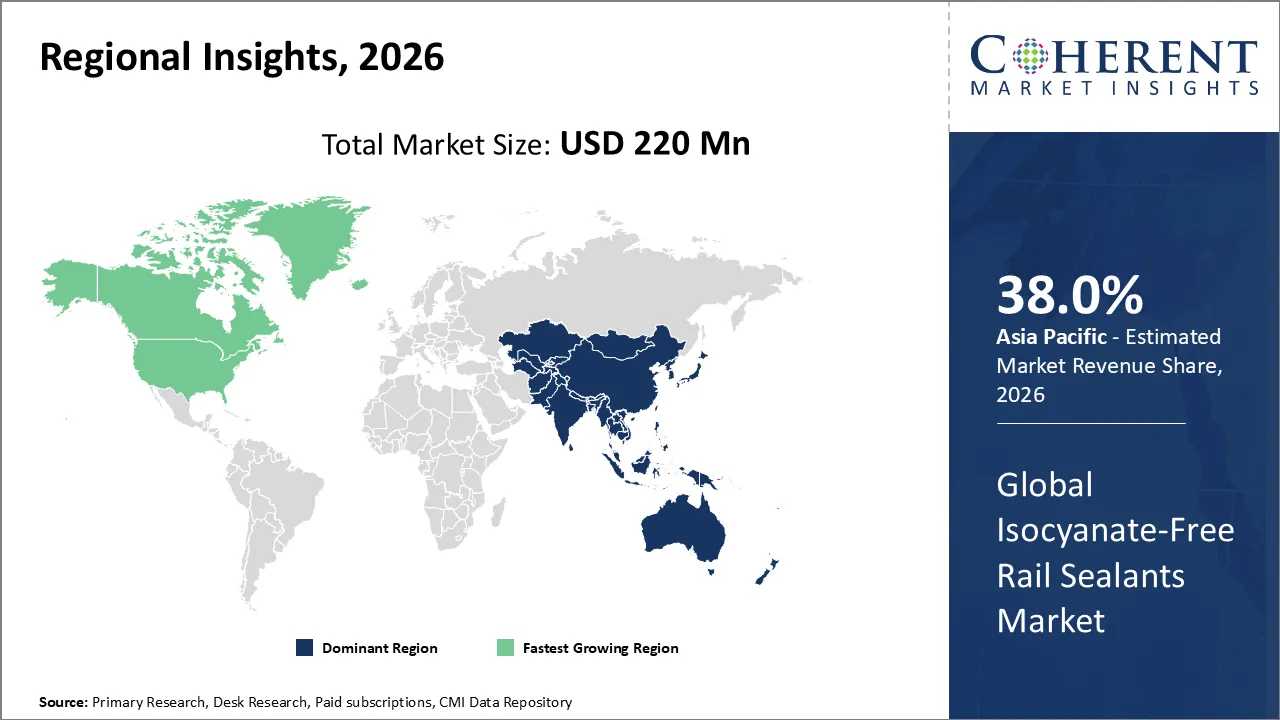
- Asia Pacific is anticipated to lead the global Isocyanate-Free Rail Sealants Market, with an estimated share of about 38.0% in 2026. Expansion of railway infrastructure, domestic rolling stock production and urban mobility investments in China, India and other Asian economies are driving regional demand. UNIFE said on September 22, 2026, that the Asia Pacific region is the largest regional rail supply market and is projected to grow by 3.5% per year through 2029-2031, driven by infrastructure modernisation and growing railway investments.
- North America is expected to be the fastest-growing region in the global Isocyanate-Free Rail Sealants Market from 2026 to 2033, capturing an estimated 18.0% market share in 2026 with an indicative CAGR of 10.2%. Growth in the regional market is expected to be fueled by greater investment in passenger rail fleet modernisation, domestic railcar manufacturing expansion, and growing demand for advanced, isocyanate-free sealing solutions. On September 3, 2026, Alstom said it had signed a C$4.7 billion contract with VIA Rail Canada to build 313 new passenger railcars and provide 15 years of technical support and spare parts.
Segmental Insights
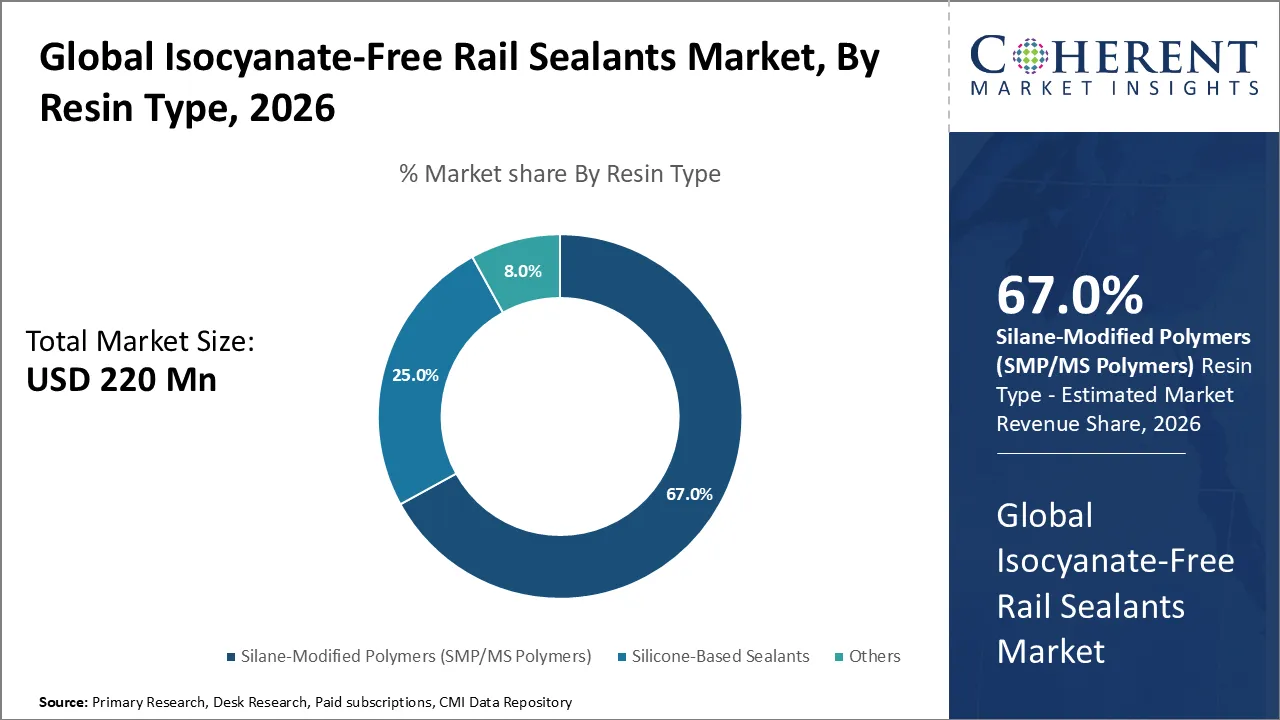
Why Do Silane-Modified Polymers (SMP/MS Polymers) Dominate the Global Isocyanate-Free Rail Sealants Market?
Based on type, the Silane-Modified Polymers (SMP/MS Polymers) segment is projected to account for 67.0% share of global Isocyanate-Free Rail Sealants Market in 2026. The segment’s dominance can be primarily ascribed to the growing demand for high-performance, isocyanate-free sealing materials in the manufacturing and maintenance of railways. “SMP-based sealants offer great adhesion to metals, glass and composites, as well as painted surfaces, and flexibility, moisture resistance and durability under constant vibration.” Their compliance with railway fire safety requirements and their ability to replace traditional polyurethane-based sealants also contribute to their adoption in passenger trains, metro vehicles and high-speed rail applications.
On March 5, 2026, Henkel unveiled a new flame-retardant, isocyanate-free SMP sealant for railway applications: TEROSON MS 949 FR. The product meets EN 45545-2 fire safety standards and resists ignition up to 28% oxygen concentration. It also forms a surface skin in about 30 minutes in high humidity.
- Current Industry Events of 2026
- Market Size Estimation
- Regional Breakdown
- Competitive Landscape
- Customer Intelligence
- Segmental Analysis
- Pricing Analysis
- Key Market Drivers, Challenges & Future Trends
- Customized Insights Section
Why Does Window and Door Sealing Dominate the Global Isocyanate-Free Rail Sealants Market?
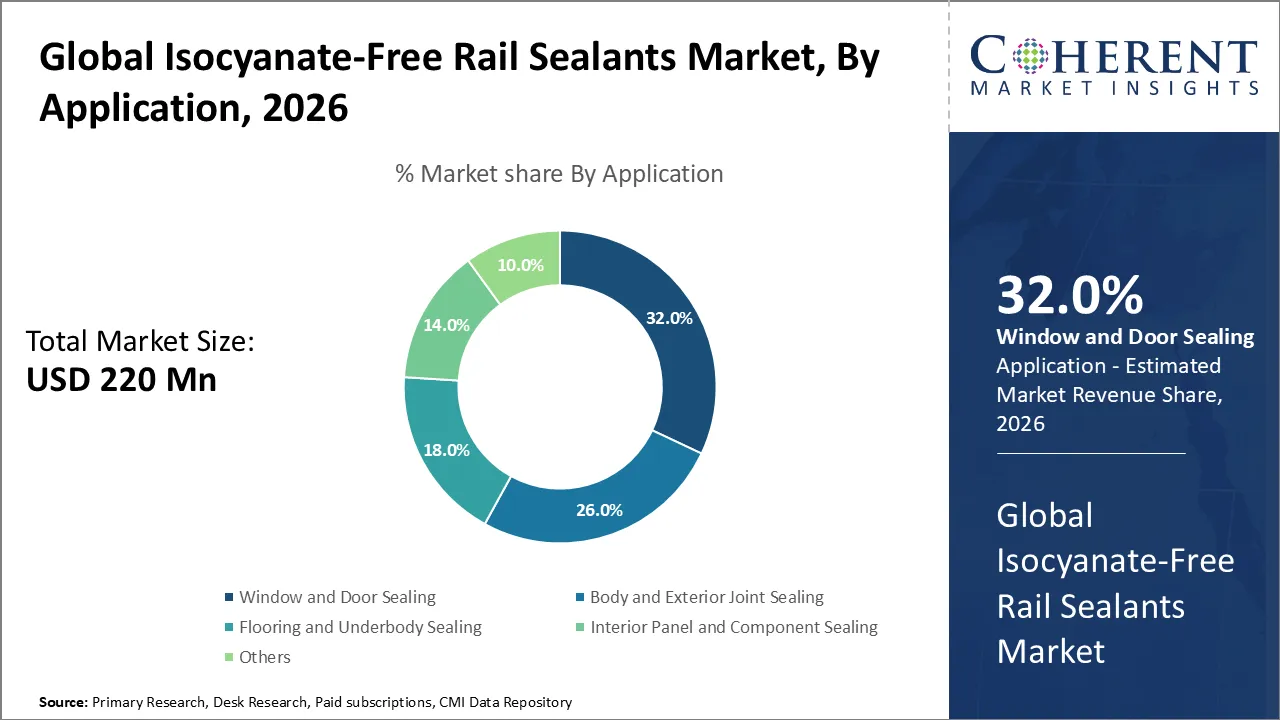
The Window and Door Sealing segment is anticipated to contribute 32.0% share in the global Isocyanate-Free Rail Sealants Market in 2026. Growing demands for weatherproofing, passenger safety, noise reduction and vibration resistance are creating demand for advanced sealing solutions in railway glazing and door assemblies. Mechanical stress, temperature variations, moisture and cleaning chemicals are a constant threat to railway windows and doors. Isocyanate free sealants provide durable elastic joints and adhesion between dissimilar materials and long term performance in railcar manufacturing and refurbishment.
On September 21, 2026, Henkel introduced TEROSON MS 940, an isocyanate-free adhesive and sealant for railway windows, doors and structural components. The product has operating service temperature from -40°C to +100°C with short-term resistance up to +120°C to help support sealing performance in the demanding railway operating conditions.
Why Do Metro and Light Rail Vehicles Dominate the Global Isocyanate-Free Rail Sealants Market?
The Metro and Light Rail Vehicles segment is expected to hold 34.0% share of the global Isocyanate Free Rail Sealants market by 2026. Rapid urbanisation, growing metropolitan railway networks and increasing procurement of modern metro trainsets are driving demand for advanced sealing materials. Extensive sealing is required for Metro vehicles at passenger doors, windows, flooring, inside panels and outside body joints. High service frequency, repeated door operations and vibration exposure have increased the demand for durable and flexible sealants. Also, the use of isocyanate-free formulations is further promoted by the growing use of lightweight railway components and modern vehicle assembly techniques.
On September 30, 2026, Alstom announced the completion of deliveries for Singapore’s North-South and East-West MRT fleet renewal programme, which includes 106 metro trains and 636 railcars. The large-scale replacement programme reflects continued investment in urban rolling stock, creating opportunities for railway sealing materials used in vehicle manufacturing.
Why Do Rolling Stock OEMs Dominate the Global Isocyanate-Free Rail Sealants Market?
The Rolling Stock OEMs segment is estimated to dominate 67.0% share of Isocyanate-Free Rail Sealants Market in 2026. Consumption of sealants in original equipment manufacturing is driven by the increase in production of metro trains, passenger railcars and high-speed railway vehicles. Rolling stock manufacturers need sealing materials for structural joints, glazing, flooring, interior assembly and exterior component protection. The growing focus on production efficiency, worker safety, and adherence to railway fire protection regulations is spurring the adoption of isocyanate-free sealing technologies. Demand from OEMs is also being helped by growing order books for rolling stock and manufacturing capacity.
On 26 August 2026, Stadler announced that its orders for rolling stock in the first half of 2026 had risen to CHF 2.19 billion compared with CHF 1.40 billion for the same period in 2025, an increase of around 56.9%. The company’s total order backlog of CHF 33.3 billion showed a healthy pipeline of future rail vehicle manufacturing activity.
Current Events and Their Impact on the Isocyanate-Free Rail Sealants Market
Current Event | Description and its Impact |
European Union Implements Stricter Occupational Exposure Limits for Diisocyanates (2026) |
|
European Commission Introduces High-Speed Rail Expansion Action Plan (November 2025) |
|
Isocyanate-Free Rail Sealants Market Dynamics
Market Drivers
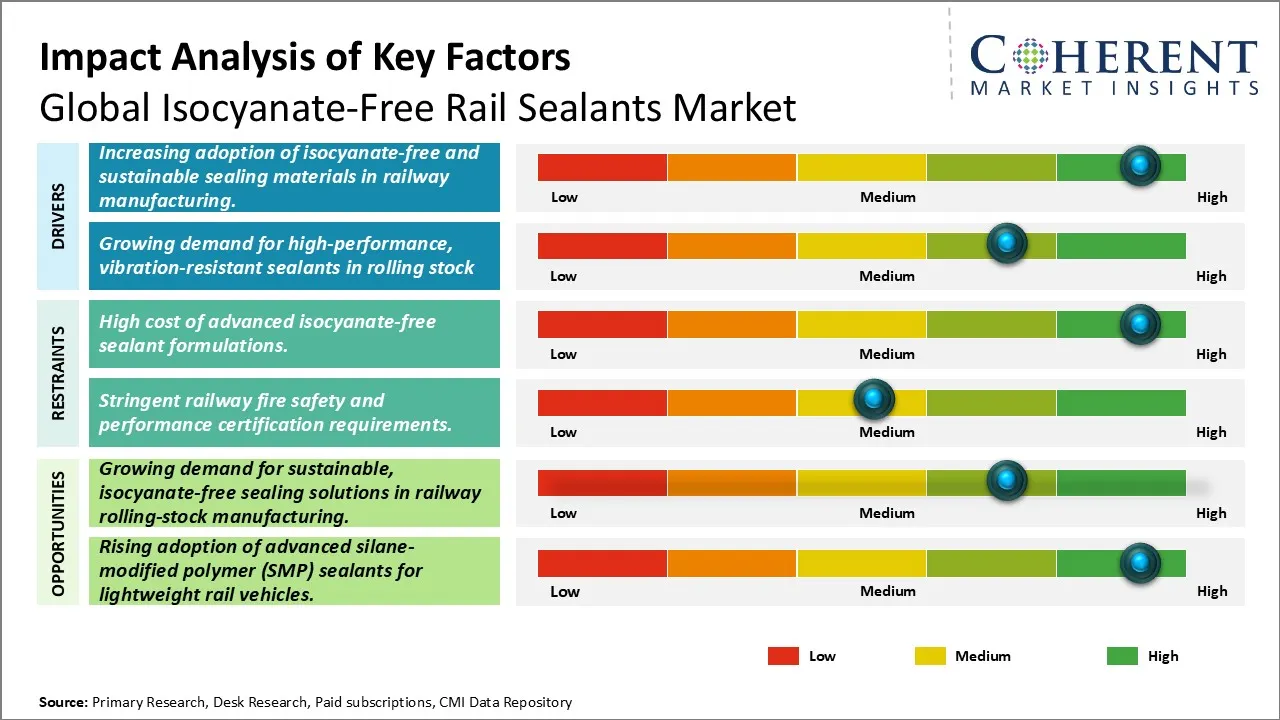
- Increasing adoption of isocyanate-free sealants due to occupational safety requirements: Increasing focus on worker safety, reduction in chemical exposure and regulatory compliance is expected to drive growth of isocyanate-free sealants in railway manufacturing and maintenance. Additional handling precautions, safety training and exposure controls may be necessary for conventional polyurethane sealants containing diisocyanates. Silane-modified polymer (SMP) and compatible silicone-based alternatives can reduce these specific chemical-handling burdens and offer flexibility, adhesion, and vibration resistance. Railcar manufacturers are increasingly evaluating advanced formulations that support workplace safety and demanding railway performance specifications.
- In February 2026 ISOPA released its 2025 Annual Report, showing that over 900,000 workers have registered on the Safe Use Diisocyanates digital training platform. The organisation also said it plans to roll out an updated training platform in 2026, citing the heavy compliance requirements that accompany use of industrial diisocyanate.
- Increase the production of modern railway rolling stock: The demand for passenger trains, metro vehicles, and electric locomotives is increasing, which is driving the growth of the global Isocyanate-Free Rail Sealants Market. Durable sealing materials are required by railway manufacturers for glazing systems, vehicle body joints, flooring assemblies and interior components. Rising production of lightweight rail vehicles and the growing trend of automated assembly operations are opening up opportunities for sealants that provide strong adhesion to a variety of substrates without the need for conventional isocyanate-containing formulations. The demand for advanced sealing technologies is expected to recur across the large scale fleet modernisation programmes during the forecast period.
- On February 6, 2026, Siemens Mobility and Stadler signed a contract worth approximately EUR 3 billion for the supply of 226 fully automated four-car trainsets for the Copenhagen S-Bahn network, with an option for a further 100 trainsets. The contract also includes a long-term service and maintenance concept for more than 30 years, underlining the ongoing commitment to the production of modern rail cars.
Isocyanate-Free Rail Sealants Market Trends (2026–2033)
- Increasing development of isocyanate-free multifunctional polymer formulations: Manufacturers are concentrating on advanced silane-modified polymer technologies combining elastic sealing, strong adhesion, weather resistance and compatibility with various railway substrates. These formulations allow railcar manufacturers to replace some traditional polyurethane systems while still meeting demanding mechanical performance requirements. In September 2026 at InnoTrans 2026, Henkel introduced two new SMP solutions and thus emphasised its commitment to continuous innovation in high-performance rail sealing technologies.
- Sealants increasingly being incorporated into lightweight, multi-material railway structures: Increasing use of aluminium, composite panels, thermoplastics and glass reinforced materials in railway manufacturing is raising the demand for flexible sealing systems that can cater to differential thermal expansion and vibration. Modified-silane technologies are compatible with a variety of dissimilar substrates, and help simplify manufacturing processes. H.B. Fuller points out that major developments in rail bonding include lightweight sandwich panels and aluminium honeycomb structures, including applications requiring more than 60 N/mm roll-peel strength. This is a performance figure for adhesive applications, not an approved isocyanate-free sealant specification.
- Growing demand for primerless, solvent-free and low emission sealing solutions: Railway manufacturers are looking at sealants that require less surface preparation, are easier to apply and that limit solvent-related emissions. Isocyanate-free SMP formulations are attracting attention due to their compatibility with various surfaces and suitability for passenger compartment applications. Key properties of Bostik's SMP-based railway sealing technologies include primerless adhesion, solvent-free formulations and high flame retardancy, reflecting the industry’s focus on manufacturing efficiency and chemical safety.
Regional Insights
Why Does Asia Pacific Dominate the Global Isocyanate-Free Rail Sealants Market?
Asia Pacific is projected to lead the global Isocyanate-Free Rail Sealants Market, holding 38.0% share of the global market in 2026. Its leading position is supported by strong railway manufacturing capabilities, expanding high-speed rail networks and growing investment in metro and commuter transport systems. Countries such as China, India, Japan and South Korea have developed railway rolling-stock manufacturing industries, creating demand for advanced sealing materials for train windows, doors, flooring and joints in exterior body. The increased focus on light-weight railway structures, passenger safety and efficient production processes are driving the use of silane-modified polymer and other isocyanate-free sealing technologies. The increased investment in domestic train manufacturing and fleet modernisation is likely to fuel regional demand.
On August 20, 2026, India’s Ministry of Railways announced plans to build 238 air-conditioned electric multiple-unit (EMU) trainsets for the Mumbai suburban railway network, with deliveries scheduled to take place between 2027 and 2030.
Why Is North America the Fastest-Growing Region in the Global Isocyanate-Free Rail Sealants Market?
North America is expected to be the fastest-growing region in the global Isocyanate-Free Rail Sealants Market with an indicative CAGR of 10.2% during 2026-2033 with an estimated 18.0% global market share in 2026. The region is expected to benefit from growth driven by increased investment in domestic rolling-stock manufacturing, replacement of ageing passenger rail fleets and development of regional railway supply chains. The U.S. and Canada are increasing local production capabilities for passenger trains, locomotives and transit vehicles that will create opportunities for advanced sealing materials. Moreover, increasing emphasis on manufacturing efficiency, workplace chemical safety and durable low-emission materials is anticipated to drive the adoption of isocyanate-free sealants in railway assembly and maintenance operations.
On May 4, 2026, Siemens announced that it has invested USD 1 billion over five years in U.S. manufacturing including industrial infrastructure and passenger rail facilities, and in transportation manufacturing. The investments are projected to generate or preserve more than 2,200 jobs, building domestic production and supply networks.
Global Isocyanate-Free Rail Sealants Market Outlook for Key Countries (2026–2033)
Why is the U.S. Emerging as a Major Market for Isocyanate-Free Rail Sealants?
The U.S. Isocyanate-Free Rail Sealants Market is driven by increasing investments in replacement of railway fleet, domestic manufacturing of railcars and modernisation of urban transportation systems. Railway manufacturers are exploring advanced sealing materials to enhance moisture protection, vibration resistance and long-term durability in passenger trains, commuter railcars and light rail vehicles. The increasing focus on worker safety and manufacturing efficiency is opening up opportunities for silane-modified polymer (SMP) sealants to replace traditional polyurethane formulations. Replacement of old rail vehicles is particularly critical as newly manufactured railcars need sealing materials for windows, doors, flooring, interior panels and exterior body joints.
On September 3, 2026, the U.S. Federal Transit Administration announced USD 166 million in funding for three rail vehicle replacement projects. The agency reported that approximately one-third of U.S. subway and commuter rail vehicles are more than 25 years old, highlighting substantial opportunities for fleet modernization and related railway component suppliers.
Is China a Major Growth Engine for the Isocyanate-Free Rail Sealants Market?
China’s isocyanate-free rail sealants market is driven by the country’s large high-speed railway network, domestic rolling-stock manufacturing industry and ongoing investment in rail transportation technology. Increasing passenger rail networks and demand for high capacity trainsets are opening opportunities for advanced sealing materials used in rail glazing, door assemblies, interior components and exterior joints. Railway component suppliers are also being challenged by the use of lightweight vehicle structures and modern manufacturing processes to develop high-performance sealing technologies. Isocyanate-free SMP and silicone formulations can offer advantages in elastic sealing, weather resistance and compatibility with a variety of railway substrates.
In October 2026, the China National Railway Administration issued the “2026-2030 Railway Science and Technology Innovation Plan”, with a focus on advanced railway equipment, intelligent technologies and independent innovation. The government also said China’s high-speed railway network is expected to expand to about 70,000 km by 2035, creating long-term opportunities for rail vehicle manufacturers and material suppliers for rail maintenance.
Germany Isocyanate-Free Rail Sealants Market Analysis and Trends
The Germany Isocyanate-Free Rail Sealants Market is driven by the existence of established railway vehicle manufacturing capabilities, fleet modernisation programmes and demand for high-performance materials that meet European chemical safety and railway fire protection requirements. The country’s rail industry is increasingly focused on improving train reliability, passenger comfort and lifecycle maintenance efficiency. The sealants based on SMPs are applied in railway glazing, flooring and interior assembly and weatherproofing. They offer elastic adhesion and can absorb vibrations and temperature fluctuations. The demand for advanced sealing materials from railway OEMs and maintenance providers is expected to be supported by continued development of high-speed passenger trains and modernisation of existing fleets.
According to the company’s 2026 Interim Report, Deutsche Bahn had 45 ICE 3neo high-speed trains in service by mid-2026, six of which were newly accepted during the year. Also delivered in the first half of 2026 were six ICE L trains, making for a total of eight trainsets in operation for the ICE L fleet. These developments suggest continued fleet investments and potential demand for railway assembly and maintenance materials.
U.K. Isocyanate-Free Rail Sealants Market Analysis and Trends
The U.K. Isocyanate-Free Rail Sealants Market is driven by renewal of railway fleets, modernisation of infrastructure and increasing focus on whole-life performance in rolling-stock procurement. Increasing emphasis on maintenance efficiency and reliability of railway assets is opening avenues for isocyanate-free formulations in passenger train manufacture and refurbishment. Coordinated procurement strategies can also stimulate suppliers to develop standardised sealing technologies that meet performance, environmental and safety requirements of railways.
On 28 September 2026, the U.K. Department for Transport published the Great British Railways Rolling Stock and Infrastructure Strategy, introducing a coordinated national approach to train procurement and supporting infrastructure investment. The strategy advocates standardised train fleets, long-term relationships with suppliers and procurement decisions based on the lifecycle.
Japan Isocyanate-Free Rail Sealants Market Analysis and Trends
Japan's Isocyanate-Free Rail Sealants Market is being driven by the technologically advanced railway manufacturing industry, large-scale passenger rail operations, and high expectations for vehicle reliability and maintenance performance. Railway operators need sealing solutions that stay adhesive and flexible under constant vibration, frequent passenger door operation and varying environmental conditions. The demand for lightweight railway parts, durable window sealing and reliable interior assembly materials is opening up the door for advanced SMP and silicone-based formulations. The country’s large operating fleet underpins the recurring demand for replacement sealants during refurbishment and scheduled maintenance.
As of July 1, 2026, the operator had 12,103 railway vehicles, operated on about 7,418.7 km of railway lines and carried about 16.5 million passengers daily, according to the corporate data of East Japan Railway Company. The company also handled 11,843 trains a day, highlighting the scale of railway operations and the continuing significant need for rolling-stock maintenance and component reliability.
How Is the Growing Adoption of Sustainable and Isocyanate-Free Sealing Technologies Creating New Growth Opportunities in the Isocyanate-Free Rail Sealants Market?
The global Isocyanate-Free Rail Sealants Market is witnessing new growth opportunities due to the increasing demand for sustainable and high-performance sealing technologies. Producers of railway rolling-stock are looking more and more at alternatives to conventional polyurethane sealants to reduce occupational exposure to diisocyanates, improve the efficiency of the manufacturing process and meet strict material safety requirements. Suppliers can develop solutions that combine silane-modified polymer (SMP) and silicone based sealants with strong adhesion, flexibility, weather resistance and vibration durability. The growing adoption of lightweight aluminium structures, composite panels and advanced railway glazing systems also supports demand for sealing materials compatible with multiple substrates.
For instance: the Europe’s Rail Joint Undertaking says that combining composites with metallic parts can reduce the weight of railway carriages by about 20%, while lightweight composite running-gear applications can achieve weight reductions of 60-70% in selected components. These developments provide opportunities for flexible, multi-substrate sealing technologies in next generation rail vehicles
Market Players, Key Development, and Competitive Intelligence
Key Developments
- On April 7, 2026, Henkel announced, that TEROSON MS 9381 HPT is an adhesive sealant for heavy equipment and vehicle applications. It is free of isocyanates, tin, solvents, silicones and PVC and provides primerless adhesion to a variety of substrates.
- On August 10, 2026, Sika launched Sika Stixall Ultra, a premium hybrid adhesive and sealant for professional applications requiring high bonding strength, flexibility and compliance with performance standards. The development fits with ongoing investment in hybrid polymer technologies, however the product has not been specifically identified as a railway qualified sealant.
Competitive Landscape
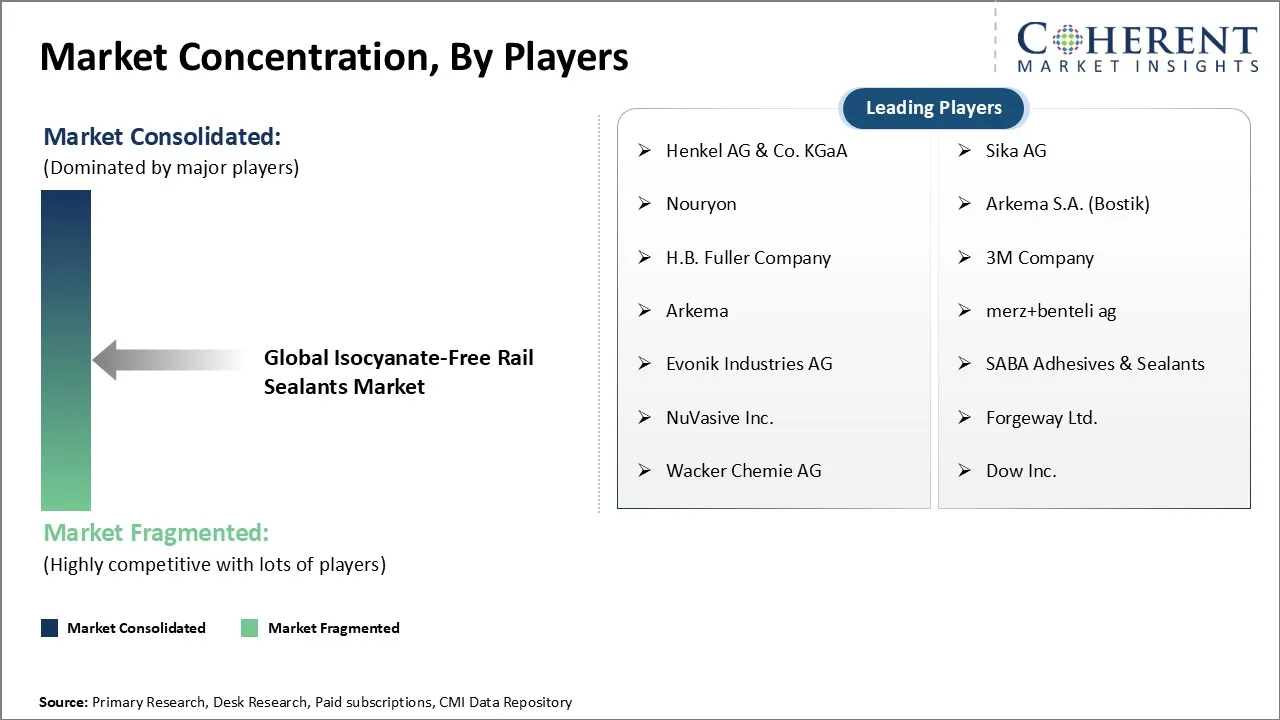
The global Isocyanate-Free Rail Sealants market is competitive with established speciality chemical and sealant suppliers competing on sustainable formulations, product durability and compliance with railway safety standards. Henkel AG & Co. KGaA provides advanced isocyanate-free TEROSON sealants for railway applications. Sika AG and Arkema S.A. (Bostik) specialise in silane-modified polymer technologies which provide excellent adhesion and vibration resistance. H.B. Fuller Company and 3M Company provide high-performance sealing and bonding solutions for the transportation industry. Specialised manufacturers, like merz+benteli ag, SABA Adhesives & Sealants and Forgeway Ltd. focus on flexible sealing and application-specific formulations, while Wacker Chemie AG and Dow Inc. offer speciality silicone technologies. Compliance with EN 45545-2 fire safety standards, low-emission formulations, faster curing and long-term partnerships with rolling-stock manufacturers are becoming increasingly important for competitive differentiation.
Top Manufacturers and Notable Products/Solutions in the Isocyanate-Free Rail Sealants Market
Company/Manufacturer | Notable Product/Brand | Key Features |
Henkel AG & Co. KGaA | TEROSON MS 949 FR, TEROSON MS 940 | Isocyanate-free SMP sealants, flame resistance, primerless adhesion, high elasticity, vibration resistance, railway interior and exterior sealing. |
Sika AG | Sikaflex-521 UV | Isocyanate- and solvent-free STP sealant, weather and UV resistance, multi-substrate adhesion, low odor, paintable, suitable for railway exterior sealing. |
Arkema S.A. (Bostik) | Simson ISR 70-03 FR, ISR 70-03 | SMP-based adhesive and sealant technologies, isocyanate-free formulations, elastic bonding, UV resistance, primerless adhesion, railway body and interior applications. |
H.B. Fuller Company | Rail Transportation Adhesives and Sealants Portfolio | Industrial bonding and sealing solutions for rail assembly, lightweight components, and manufacturing applications; specific isocyanate-free rail sealant formulation requires verification. |
3M Company | 3M Adhesive Sealant 740 UV, 760 UV | Isocyanate-free, moisture-curing elastomeric sealants, UV resistance, flexible joints, weather-resistant sealing, and suitability for rail transportation applications. |
merz+benteli ag | Merbenit RV30, Merbenit RV55 | Isocyanate-free SMP formulations, flexible sealing, fire-resistant railway applications, EN 45545-2 compliance, weather resistance, and vibration accommodation. |
SABA Adhesives & Sealants | Sabatack 755 HL3 | Isocyanate-free MS polymer adhesive/sealant, flame retardancy, EN 45545-2 HL1–HL3 compliance, primerless adhesion, and railway interior/exterior sealing. |
Forgeway Ltd. | Formoa 760 | Single-component MS polymer sprayable sealant, EN 45545 approval, corrosion protection, chemical resistance, impact resistance, and vibration reduction for rail applications |
Market Report Scope
Isocyanate-Free Rail Sealants Market Report Coverage
Report Coverage | Details | ||
Base Year: | 2025 | Market Size in 2026: | USD 220 Mn |
Historical Data for: | 2020 to 2024 | Forecast Period: | 2026 to 2033 |
CAGR: | 8.1% | 2033 Value Projection: | USD 380 Mn |
Geographies covered: |
| ||
Segments covered: |
| ||
Companies covered: | Henkel AG & Co. KGaA, Sika AG, Arkema S.A. (Bostik), H.B. Fuller Company, 3M Company, merz+benteli ag, SABA Adhesives & Sealants, Forgeway Ltd., Wacker Chemie AG, Dow Inc. | ||
Growth Drivers: |
| ||
Restraints & Challenges: |
| ||
Analyst Opinion (Expert Opinion)
- High-performance silane-modified polymers (SMP), low-emission formulations, and railway-certified sealing technologies will shape the future of the global Isocyanate-Free Rail Sealants Market. “In rolling-stock manufacturing, the focus is likely to be on materials offering good adhesion, vibration resistance, long-term flexibility and adherence to railway fire safety requirements. Suppliers able to supply isocyanate-free alternatives with demonstrated durability and ease of application will be better placed to secure OEM contracts. UNIFE’s September 2026 World Rail Market Study forecasts the global rail supply market to reach EUR 266.8 billion in 2029-2031, growing at a CAGR of about 3.2%. The overall growth of this industry offers a positive demand environment for specialised railway sealing materials.
- The largest growth opportunities are expected to be in the production of railway rolling stock, fleet refurbishment and advanced multi-material sealing applications. There is a large opportunity in Asia Pacific with a huge rail manufacturing base. There is an opportunity in North America for rapid growth through investments in domestic manufacturing and fleet modernisation. Europe is still strategic for speciality sealants that meet railway safety and material qualification requirements. On March 18, 2026, Stadler announced capital investments of around CHF 250 million planned for 2026 and predicted annual revenues of more than CHF 5 billion. These investments are an indication of the continued growth of rolling-stock manufacturing and create opportunities for qualified suppliers of sealing materials.
- Along with sustainability claims, product performance (verified), railway-specific certifications, supply-chain reliability and cost-effective application technologies will increasingly become important differentiators for market participants. The manufacturer should consider compliance with EN 45545-2, strong adhesion to aluminium and composites, efficient cure and durability under repeated vibration and environmental exposure. Suppliers should also invest in local distribution network, technical support and long term OEM qualification programmes to strengthen customer retention. On October 29, 2026, UNIFE noted that critical raw materials are increasingly important for the manufacturing and maintenance of European railways and mentioned supply constraints as an industry concern.
Speak to the analyst
Want personalized insights?
Take the findings above to one of our principal consultants, or have the report rebuilt around the segments, geographies and competitors you actually track.
Market Segmentation
- By Resin Type (Revenue, USD Mn, 2021-2033)
- Silane-Modified Polymers (SMP/MS Polymers)
- Silicone-Based Sealants
- Others (Isocyanate-Free Acrylic and Specialty Hybrid Sealants)
- By Application (Revenue, USD Mn, 2021-2033)
- Window and Door Sealing
- Body and Exterior Joint Sealing
- Flooring and Underbody Sealing
- Interior Panel and Component Sealing
- Others (HVAC, Electrical Enclosure and Roof Component Sealing)
- By Rolling Stock Type (Revenue, USD Mn, 2021-2033)
- Metro and Light Rail Vehicles
- Conventional Passenger Trains
- High-Speed Trains
- Freight Rail Vehicles
- By End User (Revenue, USD Mn, 2021-2033)
- Rolling Stock OEMs
- Railway Maintenance
- Repair and Overhaul (MRO) Providers
- By Region (Revenue, USD Mn, 2021-2033)
- North America
- U.S.
- Canada
- Latin America
- Brazil
- Mexico
- Argentina
- Rest of Latin America
- Europe
- Germany
- U.K.
- France
- Italy
- Spain
- Russia
- Rest of Europe
- Asia Pacific
- China
- India
- Japan
- Australia
- South Korea
- ASEAN
- Rest of Asia Pacific
- Middle East
- GCC
- Israel
- Rest of Middle East
- Africa
- South Africa
- Central Africa
- North Africa
- North America
- Key Players
- Henkel AG & Co. KGaA
- Sika AG
- Arkema S.A. (Bostik)
- H.B. Fuller Company
- 3M Company
- merz+benteli ag
- SABA Adhesives & Sealants
- Forgeway Ltd.
- Wacker Chemie AG
- Dow Inc.
Sources
Primary Research Interviews
- Railway rolling-stock OEMs and manufacturing executives
- Isocyanate-free sealant and adhesive manufacturers
- Silane-Modified Polymer (SMP/MS Polymer) formulation specialists
- Silicone sealant manufacturers and polymer scientists
- Railway materials and chemical engineering experts
- Railway maintenance, repair, and overhaul (MRO) service providers
- Procurement and sourcing managers from metro, passenger rail, and high-speed train manufacturers
- Railway fire safety, testing, and certification specialists
- Key opinion leaders (KOLs) in railway materials and sustainable sealing technologies
Databases
- World Bank
- Organisation for Economic Co-operation and Development (OECD)
- Eurostat – Railway Transport Statistics
- United Nations Comtrade Database
- European Chemicals Agency (ECHA)
- European Commission – Transport and Mobility Database
- U.S. Bureau of Transportation Statistics (BTS)
- U.S. Federal Transit Administration (FTA)
- International Transport Forum (ITF) – Transport Statistics
Magazines
- Railway Gazette International
- International Railway Journal
- Railway Technology
- Railway News
- Global Railway Review
- European Railway Review
- Adhesives & Sealants Industry (ASI)
- European Coatings Journal
Journals
- International Journal of Adhesion and Adhesives
- Journal of Adhesion Science and Technology
- Polymer Testing
- Progress in Organic Coatings
- Polymer Engineering & Science
- Journal of Applied Polymer Science
- Construction and Building Materials
- Transportation Research Procedia
Newspapers
- Financial Times
- The Wall Street Journal
- Reuters
- The Economic Times
- The Guardian
- Nikkei Asia
Associations
- International Union of Railways (UIC)
- UNIFE – The European Rail Supply Industry
- European Federation of Adhesive and Sealant Industry (FEICA)
- The Adhesive and Sealant Council (ASC)
- American Public Transportation Association (APTA)
- Railway Industry Association (RIA), U.K.
- Association of American Railroads (AAR)
- ASTM International
- International Organization for Standardization (ISO)
Public Domain Sources
- Company Annual Reports and Investor Presentations
- Manufacturer Product Catalogs, Technical Data Sheets, and Safety Data Sheets
- Government Railway Infrastructure and Rolling Stock Investment Reports
- UNIFE World Rail Market Study and Industry Publications
- Europe's Rail Joint Undertaking Research Publications
- European Union Agency for Railways – Technical and Safety Publications
- European Union REACH Regulations on Diisocyanates
- Railway Fire Safety Standards and Certification Documents, Including EN 45545-2
- Patent Databases, Including WIPO, USPTO, and Google Patents
- Railway OEM Sustainability Reports and Supplier Qualification Documents
- Publicly Available Rail Vehicle Manufacturing and Maintenance Reports
Proprietary Elements
- CMI Data Analytics Tool
- Proprietary CMI Existing Repository of Information for the Last 10 Years
Get access to 250+ pages report
Every segment, forecast, competitor profile and data table behind the analysis above — available for instant download.
- ESOMAR Member
- ISO 9001:2015 Certified
- D-U-N-S Registered
- GDPR & CCPA Compliant
Frequently Asked Questions
The global Isocyanate-Free Rail Sealants Market is estimated to reach USD 380 Mn by 2033, compared with USD 220 Mn in 2026.
Major players operating in or supplying technologies relevant to the global Isocyanate-Free Rail Sealants Market include Henkel AG & Co. KGaA, Sika AG, Arkema S.A. (Bostik), H.B. Fuller Company, 3M Company, merz+benteli ag, SABA Adhesives & Sealants, Forgeway Ltd., Wacker Chemie AG, and Dow Inc.
High costs of advanced isocyanate-free sealant formulations, stringent railway fire safety certification requirements, lengthy product qualification processes, and competition from conventional polyurethane-based sealants are the major factors hampering market growth.
Increasing adoption of sustainable and low-emission sealing materials, growing railway rolling-stock production, expanding rail infrastructure investments, and rising demand for high-performance, vibration-resistant sealants are driving market growth.
The global Isocyanate-Free Rail Sealants Market is projected to grow at a CAGR of 8.1% from 2026 to 2033, based on analyst-estimated market values.
Asia Pacific is expected to dominate the global Isocyanate-Free Rail Sealants Market, accounting for an estimated 38.0% market share in 2026, supported by expanding railway manufacturing and infrastructure development in China, India, Japan, and South Korea.
North America is projected to be the fastest-growing region, with an indicative CAGR of 10.2% during 2026–2033, supported by railway fleet modernization, domestic rolling-stock manufacturing investments, and increasing demand for advanced sealing technologies.