

Global IT Sourcing Market Size and Forecast – 2026 To 2033
The global IT sourcing market is expected to grow from USD 855.00 Bn in 2026 to USD 1,450.00 Bn by 2033, registering a compound annual growth rate (CAGR) of 8.7% from 2026 to 2033. The global IT sourcing market is driven by rising demand for cybersecurity and artificial intelligence expertise. On December 24, 2025, Deloitte Touche Tohmatsu India LLP expanded its strategic partnership with Google Cloud. The firm will serve as a premier partner, reseller and Managed Security Service Provider for Google Cloud in India.
Key Takeaways of the Global IT Sourcing Market
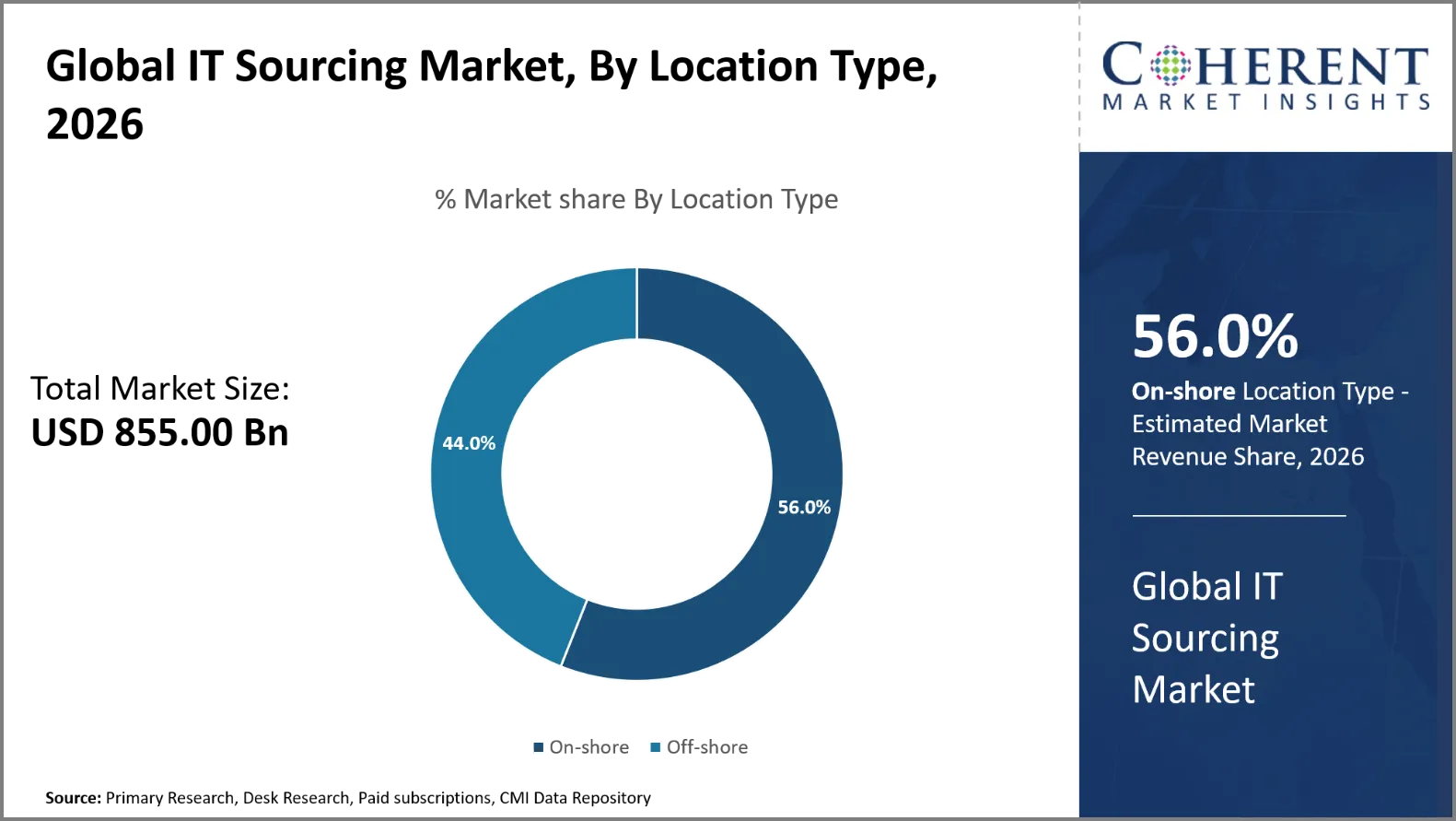
- The On-shore segment is expected to account for 56.0% of the global IT sourcing market share in 2026 Shortages of specialized technology professionals is driving the growth of the segment. On June 1, 2026, Cognizant announced the creation of two new job categories; Frontier Certified Engineer and Frontier Business Operator, purpose-built for the AI era. The roles represent a significant expansion of Cognizant's workforce strategy and are designed for a new generation of talent at the forefront of enterprise AI transformation.
- The Application Services segment is estimated to capture 34.0% of the market share in 2026. Increasing enterprise modernization and legacy system replacement is majorly driving the growth of the segment. On July 14, 2026, Fujitsu Limited the Japan launch of the Fujitsu AI-driven Modernization Service. It is a service to assist the sustainable development of enterprises and organizations, combining Fujitsu’s practical modernization knowledge acquired over decades of system integration with generative AI.
- The Information Technology Outsourcing segment is estimated to capture 38.0% of the market share in 2026. Growth of regional delivery centers and specialized technology partnerships is driving the growth of the segment. In December 2025, NTT DATA Expanded its regional cybersecurity delivery network. NTT DATA announced a coordinated expansion of cyber defense capabilities across India, the United Kingdom, and the U.S.
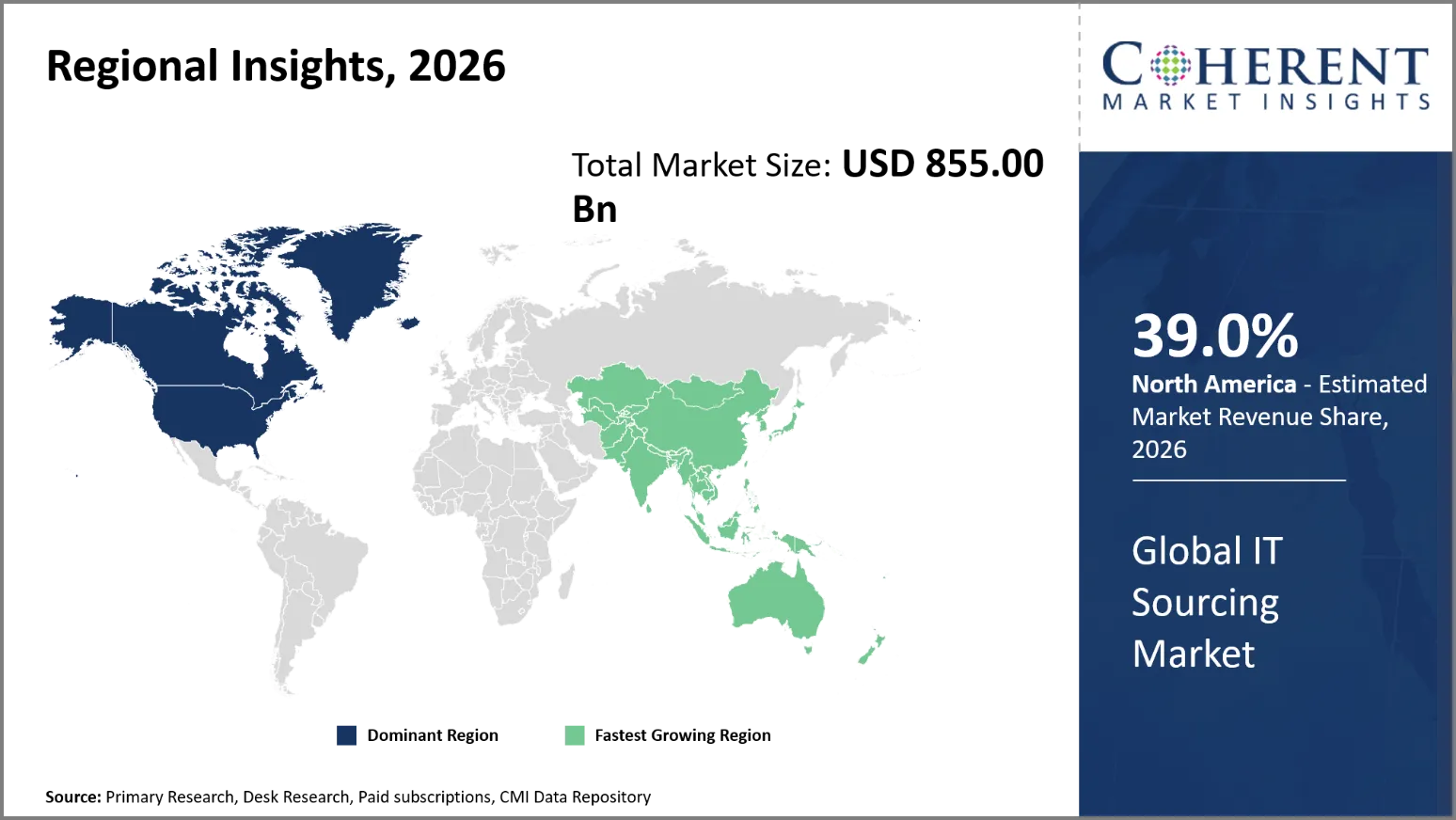
- North America is expected to dominate the IT sourcing market in 2026 with a market share of 39.0%. Growing cybersecurity outsourcing and regulatory compliance in North America is driving the growth of the regional market. On May 12, 2026, Proofpoint, Inc. announced the formation of Proofpoint MSP Platform, a dedicated business unit serving managed service providers (MSPs) and small and mid-sized businesses and the North America launch of Proofpoint 365 Total Protection, its comprehensive, AI-powered Microsoft 365 security platform built for the MSP channel.
- Asia Pacific is expected to account for 26.0% share in 2026. Growing emphasis on sustainable information technology operations and infrastructure optimization in Asia Pacific is driving the growth of the regional market. On February 9, 2026, Nxera, Singtel Group’s regional data center arm, announced the opening of DC Tuas, its largest, next-generation and most energy efficient data center. This expands Nxera’s capacity in Singapore to meet accelerating demand for AI, cloud and high-performance computing workloads from enterprises and hyper scalers.
Segmental Insights
Why Does On-shore Dominate the Global IT Sourcing Market?
The on-shore segment is expected to account for 56.0% of the global IT sourcing market share in 2026. On-shore sourcing dominates because it allows companies and technology service providers to work closely together within the same country. It enables to communicate faster, coordinate projects more easily, and better match with local company requirements. Shared language, cultural understanding, and comparable working hours can assist organizations. It is easier to comply with national data protection laws, industry standards and contractual duties by bringing delivery ashore. It’s especially useful for government agencies, financial institutions, healthcare providers, and businesses that deal with sensitive data. These advantages make on-shore sourcing an excellent alternative for projects needing tight supervision, fast technical assistance and close collaboration with key stakeholders.
On December 5, 2025, the Government of India selected Zoho Corporation Ltd. in a competitive procedure to modernize its antiquated government email system to a secure cloud-based platform. The government specified that primary and disaster recovery data centers must remain physically within India.
- Current Industry Events of 2026
- Market Size Estimation
- Regional Breakdown
- Competitive Landscape
- Customer Intelligence
- Segmental Analysis
- Pricing Analysis
- Key Market Drivers, Challenges & Future Trends
- Customized Insights Section
Why is Application Services the Most Preferred Service Type?
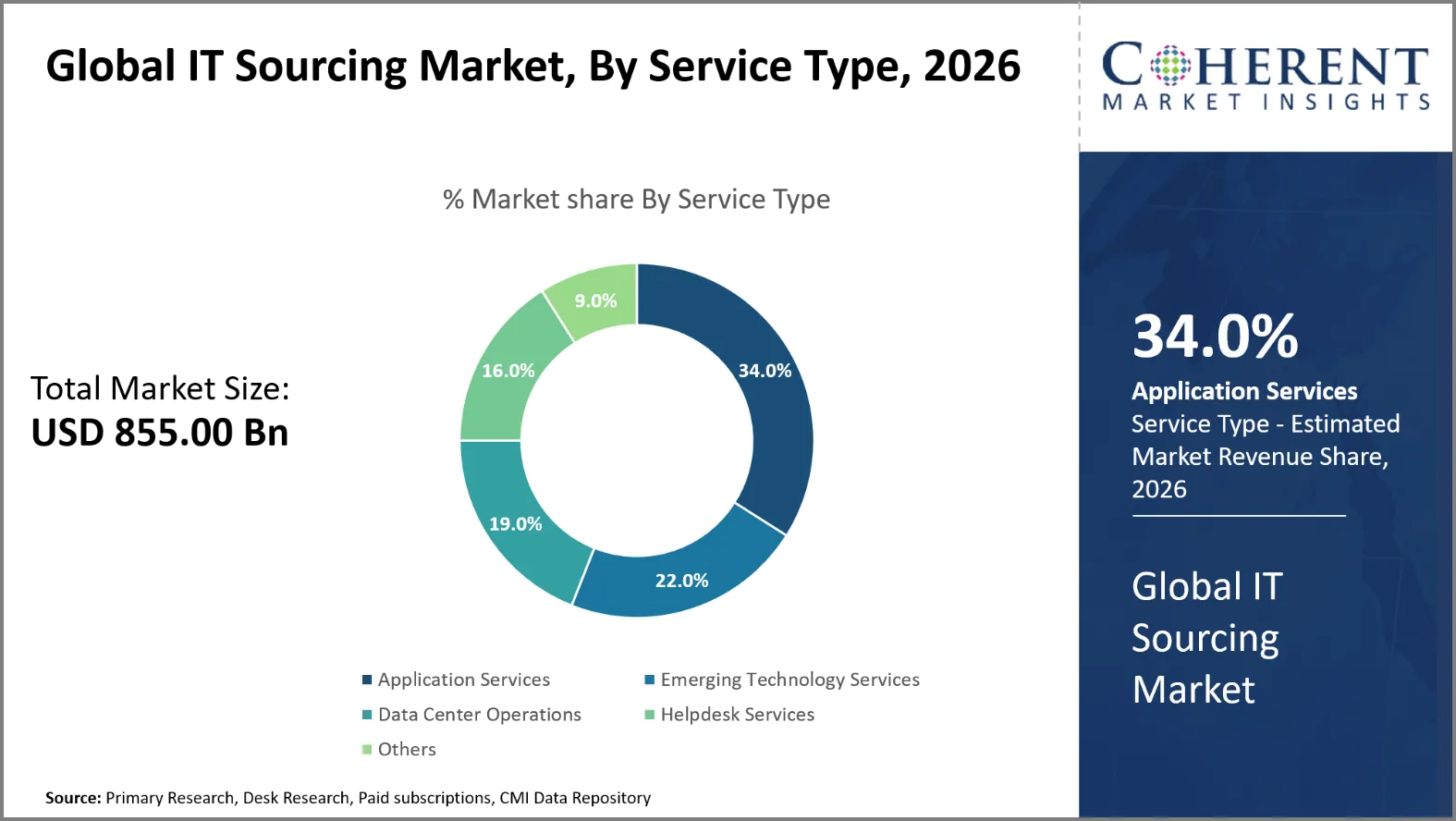
The application services segment is expected to account for 34.0% of the global IT sourcing market share in 2026. Application services are a popular sort of service because businesses need software apps to perform daily operations and engage customers. Organizations outsource application development, modernization, testing, integration and maintenance to leverage specialized technological knowledge. Businesses can use external suppliers to modernize legacy systems, increase the performance of software and reduce application downtime. The increased prevalence of cloud computing, artificial intelligence and digital business platforms also means there is more demand for application-related knowledge. Outsourcing also frees internal information technology teams to focus on strategic priorities, rather than on regular development activities. These advantages make application services crucial to operational efficiency, speed of digital transformation and competitive business capabilities.
On June 3, 2025, Wipro Limited announced it has signed a multiyear agreement with Entrust, a global leader in identity-centric security solutions, to deliver strategic resources, scalability and agility to help accelerate its growth. Wipro will help Entrust with product development, infrastructure and application modernization using leading industry standards.
Information Technology Outsourcing Dominates the Global IT Sourcing Market
The information technology outsourcing segment is expected to account for 38.0% of the global IT sourcing market share in 2026. Information technology outsourcing dominates as enterprises increasingly rely on external specialists to fulfill sophisticated IT requirements. Outsourcing provides access to qualified personnel, advanced infrastructure, cybersecurity expertise, and specialist technical capabilities without having to construct every resource in-house. Enterprises can reduce operational expenses, scale services to match demand, and speed up technology deployment. Common functions that are outsourced are infrastructure management, application development, cloud operations, technical support and cyber security services. Demand is fueled by rapid digital change and ongoing shortages of specialist technology experts.
On February 13, 2025, Skanska signed a contract with DXC Technology for the management of Skanska’s global IT infrastructure operations. Skanska seeks with this solution to address increasing needs for contemporary and adaptable IT infrastructure services. The goal is to drive operational efficiency and to focus more on innovation and client solutions.
Current Events and their Impact
Current Events | Description and its Impact |
India - Digital Personal Data Protection Act, 2023, and Digital Personal Data Protection Rules, 2025. |
|
European Union Artificial Intelligence Act Regulation (EU) 2024/1689 |
|
IT Sourcing Market Dynamics
Market Drivers
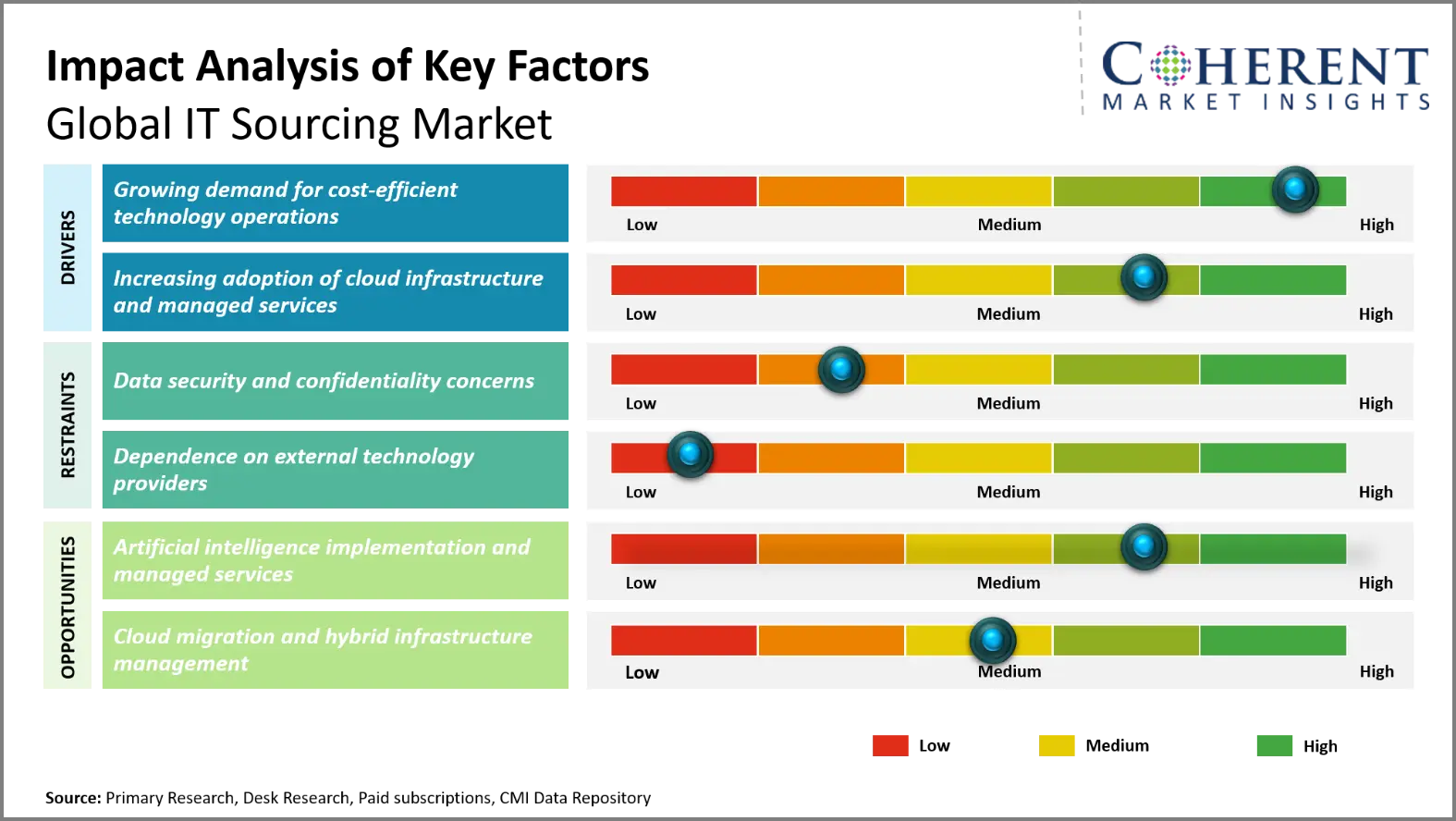
Growing demand for cost-efficient technology operations
Organizations are outsourcing information technology operations at a faster pace to control costs and utilize resources better. Firms need to spend in internal IT teams for recruitment, training, infrastructure, software licenses and cybersecurity. With IT sourcing, companies can access specialized skills without having to keep every capability in-house. Service agreements are flexible, so that enterprises can tailor technology investment based on operational needs. Additionally, companies can reallocate internal resources to product development, customer experience, and strategic projects. Demand for outsourced application management, technical support, infrastructure maintenance and cybersecurity services continues to grow, driven by ongoing cost pressures and rising complexity of technology.
On June 16, 2025, HCLTech announced a strategic agreement with E.ON, one of Europe’s leading energy firms, with a 1.6-million-kilometer distribution grid and about 47 million users. As part of the new multi-year arrangement, HCLTech will create a new private cloud and deliver cloud and network management on hyper scalers across E.ON globally.
Increasing adoption of cloud infrastructure and managed services
Growing adoption of cloud infrastructure and managed services is driving demand in the Global IT Sourcing Market. Organizations are increasingly looking for external expertise to transfer apps, manage hybrid environments, maximize cloud spend and keep systems available. Managed service providers assist with cloud monitoring, infrastructure automation, cybersecurity, backup management and performance optimization. These competencies allow companies to overcome internal skill gaps and navigate complex technology landscapes. The increasing adoption of AI applications and data-intensive workloads further drive the demand for scalable cloud resources. So, a lot of companies are looking to choose partners with better capabilities in cloud integration, operation, and administration, and security.
On July 22, 2025, Infosys announced that it has extended its strategic relationship with AGCO Corporation, a global leader in the design, production and sale of agricultural machinery and precision agriculture technologies. This new engagement covers IT infrastructure and HR operations, positioning AGCO with a future-ready operational model and operational efficiency.
Rapid growth of Nearshoring in Latin America
Nearshoring is gaining traction in Latin America as corporations seek cost-effective technological talent in comparable time zones. Mexico, Brazil, Colombia and Costa Rica are examples of countries that are attracting outsourcing contracts owing to their existing technology ecosystems and rising pools of competent workers. Being geographically proximate allows for real-time cooperation, faster project coordination and a closer alignment with customer objectives. Its trade links and burgeoning digital infrastructure also make the region more attractive. “There is growth in demand for software development, application maintenance, cloud engineering, cyber security and business process automation. Talent shortages, wage inflation and infrastructural gaps are also causing corporations to examine suppliers closely before picking where to place their nearshore delivery centers.
On October 8, 2025, Salesforce announced plans to invest USD 1 billion in its Mexico operations over the next five years. This announcement reinforces Salesforce’s commitment to the economic and social development of Mexico and is designed to help companies countrywide and across the broader region transform into Agentic Enterprises, where humans and AI agents work together to drive customer success.
Emerging Trends
- Artificial Intelligence-Driven IT Service Delivery: IT sourcing providers are deploying artificial intelligence for software development, service desk operations, cybersecurity monitoring and application maintenance. Automated workflows boost productivity, decrease incident resolution time and enable predictive maintenance. Vendors are increasingly being judged on what automation achieves.
- Growth of Multi-Cloud and Hybrid Cloud Sourcing: Organizations are deploying various cloud platforms and hybrid environments to better agility, resilience and workload management. Cloud migration, infrastructure optimization, interoperability and managed security are increasingly being offered by IT sourcing providers. This growth increases the need for specialized cloud integration knowledge.
- Expansion of Nearshore and Regional Delivery Centers: Companies are expanding their outsourcing sites to balance labor costs, collaboration needs, and geopolitical risks. Latin America attracts North American customers, and Central and Eastern Europe caters to European companies. Regional delivery centers enable faster communication and more resilient sourcing strategies.
- Increasing Focus on Cybersecurity and Regulatory Compliance: Enterprises are increasingly selecting sourcing partners with robust cybersecurity controls, clear subcontracting practices, and proven regulatory compliance. Vendor assessments are being impacted by data protection legislation and supply-chain security requirements. Providers are differentiating themselves more and more, in addition to offering security certifications, ongoing surveillance, and documented risk management processes.
Regional Insights
Why is North America a Strong Market for IT Sourcing?
North America is expected to account for a market share of 39.0% in 2026. North America is benefiting from enterprise need for artificial intelligence integration, cybersecurity modernization and specialist cloud management. U.S. financial institutions have outsourced needs for fraud detection, application modernization, and regulatory reporting. More and more Canadian enterprises are relying on technology providers for digital government services, cloud migration and financial technology platforms. Canada bolsters regional sourcing with nearshore software development and application support. For example, companies can coordinate development teams across U.S. and Canadian locations during overlapping business hours. Growing requirements for secure artificial intelligence deployment, legacy system replacement, and technology supplier risk management support demand for specialized IT sourcing partnerships across the region.
Why Does Asia Pacific IT Sourcing Market Exhibit High Growth?
Asia Pacific is expected to register the fastest growth with a CAGR of 9.6% over the forecast period. The region is projected to account for 26.0% of the global IT sourcing market in 2026. Cloud adoption, AI implementation and demand for niche technical services are shaping the IT sourcing industry in Asia Pacific. Manufacturers outsourcing robotics software, factory analytics and connected production systems are giving a boost to Japan’s industrial digitalization. South Korean electronics industries need semiconductor design software, supply-chain technology integration and testing automation. Established regional technology operations in Singapore with financial services, cloud infrastructure and digital governance skills. Managed cybersecurity, digital healthcare platforms and cloud modernization are being driven by demand in Australia. Cloud engineering and artificial intelligence deployment are rapidly converging by regional service providers for enterprise needs. These distinct national priorities create varied sourcing opportunities across Asia Pacific.
Global IT Sourcing Market Outlook for Key Countries
Why is U.S. Emerging as a Major Hub in the IT Sourcing Market?
Federal cloud procurement, cybersecurity regulations and enterprise artificial intelligence integration are progressively defining the U.S. IT sourcing industry. The federal cloud purchase continues to have problems, including the use of outmoded terminology in procurements and challenges in managing multivendor settings, the Government Accountability Office reported in June 2026. The problems also provide up potential for cloud cost regulation, procurement support, and interoperable infrastructure management. The General Services Administration’s OneGov initiative also seeks to buy technology directly, have transparent pricing and have improved cybersecurity measures. Enterprises and public agencies need sourcing partners that are capable of handling complicated vendor ecosystems, improve cloud accountability and enable secure technology modernization.
Is China the Next Growth Engine for the IT Sourcing Market?
China IT sourcing market is driven by industrial software adoption, indigenous technological growth and increasing demand for digital manufacturing solutions. In 2025, 68.7% of the nation’s software industry revenue came from the service sector, the Ministry of Industry and Information Technology stated. The combined revenue of cloud computing and big data services was USD 240.50 billion. Semiconductor design services, industrial software and embedded systems provide specialized sourcing options across electronics and automotive manufacturing. Domestic firms also need software integration, data platforms and industrial automation help. These criteria benefit providers with strong Chinese-language engineering teams, competence in local infrastructure, and awareness of domestic data governance standards.
India IT Sourcing Market Analysis and Trends
India’s IT sourcing industry is bolstered by global delivery centers, engineering talent, and proven capability in enterprise technology services. According to the National Association of Software and Services Companies, the industry is expected to earn USD 283 billion in FY 2024-2025, the Ministry of Electronics and Information Technology said. Export earnings were estimated to USD 224 billion. Bengaluru is a center for cloud engineering and enterprise software development, whereas Hyderabad has worldwide technology centers and artificial intelligence activities. Pune has built expertise in automotive software, engineering services and enterprise applications. Government-funded digital skills training initiatives and technology incubators additionally increase the availability of specialist talent for international sourcing contracts.
Mexico IT Sourcing Market Analysis and Trends
Nearshore delivery, cloud infrastructure investment and manufacturing technology requirements are driving Mexico’s IT sourcing sector. Querétaro has become a key data center location due to investments from major cloud providers. Amazon Web Services announced in January 2025 a USD 5 billion investment commitment for its cloud region in Mexico. The corporation also announced training and job proposals related with the investment. In Mexico, the automotive and electronics manufacturing clusters are creating demand for industrial software, supply chain analytics, factory automation and cyber security.
Poland IT Sourcing Market Analysis and Trends
Polish IT sourcing business is fueled by engineering education, access to the European Union market and the ability to manage large corporate IT projects. According to the Polish Agency for Enterprise Development, its 2025 sector study showed more than 100,000 entities in the industry of information and communication technologies. Polish technology companies are increasingly creating applications based on artificial intelligence, cloud platforms, the Internet of Things and cybersecurity technologies. Warsaw attracts enterprise technology operations, whilst Kraków and Wrocław are hubs for software engineering and research activities. European clients also appreciate Poland’s closeness, regional language skills and knowledge of European data protection rules. These strengths are well suited to procuring contracts for regulated industries, financial technology and advanced software development.
IT Sourcing Market – Acceleration of Nearshoring in Latin America
Company | Announcement Date | Country | Investment / Expansion Metric | Delivery Capacity / Hiring | IT Services Supported | Nearshoring Benefit |
Confiz | June 2025 | Mexico and Costa Rica | Established Consultfiz LATAM operations | More than 200 open roles | Software development, enterprise solutions, digital services | North American time-zone alignment and skilled regional talent |
Improving | June 2026 | Costa Rica | Acquired Oceans Code Experts nearshore development team | Team integrated into global delivery model | Application development, data engineering, artificial intelligence solutions | Closer collaboration with enterprise clients |
Auxis | August 2026 | Colombia | Opened second major Colombian outsourcing center in Bogotá | Expanded regional delivery capacity; headcount not disclosed | Information technology, accounting, human resources outsourcing | Bilingual talent and scalable services for U.S. clients |
CGS Nexus | February 2026 | Colombia | More than doubled Colombian operations | More than doubled turnover in 2025 | Contact center outsourcing, customer experience, artificial intelligence-enabled support | Cost-efficient, multilingual customer operations |
Tata Consultancy Services | August 2025 | Mexico | Opened eighth operations center in Mexico City | More than 11,000 employees in Mexico reported | Artificial intelligence, cloud, cybersecurity, infrastructure, application development | Regional delivery close to North American customers |
Ness Digital Engineering | October 2025 | Mexico | Inaugurated Mexican headquarters near Guadalajara | Five major clients reportedly supported the engineering hub | Digital product engineering, software development, artificial intelligence | Faster product development and closer client collaboration |
How is Artificial Intelligence Implementation and Managed Services Creating New Growth Opportunities in the IT Sourcing Market?
Artificial intelligence implementation and managed services are offering new development prospects for the IT Sourcing Market, as businesses may now deploy production-ready systems rather than just buying software. Businesses are increasingly looking for external expertise to link massive language models to customer databases, enterprise resource planning platforms, and internal knowledge repositories. Recurring revenue can come from providers managing retrieval-augmented generation pipelines, model monitoring, inference expenses, restriction of access, and system updates. For instance, financial institutions need controlled AI workflows for document review and customer support, and manufacturers need predictive maintenance models coupled to equipment sensors. These projects extend the demand for sourcing beyond standard software development and infrastructure support.
This trend is evidenced in recent industry advances. In June 2026, Infosys furthered its multi-year partnership with GlobalFoundries to run application, infrastructure, data and service desk operations leveraging artificial intelligence and automation. Accenture and Microsoft announced the launch of an engineering practice to assist organizations operationalize artificial intelligence across business functions in March 2026. The programs provide open sourcing opportunities in model integration, legacy modernization, ongoing optimization and managed artificial intelligence governance. Providers with proven commercial outcomes, security controls and continuing maintenance of model performance may pursue longer-term enterprise service contracts.
Market Players, Key Development, and Competitive Landscape
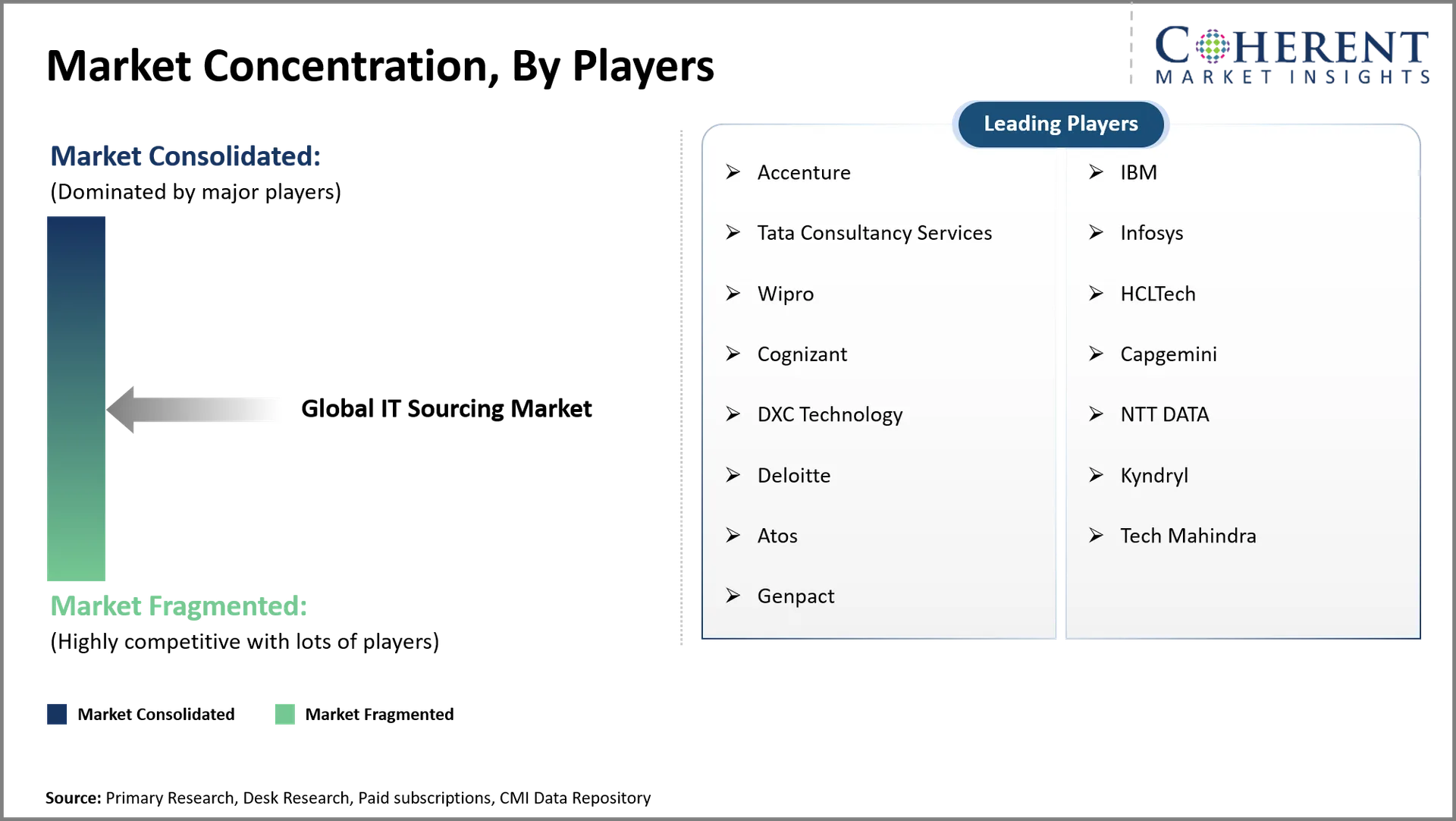
Key Developments
- On June 22, 2026, Cognizant completed its acquisition of Astreya, a global IT managed services provider headquartered in San Jose, California, U.S. The combination strengthens Cognizant's AI infrastructure and managed services capabilities by bringing together Cognizant's global delivery model and AI builder approach with Astreya's deep expertise supporting complex technology environments for many of the world's largest technology companies.
- On May 19, 2026, Accenture invested in Aera Technology, a leader in agentic decision intelligence for enterprises. The companies will combine Aera’s decision intelligence and Accenture’s AI-enabled supply chain capabilities to bring AI-led, real-time decision-making solutions to complex global supply chains in the consumer goods, high-tech, life sciences, mining and oil & gas industries.
- On February 20, 2026, Tata Consultancy Services partnered with Cisco to launch a Center of Excellence (CoE) in Hyderabad, India, for Autonomous Enterprise Operations. The CoE aims to help enterprises move from rule-based automation to intelligent, self-governing operations that understand the context in real-time and take actions on their own.
- On June 9, 2025, Ericsson secured a multi-year NOC Managed Services contract by Bharti Airtel, further strengthening the long-standing partnership between the two companies. This strategic agreement underscores Ericsson’s leadership in managed services and reaffirms its commitment to delivering exceptional value to Airtel customers.
Competitive Landscape
Legacy tech service providers are duking it out in the global IT sourcing market with artificial intelligence, cloud modernization, industry specialization and managed services. Accenture leads in enterprise transformation and the application of artificial intelligence in complicated business operations. Infosys is extending AI-led managed services as seen in their June 2026 partnership with GlobalFoundries that includes apps, infrastructure, data and service desk operations. Tata Consultancy Services focuses on end-to-end technology management, automation and long-term customer engagements. It offers products like Ignio for intelligent operations and predictive insights. Capgemini fortifies its position in cloud engineering, digital transformation and industry-specific technology services. Strategies include increased competitiveness on demonstrable results, specialized knowledge and integrated service delivery.
Top Market Players and Notable Products/Services in the IT Sourcing Market
Manufacturer | Notable Service Offering | Key features |
Tata Consultancy Services | TCS Enterprise Solutions and Managed Services | Application development, cloud migration, infrastructure management, cybersecurity, regional delivery centers |
Accenture | Accenture Managed Services | Application operations, cloud management, automation, artificial intelligence integration, scalable global delivery |
Globant | Globant AI Pods and Globant Enterprise AI | Artificial intelligence engineering, software development, digital product design, cloud modernization, specialized engineering teams |
Softtek | Softtek Managed Services and Digital Solutions | Nearshore software development, application modernization, enterprise resource planning, infrastructure support, aligned working hours |
Infosys | Infosys Cobalt and Infosys Topaz | Cloud services, artificial intelligence, application modernization, automation, cybersecurity, global delivery capabilities |
Market Report Scope
Report Coverage | Details | ||
Base Year | 2025 | Market Size in 2026: | USD 855.00 Bn |
Historical Data For: | 2020 To 2024 | Forecast Period: | 2026 To 2033 |
Forecast Period 2026 To 2033 CAGR: | 8.7% | 2033 Value Projection: | USD 1,450.00 Bn |
Geographies covered: |
| ||
Segments covered: |
| ||
Companies covered: | Accenture, IBM, Tata Consultancy Services, Infosys, Wipro, HCLTech, Cognizant, Capgemini, DXC Technology, NTT DATA, Deloitte, Kyndryl, Atos, Tech Mahindra, Genpact | ||
Growth Drivers: |
| ||
Restraints & Challenges: |
| ||
Analyst Opinion (Expert Opinion)
- The future of the IT sourcing industry will be more driven by business outcomes rather than outsourced employment volumes. Artificial intelligence will automate routine support, testing, infrastructure monitoring and software maintenance. Providers will need to shift from classic labor-based pricing to contracts linked to service quality, productivity, resilience and business outcomes. Managed services are key because organizations need regular monitoring of systems, security updates and optimization of applications. Vendors who combine automation with accountable management by humans are able to build deeper, long-term relationships with customers.
- The strongest possibilities will be for AI deployment, managed cloud services, cybersecurity operations and legacy application modernization. India has immense potential in complicated software engineering, worldwide delivery centers, and AI development. Mexico can draw North American companies into nearshore application development and real-time support contracts. Poland is a country of opportunity for those who have specialized software engineering and cybersecurity experience in regulated European sectors. Financial services, manufacturing, health care and retail all have their own applications, and all require domain knowledge, systems integration and ongoing operations support.
- IT sourcing providers should design reusable industry specific solutions, not only particular project teams. Vendors will need to become experts in AI governance, cloud cost optimization, safe data integration, and automated service management. They should show measurable gains in incident resolution, application performance and operating efficiency. Transparent pricing and explicit performance commitments help to build client confidence. Providers should also invest in regional delivery capabilities to fulfill data-residency and customer-collaboration requirements. These actions can differentiate suppliers in an increasingly automated and outcome-driven market.
Speak to the analyst
Want personalized insights?
Take the findings above to one of our principal consultants, or have the report rebuilt around the segments, geographies and competitors you actually track.
Market Segmentation
- Location Type Insights (Revenue, USD Billion, 2021 - 2033)
- On-shore
- Off-shore
- Service Type Insights (Revenue, USD Billion, 2021 - 2033)
- Application Services
- Emerging Technology Services
- Data Center Operations
- Helpdesk Services
- Others
- Sourcing Type Insights (Revenue, USD Billion, 2021 - 2033)
- Information Technology Outsourcing
- Business Process Outsourcing
- Managed Services
- Professional Services
- Staff Augmentation
- Deployment Type Insights (Revenue, USD Billion, 2021 - 2033)
- Cloud-Based
- On-Premises
- Hybrid
- Enterprise Size Insights (Revenue, USD Billion, 2021 - 2033)
- Small and Medium Enterprises
- Large Enterprises
- End User Insights (Revenue, USD Billion, 2021 - 2033)
- Banking and Financial Services
- Healthcare
- Manufacturing
- Retail and E-Commerce
- Telecommunications
- Government and Public Sector
- Transportation and Logistics
- Regional Insights (Revenue, USD Billion, 2021 - 2033)
- North America
- U.S.
- Canada
- Latin America
- Brazil
- Argentina
- Mexico
- Rest of Latin America
- Europe
- Germany
- U.K.
- Spain
- France
- Italy
- Russia
- Rest of Europe
- Asia Pacific
- China
- India
- Japan
- Australia
- South Korea
- ASEAN
- Rest of Asia Pacific
- Middle East
- GCC Countries
- Israel
- Rest of Middle East
- Africa
- South Africa
- North Africa
- Central Africa
- North America
- Key Players Insights
- Accenture
- IBM
- Tata Consultancy Services
- Infosys
- Wipro
- HCLTech
- Cognizant
- Capgemini
- DXC Technology
- NTT DATA
- Deloitte
- Kyndryl
- Atos
- Tech Mahindra
- Genpact
Sources
Primary Research Interviews
- IT Sourcing Managers & Procurement Specialists
- Chief Information Officers (CIOs) & IT Directors
- Managed Service Providers (MSPs) & Outsourcing Vendors
- Enterprise IT Consultants & Solution Architects
Magazines
- CIO Magazine
- InformationWeek
- Computerworld
- IT Pro Magazine
Journals
- Journal of Information Technology Outsourcing
- MIS Quarterly (Management Information Systems)
- Journal of Strategic Information Systems
Associations
- National Association of Software and Service Companies (NASSCOM)
- Information Technology Industry Council (ITI)
- International Association of Outsourcing Professionals (IAOP)
- Global Sourcing Association (GSA)
Public Domain Sources
- U.S. Bureau of Labor Statistics (BLS) – IT Workforce Data
- World Trade Organization (WTO) – IT Trade Reports
- World Bank – Digital Economy & IT Reports
- Organization for Economic Co-operation and Development (OECD) – ICT Reports
Proprietary Elements
- CMI Data Analytics Tool
- Proprietary CMI Existing Repository of information for last 10 years
Get access to 250+ pages report
Every segment, forecast, competitor profile and data table behind the analysis above — available for instant download.
- ESOMAR Member
- ISO 9001:2015 Certified
- D-U-N-S Registered
- GDPR & CCPA Compliant
Frequently Asked Questions
The global IT sourcing market is expected to stand at USD 855.00 Bn in 2026 and is expected to reach USD 1,450.00 Bn by 2033.
The CAGR of the global IT Sourcing market is projected to be 8.7% from 2026 to 2033.
Growing demand for cost-efficient technology operations and Increasing adoption of cloud infrastructure and managed services are the major factors driving the growth of the global IT Sourcing market.
Data security and confidentiality concerns and Dependence on external technology providers are the major factors hampering the growth of the global IT sourcing market.
In terms of location type, on-shore segment is estimated to dominate the market revenue share in 2026.
Nearshore IT sourcing involves obtaining technology services from geographically nearby countries with convenient collaboration and overlapping working hours.
Businesses choose offshore sourcing to access specialized talent, expand delivery capacity, and manage technology costs across international locations.