

Japan Small Molecules Compound Management Market Size and Forecast – 2026 To 2033
The Japan small molecules compound management market is expected to grow from USD 33.1 Mn in 2026 to USD 57.5 Mn by 2033, registering a compound annual growth rate (CAGR) of 8.2% from 2026 to 2033. The market for Japan small molecules compound management is poised for significant expansion, fueled by the strong pharmaceutical R&D activity and continued investment in drug discovery infrastructure.
According to the Japan Ministry of Health, Labour and Welfare (MHLW), pharmaceutical companies in Japan reported ¥196.9 billion in drug sales-related activity among marketing authorization holders in FY2023, with large-capital companies accounting for 73.7% of total drug sales. This strong pharmaceutical industry base and continued investment in drug development are expected to drive demand for efficient compound storage, tracking, retrieval, and automated handling solutions, supporting the growth of Japan’s small molecules compound management market.
Key Takeaways of the Japan Small Molecules Compound Management Market
- Compound management products are projected to hold 56.7 % of the Japan small molecules compound management market share in 2026, making it dominant offering segment, supported by continued pharmaceutical R&D investment and demand for automated compound-handling infrastructure. For instance, according to Japan’s Statistics Bureau, pharmaceutical-industry R&D expenditure reached USD 10.4 billion (¥1.66 trillion) in FY2024, up 7.9% from the previous year, strengthening demand for advanced compound storage, handling, and tracking infrastructure.
- Storage and Preservation is projected to 25.0 % of the Japan small molecules compound management market share in 2026, making it dominant service type segment, supported by stringent requirements for controlled sample storage and traceability. For instance, PMDA requires records on the receipt and management of samples and reference standards to be available during quality-related inspections, while MHLW’s GMP requirements mandate appropriate storage of samples and reference standards.
- In-house is projected to 48.4 % of the Japan small molecules compound management market share in 2026, making it dominant delivery model segment, as pharmaceutical organizations retain greater control over critical compound-management activities. For instance, MHLW’s GMP guidance requires manufacturing and quality records to be maintained and controlled, while outsourced activities require formal agreements and oversight of external contractors, reinforcing the value of maintaining critical management processes internally.
Segmental Insights
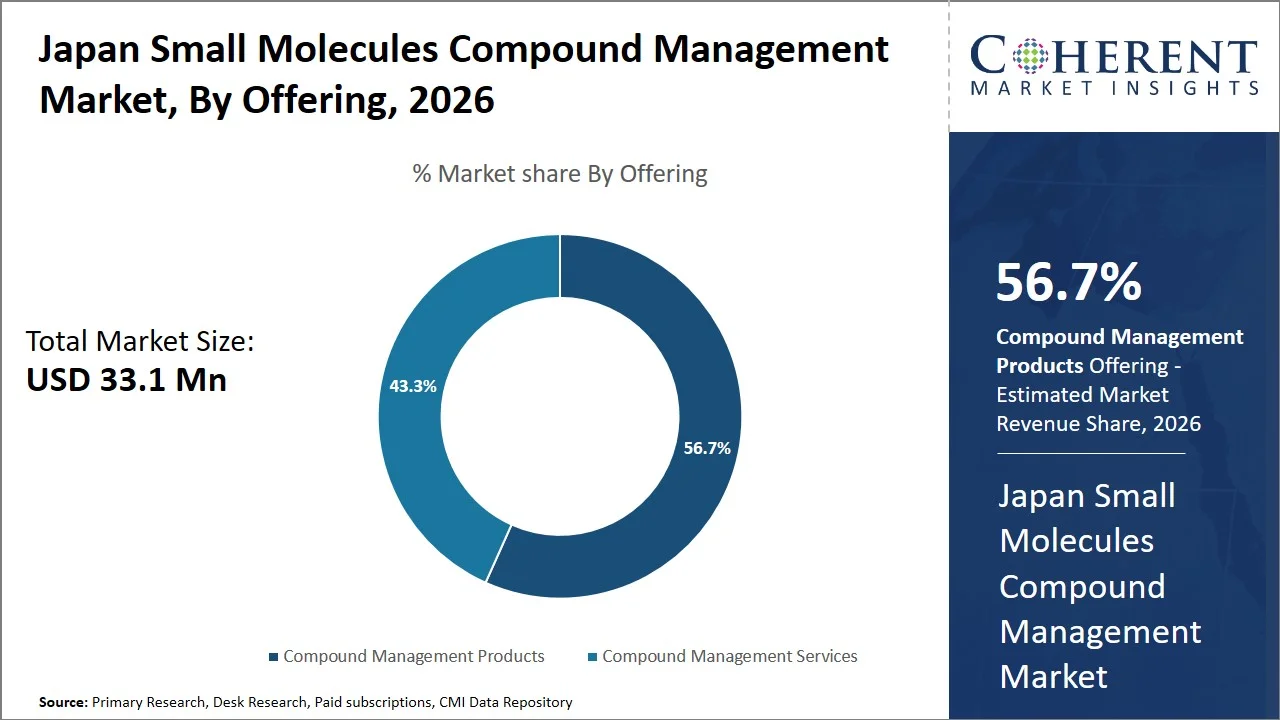
Why Do Compound Management Products Dominate the Japan Small Molecules Compound Management Market?
Compound management products are projected to hold the market share of 56.7% in 2026, owing to growing demand for automated and accurate methods that can scale for handling and processing large numbers of compounds; to manage, store, and track them efficiently. The uptake of robotics for a host of laboratory applications-high-throughput screening is translating to increased demand for compound management systems in Japan driven by automation requirements. The move toward fully integrated, digitally-connected workflows within drug discovery necessitates increased use of products that can handle accurate sample ID, dispensing, and tracking. For instance, On September 2, 2026, Shimadzu Corporation and Astellas Pharma Inc. launched "AtmosOrchestra", a robotic system that enables automated liquid dispensing, reactions and solvent drying which aims for supporting the small and medium molecules drug discovery.
- Current Industry Events of 2026
- Market Size Estimation
- Regional Breakdown
- Competitive Landscape
- Customer Intelligence
- Segmental Analysis
- Pricing Analysis
- Key Market Drivers, Challenges & Future Trends
- Customized Insights Section
Why are Storage and Preservation the Most Preferred Service Type Segment in Japan Small Molecules Compound Management Market ?
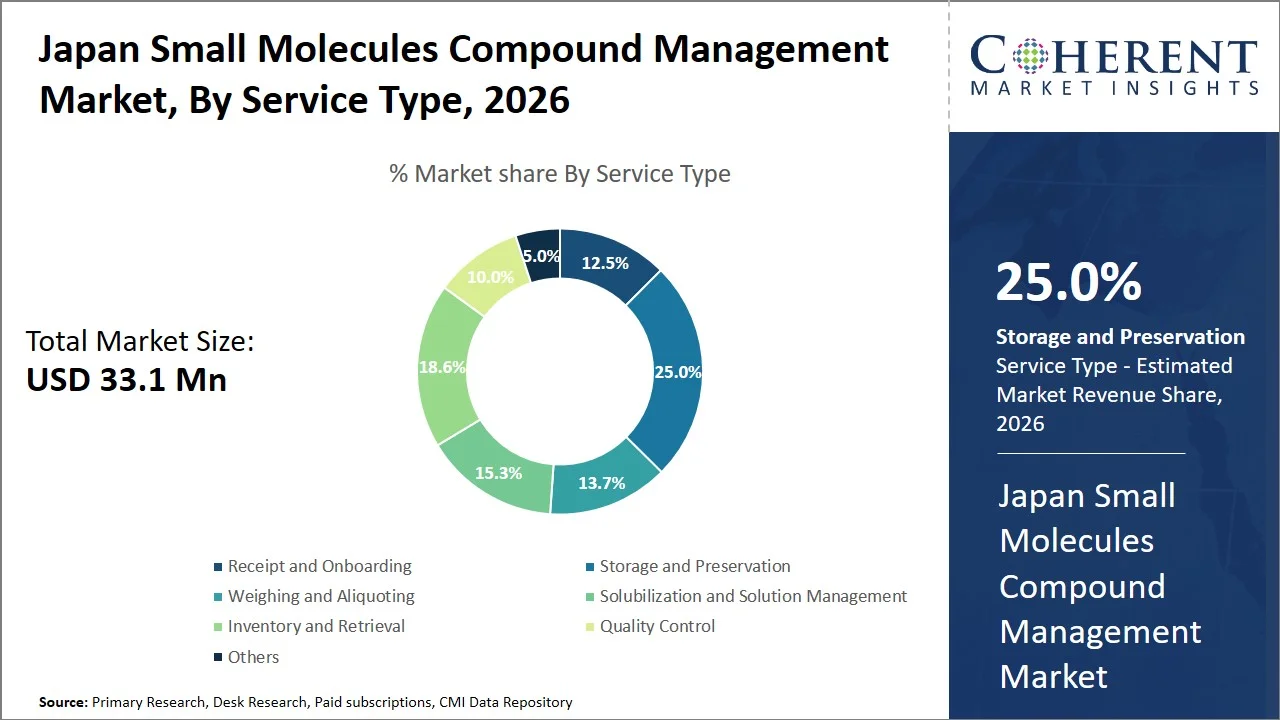
Storage and preservation are projected to hold a market share of 25.0% in 2026, since preserving the integrity, stability, and accessibility of compounds for the duration of the drug discovery lifecycle is critical. As the range of compound formats and storage conditions increases, requirements for temperature-controlled storage (refrigerated/frozen) are rising, and they need to be supported by automated inventory and retrieval mechanisms. In addition, the development of compound-library infrastructure in Japan, particularly with the significant expansion of the library architecture in the region, confirms the reliance on robust long-term compound storage and tracking mechanisms. For instance, at RIKEN Center for Sustainable Resource Science (CSRS), the drug discovery chemical bank stores its compounds in purpose built cold rooms at 4°C, and its compound solutions in freezers at −25°C, allowing them to be stored and accessed reliably over extended periods.
In-house Segment Dominates the Japan Small Molecules Compound Management Market
In-house segment is projected to hold a market share of 48.4% in 2026, due to the desire among pharma companies to control their own IP compound library, samples integrity, workflow customization and research data. Managing internally allows swift links between compound management and its internal drug discovery department. This reduces reliance on outsourced service providers for activities that can only be kept internally and are facilitated by improved automation and digital laboratory. For instance, since September 2023 DAIICHI SANKYO COMPANY has employed state of the art robotics at the research sites in Japan to automate synthesis research, supporting their small molecule drug discovery. High-end technology supporting both 'unmanned' and 'remotely controlled' experiments 24 hours a day, displays the increasing power of pharmaceutical firms to execute state of the art research 'in-house'.
Currents Events and their Impact
Current Events | Description and its Impact |
MHLW Expands Drug Discovery Cluster Support (July 2025) |
|
AMED Concludes Industry-Academia Screening Consortium Program (May 2026) |
|
AMED Updates Drug Discovery Booster Program (April 2026) |
|
Japan Small Molecules Compound Management Market Dynamics
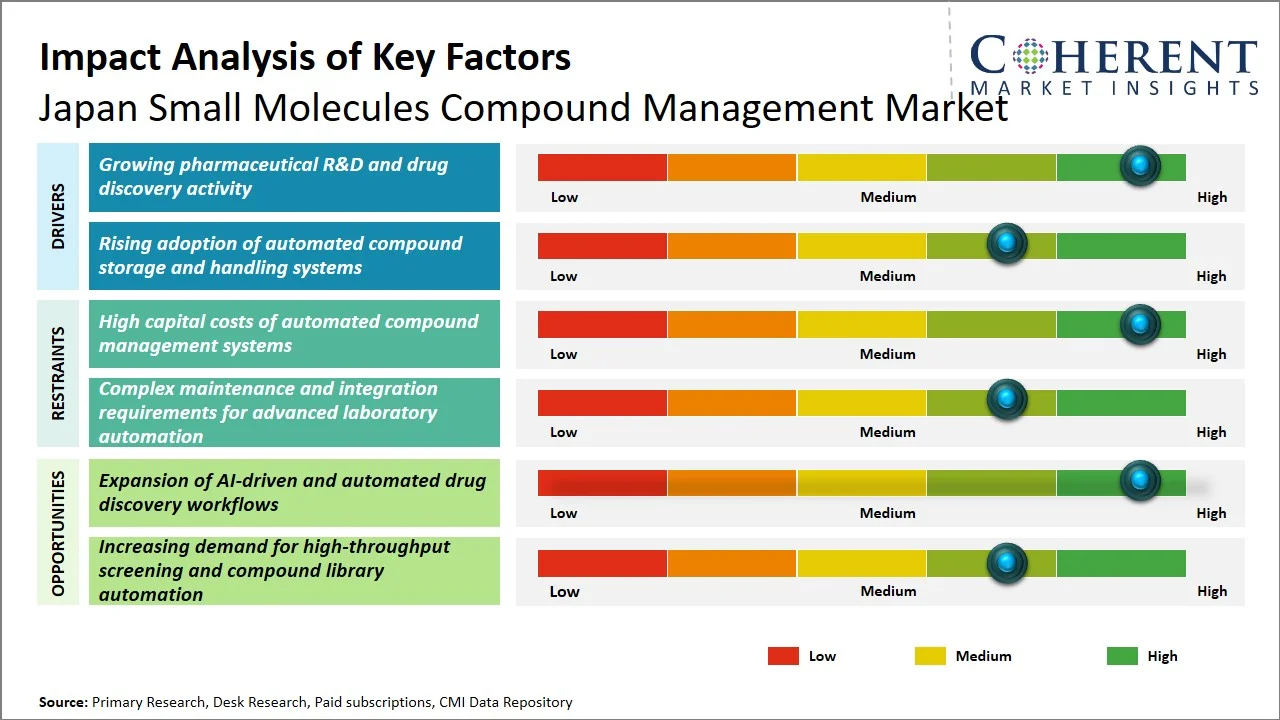
Market Drivers
- Growing pharmaceutical R&D and drug discovery activity: Japan’s expanding research base is strengthening demand for advanced compound management infrastructure across pharmaceutical and biotechnology organizations. For instance, according to Japan’s Statistics Bureau, the number of researchers in Japan reached a record 912,800 as of March 2025, increasing 0.6% year-on-year. The expanding research workforce supports greater drug-discovery activity and utilization of compound libraries, creating demand for efficient storage, tracking, and retrieval solutions.
- Rising adoption of automated compound storage and handling systems: Japanese pharmaceutical and research organizations are increasingly adopting automated storage, retrieval, dispensing, and identification systems to improve compound-handling accuracy and throughput. Automation reduces manual intervention, minimizes sample-handling errors, and enables efficient management of expanding compound libraries. For instance, AMED established a drug-discovery library platform incorporating automated room-temperature solid-compound storage and −20°C automated solution storage, together with barcode/QR-based compound management.
- Expansion of government-supported compound libraries: Japan’s expanding government-supported compound-library infrastructure is increasing access to diverse small-molecule collections for drug discovery. Shared libraries enable researchers to conduct screening and compound optimization more efficiently, creating demand for systems that can manage, store, track, and retrieve growing compound inventories. For instance, AMED supports a next-generation drug-discovery seed library comprising compounds of approximately 500 molecular weight and uses the library for screening against drug-discovery targets. This government-backed initiative strengthens Japan’s small-molecule library ecosystem and supports compound-management requirements.
Emerging Trends
- AI-Integrated Compound Management: AI is increasingly being integrated with small-molecule drug discovery to support compound prioritization, virtual screening, and molecular property prediction, increasing the need for data-rich compound management platforms.
- Robotics and Automated High-Throughput Experimentation: Japanese pharmaceutical companies are adopting robotic systems that automate compound dispensing, synthesis, and screening, driving demand for automated handling and inventory-management capabilities.
- Integration of Compound Libraries with Digital Drug Discovery: Large compound datasets are increasingly being connected with AI and computational screening platforms; Japan’s RIKEN-led work has demonstrated screening of 440,000 compounds using AI-enabled approaches, highlighting the shift toward digitally integrated compound libraries.
Drug Development Pipeline in Japan, by Key Indicator, November 2025
Indicator | Data |
Active ingredients in development | 224 |
New molecular entities (NMEs) | 164 |
Development candidates across 60 diseases | 368 |
How is the expansion of AI-driven and automated drug discovery workflows creating new growth opportunities in the Japan small molecules compound management market?
The integration of AI, robotics, and automated experiments is opening new avenues for managing small molecules in Japan by increasing compound screening, prioritization, or even development by helping organizations process data faster. AI compound work demands structured data to enable workflows, digital access within a management system and speed through automated compound processing, all contributing to pharma and research organizations invest in transforming their compound libraries with automated storage and retrieval, dispensaries and tracking informatics. For instance, in July 2025, Elix, Inc., and LINC (Life Intelligence Consortium) introduced an AI drug-discovery platform that utilizes federated-learning models trained from the data of 16 pharmaceutical companies. Elix, Inc.’s new platform, facilitated by the AMED-programmed DAIIA project funded by the Japanese government, will permit other pharmaceutical companies to utilize AI in analyzing drug-discovery data without revealing confidential information.
Market Players, Key Development, and Competitive Landscape
Key Developments
- In March 2026, KH Neochem and Luxna Biotech launched joint research to advance next-generation deliverable nucleic acid therapeutics. The collaboration focuses on developing advanced delivery technologies for nucleic acid-based therapeutic candidates. The initiative is expected to support innovation in next-generation drug delivery and nucleic acid therapeutics.
- In February 2026, Alchemedicine, Inc. and Asahi Kasei Pharma Corporation entered an exclusive global license agreement for HiSAP lead compounds. The agreement supports the development and commercialization of novel therapeutic candidates. It highlights continued investment in lead-compound development and small-molecule drug discovery in Japan.
- In December 2025, Xeureka Inc. and UBE Corporation entered into a joint research agreement focused on small-molecule drug discovery in oncology. The collaboration aims to advance the discovery of novel small-molecule drug candidates. The agreement is expected to strengthen small-molecule R&D activities and support demand for compound management solutions in Japan.
Competitive Landscape
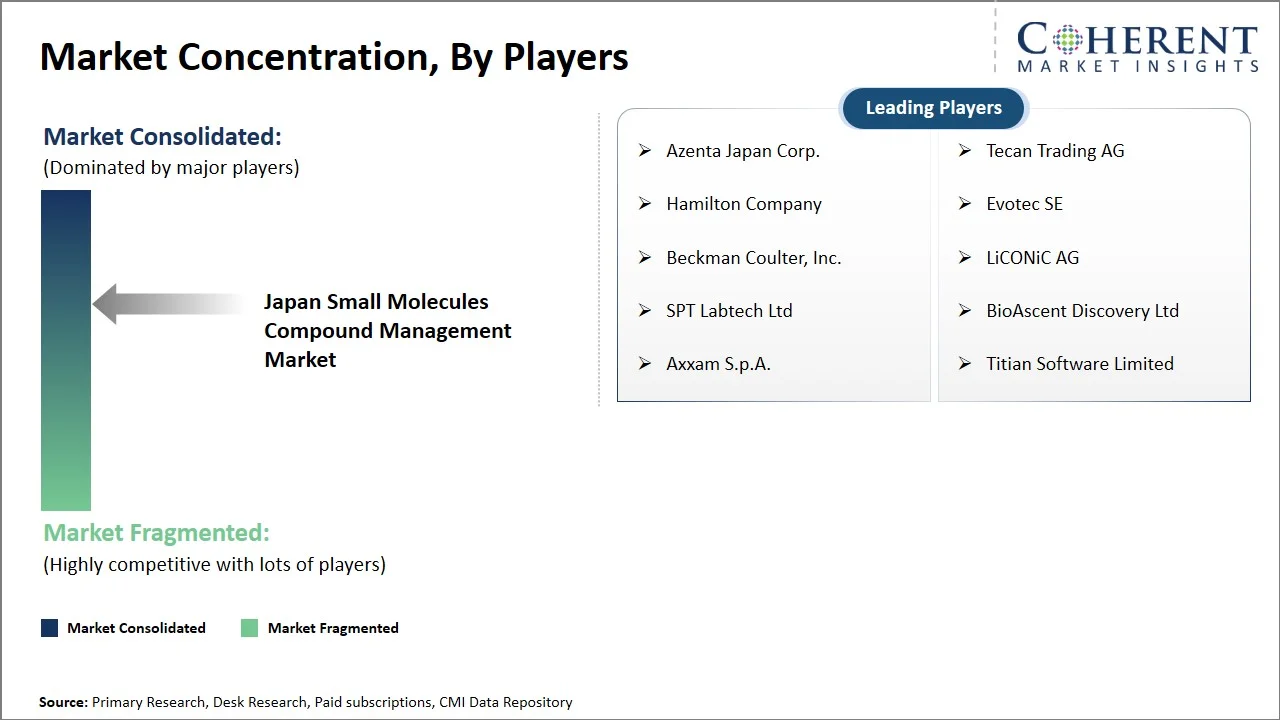
The Japan small molecules compound management market is moderately fragmented, with competition centered on automation capabilities, storage capacity, compound tracking, liquid handling precision, software integration, and workflow scalability. Leading players are strengthening their positions by expanding automated compound-storage solutions, integrating laboratory informatics, and offering end-to-end compound handling capabilities across pharmaceutical and research organizations. Key focus areas include:
- Expansion of automated compound storage and retrieval systems
- Integration of compound management with liquid handling, laboratory automation, and informatics platforms
- Development of scalable and flexible solutions for pharmaceutical companies, CROs, and research institutions
- Expansion of temperature-controlled and high-density storage solutions
- Strengthening data management and traceability capabilities
Market Report Scope
Japan Small Molecules Compound Management Market Report Coverage
| Report Coverage | Details | ||
|---|---|---|---|
| Base Year: | 2025 | Market Size in 2026: | USD 33.1 Mn |
| Historical Data for: | 2020 To 2024 | Forecast Period: | 2026 To 2033 |
| Forecast Period 2026 to 2033 CAGR: | 8.2% | 2033 Value Projection: | USD 57.5 Mn |
| Segments covered: |
| ||
| Companies covered: | Azenta Japan Corp., Tecan Trading AG, Hamilton Company, Evotec SE, Beckman Coulter, Inc., LiCONiC AG, SPT Labtech Ltd, BioAscent Discovery Ltd, Axxam S.p.A., Titian Software Limited | ||
| Growth Drivers: |
| ||
| Restraints & Challenges: |
| ||
Analyst Opinion (Expert Opinion)
- In the coming years, Japan small molecules compound management market will be shaped by the convergence of AI, laboratory robotics, and digital compound informatics. Compound management is expected to move beyond basic storage and retrieval toward integrated, automated workflows that connect compound registration, inventory, dispensing, screening, and data analysis. The shift toward higher-throughput and AI-enabled drug discovery will increase demand for intelligent systems capable of managing larger and more complex compound libraries with minimal manual intervention.
- The maximum opportunities will probably exist within automated compound management solutions for high-throughput screening and AI-driven drug discovery applications in Japan, particularly among large pharmaceutical companies and advanced discovery-service providers. Vendors offering integrated storage, automated handling, liquid dispensing, tracking, and informatics capabilities should be well positioned as Japanese R&D organizations increasingly adopt end-to-end automated discovery workflows.
- In order to obtain a competitive advantage, market participants should focus on developing modular, scalable platforms that integrate compound storage, robotic handling, inventory management, and laboratory informatics, rather than competing on individual equipment capabilities alone. Differentiation will increasingly depend on interoperability with AI-driven discovery platforms, high-throughput experimentation systems, and existing laboratory infrastructure, while maintaining accuracy, traceability, and flexible storage across different compound formats.
Speak to the analyst
Want personalized insights?
Take the findings above to one of our principal consultants, or have the report rebuilt around the segments, geographies and competitors you actually track.
Market Segmentation
- Offering Insights (Revenue, USD Mn, 2021 - 2033)
- Compound Management Products
- Compound Management Services
- Service Type Insights (Revenue, USD Mn, 2021 - 2033)
- Receipt and Onboarding
- Storage and Preservation
- Weighing and Aliquoting
- Solubilization and Solution Management
- Inventory and Retrieval
- Quality Control
- Others
- Delivery Model Insights (Revenue, USD Mn, 2021 - 2033)
- In-house
- Outsourced
- On-site Managed Service
- Hybrid
- Compound Format Insights (Revenue, USD Mn, 2021 - 2033)
- Solids
- Solutions
- Pre-plated Formats
- Others
- Library Scale Insights (Revenue, USD Mn, 2021 - 2033)
- Small Libraries
- Mid-scale Libraries
- Large-scale Libraries
- End User Insights (Revenue, USD Mn, 2021 - 2033)
- Large Pharmaceutical Manufacturers
- Mid-sized and Small Biotech Companies
- CROs / Discovery Service Providers
- Academic and Research Institutes
- Government / Public Research Organizations
- Chemical Library Owners / Compound Vendors
- Key Players Insights
- Azenta Japan Corp.
- Tecan Trading AG
- Hamilton Company
- Evotec SE
- Beckman Coulter, Inc.
- LiCONiC AG
- SPT Labtech Ltd
- BioAscent Discovery Ltd
- Axxam S.p.A.
- Titian Software Limited
Sources
Primary Research Interviews
- Senior executives and R&D leaders at pharmaceutical and biotechnology companies involved in small-molecule drug discovery in Japan
- CEOs, commercial directors, and technical leaders of compound management, laboratory automation, and drug-discovery solution providers
- Drug discovery scientists, medicinal chemists, and laboratory automation specialists involved in compound libraries, high-throughput screening, and chemical data management
- Researchers and facility managers at academic and public research organizations operating compound libraries and drug-discovery platforms
- Representatives from CROs, discovery service providers, and chemical library vendors supporting small-molecule research in Japan
Stakeholders
- Pharmaceutical manufacturers and biotechnology companies
- Contract research organizations (CROs) and drug-discovery service providers
- Academic and research institutes
- Government and public drug-discovery organizations
- Chemical library owners and compound vendors
- Laboratory automation and compound management solution providers
- Research centers and organizations conducting high-throughput screening
- End-use Sectors
- Pharmaceutical and biotechnology companies
- Contract research organizations (CROs) and discovery service providers
- Academic and research institutes
- Government and public research organizations
- Chemical library owners and compound vendors
- Drug discovery and high-throughput screening laboratories
- Regulatory & Health Bodies
- Pharmaceuticals and Medical Devices Agency (PMDA), Japan
- Ministry of Health, Labour and Welfare (MHLW), Japan
- Japan Agency for Medical Research and Development (AMED)
- RIKEN
- Ministry of Economy, Trade and Industry (METI), Japan
- National Institute of Advanced Industrial Science and Technology (AIST)
- Japan Pharmaceutical Manufacturers Association (JPMA)
Databases
- PMDA drug and regulatory databases
- AMED research-program and drug-discovery databases
- RIKEN compound-library and drug-discovery databases
- Japan Patent Office (JPO) patent databases
- e-Stat, Portal Site of Official Statistics of Japan
- JPMA pharmaceutical industry and drug-development databases
- PubChem and other publicly available chemical compound databases
Associations
- Japan Pharmaceutical Manufacturers Association (JPMA)
- Japan Chemical Industry Association (JCIA)
- Japan Bioindustry Association (JBA)
- Japan Society for Bioscience, Biotechnology, and Agrochemistry (JSBBA)
- Pharmaceutical Society of Japan (PSJ)
Public Domain Sources
- PMDA – Drug review, GMP, GLP/GCP and regulatory guidance
- MHLW – Pharmaceutical regulations, GMP requirements and drug-discovery policies
- AMED – Drug-discovery programs, screening initiatives and research funding
- RIKEN – Compound libraries, chemical banks and small-molecule drug-discovery platforms
- METI – Biotechnology and life-science industry policies and statistics
- AIST – Chemical, biotechnology and drug-discovery research resources
- e-Stat – Japan official R&D and science & technology statistics
- JPO – Patent and intellectual-property information related to pharmaceutical and chemical technologies
Proprietary Elements
- CMI Data Analytics Tool, Proprietary CMI Existing Repository of information for last 10 years.
Get access to 250+ pages report
Every segment, forecast, competitor profile and data table behind the analysis above — available for instant download.
- ESOMAR Member
- ISO 9001:2015 Certified
- D-U-N-S Registered
- GDPR & CCPA Compliant
Missing comfort of reading report in your local language? Find your preferred language:
Frequently Asked Questions
It enables efficient storage, tracking, preparation, retrieval, and screening of compounds throughout the drug discovery process.
Automation improves compound-handling accuracy, reduces manual intervention, and increases the speed and throughput of library processing.
Proper storage helps preserve compound integrity while enabling reliable retrieval and long-term management of chemical libraries.
Compound libraries are managed through integrated storage, registration, inventory tracking, quality control, and retrieval workflows.
Inventory tracking maintains accurate records of compound identity, quantity, location, and availability, supporting efficient screening workflows.
It provides rapid and controlled access to compound libraries for automated screening of large numbers of compounds.
Automated systems improve throughput, sample traceability, handling consistency, storage efficiency, and workflow productivity.