

Global Kanban Software Market Size and Forecast – 2026 To 2033
The global Kanban software market is expected to grow from USD 470 Mn in 2026 to USD 1,760 Mn by 2033, registering a compound annual growth rate (CAGR) of 11% from 2026 to 2033. The global Kanban software market is driven by rising use of cloud-based collaboration platforms. On May 29, 2026, Microsoft expanded its cloud collaboration ecosystem through new Microsoft 365 capabilities and agentic collaboration features, with Microsoft describing 2026 as the year AI agents move from assistants to operators across Microsoft 365, allowing work to be executed directly within cloud-based business workflows.
Key Takeaways of the Global Kanban Software Market
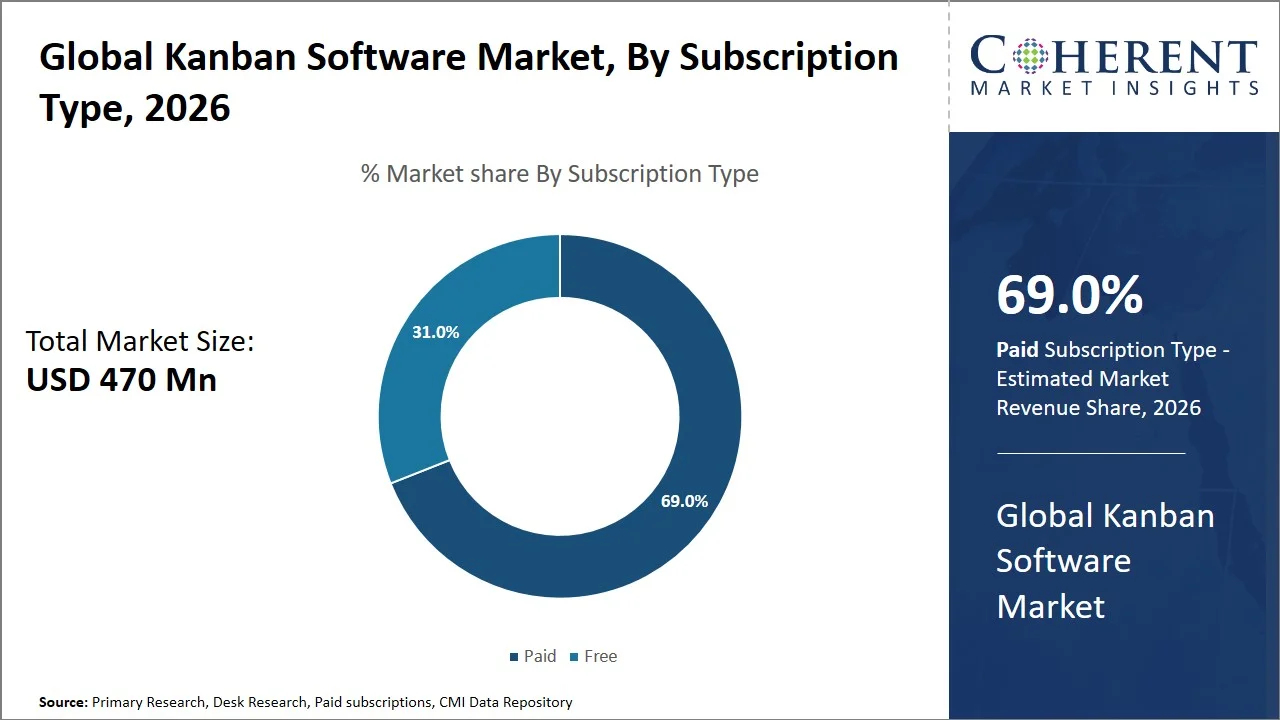
- The Paid segment is expected to account for 69.0 % of the global Kanban software market share in 2026. Increasing digitization among SMEs is driving the growth of the segment. On March 25, 2026, Meta launched Meta Small Business, a company-wide initiative focused on helping entrepreneurs adopt AI tools, building on an ecosystem where more than 250 million small businesses globally already use Facebook, Instagram or WhatsApp.
- The Cloud segment is estimated to capture 73.0 % of the market share in 2026. Expansion of distributed and hybrid workforces is majorly driving the growth of the segment. On May 29, 2026, Infosys reported in its FY2026 ESG disclosures that 79% of its workforce operates under a hybrid model, while approximately 10% work fully remotely and 11% work entirely from offices.
- The Project Management segment is estimated to capture 34.0 % of the market share in 2026. Growing adoption of AI assisted project management capabilities is driving the growth of the segment. On December 20, 2025, ClickUp rolled out ClickUp Brain across project management processes, allowing teams to establish project roadmaps, test plans, summarize updates, draft task descriptions, and break goals into manageable subtasks.
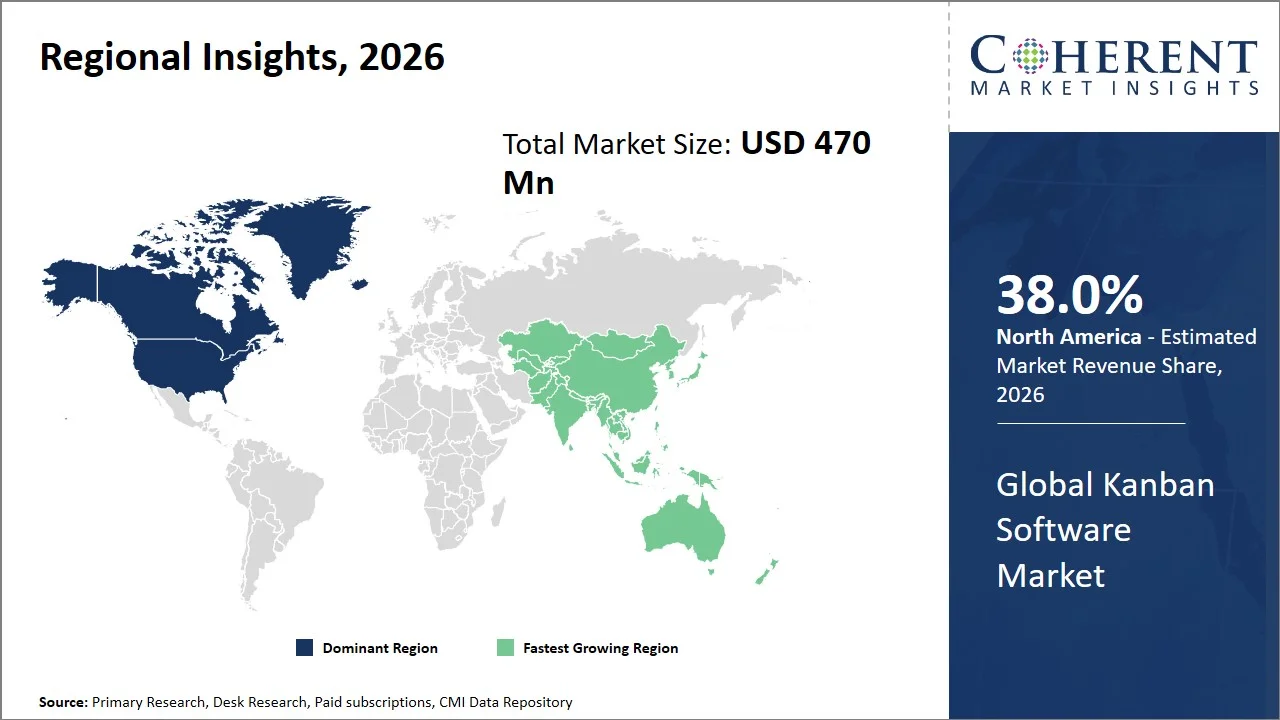
- North America is expected to dominate the Kanban software market in 2026 with a market share of 38.0 %. Increasing integration with enterprise resource planning and CRM platforms in North America is driving the growth of the regional market. In February 2025, SAP announced its SAP ERP, private edition, transition option to help large enterprises move from legacy SAP ERP environments toward SAP Cloud ERP.
- Asia Pacific is expected to account for 29.0 % share in 2026. Expansion of Kanban into non-IT business functions across Asia Pacific is driving the growth of the regional market. On December 22, 2025, Suzuki introduced Ollo Factory at its Sagara assembly plant as part of its Smart Factory initiative, using real time work analysis, automated work instruction creation and anomaly detection to standardize production activities and reduce work errors.
Segmental Insights
Why Does Paid Dominate the Global Kanban Software Market?
The paid segment is expected to account for 69.0% of the global Kanban software market share in 2026. Paid plans provide organizations with advanced features such as workflow automation, custom workflows, enhanced integrations, analytics, higher storage limits, admin controls and enterprise security features that are typically limited or restricted in the free versions. Suitable for teams managing complex projects and a larger number of users and workflows. On May 25, 2026, Asana upgraded its legacy Premium and Business plans to Starter and Advanced plans and added paid-tier functionality such as universal reporting on Starter, Salesforce and Tableau and Power BI integrations on Advanced, unlimited automation actions and expanded AI Studio access.
- Current Industry Events of 2026
- Market Size Estimation
- Regional Breakdown
- Competitive Landscape
- Customer Intelligence
- Segmental Analysis
- Pricing Analysis
- Key Market Drivers, Challenges & Future Trends
- Customized Insights Section
Why is Cloud the Most Preferred Deployment Type?
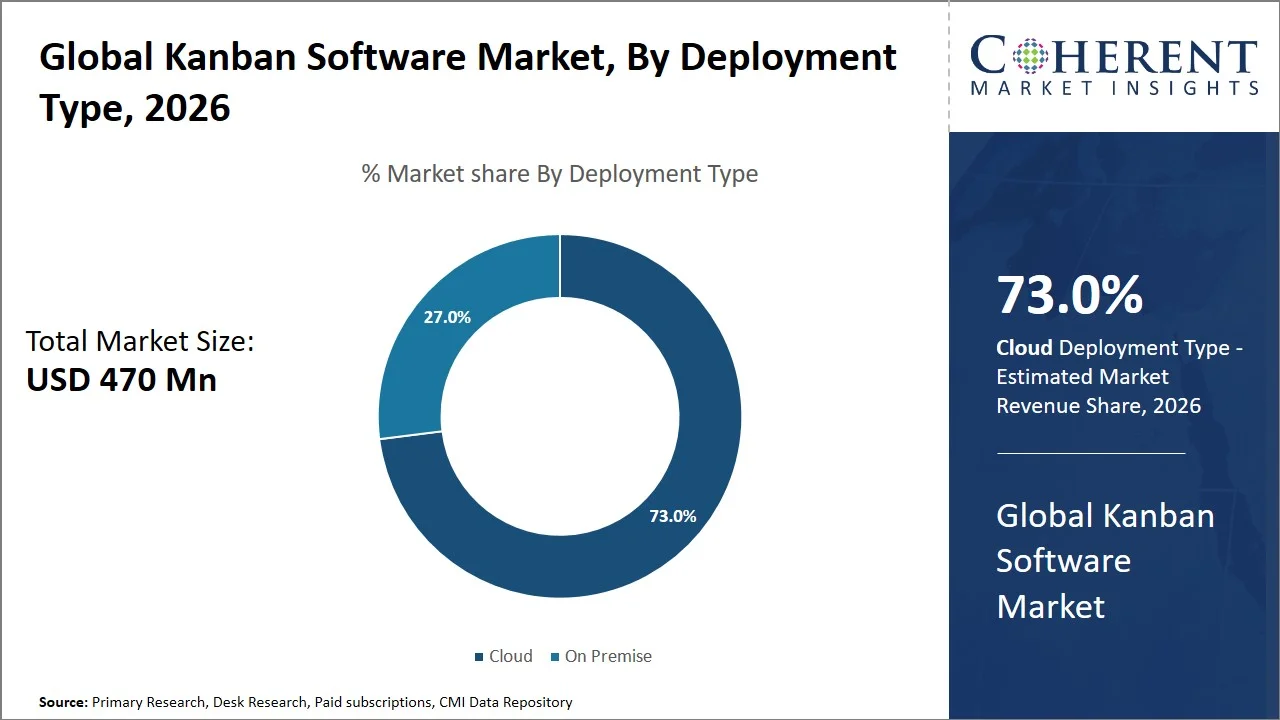
The cloud segment is expected to account for 73.0% of the global Kanban software market share in 2026. Cloud deployment means teams can access Kanban boards, task updates, workflow data and collaboration features from anywhere, on any device, making it ideal for remote and hybrid teams, and removes the need for organizations to maintain their own dedicated infrastructure and perform software updates themselves. On June 25, 2026, Wrike purchased Klaxoon, adding digital whiteboards, visual collaboration, mind mapping and brainstorming tools to its cloud-based job management system. The move strengthened Wrike’s ability to support distributed teams that need real time collaboration alongside project boards and workflow management.
Project Management Dominates the Global Kanban Software Market
The project management segment is expected to account for 34.0% of the global Kanban software market share in 2026. Project management applications benefit from Kanban’s visual representation of tasks, workflow stages, priorities and progress, allowing teams to monitor project status in real time, identify bottlenecks and control work in progress while improving coordination across project members. On May 6, 2025, Asana unveiled Smart Workflow Gallery, a library of prebuilt, AI-powered workflows to enable enterprises expand the usage of AI in common workflows to unleash increased employee productivity. The Smart workflows draw on best practices from hundreds of firms around the world to give a roadmap for business executives and teams in Marketing, IT and Operations to operate in tandem with humans and AI.
Current Events and their Impact
Current Events | Description and its Impact |
European Union - EU AI Act |
|
European Union - NIS2 Directive |
|
Kanban Software Market Dynamics
Market Drivers
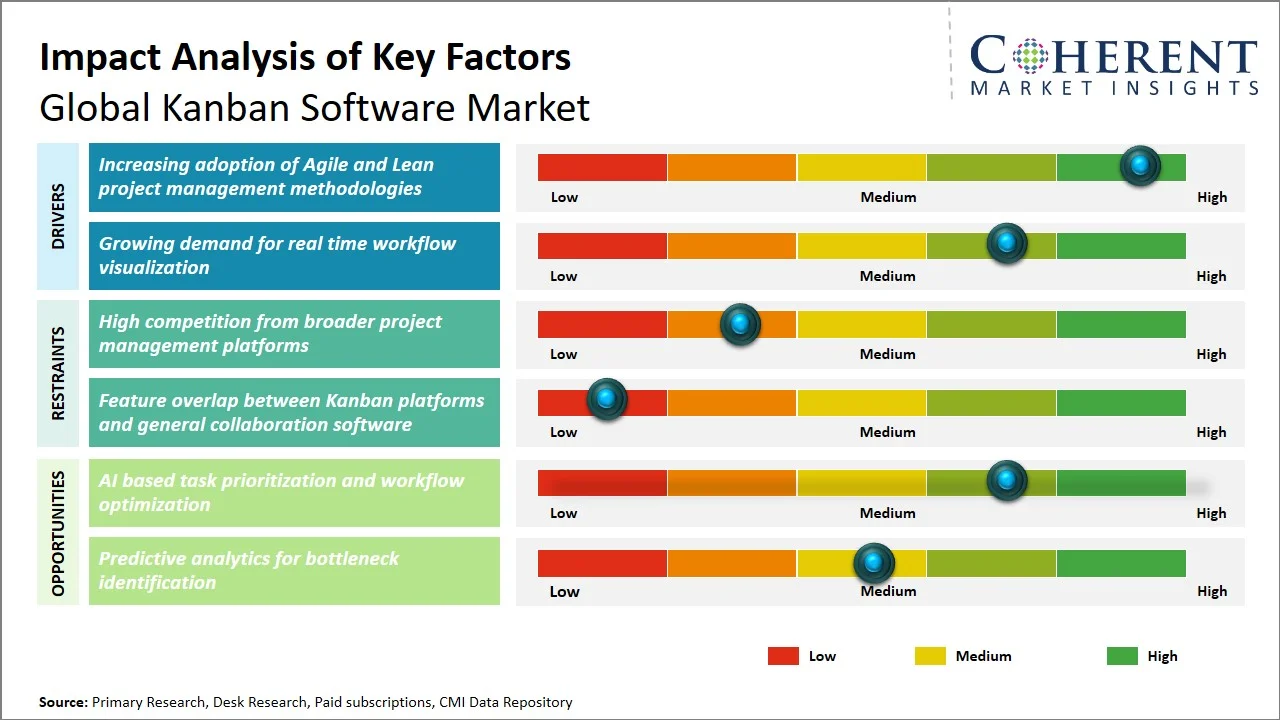
- Increasing adoption of agile and lean project management methodologies: The rising popularity of Agile and Lean methodologies is driving organizations to adopt Kanban software, due to the focus of these approaches on incremental delivery, continuous improvement, work in progress management, and workflow efficiency. All of these may be realized with digital Kanban boards, task cards and flow analytics, enabling teams to change priorities while removing needless work and spotting process bottlenecks more effectively. On July 27, 2026, EuroTeleSites, one of the top independent tower firms in Central and Eastern Europe, published the results of its first year working with Sitetracker, the leading worldwide Asset Lifecycle Management platform. A year after deployment, EuroTeleSites reports considerable progress in its digital transformation with measurable benefits in operational efficiency, cross-market transparency and project collaboration across its six-country footprint.
- Growing demand for real time workflow visualization: The increasing demand for real time workflow visualization is driving the adoption of Kanban software as digital boards give teams with an updated view of task ownership, progress, priority and blocked activities on a single interface. This enables managers and employees to rapidly detect process bottlenecks, coordinate activities more effectively and make faster modifications when project requirements change. On July 21, 2026, monday.com announced Sidekick chart features that enable users to convert item fields into dynamic visual charts, allowing teams to recognize patterns and respond more swiftly to workflow data. In the same product extension, monday.com included portfolio dashboards to connect projects and provide consolidated portfolio analytics, highlighting the migration from individual Kanban boards to always-on management visualizations.
Emerging Trends
- AI Powered Workflow Optimization: Kanban solutions are rapidly incorporating AI to prioritize work, suggest workflow course corrections, spot bottlenecks, and offer project insights, helping teams to decrease manual planning and make faster data driven decisions.
- Integration With Enterprise Software Ecosystems: Kanban solutions are rapidly being integrated with customer relationship management, ERP, DevOps, communication and collaboration platforms so that tasks and project information can flow smoothly across company applications and reduce fragmented workflows.
- Real Time Analytics and Predictive Insights: Modern Kanban tools are going beyond visual task management and are creating real time dashboards, cycle time analysis, workload monitoring and predictive identification of potential delays to help managers proactively address workflow inefficiencies.
- Expansion of Kanban Beyond Software Development: Kanban is increasingly being used in marketing, human resources, manufacturing, healthcare, finance and customer service where visual workflow management can be applied in operational processes, approvals, service requests and cross functional projects.
Regional Insights
Why is North America a Strong Market for Kanban Software?
North America is expected to account for a market share of 38.0% in 2026. It is supported by the region’s early adoption of Agile and DevOps practices, strong enterprise SaaS infrastructure and extensive use of digital collaboration tools across technology, financial services and healthcare. The region recorded more than 12,500 enterprise Kanban tool deployments across IT, healthcare and finance in 2024 according to industry estimates, while cloud-based delivery and AI enabled workflow management are increasingly being integrated into enterprise project environments. The U.S. accounts for the majority of regional adoption, with Canada adding demand from technology clusters in Toronto, Vancouver and Montreal, where software development companies and Agile consulting firms increasingly use visual workflow platforms for distributed teams.
Why Does Asia Pacific Kanban Software Market Exhibit High Growth?
Asia Pacific is expected to register the fastest growth with a CAGR of 12.2% over the forecast period. It is projected to account for 29.0% of the global Kanban software market in 2026. Asia Pacific is experiencing particularly strong adoption because Kanban practices are expanding from software development into manufacturing, financial services and business operations, while India, China, and Japan are major contributors to regional implementation activity. Industry estimates show over 8,700 new Kanban implementations in 2024 came from China, India, and Japan combined, mirroring the region’s fast-paced digital transformation and growth of cloud-based project management. The greater usage of Kanban beyond traditional IT development is also a boon to the region, with the increased use of Kanban in dispersed software engineering teams, manufacturing operations and digitally controlled SME workflows.
Global Kanban Software Market Outlook for Key Countries
Why is U.S. Emerging as a Major Hub in the Kanban Software Market?
The U.S. has a mature SaaS ecosystem and broad use of Kanban capabilities inside enterprise development, DevOps and collaborative environments. Jira and its larger platform ecosystem provide a case in point. Atlassian reported 2.3 million AI monthly active users in fiscal 2025, and more than double the number of annual contract value deals over USD 1 million compared with the prior year, indicating growing enterprise appetite for integrated workflow and AI capabilities. Financial institutions, healthcare organizations, retailers and technology companies are particularly important adopters because their teams require continuous software delivery, cross functional task management and real time visibility across complex projects.
Is Japan the Next Growth Engine for the Kanban Software Market?
Japan represents a distinctive growth market because digital Kanban software complements the country’s established manufacturing philosophy based on visual workflow management, continuous improvement and just in time production. Automotive and electronics manufacturers can apply digital Kanban boards to production scheduling, engineering changes, supplier coordination and quality activities, while software teams use the same principles for iterative development and issue management. This combination of manufacturing heritage and increasing industrial digitalization gives Kanban platforms a broader use case in Japan than purely software-oriented project management, particularly as manufacturers modernize production and connect operational workflows with digital systems.
Germany Kanban Software Market Analysis and Trends
Germany is being driven by the transition of Agile methods from software development toward wider corporate functions and industrial operations. A PMI study of 109 organizations in Germany found that almost one third had implemented Agile in selected projects and another third were applying it in software development, while 60% expected to reach scaled or more mature Agile adoption within two to three years. The strongest application opportunities are therefore being created in automotive, industrial manufacturing, banking, insurance, telecommunications and consumer goods, where Kanban platforms can provide transparency across departments and help teams shorten development cycles and coordinate complex workflows.
U.K. Kanban Software Market Analysis and Trends
The U.K. market is benefiting from high business adoption of cloud and digital technologies, creating favorable infrastructure for cloud-based Kanban platforms. The UK Innovation Survey 2025 indicated that 84% of broader innovators and 81% of non-broader innovators that employed production improving technology used cloud-based computing. Computer software was one of the most prevalent areas of company innovation investment. Separately, the UK Business Data Survey 2026 showed 31% of digitized data handling organizations used public cloud providers, and 22% used third party software or web solutions, suggesting further migration toward remotely accessible workflow and collaboration technologies.
India Kanban Software Market Analysis and Trends
India is reaping the benefits of the scale of its IT services and software engineering ecosystem where scattered development teams, offshore delivery centers and multinational client projects generate a high need for visual task coordination and workflow transparency. Kanban technologies are especially relevant to firms that manage development, testing, deployment and support operations across several cities and time zones. As Indian SaaS companies expand, familiarity with subscription-based cloud applications is growing. The fast digitalization of SMEs and technology demanding organizations also works well for the country, with Kanban software expanding from large IT service providers to startups, product companies, financial technology firms and digitally controlled corporate processes.
Global Kanban Software Market - Average Workflow Stages Configured Per Kanban Board
Workflow Stage Configuration | Estimated Share of Kanban Boards, 2026 | Typical Use Case |
3 stages | 22% | Personal tasks and small teams |
4 stages | 18% | Basic project management |
5 stages | 28% | Standard project and software teams |
6 stages | 13% | Software development and operations |
7-8 stages | 12% | Complex cross functional workflows |
9-10 stages | 5% | Enterprise and highly controlled workflows |
More than 10 stages | 2% | Highly specialized enterprise workflows |
How is AI Based Task Prioritization and Workflow Optimization Creating New Growth Opportunities in the Kanban Software Market?
AI based task prioritization is creating a specific growth opportunity by enabling Kanban platforms to automatically determine which work requires immediate attention using workload, task dependencies, deadlines, skills and changing workflow conditions rather than relying solely on manually assigned priority labels. For example, Monday agents can generate task plans with owners, dependencies and milestones, assign work according to real time capacity and skill sets, and flag at risk tasks, while Monday AI can automatically classify incoming requests, detect sentiment and raise priority when negative sentiment is identified; Atlassian’s Jira AI can similarly break high level work into actionable subtasks and assist with prioritization. These capabilities create opportunities for Kanban vendors to introduce premium AI functions such as intelligent workload balancing, automated escalation, dependency based sequencing and predictive bottleneck detection, moving the value proposition beyond visual task tracking toward active workflow execution and optimization. On July 9, 2026, Wrike introduced a Conversational AI Agent Builder that enables users to build and deploy workflow automation using natural language.
Market Players, Key Development, and Competitive Landscape
Key Developments
- On February 5, 2026, Wrike announced the general availability of Wrike AI Agents. Following a highly anticipated preview at Wrike Collaborate 2025, Wrike now delivers agentic collaborative work management. This brings autonomous intelligence directly into the flow of work, where AI doesn’t just offer advice but actively executes complex workflows alongside human teams within a secure, governed environment.
- On November 5, 2025, Smartsheet announced the next major evolution of its platform, unveiling a powerful suite of new generative AI, agentic AI and enterprise-grade features at the 2025 ENGAGE conference. With more than 123,000 organizations managing almost three million active projects, the Smartsheet platform eliminates the barriers between ideas and execution, ensuring every digital and human worker operates from a unified, intelligent AI-first system.
Competitive Landscape
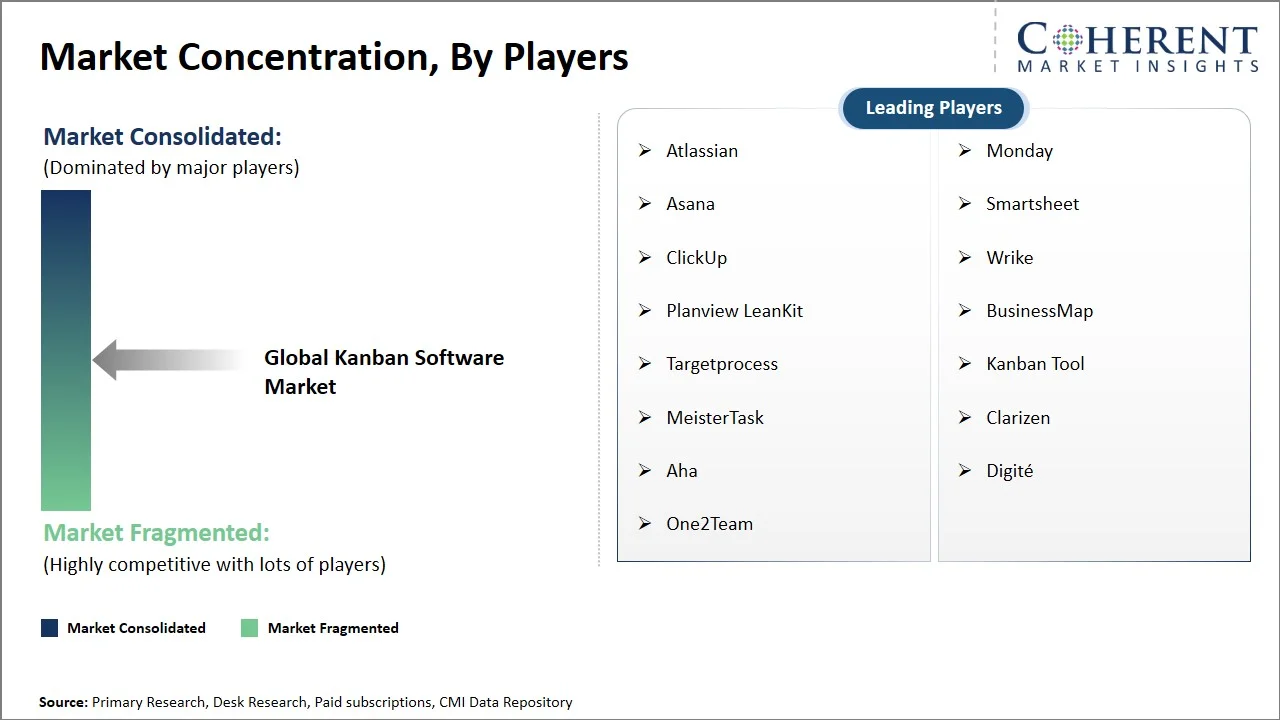
The competitive landscape is increasingly being shaped by Atlassian, particularly through Jira, Confluence and Rovo, with the company focusing on enterprise expansion, cloud migration, AI powered workflow automation and consolidation of multiple work management applications into its System of Work; Atlassian reported more than 300,000 customers, 2.3 million AI monthly active users in FY2025 and a more than twofold year over year increase in deals exceeding USD 1 million in annual contract value, while Rovo agents had automated 2.4 million workflows within six months by FY2026. monday.com is pursuing a different but increasingly competitive strategy by shifting from work management toward an AI Work Platform, with monday agents designed to monitor workflows, make decisions based on defined priorities and execute tasks directly within boards; its 2026 strategy also enables external AI agents to authenticate and operate inside the platform, targeting automated project execution rather than simple task tracking. Asana, Smartsheet, ClickUp and Wrike are similarly positioned around workflow automation, cross functional work management and AI assisted productivity, making AI capabilities, enterprise integrations, security and the ability to extend Kanban functionality beyond software development the primary areas of competitive differentiation.
Market Report Scope
Kanban Software Market Report Coverage
| Report Coverage | Details | ||
|---|---|---|---|
| Base Year: | 2025 | Market Size in 2026: | USD 470 Mn |
| Historical Data for: | 2020 To 2024 | Forecast Period: | 2026 To 2033 |
| Forecast Period 2026 to 2033 CAGR: | 11% | 2033 Value Projection: | USD 1,760 Mn |
| Geographies covered: |
| ||
| Segments covered: |
| ||
| Companies covered: | Atlassian, Monday, Asana, Smartsheet, ClickUp, Wrike, Planview LeanKit, BusinessMap, Targetprocess, Kanban Tool, MeisterTask, Clarizen, Aha, Digité, One2Team | ||
| Growth Drivers: |
| ||
| Restraints & Challenges: |
| ||
Analyst Opinion (Expert Opinion)
- The future of the industry is expected to move from visual Kanban boards toward agentic workflow execution, where AI continuously evaluates priorities, dependencies, workloads and workflow conditions and then recommends or performs the next action. Atlassian’s Rovo agents and monday.com’s agent infrastructure already demonstrates this transition, indicating that competitive advantage will increasingly depend on how effectively platforms can convert existing workflow data into autonomous actions rather than simply displaying task status.
- The strongest opportunity is expected to emerge in cloud-based enterprise Kanban platforms with embedded AI, particularly for project management, software development, IT service management and cross functional operations. Geographically, the United States remains strategically important for enterprise AI adoption, while India and Japan offer attractive expansion opportunities because of their large software engineering and technology operations in India and the deep integration of Kanban principles with manufacturing and continuous improvement practices in Japan.
- Players should prioritize proprietary workflow intelligence, AI agents, enterprise integrations and industry specific automation instead of competing primarily on-board design and basic task management features. Building a strong data layer similar to Atlassian’s Teamwork Graph, providing controlled agent permissions like monday.com, and offering measurable outcomes such as automated task resolution, reduced bottlenecks and improved resource allocation could create stronger customer retention and justify premium enterprise pricing.
Speak to the analyst
Want personalized insights?
Take the findings above to one of our principal consultants, or have the report rebuilt around the segments, geographies and competitors you actually track.
Market Segmentation
- Subscription Type Insights (Revenue, USD Million, 2021 - 2033)
- Paid
- Free
- Deployment Type Insights (Revenue, USD Million, 2021 - 2033)
- Cloud
- On Premise
- Application Insights (Revenue, USD Million, 2021 - 2033)
- Project Management
- Workflow Management
- Agile Development
- Task Management
- Team Collaboration
- End User Insights (Revenue, USD Million, 2021 - 2033)
- IT and Telecom
- Manufacturing
- Healthcare
- BFSI
- Retail and E Commerce
- Education
- Others
- Regional Insights (Revenue, USD Million, 2021 - 2033)
- North America
- U.S.
- Canada
- Latin America
- Brazil
- Argentina
- Mexico
- Rest of Latin America
- Europe
- Germany
- U.K.
- Spain
- France
- Italy
- Russia
- Rest of Europe
- Asia Pacific
- China
- India
- Japan
- Australia
- South Korea
- ASEAN
- Rest of Asia Pacific
- Middle East
- GCC Countries
- Israel
- Rest of Middle East
- Africa
- South Africa
- North Africa
- Central Africa
- North America
- Key Players Insights
- Atlassian
- Monday
- Asana
- Smartsheet
- ClickUp
- Wrike
- Planview LeanKit
- BusinessMap
- Targetprocess
- Kanban Tool
- MeisterTask
- Clarizen
- Aha
- Digité
- One2Team
Sources
Primary Research Interviews
- Project managers and PMO leaders
- Operations, procurement, HR and marketing managers
- System integrators and digital transformation consultants
Journals
- Journal of Software Engineering Research and Development
- IEEE Transactions on Engineering Management
Associations
- IEEE Computer Society
- Association for Computing Machinery
- International Council on Systems Engineering
Public Domain Sources
- Government digital transformation portals
- World Bank
Proprietary Elements
- CMI Data Analytics Tool
- Proprietary CMI Existing Repository of Information for the Last 10 Years
Get access to 250+ pages report
Every segment, forecast, competitor profile and data table behind the analysis above — available for instant download.
- ESOMAR Member
- ISO 9001:2015 Certified
- D-U-N-S Registered
- GDPR & CCPA Compliant
Missing comfort of reading report in your local language? Find your preferred language:
Transform your Strategy with Exclusive Trending Reports
Frequently Asked Questions
The global Kanban software market is expected to stand at USD 470 Mn in 2026 and is expected to reach USD 1,760 Mn by 2033.
The CAGR of the global Kanban software market is projected to be 11% from 2026 to 2033.
Kanban software is a digital workflow management solution that uses visual boards, cards, columns and workflow rules to manage tasks and monitor work progress.
AI is enabling platforms to prioritize tasks, identify bottlenecks, recommend workflow changes, summarize work and automate selected actions based on project conditions.
AI based task prioritization evaluates factors such as deadlines, dependencies, workload and task urgency to recommend which activities should receive attention first.
Platforms are increasingly integrating with CRM, ERP, DevOps, communication, customer support and development applications to synchronize tasks and workflow information.
Real time analytics helps teams monitor cycle time, work in progress, bottlenecks, workload distribution and workflow performance while projects are being executed.