
Global Kojic Acid Serum Market Size and Forecast – 2026 To 2033
The global kojic acid serum market is estimated to be valued at USD 1.54 Bn in 2026 and is expected to reach USD 3.47 Bn by 2033, growing at a compound annual growth rate (CAGR) of 12.30% from 2026 to 2033. The growth is mainly attributable to rising consumer awareness of skin concerns related to pigmentation, a growing preference for targeted brightening solutions and the expansion of ingredient focused skincare products. Manufacturers are also creating formulations that combine kojic acid with complementary active ingredients such as niacinamide and alpha arbutin to address uneven skin tone and post-acne discoloration.
In March 2025, L'Oréal Dermatological Beauty featured a clinical evaluation of a facial serum containing 3% tranexamic acid, 1% kojic acid, and 5% niacinamide. The 12-week evaluation examined its application in addressing melasma, post-inflammatory hyperpigmentation, and uneven skin tone. This development highlights the growing importance of clinically evaluated, multi-active formulations in the pigmentation-care market.
Key Takeaways of the Global Kojic Acid Serum Market
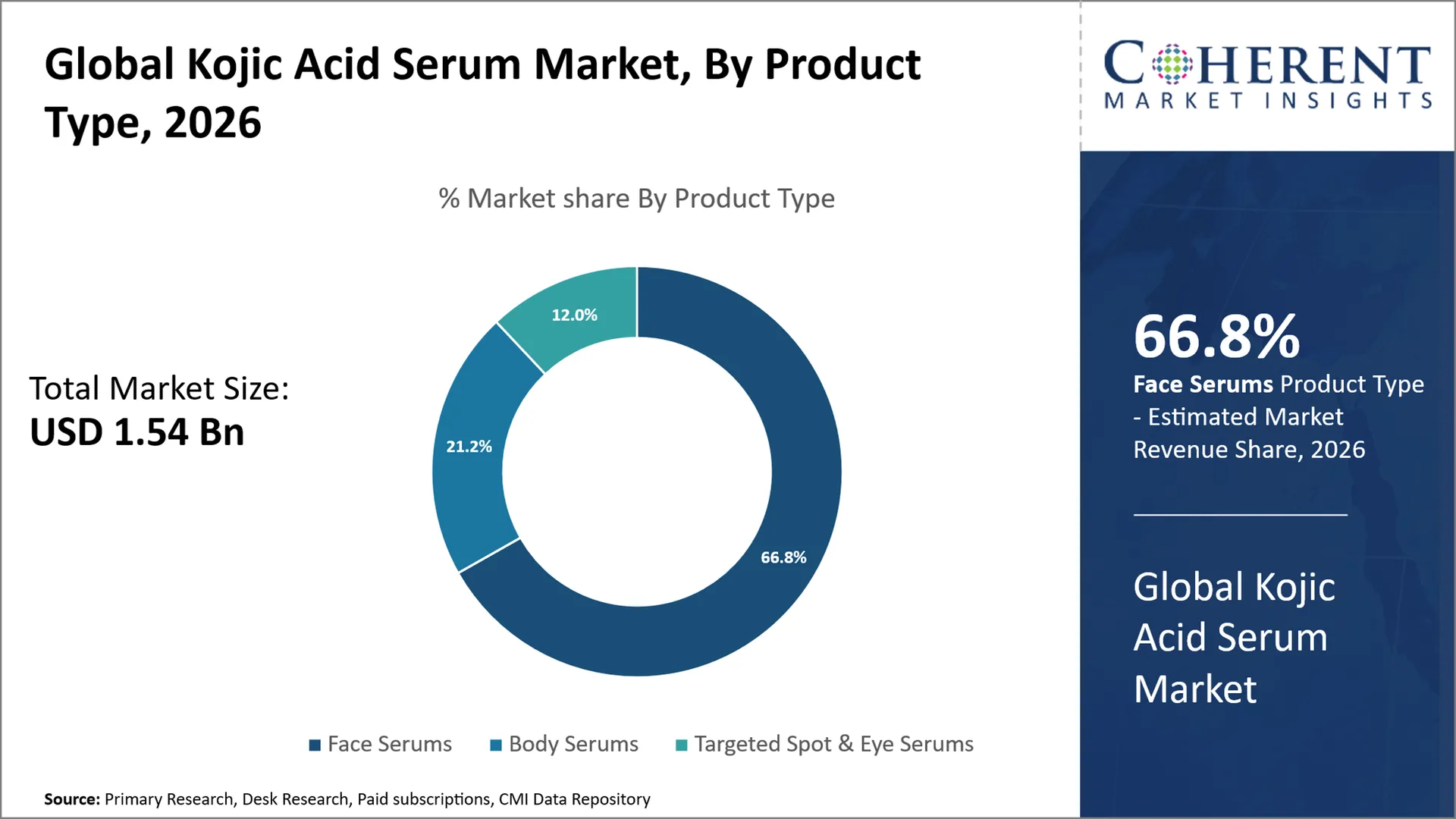
- Face Serums are forecast to register an estimated CAGR of 12.1% during 2026–2033, with an expected 66.8% share of the global kojic acid serum market in 2026. Their familiar daily-use format supports premium positioning and repeat purchases. In December 2025, KOSÉ announced an upgraded DECORTÉ WHITELOGIST kojic-acid brightening serum for a January 2026 launch.
- Multi-Active Kojic Acid Serums are projected to expand at an estimated CAGR of 13.1% during 2026–2033, commanding an expected 78.5% share of the global kojic acid serum market in 2026. Combining complementary active ingredients offers brands differentiated benefits and pricing flexibility. In October 2024, Asaya introduced a serum combining kojic acid with alpha arbutin to address uneven skin tone.
- Hyperpigmentation & Melasma Care is expected to register an estimated CAGR of 12.7% during 2026–2033, accounting for 47.2% of the global kojic acid serum market in 2026. Condition-specific positioning encourages evidence-led formulation and dermatologist engagement. In June 2025, an Elsevier-published randomized clinical trial examined kojic acid serum, alone and alongside microneedling, for melasma management.
- Online Retail is forecast to grow at an estimated CAGR of 15.0% during 2026–2033, with an expected 43.2% share of the global kojic acid serum market in 2026. Ingredient-based searches and product comparisons enable efficient customer acquisition. In September 2025, Honasa Consumer identified The Derma Co.’s 2% Kojic Acid Serum among its online marketplace bestsellers.
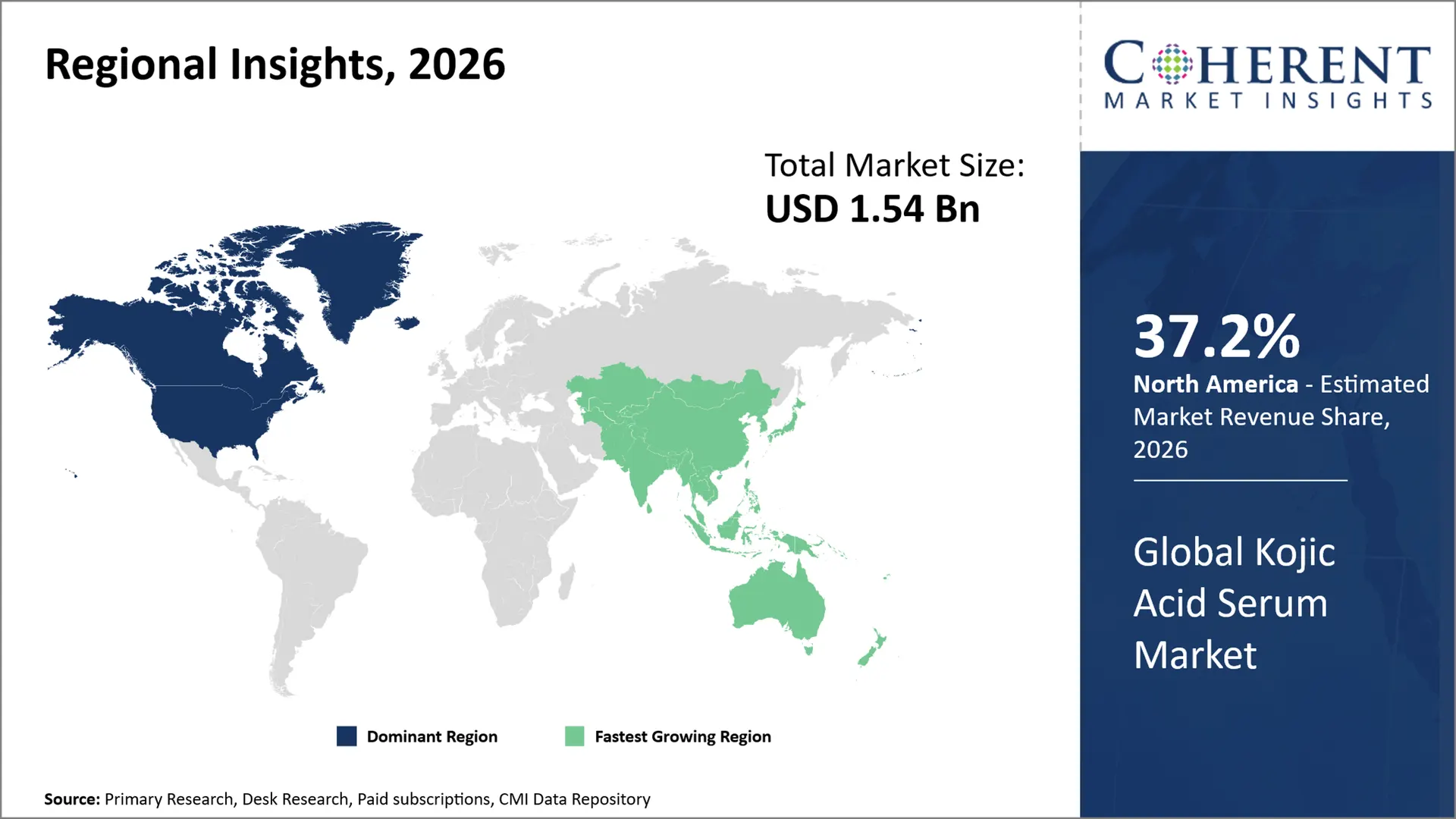
- North America is anticipated to maintain regional leadership, with an estimated CAGR of 11.0% during 2026–2033 and an expected 37.2% share of the global kojic acid serum market in 2026. Established premium-skincare retail and ingredient-conscious consumers support commercialization. In July 2025, Los Angeles-based IKI Skin Care launched its KIDO Brightening Serum containing kojic acid and alpha arbutin.
- Asia Pacific is expected to register the fastest regional growth with estimated CAGR 12.30% and expected market share 30.4% of the global kojic acid serum market, as local manufacturers develop brightening formulations addressing diverse skin concerns and purchasing power. Expanding specialty beauty distribution, scalable contract manufacturing, and digitally engaged consumers create opportunities for affordable multi-active products. Brands prioritizing formulation stability, ingredient transparency, and localized product development could strengthen their regional competitive positioning.
Segmental Insights
Why Do Face Serums Dominate the Global Kojic Acid Serum Market?
Face Serums will generate 66.8% of global kojic acid serum market revenue in 2026. This is attributable to the fact that kojic acid face serums are more apt to treat common facial discoloration, as opposed to mere body or under-eye discoloration. Full-face application is relevant to a wider customer base due to pigmentation across the cheeks, forehead, jawline. For manufacturers, standardized facial serum formats simplify filling operations, packaging procurement and assortment planning compared to developing numerous application-specific products. These treatments also allow specialty retailers to add higher-value offerings to their facial-care portfolios. In June 2025, ALBION highlighted the U.S. introduction of its EXCIA BRIGHTENING Immaculate Serum Z, formulated with Kojic Acid EX and positioned as an intensive 28-day facial brightening regimen. This development illustrates the commercial value of specialized facial treatment products.
- Current Industry Events of 2026
- Market Size Estimation
- Regional Breakdown
- Competitive Landscape
- Customer Intelligence
- Segmental Analysis
- Pricing Analysis
- Key Market Drivers, Challenges & Future Trends
- Customized Insights Section
Why Do Multi-Active Kojic Acid Serums Represent the Largest Formulation Type in the Global Kojic Acid Serum Market?
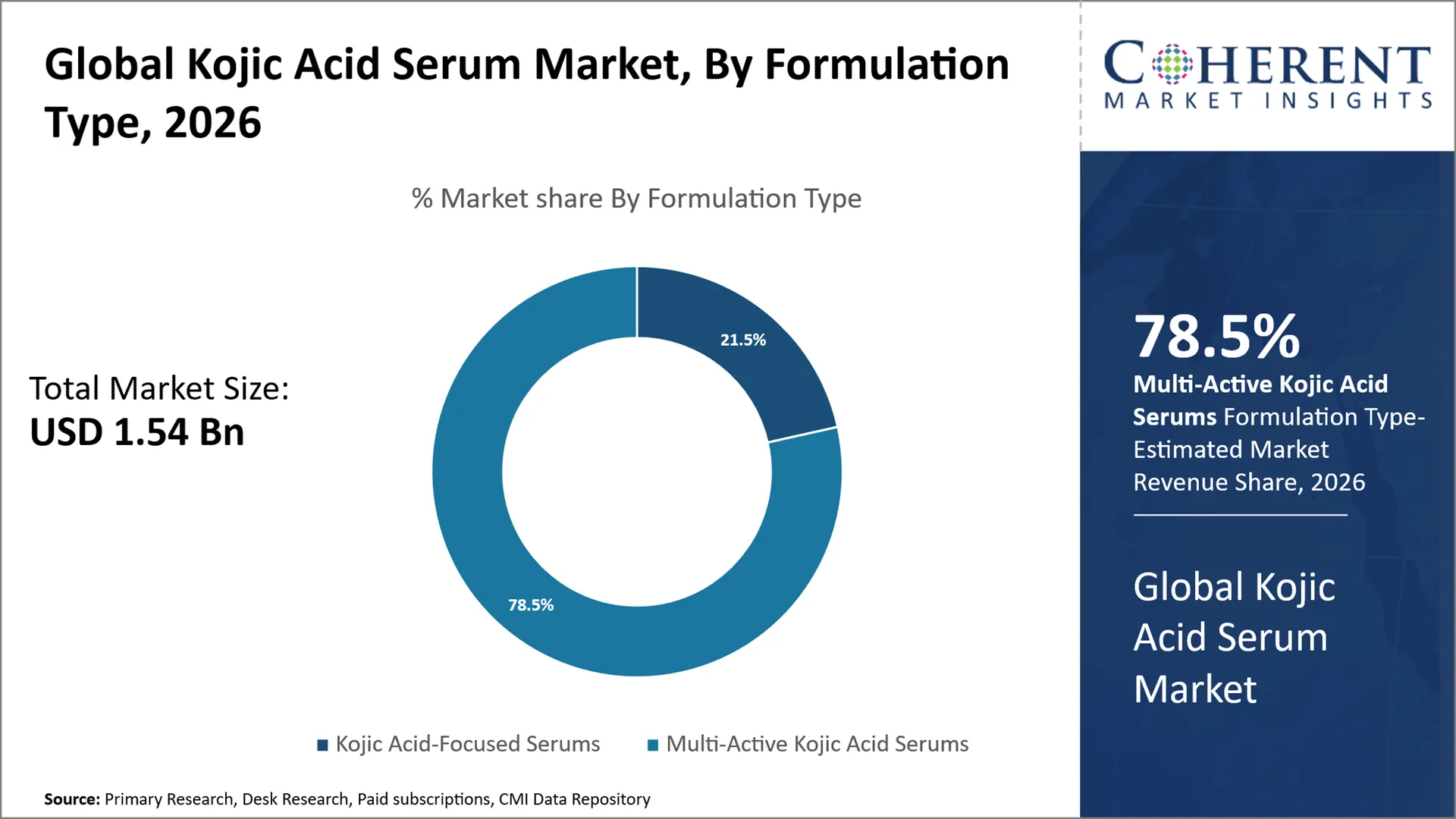
Multi-Active Kojic Acid Serums are estimated to hold 78.5% of the global kojic acid serum market in 2026, as consumers increasingly evaluate pigmentation products against overlapping concerns, including dullness, uneven tone, and post-blemish marks. A single multi-active product can reduce the need to purchase and layer separate treatment serums, improving convenience and simplifying skincare routines. However, manufacturers must assess ingredient compatibility, stability, and tolerability before combining active substances, making formulation expertise commercially important. In July 2024, HYPHEN launched its Brightening and Pigmentation Essentials range which includes the Yuzu Dark Spot Corrector Serum with 1% kojic acid, 2% alpha arbutin, 5% niacinamide and 1% yuzu extract. The launch showcases how skincare manufacturers are combining synergistic actives to differentiate pigmentation-focused serums and target multiple consumer needs in one formulation.
Why Does Up to 1% Dominate the Kojic Acid Concentration Segment of the Global Kojic Acid Serum Market?
Up to 1% kojic acid concentration is projected to represent 48.7% of global kojic acid serum market revenue in 2026, supported by products designed for moderate-intensity skincare rather than concentration-led differentiation. Instead of simply increasing the amount of kojic acid, manufacturers can focus their formulation efforts on skin feel, ingredient compatibility and preservation. This concentration bracket also gives distributors the opportunity to distinguish themselves for consumers wanting to achieve gradual cosmetic brightening, with tolerability dependent on the overall formulation. In February 2025, Brunei Darussalam's Ministry of Health listed NINELESS B-Boost 1% Kojic Acid Serum distributed by Biolab Plus Company as one of the notified cosmetic products. While the documented existence of an import market suggests that kojic acid serums of lower concentrations are commercially available, this does not imply regulatory approval of the efficacy of the products.
Current Events and their Impact
Current Event | Description and Its Impact |
April 2024 – European Union Introduces Kojic Acid Concentration Restrictions |
|
December 2024 – Great Britain Establishes New Kojic Acid Safety Requirements |
|
October 2026 – U.S. FDA Finalizes Mandatory Cosmetic Recall Guidance |
|
Global Kojic Acid Serum Market Dynamics
Key Market Drivers
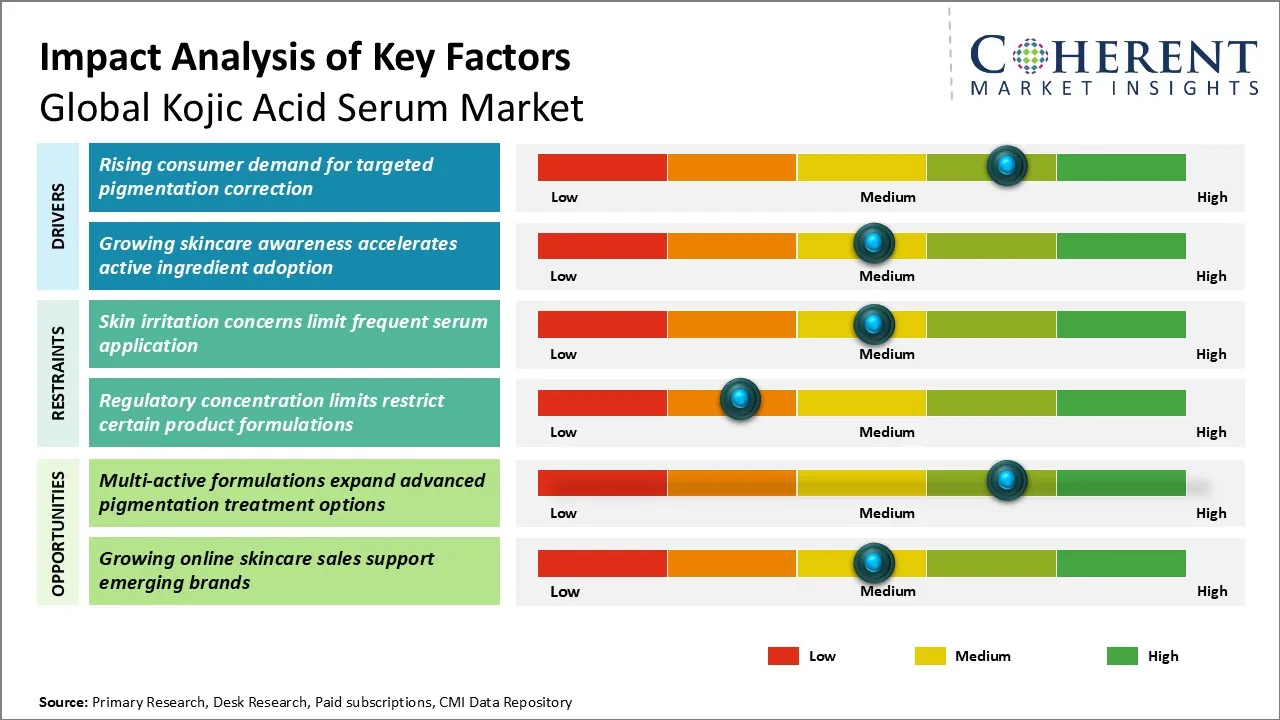
- Rising consumer demand for targeted pigmentation correction: Consumers who want to manage post-acne marks, uneven skin tone, and localized discoloration are increasingly choosing serums that target specific skin issues over general brightening products. This encourages the creation of formulations that are treatment-oriented by manufacturers and helps specialty beauty retailers to set themselves apart. The suppliers of ingredients are also benefiting from the demand for active ingredients that are effective and well tolerated. In April 2026, MECCA featured Allies of Skin’s new Azelaic & Kojic Advanced Clarifying Serum as part of its Australian beauty arrivals, showing the comercial potential of targeted pigmentation solutions.
- Growing skincare awareness accelerates active ingredient adoption: This trend is fueling the trend of buying skincare products based on the formulation composition, rather than brand recognition. People are starting to put more emphasis on ingredient transparency, concentration information, and education when they decide what products to buy. For formulation-focused manufacturers and retailers who offer transparency in ingredients, this is good news, and raises the bar for brands making sweeping brightening claims. In November 2025, Amore pacific's Amazon Insider analysis reported that searches for Kojic Acid Serum increased by 142% compared with the previous year, indicating stronger ingredient-led product discovery.
Emerging Market Trends
- Increasing Preference for Skin-Tolerant Brightening Formulations: The evolution of kojic acid serums is moving toward products that combine pigmentation correction with skin hydration and comfort. Manufacturers are increasingly considering how multiple active ingredients interact during repeated application.
- Impact: This change is expected to increase the demand for compatibility-tested formulations and gentle delivery systems. It may also reduce the competitive advantage of products which are mainly marketed on the basis of high concentrations of ingredients.
- Relevance to Market: Brands that can consistently deliver cosmetic performance with a reduced potential for irritation may improve customer retention. Such evolving product requirements will likely be beneficial to formulation specialists and quality-conscious contract manufacturers.
- Evolution Toward Guided Pigmentation-Care Routines: Consumers are shifting from single brightening products to guided skin care routines that combine corrective serums, moisturizers and sun protection. The product instructions and suggested application schedules are becoming an increasingly important part of the purchase experience.
- Impact: Guided routines can be implemented to increase customer satisfaction, and can encourage consistent use of products. They also enable brands in the skincare industry to encourage repeat purchases by suggesting complementary products.
- Relevance to Market: Kojic acid serum manufacturers can differentiate themselves through practical usage guidance and realistic treatment expectations. This approach may favor companies that combine product development with ongoing consumer education.
Key Market Restraints
- Regulatory Restrictions on Kojic Acid Concentration: Regulatory bodies set limits for the amount of kojic acid in cosmetics, creating additional challenges in formulation and market access, particularly for higher concentration serums. In the European Union and Great Britain, kojic acid is restricted to 1% in certain cosmetics used on the face and hands. This means that manufacturers that operate in multiple markets must take into account jurisdiction-specific formulations, safety assessments, and product portfolios, which adds to the complexity of compliance.
- Formulation Stability and Skin Sensitivity Concerns: Kojic acid presents formulation issues in terms of oxidation, discoloration, and potential skin irritation. Lack of stability or compatibility testing may result in poor product appearance, consumer acceptance and shelf-life performance. Brands would have to invest in appropriate packaging, formulation stabilization and safety testing, which could raise the cost of development and restrict the commercial potential of poorly differentiated, low-priced products.
Regional Insights
Why Does North America Dominate the Global Kojic Acid Serum Market?
North America is expected to account for 37.2% of the global kojic acid serum market in 2026, supported by strong demand for cosmetic treatments addressing discoloration across diverse skin tones. The region also has a strong skincare industry that is focused on dermatology, allowing manufacturers to develop formulations with consumer testing and unique ingredient combinations. There is a commercial opportunity for high-value pigmentation-correction products, developed with specialist skincare brands and premium beauty retailers. In May 2025, U.S.-based Reframe Beauty introduced its Pigment Processor brightening serum, formulated with kojic acid dipalmitate, a kojic acid derivative, alongside other pigmentation-focused ingredients. The development is a sign of growing commercial interest in discoloration products that are scientifically positioned for a wide range of consumers.
Why Is Asia Pacific Emerging as the Fastest-Growing Region in the Global Kojic Acid Serum Market?
Asia Pacific is projected to hold 30.4% of the global kojic acid serum market in 2026 and register the fastest growth during the forecast period. The region takes advantage of its existing preference for brightening skincare, its specialized cosmetic formulation capabilities and increasing access to domestically developed products. Manufacturers are exploring different concentrations of kojic acid, different textures and price points to meet the specific needs of consumers. Plus, the online-first product launches enable smaller companies to enter specialty skincare categories without a large brick-and-mortar set up. In May 2026, Japan's Ashitarunrun Lab announced the June launch of its 4% Kojic Acid Gel Serum, reflecting continued product development within the region's ingredient-focused skincare industry. This announcement reflects the ongoing product development in the ingredient-driven skincare industry of the region.
Global Kojic Acid Serum Market Outlook for Key Countries
Why Is the U.S. a Key Market for the Global Kojic Acid Serum Market?
The U.S. represents an important global kojic acid serum market because consumers increasingly distinguish between products addressing general dullness and those formulated for post-inflammatory pigmentation. Established specialty skincare brands may capitalize on targeted formulations by directly engaging with customers, educating on ingredients and premium positioning. Companies also have access to cosmetic research and clinical testing which allows them to substantiate differentiated product claims. A prime example of this product-first approach is Topicals’ Faded Brightening + Clearing Serum. It contains kojic acid, azelaic acid, licorice root, and supporting brightening ingredients. The formulation shows commercial relevance of pigmentation-specific skin care products that are tailored for consumers of different skin tones.
Why Is Japan Important in the Global Kojic Acid Serum Market?
Japan is important in the global kojic acid serum market because of its long history of commercially using kojic acid to lighten skin, and its highly developed expertise in researching cosmetic ingredients. Japanese manufacturers are increasingly distinguishing their products by the quality of their formulation, the compatibility of their ingredients, and development that takes into account sensitivity. Dermatologist-supervised brands also cater to consumers who desire targeted pigmentation care without sacrificing the comfort of their daily skincare routine. Developed under the supervision of a dermatologist, HAL SKIN’s Koji Clear Serum, released by SKIN AD in April 2025, contains kojic acid, panthenol, bisabolol and ceramides. The introduction shows how Japanese brands are combining skin-barrier-supporting ingredients with traditional brightening ingredients to meet the specific needs of niche consumers.
Why Does South Korea Support Growth in the Global Kojic Acid Serum Market?
South Korea supports the kojic acid serum market through its established K-beauty formulation ecosystem, ingredient-focused product positioning, and international beauty distribution networks. Korean skincare brands distinguish themselves with lightweight textures, unique packaging, and formulations that contain complementary cosmetic actives. These capabilities allow manufacturers to identify consumers interested in convenient pigmentation-care products in both domestic and international markets. One such product is APRILSKIN’s A.C.E Vita Kojic Brightening Serum that combines kojic acid with vitamin C and other supportive ingredients. The product is marketed in a lightweight format that is suitable for application to the face and the body. The fact that the product is available in the brand’s international online shop is an example of how Korean skincare companies can market proprietary kojic acid formulas in different parts of the world.
Why Is China a Strategic Country in the Global Kojic Acid Serum Market?
China’s established chemical processing infrastructure and capabilities for making cosmetic ingredients make it a major supply-side participant in the global market for kojic acid serum. Domestic suppliers are available to provide kojic acid and other related ingredients to help serum makers develop their formulations. The quality control of the finished serums can be affected by variations in active ingredients. Consistency in ingredient assays, production documentation and reliable delivery is of utmost importance. In November 2025, Natural Field Co., Ltd. of Xi'an, China, issued a certificate of analysis for a 1,000 kg lot of kojic acid with an assay of 99.68%. This is a specific example of a documented Chinese production of kojic acid relevant to downstream cosmetic production.
Why Is Brazil an Important Growth Market for the Global Kojic Acid Serum Market?
Brazil is a matured market for dermo cosmetics and the consumer interest toward the products for melasma, suninduced discoloration and uneven skin tone is growing. This is expected to create opportunity for the manufacturers in the global kojic acid serum market. Domestic skincare brands can differentiate themselves by developing specialized formulations, conducting cosmetic testing and providing products that appeal to local consumers’ preferences. Also, manufacturers can expand their range of products from traditional facial cleansers and moisturizers to high-end brightening serums. ADA TINA introduced Clarivis High Potency, a facial brightening serum with kojic acid, glycolic acid and citric acid in September 2026. The formulation reflects the commercial focus on specialized dermo cosmetic development and multi-ingredient pigmentation-care products for the Brazilian skincare market.
Kojic Acid Serum Formulation and Product Evolution Landscape in the Global Kojic Acid Serum Market
Formulation Technology | Application in Kojic Acid Serums | Commercial Significance | Adoption Considerations |
Active Ingredient Stabilization | Uses carefully selected stabilizers and formulation conditions to prevent oxidation and discoloration of the kojic acid. | Helps to maintain consistent appearance and quality of product during storage. | Needs ingredient compatibility and accelerated stability testing. |
pH-Optimized Serum Systems | pH of formulation adjusted to enhance stability of active ingredient, compatibility and skin tolerability. | Provides reliable product performance and consistent quality of manufacture. | requires proper buffering systems and finished product testing. |
Encapsulation and Liposomal Delivery | Uses specialized carriers to encapsulate selected ingredients to alter their distribution and delivery characteristics. | It opens the door to differentiated serum textures and claims around delivery. | Proof of stability, safety and claimed performance required. |
Multi-Active Formulation Systems | Blends kojic acid with compatible ingredients like niacinamide, azelaic acid, or alpha arbutin. | Allows manufacturers to fix multiple cosmetic problems in one product. | It is a matter of ingredient interactions and concentration limits that vary by jurisdiction. |
Protective Packaging Systems | Uses opaque containers, controlled dispensing and air tight packaging designs. | May reduce exposure related quality deterioration and wastage of products. | The high costs of packaging need to be considered against the benefits of shelf-life. |
Instrumental Efficacy and Safety Testing | Performs colorimetric skin assessments, stability analysis and controlled skin tolerance evaluations. | Provides measurable data to help substantiate product differentiation and support cosmetic claims. | Needs laboratory capabilities, proper study design and documentation. |
How Are Targeted Hand-Care Formulations Creating New Growth Opportunities in the Global Kojic Acid Serum Market?
The emerging commercial opportunity lies in hand-care serums as consumers are seeking products to treat visible discoloration outside of the face. Conventional hand creams are mostly focused on moisturizing, so there is a space for specialized formulations that combine cosmetic brightening with everyday hand care.
Manufacturers can develop lightweight kojic acid serums designed for localized dark spots and uneven-looking skin tone. Precision applicators, portable packaging, and complementary moisturizers could help differentiate these products.
Potential distribution partners include specialty beauty retailers, pharmacies and professional skin care providers. They need to be formulated appropriately, stability tested, have supported cosmetic claims and meet any applicable ingredient restrictions to be successfully commercialized.
The opportunity could be especially good for specialist formulators and established skincare companies with formulation and testing capabilities. Smaller brands could enter through focused positioning and contract manufacturing deals.
Hand-specific serum development can create additional premium product niches during the forecast period, without the manufacturers having to compete directly across the broader facial serum category.
Market Players, Key Developments, and Competitive Intelligence
Key Developments
- In October 2026, ALORÉA Cosmetics introduced its Advanced Serum Collection in Pakistan, including a Whitening Serum formulated with kojic acid and collagen. The introduction expands the company's ingredient-focused skincare portfolio and demonstrates how emerging regional manufacturers can participate in the market through targeted formulations and differentiated product assortments.
- In September 2025, Medicube expanded its kojic acid skincare offering with the Kojic Acid Turmeric Niacinamide Serum, highlighted among its new product releases. The formula combines multiple cosmetic actives with a capsule-based format. This strengthens competition through differentiated K-beauty formulations aimed at consumers concerned about uneven skin tone.
Competitive Landscape
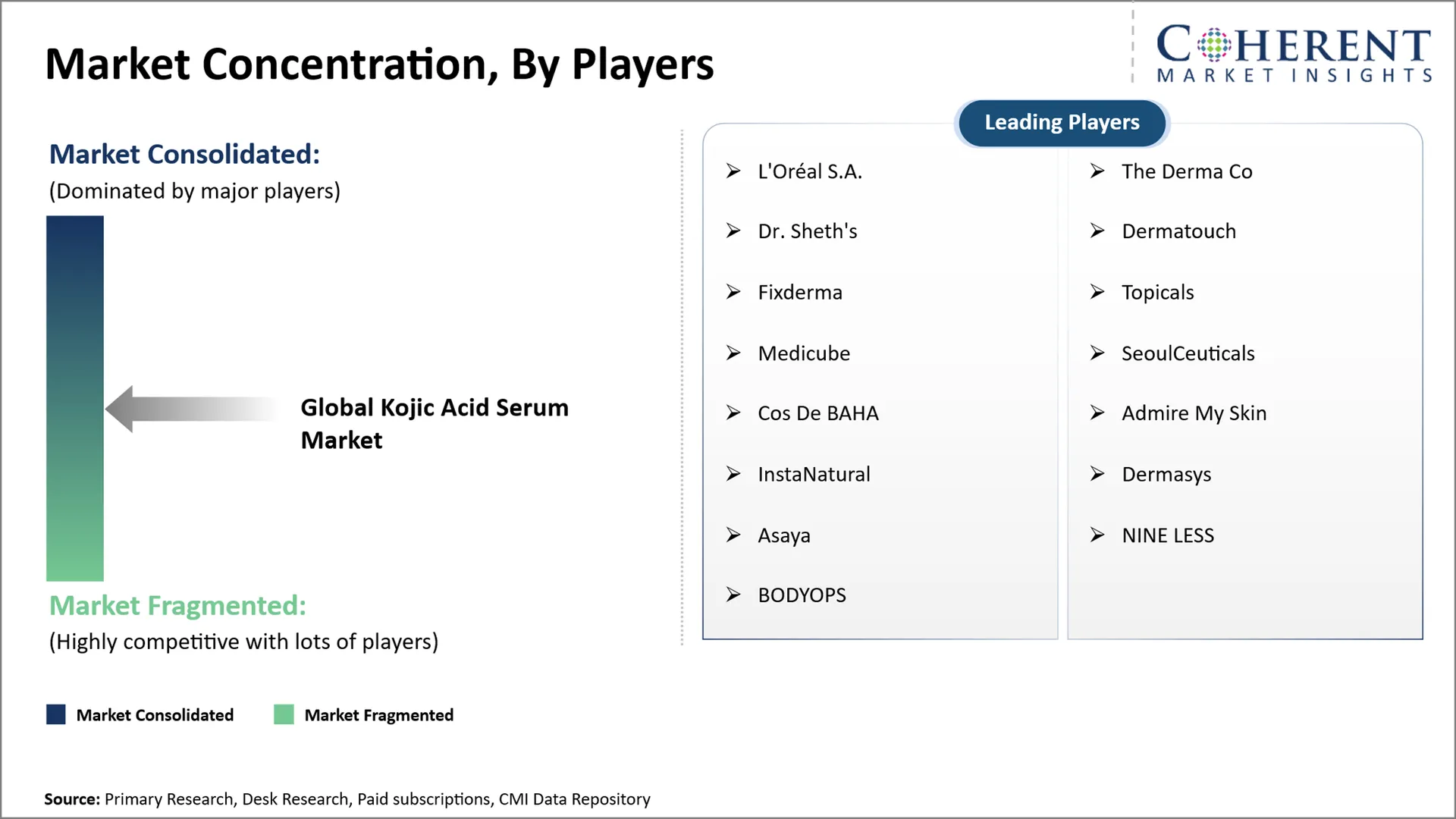
The global market for kojic acid serum seems fragmented with the presence of multinational skincare manufacturers, dermatology-focused brands, Korean beauty experts and regional cosmetic producers competing for market share. The competition is mainly driven by the quality of the formulation, the tolerability of the product, the price and the existence of distribution networks. Specialist companies compete on targeted formulations, product positioning and localized consumer understanding, while incumbents benefit from procurement scale and established customer relationships.
Key competitive factors include
- Formulation Differentiation: Creating unique textures and compatible active ingredient combinations.
- Product Quality: Maintaining consistency across commercial production batches.
- Pricing Strategy: Mixing premium products with affordable alternatives.
- Manufacturing Capabilities: building dependable suppliers and simplifying manufacturing processes.
- Quality Assurance: Documentation of safety assessments and specifications.
- Product Portfolio: Introducing serum formats that complement each other and products that are designed for specific uses.
- Distribution Strategy: Strengthening specialty retail, pharmacy, and direct-to-consumer relationships.
Market Report Scope
Global Kojic Acid Serum Market Report Coverage | |||
Report Coverage | Details | ||
Base Year | 2025 | Market Size in 2026: | USD 1.54 Bn |
Historical Data For: | 2020 to 2024 | Forecast Period: | 2026 to 2033 |
Forecast Period 2026 To 2033 CAGR: | 12.30% | 2033 Value Projection: | USD 3.47 Bn |
Geographies covered: |
| ||
Segments covered: |
| ||
Companies covered: | L'Oréal S.A., The Derma Co, Dr. Sheth's, Dermatouch, Fixderma, Topicals, Medicube, SeoulCeuticals, Cos De BAHA, Admire My Skin, InstaNatural, Dermasys, Asaya, NINE LESS, BODYOPS | ||
Growth Drivers: |
| ||
Restraints & Challenges: |
| ||
Analyst Opinion (Expert Opinion)
- Future Market Direction: The global kojic acid serum market is expected to move from products focused on individual ingredients to companies that can consistently maintain quality across larger, clearly differentiated skincare portfolios. The governance of products, disciplined management of product range and reliable partnerships for manufacturing may be more important than frequently introducing similar brightening formulations.
- Transformative Trend or Disruption: Emergence of alternative pigmentation-correcting ingredients could challenge the competitive positioning of kojic acid. Cosmetic manufacturers who are heavily dependent on the ingredient may come under pressure as cosmetic brands search for replacements with distinctive stability, tolerability or formulation properties. Companies that can change their ingredient portfolios without compromising the performance of existing products will have a structural advantage.
- Strategic Priorities, Risks, and Recommendations: Manufacturers should focus on strong stability programs, independent product testing and reliable ingredient sourcing. Expansion into regions should be based on an assessment of the customer affordability and formulation needs. Companies should not over-invest in high strength products without clear justification on safety, compliance and demand. Partnerships with reliable suppliers and dedicated contract manufacturers can help to mitigate production risks and protect margins.
Speak to the analyst
Want personalized insights?
Take the findings above to one of our principal consultants, or have the report rebuilt around the segments, geographies and competitors you actually track.
Market Segmentation
- Product Type Insights (Revenue, USD Bn, 2021 - 2033)
- Face Serums
- Body Serums
- Targeted Spot & Eye Serums
- Formulation Type Insights (Revenue, USD Bn, 2021 - 2033)
- Kojic Acid-Focused Serums
- Multi-Active Kojic Acid Serums
- Kojic Acid Concentration Insights (Revenue, USD Bn, 2021 - 2033)
- Up to 1%
- Above 1%–2%
- Above 2%
- Application Insights (Revenue, USD Bn, 2021 - 2033)
- Hyperpigmentation & Melasma Care
- Post-Acne Dark Spot Reduction
- Skin Brightening & Even Tone
- Other Applications
- Distribution Channel Insights (Revenue, USD Bn, 2021 - 2033)
- Online Retail
- Specialty Beauty Stores
- Pharmacies & Drugstores
- Supermarkets & Hypermarkets
- Other Channels
- Regional Insights (Revenue, USD Bn, 2021 - 2033)
- North America
- U.S.
- Canada
- Latin America
- Brazil
- Argentina
- Mexico
- Rest of Latin America
- Europe
- Germany
- U.K.
- Spain
- France
- Italy
- Russia
- Rest of Europe
- Asia Pacific
- China
- India
- Japan
- Australia
- South Korea
- ASEAN
- Rest of Asia Pacific
- Middle East
- GCC Countries
- Israel
- Rest of Middle East
- Africa
- South Africa
- North Africa
- Central Africa
- North America
- Key Players Insights
- L'Oreal S.A.
- The Derma Co
- Dr. Sheth's
- Dermatouch
- Fixderma
- Topicals
- Medicube
- SeoulCeuticals
- Cos De BAHA
- Admire My Skin
- InstaNatural
- Dermasys
- Asaya
- NINE LESS
- BODYOPS
Sources
Primary Research Interviews
- Kojic acid serum manufacturers, formulators, and contract manufacturers
- Cosmetic brands, skincare product developers, and active ingredient suppliers
- Cosmetic chemists, dermatologists, and pigmentation-care researchers
- Beauty retailers, pharmacy chains, and e-commerce distributors
- Cosmetic ingredient distributors and packaging manufacturers
Stakeholders
- Kojic acid and specialty cosmetic ingredient suppliers
- Skincare and pigmentation-treatment manufacturers
- Cosmetic formulation and private-label companies
- Contract development and manufacturing organizations (CDMOs)
- Serum packaging, dispensing, and applicator manufacturers
- Beauty retailers, wholesalers, and online marketplaces
End-use Sectors
- Individual Consumers: Facial pigmentation, dark spots, and uneven skin tone
- Dermatology & Skincare Clinics: Professional pigmentation-care recommendations
- Beauty & Personal Care Retailers: Serum sales and product distribution
- Pharmacies & Drugstores: Specialty skincare and dermocosmetic products
- Online Skincare Platforms: Direct-to-consumer skincare product sales
Product Applications
- Hyperpigmentation and melasma care
- Post-acne dark spot reduction
- Facial skin brightening and even-tone treatments
- Body pigmentation and discoloration care
- Targeted spot and localized pigmentation treatments
- Daily skincare and cosmetic maintenance applications
Regulatory and Industry Bodies
- U.S. Food and Drug Administration (FDA)
- European Commission and Scientific Committee on Consumer Safety (SCCS)
- European Chemicals Agency (ECHA)
- Health Canada
- Therapeutic Goods Administration (TGA), Australia
- Central Drugs Standard Control Organization (CDSCO), India
- National Medical Products Administration (NMPA), China
- Ministry of Food and Drug Safety (MFDS), South Korea
- Ministry of Health, Labour and Welfare (MHLW), Japan
- National Health Surveillance Agency (ANVISA), Brazil
Databases
- UN Comtrade and ITC Trade Map
- Eurostat – Cosmetics and Personal Care Trade Statistics
- U.S. Census Bureau – International Trade Statistics
- EU CosIng – Cosmetic Ingredients Database
- FDA – MoCRA Cosmetic Product and Facility Information
- Google Trends – Kojic Acid and Pigmentation-Care Searches
- PubMed – Kojic Acid and Dermatological Research
- ClinicalTrials.gov – Pigmentation Treatment Studies
- Company Annual Reports and Investor Presentations
- E-commerce Product Listings and Pricing Databases
Magazines and Journals
- International Journal of Cosmetic Science
- Journal of Cosmetic Dermatology
- Journal of the American Academy of Dermatology
- Journal of Drugs in Dermatology
- Clinical, Cosmetic and Investigational Dermatology
- Cosmetics & Toiletries
- Global Cosmetic Industry
- CosmeticsDesign
- Happi Magazine
Associations
- Personal Care Products Council (PCPC)
- Cosmetics Europe
- Cosmetic, Toiletry and Perfumery Association (CTPA)
- Society of Cosmetic Chemists (SCC)
- International Federation of Societies of Cosmetic Chemists (IFSCC)
- Japan Cosmetic Industry Association (JCIA)
- Korea Cosmetic Association (KCA)
- Brazilian Association of the Cosmetic, Toiletry and Fragrance Industry (ABIHPEC)
- ASEAN Cosmetics Association
Public Domain Sources
- Kojic acid serum product catalogues and ingredient disclosures
- Kojic acid and cosmetic active ingredient technical datasheets
- Cosmetic formulation patents and manufacturing disclosures
- Skin pigmentation, melasma, and hyperpigmentation clinical studies
- Kojic acid concentration, formulation stability, and safety assessments
- Product launches, retail partnerships, and distribution expansions
- Company financial reports and manufacturing disclosures
- Serum pricing, e-commerce listings, and import-export statistics
- Consumer skincare preferences and ingredient purchasing trends
- Cosmetic packaging, preservation, and shelf-life studies
Key Standards and Regulations
- EU Regulation (EC) No. 1223/2009 – Cosmetic Products
- Commission Regulation (EU) 2024/996 – Cosmetic Ingredient Restrictions
- U.S. Modernization of Cosmetics Regulation Act (MoCRA), 2022
- U.S. Federal Food, Drug, and Cosmetic Act (FD&C Act)
- ASEAN Cosmetic Directive
- China Cosmetics Supervision and Administration Regulation (CSAR)
- India Cosmetics Rules, 2020
- Japan – Pharmaceuticals and Medical Devices Act (PMD Act)
- ISO 22716 – Cosmetics Good Manufacturing Practices
- ISO 17516 – Cosmetics Microbiological Limits
- ISO 11930 – Cosmetics Preservation Efficacy Testing
- ISO 16128 – Guidelines on Technical Definitions and Criteria for Natural and Organic Cosmetic Ingredients
Proprietary Elements
- CMI Data Analytics Tool
- Proprietary research repository, supported by primary interviews, kojic acid serum formulation analysis, active ingredient benchmarking, concentration and pricing assessment, consumer purchasing behavior, product application analysis, distribution-channel evaluation, country-level market sizing, import-export assessment, regulatory and safety analysis, manufacturer benchmarking, product launch tracking, and competitive intelligence.
Get access to 250+ pages report
Every segment, forecast, competitor profile and data table behind the analysis above — available for instant download.
- ESOMAR Member
- ISO 9001:2015 Certified
- D-U-N-S Registered
- GDPR & CCPA Compliant
Frequently Asked Questions
The CAGR of global kojic acid serum market is projected to be 12.30% from 2026 to 2033.
The global kojic acid serum market is estimated to be valued at USD 1.54 Bn in 2026 and is expected to reach USD 3.47 Bn by 2033.
Kojic acid serums are primarily used to address hyperpigmentation, melasma, post-acne dark spots, uneven skin tone, and visible discoloration.
Niacinamide, alpha arbutin, vitamin C, azelaic acid, and licorice root extract are commonly combined with kojic acid to develop multi-active pigmentation-care formulations.
Manufacturers should prioritize formulation stability, ingredient compatibility, skin tolerability, concentration limits, packaging requirements, and regulatory compliance.
Ingredient transparency, product safety, formulation effectiveness, brand reputation, pricing, customer reviews, and product availability influence consumer purchasing decisions.
Rising demand for targeted pigmentation treatments and growing consumer awareness of skincare ingredients are key factors driving the growth of the global kojic acid serum market.