
Global Linear Alkyl Benzene Market Size and Share Analysis- 2026 To 2033
The Global Linear Alkyl Benzene (LAB) Market size is estimated to be valued at USD 10.49 Bn in 2026 and is expected to reach USD 14.42 Bn by 2033, while exhibiting a compound annual growth rate (CAGR) of 4.65% during the same timeline. LAB is an important petrochemical intermediate used in the production of linear alkylbenzene sulfonate (LAS), an anionic surfactant widely incorporated into laundry detergents, dishwashing liquids, and institutional cleaning formulations.
Global Trade Scenario for Mixed Alkylbenzenes and Alkylnaphthalenes, 2024
Leading Exporters | Export Value (USD Million) | Leading Importers | Import Value (USD Million) |
Saudi Arabia | 594 | India | 418 |
U.S. | 276 | Mexico | 297 |
Canada | 221 | Pakistan | 153 |
Spain | 221 | U.S. | 136 |
China | 198 | Turkey | 131 |
South Korea | 188 | Vietnam | 110 |
Qatar | 156 | Germany | 109 |
Italy | 153 | South Africa | 106 |
Chinese Taipei | 144 | Colombia | 90.7 |
Egypt | 138 | Philippines | 79.1 |
The primary factors driving market expansion include the expanding detergent manufacturing capabilities, increasing consumption of affordable household cleaning products, advancements in alkylation technologies, and growing commercial interest in renewable feedstock-based surfactants. The increasing demand for cost-effective cleaning ingredients, combined with investments in integrated petrochemical manufacturing facilities, is further enabling long-term development in the global linear alkyl benzene market.
Key Takeaways of the Global Linear Alkyl Benzene Market
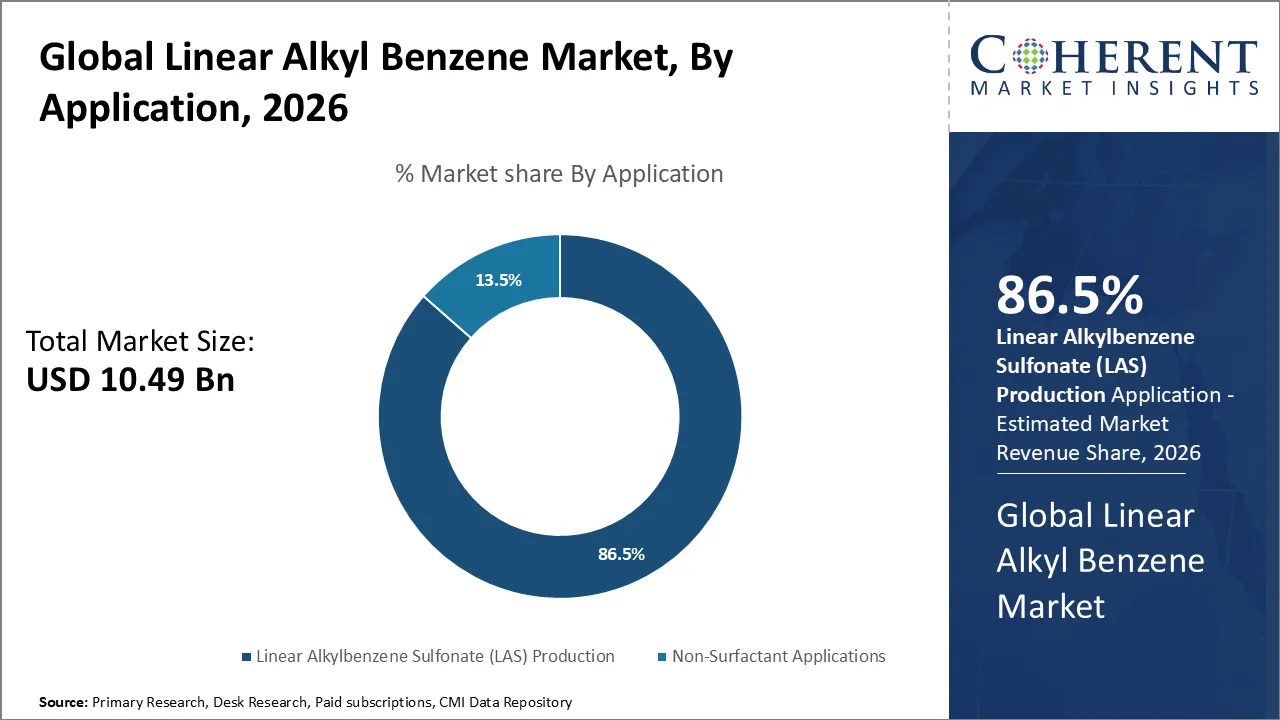
- The linear alkylbenzene sulfonate (LAS) production is expected to lead the application segment on account of an 86.5% share in the global linear alkyl benzene market share in 2026. Compatibility with large-scale sulfonation facilities, established detergent formulations, and competitive manufacturing economics are supporting this dominance. In this regard, the U.S. National Center for Biotechnology Information (NCBI) estimated the world’s LAS manufacturing output to reach almost 7 million tonnes by the end of 2026, from 2.4 million tonnes in 1994.
- The laundry detergents are poised to hold 71.5% of the market share in 2026. Regular washing requirements and the widespread consumption of powder & liquid detergents are generating recurring demand for LAB-derived surfactants. As evidence, in 2024, the worldwide trade value of cleaning products totaled USD 39.7 Bn, growing at an annualized rate of 4.83% from 2019, according to the OEC findings.
- Asia Pacific is anticipated to dominate the global linear alkyl benzene market in 2026, while exhibiting the highest CAGR. The concentration of petrochemical manufacturing facilities and expanding detergent distribution networks are consolidating the region’s leadership. Testifying to the same, by 2030, China is poised to account for approximately half of global production capacity for basic commodity chemicals and synthetic materials, showing an increase from less than 10% in 2001, as per the American Chemistry Council.
- North America is predicted to capture a considerable share in the global linear alkyl benzene market share in 2026. Substantial consumer goods manufacturing capabilities and demand for differentiated cleaning formulations are responsible for such a steady growth. Evidencing such commercial advantages, in 2026, the U.S. cleaning products industry generated USD 88.5 Bn in direct economic output, making the total economic output USD 103.6 Bn, as unveiled by the American Cleaning Institute (ACI).
Segmental Insights
Why Does Linear Alkylbenzene Sulfonate Production Remain the Primary Application in the Global Linear Alkyl Benzene Market?
The LAS production is expected to contribute to 86.5% application share in the global linear alkyl benzene market share in 2026. The segment's dominance is attributed to the ability of LAB-derived surfactants to provide effective detergency, emulsification, wetting, and oily stain removal at competitive formulation costs. As evidence, a 2024 NCBI review reported a LAS critical micelle concentration (CMC) of 0.0631 mmol/L, compared with 2.0 mmol/L for alpha-olefin sulfonates and 8.44 mmol/L for sodium dodecyl sulfate. Low CMC indicates the ability to form micelles at relatively low concentrations, supporting the solubilization of oily contaminants.
Sulfonation of linear alkyl benzene produces linear alkylbenzene sulfonic acid, which is subsequently neutralized to manufacture LAS. Detergent manufacturers benefit from established processing infrastructure, consistent raw material specifications, and compatibility with other surfactants and formulation additives. Furthermore, the development of renewable and lower-carbon LAB is creating opportunities for manufacturers operating in the linear alkylbenzene sulfonate (LAS) industry.
- Current Industry Events of 2026
- Market Size Estimation
- Regional Breakdown
- Competitive Landscape
- Customer Intelligence
- Segmental Analysis
- Pricing Analysis
- Key Market Drivers, Challenges & Future Trends
- Customized Insights Section
How Does the Recurring Consumption of Laundry Detergents Sustain Demand in the Global Linear Alkyl Benzene Market?
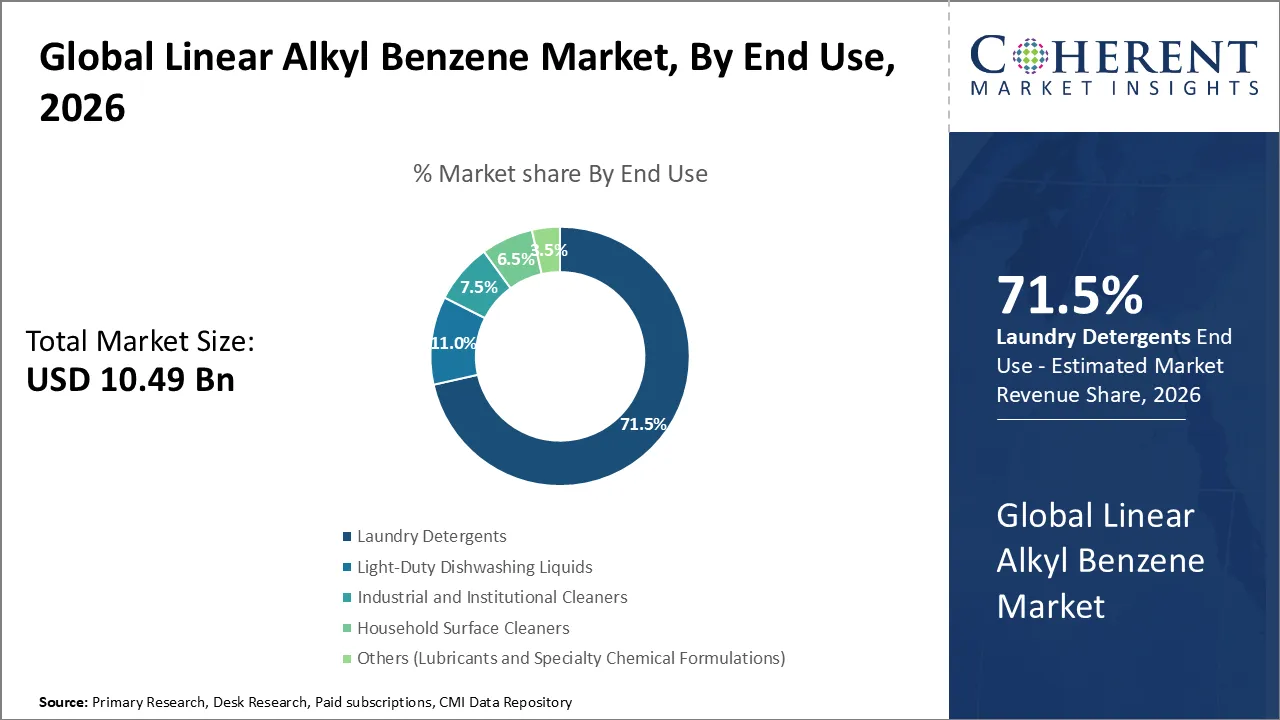
Laundry detergents are expected to account for the largest end use share of 71.5% in the global linear alkyl benzene market in 2026. In contrast to discretionary consumer products, demand from this category is largely induced by repetitive purchasing patterns associated with routine household washing requirements. Evidencing such proprietary surge, fabric care remained the largest cleaning products category in the U.S. till 2025, generating a total retail sales value of USD 18.5 billion, as per the ACI records.
This is due to LAB-derived surfactants assisting detergent formulations in separating greasy residues and particulate impurities from textile surfaces. The continued commercialization of concentrated detergents and formulations designed for lower-temperature washing is further encouraging ingredient suppliers to improve surfactant consistency and formulation compatibility. Moreover, developments in the laundry care products industry consequently influence upstream LAB procurement strategies.
Current Events and Their Impact on the Global Linear Alkyl Benzene Market
Current Event | Description and its Impact |
India's Anti-Dumping Investigation Concerning Linear Alkyl Benzene Imports (2025) |
|
U.S. EPA Strengthens Safer Choice Standards for Cleaning Products (August 2024) |
|
Global Linear Alkyl Benzene Market Dynamics
Market Drivers
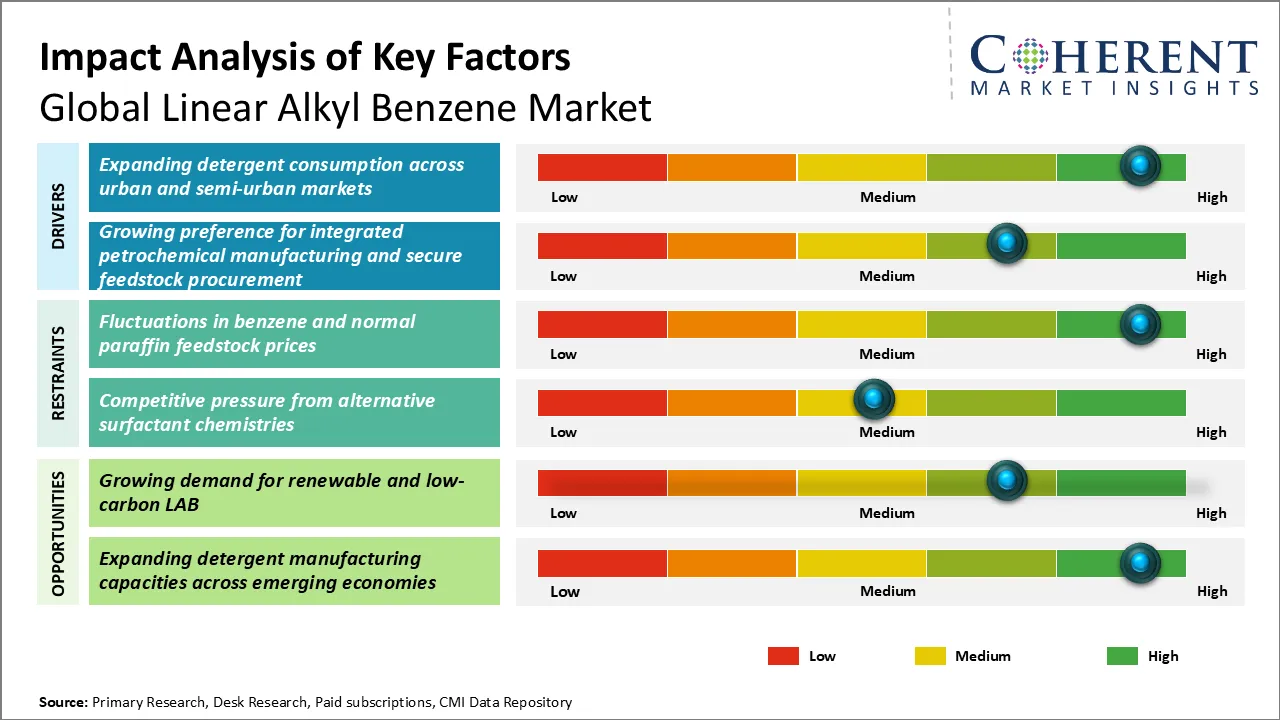
- Expanding detergent consumption across urban & semi-urban markets: The transition from conventional cleaning materials to commercially formulated detergents are expanding the addressable market for synthetic anionic surfactants. Subsequently, manufacturers are introducing affordable packaging formats and strengthening retail distribution across smaller cities and rural communities. LAB-based ingredients give detergent formulators another option to balance cleaning performance with affordability, making the global linear alkyl benzene market particularly relevant to these price-sensitive marketplaces. As a result, increasing urban concentration and commercialization of packaged cleaning products across developing economies creates opportunities for LAB-suppliers to serve organized household cleaning product distribution and branded detergent manufacturers.
- Displaying rapid urbanization, till 2025, cities were accommodating approximately 45% of the world's population of 8.2 billion, according to the United Nations (UN) World Urbanization Prospects. Besides, between 2023 and 2024, the global trade value of retail-ready washing & cleaning preparations showed a steady year-on-year (YoY) and annualized growth rates of 1.58% and 4.87%, respectively, as per OEC data.
- Growing preference for integrated petrochemical manufacturing & secure feedstock procurement: Integrated production facilities can reduce dependence on external feedstock procurement, improve inventory planning, and facilitate more efficient utilization of petrochemical infrastructure. Manufacturers with diversified supply networks are also better positioned to address variations in regional availability and transportation costs. These developments support the reliable supply of raw materials to companies operating in the anionic surfactants industry. Moreover, the availability of benzene and normal paraffins through integrated refining operations is improving the operational competitiveness of LAB manufacturers, directly benefiting the global linear alkyl benzene market.
- Exemplifying such developments, in November 2025, Moeve and Honeywell expanded their strategic collaboration to commercialize renewable feedstock-based LAB production technology. This partnership concluded that Moeve's NextLab-R technology will be offered through Honeywell's licensing platform, enabling chemical manufacturers to explore alternative raw materials for biodegradable detergent surfactants.
Global Linear Alkyl Benzene Market Trends
- Transition towards solid acid catalyst-based alkylation: Manufacturers are increasingly evaluating production technologies that reduce reliance on conventional liquid acid catalysts to simplify catalyst handling, improve process selectivity, and reduce selected operational risks. For instance, in July 2025, Neorius disclosed a proposed solid acid alkylation project with an annual LAB production capacity of 300,000 metric tons. Its zeolite-based catalyst technology offers an olefin conversion rate of 99% or above, LAB yield of 98% or above, and a catalyst regeneration cycle of at least 90 days.
- Growing emphasis on chemical supply chain traceability: Consumer goods manufacturers are requesting more detailed information about feedstock origin, production-related emissions, and environmental performance, encouraging LAB suppliers to strengthen documentation, mass-balance accounting, and product-level sustainability disclosures. Evidencing these advances, in September 2024, Cepsa Química commercialized NextLab Low Carbon, offering approximately 20% lower carbon footprint compared to conventional fossil energy-based LAB, across Europe and Asia. The product is manufactured at the company’s Puente Mayorga facility using renewable thermal energy, with its traceability certified by AENOR.
- Increasing adoption of predictive maintenance in petrochemical facilities: The deployment of real-time process monitoring and equipment performance analytics is supporting improved production scheduling, reduced unplanned downtime, and better utilization of continuous LAB manufacturing plants. Testifying to the same, in November 2025, Clariant signed a 10-year agreement with SECCO Petrochemicals to provide its CLARITY Prime digital monitoring services. The AI-powered platform will support SECCO's 900,000 tons per annum ethylene manufacturing facility in Shanghai, China.
Regional Insights
Why Does Asia Pacific Lead the Global Linear Alkyl Benzene Market?
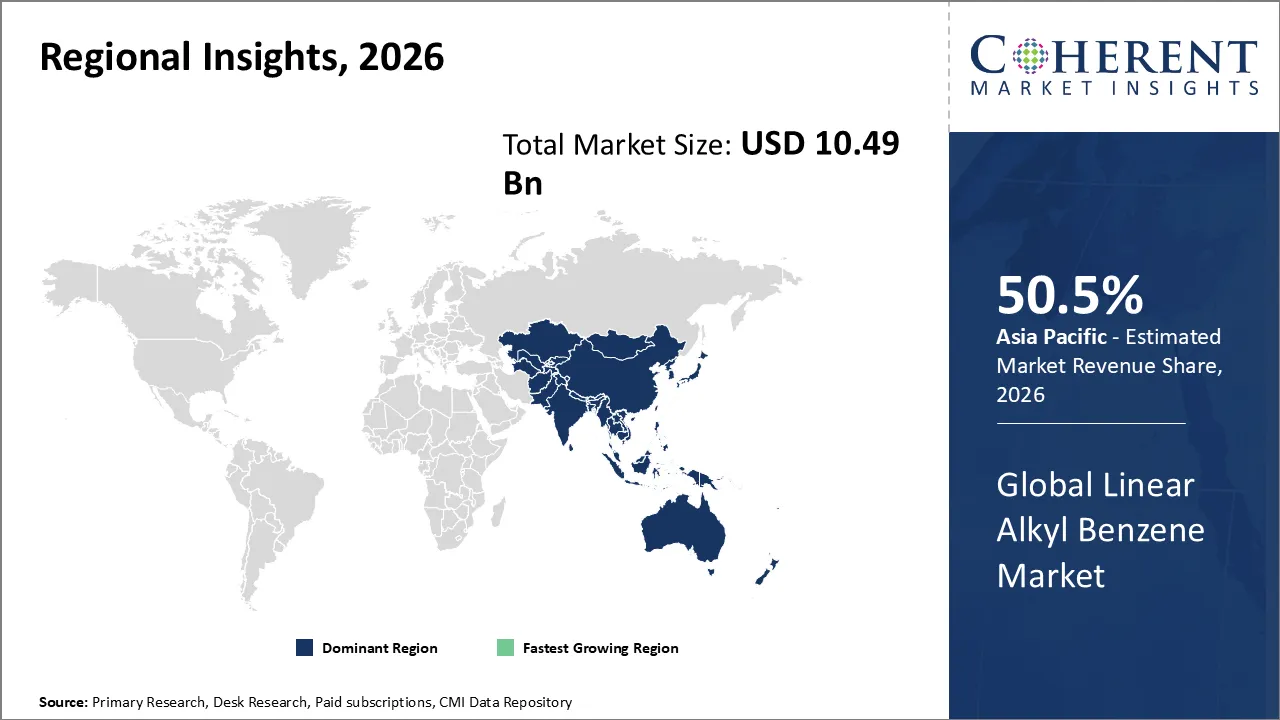
Asia Pacific is expected to dominate the global linear alkyl benzene market till the end of 2026, while augmenting as the fastest-growing region throughout 2026-2033. This leadership is primarily backed by the concentration of detergent manufacturing operations, established petrochemical processing capabilities, and a substantial consumer base for daily-use cleaning products. Differences in consumer income and washing practices across the region also support a diverse portfolio of powder, liquid, and detergent bar formulations.
In particular, China and India represent important production and consumption centers, while Indonesia, Thailand, and South Korea contribute to regional chemical manufacturing and distribution. As evidence, during 2023-2024, India was producing 467,000 tonnes out of an installed capacity of 586,800 tonnes, while consuming 728,000 tonnes, according to the country’s Department of Chemicals and Petrochemicals. Further, increasing domestic production capacity is expected to help downstream detergent manufacturers secure supplies and reduce exposure to international shipping disruptions.
How Is North America's Established Cleaning Industry Supporting the Linear Alkyl Benzene Market?
North America is expected to account for a considerable revenue share in the global linear alkyl benzene market share in 2026. Regional demand is characterized by established household care brands, sophisticated detergent formulation capabilities, and well-developed chemical distribution infrastructure. Greater competition from alternative surfactants is also prompting LAB manufacturers to focus on process efficiency and technical support rather than competing exclusively through production volume.
The U.S. and Canada possess complementary petrochemical manufacturing and trade networks, enabling surfactant producers to procure raw materials from regional suppliers. According to the World Integrated Trade Solution (WITS), Canada exported approximately 124,138 metric tons of mixed alkylbenzenes across the globe in 2024, valued at USD 226.3 million. The export activity reflects North America's established regional chemical supply capabilities.
Demand for concentrated detergents, institutional cleaning solutions, and differentiated household care products is further encouraging suppliers to maintain consistent chemical specifications. Exemplifying local participation in such a favorable trend, in April 2025, Stepan Company commenced operations at its new alkoxylation facility in Pasadena, Texas. The facility has an annual production capacity of 75,000 metric tons of alkoxylates.
Global Linear Alkyl Benzene Market Outlook for Key Countries
How Is China's Integrated Chemical Manufacturing Ecosystem Strengthening the Linear Alkyl Benzene Market?
China's linear alkyl benzene market benefits largely from its globally leading refinery capabilities, large-scale chemical manufacturing facilities, and extensive downstream detergent production infrastructure. Such an established supply chain/ecosystem can be displayed by the country exporting approximately 131,542 metric tons of mixed alkylbenzenes, worth USD 193.4 million, in 2024, according to the WITS database.
Domestic manufacturers are focusing on improving production yields, optimizing feedstock utilization, and maintaining competitive chemical prices. The availability of integrated sulfonation facilities also enables closer coordination between LAB producers and detergent ingredient manufacturers. China's established export infrastructure creates additional opportunities for supplying chemical intermediates to neighboring Asian economies.
Why Is India Becoming an Important Investment Destination for Linear Alkyl Benzene Manufacturers?
India’s augmentation in the regional linear alkyl benzene market is fueled by the increasing domestic chemical manufacturing investments and demand for competitively priced detergent ingredients. For instance, in December 2025, Tamilnadu Petroproducts Limited issued a stock exchange disclosure concerning the expansion of its linear alkyl benzene manufacturing facility from 120,000 metric tons per annum to 145,000 metric tons per annum. The expansion was intended to strengthen the company's domestic production capabilities.
The country's detergent industry includes multinational consumer goods manufacturers, regional brands, and smaller independent formulators. Thus, both local and international LAB suppliers are expanding their manufacturing infrastructure to address domestic procurement requirements and reduce dependence on overseas supply. Moreover, India's established refining industry provides opportunities for backward integration into essential petrochemical feedstocks.
How Is the U.S. Linear Alkyl Benzene Market Responding to Changing Detergent Formulation Requirements?
The U.S.-based linear alkyl benzene market is shaped by advanced detergent product development, established retail distribution channels, and increasing demand for specialized cleaning formulations. Exemplifying the sequence of events creating evolving performance requirements for upstream ingredient suppliers, in April 2024, Procter & Gamble introduced a fiber tile-based laundry detergent format, Tide evo, at SXSW to initiate a new era of laundry care.
Consumer goods companies are differentiating their products through improved stain removal, fragrance profiles, convenience, and compatibility with modern washing machines. LAB manufacturers are consequently focusing on consistent chemical properties and reliable delivery schedules to meet the requirements of large-scale detergent producers. Innovation in detergent delivery formats also creates opportunities for customized surfactant blends.
How Is Saudi Arabia Leveraging Feedstock Integration to Expand Its Linear Alkyl Benzene Industry?
Saudi Arabia's success in the linear alkyl benzene market is closely anchored to its access to refinery-derived petrochemical feedstocks, large-scale industrial complexes, and export-oriented chemical manufacturing strategies. Besides, the country's proximity to international shipping routes supports distribution to detergent manufacturing markets across Asia, Europe, and Africa. Increasing collaboration with multinational consumer goods manufacturers is also strengthening long-term commercial opportunities.
Domestic manufacturers benefit from opportunities to integrate normal paraffin and LAB production within established petrochemical infrastructure. For instance, in September 2025, Farabi Petrochemicals inaugurated its fourth integrated LAB manufacturing facility in Saudi Arabia. The USD 950 million investment in Yanbu adds approximately 120,000 metric tons of annual LAB production capacity, reinforcing the country's position in the international detergent raw materials supply chain.
What Is Driving the Development of Brazil's Linear Alkyl Benzene Market?
Brazil's linear alkyl benzene market is empowered by domestic detergent manufacturing, established consumer goods distribution networks, and regional chemical production capabilities. Portraying continued investment in this aspect, in its 2025 annual report, Unilever declared future investment plans in enhanced production capabilities in Brazil for its home care portfolio, including liquid detergents.
Such expansion in the presence of detergent and other household cleaning good manufacturing companies facilitates a stable raw material procurement opportunity for LAB producers. This is also due to the urge among local end users in responding to changing consumer preferences through differentiated laundry and household cleaning products.
How Are Lower-Carbon Manufacturing Technologies Creating New Opportunities in the Global Linear Alkyl Benzene Market?
The development of lower-carbon chemical manufacturing technologies is found creating a new pathway of greater revenue generation for LAB producers who are interested to differentiate their pipelines beyond conventional price and volume competition. The development of alternative hydrocarbon feedstocks could also help producers to eliminate the need for extensive changes to established downstream sulfonation infrastructure in product differentiation. This is particularly due to the recent regulatory reformations, reinforcing the importance of performance and environmental documentation in specialized cleaning product categories.
Exemplifying this sequence of regulatory events, the U.S. EPA's November 2024 criteria for specialized industrial products emphasized on the availability of safer alternatives within functional chemical classes, including surfactants, under its Safer Choice program. This is pushing consumer goods manufacturers to evaluate environmental impacts associated with their purchased chemical ingredients as part of broader supply chain sustainability strategies.
LAB manufacturers can capitalize on this opportunity through renewable electricity procurement, waste heat recovery, energy-efficient separation technologies, and improved catalyst performance. For instance, in January 2024, Stepan Company expanded its International Sustainability & Carbon Certification (ISCC) PLUS certification to manufacturing facilities in Vlissingen, the Netherlands, and Millsdale, Illinois, U.S., complementing its previously certified Wesseling facility in Germany. This decision was made to utilize certified bio-based, bio-circular, and circular raw materials in its manufacturing operations.
In conclusion, these commercial opportunities are particularly attractive for suppliers capable of providing reliable product-level emissions documentation, consistent quality specifications, and compatibility with existing detergent manufacturing processes. Specifically, these prospects of a successful business operation in this sector are emerging across the household care & specialty chemicals industry, where ingredient suppliers are developing differentiated solutions for next-generation consumer cleaning formulations.
Market Players, Key Development, and Competitive Intelligence
Key Developments
- In October 2026, Sasol International Chemicals restarted operations at its previously idled ISOSIV paraffin production unit in Augusta, Italy to strengthen feedstock availability for solid acid catalyst-based LAB manufacturing and reinforce the commercial importance of DETAL technology. The facility produces a critical feedstock for manufacturing DETAL-based LAB and LAS, normal paraffins.
- In October 2026, Moeve announced that it became the first company to apply the ISCC Carbon Footprint Certification (CFC) framework to an ISCC PLUS-certified renewable-based chemical product. The certification supports the product carbon footprint of NextLab R100, manufactured at its Puente Mayorga facility in Spain using certified renewable feedstocks, mass-balance accounting, and renewable electricity.
Competitive Landscape
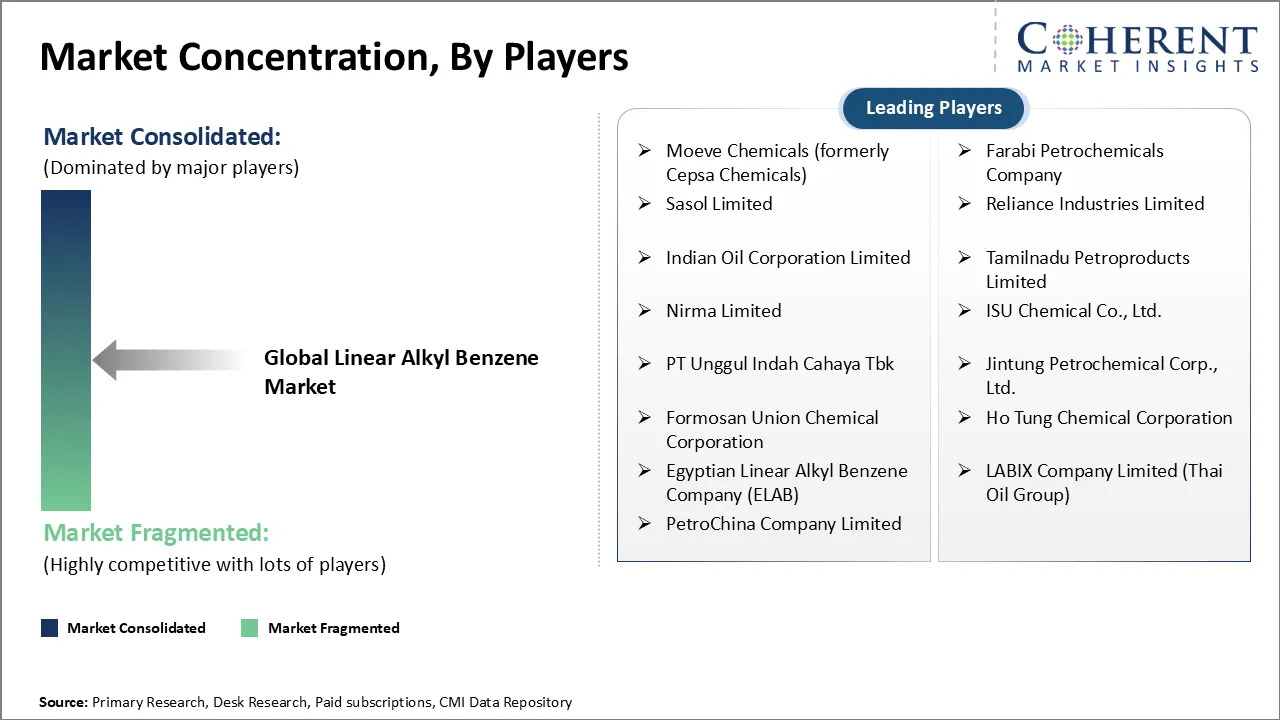
The global linear alkyl benzene market is characterized by competition among integrated petrochemical companies, specialized chemical manufacturers, and regional LAB suppliers. Among this cohort of global LAB pioneers, differentiation is primarily influenced by feedstock procurement costs, manufacturing efficiency, production scale, product purity, and distribution capabilities.
As a result, Moeve Chemicals is now focusing on differentiated LAB grades and manufacturing technologies designed to improve environmental performance. Whereas Farabi Petrochemicals leverages integrated normal paraffin and LAB manufacturing capabilities to strengthen its position in international chemical markets. On the other hand, Sasol Limited operates within established petrochemical and surfactant value chains, with Reliance Industries Limited and Indian Oil Corporation Limited benefiting from extensive refining and chemical manufacturing infrastructure.
Future competitive positioning is expected to depend on manufacturers' ability to optimize operating expenditure, maintain stable product specifications, establish long-term customer contracts, and respond to evolving environmental procurement requirements. Thus, Tamilnadu Petroproducts Limited, Nirma Limited, ISU Chemical Co., Ltd., and PT Unggul Indah Cahaya Tbk contribute to regional competition through their established manufacturing capabilities and commercial relationships with detergent producers. Meanwhile, Chinese manufacturers, including Jintung Petrochemical Corp., Ltd., strengthen regional supply through integrated production of LAB and downstream sulfonated chemical products.
Top Manufacturers and Notable Products/Solutions in the Global Linear Alkyl Benzene Market
Company/Manufacturer | Notable Product | Key Features |
Moeve Chemicals (formerly Cepsa Chemicals) | NextLab product portfolio | Conventional, lower-carbon, and renewable feedstock-based LAB solutions |
Farabi Petrochemicals Company | Linear Alkyl Benzene | Integrated normal paraffin and LAB manufacturing, detergent raw material supply |
Reliance Industries Limited | Linear Alkyl Benzene | Integrated petrochemical production, detergent manufacturing applications |
Tamilnadu Petroproducts Limited | Linear Alkyl Benzene | Established domestic manufacturing, detergent-grade chemical intermediate |
Indian Oil Corporation Limited | Linear Alkyl Benzene | Refinery-integrated chemical manufacturing and domestic detergent industry supply |
Jintung Petrochemical Corp., Ltd. | LAB, LABSA and LABSNa | Integrated upstream and downstream detergent intermediate production |
Market Report Scope
Global Linear Alkyl Benzene Market Report Coverage
Report Coverage | Details | ||
Base Year: | 2025 | Market Size in 2026: | USD 10.49 Bn |
Historical Data for: | 2020 to 2024 | Forecast Period: | 2026 to 2033 |
CAGR: | 4.65% | 2033 Value Projection: | USD 14.42 Bn |
Geographies covered: |
| ||
Segments covered: |
| ||
Companies covered: | Moeve Chemicals, Farabi Petrochemicals Company, Sasol Limited, Reliance Industries Limited, Indian Oil Corporation Limited, Tamilnadu Petroproducts Limited, Nirma Limited, ISU Chemical Co., Ltd., PT Unggul Indah Cahaya Tbk, Jintung Petrochemical Corp., Ltd., and others. | ||
Growth Drivers: |
| ||
Restraints & Challenges: |
| ||
Analyst Opinion (Expert Opinion)
- Cost competitiveness and feedstock security will remain critical determinants of market leadership. LAB manufacturers with integrated refining capabilities, diversified procurement networks, and energy-efficient production technologies are expected to maintain stronger operating margins. According to the U.S. Energy Information Administration (EIA), monthly average Brent crude oil prices declined from USD 79 per barrel in January 2025 to approximately USD 63 per barrel in December 2025. Such fluctuations highlight the importance of strategic feedstock procurement, long-term supply contracts, and flexible pricing mechanisms in managing exposure to petrochemical input costs.
- Recurring household cleaning requirements will provide a stable foundation for long-term LAB demand. Manufacturers should prioritize consistent product quality, competitive pricing, and customized technical specifications to strengthen relationships with detergent formulators. According to the American Cleaning Institute's 2026 Spring Cleaning Survey, conducted among 1,000 U.S. adults, 80% of respondents undertake spring cleaning at least once annually, while 46% identified health or hygiene concerns as a motivating factor. These findings reflect the established importance of household cleaning practices, indirectly supporting demand for LAB-derived surfactants across multiple cleaning applications.
- Environmental performance and chemical formulation compatibility will increasingly influence competitive differentiation. LAB manufacturers should invest in cleaner production technologies, ingredient traceability, and technical collaboration with downstream detergent manufacturers. According to the U.S. Environmental Protection Agency's Safer Choice performance measures, updated in 2026, 2.4 billion pounds of Safer Choice- and Design for the Environment-certified products were reported in FY2025. These developments highlight commercial opportunities for chemical suppliers capable of supporting environmentally responsible cleaning formulations without compromising performance or affordability.
Speak to the analyst
Want personalized insights?
Take the findings above to one of our principal consultants, or have the report rebuilt around the segments, geographies and competitors you actually track.
Market Segmentation
- By Application (Revenue, USD Bn, 2021-2033)
- Linear Alkylbenzene Sulfonate (LAS) Production
- Non-Surfactant Applications
- By End Use (Revenue, USD Bn, 2021-2033)
- Laundry Detergents
- Light-Duty Dishwashing Liquids
- Industrial and Institutional Cleaners
- Household Surface Cleaners
- Others (Lubricants and Specialty Chemical Formulations)
- By Region (Revenue, USD Bn, 2021-2033)
- North America
- U.S.
- Canada
- Latin America
- Brazil
- Mexico
- Argentina
- Rest of Latin America
- Europe
- Germany
- U.K.
- France
- Italy
- Spain
- Russia
- Rest of Europe
- Asia Pacific
- China
- India
- Japan
- Australia
- South Korea
- ASEAN
- Rest of Asia Pacific
- Middle East
- GCC
- Israel
- Rest of Middle East
- Africa
- South Africa
- Central Africa
- North Africa
- North America
- Key Players
- Moeve Chemicals (formerly Cepsa Chemicals)
- Farabi Petrochemicals Company
- Sasol Limited
- Reliance Industries Limited
- Indian Oil Corporation Limited
- Tamilnadu Petroproducts Limited
- Nirma Limited
- ISU Chemical Co., Ltd.
- PT Unggul Indah Cahaya Tbk
- Jintung Petrochemical Corp., Ltd.
- Formosan Union Chemical Corporation
- Ho Tung Chemical Corporation
- Egyptian Linear Alkyl Benzene Company (ELAB)
- LABIX Company Limited (Thai Oil Group)
- PetroChina Company Limited
Sources
Primary Research Interviews
- Linear alkyl benzene (LAB) manufacturers and suppliers
- Linear alkylbenzene sulfonate (LAS) manufacturers
- Benzene and normal paraffin feedstock suppliers
- Petrochemical production and process engineering specialists
- Alkylation and sulfonation technology providers
- Household and industrial detergent formulation specialists
- Procurement managers from household care product manufacturers
- Chemical distributors and international trade specialists
- Petrochemical sustainability and environmental compliance experts
- Key opinion leaders (KOLs) in surfactants, specialty chemicals, and petrochemical manufacturing
Databases
- Observatory of Economic Complexity (OEC)
- World Integrated Trade Solution (WITS) – World Bank
- United Nations Comtrade Database (UN Comtrade)
- National Center for Biotechnology Information (NCBI) – PubMed and PubMed Central
- U.S. Energy Information Administration (EIA)
- U.S. Environmental Protection Agency (EPA) – Safer Choice Database
- Department of Chemicals and Petrochemicals (DCPC), Government of India
- Directorate General of Trade Remedies (DGTR), Government of India
- United Nations Department of Economic and Social Affairs (UN DESA) – World Urbanization Prospects
- International Sustainability and Carbon Certification (ISCC) Database
Magazines
- Chemical & Engineering News (C&EN)
- Chemical Week
- Hydrocarbon Processing
- Chemical Engineering
- HAPPI – Household and Personal Products Industry
- Specialty Chemicals Magazine
- Chemical Industry Digest
- Petrochemical Update
- ICIS Chemical Business
- Indian Chemical News
Journals
- Journal of Surfactants and Detergents
- Industrial & Engineering Chemistry Research
- Chemical Engineering Journal
- Journal of Cleaner Production
- ACS Sustainable Chemistry & Engineering
- Applied Catalysis A: General
- Journal of Environmental Chemical Engineering
- Journal of Petroleum Science and Engineering
- Catalysis Today
- Colloids and Surfaces A: Physicochemical and Engineering Aspects
- Journal of Chemical Technology & Biotechnology
- Fuel
Newspapers
- Reuters
- The Economic Times
- Business Standard
- Financial Times
- The Wall Street Journal
- Arab News
- Saudi Gazette
- The Hindu BusinessLine
- China Daily
- Valor Econômico
Associations
- American Cleaning Institute (ACI)
- American Chemistry Council (ACC)
- American Chemical Society (ACS)
- Gulf Petrochemicals and Chemicals Association (GPCA)
- European Chemical Industry Council (Cefic)
- Chemicals and Petrochemicals Manufacturers Association (CPMA), India
- International Association for Soaps, Detergents and Maintenance Products (A.I.S.E.)
- Indian Surfactant Group (ISG)
- International Sustainability and Carbon Certification (ISCC)
- Japan Soap and Detergent Association (JSDA)
- Brazilian Chemical Industry Association (ABIQUIM)
- Brazilian Association of Cleaning Products and Related Industries (ABIPLA)
Public Domain Sources
- Observatory of Economic Complexity – Global Trade Statistics for Alkylbenzenes and Alkylnaphthalenes and Cleaning Products
- World Bank WITS – International Trade Statistics for Mixed Alkylbenzenes
- United Nations World Urbanization Prospects 2025
- National Center for Biotechnology Information – Scientific Publications on LAS Production and Surfactant Properties
- American Cleaning Institute – Cleaning Products Industry Economic Impact Reports, Retail Sales Statistics, and 2026 Spring Cleaning Survey
- American Chemistry Council – Global Chemical Production Capacity and Industry Outlook Reports
- Department of Chemicals and Petrochemicals, Government of India – LAB Production, Installed Capacity, and Consumption Statistics
- Directorate General of Trade Remedies – Anti-Dumping Investigation Notifications Concerning LAB Imports
- U.S. Environmental Protection Agency – Safer Choice Standards, Specialized Industrial Product Criteria, and Performance Measures
- U.S. Energy Information Administration – Brent Crude Oil Price Statistics
- Moeve Chemicals (formerly Cepsa Química) – NextLab Product Announcements and Renewable LAB Technology Developments
- Honeywell – Renewable Feedstock-Based LAB Technology Licensing Announcements
- Neorius – Solid Acid Alkylation Technology and LAB Manufacturing Project Announcements
- Clariant – Digital Monitoring and Predictive Maintenance Technology Announcements
- Stepan Company – Alkoxylation Capacity Expansion and ISCC PLUS Certification Announcements
- Tamilnadu Petroproducts Limited – Annual Reports, Stock Exchange Filings, and LAB Capacity Expansion Disclosures
- Procter & Gamble – Laundry Detergent Product Innovation Announcements
- Farabi Petrochemicals Company – Integrated LAB Manufacturing Facility Investment Announcements
- Unilever – Annual Reports and Home Care Manufacturing Investment Disclosures
- Sasol International Chemicals – Normal Paraffin Manufacturing and DETAL Technology Announcements
- Company Annual Reports, Investor Presentations, Product Catalogues, and Sustainability Reports
- Government Industrial Development Policies and Petrochemical Investment Programs
- Publicly Available Patent Documents Related to LAB Manufacturing, Alkylation, and Sulfonation Technologies
- Environmental Certification and Product Carbon Footprint Assessment Publications
Proprietary Elements
- CMI Data Analytics Tool
- Proprietary CMI Existing Repository of Information for the Last 10 Years
Get access to 250+ pages report
Every segment, forecast, competitor profile and data table behind the analysis above — available for instant download.
- ESOMAR Member
- ISO 9001:2015 Certified
- D-U-N-S Registered
- GDPR & CCPA Compliant
Frequently Asked Questions
The global linear alkyl benzene market is expected to reach USD 14.42 Bn by 2033, compared to USD 10.49 Bn in 2026.
Major players include Moeve Chemicals, Farabi Petrochemicals Company, Sasol Limited, Reliance Industries Limited, Indian Oil Corporation Limited, Tamilnadu Petroproducts Limited, Nirma Limited, ISU Chemical Co., Ltd., and PT Unggul Indah Cahaya Tbk.
Fluctuating petrochemical feedstock prices, capital-intensive manufacturing infrastructure, competition from alternative surfactants, and international supply chain uncertainties are the principal factors hampering market growth.
Expanding detergent production, growing penetration of packaged cleaning products, advancements in alkylation technologies, and investments in integrated petrochemical manufacturing are driving market growth.
The global linear alkyl benzene market is anticipated to grow at a CAGR of approximately 4.65% between 2026 and 2033.
Asia Pacific is expected to dominate the global linear alkyl benzene market, accounting for approximately 50.5% of the market share in 2026.
Linear alkyl benzene is an organic chemical intermediate generally manufactured by reacting benzene with linear olefins. It is primarily used as a feedstock for producing anionic surfactants.