

Global Liner Hanger Systems Market Size & Forecast – 2026 To 2033
The Global Liner Hanger Systems Market is estimated to be valued at USD 1,119.6 Mn in 2026 and is expected to reach USD 1,751.3 Mn by 2033, exhibiting a compound annual growth rate (CAGR) of 6.60% from 2026 to 2033. Growth is supported by increasing oil and gas exploration, advancements in drilling and completion technologies, and rising investments in offshore and complex well-development projects.
In April 2026, Weatherford announced that a major operator awarded the company a four-year contract to provide cementation products and liner hanger services in Denmark. The company also reported that higher liner hanger activity supported its Well Construction and Completions revenue. This contract highlights sustained demand for reliable liner hanger technologies that improve well integrity and support efficient offshore well construction.
Key Takeaways of the Global Liner Hanger Systems Market
- Hydraulic set liner hangers are expected to dominate the system type segment, holding 46.8 % of the market share in 2026. Their leadership is attributed to reliable pressure-based activation, minimal requirement for drill-pipe manipulation, reduced risk of premature setting, and suitability for deep, highly deviated, extended-reach, and HP/HT wells. In February 2026, Weatherford completed Kuwait’s first deployment of its Xpress XT pressure-balanced liner hanger system, demonstrating safe and reliable operation under HP/HT conditions and reinforcing the adoption of hydraulic and pressure-activated liner systems in complex wells.
- Horizontal wells are projected hold 38.6 % of the market share in 2026. The segment’s growth is driven by increasing shale and tight-resource development, longer lateral sections, and the need for liner hanger systems capable of overcoming high torque, drag, restricted pipe movement, and complex well trajectories. Hydraulic-set systems are particularly suitable for these wells because they can be activated without extensive workstring rotation. Halliburton’s MatchSet hydraulic-set liner hanger, for example, incorporates a compact design specifically engineered for highly deviated and horizontal wells.
- Production liners are anticipated to dominate the liner application segment with 44.8 % of the market share in 2026. Their leadership is supported by their extensive use in isolating producing formations, maintaining zonal integrity, supporting completion equipment, and reducing the cost and weight associated with running full-length casing strings to the surface. In May 2026, Halliburton deployed its VersaFlex expandable liner hanger system at bp’s Azeri–Chirag–Gunashli offshore field in Azerbaijan. The system replaced a conventional liner hanger, strengthened anchoring and sealing performance, and reduced well-construction time by approximately two days, highlighting the increasing importance of dependable liner installations in production-oriented offshore developments.
- North America leads the global liner hanger systems market with an expected share of 34.8 % in 2026, anchored by sustained Permian Basin drilling intensity and extended-lateral completions activity. As of late June 2026, Baker Hughes recorded 258 active rigs in the Permian Basin, the highest concentration of any U.S. basin, sustaining strong regional liner hanger demand.
- Asia Pacific is expected to account for 23.4 % of the global liner hanger systems market in 2026. Regional growth is supported by increasing deepwater exploration investments by national oil companies, particularly in India, China, Malaysia, Indonesia, and Australia. In March 2026, India's Oil and Natural Gas Corporation (ONGC) floated a US$ 18–20 billion global tender for deepwater drilling rigs under its Samudra Manthan mission, targeting the KG, Andaman, and other frontier basins and signaling a major upcoming liner hanger deployment cycle.
- Convergence with Digital Well Construction Platforms: Liner hanger suppliers are increasingly bundling hardware with torque-and-drag simulation, real-time downhole telemetry, and automated setting verification. This convergence is reshaping vendor selection criteria, favoring integrated technology providers over standalone equipment manufacturers, and opening new recurring-revenue streams tied to predictive analytics, remote job planning, and post-installation performance monitoring.
- Shift Toward Extended-Reach and Multilateral Architectures: As operators pursue longer laterals and multilateral designs to maximize reservoir contact per well, liner hanger systems must handle greater torque, higher bypass rates, and more complex zonal isolation. This structural shift elevates the strategic value of high-performance and expandable hanger technologies, pressuring suppliers to prioritize R&D investment over volume-driven, commoditized product lines.
Segmental Insights
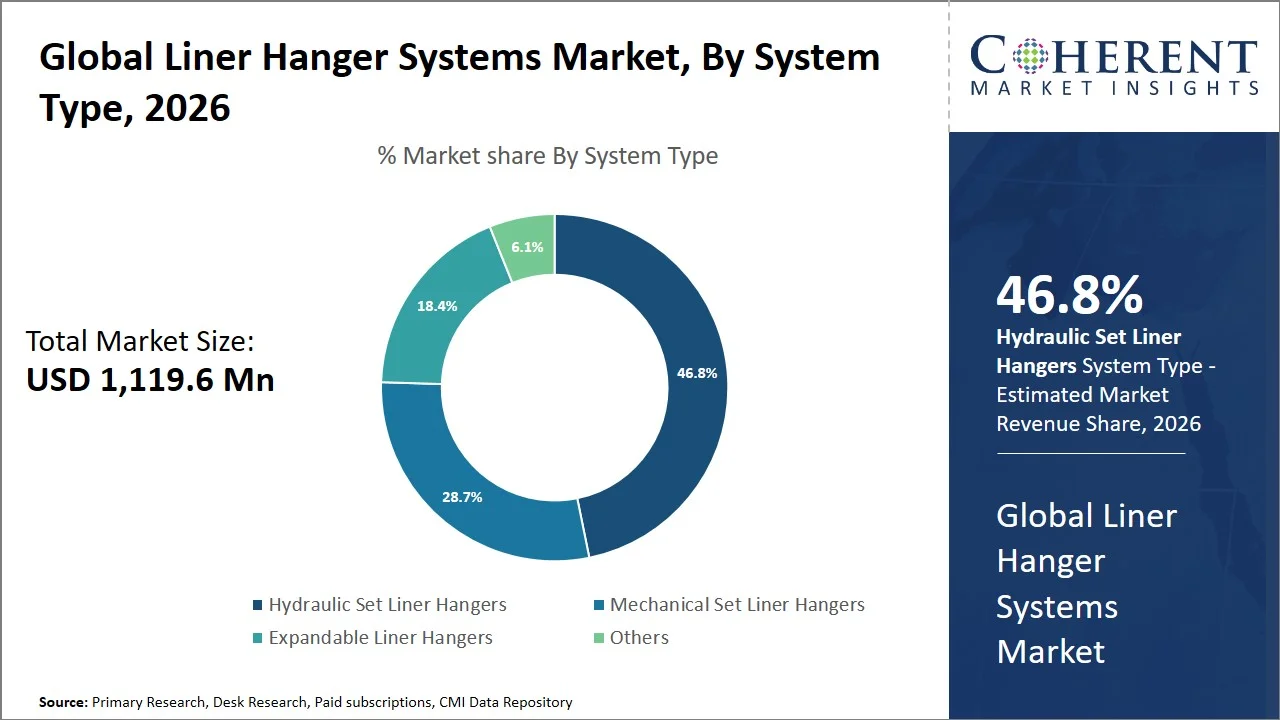
Why Do Hydraulic Set Liner Hangers Dominate the Global Liner Hanger Systems Market?
Hydraulic set liner hangers are projected to hold 46.8% of the market share in 2026, dominating on account of their differential-pressure or ball-drop activation, which removes dependence on rig-floor pipe manipulation and performs consistently across a wide range of depths, deviations, and temperatures. Demand is the strongest among operators running extended-reach and high-angle wells, where mechanical setting becomes unreliable. On the supply side, Halliburton, Baker Hughes, SLB, and Weatherford continue investing in multi-cone, high-bypass hydraulic designs qualified to API 19LH, improving cementing quality and reducing non-productive time. These systems see broad end-use across unconventional shale, offshore, and HP/HT applications for both production and intermediate liner strings. In June 2026, SLB's Xcelis high-performance hydraulic-set liner hanger system was validated in an HPHT deepwater environment requiring active well control, reinforcing hydraulic-set reliability in extreme conditions.
- Current Industry Events of 2026
- Market Size Estimation
- Regional Breakdown
- Competitive Landscape
- Customer Intelligence
- Segmental Analysis
- Pricing Analysis
- Key Market Drivers, Challenges & Future Trends
- Customized Insights Section
Why Do Horizontal Wells Represent the Largest Well Profile in the Global Liner Hanger Systems Market?
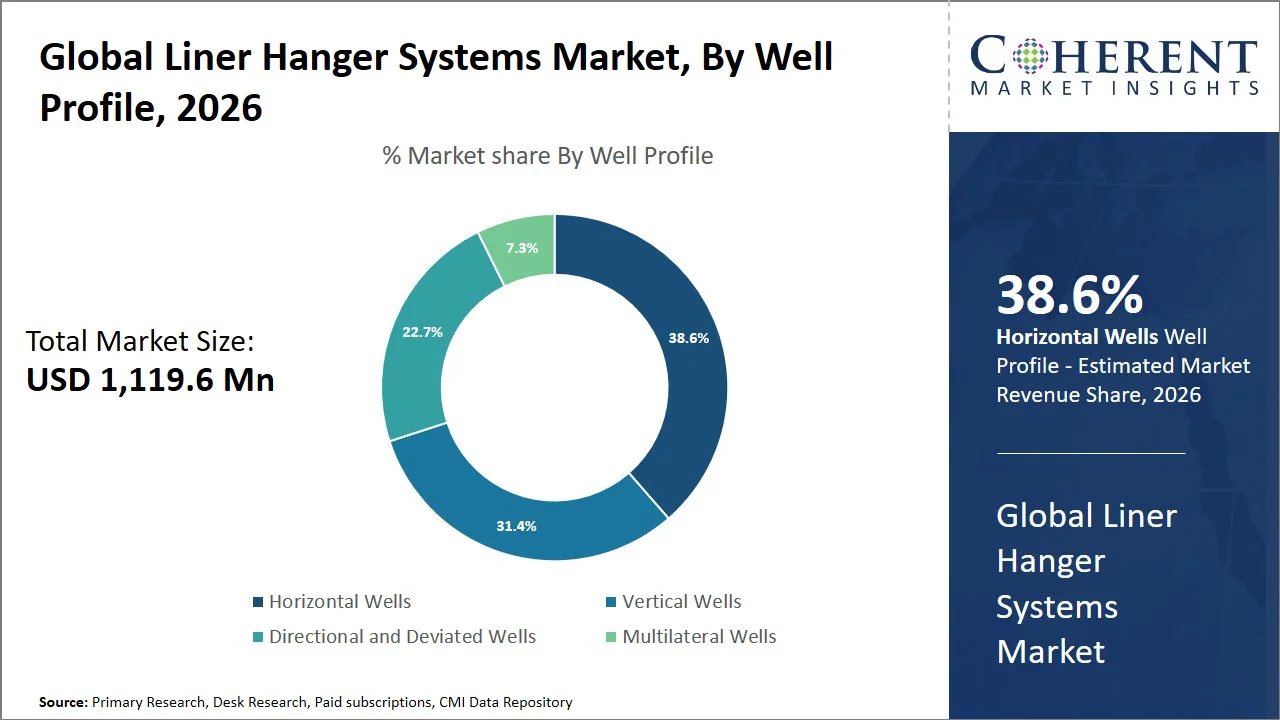
Horizontal wells are expected to account for 38.6% of liner hanger demand in 2026, driven by unconventional operators prioritizing longer laterals to maximize reservoir contact and improve capital efficiency per well drilled. This demand pull is distinct from regional rig-count dynamics, rooted instead in well architecture economics rather than drilling volume alone. Supply-side innovation has centered on rotating, high-torque liner hangers with enlarged bypass areas that support reaming, drill-down, and cementing across extended horizontal sections without compromising zonal isolation. End-use relevance is concentrated in multistage hydraulic fracturing completions across shale plays where liner integrity directly determines stage count and production efficiency. According to the American Petroleum Institute, more than 50% of Midland Basin wells completed in 2025 exceeded 10,500 feet of lateral length, with the longest reaching 21,276 feet, confirming sustained horizontal-well complexity growth.
Why Do Production Liners Dominate the Global Liner Hanger Systems Market?
Production liners are set to capture 44.8% of the market share in 2026, as they are installed in the majority of completed wells to isolate pay zones, control long-term flow, and support infill and refracturing campaigns in maturing fields. Unlike drilling or tieback liners, demand here is tied directly to well count and completions cadence rather than exploration activity, making it the most volume-driven liner application. Suppliers have responded with floated-liner and low-ECD hanger configurations engineered for tight-clearance production strings in horizontal laterals. End-use relevance spans shale, tight gas, and mature conventional reservoirs where reliable liner-top sealing is essential for sustained production integrity. In February 2026, Halliburton deployed its VersaFlex XSL expandable liner hanger with a Ball-Set running tool for a Permian Basin operator's floated production liner application, achieving a pressure-balanced, zero-incident installation.
Global Liner Hanger Systems Market Dynamics
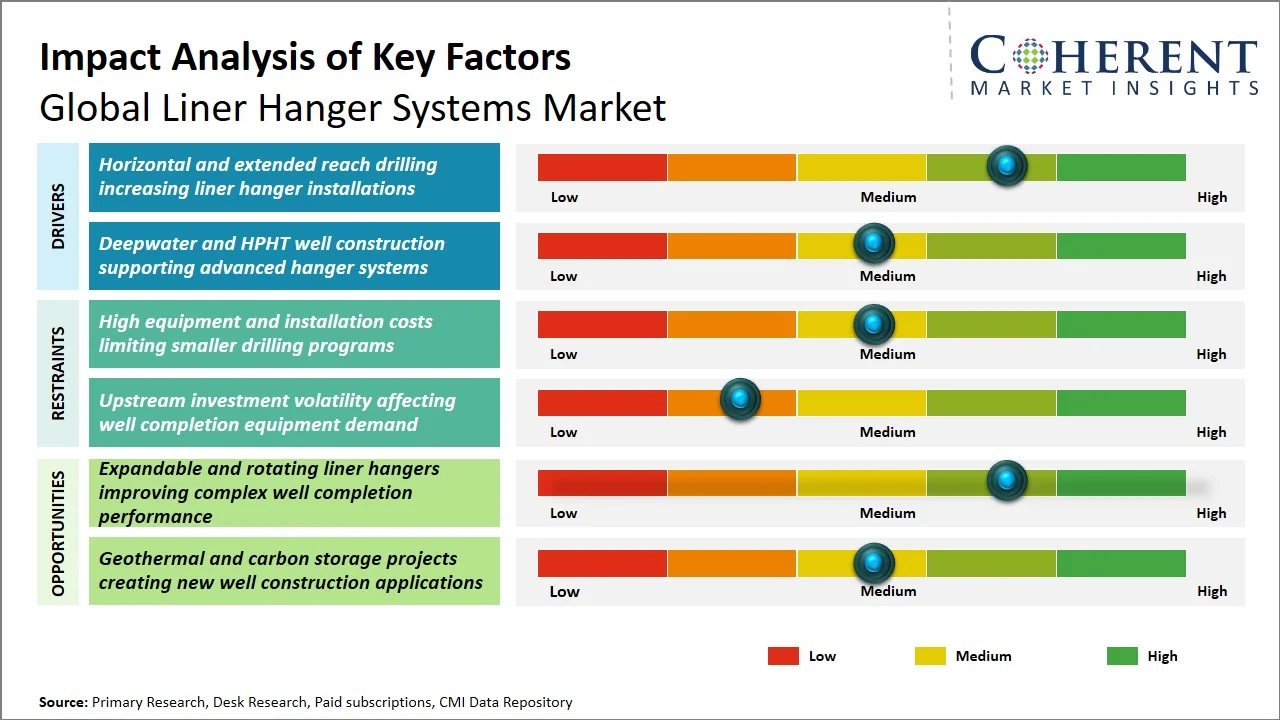
Key Market Drivers
- Horizontal and Extended-Reach Drilling Increasing Liner Hanger Installations: The industry-wide shift toward longer horizontal laterals and multi-well pad development is structurally increasing per-well liner hanger consumption, since extended-reach completions require rotating, high-torque hangers capable of reaching total depth without compromising cement integrity. As operators prioritize capital efficiency over well count, each horizontal well now demands more sophisticated bypass and anti-preset technology than shorter historical laterals, lifting average product value per installation even as total well counts moderate. This trend is reshaping vendor qualification criteria toward suppliers offering high-bypass, drill-down-capable systems. In its FY2025 Form 10-K, Diamondback Energy reported drilling 463 gross horizontal wells and completing 503 gross horizontal wells across the Midland and Delaware basins during the year, underscoring the scale of ongoing extended-lateral activity supporting liner hanger demand.
- Deepwater and HPHT Well Construction Supporting Advanced Hanger Systems: Deepwater and HPHT project sanctioning is directly expanding the addressable market for premium expandable and metal-to-metal sealing liner hanger systems, since conventional slip-based designs cannot reliably withstand the pressure and temperature envelopes found in ultra-deepwater reservoirs. As majors commit capital to new deepwater basins and infill developments, each additional well brings recurring, high-value liner hanger and liner-top packer requirements that carry meaningfully higher margins than onshore equivalents. This is pulling premium completion technology investment toward operators with the largest deepwater project pipelines. In September 2025, ExxonMobil made a final investment decision for its Hammerhead development on the Stabroek Block offshore Guyana, the company's fifth deepwater development in the basin, requiring advanced completion and liner hanger systems suited to ultra-deepwater conditions.
Emerging Market Trends
- Convergence of Liner Hangers with Real-Time Well Integrity Monitoring: Liner hanger systems are increasingly being engineered alongside embedded sensing and telemetry capabilities that allow operators to verify slip engagement, seal integrity, and cement bond quality without dedicated intervention runs. This convergence is shifting the competitive basis of the market from purely mechanical reliability toward data-enabled assurance, where suppliers who can demonstrate verifiable, real-time setting confirmation command premium pricing. As well integrity liability grows more consequential for operators facing tighter regulatory scrutiny, this trend is expected to accelerate adoption of acoustic and fiber-based monitoring integrated directly into hanger and packer assemblies, gradually displacing legacy ball-and-seat verification methods reliant on surface pressure indication alone.
- Modularization and Standardization of Liner Hanger Portfolios for Multi-Basin Deployment: Suppliers are consolidating previously basin-specific liner hanger configurations into modular platforms that can be reconfigured across onshore, offshore, and geothermal applications with minimal engineering redesign. This standardization reduces qualification cycles for new deployments, lowers inventory carrying costs across global service networks, and allows faster mobilization into emerging basins without extensive site-specific requalification. For operators, this trend translates into shorter lead times and more predictable procurement costs, while for suppliers it concentrates competitive advantage around platform breadth and manufacturing scale rather than single-application specialization, gradually squeezing out narrowly focused regional equipment providers.
Current Events and their Impact
Current Events | Description and its Impact |
BOEM Approves bp's Kaskida HPHT Development Plan (March 2026) |
|
India's Oilfields (Regulation and Development) Amendment Act, 2025 (effective April 2025) |
|
U.S. BSEE Offshore Downhole Commingling Regulatory Update (effective March 2026) |
|
Regional Insights
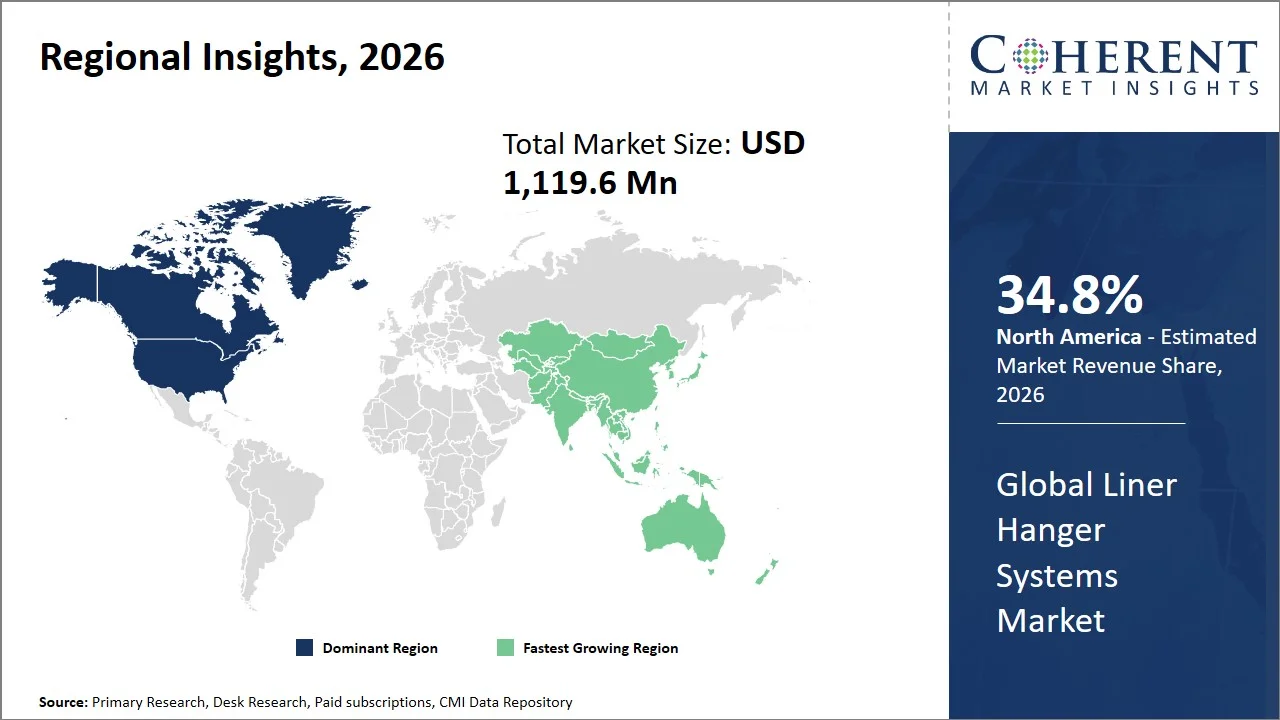
Why Does North America Dominate the Global Liner Hanger Systems Market?
North America leads the global liner hanger systems market with an expected share of 34.8% in 2026 on the back of sustained Permian Basin development, the world's most active unconventional drilling region, where extended-lateral completions demand advanced hydraulic-set and rotating liner hanger systems at scale. The region's mature oilfield services supply chain, anchored by Halliburton, Baker Hughes, SLB, and Weatherford, ensures rapid technology deployment and dense service coverage across Texas, New Mexico, and the Gulf of America. Regulatory clarity from BSEE and consistent federal leasing activity further support long-cycle offshore investment. In its January 2026 Short-Term Energy Outlook, the U.S. Energy Information Administration forecast that Permian crude production would hold at approximately 6.6 million barrels per day in 2026, matching 2025's record level and confirming the basin's continued role as the primary demand driver for liner hanger installations across onshore and offshore North America.
Why is Asia Pacific Emerging as the Fastest-Growing Region in the Global Liner Hanger Systems Market?
Asia Pacific is projected to hold a share of 23.4% in the global liner hanger systems market in 2026. This accelerated growth stems from a wave of national oil company-led deepwater and frontier exploration programs across India, China, and Southeast Asia, where operators are extending drilling into previously untested basins requiring advanced completion equipment. Government-backed exploration mandates, rising import dependency, and improving fiscal terms for deepwater licensing are unlocking capital that was previously directed toward mature onshore fields. This shift is translating into fresh demand for expandable and HP/HT-rated liner hanger systems suited to complex offshore geology. According to Core LLC, in September 2025, Oil India reported a natural gas occurrence at its Vijayapuram-2 well, prompting a technology service agreement with TotalEnergies for wells at 2,000-metre water depths, illustrating the region's growing reliance on advanced well construction partnerships to unlock frontier reserves.
Global Liner Hanger Systems Market Outlook for Key Countries
Why is the U.S. a Key Market for the Global Liner Hanger Systems Market?
The U.S. anchors an estimated 29% of the global liner hanger demand in 2026, driven by the sheer density of horizontal well completions across the Permian, Eagle Ford, and Appalachian plays. The country's innovation ecosystem, integration of automated rig systems, and proprietary well-design approaches from majors and independents alike sustain continuous refinement of liner hanger technology, from rotating hydraulic systems to floated production liner configurations. Trade relevance is high, with U.S.-based Halliburton, Baker Hughes, and NOV supplying liner hanger technology globally. In its FY2025 Form 10-K, ExxonMobil reported record Permian production of approximately 1.6 million barrels of oil equivalent per day, supported by its proprietary Cube development approach and advanced completions technology, reinforcing sustained U.S. demand for high-performance liner hanger systems.
Why is India Important in the Global Liner Hanger Systems Market?
India is expected to command close to 6% of the global market in 2026, propelled by an aggressive national push to reduce crude oil import dependency, which stood at 88.2% in FY2025. Government reforms under the Hydrocarbon Exploration and Licensing Policy and continued deepwater tendering by ONGC and Oil India are broadening the country's well construction base beyond mature onshore fields into ultra-deepwater and HP/HT frontier zones. Domestic manufacturing remains limited, keeping India reliant on international liner hanger suppliers, while cost competitiveness continues to attract global service majors. In July 2025, Cairn Oil & Gas granted Weatherford a Letter of Award to supply completions, liner hanger, and whipstock systems for a high-temperature, ultra-high-temperature drilling and rigless project in Barmer, Rajasthan, reflecting sustained onshore HT-UHT liner hanger demand.
Why Does China Support Growth in the Global Liner Hanger Systems Market?
China is projected to hold approximately 9% share in 2026, underpinned by CNOOC's expanding ultra-deepwater and HP/HT drilling program in the South China Sea, which is rapidly closing the technology gap with Western majors. The country's growing domestic manufacturing base for completion tools, supported by state industrial clustering policy, is reducing reliance on imported liner hanger equipment while building export capacity for regional projects. Downstream consumption is reinforced by CNOOC's shift from purely domestic deepwater cultivation toward overseas project participation, signaling maturing technical capability. In April 2025, CNOOC's sixth-generation, independently developed ultra-deep-water semi-submersible drilling platform completed a 3,500–4,000-metre exploration well in the South China Sea in just 11.5 days, setting a new national ultra-deepwater drilling-cycle record.
Why is Germany a Strategic Country in the Global Liner Hanger Systems Market?
Germany is estimated to account for roughly 4% of the global liner hanger systems market in 2026, distinguished not by conventional oil and gas volume but by its position at the forefront of advanced geothermal well construction, an increasingly important adjacent application for liner hanger technology. Germany's stringent quality and environmental compliance standards, combined with its R&D-intensive engineering base, make it a proving ground for high-temperature liner hanger and multilateral well designs before broader European rollout. This premium, technically demanding end-use profile differentiates Germany from volume-driven markets. In December 2025, Eavor Technologies began delivering electricity from its Eavor-Loop closed-loop geothermal system at Geretsried, Bavaria, the first commercial-scale application of its kind, following complex multilateral well construction supported by SLB's well-completion expertise.
Why is Brazil an Important Growth Market for the Global Liner Hanger Systems Market?
Brazil is projected to represent close to 4.5% of the global liner hanger systems market in 2026, driven almost entirely by pre-salt and post-salt deepwater development in the Santos and Campos basins, among the most geologically complex reservoir settings requiring expandable and HP/HT-rated liner hanger systems. The country's raw material position is less relevant here than its role as a proving ground for advanced completion technology, given the extreme salt-zone drilling conditions operators must navigate. Brazil's regional distribution strength stems from Petrobras's scale and its consortium partnerships with international majors. In a case study published in January 2026, Halliburton detailed how it supported Repsol Sinopec's exploratory deepwater pre-salt well offshore Brazil using its VersaFlex expandable liner hanger system, completing the job 20% faster than scheduled and saving more than $200,000 in rig time.
Technology Adoption Landscape in the Global Liner Hanger Systems Market
Technology | Adoption Level | Key Application Area | Business Impact |
Hydraulic-Set Multi-Cone Liner Hangers | High | Extended-reach and high-angle horizontal wells | Improves bypass flow and reduces non-productive time during cementing, supporting faster well construction cycles |
Expandable Metal-to-Metal Sealing Systems | Medium-High | Deepwater and HPHT completions | Eliminates elastomer degradation risk, extending liner-top seal life in extreme pressure and temperature environments |
Acoustic-Set Liner Hanger Technology | Low-Medium | Wells with unreliable hydraulic differential pressure | Reduces setting time from hours to minutes and removes dependence on ball-and-seat activation, cutting rig time costs |
Real-Time Torque-and-Drag Simulation Software | High | Pre-job planning for extended-reach and deepwater liners | Reduces stuck-pipe risk and optimizes running speed, lowering both NPT and liner installation failure rates |
Anti-Preset Locking Mechanisms | High | HPHT wells with high solids content or debris | Prevents premature slip or packer activation, improving first-time installation success and reducing costly remedial jobs |
Digital Well Integrity Monitoring Platforms | Low-Medium | Post-installation verification of seal and slip engagement | Enables real-time assurance of liner integrity, reducing intervention frequency and supporting regulatory compliance reporting |
How are Digital Integration and Geothermal Diversification Creating New Growth Opportunities in the Global Liner Hanger Systems Market?
In the global liner hanger systems market pairing of liner hanger hardware with digital planning and monitoring platforms represents a significant commercial opportunity, allowing suppliers to shift from one-time equipment sales toward recurring, service-based revenue models tied to well-planning software, real-time job execution support, and post-installation integrity verification. This premiumization pathway differentiates suppliers competing purely on mechanical specifications and strengthens customer retention through integrated service contracts. Simultaneously, the extension of liner hanger applications into geothermal well construction opens an entirely new end-use category, as closed-loop and enhanced geothermal systems require multilateral, high-temperature-rated hanger technology closely related to existing oilfield designs. Suppliers that adapt their qualified product lines for geothermal deployment can capture early-mover advantage in a nascent but rapidly professionalizing sector, diversifying revenue away from cyclical oil and gas capital spending. Together, these shifts support manufacturing scale-up, technology differentiation, and long-term export potential for suppliers positioned across both conventional and emerging energy applications.
Market Players, Key Development, and Competitive Landscape
Key Developments
- In May 2026, Halliburton launched its OSTMZ sand control system, enabling single-trip treatment of multiple zones in complex completions without repositioning deployment tools. This is important for the liner hanger systems market because it reflects the broader industry shift toward integrated, single-trip completion architectures that reduce rig time and increasingly bundle liner hanger deployment with adjacent completion technologies.
- In May 2026, Baker Hughes and Helmerich & Payne announced a strategic collaboration to support U.S. geothermal exploration and development, including a dedicated geothermal-capable land drilling rig. This is important for the liner hanger systems market because it formalizes a scalable pathway for oilfield-grade completion technology, including high-temperature liner hangers, to expand into the commercial geothermal sector.
- In October 2025, Weatherford showcased more than 20 product launches across its portfolio at its FWRD 2025 conference, including Intelligent Completions and the Weatherford Intelligence digital platform. This is important for the liner hanger systems market because it signals accelerating convergence between completion hardware and digital well-construction platforms, reshaping how liner hanger performance is planned, monitored, and verified.
Competitive Landscape
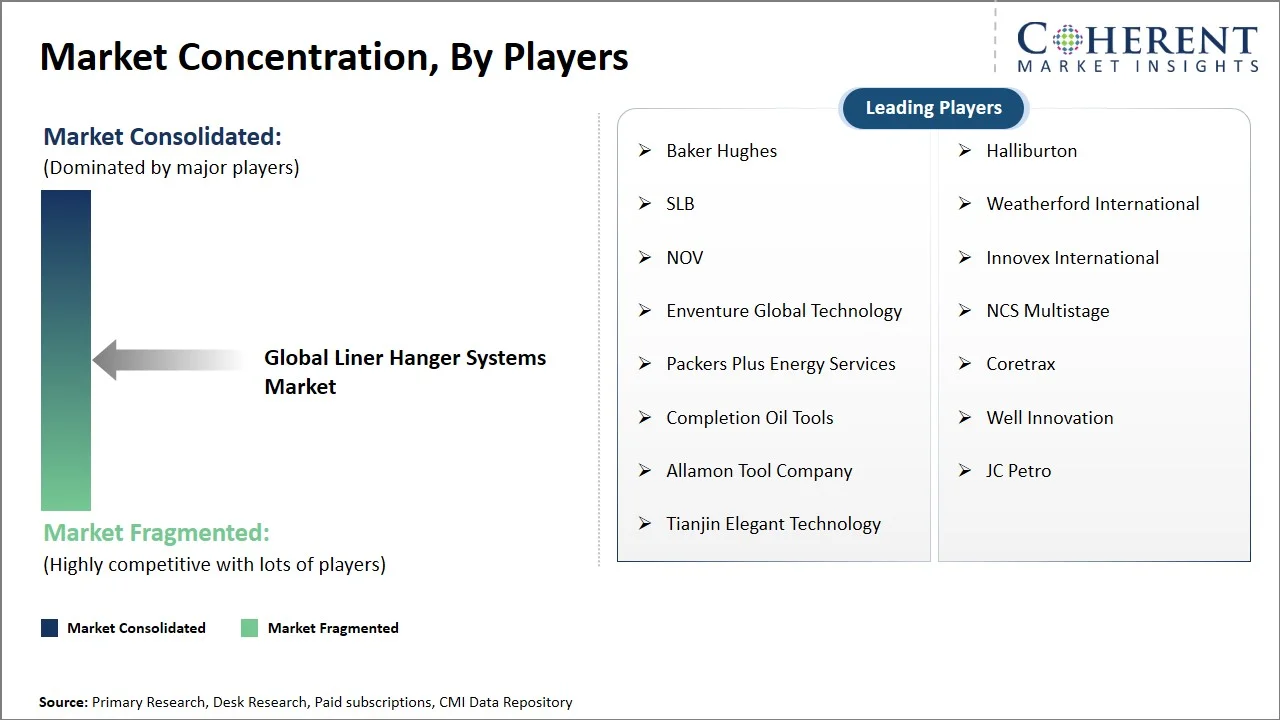
The global liner hanger systems market is moderately consolidated, with a small group of integrated oilfield service majors controlling the bulk of global installations, while a secondary tier of specialized completion equipment manufacturers competes on niche technical differentiation and regional agility.
Key focus areas include
- Product differentiation centers on sealing technology (elastomeric versus metal-to-metal), hanging capacity, and rotation-while-cementing capability
- Technology adoption and digital integration with well-planning software are becoming key differentiators beyond mechanical reliability alone
- Pricing competitiveness is most intense in onshore mechanical and hydraulic segments where multiple qualified suppliers exist
- Manufacturing capacity and global service center coverage determine ability to support fast-mobilization contracts across multiple basins simultaneously
- API 19LH qualification and V0/V3 sealing certification serve as baseline compliance requirements separating tier-one suppliers from smaller regional players
- Long-term framework agreements and multi-year integrated completions contracts with national oil companies are increasingly replacing transactional, single-job procurement
- Specialty positioning in HPHT, geothermal, and expandable technology segments allows smaller innovators to compete against larger incumbents on technical merit
- Distribution reach through regional manufacturing and field-service hubs remains a critical differentiator for serving remote or logistically constrained drilling regions
Market Report Scope
Liner Hanger Systems Market Report Coverage
| Report Coverage | Details | ||
|---|---|---|---|
| Base Year: | 2025 | Market Size in 2026: | USD 1,119.6 Mn |
| Historical Data for: | 2020 To 2024 | Forecast Period: | 2026 To 2033 |
| Forecast Period 2026 to 2033 CAGR: | 6.60% | 2033 Value Projection: | USD 1,751.3 Mn |
| Geographies covered: |
| ||
| Segments covered: |
| ||
| Companies covered: | Baker Hughes, Halliburton, SLB, Weatherford International, NOV, Innovex International, Enventure Global Technology, NCS Multistage, Packers Plus Energy Services, Coretrax, Completion Oil Tools, Well Innovation, Allamon Tool Company, JC Petro, and Tianjin Elegant Technology | ||
| Growth Drivers: |
| ||
| Restraints & Challenges: |
| ||
Analyst Opinion (Expert Opinion)
- The global liner hanger systems market is set for steady, technology-led expansion over the forecast period, with growth increasingly decoupled from simple rig-count trends and instead tied to well complexity, deepwater project sanctioning, and the broadening application base into geothermal energy. The strongest growth pockets will likely emerge at the intersection of HPHT deepwater development and digitally integrated completion technology, where premium pricing power is greatest and switching costs for operators are highest.
- Looking ahead, the market's center of gravity may gradually shift from volume-driven onshore shale demand toward value-driven deepwater and multi-zone completion applications, rewarding suppliers who can demonstrate integrity assurance and reduced intervention risk rather than mechanical reliability alone.
- The geothermal energy transition represents a genuinely transformative, if still early-stage, growth vector; suppliers that treat it as a core strategic market rather than an opportunistic side application stand to build durable competitive advantage as the sector scales globally.
- Key risks include commodity price volatility dampening deepwater capital commitments, prolonged softness in onshore rig activity in mature basins, and the operational complexity of qualifying premium technology across fragmented regional regulatory regimes.
Speak to the analyst
Want personalized insights?
Take the findings above to one of our principal consultants, or have the report rebuilt around the segments, geographies and competitors you actually track.
Market Segmentation
- System Type Insights (Revenue, USD Mn, 2021 - 2033)
- Hydraulic Set Liner Hangers
- Mechanical Set Liner Hangers
- Expandable Liner Hangers
- Others
- Well Profile Insights (Revenue, USD Mn, 2021 - 2033)
- Horizontal Wells
- Vertical Wells
- Directional and Deviated Wells
- Multilateral Wells
- Liner Application Insights (Revenue, USD Mn, 2021 - 2033)
- Production Liners
- Intermediate Liners
- Tieback Liners
- Drilling Liners
- Others
- Location Insights (Revenue, USD Mn, 2021 - 2033)
- Onshore
- Offshore
- Regional Insights (Revenue, USD Mn, 2021 - 2033)
- North America
- U.S.
- Canada
- Latin America
- Brazil
- Argentina
- Mexico
- Rest of Latin America
- Europe
- Germany
- U.K.
- Spain
- France
- Italy
- Russia
- Rest of Europe
- Asia Pacific
- China
- India
- Japan
- Australia
- South Korea
- ASEAN
- Rest of Asia Pacific
- Middle East
- GCC Countries
- Israel
- Rest of Middle East
- Africa
- South Africa
- North Africa
- Central Africa
- North America
- Key Players Insights
- Baker Hughes
- Halliburton
- SLB
- Weatherford International
- NOV
- Innovex International
- Enventure Global Technology
- NCS Multistage
- Packers Plus Energy Services
- Coretrax
- Completion Oil Tools
- Well Innovation
- Allamon Tool Company
- JC Petro
- Tianjin Elegant Technology
Source
Primary Research Interviews
- Manufacturers of hydraulic-set, mechanical-set, expandable, and swellable liner hanger systems
- Suppliers of liner-top packers, running tools, tieback receptacles, polished bore receptacles, centralizers, and casing accessories
- Product development and engineering executives from well construction, well completion, and drilling technology divisions of oilfield service companies
- Completion engineers and drilling technology specialists involved in HPHT, deepwater, horizontal, and multilateral well design
- OEMs, contract manufacturers, tubular goods suppliers, and downhole tool fabricators
- Regulatory, well-integrity, HSE, and quality-assurance professionals from national oil companies and international operators
Stakeholders
- Liner hanger system manufacturers and completion tool OEMs
- Elastomer, metal alloy, casing, and packer-seal material suppliers
- Drilling rig contractors and offshore rig operators
- Exploration & Production (E&P) companies and national oil companies (NOCs)
- Contract well-services and completion service providers
- Distributors, oilfield equipment rental companies, and tubular goods suppliers
- Well testing, certification, and well-integrity monitoring companies
- End-use Sectors
- Onshore and offshore oil and gas well construction
- Horizontal, vertical, directional, and multilateral well completions
- Deepwater and ultra-deepwater exploration and production
- HP/HT (high-pressure, high-temperature) drilling operations
- Unconventional shale and tight oil/gas well development
- Geothermal well construction and enhanced geothermal systems (EGS)
- Production, intermediate, tieback, and drilling liner applications
- Regulatory & Government Bodies
- American Petroleum Institute (API)
- U.S. Bureau of Safety and Environmental Enforcement (BSEE)
- U.S. Bureau of Ocean Energy Management (BOEM)
- U.S. Department of the Interior (DOI)
- U.S. Energy Information Administration (EIA)
- Directorate General of Hydrocarbons (DGH), India
- Ministry of Petroleum and Natural Gas, Government of India
- National Energy Administration (NEA), China
- Petroleum Safety Authority (PSA), Norway
- North Sea Transition Authority (NSTA), United Kingdom
- Agência Nacional do Petróleo, Gás Natural e Biocombustíveis (ANP), Brazil
- Nigerian Upstream Petroleum Regulatory Commission (NUPRC)
Databases
- UN Comtrade Database
- International Trade Centre Trade Map
- U.S. International Trade Commission DataWeb
- Eurostat and EU PRODCOM
- World Bank Open Data
- OECD Data Explorer
- EIA Drilling Productivity Report and Short-Term Energy Outlook (STEO) database
- Baker Hughes Worldwide Rig Count database
- U.S. Census Bureau and International Trade Administration databases
- SEC EDGAR filings database (10-K, 8-K, S-1 filings of oilfield service companies)
Magazines
- World Oil
- Offshore Magazine
- Drilling Contractor
- Journal of Petroleum Technology (JPT)
- Hart Energy
- Oil & Gas Journal
- Petroleum Economist
- E&P Magazine
- Rigzone
Journals
- SPE Journal (Society of Petroleum Engineers)
- Journal of Petroleum Science and Engineering
- Journal of Natural Gas Science and Engineering
- Energies
- Geoenergy Science and Engineering
- Petroleum Exploration and Development
- Journal of Energy Resources Technology
- International Journal of Oil, Gas and Coal Technology
Newspapers
- Financial Times – Energy and Commodities
- The Wall Street Journal – Energy and Industrials
- The Economic Times – Energy and Infrastructure
Associations
- American Petroleum Institute (API)
- Society of Petroleum Engineers (SPE)
- International Association of Drilling Contractors (IADC)
- International Association of Oil & Gas Producers (IOGP)
- Petroleum Equipment & Services Association (PESA)
- Association of Energy Service Companies (AESC)
- Offshore Energies UK (OEUK)
- International Petroleum Industry Environmental Conservation Association (IPIECA)
Public Domain Sources
- U.S. Energy Information Administration (EIA)
- U.S. Department of the Interior
- U.S. Bureau of Safety and Environmental Enforcement (BSEE)
- U.S. Bureau of Ocean Energy Management (BOEM)
- International Energy Agency (IEA)
- OPEC Monthly Oil Market Report
- Company annual reports, investor presentations, and press releases (Halliburton, SLB, Baker Hughes, Weatherford, NOV)
- Government of India Press Information Bureau (PIB)
- World Bank and OECD public energy datasets
Proprietary Elements
- CMI Data Analytics Tool, Proprietary CMI Existing Repository of information for last 10 years.
Get access to 250+ pages report
Every segment, forecast, competitor profile and data table behind the analysis above — available for instant download.
- ESOMAR Member
- ISO 9001:2015 Certified
- D-U-N-S Registered
- GDPR & CCPA Compliant
Missing comfort of reading report in your local language? Find your preferred language:
Transform your Strategy with Exclusive Trending Reports
Frequently Asked Questions
The CAGR of the global liner hanger systems market is projected to be 6.60% from 2026 to 2033.
The global liner hanger systems market is estimated to be valued at USD 1,119.6 million in 2026 and is expected to reach USD 1,751.3 million by 2033.
Liner hanger systems are primarily used in production liners, intermediate liners, tieback liners, and drilling liners across oil, gas, and geothermal wells.
Liner hanger systems are widely used in horizontal, vertical, directional, deviated, and multilateral wells to support efficient well completion and zonal isolation.
Growing adoption of expandable liner hangers, high-pressure and high-temperature completion technologies, and advanced downhole monitoring solutions are key market trends.
Horizontal and extended reach drilling increasing liner hanger installations and deepwater and HPHT well construction supporting advanced hanger systems are the major factors driving the growth of the global liner hanger systems market.
High equipment and installation costs limiting smaller drilling programs and upstream investment volatility affecting well completion equipment demand are the major factors hampering the growth of the global liner hanger systems market.