
Global Lithium-Ion Battery Recycling Market Size and Forecast – 2026 To 2033
The Global Lithium-Ion Battery Recycling Market is estimated to be valued at USD 6.47 Bn in 2026 and is expected to reach USD 26.39 Bn by 2033, growing at a compound annual growth rate (CAGR) of 22.24% from 2026 to 2033. This is driven by the expansion of battery manufacturing activities, the increasing volumes of spent electric vehicle batteries and the need to recover valuable materials such as lithium, nickel and cobalt.
Investment in recycling infrastructure is increasing the supply of secondary raw materials for battery production, and reducing reliance on primary mineral extraction. In November 2025, Redwood Materials commenced critical mineral recovery operations at its South Carolina campus, adding an initial 20,000 metric tons of annual materials production capacity. The move highlights growing commercial investment in large-scale battery recycling infrastructure and the recovery of critical minerals for domestic manufacturing supply chains.
Key Takeaways of the Global Lithium-Ion Battery Recycling Market
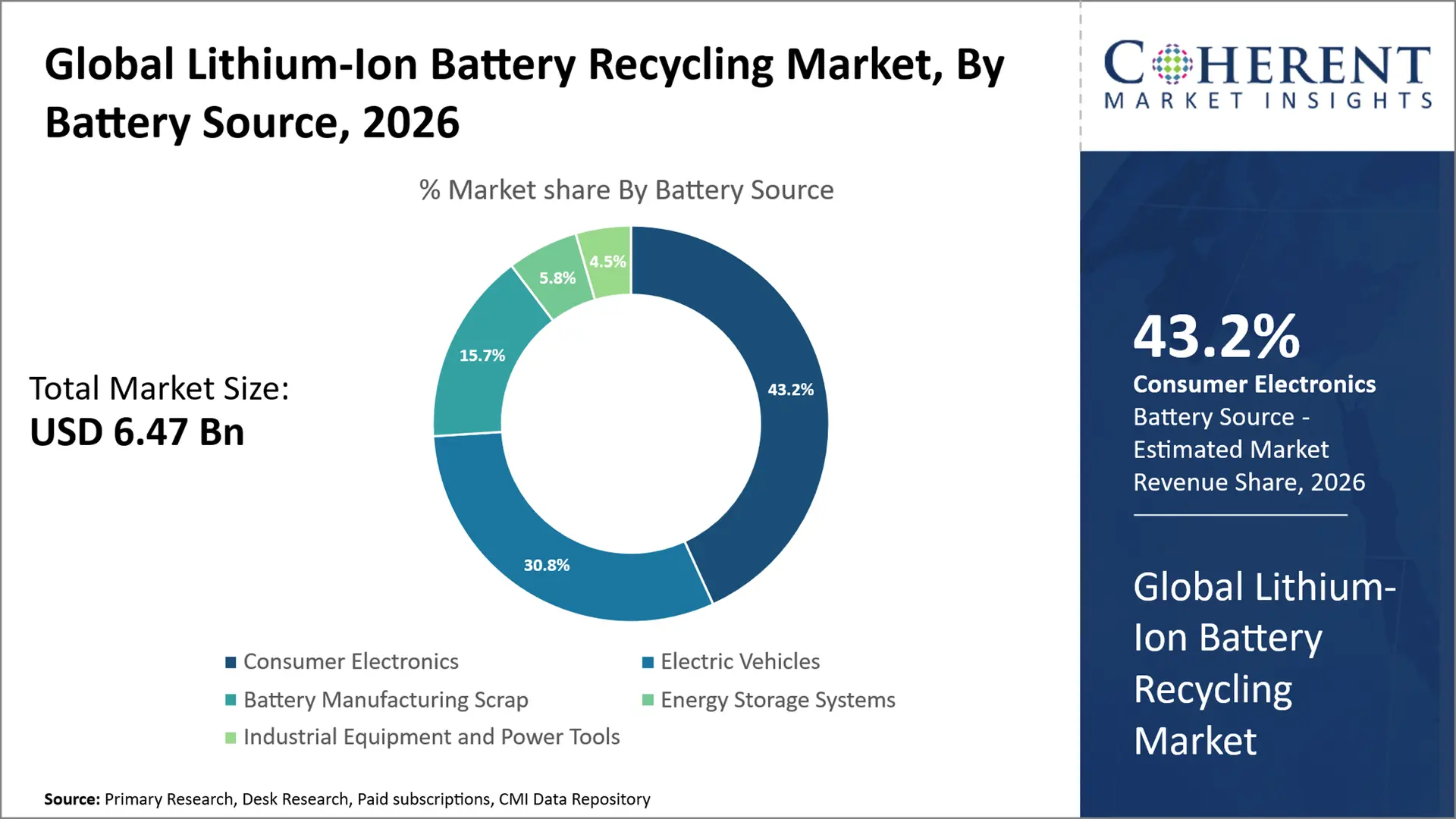
- Consumer Electronics is expected to register an estimated CAGR of 17.8% during 2026–2033 and hold 43.2% of the market in 2026. Frequent device replacement and well-established take-back networks provide a steady stream of recycling feedstock. In April 2026, Apple announced that all Apple-designed batteries contain recycled cobalt, further strengthening commercial demand for recovered battery materials.
- Lithium Cobalt Oxide (LCO) is projected to grow at an estimated CAGR of 18.4% during 2026–2033, capturing 36.7% of the market in 2026. Spent electronics batteries are economically attractive feedstock for recycling due to their cobalt-rich composition. In May 2025, researchers at Rice University published an electrothermal pathway to regenerate degraded LCO cathodes, showing an alternative pathway to preserve valuable cathode materials.
- Hydrometallurgical Recycling is anticipated to achieve an estimated CAGR of 24.9% during 2026–2033, accounting for 50.3% of market revenue in 2026. Selective metal extraction and purification allow recyclers to reclaim battery-grade materials from a variety of battery chemistries. BatX Energies secured support from India’s Technology Development Board in June 2025 to commercialize its low-temperature hydrometallurgical battery recycling technology.
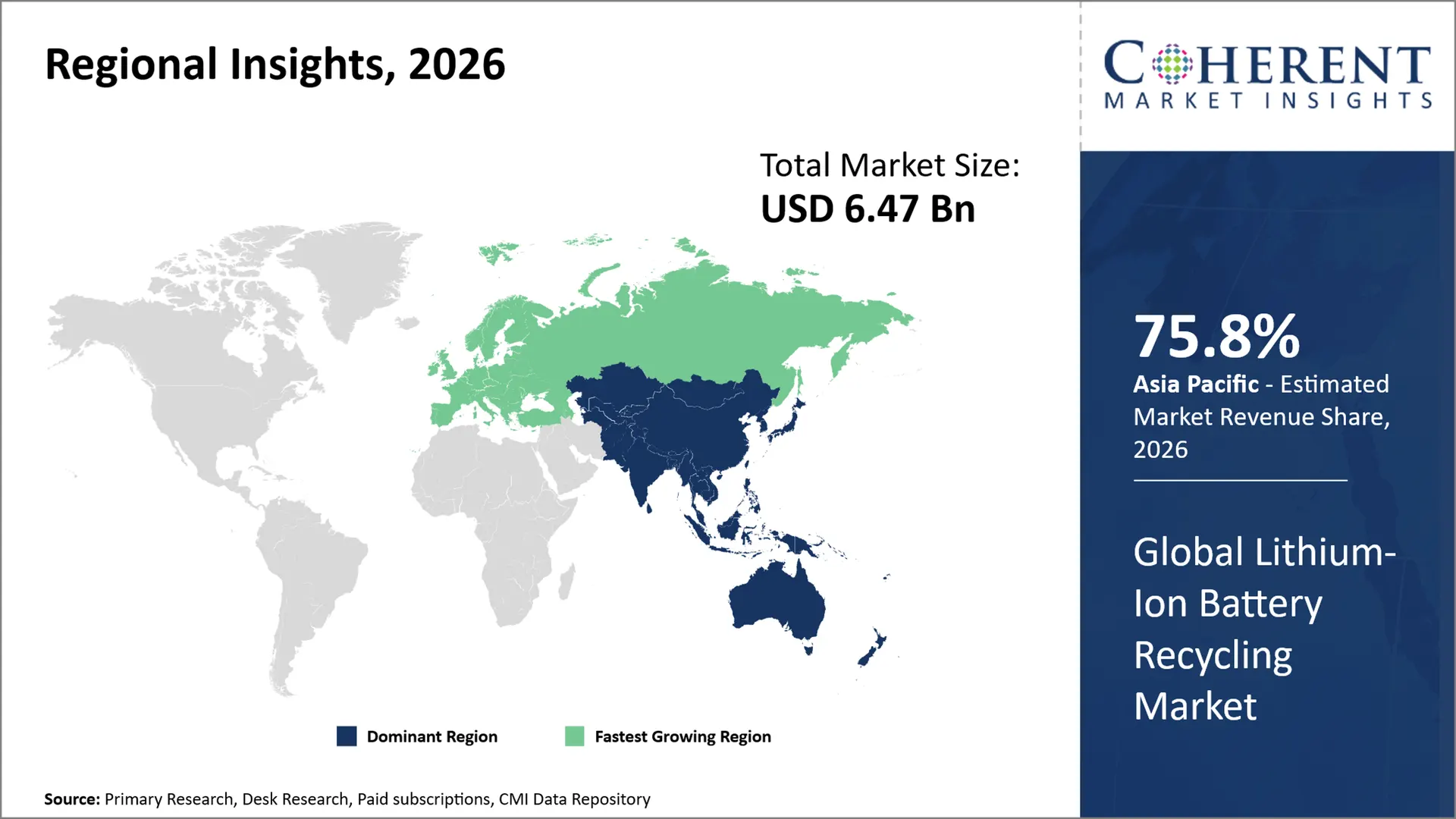
- Asia Pacific is expected to grow at an estimated CAGR of 21.3% over the forecast period 2026-2033 and will hold 75.8% of the global market in 2026. The presence of battery manufacturing clusters, collection infrastructure and refining capabilities strengthens the regional leadership. India’s Ministry of Mines has approved 58 companies to qualify for incentives under a scheme for recycling critical minerals, including waste from lithium-ion batteries and other recyclable materials, in April 2026.
- Europe will likely grow at a CAGR of 29.0% in 2026-2033 with a 12.2% market share in 2026. Battery recovery obligations and demand for domestically sourced secondary materials enhance the investment prospects for recycling. In July 2025 the European Commission introduced harmonized ways of measuring battery recycling efficiency and material recovery, adding to the regulatory compliance burden for recyclers.
Segmental Insights
Why Does Consumer Electronics Dominate the Global Lithium-Ion Battery Recycling Market?
Consumer Electronics is expected to contribute 43.2% of the global lithium-ion battery recycling market in 2026, supported by substantial recoverable battery volumes from smartphones, tablets, and portable computing devices. The segment uses existing electronics refurbishing businesses, trade-in channels, and repair operations that can bundle discarded cells before disposal. What’s valuable commercially about access to organized collection channels is the careful disassembly and sorting processes that small batteries need. Electronics manufacturers can form ongoing contracts with recyclers who can handle a wide range of device models, document safe handling, and supply consistent black mass. In April 2025, Samsung Electronics detailed its Circular Battery Supply Chain, which collects batteries from used Galaxy phones and production waste, recovers cobalt, and reintegrates it into Galaxy S25 batteries. This demonstrates how manufacturer-controlled return streams can improve feedstock traceability and downstream material procurement.
- Current Industry Events of 2026
- Market Size Estimation
- Regional Breakdown
- Competitive Landscape
- Customer Intelligence
- Segmental Analysis
- Pricing Analysis
- Key Market Drivers, Challenges & Future Trends
- Customized Insights Section
Why Does Lithium Cobalt Oxide (LCO) Lead the Battery Chemistry Segment of the Global Lithium-Ion Battery Recycling Market?
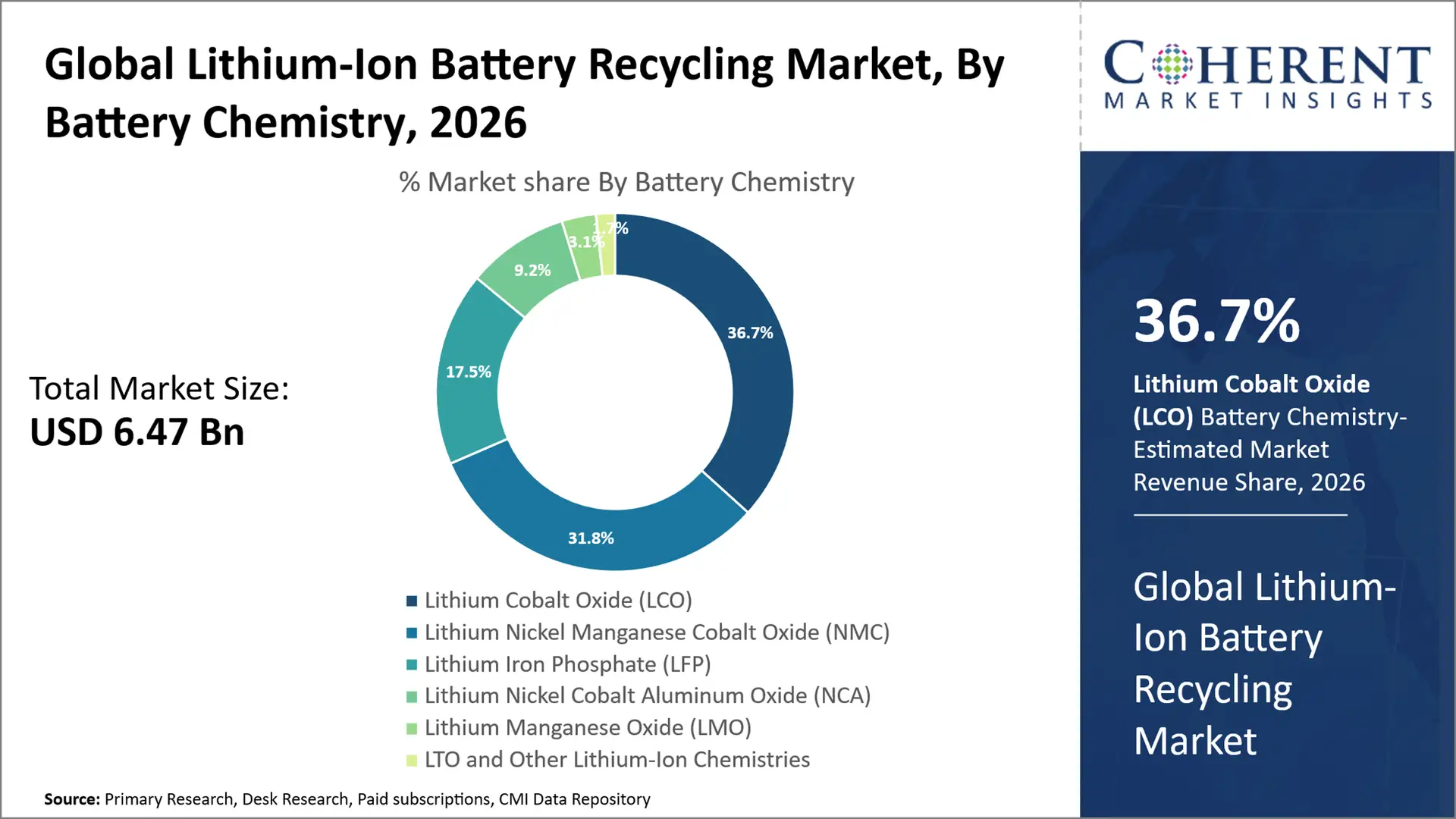
Lithium cobalt oxide (LCO) is projected to account for 36.7% of the global lithium-ion battery recycling market share in 2026 owing to the recoverable value of the cobalt-intensive cathode composition. LCO materials are particularly relevant for legacy smartphones and other small electronics that require high volumetric energy density. “By identifying LCO-rich input, rather than treating all cathode powders as equivalent, recyclers can optimize recovery processes for lithium and cobalt. Effective separation chemistry will lead to better metal accounting and less uncertainty on downstream product specification. In August 2025, a peer-reviewed study by researchers at Washington University in St. Louis was published. This study showed electrochemical-assisted leaching of spent LCO batteries, with cobalt separated by precipitation and lithium kept in solution. While the results are at laboratory scale, they show the potential to improve the economics of chemistry-specific recovery and optimize the commercial value of sorted LCO feedstocks.
Why Does Hydrometallurgical Recycling Dominate the Recycling Process Segment of the Global Lithium-Ion Battery Recycling Market?
Hydrometallurgical Recycling is projected to account for 50.3% of the global lithium-ion battery recycling market in 2026, due to its suitability for commercial black mass refining in the recycling process. Processors can adjust the outputs to the specifications of the battery material manufacturers through staged leaching, impurity removal and metal separation. The production of defined intermediate compounds, as opposed to the sale of untreated concentrates, may enhance the commercial position if the recovery yields justify the costs for reagents, wastewater treatment and energy. The process also supports modular capacity planning and qualification of individual product streams before a full-scale investment is made. Electra Battery Materials completed a feasibility-level engineering study for a planned modular hydrometallurgical recycling facility in Ontario in June 2025, after a year-long pilot program for black mass. The planned integration with cobalt sulfate refining highlights the necessity of translating technical recovery performance into qualified industrial supply.
Current Events and their Impact
Current Event | Description and Its Impact |
China Introduces New EV Battery Recycling Rules – January 2026 |
|
England Strengthens Battery Waste Facility Guidance – May 2026 |
|
Global Lithium-Ion Battery Recycling Market Dynamics
Key Market Drivers
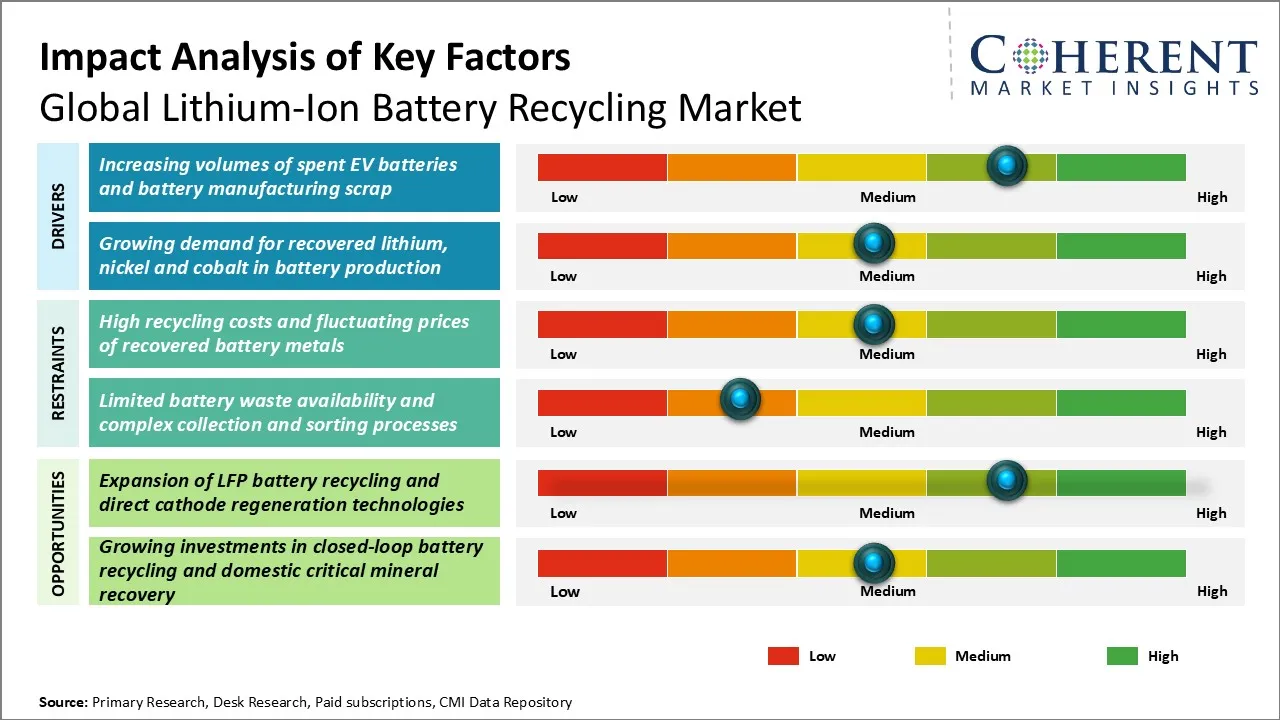
- Increasing volumes of spent EV batteries and battery manufacturing scrap: Battery manufacturing scrap provides a steady near-term feedstock for recyclers, while processing volumes are expected to grow with retired electric vehicle batteries. Rejected cells, damaged modules and electrode offcuts must be collected and separately recovered. That provides recyclers with the opportunity to enter into long-term supply agreements with automotive OEMs and battery makers. In June 2025, LG Energy Solution and Toyota Tsusho established a US battery recycling joint venture to develop a preprocessing facility in North Carolina, targeting battery manufacturing scrap and future material recovery.
- Growing demand for recovered lithium, nickel and cobalt in battery production: Battery manufacturers are increasingly looking to recycled lithium, nickel and cobalt as a substitute for primary raw materials in cathode production. Recovery of these metals to appropriate levels of purity may help to offset exposure to supply disruptions of primary minerals and aid material procurement strategies. Recyclers capable of producing high-quality battery-grade materials can build closer relationships with automotive manufacturers and cathode producers. In October 2024, Mercedes-Benz opened its integrated mechanical-hydrometallurgical recycling plant in Kuppenheim, Germany, to recover lithium, nickel and cobalt for reuse in future electric vehicle batteries.
Emerging Market Trends
Transition Toward Quality-Based Black Mass Trading
Black mass trading is shifting toward quality-based pricing, with greater emphasis on metal concentration, material purity, moisture levels, and contamination. Recyclers are moving to better material testing and classification processes to meet downstream refining specifications.
Impact: Improves transparency of pricing, reduces the risk of material rejection and locks in commercial agreements between recyclers and refiners.
Relevance to the Market: This trend supports higher value black mass transactions and investment in quality assurance. Those recyclers that can offer consistent material specifications will likely have stronger relationships with the battery material manufacturers.
Development of Distributed Recycling and Centralized Refining Networks
Regional preprocessing facilities are being developed by battery recyclers to link to centralized metal refining facilities to improve operational efficiencies. The model provides for local collection and disassembly of batteries and recovery of complex metals in specialized facilities.
Impact: Reduces transportation risks, improves processing capacity utilization, and limits investment duplication across recycling locations.
Relevance to the Market: This approach enables the cost-effective growth of battery recycling infrastructure across a number of regions. Companies with integrated collection, preprocessing and refining networks may maximize feedstock management and improve long term processing economics.
Regional Insights
Why Does Asia Pacific Dominate the Global Lithium-Ion Battery Recycling Market?
The Asia Pacific is expected to hold a dominant share of 75.8% of the global lithium-ion battery recycling market in 2026, owing to the interconnected battery manufacturing, recycling and raw material processing industries. The region has mature industrial clusters and is conducive to the collection of waste batteries, as well as the production of cathode materials and refined metals. The proximity of large battery producers allows recyclers to align downstream customer and material specifications. Advanced recycling capabilities also increase the commercial value of the recovered lithium and other battery metals. In April 2025, Japan's JX Advanced Metals announced the development of a process capable of recovering more than 90% of lithium from retired automotive batteries. The company also outlined plans to install demonstration equipment at its Tsuruga facilities, highlighting continued investment in higher-value battery material recovery.
Why Is Europe Emerging as the Fastest-Growing Region in the Global Lithium-Ion Battery Recycling Market?
Europe is expected to represent 12.2% of the global lithium-ion battery recycling market in 2026, emerging as the fastest-growing region through investments in domestic material recovery and battery supply-chain localization. This can be attributed to the investments in local material recovery and battery supply-chain localization. European car makers are looking for reliable sources of secondary battery materials and opportunities for regional refining infrastructure are developing. The need for traceable recycled inputs also incentivizes a more collaborative relationship between recyclers and cell manufacturers. However, the lack of feedstock and the high processing costs are major investment drivers. In April 2026, UK firm Altilium secured USD 24.65 m of government funding for its proposed ACT3 recycling facility in Plymouth. The project aims to enable the development of a domestic battery material supply chain by processing retired EV batteries into nickel intermediates, lithium sulfate and graphite.
Global Lithium-Ion Battery Recycling Market Outlook for Key Countries
Why Is the U.S. a Key Market for the Global Lithium-Ion Battery Recycling Market?
The U.S. remains a strategically important player in the lithium-ion battery recycling market as the ability to collect batteries must be paired with domestic refining of the black mass into usable battery inputs. Automakers, recyclers and cathode material suppliers need reliable outlets for recovered lithium, nickel and cobalt, rather than relying solely on overseas chemical processing. Therefore, the proposed facilities are subject to rigorous scrutiny in terms of feedstock contracts, metal recovery yields and product qualification. Although public financing can help overcome barriers to initial investment, economics still need to be worked out for commercial success. The U.S. Department of Energy said in August 2026 that it would invest $500 million into seven chosen projects for recycling, battery manufacturing and critical material processing. The announcement highlights the need to expand domestic processing capacity to support battery and other industrial supply chains.
Why Does China Support Growth in the Global Lithium-Ion Battery Recycling Market?
China is central to the lithium-ion battery recycling market, with the mass production of cathodes and cells stimulating domestic demand for recovered materials. The integrated supply chain allows recyclers to organize the processing of battery waste, the recovery of metals and the sale of secondary materials in established industrial clusters. There are commercial implications here as recovered products can be fed into existing procurement channels. But pricing pressure is still fierce and lower-value battery chemistries require close control of costs. In March 2026, CATL announced that its spent battery recycling volume reached 210,000 tons in 2025, producing 24,000 tons of lithium salts. The findings show the scale that can be achieved at an industrial level when recycling operations are combined with large battery manufacturing ecosystems and the existing downstream material requirements.
Why Is India Important in the Global Lithium-Ion Battery Recycling Market?
India’s commercial lithium-ion battery recycling market is expanding as battery makers and importers are increasingly held responsible for collection and treatment. Extended Producer Responsibility creates a service with a paper trail beyond the sale of recovered metals. The registered recyclers are able to offer recurring contracts by giving compliant treatment, transferable EPR certificates, and reporting records. This is to the advantage of formal operators who can verify waste sources and maintain audited recovery processes. In December 2025, the Ministry of Environment, Forest and Climate Change of India reaffirmed that the battery EPR mechanism accepts only certificates from registered recyclers. The ministry’s announcement of upcoming domestic recycled content requirements for new batteries also helped spur the potential market for qualified locally recovered materials.
Why Is South Korea an Important Growth Market for the Global Lithium-Ion Battery Recycling Market?
South Korea is commercially significant for global lithium-ion battery recycling market because its battery materials industry requires technically validated recovery processes and consistent material specifications. Smaller recycling specialists face expensive testing and pilot-scale equipment requirements before approaching industrial customers. Shared demonstration infrastructure can reduce these barriers and accelerate the development of viable processing routes. In November 2025, South Korea's Ministry of Climate, Energy and Environment announced the opening of the Korea Battery Circulation Cluster in Pohang. The facility provides access to used-battery assessment, black mass preparation, and metal-extraction research equipment. This creates a practical route for specialist recyclers to test processes and prepare for commercialization without independently building complete demonstration facilities.
Why Is Germany a Strategic Country in the Global Lithium-Ion Battery Recycling Market?
The automotive industry’s demanding performance, safety and traceability requirements for recovered battery materials make Germany a strategic market for lithium-ion battery recycling. Suppliers of recycling have to prove that the technical quality of new cells can be maintained by secondary cathode inputs. Therefore, it is of particular advantage to cooperate directly with vehicle manufacturers and to carry out documentation and material testing. In September 2026, Porsche said it had been producing battery cells with cathode active material whose entire raw material component was recycled raw material recovered via its partnership with German recycler cylib. The cells are being tested and are not yet in series production. The initiative is a forerunner to the commitment to a larger manufacturing application and exemplifies Germany’s focus on the qualification of recycled materials for demanding automotive applications.
Battery Recycling Business Models and Commercial Value Chain Landscape
Business Model | Primary Customers | Revenue Model | Commercial Implication |
Battery Collection and Compliance Services | Electronics companies and automotive OEMs, battery importers and manufacturers | EPR compliance services, collection fees, waste management contracts | Creates repeat service revenue through regulatory compliance management and organized battery collection. |
Battery pre-processing and disassembly services. | Car makers, battery manufacturers, recyclers | The processing fees are determined by the volume, weight and handling requirements of the battery. | Creates opportunities for specialized service providers handling end-of-life, defective and damaged batteries |
Supply Contracts and the Black Mass Trading | Companies that recover metals and refiners of battery materials | The price of the black mass is based on the recoverable metal content and the pricing contract. | Promotes the creation of commercial partnerships between downstream refining companies and battery waste processors |
Toll Processing and Contract Recycling | Suppliers of cathode materials, battery manufacturers and waste holders. | Processing fees for agreements in which customers retain ownership of reclaimed materials | Allowing customers to keep material value while giving recycling companies service-based revenues at the same time |
Recovered Battery Material Sales | Specialty chemical companies, battery makers and cathode producers | Recovered sales of secondary materials, including nickel, cobalt and lithium compounds. | Provides industrial customers with qualified recovered materials that deliver higher-value revenue opportunities |
Closed Loop Recycling Collaborations | Battery cell manufacturers, automotive OEMs and cathode material producers | Long-term agreements for material supply and recycling | Improves customer retention, increases visibility of feedstock supplies, and helps in the integration of recovered materials into new battery production. |
How Is Electrolyte Recovery Creating New Growth Opportunities in the Global Lithium-Ion Battery Recycling Market?
Recovering electrolyte solvents and fluorine-containing salts from spent lithium-ion batteries represents an underdeveloped opportunity beyond conventional metal extraction. These materials are frequently lost, degraded or transferred into waste-treatment streams during cell shredding and wet processing.
Developing controlled electrolyte removal before destructive treatment could enable specialty chemical recovery while reducing emissions and downstream neutralization costs. Potential customers include electrolyte formulators, battery manufacturers, chemical processors and licensed hazardous-waste treatment companies.
Commercial participation would require sealed handling equipment, solvent purification, fluorine management, chemical assays and customer qualification programs. Business models could combine recycling service fees with sales of purified solvent fractions or fluorine compounds where specifications and economics permit.
Market Players, Key Development, and Competitive Landscape
Key Developments
- In March 2026, tozero will build an industrial demonstration facility at Chemical Park Gendorf, Germany. The facility will recover lithium carbonate, graphite and nickel-cobalt materials from battery waste. The development expands the range of recoverable products and enables the qualification of secondary materials for battery manufacturing applications.
- In November 2025, American Battery Technology Company announced that it had been awarded and approved by the US Environmental Protection Agency to recycle damaged lithium-ion batteries from a major cleanup operation. The project is a real demonstration of the commercial opportunity for specialized battery waste handling and material recovery services.
- In June 2025, BASF recycling plant for black mass in Schwarzheide, Germany, began commercial operation in June 2025. The facility has a capacity of up to 15,000 tons per year. This enhances industrial scale pre-processing capabilities and ensures the availability of metal-bearing concentrates for downstream recycling and battery material production.
Competitive Landscape
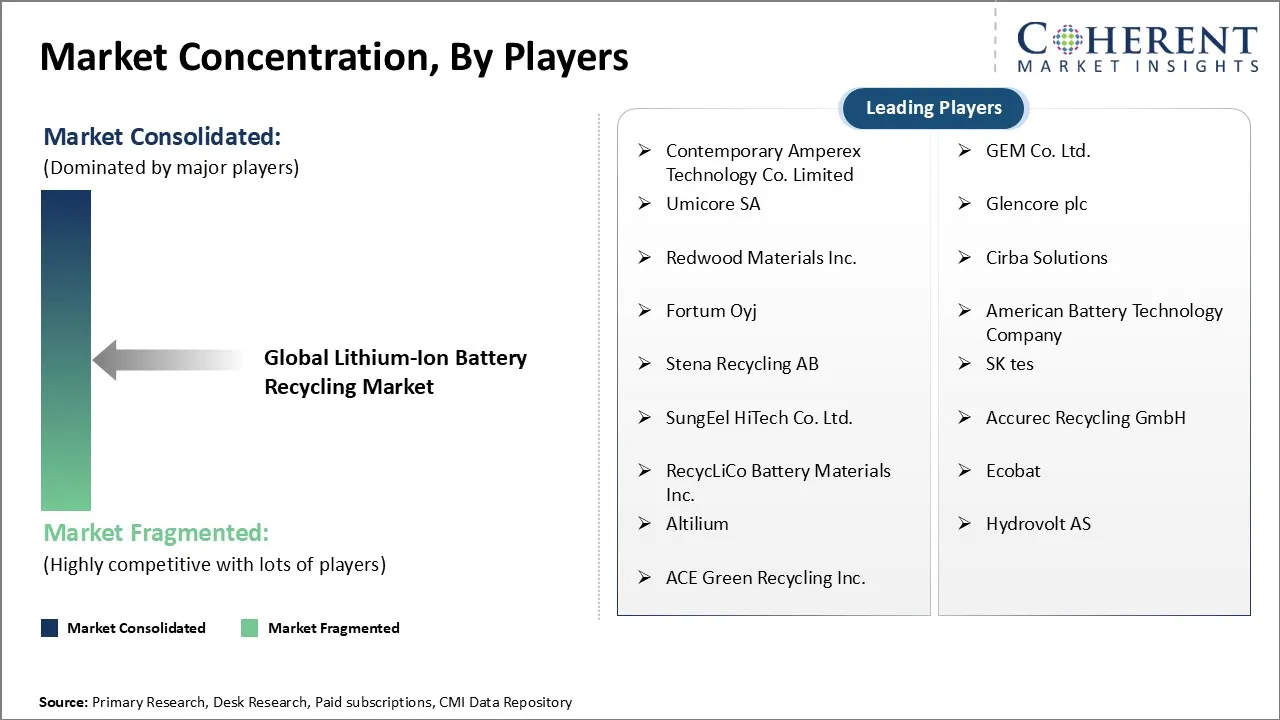
The global lithium-ion battery recycling market remains fragmented, although integrated chemical companies and specialist recyclers have developed larger processing platforms. Companies compete on recovery efficiency, purity of output, economics of processing, safety compliance and reliability of supply. Regional players have an advantage when commercial access is restricted by collection infrastructure, hazardous-waste permitting, and proximity to customers.
Key competitive factors include
- Recovery Efficiency: Maximizing recoverable material yield while minimizing processing losses.
- Material Purity: Meeting chemical specifications required by downstream refiners and battery material manufacturers.
- Processing Economics: Controlling reagent consumption, energy costs, wastewater treatment and residue disposal.
- Plant Utilization: Maintaining sufficient feedstock throughput to support sustainable processing economics.
- Safety Compliance: Establishing controlled storage, thermal-runaway prevention and hazardous-material handling procedures.
- Technology Differentiation: Developing proprietary separation, purification and material regeneration capabilities.
- Customer Qualification: Securing technical approvals, consistent product specifications and reliable deliveries to industrial buyers.
- Regional Integration: Aligning collection infrastructure and permitted processing facilities with local battery supply chains.
Market Report Scope
Lithium-Ion Battery Recycling Market Report Coverage | |||
Report Coverage | Details | ||
Base Year | 2025 | Market Size in 2026: | USD 6.47 Bn |
Historical Data For: | 2020 To 2024 | Forecast Period: | 2026 To 2033 |
Forecast Period 2026 To 2033 CAGR: | 22.24% | 2033 Value Projection: | USD 26.39 Bn |
Geographies covered: |
| ||
Segments covered: |
| ||
Companies covered: | Contemporary Amperex Technology Co. Limited, GEM Co. Ltd., Umicore SA, Glencore plc, Redwood Materials Inc., Cirba Solutions, Fortum Oyj, American Battery Technology Company, Stena Recycling AB, SK tes, SungEel HiTech Co. Ltd., Accurec Recycling GmbH, RecycLiCo Battery Materials Inc., Ecobat, Altilium, Hydrovolt AS, ACE Green Recycling Inc. | ||
Growth Drivers: |
| ||
Restraints & Challenges: |
| ||
Analyst Opinion (Expert Opinion)
- In the next phase of the competition for the global lithium-ion battery recycling market, recyclers who are able to take on a broader responsibility for battery EOL management are likely to be preferred. In addition to contractual liability management, documented treatment and reliable service execution, customers may increasingly emphasize material recovery. The pairing of recycling infrastructure with full life-cycle services by companies may enable more stable business relationships and diversified revenue models.
- The installed recycling capacity may be ahead of the availability of recyclable end-of-life batteries due to longer battery operating lives and improved refurbishment. This poses a structural challenge for facilities built on aggressive retirement assumptions. Operators capable of adapting processing capacity, and selective making of refurbishment and recycling decisions, may have an advantage over businesses whose operations depend on premature battery disposal.
- For recycling companies, the focus should be on reliable downstream material sales, verified feedstock agreements and flexible processing infrastructure before embarking on major capacity expansions. When making investment decisions, consider variable recovery margins, operating compliance costs, evolving battery chemistries and metal price volatility. Profitability will be maintained throughout the forecast period by means of phased development, diversified customer contracts and disciplined capital allocation.
Speak to the analyst
Want personalized insights?
Take the findings above to one of our principal consultants, or have the report rebuilt around the segments, geographies and competitors you actually track.
Market Segmentation
- Battery Source Insights (Revenue, USD Bn, 2021 - 2033)
- Consumer Electronics
- Electric Vehicles
- Battery Manufacturing Scrap
- Energy Storage Systems
- Industrial Equipment and Power Tools
- Battery Chemistry Insights (Revenue, USD Bn, 2021 - 2033)
- Lithium Cobalt Oxide (LCO)
- Lithium Nickel Manganese Cobalt Oxide (NMC)
- Lithium Iron Phosphate (LFP)
- Lithium Nickel Cobalt Aluminum Oxide (NCA)
- Lithium Manganese Oxide (LMO)
- LTO and Other Lithium-Ion Chemistries
- Recycling Process Insights (Revenue, USD Bn, 2021 - 2033)
- Hydrometallurgical Recycling
- Mechanical Recycling Only
- Pyrometallurgical Recycling
- Direct Recycling and Cathode Regeneration
- Regional Insights (Revenue, USD Bn, 2021 - 2033)
- North America
- U.S.
- Canada
- Latin America
- Brazil
- Argentina
- Mexico
- Rest of Latin America
- Europe
- Germany
- U.K.
- Spain
- France
- Italy
- Russia
- Rest of Europe
- Asia Pacific
- China
- India
- Japan
- Australia
- South Korea
- ASEAN
- Rest of Asia Pacific
- Middle East
- GCC Countries
- Israel
- Rest of Middle East
- Africa
- South Africa
- North Africa
- Central Africa
- North America
- Key Players Insights
- Contemporary Amperex Technology Co. Limited
- GEM Co. Ltd.
- Umicore SA
- Glencore plc
- Redwood Materials Inc.
- Cirba Solutions
- Fortum Oyj
- American Battery Technology Company
- Stena Recycling AB
- SK tes
- SungEel HiTech Co. Ltd.
- Accurec Recycling GmbH
- RecycLiCo Battery Materials Inc.
- Ecobat
- Altilium
- Hydrovolt AS
- ACE Green Recycling Inc.
Sources
Primary Research Interviews
- Lithium-ion battery recyclers, black mass processors, and metal recovery companies
- Battery manufacturers, automotive OEMs, cathode material suppliers, and recycling technology experts
Stakeholders
- Battery recycling companies, waste collection operators, and battery manufacturers
- Automotive OEMs, metal refiners, raw material suppliers, and recycling service providers
End-use Sectors
- Electric vehicles, consumer electronics, and energy storage systems
- Battery manufacturing, industrial equipment, and power tools
Regulatory and Industry Bodies
- U.S. Environmental Protection Agency (EPA)
- European Commission
- Central Pollution Control Board (CPCB), India
- Ministry of Industry and Information Technology (MIIT), China
Databases
- International Energy Agency (IEA) battery and electric vehicle datasets
- U.S. Geological Survey (USGS) mineral commodity statistics
- Eurostat waste management data and UN Comtrade
- Battery recycling capacity, metal recovery, and commodity pricing databases
Magazines and Journals
- Resources, Conservation and Recycling
- Journal of Power Sources
- Journal of Cleaner Production
- Waste Management
Associations
- Global Battery Alliance (GBA)
- European Battery Recycling Association (EBRA)
- RECHARGE – European Advanced Rechargeable and Lithium Batteries Association
- Recycled Materials Association (ReMA)
Public Domain Sources
- Spent battery volumes, recycling capacity, and material recovery data
- Lithium, nickel, cobalt, and black mass pricing trends
- Battery recycling investments, government initiatives, and recovery efficiency statistics
Key Standards and Regulations
- EU Battery Regulation (EU) 2023/1542
- India's Battery Waste Management Rules, 2022, and amendments
- Basel Convention – Transboundary Movement of Hazardous Waste
- U.S. Resource Conservation and Recovery Act (RCRA)
- ISO 14001 – Environmental Management Systems
Proprietary Elements
- CMI Data Analytics Tool and proprietary research repository, supplemented by primary interviews, recycling capacity assessments, battery waste generation estimates, metal recovery analysis, pricing intelligence, and competitive benchmarking.
Get access to 250+ pages report
Every segment, forecast, competitor profile and data table behind the analysis above — available for instant download.
- ESOMAR Member
- ISO 9001:2015 Certified
- D-U-N-S Registered
- GDPR & CCPA Compliant
Frequently Asked Questions
The CAGR of global lithium-ion battery recycling market is projected to be 22.24% from 2026 to 2033.
The global lithium-ion battery recycling market is estimated to be valued at USD 6.47 billion in 2026 and is expected to reach USD 26.39 billion by 2033.
The biggest opportunities include battery collection infrastructure, commercial recycling facilities, refining of recovered materials and long-term recycling partnerships with automotive and battery manufacturers.
Recyclers make revenue by selling metals they have recovered, trading black mass, collecting and processing batteries and entering into contracts with battery manufacturers to take their used products and recycle them.
The main challenges are to ensure a steady supply of battery waste, the profitability of recovery, handling hazardous materials and the material purity requirements of battery manufacturers.
Battery waste management laws, extended producer responsibility requirements and recycled material recovery obligations are propelling formal recycling operations and higher investment in compliant processing infrastructure.
The increasing volume of spent electric vehicle batteries and battery manufacturing scrap, along with growing demand for recovered lithium, nickel, and cobalt in battery production, are the major factors driving growth in the global lithium-ion battery recycling market.