

Global Low-TPO Medical Adhesives Market Size and Forecast – 2026 To 2033
The Global Low-TPO Medical Adhesives Market is estimated to be valued at USD 42.6 Mn in 2026 and is expected to reach USD 170.4 Mn by 2033, growing at a compound annual growth rate (CAGR) of 21.90% from 2026 to 2033. The expansion is indicative of the growing demand for high-performance, chemically safe bonding solutions for medical device manufacturing, particularly for catheter assemblies, diagnostic devices and wearable medical electronics.
In January 2026, Dymax announced plans to showcase CMR- and TPO-free light-curable medical adhesives at MD&M West 2026, The adhesives will be used to showcase their use in medical device bonding, sealing and coating, as well as UV/LED curing systems. This development shows manufacturers trying to blend alternate photoinitiator chemistry with manufacturing efficiency and biocompatibility needs which will enhance the market’s long-term commercial view.
Key Takeaways of the Global Low-TPO Medical Adhesives Market
- TPO-Free Medical Adhesives are projected to grow at a CAGR of 22.7% during 2026-33, holding a 64.7% share of the global low-TPO medical adhesives market in 2026 as OEMs are looking to address photoinitiator concerns before the long product qualification process. In May 2025, Dymax extended its TPO-free light-curable portfolio to include medical-device formulations that help in biocompatibility assessment.
- Acrylic and methacrylate based adhesives are expected to grow at a compound annual growth rate (CAGR) of 22.1% between 2026 and 2033 and account for 49.6% share of the global low-TPO medical adhesives market in 2026. The resins are compatible with dissimilar plastics and metals and their viscosity can be adjusted, making them suitable for needle hubs and tubing connections. In December 2025, Hoenle introduced the TPO-free acrylate Vitralit E-7041 T for bonding medical needles.
- The UV and LED Light Curing segment is expected to grow at a CAGR of 22.5% during 2026-2033. The segment is expected to hold 72.5% share in global low-TPO medical adhesives market. Repeatable assembly is achievable with short curing cycles that don't require prolonged thermal exposure. In April 2026, DELO launched PHOTOBOND MG4202, a TPO-free material for medical wearables, which reportedly cures in one second under certain LED conditions.
- North America is estimated to expand at a 20.4% CAGR during 2026–2033 while retaining 39.2% of global low-TPO medical adhesives market revenue in 2026. In its established medical-device production base, it focuses on traceable formulation chemistry and documented biological risk assessment. In September 2026, the U.S. FDA partially adopted ISO 10993-18 for chemical characterization of material constituents, extractables, and leachables.
- Europe is projected to lead regional growth at an estimated 25.0% CAGR during 2026–2033, alongside a 30.7% global low-TPO medical adhesives market share in 2026. Regulatory scrutiny of substances in selected medical devices encourages supplier reformulation and early OEM requalification. In October 2026, Henkel launched five light-curing Loctite medical adhesives formulated around EU MDR and TPO-content requirements.
Segmental Insights
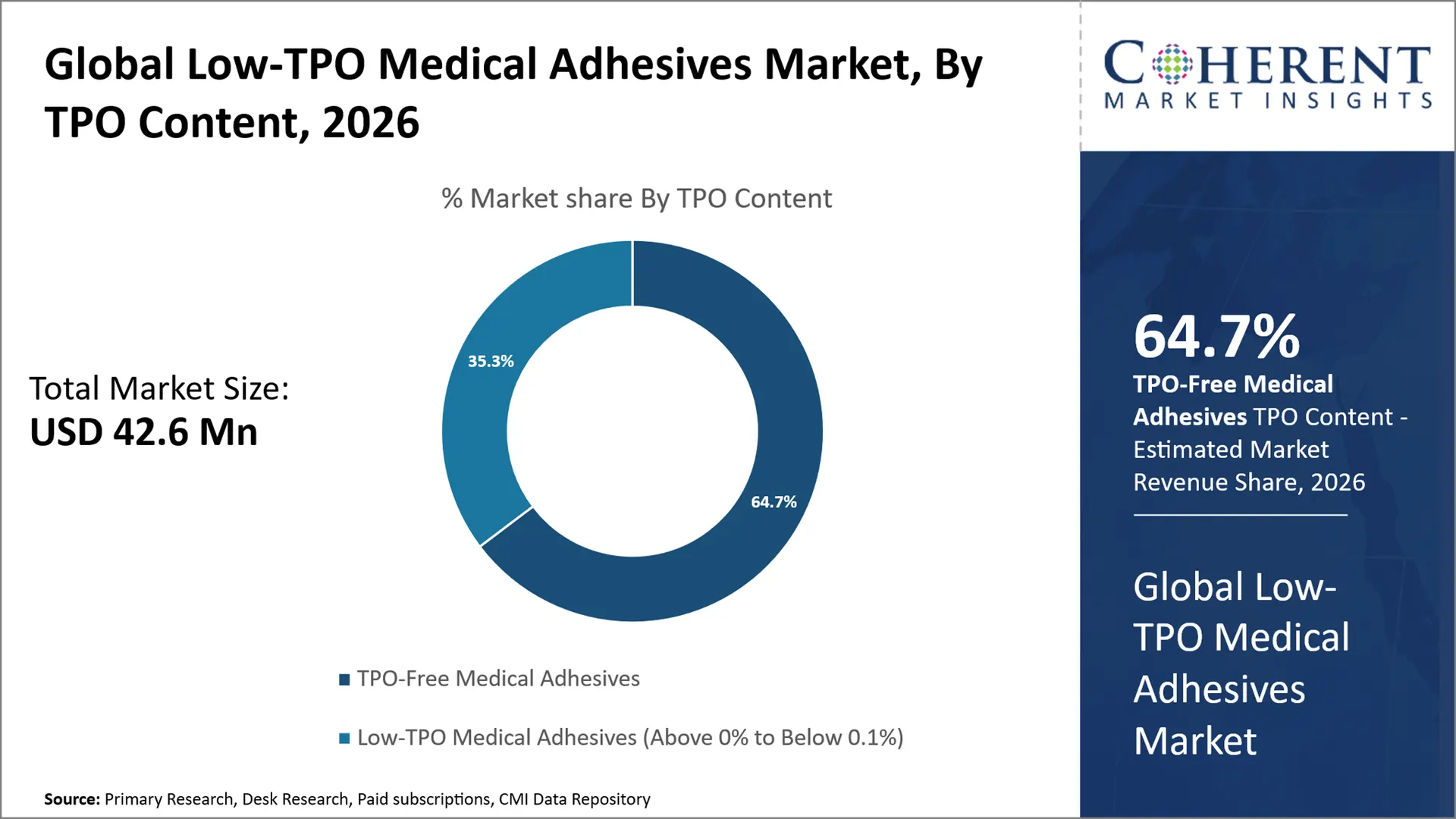
Why Are TPO-Free Medical Adhesives Expected to Dominate the Global Low-TPO Medical Adhesives Market?
TPO-Free Medical Adhesives are expected to hold 64.7% of the global low-TPO medical adhesives market in 2026. Removing the specified photoinitiator can simplify long-term material governance for devices whose component formulations must remain stable across successive production batches. Commercial success nevertheless depends on proving equivalent curing, extractables behavior, and bond durability, rather than treating TPO absence as a substitute for biological evaluation. In November 2024, Biomaterial Science researchers at Harvard University published a photoinitiator-free, light-mediated crosslinking method for polymer and protein networks, including experimental bioadhesives with potential biomedical applications. This laboratory study illustrates an alternative chemistry, not a commercially qualified device-assembly adhesive. For manufacturers, the opportunity lies in translating alternative photochemistry into validated formulations that can be incorporated into established device designs without creating avoidable production changes or extended qualification cycles.
- Current Industry Events of 2026
- Market Size Estimation
- Regional Breakdown
- Competitive Landscape
- Customer Intelligence
- Segmental Analysis
- Pricing Analysis
- Key Market Drivers, Challenges & Future Trends
- Customized Insights Section
Why Do Acrylic and Methacrylate-Based Adhesives Represent the Largest Resin Type in the Global Low-TPO Medical Adhesives Market?
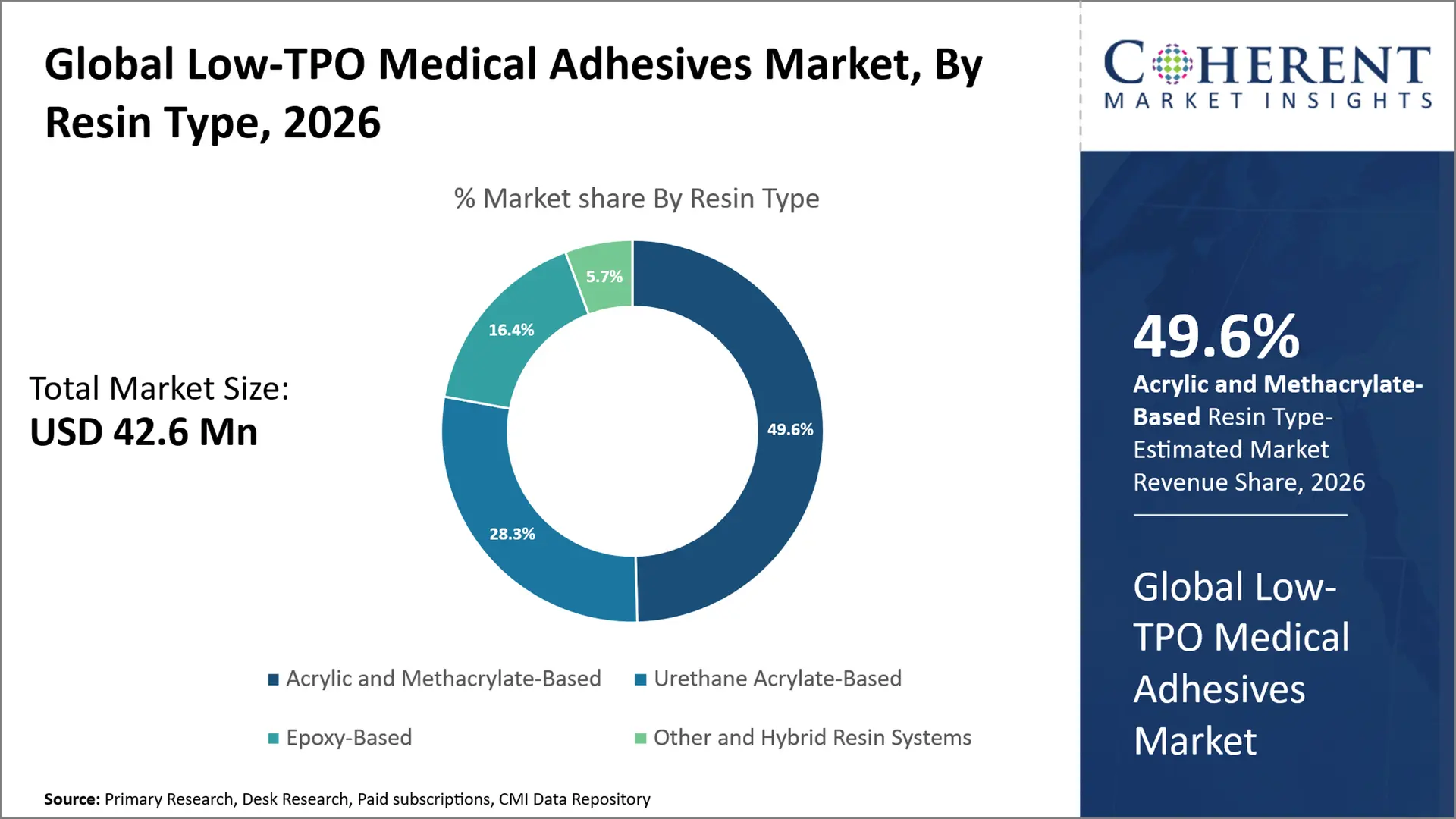
Acrylic and methacrylate-based adhesives are expected to account for the largest share of the global low-TPO medical adhesives market in 2026, with 49.6% of the market. The biggest advantage of these is the ability to optimize the flow behavior for narrow bonds and to strike the right balance between adhesion, transparency and flexibility with mixed substrates. This flexibility can facilitate precision dispensing and reduce material overflow around functional features in disposable diagnostic housings and miniature medical assemblies. Permacol launched its 3530 and 3540 CMR-free capillary UV adhesives in December 2025. These are part of the company’s acrylate portfolio and are targeted at applications such as transparent medical-device components and instrumentation. The products demonstrate the ability of resin suppliers to integrate precise capillary flow into commercial assembly offerings. However, the announcement did not provide a complete analysis of TPO-content, and did not establish ISO 10993 qualification. Therefore, it is important that the medical OEMs ensure the biological safety of the device and the suitability of the formulation before its adoption.
Why Do UV and LED Light Curing Dominate the Curing Technology Category of the Global Low-TPO Medical Adhesives Market?
UV and LED Light Curing is expected to account for 72.5% of curing-technology revenue in the global low-TPO medical adhesives market in 2026. Its manufacturing appeal is process observability: engineers can specify irradiance, exposure duration, and treatment geometry, then monitor whether each workstation delivers the validated dose. This is particularly valuable for distributed medical production lines where reproducibility must be demonstrated across equipment and shifts. In October 2026, Excelitas announced that it would demonstrate its OmniCure LX500 UV LED spot-curing system and new R2000Plus radiometer at MD&M Midwest, specifically highlighting medical-device adhesive assembly and measurement of light output. The development reflects investment in cure-process control rather than a new adhesive formulation. Suppliers that align photoinitiator absorption with calibrated equipment can help OEMs reduce rework while maintaining documented production consistency.
Current Events and their Impact
Current Event | Description and Its Impact |
European Commission Announces EUDAMED Mandatory Modules – November 2025 |
|
June 2025 – UK tightens post-market surveillance requirements for medical devices |
|
Global Low-TPO Medical Adhesives Market Dynamics
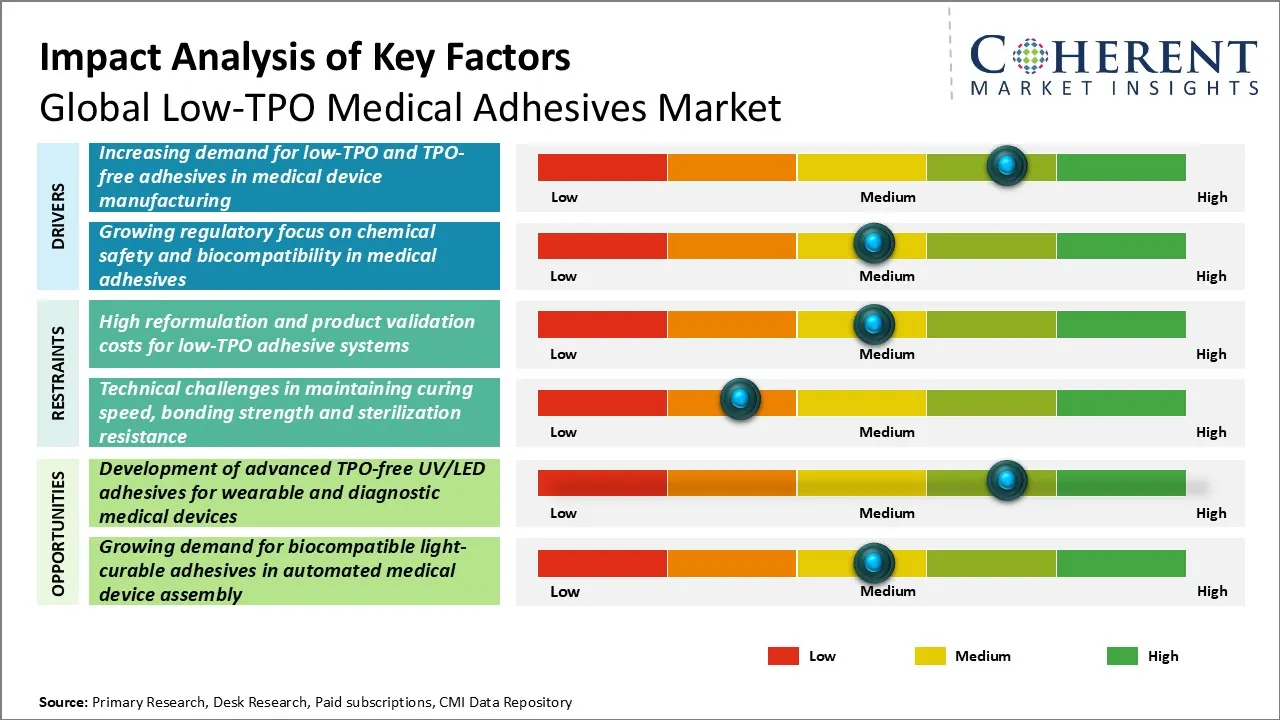
Key Market Drivers
- Increasing demand for low-TPO and TPO-free adhesives in medical device manufacturing: Medical device manufacturers are increasingly considering photoinitiator composition during early material selection rather than treating chemical substitution as a procurement adjustment. Low-TPO and TPO-free formulations can reduce dependence on substances facing heightened regulatory scrutiny, provided bonding strength, curing reliability, and biological safety are maintained. This creates reformulation opportunities for specialty adhesive manufacturers and qualification laboratories. In January 2024, the European Commission published Delegated Regulation (EU) 2024/197, classifying TPO as toxic to reproduction, Category 1B, and a skin sensitizer, Category 1B, with mandatory application from September 2025.
- Growing regulatory focus on chemical safety and biocompatibility in medical adhesives: Biological safety assessment increasingly requires medical device manufacturers to evaluate adhesive constituents, potential chemical exposure, and patient-contact conditions throughout product development. Detailed documentation on the formulation helps OEMs to identify material-related hazards and support biological risk assessments. This creates a commercial advantage for suppliers who can provide reliable toxicological data and controlled manufacturing processes. In November 2025, the International Organization for Standardization published ISO 10993-1:2025, which strengthens the alignment between biological evaluation, material characterization, exposure assessment, and medical device risk management. This further highlights the need for adhesive qualification beyond just cytotoxicity testing.
Emerging Market Trends
- Application-Specific Adhesive Platforms Replacing Standard Formulations: Medical device manufacturers are expected to show an increasing preference for adhesive formulations that are tailored to specific substrates, joint geometries and assembly conditions. Therefore, suppliers will align their portfolios to validated application requirements rather than supplying interchangeable general-purpose products.
Impact: Application engineering and customizing formulations can be used by specialized formulators to command premium prices. Technical compatibility can be a pressure point for adhesive suppliers who provide standardized products and whose purchasing decisions are based on this factor.
Market Relevance: The global low-TPO medical adhesives market will increasingly reward suppliers who can customize curing behavior, mechanical properties and processing characteristics to specific medical device designs.
- Decentralized Supply and Localized Technical Support: Medical contract manufacturers with multiple manufacturing sites are likely to be interested in consistent adhesive specifications, regional inventory availability, and localized application support. With cross-site manufacturing transfers, reliable material handling instructions and predictable adhesive performance will be required.
Impact: Suppliers that offer integrated technical services and regional replenishment capabilities can improve client retention. Manufacturers reliant on centralized distribution may have longer qualification and production-transfer cycles.
Market Relevance: The move to low-TPO medical adhesive will put more emphasis on operational continuity as well as chemical performance, pushing suppliers to create regional support networks and standard material transfer processes.
Market Restraints
- High Reformulation and Device Requalification Costs: Replacing TPO with other photoinitiators can change the curing response, mechanical properties, stability and residual chemical profile of an adhesive. Medical device makers need to evaluate whether these changes affect established bonding processes or biological safety assessments. Additional lab testing, production trials and documentation requirements can add to product development costs and slow adoption, especially for smaller manufacturers that work with limited qualification budgets.
- Limited Curing Accessibility in Complex Assemblies: UV and LED curing require sufficient light exposure to initiate polymerization, leading to difficulties in opaque housings, recessed joints, and multilayer medical parts. Insufficient curing may lead to reduced bond integrity or residual undesirable constituents. While secondary curing technologies can address these limitations, they introduce additional process-control requirements, equipment considerations, and manufacturing costs that may limit adoption in price-sensitive medical device production.
Regional Insights
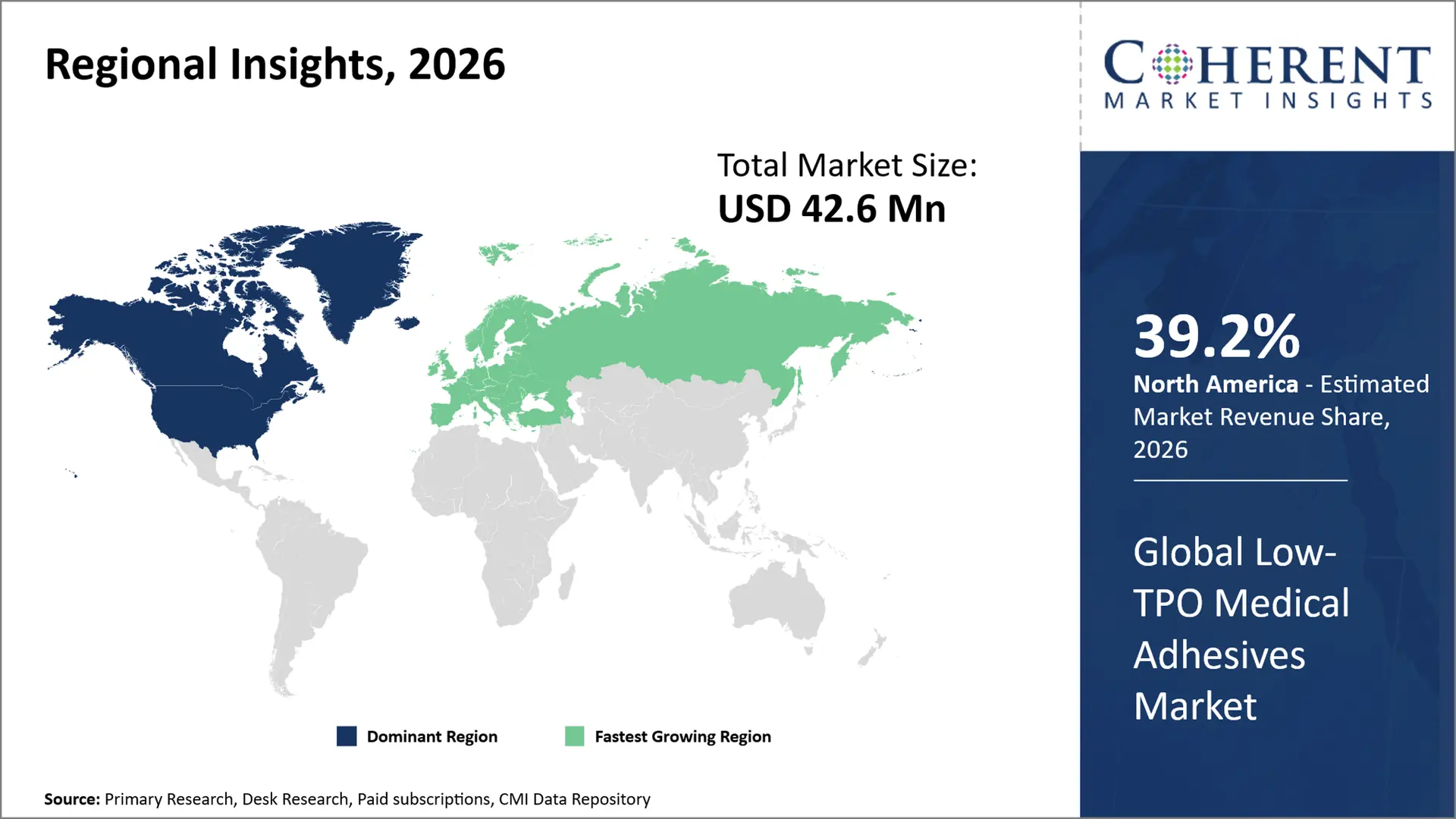
Why Does North America Dominate the Global Low-TPO Medical Adhesives Market?
North America is expected to account for 39.2% of the global low-TPO medical adhesives market in 2026, supported by its well-established medical device contract manufacturing ecosystem and strong presence in complex drug delivery device assembly operations. For manufacturers of miniature components, the need for controlled bonding processes is becoming more important, since the consistency of materials has a direct impact on production yields and product reliability. Regional sourcing of advanced medical adhesives is supported by specialized material qualification services, automated assembly capabilities, and cleanroom manufacturing. In February 2026, MGS opened a 300,000-sq-ft manufacturing facility in Wisconsin, including 140,000 sq ft of Class 8 cleanrooms for automated production of drug delivery devices. This expansion creates potential opportunities for qualified low-TPO adhesive suppliers for high-volume manufacturing programs and demonstrates the regional commitment to cutting-edge medical assembly capabilities.
Why Is Europe Emerging as the Fastest-Growing Region in the Global Low-TPO Medical Adhesives Market?
Europe is expected to account for 30.7% of the global low-TPO medical adhesives market in 2026 and witness the highest regional growth during the forecast period ending in 2033. Medical device manufacturers are taking a greater interest in localized supply networks, controlled material selection and manufacturing continuity across production facilities. These needs are creating opportunities for adhesive suppliers that can offer formulation assistance and dependable local distribution. In June 2026, Medline announced progress on expanding its manufacturing facility in Partizánske, Slovakia, including additional cleanroom capacity and improved production flows, with operations scheduled to begin in 2027. The investment marks the continued development of Europe’s medical manufacturing infrastructure. While the project does not specifically call for the use of low-TPO adhesives, this expansion may fulfill the future need for qualified specialty bonding materials.
Global Low-TPO Medical Adhesives Market Outlook for Key Countries
Why Is the U.S. a Key Market for the Global Low-TPO Medical Adhesives Market?
The US is a major global low-TPO medical adhesives market due to the presence of a large manufacturing base for precision-engineered healthcare components, pharmaceutical delivery systems, and disposable medical devices. With the increasing market of prefillable syringe manufacturing, there is the potential need for specialized bonding materials in compatible device subassemblies where joint integrity and process reliability are critical. In January 2026, BD announced plans to invest USD 110 million to establish BD Neopak glass prefillable syringe production in Columbus, Nebraska, to supply biologic and GLP-1 drugs. The investment is indicative of the growing domestic manufacturing capability for advanced injection systems. However, investment alone is not a measure of adhesive demand, and these developments also give medical adhesive suppliers the opportunity to work with component manufacturers on qualified materials, production efficiency and supply agreements.
Why Is India Important in the Global Low-TPO Medical Adhesives Market?
India offers developing opportunities for global low-TPO medical adhesives market as domestic manufacturers expand their capabilities in advanced medical equipment and increasingly complex device components. The country’s manufacturing base provides potential demand for specialized bonding formulations for diagnostic assemblies, medical electronics and selected disposable devices. India’s Department of Pharmaceuticals said in September 2026 that the Production Linked Incentive scheme had led to the domestic production of 57 different medical devices, including diagnostic imaging equipment, anesthesia systems and heart valves. This broadens the overall customer base for specialty medical materials. Adhesive suppliers may capitalize on technical partnerships with domestic OEMs, custom material specifications and localized application support to overcome qualification costs and dependence on imported specialty chemicals.
Why Does China Support Growth in the Global Low-TPO Medical Adhesives Market?
China's extensive medical device manufacturing network and established precision component supply chains provide a foundation for the commercialization of low-TPO medical adhesives. Bonding formulations are required by domestic manufacturers of diagnostic equipment, medical tubing and electronic healthcare devices that are compatible with automated production and the ever-increasing quality systems. In November 2025, China’s National Medical Products Administration issued updated Good Manufacturing Practice requirements for medical devices, which will come into effect in November 2026. The amendments strengthen supervision of product safety and quality management of manufacturing. This regulatory change may lead device manufacturers to focus on documentation of adhesive suppliers, traceability of materials and control of the manufacturing process. Hence, domestic specialty chemical manufacturers and international adhesive suppliers have an opportunity to gain by providing products that meet these technical and buying specifications.
Why Is Germany a Strategic Country in the Global Low-TPO Medical Adhesives Market?
Germany is a key player in the global low-TPO medical adhesives market owing to its expertise in automated production systems, precision medical manufacturing and complex healthcare components. As miniature assemblies involve a wide range of engineered materials, domestic manufacturers of infusion systems and medical instruments need a consistent joining performance. In October 2025 B. Braun opened its ACTIVE production site in Melsungen following an investment of around EUR 150 million. The facility produces disposable infusion therapy components, including CytoSet assemblies and Mini-Spikes, through digitally linked, automated processes. This is an example of Germany’s investment in the production of high-end medical components. Facilities such as this offer opportunities for qualified adhesive suppliers to introduce specialized bonding materials into highly controlled manufacturing environments.
Why Is Japan an Important Growth Market for the Global Low-TPO Medical Adhesives Market?
Japan possesses expertise in precision polymer processing and minimally invasive medical devices, which opens up niche opportunities for global low-TPO medical adhesives market. Japanese medical device manufacturers focus on compact designs, tight manufacturing tolerances and reliable performance for catheter-related components and diagnostic instruments. In Japan, Terumo introduced the TR Band Distal in May 2026, a hemostasis device designed specifically for distal radial artery procedures. The introduction highlights ongoing product development in the area of specialized vascular access technologies. This innovation may create a demand for adhesives that are integrated into the design of devices, which may lead to the development of compatible bonding and assembly materials. The commercial opportunities for suppliers are not just a function of chemical composition, but rather of demonstrating reliable adhesizon to medical grade polymers, consistency between manufacturing batches and conformance to the individual device qualification requirements.
Medical Adhesive Qualification and Procurement Landscape
Key Parameter | Market Landscape | Key Applications / Buyers | Commercial Significance |
TPO Content and Chemical Compliance | Growing demand for documented TPO-free and low-TPO formulations, especially relevant for substance restrictions or CMR assessments. | Medical device OEMs, catheter manufacturers and drug delivery system manufacturers. | Suppliers that can provide verified photoinitiator composition and supporting chemical documentation can make material screening easier and improve eligibility for regulated device programs. |
Biocompatibility and Patient Safety | Biological evaluation will still need to be performed on a device-specific basis and will depend on the nature and duration of contact with the patient. | Wearable medical devices, skin-contact assemblies and invasive medical parts. | Adhesive manufacturers who can provide the appropriate ISO 10993 evaluation data can reduce uncertainty during customer qualification and support long-term supply contracts for medical devices. |
Extractables and Leachables Assessment | Increased sensitivity in detecting potentially releasable adhesive constituents, residuals and degradation products. | Fluid paths for catheters, infusion systems and diagnostic cartridges. | Robust chemical characterization capabilities help suppliers meet toxicological assessment requirements and differentiate formulations for sensitive medical applications. |
Bond Strength and Performance Validation | OEM qualification includes adhesion reliability, joint durability, dimensional stability and performance under the intended operating conditions. | Needle and syringe assemblies. Medical tubing fittings. Diagnostic housings. | Consistent bonding performance can reduce assembly rejection, increase manufacturing reliability and improve prospects for supplier selection. |
Sterilization and Shelf-Life Compatibility | Adhesive selection increasingly accounts for compatibility with the device's intended sterilization method and required storage conditions. | Sterile disposable devices, infusion components, and selected surgical assemblies. | Suppliers demonstrating retained adhesive performance after applicable sterilization and aging tests can serve more demanding medical device programs and justify specialized product positioning. |
Supplier Qualification and Change Control | Medical manufacturers prioritize documented material specifications, batch consistency, supplier assessments, and notification of formulation changes. | Medical device OEMs, contract medical device manufacturers, and diagnostic device manufacturers. | Strong quality documentation and controlled product changes support repeat procurement, reduce requalification risks, and improve customer retention. |
How Are Specialized Bonding Requirements in Miniaturized Drug Delivery Assemblies Creating Growth Opportunities in the Global Low-TPO Medical Adhesives Market?
Suppliers who can combine controlled adhesive chemistry with tight structural and chemical compatibility requirements have a good opportunity. Miniaturized drug delivery assemblies are one example. These devices often include fluid reservoirs, small areas for bonding, small metallic parts and multiple polymers, all of which provide opportunities for the development of specialized low-TPO formulations.
This opens the door for adhesive manufacturers to formulate products that are compatible with appropriate sterilization or processing conditions, exhibit controlled viscosity, exhibit consistent adhesion to dissimilar materials, and have low levels of extractables. These capabilities can assist medical device developers in creating joints more efficiently while maintaining functional reliability.
To participate commercially, there will be a need for investment in formulation research, chemical characterization, application testing and collaborative product qualification. Suppliers should also establish technical relationships with drug delivery device developers and specialized contract manufacturers.
The opportunity is likely to favor established formulation specialists and technically capable smaller companies that can provide customized materials alongside documented testing support. Such offerings may command premium pricing where adhesive performance directly affects device functionality and manufacturing yield.
Market Players, Key Development, and Competitive Intelligence
Key Developments
- In March 2026, Bostik presented its new Born2Bond LC 2100 Gel UV-acrylate adhesive through a technical program addressing precision bonding applications, including medical devices. The product combines fast light curing with structural flexibility and controlled dispensing characteristics. Its development illustrates the potential for specialized acrylic formulations to address demanding assembly requirements.
- In February 2026, Master Bond introduced UV26DCMed, a dual-curable adhesive designed for medical device assembly requiring repeated sterilization. The formulation combines UV-initiated fixturing with secondary thermal curing and meets ISO 10993-5 non-cytotoxicity requirements. This development illustrates the commercial importance of bonding solutions capable of accommodating complex assembly geometries and reusable medical devices.
Competitive Landscape
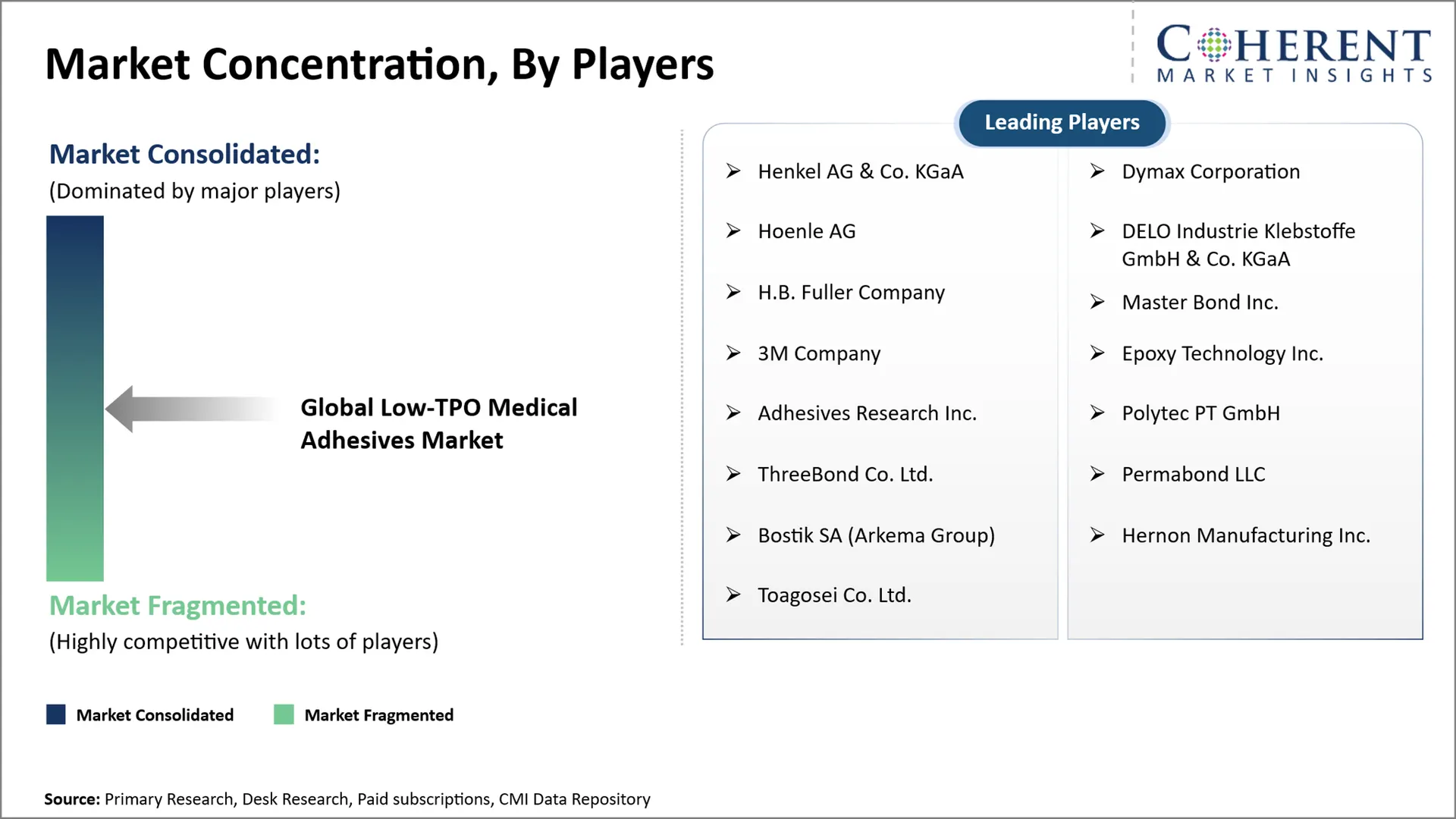
The global low-TPO medical adhesives market is moderately consolidated with established specialty adhesive manufacturers and smaller formulation specialists competing. Competition here is largely based on application performance, formulation consistency, manufacturing reliability, technical support and qualification requirements. Smaller regional manufacturers can compete by offering custom products and close customer service, while larger competitors enjoy established relationships with medical device manufacturers, deep technical expertise, and broad manufacturing capabilities.
Key focus areas include
- Formulation differentiation: Suppliers compete to show compatibility with medical grade substrates, adhesion strength, flexibility and control of viscosity.
- Curing process efficiency: Predictable light exposure requirements and consistent production throughput influence overall manufacturing economics.
- Pricing and production economics: A stable supply of raw materials, regulated batches and reliable delivery times are the basis for long-term supply contracts.
- Manufacturing reliability: Consistent raw material sourcing, controlled batches, and dependable delivery schedules support long-term procurement agreements.
- Medical-grade customization: Manufacturers with specialization can offer producers of technically sophisticated medical equipment the appropriate materials, owing to their application-oriented properties.
- Intellectual property: Proprietary resin chemistry, curing formulations and process know-how can protect differentiated commercial positions.
- Technical service capabilities: Joint testing, dispensing optimization, and manufacturing troubleshooting provide additional value beyond adhesive supply.
Market Report Scope
Global Low-TPO Medical Adhesives Market Report Coverage | |||
Report Coverage | Details | ||
Base Year | 2025 | Market Size in 2026: | USD 42.6 Mn |
Historical Data For: | 2020 To 2024 | Forecast Period: | 2026 To 2033 |
Forecast Period 2026 To 2033 CAGR: | 21.90% | 2033 Value Projection: | USD 170.4 Mn |
Geographies covered: |
| ||
Segments covered: |
| ||
Companies covered: | Henkel AG & Co. KGaA, Dymax Corporation, Hoenle AG, DELO Industrie Klebstoffe GmbH & Co. KGaA, H.B. Fuller Company, Master Bond Inc., 3M Company, Epoxy Technology Inc., Adhesives Research Inc., Polytec PT GmbH, ThreeBond Co. Ltd., Permabond LLC, Bostik SA (Arkema Group), Hernon Manufacturing Inc., Toagosei Co. Ltd. | ||
Growth Drivers: |
| ||
Restraints & Challenges: |
| ||
Analyst Opinion (Expert Opinion)
- The global low-TPO medical adhesives market is expected to move from selling individual formulations to integrated material and application-support offerings. Manufacturers who combine adhesive development with production troubleshooting, manufacturing transfer assistance and long-term product support will be better positioned to develop strategic supplier relationships. Such a move could increase customer loyalty and reduce reliance on price competition.
- The potential structural change is the introduction of interchangeable, pre-qualified adhesive platforms in medical device manufacturing networks. If device developers standardize material interfaces and production requirements across product families, suppliers may compete for broader platform-level supply agreements instead of individual component orders. Such a system would disadvantage manufacturers that depend on isolated product approvals, but would reward suppliers that can support coordinated product architectures.
- Adhesive manufacturers should concentrate on development partnerships with medical device OEMs and specialty contract manufacturers, reliable formulation inputs and strong product change-control systems. Investment should be directed to commercially proven applications that can achieve sustainable margins through performance differentiation. In the absence of confirmed customer requirements, companies should avoid an overexpansion of their portfolio, especially if the alternative raw materials come with uncertain supply cost or additional qualification obligation.
Speak to the analyst
Want personalized insights?
Take the findings above to one of our principal consultants, or have the report rebuilt around the segments, geographies and competitors you actually track.
Market Segmentation
- TPO Content Insights (Revenue, USD Mn, 2021 - 2033)
- TPO-Free Medical Adhesives
- Low-TPO Medical Adhesives (Above 0% to Below 0.1%)
- Resin Type Insights (Revenue, USD Mn, 2021 - 2033)
- Acrylic and Methacrylate-Based
- Urethane Acrylate-Based
- Epoxy-Based
- Other and Hybrid Resin Systems
- Curing Technology Insights (Revenue, USD Mn, 2021 - 2033)
- UV and LED Light Curing
- Dual Curing Systems
- Application Insights (Revenue, USD Mn, 2021 - 2033)
- Needle and Syringe Assembly
- Catheter and Medical Tubing Bonding
- Wearable Medical Devices
- Diagnostic and Microfluidic Devices
- Other Medical Device Assembly
- End User Insights (Revenue, USD Mn, 2021 - 2033)
- Medical Device OEMs
- Contract Medical Device Manufacturers
- Diagnostic Device Manufacturers
- Medical Electronics Manufacturers
- Sales Channel Insights (Revenue, USD Mn, 2021 - 2033)
- Direct Manufacturer Sales
- Specialty Adhesive Distributors
- Regional Insights (Revenue, USD Mn, 2021 - 2033)
- North America
- U.S.
- Canada
- Latin America
- Brazil
- Argentina
- Mexico
- Rest of Latin America
- Europe
- Germany
- U.K.
- Spain
- France
- Italy
- Russia
- Rest of Europe
- Asia Pacific
- China
- India
- Japan
- Australia
- South Korea
- ASEAN
- Rest of Asia Pacific
- Middle East
- GCC Countries
- Israel
- Rest of Middle East
- Africa
- South Africa
- North Africa
- Central Africa
- North America
- Key Players Insights
- Henkel AG & Co. KGaA
- Dymax Corporation
- Hoenle AG
- DELO Industrie Klebstoffe GmbH & Co. KGaA
- H.B. Fuller Company
- Master Bond Inc.
- 3M Company
- Epoxy Technology Inc.
- Adhesives Research Inc.
- Polytec PT GmbH
- ThreeBond Co. Ltd.
- Permabond LLC
- Bostik SA (Arkema Group)
- Hernon Manufacturing Inc.
- Toagosei Co. Ltd.
Sources
Primary Research Interviews
- Medical adhesive manufacturers, photoinitiator and specialty resin producers
- Medical device OEMs, contract manufacturers, and adhesive formulation specialists
Stakeholders
- TPO-free and low-TPO adhesive manufacturers
- Medical device assemblers, chemical suppliers, testing laboratories, and regulatory consultants
End-use Sectors
- Medical device OEMs, contract medical device manufacturers, diagnostic device manufacturers, and medical electronics manufacturers
- Needle and syringe assemblies, catheters, medical tubing, wearable devices, and microfluidic devices
Regulatory and Industry Bodies
- U.S. Food and Drug Administration (FDA)
- European Medicines Agency (EMA)
- European Chemicals Agency (ECHA)
- European Commission (EC)
Databases
- FDA medical device databases and 510(k) clearances
- EUDAMED and European medical device regulatory databases
- UN Comtrade and ITC Trade Map
- Eurostat PRODCOM and national medical device manufacturing statistics
Magazines and Journals
- International Journal of Adhesion and Adhesives
- Journal of Biomedical Materials Research
- ACS Applied Polymer Materials
- Biomaterials
Associations
- Medical Device Manufacturers Association (MDMA)
- MedTech Europe
- Advanced Medical Technology Association (AdvaMed)
- Adhesive and Sealant Council (ASC)
Public Domain Sources
- Medical adhesive technical data sheets and manufacturer product catalogs
- Biocompatibility reports, chemical safety documentation, and photoinitiator specifications
- Medical device manufacturing investments, product launches, and regulatory publications
Key Standards and Regulations
- ISO 10993 – Biological Evaluation of Medical Devices
- ISO 13485 – Medical Device Quality Management Systems
- EU Medical Device Regulation (EU) 2017/745
- EU REACH Regulation (EC) No 1907/2006
- EU CLP Regulation (EC) No 1272/2008
- FDA 21 CFR Part 820 – Quality Management System Regulation
Proprietary Elements
- CMI Data Analytics Tool
- Proprietary research repository, supported by primary interviews, medical adhesive consumption modeling, TPO-free formulation assessments, pricing analysis, regulatory mapping, and competitive intelligence.
Get access to 250+ pages report
Every segment, forecast, competitor profile and data table behind the analysis above — available for instant download.
- ESOMAR Member
- ISO 9001:2015 Certified
- D-U-N-S Registered
- GDPR & CCPA Compliant
Frequently Asked Questions
The global low-TPO medical adhesives market is projected to grow at a CAGR of 21.90% from 2026 to 2033.
The global low-TPO medical adhesives market is estimated to be valued at USD 42.6 Mn in 2026 and is expected to reach USD 170.4 Mn by 2033.
Manufacturers should evaluate TPO content, biocompatibility, substrate compatibility, bonding strength, curing requirements, sterilization resistance, and supplier qualification documentation.
TPO-free medical adhesives do not contain TPO photoinitiators and use alternative curing chemistry, where applicable to deliver suitable bonding performance, processing reliability, and device-specific safety.
Relevant requirements include ISO 10993 for biological evaluation, applicable medical device regulations, and chemical substance restrictions depending on product composition, intended use, and jurisdiction.
Buyers should expect supplier benchmarking, product and formulation analysis, regulatory requirements, competitive positioning, manufacturing capabilities, pricing considerations, and medical device procurement trends.
The increasing use of low-TPO and TPO-free adhesives in medical device manufacturing, along with a stronger regulatory focus on chemical safety and biocompatibility, are the key factors driving growth in the global low-TPO medical adhesives market.