

Global MEMS Sensor Market Size and Forecast – 2026 To 2033
The global MEMS sensor market is expected to grow from USD 22.00 Bn in 2026 to USD 31.50 Bn by 2033, registering a compound annual growth rate (CAGR) of 6.1% from 2026 to 2033. The global MEMS sensor market is driven by growing demand for vehicle navigation and positioning sensors. On June 4, 2025, Trimble and InvenSense announced they will work together to deliver an advanced navigation solution that combines the Trimble ProPoint Go engine and Trimble RTX correction service with TDK's SmartAutomotive Inertial Measurement Units (IMUs) module from InvenSense.
Key Takeaways of the Global MEMS Sensor Market
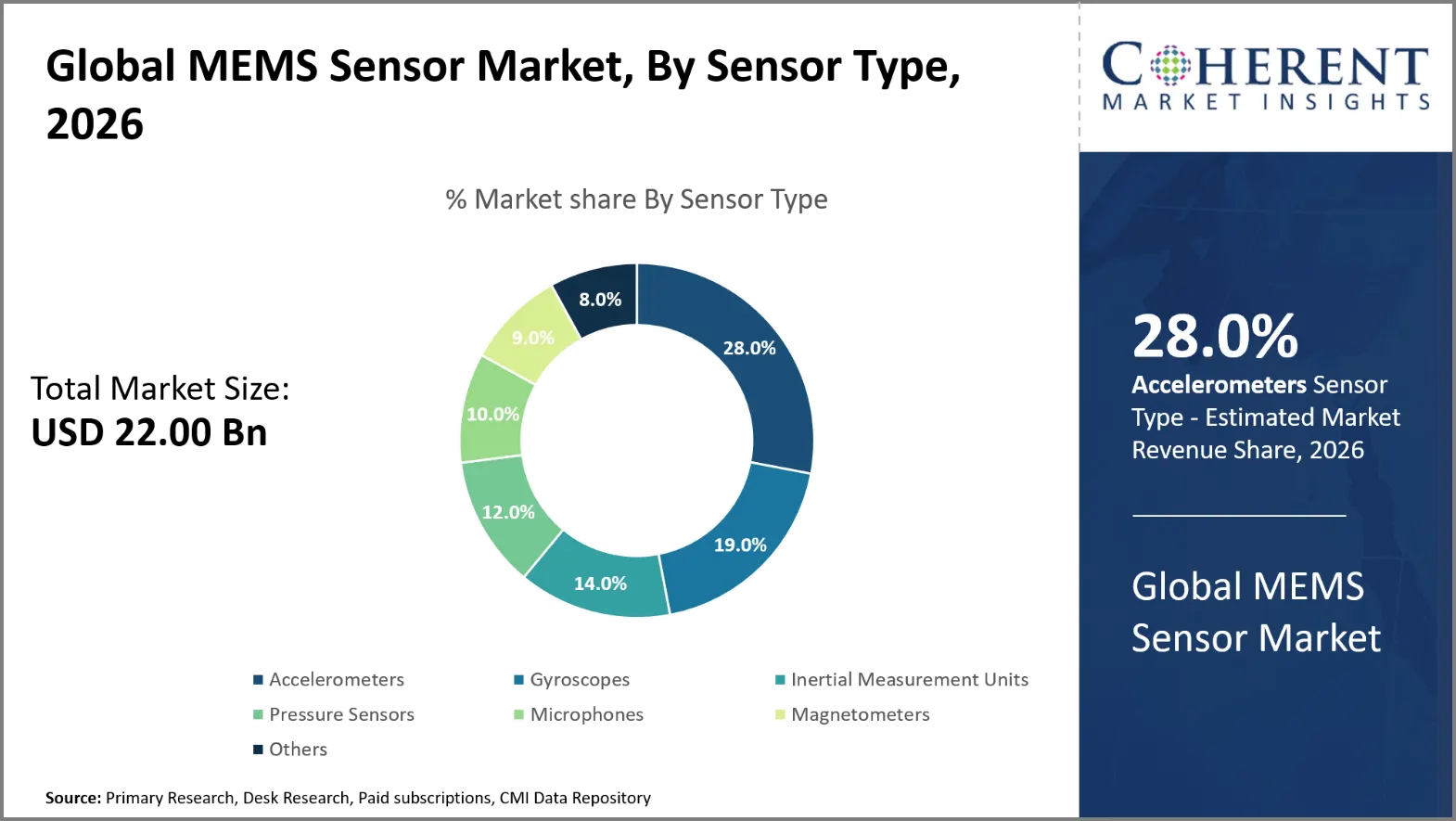
- The Accelerometers segment is expected to account for 28.0% of the global MEMS sensor market share in 2026. Expansion of industrial condition monitoring and predictive maintenance is driving the growth of the segment. On March 17, 2025, TDK Corporation launched the TDK SensEI edgeRX, which represents a significant leap forward in industrial maintenance, bringing cutting-edge innovation to the forefront of machine health monitoring.
- The Consumer Electronics segment is estimated to capture 34.0% of the market share in 2026. Increasing adoption of MEMS sensors in smartphones and wearables is majorly driving the growth of the segment. On January 7, 2026, TDK Corporation announced a suite of InvenSense SmartMotion custom sensing solutions for more intuitive user experiences with TWS ear buds, AI glasses, augmented reality eyewear, smart watches, fitness bands, and other IoT devices.
- The Smartphones and Tablets segment is estimated to capture 27.0% of the market share in 2026. Growing demand for compact low-power sensing technologies is majorly driving the growth of the segment. On May 13, 2025, STMicroelectronics introduced the LSM6DSV320X inertial measurement unit for personal electronics and Internet of Things devices. The device combines dual MEMS accelerometers with embedded artificial intelligence.
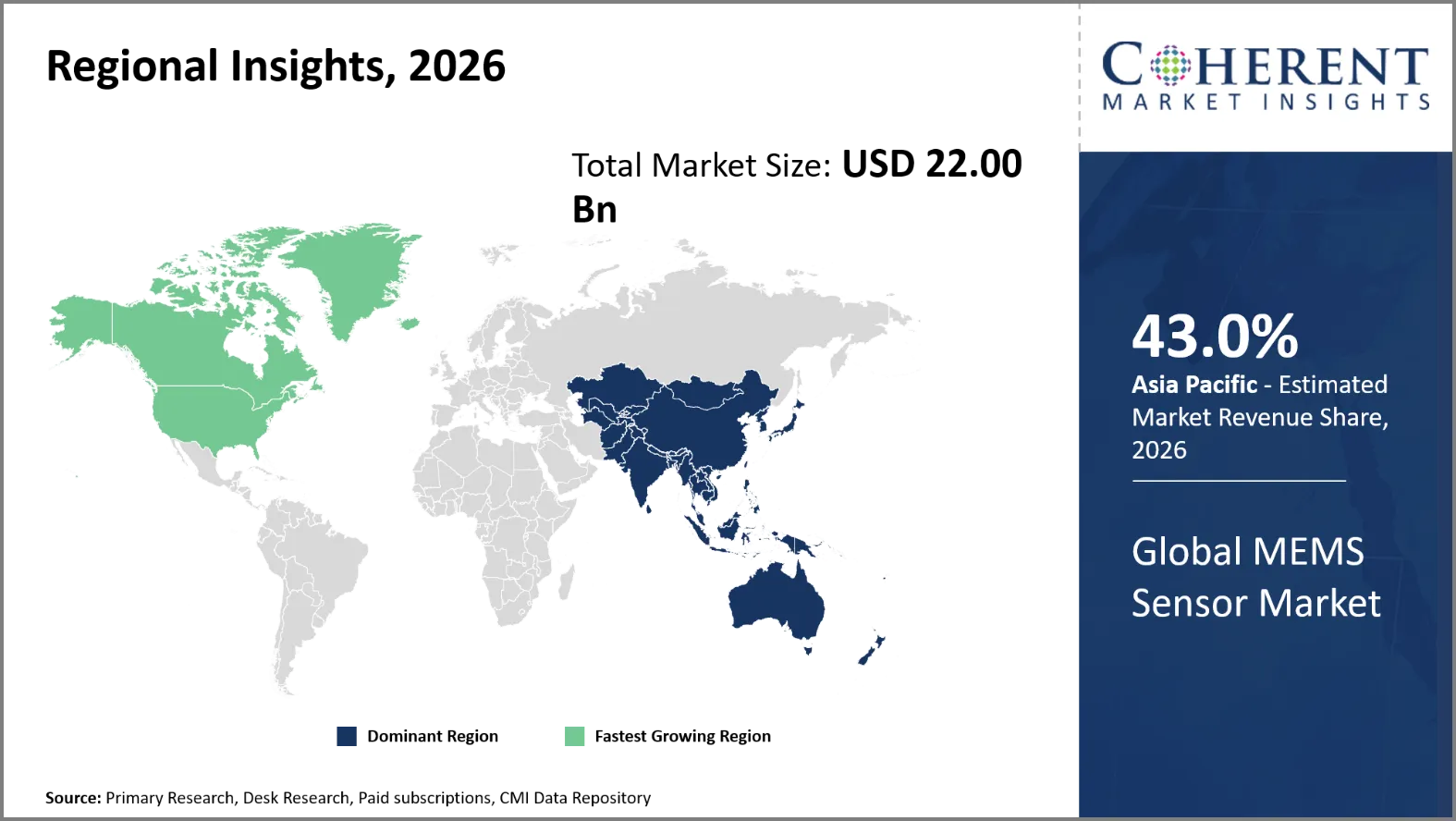
- Asia Pacific is expected to dominate the MEMS sensor market in 2026 with a market share of 43.0%. Growing use of advanced inertial sensors for robotics and navigation in Asia Pacific is driving the growth of the regional market. On January 8, 2025, Murata Manufacturing launched the SCH16T-K10 six-axis inertial sensor for drones and robotics. The device provides a ±2,000 degrees-per-second gyroscope range and ±16 g acceleration range.
- North America is expected to account for 27.0% share in 2026 and is projected to record the fastest growth over the forecast period. Increasing development of MEMS biosensors for continuous health monitoring in North America is driving the growth of the regional market. On July 1, 2025, MY01 launched its Continuous Perfusion Sensing Technology Platform. The platform uses MEMS sensing to provide continuous real-time perfusion measurements.
Segmental Insights
Why Does Accelerometers Dominate the Global MEMS Sensor Market?
The accelerometers segment is expected to account for 28.0% of the global MEMS sensor market share in 2026. Accelerometers have broad adoption across automotive, consumer electronics, industrial equipment, and wearable devices. Their compact size enables integration into smartphones, fitness trackers, vehicle systems, and industrial monitoring equipment. They detect motion, vibration, tilt, and shock with low power consumption and rapid response. Automotive applications increasingly use accelerometers for airbag deployment, electronic stability control, and vehicle safety systems. Growing demand for motion sensing across connected devices continues to expand their application base. On May 5, 2026, TDK Corporation introduced SensorStage software for developing and evaluating SmartMotion inertial measurement units. The platform supports evaluation of machine-learning algorithms, sensor fusion, motion detection, and power optimization. TDK targets smart glasses, wearables, optical image stabilization, and Internet of Things applications.
- Current Industry Events of 2026
- Market Size Estimation
- Regional Breakdown
- Competitive Landscape
- Customer Intelligence
- Segmental Analysis
- Pricing Analysis
- Key Market Drivers, Challenges & Future Trends
- Customized Insights Section
Why is Consumer Electronics the Most Widespread Application?
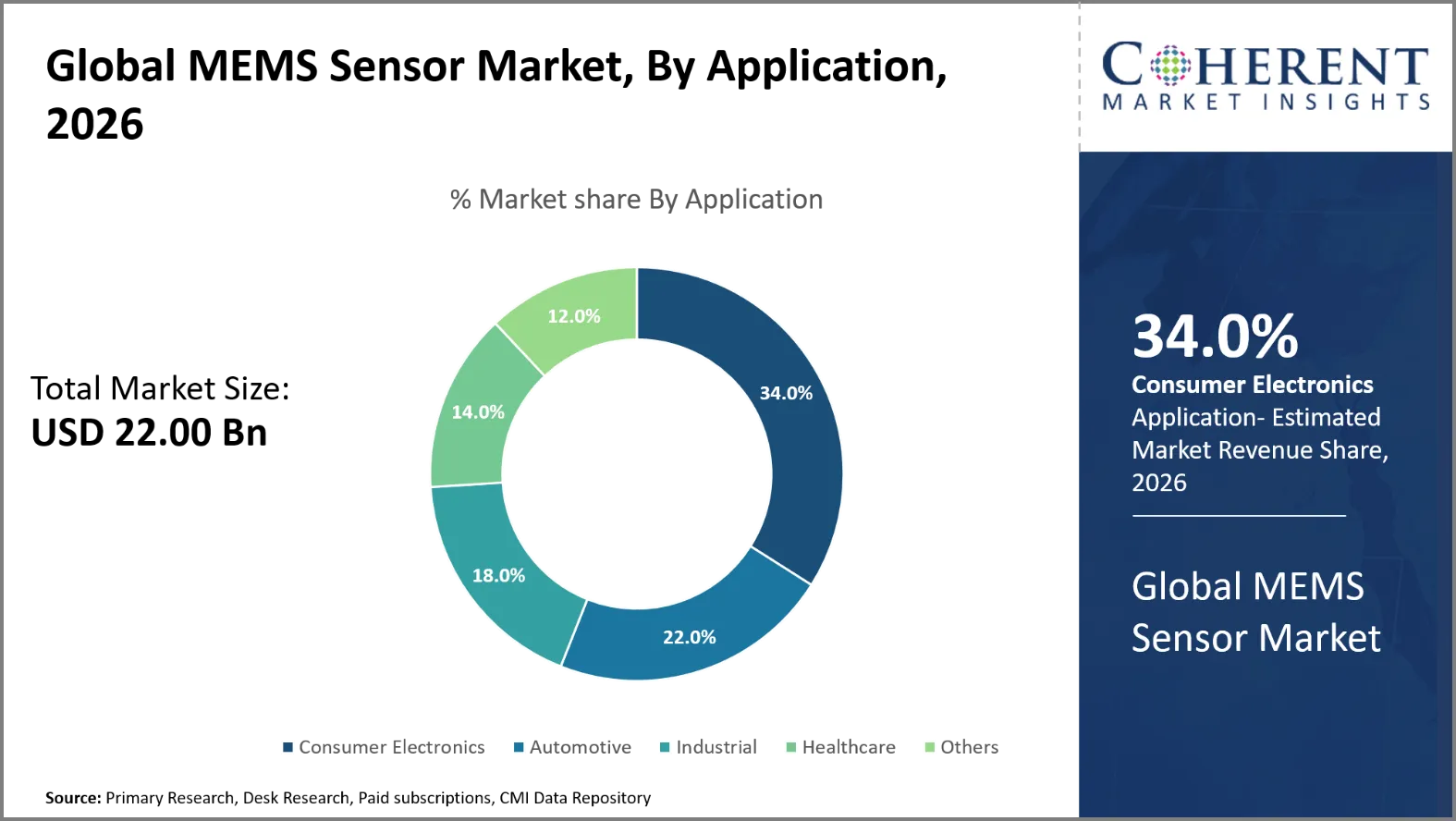
The consumer electronics segment is expected to account for 34.0% of the global MEMS sensor market share in 2026. Consumer electronics increasingly require compact sensing components for motion detection, orientation tracking, and user interaction. MEMS sensors support smartphones, tablets, wearables, gaming devices, and smart home products. Their small footprint allows manufacturers to integrate multiple sensing functions within space-constrained devices. Low power consumption also supports longer battery life across portable electronic products. Rising demand for connected and feature-rich consumer devices continues to expand MEMS sensor integration. On January 6, 2026, Bosch Sensortec launched the BMI5 motion sensor platform for next-generation consumer devices. The platform includes BMI560, BMI563, and BMI570 variants. The BMI560 targets extended-reality headsets, smart glasses, smartphones, and action cameras. The BMI570 supports activity and context recognition in wearables and hearables.
Smartphones and Tablets Dominates the Global MEMS Sensor Market
The smartphones and tablets segment is expected to account for 27.0% of the global MEMS sensor market share in 2026. Smartphones and tablets require multiple sensing functions for navigation, orientation, motion detection, and user interaction. MEMS accelerometers and gyroscopes support screen rotation, image stabilization, gaming, and motion-based applications. Pressure sensors can enhance altitude estimation and location-related functions in mobile devices. Their compact dimensions and low power consumption suit increasingly thin and battery-powered electronics. Growing device functionality continues to increase the number of MEMS sensors integrated into mobile products. On august 7, 2025, TDK Corporation announced production availability of its ICM-536xx six-axis MEMS inertial measurement units. The devices support optical image stabilization in smartphones, tablets, and cameras. The solution improves stabilization performance during photography and video recording.
Current Events and their Impact
Current Events | Description and its Impact |
European Union Cyber Resilience Act |
|
European Union Radio Equipment Cybersecurity Requirements |
|
MEMS Sensor Market Dynamics
Market Drivers
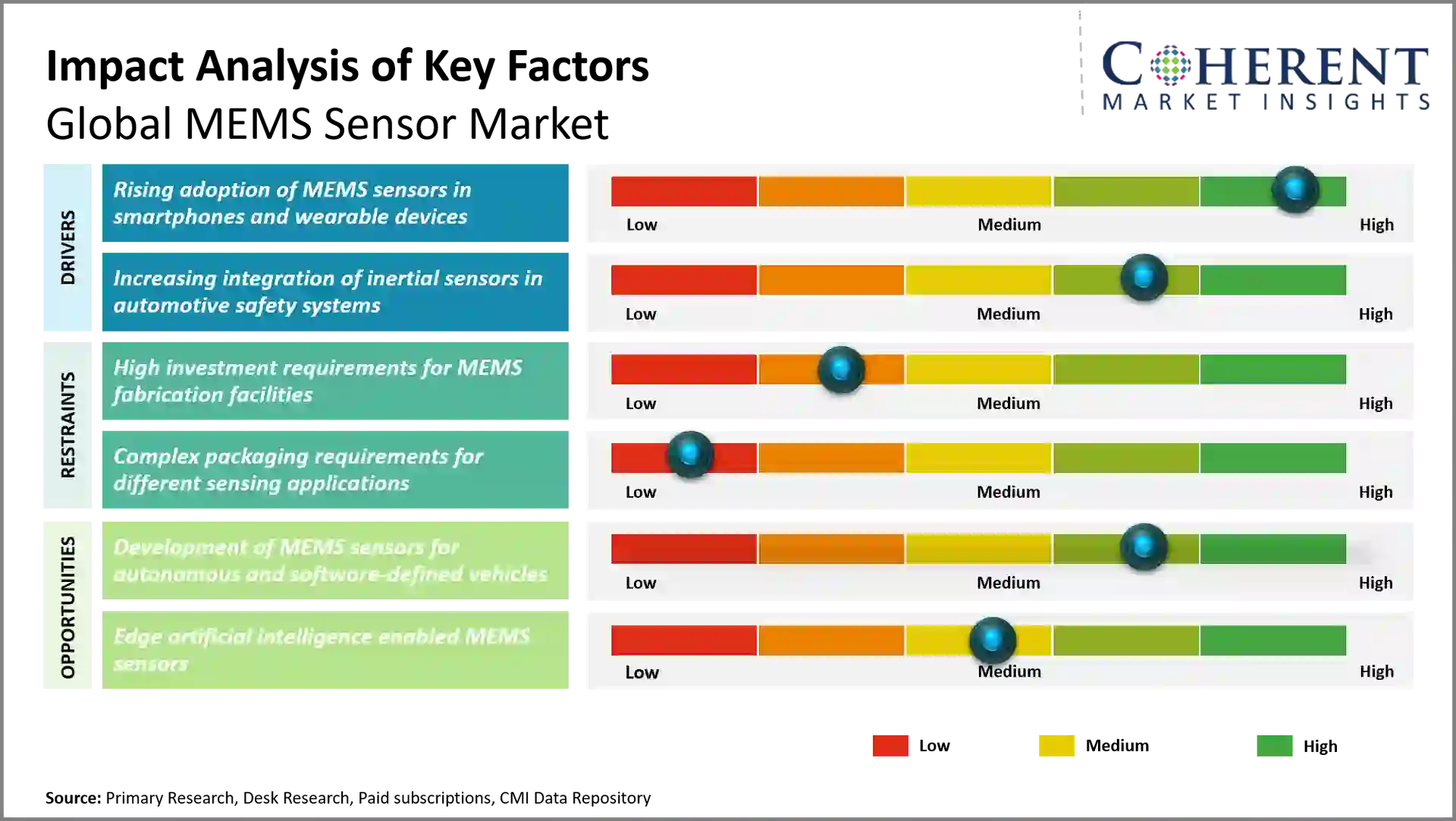
Rising adoption of MEMS sensors in smartphones and wearable devices
Smartphones and wearable devices increasingly integrate MEMS sensors for motion tracking and orientation detection. Accelerometers and gyroscopes support screen rotation, gaming, fitness tracking, and image stabilization. Pressure sensors can support altitude estimation and navigation functions. Their compact dimensions and low power consumption suit increasingly portable electronic designs. Growing demand for connected devices continues expanding MEMS sensor integration across consumer electronics.
On May 28, 2026, USound announced a collaboration with WuQi Technologies to advance the deployment of its proprietary biosensing platform in next-generation wearable devices. The solution is designed for wearable applications such as True Wireless Stereo (TWS) earbuds, OTC hearing aids, and sleep earbuds, where compact form factor, battery efficiency, and integration simplicity are critical challenges.
Increasing integration of inertial sensors in automotive safety systems
Automakers increasingly integrate MEMS inertial sensors into advanced vehicle safety systems. Accelerometers and gyroscopes provide motion data for electronic stability control and rollover detection. These sensors also support airbag systems, braking functions, and vehicle dynamics monitoring. Higher automation levels require accurate real-time measurements of vehicle movement and orientation. Expanding vehicle safety requirements therefore support greater adoption of automotive MEMS inertial sensors.
On September 3, 2025, Bosch presented its SMU300 and SMI980 MEMS inertial sensors at IAA Mobility 2025. The sensors measure acceleration, rotation, and vehicle tilt for advanced driver assistance systems. The SMU300 supports ASIL-D safety architectures and AEC-Q100 Grade 1 qualification. Bosch designed the sensors for software-defined vehicles requiring precise vehicle motion data.
Emerging Trends
- Edge intelligence integration: MEMS sensors increasingly combine sensing with local processing capabilities, enabling faster decisions and reduced data transmission requirements. This trend supports autonomous vehicles, industrial monitoring, robotics, and wearable devices requiring responsive sensing with lower communication latency and energy consumption.
- Advanced inertial sensing: High-performance inertial MEMS sensors are gaining importance for autonomous navigation, industrial robotics, drones, and advanced driver assistance systems. Manufacturers are developing smaller sensors with improved accuracy, lower noise, and greater stability for demanding motion measurement applications.
- MEMS health sensing: Healthcare applications increasingly incorporate MEMS technologies for physiological monitoring, diagnostics, and wearable medical devices. Miniaturized sensors can measure pressure, motion, temperature, and other parameters, supporting continuous monitoring and enabling increasingly compact healthcare equipment and connected medical systems.
- Smart automotive sensor integration: Automotive manufacturers are integrating multiple MEMS sensors across safety, navigation, vehicle dynamics, and automated driving systems. Sensor fusion combines data from accelerometers, gyroscopes, pressure sensors, and other devices to improve vehicle awareness, stability, and control.
Regional Insights
Why is Asia Pacific a Strong Market for MEMS Sensor?
Asia Pacific is expected to account for a market share of 43.0% in 2026. Asia Pacific benefits from dense electronics manufacturing across smartphones, wearables, automotive systems, and industrial equipment. China, South Korea, and Japan host major device and vehicle manufacturers using MEMS extensively. Bosch reports that MEMS production supports smartphones, wearables, virtual reality devices, and Internet of Things nodes. Taiwan also has advanced semiconductor manufacturing capabilities supporting specialized sensor fabrication. South Korea’s smartphone and automotive industries create demand for accelerometers, gyroscopes, pressure sensors, and microphones. Japan’s robotics and factory automation industries create additional demand for precise motion and vibration sensing. These manufacturing clusters support rapid sensor integration across multiple end-use products.
Why Does North America MEMS Sensor Market Exhibit High Growth?
North America is expected to register the fastest growth with a CAGR of 6.8% over the forecast period. It is projected to account for 27.0% of the global MEMS sensor market in 2026. North America benefits from strong demand for MEMS sensors in aerospace, medical devices, industrial automation, and advanced vehicles. U.S. technology companies use inertial sensing extensively in smartphones, wearable devices, robotics, and navigation equipment. Automotive developers increasingly require inertial measurement units for driver assistance and automated driving functions. Bosch describes six-dimensional inertial measurement for yaw, pitch, roll, and three-axis acceleration. Aerospace applications also require compact inertial sensors for navigation and stabilization. Healthcare manufacturers use MEMS components in monitoring equipment and implantable technologies. Strong research capabilities further support development of high-precision sensors for demanding applications.
Global MEMS Sensor Market Outlook for Key Countries
Why is China Emerging as a Major Hub in the MEMS Sensor Market?
China benefits from large-scale smartphone manufacturing and extensive electric vehicle production. MEMS microphones, accelerometers, gyroscopes, and pressure sensors are integrated across mobile devices and connected electronics. Domestic electric vehicle manufacturers increasingly deploy sensors for battery monitoring, vehicle dynamics, safety, and navigation. China’s industrial automation expansion also supports MEMS vibration sensors for equipment monitoring. Robotics manufacturers require compact inertial components for positioning, balancing, and movement control. Consumer electronics production creates additional demand for camera stabilization and motion sensing. Local semiconductor development is also increasing attention toward domestic sensor supply chains and advanced packaging capabilities. These applications create multiple demand channels beyond smartphones.
Is U.S. the Next Growth Engine for the MEMS Sensor Market?
U.S. demand is supported strongly by aerospace, defense, healthcare, robotics, and autonomous mobility applications. MEMS inertial sensors provide motion information for navigation systems used in aircraft, drones, robots, and autonomous platforms. Medical equipment manufacturers use MEMS pressure and motion sensing for monitoring and diagnostic devices. Automotive technology companies increasingly develop advanced driver assistance systems requiring precise inertial measurements. Industrial manufacturers deploy vibration sensors for predictive equipment maintenance and machine health monitoring. Wearable technology companies also integrate accelerometers and gyroscopes for fitness and activity tracking. These applications favor sensors offering high accuracy, compact dimensions, low power consumption, and strong environmental stability.
Germany MEMS Sensor Market Analysis and Trends
Germany benefits from its strong automotive engineering and industrial automation ecosystem. Bosch manufactures MEMS sensors entirely in-house at facilities in Reutlingen and Dresden. Bosch produces more than four million MEMS sensors daily for mobility and consumer electronics applications. German automotive manufacturers use inertial sensors for stability control, safety systems, and automated driving. Bosch also introduced a new generation of high-performance MEMS inertial sensors at IAA Mobility 2025. Industrial automation provides another important application through vibration, pressure, and motion monitoring. Germany’s automotive semiconductor ecosystem therefore supports continued MEMS technology development.
Japan MEMS Sensor Market Analysis and Trends
Japan benefits from strong demand from automotive manufacturing, robotics, factory automation, cameras, and precision equipment. Japanese manufacturers use MEMS accelerometers and gyroscopes for stabilization, navigation, and motion control applications. Robotics systems require accurate inertial measurements for balancing, positioning, and coordinated movement. Factory automation creates demand for vibration sensors that identify mechanical abnormalities in motors, pumps, and precision machinery. Automotive suppliers also integrate MEMS devices into stability control and advanced driver assistance systems. Japanese camera and electronics manufacturers use MEMS components for optical stabilization and motion compensation. Strong precision manufacturing expertise supports development of highly reliable sensors for demanding industrial environments.
South Korea MEMS Sensor Market Analysis and Trends
South Korea benefits from extensive smartphone, semiconductor, display, and automotive manufacturing. Major electronics manufacturers integrate MEMS accelerometers, gyroscopes, microphones, and pressure sensors into mobile and wearable products. Automotive manufacturers increasingly use inertial sensing for electronic stability control, navigation, and advanced driver assistance. Semiconductor expertise also supports advanced packaging and miniaturized sensor development. Robotics and smart factory investments create additional demand for motion and vibration sensing. MEMS microphones support voice interfaces across smartphones, earbuds, laptops, and smart devices. The combination of high-volume electronics production and advanced semiconductor engineering creates diverse opportunities for sensor integration across consumer and industrial applications.
Global MEMS Sensor Market - MEMS Inertial Sensor Adoption in Humanoid Robots by Region (2026)
Region | Estimated MEMS Inertial Sensor Adoption |
Asia Pacific | 95% |
North America | 92% |
Europe | 90% |
Rest of World | 80% |
Global Average | 92% |
Global MEMS Sensor Market - MEMS Sensor Deployment in Drones and Unmanned Aerial Vehicles (2025)
Region | MEMS-equipped UAV penetration | Average 6-axis IMUs per UAV | Redundant IMU deployment | Barometric MEMS sensor deployment | 9-axis MEMS deployment | High-performance IMU deployment |
Asia Pacific | 97% | 1.8 | 38% | 82% | 54% | 43% |
North America | 96% | 2.0 | 46% | 86% | 61% | 55% |
Europe | 95% | 1.9 | 43% | 84% | 58% | 52% |
Rest of World | 89% | 1.5 | 25% | 69% | 39% | 31% |
Global Average | 95% | 1.8 | 39% | 81% | 54% | 46% |
How is Development of MEMS Sensors for Autonomous And Software-Defined Vehicles Creating New Growth Opportunities in the MEMS Sensor Market?
Development of MEMS sensors for autonomous and software-defined vehicles is creating opportunities for higher-performance inertial sensing and sensor fusion. Bosch introduced a new MEMS inertial sensor generation for advanced vehicle applications at IAA Mobility 2025. These sensors combine acceleration and angular-rate measurements for vehicle motion estimation. Advanced driver assistance systems increasingly require accurate motion data for automated lane changes, stability control, and automated parking. Software-defined architectures also increase demand for programmable sensor interfaces and continuous sensor diagnostics. This creates opportunities for suppliers developing automotive-grade inertial measurement units with lower noise, higher stability, and stronger functional safety capabilities.
On January 7, 2025, NXP Semiconductors N.V. announced that it has entered into a definitive agreement to acquire TTTech Auto in a transaction valued at USD 625 million. TTTech Auto, based in Vienna, Austria, is a leader in innovating unique safety-critical systems and middleware for software-defined vehicles (SDVs).
Market Players, Key Development, and Competitive Landscape
Key Developments
- On September 16, 2025, Bosch Sensortec and Espressif Systems announced a strategic collaboration to introduce the ESP SensairShuttle universal sensor development platform. Integrating Bosch Sensortec’s high-performance MEMS sensors with Espressif’s wireless SoC technology, the platform is designed for education, research, and multi scenario application validation.
- On June 25, 2025, TDK Corporation expanded its MEMS inertial sensors portfolio with the Tronics AXO315T0, a high-temperature MEMS accelerometer with ±14 g input range and a digital interface for measurement while drilling (MWD) applications in the energy market.
- On January 16, 2025, Infineon Technologies AG announced the formation of a new business unit to drive the company’s growth in the area of sensors by combining the existing Sensor and Radio Frequency (RF) businesses into one dedicated organization. The new business unit SURF will be part of the Power & Sensor Systems (PSS) division.
Competitive Landscape
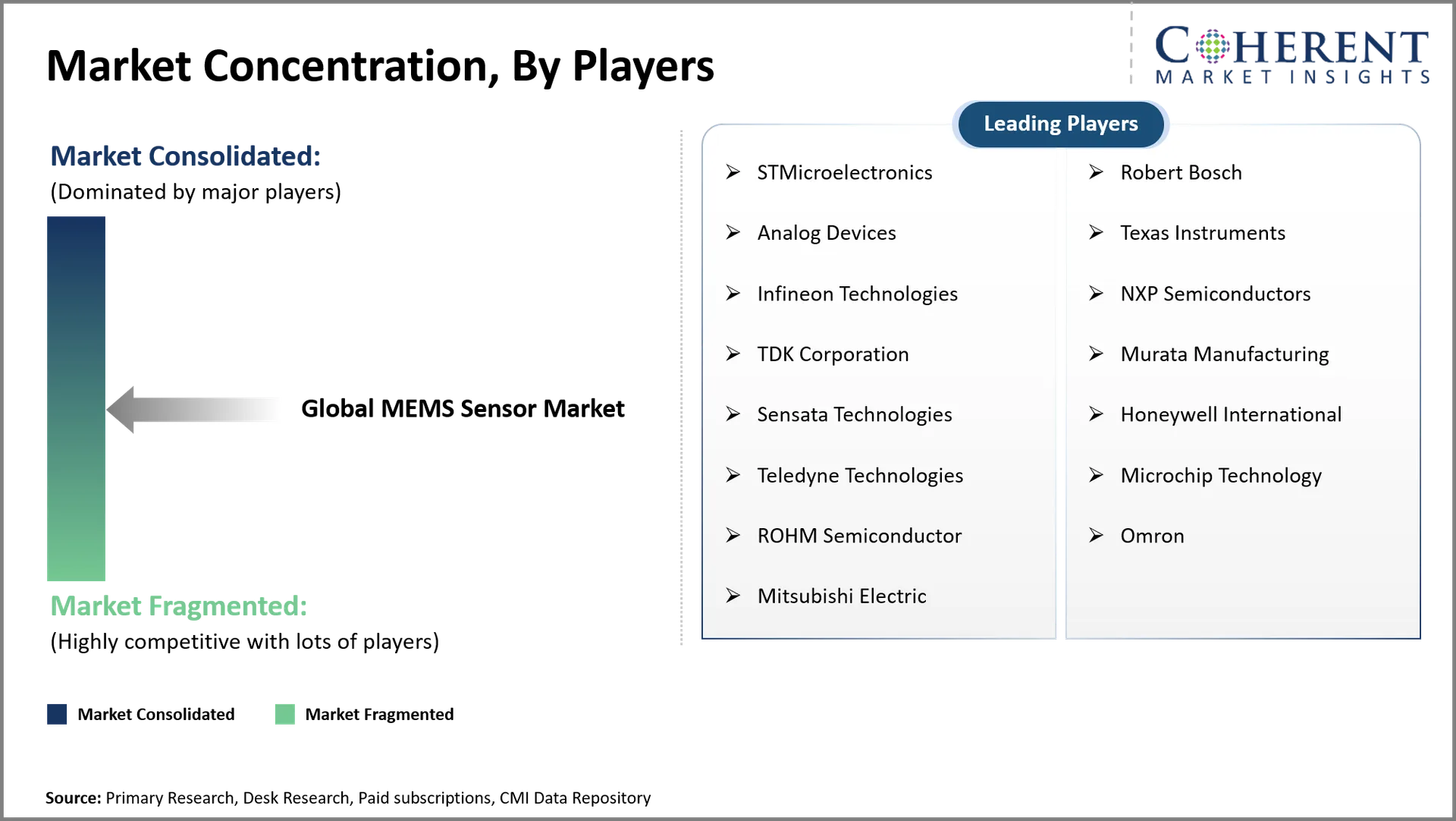
The MEMS sensor market features strong competition among Bosch, STMicroelectronics, Analog Devices, TDK Corporation, and Murata Manufacturing. Bosch focuses on automotive safety, automated driving, consumer electronics, and in-house manufacturing. Bosch produces more than four million MEMS sensors daily in Reutlingen and Dresden. Its SMU300 targets software-defined vehicles with lower noise, reduced drift, and Automotive Electronics Council qualification. STMicroelectronics strengthened automotive and industrial capabilities after completing its NXP MEMS acquisition in February 2026. ST also combines MEMS, microcontrollers, embedded intelligence, and edge artificial intelligence for industrial and automotive applications. Analog Devices emphasizes precision sensing for industrial, automotive, healthcare, and instrumentation applications. TDK Corporation and Murata Manufacturing focus strongly on miniaturization, inertial sensing, automotive electronics, and consumer devices.
Market Report Scope
MEMS Sensor Market Report Coverage | |||
Report Coverage | Details | ||
Base Year | 2025 | Market Size in 2026: | USD 22.00 Bn |
Historical Data For: | 2020 To 2024 | Forecast Period: | 2026 To 2033 |
Forecast Period 2026 To 2033 CAGR: | 6.1% | 2033 Value Projection: | USD 31.50 Bn |
Geographies covered: |
| ||
Segments covered: |
| ||
Companies covered: | STMicroelectronics, Robert Bosch, Analog Devices, Texas Instruments, Infineon Technologies, NXP Semiconductors, TDK Corporation, Murata Manufacturing, Sensata Technologies, Honeywell International, Teledyne Technologies, Microchip Technology, ROHM Semiconductor, Omron, Mitsubishi Electric | ||
Growth Drivers: |
| ||
Restraints & Challenges: |
| ||
Analyst Opinion (Expert Opinion)
- The industry is likely to shift from standalone sensors toward intelligent sensing platforms. Edge processing will become increasingly important for robotics, vehicles, wearables, and industrial equipment. STMicroelectronics already embeds machine learning functions within selected MEMS devices. Bosch is also developing high-performance inertial sensors for automated driving systems. This direction will increase demand for sensors combining measurement, processing, diagnostics, and application-specific algorithms. Suppliers should therefore prioritize integrated sensing architectures instead of competing primarily on sensor component specifications.
- The strongest opportunities should center on inertial sensors, pressure sensors, and intelligent accelerometers. Automotive applications offer substantial room for advanced inertial measurement units supporting automated driving and vehicle dynamics. Industrial applications can expand through vibration monitoring and predictive maintenance. STMicroelectronics already markets MEMS accelerometers with embedded machine learning and intelligent sensor processing. China, Japan, South Korea, and Germany should remain important focus countries because of their automotive, electronics, robotics, and manufacturing ecosystems. Suppliers should also target robotics and humanoid systems, where precise motion sensing supports balance, navigation, and movement control.
- Players should differentiate through sensor intelligence, automotive qualification, manufacturing control, and application-specific software. Bosch demonstrates the value of controlling MEMS production internally across major manufacturing stages. STMicroelectronics demonstrates another route by combining MEMS, embedded processing, edge artificial intelligence, and microcontrollers. Companies should develop sensor platforms supporting local analytics, sensor fusion, and predictive diagnostics. They should also strengthen partnerships with automotive suppliers, robotics developers, and industrial equipment manufacturers. Faster customization and longer product lifecycles can further improve customer retention.
Speak to the analyst
Want personalized insights?
Take the findings above to one of our principal consultants, or have the report rebuilt around the segments, geographies and competitors you actually track.
Market Segmentation
- Sensor Type Insights (Revenue, USD Billion, 2021 - 2033)
- Accelerometers
- Gyroscopes
- Inertial Measurement Units
- Pressure Sensors
- Microphones
- Magnetometers
- Others
- Application Insights (Revenue, USD Billion, 2021 - 2033)
- Consumer Electronics
- Automotive
- Industrial
- Healthcare
- Others
- End User Insights (Revenue, USD Billion, 2021 - 2033)
- Smartphones and Tablets
- Wearable Devices
- Automobiles
- Industrial Equipment
- Medical Devices
- Drones and Robotics
- Aerospace Systems
- Smart Home Devices
- Regional Insights (Revenue, USD Billion, 2021 - 2033)
- North America
- U.S.
- Canada
- Latin America
- Brazil
- Argentina
- Mexico
- Rest of Latin America
- Europe
- Germany
- U.K.
- Spain
- France
- Italy
- Russia
- Rest of Europe
- Asia Pacific
- China
- India
- Japan
- Australia
- South Korea
- ASEAN
- Rest of Asia Pacific
- Middle East
- GCC Countries
- Israel
- Rest of Middle East
- Africa
- South Africa
- North Africa
- Central Africa
- North America
- Key Players Insights
- STMicroelectronics
- Robert Bosch
- Analog Devices
- Texas Instruments
- Infineon Technologies
- NXP Semiconductors
- TDK Corporation
- Murata Manufacturing
- Sensata Technologies
- Honeywell International
- Teledyne Technologies
- Microchip Technology
- ROHM Semiconductor
- Omron
- Mitsubishi Electric
Sources
Primary Research Interviews
- MEMS Device Manufacturers & OEMs
- Semiconductor Component Suppliers
- End-Use Industry Representatives (Automotive, Consumer Electronics, Healthcare)
- MEMS Sensor Distributors & System Integrators
Magazines
- Semiconductor Engineering Magazine
- MEMS & Nanotechnology News Magazine
- Electronic Design Magazine
- Sensors Magazine
Journals
- Journal of Microelectromechanical Systems (JMEMS)
- Journal of Sensors and Actuator Systems
- IEEE Transactions on Electron Devices
Associations
- SEMI (Semiconductor Equipment and Materials International)
- MEMS & Sensors Industry Group (MSIG)
- IEEE Sensors Council
Public Domain Sources
- U.S. Geological Survey (USGS) – Materials & Minerals Data
- European Commission – Electronics & Semiconductor Industry Reports
- U.S. International Trade Commission (USITC)
- World Trade Organization (WTO) – Trade Statistics
Proprietary Elements
- CMI Data Analytics Tool
- Proprietary CMI Existing Repository of Information for the Last 10 Years
Get access to 250+ pages report
Every segment, forecast, competitor profile and data table behind the analysis above — available for instant download.
- ESOMAR Member
- ISO 9001:2015 Certified
- D-U-N-S Registered
- GDPR & CCPA Compliant
Missing comfort of reading report in your local language? Find your preferred language:
Frequently Asked Questions
The global MEMS sensor market is expected to stand at USD 22.00 Bn in 2026 and is expected to reach USD 31.50 Bn by 2033.
The CAGR of the global MEMS sensor market is projected to be 6.1% from 2026 to 2033.
Rising adoption of MEMS sensors in smartphones and wearable devices and Increasing integration of inertial sensors in automotive safety systems are the major factors driving the growth of the global MEMS sensor market.
High investment requirements for MEMS fabrication facilities and Complex packaging requirements for different sensing applications are the major factors hampering the growth of the global MEMS sensor market.
In terms of sensor type, accelerometers segment is estimated to dominate the market revenue share in 2026.
Smartphones use accelerometers, gyroscopes, pressure sensors, and other MEMS devices for navigation and motion functions.
MEMS sensors provide acceleration and angular-rate measurements supporting vehicle stability and automated driving functions.