
Flat 45% off this market research report
Nov 26 – 29 · Direct purchase only · Not applicable to customized reports
Global Methane-to-Sustainable Aviation Fuel Market Size and Forecast – 2026 To 2033
The global methane-to-sustainable aviation fuel market is expected to grow from USD 0.26 Mn in 2026 to USD 31.8 Mn by 2033, at a compound annual growth rate (CAGR) of 98.7% over 2026–2033. Methane-to-sustainable aviation fuel (SAF) turns methane from biogas, renewable natural gas (RNG) and flare or industrial waste gas into drop-in jet fuel. The gas is reformed into synthesis gas and then converted through the Fischer-Tropsch or methanol-to-jet route, so the finished fuel can be blended into existing aircraft fuel systems. Most plants are still at demonstration stage, which explains the small starting base and the steep growth rate.
The market sits between aviation fuel and waste-gas supply. It grows with the wider Sustainable Aviation Fuel Market and draws on the gas volumes tracked in the Renewable Natural Gas Market. On June 6, 2026, IATA reported that global SAF production is expected to reach about 2.4 million tonnes in 2026, or about 0.8% of aviation fuel use. On September 17, 2026, the EASA report on ReFuelEU Aviation showed that SAF reached 2.8% of fuel supplied at EU airports in 2025. On the supply side, the IEA reported global biogases production of 1,785 PJ in 2025, giving fuel makers a large pool of methane that has not yet been tapped for aviation.
Key Takeaways of the Global Methane-to-Sustainable Aviation Fuel Market
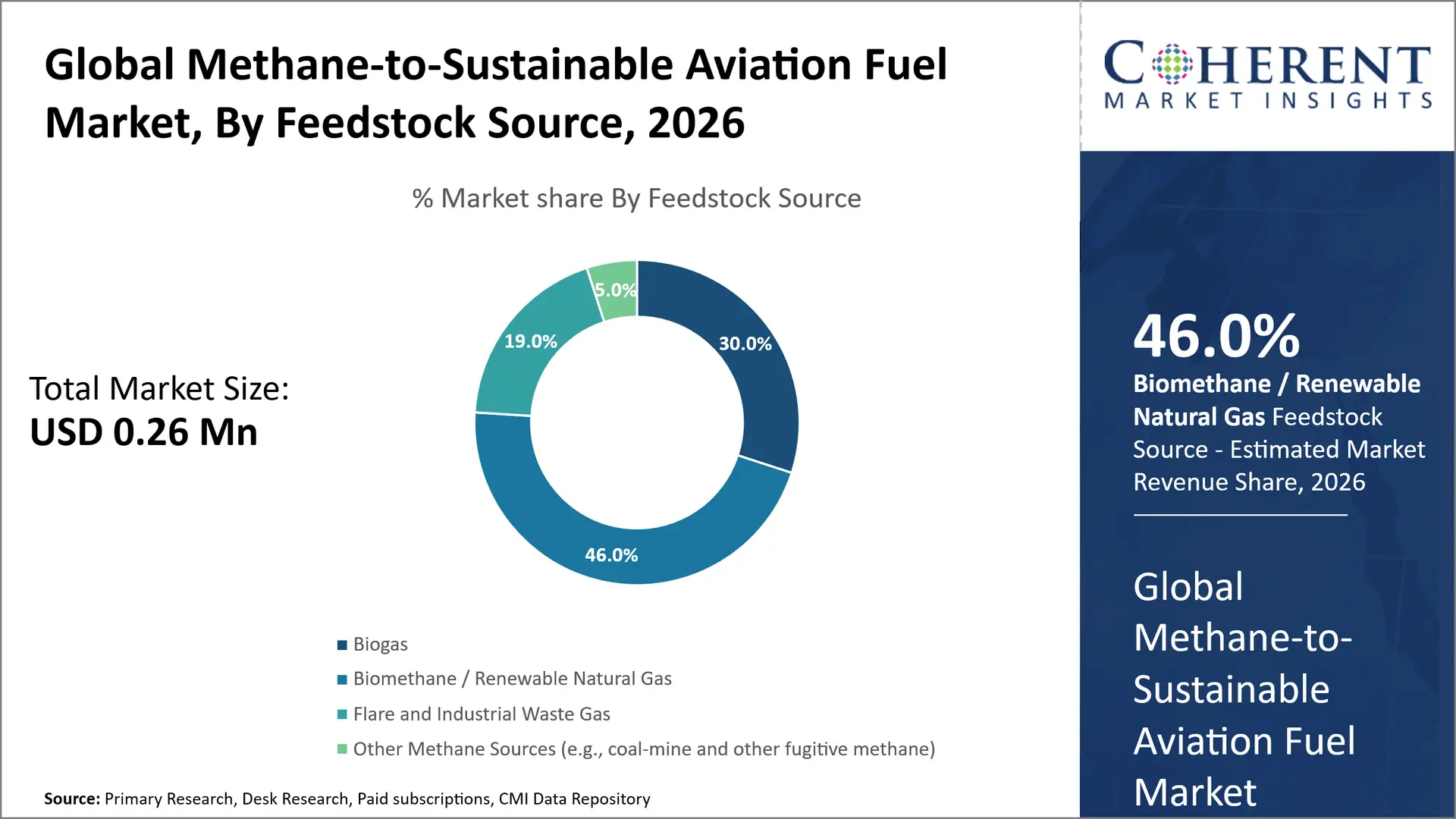
- By feedstock source, biomethane and renewable natural gas (RNG) is expected to account for 46.0% of the global methane-to-sustainable aviation fuel market share in 2026. It is pipeline-quality gas with the same properties as fossil natural gas, so reforming units built for fossil gas can take it without redesign, and it can be sourced from a landfill or digester far from the fuel plant.
- By conversion pathway, Fischer-Tropsch (FT-SPK) is expected to hold 72.0% share in 2026. It is the longest-established route from synthesis gas to jet-range hydrocarbons and has been approved for aviation use under ASTM D7566 since 2009, ahead of any other pathway in this market.
- By plant scale, demonstration and pilot plants below 100 barrels per day are expected to account for 84.0% share in 2026, because almost every methane-to-SAF facility built so far is a first-of-a-kind unit proving yield, uptime and carbon intensity.
- By end user, passenger airlines are expected to account for 66.0% share in 2026. They are the largest buyers of SAF and the main signers of the long-term offtake agreements that early producers need to raise finance.
- North America is expected to dominate the market in 2026, with a share of 44.0%. The region combines the world's largest biomethane output with the first integrated demonstration lines.
- Europe is expected to account for 24.0% share in 2026. SAF blending mandates create the demand pull, and research pilots keep technology development active.
- Asia Pacific is expected to account for 17.0% share in 2026 and register to be the fastest-growing region. Plentiful agricultural and municipal waste gas and airlines willing to sign supply deals early are drawing new projects to the region.
Segmental Insights
Why Does Biomethane / Renewable Natural Gas Dominate the Global Methane-to-Sustainable Aviation Fuel Market?
In terms of feedstock source, biomethane and renewable natural gas is expected to account for 46.0% of the global methane-to-sustainable aviation fuel market share in 2026. Biomethane is biogas that has been cleaned of carbon dioxide and trace impurities until it matches pipeline natural gas. That sameness is its commercial advantage. Reformers, catalysts and gas-handling equipment designed for fossil gas run on it with little change, and the gas can travel through the pipeline grid from a landfill or digester to a plant built near a fuel buyer, with the renewable volumes tracked on a mass-balance basis.
Topsoe sets out this logic in a technical article on RNG as a SAF feedstock. It describes using established gas-to-liquids technology, namely SynCOR autothermal reforming followed by Fischer-Tropsch synthesis, to convert pipeline-quality biogas into jet fuel with high carbon efficiency.
Buyers also look closely at origin. Carbon intensity depends on whether the gas came from a landfill, dairy manure or wastewater, so airlines and traders ask for project-level certification of the gas supply before they sign.
- Current Industry Events of 2026
- Market Size Estimation
- Regional Breakdown
- Competitive Landscape
- Customer Intelligence
- Segmental Analysis
- Pricing Analysis
- Key Market Drivers, Challenges & Future Trends
- Customized Insights Section
Why Does Fischer-Tropsch (FT-SPK) Lead the Conversion Pathway Segment?
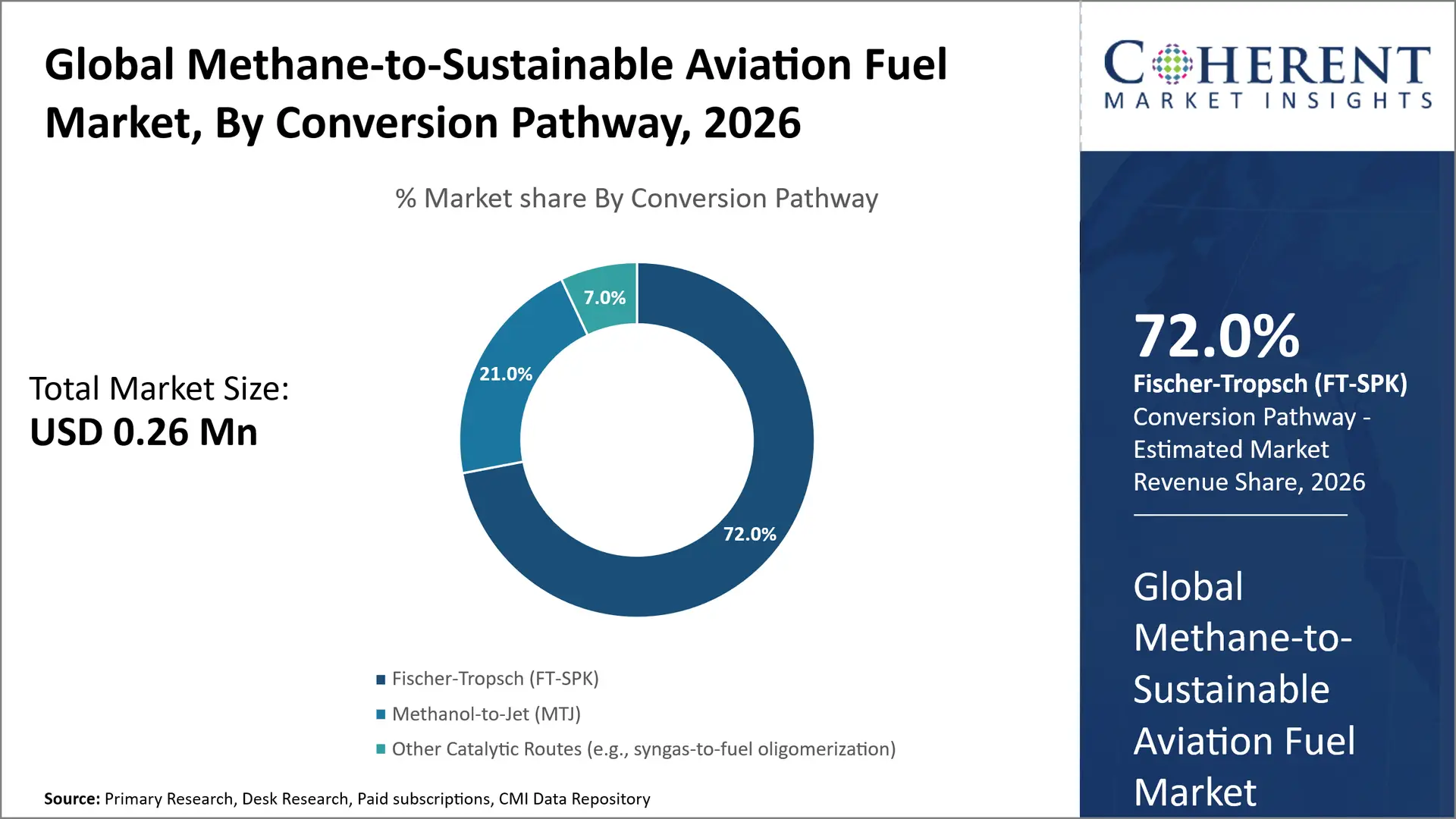
In terms of conversion pathway, Fischer-Tropsch (FT-SPK) is expected to account for 72.0% of the global methane-to-sustainable aviation fuel market share in 2026. Synthesis gas, a mix of carbon monoxide and hydrogen made by reforming methane, is passed over a catalyst that builds long hydrocarbon chains. These are then hydroprocessed and distilled into jet-range kerosene. FT-SPK was the first synthetic route approved under ASTM D7566, in 2009, for blends of up to 50% with conventional jet fuel, and decades of gas-to-liquids operation give lenders a reference point that newer routes do not yet have.
Suppliers are now shrinking the technology to fit small gas sources. On February 19, 2026, Velocys announced a capital-cost reduction of more than 30% for deployment of its microFTL technology, achieved by standardising key reactor and module design elements and improving how they are fabricated and delivered. The company reported that performance and technology readiness were unchanged.
A share of FT output leaves the plant as naphtha or diesel, which gives operators a second revenue line and is the reason upgrading units are designed together with the reactor.
Why Do Demonstration and Pilot Plants Lead the Plant Scale Segment?
In terms of plant scale, demonstration and pilot plants below 100 barrels per day are expected to account for 84.0% of the global methane-to-sustainable aviation fuel market share in 2026. Methane-to-SAF is at the stage where nearly every facility is a proof of design. Each unit is built to show yield, catalyst life, uptime and a certified carbon-intensity score, and the lessons are written back into larger designs. Spending on engineering, hardware and test fuel for these plants makes up most of the revenue, while the volume of fuel they produce stays small.
On September 29, 2026, Aether Fuels announced that its integrated 2.5 barrel-per-day demonstration line at Research Triangle Park, North Carolina, had produced synthetic aviation fuel meeting ASTM D7566 specifications. The line used mass-balanced RNG derived from landfill gas generated in Kentucky and industrial carbon dioxide as feedstocks, and Aether reported that it believes it is the first company in North America to produce ASTM-specification synthetic aviation fuel from mass-balanced RNG.
The step from demonstration to commercial scale is where cost and risk concentrate, so developers use each demonstration to fix equipment designs before they commit to larger plants.
Why Do Passenger Airlines Lead the End User Segment?
In terms of end user, passenger airlines are expected to account for 66.0% of the global methane-to-sustainable aviation fuel market share in 2026. Passenger carriers burn the most jet fuel, face the most visible customer and regulatory pressure to cut emissions, and can sign multi-year purchase agreements. A binding offtake is what lets an early producer raise project finance, so airline contracts decide which plants get built.
On October 28, 2026, Singapore Airlines and Aether Fuels announced that SIA has signed an agreement to buy up to 4,800 tons of next-generation SAF over three years, with deliveries starting in 2028. The fuel will come from Project Beacon in Singapore and will be produced from waste carbon feedstock, including biomethane and industrial waste gases. SIA is the first airline to purchase fuel from the plant, and the agreement was signed on October 23, 2026.
Current Events and their Impact
Current Events | Description and its Impact |
Binding offtake for biogas-based SAF in Uruguay (January 20, 2026) |
|
ASTM approval of the methanol-to-jet pathway (June 18, 2026) |
|
Methane-to-Sustainable Aviation Fuel Market Dynamics
Market Drivers
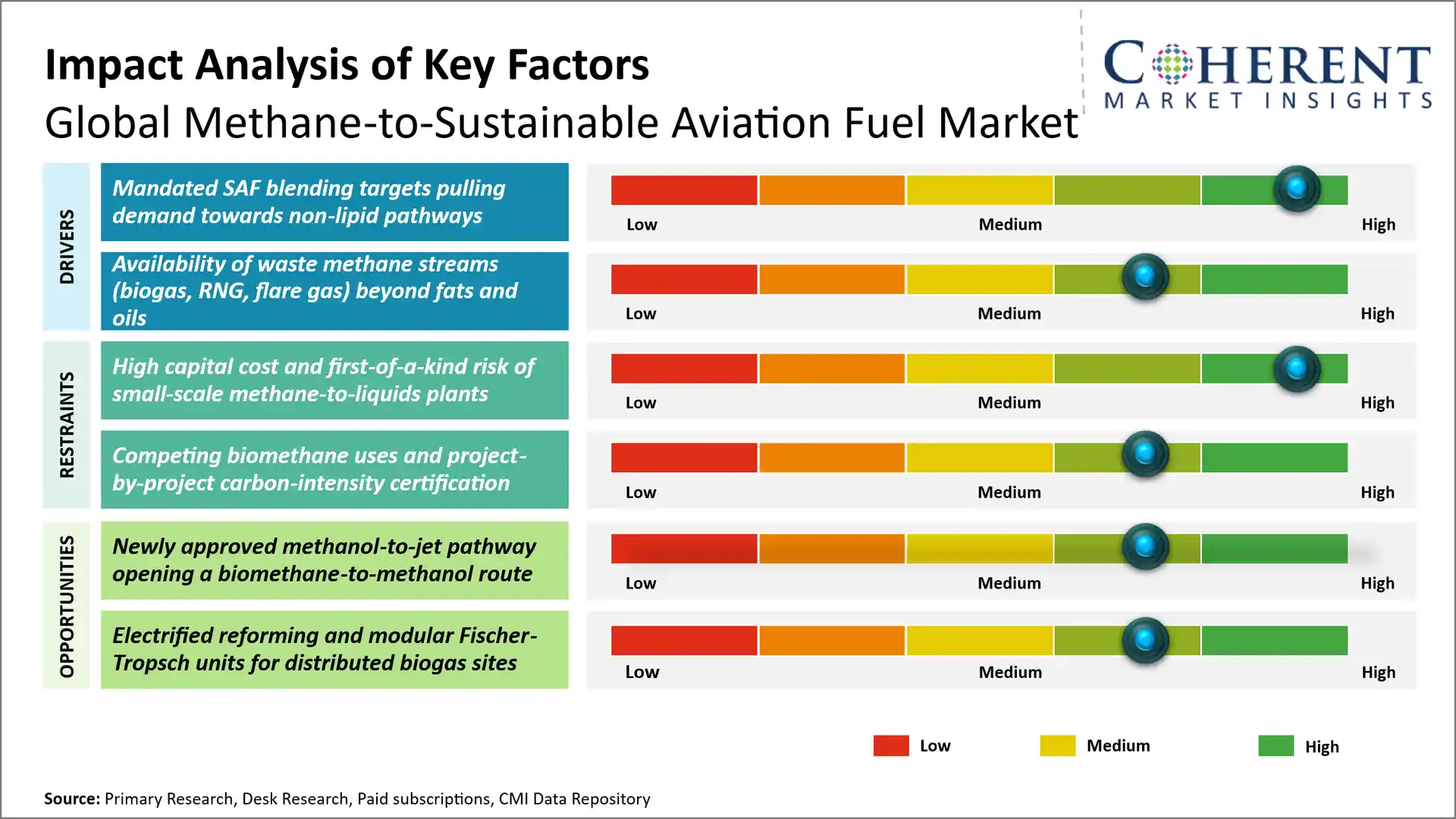
- Mandated SAF blending targets pulling demand towards non-lipid pathways: Fats and used cooking oil supply most SAF made so far, and those supplies are limited. Mandates keep raising the volume that fuel suppliers must deliver, so producers are turning to gas-based routes. The European Commission states that ReFuelEU Aviation requires a 2% SAF share at EU airports from 2025 and 70% by 2050, with a separate synthetic-fuel share of 1.2% from 2030 and 35% by 2050. Waste-derived gas converted to jet fuel can add to the overall SAF share where it meets the regulation's sustainability criteria, which makes methane-based plants a way to meet rising targets without competing for fats and oils.
- Availability of waste methane streams (biogas, RNG, flare gas) beyond fats and oils: Methane from landfills, farms, wastewater plants and flaring is produced whether or not a fuel plant exists, and it is cheapest where it is already collected. The IEA reports that emerging Asian economies typically have the lowest biogas costs, with 40 bcme available at below USD 10 per GJ. Developers can therefore site small plants at the gas source instead of moving bulky waste to a central facility.
Emerging Trends
- Standardised, factory-built Fischer-Tropsch modules for small gas sources: Reactor makers are moving from one-off designs to repeatable units that can be built in a workshop and shipped to the gas site. On July 14, 2026, Velocys announced a product roadmap that extends its microchannel Fischer-Tropsch technology to larger SAF projects, starting with the AlphaCore 400, a higher-capacity reactor that doubles the capacity of the AlphaCore 200 design.
- Impact: Plant makers can quote fixed designs instead of custom engineering, which shortens the path from permit to start-up.
- Relevance to the market: Standard modules lower the capital hurdle for biogas sites that were too small for conventional gas-to-liquids plants.
- Methanol as the bridge between biomethane and jet fuel: Methanol-to-jet splits the route in two: methanol is made first, then converted into jet-range fuel. On February 24, 2026, Honeywell announced that Verso Energy will use its UOP eFining methanol-to-jet technology at seven planned sites in France, Finland and the United States, with combined output of about 200 million gallons of eSAF per year. Those sites run on biogenic carbon dioxide and renewable hydrogen, but the same conversion step can take methanol made from biomethane.
- Impact: Methanol can be made at one site and upgraded at another, so small gas sources can feed a shared upgrading unit.
- Relevance to the market: This favors licensors with a proven methanol-to-jet unit that can accept methanol from more than one source.
Regional Insights
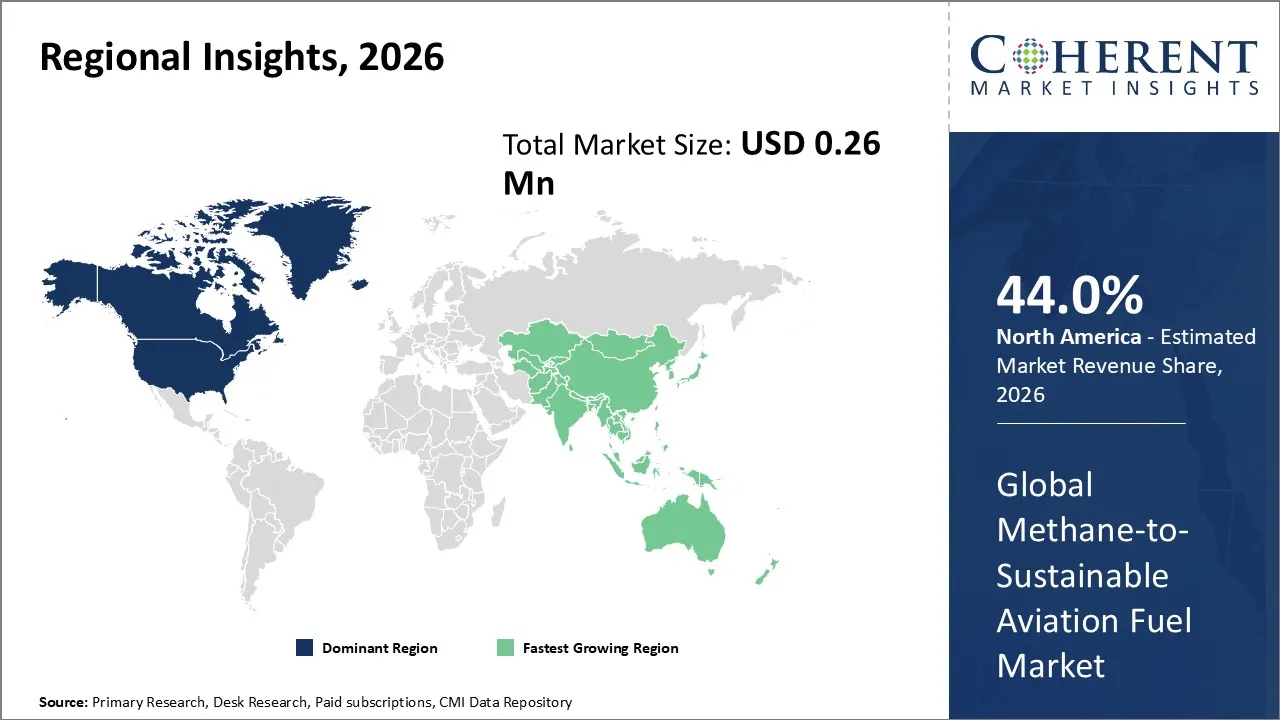
Why Does North America Lead the Global Methane-to-Sustainable Aviation Fuel Market?
North America is expected to account for a market share of 44.0% in 2026. The IEA reports that the United States supplies 38% of global biomethane and is the world's largest producer, and the region also has deep landfill, dairy and flare-gas supplies. Developers sit close to that gas. Chicago-based Aether Fuels runs its integrated line in North Carolina, and Infinium is building its Project Roadrunner electric steam methane reformer in Pecos, Texas.
Raven SR builds steam/CO2 reforming systems in Pinedale, Wyoming, that turn methane and landfill gas into Fischer-Tropsch fuels, including jet fuel, with hydrogen as a second product. Regional leadership in 2026 reflects where plants are being proven, since part of the early output is contracted to airlines in other regions.
Why Is Asia Pacific the Fastest-Growing Region in the Global Methane-to-Sustainable Aviation Fuel Market?
Asia Pacific is expected to account for 17.0% of the global market in 2026 and to register the fastest growth over the forecast period. The region has large volumes of agricultural and municipal waste, a SAF market that is still young, and airlines that sign supply deals early, so each new plant moves the regional total noticeably.
On September 9, 2025, Emerging Fuels Technology announced a memorandum of understanding with SAFasia Inc. to support the development of multiple SAF projects in the Philippines. Singapore and India, covered below, show two different entry points: an airline-led plant and a large untapped biogas base.
Global Methane-to-Sustainable Aviation Fuel Market Outlook for Key Countries
Is the U.S. the Largest Market for Methane-to-Sustainable Aviation Fuel?
The U.S. market is projected to reach USD 0.10 Mn in 2026, the largest of any country, with Canada adding USD 0.01 Mn to the North American total. The U.S. leads for three reasons: it has the largest biomethane output in the world, it hosts a dense group of developers, including Aether Fuels, Infinium and Raven SR, and it has the first integrated demonstration lines. Fuel buyers can also purchase renewable gas on a mass-balance basis, so a plant does not need to sit next to a landfill to claim renewable feedstock.
Europe Methane-to-Sustainable Aviation Fuel Market Analysis and Trends
Europe is projected to reach USD 0.06 Mn in 2026. The region has no commercial methane-to-SAF plant in operation, but it is where much of the technology is being developed and where the fuel will be sold. On June 1, 2023, ExxonMobil reported that it had begun producing methanol-to-jet fuel components at pilot-plant scale at its Machelen research facility in Belgium, with more than 100 gallons produced to that point, and that the fuel would have to be evaluated under ASTM D4054 before it could be used.
Singapore Methane-to-Sustainable Aviation Fuel Market Analysis and Trends
Singapore is projected to reach USD 0.03 Mn in 2026, the largest in Asia Pacific. On November 11, 2025, Aster and Aether Fuels announced Project Beacon, a commercial demonstration plant that will produce up to 50 barrels of fuel per day, or 2,000 tons per year. It will convert industrial waste gas and biomethane into CORSIA-certified SAF with a greenhouse gas reduction of more than 70% against conventional jet fuel, and the companies described it as the first commercial facility of its kind. Singapore leads the region because a home-based airline group, a major refining and chemicals base and a project partner sit within one city-state.
Uruguay Methane-to-Sustainable Aviation Fuel Market Analysis and Trends
Uruguay is projected to reach USD 0.02 Mn in 2026, the largest in Latin America. On July 16, 2025, Velocys announced that its Fischer-Tropsch technology had been selected for the world's first electrified biogas-to-SAF plant, NovaSAF 1 in Durazno. The country combines dairy and agro-industrial biogas with a power supply that is largely renewable, which is the pairing an electrified reactor needs.
India Methane-to-Sustainable Aviation Fuel Market Analysis and Trends
India is projected to reach USD 0.01 Mn in 2026. The IEA reports that India's sustainable biogas potential exceeds its natural gas consumption, yet less than 5% of it is currently used. That unused gas is the base on which future methane-to-SAF projects in the country would be built.
Global Methane-to-Sustainable Aviation Fuel Market – Routes from Methane to Jet Fuel and What Each Means for Plant Design
Route | Gas Conversion Step | Fuel Certification Basis | Representative Provider | Source |
Autothermal reforming plus low-temperature Fischer-Tropsch | Methane-rich gas, including biogas, is reformed to carbon monoxide and hydrogen, then built into long-chain paraffins | FT-SPK, ASTM D7566 Annex A1 | Topsoe and Sasol (G2L single-point licence) | |
Electrified steam methane reforming plus Fischer-Tropsch | Renewable electricity supplies process heat, so feed gas is not burned to run the reformer | FT-SPK, with carbon intensity certified for each project | Infinium (mSAF) | |
Light-driven reforming plus microchannel Fischer-Tropsch | A light-driven reactor converts biogas to synthesis gas; compact microchannel reactors build the paraffins | Synthetic paraffinic kerosene, assessed against ISCC-EU RFNBO documents | Syzygy Plasmonics with Velocys (NovaSAF) | |
Plasma reforming plus Fischer-Tropsch | A plasma-based system converts biogas and waste methane to synthesis gas; a separate platform converts it to SAF | FT-SPK, tested at pilot scale in Tulsa, Oklahoma | ReCarbon and Emerging Fuels Technology | |
Steam/CO2 reforming plus Fischer-Tropsch at small scale | Methane and landfill gas are reformed with steam and carbon dioxide; hydrogen is a second product | FT fuels, including Jet A, Jet B and JP-8 | Raven SR |
Does Methanol-to-Jet Give Small Gas Sites a Better Route Than Fischer-Tropsch?
Not in every case. The two routes suit different sites. Fischer-Tropsch keeps the whole chain in one plant, and microchannel reactors have shrunk it to a size that suits a single large biogas source. Methanol-to-jet splits the chain: ExxonMobil describes the process as converting methanol with high selectivity, with the methanol itself made first by commercially available third-party technology. That means several small gas sites could each make methanol and send it to one shared upgrading unit.
The choice depends on site size, how far methanol has to travel, and what each route has been certified for. Fischer-Tropsch has the longer track record, so most plants in this report use it. Methanol-to-jet is the newer route, and its approval gives developers a second option as small biogas projects multiply.
For project teams, the practical test is to compare the cost of building a full conversion plant at each gas site with the cost of building methanol units and a shared upgrader, then to check which route the airline buyer will accept for its carbon accounting.
Market Players, Key Development, and Competitive Landscape
Key Developments
- On September 21, 2026, Infinium announced the launch of mSAF, a sustainable aviation fuel platform based on methane. It converts renewable natural gas, biogas, flare gas and other qualified methane streams into low-carbon aviation fuel, using the company's Fischer-Tropsch technology with an electrified reformer, and carbon intensity will be assessed and independently certified for each project.
- On August 18, 2026, Syzygy Plasmonics announced a framework agreement with the International Finance Corporation to support a pipeline of SAF projects across Latin America. IFC will provide technical and commercial advisory services, Syzygy targets up to one million metric tons of annual SAF capacity in Brazil by 2035, and individual IFC investments have not yet been approved.
- On May 29, 2026, Velocys and Tetracore GTL Limited signed a memorandum of understanding to evaluate a licence of the modular microFTL technology for the proposed Atakobo gas-to-liquids project in Ogun State, Nigeria. The project would convert about 55 MMSCFD of natural gas into diesel, Jet-A1 and naphtha.
- On May 8, 2025, Emerging Fuels Technology and ReCarbon announced a five-year technology collaboration agreement to develop, test and integrate their technologies for SAF, with pilot testing planned at EFT's facilities in Tulsa, Oklahoma. ReCarbon's plasma system converts biogas and other methane into synthesis gas, which EFT's platform converts into SAF.
- On February 3, 2025, Aether Fuels announced a memorandum of understanding with Singapore Airlines Group for sustainable aviation fuel.
Competitive Landscape
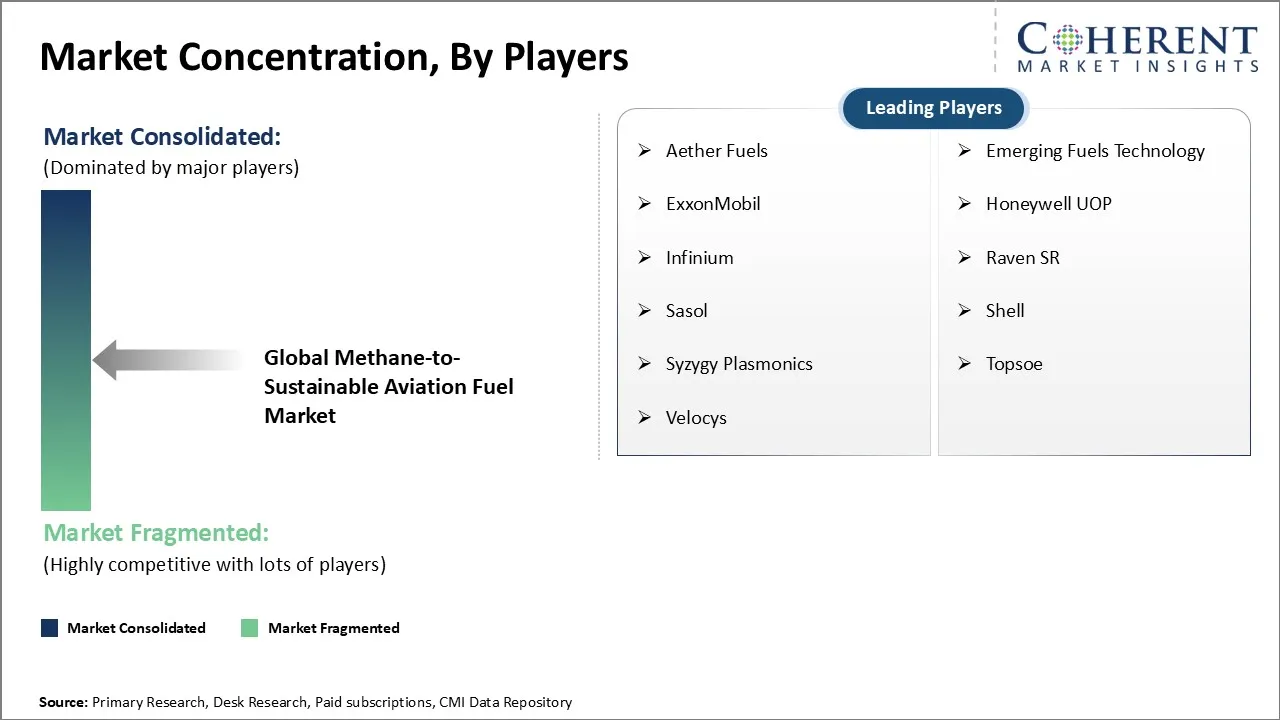
The market is early and fragmented, and no methane-to-SAF facility has yet reached commercial-scale operation. Competition is organized by role. Technology licensors and energy majors such as ExxonMobil, Honeywell UOP, Shell, Sasol and Topsoe bring proven reforming, Fischer-Tropsch, methanol and upgrading know-how, and can give lenders performance guarantees. Modular developers such as Aether Fuels, Emerging Fuels Technology, Infinium, Raven SR, Syzygy Plasmonics and Velocys compete on smaller, factory-built units that fit a single gas source. Partnerships are common. Sasol and Topsoe license their technologies jointly under the G2L name, and Syzygy Plasmonics pairs its reactor with Velocys Fischer-Tropsch technology. Winning a binding offtake and a certified carbon-intensity score matters as much as the technology, because both decide whether a project can be financed.
Top Companies and Notable Products in the Methane-to-Sustainable Aviation Fuel Market
Company | Notable Product | Key Features |
Aether Aurora (Tri-Converter and Upgrader) | Converts waste-carbon gas to ASTM-specification synthetic jet fuel in an integrated line | |
Fischer-Tropsch technology packages | Fischer-Tropsch conversion and upgrading for biogas, flare gas and other waste carbon sources | |
Methanol-to-jet (MTJ) process | Proprietary process converting methanol to a synthetic jet blending component, piloted in Belgium | |
eFining methanol-to-jet technology | ASTM-approved pathway with up to 88% lower greenhouse gas emissions than conventional jet fuel | |
mSAF platform | Electrified reformer with Fischer-Tropsch synthesis for RNG, biogas and flare gas | |
Steam/CO2 reforming system | Turns methane and landfill gas into Fischer-Tropsch fuels, including Jet A, Jet B and JP-8, plus hydrogen | |
Low-temperature Fischer-Tropsch (LTFT) | Fischer-Tropsch technology licensed with Topsoe as an integrated G2L package | |
Shell XTL gas-to-liquids technology and catalysts | Gas-to-liquids know-how from Pearl GTL in Qatar, offered to licensees as technology and catalysts | |
NovaSAF | Light-driven reactor converting biogas to SAF, with up to 90% lower lifecycle emissions than fossil jet fuel | |
SynCOR reforming and G2L licence | Autothermal reforming of methane-rich gas, including biogas, offered with Sasol as a single-point licence | |
microFTL and AlphaCore reactors | Modular microchannel Fischer-Tropsch reactors, with microFTL capital cost down by more than 30% |
Market Report Scope
Methane-to-Sustainable Aviation Fuel Market | |||
Report Coverage | Details | ||
Base Year | 2025 | Market Size in 2026: | USD 0.26 Mn |
Historical Data For: | 2020 To 2024 | Forecast Period: | 2026 To 2033 |
Forecast Period 2026 To 2033 CAGR: | 98.7% | 2033 Value Projection: | USD 31.8 Mn |
Geographies covered: |
| ||
Segments covered: |
| ||
Companies covered: | Aether Fuels, Emerging Fuels Technology, ExxonMobil, Honeywell UOP, Infinium, Raven SR, Sasol, Shell, Syzygy Plasmonics, Topsoe, Velocys | ||
Growth Drivers: |
| ||
Restraints & Challenges: |
| ||
Analyst Opinion (Expert Opinion)
- Biomethane feeds the market, and Fischer-Tropsch turns it into fuel. Biomethane and RNG hold 46.0% of the market in 2026, followed by biogas at 30.0%, flare and industrial waste gas at 19.0% and other methane sources at 5.0%. Biogas is the fastest-growing feedstock, because every digester and landfill that adds a gas-cleaning step becomes a possible fuel plant. Fischer-Tropsch (FT-SPK) holds 72.0% of conversion pathway revenue, which keeps near-term design choices tied to reactors with a long operating record.
- The spending base is made up of proof-of-design plants. Demonstration and pilot plants account for 84.0% of the market in 2026 and passenger airlines for 66.0%, so revenue follows engineering, hardware and offtake-backed first plants rather than fuel volume. The larger long-run change comes from modular commercial units and from the newly approved methanol-to-jet route.
- North America is the volume base, Asia Pacific the growth edge, and two restraints remain. North America holds 44.0% in 2026, followed by Europe at 24.0%, Asia Pacific at 17.0%, Latin America at 9.0%, the Middle East at 3.5% and Africa at 2.5%. Asia Pacific grows fastest. The first restraint is the high capital cost and first-of-a-kind risk of small-scale methane-to-liquids plants. The second is competing biomethane uses and project-by-project carbon-intensity certification. The opportunities are the newly approved methanol-to-jet pathway opening a biomethane-to-methanol route, and electrified reforming and modular Fischer-Tropsch units for distributed biogas sites.
Speak to the analyst
Want personalized insights?
Take the findings above to one of our principal consultants, or have the report rebuilt around the segments, geographies and competitors you actually track.
Market Segmentation
- Feedstock Source Insights (Revenue, USD Million, 2021 - 2033)
- Biogas
- Biomethane / Renewable Natural Gas
- Flare and Industrial Waste Gas
- Other Methane Sources (e.g., coal-mine and other fugitive methane)
- Conversion Pathway Insights (Revenue, USD Million, 2021 - 2033)
- Fischer-Tropsch (FT-SPK)
- Methanol-to-Jet (MTJ)
- Other Catalytic Routes (e.g., syngas-to-fuel oligomerization)
- Plant Scale Insights (Revenue, USD Million, 2021 - 2033)
- Demonstration and Pilot
- Modular Commercial
- Large-Scale
- End User Insights (Revenue, USD Million, 2021 - 2033)
- Passenger Airlines
- Cargo and Express Operators
- Business and General Aviation
- Military and Government
- Regional Insights (Revenue, USD Million, 2021 - 2033)
- North America
- U.S.
- Canada
- Latin America
- Brazil
- Argentina
- Mexico
- Rest of Latin America
- Europe
- Germany
- U.K.
- Spain
- France
- Italy
- Russia
- Rest of Europe
- Asia Pacific
- China
- India
- Japan
- Australia
- South Korea
- ASEAN
- Rest of Asia Pacific
- Middle East
- GCC Countries
- Israel
- Rest of Middle East
- Africa
- South Africa
- North Africa
- Central Africa
- North America
- Key Players Insights
- Aether Fuels
- Emerging Fuels Technology
- ExxonMobil
- Honeywell UOP
- Infinium
- Raven SR
- Sasol
- Shell
- Syzygy Plasmonics
- Topsoe
- Velocys
Sources
Primary Research Interviews
- Methane-to-Liquids and Fischer-Tropsch Technology Developers
- Airline Sustainability and Fuel Procurement Teams
- Biogas, RNG and Flare Gas Project Developers
- Reforming Technology and Catalyst Suppliers
- Research Institutes and Pilot-Plant Operators
Magazines
- Hydrocarbon Processing
- Biofuels Digest
- Renewable Energy World
- Aviation Week
Journals
- Fuel
- Applied Energy
- Energy & Fuels
- Catalysis Today
Associations
- International Air Transport Association (IATA)
- International Civil Aviation Organization (ICAO)
- International Energy Agency (IEA)
- ASTM International
Public Domain Sources
- ASTM D7566 and D4054 aviation fuel standards
- Regulation (EU) 2023/2405 (ReFuelEU Aviation) and EASA annual reports
- Company annual reports and investor presentations
- Company press releases
Proprietary Elements
- CMI Data Analytics Tool
- Proprietary CMI Existing Repository of information for last 10 years
Get access to 250+ pages report
Every segment, forecast, competitor profile and data table behind the analysis above — available for instant download.
- ESOMAR Member
- ISO 9001:2015 Certified
- D-U-N-S Registered
- GDPR & CCPA Compliant
Frequently Asked Questions
The global methane-to-sustainable aviation fuel market is valued at USD 0.26 Mn in 2026 and is expected to reach USD 31.8 Mn by 2033.
The CAGR of the global methane-to-sustainable aviation fuel market is projected to be 98.7% from 2026 to 2033.
Mandated SAF blending targets pulling demand towards non-lipid pathways, and the availability of waste methane streams (biogas, RNG, flare gas) beyond fats and oils, are the major factors driving market growth.
The high capital cost and first-of-a-kind risk of small-scale methane-to-liquids plants, and competing biomethane uses and project-by-project carbon-intensity certification, are the major factors hampering market growth.
In terms of feedstock source, biomethane / renewable natural gas is expected to dominate the market, with a revenue share of 46.0% in 2026.
In terms of conversion pathway, Fischer-Tropsch (FT-SPK) is expected to dominate the market, with a revenue share of 72.0% in 2026.
In terms of plant scale, demonstration and pilot plants below 100 barrels per day are expected to dominate the market, with a revenue share of 84.0% in 2026.