

Global Mold Release Agents Market Size and Forecast – 2026 To 2033
The global mold release agents market is estimated to be valued at USD 2.53 Bn in 2026 and is projected to reach USD 3.86 Bn by 2033, exhibiting a compound annual growth rate (CAGR) of 6.22% during 2026–2033. The market is growing due to increased output of precision-molded components in the automotive manufacturing, aerospace parts, construction and industrial manufacturing segments. Manufacturers are concentrating on special release formulations for easy demolding, reduced surface defects, less frequent mold cleaning and increased production efficiency.
The complexity of composite components is increasing, which is also driving investment in advanced mold preparation and semi-permanent release systems. In May 2026, AXEL Plastics Research Laboratories unveiled XTEND PR-GCP, a mold primer for composite manufacturing, designed to enhance release performance, minimize styrene accumulation, and achieve superior surface finishes. This trend is indicative of a growing industry emphasis on integrated mold treatment solutions to enhance consistency in manufacturing and tooling performance.
Key Takeaways of the Global Mold Release Agents Market
- Water-Based Release Agents are projected to grow at a CAGR of 6.8% over the forecast period and represent 56.2% share of the global mold release agents market in 2026. They are designed to be suitable for tire, rubber and die-casting operations, limiting solvent handling and maintaining production efficiency. In April 2024, Kao introduced LUNAFLOW RA, a cellulose-nanofiber release agent designed for the repeated demolding of rubber and resin parts.
- Silicone-Based Release Agents are estimated to hold 40.5% of the global mold release agents market revenue in 2026 and are expected to register a CAGR of 6.6% through 2033. Their low surface energy films enable the separation of complex polymer parts and protect surface finishes while reducing defects associated with adhesion. Stoner Molding introduced its B445 water-based silicone in March 2025 to solve problems with static and adhesion in plastic thermoforming and extrusion.
- Conventional Release Agents are anticipated to register an estimated CAGR of 5.7% through 2033, and account for 70.1% of global mold release agents market revenue in 2026. Its ease of application and variable coating coverage accommodate a wide variety of elastomer formulations and manufacturing requirements. In December 2025, Münch Chemie launched MK-77, a conventional release agent concentrates free of PFAS and silicone for efficient rubber production and clean demolding.
- Asia Pacific is expected to grow at an estimated CAGR of 6.3% during the forecast period and account for 44.7% of the global mold release agents market revenue in 2026. Tire, rubber, automotive and metalworking supply chains are established and prefer local production and dependable chemical supply. In February 2024, LANXESS started up an expanded production line for the Rhenodiv release agent in Jhagadia, India, targeting tire and rubber manufacturers in Asia.
- Europe is projected to register the fastest regional CAGR of 7.4% during 2033 and account for 23.4% of the global mold release agents market. Composite processors are increasingly focused not only on chemical price, but also on shorter mold preparation cycles and consistent surface quality. In September 2024, Chem-Trend launched its Europe-manufactured Chemlease PMR semi-permanent release line, which is designed to eliminate the need for separate mold sealing.
Segmental Insights
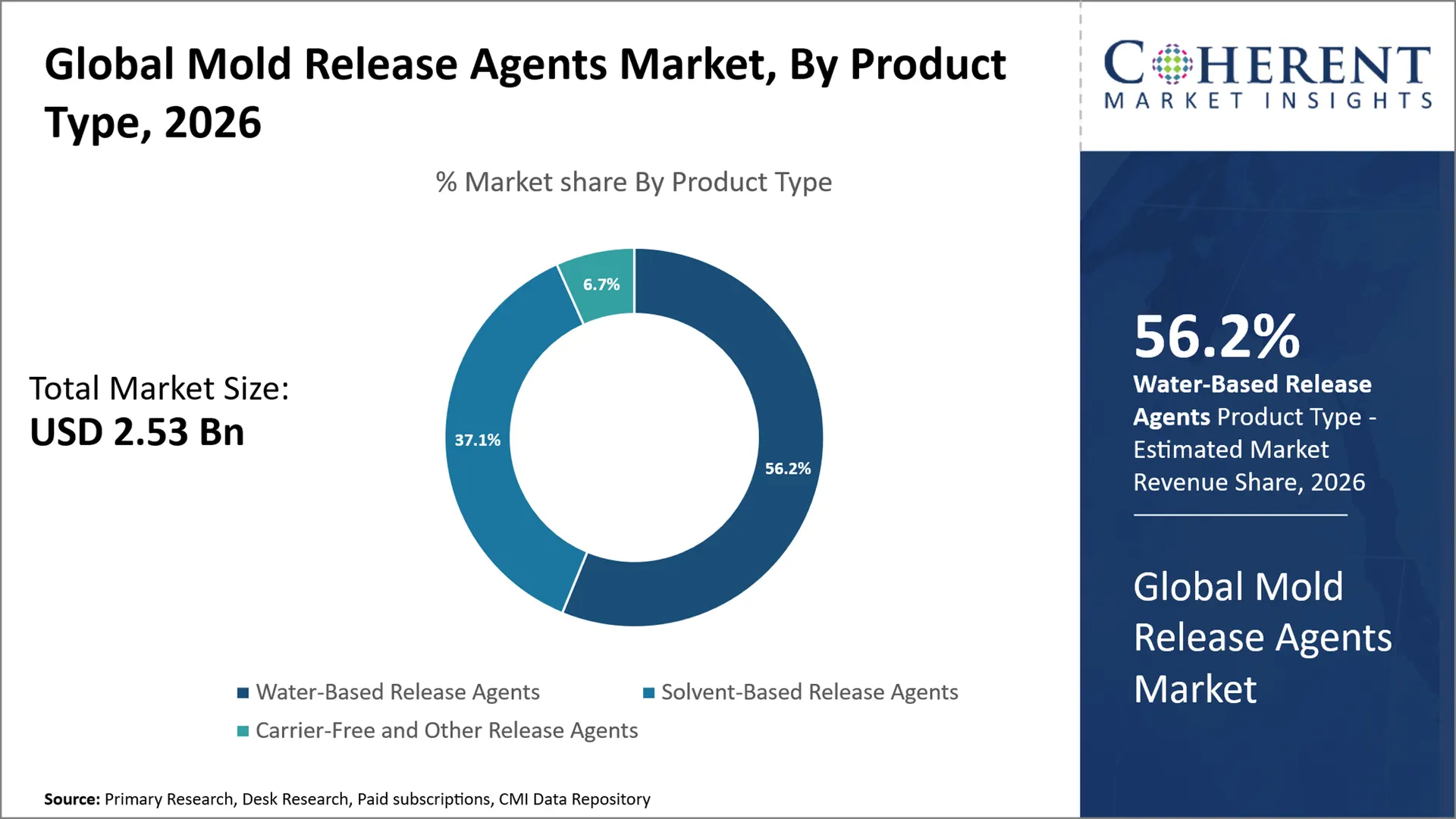
Why Do Water-Based Release Agents Dominate the Global Mold Release Agents Market?
Water-Based Release Agents are expected to account for 56.2% of the global mold release agents market in 2026, leading the carrier-type category. In aluminum casting, waterborne concentrates allow processors to adjust working strength while maintaining compatibility with automated spraying equipment. Stable emulsions help prevent separation during dilution, making chemical usage more predictable across continuous production lines. For suppliers, this creates opportunities to offer formulations validated for spray-system stability and subsequent painting or bonding, rather than competing only on concentrate price. In September 2026, Hangzhou Topwin Technology announced its SE-7009 water-based siloxane emulsion for aluminum forming, casting, and extrusion, emphasizing dilution stability and compatibility with downstream surface treatments. The development illustrates how carrier selection influences both production control and finished-component processing requirements.
- Current Industry Events of 2026
- Market Size Estimation
- Regional Breakdown
- Competitive Landscape
- Customer Intelligence
- Segmental Analysis
- Pricing Analysis
- Key Market Drivers, Challenges & Future Trends
- Customized Insights Section
Why Do Silicone-Based Release Agents Represent the Largest Material Type in the Global Mold Release Agents Market?
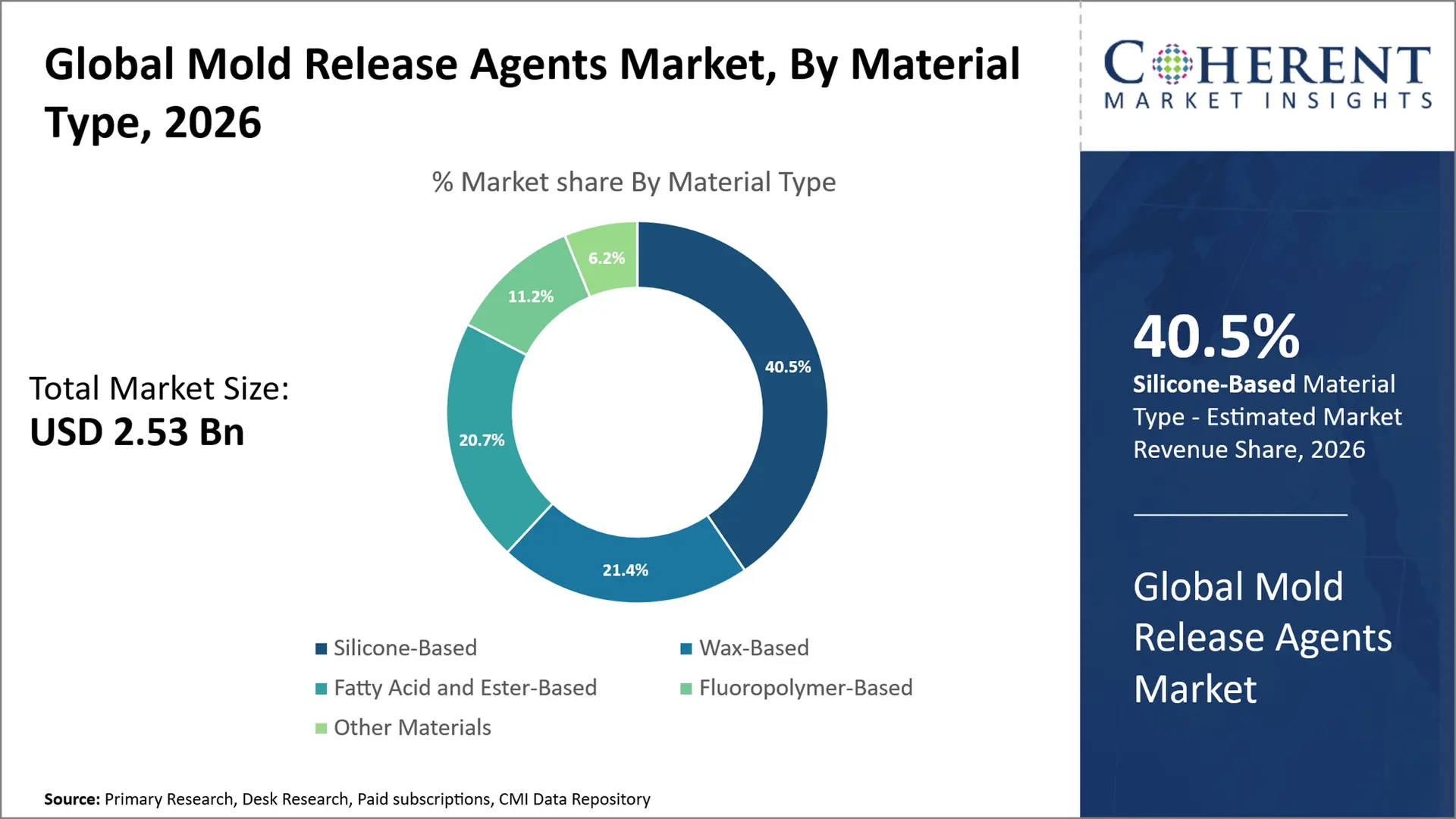
Silicone-Based release agents are estimated to capture 40.5% share in the global mold release agents market in 2026, highest share in the material-type segment. They are also commercially attractive for use in manufacturing environments where release performance, hygiene and material-safety specifications are required. The silicone films do not contain any abrasive particles at the interface with the mold and thus allow for the controlled processing of both thermoplastic and thermoset parts. These requirements encourage suppliers to differentiate themselves by product registration, temperature tolerance and application-specific documentation rather than simply competing on chemical cost. In August 2025, HASCO extended its range of chemical products with Z2640, a silicone-based release and lubricant spray for the plastics processing industry. The product is NSF H1 and 3H registered, showing how documented suitability for use can increase the possible customer base for silicone release formulations.
Why Do Conventional Release Agents Dominate the Release Technology Segment of the Global Mold Release Agents Market?
Conventional Release Agents are expected to account for 70.1% of the global mold release agents market in 2026. This is the leading release-technology category. For concrete formwork, a new barrier must be erected before each pour, since the release layer is consumed or disturbed during stripping. The recurring-use requirement allows for predictable replenishment through construction chemical distributors and site procurement contracts. Suppliers also benefit from having simple grades that can be used with timber, steel and other formwork materials without the need for special curing procedures. Adomast Manufacturing has released updated technical documentation for Adolease, its mineral-oil-based general-purpose release treatment, in February 2025. The product is used before each concrete pour and uses reactive oils to help release the cured concrete from the form faces, showing that traditional release systems are still relevant
Current Events and their Impact
Current Event | Description and Its Impact |
July 2025 – U.S. EPA Extends Compliance Timeline for Aerosol Coating VOC Standards |
|
May 2024 – European Commission Tightens Controls on Cyclic Siloxanes under REACH |
|
Global Mold Release Agents Market Dynamics
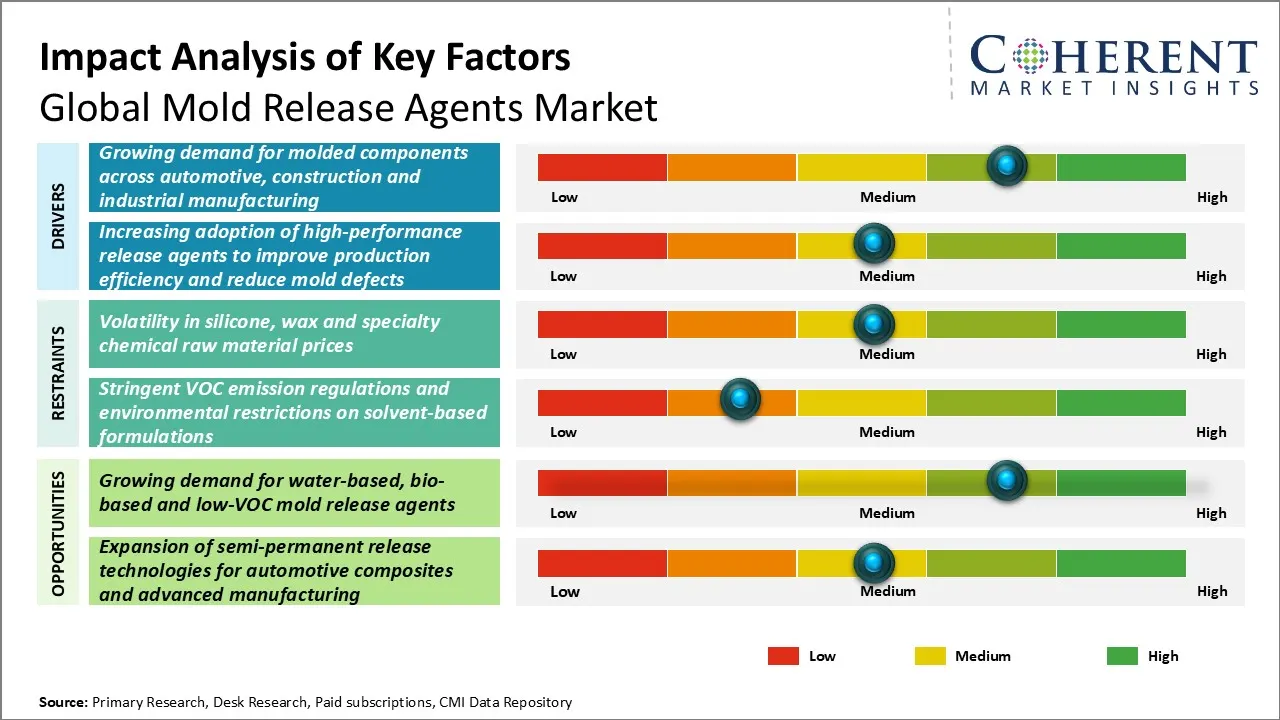
Key Market Drivers
- Growing Demand for Molded Components Across Automotive, Construction and Industrial Manufacturing: Automotive structural castings need controlled die ejection, thermal management and consistent aluminum surface quality. As component designs grow more intricate, defects in castings result in significant material waste, reinforcing the need for application-specific release agents. This is good news for suppliers of die-casting chemicals, makers of spray systems and technical service providers. In July 2025, Nemak announced an agreement to acquire the automotive business of GF Casting Solutions, adding high-pressure die-casting capabilities for complex aluminum and magnesium components. Such investments increase the customer base for release-agent manufacturers in advanced casting operations.
- Increasing Adoption of High-Performance Release Agents to Improve Production Efficiency and Reduce Mold Defects: The use of release agents capable of withstanding harsh molding conditions without impacting component dimensions or surface integrity is essential for high-temperature polymer processing. Manufacturers are paying more attention to release additives for their compatibility with engineered plastics, their ability to reduce demolding resistance and their contribution to tooling protection. This is an opportunity for specialty chemical formulators who serve technically demanding applications. In July 2024, Avient introduced Evoluscend, a non-PFAS mold release additive for high-temperature polymers. Processors have an alternative release mechanism when incorporated internally into plastic materials that can simplify manufacturing operations and protect molded components.
Emerging Market Trends
- Transition Toward Precision-Controlled Release Agent Application Systems: Manufacturers are moving toward automated dispensing and programmable spray systems to control the application of release agents, the coating thickness and the frequency of spraying. These systems provide consistency in the application and reduce the need for manual adjustments during the molding operations.
Impact: Automation in application of chemicals reduces wastage of chemicals, improves production efficiency and reduces uneven coating. It also promotes suppliers to develop formulations that are stable, low-clogging and compatible with precision dispensing equipment.
Market Relevance: The trend is an opportunity for manufacturers of mold release agents and suppliers of automation equipment to provide integrated application solutions for polyurethane processing, rubber molding, and die casting.
- Greater Emphasis on Release Chemistry Compatibility with Downstream Finishing: Manufacturers are beginning to look at how residues from release agents can affect subsequent surface coating, adhesive bonding, painting and printing operations. Therefore, the development of low-residue formulations that maintain the quality of the component surface after demolding is encouraged.
Impact: Improved chemical compatibility reduces finishing defects, rework costs, and production delays. Suppliers offering low-transfer formulations can strengthen their position in precision molding and surface-sensitive manufacturing applications
Market Relevance: This trend supports demand for specialized mold release agents in automotive components, composite manufacturing, and engineered plastics, were surface finishing quality influences final product acceptance
Market Restraints
- Raw Material Price Volatility and Formulation Cost Pressure: Silicone fluids, specialty waxes, surfactants and synthetic additives subject release-agent makers to cost swings in chemical feedstocks. Smaller formulators may not be able to absorb cost increases, especially when serving price-sensitive construction and general industrial molding customers. Raw material substitution can also help maintain product specifications stable, which can increase the formulation and customer requalification costs.
- Surface Contamination and Product Requalification Requirements: Release-agent formulations that are not compatible may lead to residue buildup, discoloration, failures in adhesion, or defects in secondary processing. For precision elastomers, composites and automotive parts, customers may require extended production trials to sign off on alternative formulations. This extends sales cycles for new vendors, and raises costs for technical support. It inhibits rapid substitution of established products.
Regional Insights
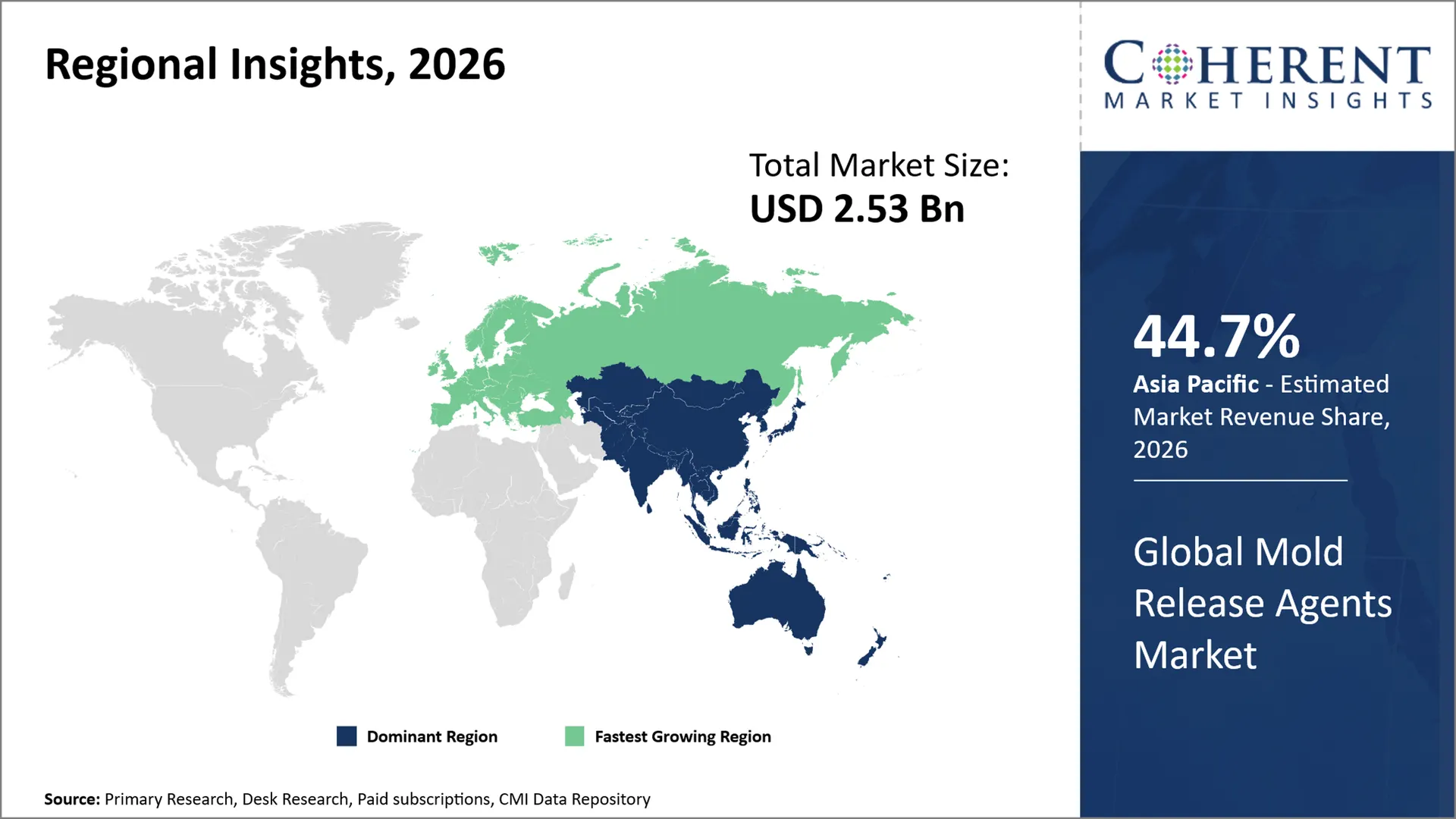
Why Does Asia Pacific Dominate the Global Mold Release Agents Market?
Asia Pacific is expected to hold a share of 44.7% in the global mold release agents market by 2026 owing to its integrated supply network connecting silicone chemical producers, industrial formulators, and downstream molding facilities. Regional manufacturing hubs provide access to specialized raw materials and existing chemical distribution infrastructure that ensures consistent formulation availability for automotive and industrial uses. Shin-Etsu Chemical said in May 2024 that it will invest around USD 0.013 billion in a silicone products plant in Zhejiang Province, China, to make functional silicone emulsions and specialty products. The investment reflects the strengthening regional supply base for silicone chemistry, a key input for certain release-agent formulations. Local availability of materials might lead to better sourcing flexibility and procurement efficiency for mold release agent manufacturers in the region.
Why Is Europe Emerging as the Fastest-Growing Region in the Global Mold Release Agents Market?
Europe is expected to account for 23.4% of the global mold release agents market in 2026 and is expected to be the fastest growing region during the forecast period. Specialized polyurethane molding applications are associated with growth potential, as demand from the component manufacturers is for accurate surface characteristics, formulation compatibility and reproducible manufacturing quality. In Europe, automotive suppliers are increasingly considering release chemistry in parallel with polyurethane system design and component specifications. This creates opportunities for application-focused chemical manufacturers. In September 2024, Spain-based Concentrol joined EURO-MOULDERS, an association representing European automotive polyurethane manufacturers, to strengthen technical collaboration and product innovation. Such industry partnerships can accelerate formulation qualification and help release-agent suppliers address specialized requirements for molded automotive interiors and polyurethane components.
Global Mold Release Agents Market Outlook for Key Countries
Why Is the U.S. a Key Market for the Global Mold Release Agents Market?
The U.S. is a large global market for mold release agents used in aerospace composite tooling, molded cabin components and precision polymer manufacture. Aerospace manufacturing requires release formulations that deliver consistent de-molding performance without affecting subsequent bonding, painting or surface finishing. These requirements provide opportunities to suppliers who can supply technical support for certain applications and qualified formulations. In November, Boeing said it would invest more than USD 1 billion to expand its South Carolina facilities that build the 787 Dreamliner, including more space for preparing parts and making interior components for airplanes. This expansion is a result of continued investment in manufacturing within aerospace supply chains where the demands of composite processing, precision tooling and surface quality present opportunities for a technically differentiated mold release solution.
Why Is India Important in the Global Mold Release Agents Market?
India's mold release agents market benefits from expanding tire manufacturing capacity, particularly in rubber vulcanization processes requiring consistent mold separation and controlled surface finishing. Tire manufacturing process involves vulcanization of rubber which requires consistent separation of mold surfaces and controlled surface finishing. Specialty release coatings and bladder lubricants help tire manufacturers to facilitate curing operations, protect tread patterns and ensure consistency in processing. Local formulation services and reliable restocking arrangements can be advantageous for domestic chemical suppliers. JK Tyre has begun the third phase of expansion of its Banmore manufacturing facility in Madhya Pradesh that will raise the company’s capacity to produce passenger car radial tyres to 30,000 units per day by January 2026. The expansion bolsters India’s manufacturing base for rubber processing and offers more commercial opportunities to qualified tire mold release formulations, curing auxiliaries and specialized industrial chemical suppliers.
Why Does China Support Growth in the Global Mold Release Agents Market?
China represents a colossal commercial opportunity for global mold release agents market vendors serving the plastic processing, household appliance manufacturing, and precision injection molding industries. It has a strong polymer processing ecosystem that enables large-scale production of molded housings, engineered parts and industrial plastic products. Many thermoplastics can be demolded without external release agents, but complex geometries and adhesion-sensitive applications create opportunities for specialized formulations. In February 2025, China’s Ministry of Industry and Information Technology said that in 2024 the national output of plastic products was about 77.1 million metric tons, up 2.9% year on year. Industrial scale offers a large customer base to suppliers with application-specific release performance, competitive pricing, and reliable delivery to regional manufacturing clusters.
Why Is Germany a Strategic Country in the Global Mold Release Agents Market?
Germany is strategically critical for high-performance mold release formulations for precision automotive castings and engineered component manufacturing. Its industrial customers have a strong concern for dimensional accuracy, casting integrity and compatibility with automated quality-control systems. Release-agent suppliers for these applications must be able to demonstrate consistent lubrication and thermal performance under tightly controlled production conditions. BMW Group said in May 2025 it was using automated computed tomography inspection on aluminum electric motor housings made at its Landshut foundry. The inspection process is reflective of the stringent quality specifications of contemporary German foundries. Such manufacturing requirements are conducive to specialized die-release formulations that allow for repeatable component quality and minimize production losses related to defects.
Why Is Brazil an Important Growth Market for the Global Mold Release Agents Market?
Brazil offers selective growth opportunities for mold release agent manufacturers servicing industrial foundries, commercial vehicle component manufacturers and agricultural machinery supply chains. The demands arising from its established metalworking industry are for reliable mold preparation, tooling maintenance and processing materials related to casting. Those suppliers who can distribute to the region are able to fulfills the customers’ need for a reliable product supply and cost-effective industrial formulations. Randoncorp opened a Castertech foundry in Mogi Guaçu, São Paulo, in November 2024, with a casting capacity of more than 22,000 metric tons per year and capable of producing more than 350,000 brake drums. The investment reinforces Brazil’s automotive component manufacturing infrastructure and supports potential demand for appropriate foundry mold-separation materials and specialized processing chemicals.
Mold Release Agent Innovation, Formulation and Application Technology Landscape
Technology | Technical Application | Commercial Advantage | Adoption Considerations |
High-Solids Aqueous Dispersions | Concentrated silicone, wax, or specialty polymer dispersions diluted for industrial mold application | Lower transportation requirements per unit of active material and flexible dosing concentrations | Dispersion stability, water quality, and drying characteristics require validation |
Semi-Permanent Reactive Release Coatings | Polymer films engineered to adhere to mold surfaces and support repeated demolding | Less frequent recoating and improved continuity between molding cycles | Mold preparation, film curing, and compatibility with tooling materials |
Robotic Micro-Spray and Precision Dosing | Programmable nozzles and controlled spraying for die-casting and molding equipment | More uniform coating distribution and lower risk of excessive application | Spray hardware investment, nozzle maintenance, and process calibration |
High-Temperature Die-Lubrication Formulations | Heat-resistant lubricant systems for aluminum and magnesium die casting | Improved thermal stability and reduced die soldering under demanding processing conditions | Die temperature, lubricant dilution, cooling requirements, and alloy compatibility |
Silicone-Free Low-Transfer Formulations | Specialty release films designed for parts requiring subsequent bonding, painting, or finishing | Reduced risk of release-agent contamination interfering with downstream operations | Qualification against specific substrates, adhesives, and coating systems |
Internal Mold Release Additive Systems | Release-promoting additives incorporated directly into polymer or elastomer compounds | Reduced reliance on external coating steps in suitable molding processes | Compound compatibility, additive migration, mechanical properties, and final-part specifications |
How Are High-Purity Release Formulations Creating New Growth Opportunities in the Global Mold Release Agents Market?
Specialized release formulations can be an opportunity for suppliers of pharmaceutical elastomer closures and precision healthcare components that can meet stringent contamination-control requirements. Demolding consistency is critical in the manufacturing of rubber stoppers, sealing components and healthcare elastomers to ensure the functional integrity of the finished component.
Traditional release coatings may raise concerns regarding chemical transfer, extractable residues and compatibility with subsequent cleaning or sterilization processes. This leads to the creation of application-specific, low transfer and stringently qualified release systems.
This presents a significant opportunity for chemical manufacturers to develop validated formulations with full technical documentation, traceable production records and material compatibility studies. Customer qualification will be a joint effort between closure manufacturers, elastomer compounders and specialized testing laboratories.
The opportunity is expected to favor existing specialty suppliers that offer analytical testing capabilities and smaller formulation specialists with application know-how. However, the high quality standards and long qualification cycles may limit the rapid commercialization of this technology.
Market Players, Key Development, and Competitive Intelligence
Key Developments
- In August 2025, ROCOL introduced its ULTIMATE Silicone Spray globally for industrial lubrication and mold-release applications. The product combines precision spraying with a formulation suitable for demanding industrial and food-adjacent environments. This development strengthens the commercial positioning of specialized aerosol release products were controlled application and operational accessibility influence purchasing decisions.
- In April 2025, Yoshida SKT commercially released its CAS ceramic-alloy coating technology, combining engineered ceramic surface structures with release materials to reduce adhesion problems. Although a mold-surface treatment rather than a conventional liquid release agent, the technology represents a competitive alternative for selected manufacturing processes requiring durable anti-adhesion performance.
- In February 2024, Kroon-Oil introduced Bio Mould Oil, a biodegradable, solvent-free release agent formulated using vegetable-derived materials for concrete molding and construction applications. The development expands alternatives available to precast concrete manufacturers and formwork operators, creating differentiation around cleaner handling, surface finishing quality, and raw-material selection in construction chemical procurement.
Competitive Landscape
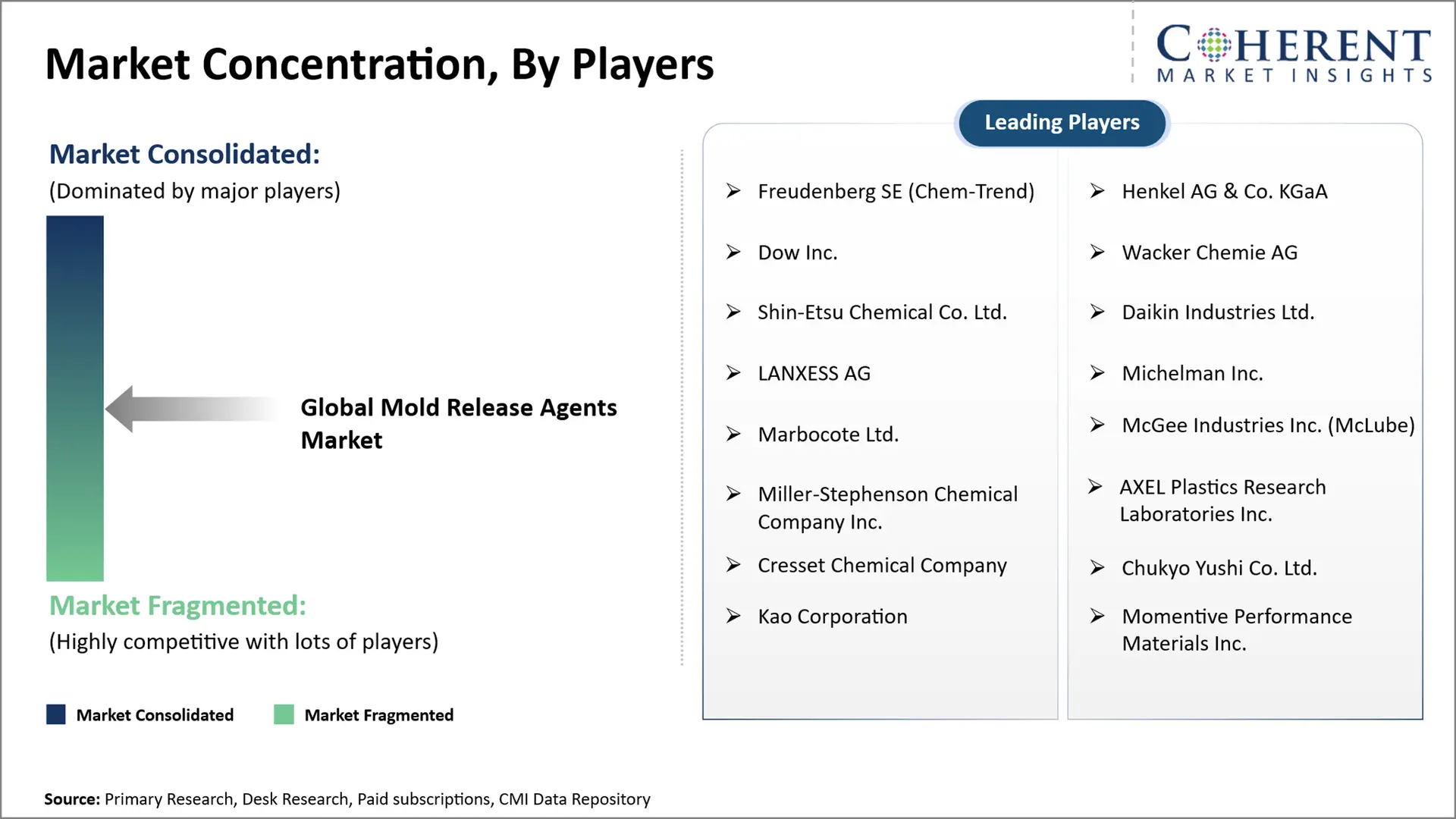
The global mold release agents market is fragmented, comprising multinational specialty chemical manufacturers, industrial lubricant suppliers, regional formulators, and application-focused businesses. Competition differs considerably across die casting, rubber molding, polyurethane processing, and composites. The choice of a product is driven by the following factors: substrate compatibility, specification consistency, delivered cost, technical reliability and regional availability. Specialist suppliers cling to opportunities where responsive service and customized formulations trump broad portfolio coverage.
Key focus areas include
- Product Differentiation: Chemical properties modified to satisfy the specific needs of finished components, mold materials and processing temperatures.
- Cost Competitiveness: the ability to balance the cost of formulation, the concentration of chemicals, the efficiency of application and the overall operating costs.
- Manufacturing Reliability: Ensuring consistent quality across production batches and geographically distributed supply operations.
- Regulatory Compliance: Improved traceability of substances, safety documentation and product stewardship for certain markets.
- Product Customization: Development of customer-specific grades for special elastomers, thermosets, composites and metal alloys.
- Distribution Capabilities: Developing industrial chemical distribution agreements and local inventory support for smaller manufacturing customers.
- Technical Relationships: Developing long term customer relationships through application engineering knowledge, formulation qualification and production troubleshooting.
Market Report Scope
Global Mold Release Agents Market Report Coverage | |||
Report Coverage | Details | ||
Base Year | 2025 | Market Size in 2026: | USD 2.53 Bn |
Historical Data For: | 2020 To 2024 | Forecast Period: | 2026 To 2033 |
Forecast Period 2026 To 2033 CAGR: | 6.22% | 2033 Value Projection: | USD 3.86 Bn |
Geographies covered: |
| ||
Segments covered: |
| ||
Companies covered: | Freudenberg SE (Chem-Trend), Henkel AG & Co. KGaA, Dow Inc., Wacker Chemie AG, Shin-Etsu Chemical Co. Ltd., Daikin Industries Ltd., LANXESS AG, Michelman Inc., Marbocote Ltd., McGee Industries Inc. (McLube), Miller-Stephenson Chemical Company Inc., AXEL Plastics Research Laboratories Inc., Cresset Chemical Company, Chukyo Yushi Co. Ltd., Kao Corporation, Momentive Performance Materials Inc. | ||
Growth Drivers: |
| ||
Restraints & Challenges: |
| ||
Analyst Opinion (Expert Opinion)
- Global mold release agents market leadership may depend on suppliers' ability to convert release-agent expertise into process performance assurances. This is not simply about adding to their product portfolio, but it is recommended that manufacturers focus on commercial agreements related to proven production results. Those suppliers that can assume more responsibility for keeping the demolding performance stable may be able to get more predictable recurring revenue and better customer retention.
- A closer integration between mold tooling manufacturers and specialty chemical developers could revolutionize the selection of release systems. The release chemistry may be incorporated into the tooling qualification process before the start of production rather than being purchased as a separate item after the equipment has been installed. This would put pressure on suppliers to rely on interchangeable products, while companies that are able to establish early technical relationships with machine manufacturers and industrial engineering partners will be rewarded.
- Manufacturers should emphasize formulation flexibility, diversified raw-material sourcing and qualification capabilities for complex elastomers and specialized industrial components. There are also costs associated with customer approvals and exposure to commodity chemical pricing. Regulatory uncertainty should be taken into account in investment decisions. Margin protection can be ensured by selective localization, partnerships with industrial distributors and disciplined inventory management. Suppliers should be cautious about producing large volumes of undifferentiated product grades without confirmed customer commitments.
Speak to the analyst
Want personalized insights?
Take the findings above to one of our principal consultants, or have the report rebuilt around the segments, geographies and competitors you actually track.
Market Segmentation
- Product Type Insights (Revenue, USD Bn, 2021 - 2033)
- Water-Based Release Agents
- Solvent-Based Release Agents
- Carrier-Free and Other Release Agents
- Material Type Insights (Revenue, USD Bn, 2021 - 2033)
- Silicone-Based
- Wax-Based
- Fatty Acid and Ester-Based
- Fluoropolymer-Based
- Other Materials
- Release Technology Insights (Revenue, USD Bn, 2021 - 2033)
- Conventional Release Agents
- Semi-Permanent Release Agents
- Application Insights (Revenue, USD Bn, 2021 - 2033)
- Die Casting
- Rubber Molding
- Polyurethane Molding
- Composite Molding
- Plastic Molding
- Concrete Molding
- Wood Composite and Panel Pressing
- Other Applications
- End User Insights (Revenue, USD Bn, 2021 - 2033)
- Automotive and Transportation
- Building and Construction
- Industrial Machinery
- Consumer Goods
- Aerospace and Marine
- Electrical and Electronics
- Sales Channel Insights (Revenue, USD Bn, 2021 - 2033)
- Direct Manufacturer Sales
- Specialty Chemical Distributors
- Online and Other Channels
- Regional Insights (Revenue, USD Bn, 2021 - 2033)
- North America
- U.S.
- Canada
- Latin America
- Brazil
- Argentina
- Mexico
- Rest of Latin America
- Europe
- Germany
- U.K.
- Spain
- France
- Italy
- Russia
- Rest of Europe
- Asia Pacific
- China
- India
- Japan
- Australia
- South Korea
- ASEAN
- Rest of Asia Pacific
- Middle East
- GCC Countries
- Israel
- Rest of Middle East
- Africa
- South Africa
- North Africa
- Central Africa
- North America
- Key Players Insights
- Freudenberg SE (Chem-Trend)
- Henkel AG & Co. KGaA
- Dow Inc.
- Wacker Chemie AG
- Shin-Etsu Chemical Co. Ltd.
- Daikin Industries Ltd.
- LANXESS AG
- Michelman Inc.
- Marbocote Ltd.
- McGee Industries Inc. (McLube)
- Miller-Stephenson Chemical Company Inc.
- AXEL Plastics Research Laboratories Inc.
- Cresset Chemical Company
- Chukyo Yushi Co. Ltd.
- Kao Corporation
- Momentive Performance Materials Inc.
Sources
Primary Research Interviews
- Mold release agent manufacturers, specialty chemical formulators, and industrial distributors
- Die-casting operators, rubber molders, polyurethane processors, and composite manufacturers
Stakeholders
- Silicone, wax, and specialty chemical suppliers
- Mold release agent producers, industrial buyers, and application technology providers
End-use Sectors
- Automotive, aerospace, construction, and industrial machinery
- Rubber, plastics, polyurethane, composites, and metal die casting
Regulatory and Industry Bodies
- U.S. Environmental Protection Agency (EPA)
- European Chemicals Agency (ECHA)
- European Commission
- Occupational Safety and Health Administration (OSHA)
Databases
- UN Comtrade and International Trade Centre (ITC) Trade Map
- Eurostat PRODCOM and U.S. Census Bureau manufacturing statistics
- OICA automotive production statistics and national industrial production datasets
Magazines and Journals
- Progress in Organic Coatings
- Journal of Applied Polymer Science
- International Journal of Metalcasting
- Rubber Chemistry and Technology
Associations
- American Foundry Society (AFS)
- Society of Plastics Engineers (SPE)
- American Composites Manufacturers Association (ACMA)
- American Concrete Institute (ACI)
Public Domain Sources
- Mold release product specifications, technical data sheets, and safety data sheets
- Automotive production, metal casting, and polymer processing statistics
- Chemical feedstock pricing, industrial investments, and manufacturing capacity announcements
Key Standards and Regulations
- EU REACH Regulation (EC) No 1907/2006
- EU CLP Regulation (EC) No 1272/2008
- U.S. EPA 40 CFR Part 59, Subpart E – Aerosol Coating VOC Standards
- ACI 347 – Guide to Formwork for Concrete
Proprietary Elements
- CMI Data Analytics Tool
- Proprietary research repository, supplemented by primary interviews, application-level demand estimates, production analysis, pricing assessments, and competitive intelligence.
Get access to 250+ pages report
Every segment, forecast, competitor profile and data table behind the analysis above — available for instant download.
- ESOMAR Member
- ISO 9001:2015 Certified
- D-U-N-S Registered
- GDPR & CCPA Compliant
Frequently Asked Questions
The CAGR of global mold release agents market is projected to be 6.22% from 2026 to 2033.
The global mold release agents market is estimated to be valued at USD 2.53 Bn in 2026 and is projected to reach USD 3.86 Bn by 2033.
Pricing of mold release agents is based on formulation chemistry, raw material costs, product concentration, application performance, packaging, and industrial purchasing volumes.
Industrial buyers look at how well it comes out of the mold, how well it works with the mold, how well it stands up to heat, the quality of the surface finish, whether it leaves residue and the overall cost of using it.
The market is characterized by the presence of multinational specialty chemical manufacturers and specialized formulators who compete on the basis of product quality, formulation expertise, pricing, technical support and supply reliability.
Testing of the product for qualification should concentrate on the release consistency, material compatibility, surface contamination, finishing performance downstream, and reliability under real-world manufacturing conditions.
The major factors driving the growth of the global mold release agents market are increasing demand for molded components in the automotive, construction, and industrial manufacturing sectors, along with greater adoption of high-performance release agents to improve production efficiency and minimize molding defects.