
Global Mono-PP Barrier Coatings Market Size and Forecast – 2026 To 2033
The global Mono-PP barrier coatings market is expected to grow from USD 1.85 Bn in 2026 to USD 2.50 Bn by 2033, registering a compound annual growth rate (CAGR) of 4.8% from 2026 to 2033. The global Mono-PP barrier coatings market is driven by growing demand for high-barrier food packaging materials. On May 28, 2026, H.B. Fuller Company announced a strategic investment in advanced oxygen barrier technology. VerdaFresh enhances the company’s already strong barrier coating offerings with a high-performance solution, accelerating the shift to fully recyclable packaging.
Key Takeaways of the Global Mono-PP Barrier Coatings Market
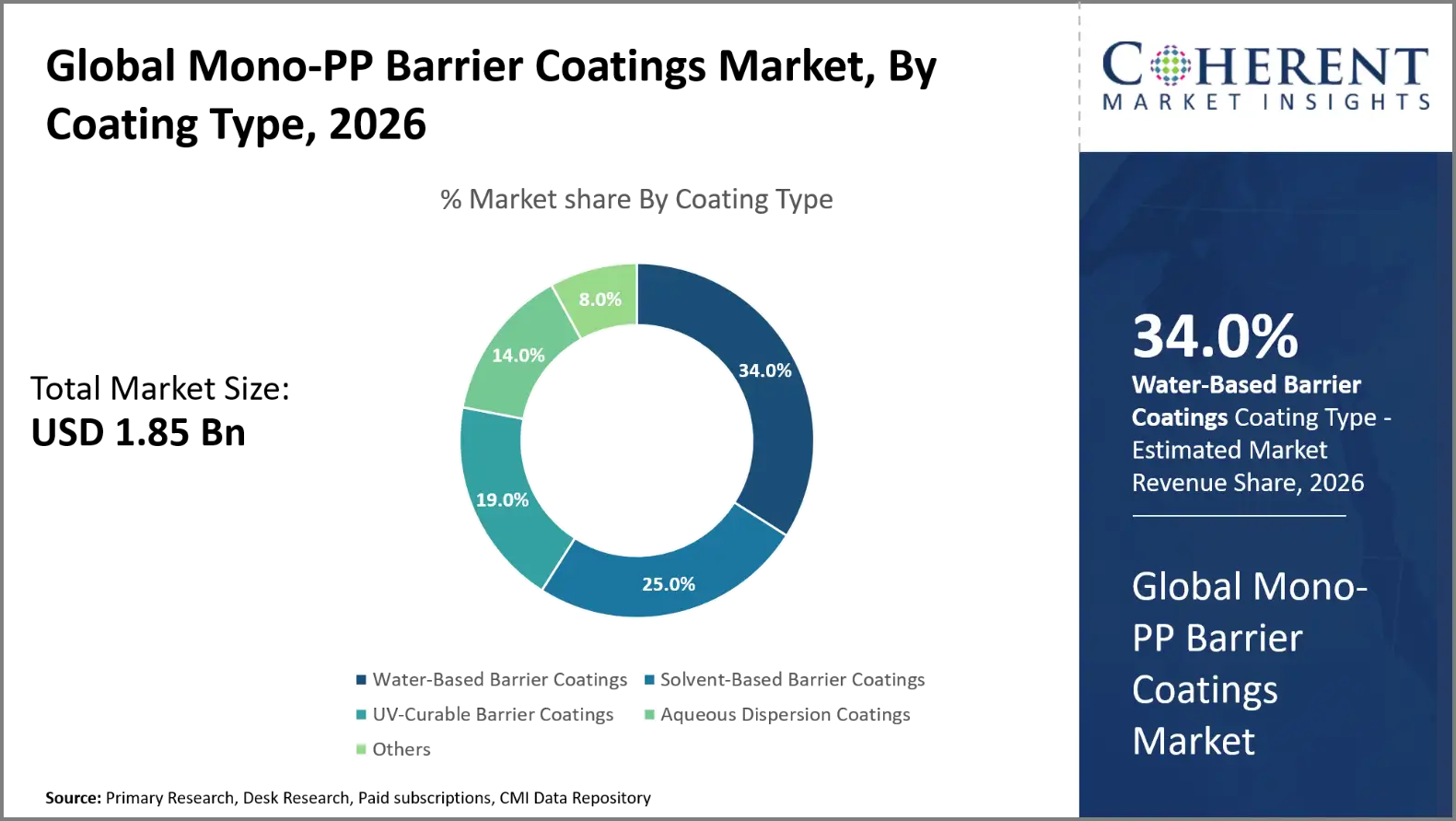
- The Water-Based Barrier Coatings segment is expected to account for 34.0% of the global Mono-PP barrier coatings market share in 2026. Expansion of sustainable packaging initiatives among brand owners is driving the growth of the segment. On July 31, 2025, Mars introduced mono-polypropylene WHISKAS pouches in the U.K. and Germany. The new packaging replaces conventional pouches containing inseparable plastic and aluminum materials.
- The Oxygen Barrier Coatings segment is estimated to capture 39.0% of the market share in 2026. Increasing preference for recyclable alternatives to multilayer laminates systems is majorly driving the growth of the segment. On September 30, 2025, Siegwerk, Borouge, and TPN Food Packaging introduced a recyclable mono-material barrier stand-up pouch. The structure targets oxygen-sensitive products, including nuts and pet food.
- The Flexible Films segment is estimated to capture 35.0% of the market share in 2026. Growing use of polypropylene in flexible packaging applications is majorly driving the growth of the segment. On November 11, 2025, TOPPAN Speciality Films introduced a hybrid manufacturing line capable of producing both BOPP and BOPE films. The installation increases the company's production capacity by 40%.
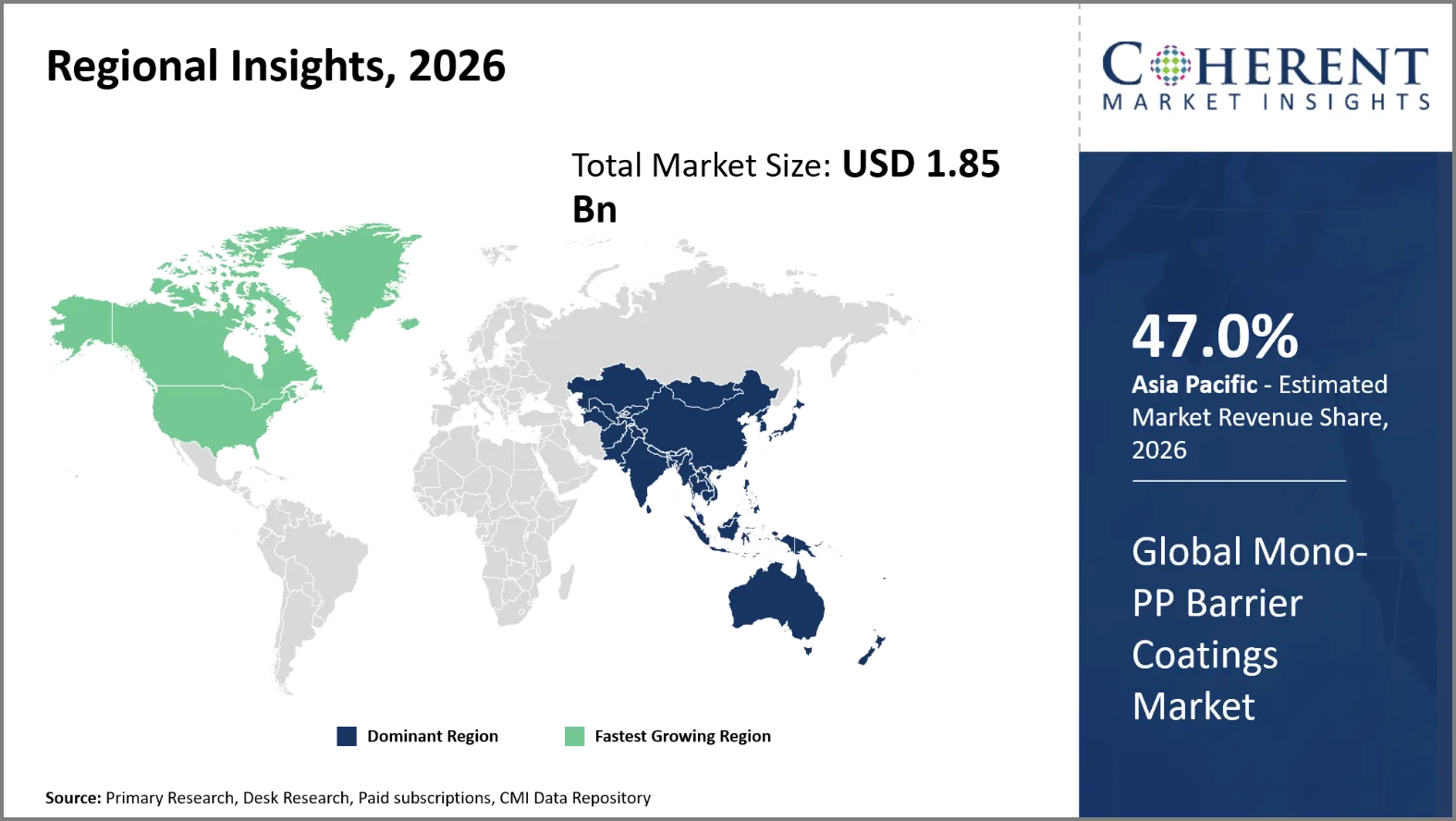
- Asia Pacific is expected to dominate the Mono-PP barrier coatings market in 2026 with a market share of 47.0%. Rising demand for moisture and oxygen barrier protection in Asia Pacific is driving the growth of the regional market. On July 8, 2025, Dai Nippon Printing announced its vacuum-metallized high-barrier polypropylene film for mono-material packaging. The film provides oxygen, water-vapor, and light protection. Its barrier performance is almost twice that of the company's conventional mono-material packaging.
- North America is expected to account for 28.0% share in 2026 and is projected to record the fastest growth over the forecast period. Increasing investment in recyclable packaging structures in North America is driving the growth of the regional market. On July 1, 2025, Amcor announced an investment in its Nicholasville, Kentucky facility to increase post-consumer recycled packaging production. The upgraded system uses dedicated silos to supply multiple production lines with controlled recycled resin blends.
Segmental Insights
Why Does Water-Based Barrier Coatings Dominate the Global Mono-PP Barrier Coatings Market?
The water-based barrier coatings segment is expected to account for 34.0% of the global Mono-PP barrier coatings market share in 2026. Water-based barrier coatings are prominent since they enable the production of recyclable packaging and reduce the usage of solvent demanding formulations. Such coatings provide better processing compatibility, fewer volatile organic compound emissions and flexibility compared to polypropylene film substrates. These aids can be used to impart oxygen, moisture and grease resistance to producers without introducing large amounts of incompatible polymers. Water-based formulations are also compatible with existing gravure and flexographic coating operations. Their acceptance is further strengthened by the increasing demand for sustainable food packaging. Studies on aqueous silica-alumina coatings show that they offer better oxygen protection on biaxially oriented polypropylene films.
On February 24, 2025, Cosmo Specialty Chemicals, a subsidiary of Cosmo First Limited, debuted their barrier coatings OGR 145B and OGR 145S. Both formulations offer water and oil resistance for sustainable packaging applications. OGR 145B has oil and grease protection but no heat-sealing capability.
- Current Industry Events of 2026
- Market Size Estimation
- Regional Breakdown
- Competitive Landscape
- Customer Intelligence
- Segmental Analysis
- Pricing Analysis
- Key Market Drivers, Challenges & Future Trends
- Customized Insights Section
Why is Oxygen Barrier Coatings the Most Crucial Barrier Functionality?
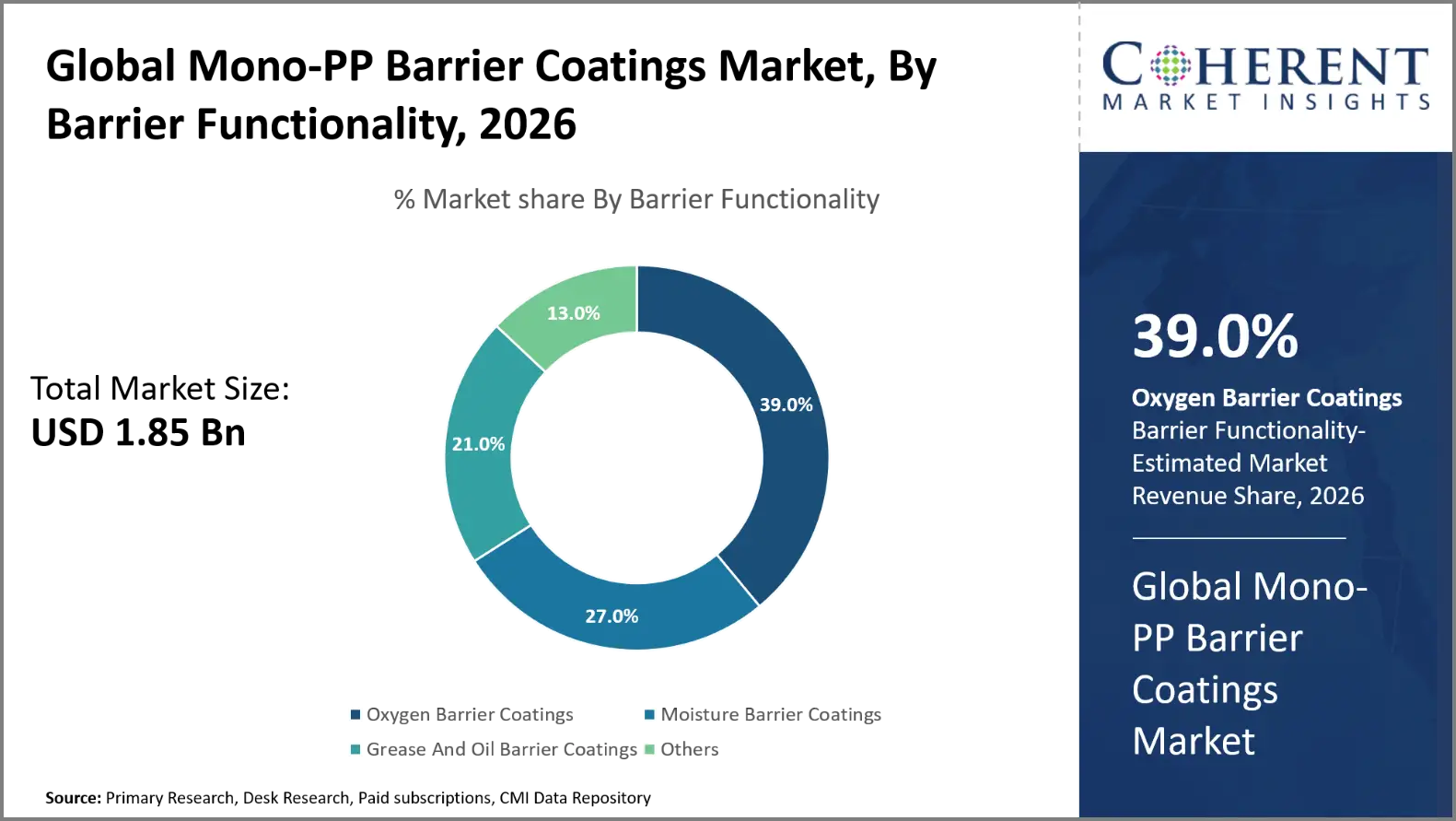
The oxygen barrier coatings segment is expected to account for 39.0% of the global Mono-PP barrier coatings market share in 2026. The most important functionality of oxygen barrier coatings is that the presence of oxygen has a direct impact on the quality and shelf life of the product. Increased oxygen penetration leads to oxidation, rancidity, discoloration and breakdown of sensitive food components. These consequences provide a major difficulty for snacking, dairy, processed foods and packaged beverages. Conventional polypropylene films have useful moisture resistance, but comparably weak oxygen protection. Coatings developed specifically to overcome this weakness without the need for massive multilayer plastic frameworks. Studies on polypropylene films have shown that graphene hybrid coatings drastically reduce oxygen permeability.
On June 4, 2025, TwoDM completed the development of graphene-based barrier technology for instant-rice containers. Dae-A C&I manufactures containers incorporating the graphene barrier. The technology improves oxygen and moisture protection compared with conventional polypropylene and ethylene vinyl alcohol composite containers.
Flexible Films Dominates the Global Mono-PP Barrier Coatings Market
The flexible films segment is expected to account for 35.0% of the global Mono-PP barrier coatings market share in 2026. Flexible films dominate because polypropylene offers lightweight construction, mechanical strength, transparency, and efficient packaging performance. Biaxially oriented polypropylene sheets offer improved stiffness, printability and dimensional stability for high-speed packing operations. Barrier coatings make them more suitable for safeguarding products from air, moisture, grease and external contamination. These films are widely used in snacks, confectionery, frozen food, personal care and domestic products. Their low weight minimizes the amount of packaging material used against certain standard rigid solutions. Coating technologies enable manufacturers to retain flexible packaging advantages while improving recyclability.
On June 2, 2025, Cosmo First announced the successful commissioning of new BOPP (Biaxially Oriented Poly Propylene) Film Line with Capex of more than USD 40.0 million at Company's existing manufacturing plant located at Aurangabad, Maharashtra, India. The new line boasts an annual rated capacity of 81,200 MT with the world’s most advanced technology.
Current Events and their Impact
Current Events | Description and its Impact |
European Parliament and Council of the European Union - Packaging and Packaging Waste Regulation (EU) 2025/40 (PPWR |
|
India - Plastic Waste Management (Amendment) Rules, G.S.R. 73(E) (Ministry of Environment, Forest and Climate Change) |
|
Mono-PP Barrier Coatings Market Dynamics
Market Drivers
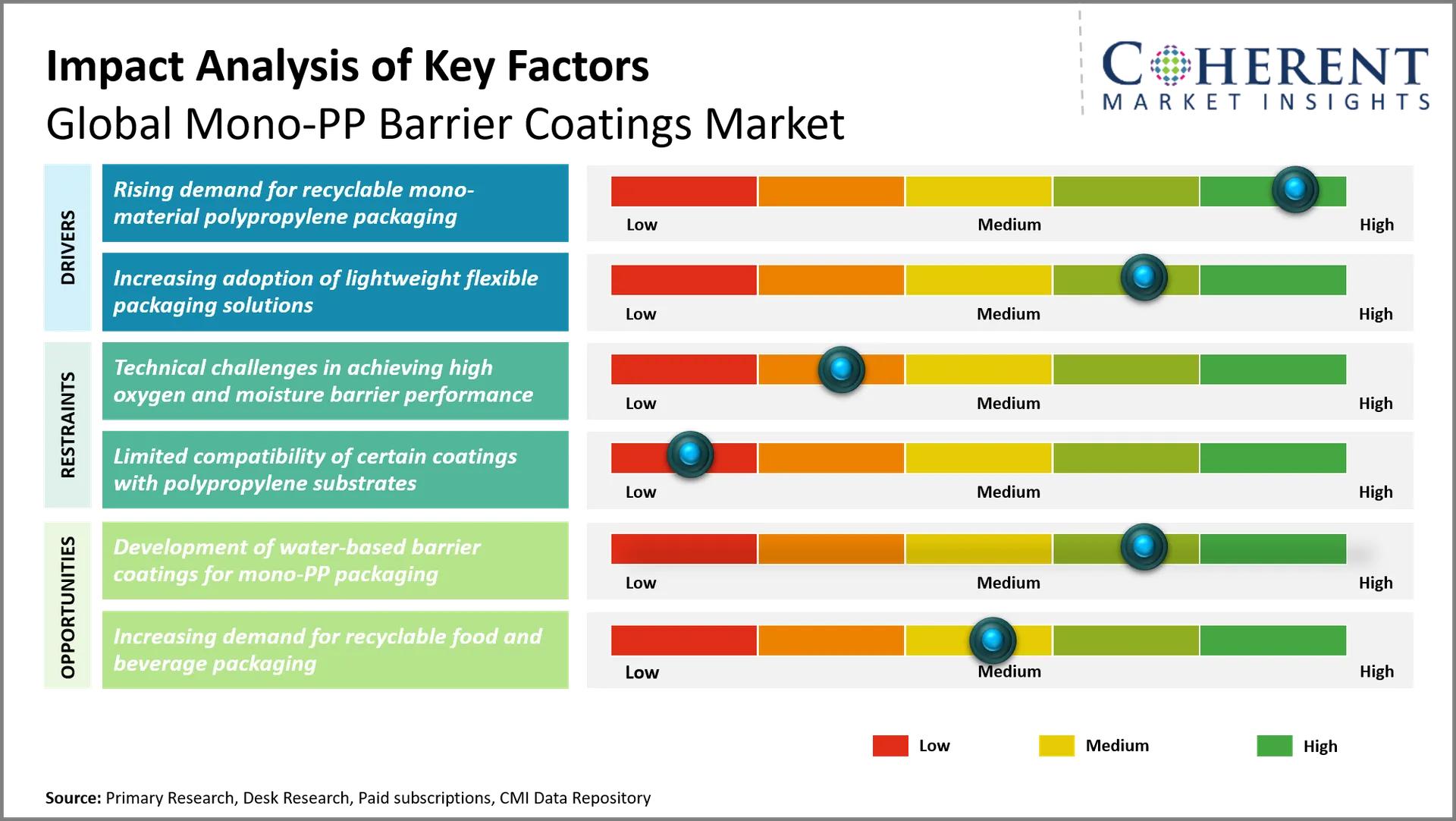
- Rising demand for recyclable mono-material polypropylene packaging: The increasing demand for recyclable mono-material polypropylene packaging is propelling the use of specialty barrier coatings. Packaging makers are moving away from intricate multilayer constructions to recyclable polypropylene-based options. Conventional packaging is frequently composed of layers of polypropylene, polyethylene, polyethylene terephthalate and aluminum. These combinations generate problems in the separation and recycling of materials. The mono-PP construction is compatible with material recovery, while offering a functional package. Barrier coatings protect against oxygen, moisture and grease without the need for incompatible polymer layers. This shift is backed by growing sustainability commitments among food businesses. The European Union packaging standards are pushing recyclable package design even more. Such advances mean there are prospects for high-performance barrier coatings that are compatible with recycling.
- On June 3, 2026, TOPPAN Inc. announced that TOPPAN Group film manufacturer Irplast S.p.A. (Irplast), has been awarded Silver in the Sustainability Design Award category at interpack 2026, a leading international packaging industry trade fair held in Düsseldorf, Germany.
- Increasing adoption of lightweight flexible packaging solutions: Growing adoption of lightweight flexible packaging solutions is boosting demand for mono-PP barrier coatings. Manufacturers are increasingly opting for flexible polypropylene films which offer low weight, good mechanical strength and an economical use of materials. Such features help to reduce the consumption of packaging material and emissions associated with transportation. Conventional polypropylene films, however, offer only minimal oxygen protection for delicate items. Specialized barrier coatings improve their appropriateness for snacking, confectionery, processed meals and personal care goods. Coated polypropylene films are also used in wrapper, bag, sachet and lidding applications. Compatibility with high-speed packing operations contributes to commercial attractiveness. Investments in innovative coating technologies are being driven by rising demand for practical container options.
- On April 29, 2025, Pregis announced an extension of its blown film operations at its Anderson facility in South Carolina, U.S. The investment expands manufacturing capacity for ethylene vinyl alcohol barrier-film choices. That additional capacity will help support its Pregis Renew portfolio of sustainable flexible packaging.
Emerging Trends
- Development of recyclable high-barrier mono-PP packaging: Packaging makers are designing structures based on polypropylene that offer better resistance to oxygen, moisture and grease. These technologies lessen reliance on incompatible multi-layer materials and promote the recyclability of packaging.
- Impact: Improved barrier performance enables mono-PP packaging to safeguard delicate products while still being lightweight. It also helps to simplify materials and potentially enhances compatibility with polypropylene recycling processes.
- Relevance to the market: Growing industry interest in advanced polypropylene film architectures shown by Jindal Films and Innovia Films. Their advances offer prospects for unique coatings that improve the barrier performance without compromising mono-material packaging designs.
- Growth of water-based and low-solvent barrier coating technologies: Coating producers are working on water-based formulations to decrease reliance on solvents. These innovations assist cleaner manufacturing processes and enable functional barrier layers on polypropylene packaging substrates.
- Impact: Water based coatings can reduce volatile organic compound emissions and increase compatibility with sustainable packaging production. Also, their usage drives coating innovation for recyclable flexible packaging applications.
- Relevance to the market: Siegwerk and Sun Chemical are expanding sustainable packaging technology portfolios. Their formulation expertise enables prospects for water-based barrier coatings for mono-PP films and flexible packaging converters.
Regional Insights
Why is Asia Pacific a Strong Market for Mono-PP Barrier Coatings?
Asia Pacific is expected to account for a market share of 47.0% in 2026. Integrated polypropylene film manufacturing in the Asia Pacific region continues to invest in functional coating capabilities. Polyplex has polypropylene film manufacturing sites in India, Thailand and Indonesia. Guangdong DECRO Film New Materials has seven BOPP production lines and two functional coating lines in China. Its facilities support specialty film development and proprietary package configurations. Japan's Dai Nippon Printing is applying sophisticated barrier engineering to their polypropylene mono-material packaging solutions. Regional producers are increasingly looking for coatings that offer product protection and at the same time simplify package systems. Demand potential include dry foods, confectionary, pharmaceutical items and domestic packaging. These manufacturing capabilities support regional sourcing and technological collaboration. These manufacturing capabilities strengthen regional sourcing and technical collaboration.
Why Does North America Mono-PP Barrier Coatings Market Exhibit High Growth?
North America is expected to register the fastest growth with a CAGR of 5.4% over the forecast period and is projected to account for 28.0% of the global Mono-PP barrier coatings market in 2026. It offers opportunities through established flexible packaging manufacturing and growing investment in polypropylene recycling compatibility. Jindal Films is located in Shawnee, OK and LaGrange, GA. These facilities enhance access to U.S. packaging converters and brand owners. Berry Global and Mitsubishi Gas Chemical have developed an MXD6 barrier solution for polypropylene packaging applications. The Association of Plastics Recyclers has recognized its compatibility with the polypropylene recycling process. The solution addresses limitations associated with certain conventional barrier materials. Canadian Plastics Pact guidance also identifies polypropylene’s temperature resistance and suitability for hot-fill, microwaveable, and retort applications. These requirements encourage specialized barrier development.
Global Mono-PP Barrier Coatings Market Outlook for Key Countries
Why is China Emerging as a Major Hub in the Mono-PP Barrier Coatings Market?
A large BOPP manufacturing infrastructure and the indigenous development of advanced functional films are strengthening China’s market. Guangdong DECRO Film New Materials has 7 international BOPP production lines, 2 coating lines and 7 research laboratories. The company also reports 182 invention patents across its operations. Firsta Group has commercialized ILC-BOPP high-barrier film, describing it as China's first large-scale industrialized technology of its kind. Its in-line coating technology is designed to defend against oxygen, moisture and scent. Applications include coffee, nuts, snacks, powdered meals and pharmaceuticals. These trends open up possibilities for coatings that combine processing efficiency with uniform barrier performance.
Is U.S. the Next Growth Engine for the Mono-PP Barrier Coatings Market?
The U.S. market is led by domestic film production, innovation in food packaging and demand for recyclable barrier constructions. Jindal Films has manufacturing operations in Georgia and Oklahoma to meet local demand for flexible packaging converters. TOPPAN also identifies the U.S. within its global GL BARRIER production network. Its polypropylene-based GL-SP technology demonstrates how transparent barrier layers can support mono-material packaging for dry products. Separately, Berry Global and Mitsubishi Gas Chemical developed an MXD6 barrier solution compatible with polypropylene recycling. The Association of Plastics Recyclers recognized this solution. These improvements support investment in barrier technologies that satisfy recyclability and rigorous packaging performance criteria.
Germany Mono-PP Barrier Coatings Market Analysis and Trends
Germany’s market is driven by modern packaging machinery, food processing needs, and engineering of recyclable thermoformed structures. At their industry presentation in October 2024, Weber Food Technology showcased the safe processing of mono-PP films on thermoforming machines. This discovery is a response to the processing difficulties in replacing standard APET/PE and boPET/PE laminates. Coveris has created MonoFlex Thermoform, which has nylon-free constructions made from polypropylene produced at its German sites. These films combine thermoformability with barrier performance for food protection. Fraunhofer Institute for Process Engineering and Packaging develops tailored oxygen and water-vapor barrier coatings. It works with mono-material trays, flexible films and packaging with recycled content.
Japan Mono-PP Barrier Coatings Market Analysis and Trends
Japan's market benefits from expertise in specialized barrier film engineering and existing uses in food and pharmaceutical packaging. In July 2025 Dai Nippon Printing created vacuum metalized high barrier polypropylene film. The technology delivers almost twice the barrier performance of its conventional mono-material packaging. The company also developed a polypropylene blister-pack lid that can replace aluminum foil in press-through packaging. Earlier, its barrier polypropylene packaging was adopted for Unilever's Lipton tea pouches in September 2020. That application demonstrated an alternative to aluminum-containing structures. These developments strengthen demand for coatings and surface treatments that preserve oxygen protection, moisture resistance, and product shelf life.
India Mono-PP Barrier Coatings Market Analysis and Trends
Domestic BOPP production and integrated barrier-film manufacture and demand for dry-food packaging are a positive for the Indian market. In April 2024, TOPPAN Specialty Films introduced GL-SP, a transparent barrier film with BOPP substrate. Its Indian facility combines substrate manufacture and barrier-film production. The product has an oxygen barrier of 0.5 cc/m2/day and a water vapor transmission rate of 0.5 g/m2/day under the indicated testing circumstances. TOPPAN targets export markets and dry-food packaging in India, ASEAN, Europe and the Americas. The company also reports a BOPP capacity of 102,000 tons annually. This infrastructure supports specialized coating development and domestic supply reliability.
Global Mono-PP Barrier Coatings Market – Regional BOPP Demand Distribution (2025)
Region/Country | Global Demand Share | Estimated Demand (KMT) |
China | 46% | 4779 |
Europe | 14% | 1454 |
India | 7% | 727 |
Southeast Asia | 7% | 727 |
Americas | 12% | 1247 |
Rest of World | 14% | 1454 |
Global | 100% | 10389 |
Development of Water-Based Barrier Coatings for Mono-PP Packaging
How is Development of Water-Based Barrier Coatings for Mono-PP Packaging Creating New Growth Opportunities in the Mono-PP Barrier Coatings Market?
The development of water-based barrier coatings creates growth opportunities by enabling polypropylene films to achieve stronger oxygen, grease, and moisture protection without relying heavily on solvent-based formulations. This is in support of mono-PP packaging for snacks, confectionery, dry foods and personal care goods. Coating providers can offer unique formulas for BOPP substrates that will enable converters replace complex laminates while maintaining compatibility with printing and converting processes. Water-based technologies also provide an opportunity to reduce volatile organic compound emissions and streamline production procedures.
This opportunity is illustrated by specific commercial developments. In 2023 DIC launched its water-based barrier coatings, SunSys, Sunstar and Hydbar, for trials in India. The formulations are designed to address oxygen barrier and sealing qualities on polyolefin structures, and are available for gravure, flexographic and offset application. Another example is Mitsui Chemicals’ TAKELAC WPB series, offering water-based oxygen barrier coatings for polypropylene mono-material retort packaging. These improvements open new potential for coating providers to cater to converters who want to provide recyclable, high-performance packaging for demanding culinary applications.
Market Players, Key Development, and Competitive Intelligence
Key Developments
- On October 14, 2026, Innovia Films, a leading materials science pioneer and manufacturer of high-performance biaxially oriented polypropylene (BOPP) films, announced the launch of Propafilm CHBM, an ultra-high barrier metallized BOPP film engineered to deliver exceptional product protection while supporting the transition to more recyclable flexible packaging solutions.
- On May 20, 2026, Surya Global Flexifilms (SGF) based in India invested in an EXPERT K5 3650mm with AlOx capability. The new machine will be installed in their factory at the end of 2026 and will sit alongside their three other BOBST metallizers further cementing the relationship between the two companies.
- On April 29, 2026, Siegwerk, one of the leading global providers of printing inks and coatings for packaging applications and labels, and Enplater Group, a specialist in the printing and production of rigid and flexible packaging, announced the joint development of an innovative mono-material packaging solution made of polypropylene (PP) that offers high technical performance full recyclability.
Competitive Landscape
The mono-PP barrier coatings market is developing around coating chemistry, substrate engineering, and integrated packaging solutions. DIC Corporation is a prominent specialist, using SunSys and Sunstar formulations to improve oxygen barriers and sealing qualities of polyolefin packaging. Mitsui Chemicals offers mono-material constructions based on polypropylene, using its proprietary TAKELAC WPB water-based oxygen barrier coating and ADMER tie-layer technologies. TOPPAN focuses on combining coating and vapor-deposition technologies through its GL BARRIER portfolio, including polypropylene-based GL-SP barrier film manufactured with Toppan Speciality Films in India. Competition increasingly depends on achieving reliable barrier performance, converting compatibility, food-contact suitability, and recyclability within commercially viable mono-PP structures.
Top Manufacturers and Notable Products in the Mono-PP Barrier Coatings Market
Manufacturer | Notable Product | Key features |
Jindal Films | Bicor and Alox-Lyte | Water-based coated BOPP options, transparent oxygen and moisture barriers, strong printability, heat-sealing and converting performance |
Taghleef Industries | EXTENDO | High and ultra-high oxygen and moisture barriers, aroma protection, lightweight construction, recyclable mono-PP packaging compatibility |
Cosmo First Limited | C1011 and Ultra High Barrier Films | High oxygen and aroma protection, moisture resistance, strong sealing performance, suitability for food packaging |
TOPPAN Holdings | GL BARRIER GL-BP-F | Transparent inorganic barrier coating, PP substrate compatibility, oxygen and moisture protection, suitability for recyclable mono-PP structures |
Polyplex Corporation Limited | Sarafil BOPP | Transparent polypropylene film, high tensile strength, flexibility, heat resistance, suitability for flexible packaging and value-added coating |
Market Report Scope
Global Mono-PP Barrier Coatings Market Report Coverage | |||
Report Coverage | Details | ||
Base Year | 2025 | Market Size in 2026: | USD 1.85 Bn |
Historical Data For: | 2020 To 2024 | Forecast Period: | 2026 To 2033 |
Forecast Period 2026 To 2033 CAGR: | 4.80% | 2033 Value Projection: | USD 2.50 Bn |
Geographies covered: |
| ||
Segments covered: |
| ||
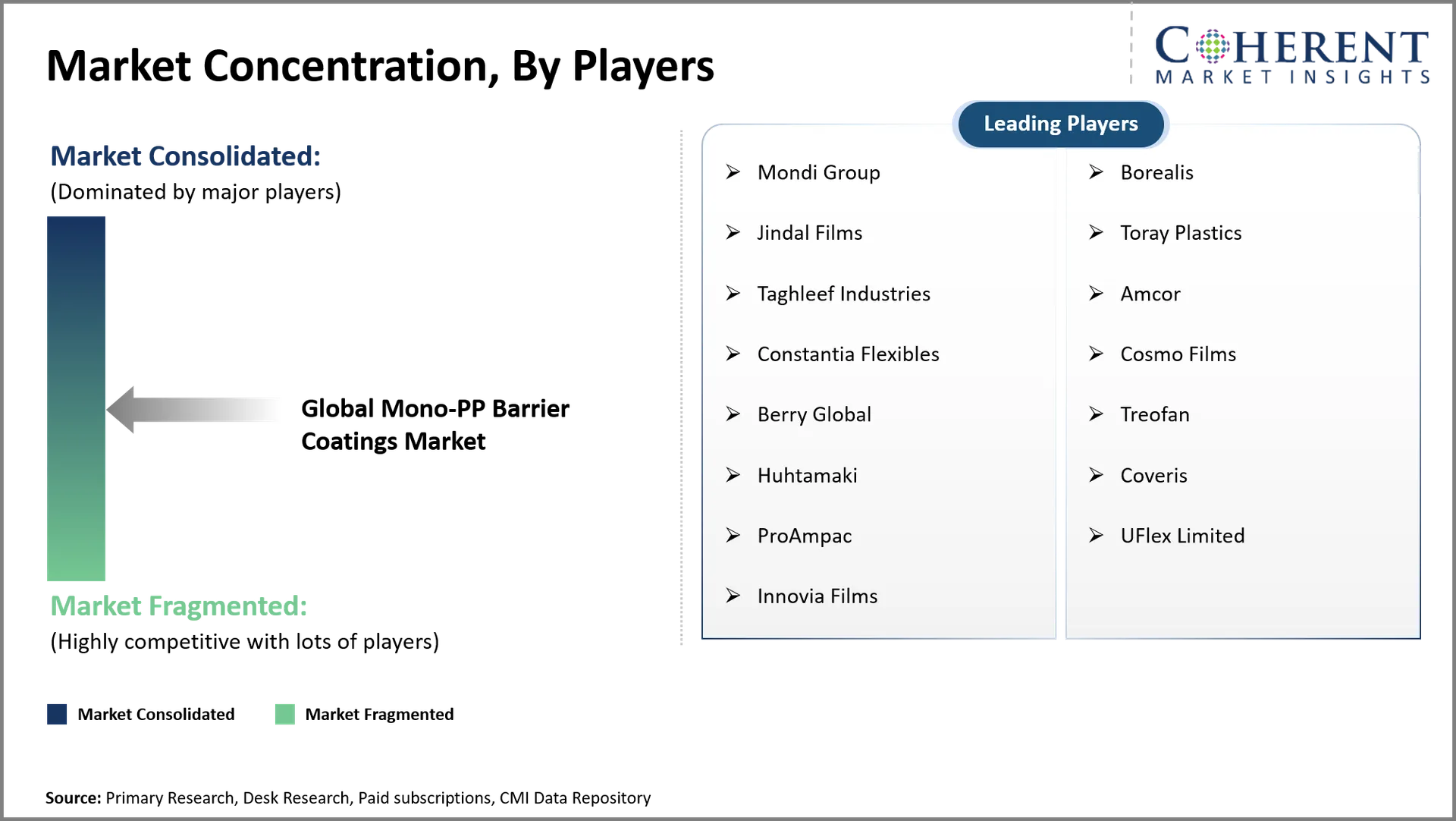
Companies covered: | Mondi Group, Borealis, Jindal Films, Toray Plastics, Taghleef Industries, Amcor, Constantia Flexibles, Cosmo Films, Berry Global, Treofan, Huhtamaki, Coveris, ProAmpac, UFlex Limited, Innovia Films | ||
Growth Drivers: |
| ||
Restraints & Challenges: |
| ||
Analyst Opinion (Expert Opinion)
- The future of the mono-PP barrier coatings industry will depend on improving oxygen protection without compromising polypropylene recyclability. Coating suppliers will increasingly need formulations that withstand printing, lamination, heat sealing, and demanding packaging conditions. Water-based polyurethane dispersions and other aqueous barrier chemistries offer promising development pathways. Suppliers should focus on coating technologies that maintain performance after flexing and thermal processing. Commercial success will depend on proving compatibility with existing BOPP production and packaging conversion equipment.
- The best potential will be in oxygen-barrier coatings for flexible food packaging, especially for snack foods, coffee, confectionery and powdered items. Polypropylene already has useful resistance to moisture; therefore, the oxygen protection is a valuable functional boost. India and China are excellent manufacturing prospects with large BOPP production ecosystems and growing package conversion businesses. Germany and Japan provide chances for sophisticated formulations for retort packaging, precise coating and stringent food protection standards. Other areas where suppliers can look for grease-resistant coatings are snack and ready-to-eat food applications.
- Market participants should build application-specific coating portfolios rather than commercializing one formulation across every polypropylene substrate. They should collaborate directly with BOPP producers, printing companies, and flexible packaging converters during formulation development. Testing should cover oxygen transmission, water-vapor transmission, heat-seal strength, coefficient of friction, and barrier retention after flexing. Suppliers should establish food-contact compliance documentation and provide coating parameters for gravure and flexographic operations. Partnerships with Indian and Chinese film manufacturers can accelerate industrial trials and customer qualification. Companies demonstrating consistent performance on commercial converting lines will gain a stronger competitive advantage.
Speak to the analyst
Want personalized insights?
Take the findings above to one of our principal consultants, or have the report rebuilt around the segments, geographies and competitors you actually track.
Market Segmentation
- Coating Type Insights (Revenue, USD Billion, 2021 - 2033)
- Water-Based Barrier Coatings
- Solvent-Based Barrier Coatings
- UV-Curable Barrier Coatings
- Aqueous Dispersion Coatings
- Others
- Barrier Functionality Insights (Revenue, USD Billion, 2021 - 2033)
- Oxygen Barrier Coatings
- Moisture Barrier Coatings
- Grease And Oil Barrier Coatings
- Others
- Application Insights (Revenue, USD Billion, 2021 - 2033)
- Flexible Films
- Pouches and Sachets
- Lidding Films
- Flow-Wrap Packaging
- Stand-Up Pouches
- Laminated Packaging Structures
- End User Insights (Revenue, USD Billion, 2021 - 2033)
- Food and Beverage
- Personal Care and Cosmetics
- Healthcare and Pharmaceuticals
- Home Care
- Industrial Packaging
- Consumer Goods
- Regional Insights (Revenue, USD Billion, 2021 - 2033)
- North America
- U.S.
- Canada
- Latin America
- Brazil
- Argentina
- Mexico
- Rest of Latin America
- Europe
- Germany
- U.K.
- Spain
- France
- Italy
- Russia
- Rest of Europe
- Asia Pacific
- China
- India
- Japan
- Australia
- South Korea
- ASEAN
- Rest of Asia Pacific
- Middle East
- GCC Countries
- Israel
- Rest of Middle East
- Africa
- South Africa
- North Africa
- Central Africa
- North America
- Key Players Insights
- Mondi Group
- Borealis
- Jindal Films
- Toray Plastics
- Taghleef Industries
- Amcor
- Constantia Flexibles
- Cosmo Films
- Berry Global
- Treofan
- Huhtamaki
- Coveris
- ProAmpac
- UFlex Limited
- Innovia Films
Sources
Primary Research Interviews
- Mono-PP Barrier Coating Manufacturers & Formulators
- Flexible Packaging Converters & Processors
- Raw Material Suppliers (Polypropylene & Coating Additives)
- End-Use Industry Representatives (Food & Beverage, Pharmaceutical Packaging)
Magazines
- Packaging World Magazine
- Plastics Technology Magazine
- Converting Magazine
- Flexible Packaging Magazine
Journals
- Journal of Applied Polymer Science
- Progress in Organic Coatings (Elsevier)
- Journal of Packaging Technology and Research
Associations
- Flexible Packaging Association (FPA)
- European Coatings Association (ECA)
- Plastics Industry Association (PLASTICS)
- Society of Plastics Engineers (SPE)
Public Domain Sources
- U.S. Environmental Protection Agency (EPA)
- European Chemicals Agency (ECHA)
- Food and Agriculture Organization (FAO)
- World Packaging Organization (WPO)
Proprietary Elements
- CMI Data Analytics Tool
- Proprietary CMI Existing Repository of Information for the Last 10 Years
Get access to 250+ pages report
Every segment, forecast, competitor profile and data table behind the analysis above — available for instant download.
- ESOMAR Member
- ISO 9001:2015 Certified
- D-U-N-S Registered
- GDPR & CCPA Compliant
Frequently Asked Questions
The global Mono-PP barrier coatings market is expected to stand at USD 1.85 Bn in 2026 and is expected to reach USD 2.50 Bn by 2033.
The CAGR of the global Mono-PP barrier coatings market is projected to be 4.8% from 2026 to 2033.
Rising demand for recyclable mono-material polypropylene packaging and Increasing adoption of lightweight flexible packaging solutions are the major factors driving the growth of the global Mono-PP barrier coatings market.
Technical challenges in achieving high oxygen and moisture barrier performance and Limited compatibility of certain coatings with polypropylene substrates are the major factors hampering the growth of the global Mono-PP barrier coatings market.
In terms of coating type, water-based barrier coatings segment is estimated to dominate the market revenue share in 2026.
Mono-PP barrier coatings are functional layers applied to polypropylene packaging to improve oxygen, moisture, grease, and aroma resistance.
Recyclability requirements encourage manufacturers to replace complex packaging combinations with structures designed for compatible material recovery.