

Global Nanofiltration Membrane Market Size and Forecast – 2026 To 2033
The Global Nanofiltration Membrane Market is estimated to be valued at USD 940.2 Mn in 2026 and is expected to reach USD 1,519.7 Mn by 2033, growing at a compound annual growth rate (CAGR) of 7.10% from 2026 to 2033. Market expansion is supported by increasing requirements for selective water purification, industrial wastewater reuse, sulfate and ion removal, and resource-efficient separation across municipal water, chemicals, energy, food processing, and other process industries. Nanofiltration is gaining commercial relevance where operators need targeted contaminant removal while retaining selected dissolved species and reducing the energy intensity associated with complete desalination.
In May 2025, Veolia announced water-technology contracts worth more than USD 750 Mn across Brazil, the U.S., and the UAE, including projects that will deploy nanofiltration membranes to remove sulfates and harmful ions from seawater used in offshore energy operations. This deployment demonstrates how nanofiltration is moving beyond conventional municipal treatment into large-scale industrial water-management applications where membrane selectivity directly supports asset protection, operating reliability, and water efficiency.
Key Takeaways of the Global Nanofiltration Membrane Market
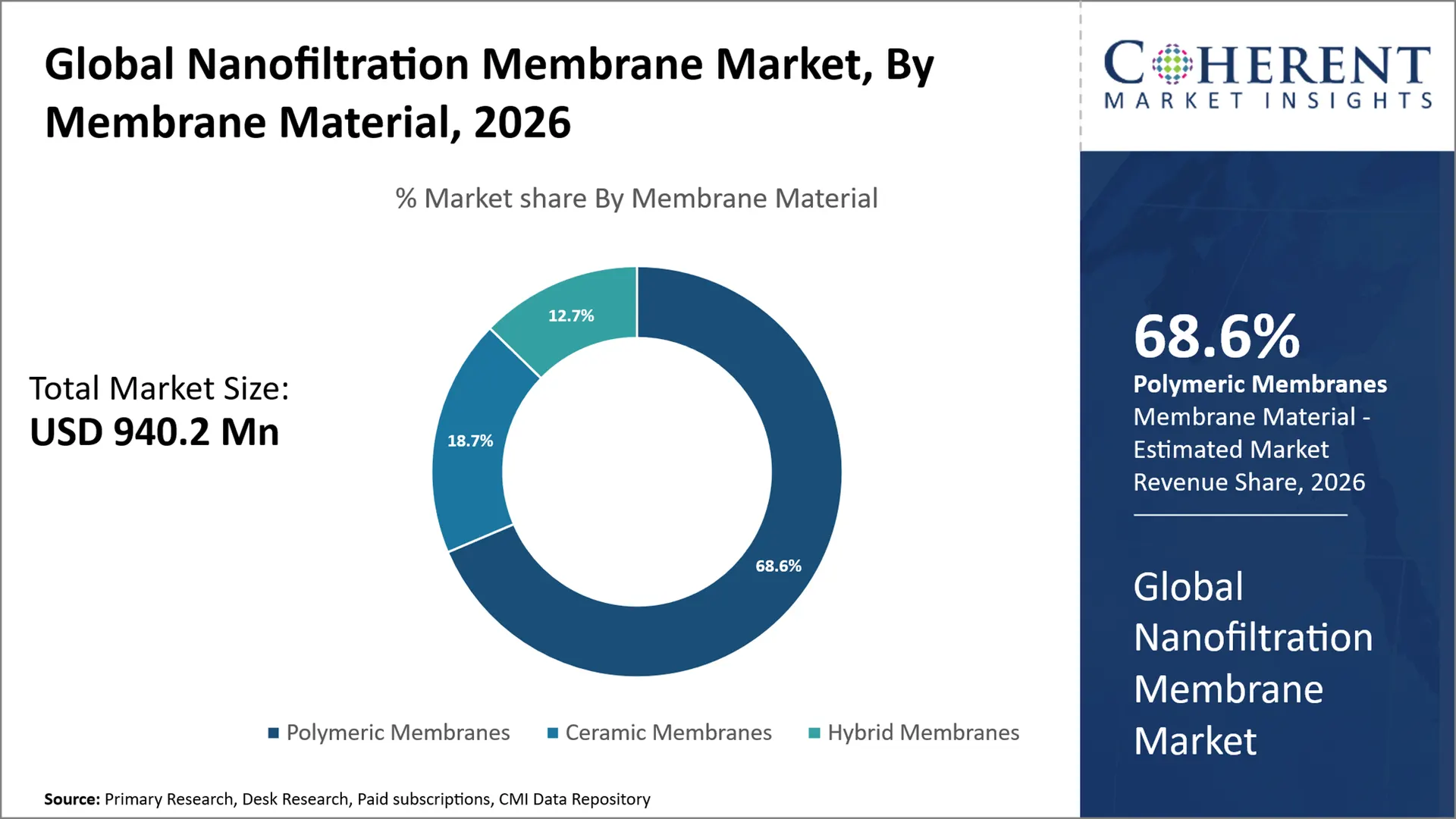
- Polymeric Membranes are projected to expand at an estimated 7.3% CAGR during 2026–2033; their 2026 share is expected to reach 68.6% of the global nanofiltration membrane market. Their scalable thin-film composite construction, tunable polyamide chemistry, lower cost, and broad compatibility with municipal and industrial systems underpin adoption. In June 2025, DuPont reported FilmTec nanofiltration elements operating in the Foshan Jialida Dyeing minimal-liquid-discharge project for industrial wastewater reuse and resource recovery.
- Spiral Wound Membranes should grow at an estimated 7.4% CAGR during 2026–2033 and are expected to account for 42.8% of the global nanofiltration membrane market in 2026. High packing density, standardized pressure-vessel integration, and established replacement practices make this configuration commercially efficient for high-throughput treatment. In March 2024, the U.S. EPA’s PFAS treatment technical support document stated that RO/NF membranes in drinking-water treatment are most often deployed in spiral-wound configuration.
- Water and Wastewater Treatment is forecast to record an estimated 7.7% CAGR during 2026–2033 while representing an expected 46.8% of the global nanofiltration membrane market in 2026. Selective hardness removal, organic contaminant control, reuse capability, and lower-pressure operation than reverse osmosis make nanofiltration attractive for utilities and industrial users. In May 2025, LG Water Solutions launched LG NF9 for municipal and industrial water treatment, including PFAS and THM removal.
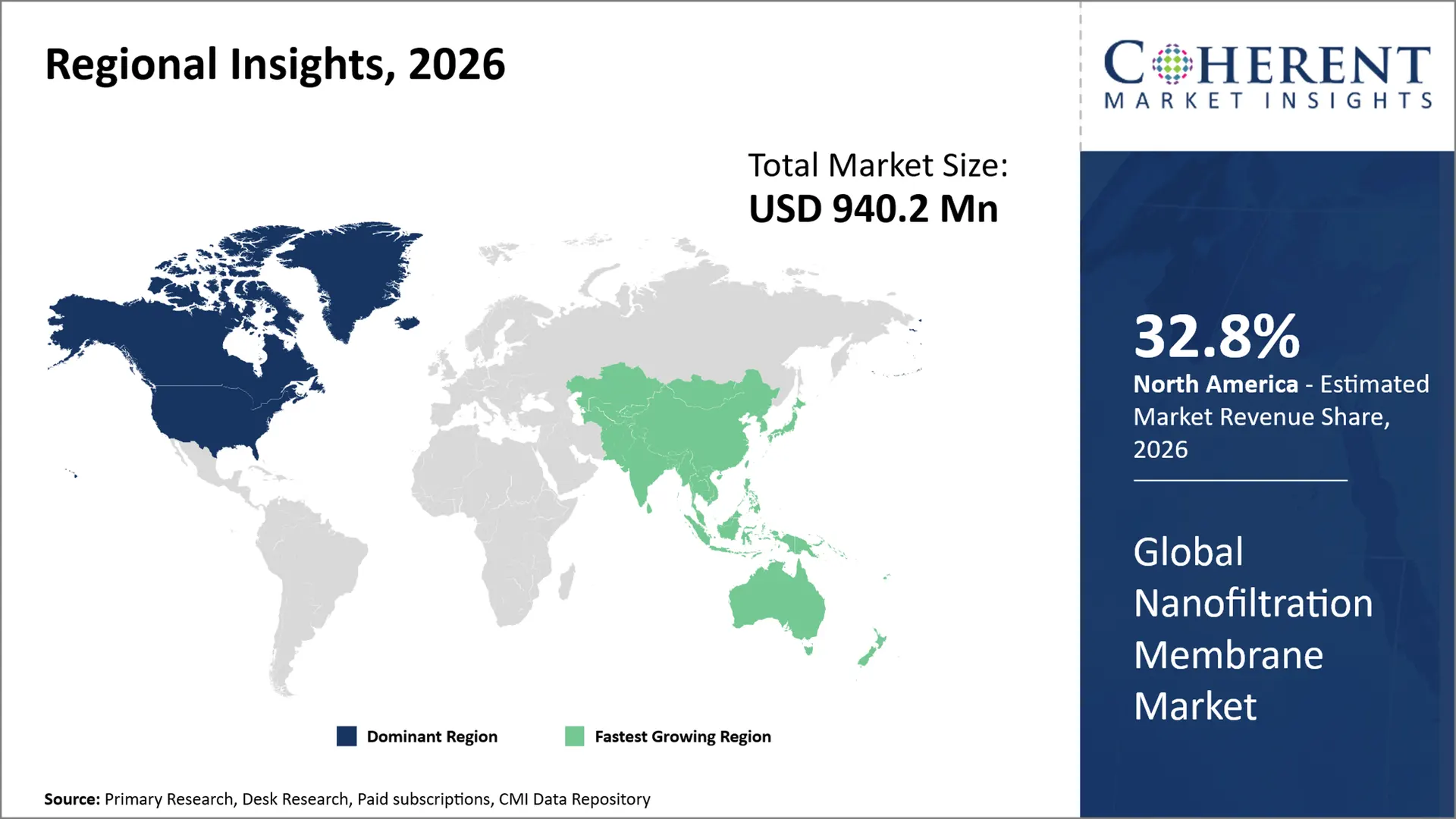
- North America is likely to advance at an estimated 6.8% CAGR during 2026–2033; its 2026 share is expected to be 32.8% of the global nanofiltration membrane market. Mature water infrastructure, contaminant-control requirements, and strong engineering procurement channels support sustained commercial adoption. In August 2026, NX Filtration reported securing its first hollow-fiber nanofiltration orders with Applied Membranes in North America, indicating conversion of regional OEM relationships into commercial projects.
- Asia Pacific, with an estimated 8.6% CAGR during 2026–2033, is expected to hold 28.7% of the global nanofiltration membrane market in 2026, making it the fastest-growing region. Industrial water reuse, food processing expansion, tighter discharge standards, and capacity additions in advanced manufacturing are widening the addressable base. In March 2025, Alfa Laval announced a major Asian industrial filtration order for a plant combining nanofiltration and ultrafiltration.
Segmental Insights
Why Do Polymeric Membranes Dominate the Global Nanofiltration Membrane Market?
Polymeric Membranes, with an expected 68.6% share in 2026, lead the membrane-material category in the global nanofiltration membrane market because their manufacturing base is already built around large-area film casting, coating, and element conversion at commercial scale. This gives suppliers greater production flexibility than ceramic or hybrid alternatives when serving drinking-water, hardness-removal, dairy, pharmaceutical, and industrial separation projects. Buyers also benefit from broader grade availability and established qualification pathways, while manufacturers can adapt surface chemistry, support structures, and operating envelopes without changing the entire production platform. In December 2025, India’s Department of Atomic Energy reported that BARC-developed membrane purification technologies, including charged nanofiltration technology, were available for commercial transfer and had been deployed through licensed manufacturers across multiple states. This reinforces the supply-side advantage of scalable membrane platforms and local commercialization capability.
- Current Industry Events of 2026
- Market Size Estimation
- Regional Breakdown
- Competitive Landscape
- Customer Intelligence
- Segmental Analysis
- Pricing Analysis
- Key Market Drivers, Challenges & Future Trends
- Customized Insights Section
Why Do Spiral Wound Membranes Represent the Largest Membrane Configuration in the Global Nanofiltration Membrane Market?
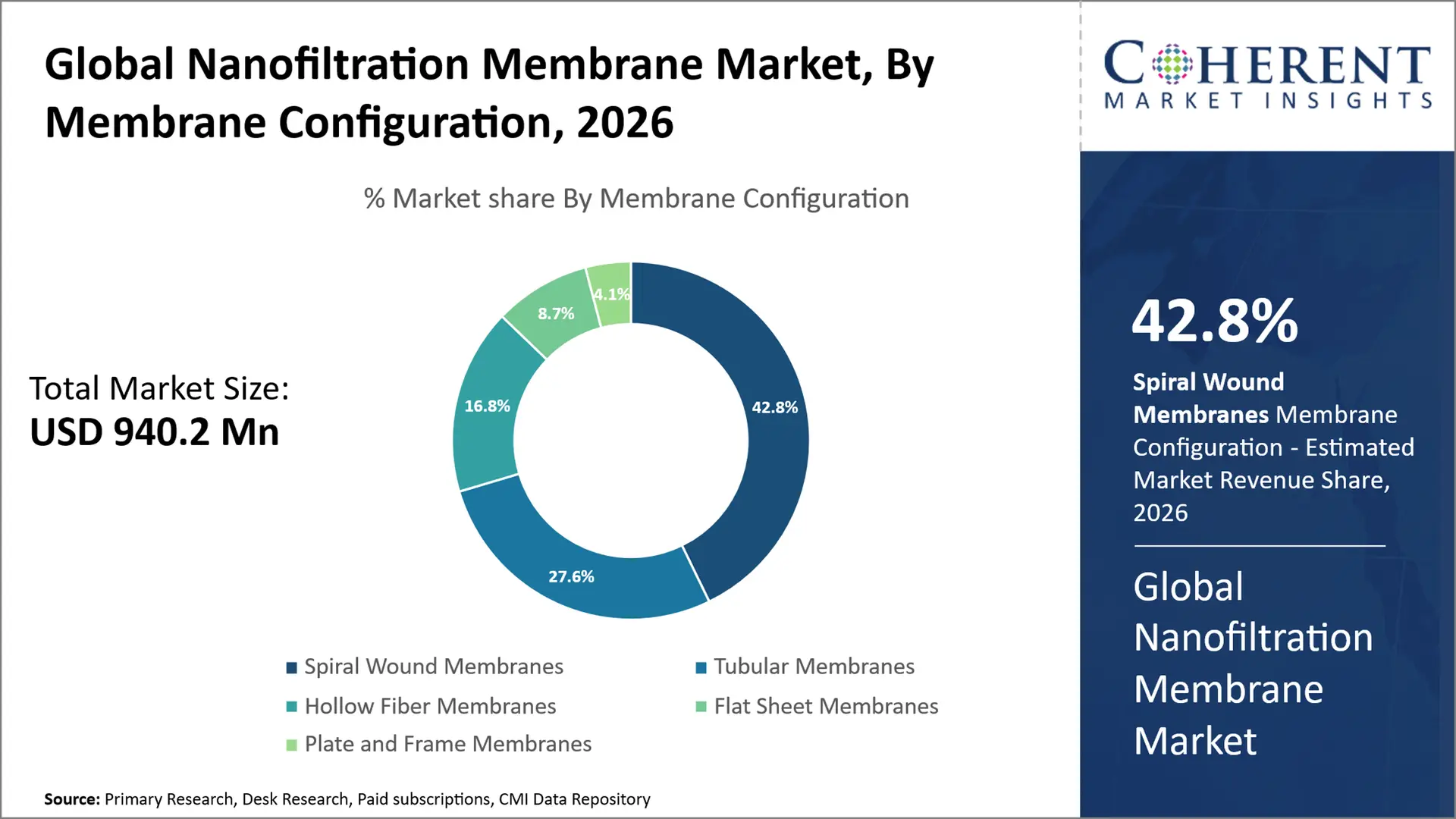
Spiral Wound Membranes, expected to account for 42.8% of the global nanofiltration membrane market in 2026, lead the membrane-configuration category because they allow NF systems to be scaled through staged element arrays rather than through major redesign of the separation process. Feed-spacer geometry, leaf construction, and pressure-vessel sequencing give system engineers practical control over crossflow, recovery, pressure drop, and fouling management. This makes the format attractive for process water, dairy, food ingredients, biopharmaceuticals, and industrial separations where capacity expansion must remain modular. Suppliers gain commercially because one element architecture can be incorporated into both standard and application-specific skids. In January 2026, Synder Filtration stated that it was designing and fabricating custom spiral-wound systems for NF, RO, UF, and MF applications, with in-house system engineering and controls integration. The development illustrates the configuration’s adaptability across engineered separation projects.
Why Do Water and Wastewater Treatment Dominate the Application Segment of the Global Nanofiltration Membrane Market?
Water and Wastewater Treatment, with an expected 46.8% share in 2026, remains the largest application in the global nanofiltration membrane market because treatment operators increasingly need membrane steps that do more than produce permeate: they must also control concentrate volume, protect downstream equipment, and recover more usable water from difficult streams. Nanofiltration can be positioned between pretreatment and higher-intensity desalination or thermal concentration, giving municipal and industrial users another design lever for managing salts, organics, and brine. This expands commercial opportunities for membrane suppliers, EPC firms, and integrated water-system providers capable of optimizing complete treatment trains. In July 2025, Saltworks Technologies launched FusionRO, combining ultra-high-pressure RO with tight NF for brine concentration and higher freshwater recovery in industrial applications. The launch demonstrates how NF is being integrated into advanced wastewater architectures where disposal volume and downstream treatment cost directly influence project economics.
Current Events and Their Impact
Current Event | Description and Its Impact |
EU Revised Urban Wastewater Treatment Directive – November 2024 |
|
EU Industrial Emissions Directive 2.0 – August 2024 |
|
Global Nanofiltration Membrane Market Dynamics
Key Market Drivers
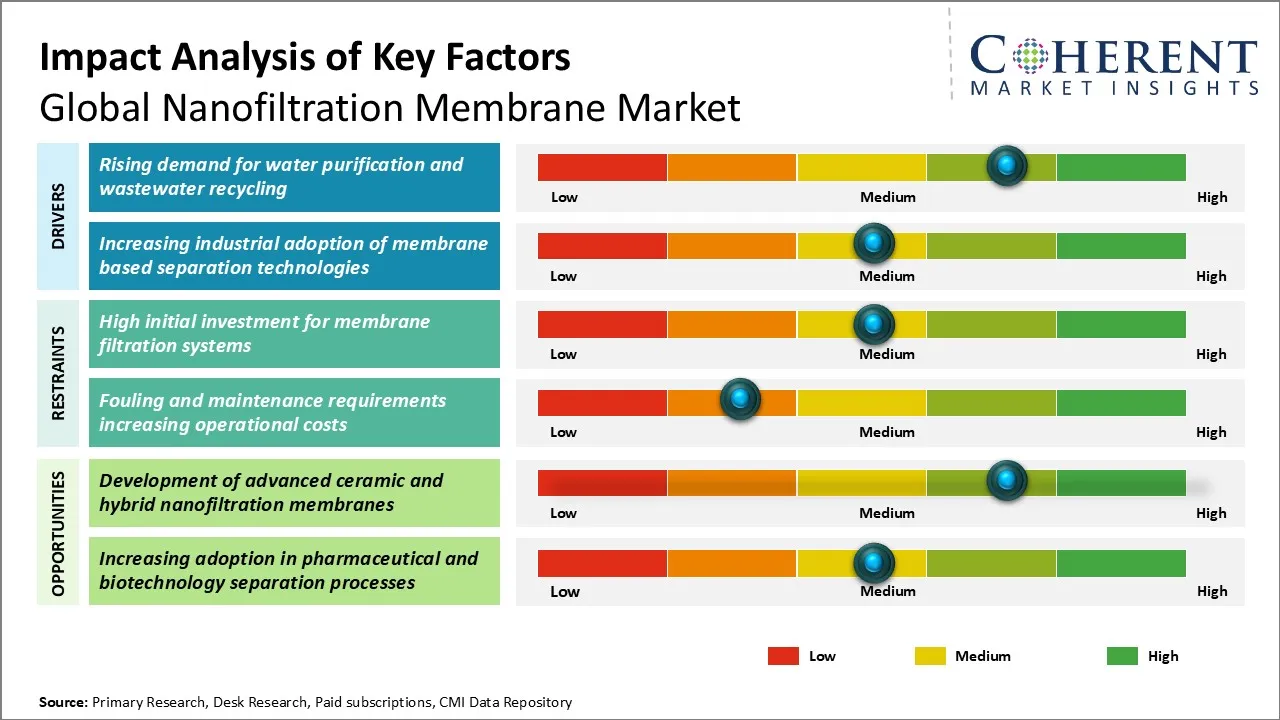
- Rising demand for water purification and wastewater recycling: Rising demand for water purification and wastewater recycling is broadening nanofiltration procurement beyond conventional softening toward reclamation, high-recovery reuse, and industrial process-water loops. NF is commercially attractive where operators need selective removal of multivalent ions and organics without the full demineralization burden of reverse osmosis, improving recovery economics and preserving useful salts. OEMs, membrane suppliers, EPC contractors, and reuse-system integrators benefit as treatment trains become more application-specific. In September 2025, INEXA and IonClear formed an alliance combining engineering with RO/NF membrane technology for desalination, reclamation, and water-reuse systems worldwide.
- Increasing industrial adoption of membrane based separation technologies: Increasing industrial adoption of membrane based separation technologies is creating a higher-value role for nanofiltration in chemical, pharmaceutical, and specialty-process separations where selective molecular fractionation can reduce dependence on energy-intensive thermal steps. Commercial demand increasingly depends on solvent resistance, temperature tolerance, cleanability, and stable selectivity under harsh feeds, rewarding materials developers and specialist process integrators rather than commodity membrane suppliers alone. In December 2024, the U.S. Department of Energy proposed federal funding to the University at Buffalo for carbon-doped titanium oxide membranes designed for highly energy-efficient, precise organic-solvent nanofiltration in harsh industrial conditions.
Emerging Market Trends
- Procurement Is Moving Toward Feed-Specific Selectivity Guarantees: Nanofiltration buyers are increasingly evaluating membranes against the chemistry of their actual feed rather than relying only on nominal molecular-weight cut-off or headline rejection values. Qualification is therefore shifting toward pilot data, ion-to-ion selectivity, organic rejection, cleaning recovery, and performance stability across variable feed conditions. This favors suppliers with application laboratories, modelling capability, and repeatable field-validation protocols, while placing pressure on vendors competing mainly through catalogue specifications. Over the forecast period, performance guarantees are likely to become more closely linked to defined feed envelopes and operating conditions.
- Dry-Shipped and Lower-Chemical Membrane Formats Are Reworking Logistics: Membrane suppliers are exploring formats that reduce dependence on liquid preservatives and simplify storage, transport, handling, and commissioning. For distributors and system integrators, this can lower inventory complexity and chemical-handling requirements while making replacement stock easier to position across geographically dispersed projects. Buyers also gain from simpler start-up procedures and potentially less preservative flushing before operation. The trend could alter packaging standards and aftermarket economics, but adoption will depend on proving that dry storage does not compromise membrane integrity, wet-out behavior, or long-term separation performance.
Regional Insights
Why Does North America Dominate the Global Nanofiltration Membrane Market?
North America is expected to hold 32.8% of the global nanofiltration membrane market in 2026, supported by a mature base of municipal treatment systems, industrial water-reuse projects, membrane OEMs, engineering firms, and high-value separation applications. Demand is increasingly shaped by the need to remove hardness, dissolved organics, emerging contaminants, and selected ions while avoiding unnecessary full desalination. The region also benefits from strong commercialization pathways linking university research, federal funding, pilot validation, and industrial deployment. This is particularly important for resource-recovery applications where membrane selectivity can create value beyond water treatment. In November 2025, the National Research Council Canada committed USD 210205.48 through its Industrial Research Assistance Program to Edmonton-based Greenvi Corp. for development of a lithium-selective nanofiltration membrane and manufacturing optimization. The project illustrates how North American funding is extending NF into critical-mineral recovery and domestic membrane commercialization.
Why Is Asia Pacific Emerging as the Fastest-Growing Region in the Global Nanofiltration Membrane Market?
Asia Pacific is expected to represent 28.7% of the global nanofiltration membrane market in 2026 and emerge as the fastest-growing region as new treatment capacity is added alongside industrial expansion rather than being limited to replacement demand. Electronics, chemicals, food processing, textiles, mining, and urban water systems create diverse feed streams requiring selective ion removal, water reuse, and resource recovery. Regional suppliers also benefit from expanding membrane fabrication capability and a growing pilot-to-commercial scale-up ecosystem. This combination shortens the route between laboratory membrane chemistry and industrial qualification. In August 2025, Australia’s CSIRO and Monash University unveiled a national-scale Membrane Pilot Facility with roll-to-roll coating and casting, testing platforms, and scale-up capability for water purification and resource recovery. Although the facility supports multiple membrane technologies, it strengthens the regional infrastructure needed to validate and commercialize next-generation nanofiltration solutions
Global Nanofiltration Membrane Market Outlook for Key Countries
Why Is the U.S. a Key Market for the Global Nanofiltration Membrane Market?
The U.S. is a key market for nanofiltration membranes because water-stressed states, industrial water reuse programs, and utilities investing in advanced treatment create demand for selective membrane separation. Nanofiltration is commercially relevant where operators need hardness reduction, organic-matter control, partial demineralization, or protection of downstream reverse-osmosis assets without applying full desalination to every stream. The country also has a deep engineering and equipment-integration base, supporting pilot testing, retrofits, and lifecycle service. Regulatory movement toward potable reuse further expands the addressable pool for advanced membrane suppliers, even where NF is not explicitly prescribed. In October 2024, California’s direct potable reuse regulations became effective, allowing water systems to invest in treatment plants that convert wastewater into drinking water. The regulation does not mandate nanofiltration, but it increases project activity around advanced, multi-barrier treatment architectures in which selective membrane processes can compete for pretreatment and polishing roles.
Why Does China Support Growth in the Global Nanofiltration Membrane Market?
China is strategically important to the global nanofiltration membrane market because its large chemical, textile, electronics, pharmaceutical, and water-treatment industries create demand for both aqueous and solvent-based separations. Domestic manufacturing scale also gives Chinese membrane and module producers an opportunity to shorten lead times, localize system design, and compete on application-specific performance rather than relying solely on imported technology. Standardized testing is becoming particularly important as organic-solvent nanofiltration moves from laboratory work toward industrial solvent recovery and molecular fractionation. In July 2026, China published national standard GB/T 47899-2026, Test methods for organic solvent nanofiltration membrane, with implementation scheduled for February 2027. The standard provides a formal test framework for an emerging NF application, reducing qualification ambiguity for suppliers and industrial buyers. This is commercially relevant for processors requiring comparable membrane-performance data before adopting solvent-resistant separation systems at production scale.
Why Is India Important in the Global Nanofiltration Membrane Market?
India is an important growth market for nanofiltration membranes because industrial clusters face water-quality challenges, wastewater discharge requirements, freshwater constraints, and pressure to control treatment costs. These conditions create room for NF where selective salt passage, color removal, fractionation, or resource recovery can achieve the required separation without the higher pressure associated with complete desalination. Textile processing, specialty chemicals, food ingredients, pharmaceuticals, and industrial reuse are especially relevant application areas. Local membrane research is also important because feed chemistry and cost targets often differ from imported-system reference conditions. In March 2024, CSIR–Central Salt & Marine Chemicals Research Institute began a Science & Engineering Research Board-funded project to develop low-fouling tight ultrafiltration and loose nanofiltration membranes for fractionation and resource recovery. The program supports indigenous membrane design and could improve application-specific know-how for cost-sensitive Indian industrial users.
Why Is Japan an Important Growth Market for the Global Nanofiltration Membrane Market?
Japan is a key nanofiltration membrane market because its industrial base places unusually high value on purity, yield, process efficiency, and recovery of expensive materials rather than treating membranes only as water-treatment equipment. Semiconductor materials, fine chemicals, pharmaceuticals, food ingredients, and battery recycling create applications where selective separation can reduce chemical consumption and recover valuable ions or molecules. Japan’s strength in materials science and precision process engineering also supports sophisticated membrane modification and validation. In November 2025, Tohoku University reported a membrane-separation process for recovering valuable metals from spent lithium-ion battery leachates using surface-modified commercial nanofiltration membranes. The researchers demonstrated selective separation of lithium from nickel, cobalt, and manganese and subsequently obtained battery-grade lithium carbonate after concentration and recrystallization. The work highlights a commercially important direction for Japan: applying NF to circular-economy processes where recovered material value can justify advanced separation technology.
Why Is Germany a Strategic Country in the Global Nanofiltration Membrane Market?
Germany is a strategic country for the global nanofiltration membrane market because its chemical, pharmaceutical, food-processing, and environmental-engineering sectors demand high process reliability and increasingly precise contaminant control. The country’s strength lies less in commodity membrane consumption and more in advanced applications where durability, selectivity, energy use, and validated treatment performance influence purchasing decisions. German research institutes and equipment specialists also provide a strong bridge between ceramic-material development, pilot systems, and industrial engineering. In August 2026, Fraunhofer IKTS documented real-condition testing under its PharMem project, which combines functionalized ceramic nanofiltration membranes with advanced oxidation to remove pharmaceutical micropollutants from wastewater. The project is scaling NF layers to larger multi-channel tubes and rotating-disk filters, with the NF step already demonstrating high retention for selected pharmaceuticals. This supports Germany’s position in premium, technically demanding nanofiltration applications rather than volume-led competition.
Nanofiltration Technology Adoption and Commercialization Landscape for the Global Nanofiltration Membrane Market
Technology | Adoption Stage | Priority Applications | Commercial Implication |
Thin-Film Composite Polyamide NF Membranes | Commercially established | Water softening, dissolved-organic removal, industrial reuse, process water | Remains the core platform for scalable NF deployment because manufacturers can adjust selective-layer chemistry while using standardized module formats. Competition centers increasingly on durability and application-specific selectivity rather than basic membrane availability. |
Ceramic Nanofiltration Membranes | Selective commercial adoption | High-temperature streams, aggressive chemicals, abrasive feeds, harsh cleaning environments | Higher initial investment limits broad use, but tolerance to difficult operating conditions can improve lifecycle economics where polymeric membranes experience rapid degradation or frequent replacement. |
Hollow-Fiber Nanofiltration | Scaling commercialization | Surface water, high-fouling wastewater, reuse pretreatment, decentralized treatment | Backwashable architecture and alternative hydraulic configurations can simplify treatment of challenging feeds. Commercial adoption depends on demonstrating durable selectivity and competitive lifecycle cost at plant scale. |
Organic Solvent Nanofiltration | Specialist and early commercial adoption | Pharmaceuticals, specialty chemicals, solvent recovery, fine-chemical purification | Offers a route to molecular separation without relying entirely on evaporation or distillation. Solvent compatibility, membrane stability, and application qualification remain decisive barriers to wider procurement. |
Surface-Engineered Antifouling NF Membranes | Emerging commercial enhancement | Complex industrial wastewater, organic-rich feedwater, difficult cleaning environments | Hydrophilic, charged, or modified selective surfaces aim to preserve flux and reduce cleaning intensity. Suppliers that can prove coating stability through repeated operating and cleaning cycles can differentiate on uptime rather than nominal rejection alone. |
Digital NF Process Optimization and Predictive Control | Expanding system-level adoption | Multi-stage plants, variable-feed reuse systems, industrial process water | Process models, sensor data, and predictive control allow operators to adjust pressure, recovery, cleaning, and staging around changing feeds. This shifts competitive value toward membrane suppliers and integrators capable of combining physical products with operational intelligence. |
How Are Standardized Skid-Mounted NF Systems Creating New Growth Opportunities in the Global Nanofiltration Membrane Market?
Standardized skid-mounted nanofiltration systems can open an underdeveloped customer pool among small and mid-sized industrial facilities that need selective treatment but cannot justify bespoke membrane engineering. Packaged systems reduce project friction by combining pretreatment interfaces, pumps, controls, membrane housings, cleaning functions, and remote support into repeatable designs. Specialty chemical plants, food-ingredient processors, metal-finishing sites, and distributed manufacturing clusters are attractive targets where water reuse or product recovery has clear operating value. Suppliers can capture this opportunity through configurable module families, rental or pilot fleets, performance-based service contracts, and partnerships with local integrators. Success requires strong feed-water diagnostics, application engineering, automation, spare-parts availability, commissioning capability, and field service rather than membrane supply alone. The opportunity should favor vertically integrated membrane-system suppliers and specialist integrators able to standardize engineering without oversimplifying feed chemistry. New entrants will need reference installations and service coverage before buyers accept operational risk at scale in target markets.
Market Players, Key Development, and Competitive Intelligence
Key Developments
- In August 2026, Toray Industries, Inc announced that two CSM nanofiltration membrane elements, NE8040-XDM and NE8040-90F, had been launched worldwide in July. The development broadens choices for harsh industrial wastewater treatment and advanced purification, strengthening competition around chemical durability, selective ion separation, and trace-contaminant removal.
- In May 2024, ITT Flow Technologies’ APV brand presented an integrated milk-fractionation approach using microfiltration, ultrafiltration, and nanofiltration to retain multiple valuable milk components. The development expands nanofiltration’s role from utility-water treatment into ingredient recovery, giving dairy processors a route to improve yield and create higher-value product streams.
- In February 2024, PSP.US announced the North American reintroduction of PolyCera membranes, including its Titan nanofiltration line, after earlier pandemic-related marketing delays. The move expands the competitive set for industrial wastewater and process-separation projects by offering an organic-metal membrane architecture designed for salt passage, color removal, and difficult process feeds.
Competitive Landscape
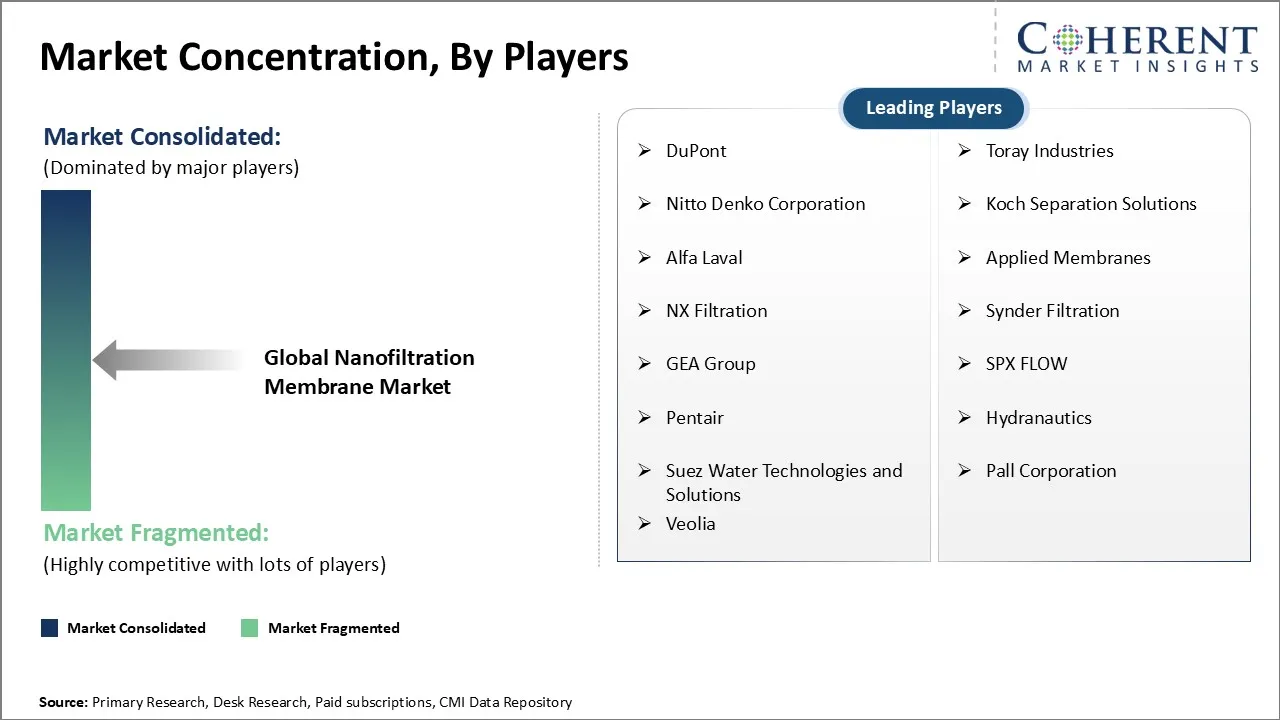
The global nanofiltration membrane market is moderately consolidated at the membrane-technology level but more fragmented across system integration, regional distribution, and application engineering. Competition increasingly rests on reproducible separation performance under real feed conditions, membrane durability, lifecycle economics, and supply reliability. Regional specialists remain influential where local service, pilot testing, retrofit capability, and end-user relationships determine whether a membrane specification converts into a commercial installation.
Key focus areas include
- Real-feed separation performance: Competitive evaluation is moving beyond laboratory rejection specifications toward consistency across changing ionic composition, organics, temperature, and operating pressure.
- Fouling resistance and cleanability: Longer stable operating cycles can materially influence membrane replacement frequency, downtime, chemical consumption, and customer retention.
- Total cost of ownership: Element price alone is becoming a weaker differentiator where energy use, pretreatment requirements, membrane life, cleaning frequency, and recovery determine project economics.
- Manufacturing consistency and supply reliability: OEMs and large end users require repeatable membrane quality, predictable lead times, and sufficient capacity to support replacement cycles.
- Application-specific qualification: Drinking-water, pharmaceutical, food-processing, and industrial customers place different requirements on materials, documentation, hygiene, and operating validation.
- Technical service and channel coverage: Regional engineering support, troubleshooting, commissioning, and distributor inventory can materially influence supplier selection in retrofit and replacement markets.
- Proprietary chemistry and customization: Selective-layer formulation, module architecture, chemical tolerance, and application-tailored membrane grades provide stronger differentiation than broad catalogue expansion alone.
Global Nanofiltration Membrane Market Report Scope
Global Nanofiltration Membrane Market Report Coverage | |||
Report Coverage | Details | ||
Base Year | 2025 | Market Size in 2026: | USD 940.2 Mn |
Historical Data For: | 2020 To 2024 | Forecast Period: | 2026 To 2033 |
Forecast Period 2026 To 2033 CAGR: | 7.10% | 2033 Value Projection: | USD 1,519.7 Mn |
Geographies covered: |
| ||
Segments covered: |
| ||
Companies covered: | DuPont, Toray Industries, Nitto Denko Corporation, Koch Separation Solutions, Alfa Laval, Applied Membranes, NX Filtration, Synder Filtration, GEA Group, SPX FLOW, Pentair, Hydranautics, Suez Water Technologies and Solutions, Pall Corporation, Veolia | ||
Growth Drivers: |
| ||
Restraints & Challenges: |
| ||
Analyst Opinion (Expert Opinion)
- The global nanofiltration membrane market leadership is likely to move from vendors selling membrane elements as stand-alone products toward separation-solution providers that can own more of the application outcome. Buyers will place greater value on feed characterization, pilot validation, process design, commissioning, and aftermarket support. Suppliers that convert proprietary application knowledge into repeatable design rules should defend margins better than those competing mainly on element price.
- A more disruptive shift could come from linking membrane-material discovery with adaptive process control. Faster formulation screening, digital process models, and plant data can shorten the path from a new selective layer to a validated operating window. This would pressure fixed-specification product portfolios and make data quality, sensing, model validation, and cross-disciplinary materials expertise increasingly important competitive capabilities.
- Participants should prioritize durability under difficult feeds, application laboratories, localized technical service, and resilient sourcing of membrane materials and module components. Underpenetrated industrial separations deserve attention where customers can measure recovery value or avoided treatment cost. Companies should avoid overbuilding commodity capacity before application demand is validated, while actively managing price erosion, concentrate-disposal constraints, qualification cycles, and regulatory uncertainty.
Speak to the analyst
Want personalized insights?
Take the findings above to one of our principal consultants, or have the report rebuilt around the segments, geographies and competitors you actually track.
Market Segmentation
- Membrane Material Insights (Revenue, USD Mn, 2021 - 2033)
- Polymeric Membranes
- Ceramic Membranes
- Hybrid Membranes
- Membrane Configuration Insights (Revenue, USD Mn, 2021 - 2033)
- Spiral Wound Membranes
- Tubular Membranes
- Hollow Fiber Membranes
- Flat Sheet Membranes
- Plate and Frame Membranes
- Application Insights (Revenue, USD Mn, 2021 - 2033)
- Water and Wastewater Treatment
- Food and Beverage Processing
- Pharmaceutical and Biomedical
- Chemical and Petrochemical
- Others
- Separation Process Insights (Revenue, USD Mn, 2021 - 2033)
- Water Purification and Softening
- Organic Compound Separation
- Salt and Ion Removal
- Concentration and Fractionation
- Others
- End Use Industry Insights (Revenue, USD Mn, 2021 - 2033)
- Municipal Water Treatment
- Industrial Water Treatment
- Food and Beverage
- Pharmaceutical
- Chemical Processing
- Others
- Distribution Channel Insights (Revenue, USD Mn, 2021 - 2033)
- Direct Sales
- Indirect Sales
- Regional Insights (Revenue, USD Mn, 2021 - 2033)
- North America
- U.S.
- Canada
- Latin America
- Brazil
- Argentina
- Mexico
- Rest of Latin America
- Europe
- Germany
- U.K.
- Spain
- France
- Italy
- Russia
- Rest of Europe
- Asia Pacific
- China
- India
- Japan
- Australia
- South Korea
- ASEAN
- Rest of Asia Pacific
- Middle East
- GCC Countries
- Israel
- Rest of Middle East
- Africa
- South Africa
- North Africa
- Central Africa
- North America
Sources
Primary Research Interviews
- Nanofiltration membrane manufacturers and module suppliers
- Water treatment EPC companies system integrators and membrane distributors
- Municipal utilities industrial water users and process engineering professionals
Stakeholders
- Polymeric ceramic and hybrid membrane manufacturers
- Spiral wound tubular hollow fiber and flat sheet module suppliers
- Water treatment OEMs EPC contractors distributors and service providers
- Municipal industrial food pharmaceutical and chemical end users
End-use Sectors
- Municipal water treatment
- Industrial water and wastewater treatment
- Food and beverage processing
- Pharmaceutical and biomedical processing
- Chemical and petrochemical processing
Regulatory and Industry Bodies
- U.S. Environmental Protection Agency EPA
- World Health Organization WHO
- European Commission
- U.S. Food and Drug Administration FDA
- International Organization for Standardization ISO
- ASTM International
- National drinking water and wastewater authorities
Databases
- Company annual reports and investor presentations
- UN Comtrade membrane and water treatment equipment trade data
- Eurostat and national water infrastructure databases
- Municipal wastewater treatment and industrial water-use databases
- Membrane capacity pricing installation and replacement databases
- Patent membrane performance and water technology databases
Magazines and Journals
- Journal of Membrane Science
- Desalination
- Water Research
- Separation and Purification Technology
- Membranes
- Journal of Water Process Engineering
Associations
- American Membrane Technology Association AMTA
- American Water Works Association AWWA
- Water Environment Federation WEF
- International Water Association IWA
- European Desalination Society EDS
- Regional membrane and water treatment associations
Public Domain Sources
- Drinking water and wastewater treatment capacity data
- Industrial water consumption and recycling statistics
- Desalination and membrane treatment project data
- Membrane technology and selective separation developments
- Water scarcity and reuse infrastructure data
- PFAS micropollutant and hardness removal regulations
- Municipal and industrial wastewater policy updates
Key Standards and Regulations
- U.S. Safe Drinking Water Act requirements
- EU Drinking Water Directive
- EU Urban Wastewater Treatment Directive
- U.S. EPA drinking water and wastewater regulations
- ISO water quality and membrane testing standards
- ASTM membrane filtration and water quality test methods
- Industrial discharge water reuse and potable reuse regulations
Proprietary Elements
- CMI Data Analytics Tool
- Proprietary CMI repository containing 10+ years of nanofiltration membrane demand membrane materials configurations municipal and industrial water treatment installations pricing trade flows technology developments regulatory changes end-use adoption and competitive intelligence.
Get access to 250+ pages report
Every segment, forecast, competitor profile and data table behind the analysis above — available for instant download.
- ESOMAR Member
- ISO 9001:2015 Certified
- D-U-N-S Registered
- GDPR & CCPA Compliant
Frequently Asked Questions
The CAGR of global nanofiltration membrane market is projected to be 7.10% from 2026 to 2033.
The global nanofiltration membrane market is estimated to be valued at USD 940.2 Mn in 2026 and is expected to reach USD 1,519.7 Mn by 2033
Nanofiltration membranes are widely used in water and wastewater treatment, food and beverage processing, pharmaceutical and biomedical applications, chemical and petrochemical processing, and other industrial separation processes.
Spiral wound membranes are the most widely used membrane configuration due to their compact design, high membrane packing density, scalability, and suitability for municipal and industrial water treatment systems.
Major end-use industries include municipal water treatment, industrial water treatment, food and beverage, pharmaceutical, chemical processing, and other process industries requiring selective separation, water reuse, purification, and concentration.
Buyers typically evaluate membrane material, ion and organic rejection performance, operating pressure, fouling resistance, chemical compatibility, cleaning requirements, feed-water characteristics, membrane lifetime, system configuration, energy consumption, maintenance needs, technical support, and total cost of ownership before selecting a nanofiltration membrane solution.
The major factors driving the growth of the global nanofiltration membrane market are the rising demand for water purification and wastewater recycling and the increasing industrial adoption of membrane-based separation technologies.