

Global Net Sponge Market Size and Forecast – 2026 To 2033
The Global Net Sponge Market is estimated to be valued at USD 225.4 Mn in 2026 and is projected to reach USD 357.2 Mn by 2033, exhibiting a compound annual growth rate (CAGR) of 6.80% during 2026–2033. Growing interest in personal care, affordable exfoliating accessories, and reusable bathing products is supporting market growth. Manufacturers are increasingly focusing on improved mesh construction, product durability, and the use of recycled polymer materials to enhance product value.
Market development is also promoted by the demand of household consumers, hotels and wellness establishments. In November 2026, U.K.-based SNOAP made a stand with its Eco Shower Puff, which was crafted from recycled plastic from three plastic bottles found in the ocean. This is representative of the opportunities for differentiated product design and the use of recycled materials in the global market for net sponge.
Key Takeaways of the Global Net Sponge Market
- Bath Poufs & Shower Puffs are anticipated to account for 45.4% of the global net sponge market in 2026, and are estimated to grow at a CAGR of 6.4% till 2033. Competitive pricing, effective lathering, and regular household replacement support this position. Cailap's beauty catalogue in March 2026 included an assortment of colors for shower puffs in shelf ready retail packs.
- Polyethylene (PE) is projected to ring in at an estimated CAGR of 6.5% and account for 47.6% of the global net sponge market in 2026. It is flexible, cost-effective and suitable for high-volume sponge manufacturing and private labelling. Olivette Industries, a Taiwan-based manufacturer, in November 2025, debuted its General PE Net bath sponge that comes with customized mesh, color, and packaging options.
- Standard Open-Mesh Sponges are expected to have an estimated CAGR of 6.1% and hold a 43.5% share of the global net sponge market in 2026. They are open in construction, allowing for easy rinsing, effective lathering of the product, and an economical manufacturing process without complex layered design. In June 2024, Indian products manufacturer Paxson Industries sold loofahs that came in one tone and ringed net poufs in its catalogue.
- Asia Pacific is forecast to achieve an estimated CAGR of 7.1% through 2033, holding 33.2% of global net sponge market revenue in 2026. Affordable retail distribution and established manufacturing networks cement its market standing in a world market forecasted to grow to USD 357.2 Mn by the year 2033. The Japanese company, OHE, unveiled its polyethylene amois body-foaming net in September 2024.
- North America could record the fastest estimated CAGR of 8.1% through 2033, despite representing 27.5% of global net sponge sales in 2026. Specialized exfoliating nets are gaining access to consumers from social media product demonstrations Bellanomi, a net sponge company that used TikTok to support its social-first customer acquisition strategy.
Segmental Insights
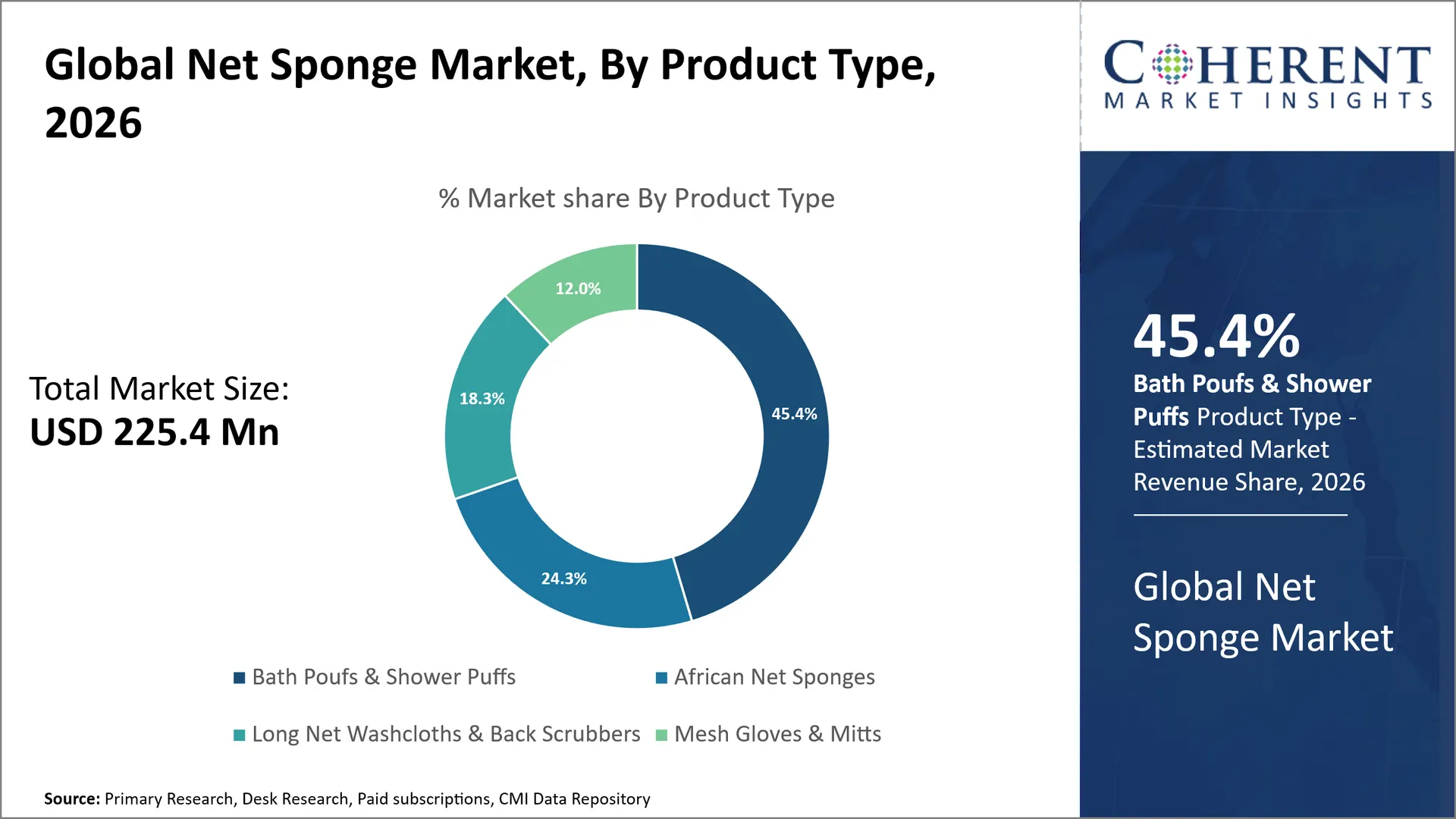
Why Do Bath Poufs & Shower Puffs Dominate the Global Net Sponge Market?
Bath Poufs & Shower Puffs are projected to account for 45.4% global net sponge market revenue in 2026. Their dominance reflects a clear retail advantage: consumers can assess a product's size, softness, and color immediately, allowing supermarkets to stock these products as familiar bathing essentials. Rounded, gathered-net designs also offer manufacturers a recognizable product format that can be adapted through different colors, sizes, and packaging options. Body-wash brands can really take advantage of poufs being viewed as ancillary items instead of a core product. In April 2025, method will bring back Lulu the Loofah Cart to Coachella to connect with consumers and introduce their body-care products through a mobile sampling experience. This is a prime example of how loofah themes can help to strengthen product marketing. The benefit for suppliers is to have distinctively different assortments and consistent replenishment to the stores.
- Current Industry Events of 2026
- Market Size Estimation
- Regional Breakdown
- Competitive Landscape
- Customer Intelligence
- Segmental Analysis
- Pricing Analysis
- Key Market Drivers, Challenges & Future Trends
- Customized Insights Section
Why Does Polyethylene (PE) Represent the Largest Material Segment in the Global Net Sponge Market?
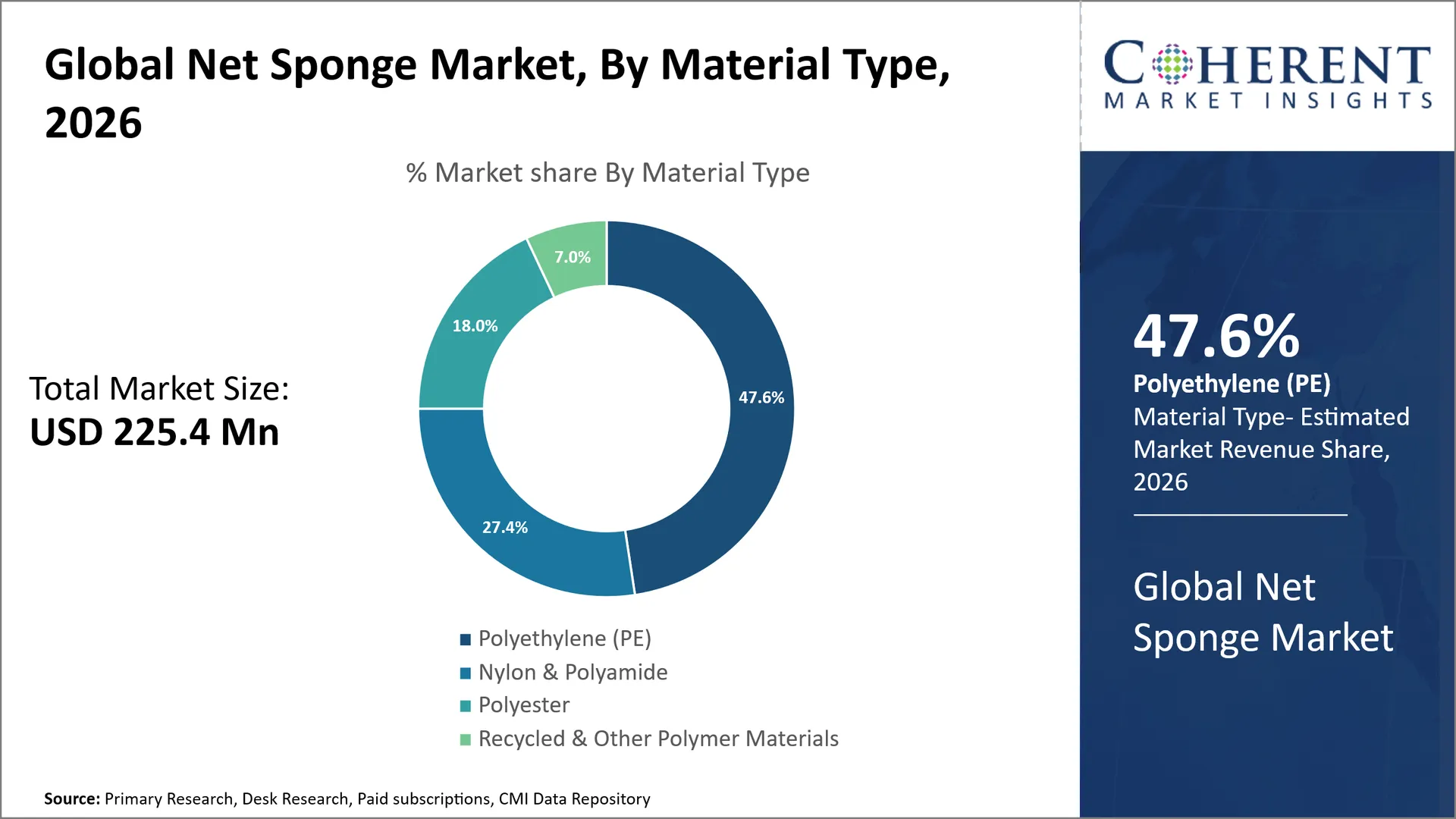
Polyethylene (PE) is expected to account for 47.6% of global net sponge material sales in 2026. The polymer can be formed into lightweight netting with controllable flexibility and strand dimensions, helping producers offer different textures using established manufacturing equipment. This offers manufacturers a realistic compromise between raw-material costs, product uniformity and flexibility. Gathered bath nets are ideal for use with PE because they have such a great end result and it's very flexible. Nitori, the Japanese retailer, has recently launched a new extra-soft polyethylene foaming bath following its report of 170,000+ units sold in the product series to date. The documented expansion, although not the preferred reference period, represents the functionality of polyethylene in providing differentiated product comfort. Manufacturers can further leverage this strategy by providing accurate yarn specifications, quality testing and effective material procurement.
Why Do Standard Open-Mesh Sponges Lead the Texture & Mesh Structure Segment of the Global Net Sponge Market?
Standard Open-Mesh Sponges are projected to hold 43.5% of the global net sponge market by texture and mesh structure in 2026. Their commercial appeal lies in an uncomplicated construction that leaves spaces between strands, facilitating rinsing and water drainage. Unlike dense multilayer designs, standard net structures can be incorporated into shaped bathing accessories without requiring intricate fabric combinations. For retailers, this supports straightforward merchandising around everyday cleansing performance rather than specialized exfoliation claims. In August 2024, Daiya announced its Rascal Body Sponge, a ball-shaped bathing accessory incorporating breathable mesh, a hanging loop, and a polyethylene ball component. Its design illustrates the continued relevance of ventilated mesh constructions in consumer bath products. Producers should prioritize consistent mesh openings and secure bindings to reduce product defects.
Why Do Individual Consumers Dominate the End-User Segment of the Global Net Sponge Market?
Individual Consumers are expected to contribute 82.6% of global net sponge market revenue in 2026, making household purchasing the industry's principal commercial outlet. Buying decisions often depend on whether a scrubber meets personal preferences for grip, body coverage, cleansing intensity, and storage convenience. Unlike institutional buyers, household consumers can readily switch between accessory formats, making clear product descriptions and usage instructions important for purchase decisions. In May 2026, Cosmopolitan selected the Luv Scrub African Mesh Body Exfoliator as its best body exfoliating tool following editorial testing. This recognition highlights consumer-facing interest in specialized mesh bathing accessories, although it does not measure overall market adoption. Manufacturers can strengthen their positioning through clearly differentiated designs, practical product education, and convenient purchasing options.
Current Events and their Impact
Current Event | Description and Its Impact |
December 2024 – EU General Product Safety Regulation becomes applicable |
|
August 2026 – EU Packaging and Packaging Waste Regulation begins applying |
|
September 2026 – EU environmental marketing restrictions take effect |
|
Global Net Sponge Market Dynamics
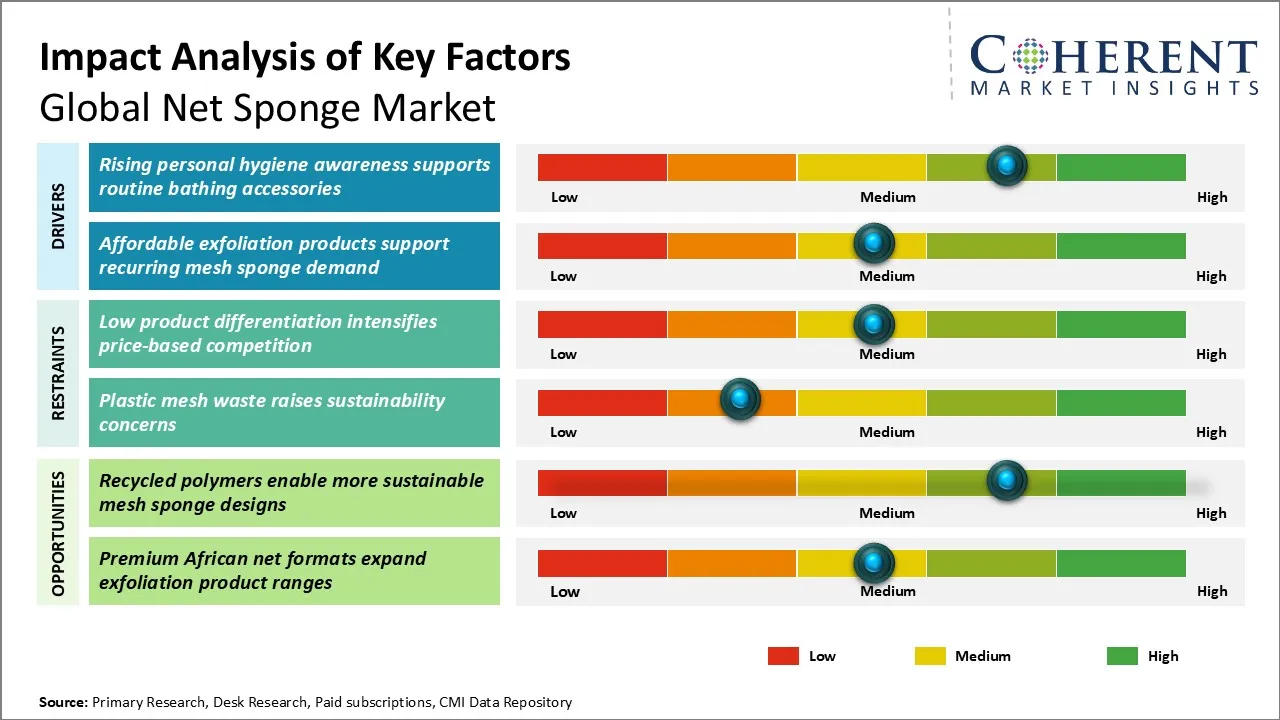
Key Market Drivers
- Rising personal hygiene awareness supports routine bathing accessories: As people become more conscious of their hygiene, the consumption of mesh sponges is also being promoted in the general baths. Net sponges and long washcloths are available for difficult to reach areas for the African and normal wash poufs are used for daily cleansing with body washes. This can open the doors for personal care brands to market bathing products as a side product of hygiene products. In January 2026, Sunu Body was featured for its African net sponge and black soap offerings, ahead of a branded launch event that month. The pairing illustrates how complementary cleansing products can strengthen consumer engagement.
- Affordable exfoliation products support recurring mesh sponge demand: Items that exfoliate are inexpensive products that can be used in the home and increase the demand for mesh sponges. Lower unit prices will encourage multi-packs, household use and retail experimentation, which will be positive for manufacturers and value-oriented personal care brands. In September 2026, a retailer listed September 17, 2026, as the shipment date for Kitsch's Berry Pink African Net Sponge three-piece set. This pricing provides a glimpse into how branded exfoliating accessories can be priced so that they are both accessible yet offer differentiated product formats.
Emerging Market Trends
- Greater Emphasis on Mesh Texture Classification and Product Suitability: Consumers will be more discriminating about choosing the texture and structure of bathing nets and will not only buy them based on appearance. The fine-mesh, open-mesh, and dense multilayer finishes are clearly explained to help buyers find the right accessories for cleaning.
- Impact: Manufacturers can get better product positioning by providing mesh clear specifications, usage tips, and through texture based assortment planning. This can cut down on inappropriate purchases and enhance customer satisfaction.
- Relevance to Market: Specialty personal care manufacturers and retailers with uniform mesh sizes might be helped by a more performance-based product selection.
- Greater Scrutiny of Polymer Composition and Product-Life Claims: Product descriptions are slowly changing to identifying the polymer, stating the recycled content, as well as realistic expectations for the product's lifespan. Consumers have more reasons to differentiate the reusable synthetic mesh products from the truly recyclable or biodegradable products.
- Impact: Increased material documentation and environmental marketing claims control abilities of producers. Industry suppliers with generic sustainability claims may be under more market and regulatory pressure.
- Relevance to Market: Polymer processors and private-label manufacturers with traceable inputs and consistent quality may improve their positioning with major retailers and international distributors.
Regional Insights
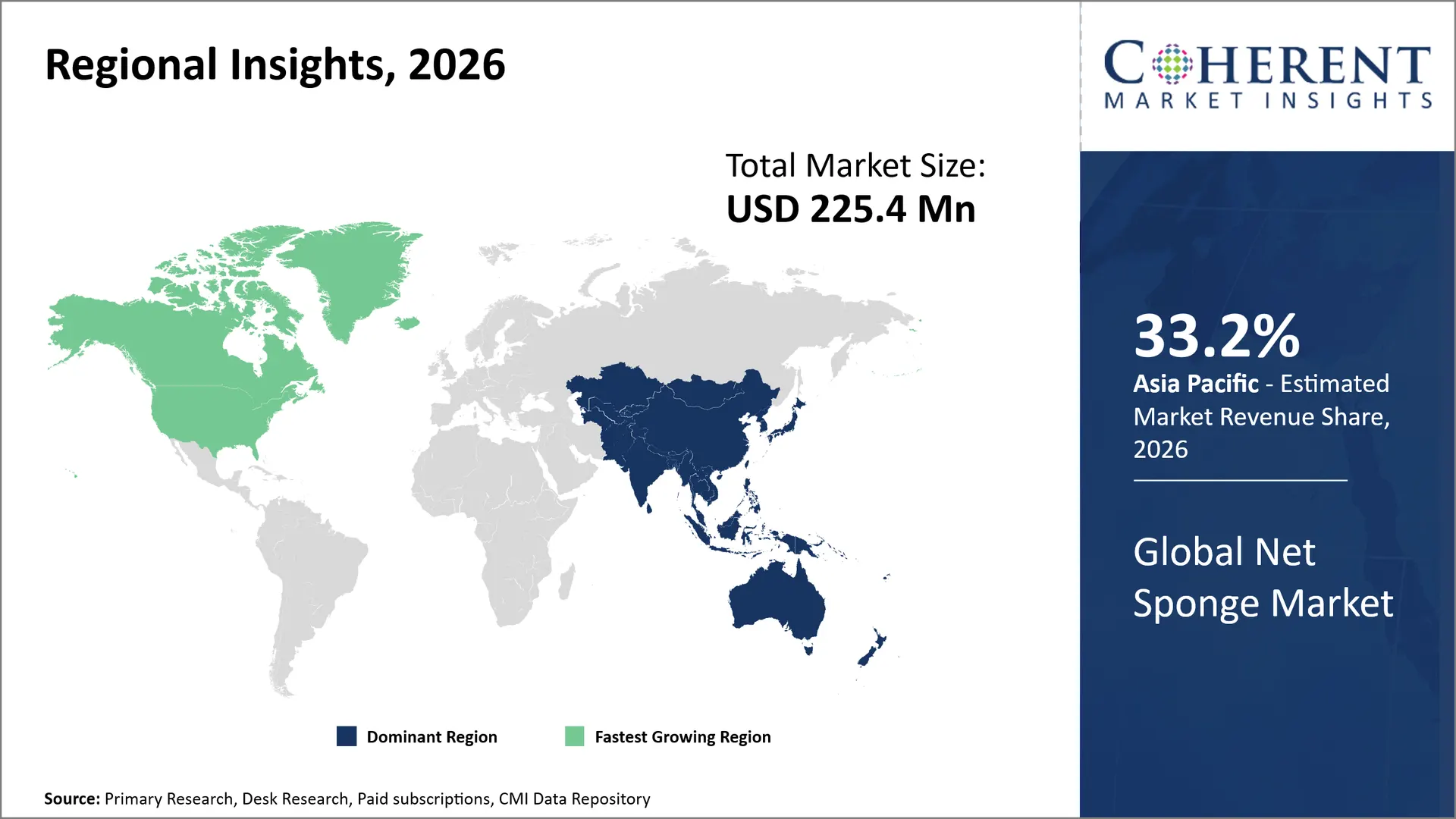
Why Does Asia Pacific Dominate the Global Net Sponge Market?
Asia Pacific is expected to account for 33.2% of the global net sponge market in 2026, owing to the presence of well-established bath accessory manufacturers, strong consumer retail networks, and diverse product preferences in China, India, and Japan. Chinese manufacturers offer scalable mesh processing capabilities, while Japanese brands concentrate on functional design and product differentiation. Regional suppliers can provide domestic and international private label buyers with flexible product specifications. In January 2026, Japan’s Mash Holdings introduced Sesame Street-themed mesh body sponges in character shapes for body-wash lathering as part of its Sesame Street Market collection. Such diversification of products highlights opportunities to generate additional value from traditional bathroom accessories by means of branded designs and specialized retail positioning.
Why Is North America Emerging as the Fastest-Growing Region in the Global Net Sponge Market?
North America is projected to hold 27.5% of the worldwide net sponge market in 2026 and witness the highest growth till 2033. Specialty mesh sponges are now offered in national retail chains, moving beyond the traditional bath accessories. Retailers are better placed to offer products differentiated by cleansing intensity, ergonomic design and body coverage. In February 2026, Cleanlogic announced that it would launch its bath accessories, including its Sport High Performance Mesh Sponge, in about 300 Target stores across the U.S. and online. This expansion illustrates how specialist manufacturers can gain access to larger consumer bases through established retail chains. There are additional growth opportunities in premium formats, differentiated product ranges and convenient omnichannel purchasing.
Global Net Sponge Market Outlook for Key Countries
Why Is the U.S. a Key Market for the Global Net Sponge Market?
The U.S. is an attractive market for branded and specialty net sponges, given the presence of developed beauty retail channels and the consumer's desire for unique body-cleansing accessories. African net sponges, washcloths with exfoliating texture and traditional shower poufs cater to different preferences regarding texture, body coverage, and ease of use. Specialty stores open up space for manufacturers to offer products that have more value than the standard bath products. At US$9.99, Ulta Beauty currently has The Vintage Cosmetic Company's Exfoliating Net Sponge available, noting it is easy to rinse, lathers easily and cleanses the entire body. This retail positioning shows that specialized net sponges have a commercial potential, even in retail outlets offering value-priced products. Brands that supply a consistent product quality, provided detailed guidelines for use, and are easily identified can improve their presence in specialty beauty stores as well as online.
Why Is India Important in the Global Net Sponge Market?
India's market for inexpensive bathing accessories and the growing sales of shower gels in organized personal care retail presents opportunities for net sponge market manufacturers. Bathing poufs are sold separately or with additional bathing items, facilitating various merchandising strategies. Economical mesh production, flexible packaging, and distribution partnerships are ways that domestics can compete with private-label suppliers. Complementary product merchandising can be seen in ITC's Fiama brand product, which has five shower gels and a loofah in one pack, as a shower gel is a complementary product to the loofah. Combinations such as these enable manufacturers to sell a product to the consumer in the form of brands rather than just accessories. Increased supermarket and online variety and availability may help to increase access to affordable and differentiated net sponge formats.
Why Does China Support Growth in the Global Net Sponge Market?
China has an important supply side role in the global net sponge market due to its polymer processing technology and manufacturing base of bathing accessories. Polyethylene mesh extrusion, cutting, gathering and finishing can be all in one to make bath poufs and customized body scrubbers. These capacities can aid contract manufacturing and private-label sourcing for overseas retailers. The government-based environmental project filing from Zhejiang Province is proposing a production line that could produce 40 million bathing scrubbers a year via polyethylene extrusion and then assembly. The filing is a good example of the possible scope of the specialized bath accessory business, but not proof of completed production capacity. Production consistency, material sourcing and quality assurance (QA) and meeting the importing-market requirements will be key factors in helping to position a company competitively.
Why Is Germany a Strategic Country in the Global Net Sponge Market?
Germany is an important market for net sponge suppliers because established drugstore chains provide well established distribution channels for personal care and bathing accessories that are priced to the market. The availability of mesh shower balls in addition to bathroom products such as body washes and exfoliating tools, and the price of these products is commercially significant. Now, Rossmann has its FOR YOUR Beauty Wellness Dusch-Netzball which is a nylon mesh shower ball to lather the body and gently exfoliate, and is priced at USD 1.09. It shows the ongoing relevance of economic synthetic mesh products in structured German retail. Suppliers to this market need to ensure that material is consistent and complies with relevant consumer product regulations. There are opportunities for suppliers that provide reliable supply, product specifications and different mesh textures.
Why Is Japan an Important Growth Market for the Global Net Sponge Market?
In Japan the global net sponge market is driven by the demand for well-designed bathing accessories with unique texture and effective cleansing. Retailers have body nets and washcloths in various degrees of softness, lathering performance and comfort in washing. These preferences encourage manufacturers to distinguish products by yarn construction and surface characteristics rather than by price alone. In June 2026, MUJI introduced a new foaming body towel series with three textures: soft, regular and firm. The products utilize a three dimensional yarn construction to support lather formation. This trend is an opportunity for long net washcloth manufacturers and other bathing accessory manufacturers to extend their texture-based assortments. Product consistency, comfort and functional design will probably continue to be important competitive factors.
Consumer Preference and Product Evolution Landscape in the Global Net Sponge Market
Key Market Factors | Consumer Preferences and Market Characteristics | Commercial Significance | Market Outlook |
Everyday Bathing Convenience | Lightweight bath poufs preferred for good lather and comfortable handling | Supports mass market retail sales and repeat household purchases | Established |
Exfoliating Net Sponge Preferences | Interest in African net sponges for body exfoliation and reusability for bathing. | Creates opportunities for specialized products & premium positioning. | Expanding |
Extended-Reach Bath Accessories | Demand for long net washcloths and back scrubbers that increase access while bathing | Promotes product and function differentiation | Growing |
Personalized Mesh Texture | Consumer preference for skin comfort of soft, standard and coarse mesh structures | Supports diverse product assortments and targeted marketing | Evolving |
Online Product Discovery and Purchasing | Consumers look at mesh designs, product demos and reviews before buying | Better market entry for specialist brands and direct to consumer sellers | Expanding |
How Are Institutional Hygiene Requirements Creating New Growth Opportunities in the Global Net Sponge Market?
Net sponges manufacturers should consider hotels, resorts, wellness centers and beauty salons as an opportunity to develop products that will be specifically more appropriate for institutional purchase rather than the traditional household retail.
These buyers are looking for predictable quality, consistent supply, appropriate packaging and clear hygiene practices. Manufacturers can meet these needs with individually wrapped bath poufs, standard washcloth specifications and custom branded bathing accessories.
Reliable replacement schedules and packaging formats that support inventory management may also be appreciated by institutional buyers. This allows niche suppliers to enter the picture who can supply the consistent product dimensions and fulfilling repeat orders
To be effective in their participation, manufacturers need better batch traceability, flexible packaging, documented product specifications and reliable distribution partnerships. Regional wholesalers may be able to help with market entry, by catering for smaller hospitality businesses and independent wellness operators.
The opportunity is likely to benefit established contract manufacturers and specialist suppliers who can strike the right balance between customization and competitive procurement costs.
Market Players, Key Developments, and Competitive Intelligence
Key Developments
- In November 2026, Shower Bouquet, a brand of RH Bath & Beauty, announced an expansion beyond conventional mesh bath poufs into dual-texture exfoliating cloths and mitts. The products combine different cleansing surfaces within one accessory. This broadens the company's addressable customer preferences and demonstrates portfolio diversification among manufacturers of traditional mesh bathing products.
- In January 2026, Espina Studio's packaging redesign for Esponjabón received industry coverage as the soap-infused sponge brand prepared for broader international commercialization. Its portfolio includes a combined soap-and-bath-pouf format. This development illustrates how functional packaging and clear product communication can support market entry and retail differentiation for combined cleansing accessories.
- In May 2025, EcoTools promoted its Sea Gems collection, which includes the Sea Gems EcoPouf Bath Brush. The product uses recycled netting and a handle incorporating ocean-bound plastic. This is relevant to the global net sponge market because it demonstrates how manufacturers can differentiate conventional mesh bath accessories through documented material composition and product design.
Competitive Landscape
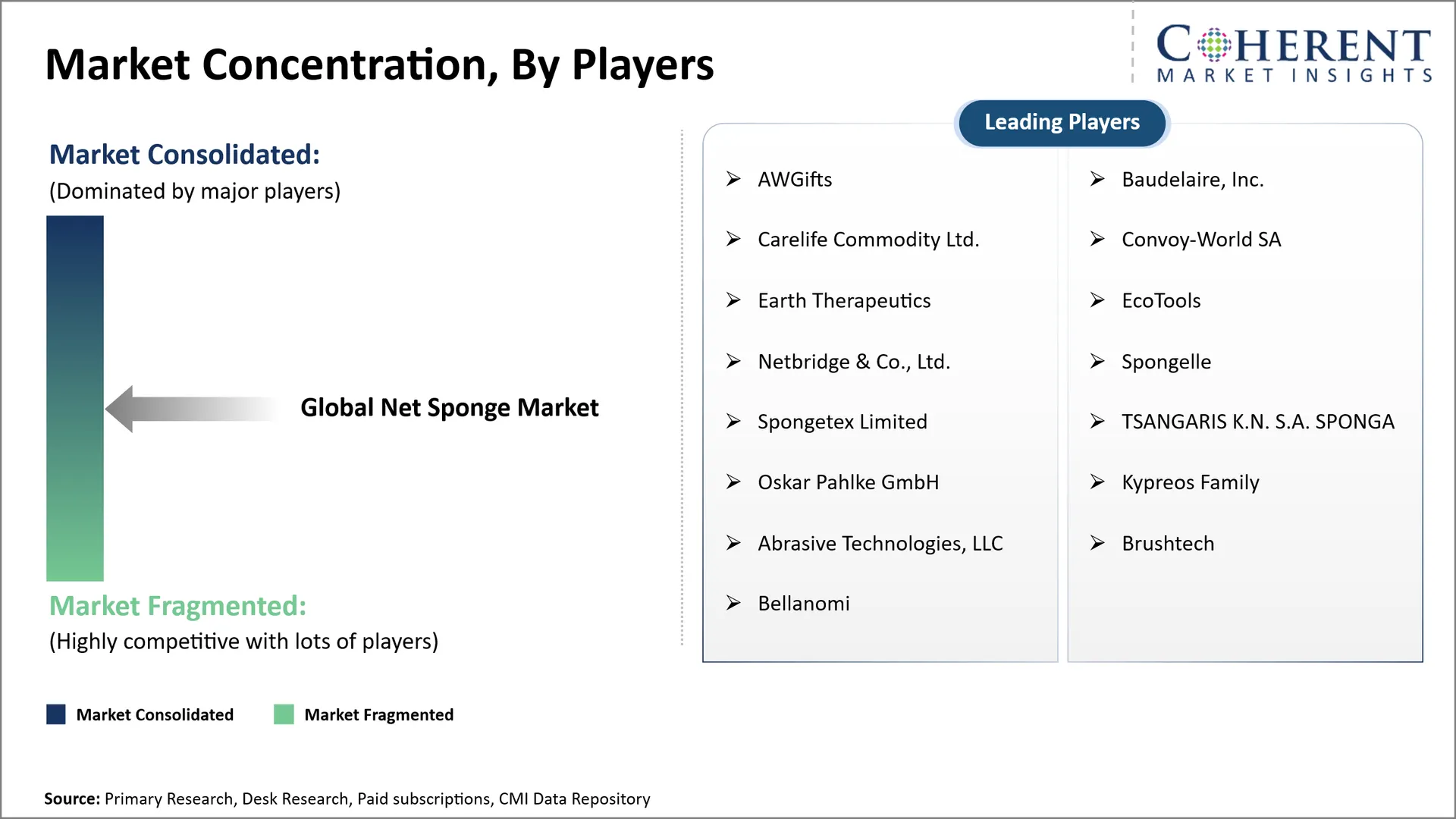
The global net sponge market is characterized by the presence of a large number of players, including specialized bath accessory manufacturers, regional polymer mesh processors, private-label suppliers, and established personal care brands. The competition is to produce a consistent product, price at the retail level, durability of the mesh, presentation of the product and reliability of distribution. Smaller producers compete on customization and flexible orders; established suppliers benefit from broader retailer relationships, purchasing scale and standardized production capabilities.
Key focus areas include
- Mesh quality: Consistent yarn strength reduces product defects and returns.
- Manufacturing efficiency: Automated production supports competitive bulk pricing.
- Private labeling: Custom specifications improve retailer-supply relationships.
- Product differentiation: Original designs increase product recognition at shelf level.
- Supply reliability: Predictable deliveries support large retail procurement programs.
- Quality documentation: Material records strengthen importer and distributor confidence.
- Channel management: Balanced retail and wholesale coverage reduces customer concentration.
Market Report Scope
Global Net Sponge Market Report Coverage | |||
Report Coverage | Details | ||
Base Year | 2025 | Market Size in 2026: | USD 225.4 Mn |
Historical Data For: | 2020 to 2024 | Forecast Period: | 2026 to 2033 |
Forecast Period 2026 To 2033 CAGR: | 6.80% | 2033 Value Projection: | USD 357.2 Mn |
Geographies covered: |
| ||
Segments covered: |
| ||
Companies covered: | AWGifts, Baudelaire, Inc., Carelife Commodity Ltd., Convoy-World SA, Earth Therapeutics, EcoTools, Netbridge & Co., Ltd., Spongelle, Spongetex Limited, TSANGARIS K.N. S.A. SPONGA, Oskar Pahlke GmbH, Kypreos Family, Abrasive Technologies, LLC, Brushtech, Bellanomi | ||
Growth Drivers: |
| ||
Restraints & Challenges: |
| ||
Analyst Opinion (Expert Opinion)
- Future Market Direction: The global net sponge market leadership is likely to depend increasingly on manufacturers' ability to manage differentiated product portfolios without adding unnecessary production complexity. Companies that standardize core components, but allow for customization in shape, packaging and branding, should be able to offer a more flexible service to both retail and contract manufacturing clients.
- Disruptive or Transformative Trend: The increasing availability of alternative bathing tools has the potential to gradually change the way consumers evaluate traditional net sponges. Products can be compared on the basis of ease of maintenance, useful life, and consistency of cleansing performance, not just familiarity. Pricing power may be lost by manufacturers who are not able to show practical advantages against competing formats.
- Strategic Priorities, Risks and Guidance: Manufacturers should focus on the efficient cutting and assembly of mesh and the consistency of mesh strength, reliable polymer sourcing, and appropriate product testing. Institutional customers and specialized distributors deserve closer attention, but investments should follow confirmed procurement demand. Companies should avoid excessive capacity expansion in undifferentiated products and protect margins through supplier diversification and disciplined production planning.
Speak to the analyst
Want personalized insights?
Take the findings above to one of our principal consultants, or have the report rebuilt around the segments, geographies and competitors you actually track.
Market Segmentation
- Product Type Insights (Revenue, USD Mn, 2021 - 2033)
- Bath Poufs & Shower Puffs
- African Net Sponges
- Long Net Washcloths & Back Scrubbers
- Mesh Gloves & Mitts
- Material Type Insights (Revenue, USD Mn, 2021 - 2033)
- Polyethylene (PE)
- Nylon & Polyamide
- Polyester
- Recycled & Other Polymer Materials
- Texture & Mesh Structure Insights (Revenue, USD Mn, 2021 - 2033)
- Standard Open-Mesh Sponges
- Fine-Mesh Sponges
- Dense & Multi-Layer Mesh Sponges
- Knotted & Woven Net Sponges
- End User Insights (Revenue, USD Mn, 2021 - 2033)
- Individual Consumers
- Hotels & Hospitality
- Beauty Salons & Spas
- Distribution Channel Insights (Revenue, USD Mn, 2021 - 2033)
- Supermarkets & Hypermarkets
- Online Retail
- Specialty Personal Care Stores
- Convenience Stores & Other Channels
- Regional Insights (Revenue, USD Mn, 2021 - 2033)
- North America
- U.S.
- Canada
- Latin America
- Brazil
- Argentina
- Mexico
- Rest of Latin America
- Europe
- Germany
- U.K.
- Spain
- France
- Italy
- Russia
- Rest of Europe
- Asia Pacific
- China
- India
- Japan
- Australia
- South Korea
- ASEAN
- Rest of Asia Pacific
- Middle East
- GCC Countries
- Israel
- Rest of Middle East
- Africa
- South Africa
- North Africa
- Central Africa
- North America
- Key Players Insights
- AWGifts
- Baudelaire, Inc.
- Carelife Commodity Ltd.
- Convoy-World SA
- Earth Therapeutics
- EcoTools
- Netbridge & Co., Ltd.
- Spongelle
- Spongetex Limited
- TSANGARIS K.N. S.A. SPONGA
- Oskar Pahlke GmbH
- Kypreos Family
- Abrasive Technologies, LLC
- Brushtech
- Bellanomi
Sources
Primary Research Interviews
- Net sponge manufacturers, bath accessory producers, and polymer mesh suppliers
- Personal care brands, private-label manufacturers, and contract producers
- Supermarket buyers, specialty retailers, and e-commerce distributors
- Hotel procurement managers, spa operators, and salon professionals
- Polymer processing specialists, packaging suppliers, and sustainability experts
Stakeholders
- Bath pouf and African net sponge manufacturers
- Polyethylene, nylon, and polyester mesh suppliers
- Polymer yarn processors and textile netting manufacturers
- Personal care accessory brands and private-label suppliers
- Supermarkets, specialty stores, and online retailers
- Hospitality buyers, beauty salons, spas, and distributors
End-use Sectors
- Individual Consumers: Daily bathing, body cleansing, and exfoliation
- Hotels & Hospitality: Guest amenities and bathing accessories
- Beauty Salons & Spas: Body cleansing and exfoliation treatments
Product Applications
- Bath poufs and shower puffs
- African net sponges
- Long net washcloths and back scrubbers
- Mesh gloves and exfoliating mitts
Regulatory and Industry Bodies
- U.S. Consumer Product Safety Commission (CPSC)
- U.S. Federal Trade Commission (FTC)
- European Commission – DG GROW
- European Chemicals Agency (ECHA)
- Bureau of Indian Standards (BIS)
- Central Pollution Control Board (CPCB), India
- State Administration for Market Regulation (SAMR), China
- Consumer Affairs Agency (CAA), Japan
Databases
- UN Comtrade and ITC Trade Map
- Eurostat – Manufacturing and Retail Statistics
- U.S. Census Bureau – Retail Trade Data
- U.S. Bureau of Labor Statistics (BLS)
- National Bureau of Statistics of China
- Ministry of Statistics and Programme Implementation (MoSPI), India
- Statistics Bureau of Japan
- German Federal Statistical Office (Destatis)
- World Bank Open Data
Magazines and Journals
- Journal of Cleaner Production
- Resources, Conservation and Recycling
- Polymer Testing
- Textile Research Journal
- Journal of Consumer Behaviour
- Packaging Europe
- Beauty Packaging
- Cosmetics Business
- Plastics Today
Associations
- Plastics Industry Association (PLASTICS)
- PlasticsEurope
- Personal Care Products Council (PCPC)
- Textile Exchange
- Cosmetics Europe
- PLASTINDIA Foundation
- China Plastics Processing Industry Association (CPPIA)
- Japan Plastics Industry Federation (JPIF)
Public Domain Sources
- Net sponge product catalogues and technical specifications
- PE, nylon, polyester, and recycled polymer material data
- Mesh texture, durability, softness, and product performance studies
- Bath accessory manufacturing and polymer processing information
- Retail pricing, product assortments, and distribution channel data
- Consumer bathing preferences and exfoliation product reviews
- Company annual reports, product launches, and manufacturing investments
- Relevant trade statistics, supplier disclosures, and sustainability reports
Key Standards and Regulations
- EU Regulation 2023/988 – General Product Safety Regulation (GPSR)
- EU Regulation 1907/2006 – REACH Chemical Safety Requirements
- EU Regulation 2025/40 – Packaging and Packaging Waste Regulation
- U.S. Consumer Product Safety Act (CPSA)
- U.S. FTC Green Guides – Environmental Marketing Claims
- India Plastic Waste Management Rules, 2016, as amended
- China – Applicable Consumer Product Safety and Quality Standards
- ISO 9001 – Quality Management Systems
- ISO 14001 – Environmental Management Systems
- ISO/IEC 17025 – Testing Laboratory Competence
- Global Recycled Standard (GRS) and Recycled Claim Standard (RCS)
Proprietary Elements
- CMI Data Analytics Tool
- Proprietary research repository, supported by primary interviews, net sponge product benchmarking, polymer material analysis, manufacturing cost assessment, consumer purchasing behavior, segment-wise market sizing, average selling price (ASP) evaluation, country-level demand assessment, import-export analysis, distribution-channel evaluation, sustainability assessment, and competitive intelligence.
Get access to 250+ pages report
Every segment, forecast, competitor profile and data table behind the analysis above — available for instant download.
- ESOMAR Member
- ISO 9001:2015 Certified
- D-U-N-S Registered
- GDPR & CCPA Compliant
Frequently Asked Questions
The CAGR of the global net sponge market is projected to be 6.80% from 2026 to 2033.
The global net sponge market is estimated to be valued at USD 225.4 Mn in 2026 and is projected to reach USD 357.2 Mn by 2033.
The report provides an understanding of the market dynamics, product innovation, manufacturing, distribution, competition, and new business opportunities.
The report offers business benchmarking by examining key manufacturers, product portfolios, competitive strategies, supplier capabilities and distribution channels.
The report examines polymer sourcing, manufacturing processes, production economics, supplier relationships, and distribution structures that influence market competitiveness.
Businesses can use the findings to evaluate market entry opportunities, identify potential suppliers, refine product portfolios, and develop competitive expansion strategies.
Rising personal hygiene awareness supports routine bathing accessories and Affordable exfoliation products support recurring mesh sponge demand are the major factors driving growth in the global net sponge market