

Global Organic Peroxide Market Size and Forecast – 2026 To 2033
The Global Organic Peroxide Market is estimated to be valued at USD 2.13 Bn in 2026 and is expected to reach USD 2.76 Bn by 2033, growing at a compound annual growth rate (CAGR) of 3.80% from 2026 to 2033. This steady expansion is supported by increasing consumption of organic peroxides in polymerization, crosslinking, and curing applications across plastics, rubber, composites, and specialty chemical industries. Demand growth is closely linked with the expansion of polymer processing capacity, lightweight material adoption, and rising requirements for high-performance plastics in automotive, packaging, construction, and renewable energy applications.
Manufacturers are increasingly focusing on localized production capacity and application-specific peroxide solutions to improve supply reliability and meet evolving customer requirements. In September 2024, AkzoNobel expanded its organic peroxide manufacturing capabilities in Mexico through additional capacity investments at its Los Reyes facility, strengthening regional supply availability for plastics and polymer processing applications.
Key Takeaways of the Global Organic Peroxide Market
- Dialkyl Peroxides are estimated to register a CAGR of 4.1% and account for 25.8% of the global organic peroxide market in 2026, supported by their widespread use as polymerization initiators and crosslinking agents in polyethylene, polypropylene, elastomers, and specialty polymer production. Their ability to improve material strength, thermal stability, and processing efficiency makes them essential for advanced plastic applications. In June 2025, United Initiators announced the expansion of its organic peroxide production capabilities in Germany to strengthen supply reliability for polymer and composite customers across Europe.
- Diacyl Peroxides are projected to achieve a CAGR of 3.9% and hold 24.6% of the global organic peroxide market in 2026, supported by their widespread use as polymerization initiators and crosslinking agents in polyethylene, polypropylene, elastomers, and specialty polymer production. Their ability to improve material strength, thermal stability, and processing efficiency makes them essential for advanced plastic applications. In June 2025, United Initiators expanded its specialty peroxide capabilities in Germany to strengthen supply reliability for polymer, composite, and industrial customers, supporting growing demand for application-specific peroxide solutions..
- Polymers and Rubber applications are expected to expand at a CAGR of 4.0%and represent 46.8% of the global organic peroxide market in 2026, as organic peroxides remain critical for polymer crosslinking, rubber modification, and performance enhancement. Demand is supported by automotive components, wire and cable insulation, construction materials, and renewable energy applications requiring durable polymer systems. In August 2025, Evonik announced advancements in specialty additive solutions supporting polymer processing efficiency and material performance improvements for industrial applications.
- Asia Pacific is anticipated to grow at a CAGR of 4.2% and account for 41.8% of the global organic peroxide market in 2026, supported by expanding polymer manufacturing capacity, increasing chemical investments, and strong downstream demand from plastics, automotive, and electronics industries. The region benefits from integrated chemical supply chains and growing domestic consumption of engineered materials. In January 2025, Mitsubishi Chemical Group announced continued investments in specialty chemical production capabilities in Japan to strengthen advanced material supply chains across Asia.
- North America is estimated to achieve a CAGR of 4.3% and represent 24.8% of the global organic peroxide market in 2026, supported by advanced polymer processing, specialty chemical innovation, and demand for high-performance materials in automotive, infrastructure, and renewable energy applications. The region’s mature chemical ecosystem enables rapid adoption of customized peroxide formulations. In April 2025, LyondellBasell announced developments in advanced polymer solutions and circular plastics technologies in the United States, supporting future demand for specialized polymer processing additives.
Segmental Insights
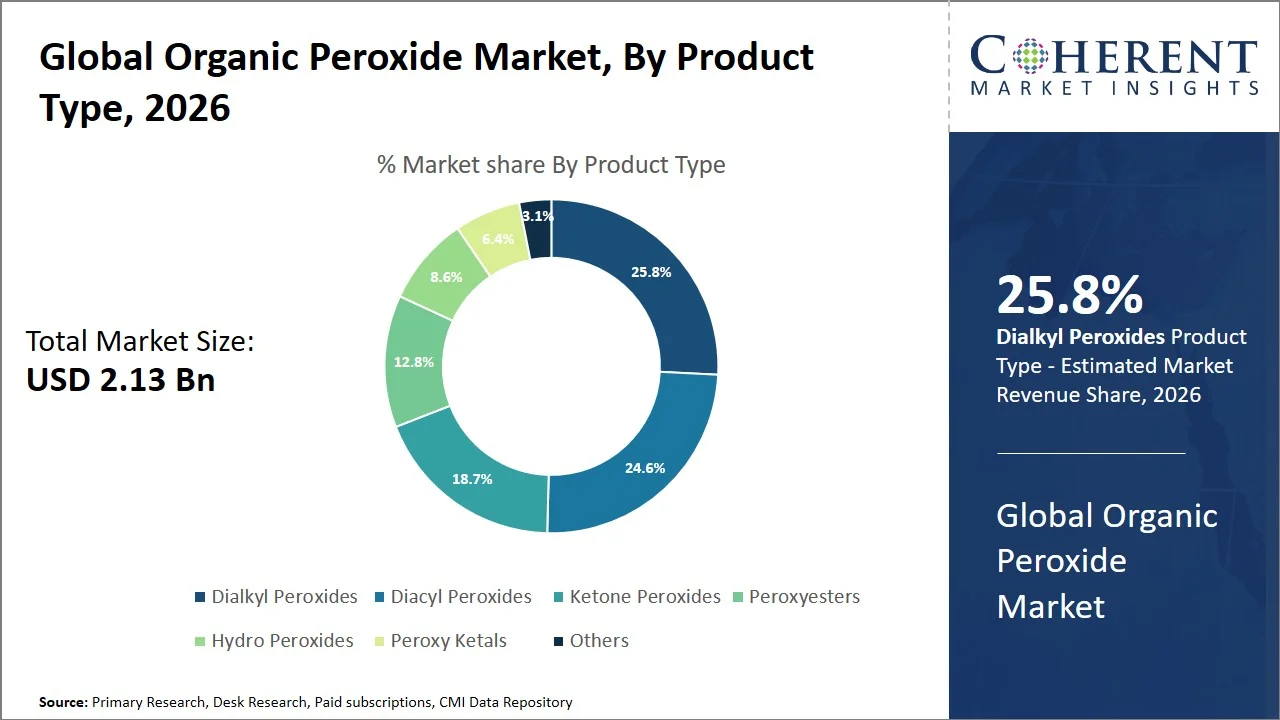
Why Does Dialkyl Peroxides Dominate the Product Type Segment in the Global Organic Peroxide Market?
Dialkyl Peroxides are expected to account for 25.8% of the global organic peroxide market in 2026, supported by their critical role as high-efficiency initiators and crosslinking agents in polyethylene, polypropylene, elastomers, and specialty polymer processing. Their strong adoption is linked to the need for controlled polymer modification, improved thermal resistance, and enhanced mechanical properties in advanced materials. Manufacturers benefit from established production technologies, stable raw material availability, and broad compatibility with industrial polymer systems. Demand is particularly concentrated in cable insulation, automotive components, and flexible plastics where performance consistency is essential. In July 2025, Dongsung Chemical expanded its organic peroxide production line at its Yeosu facility, adding more than 4,000 tons of annual capacity to strengthen supply for polymer applications and specialty chemical markets.
- Current Industry Events of 2026
- Market Size Estimation
- Regional Breakdown
- Competitive Landscape
- Customer Intelligence
- Segmental Analysis
- Pricing Analysis
- Key Market Drivers, Challenges & Future Trends
- Customized Insights Section
Why Do Polymers and Rubber Represent the Largest Application Segment in the Global Organic Peroxide Market?
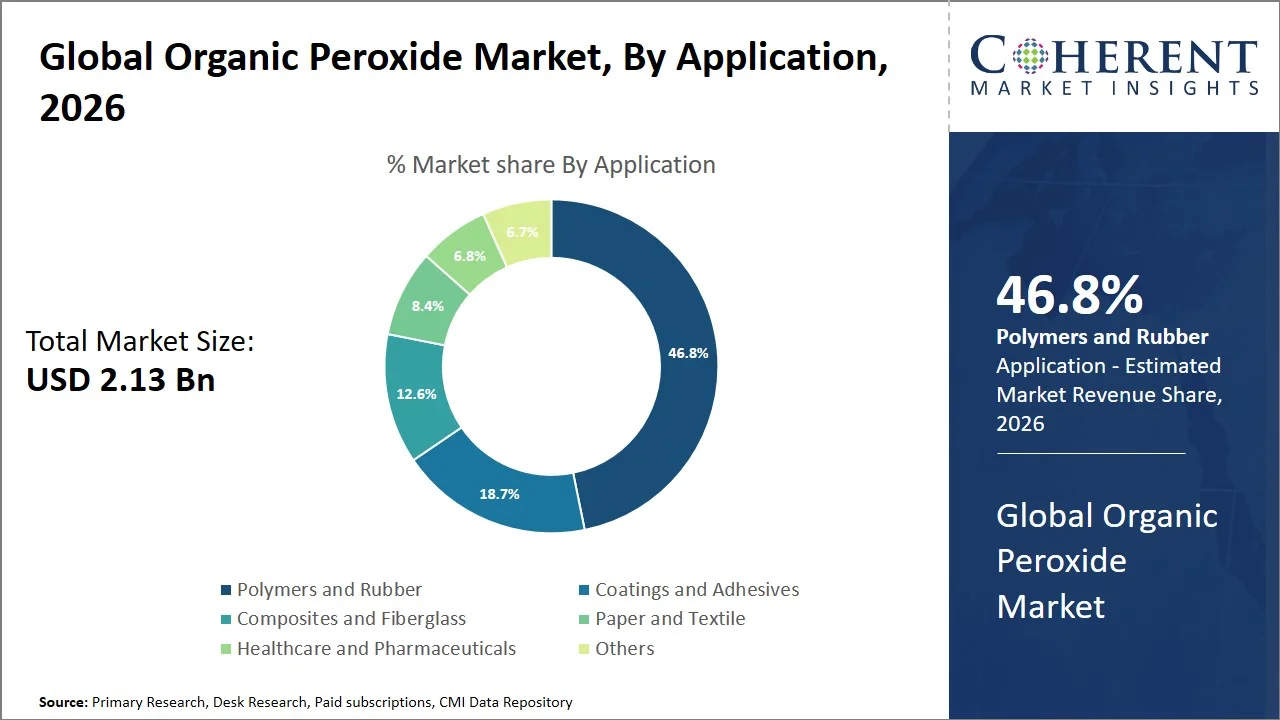
Polymers and Rubber applications are projected to represent 46.8% of the global organic peroxide market in 2026, making them the largest application segment due to the critical role of organic peroxides in polymer crosslinking, curing, and molecular modification processes. These chemicals enable improved mechanical strength, elasticity, thermal resistance, and processing efficiency across thermoplastics, elastomers, and specialty polymer systems. Demand is supported by automotive components, wire and cable insulation, construction materials, packaging solutions, and renewable energy applications requiring durable polymer performance. Supply-side advantages include customized peroxide formulations, technical application support, and regional manufacturing networks positioned near polymer processing clusters. In March 2025, United Initiators announced the expansion of its production capabilities for specialty peroxides in Germany, strengthening supply availability for polymer, rubber, and composite processing customers across global markets.
Why Do Chemicals and Plastics Dominate the End-use Industry Segment in the Global Organic Peroxide Market?
Chemicals and Plastics are expected to hold 55.8% of the global organic peroxide market in 2026, driven by their direct integration into polymer manufacturing chains and specialty chemical production processes. Organic peroxides are widely purchased by chemical and plastics producers as reaction initiators, curing agents, and performance modifiers for improving polymer quality and enabling advanced material development. The segment benefits from large-scale plastics production capacity, increasing demand for engineered polymers, and growing requirements for recycled plastic enhancement. Commercial opportunities are strongest for suppliers offering reliable supply, customized formulations, and technical assistance to polymer manufacturers. In October 2025, Nouryon announced investments in China, including a future organic peroxides innovation center in Tianjin, designed to support polymer application development and improve customer-focused solutions.
Current Events and their Impact
Current Event | Description and Its Impact |
October 2025 – European Chemicals Agency (ECHA) Updated Chemical Regulatory Guidance |
|
April 2025 – European Union Packaging and Packaging Waste Regulation (PPWR) Implementation Progress |
|
2024 – U.S. Environmental Protection Agency Chemical Safety Program Updates |
|
Global Organic Peroxide Market Dynamics
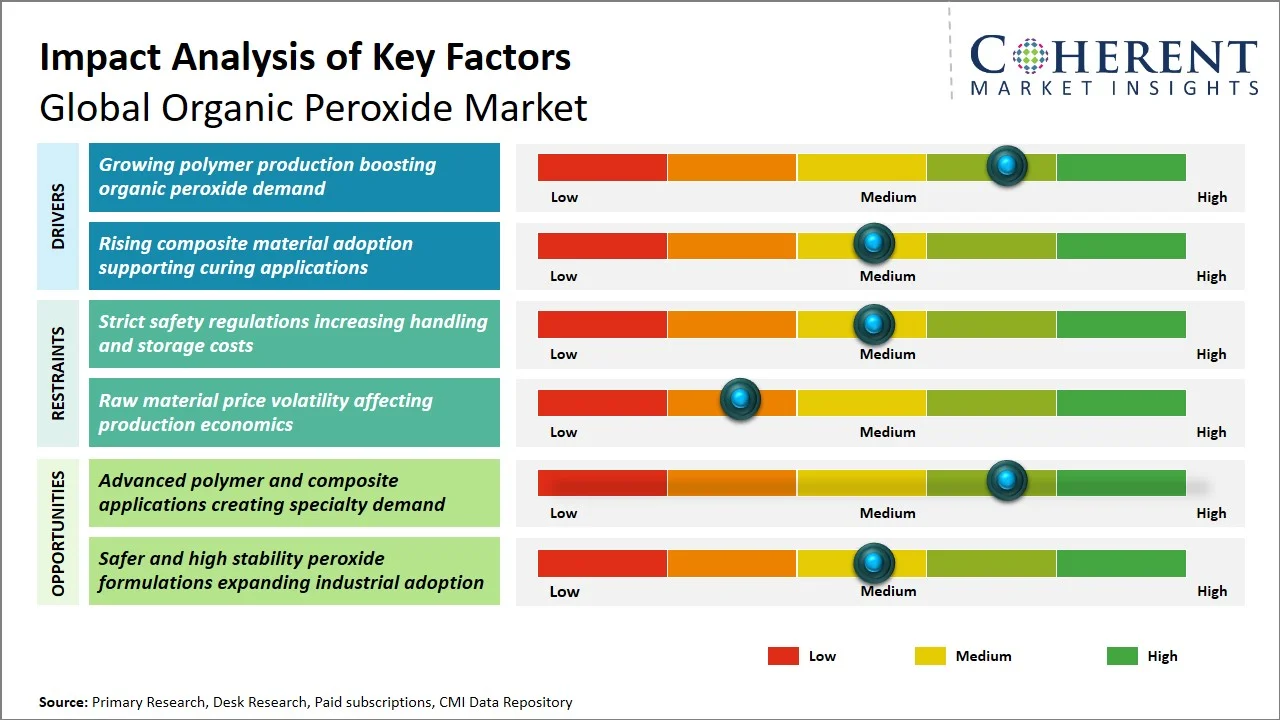
Key Market Drivers
Growing Polymer Production Boosting Organic Peroxide Demand
Growing polymer production is strengthening organic peroxide consumption as manufacturers rely on peroxide-based initiators and crosslinking agents to modify polyethylene, polypropylene, elastomers, and specialty polymers. Demand is particularly supported by automotive lightweight materials, cable insulation, packaging, and renewable-energy components requiring improved thermal stability and mechanical performance. Polymer producers, compounders, and peroxide suppliers benefit from closer technical collaboration to optimize formulations for advanced materials. In March 2025, Arkema completed a major expansion of its organic peroxide capacity at Changshu, China, increasing output capability to support polymer processing and renewable energy applications across Asia.
Rising Composite Material Adoption Supporting Curing Applications
Increasing adoption of composite materials in wind energy, transportation, construction, and industrial equipment is creating additional demand for organic peroxides used in resin curing systems. These chemicals enable controlled curing reactions in unsaturated polyester and vinyl ester resins, improving durability, dimensional stability, and long-term performance of composite structures. Manufacturers of composite materials and peroxide suppliers are benefiting from opportunities in lightweight component development and high-performance material applications. In June 2025, Polynt announced continued investments in composite resin capabilities, strengthening its position in advanced composite manufacturing where peroxide curing systems are widely applied.
Emerging Market Trends
Shift Toward Safer and More Efficient Organic Peroxide Formulations
Organic peroxide producers are increasingly focusing on safer formulations that improve handling stability, storage efficiency, and transportation compliance. Customers are showing greater preference for products designed with improved thermal control, reduced processing risks, and optimized decomposition characteristics. This trend is encouraging suppliers to develop customized peroxide grades rather than competing only on production volume. The shift benefits companies with strong formulation expertise, technical service capabilities, and application-development infrastructure. Over the forecast period, safety-focused product engineering is expected to become a stronger differentiator in customer selection decisions.
Increasing Integration of Organic Peroxides into Circular Polymer Solutions
The role of organic peroxides is expanding beyond conventional polymer processing toward circular plastics applications. Suppliers are developing solutions that help recyclers and compounders restore mechanical properties of recycled polymers, enabling broader use of recycled materials in demanding applications. This trend is changing purchasing priorities as customers increasingly evaluate additives based on their contribution to material recovery, performance consistency, and sustainability objectives. Companies capable of supporting recycling-focused applications and providing technical guidance to processors are expected to gain stronger positioning within evolving polymer value chains.
Regional Insights
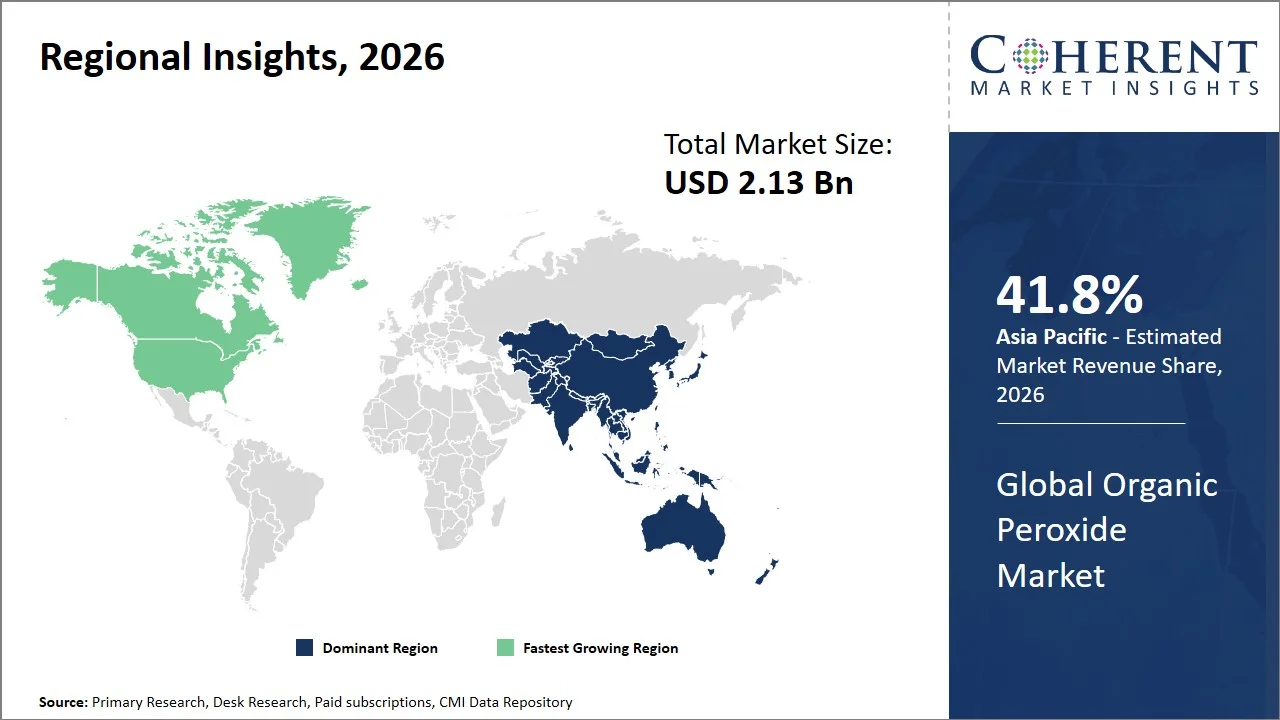
Why Does Asia Pacific Dominate the Global Organic Peroxide Market?
Asia Pacific is expected to account for 41.8% of the global organic peroxide market in 2026, supported by advanced polymer processing, specialty chemical innovation, and demand for high-performance materials in automotive, infrastructure, and renewable energy applications. The region’s mature chemical ecosystem enables rapid adoption of customized peroxide formulations. In January 2025, Mitsubishi Chemical Group announced continued investments in specialty chemical production capabilities in Japan to strengthen advanced material supply chains and support high-performance industrial applications across Asia.
Why Is North America Emerging as the Fastest-Growing Region in the Global Organic Peroxide Market?
North America is expected to account for 24.8% of the global organic peroxide market in 2026 and is likely to be the fastest-growing region, as the demand for advanced polymers, lightweight automotive material, infrastructure products, and specialty plastics in the region is rising. In addition to a well-established chemical manufacturing ecosystem, there is also a robust presence of polymer manufacturers, and continued investments in high-quality materials for EV, renewable energy and industrial applications. Safe handling of chemicals and sustainable material development is also a focus of regulatory and market attention that is driving improvements in the use of safer peroxide formulations and controlled processing technologies. In March 2025, LyondellBasell advanced its circular polymer and advanced materials initiatives in the U.S., supporting future demand for specialty polymer processing solutions and performance-enhancing chemical technologies.
Global Organic Peroxide Market Outlook for Key Countries
Why Is the U.S. a Key Market for the Global Organic Peroxide Market?
The U.S. represents a key market for the global organic peroxide market due to its advanced chemical manufacturing infrastructure, high consumption of engineered plastics, and strong demand from automotive, construction, packaging, and energy-related industries. The country hosts a large base of polymer processors and specialty chemical manufacturers requiring organic peroxides for polymer modification, curing, and crosslinking applications. Demand is further supported by increasing adoption of lightweight composite materials and recycled polymers that require performance enhancement during processing. Strong safety standards and technical expertise among chemical producers also encourage the use of specialized peroxide systems. In July 2025, AkzoNobel’s Specialty Chemicals business continued strengthening its global organic peroxide network, including North American manufacturing capabilities, to support polymer industry customers with improved supply reliability.
Why Is China Important in the Global Organic Peroxide Market?
China plays a central role in the global organic peroxide market due to its dominant position in plastics production, polymer processing, electronics materials, renewable energy components, and chemical manufacturing. The country provides a large customer base for organic peroxide suppliers because of extensive polyethylene, polypropylene, rubber, and composite material production capacity. Industrial clusters across regions such as Zhejiang, Jiangsu, and Guangdong support efficient supply chains between chemical producers and downstream processors. Increasing focus on recycled plastics and high-performance polymers is also creating demand for advanced peroxide solutions. In June 2025, Chinasun Specialty Products strengthened its organic peroxide business capabilities in China, supporting domestic polymer processors with localized peroxide supply solutions for plastics and specialty material applications.
Why Is India a Key Growth Market for the Global Organic Peroxide Market?
India is emerging as an important growth market for the global organic peroxide market due to expanding polymer demand from packaging, automotive components, infrastructure, renewable energy, and consumer goods industries. The country’s growing plastics processing sector and increasing investment in specialty chemicals are creating opportunities for organic peroxide suppliers. Domestic manufacturing capabilities, improving logistics infrastructure, and rising adoption of advanced materials are supporting market development. India also benefits from its position as a cost-competitive chemical manufacturing destination with increasing integration into global supply chains. In July 2025, Nouryon launched a new organic peroxide warehouse in Bhiwandi near Mumbai to improve storage capability and supply responsiveness for India’s growing polymer industry, supporting applications such as solar materials, wire and cable, and specialty polymers.
Why Is Japan a Strategic Country in the Global Organic Peroxide Market?
Japan remains strategically important in the global organic peroxide market due to its advanced materials industry, precision chemical manufacturing capabilities, and strong presence in automotive, electronics, and specialty polymer applications. Japanese manufacturers demand high-performance peroxide solutions that support strict quality requirements in engineering plastics, elastomers, and industrial materials. The country’s emphasis on technological precision, safety standards, and product consistency creates opportunities for suppliers offering customized organic peroxide grades. Japan also serves as an important innovation base within Asia through established chemical research and manufacturing networks. In 2025, NOF Corporation continued strengthening its specialty chemical portfolio in Japan, supporting advanced material applications including polymer additives and performance-enhancing chemical solutions.
Why Is Germany a Strategic Country in the Global Organic Peroxide Market?
Germany holds strategic importance in the global organic peroxide market due to its advanced chemical industry, strong automotive manufacturing base, and demand for high-performance polymer materials. The country’s industrial ecosystem supports applications requiring precise material properties, including automotive components, composites, coatings, and engineered plastics. German manufacturers also emphasize sustainability, process efficiency, and compliance with stringent chemical regulations, encouraging adoption of optimized peroxide technologies. Its strong research infrastructure and export-oriented manufacturing model further strengthen its role within the European chemical value chain. In 2023, Arkema increased organic peroxide capacity at its Günzburg facility in Germany, improving production capabilities for Luperox products and supporting European customers requiring advanced polymer processing solutions
Innovation, Production & Manufacturing Landscape
Technology / Manufacturing Approach | Description | Commercial Impact | Adoption Level |
Controlled Decomposition Organic Peroxide Systems | Advanced peroxide formulations designed for precise decomposition temperatures and reaction control. | Improves polymer processing efficiency and product consistency. | High |
Low-Dust and Granular Peroxide Formulations | Safer physical formats reducing handling risks during industrial operations. | Supports improved workplace safety and easier transportation. | Increasing |
Encapsulated Organic Peroxide Technology | Encapsulation techniques provide controlled release during polymerization and curing. | Enables specialized applications requiring reaction stability. | Moderate |
Recycling-Compatible Peroxide Solutions | Formulations designed to improve recycled polymer performance. | Creates opportunities in circular plastics applications. | Emerging |
Digital Process Monitoring in Chemical Production | Advanced monitoring systems improve manufacturing control and safety. | Enhances quality assurance and operational reliability. | Increasing |
Energy-Efficient Organic Peroxide Manufacturing | Improved production processes aimed at reducing resource consumption. | Supports sustainability goals and regulatory compliance. | Emerging |
How Are Circular Polymer Applications Creating New Growth Opportunities in the Global Organic Peroxide Market?
Circular polymer applications represent a strategic opportunity for organic peroxide suppliers as recyclers and compounders seek solutions that restore the performance characteristics of recovered plastics. Traditional polymer additives were primarily designed for virgin material processing; however, recycled polymers often require additional modification to achieve comparable strength, durability, and processing stability. Organic peroxide manufacturers can capture this opportunity by developing application-specific formulations for recycled polypropylene, polyethylene, and engineered plastics. The opportunity favors suppliers with strong technical support capabilities, close relationships with recyclers, and expertise in polymer chemistry. Companies investing in recycling-focused product development, customer testing facilities, and regional application centers can strengthen their position in emerging circular material ecosystems. This shift also creates opportunities for specialty peroxide producers to compete through value-added solutions rather than only through manufacturing scale.
Market Players, Key Development, and Competitive Intelligence
Key Developments
- In October 2025, Nouryon announced investments in China including a new Organic Peroxides Innovation Center in Tianjin planned for 2026. This development is important for the Global Organic Peroxide Market because it strengthens localized application support and accelerates product development for polymer customers in Asia.
- In September 2025, Dongsung Chemical completed expansion of its organic peroxide production facilities at its Yeosu plant, adding more than 4,000 tons of annual capacity. This strengthens regional supply capability and supports growing demand from polymer processors requiring locally available peroxide solutions.
- In July 2025, United Initiators strengthened its specialty chemical market position through continued collaboration with industrial resin customers, supporting peroxide-based curing applications across coatings and composite industries. This highlights the importance of supplier reliability and technical partnerships in specialty peroxide markets.
Competitive Landscape
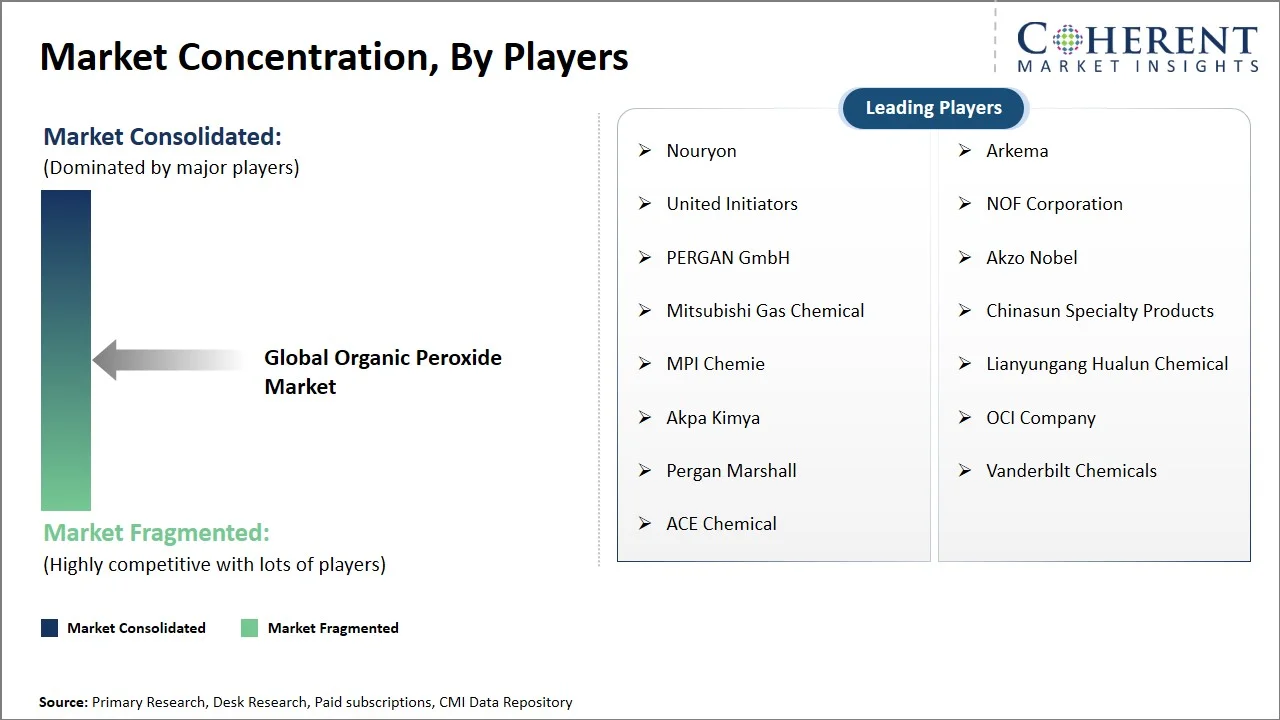
The global organic peroxide market is moderately consolidated, with competition concentrated among multinational specialty chemical producers and regional manufacturers. Market positioning depends on product consistency, safety compliance, production reliability, application expertise, and customer support capabilities. Global suppliers compete through technology development, regional manufacturing presence, and customized formulations, while regional players focus on cost competitiveness and specialized applications.
Key Focus Areas Include:
- Product performance and decomposition control characteristics
- Manufacturing capacity and supply reliability
- Compliance with chemical safety regulations
- Customized peroxide grades for specific polymer applications
- Technical support and application-development capabilities
- Regional production facilities near polymer manufacturing clusters
- Sustainable formulations supporting recycled polymer applications
- Distribution networks for temperature-sensitive chemical products
Market Report Scope
Organic Peroxide Market Report Coverage
| Report Coverage | Details | ||
|---|---|---|---|
| Base Year: | 2025 | Market Size in 2026: | USD 2.13 Bn |
| Historical Data for: | 2020 To 2024 | Forecast Period: | 2026 To 2033 |
| Forecast Period 2026 to 2033 CAGR: | 3.80% | 2033 Value Projection: | USD 2.76 Bn |
| Geographies covered: |
| ||
| Segments covered: |
| ||
| Companies covered: | Nouryon, Arkema, United Initiators, NOF Corporation, PERGAN GmbH, Akzo Nobel, Mitsubishi Gas Chemical, Chinasun Specialty Products, MPI Chemie, Lianyungang Hualun Chemical, Akpa Kimya, OCI Company, Pergan Marshall, Vanderbilt Chemicals, ACE Chemical | ||
| Growth Drivers: |
| ||
| Restraints & Challenges: |
| ||
Analyst Opinion (Expert Opinion)
- The global organic peroxide market is expected to shift toward a solution-based model where technical expertise, customized formulations, and application support become key competitive differentiators. Suppliers with strong polymer-processing capabilities and customer collaboration models are likely to gain stronger market positioning.
- Circular polymer applications could reshape market dynamics as demand increases for peroxide solutions that improve recycled plastic performance. Companies developing recycling-focused formulations and technical support capabilities may gain advantages over traditional volume-based suppliers.
- Market participants should focus on specialized peroxide grades, regional technical capabilities, and supply-chain resilience. Investments in customer partnerships, regulatory expertise, and localized manufacturing will be important to manage raw material risks and strengthen long-term competitiveness.
Speak to the analyst
Want personalized insights?
Take the findings above to one of our principal consultants, or have the report rebuilt around the segments, geographies and competitors you actually track.
Market Segmentation
- Product Type Insights (Revenue, USD Bn, 2021 - 2033)
- Dialkyl Peroxides
- Diacyl Peroxides
- Ketone Peroxides
- Peroxyesters
- Hydro Peroxides
- Peroxy Ketals
- Others
- Application Insights (Revenue, USD Bn, 2021 - 2033)
- Polymers and Rubber
- Coatings and Adhesives
- Composites and Fiberglass
- Paper and Textile
- Healthcare and Pharmaceuticals
- Others
- End Use Industry Insights (Revenue, USD Bn, 2021 - 2033)
- Chemicals and Plastics
- Automotive
- Construction
- Electronics
- Healthcare
- Others
- Distribution Channel Insights (Revenue, USD Bn, 2021 - 2033)
- Direct Sales
- Indirect Sales
- Regional Insights (Revenue, USD Bn, 2021 - 2033)
- North America
- U.S.
- Canada
- Latin America
- Brazil
- Argentina
- Mexico
- Rest of Latin America
- Europe
- Germany
- U.K.
- Spain
- France
- Italy
- Russia
- Rest of Europe
- Asia Pacific
- China
- India
- Japan
- Australia
- South Korea
- ASEAN
- Rest of Asia Pacific
- Middle East
- GCC Countries
- Israel
- Rest of Middle East
- Africa
- South Africa
- North Africa
- Central Africa
- North America
Sources
Primary Research Interviews
- Organic peroxide manufacturers, specialty chemical producers, polymer processors, resin manufacturers, and industry experts
- Chemical procurement professionals, R&D specialists, production managers, and application engineers
Stakeholders
- Organic peroxide manufacturers, specialty chemical companies, polymer additive suppliers, and chemical distributors
- Plastic processors, rubber manufacturers, composite producers, coatings companies, and industrial end users
- Automotive suppliers, packaging manufacturers, wire & cable producers, and renewable energy material providers
End-use Sectors
- Plastics and polymer processing
- Rubber and elastomer manufacturing
- Composites and fiberglass applications
- Coatings, adhesives, and specialty chemical production
- Automotive, construction, packaging, and renewable energy industries
Regulatory and Industry Bodies
- European Chemicals Agency (ECHA)
- U.S. Environmental Protection Agency (EPA)
- Occupational Safety and Health Administration (OSHA)
- International chemical safety and regulatory organizations
Databases
- Company annual reports, investor presentations, and corporate filings
- Chemical trade databases and import-export statistics
- Polymer, plastics, and specialty chemical industry databases
- Product portfolio analysis and manufacturing capacity databases
Magazines and Journals
- Chemical engineering and specialty chemical publications
- Polymer science and materials research journals
- Plastics processing and elastomer technology publications
- Industrial chemistry and advanced materials journals
Associations
- Plastics Industry Association
- European Chemical Industry Council (CEFIC)
- American Chemistry Council (ACC)
- International Rubber Study Group (IRSG)
- Composite materials and polymer industry associations
Public Domain Sources
- Polymer production and specialty chemical industry developments
- Organic peroxide manufacturing expansions and technology advancements
- Chemical safety and regulatory updates
- Recycling, circular polymer, and sustainable materials developments
- Industrial application trends across plastics, rubber, and composites
Key Standards and Regulations
- Chemical classification and labeling requirements
- Storage, handling, and transportation safety standards for organic peroxides
- REACH and TSCA chemical compliance requirements
- Workplace chemical safety regulations
- International trade and hazardous chemical transportation regulations
Proprietary Elements
- CMI Data Analytics Tool
- Proprietary CMI repository containing 10+ years of specialty chemicals, polymers, materials, and industrial market intelligence.
Get access to 250+ pages report
Every segment, forecast, competitor profile and data table behind the analysis above — available for instant download.
- ESOMAR Member
- ISO 9001:2015 Certified
- D-U-N-S Registered
- GDPR & CCPA Compliant
Missing comfort of reading report in your local language? Find your preferred language:
Frequently Asked Questions
The CAGR of global organic peroxide market is projected to be 3.80% from 2026 to 2033.
The global organic peroxide market is estimated to be valued at USD 2.13 Bn in 2026 and is expected to reach USD 2.76 Bn by 2033.
Organic peroxides are primarily used in polymer processing, rubber curing, composite manufacturing, coatings, adhesives, and specialty chemical production due to their ability to initiate controlled chemical reactions.
Organic peroxides are used as polymerization initiators and crosslinking agents to improve material properties such as strength, durability, elasticity, and thermal resistance in various polymer systems.
Organic peroxide products are used across industries including plastics, automotive, construction, packaging, renewable energy, electronics, and specialty chemical manufacturing.
Key considerations include product quality, safety compliance, supply reliability, technical support, formulation capabilities, storage requirements, and the supplier’s ability to meet application-specific performance needs.
Growing polymer production boosting organic peroxide demand and Rising composite material adoption supporting curing applications are the major factors driving the growth of global organic peroxide market.