

Hydrogen Peroxide Market Analysis & Forecast
The global hydrogen peroxide market is estimated to be valued at USD 3.95 Bn in 2026 and is expected to reach USD 5.74 Bn by 2033, growing at a compound annual growth rate (CAGR) of 5.5% from 2026 to 2033.
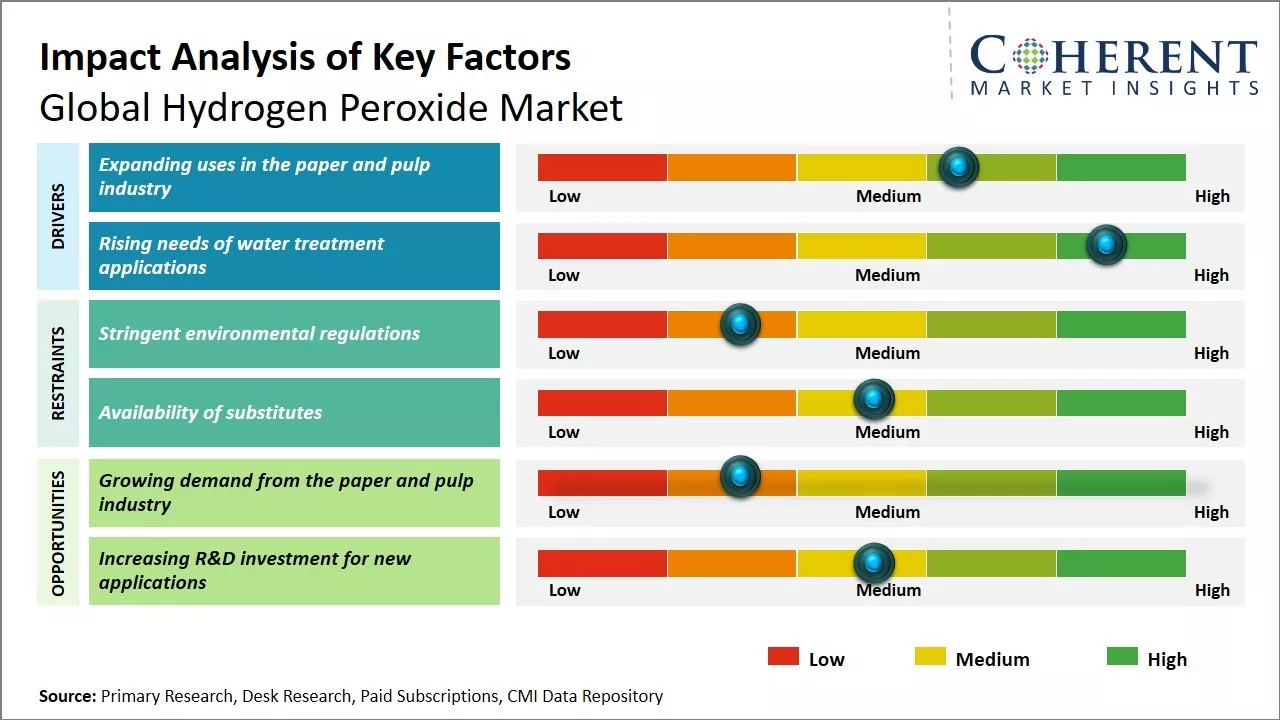
Key Takeaways
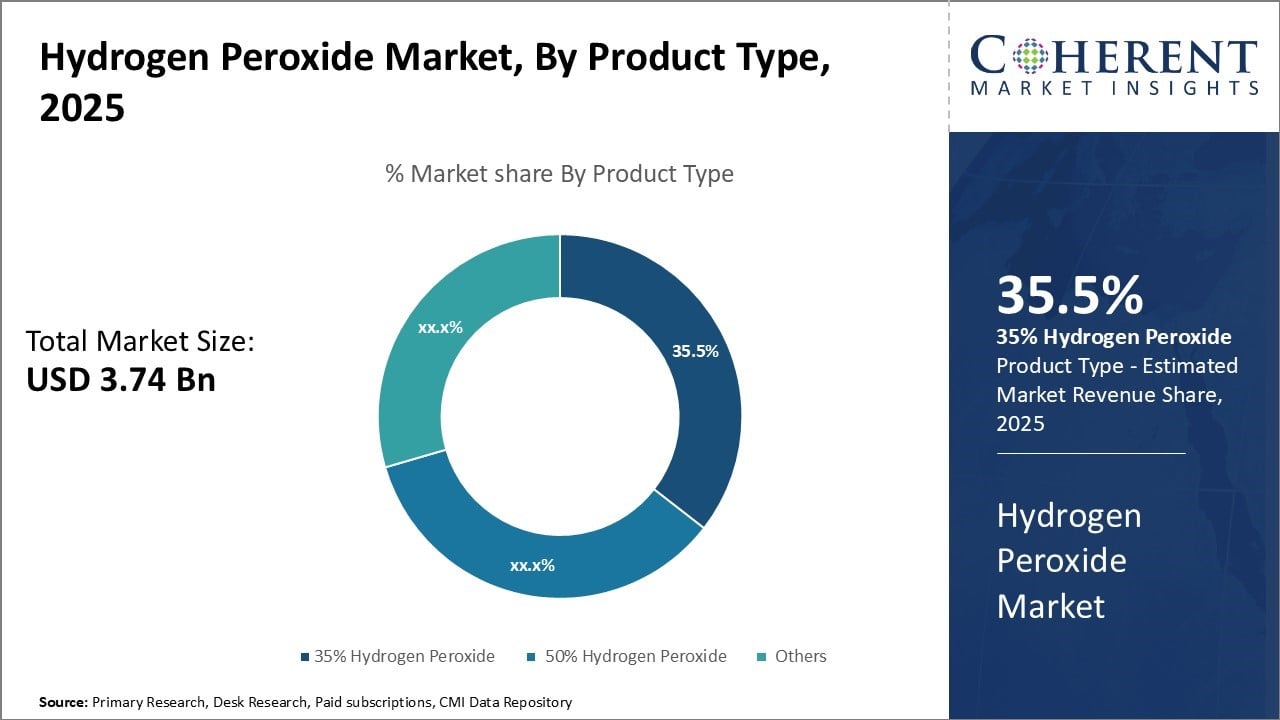
- By Product Type, the 36% hydrogen peroxide segment is projected to dominate the market with a 36.5% share in 2026.
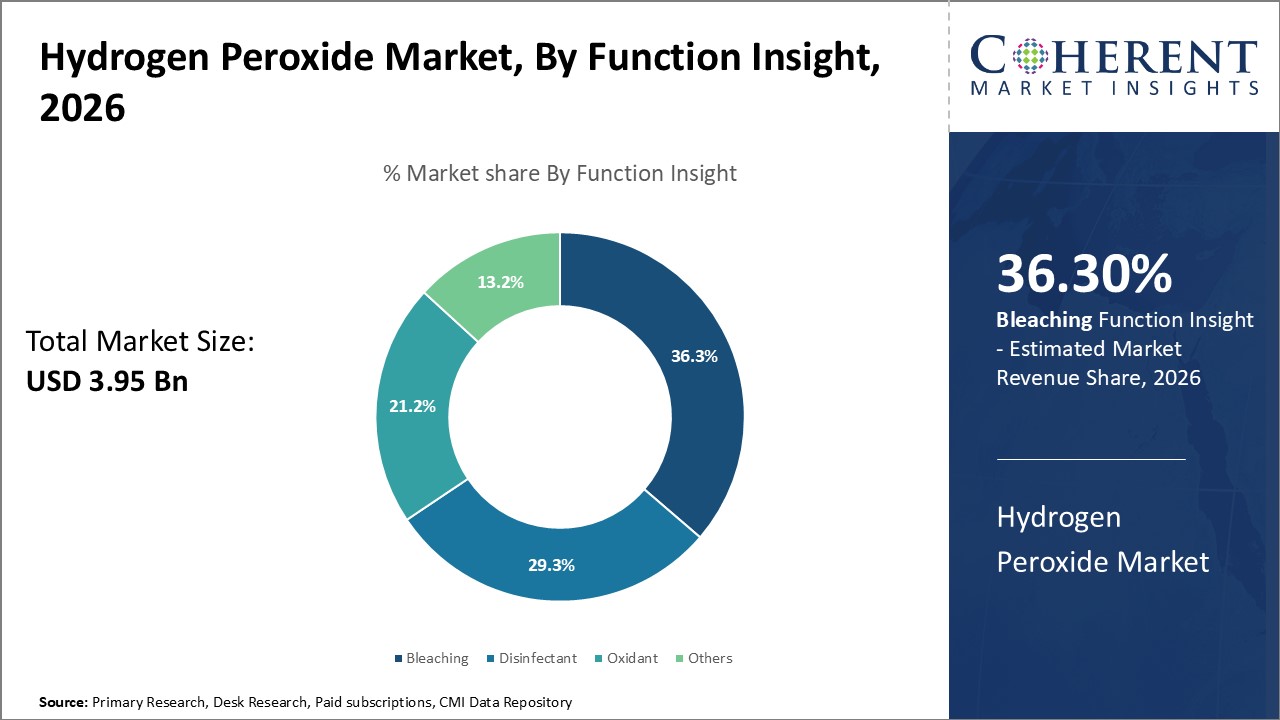
- By Function, the bleaching function accounts for 36.3% of the market share in 2026.
- By Application, the pulp and paper segment are set to retain its lead with a 36.1% share in 2026.
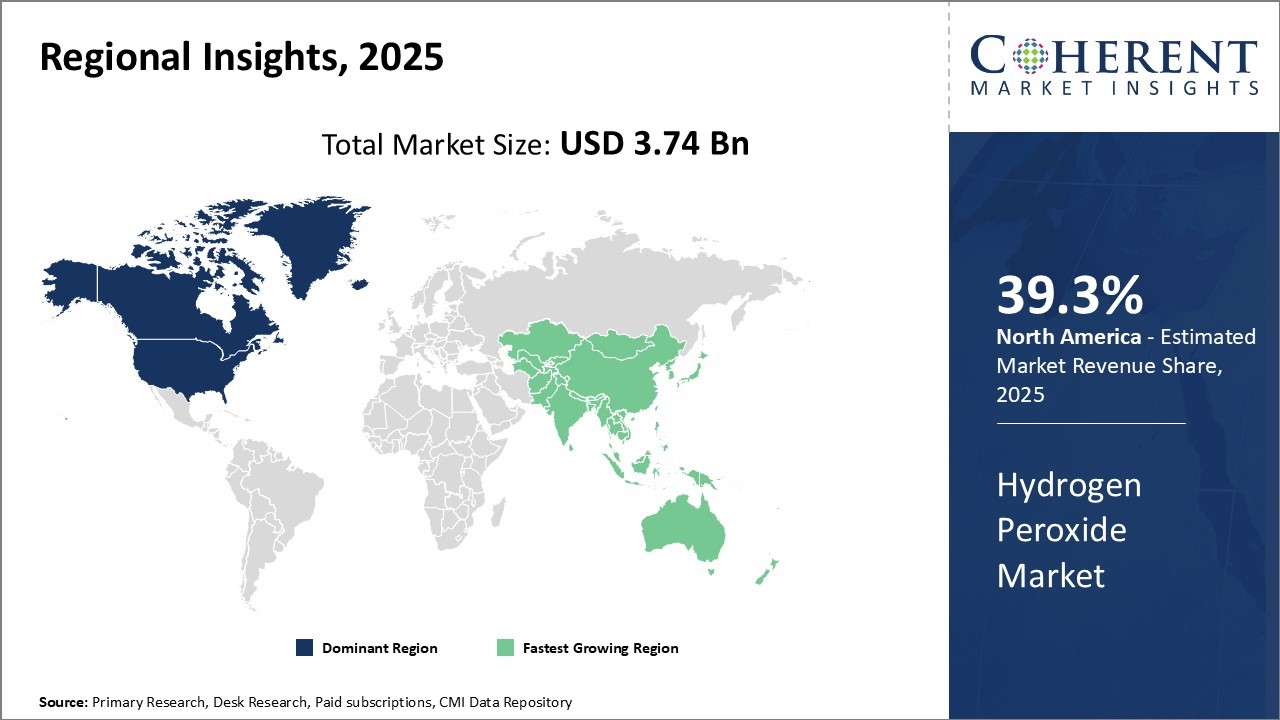
- North America continues to lead the global hydrogen peroxide market with a 39.3% share in 2026.
Market Overview
The global Hydrogen Peroxide Market is experiencing steady growth, fuelled by increasing demand across industries such as pulp and paper, textiles, and wastewater treatment. Its strong oxidizing properties and eco-friendly profile drive widespread adoption, particularly in bleaching and disinfection applications. Cost-effective concentrations like 35% are widely used, balancing efficiency and safety.
Current Events and its Impact on the hydrogen peroxide market
Current Event | Description and its impact |
Green Chemistry Initiatives and Environmental Regulations |
|
Technological Innovations and Production Optimization |
|
Strategic Expansions and Capacity Enhancements |
|
Pricing Analysis: Hydrogen Peroxide Market
The pricing dynamics in the global hydrogen peroxide market are shaped by several interlinked factors, including raw material availability, energy costs, production technology, transportation logistics, and regulatory compliance. In 2025, the market faces moderate price volatility driven by shifts in hydrogen and oxygen feedstock prices, which are highly sensitive to global energy trends and natural gas fluctuations.
One of the primary cost drivers is the energy-intensive nature of hydrogen peroxide production, especially at higher concentrations like 50%. Variations in electricity and fuel prices, particularly in regions dependent on thermal power, significantly affect manufacturing costs. In addition, strict environmental regulations in North America and Europe contribute to compliance costs, influencing the final price of industrial-grade hydrogen peroxide.
Global transportation disruptions and rising logistics costs—especially for bulk liquid chemicals—further influence regional pricing discrepancies. Export-heavy markets such as China and the U.S. often see pricing advantages due to economies of scale, while import-reliant nations experience cost markups.
However, technological advancements in energy-efficient production methods and on-site generation systems are helping mitigate cost pressures. Companies are also investing in vertically integrated supply chains to control raw material sourcing and maintain pricing stability.
Despite inflationary pressures, the hydrogen peroxide market maintains competitive pricing due to its widespread industrial utility and the presence of several global and regional players. Long-term pricing trends are expected to stabilize as sustainability-focused production gains traction and supply chains become more resilient.
- Current Industry Events of 2026
- Market Size Estimation
- Regional Breakdown
- Competitive Landscape
- Customer Intelligence
- Segmental Analysis
- Pricing Analysis
- Key Market Drivers, Challenges & Future Trends
- Customized Insights Section
Role of Emerging Technology in the Hydrogen peroxide market
Emerging technologies are significantly reshaping the hydrogen peroxide market by enhancing production efficiency, sustainability, and application versatility. Innovations such as advanced oxidation processes (AOPs) are expanding the use of hydrogen peroxide in water and wastewater treatment, offering eco-friendly solutions for removing organic contaminants.
Additionally, advancements in catalytic and plasma-assisted synthesis are enabling on-site and small-scale production, reducing dependence on large centralized plants and minimizing transportation costs and hazards.
The integration of automation and process analytics is optimizing real-time monitoring and control across manufacturing units, improving yield consistency and reducing operational costs. In sectors like electronics and pharmaceuticals, high-purity hydrogen peroxide is being developed using precision purification technologies to meet strict quality standards.
Moreover, research in green chemistry and bio-based feedstock’s is driving innovation toward more sustainable production routes. These technological advancements collectively support safer handling, lower environmental impact, and wider adoption across industries.
Hydrogen peroxide market Trends
- Growing usage in the paper and pulp industry
The global hydrogen peroxide market has been witnessing steady growth over the past few years due to its expanding applications in the paper and pulp industry. As one of the largest end-use sectors, the paper and pulp industry utilizes hydrogen peroxide for bleaching papers and removing wood lignin content.
The usage of hydrogen peroxide for bleaching has various environmental benefits as compared to traditional chlorine-based methods. It leaves no residues and breaks down into water and oxygen, thus reducing pollution. With growing awareness about sustainability, more paper manufacturers are switching to hydrogen peroxide for their bleaching needs.
Additionally, demand for higher-quality bleached paper grades is rising globally with the development of the packaging and tissue paper segments. Customers prefer bright and vibrant packaging for marketed products along with soft and bright tissue papers. As hydrogen peroxide allows achieving desired shade and brightness levels efficiently, its dependence is deepening within the papermaking sector.
For example, recent data from the European Commission shows that over 60% of paper mills in Europe have already adopted hydrogen peroxide partially or fully for bleaching. This transition is likely to continue as sustainability becomes a key business priority. Future projections by the Food and Agriculture Organization (FAO) also favour market growth.
The FAO report estimates world demand for paper to increase by over 40% between 2020 and 2030 driven by the global middle-class population expansion. With this sharp rise, pulp and paper mill capacities are expected to simultaneously strengthen. This would translate to augmented hydrogen peroxide needs for bleaching the additional paper production over the coming decade. Thus, expanding applications as an eco-friendly bleaching agent for the steadily growing paper industry will remain a key factor driving the global hydrogen peroxide market in the near future.
In May 2024, The Times of India reported that a chemical plant in Dombivli, Maharashtra, experienced a devastating boiler explosion. Authorities had previously issued warnings to the facility to cease using hydrogen peroxide—an oxidizing agent due to its risk of supporting combustion, but the plant continued its use, tragically leading to the accident.
- Rising needs of water treatment applications
Clean and safe water is crucial for industries, communities as well as populations at large. With growing concerns about water pollution and contamination of water bodies, there is heightened focus on advanced purification of water supplies. Hydrogen peroxide has emerged as a workhorse chemical for treating wastewater discharged from varied industries before its disposal. It helps remove toxins and neutralize pathogens.
Similarly, drinking water treatment plants too are leveraging hydrogen peroxide to sanitize and disinfect water. This ensures high-level safety. Its properties of decomposing into water and oxygen without forming any harmful residues make it an environment-friendly disinfectant.
Additionally, many municipal corporations in urban areas are installing hydrogen peroxide producing units for decentralizing water treatment activities. Thus, the rapidly expanding water treatment infrastructure and rising focus on recycled water utilization are fuelling the demand for hydrogen peroxide in this strategically important application sphere.
In March 2025, The Indian Express covered an incident where a truck transporting hydrogen peroxide from Pune to Tamil Nadu developed a leak on the Pune–Bengaluru highway. Fire brigade officials responded promptly, transferring the chemical to an alternate vehicle. The leak drew attention to safety concerns surrounding the transportation of industrial-grade hydrogen peroxide.
Opportunities In the Hydrogen Peroxide Market
- Growing demand from the paper and pulp industry
Growing demand from the paper and pulp industry is increasing as paper production rises globally. Additionally, the pharmaceuticals and personal care products sectors also offer promise as hydrogen peroxide finds more applications in these fields. Opportunities exist in wastewater treatment plants to utilize hydrogen peroxide for disinfection.
Segmental Insights
Hydrogen Peroxide Market Insights, By Product Type
The 36% hydrogen peroxide segment is projected to dominate the global hydrogen peroxide market, commanding a significant 35.5% share in 2026. This dominance is driven by its balanced combination of effectiveness and cost-efficiency, making it suitable for a wide array of applications including environmental disinfection, water purification, textile processing, and surface cleaning. Unlike higher concentration variants, 35% hydrogen peroxide offers safer handling and storage, which makes it more favourable across both industrial and commercial domains.
In contrast, 50% hydrogen peroxide is primarily utilized in specialized applications requiring higher oxidation power but faces constraints due to stringent handling protocols and safety regulations. The market distribution highlights a preference for multi-use, moderately concentrated hydrogen peroxide driven by operational efficiency and safety.
Hydrogen Peroxide Market Insights, By Function Insight
The bleaching function segment holds the top position in the hydrogen peroxide market, accounting for 36.3% of the market share in 2026. This segment’s dominance is rooted in hydrogen peroxide’s unparalleled performance as a bleaching agent in the pulp and paper and textile industries.
Particularly, high-concentration variants like 50% hydrogen peroxide are widely applied where intensive oxidation and colour removal are required. Its eco-friendly decomposition into water and oxygen gives it an edge over chlorine-based alternatives, further reinforcing its position in bleaching operations aligned with environmental compliance and sustainability goals. As industries continue shifting toward greener chemicals, hydrogen peroxide remains a key choice for efficient and responsible bleaching.
Hydrogen Peroxide Market Insights, By Application
The pulp and paper segment is set to remain the leading application in the hydrogen peroxide market, capturing a 36.1% share in 2026. This sustained leadership is attributed to hydrogen peroxide’s vital role in delignification, bleaching, and brightening processes during paper manufacturing. Its non-toxic, chlorine-free nature makes it highly desirable in eco-conscious operations, especially as the industry adapts to stringent environmental regulations.
Demand is further amplified by the growing need for sustainable packaging materials and paper products across various sectors. As a result, hydrogen peroxide continues to be the preferred oxidizing and bleaching agent in modern pulp and paper processing systems.
Hydrogen peroxide market: Regional Insights
North America Hydrogen Peroxide Market Trends and Analysis
North America continues to lead the global hydrogen peroxide market, holding a dominant 39.3% share in 2026. This regional leadership is supported by a mature and well-established pulp and paper industry, stringent environmental regulations, and major investments in water treatment infrastructure.
The U.S. and Canada are at the forefront, leveraging hydrogen peroxide as a sustainable solution for industrial bleaching and environmental applications. The region’s focus on eco-friendly chemical alternatives and robust industrial base makes it a cornerstone for hydrogen peroxide demand and innovation.
Europe Hydrogen Peroxide Market Trends and Analysis
Europe follows closely, driven by increasing demand in textile recycling, green chemistry, and wastewater treatment. The region is seeing strong policy support for reducing the environmental impact of industrial chemicals, positioning hydrogen peroxide as a preferred oxidizing agent.
Countries like Germany, France, and the Netherlands are at the helm of adopting hydrogen peroxide in sustainable manufacturing processes, reinforcing its market presence. Europe’s commitment to circular economy principles and clean industrial practices continues to drive steady market growth.
Hydrogen peroxide market Dominating Countries
United States and Canada
The United States plays a leading role in the global hydrogen peroxide market, anchored by its dominance in North America’s 39.3% market share. This is attributed to a well-established pulp and paper industry, stringent environmental regulations, and substantial investments in water treatment and disinfection technologies. The U.S. also drives innovation in sustainable chemical manufacturing, positioning hydrogen peroxide as a key eco-friendly oxidizing agent for multiple industrial applications.
Canada also contributes significantly, leveraging its growing emphasis on clean water infrastructure, eco-friendly industrial practices, and environmental compliance standards. The country’s pulp and paper sector, along with emerging demand in agri-chemicals and healthcare disinfection, supports its increasing consumption of hydrogen peroxide.
Market Report Scope
Hydrogen Peroxide Market Report Coverage
| Report Coverage | Details | ||
|---|---|---|---|
| Base Year: | 2025 | Market Size in 2026: | USD 3.95 Bn |
| Historical Data for: | 2020 To 2024 | Forecast Period: | 2026 To 2033 |
| Forecast Period 2026 to 2033 CAGR: | 5.5% | 2033 Value Projection: | USD 5.74 Bn |
| Geographies covered: |
| ||
| Segments covered: |
| ||
| Companies covered: | Solvay S.A., BASF SE, Novo Nordisk Pharmatech A/S, Evonik Industries AG, Akzo Nobel N.V., Mitsubishi Gas Chemical Company, Inc., PeroxyChem LLC, Arkema Group, Gujarat Alkalies and Chemicals Ltd., Merck KGaA, Kemira Oyj, Aditya Birla Chemicals (Thailand) Ltd., Arkema Inc., Kingboard Chemical Holdings Ltd., Hansol Chemical Co. Ltd., Ecolab Inc., Dow Chemical Company, Christeyns, Apollo Scientific Ltd., and Guangdong Zhongcheng Chemicals Inc. | ||
| Growth Drivers: |
| ||
| Restraints & Challenges: |
| ||
Analyst Viewpoint – Hydrogen Peroxide Market
- Analysts express a positive outlook on the global hydrogen peroxide market, emphasizing its expanding role in environmental sustainability and industrial efficiency. They highlight that rising demand for eco-friendly oxidizing agents in water treatment, pulp and paper bleaching, and textile processing is a major growth driver, particularly amid tightening environmental regulations. The compound’s versatility and biodegradability make it a preferred choice across diverse sectors.
- Experts point to technological innovations such as advanced oxidation processes (AOPs) and on-site hydrogen peroxide generation as transformative, offering operational efficiency and safety in industrial use. These advancements are expected to reduce costs and support localized applications, especially in emerging economies.
- Regionally, Asia Pacific is seen as the fastest-growing market, led by China and India, owing to rapid industrialization, environmental reforms, and increasing water treatment needs. North America and Europe remain mature yet innovation-driven markets. Analysts agree that the market’s future will hinge on green chemistry, industrial diversification, and policy-driven sustainability.
Hydrogen Peroxide Market: Key Development
- In March 2025: Solvay announced plans in March 2025 to build a new electronic‑grade hydrogen peroxide (eH₂O₂) manufacturing facility in Casa Grande, Arizona. Fully powered by renewable electricity, this plant will serve the burgeoning U.S. semiconductor industry with ultra‑high purity H₂O₂ for wafer cleaning and etching applications. This strategic move strengthens North America’s domestic supply chain for critical chemicals, reduces dependence on imports, and supports the fast-growing semiconductor sector.
- In May 2025: Analysts report the hydrogen peroxide market is projected to reach USD 5.05 billion within five years, driven by eco-conscious consumer behaviour and regulatory pressures promoting sustainable chemicals. This bullish forecast encourages industry investment in production scalability and supports development of green manufacturing and applications.
- In March 2025, Nouryon launched Eka HP Puroxide, a low-carbon hydrogen peroxide product targeting pulp and paper, mining, and water treatment markets. This product addresses industrial decarbonization needs by lowering Scope 3 emissions for end-users, reinforcing hydrogen peroxide’s role in sustainable manufacturing and water infrastructure.
- In August 2024: DCM Shriram inaugurated a 52,000 t/year hydrogen peroxide facility to support growing demand in the photovoltaic sector. Although outside North America, this signals global capacity growth and potential pricing ripple effects, while setting benchmarks for plant efficiency and specialized applications.
- In March 2024: In Q1 2024, North American spot prices for hydrogen peroxide surged to USD 682/ton, driven by rebounding industrial activity and water-treatment demand. This price uptick improved margins for suppliers while also motivating end-user industries to explore on-site generation or alternative sourcing to hedge cost risks.
Market Segmentation
- By Product Type (Revenue, USD Bn, 2021 - 2033)
- 35% Hydrogen Peroxide
- 50% Hydrogen Peroxide
- Others
- By Function (Revenue, USD Bn, 2021 - 2033)
- Disinfectant
- Bleaching
- Oxidant
- Others
- By Application (Revenue, USD Bn, 2021 - 2033)
- Pulp & Paper
- Chemical Synthesis
- Wastewater Treatment
- Mining
- Food & Beverages
- Personal Care
- Healthcare
- Textiles
- Others
Regional Insights (Revenue, USD Bn, 2021 - 2033)
- North America
- U.S.
- Canada
- Latin America
- Brazil
- Argentina
- Mexico
- Rest of Latin America
- Europe
- Germany
- U.K.
- Spain
- France
- Italy
- Russia
- Rest of Europe
- Asia Pacific
- China
- India
- Japan
- Australia
- South Korea
- ASEAN
- Rest of Asia Pacific
- Middle East
- GCC Countries
- Israel
- Rest of Middle East
- Africa
- South Africa
- North Africa
- Central Africa
- North America
- Company Profiles
- Solvay S.A.
- BASF SE
- Novo Nordisk Pharmatech A/S
- Evonik Industries AG
- Akzo Nobel N.V.
- Mitsubishi Gas Chemical Company, Inc.
- PeroxyChem LLC
- Arkema Group
- Gujarat Alkalies and Chemicals Ltd.
- Merck KGaA
- Kemira Oyj
- Aditya Birla Chemicals (Thailand) Ltd.
- Arkema Inc.
- Kingboard Chemical Holdings Ltd.
- Hansol Chemical Co. Ltd.
- Ecolab Inc.
- Dow Chemical Company
- Christeyns
- Apollo Scientific Ltd.
- Guangdong Zhongcheng Chemicals Inc.
Sources
The Stakeholders Consulted
- Industrial plant managers and process engineers
- Manufacturers and suppliers of hydrogen peroxide and related chemical agents
- Environmental and chemical safety compliance officers
- Regulatory authorities and government bodies involved in chemical manufacturing standards
- Researchers and academicians in industrial chemistry and chemical engineering
- Government agencies engaged in water treatment, pulp & paper, and healthcare sectors
- End-users from sectors such as pulp and paper, textiles, water treatment, healthcare, and food processing
Databases Opened
- U.S. Department of Energy (DOE) – Chemical Industry Data
- International Energy Agency (IEA) – Chemical Production Energy Metrics
- Eurostat – Production and Trade of Chemicals in the EU
- Ministry of Chemicals and Fertilizers (India) – Sector Reports and Import-Export Data
- World Bank Open Data – Manufacturing & Chemicals Sector Statistics
Magazines & Trade Publications
- Chemical Engineering Magazine
- ICIS Chemical Business
- Process Industry Informer
- The Chemical Engineer (IChemE)
- Manufacturing.net – Chemical Processing Section
Scientific and Industry Journals
- Journal of Hazardous Materials
- Industrial & Engineering Chemistry Research
- International Journal of Environmental Science and Technology
- Journal of Cleaner Production
- Chemical Engineering Journal
Newspapers & Media Outlets
- The Wall Street Journal – Global Chemicals & Energy Coverage
- Bloomberg – Chemicals and Commodities Section
- Reuters – Global Industrial Materials & Specialty Chemicals Reports
- The Economic Times – Chemicals and Manufacturing Section
- Business Standard – Chemicals & Energy Transition Coverage
Associations and Regulatory Bodies
- American Chemical Society (ACS)
- European Chemicals Agency (ECHA)
- U.S. Environmental Protection Agency (EPA) – Toxic Substances Control Act (TSCA)
- Central Pollution Control Board (CPCB), India
- Bureau of Indian Standards (BIS) – Chemical Sector Norms
Public Domain Sources
- U.S. Energy Information Administration (EIA) – Chemical Production Reports
- European Commission – REACH Regulations and Chemical Industry Insights
- World Bank – Industry & Pollution Control Reports
- International Renewable Energy Agency (IRENA) – Industrial Decarbonization Programs
Proprietary Research Elements
- CMI Data Analytics Tool
- Proprietary CMI Repository of Market Data (covering past 8 years)
- CMI Expert Interviews and Transcripts (focused on hydrogen peroxide applications, supply chains, and emerging opportunities in green chemistry and disinfection)
Get access to 250+ pages report
Every segment, forecast, competitor profile and data table behind the analysis above — available for instant download.
- ESOMAR Member
- ISO 9001:2015 Certified
- D-U-N-S Registered
- GDPR & CCPA Compliant
Missing comfort of reading report in your local language? Find your preferred language:
Transform your Strategy with Exclusive Trending Reports
Frequently Asked Questions
The Hydrogen Peroxide Market size is estimated to be valued at USD 3.95 Bn in 2026, and is expected to reach USD 5.74 Bn by 2033.
The CAGR of the global Market is projected to be 5.5% from 2026 to 2033.
Expanding uses in the paper and pulp industry and rising needs of water treatment applications are the major factors driving the growth of the global market.
Stringent environmental regulations and availability of substitutes are the major factors hampering the growth of the global market.
In terms of product type, 35% hydrogen peroxide is estimated to dominate the market revenue share in 2026.
Solvay S.A., BASF SE, Novo Nordisk Pharmatech A/S, Evonik Industries AG, Akzo Nobel N.V., Mitsubishi Gas Chemical Company, Inc., PeroxyChem LLC, Arkema Group, Gujarat Alkalies and Chemicals Ltd., Merck KGaA, Kemira Oyj, Aditya Birla Chemicals (Thailand) Ltd., Arkema Inc., Kingboard Chemical Holdings Ltd., Hansol Chemical Co. Ltd., Ecolab Inc., Dow Chemical Company, Christeyns, Apollo Scientific Ltd., and Guangdong Zhongcheng Chemicals Inc. are the major players.
North America is expected to lead the global hydrogen peroxide industry.