

Global Orthopedic Navigation Systems Market Size and Share Analysis- 2026 To 2033
The global orthopedic navigation systems market is expected to hold a value of USD 3.4 Bn in 2026, therefore reaching USD 8.0 Bn by 2033 with a CAGR of 12.9% during the forecast period. The sector’s growth is a cumulative result of the increasing prevalence of musculoskeletal disorders, rising demand for precision-guided orthopedic procedures, growing adoption of computer-assisted surgery, and advancements in intraoperative imaging & instrument-tracking technologies.
Orthopedic navigation systems enable surgeons to visualize anatomical structures, monitor surgical instrument positioning, and improve implant alignment during knee replacement, hip replacement, spinal reconstruction, and other orthopedic procedures. For instance, in October 2025, the U.S. National Library of Medicine (NLM) assessed a short-term multicenter randomized clinical trial on 154 obese patients. The results revealed that navigation-assisted total knee replacement surgery achieved correct mechanical axis alignment in 69% of cases, compared with 47% using conventional surgery.
The increasing integration of digital surgical planning, real-time visualization, and minimally invasive surgical techniques is further expanding the commercial opportunities for orthopedic navigation system manufacturers.
Key Takeaways of the Global Orthopedic Navigation Systems Market
- The optical navigation systems are poised to hold 42.0% of revenue generation from the technology segment in the global market in 2026. This dominance is primarily attributed to their capability in accurate spatial tracking, compatibility with multiple surgical instruments, and established applications in computer-assisted orthopedic procedures. In this regard, a 2025 NLM-presented performance overview from 24 research papers, including 16 related to surgical navigation, reported expected optical surgical navigation pointer errors of less than 1 mm in optically tracked instrumented pointers.
- The knee replacement is anticipated to capture the largest application share of 50.0% in the market in 2026. Increasing demand for precise bone resections, ligament balancing, and patient-specific implant positioning during knee arthroplasty is driving such growth in this category. As evidence, a 2024 NLM study involving 198,263 knee replacement patients from the TriNetX U.S. Collaborative Network reported that technology-assisted knee arthroplasty utilization increased by 375%, from 11.9% in 2020 to 27.0% in 2024.
- The sub-segment of hospitals is projected to acquire 72.5% of the end user share in the market by the end of 2026. In particular, access to advanced operating rooms, multidisciplinary surgical teams, and capital-intensive medical technologies supports this leadership. Testifying to the proprietary utilization scale of these healthcare providers, a large tertiary hospital study, indexed by the NLM in August 2025, analyzed 1,434 total knee replacements, comprising 1,046 navigation-assisted and 388 robotic-assisted procedures.
- North America is expected to dominate the global orthopedic navigation systems market in 2026, with a 42.5% revenue share, in support from its established digital surgery ecosystem and widespread availability of advanced orthopedic treatment facilities. This can also be evidenced by the massive surgical & medical equipment spending by U.S.-based hospitals. In this aspect, the American Hospital Association (AHA) recorded a total of USD 10 Bn investment in 2024, where USD 4.5 Bn was dedicated to computing infrastructure and data processing.
- Asia Pacific is anticipated to emerge as the fastest-growing regional market during 2026-2033 on account of its expanding surgical capacity, increasing healthcare investments, and commercialization of affordable navigation technologies. Exemplifying the same, in March 2025, AIIMS New Delhi reported a 50% increase in surgical capacity, performing approximately 280,000 surgeries annually, as updated by the Indian Ministry of Health and Family Welfare.
Segmental Insights
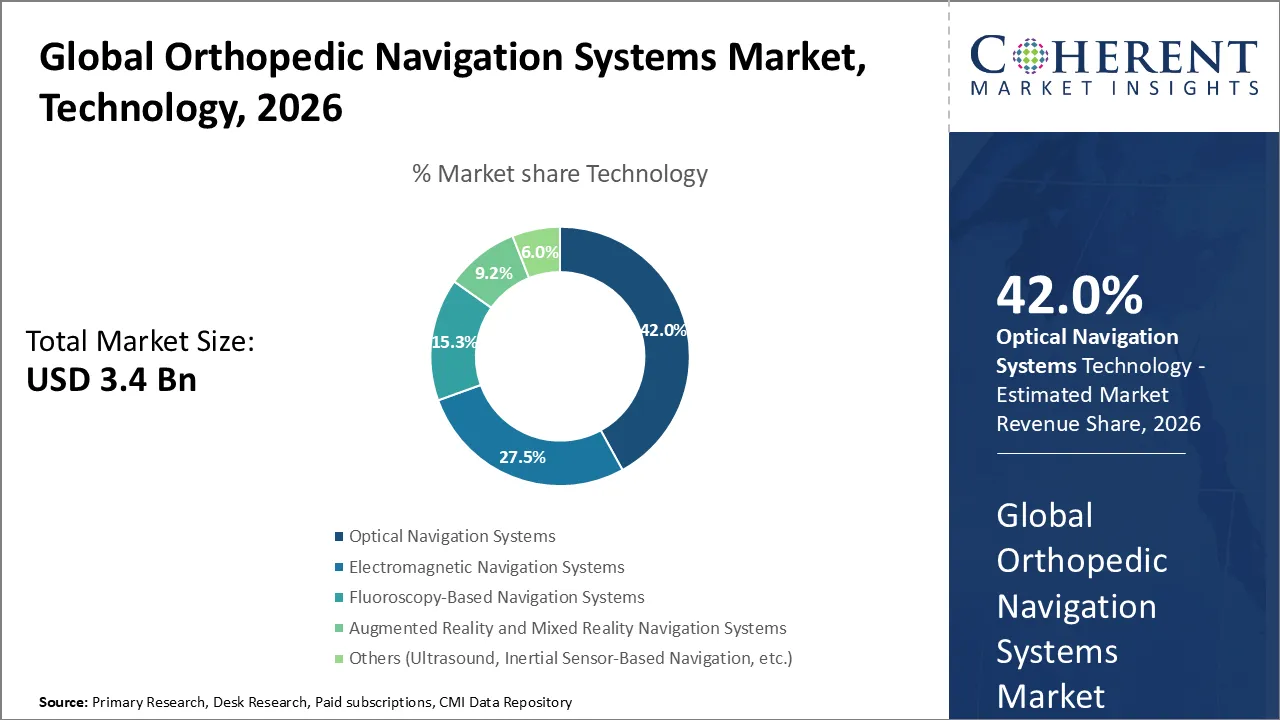
Why Do Optical navigation systems Dominate the Global Orthopedic Navigation Systems Market?
Optical navigation systems are expected to capture 42.0% of the global orthopedic navigation systems market share in 2026. Optical navigation platforms employ cameras and reflective or active markers to determine the spatial orientation of surgical instruments relative to patient anatomy. This creates an ability to provide continuous positional feedback, making them particularly suitable for complex spinal instrumentation, joint reconstruction, and implant placement procedures.
In addition, the technology enables surgeons to monitor anatomical landmarks and planned surgical trajectories without relying exclusively on conventional intraoperative imaging. Compatibility with three-dimensional anatomical reconstruction and multiple surgical instruments is also encouraging healthcare facilities to invest in optical tracking platforms.
Furthermore, manufacturers are improving camera sensitivity, instrument recognition, and registration workflows to address line-of-sight limitations. Such extension in the portfolio of intraoperative imaging infrastructure can be exemplified by Medtronic expanding its AiBLE spine surgery ecosystem through the launch of new hardware, software, and imaging technologies in September 2024. The company further shared plans to continue this development by forming a partnership with Siemens Healthineers.
- Current Industry Events of 2026
- Market Size Estimation
- Regional Breakdown
- Competitive Landscape
- Customer Intelligence
- Segmental Analysis
- Pricing Analysis
- Key Market Drivers, Challenges & Future Trends
- Customized Insights Section
Knee Surgery Dominates the Global Orthopedic Navigation Systems Market
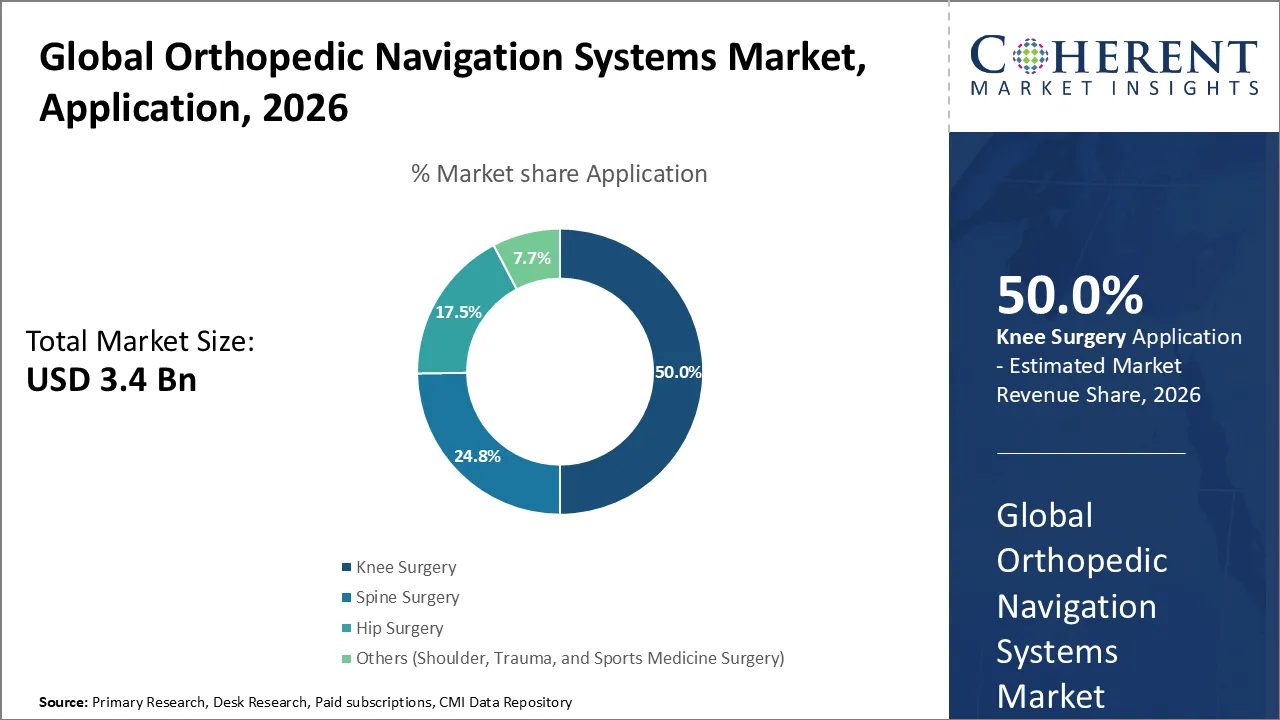
The knee surgery application segment is anticipated to hold 50.0% of the global orthopedic navigation systems market share in 2026. The segment's leadership is primarily attributable to the growing need for accurate bone preparation, restoration of lower-limb alignment, and appropriate positioning of femoral & tibial components during knee arthroplasty. Demonstrating the substantial procedural base, the 2023 NLM-cited Global Burden of Disease (GBD) Study identified knee osteoarthritis to remain the largest contributor till 2050, with a total 642 million cases worldwide, showing a staggering 74.9% increase from 2020.
Navigation systems assist orthopedic surgeons in evaluating anatomical variations and monitoring bone resection angles throughout surgical procedures. In contrast to conventional mechanical alignment instruments, computer-assisted platforms provide quantitative intraoperative measurements that help surgeons adjust their surgical approach according to individual patient anatomy.
Moreover, the growing commercialization of imageless navigation and handheld alignment technologies is making computer-assisted knee procedures accessible to facilities with limited operating room infrastructure. This signals continued expansion of this sector within the knee replacement industry, which creates additional commercial opportunities for manufacturers offering navigation-compatible surgical instruments.
Why Do Hospitals Dominate the Global Orthopedic Navigation Systems Market?
The hospitals segment is projected to account for 72.5% of the global orthopedic navigation systems market share in 2026. Hospitals possess adequate financial resources, specialized clinical personnel, and operating room infrastructure, which are considered necessary to implement sophisticated computer-assisted surgical technologies. The economic value and output of standardized and efficient hospital-based joint replacement workflows testify to the same. In this regard, in September 2026, a CMS-led Performance year 8 Evaluation of the Comprehensive Care for Joint Replacement (CJR) Model recorded a USD 180 million Medicare savings generation from 323 hospitals, showing a massive jump from USD 112.7 million in 2021-2023.
Besides, multispecialty hospitals can deploy navigation workstations across several orthopedic departments, including spinal surgery, joint replacement, and trauma reconstruction. This facilitates better equipment utilization and allows healthcare organizations to distribute acquisition and maintenance expenses across a broader procedural base. Thus, teaching hospitals can potentially benefit navigation platforms that provide quantitative surgical information for resident training, clinical research, and postoperative evaluation.
Current Events and Their Impact on the Orthopedic Navigation Systems Market
Current Event | Description and its Impact |
U.S. Implementation of the Transforming Episode Accountability Model (January 2026) |
|
U.K. Elective Reform Plan and Expansion of Surgical Hubs (January 2025) |
|
Orthopedic Navigation Systems Market Dynamics
Market Drivers
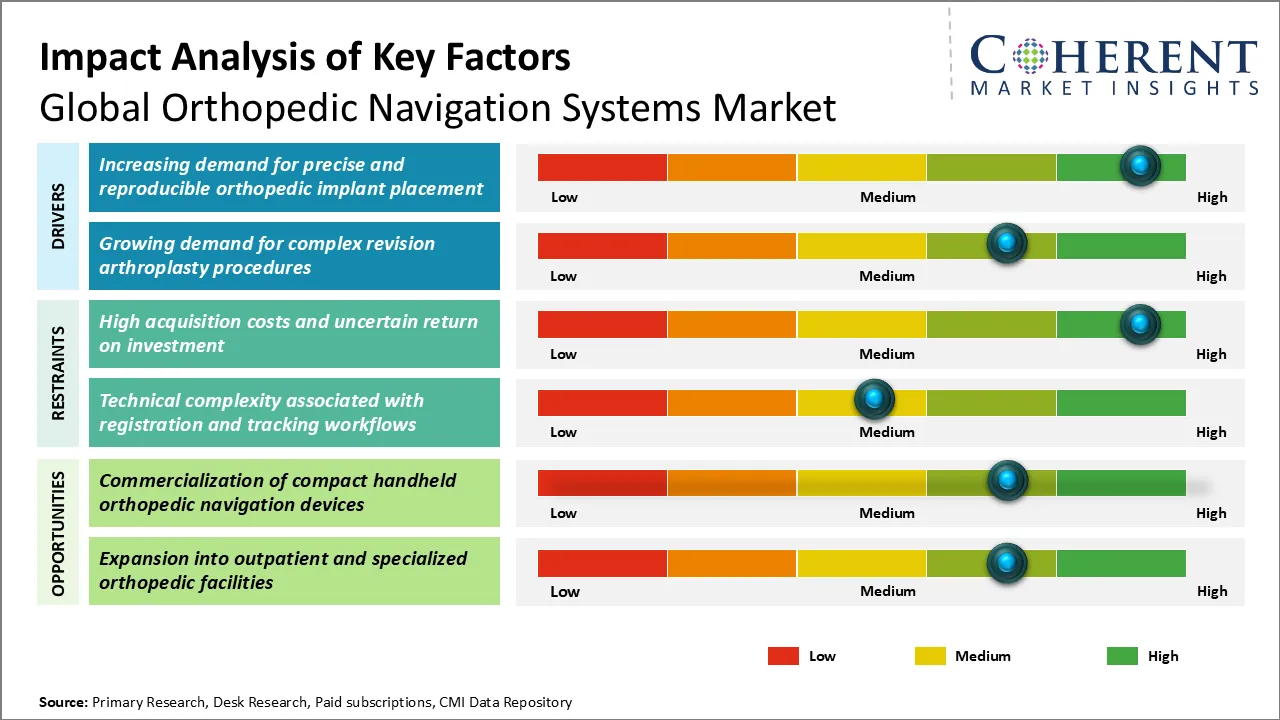
- Increasing demand for precise & reproducible orthopedic implant placement: Anatomical deformities, obesity, previous surgical interventions, and restricted operative visibility can make conventional alignment techniques more challenging. Whereas computer-assisted navigation provides quantitative feedback that allows surgeons to assess planned surgical corrections before completing implant fixation.
- This capability is particularly valuable in technically demanding reconstruction procedures where small positional deviations can influence biomechanical performance. This is pushing orthopedic surgeons to seek technologies available in the orthopedic navigation systems market to improve control over implant orientation and surgical instrument positioning.
- Portraying the potential demand base for this sector, a 2025 NLM study estimated the global count of osteoarthritis (OA) cases to grow by 60-100% by 2050 and the ailment to become the leading cause of disability worldwide by 2030. These projections were made following the epidemiological trends of OA in 2020, with another NLM study from the same year indicating high body-mass index to cause 205.10% increase in OA-induced disability-adjusted life years (DALYs) between 2021 and 2050.
- Growing demand for complex revision arthroplasty procedures: Increasing numbers of patients living with orthopedic prostheses are creating a surge in revision procedures, including implant replacement, bone defect reconstruction, and correction of previously altered anatomical structures. Orthopedic navigation systems can assist surgeons in identifying anatomical reference points and reconstructing alignment in such cases, when conventional landmarks are compromised. This allows manufacturers to capitalize on this extensive demand by developing specialized revision software, configurable tracking instruments, and navigation-compatible reconstruction workflows.
- An NLM study modeled revision arthroplasty demand across 17 countries and estimated 243,404 revision total hip procedures (rTHA) and 267,456 revision total knee procedures (rTKA) to take place across the globe by 2060, corresponding to increases of 31% and 41%, respectively, from 2024.
Orthopedic Navigation Systems Market Trends
- Emergence of augmented reality and mixed reality navigation: Head-mounted visualization technologies are gaining traction among surgeons seeking solutions to access anatomical guidance within their operative field rather than repeatedly directing their attention toward external monitors. As evidence, in September 2025, Brainlab obtained FDA 510(k) clearance for the commercial launch of its Spine Mixed Reality Navigation solution in the U.S. for ergonomic view of the navigation screen.
- Integration of artificial intelligence (AI) into surgical navigation workflows: AI-enabled anatomical identification and image-processing capabilities are becoming popular among manufacturers developing navigation platforms to reduce manual measurements and support intraoperative assessment, contributing to the convergence of the broader surgical robots industry. For instance, in June 2026, DePuy Synthes announced U.S. commercial availability of VELYS Hip Navigation with AI Assistance, designed to support consistency and efficiency during THA procedures.
- Development of video-based navigation for sports medicine: Orthopedic navigation is expanding beyond joint reconstruction into arthroscopic procedures, where video-based systems combine surgical visualization with anatomical guidance to support ligament reconstruction and other sports medicine interventions. Testifying to the growing participation in this trend, in February 2025, Smith+Nephew shared plans to launch its next-generation digital video-based navigation for a new intramedullary nail, the arthroscopic tower.
Regional Insights
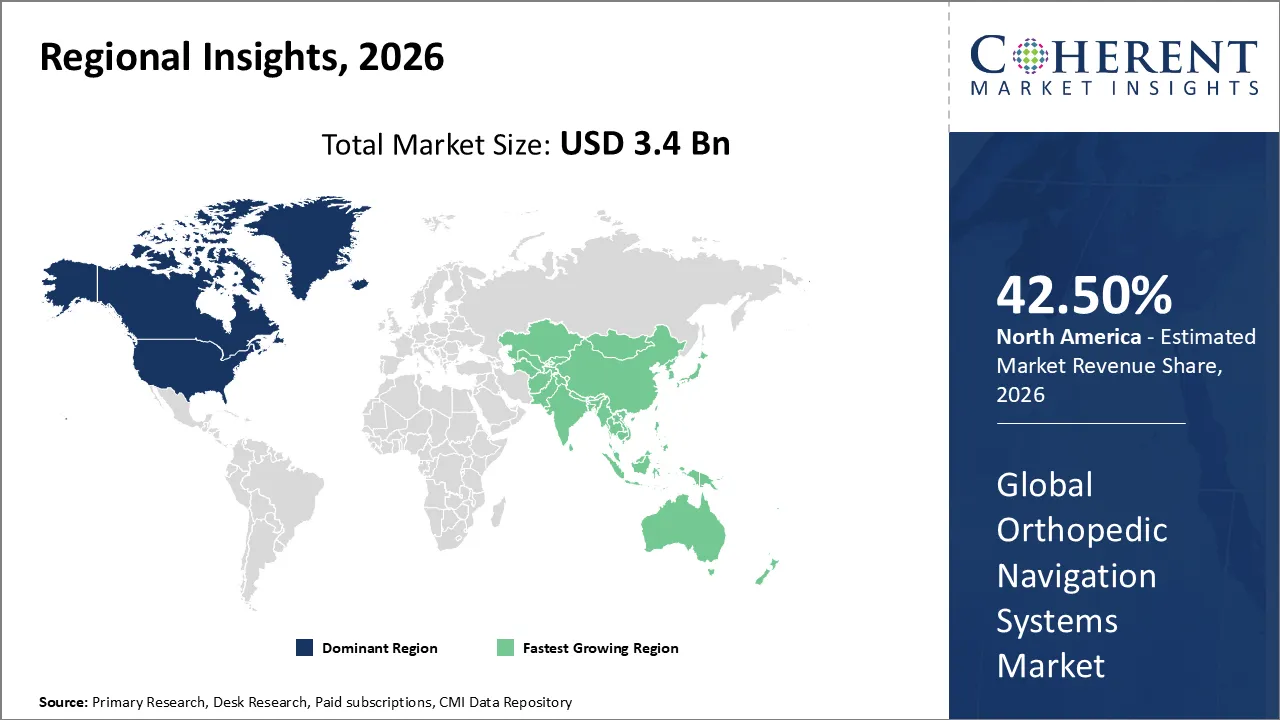
Why Does North America Lead the Global Orthopedic Navigation Systems Market?
North America is expected to dominate the global orthopedic navigation systems market, with a 42.5% revenue share in 2026. The region consolidates its position through established medical device distribution networks, extensive orthopedic specialist availability, advanced surgical training programs, and strong relationships between medical technology manufacturers and healthcare institutions. The presence of established orthopedic implant manufacturers also enables navigation technology providers to integrate their systems into existing surgical instrument ecosystems.
The U.S. remains an important commercialization hub for navigation platforms, while Canada offers opportunities for technologies designed to support outpatient orthopedic treatment. For instance, between 2021 and 2024, the proportion of same-day hip and knee replacement procedures in the total joint arthroplasty (TJA) across Canada grew to 20%, according to the Canadian Institute for Health Information (CIHI) data.
Thus, manufacturers are increasingly emphasizing interoperability, clinical education, technical assistance, and utilization-based commercial models to differentiate their offerings. Testifying to such commercial-level efforts in product development, in December 2024, OrthAlign announced the successful first clinical use of its Lantern Hip handheld navigation technology at the Hospital for Special Surgery (HSS) in New York.
What Makes Asia Pacific the Fastest-Growing Orthopedic Navigation Systems Market?
Asia Pacific is anticipated to register the fastest growth in the global orthopedic navigation systems market share in 2026, till the end of 2033. The region’s accelerated augmentation in this sector is fueled by the robust expansion of private orthopedic hospitals, increasing specialization in joint reconstruction, domestic medical device manufacturing, and rising demand for advanced treatment options among older patients.
Testifying to this escalation in demand for age-related orthopedic treatment, a 2025 NLM study, examining population aging in Southeast Asia, reported that individuals aged 65 years and above accounted for more than 21%, 14.7%, 14.2%, and 8.6% of Japan’s, Thailand's, Singapore's, and Vietnam's total population. To utilize this opportunity, in 2025, MicroPort MedBot expanded the availability of its SkyWalker orthopedic surgical robot across Thailand, Vietnam, Pakistan, and Indonesia.
Moreover, Southeast Asian countries are creating additional opportunities through the expansion of specialist healthcare services and medical tourism. China is also showing potential in leading the regional market by strengthening its domestic orthopedic technology manufacturing capabilities, while Japan maintains an established ecosystem for precision-guided orthopedic procedures.
Global Orthopedic Navigation Systems Market Outlook for Key Countries
Why Is the U.S. at the Forefront of Orthopedic Navigation Technology Commercialization?
The regional dominance of the U.S. orthopedic navigation systems market is backed by a well-organized medical technology commercialization ecosystem, extensive clinical research capabilities, and increasing competition among orthopedic device manufacturers. Exemplifying the same, in April 2025, Medivis earned FDA clearance to secure the U.S. commercial launch of its Spine Navigation platform. The technology combines advanced visualization and image guidance to support open and minimally invasive spinal procedures.
On the other hand, the country's regulatory framework provides defined pathways for introducing new computer-assisted surgical technologies. Manufacturers are increasingly collaborating with orthopedic surgeons and clinical research institutions to evaluate navigation accuracy, device usability, and compatibility with existing surgical practices.
Can Domestic Medical Technology Innovation Accelerate China's Orthopedic Navigation Systems Market?
China's orthopedic navigation systems market is benefiting from the emergence of domestic surgical technology manufacturers, increasing engineering capabilities, and commercialization of locally developed computer-assisted orthopedic platforms. For instance, in 2025, Beijing Chunli Zhengda Medical Instrument announced that its Yangtze INS-1 hip arthroplasty navigation system and Yellow River INS-1 knee arthroplasty navigation system were included in Beijing's first batch of major innovative technical equipment.
Domestic manufacturers are developing navigation systems tailored to the requirements of Chinese hospitals, including localized software interfaces, compatibility with domestic orthopedic implants, and competitively priced surgical instruments. This promotes collaboration between medical technology companies and orthopedic departments is supporting clinical evaluation and product optimization. This can be evidenced by an April 2024 clinical study conducted in Hebei Province, evaluating 239 patients undergoing total knee arthroplasty, comparing conventional surgery with procedures supported by Brainlab's navigation technology.
Germany Orthopedic Navigation Systems Market Analysis and Trends
Germany's augmentation in its regional orthopedic navigation systems market is empowered by its mature medical engineering industry, widespread specialized orthopedic treatment centers, and expertise in computer-assisted surgical technologies. The presence of comprehensive clinical registries also provides healthcare institutions with opportunities to assess procedural outcomes and evaluate emerging navigation technologies.
Demonstrating such presence of an extensive orthopedic clinical infrastructure in Germany, a study published by the NLM in April 2025 analyzed German Arthroplasty Registry (EPRD) records, comprising 403,073 elective total hip arthroplasties, 320,913 bicondylar total knee arthroplasties, and 48,480 unicondylar knee arthroplasties with valid body mass index information.
U.K. Orthopedic Navigation Systems Market Analysis and Trends
The U.K. orthopedic navigation systems market is shaped by evidence-based surgical procurement, increasing evaluation of computer-assisted orthopedic procedures, and efforts to improve the operational productivity of elective surgical services. Healthcare institutions are also contributing to this cohort by exploring next-generation digital surgical technologies based on their ability to support reproducible outcomes, simplify surgical preparation, and integrate into established operating theatre workflows.
On the other hand, the country's academic research capabilities and established clinical registries facilitate comparative evaluations of conventional and technology-assisted procedures. Displaying the availability of supportive national database, a 2026 NLM study using National Joint Registry data examined 697,145 knee replacement operations performed between 2018 and 2024, including 675,034 conventional procedures and 22,111 robotic procedures. Consequently, manufacturers providing credible clinical evidence, transparent procedure-level costs, and comprehensive training support are positioned to strengthen their presence in this country.
Japan Orthopedic Navigation Systems Market Analysis and Trends
Growth in the Japan orthopedic navigation systems market is primarily anchored to its expertise in precision engineering, sophisticated surgical instrumentation, and established use of computer-assisted orthopedic procedures. The established relationship between orthopedic surgeons, academic institutions, and medical equipment distributors also facilitates clinical assessment and adoption of specialized navigation platforms.
Currently, integration of smartphone-based visualization, digital alignment assessment, and minimally invasive instrumentation is encouraging innovation within the country's orthopedic technology ecosystem. Exemplifying the domestic commercialization events of such products, in May 2024, OrthAlign announced the official launch of its handheld navigation technology, Lantern, in Japan for total, partial, and revision knee arthroplasty.
How Is the Commercialization of Handheld Navigation Devices Creating New Growth Opportunities in the Orthopedic Navigation Systems Market?
Traditional navigation platforms frequently require dedicated equipment space, specialized workstations, external tracking cameras, and technical personnel. Handheld technologies are designed to reduce these infrastructure requirements by incorporating motion sensors, integrated measurement capabilities, and simplified user interfaces into portable surgical devices.
As the medical implants industry evolves toward personalized reconstruction, introduction of compact navigation technologies can help manufacturers extend their portfolio compatibility with a broader range of surgical settings. Grasping this scope of imposing new avenues, in June 2026, OrthAlign attained FDA 510(k) clearance for its handheld orthopedic navigation solution, Lantern ASC system, which is specifically designed to address the cost and operational requirements of ambulatory surgical centers.
Market Players, Key Development, and Competitive Intelligence

Key Developments
- In October 2026, Brainlab gained FDA 510(k) clearance for its Elements Spine Planning software that enables clinicians to analyze patient-specific spinopelvic parameters and plan spinal alignment in complex and deformity-related surgical procedures.
- In April 2026, OrthAlign announced that its orthopedic navigation portfolio received CE marking under the European Union Medical Device Regulation, marking a new milestone in commercialization of its handheld navigation technologies across European markets.
- In July 2025, Zimmer Biomet signed a definitive agreement to acquire Monogram Technologies, including CT-based, AI-navigated orthopedic robotic technology for total knee arthroplasty, for an upfront equity value of almost USD 177 million.
Competitive Landscape
The global orthopedic navigation systems market is characterized by competition between diversified medical device manufacturers, specialized surgical navigation companies, and emerging digital surgery technology developers. Following this pathway of commercial success, Medtronic and Stryker compete through integrated spinal navigation platforms and established surgical equipment distribution networks. Whereas Brainlab differentiates itself through image-guided surgery software, optical tracking capabilities, and advanced visualization solutions.
Conversely, OrthAlign and Intellijoint Surgical focus on compact navigation technologies designed to address procedural efficiency and equipment accessibility. In contrast to this strategy, Zimmer Biomet, DePuy Synthes, and Smith+Nephew heavily invest in integrating navigation capabilities with their orthopedic reconstruction and robotic surgical portfolios. For instance, in April 2026, Intellijoint Surgical partnered with Insurgical to combine its surgical navigation solutions with single-use powered orthopedic instruments. Meanwhile, companies such as Medivis are pursuing differentiated opportunities in immersive surgical visualization, while Chinese manufacturers, including Chunli Medical and MicroPort MedBot, are expanding their presence through locally developed orthopedic surgical guidance technologies.
Top Manufacturers and Notable Products/Solutions in the Orthopedic Navigation Systems Market
Company/Manufacturer | Notable Product/Brand | Key Features |
Medtronic plc | StealthStation S8 | Image-guided surgical navigation, instrument tracking, anatomical registration, spinal instrumentation guidance. |
Stryker Corporation | Active and passive optical tracking, spinal guidance software, intraoperative instrument localization, advanced camera technology. | |
Brainlab SE | Spine & Trauma Navigation | Three-dimensional anatomical visualization, image registration, tracked surgical instrumentation, spinal and trauma procedures. |
OrthAlign, Inc. | Lantern | Handheld orthopedic navigation, real-time alignment measurements, portable instrumentation, joint reconstruction applications. |
Intellijoint Surgical Inc. | Intellijoint HIP | Intraoperative hip measurements, acetabular cup positioning, leg-length and offset assessment. |
DePuy Synthes | VELYS Hip Navigation | Digital hip arthroplasty guidance, intraoperative anatomical assessment, implant positioning assistance. |
Zimmer Biomet Holdings, Inc. | ROSA Knee | Computer-assisted planning, intraoperative tracking, patient-specific knee alignment, robotic surgical assistance. |
Smith+Nephew plc | RI.HIP Navigation | Digital intraoperative hip alignment assessment, component positioning, patient-specific surgical measurements. |
Medivis, Inc. | Holographic visualization, image guidance, anatomical registration, thoracolumbar spine navigation. | |
Beijing Chunli Zhengda Medical Instrument Co., Ltd. | Yangtze INS-1 and Yellow River INS-1 | Dedicated navigation platforms for hip and knee arthroplasty applications. |
Market Report Scope
Orthopedic Navigation Systems Market Report Coverage
Report Coverage | Details | ||
Base Year: | 2025 | Market Size in 2026: | USD 3.4 Bn |
Historical Data for: | 2020 to 2024 | Forecast Period: | 2026 to 2033 |
CAGR: | 12.9% | 2033 Value Projection: | USD 8.0 Bn |
Geographies covered: |
| ||
Segments covered: |
| ||
Companies covered: | Medtronic plc, Stryker Corporation, Brainlab SE, OrthAlign, Inc., Intellijoint Surgical Inc., DePuy Synthes, Zimmer Biomet Holdings, Inc., Smith+Nephew plc, Medivis, Inc., Globus Medical, Inc., B. Braun SE, MicroPort MedBot, and Beijing Chunli Zhengda Medical Instrument Co., Ltd. | ||
Growth Drivers: |
| ||
Restraints & Challenges: |
| ||
Analyst Opinion (Expert Opinion)
- The global orthopedic navigation systems market is transitioning toward modular and procedure-specific technology platforms. Rather than adopting a single equipment configuration across every orthopedic specialty, healthcare institutions are expected to evaluate solutions according to clinical complexity, operating room availability, and expected equipment utilization. Manufacturers offering adaptable software modules and independently configurable tracking technologies could establish stronger relationships with healthcare providers.
- Clinical validation will remain a significant competitive differentiator. Navigation technologies provide intraoperative measurements, but their effectiveness also depends on surgical execution, anatomical registration, and implant fixation. A 2025 study involving 70 knee arthroplasty procedures found that augmented reality guidance could improve bone resection accuracy without necessarily eliminating deviations in final implant alignment. Manufacturers must therefore demonstrate improvements across the complete surgical workflow rather than focusing exclusively on navigation measurement accuracy.
- Future commercial success is expected to depend on manufacturers' ability to establish sustainable revenue models combining equipment sales, software upgrades, technical maintenance, and procedure-specific accessories. Interoperability with existing orthopedic instrument portfolios and the evolving knee implants industry will become increasingly important as healthcare providers seek to avoid unnecessary equipment duplication and restrictive technology ecosystems.
Speak to the analyst
Want personalized insights?
Take the findings above to one of our principal consultants, or have the report rebuilt around the segments, geographies and competitors you actually track.
Market Segmentation
- By Technology (Revenue, USD Bn, 2021-2033)
- Optical Navigation Systems
- Electromagnetic Navigation Systems
- Fluoroscopy-Based Navigation Systems
- Augmented Reality and Mixed Reality Navigation Systems
- Others (Ultrasound, Inertial Sensor-Based Navigation, etc.)
- By Application (Revenue, USD Bn, 2021-2033)
- Knee Surgery
- Spine Surgery
- Hip Surgery
- Others (Shoulder, Trauma, and Sports Medicine Surgery)
- By End User (Revenue, USD Bn, 2021-2033)
- Hospitals
- Ambulatory Surgical Centers
- Specialty Orthopedic Clinics
- By Region (Revenue, USD Bn, 2021-2033)
- North America
- U.S.
- Canada
- Latin America
- Brazil
- Mexico
- Argentina
- Rest of Latin America
- Europe
- Germany
- U.K.
- France
- Italy
- Spain
- Russia
- Rest of Europe
- Asia Pacific
- China
- India
- Japan
- Australia
- South Korea
- ASEAN
- Rest of Asia Pacific
- Middle East
- GCC
- Israel
- Rest of Middle East
- Africa
- South Africa
- Central Africa
- North Africa
- North America
- Key Players
- Medtronic plc
- Stryker Corporation
- Brainlab SE
- OrthAlign, Inc.
- Intellijoint Surgical Inc.
- DePuy Synthes
- Zimmer Biomet Holdings, Inc.
- Smith+Nephew plc
- Medivis, Inc.
- Globus Medical, Inc.
- B. Braun SE
- Shanghai MicroPort MedBot (Group) Co., Ltd.
- Beijing Chunli Zhengda Medical Instrument Co., Ltd.
Sources
Primary Research Interviews
- Orthopedic navigation system manufacturers and product development executives
- Optical and electromagnetic surgical navigation technology specialists
- Orthopedic surgeons specializing in total knee and hip arthroplasty
- Spinal surgeons and orthopedic trauma specialists
- Computer-assisted surgery and robotic navigation experts
- Hospital procurement managers and operating room administrators
- Ambulatory surgical center directors and orthopedic department heads
- Biomedical engineers and surgical equipment integration specialists
- Clinical application specialists and orthopedic technology distributors
- Regulatory affairs professionals specializing in orthopedic medical devices
- Key opinion leaders in digital orthopedic surgery and image-guided interventions
Stakeholders
- Orthopedic navigation system manufacturers and technology developers
- Optical tracking camera and electromagnetic sensor manufacturers
- Surgical imaging and intraoperative visualization technology providers
- Orthopedic implant and instrument manufacturers
- Computer-assisted surgical planning software developers
- Robotic-assisted orthopedic surgery technology providers
- Medical device distributors and hospital procurement organizations
- Healthcare technology integrators and clinical training providers
- Ambulatory surgical centers and specialized orthopedic hospitals
Regulatory and Government Bodies
- U.S. Food and Drug Administration (FDA)
- Centers for Medicare & Medicaid Services (CMS)
- U.S. National Institutes of Health (NIH)
- European Commission – Medical Device Regulation (MDR)
- European Medicines Agency (EMA), where relevant to medical technology regulation
- U.K. Medicines and Healthcare products Regulatory Agency (MHRA)
- Central Drugs Standard Control Organisation (CDSCO), India
- National Medical Products Administration (NMPA), China
- Pharmaceuticals and Medical Devices Agency (PMDA), Japan
- Health Canada
- Australian Therapeutic Goods Administration (TGA)
- Ministry of Health and Family Welfare, Government of India
- National Institute for Health and Care Excellence (NICE), U.K.
Databases
- U.S. National Library of Medicine (NLM) – PubMed and PubMed Central
- ClinicalTrials.gov – Clinical Research and Trial Database
- FDA – 510(k) Premarket Notification Database
- FDA – De Novo Classification Database
- FDA – Medical Device Approval and Clearance Database
- Centers for Medicare & Medicaid Services (CMS) – Medicare Claims and Payment Data
- American Joint Replacement Registry (AJRR)
- National Joint Registry (NJR), U.K.
- German Arthroplasty Registry (EPRD)
- Canadian Joint Replacement Registry (CJRR)
- Australian Orthopaedic Association National Joint Replacement Registry (AOANJRR)
- Organisation for Economic Co-operation and Development (OECD) – Health Statistics
- World Health Organization (WHO) – Global Health Observatory
- World Intellectual Property Organization (WIPO) – PATENTSCOPE
- U.S. Patent and Trademark Office (USPTO) – Patent Database
- India Brand Equity Foundation (IBEF) – Healthcare Industry Publications
Magazines and Industry Publications
- Orthopedics Today
- Orthopaedic Product News
- Orthopedic Design & Technology
- Medical Device and Diagnostic Industry (MD+DI)
- Medical Device Network
- MassDevice
- MedTech Insight
- Spinal News International
- Orthopedics This Week
- Healthcare IT News
- Medical Device Technology
- Surgical Robotics Technology
Journals
- The Journal of Bone and Joint Surgery
- The Journal of Arthroplasty
- Clinical Orthopaedics and Related Research
- International Orthopaedics
- The Bone & Joint Journal
- European Spine Journal
- The Spine Journal
- Journal of Orthopaedic Surgery and Research
- Knee Surgery, Sports Traumatology, Arthroscopy
- Journal of Experimental Orthopaedics
- International Journal of Computer Assisted Radiology and Surgery
- Journal of Robotic Surgery
- Arthroplasty Today
- BMC Musculoskeletal Disorders
- Scientific Reports
- Journal of Clinical Medicine
Newspapers
- Reuters
- The Wall Street Journal
- Financial Times
- The Economic Times
- The New York Times
- The Japan Times
- China Daily
- The Guardian
- Handelsblatt
- Nikkei Asia
Associations and Industry Organizations
- American Academy of Orthopaedic Surgeons (AAOS)
- American Association of Hip and Knee Surgeons (AAHKS)
- North American Spine Society (NASS)
- International Society for Computer Assisted Orthopaedic Surgery (CAOS International)
- European Federation of National Associations of Orthopaedics and Traumatology (EFORT)
- British Orthopaedic Association (BOA)
- Canadian Orthopaedic Association (COA)
- Japanese Orthopaedic Association (JOA)
- Orthopaedic Research Society (ORS)
- International Society of Orthopaedic Surgery and Traumatology (SICOT)
- AO Foundation
- Advanced Medical Technology Association (AdvaMed)
- International Society for Technology in Arthroplasty (ISTA)
- American Hospital Association (AHA)
- Canadian Institute for Health Information (CIHI)
Public Domain Sources
- FDA Medical Device Clearance and Regulatory Approval Announcements
- Government Healthcare Infrastructure Investment and Procurement Announcements
- National and Regional Joint Replacement Registry Annual Reports
- Published Clinical Studies on Computer-Assisted Orthopedic Surgery
- Peer-Reviewed Research on Optical and Electromagnetic Navigation Accuracy
- Clinical Research on Navigation-Assisted Knee and Hip Arthroplasty
- Government Healthcare Reimbursement and Surgical Payment Policy Documents
- Publicly Available Orthopedic Navigation Device Specifications and Technical Documentation
- Medical Device Manufacturer Annual Reports and Investor Presentations
- Corporate Press Releases on Product Launches and Regulatory Clearances
- Corporate Announcements on Mergers, Acquisitions, and Strategic Collaborations
- University and Teaching Hospital Research Publications
- Patent Publications Related to Surgical Tracking and Navigation Technologies
- Publicly Available Research on Augmented Reality and Mixed Reality Surgical Guidance
- Government Publications on Aging Populations and Musculoskeletal Disease Burden
Proprietary Elements
- CMI Data Analytics Tool
- Proprietary CMI Existing Repository of Information for the Last 10 Years
Get access to 250+ pages report
Every segment, forecast, competitor profile and data table behind the analysis above — available for instant download.
- ESOMAR Member
- ISO 9001:2015 Certified
- D-U-N-S Registered
- GDPR & CCPA Compliant
Frequently Asked Questions
The global orthopedic navigation systems market is estimated to reach USD 8.0 Bn by 2033, compared to USD 3.4 Bn in 2026.
Major players operating in the global orthopedic navigation systems market include Medtronic plc, Stryker Corporation, Brainlab SE, OrthAlign, Inc., Intellijoint Surgical Inc., DePuy Synthes, Zimmer Biomet Holdings, Inc., Smith+Nephew plc, Medivis, Inc., and Globus Medical, Inc.
High equipment acquisition and maintenance costs, uncertain return on investment, anatomical registration complexities, and specialized surgical training requirements are the key factors hampering market growth.
Increasing demand for precise orthopedic implant placement, growing requirements for complex revision arthroplasty, and advancements in computer-assisted surgical guidance technologies are the major factors driving market growth.
The global orthopedic navigation systems market is anticipated to grow at a CAGR of approximately 12.90% between 2026 and 2033.
North America is expected to dominate the global orthopedic navigation systems market, accounting for 42.5% of revenue in 2026, while Asia Pacific is anticipated to emerge as the fastest-growing regional market.
Orthopedic navigation systems are computer-assisted medical technologies that help surgeons determine the position of surgical instruments and implants relative to patient anatomy during orthopedic procedures.