

Surgical Instrument Tracking Market Analysis & Forecast: 2026 to 2033
Surgical Instrument Tracking Market is estimated to be valued at USD 602.6 Mn in 2026 and is expected to reach USD 2,060.3 Mn in 2033, exhibiting a compound annual growth rate (CAGR) of 19.2% from 2026 to 2033.
Key Takeaways
- Based on Technology, the Barcode segment is expected to lead with 78.4% share in 2026, driven by widespread adoption of cost effective, robust 2d barcodes with 360° readability.
- Based on Component, the Hardware segment is expected to hold the largest share of the market in 2026, driven by rising demand for readers, tags, and scanners that form the essential infrastructure for tracking systems.
- Based on End User, the Public Hospitals segment is projected to account for the greatest share of the market in 2026, driven by government investments, compliance mandates, and high surgical volumes.
- Based on Region, North America region is set to lead the surgical instrument tracking market with 35.7% share in 2026. While, Asia Pacific is anticipated to be the fastest growing region.
Market Overview
The global surgical instrument tracking market is experiencing strong growth due to the rise in burden of cardiovascular diseases and growing number of surgical procedures worldwide. Moreover, high demand for surgical instrument tracking devices/systems and lack of skilled or trained healthcare professionals is expected to boost the surgical instrument market growth. However, factors such as product recalls and data security and high cost of surgical instrument tracking system expected to hamper the growth of the global surgical instrument tracking market.
Current Events and Its Impacts on the Surgical Instrument Tracking Market
Current Event | Description and its Impact |
Regulatory Compliance Mandates and Database Rollout |
|
Digital Health Ecosystem Integration and Interoperability Initiatives |
|
End‑User Feedback and Unmet Needs in the Surgical Instrument Tracking Market
End‑User Feedback
- Improved Compliance & Safety
- Users appreciate that tracking systems help meet regulatory requirements (e.g., UDI, Joint Commission standards).
- Traceability reduces risk of retained surgical items and improves patient safety.
- Workflow Efficiency
- Positive feedback on reduced manual documentation and faster instrument set reconciliation.
- RFID systems are valued for hands‑free scanning, saving time compared to barcodes.
- Training & Usability Challenges
- Staff often report that systems can be complex to learn and require ongoing training.
- Barcode scanning is sometimes seen as time‑consuming compared to RFID.
- Integration with Existing IT Systems
- Users want seamless integration with EMR, OR scheduling, and sterilization software.
- Feedback often highlights fragmentation between tracking systems and hospital IT infrastructure.
Unmet Needs in the Market
- Cost & Scalability
- Smaller hospitals find RFID/DPM systems too expensive to implement at scale.
- Need for affordable, modular solutions that can grow with hospital size.
- Durability of Tags & Marks
- RFID tags can fail under repeated sterilization cycles.
- Direct Part Marking sometimes fades or becomes unreadable over time.
- End users want longer‑lasting, sterilization‑resistant identifiers.
- Real‑Time Visibility
- Current systems often provide batch updates, not true real‑time tracking.
- Hospitals want live dashboards showing instrument location/status across departments.
- Analytics & Predictive Insights
- Users want more than just tracking, they want predictive analytics (e.g., instrument usage trends, set optimization, lifecycle management).
- Current systems are often data‑rich but insight‑poor.
- Interoperability Standards
- Lack of global standards for instrument tracking makes cross‑hospital or cross‑vendor integration difficult.
- End users want standardized identifiers that work across systems.
- Current Industry Events of 2026
- Market Size Estimation
- Regional Breakdown
- Competitive Landscape
- Customer Intelligence
- Segmental Analysis
- Pricing Analysis
- Key Market Drivers, Challenges & Future Trends
- Customized Insights Section
Segmental Insights
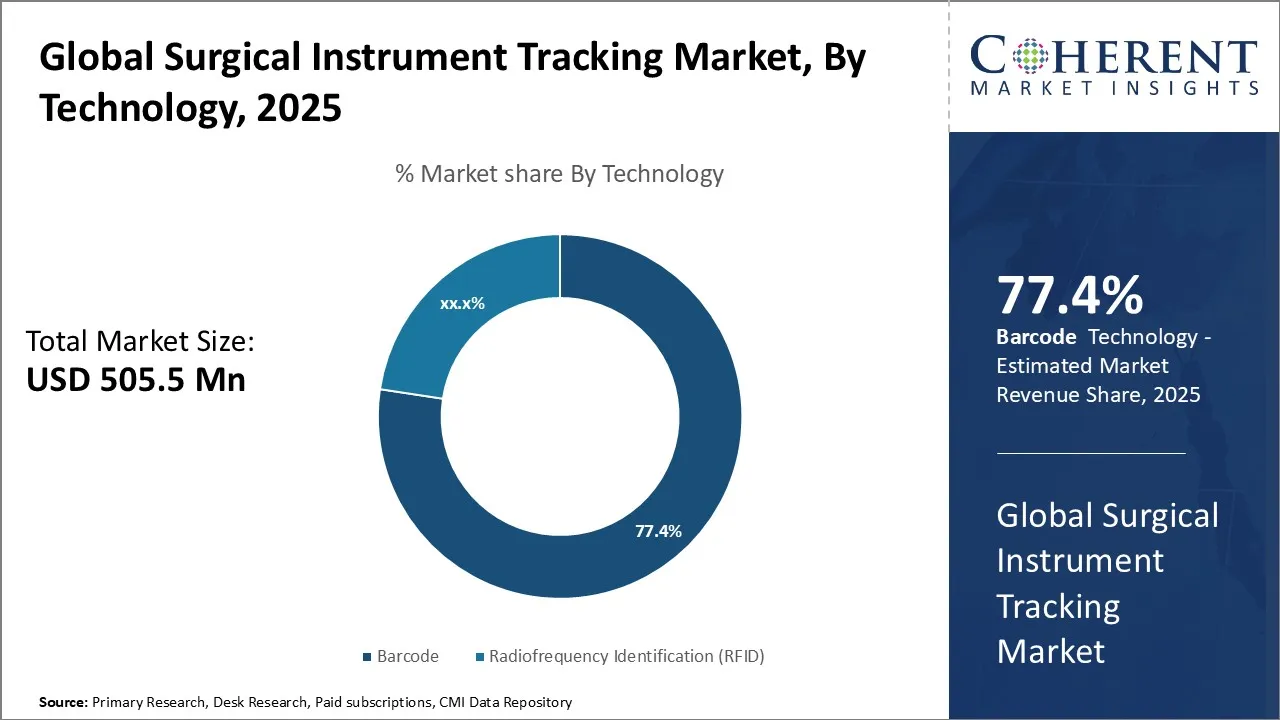
Global Surgical Instrument Tracking Market Insights, By Technology - Barcode Dominances Driven by Widespread Adoption of Cost‑Effective, Robust 2D Barcodes With 360° Readability
In terms of technology, the barcode segment is expected to dominate the surgical instrument tracking market with 78.4% share in 2026. This is attributed to the increasing adoption of 2D barcodes. 2D barcodes such as data matrices and QR Codes, are more popular due to their advantages, which include robust build, low cost, and 360° readability.
For instance, the new DPM barcode scanner from Socket Mobile is very useful for keeping track of surgical instruments. Laser-etched DPM barcodes stay on instruments even after they have been sterilized. Hospitals use scanners to keep track of usage, make sure rules are followed, and stop things from being kept. This technology makes surgical settings safer, helps with managing inventory, and makes it easier to trace things back to their source.
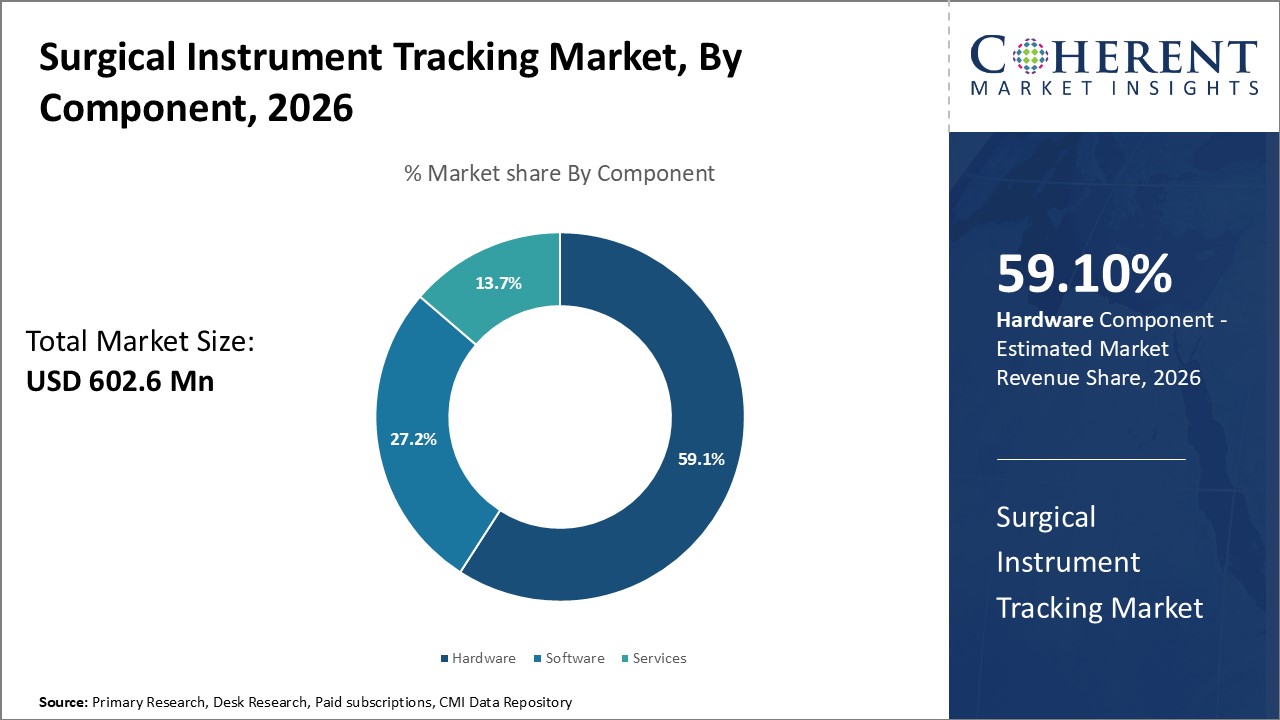
Global Surgical Instrument Tracking Market Insights, By Component - Hardware Lead Is Driven by Rising Demand for Readers, Tags, And Scanners That Form the Essential Infrastructure for Tracking Systems
In terms of component, the hardware segment is also expected to witness robust growth in the near future and this is owing to increasing adoption of surgical instrument tracking hardware. the hardware includes readers, tags, scanners, and many more. The dominance of hardware segment is mainly observed by the demand for physical infrastructure to enable tracking systems.
Global Surgical Instrument Tracking Market Insights, By Application - Public Hospitals Dominances Is Driven by Government Investments, Compliance Mandates, And High Surgical Volumes
In terms of application, the public hospitals segment is expected to dominate the market over the forecast period and this is attributed to the increasing prevalence of cardiovascular disorders and other chronic disorders around the world. The public hospitals are largely dominating due to large-scale government investments, mandatory compliance regulations, and higher surgical volumes in public healthcare systems.
For instance, in March 2026, Sengkang General Hospital set up an automated system that uses robots and conveyor belts to move surgical tools straight to the operating rooms. This new idea reduces on manual work, makes things run more smoothly, and makes things safer. It doesn't focus on instrument traceability like barcode or RFID tracking does. Instead, it focuses on automating logistics to make hospital workflows more efficient.
Regional Insights
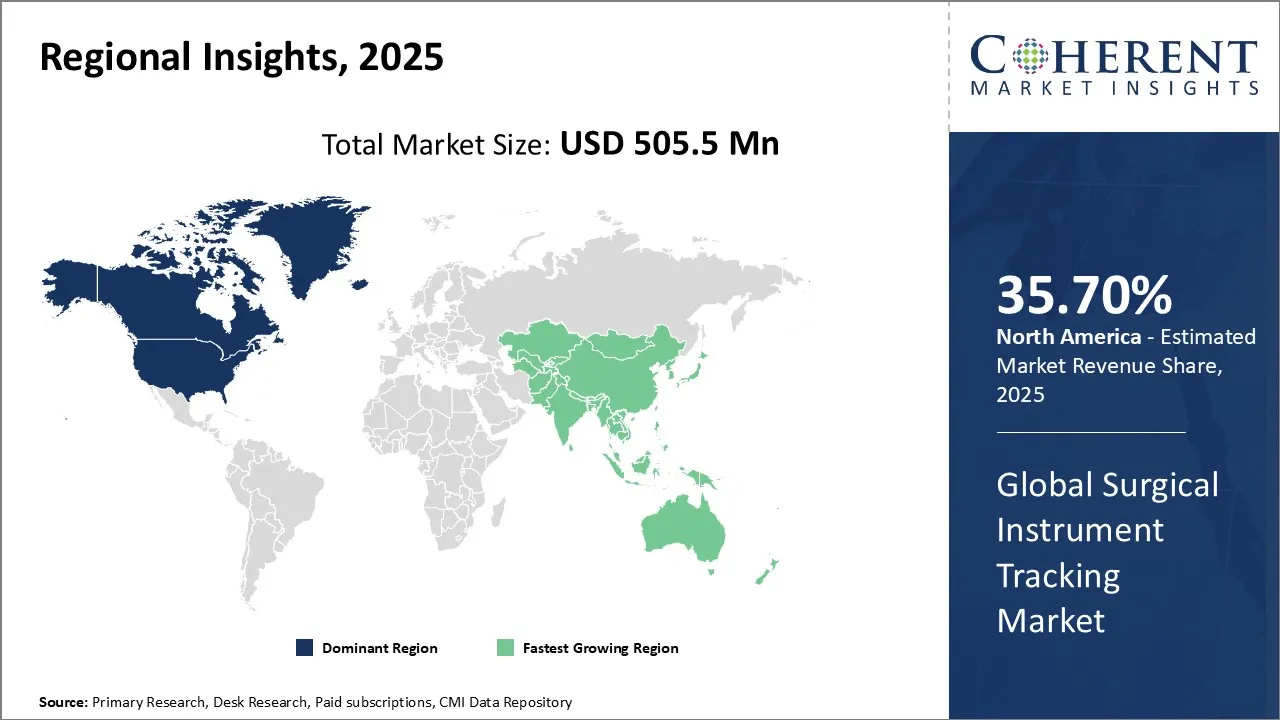
North America Surgical Instrument Tracking Market Analysis & Trends
North America is expected to gain highest share in the market of 35.7% share in 2026, owing to the increasing prevalence of cardiovascular disorders and other chronic disorders, increasing number of road accidents, and increasing number of surgical procedures in this region. For instance, with the increasing number of surgical procedures, the use and demand for surgical instrument tracking devices is also increasing. According to the U.S. Centers for Disease Control and Prevention (CDC), heart disease is the leading cause of death for men, women, and people of most racial and ethnic groups in the United States.
Asia Pacific Surgical Instrument Tracking Market Analysis & Trends
Asia Pacific region is projected to be the fastest growing, due to stricter rules, more surgeries, and worries about patient safety. Hospitals in China, India, and Southeast Asia are quickly adopting RFID and barcode systems for real-time tracking, inventory management, and sterilization management.
Surgical Instrument Tracking Market Outlook Country-Wise
The U.S. Surgical Instrument Tracking Market Trends
The U.S. surgical instrument tracking market is going to expand in 2026 owing to strict FDA rules, patient safety requirements, and more surgeries being done. Hospitals use RFID and barcode systems to make sure they follow the rules, stop instruments from being kept, speed up sterilization, and improve inventory management. This has led to a lot of demand across the country.
For instance, in April 2026, Aesculap USA introduced the Aicon RTLS to the US. This real-time location system uses RFID to keep track of surgical tools and other assets, making sure that everything is safe, compliant, and running smoothly. The company started out working with hospitals in the U.S., but now it wants to grow into markets in Europe and Asia Pacific.
China Surgical Instrument Tracking Market Trends
In 2026, stricter rules, faster hospital modernization, and more surgeries are going to propel China's market for tracking surgical instruments. Using RFID and barcode systems makes sure that patients are safe, keeps instruments from being left behind, and makes sterilization processes faster. Government programs and the implementation of UDI are driving up demand even more in major healthcare institutions.
Market Report Scope
Surgical Instrument Tracking Market Report Coverage
| Report Coverage | Details | ||
|---|---|---|---|
| Base Year: | 2025 | Market Size in 2026: | USD 602.6 Mn |
| Historical Data for: | 2020 To 2024 | Forecast Period: | 2026 To 2033 |
| Forecast Period 2026 to 2033 CAGR: | 19.2% | 2033 Value Projection: | USD 2,060.3 Mn |
| Geographies covered: |
| ||
| Segments covered: |
| ||
| Companies covered: | Keir Surgical Ltd., Case Medical, Scanlan International, Inc., Koch Industries, Getinge Group, B. Braun (Aesculap, Inc.), Xerafy, Mobile Aspects, Key Surgical, Inc., Spatrack Medical Limited, Fortive Corporation Group, Haldor Advanced Technologies, Tgx Medical Systems, Becton, Dickinson and Company, Intechnology Distribution Pty Ltd., Nutrace, Steris Insturment Management Services, Material Management Microsystems, Asanus Medizintechnik GmbH Inc., and Stanley Healthcare (Division of Stanley Black & Decker), among others. | ||
| Growth Drivers: |
| ||
| Restraints & Challenges: |
| ||
Global Surgical Instrument Tracking Market Drivers
Rise in burden of cardiovascular disorders to propel market growth
One of the key factors expected to augment the growth of the global surgical instrument tracking market over the forecast period is the increasing prevalence of cardiovascular diseases worldwide. Such a high burden of cardiovascular diseases leads to an increased number of surgical procedures and is expected to increase the use and demand for surgical instrument tracking devices. According to the National Institutes of Health (NIH), each year, more than 2 million people around the world have open-heart surgery to treat various heart problems. This in turn is expected to augment growth of the global surgical instrument tracking market.
Increasing number of surgical procedures to drive market growth
Another factor which is driving the growth of the global surgical instrument tracking market is the increasing number of surgical procedures around the world. For instance, according to the National Center for Biotechnology Information (NCBI), worldwide, around 310 million major surgeries are performed each year; around 40 to 50 million in the United States and over 20 million in Europe. The volume of surgical procedures across the globe is on the rise, which in turn increases the use or demand for surgical instrument tracking devices; thereby positively impacting the growth of the global surgical instrument tracking market.
Global Surgical Instrument Tracking Market Opportunities
Increasing demand for surgical instrument tracking devices/systems is expected to offer significant growth opportunities for players in the global surgical instrument tracking market. For instance, in April 2023, GE HealthCare announced the launch of a next-gen intraoperative ultrasound imaging system, bkActiv, to provide guidance for urology, colorectal, and pelvic floor surgical procedures. bkActiv provides surgeons with advanced ultrasound guidance, ensuring better performance while offering them a user-friendly and intuitive experience. Furthermore, the system delivers improved image quality that enhances decision-making during surgical procedures.
Lack of skilled/trained healthcare professionals is expected to offer lucrative growth opportunities for players in the global surgical instrument tracking market. For instance, owing to lack of skilled or trained healthcare professionals, the use or demand for surgical instrument tracking devices has increased significantly.
Global Surgical Instrument Tracking Market Trends
Rising adoption of HIT solutions is a recent trend
With the increase in healthcare digitalization, the adoption or use of Healthcare IT solutions is also increasing with a rapid pace. Healthcare IT solutions or services improves the quality of healthcare delivery, increases patient safety, reduces medical errors, and strengthens the interaction between the healthcare providers and patients.
Increasing number of healthcare centers is another trend
With the increasing healthcare expenditure, along with investment in new hospitals and increasing number of healthcare centers, the use or adoption of surgical instrument tracking devices/systems is also increasing. According to the American Hospital Association (AHA), the number of active hospitals in the U.S. increased from 5,534 in 2016 to 6,093 in 2020 and total hospital admissions stood at about 33.4 million with a total hospital expense of around US$ 1.2 trillion. This trend is also expected to continue during the forecast period.
Analyst Opinion (Expert Opinion)
- As hospitals standardize digital tracking in operating rooms and sterile processing departments, the market for tracking surgical instruments is growing in a structured way. Barcode systems have the most users because they are easy to set up and work with a wide range of existing workflows. Several industry studies show that barcode solutions make up a large part of global deployments. RFID adoption is also growing quickly in high-throughput environments where non-line-of-sight scanning and real-time visibility are important.
- Hospital studies show that RFID systems can greatly improve inventory management. For example, when precise usage data is used to rationalize trays, the number of extra instruments can drop by more than 50%. Software platforms are now the most important part of the value chain, and hospitals are focusing on features like cycle-level traceability, maintenance scheduling, sterilization integration, and automated reporting. Hardware parts like readers, scanners, and tags help this ecosystem, but they make up a smaller part of its long-term value.
- North America is still the largest marketplace owing to strict traceability requirements and a well-developed sterile processing infrastructure. Asia Pacific is growing quickly because of capacity expansion and the digitization of surgical workflows. Adopters have reported operational gains such as faster tray assembly, fewer incidents of missing instruments, less time spent counting by hand, and measurable improvements in compliance.
- Key barriers to adoption remain: the cost of RFID, the need to integrate it with older IT systems, and the need to train staff. Hybrid models that use both barcodes and selective RFID are still a good, cheap way to make the switch.
Speak to the analyst
Want personalized insights?
Take the findings above to one of our principal consultants, or have the report rebuilt around the segments, geographies and competitors you actually track.
Global Surgical Instrument Tracking Market: Key Developments
- In April 2025, Circlog developed an AI-based system to identify surgical tools, which improved the management of sterile supplies. The new idea makes hospitals more accurate, efficient, and easy to trace. By automating identification, it reduces on mistakes and helps with compliance. This is a smarter way to keep track of surgical instruments and make sure that sterile processing departments are doing their jobs right.
- In May 2024, Crothall Healthcare and Ascendco Health announced they would work together to improve the tracking of surgical instruments in sterile processing. The goal of the partnership is to use digital solutions to make things more compliant, efficient, and high-quality. Hospitals benefit from better visibility, fewer mistakes, and more efficient workflows, which help with two major problems in instrument management and patient safety.
Market Segmentation
- Global Surgical Instrument Tracking Market, By Technology (Revenue, USD Mn, 2021 - 2033)
- Barcode
- Radiofrequency Identification (RFID)
- Global Surgical Instrument Tracking Market, By Component (Revenue, USD Mn, 2021 - 2033)
- Software
- Hardware
- Readers
- Tags
- Other Hardware
- Services
- Global Surgical Instrument Tracking Market, By End User (Revenue, USD Mn, 2021 - 2033)
- Public Hospitals
- Private Hospitals
- Other End Users
- Global Surgical Instrument Tracking Market, By Geography (Revenue, USD Mn, 2021 - 2033)
- North America
- U.S.
- Canada
- Latin America
- Brazil
- Argentina
- Mexico
- Rest of Latin America
- Europe
- Germany
- U.K.
- Spain
- France
- Italy
- Russia
- Rest of Europe
- Asia Pacific
- China
- India
- Japan
- Australia
- South Korea
- ASEAN
- Rest of Asia Pacific
- Middle East & Africa
- GCC Countries
- Israel
- Rest of Middle East & Africa
- North America
- Global Surgical Instrument Tracking Market: Key Companies Insights (Revenue, USD Mn, 2021 - 2033)
- Keir Surgical Ltd.
- Case Medical
- Scanlan International, Inc.
- Koch Industries
- Getinge Group
- Braun (Aesculap, Inc.)
- Xerafy
- Mobile Aspects
- Key Surgical, Inc.
- Spatrack Medical Limited
- Fortive Corporation Group
- Haldor Advanced Technologies
- Tgx Medical Systems
- Becton
- Dickinson and Company
- Intechnology Distribution Pty Ltd.
- Nutrace
- Steris Insturment Management Services
- Material Management Microsystems
- Asanus Medizintechnik GmbH Inc.
- Stanley Healthcare (Division of Stanley Black & Decker)
Sources
Primary Research Interviews
- Surgeons (general surgery, orthopaedics, ENT, cardiac)
- Operating Room (OR) Nurses & Scrub Technicians
- Hospital Procurement & Supply Chain Managers
- Hospital Sterilization / CSSD Managers
- Hospital IT / Health Informatics Heads
- Medical Device & Surgical Instrument Manufacturers
- RFID, UWB & IoT Solution Providers for Healthcare
- Surgical Tray & Sterilization Packaging Suppliers
- Clinical Engineering / Biomed Teams
- Healthcare Services & Outsourcing Providers
- Regulatory Affairs Specialists (medical devices)
- Others
Databases
- Bloomberg Terminal
- (PubMed / MEDLINE) — for indexed clinical & technical publications
- (ClinicalTrials.gov) — for device-related clinical studies
- Others
Magazines
- OR Manager
- Medical Device + Diagnostic Industry (MD+DI)
- Healthcare IT News
- RFID Journal
- Becker’s Hospital Review
- Medical Design & Outsourcing
- Others
Journals
- Journal of Medical Devices (ASME)
- IEEE Journal of Biomedical and Health Informatics
- Journal of Hospital Infection
- Annals of Biomedical Engineering
- Health Informatics Journal
- International Journal of Medical Informatics
- Others
Newspapers
- Financial Times
- The Wall Street Journal
- Reuters
- Bloomberg News
- The New York Times (healthcare/tech coverage)
- Others
Associations
- Association of periOperative Registered Nurses (AORN)
- Association for the Advancement of Medical Instrumentation (AAMI)
- International Organization for Standardization (ISO) — TC 210 / medical devices standards
- World Health Organization (WHO) — patient safety / surgical safety programmes
- Healthcare Information and Management Systems Society (HIMSS)
- European Committee for Standardization (CEN) — medical device committees
- Others
Public Domain Sources
- U.S. Food & Drug Administration (FDA) — device recalls, guidance, MAUDE database
- European Medicines Agency (EMA) — device guidance and safety notices
- National Health Service (NHS) England — procurement & safety guidance
- Centers for Disease Control and Prevention (CDC) — infection control guidance
- World Bank Open Data / WHO Global Health Observatory
- National Institutes of Health (NIH) publications
- Others
Proprietary Elements
- CMI Data Analytics Tool
- Proprietary CMI Existing Repository of Information for the Last 8 Years
*Definition: The surgical instrument tracking system helps healthcare professionals gain access to surgical equipment or instruments and leads to reliable and time-saving procedures. The system also helps enhance tool governance to decrease the need for instant steam sterilization.
Get access to 250+ pages report
Every segment, forecast, competitor profile and data table behind the analysis above — available for instant download.
- ESOMAR Member
- ISO 9001:2015 Certified
- D-U-N-S Registered
- GDPR & CCPA Compliant
Missing comfort of reading report in your local language? Find your preferred language:
Transform your Strategy with Exclusive Trending Reports
Frequently Asked Questions
The Surgical Instrument Tracking Market is estimated to be valued at USD 602.6 Mn in 2026, and is expected to reach USD 2,060.3 Mn by 2033.
The CAGR of the Surgical Instrument Tracking Market is projected to be 19.2% from 2026 to 2033.
Increasing prevalence of cardiovascular diseases and increasing number of surgical procedures around the world is fueling the market.
The Barcode segment is the leading component segment in the market.
Product recall, data security, and high cost of surgical instrument tracking system are major factors restraining growth of the market.
Major players operating in the market are Keir Surgical Ltd., Case Medical, Scanlan International, Inc., Koch Industries, Getinge Group, B. Braun (Aesculap, Inc.), Xerafy, Mobile Aspects, Key Surgical, Inc., Spatrack Medical Limited, Fortive Corporation Group, Haldor Advanced Technologies, Tgx Medical Systems, Becton, Dickinson and Company, Intechnology Distribution Pty Ltd., Nutrace, Steris Insturment Management Services, Material Management Microsystems, Asanus Medizintechnik GmbH Inc., and Stanley Healthcare (Division of Stanley Black & Decker), among others.