

Surgical Equipment Market Analysis & Forecast: 2026-2033
Surgical Equipment Market is estimated to be valued at USD 12.92 Bn in 2026 and is expected to reach USD 18.67 Bn in 2033, exhibiting a compound annual growth rate (CAGR) of 5.4% from 2026 to 2033.
Key Takeaways
- By Product, Handheld surgical equipment is estimated to account about 84.8% shares of the global market share in 2026, owing to widespread application across various specialties.
- Europe is projected to hold a leading position in the surgical equipment market, capturing approximately 37.00% of the global revenue share in 2026.
Market Overview
The Surgical Equipment Market is witnessing steady expansion, propelled by the increasing volume of surgical procedures worldwide and rising demand for minimally invasive techniques. Handheld instruments lead the market with an 83.8% share, reflecting their versatility and essential role across specialties. Growing investments in surgical infrastructure, surgeon preference for precision tools, and patient demand for faster recovery are shaping market dynamics and fostering continuous innovation in surgical instrumentation.
Current Events and its Impact on the Surgical Equipment Market
Current Event | Description and its impact |
Technological Advancements and Equipment Upgrades |
|
Strategic Collaborations and Market Penetration |
|
Regulatory Changes and Economic Stimuli |
|
Reimbursement Scenario: Surgical Equipment Market
The reimbursement landscape for surgical equipment is evolving, particularly with the growing shift toward outpatient and ambulatory surgical settings. In the U.S., the Centres for Medicare & Medicaid Services (CMS) has introduced favorable changes, including a 2.9% increase in ASC reimbursement rates for 2025 and a reduction in the device-intensive procedure threshold from 40% to 30%. These adjustments enhance the financial feasibility of using advanced and costly surgical tools in outpatient procedures.
However, most surgical instruments are reimbursed under bundled payments, limiting separate claims for individual devices unless they meet specific criteria. This challenges providers when adopting high-end technologies like robotic-assisted systems. Globally, reimbursement varies by region public healthcare systems in Europe often emphasize cost-effectiveness, while private insurers in regions like Asia-Pacific may offer more flexibility.
As surgical practices evolve, aligning reimbursement structures with technological advancements will be crucial to ensure sustained innovation and accessibility in the surgical equipment market.
- Current Industry Events of 2026
- Market Size Estimation
- Regional Breakdown
- Competitive Landscape
- Customer Intelligence
- Segmental Analysis
- Pricing Analysis
- Key Market Drivers, Challenges & Future Trends
- Customized Insights Section
Surgical Equipment Market Trends
- Increase in the Preference for Robotic Assisted Surgery
Increase in the preference for robotic surgery, owing to its better precision, flexibility, and control, as compared to the conventional methods is expected to drive the market growth over the forecast period. For instance, Medtronic plc. A healthcare technology company, announced three significant global market-entrance and indication expansion approvals for its Hugo robotic-assisted surgery (RAS) system.
The product has enhanced visualization and instrumentation, secure and seamless video recording options, modular and portable, accessible and scalable. These approvals include CE mark clearance for general surgery indication, Health Canada license for general laparoscopic surgery indication, and Ministry of Health, Labour and Welfare (MHLW) approval for urological and gynaecological indications in Japan.
The approvals received by the company will further help the company to expand into key robotic markets. Hence, this is expected to fuel the surgical equipment market growth over the forecast period.
- Rising Geriatric Population
Rising geriatric population is also expected to drive the surgical equipment market growth during the forecast period. It is expected that individuals that are aged 60 and above are more prone towards developing disorders that requires surgery, as compared to the younger population. For instance, according to Centres for Disease Control and Prevention, around 320,900 reported hip replacements were performed among people aged 45 and above in 2020.
Moreover, various advancements in the technology of hip replacement’s surgical equipment is also expected to fuel the overall market growth. For instance, on January 26, 2022, Smith + Nephew, a medical technology company, announced the expansion of indications on its CORI Surgical System. It is the most advanced and efficient handheld robotic- solution in total knee arthroplasty surgery.
The company’s RI.HIP NAVIGATION is designed to help in maximizing accuracy and reproducibility by delivering patient-specific component alignment for total hip arthroplasty (THA). The incorporation of RI.HIP NAVIGATION in CORI Surgical Systems will further help the company in strengthening real intelligence digital ecosystem.
In June 2025, the Times reported that robotic‑assisted surgery is revolutionizing UK healthcare, with the NHS projecting that 90 % of keyhole surgeries will be robot‑led within a decade up from the current 20 %. Surgical robots currently cost between £500,000 and £1.5 million, and companies like Intuitive Surgical and investors like Worldwide Healthcare Trust are actively involved, though recent investment returns have been weak.
Segmental Insights
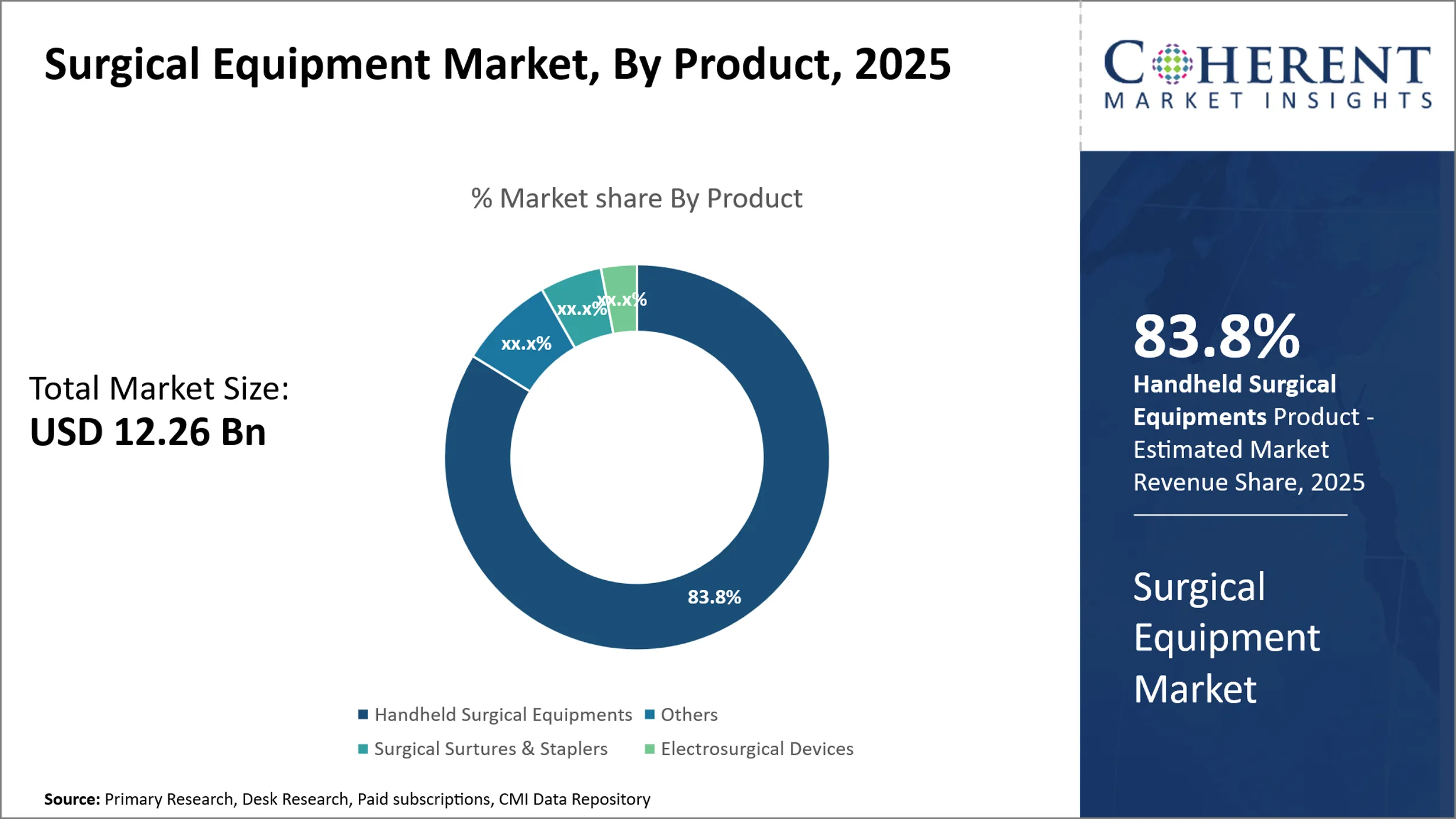
Global Surgical Equipment Market Insights, By Product
Handheld surgical equipment is expected to lead the global surgical equipment market in 2026, capturing approximately 84.8% of the total market share. This stronghold is attributed to their critical role across a wide range of surgical disciplines, including general surgery, orthopaedics, cardiovascular, and obstetrics.
Instruments such as forceps, scalpels, scissors, and retractors remain indispensable due to their durability, ease of sterilization, reusability, and surgeon preference for tactile precision. The widespread surgical equipment usage in hospitals is a key driver of this dominance, as these tools form the backbone of nearly all routine and complex surgical procedures performed in both inpatient and outpatient settings.
The surge in surgical procedures globally driven by rising incidences of chronic illnesses, trauma cases, and an aging population continues to bolster demand for high-performance manual instruments. Moreover, ongoing advancements in ergonomic design, material innovation, and safety enhancements are further elevating their utility.
As healthcare providers focus on improving surgical outcomes and operational efficiency, handheld instruments are poised to remain at the forefront of surgical practice, sustaining their dominance well beyond 2025.
Regional Insights
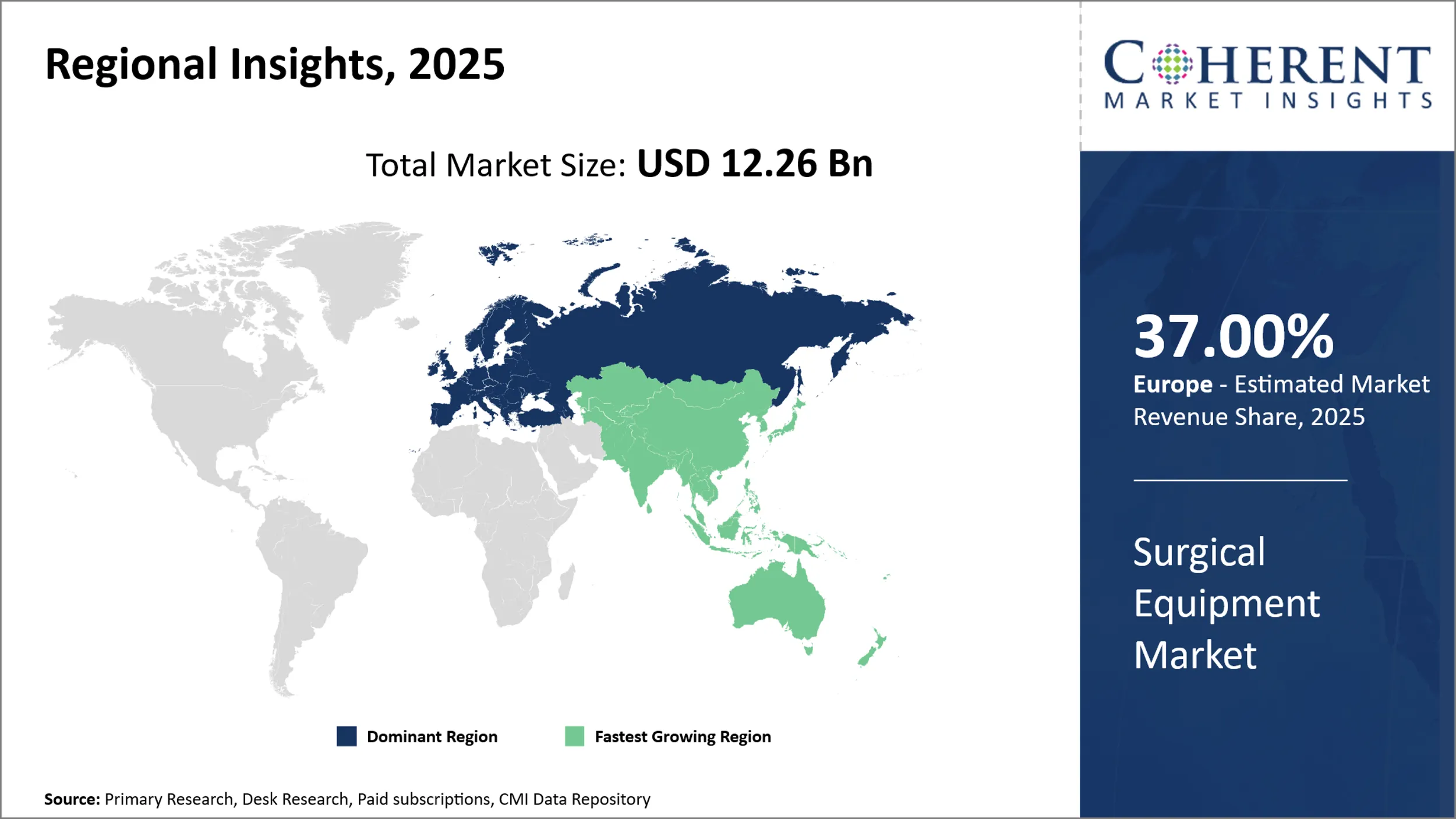
Europe Surgical Equipment Market Trends and Analysis
Europe is projected to dominate the global surgical equipment market, commanding approximately 37.00% of total revenue share by 2026. This regional leadership is underpinned by the presence of a highly developed healthcare ecosystem, significant surgical procedure volumes, and early adoption of advanced surgical technologies.
Europe healthcare providers are also rapidly integrating robotic-assisted, AI-driven, and minimally invasive surgical tools into their operative protocols, enhancing precision and improving patient outcomes. These innovations in surgical equipment are transforming the surgical landscape enabling greater accuracy, reducing patient recovery time, and lowering complication risks. With patient demand for outpatient care rising and innovation continuing to reshape surgical practices, Europe is well-positioned to maintain its leadership in the global surgical equipment market through and beyond 2026.
Surgical Equipment Market Dominating Countries
United States
The United States is the leading force in the global surgical equipment market, significantly contributing to North America’s projected 34.0% market share by 2026. A vast network of ambulatory surgery centres (ASCs), a high volume of surgical procedures, and consistent technological innovation fuel this dominance.
The U.S. benefits from advanced reimbursement systems, strong regulatory frameworks, and aggressive investment in minimally invasive and robotic-assisted surgical technologies. With major players like Medtronic, Stryker, and Johnson & Johnson headquartered in the country, the U.S. continues to drive product innovation, market penetration, and global influence in the surgical equipment space.
Canada
Canada plays a vital supporting role in the North American surgical equipment market, benefiting from its universal healthcare system and rising investment in surgical infrastructure. Canadian hospitals are increasingly integrating advanced surgical equipment and minimally invasive technologies to reduce patient recovery time and hospital stays.
Government initiatives to modernize operating rooms and improve surgical wait times are boosting demand for high-precision surgical instruments. With a growing emphasis on outpatient surgeries and sustainable procurement practices, Canada is steadily strengthening its presence in the global surgical equipment landscape.
Market Report Scope
Surgical Equipment Market Report Coverage
| Report Coverage | Details | ||
|---|---|---|---|
| Base Year: | 2025 | Market Size in 2026: | USD 12.92 Bn |
| Historical Data for: | 2020 To 2024 | Forecast Period: | 2026 To 2033 |
| Forecast Period 2026 to 2033 CAGR: | 5.4% | 2033 Value Projection: | USD 18.67 Bn |
| Geographies covered: |
| ||
| Segments covered: |
| ||
| Companies covered: | Medtronic plc., Peters Surgical SASU, Ethicon (Johnsons & Johnsons), Conmed Corporation, Novartis International AG, Smith & Nephew PLC, Boston Scientific Corporation, B. Braun Melsungen AG, Cousin-Biotech, Enthral Medical GMBH, Fuhrmann GMBH, Integral Lifesciences Holdings Corporation, KLS martin Group, Stryker Corporation, Zimmer Biomet, Dextera Surgical, Hospira, and SIM Surgical | ||
| Growth Drivers: |
| ||
| Restraints & Challenges: |
| ||
Analyst Opinion ( Expert Opinion)
- The global surgical equipment market is set for steady growth, fuelled by the rising volume of surgical procedures, technological advancements, and increasing demand for minimally invasive techniques.
- Industry experts emphasize on the growing shift toward precision-based, ergonomic, and cost-effective solutions as a major trend. Surgeons prefer tools that offer better control, durability, and ease of sterilization. Demand for smart surgical instruments, including energy-based and sensor-equipped devices, is rising due to improved patient outcomes and reduced operation times.
- Although the market faces challenges such as high equipment costs, reimbursement limitations, and supply chain constraints, the long-term outlook remains optimistic. Innovation in robotic surgery, increasing investment in outpatient surgical centres, and favourable policy changes supporting advanced technologies will continue to shape the future of the surgical equipment market.
Speak to the analyst
Want personalized insights?
Take the findings above to one of our principal consultants, or have the report rebuilt around the segments, geographies and competitors you actually track.
Surgical Equipment Market: Key Development
- In July 2025, Zimmer Biomet announced its acquisition of Monogram Technologies specialists in semi- and fully autonomous robotic platforms such as a knee replacement system that received FDA approval 2025. Bolsters Zimmer’s presence in orthopaedic robotics and positions it to deliver next-generation autonomous systems, scaling innovation across procedure types.
- In June 2025, researchers revealed a robotic circular stapler with multi-actuator motion and 75° distal bending for better tissue alignment in confined spaces. Promises improved precision and reduced complications in gastrointestinal and oesophageal surgeries, highlighting next-gen instrumentation trends.
- In May 2025, the FDA approved Initiative’s da Vinci Single‑Port (SP) surgical system for transanal local excision/resection. Extends SP use into colorectal surgery through natural orifices, reducing invasiveness and boosting outpatient capability.
- In April 2024, Medical Micro Instruments (MMI) secured FDA approval for the Symani Surgical System, the first robotic platform designed specifically for microsurgery, offering tremor-elimination and ultra-fine wristed instrument control. Enables surgeons to perform delicate procedures with enhanced precision and improved outcomes, significantly advancing robotic options in ENT, plastic surgery, and ophthalmology.
- In December 2024, SS Innovations secured approval from India’s CDSCO for the SSi Mantra robotic system to perform telesurgery and tele‑proctoring procedures remotely marking a first in India. Enables remote robotic surgeries including pioneering paediatric and cardiac procedures significantly expanding access to advanced surgical care in underserved regions using telecom-based intervention models.
Market Segmentation
- Global Surgical equipment Market, By Product (Revenue, USD Bn, 2021 - 2033)
- Handheld Surgical Equipment
- Forceps & Spatulas
- Retractors
- Dilators
- Clamps
- Trocars
- Others (Cannulas, Scissors, Lancets, etc.)
- Surgical Sutures & Staplers
- Electrosurgical Devices
- Others (Surgical Hernia Mesh, Surgical Glue/Sealant & Hemostasis, etc.)
- Global Surgical equipment Market, By Application (Revenue, USD Bn, 2021 - 2033)
- Neurosurgery
- Plastic Surgery
- Orthopedics
- Cardiovascular Surgery
- Obstetrics & Gynecology
- Others (Wound Closure, Laparoscopy, Dentistry, Urology, etc.)
- Global Surgical Equipment Market, By End User (Revenue, USD Bn, 2021 - 2033)
- Hospitals
- Clinics
- Ambulatory Surgical Centers
- Global Surgical equipment Market, By Region (Revenue, USD Bn, 2021 - 2033)
- North America
- U.S.
- Canada
- Latin America
- Brazil
- Mexico
- Argentina
- Rest of Latin America
- Europe
- Germany
- U.K.
- France
- Italy
- Spain
- Russia
- Rest of Europe
- Asia Pacific
- China
- India
- Japan
- Australia
- South Korea
- ASEAN
- Rest of Asia Pacific
- Middle East
- GCC
- Israel
- Rest of Middle East
- Africa
- South Africa
- Central Africa
- North Africa
- Company Profiles
- Medtronic plc.
- Peters Surgical SASU
- Ethicon (Johnsons & Johnsons)
- Conmed Corporation
- Novartis International AG
- Smith & Nephew PLC
- Boston Scientific Corporation
- B. Braun Melsungen AG
- Cousin-Biotech
- Enthral Medical GMBH
- Fuhrmann GMBH
- Integral Lifesciences Holdings Corporation
- KLS martin Group
- Stryker Corporation
- Zimmer Biomet
- Dextera Surgical
- Hospira
- SIM Surgical
Sources
The Stakeholders Consulted
- Surgeons and operating room professionals across general and specialty practices
- Procurement officers at hospitals, ambulatory surgical centers (ASCs), and surgical clinics
- Manufacturers and OEMs of surgical instruments and electrosurgical devices
- Distributors and logistics providers in the surgical supply chain
- Healthcare technology experts and medical device engineers
- Hospital administrators and regulatory compliance managers
- Public and private healthcare agencies involved in surgical equipment evaluation and approvals
Databases Opened
- U.S. Food and Drug Administration (FDA) – Medical Devices and Equipment Database
- Centers for Medicare & Medicaid Services (CMS) – Reimbursement and Procedure Data
- World Health Organization (WHO) – Global Surgical Volume & Equipment Access Statistics
- National Health Service (NHS, UK) – Surgical Outcomes and Procurement Data
Magazines & Trade Publications
- Medical Device and Diagnostic Industry (MD+DI)
- Surgical Products Magazine
- MedTech Dive
- Healthcare Business News
- Hospital & Healthcare Management
Scientific and Industry Journals
- Journal of Surgical Research
- Surgical Endoscopy
- International Journal of Surgery
- Annals of Biomedical Engineering
- IEEE Transactions on Medical Robotics and Bionics
Newspapers & Media Outlets
- The Wall Street Journal – Healthcare & Medical Technology
- Bloomberg – Medical Devices and Life Sciences
- Reuters – Healthcare Innovation and Regulatory News
- The Economic Times – Healthcare and Medtech News
- Business Standard – Life Sciences and Surgical Equipment
Associations and Regulatory Bodies
- U.S. Food and Drug Administration (FDA) – Center for Devices and Radiological Health
- World Health Organization (WHO) – Safe Surgery and Medical Devices Programs
- Association for the Advancement of Medical Instrumentation (AAMI)
- European Medicines Agency (EMA) – Medical Device Oversight
- Central Drugs Standard Control Organization (CDSCO), India
- International Society for Minimally Invasive Cardiothoracic Surgery (ISMICS)
Public Domain Sources
- World Bank – Global Health Expenditure and Hospital Infrastructure Reports
- OECD – Health at a Glance Reports
- European Commission – Medical Device Regulations and Market Data
- Global Health Observatory (WHO) – Surgical Care and Device Accessibility
- U.S. National Institutes of Health (NIH) – Surgical Innovation Research Reports
Proprietary Research Elements
- CMI Data Analytics Tool – Global Surgical Equipment Market Segmentation and Forecasting
- CMI Internal Repository – Surgical Device Adoption Rates and Usage Patterns (2017–2025)
- CMI Expert Interviews and Transcripts – Opinions from Surgeons, Hospital Buyers, and Device Technologists
Get access to 250+ pages report
Every segment, forecast, competitor profile and data table behind the analysis above — available for instant download.
- ESOMAR Member
- ISO 9001:2015 Certified
- D-U-N-S Registered
- GDPR & CCPA Compliant
Missing comfort of reading report in your local language? Find your preferred language:
Transform your Strategy with Exclusive Trending Reports
Frequently Asked Questions
The Surgical Equipment Market size is estimated to be valued at USD 12.92 Bn in 2026, and is expected to reach USD 18.67 Bn by 2033.
The CAGR of the global Market is projected to be 5.4% from 2026 to 2033.
Factors such as increase in the preference for robotic surgery, rising geriatric population, and surgeries associated with injuries and cardiology are expected to drive the market.
Handheld surgical equipment is the leading product segment in the market.
The major factor hampering growth of the market include increase in the number of product recalls.
Major players operating in the market include Medtronic plc., Peters Surgical SASU, Ethicon (Johnsons & Johnsons), Conmed Corporation, Novartis International AG, Smith & Nephew PLC, Boston Scientific Corporation, B. Braun Melsungen AG, Cousin-Biotech, Enthral Medical GMBH, Fuhrmann GMBH, Integral Lifesciences Holdings Corporation, KLS martin Group, Stryker Corporation, Zimmer Biomet, Dextera Surgical, Hospira, and SIM Surgical.