

Global Paper Bottle Market Size and Forecast – 2026 To 2033
The global paper bottle market is estimated to be valued at USD 79.5 Mn in 2026 and is projected to reach USD 130.2 Mn by 2033, registering a compound annual growth rate (CAGR) of 7.3% during 2026–2033. The market is growing due to increasing adoption of lighter alternatives to glass and plastic, stricter packaging sustainability requirements, and developments in molded fiber manufacturing and liquid barrier technologies.
Beverage manufacturers are also experimenting with paper-based bottles to reduce the weight of their packaging and differentiate their products. In October 2026, Frugalpac announced that California-based Monterey Wine Company, had received repeat orders for paper bottles that Petalscape wines had used after the first production run had sold out. This development signals growing commercial acceptance and a potential for expansion of paper bottle production beyond the first product introductions.
Key Takeaways of the Global Paper Bottle Market
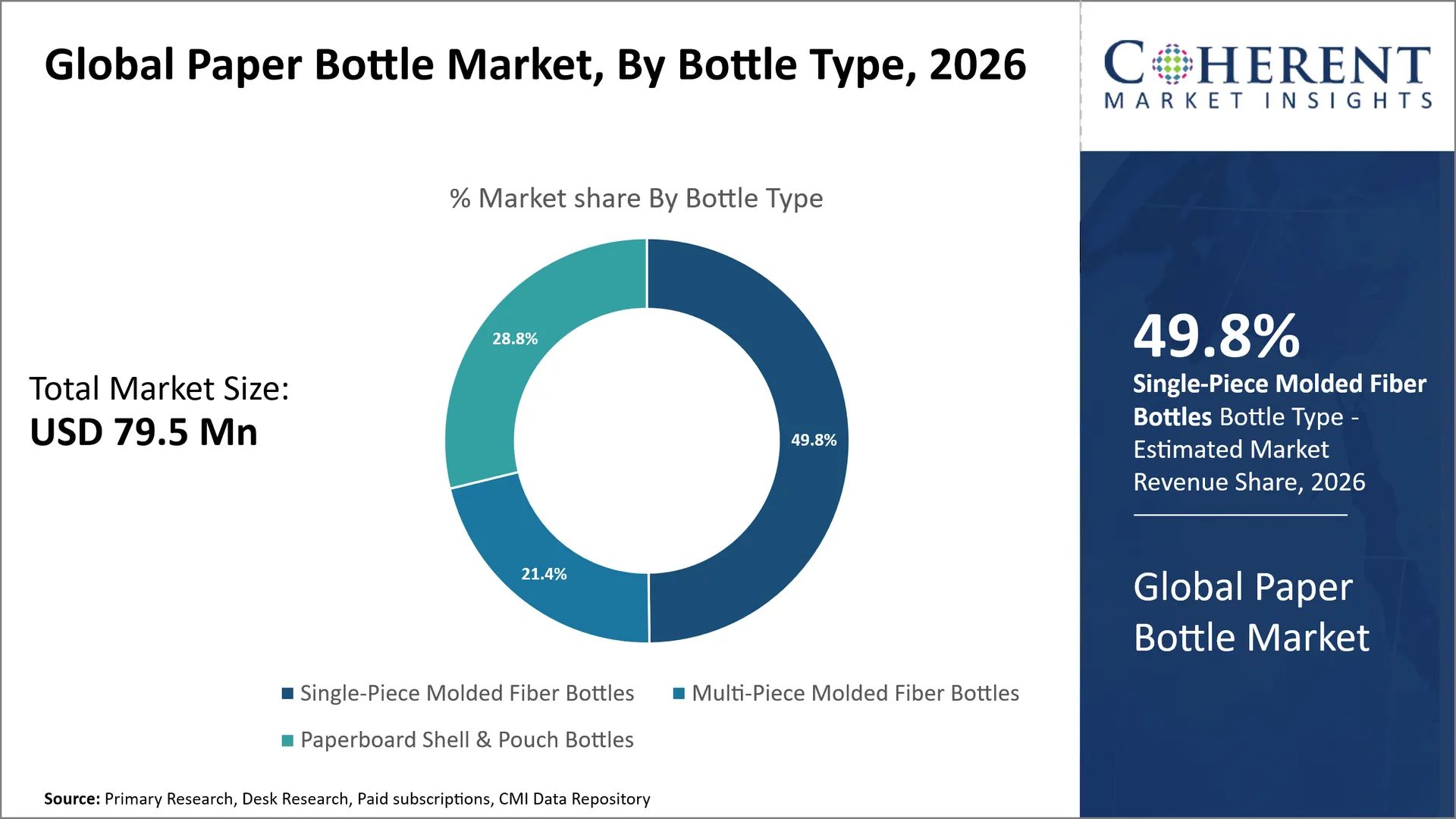
- Single-Piece Molded Fiber Bottles are projected to grow at an estimated 8.4% CAGR through 2033, holding 49.8% of the global paper bottle market in 2026. Their seamless bodies enable distinctive bottle designs while reducing the number of assembly steps and possible points of leakage. In October 2026 PAPACKS confirmed that its one-piece Model S10 bottle-forming line was operating in Arnstadt, Germany.
- Recycled Fiber is forecast to expand at an estimated 8.2% CAGR through 2033, accounting for 45.1% of global paper bottle market revenue in 2026. Recovered paper allows for the circular material sourcing and reduces the need for virgin pulp. In April 2025, Zipform Packaging launched a fiber bottle that eliminated the traditional plastic liner and contained more than 50 percent post-consumer recycled content.
- Plastic Closures are expected to register an estimated 5.8% CAGR through 2033 and represent 59.8% of global paper bottle market revenue in 2026. Existing cap designs have useful dispensing and resealing function and fiber-based alternatives continue to develop. In November 2026, smol launched its Laundry Reset detergent, packaged in a bottle made from pulp fiber and fitted with a recycled polypropylene dosing cap.
- North America is projected to record an estimated 6.4% CAGR through 2033 with a 31.8% share of the global paper bottle market in 2026. Premium beverage producers are taking advantage of opportunities such as local manufacturing, differentiated shelf presentation and lightweight packaging. Wisconsin-based Central Standard Craft Distillery's October 2025 release of Standard Issue Vodka in paper bottles shows the regional spirits industry's commercial adoption.
- Europe is expected to achieve an estimated 8.6% CAGR through 2033, with a 31.8% share in global paper bottle market 2026, positioning it as the fastest-growing region. Established packaging know-how and technology licensing may speed up regional commercialization. In March 2026, Perlen Industrieholding acquired manufacturing rights for paper bottles in Switzerland, Austria, Italy and southern Germany, but is still considering whether to go ahead.
Segmental Insights
Why Do Single-Piece Molded Fiber Bottles Dominate the Global Paper Bottle Market?
Single-Piece Molded Fiber Bottles are expected to account for 49.8% of the global paper bottle market in 2026, leading the bottle-type category through integrated body construction. The shoulder, base and sidewall are formed as a single structure, eliminating the need to join separate paper shells, but achieving consistent wall thickness and liquid resistance remains challenging. Once the barrier performance has been established, this architecture can be used by personal care and household product manufacturers to create unique rigid formats. The supply of integrated barrier systems and special molds is an advantage for the suppliers, whereas brand owners have to test prototypes under real filling conditions. In April 2026, Zerolys launched Phyber, a packaging material for rigid bottles and related containers made from plant fiber and natural wax. Prototypes were moving toward pilot scale production but mass commercialization was not proven.
- Current Industry Events of 2026
- Market Size Estimation
- Regional Breakdown
- Competitive Landscape
- Customer Intelligence
- Segmental Analysis
- Pricing Analysis
- Key Market Drivers, Challenges & Future Trends
- Customized Insights Section
Why Does Recycled Fiber Represent the Largest Material Type in the Global Paper Bottle Market?
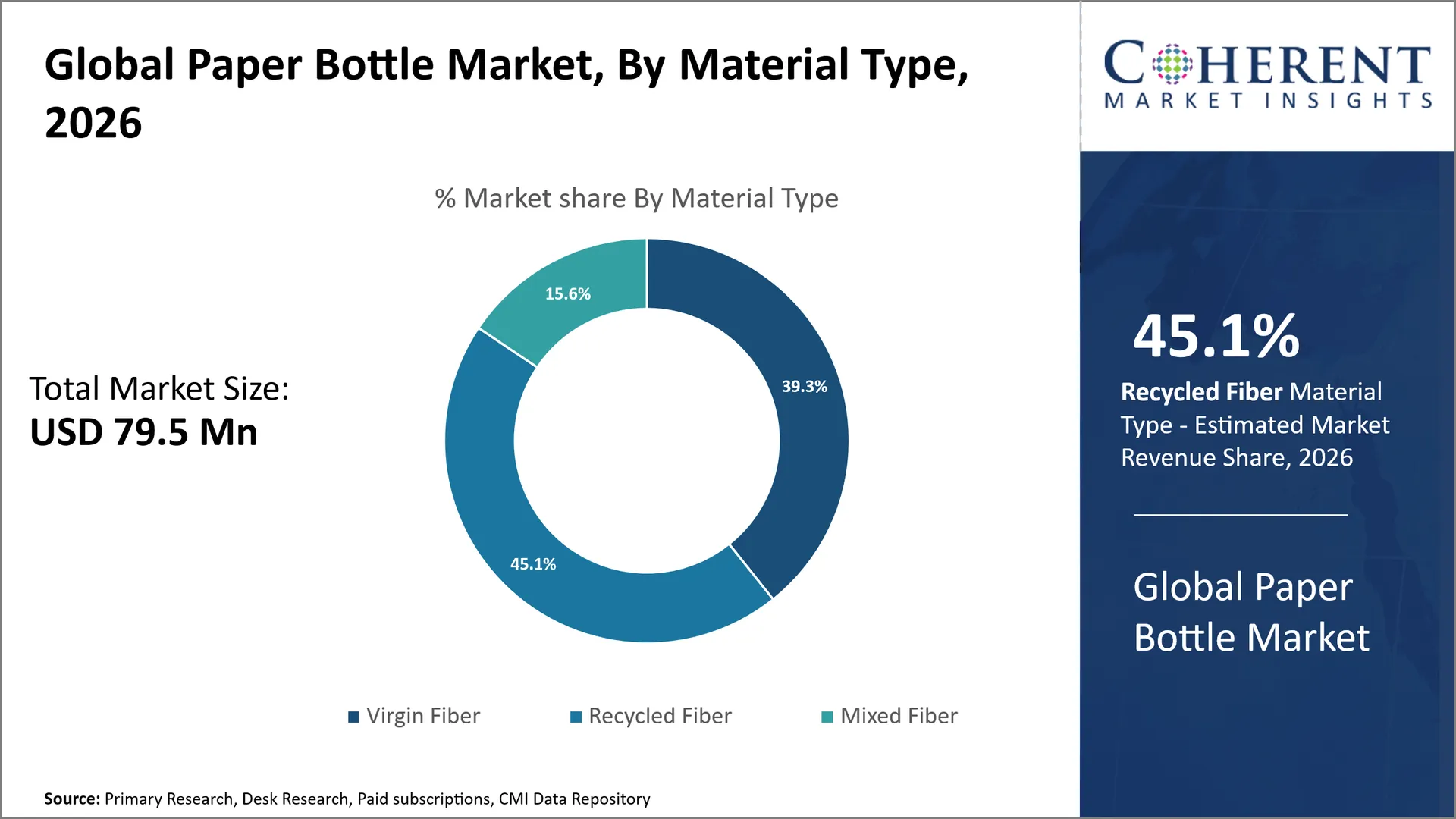
Recycled Fiber is expected to hold 45.1% of the global paper bottle market in 2026, making it the leading material category. Its commercial appeal lies in using established recovered-paper supply chains to make packaging with a documented recycled-content specification. Wine and spirits brands can select recycled-paperboard shells for their appearance and lightweight handling without requiring the fiber itself to contact the liquid. Converters must control feedstock cleanliness, board strength, surface finish, and consistency between batches, particularly where direct printing is required. In July 2024, Magnotta Winery launched its Ugly Duck red and white wines in KB paper bottles manufactured by KinsBrae Packaging from 100% recycled paperboard. The launch demonstrated retail use of recovered-fiber bottle structures rather than simply announcing a laboratory material concept.
Why Do Plastic Closures Dominate the Closure Type Segment of the Global Paper Bottle Market?
Plastic Closures are projected to command 59.8% of global paper bottle market revenue in 2026, leading the closure-type category because they build on established dispensing and sealing infrastructure Familiar screw caps and pumps can simplify procurement and equipment qualification for beverage and personal care fillers compared to producing new fiber caps. They still rely on the geometry of the caps, the amount of torque applied, compatibility of the liner and leak testing, and may also need to be removed for separate recycling. In March 2022, Paboco revealed a threaded paper-bottle neck that will be compatible with screw caps, pump dispensers and peel-off lids, while paper-based closures are still being developed. As in that previous engineering solution, adopting a new closure form does not require the complete redesign of all the parts, as long as there is a gradual shift to fiber bottles.
Current Events and their Impact
Current Event | Description and Its Impact |
June 2025 – UK Confirms Packaging Extended Producer Responsibility Fees |
|
February 2025 – Oregon Approves Packaging Recycling Modernization Program |
|
Global Paper Bottle Market Dynamics
Key Market Drivers
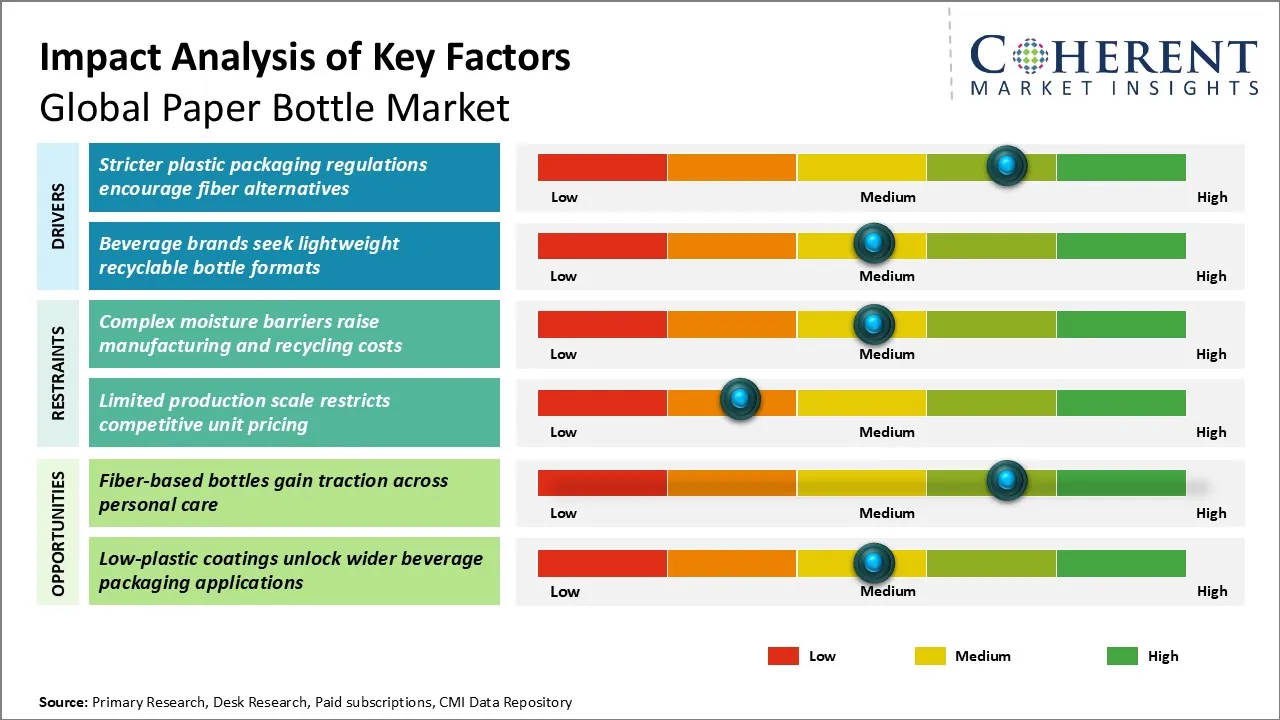
- Stricter plastic packaging regulations encourage fiber alternatives: The increased scrutiny of packaging material composition, recyclability and substances in food contact packaging is driving fiber alternatives. This provides opportunities to designs paper bottles that have fewer plastics, while ensuring safety and performance. As brands rethink traditional containers, fiber manufacturers and packaging converters are able to win new development work. On August 2026, the European Commission announced that the Packaging and Packaging Waste Regulation comes into effect across the EU, including the ban on PFAS in food contact packaging. The rule extends incentives for fibre-based alternatives, and does not require paper bottles.
- Beverage brands seek lightweight recyclable bottle formats: Bottle weight is becoming a key factor in the transportation cost, emissions from packaging and material choice for beverage manufacturers. For spirits sold in a variety of markets, paper-based containers could help reduce weight in freight compared to glass. However, commercial adoption depends on filling compatibility, liquid protection, and consumer acceptance. In September 2024, Diageo introduced a trial of 70 cl Johnnie Walker Black Label bottles made from approximately 90% paper at its Edinburgh visitor attraction. The trial evaluated bartender handling and pouring performance, and how beverage manufacturers can test packaging options without assuming them across the market.
Emerging Market Trends
- Greater Focus on Recyclability of Complete Bottle Structures: Paper bottle manufacturers are developing beyond fibre content claims and thinking about how to design bottles to be processed by current recycling systems. The separation of liners, adhesive selection, and closure materials are becoming crucial design aspects.
- Impact: Package manufacturers will be required to have a more robust repulp ability test and end-of-life validation. Even products that have a high paper content can be difficult to separate, and may need to be redesigned.
- Relevance to Market: This transition favors manufacturers with integrated material-testing capabilities. If demonstrated recycling compatibility becomes an increasing requirement in brand procurement decisions during the forecast period, it represents a huge opportunity for brands.
- Direct-to-Fiber Printing and Premium Surface Customization: Molded fiber bottles can be embossed, textured and direct to fiber printed. Use of these features may minimize the use of traditional adhesive labels and provide brands with greater packaging presentation flexibility.
- Impact: Packaging converters can reuse their equipment to make shorter runs and custom finishings. Printing quality and surface damage resistance will play a major factor in the decision making process.
- Relevance to Market: This trend is significant for the premium personal care and specialty beverage packaging sectors. Unique bottles might have a greater impact on product differentiation and suppliers.
Key Restraining Factors
- Liquid Barrier Performance and Shelf-Life Limitations: Paper fibers need to be protected by the right barriers to prevent liquid absorption and oxygen transmission, and deterioration in the structure. Creating barriers that preserve the quality of the product while still maintaining its recyclability is technically challenging, especially for carbonated, alcoholic and formulations with aggressive ingredients.
- High Initial Production Costs and Filling-Line Adaptation Requirements: The initial cost of paper bottle use may be high due to the need for specialized mounding equipment, investments in tooling, protective coatings, etc. and quality testing. The size of the market for smaller packaging buyers may also be restricted by the variation in bottle rigidity, bottle closures, and handling properties, which may also necessitate adjustments to the filling line.
Regional Insights
Why Does North America Dominate the Global Paper Bottle Market?
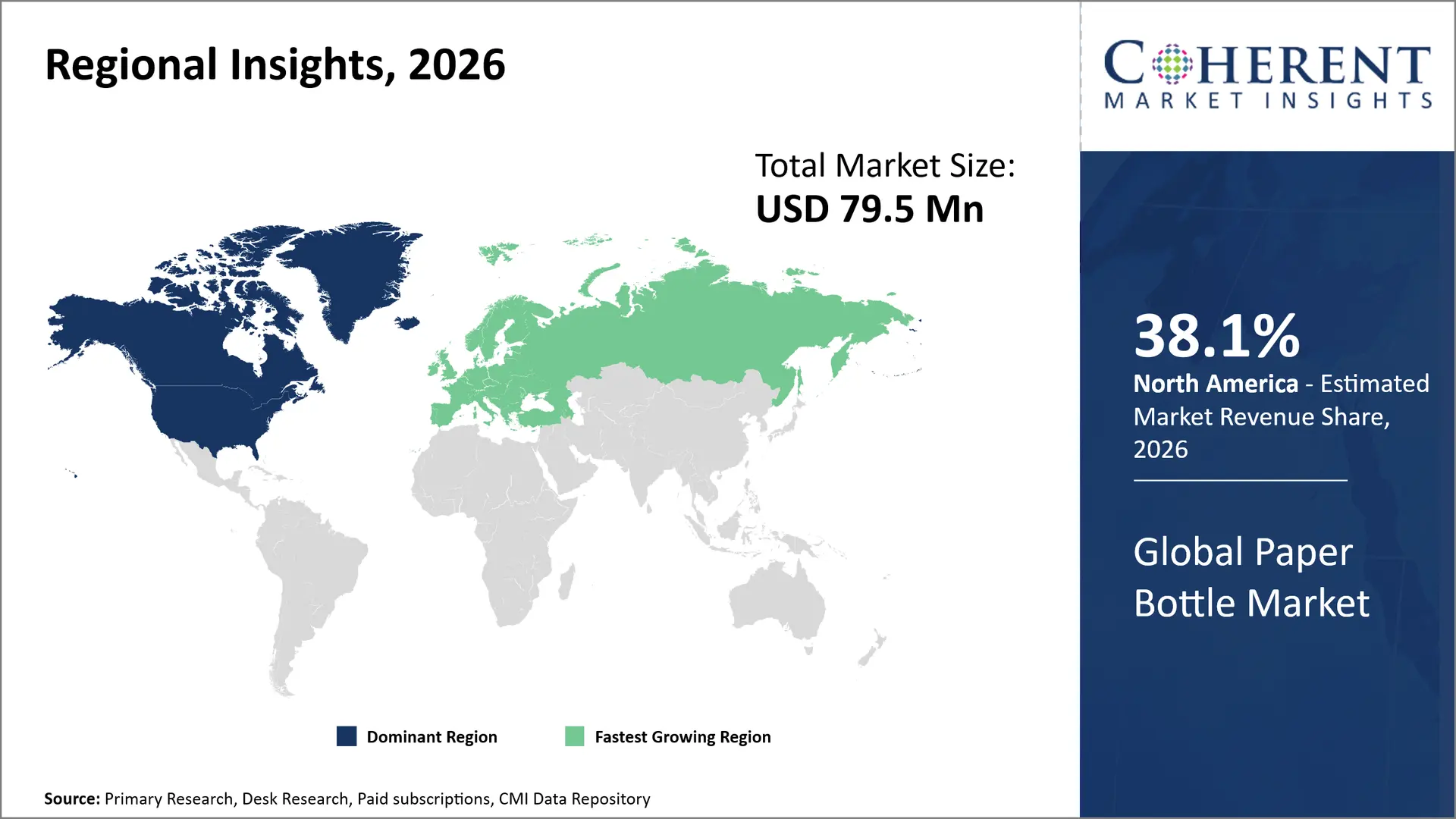
North America is anticipated to witness the largest market share of the paper bottle industry in the year 2026 with 38.1% of the market revenue. There are already established beverage packaging supply chains, premium consumer brands and access to specialized packaging engineering in the region. Fiber-based bottles are being considered by the wine, spirits and personal care industries for their packaging differentiation and the move away from traditional hard-to-recycle rigid bottles. The development of domestic technology also helps product customization and technical qualification. In December 2025, Los Angeles-based Cove PBC introduced its PB1 molded-fiber bottle platform, featuring a multi-piece construction designed for compatibility with existing production equipment. The development reveals the potential North America has to create commercially viable packaging technologies, but this will require manufacturing costs, barrier properties and qualification by customers.
Why Is Europe Emerging as the Fastest-Growing Region in the Global Paper Bottle Market?
Europe is expected to become the fastest-growing region with revenue accounting for 31.8% of the global paper bottle market in 2026. Packaging waste legislation is encouraging manufacturers, existing paper-converting facilities, and a desire to enhance the circularity of materials by manufacturers to consider alternative bottle formats. In addition, the European brands are moving beyond alcoholic products into specialty food applications to meet their packging needs, providing additional opportunities for specialty application barriers and dispensing systems. In November 2025, British rapeseed oil producer Littleseed introduced its cold-pressed oil in paperboard bottles across 25 Booths supermarkets. The commercial rollout demonstrated the suitability of paper-based bottle structures for edible oils, supporting broader product diversification. Suppliers capable of satisfying food-contact requirements and demonstrating practical recyclability could benefit from this transition.
Global Paper Bottle Market Outlook for Key Countries
Why Is the U.S. a Key Market for the Global Paper Bottle Market?
The U.S. is an important global paper bottle market due to its large retail networks, established beverage brands and ability to launch alternative packaging at a national scale. Supermarket distribution is especially important for converting specialty packaging formats into recurring purchases by consumers In March 2025, Target began selling its Collective Good wine collection in paper bottles in approximately 1,200 stores across the country. The range features four wine varieties, demonstrating that paper bottles can be distributed through mainstream retail channels. This evolution presents opportunities for domestic bottle assemblers, contract fillers and packaging suppliers that can satisfy the demands of large retailers for consistent product quality, competitive prices and uninterrupted supply.
Why Is India Important in the Global Paper Bottle Market?
India’s paper bottle manufacturers are benefiting from the growth in the premium spirits industry, domestic paperboard converting capabilities and cost-sensitive packaging supply chains. Lighter packaging could be part of differentiated products and reduce dependence on conventional glass formats, which is of particular interest for regional beverage producers. Goa-based Rhea Distilleries collaborated with packaging manufacturer ITC to introduce paper bottles for its Fidalgo Premium Cashew Feni from October 2025. The initial production was meant for chosen markets in Goa. Indian spirits producers looking at alternative bottle formats now have a practical reference. Future market development will be dictated by the economics of local production, filling compatibility and reliable access to food grade protective liners.
Why Does China Support Growth in the Global Paper Bottle Market?
China’s role in the global paper bottle market is closely linked to its integrated pulp-processing industry, automated packaging equipment manufacturing and extensive consumer goods production networks. Domestic suppliers can also potentially integrate molded-fiber production with barrier coating and closure development, reducing dependence on imported packaging technologies. Shenzhen-based YUTOECO lists molded-fiber bottles, bio-based coatings and special sealing structures among its sustainable packaging portfolio. Its technical papers also talk of automated pulp-molding and material-processing capabilities. These capabilities are a basis for creating bottle formats for personal care, household liquids and specialty beverages. However, competitive success depends not just on manufacturing capacity but on proving liquid compatibility, production consistency and commercially viable operating costs.
Why Is Germany a Strategic Country in the Global Paper Bottle Market?
Germany is a key country for the global paper bottle market, owing to its advanced packaging engineering, recycling infrastructure and premium food retail market. There are opportunities for paper bottles that protect the product while offering unique dispensing functionality in the country. In February 2026, German olive oil supplier Jordan Olivenöl launched its extra virgin olive oil in a 750 ml paperboard bottle with a specially developed pouring system. The packaging uses recycled paperboard and a separate internal liquid barrier. This commercialization shows how specialized dispensing features can extend paper bottle applications into food products with different handling requirements. There is an opportunity for German packaging suppliers to benefit from the development of tailored closures, precision-engineered components and reliable conversion processes.
Why Is Japan an Important Market for the Global Paper Bottle Market?
Japan has specialized capabilities in precision filling, liquid barrier films and compact consumer packaging that provide unique opportunities for paper bottle development. Beverage manufacturers are very concerned about product protection, ease of handling, and shelf life stability. These requirements favor suppliers with the ability to develop highly engineered fiber-based containers. In February 2025, Nippon Paper Industries announced a compact 80 ml aseptic paper container for an Ito En beverage product, showing domestic expertise in paper-based liquid packaging. While this is a carton product, not a rigid paper bottle, the barrier and filling technologies demonstrate capabilities that are relevant to future bottle development. Further engineering for suitable bottle rigidity, resealability and manufacturing efficiency is required before commercial adoption.
Why Is Brazil an Important Growth Market for the Global Paper Bottle Market?
Brazil offers longer-term potential for paper bottle manufacturers because of its established pulp industry, recovered-fiber supply chains, and substantial beverage and personal care manufacturing base. Locally sourced cellulose could support competitive packaging production, particularly where converters can integrate fiber forming with protective coating technologies. In October 2026, Brazilian paper packaging association Empapel reported that the country's paper recycling rate had reached 60.4% in 2025, while paper packaging recycling reached 66.9%. These figures reflect established material-recovery capabilities rather than confirmed paper bottle adoption. Commercial opportunities will depend on developing local bottle-conversion capacity, identifying suitable customer applications, and reducing costs associated with specialized barriers and closures.
Paper Bottle Innovation, Production and Performance Landscape in the Global Paper Bottle Market
Production Approach | Application in Paper Bottles | Commercial Significance | Principal Technical Consideration |
Wet-Press Molded Fiber Forming | Produces shaped bottle bodies from cellulose pulp using forming, pressing, and drying operations. | Enables rigid, three-dimensional bottle structures and integrated body designs. | Drying efficiency, wall thickness, and dimensional consistency. |
Dry Molded Fiber Technology | Develops fiber-based containers with less reliance on traditional wet-forming processes, using heat and pressure. | Offers an alternative way for production of light weight bottles and special molded structures. | accuracy of tooling, consistency of forming and production throughput. |
Paperboard Shell and Flexible Pouch Assembly | Rigid paperboard outer shell with liquid-containing pouch inside. | Enables current paperboard converting capabilities to serve beverage packaging applications. | Recyclability of the separated components, sealing of the pouch, neck assembly. |
Spray-Applied Liquid Barrier Coatings | Coats fiber surfaces with protective coatings to prevent liquid penetration. | Enables paper bottle format development without a separate inner pouch. | Chemical compatibility, barrier strength and recyclability. |
Fiber-Based Screw Closure Engineering | Molded fiber caps and threaded closures for paper bottle necks. | Helps reduce the plastic content of the total packaging systems. | Resistance to torque, reseal ability, no leakage, moisture stability. |
Inline Leak Detection and Dimensional Inspection | Uses pressure testing, machine vision and automated inspection to identify bottle defects. | Supports more consistent production quality and reduces rejection risks during industrial-scale filling. | Inspection accuracy, sealing performance, and integration with production equipment. |
How Are Specialized Paper Bottles for Personal Care and Travel-Size Products Creating New Growth Opportunities in the Global Paper Bottle Market?
Paper bottle manufacturers seeking applications beyond traditional beverage containers have an attractive opportunity in travel-size personal care packaging. Premium skin care brands, hospitality suppliers, wellness companies and travel retailers require compact bottles that provide easy dispensing with unique product presentation.
Custom molded fiber packaging works well for shampoos, lotions, body washes and liquid cosmetics, particularly for brands seeking to reduce conventional rigid-plastic content.
Commercial success will hinge on the development of moisture-resistant structures, formulation-compatible barriers and reliable dispensing closures. Manufacturers also need to consider the storage conditions, the shelf-life requirements and the compatibility with the existing filling operations.
Specialist converters could capture this opportunity offering standardized bottle platforms which can be customized in shape, finish and closure configuration. Reducing commercialization costs would be facilitated by partnerships with contract fillers and personal care manufacturers.
Suppliers offering a blend of materials engineering, design service and proven packaging performance will be better placed than those competing solely on container price.
Market Players, Key Developments, and Competitive Landscape
Key Developments
- In October 2026, Pulpex opened its first commercial bottle factory to produce bottles from fiber near Glasgow, Scotland, with an initial annual capacity of up to 40 million bottles. The facility provides an industrial benchmark for licensed production, which could reduce technical uncertainty for converters considering fiber bottle production at commercial scale.
- In April 2026, Frugalpac introduced its FBAM-2 paper bottle assembly machine, designed to produce approximately 14 million bottles annually in its standard three-lane configuration. The development addresses manufacturing throughput limitations and could help packaging converters improve production economics while supplying larger beverage customers.
- In June 2025, Blue Ocean Closures reported that its fiber-based cap had undergone a trial with Absolut Vodka's paper bottle. The combination was evaluated by bartenders in May. This development highlights progress in integrated fiber packaging, particularly closure functionality, sealing performance, and the potential to replace conventional closure materials.
Competitive Landscape
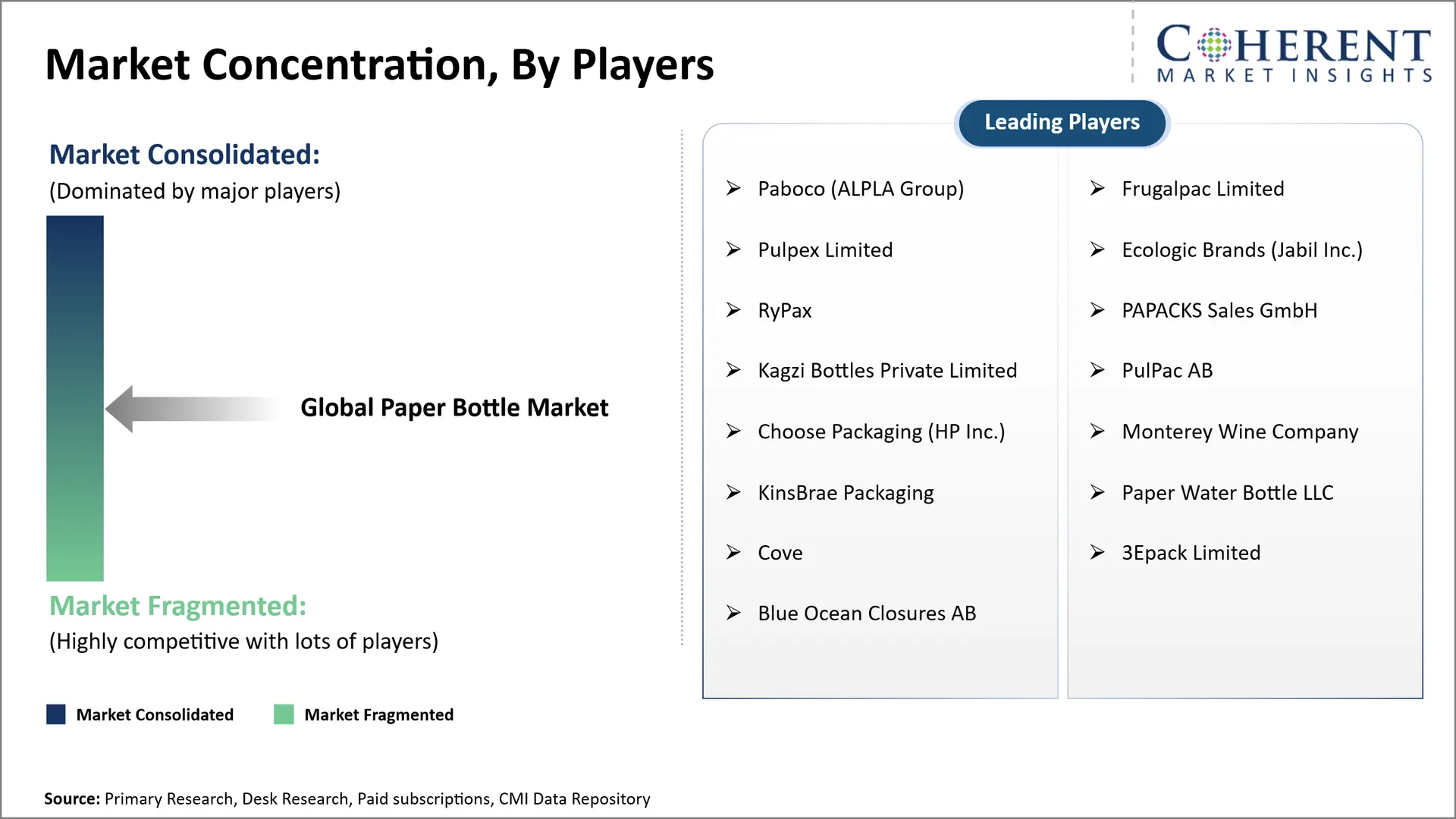
The global paper bottle market is moderately consolidated at the technology-platform level, with specialized manufacturers controlling important molding processes, barrier systems, and bottle designs. Regional packaging converters and established material suppliers contribute to commercialization. Competition increasingly depends on production economics, liquid compatibility, validated recyclability, manufacturing consistency, and intellectual property. Suppliers that can meet beverage and personal care packaging requirements at commercially acceptable costs will have stronger customer positioning.
Key focus areas include
- Barrier Performance: Achieving liquid protection without compromising fiber recovery.
- Manufacturing Productivity: Improving molding speed, equipment utilization, and production yields.
- Packaging Economics: Reducing unit costs through material efficiency and production standardization.
- Intellectual Property: Maintaining proprietary advantages in molding methods, coatings, and closure engineering.
- Quality Assurance: Demonstrating reliable sealing, structural strength, and product compatibility.
- Customer Qualification: Meeting brand-specific technical specifications and acceptance requirements.
- Supply Reliability: Securing consistent fiber quality, coating materials, and conversion capacity.
- Regional Production: Establishing manufacturing capabilities closer to major filling and packaging operations.
Market Report Scope
Paper Bottle Market | |||
Report Coverage | Details | ||
Base Year | 2025 | Market Size in 2026: | USD 79.5 Mn |
Historical Data For: | 2020 to 2024 | Forecast Period: | 2026 to 2033 |
Forecast Period 2026 To 2033 CAGR: | 7.3% | 2033 Value Projection: | USD 130.2 Mn |
Geographies covered: |
| ||
Segments covered: |
| ||
Companies covered: | Paboco (ALPLA Group), Frugalpac Limited, Pulpex Limited, Ecologic Brands (Jabil Inc.), RyPax, PAPACKS Sales GmbH, Kagzi Bottles Private Limited, PulPac AB, Choose Packaging (HP Inc.), Monterey Wine Company, KinsBrae Packaging, Paper Water Bottle LLC, Cove, 3Epack Limited, Blue Ocean Closures AB | ||
Growth Drivers: |
| ||
Restraints & Challenges: |
| ||
Analyst Opinion (Expert Opinion)
- Future Market Direction: The next phase of the global paper bottle market is likely to favor packaging suppliers that deliver complete, production-ready solutions rather than standalone containers. Buyers will increasingly evaluate technical support, qualification procedures, packaging consistency, and lifecycle economics alongside bottle design. Companies that offer integrated engineering and commercialization services can generate more predictable revenues and deepen their relationships with customers.
- Transformative Trend or Disruption: The growth of reusable and refillable packaging systems could impact the market opportunity for single serve paper bottles. Producers might have to show the particular benefits of fiber-based containers over reuse systems, rather than just competing with traditional packaging materials. Those suppliers with application-specific expertise and flexible manufacturing platforms will be better placed to meet this structural shift.
- Strategic Priorities, Risks, and Recommendations: Companies need to concentrate on lowering manufacturing costs, testing for particular applications, creating reliable closures and implementing successful liquid barriers. Investments should be made in customer segments with realistic procurement commitments and well defined technical requirements. Diversified material sourcing, regional converting partnerships, and independently substantiated environmental claims should remain important strategic priorities.
Speak to the analyst
Want personalized insights?
Take the findings above to one of our principal consultants, or have the report rebuilt around the segments, geographies and competitors you actually track.
Market Segmentation
- Bottle Type Insights (Revenue, USD Mn, 2021 - 2033)
- Single-Piece Molded Fiber Bottles
- Multi-Piece Molded Fiber Bottles
- Paperboard Shell & Pouch Bottles
- Material Type Insights (Revenue, USD Mn, 2021 - 2033)
- Virgin Fiber
- Recycled Fiber
- Mixed Fiber
- Closure Type Insights (Revenue, USD Mn, 2021 - 2033)
- Plastic Closures
- Fiber-Based Closures
- Metal Closures
- Capacity Insights (Revenue, USD Mn, 2021 - 2033)
- Up to 250 ml
- 251–500 ml
- 501–750 ml
- Above 750 ml
- End Use Insights (Revenue, USD Mn, 2021 - 2033)
- Alcoholic Beverages
- Non-Alcoholic Beverages
- Personal Care & Cosmetics
- Household Products
- Others
- Sales Channel Insights (Revenue, USD Mn, 2021 - 2033)
- Direct Manufacturer Sales
- Distributors & Packaging Converters
- Regional Insights (Revenue, USD Mn, 2021 - 2033)
- North America
- U.S.
- Canada
- Latin America
- Brazil
- Argentina
- Mexico
- Rest of Latin America
- Europe
- Germany
- U.K.
- Spain
- France
- Italy
- Russia
- Rest of Europe
- Asia Pacific
- China
- India
- Japan
- Australia
- South Korea
- ASEAN
- Rest of Asia Pacific
- Middle East
- GCC Countries
- Israel
- Rest of Middle East
- Africa
- South Africa
- North Africa
- Central Africa
- North America
- Key Players Insights
- Paboco (ALPLA Group)
- Frugalpac Limited
- Pulpex Limited
- Ecologic Brands (Jabil Inc.)
- RyPax
- PAPACKS Sales GmbH
- Kagzi Bottles Private Limited
- PulPac AB
- Choose Packaging (HP Inc.)
- Monterey Wine Company
- KinsBrae Packaging
- Paper Water Bottle LLC
- Cove
- 3Epack Limited
- Blue Ocean Closures AB
Sources
Primary Research Interviews
- Paper bottle manufacturers, molded fiber producers, and packaging converters
- Beverage brands, personal care manufacturers, distributors, and packaging procurement managers
Stakeholders
- Virgin and recycled fiber suppliers, barrier coating manufacturers, and closure suppliers
- Packaging machinery manufacturers, contract fillers, and private-label producers
End-use Sectors
- Alcoholic and non-alcoholic beverages, personal care and cosmetics
- Household products and specialty liquid packaging applications
Regulatory and Industry Bodies
- U.S. Food and Drug Administration (FDA)
- European Food Safety Authority (EFSA)
- European Commission
- Food Safety and Standards Authority of India (FSSAI)
Databases
- UN Comtrade and ITC Trade Map
- Eurostat and U.S. Census Bureau trade statistics
- U.S. International Trade Commission (USITC) DataWeb
Magazines and Journals
- Food Packaging and Shelf Life
- Packaging Technology and Science
- Journal of Cleaner Production
- Resources, Conservation and Recycling
Associations
- American Forest & Paper Association (AF&PA)
- Confederation of European Paper Industries (CEPI)
- Flexible Packaging Association (FPA)
- Fibre Box Association (FBA)
Public Domain Sources
- Paper bottle product datasheets, fiber specifications, barrier coating studies, and recyclability assessments
- Pulp and recycled fiber pricing, packaging trade data, company annual reports, patents, and manufacturing announcements
Key Standards and Regulations
- EU Regulation 2025/40 – Packaging and Packaging Waste Regulation (PPWR)
- U.S. FDA 21 CFR 176.170 – Paper and Paperboard in Contact with Food
- EU Regulation (EC) No 1935/2004 – Food-Contact Materials
- EU Regulation (EC) No 2023/2006 – Good Manufacturing Practice
- ISO 18604 – Packaging and the Environment: Material Recycling
- EN 13430 – Packaging Recoverable by Material Recycling
Proprietary Elements
- CMI Data Analytics Tool and proprietary research repository, supported by primary interviews, paper bottle demand modeling, fiber material pricing analysis, manufacturing cost assessment, bottle type and closure evaluation, end-use demand analysis, distribution channel assessment, trade analysis, regional market evaluation, and competitive intelligence.
Get access to 250+ pages report
Every segment, forecast, competitor profile and data table behind the analysis above — available for instant download.
- ESOMAR Member
- ISO 9001:2015 Certified
- D-U-N-S Registered
- GDPR & CCPA Compliant
Frequently Asked Questions
The CAGR of global paper bottle market is projected to be 7.3% from 2026 to 2033.
The global paper bottle market is estimated to be valued at USD 79.5 million in 2026 and is projected to reach USD 130.2 million by 2033.
Europe is expected to be the fastest-growing region, driven by packaging sustainability regulations, innovation in fiber based packaging and rising commercial applications.
The most common material type is recycled fiber, supported by the existing supply chains for recovered-paper and the demand for packaging with recycled-content.
The primary end-use segment is alcoholic beverages, especially for packaging of wine and spirits that offer lightweight alternatives to traditional glass bottles.
Travel-size personal care packaging, improved liquid barrier coatings, and recyclable closure systems offer new opportunities for paper bottle manufacturers.
Stricter regulations on plastic packaging and growing demand for lightweight, recyclable bottle formats among beverage brands are the major factors driving growth in the global paper bottle market.