

Global Pedestrian Detection System Market Size and Forecast – 2026 To 2033
The global pedestrian detection system market is expected to grow from USD 11.75 Bn in 2026 to USD 32.47 Bn by 2033, at a compound annual growth rate (CAGR) of 15.6% over 2026–2033. A pedestrian detection system uses cameras, radar, thermal imagers or LiDAR, together with image-recognition software, to find people in or near a vehicle’s path and then warn the driver or apply the brakes automatically. The need is easy to measure. The World Health Organization reports that pedestrians and cyclists make up around 21% and 5% of the 1.19 million road traffic deaths each year, nearly 310,000 lives. The Insurance Institute for Highway Safety found that pedestrian crash rates were 27% lower for vehicles equipped with pedestrian automatic emergency braking than for vehicles without it.
On November 26, 2025, Euro NCAP announced 2026 protocols that widen crash-avoidance testing to urban situations involving powered two-wheelers, cyclists and pedestrians. The technology forms a fast-growing part of the wider Advanced Driver Assistance System Market and shares its infrared and camera hardware with the Automotive Night Vision Systems Market.
Key Takeaways of the Global Pedestrian Detection System Market:
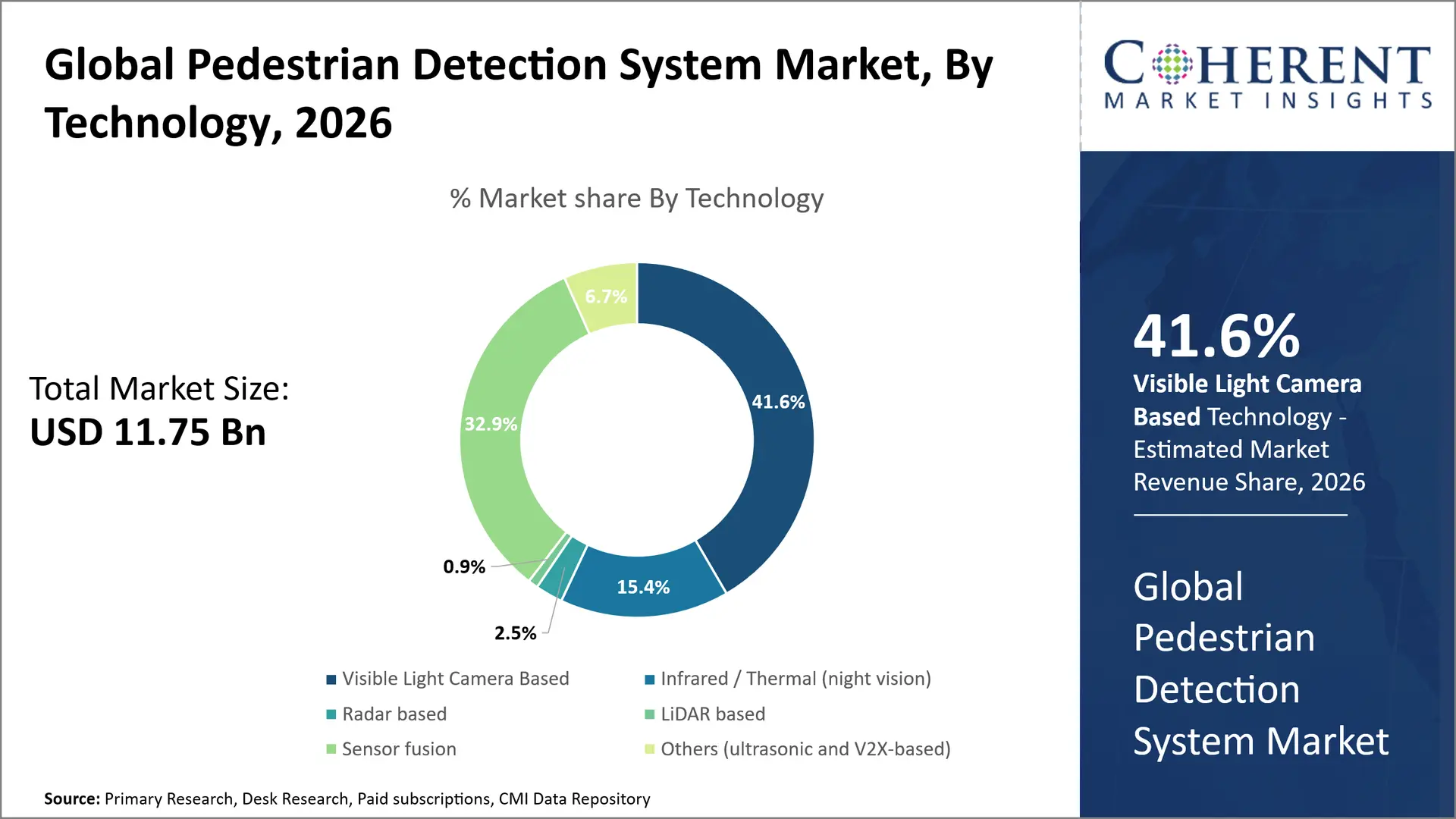
- The visible light camera-based segment is expected to account for 41.6% of the global pedestrian detection system market share in 2026. A forward camera can recognize a person by shape, posture and movement, and the same unit also reads lanes and signs, so one sensor serves several safety functions. On December 2, 2025, AUMOVIO reported a new AI-based camera system that enhances contrast so the vehicle can detect pedestrians or wildlife at the edge of dark roads, with most applications using cameras of up to 8 megapixels.
- The passenger cars segment is expected to hold 70.6% of the vehicle type segment in 2026. Automakers build their largest platform programs around passenger cars, and regulators and rating agencies test them first. On January 5, 2026, Mobileye announced that a U.S.-based automaker chose the EyeQ6H chip for Surround ADAS across millions of vehicles, and that it now expects more than 19 million EyeQ6H-based Surround systems to be delivered in total.
- The OEM segment is expected to account for 83.6% of the sales channel segment in 2026. Pedestrian detection is tied to braking controls and vehicle approval, so it is specified and validated at the factory. On May 13, 2026, Valeo announced that a leading automaker selected its VSS360 system, built around three radars and one camera, for vehicles in India, with manufacturing in Sanand, Gujarat.
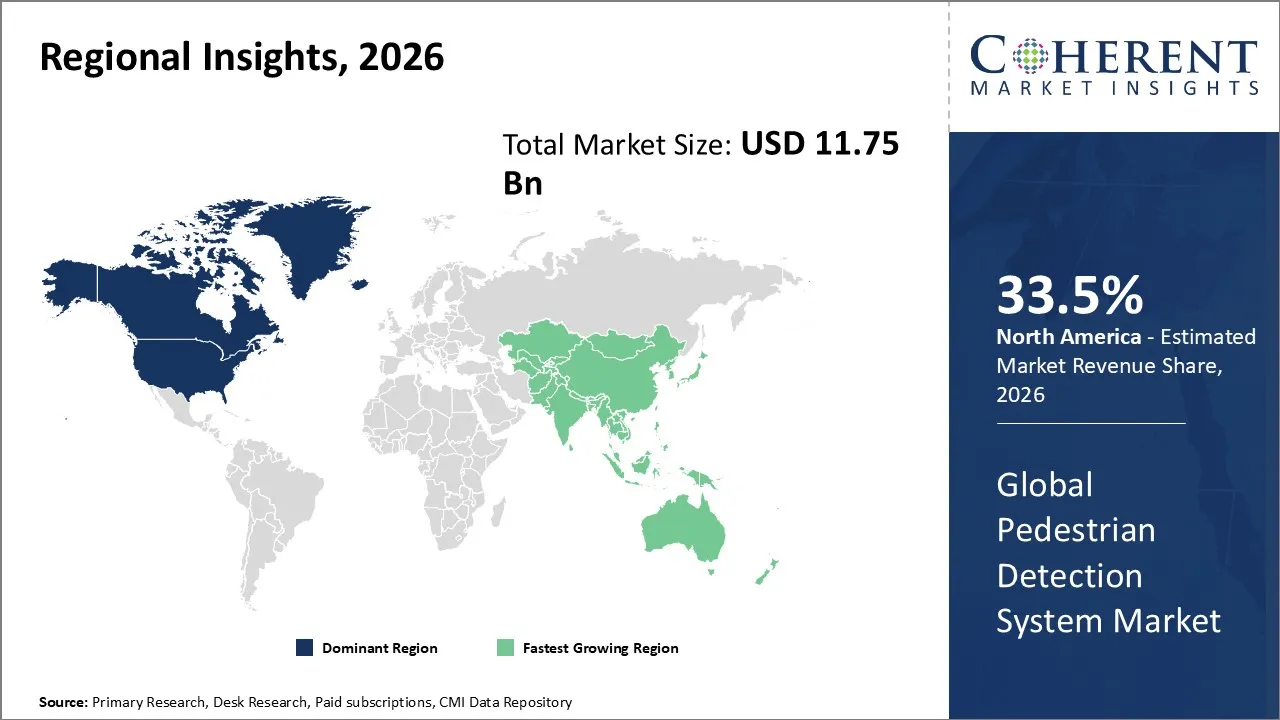
- North America is expected to dominate the pedestrian detection system market in 2026, with a share of 33.5%. The region leads on federal pedestrian-braking rule-making, with the U.S. rule due to apply to all new light vehicles from September 2029, which keeps supplier order books full ahead of the deadline. On January 5, 2026, Teledyne FLIR OEM announced Tura, the first ASIL-B longwave infrared camera developed under the ISO 26262 functional safety standard, with 640 × 512 resolution for night vision and pedestrian automatic emergency braking.
- Asia Pacific is expected to account for 27.3% share in 2026 and to be the fastest-growing region. Vehicle safety rules in China, India and Southeast Asia are moving from voluntary to mandatory. On January 6, 2026, Aptiv announced its first ADAS award from an Indian commercial vehicle maker, covering 14 models and more than 30 variants, with a camera tuned for three-wheelers, large animals and vulnerable road users.
Segmental Insights
Why Do Visible Light Camera-Based Systems Dominate the Global Pedestrian Detection System Market?
In terms of technology, visible light camera-based systems are expected to account for 41.6% of the global pedestrian detection system market share in 2026. A camera captures the shape, posture and movement of a person, which lets image-recognition software tell a pedestrian from a pole, a bin or a parked bicycle. Single-lens cameras estimate distance from the apparent size of the target, while stereo cameras compare the left and right images to measure distance directly. The software behind both is usually a trained neural network that scores each object in every frame, so detection improves as training data grows.
Suppliers are shrinking and sharpening these cameras. Hitachi Astemo describes its stereo camera as a 3D recognition sensor that detects the size, position and speed of several objects through stereoscopic processing of the left and right images. DENSO developed a compact stereo vision sensor for minicars, in which two lenses measure the distance to a pedestrian or vehicle ahead and trigger emergency braking.
- Current Industry Events of 2026
- Market Size Estimation
- Regional Breakdown
- Competitive Landscape
- Customer Intelligence
- Segmental Analysis
- Pricing Analysis
- Key Market Drivers, Challenges & Future Trends
- Customized Insights Section
Why Do Passenger Cars Lead the Vehicle Type Segment?
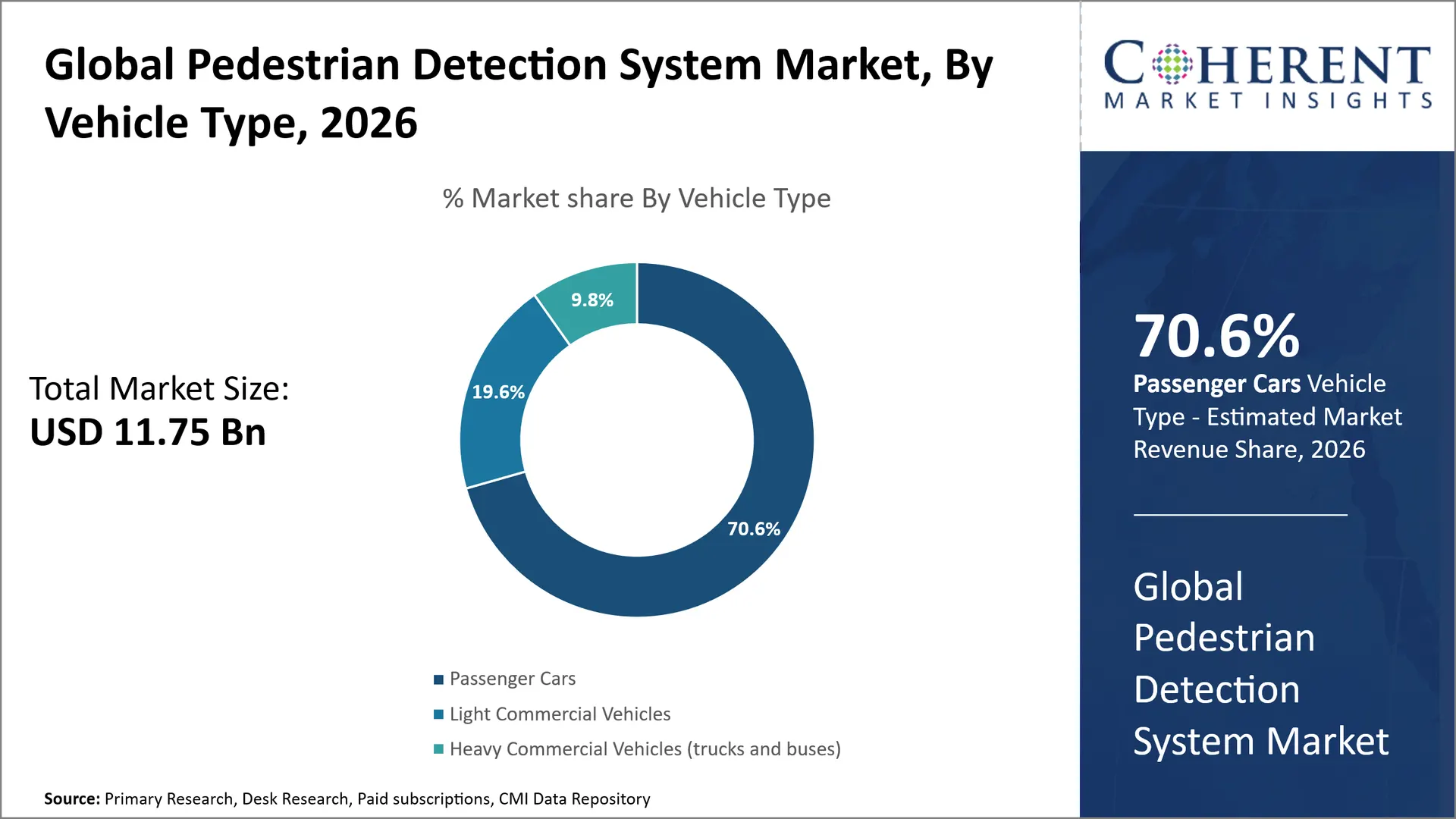
In terms of vehicle type, passenger cars are expected to account for 70.6% of the global pedestrian detection system market share in 2026. Passenger cars are the vehicles that safety ratings and type-approval rules were written for, so every new regulation reaches them first. Automakers also want one sensor set that scales from entry trims to premium trims, which favors platforms that can be switched on or expanded with software. Pedestrian detection therefore moves quickly from an option to standard equipment on new passenger car platforms.
On June 25, 2025, Valeo announced that a European premium automaker selected Valeo Smart Safety 360 for a Level 2 driving and parking system, with production set to begin in 2026. The platform integrates radar fusion into the smart front camera, scales from EU General Safety Regulation compliance up to Level 2+ functions, and is engineered to meet the U.S. FMVSS 127 standard.
Why Does the OEM Channel Lead the Sales Channel Segment?
In terms of sales channel, OEM-fitted systems are expected to account for 83.6% of the global pedestrian detection system market share in 2026. A pedestrian detection system must be wired into braking, steering and the vehicle’s electronic architecture, and it must be validated as part of the whole vehicle. Automakers therefore choose their sensor suppliers years before production starts, and contracts run for the life of a platform.
On December 11, 2025, FORVIA HELLA announced its first major series order for high-resolution radar sensors from a global premium manufacturer, with production expected to start in mid-2028. The ForWave7HD radar offers a detection range of up to 400 meters and an angular resolution better than 1°, which helps it separate individuals within groups.
Current Events and their Impact
Current Events | Description and its Impact |
EU General Safety Regulation: new mandatory systems from July 7, 2026 |
|
China mandatory standard GB 39901-2025 for automatic emergency braking (effective January 1, 2028) |
|
Pedestrian Detection System Market Dynamics
Market Drivers
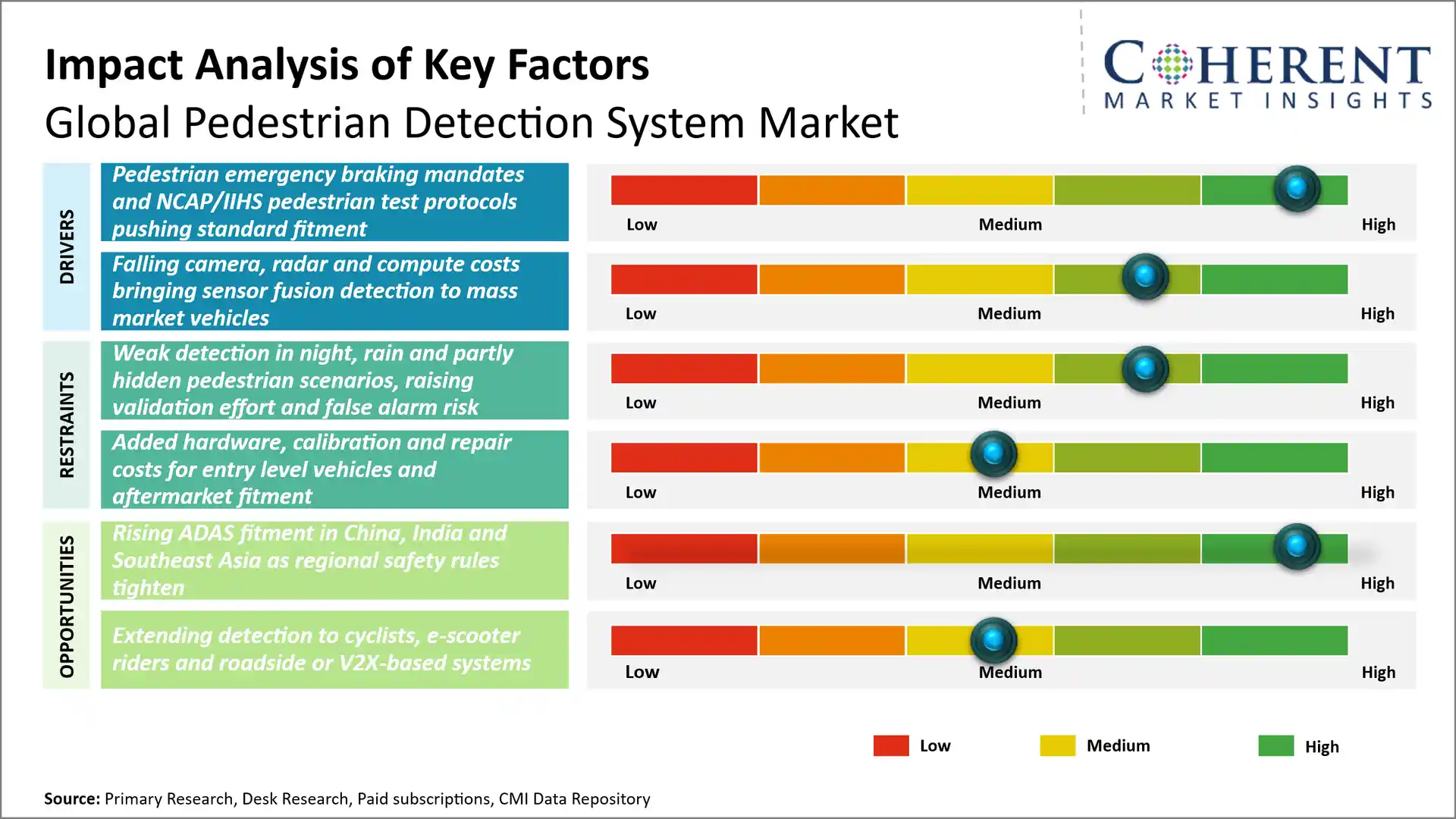
Pedestrian emergency braking mandates and NCAP/IIHS pedestrian test protocols pushing standard fitment
Pedestrian braking used to be an extra that buyers could skip. Mandates and test protocols now take that choice away, since a car that cannot detect people loses points in ratings and can fail approval. In October 2026, India’s road transport ministry published a draft notification proposing mandatory advanced emergency braking on all new M1 passenger car models from October 1, 2030 and on every M1 model from October 1, 2032.
On December 17, 2025, ASEAN NCAP reported that assessments under its 2026–2030 protocol begin in January 2026, and it gave a 5-star result to the Perodua Traz, which carries AEB Pedestrian as standard across its variants. On September 14, 2026, Bosch announced that under the EU driver-assistance rules that took effect in July 2026, the emergency braking assistant must reliably identify pedestrians and cyclists. Each rule and protocol raises the baseline, so even entry trims now ship with a camera and radar that can recognize people. Automakers lock in these sensor suppliers years ahead of launch, which gives suppliers steady, multi-year volume.
Falling camera, radar and compute costs bringing sensor fusion detection to mass market vehicles
Fusing a camera with a radar once meant two control units, extra wiring and a large processor, which kept the approach in premium cars. Suppliers are now folding that work into fewer and cheaper parts.
On June 3, 2026, Magna reported that as vehicles add cameras, radar, thermal sensing, ultrasonic sensors and LiDAR, the challenge shifts from collecting data to how it is processed, fused and acted on, and it set out centralized high-performance compute as the way to handle that fusion. The two main sensors cover each other’s weak spots: a camera gives rich visual detail but is sensitive to lighting, while radar holds up in poor conditions. A shared processor lets an automaker add the second sensor without adding a second computer. As the cost per sensor and per unit of compute falls, fused detection moves from premium models into the mainstream cars that make up most sales, and each vehicle carries more sensor and software content for suppliers.
Emerging Trends
- The front camera is becoming the compute hub for ADAS sensors: Instead of adding a separate control unit for every radar or camera, suppliers are letting the smart front camera process data from other sensors. On April 24, 2026, Valeo announced at Auto China 2026 an upgrade of Valeo Smart Safety 360 that uses the smart front camera as central compute for other ADAS sensors, allowing individual control units to be removed. The system has been in series production in China since October 2025 for a major automaker.
- Impact: Wiring and hardware cost fall, which makes a full camera-radar-ultrasonic set affordable for mass-market cars.
- Relevance to the market: This favors suppliers that own both the camera hardware and the recognition software, and it speeds adoption in price-sensitive regions.
- Higher-resolution radar is closing in on LiDAR-class detail: Radar was once used mainly for distance and speed, but new antenna designs sharpen its view of small objects. At CES 2026 in Las Vegas (January 5–9, 2026), Bosch presented its Radar Gen 7 Premium, which detects very small objects such as pallets and car tires at distances above 200 meters thanks to its antenna configuration.
- Impact: Radar can separate a person from nearby clutter earlier, and it keeps working in rain, fog and darkness.
- Relevance to the market: This supports a shift from camera-only to camera-plus-radar fitment without the cost of LiDAR.
Regional Insights
Why Does North America Lead the Global Pedestrian Detection System Market?
North America is expected to account for a market share of 33.5% in 2026. The National Highway Traffic Safety Administration reported that 7,080 pedestrians were killed and more than 71,000 were injured in U.S. traffic crashes in 2024, equal to one pedestrian death every 74 minutes. That toll has pushed federal rule-making and consumer-rating programs toward pedestrian braking, which keeps demand for higher-performing sensors strong.
Why Is Asia Pacific the Fastest-Growing Region in the Pedestrian Detection System Market?
Asia Pacific is expected to account for 27.3% of the global market in 2026 and to register the fastest growth over the forecast period. Governments across the region are writing ADAS into law, and local suppliers and global Tier-1s are racing to localize products. On February 10, 2026, Mobileye announced that it would be the exclusive “Powered By” sponsor of The ADAS Show in India on February 12, 2026, alongside the Automotive Research Association of India and the Ministry of Heavy Industries, to discuss the industry’s safety roadmap.
Global Pedestrian Detection System Market Outlook for Key Countries
Is the U.S. Driving Pedestrian Detection Adoption in North America?
The U.S. pedestrian detection system market is projected to reach USD 3.09 Bn in 2026, the largest of any country. On April 29, 2024, the U.S. Department of Transportation finalized a rule requiring automatic emergency braking, including pedestrian AEB that works in daylight and darkness and brakes automatically up to 45 mph, as standard on all new passenger cars and light trucks by September 2029. The department expects the rule to save at least 360 lives and prevent at least 24,000 injuries every year.
Is China Following Its Own Path in Asia Pacific?
China’s pedestrian detection system market is projected to reach USD 1.51 Bn in 2026, the largest in Asia Pacific. Domestic automakers fit driver assistance widely, and global suppliers are localizing for them. At Auto Shanghai in April 2025, Bosch announced that its new ADAS product family would equip the first passenger cars in China from mid-2025, and that its new multi-purpose camera would enter serial production in 2026, initially in the Chinese market.
Germany Pedestrian Detection System Market Analysis and Trends
Germany’s pedestrian detection system market is projected to reach USD 1.00 Bn in 2026. The country is the home base of four of the eleven companies profiled in this report: Bosch in Stuttgart, AUMOVIO in Frankfurt, ZF in Friedrichshafen and FORVIA HELLA in Lippstadt. Their engineering teams work close to German automakers, which shortens validation cycles for new sensors.
Japan Pedestrian Detection System Market Analysis and Trends
Japan’s pedestrian detection system market is projected to reach USD 0.55 Bn in 2026. DENSO reported in its Integrated Report 2024 that its Global Safety Package 3, which pairs millimeter-wave radar with a vision sensor, lifted accident-scenario coverage to 37% in fiscal 2023, and it targets 56% by fiscal 2026.
India Pedestrian Detection System Market Analysis and Trends
India’s pedestrian detection system market is projected to reach USD 0.29 Bn in 2026. The road transport ministry has also issued a draft notification proposing that vehicles in the L, M and N categories manufactured on or after October 1, 2028 be fitted with vehicle-to-vehicle communication systems under the AIS-230 standard, which the ministry describes as a complement to ADAS rather than a replacement.
Global Pedestrian Detection System Market – Published Sensor Specifications by Technology
Technology | How It Finds People | Published Figure or Compliance Reference | Source |
Visible light camera | Image recognition on single-lens or stereo images | Vision sensor detection angle of 128 degrees | |
Infrared / thermal | Longwave infrared imaging of body heat in the 8–14 micron band | 640 × 512 resolution; sensitivity below 50 mK (FLIR ADK) | |
Radar based | Millimeter-wave reflections give distance, direction and speed | Designed to meet UN ECE R159 (MOIS) and R151 (BSIS) for front and side VRU detection | |
LiDAR based | Laser pulses build a 3D point cloud | SCALA 3 detects obstacles over 200 meters away | |
Sensor fusion | Thermal imagery classifies the target while radar adds distance | Classes include vehicle, pedestrian and two-wheeler | |
Others (ultrasonic and V2X-based) | Ultrasonic echoes measure close-range distance; V2X radio messages announce hidden road users | Ultrasonic sensors monitor the space around the vehicle during parking and maneuvering |
How Are Truck-Trailer and Two-Wheeler Systems Creating New Growth Opportunities in the Pedestrian Detection System Market?
Commercial vehicles and two-wheelers are the two largest groups of road users that current car-focused systems barely serve. A truck driver sits high above pedestrians and cyclists near the cab, and a long trailer creates blind zones that a cab-only sensor cannot cover. Motorcycles and scooters have the opposite problem: they are the vulnerable road user, and their small frames limit what sensors can be fitted. Suppliers that solve either problem open a new product line rather than a replacement cycle.
On July 30, 2026, ZF announced a 360° safety concept for trucks and trailers that links the two through a high-speed automotive Ethernet connection called the Truck-Trailer Link, merging radar and camera data into one environmental model. Its near-field functions meet the EU requirements for the Moving Off Information System and Blind Spot Information System, and can also brake automatically to avoid or reduce the severity of collisions with vulnerable road users.
On the two-wheeler side, Valeo and Hero MotoCorp announced a partnership on January 8, 2026 to co-develop Advanced Rider Assistance Systems that use Valeo’s radar and smart camera technologies for motorcycles and scooters. The partnership has already delivered proof-of-concept systems designed to protect both riders and pedestrians.
Market Players, Key Development, and Competitive Landscape
Key Developments
- On October 14, 2026, AUMOVIO announced its new MK 120 MAB brake system for powersports vehicles at EICMA 2026 in Milan, and presented radar sensors for advanced rider assistance systems in the premium two-wheeler segment.
- On May 28, 2026, DENSO and Carnegie Mellon University announced that they will present autonomous driving research at CVPR 2026, including a method that models each vehicle, pedestrian and environmental element with its own editable representation.
- On January 5, 2026, Magna announced that it will offer NVIDIA DRIVE Hyperion-compatible electronic control units and Tier-1 integration services, supporting assisted and automated driving at Levels 2++, 3 and 4.
- On December 23, 2025, HARMAN announced a definitive agreement to acquire ZF’s ADAS business, covering compute platforms, smart cameras, radar and ADAS software functions.
- On December 11, 2025, AUMOVIO announced a trailer collision warning that uses surround-view cameras and, optionally, radar to detect pedestrians, bicycles and obstacles around a vehicle-trailer combination, with its debut at CES 2026.
Competitive Landscape
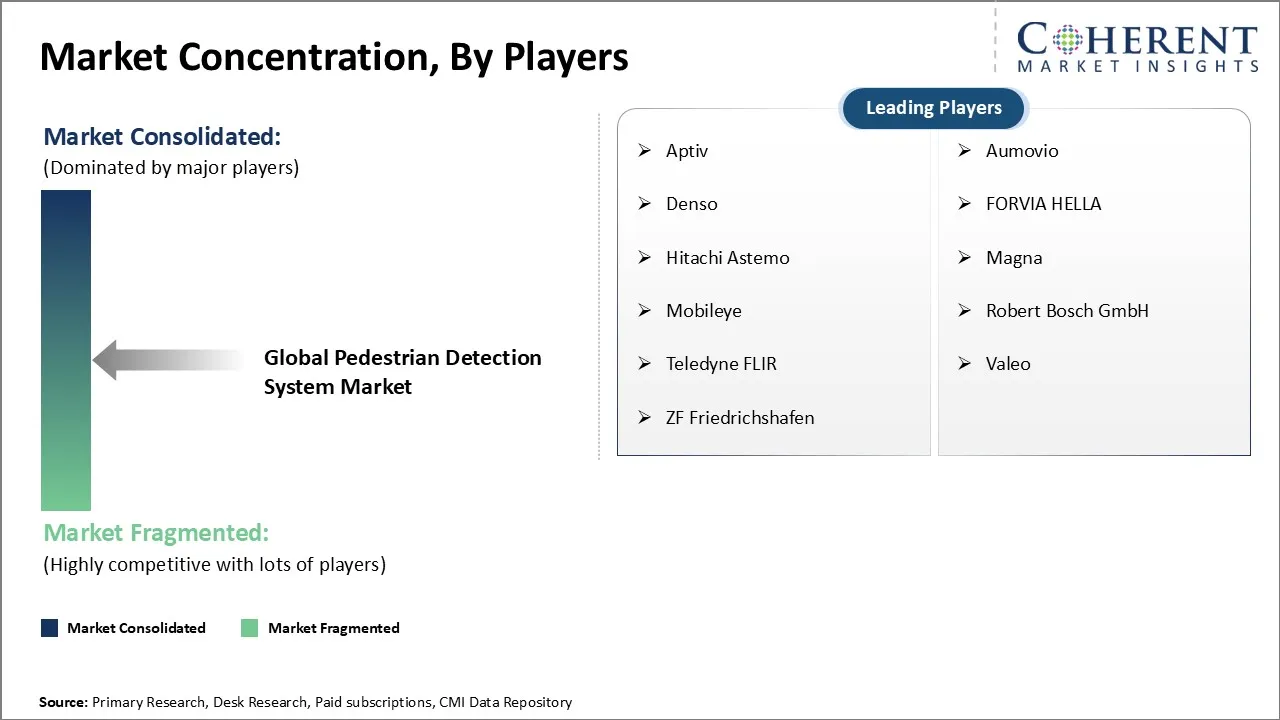
The market is moderately consolidated and shared between three groups that increasingly work together. Global Tier-1 safety suppliers such as Robert Bosch, AUMOVIO, DENSO, Valeo, ZF and Aptiv sell complete camera, radar and software packages to automakers. Sensor and silicon specialists such as Mobileye, Teledyne FLIR, FORVIA HELLA and Hitachi Astemo supply the recognition chips, thermal cameras, radars and stereo cameras that sit inside those packages. Magna combines both roles as a system integrator. Competition centers on night and bad-weather performance, the ability to detect cyclists and two-wheelers, the cost of the sensor set and the strength of the recognition software. Long qualification cycles with automakers and the safety certification each product must earn make it hard for new entrants to break in.
Top Companies and Notable Products in the Pedestrian Detection System Market:
Company | Notable Product | Key Features |
Gen 6 ADAS platform | Pairs the Gen 8 radar with a Gen 7 smart camera that uses STRADVISION vision AI | |
AI-based all-weather camera system | Modular camera portfolio with contrast-enhancing AI software for low-light driving | |
Global Safety Package 3 | Combines a millimeter-wave radar sensor and a vision sensor with a 128-degree detection angle | |
ForWave7HD radar | High-resolution radar with a range of up to 400 meters and angular resolution better than 1° | |
Stereo camera | 3D recognition sensor that measures the size, position and speed of several objects at once | |
Thermal Sensing system | Real-time thermal video that extends perception beyond headlight range to detect pedestrians, cyclists and animals | |
EyeQ6H with Surround ADAS | Single-chip platform that processes forward camera and surround sensor data for hands-free highway driving | |
Multi purpose camera and radar for automatic emergency braking on vulnerable road users | Radar with a wide opening angle spots pedestrians and cyclists early, and the camera combines AI with image processing | |
Tura thermal camera | ASIL-B longwave infrared camera with 640 × 512 resolution in an IP6K9K-rated housing | |
Valeo Smart Safety 360 | Turnkey camera, radar and ultrasonic platform that scales from basic safety to Level 2+ functions | |
OnGuardMAX Short Range Object Detection | Near-field radar that warns of vulnerable road users in blind spots and works with third-party ADAS systems |
Market Report Scope
Pedestrian Detection System Market | |||
Report Coverage | Details | ||
Base Year | 2025 | Market Size in 2026: | USD 11.75 Bn |
Historical Data For: | 2020 To 2024 | Forecast Period: | 2026 To 2033 |
Forecast Period 2026 To 2033 CAGR: | 15.6% | 2033 Value Projection: | USD 32.47 Bn |
Geographies covered: |
| ||
Segments covered: |
| ||
Companies covered: | Aptiv, Aumovio, Denso, FORVIA HELLA, Hitachi Astemo, Magna, Mobileye, Robert Bosch GmbH, Teledyne FLIR, Valeo, ZF Friedrichshafen | ||
Growth Drivers: |
| ||
Restraints & Challenges: |
| ||
Analyst Opinion (Expert Opinion)
- Cameras lead, but fused sensing is where design wins are decided. Visible light cameras hold 41.6% of technology spending in 2026 and sensor fusion holds 32.9%. The gap should narrow as rules demand detection in darkness and across cyclist and two-wheeler targets, which a camera alone handles least well. Passenger cars account for 70.6% of the vehicle type segment and OEM fitment for 83.6% of the sales channel segment, so the contest is mostly won in automaker sourcing decisions made years before a model launches. Suppliers that offer a camera, a radar and the recognition software as one validated package are best placed for those awards.
- Growth is strongest where rules are tightening, and two technical risks remain. North America holds 33.5% of the market in 2026, while Asia Pacific, at 27.3%, grows fastest as China, India and Southeast Asia move from voluntary to mandatory fitment. The first risk is detection after dark, in rain and with partly hidden pedestrians, which raises validation effort and false alarms. The second is the added hardware, calibration and repair cost on entry-level cars and aftermarket kits. Vendors that combine thermal or high-resolution radar with strong validation data are the least exposed to the first.
Speak to the analyst
Want personalized insights?
Take the findings above to one of our principal consultants, or have the report rebuilt around the segments, geographies and competitors you actually track.
Market Segmentation
- Technology Insights (Revenue, USD Billion, 2021 - 2033)
- Visible Light Camera Based
- Infrared / Thermal (night vision)
- Radar based
- LiDAR based
- Sensor fusion
- Others (ultrasonic and V2X-based)
- Vehicle Type Insights (Revenue, USD Billion, 2021 - 2033)
- Passenger Cars
- Light Commercial Vehicles
- Heavy Commercial Vehicles (trucks and buses)
- Sales Channel Insights (Revenue, USD Billion, 2021 - 2033)
- OEM fitted
- Aftermarket
- Regional Insights (Revenue, USD Billion, 2021 - 2033)
- North America
- U.S.
- Canada
- Latin America
- Brazil
- Argentina
- Mexico
- Rest of Latin America
- Europe
- Germany
- U.K.
- Spain
- France
- Italy
- Russia
- Rest of Europe
- Asia Pacific
- China
- India
- Japan
- Australia
- South Korea
- ASEAN
- Rest of Asia Pacific
- Middle East
- GCC Countries
- Israel
- Rest of Middle East
- Africa
- South Africa
- North Africa
- Central Africa
- North America
- Key Players Insights
- Aptiv
- Aumovio
- Denso
- FORVIA HELLA
- Hitachi Astemo
- Magna
- Mobileye
- Robert Bosch GmbH
- Teledyne FLIR
- Valeo
- ZF Friedrichshafen
Sources
- Primary Research Interviews
- Automotive OEM ADAS and Active Safety Engineers
- Tier-1 Sensor and ADAS Suppliers
- Automotive Radar, Camera and Thermal Imaging Component Makers
- Vehicle Safety Test Laboratories and Rating Bodies
- Fleet Operators and Aftermarket ADAS Installers
- Magazines
- Automotive News
- ADAS & Autonomous Vehicle International
- Automotive World
- EE Times
- Journals
- Accident Analysis & Prevention
- Traffic Injury Prevention
- IEEE Transactions on Intelligent Transportation Systems
- IEEE Transactions on Intelligent Vehicles
- Associations
- SAE International
- Global NCAP and Euro NCAP
- ASEAN NCAP
- European Association of Automotive Suppliers (CLEPA)Society of Indian Automobile Manufacturers (SIAM)
- Public Domain Sources
- World Health Organization: Global Status Report on Road Safety 2023
- U.S. NHTSA: Federal Motor Vehicle Safety Standard No. 127 (Automatic Emergency Braking)
- European Union: Regulation (EU) 2019/2144 (General Safety Regulation) and UN Regulation No. 152
- China MIIT: GB 39901-2025 (AEB for Light-Duty Vehicles)
- India MoRTH: Central Motor Vehicles Rules draft notifications on ADAS
- ISO 26262: Road Vehicles – Functional Safety
- ISO 19206-2: Test Devices for Target Vehicles, Vulnerable Road Users and Other Objects
- U.S. Securities and Exchange Commission (SEC): Company annual filings
- Company press releases
- Proprietary Elements
- CMI Data Analytics Tool
- Proprietary CMI Existing Repository of information for last 10 years
Get access to 250+ pages report
Every segment, forecast, competitor profile and data table behind the analysis above — available for instant download.
- ESOMAR Member
- ISO 9001:2015 Certified
- D-U-N-S Registered
- GDPR & CCPA Compliant
Frequently Asked Questions
The global pedestrian detection system market is valued at USD 11.75 Bn in 2026 and is expected to reach USD 32.47 Bn by 2033.
The CAGR of the global pedestrian detection system market is projected to be 15.6% from 2026 to 2033.
Pedestrian emergency braking mandates and NCAP/IIHS pedestrian test protocols that push standard fitment, and falling camera, radar and compute costs that bring sensor fusion detection to mass market vehicles, are the major factors driving market growth.
Weak detection in darkness and with reflective clothing, and false braking activations as detection sensitivity rises, are the major factors hampering market growth.
In terms of technology, visible light camera-based systems are expected to dominate the market, with a revenue share of 41.6% in 2026.
It is a vehicle safety function that uses sensors and recognition software to find people in or near the vehicle’s path. It warns the driver of a possible collision and, in a pedestrian automatic emergency braking (PAEB) system, applies the brakes if the driver does not react.
A typical system combines a forward camera, often with up to 8 megapixels, with a front radar, and sometimes adds a thermal camera or LiDAR. An electronic control unit runs the recognition software, and the brake controller carries out the stop.