

Global PEM Electrolyzers Market Size and Forecast – 2026 To 2033
The Global PEM Electrolyzers Market is estimated to be valued at USD 1,462.4 Mn in 2026 and is expected to reach USD 3,614.6 Mn by 2033, exhibiting a compound annual growth rate (CAGR) of 13.8% from 2026 to 2033. Expansion will be supported by renewable-power integration, industrial decarbonization commitments, green hydrogen incentives, and increasing deployment across chemicals, refining, steel, mobility, and energy storage.
PEM systems are gaining commercial relevance because their rapid response, compact footprint, and high-purity hydrogen output suit variable wind and solar electricity. In July 2024, Siemens Energy secured a contract from German utility EWE to supply a 280 MW PEM electrolysis system in Emden, scheduled to produce up to 26,000 metric tons of green hydrogen annually for regional industrial applications.
Key Takeaways of the Global PEM Electrolyzers Market
- Above 10 MW to 100 MW capacity segment is expected to hold 35.4 % of the global PEM electrolyzers market in 2026 because modular multi-megawatt systems balance industrial output with manageable financing, permitting, and construction risk. In May 2026, Plug Power confirmed final investment decision for a 30 MW GenEco PEM electrolyzer project supplying green hydrogen to Kimberly-Clark’s Barrow facility.
- The electrolyzer stack segment is expected to account for 46.2 % of the market share in 2026 because membranes, catalysts, bipolar plates, and cell architecture largely determine efficiency, durability, output, and replacement economics. In March 2025, Bosch introduced its Hybrion PEM stacks, secured orders totaling about 100 MW before commercial launch, and prepared manufacturing at its Bamberg facility.
- The on-site and distributed systems segment is expected to capture 53.6 % of the market share in 2026 because producing hydrogen near factories, fueling assets, or renewable generation reduces transport exposure and enables users to match output with operational requirements. In March 2023, Toyota installed a PEM electrolysis system at DENSO Fukushima to produce hydrogen locally for use in a plant gas furnace.
- Europe is expected to account for 35.6 % of the market share in 2026 as binding decarbonization rules, hydrogen auctions, industrial offtake programs, and domestic equipment manufacturing improve project bankability. In March 2026, the European Commission reported that its latest Hydrogen Bank auction attracted 58 bids, representing 4.3 GW of proposed electrolyzer capacity.
- Asia Pacific is expected to hold 30.2 % of the market share in 2026 while expanding the fastest as Japan, China, India, Australia, and South Korea build hydrogen supply chains, local manufacturing, and renewable-linked demonstration projects. In March 2024, ITM Power and Sumitomo completed the installation of a megawatt-class PEM electrolyzer at Tokyo Gas’s Yokohama Techno Station for e-methane development.
- Iridium-Efficient Stack Engineering and Catalyst Optimization: Manufacturers are prioritizing catalyst-thrifting, thinner coatings, recyclable materials, and longer stack life to reduce exposure to scarce precious metals. This will shift investment toward proprietary membrane-electrode assemblies, advanced coating processes, and recovery partnerships. Suppliers proving durability with lower catalyst loading can improve project economics, secure strategic customers, and differentiate beyond headline electrolyzer capacity.
- Standardized Modular Plant Platforms for Scalable Deployment: PEM electrolyzer suppliers are increasingly designing repeatable modules that can be combined across industrial sites rather than engineering every project from the ground up. Standardization can shorten delivery cycles, simplify certification, improve serviceability, and support phased capacity additions. Competition will increasingly depend on integrated power electronics, water treatment, controls, maintenance contracts, and predictable lifecycle performance.
Segmental Insights
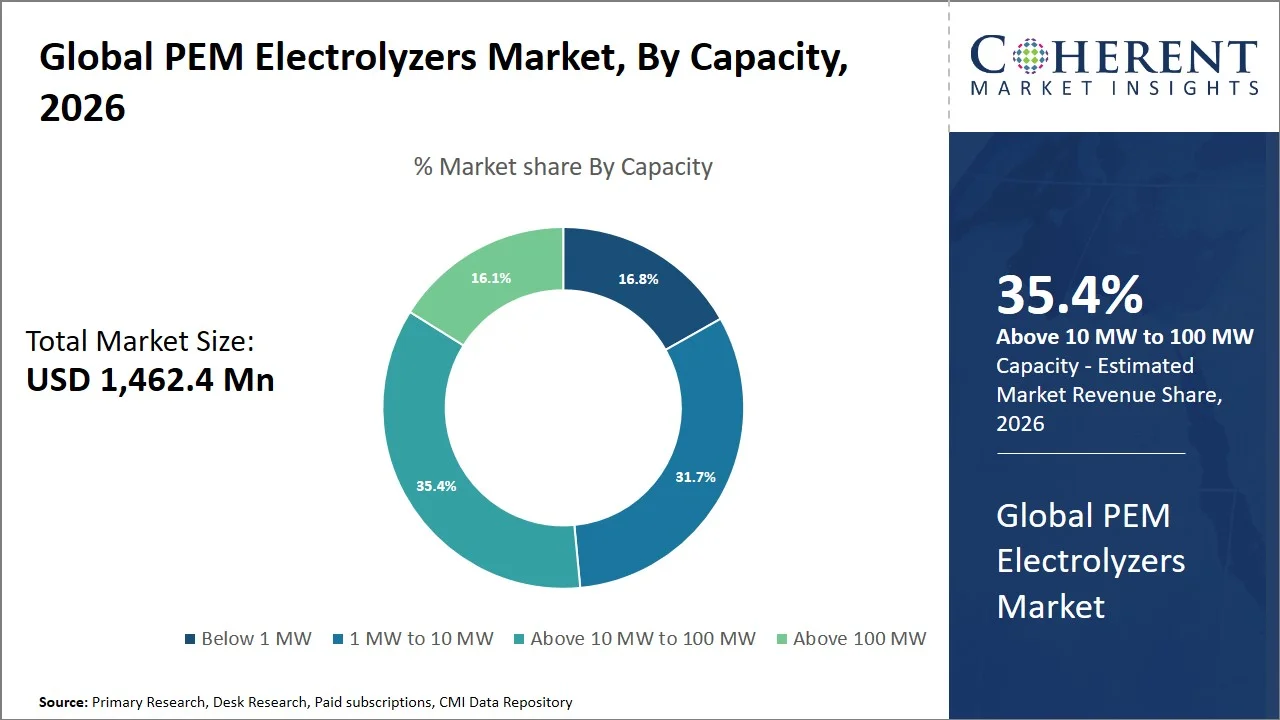
Why Does Above 10 MW to 100 MW Dominate the Global PEM Electrolyzers Market?
The above 10 MW to 100 MW segment is expected to account for 35.4% of the global PEM electrolyzers market in 2026 because it offers industrial-scale hydrogen output without the financing and construction complexity of very large centralized plants. Multi-stack configurations allow developers to phase investment, standardize balance-of-plant equipment, and align capacity with confirmed demand from ammonia, refining, chemicals, and renewable-fuel facilities. This range also supports direct integration into existing industrial sites, where hydrogen pipelines, utilities, storage, and skilled operators are already available. For manufacturers and EPC contractors, repeatable modules improve procurement visibility and reduce project-specific engineering. In June 2024, Yara opened a 24 MW renewable hydrogen plant at Herøya, Norway; Yara’s official project documentation identifies the facility as a PEM electrolysis installation supplying lower-emission ammonia and fertilizer production.
- Current Industry Events of 2026
- Market Size Estimation
- Regional Breakdown
- Competitive Landscape
- Customer Intelligence
- Segmental Analysis
- Pricing Analysis
- Key Market Drivers, Challenges & Future Trends
- Customized Insights Section
Why Does the Electrolyzer Stack Segment Represent the Largest Component in the Global PEM Electrolyzers Market?
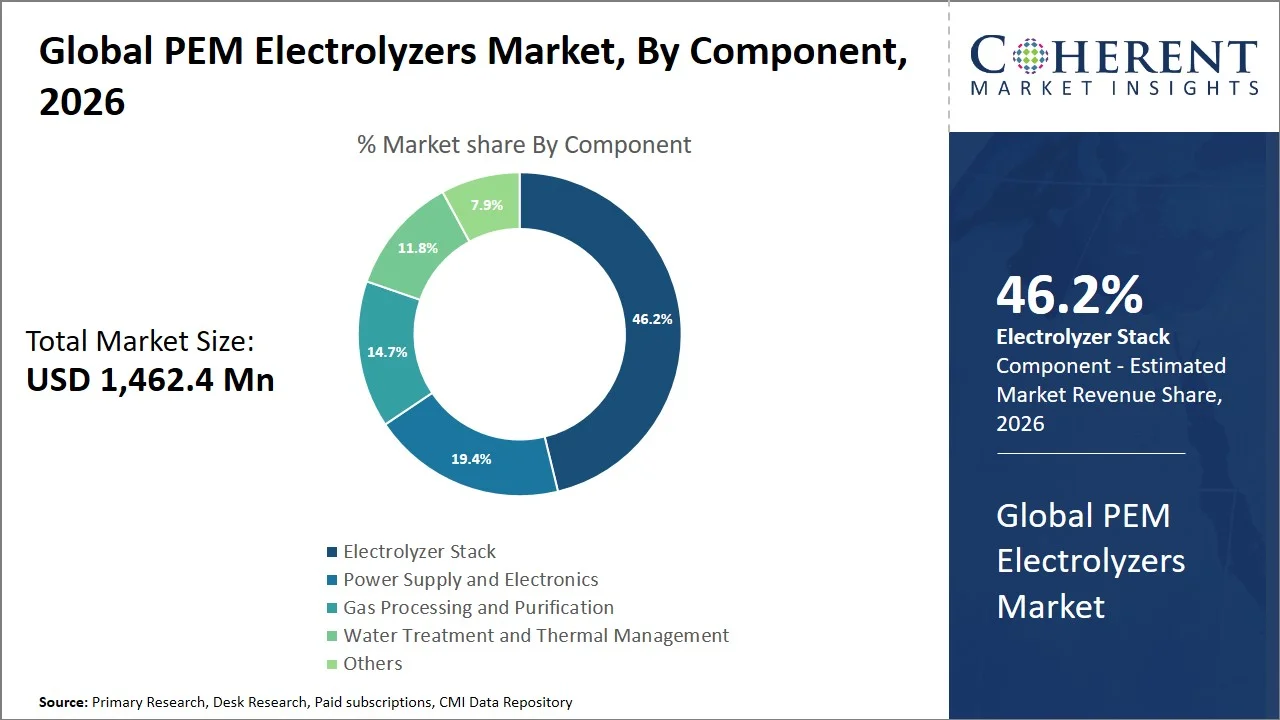
The electrolyzer stack segment is expected to hold 46.2% of the global PEM electrolyzers market in 2026 because the stack contains the membrane-electrode assembly, catalysts, porous transport layers, bipolar plates, seals, and cells that determine conversion efficiency, hydrogen purity, operating pressure, degradation, and replacement cost. Stack design therefore has the greatest influence on lifetime hydrogen output and warranty risk, making it the central value pool for OEMs and component suppliers. Industrial customers increasingly assess catalyst loading, membrane durability, current density, and cycling performance before approving a platform. This favors companies with proprietary materials, automated assembly, and validated testing capability. In February 2024, Toshiba and Bekaert signed a global partnership and manufacturing-technology license for PEM electrolyzer membrane-electrode assemblies, combining porous transport layer expertise with technology designed to reduce iridium use by 90%.
Why Do On-site and Distributed Systems Dominate the Deployment Type Segment of the Global PEM Electrolyzers Market?
On-site and distributed systems are expected to capture 53.6% of the global PEM electrolyzers market in 2026 because producing hydrogen close to consumption reduces exposure to tube-trailer logistics, compression losses, delivery interruptions, and regional hydrogen-price premiums. Modular PEM units can be installed beside industrial processes, microgrids, renewable assets, laboratories, and mobility infrastructure, allowing output to follow local electricity availability and customer demand. Users also retain greater control over hydrogen purity, pressure, inventory, and carbon-accounting records. Suppliers benefit from shorter deployment cycles, repeatable containerized designs, and recurring maintenance contracts, while customers can expand capacity in stages. In December 2024, Ohmium and Spirare Energy announced successful green hydrogen production at NTPC’s NETRA campus microgrid in India, where an on-site PEM electrolyzer uses solar power and stored hydrogen supports continuous campus electricity through fuel cells.
Current Events and their Impact
Current Event | Description and Its Impact |
January 2025 – U.S. Finalizes Section 45V Clean Hydrogen Tax-Credit Rules |
|
April 2025 – India Introduces Green Hydrogen Certification Scheme |
|
February 2025 – Australia Advances Renewable Hydrogen Production Incentive |
|
Global PEM Electrolyzers Market Dynamics
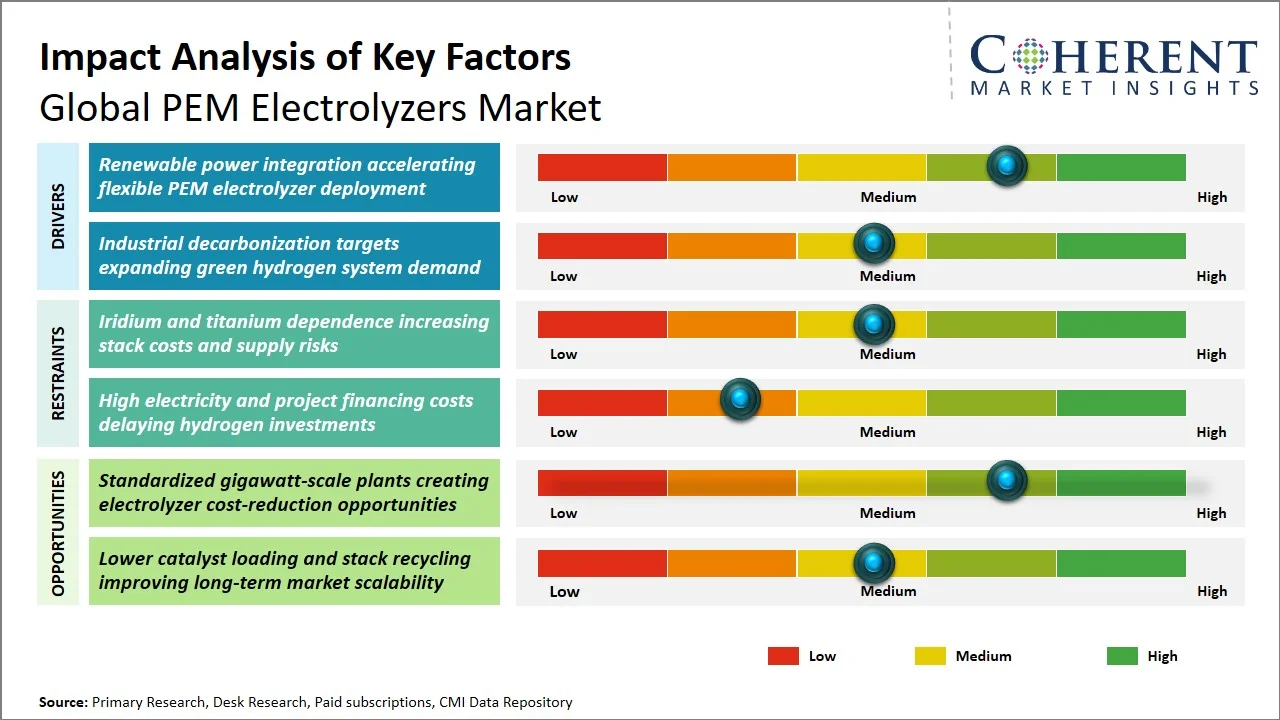
Key Market Drivers
- Renewable Power Integration Accelerates Flexible PEM Electrolyzer Deployment: Renewable-power integration is accelerating PEM electrolyzer deployment because the technology can ramp rapidly, operate across partial-load conditions, and absorb electricity that varies with wind and solar output. This flexibility enables developers to reduce curtailment exposure, optimize power-purchase agreements, and produce hydrogen when marginal electricity costs are favorable. Renewable generators, project developers, power-electronics suppliers, and industrial hydrogen users benefit as electrolysis becomes a controllable load rather than a continuously operating baseload asset. Commercial value increasingly depends on integrated controls, dynamic operating warranties, and grid-service compatibility, not solely nominal stack efficiency. In August 2024, Air Liquide officially inaugurated its 20 MW Trailblazer PEM electrolyzer in Oberhausen, Germany; the unit is connected to the company’s hydrogen pipeline network and supplies renewable hydrogen to industrial and mobility customers, demonstrating flexible PEM deployment within an established energy system.
- Industrial Decarbonization Converts Hydrogen Targets into Equipment Orders: Industrial decarbonization targets are converting green hydrogen from a demonstration input into a procurement requirement for chemicals, refining, steel, and specialty manufacturing. PEM systems are commercially attractive where users need high-purity hydrogen, compact installation, responsive operation, and direct integration with renewable electricity. The demand mechanism extends beyond emissions reduction: replacing fossil-derived hydrogen can protect export access, support lower-carbon product premiums, and help customers meet value-chain reporting obligations. Electrolyzer OEMs, EPC contractors, stack-component suppliers, renewable-power developers, and industrial gas companies gain when projects are linked to credible offtake and existing hydrogen infrastructure. In March 2025, BASF commissioned a 54 MW PEM water electrolyzer at its Ludwigshafen chemical complex, integrating the unit into site production and infrastructure to supply hydrogen for lower-carbon chemical manufacturing and selected mobility applications.
Emerging Market Trends
- Operating-Profile Validation Reshapes Electrolyzer Procurement: Buyers are moving beyond nameplate efficiency to evaluate PEM electrolyzers under variable renewable-power conditions, including cycling degradation, minimum-load operation, restart frequency, pressure response, and hydrogen purity. Suppliers offering integrated performance validation, lifetime-output modelling, and operating guarantees will gain an advantage in project financing, while manufacturers relying only on steady-state test results may face longer qualification cycles.
- Oxygen and Heat Utilization Strengthen Project Economics: PEM projects are increasingly designed to commercialize oxygen and recoverable heat alongside hydrogen. Co-location with wastewater treatment, metals, glass, aquaculture, healthcare-gas, or chemical facilities can improve overall returns and influence project siting. This will encourage suppliers to offer configurable purification, compression, and heat-recovery systems, while stand-alone projects without nearby co-product users may face weaker economics.
Regional Insights
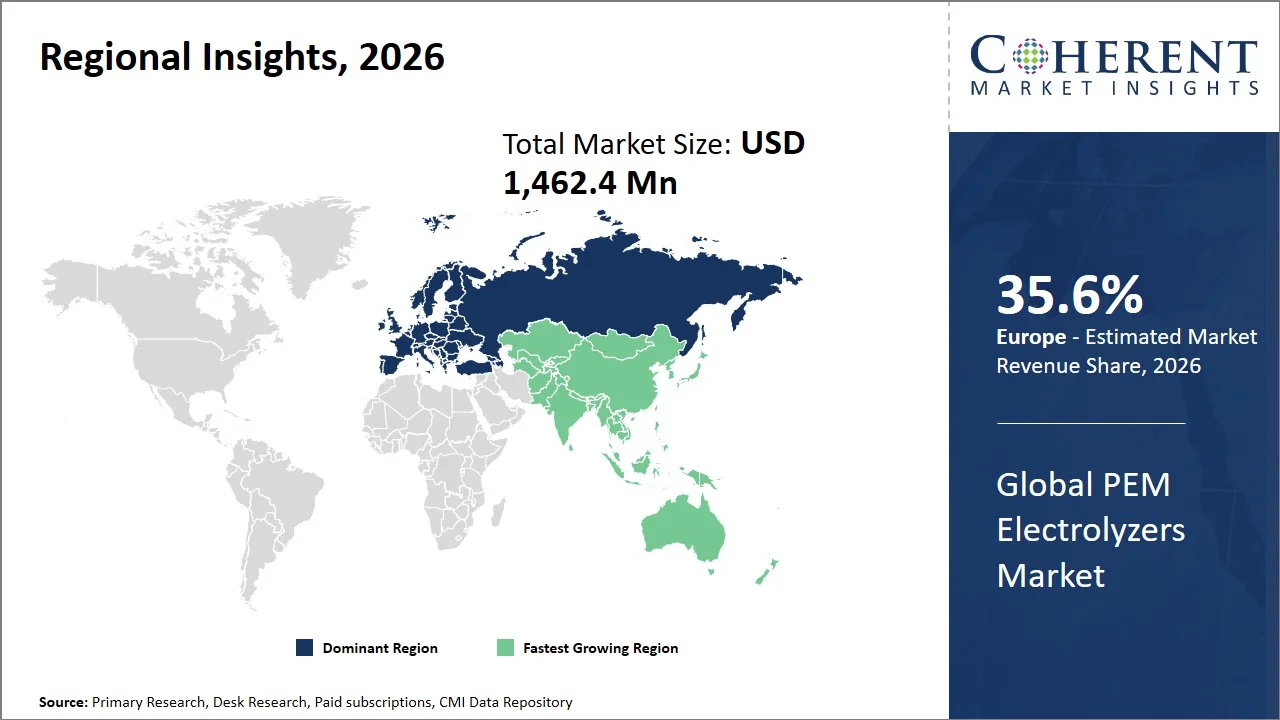
Why Does Europe Dominate the Global PEM Electrolyzers Market?
Europe is expected to lead the global PEM electrolyzers market with a 35.6% share in 2026 because policy-backed hydrogen demand is concentrated across refining, chemicals, steel, mobility, and renewable-fuels projects. The region also combines established electrolyzer engineering, membrane and catalyst expertise, cross-border hydrogen infrastructure planning, and binding rules for renewable hydrogen qualification. These conditions improve supplier access to industrial offtakers while encouraging domestic stack manufacturing and project finance.
Europe’s advantage is therefore based on the interaction of equipment capability, regulated demand, and infrastructure rather than project announcements alone. In July 2026, the European Investment Bank provided USD 511.25 million to OMV for a 140 MW renewable-powered hydrogen facility in Austria, intended to supply the Schwechat refinery. The financing illustrates how institutional capital is helping large electrolysis projects move into construction and creating bankable demand for electrolyzer systems and balance-of-plant equipment.
Why is Asia Pacific Emerging as the Fastest-Growing Region in the Global PEM Electrolyzers Market?
Asia Pacific is expected to account for 30.2% of the global PEM electrolyzers market in 2026 and emerge as the fastest-growing region as governments connect renewable generation, hydrogen mobility, industrial decarbonization, and domestic equipment manufacturing. China provides scale in components and project deployment, while Japan and South Korea strengthen certification, demonstration, and hydrogen-use infrastructure. Australia adds low-cost renewable resources and research funding for next-generation electrolysis materials. This varied ecosystem creates demand for distributed PEM units and larger modular plants while encouraging localization of membranes, catalysts, power electronics, and system integration. In April 2024, the Australian Renewable Energy Agency awarded USD 1.60 million to a Monash University-led project developing noble-metal-free catalysts, conductive membranes, and porous transport layers for lower-cost proton-exchange water electrolysis. The program supports technology commercialization and reinforces regional investment in PEM cost reduction.
Global PEM Electrolyzers Market Outlook for Key Countries
Why is South Korea a Key Market for the Global PEM Electrolyzers Market?
South Korea is becoming an important PEM electrolyzers market because its hydrogen strategy links domestic equipment production with mobility, power generation, industrial clusters, and renewable-energy integration. Large conglomerates can coordinate electrolyzer manufacturing, project finance, engineering, and downstream hydrogen use, while certification requirements encourage suppliers to adapt systems to Korean safety and performance standards. The country’s constrained land area also favors compact, responsive PEM installations that can operate near industrial and transport demand centers. Localization is commercially important because it reduces import exposure and provides faster maintenance support for critical equipment. In February 2026, Hyundai Motor Group announced an agreement with the South Korean government and Jeonbuk State to develop a Saemangeum innovation hub that includes a 200 MW-class PEM electrolyzer plant. The planned facility would establish domestic large-scale production capability and create demand for Korean stack components, power systems, construction services, and hydrogen offtake infrastructure.
Why Does China Support Growth in the Global PEM Electrolyzers Market?
China supports expansion of the global PEM electrolyzers market through large renewable-energy bases, extensive equipment manufacturing, and industrial demand from chemicals, refining, metals, and heavy transport. Domestic suppliers are developing membranes, low-iridium catalysts, large-area membrane-electrode assemblies, stacks, and modular systems, enabling tighter control over cost and delivery schedules. PEM technology is particularly relevant in projects combining wind and solar because rapid load response can complement variable generation. National technical standards are also becoming important for comparing performance and qualifying suppliers. In March 2024, China Huadian commissioned a 200 MW renewable-powered hydrogen demonstration in Baotou that included five PEM units alongside larger alkaline electrolyzers. The project connected production, storage, transport, and vehicle use, showing how PEM equipment can be deployed within hybrid technology configurations where operational flexibility is valued even when alkaline systems provide most base production.
Why is Germany a Strategic Country in the Global PEM Electrolyzers Market?
Germany is a strategic country in the global PEM electrolyzers market because it combines advanced mechanical engineering, chemical and refining demand, renewable-power procurement, and a growing hydrogen transport framework. Domestic buyers require systems capable of industrial duty cycles, verifiable efficiency, high hydrogen purity, and long-term service support, which favors technically established stack and balance-of-plant suppliers. Germany also serves as a manufacturing and demonstration base from which electrolyzer companies can address wider European projects. Connections between production clusters, storage sites, import corridors, and large consumers should reduce the risk that new electrolysis assets remain isolated. In October 2024, Bundesnetzagentur approved Germany’s 9,040-kilometre hydrogen core network, with expected investment of USD 21.47 billion and phased operation through 2032. This infrastructure pathway improves the commercial outlook for PEM projects by widening potential offtake and enabling hydrogen movement beyond individual production sites.
Why is the U.S. a Key Market for the Global PEM Electrolyzers Market?
The U.S. is a key market for PEM electrolyzers because it combines industrial hydrogen consumption, renewable-power development, advanced electrochemistry research, and federal support for domestic manufacturing. Refineries, ammonia producers, specialty-gas users, data-center energy developers, and hydrogen-fueling projects provide multiple demand routes. The country also has suppliers covering stacks, membranes, catalysts, rectifiers, compression, purification, and engineering services, allowing projects to source more of the system domestically. Commercial growth will depend on electricity contracting, incentive compliance, credible offtake, and field-proven degradation performance. In March 2024, the U.S. Department of Energy selected 52 projects across 24 states for USD 750 million in funding to advance clean-hydrogen electrolysis, manufacturing, and recycling. The program directly strengthens PEM-related component innovation, production scale, material recovery, and supplier qualification, reducing reliance on imported equipment and improving the country’s long-term project-delivery capability.
Why is Japan an Important Growth Market for the Global PEM Electrolyzers Market?
Japan is an important PEM electrolyzer growth market because its hydrogen policy emphasizes secure supply, industrial decarbonization, mobility, and power-to-gas demonstration under limited domestic energy resources. PEM systems suit Japanese applications requiring compact installation, high-purity output, rapid response, and close coupling with solar or other variable renewable power. The country’s engineering, materials, and precision-manufacturing base also supports the development of membranes, catalysts, controls, and high-quality stack components. However, commercialization depends on narrowing the cost gap between low-carbon hydrogen and conventional fuels and establishing reliable demand contracts. In May 2024, Japan enacted the Hydrogen Society Promotion Act, creating support mechanisms for low-carbon hydrogen supply and utilization in hard-to-abate sectors. The policy gives developers and industrial users a clearer framework for project support, encouraging PEM electrolyzer procurement for chemicals, mobility, distributed energy, and renewable-power demonstration projects.
Technology Adoption Landscape in the Global PEM Electrolyzers Market
Technology | Adoption Level | Key Application Area | Business Impact |
Automated Catalyst-Coated Membrane Manufacturing | Medium | High-volume membrane-electrode assembly production | Improves coating consistency, reduces manufacturing variation, and supports scalable stack production. |
Reinforced PFSA Proton Exchange Membranes | High | Industrial PEM stacks operating under differential pressure | Improves mechanical durability, proton conductivity, and resistance to repeated operating cycles. |
Coated Titanium Porous Transport Layers | Medium | Anode-side water distribution and gas removal | Enhances corrosion resistance, electrical contact, mass transport, and long-term cell performance. |
High-Efficiency Modular Rectifiers | High | Conversion of grid or renewable AC power into controlled DC supply | Reduces conversion losses and supports responsive operation under changing electricity availability. |
Closed-Loop Water Polishing and Thermal Management | High | Feedwater purification, stack cooling, and heat control | Protects membranes and catalysts while improving operating stability and equipment lifetime. |
Hydrogen Drying and Purification Systems | High | Refining, chemicals, mobility, and specialty-gas applications | Delivers application-specific hydrogen purity and pressure while reducing downstream treatment requirements. |
How are Stack Refurbishment and Material Recovery Creating New Opportunities in the Global PEM Electrolyzers Market?
Stack refurbishment, remanufacturing, and precious-metal recovery could become a valuable aftermarket opportunity as the installed PEM electrolyzer base matures. Operators will need alternatives to full stack replacement when membranes, catalyst layers, seals, porous transport components, or balance-of-stack assemblies degrade at different rates. Suppliers can capture this opportunity through condition-based inspection, standardized exchange programs, certified remanufactured stacks, material recovery, and performance requalification. The model is relevant to industrial plants, distributed hydrogen sites, mobility hubs, and remote systems where downtime and replacement lead times materially affect hydrogen cost. Participation requires diagnostic data access, safe disassembly processes, traceable component handling, catalyst-recovery partnerships, and warranties for restored equipment. Established OEMs have an advantage through design knowledge and installed-base relationships, but specialist service companies and materials recyclers can compete through multi-brand capabilities. A credible circular aftermarket would reduce lifecycle costs, improve supply resilience, and create recurring revenue beyond initial equipment sales. This would also support customer circularity targets and regional material-security objectives.
Market Players, Key Development, and Competitive Landscape
Key Developments
- In May 2026, Ohmium and InSolare Energy announced a 4 MW PEM green hydrogen project for NLC India Limited in Tamil Nadu. The installation is planned to support power-generation, industrial, and mobility applications. This is important because it illustrates how modular PEM systems can be integrated with local EPC capabilities and renewable infrastructure to serve several hydrogen demand categories from one production asset.
- In March 2025, Nel Hydrogen received an approximately USD 6 million order from Collins Aerospace for PEM electrolyzer stacks used by the U.S. Navy to generate oxygen for submarine life-support systems. This is important for the global PEM electrolyzers market because it demonstrates the technology’s relevance in high-reliability specialty applications where manufacturing quality, durability, and long-term stack supply are critical.
- In March 2025, Accelera by Cummins and GAIL signed an agreement to explore green hydrogen production, blending, transportation, and storage in India. The collaboration followed commissioning of GAIL’s Vijaipur plant using a 10 MW HyLYZER PEM system. This is important because it links electrolyzer deployment with established gas infrastructure and broadens commercial pathways across power, transport, steel, and industrial hydrogen applications.
Competitive Landscape
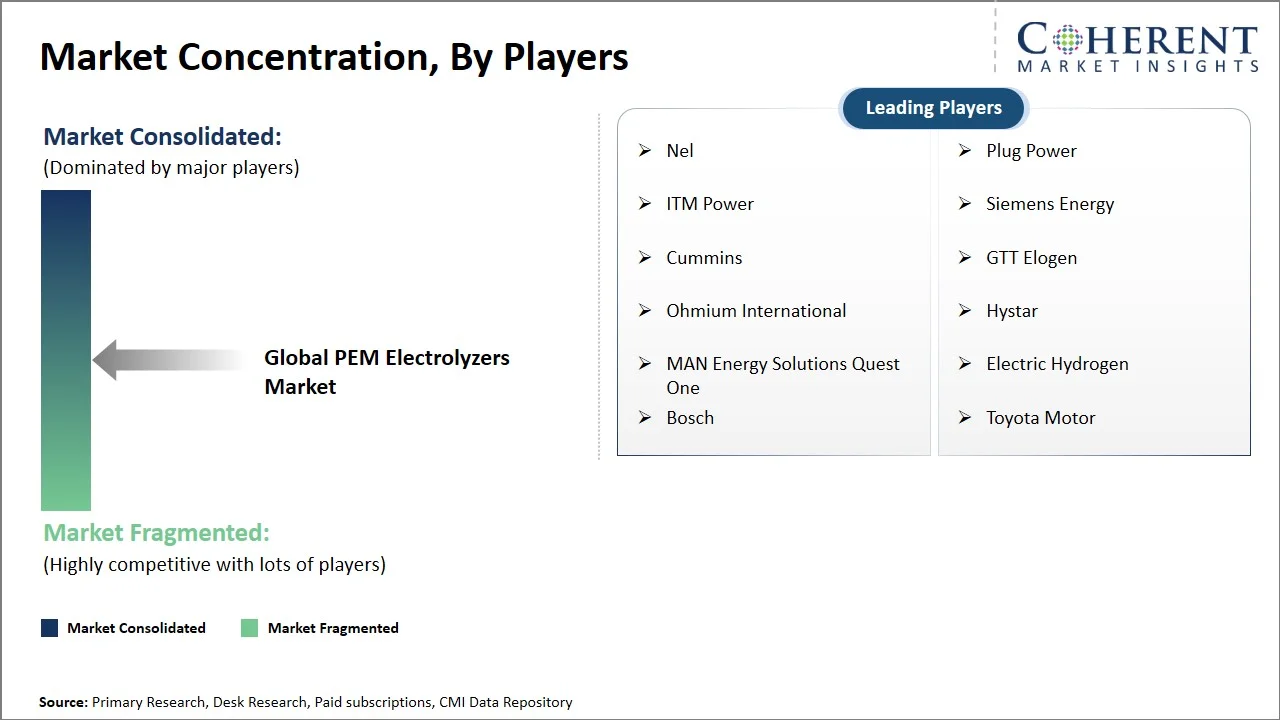
The global PEM electrolyzers market is moderately consolidated, particularly in proprietary stack technology, while system integration, EPC execution, power conversion, water treatment, and project services remain more fragmented. Global OEMs compete with hydrogen specialists, industrial gas companies, power-equipment manufacturers, and regional integrators. Competition increasingly depends on lifetime hydrogen output, degradation control, bankable warranties, project execution, local service availability, and supply-chain reliability rather than nominal equipment capacity alone.
Key focus areas include
- Stack performance: Efficiency must be balanced with cycling durability, pressure capability, hydrogen purity, and operating flexibility.
- Bankability: Customers favor suppliers with proven installations, enforceable warranties, and credible long-term service capacity.
- Delivered hydrogen cost: Equipment pricing is evaluated alongside electricity conversion, degradation, maintenance, and replacement expenditure.
- Project execution: Standard engineering, commissioning expertise, and integration with utilities reduce schedule and cost escalation.
- Supply-chain security: Access to membranes, catalysts, titanium components, electronics, and qualified manufacturing capacity influences delivery reliability.
- Localization: Regional assembly, domestic content, local certification, and nearby maintenance teams support public funding and customer qualification.
- Customer relationships: Early engineering involvement and performance-based service agreements strengthen supplier retention throughout the project lifecycle.
Market Report Scope
PEM Electrolyzers Market Report Coverage
| Report Coverage | Details | ||
|---|---|---|---|
| Base Year: | 2025 | Market Size in 2026: | USD 1,462.4 Mn |
| Historical Data for: | 2020 To 2024 | Forecast Period: | 2026 To 2033 |
| Forecast Period 2026 to 2033 CAGR: | 13.8% | 2033 Value Projection: | USD 3,614.6 Mn |
| Geographies covered: |
| ||
| Segments covered: |
| ||
| Companies covered: | Nel, Plug Power, ITM Power, Siemens Energy, Cummins, GTT Elogen, Ohmium International, Hystar, MAN Energy Solutions Quest One, Electric Hydrogen, Bosch, and Toyota Motor | ||
| Growth Drivers: |
| ||
| Restraints & Challenges: |
| ||
Analyst Opinion (Expert Opinion)
- Competitive leadership will migrate from equipment suppliers offering megawatt capacity toward partners accepting responsibility for hydrogen availability, energy consumption, degradation, and scheduled maintenance. Customers will expect integrated guarantees across stacks, power electronics, water systems, controls, and service. Suppliers capable of pricing and managing operating risk should capture stronger customer relationships and recurring revenue.
- Stack intellectual property may become increasingly separated from plant manufacturing and regional assembly. Licensing, qualified contract production, and standardized interface models could allow technology owners to enter more countries without constructing wholly owned factories. This would pressure vertically integrated models while favoring companies with defensible designs, rigorous quality control, and strong partner-governance capabilities.
- Suppliers should prioritize reference projects with contracted hydrogen offtake, dependable renewable electricity, and financially credible customers. Investment is required in stack validation, local service teams, second-source qualification, and lifecycle data. Companies should avoid speculative manufacturing expansion unsupported by bankable orders, while monitoring incentive changes, iridium exposure, project delays, and customer requests for increasingly aggressive performance guarantees.
Speak to the analyst
Want personalized insights?
Take the findings above to one of our principal consultants, or have the report rebuilt around the segments, geographies and competitors you actually track.
Market Segmentation
- Capacity Insights (Revenue, USD Mn, 2021 - 2033)
- Below 1 MW
- 1 MW to 10 MW
- Above 10 MW to 100 MW
- Above 100 MW
- Component Insights (Revenue, USD Mn, 2021 - 2033)
- Electrolyzer Stack
- Power Supply and Electronics
- Gas Processing and Purification
- Water Treatment and Thermal Management
- Others
- Deployment Type Insights (Revenue, USD Mn, 2021 - 2033)
- On site and Distributed Systems
- Centralized Hydrogen Plants
- End User Insights (Revenue, USD Mn, 2021 - 2033)
- Chemicals and Refining
- Power and Energy Storage
- Mobility and Hydrogen Fueling
- Steel and Metals
- Electronics and Specialty Gases
- Others
- Regional Insights (Revenue, USD Mn, 2021 - 2033)
- North America
- U.S.
- Canada
- Latin America
- Brazil
- Argentina
- Mexico
- Rest of Latin America
- Europe
- Germany
- U.K.
- Spain
- France
- Italy
- Russia
- Rest of Europe
- Asia Pacific
- China
- India
- Japan
- Australia
- South Korea
- ASEAN
- Rest of Asia Pacific
- Middle East
- GCC Countries
- Israel
- Rest of Middle East
- Africa
- South Africa
- North Africa
- Central Africa
- North America
- Key Players Insights
- Nel
- Plug Power
- ITM Power
- Siemens Energy
- Cummins
- GTT Elogen
- Ohmium International
- Hystar
- MAN Energy Solutions Quest One
- Electric Hydrogen
- Bosch
- Toyota Motor
Sources
Primary Research Interviews
- PEM electrolyzer manufacturers, electrolyzer stack manufacturers, membrane-electrode assembly suppliers, catalyst producers, porous transport layer suppliers, bipolar plate manufacturers, power-electronics providers, water-treatment companies, gas-purification specialists, EPC contractors, hydrogen developers, renewable-power producers, and industrial gas suppliers
- Operations, engineering, procurement, manufacturing, maintenance, R&D, project management, business development, regulatory, safety, sustainability, strategy, marketing, and sales executives
Stakeholders
- Renewable-power producers, utilities, green hydrogen developers, industrial gas companies, hydrogen storage operators, pipeline developers, hydrogen distributors, and hydrogen-hub operators
- Proton exchange membrane, catalyst, titanium component, bipolar plate, seal, rectifier, compressor, purification, water-treatment, valve, sensor, and thermal-management suppliers
- Chemical and fertilizer manufacturers, refineries, steel producers, synthetic-fuel companies, hydrogen-fueling operators, power-to-gas developers, electronics manufacturers, and specialty-gas users
- EPC contractors, technology integrators, engineering consultants, maintenance providers, testing laboratories, certification agencies, investors, insurers, and project-finance institutions
End-use Sectors
- Chemicals and refining, including ammonia, methanol, petroleum refining, industrial hydrogen, and synthetic-fuel production
- Power and energy storage, including renewable-energy balancing, power-to-gas systems, microgrids, seasonal storage, and hydrogen-to-power projects
- Mobility and hydrogen fueling, including passenger vehicles, trucks, buses, trains, maritime applications, aviation-fuel production, and material-handling equipment
- Steel and metals, electronics, semiconductor manufacturing, specialty gases, and high-purity industrial applications
- On-site and distributed hydrogen systems, centralized hydrogen plants, industrial clusters, ports, renewable-energy parks, hydrogen valleys, and export-oriented hydrogen facilities
Regulatory & Government Bodies
- U.S. Department of Energy, Hydrogen and Fuel Cell Technologies Office, U.S. Department of the Treasury, Internal Revenue Service, Environmental Protection Agency, OSHA, PHMSA, and National Renewable Energy Laboratory
- European Commission, Directorate-General for Energy, Directorate-General for Climate Action, European Hydrogen Bank, Clean Hydrogen Partnership, CINEA, and national energy ministries
- India Ministry of New and Renewable Energy, Solar Energy Corporation of India, Bureau of Indian Standards, Petroleum and Explosives Safety Organisation, and Ministry of Power
- China National Development and Reform Commission, National Energy Administration, Ministry of Industry and Information Technology, and State Administration for Market Regulation
- Japan METI and NEDO, South Korea MOTIE and Korea Gas Safety Corporation, Australian energy agencies, Natural Resources Canada, and other national hydrogen authorities
Databases
- International Energy Agency, International Renewable Energy Agency, European Hydrogen Observatory, CORDIS, European Hydrogen Bank auction records, Eurostat, and national hydrogen project databases
- U.S. DOE Hydrogen Program, H2NEW, H2Tools, National Renewable Energy Laboratory, and federal clean-hydrogen funding databases
- UN Comtrade, ITC Trade Map, WTO Statistics, Eurostat Comext, U.S. International Trade Commission DataWeb, and national customs databases
- Company filings, annual reports, project pipelines, tender records, manufacturing-capacity disclosures, renewable-power prices, hydrogen offtake agreements, equipment-pricing databases, and project-financing records
Magazines and Journals
- Hydrogen Insight, H2 View, Hydrogen Tech World, Recharge, Gasworld, Power Engineering International, Ammonia Energy Association publications, and Fuel Cells Bulletin
- International Journal of Hydrogen Energy, Journal of Power Sources, Applied Energy, Electrochimica Acta, Nature Energy, Renewable Energy, and Journal of The Electrochemical Society
- Industry publications covering PEM electrolysis, electrolyzer stacks, membranes, catalysts, porous transport layers, green hydrogen, green ammonia, power-to-X, and industrial decarbonization
Associations
- Hydrogen Council
- Hydrogen Europe
- Fuel Cell and Hydrogen Energy Association
- International Partnership for Hydrogen and Fuel Cells in the Economy
- Clean Hydrogen Partnership
- International Association for Hydrogen Safety
- The Electrochemical Society
- Ammonia Energy Association
- National hydrogen, renewable-energy, industrial gas, steel, chemical, refining, mobility, and power associations
Public Domain Sources
- Hydrogen project pipelines, renewable-power developments, industrial decarbonization programs, infrastructure plans, environmental approvals, and public-funding announcements
- Company annual reports, investor presentations, sustainability reports, product catalogues, technical specifications, manufacturing disclosures, and press releases
- Government tenders, clean-hydrogen auctions, tax incentives, grants, certification schemes, permitting documents, public procurement records, and industrial-transition programs
- Patent databases, national-laboratory studies, technical conference proceedings, university research, lifecycle assessments, and peer-reviewed publications
Key Standards and Regulations
- ISO 22734 for hydrogen generators using water electrolysis and ISO 14687 for hydrogen fuel-quality specifications
- ISO hydrogen-safety standards, NFPA 2 Hydrogen Technologies Code, ASME B31.12, pressure-vessel codes, and IEC electrical standards
- EU Renewable Energy Directive, RFNBO requirements, European Hydrogen Bank conditions, Pressure Equipment Directive, ATEX requirements, and national permitting rules
- U.S. Section 45V clean-hydrogen provisions, environmental regulations, electrical codes, fire codes, pressure-equipment requirements, and workplace-safety standards
- India Green Hydrogen Standard, Green Hydrogen Certification Scheme, National Green Hydrogen Mission, BIS standards, PESO approvals, and state-level electricity regulations
- Applicable Chinese, Japanese, South Korean, Australian, Canadian, Middle Eastern, and Latin American hydrogen-production, electrical, construction, purity, water-use, and plant-safety standards
Proprietary Elements
- CMI Data Analytics Tool, Proprietary CMI Existing Repository of information for last 10 years.
Get access to 250+ pages report
Every segment, forecast, competitor profile and data table behind the analysis above — available for instant download.
- ESOMAR Member
- ISO 9001:2015 Certified
- D-U-N-S Registered
- GDPR & CCPA Compliant
Missing comfort of reading report in your local language? Find your preferred language:
Transform your Strategy with Exclusive Trending Reports
Frequently Asked Questions
The CAGR of the global PEM electrolyzers market is projected to be 13.8% from 2026 to 2033.
The global PEM electrolyzers market is estimated to be valued at USD 1,462.4 million in 2026 and is expected to reach USD 3,614.6 million by 2033.
The electrolyzer stack is the leading component, as it determines hydrogen output, efficiency, durability, and overall system performance.
On-site and distributed systems dominate due to lower hydrogen transportation requirements, flexible installation, and direct integration with industrial facilities.
Chemicals and refining, power and energy storage, mobility and hydrogen fueling, steel and metals, and specialty gases are the major end-use industries.
Renewable power integration accelerating flexible PEM electrolyzer deployment and industrial decarbonization targets expanding green hydrogen system demand are the major factors driving the growth of the global PEM electrolyzers market.
Iridium and titanium dependence increasing stack costs and supply risks and High electricity and project financing costs delaying hydrogen investments are the major factors hampering the growth of the global PEM electrolyzers market.