

Global Pentesting Service Market Size and Forecast – 2026 To 2033
The global pentesting service market is expected to grow from USD 2.20 Bn in 2026 to USD 8.00 Bn by 2033, registering a compound annual growth rate (CAGR) of 6.2% from 2026 to 2033. The market is driven by growing expansion of digital transformation programs. On July 16, 2025, Atos announced the launch of the Atos Polaris AI Platform, a comprehensive system of AI agents that works autonomously to orchestrate complex business workflows. The Atos Polaris AI Platform, created for development, testing and IT operations, supports engineers at all stages of the development process.
Key Takeaways of the Global Pentesting Service Market
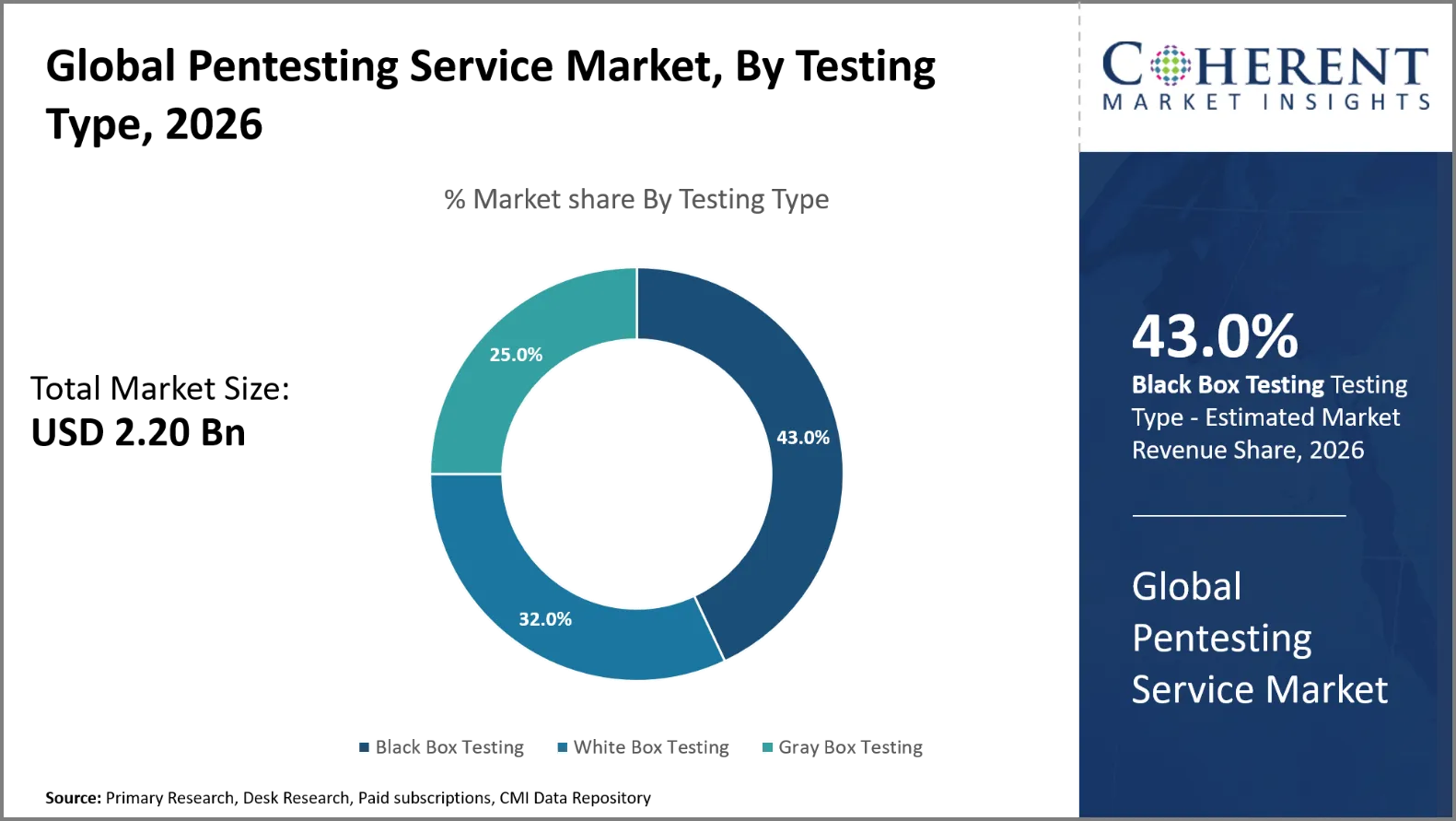
- The Black Box Testing segment is expected to account for 43.0% of the global pentesting service market share in 2026. Stronger cybersecurity compliance requirements is driving the growth of the segment. On July 29, 2025, GFT became a launch partner for Amazon Web Services D-CAT. The tool helps financial institutions address Digital Operational Resilience Act compliance requirements.
- The Cloud-Based segment is estimated to capture 56.0% of the market share in 2026. Growing adoption of DevSecOps practices is majorly driving the growth of the segment. On May 28, 2025, Snyk announced the release of their AI Trust Platform for safe AI-powered software development.
- The Network Penetration Testing segment is estimated to capture 24.0% of the market share in 2026. The growth of the segment is being driven by rising demand for ongoing security validation. On May 5, 2026, Synack announced general availability for Sara AI Pentesting. The platform combines agentic artificial intelligence with human validation for continuous security testing.
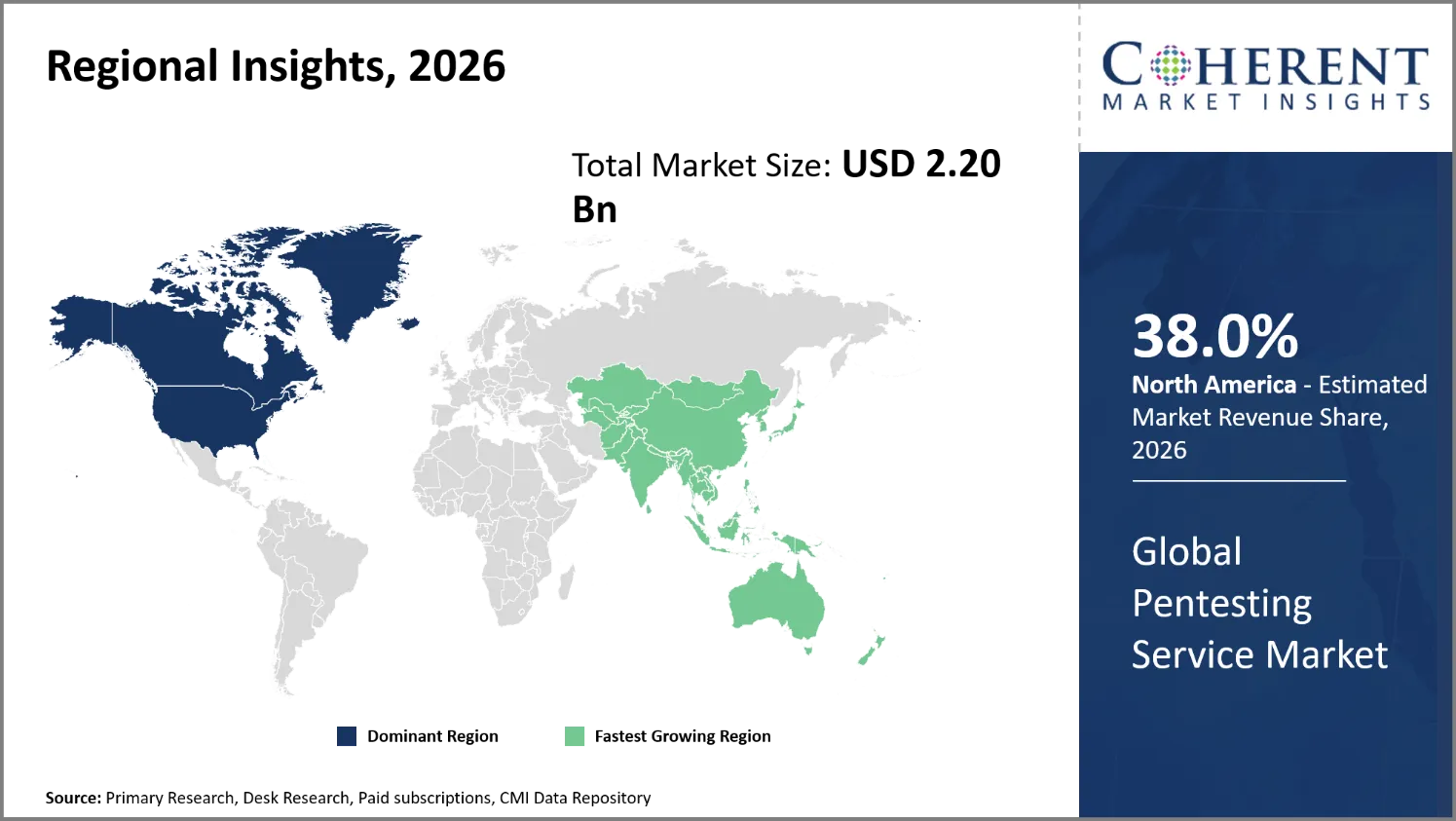
- North America is expected to dominate the pentesting service market in 2026 with a market share of 38.0%. Rising cybersecurity insurance requirements in North America is driving the growth of the regional market. In October 2025, Coalition expanded its Excess Cyber Insurance offering to Quebec businesses. The refreshed Canadian policy supports organizations with up to USD 5 billion in revenue.
- Asia Pacific is expected to account for 26.0% share in 2026. Increasing enterprise adoption of artificial intelligence in Asia Pacific is driving the growth of the regional market. On October 1, 2025, Samsung SDS entered a strategic partnership with OpenAI to develop artificial intelligence data centers and provide enterprise AI services.
Segmental Insights
Why Does Black Box Testing Dominate the Global Pentesting Service Market?
The black box testing segment is expected to account for 43.0% of the global pentesting service market share in 2026. Black box testing is akin to simulating real-world external assaults, as testers are unaware of the system's internal workings. It allows organizations to uncover vulnerabilities that hackers could exploit through public-facing assets. The approach minimizes tester bias by focusing on externally visible flaws. It also facilitates the independent validation of web applications, networks, and internet-facing infrastructure. As external cyber-attacks continue to grow in prevalence, so does the demand for authentic black box security assessments. For example, in 2025, Cobalt introduced programmatic continuous penetration testing. It combines human testing, automated testing, and constant monitoring. The platform does not depend on scheduled point-in-time evaluations but examines developing attack surfaces. This assists in reinforcing external security validation as public exposed assets change.
- Current Industry Events of 2026
- Market Size Estimation
- Regional Breakdown
- Competitive Landscape
- Customer Intelligence
- Segmental Analysis
- Pricing Analysis
- Key Market Drivers, Challenges & Future Trends
- Customized Insights Section
Why is Cloud-Based the Most Preferred Deployment Type?
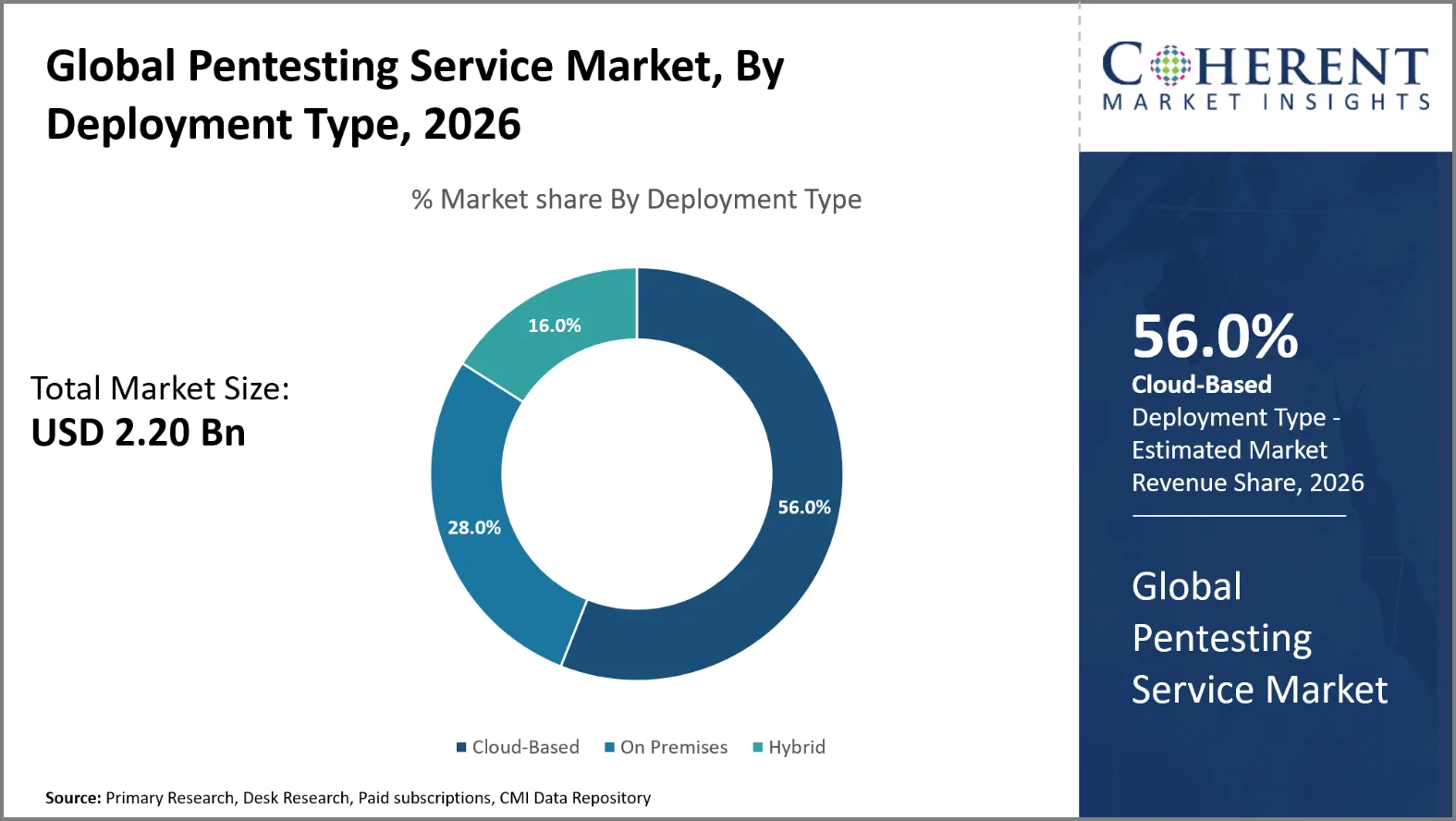
The cloud-based segment is expected to account for 56.0% of the global pentesting service market share in 2026. Cloud-based deployment allows for flexible security testing in distributed, dynamic IT environments. It enables testing teams to evaluate cloud infrastructure without significant investments in physical hardware. Organizations can scale testing activities as their workloads, applications and cloud resources grow. Cloud environments also allow for faster collaboration between internal security teams and external testing specialists. The increasing migration to public and hybrid cloud infrastructures drives the demand for cloud-based pentesting services. On March 31, 2026, AWS announced that the AWS Security Agent is now generally available in six AWS Regions for on-demand penetration testing. AWS Security Agent provides automated penetration testing that operates 24/7 at a fraction of the expense of manual penetration tests. This milestone changes penetration testing from a periodic bottleneck to an on-demand tool that scales with development pace across AWS, Azure, GCP, and other cloud-providers.
Network Penetration Testing Dominates the Global Pentesting Service Market
The network penetration testing segment is expected to account for 24.0% of the global pentesting service market share in 2026. Network penetration testing helps identify vulnerabilities across critical infrastructure, servers, routers, firewalls and connected devices. It assists enterprises in detecting unauthorized access routes before criminal actors may take use of them. Regular reviews of the network also assist firms meet cybersecurity standards and internal security regulations. The ever more interconnected enterprise environments are providing a bigger attack surface that needs to be validated for security comprehensively. As network-based cyber-attacks become more sophisticated, the demand for network penetration testing services is strengthened. On April 24, 2025, Pentera announced the release of Pentera 7, its enterprise-scale security validation platform. It has Distributed Attack Orchestration for concurrent testing in distributed network environments. Persistent and dynamic attack nodes can implement multi-site coordinated security validation.
Current Events and their Impact
Current Events | Description and its Impact |
European Union - Digital Operational Resilience Act Regulation 2022/2554 |
|
European Union - NIS2 Directive 2022/2555 |
|
Pentesting Service Market Dynamics
Market Drivers
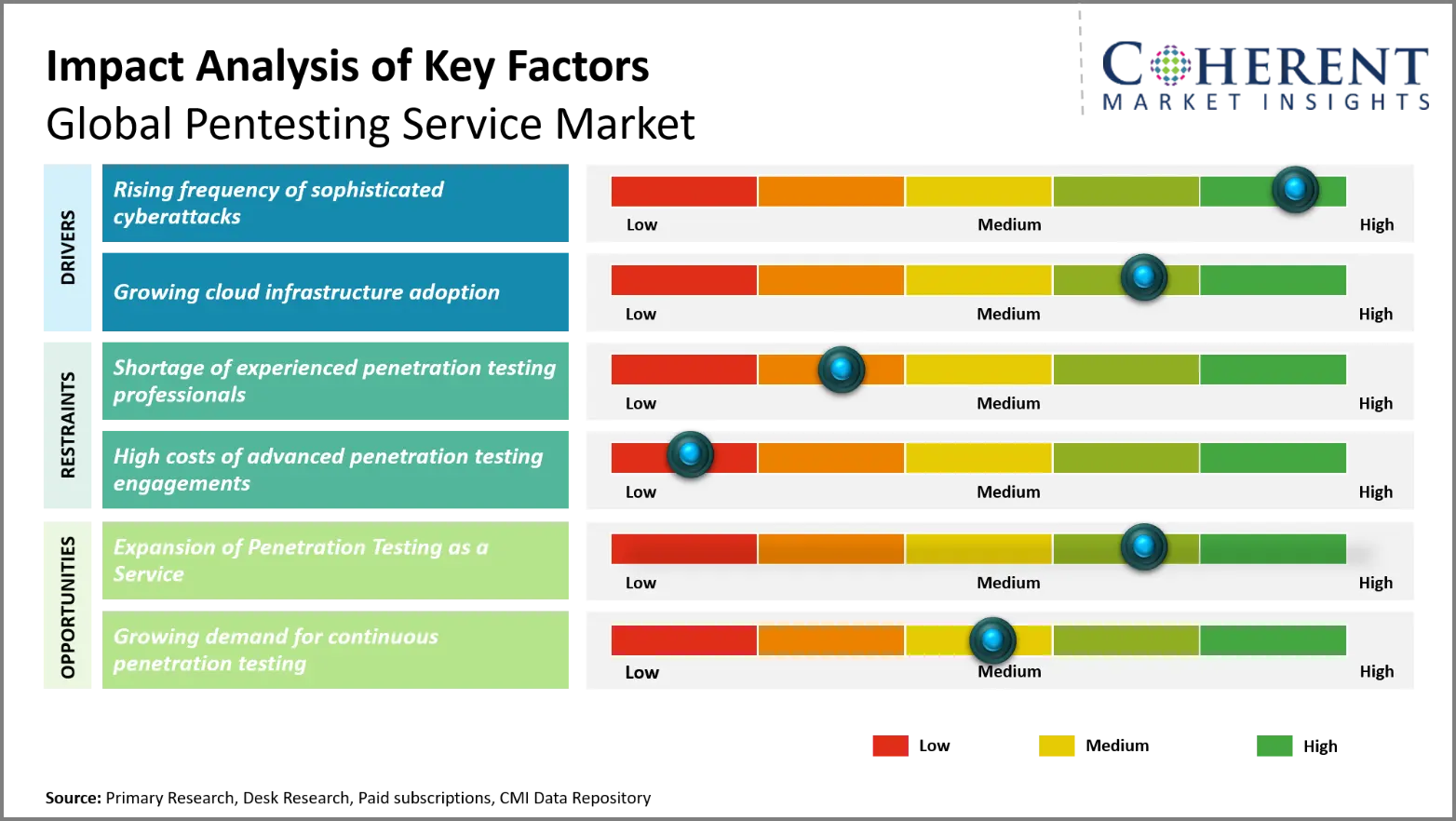
- Rising frequency of sophisticated cyberattacks: The increasing frequency of sophisticated cyber-attacks is raising the demand for penetration testing services globally. Applications, networks, cloud environments, and connected infrastructure are the new targets of choice for attackers. Organizations require proactive assessments to discover exploitable vulnerabilities before attackers reach vital systems. Advanced assaults also push organizations to test security controls against realistic attack scenarios. Hence, penetration testing is becoming increasingly important to broader cybersecurity risk management initiatives. In July 2025, Orange detected a cyberattack against one of its information systems. Orange Cyber Defense reacted swiftly by isolating the services potentially impacted and limiting the operational damage. Orange later lodged an official complaint over the occurrence. The incident underscores the ongoing targeting of key telecommunications infrastructure.
- Growing cloud infrastructure adoption: The increase in cloud infrastructure adoption is increasing the number of systems needing periodic security audits. More and more organizations are running workloads across public, private, and hybrid cloud environments. Such settings lead to complicated configurations, identity threats, application exposures and interconnected attack surfaces. Penetration testing helps organizations identify weaknesses within cloud workloads and supporting infrastructure. Continued cloud migration therefore supports recurring demand for specialized cloud penetration testing services. On December 8, 2025, AWS and Google Cloud announced a jointly engineered multi-cloud networking solution that uses both AWS Interconnect multi-cloud and Google Cloud’s Cross-Cloud Interconnect. This collaboration also introduces a new open specification for network interoperability, enabling customers to establish private, high-speed connectivity between Google Cloud and AWS with high levels of automation and speed.
Emerging Trends
- Artificial Intelligence Powered Security Testing: Artificial intelligence is enhancing vulnerability detection, attack-path analysis and software testing automation, enabling security teams to examine larger environments faster. More and more providers are combining automated analysis with expert validation to uncover sophisticated vulnerabilities in applications, networks, cloud infrastructure, and connected systems.
- Continuous Penetration Testing: Organizations are moving away from periodic assessments to continuous security validation. This approach allows the detection of vulnerabilities after application upgrades, infrastructure changes and new deployments. Continuous testing enables faster remediation and improved visibility in quickly changing digital environments.
- Cloud And Application Security Testing: Increasing popularity of cloud deployments is driving the need for specialized testing of cloud setups, application interfaces, identities and workloads. Security firms are creating wider testing capabilities to deal with complicated hybrid settings and ever-changing application architectures.
- Adversarial Artificial Intelligence Testing: Increasing numbers of organizations are testing artificial intelligence systems for adversarial manipulation, illegal access, data exposure, and prompt-based attacks. Regarding artificial intelligence applications, specialized testing contributes to safer adoption across organizational technology environments by helping uncover their shortcomings before they are put into use.
Regional Insights
Why is North America a Strong Market for Pentesting Service?
North America is expected to account for a market share of 38.0% in 2026. Demand for pentesting service is strengthened by critical infrastructure protection and federal cybersecurity programs. The Cybersecurity and Infrastructure Security Agency identify 16 critical infrastructure sectors requiring protection. The Cybersecurity and Infrastructure Security Agency also provide dedicated penetration testing services for federal agencies. Executive Order 14028 strengthened software supply chain security and vendor testing expectations. These requirements support testing across government, healthcare, energy, financial, and communications infrastructure.
Why Does Asia Pacific Pentesting Service Market Exhibit High Growth?
Asia Pacific is expected to register the fastest growth with a CAGR of 8% over the forecast period. It is projected to account for 26.0% of the global pentesting service market in 2026. Th region’s demand is supported by rapid digital infrastructure expansion and national cybersecurity programs. The Indian Computer Emergency Response Team released detailed cybersecurity audit recommendations in 2025. Australia heightens cybersecurity obligations for key infrastructure and important services. Japan is bolstering cybersecurity capabilities for technology and industrial systems. Ransomware, distributed denial-of-service, website defacements and data breaches surged in India in 2025. These developments encourage deeper application, network, cloud, and infrastructure security assessments.
Global Pentesting Service Market Outlook for Key Countries
Why is U.S. Emerging as a Major Hub in the Pentesting Service Market?
The U.S. pentesting service market benefits from extensive federal cybersecurity requirements and sophisticated critical infrastructure exposure. The Cybersecurity and Infrastructure Security Agency operates penetration testing services supporting federal agencies. The National Institute of Standards and Technology develops cybersecurity standards supporting federal agencies and U.S. industry. Executive Order 14028 established additional software security and supply chain requirements. The 16 critical infrastructure sectors identified by the Cybersecurity and Infrastructure Security Agency create substantial testing requirements. Financial services, healthcare, defense, energy, and technology companies therefore require extensive penetration testing.
Is Japan the Next Growth Engine for the Pentesting Service Market?
The requirement for Penetration Testing in Japan is increasingly linked to industrial cyber security and technology supply chain protection. Japanese enterprises have large settings of connected production and operational technologies; thus, manufacturing is still crucial. Automotive firms need testing across linked vehicles, industrial networks, and supplier systems. The Information-technology Promotion Agency provides cybersecurity recommendations and resources for Japanese enterprises. The electronics ecosystem in Japan adds testing needs for embedded systems and connected devices. Therefore, there is a growing demand for specialist security assessments for industrial automation and operational technologies.
Germany Pentesting Service Market Analysis and Trends
Germany’s demand is driven heavily by the need to protect critical infrastructure and to meet European cybersecurity needs. According to a 2025 assessment by the Federal Office for Information Security, the status of information technology security in Germany still remains tense. The German NIS2 Implementation Act has taken into force in December 2025. The Federal Office for Information Security said German enterprises suffered USD 179 billion in cyberattack damage in 2024. Automotive, manufacturing, transportation, healthcare and energy organizations are increasing their security assessment needs. These conditions support penetration testing across enterprise networks and industrial systems.
U.K. Pentesting Service Market Analysis and Trends
The U.K. pentesting service market benefits from an established government-backed framework supporting authorized penetration testing. The National Cyber Security Centre operates the CHECK scheme for public sector and critical national infrastructure systems. CHECK providers must satisfy professional qualification requirements before conducting authorized assessments under the scheme. The framework provides a systematic need for certified penetration testing companies serving government and critical infrastructure organizations. Telecommunications and financial services also need advanced assessments, as they are heavily digitally dependent. The National Cyber Security Center promotes independent security validation through third party testing.
India Pentesting Service Market Analysis and Trends
The demand for penetration testing in India is increasing due to cybersecurity audit mandates and growing digital services. In July 2025, the Indian Computer Emergency Response Team announced Comprehensive Cyber Security Audit Policy Guidelines. In September 2025 it also published 15 essential cyber defense controls for micro, small and medium organizations. India’s 2025 cybersecurity advisory centered on ransomware, distributed denial-of-service attacks, website defacements and data breaches. Thus, banking, financial services, telecommunications, government platforms, and digital companies require constant security evaluations. The increasing digital public infrastructure in India adds to the demands for application and network testing.
Global Pentesting Service Market - Application Programming Interface (API) Testing Adoption by Country (2025)
Country | API Testing Adoption |
U.S. | 72% |
U.K. | 68% |
Germany | 65% |
Japan | 61% |
India | 58% |
Australia | 54% |
Singapore | 63% |
South Korea | 60% |
Canada | 57% |
France | 62% |
How is Expansion of Penetration Testing as a Service Creating New Growth Opportunities in the Pentesting Service Market?
As penetration testing as a service continues to grow, it is presenting opportunity for enterprises to schedule regular security assessments without the need for specialized testing teams. The cloud-based delivery enables providers to experiment with distributed workloads, application programming interfaces, containers and changing infrastructure. Subscription models also benefit smaller firms who are unable to afford to have penetration testing specialists on staff. The U.K. National Cyber Security Centre identifies penetration testing as an important security assurance activity. Its CHECK scheme further creates structured demand for authorized testing providers serving public-sector and critical infrastructure systems. AI-enabled applications are also producing new testing requirements such as adversarial testing and AI red teaming. These advances broaden service possibilities for cloud settings, software development pipelines, critical infrastructure, and artificial intelligence workloads.
On August 11, 2026, CBTS launched Penetration Testing as a Service (PTaaS), utilizing industry-leading autonomous penetration testing capabilities. The new solution allows enterprises to move beyond point-in-time annual testing with autonomous penetration testing and CBTS security expertise to evaluate exploitable risk, uncover genuine attack pathways and prioritize remediation as environments change.
Market Players, Key Development, and Competitive Landscape
Key Developments
- On September 9, 2026, ImmuniWeb received CREST accreditation for AI-Enabled Penetration Testing. The accreditation evaluated its artificial intelligence technology, personnel, and operational processes. This strengthens its positioning around AI-assisted penetration testing.
- On May 12, 2026, NetSPI announced the launch of its AI-powered Continuous Pentesting services, designed to help organizations continuously identify, validate and reduce risk across dynamic external and cloud environments. NetSPI’s Continuous Pentesting services include Continuous External Penetration Testing, Continuous Cloud Penetration Testing, agentic Model Context Protocol (MCP) Integrations, and NetSPI’s AI-accelerated platform to help teams find, prioritize and remediate real risk as environments change.
Competitive Landscape
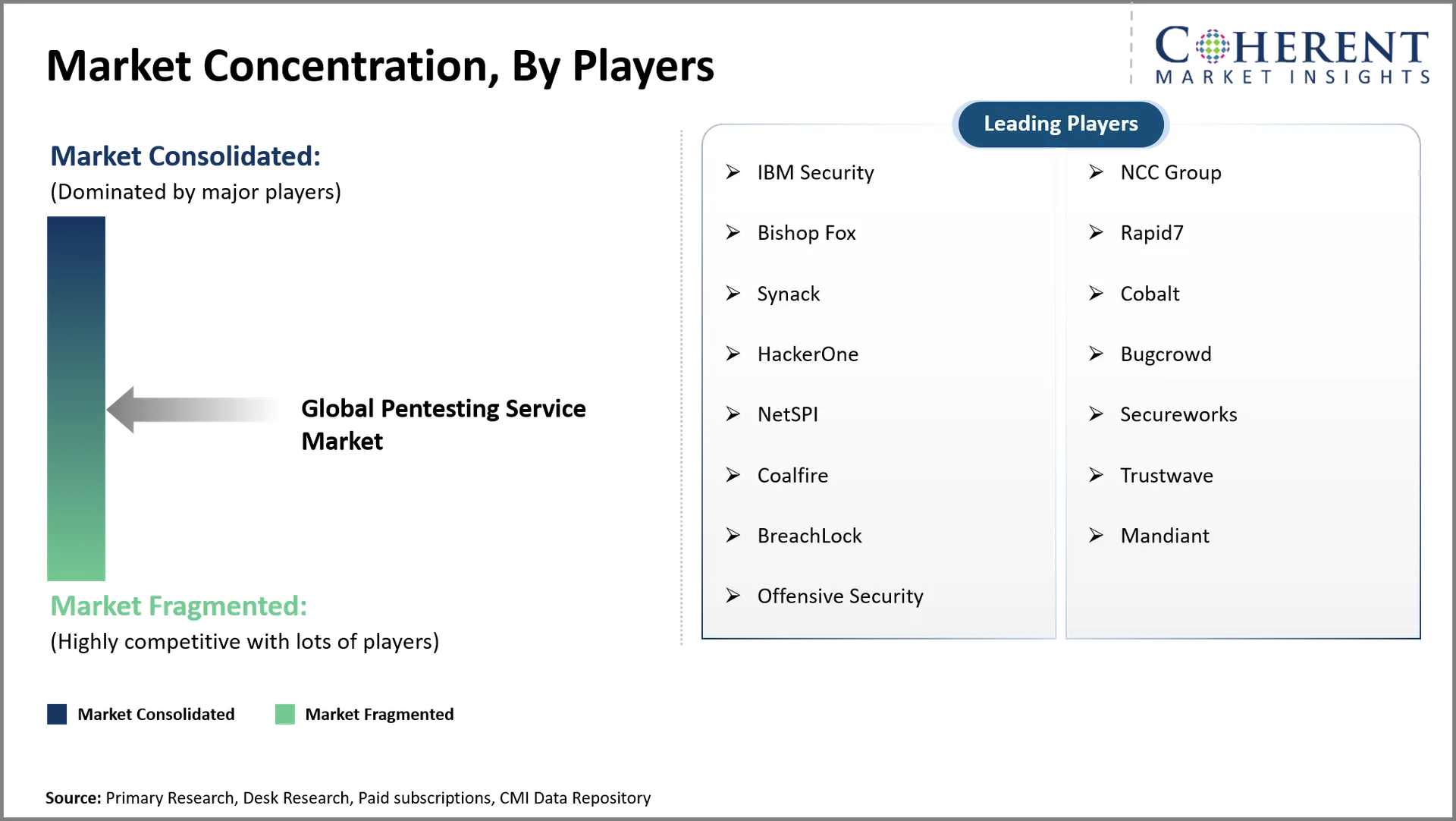
Leading players are shifting from one-time assessments toward continuous, platform-led offensive security services. NCC Group combines penetration testing with attack simulation, application security, cloud testing, and continuous assurance. Its Cyber Services Portal adds real-time reporting and prioritized remediation tracking. Cobalt focuses strongly on Penetration Testing as a Service, combining human testers with artificial intelligence automation. Its platform covers web apps, APIs, mobile applications, cloud infrastructure and AI applications. Cobalt also provides autonomous testing for more application coverage and faster validation. These strategies indicate stronger competition around continuous testing, artificial intelligence security, cloud environments, and developer workflow integration.
Market Report Scope
Pentesting Service Market Report Coverage | |||
Report Coverage | Details | ||
Base Year | 2025 | Market Size in 2026: | USD 2.20 Bn |
Historical Data For: | 2020 To 2024 | Forecast Period: | 2026 To 2033 |
Forecast Period 2026 To 2033 CAGR: | 6.2% | 2033 Value Projection: | USD 8.00 Bn |
Geographies covered: |
| ||
Segments covered: |
| ||
Companies covered: | IBM Security, NCC Group, Bishop Fox, Rapid7, Synack, Cobalt, HackerOne, Bugcrowd, NetSPI, Secureworks, Coalfire, Trustwave, BreachLock, Mandiant, Offensive Security | ||
Growth Drivers: |
| ||
Restraints & Challenges: |
| ||
Analyst Opinion (Expert Opinion)
- The future of the industry will center on continuous offensive security rather than periodic penetration testing. Providers will increasingly combine expert-led testing, artificial intelligence automation, attack simulation, and continuous validation. This model fits organizations operating rapidly changing applications, APIs, cloud infrastructure, and artificial intelligence workloads.
- The strongest opportunity should emerge in application, cloud, API, and artificial intelligence penetration testing. Application security deserves particular attention because modern development creates frequent changes across web applications and APIs. Artificial intelligence application testing should expand further as organizations deploy large language models and agentic systems. Countries with strong digital ecosystems, including the U.S., U.K., Germany, Japan, and India, should remain important opportunities.
- Market players looking for an edge should develop specific competencies in AI testing, cloud security, and continuous penetration testing. They need to embed results directly into development and vulnerability-management workflows. For complicated attack pathways and business-logic weaknesses, human skills should still be the focus. Providers should also develop industry-specific testing packages for financial services, healthcare, telecommunications, automotive, and critical infrastructure.
Speak to the analyst
Want personalized insights?
Take the findings above to one of our principal consultants, or have the report rebuilt around the segments, geographies and competitors you actually track.
Market Segmentation
- Testing Type Insights (Revenue, USD Billion, 2020 - 2033)
- Black Box Testing
- White Box Testing
- Gray Box Testing
- Deployment Type Insights (Revenue, USD Billion, 2020 - 2033)
- Cloud-Based
- On Premises
- Hybrid
- Service Type Insights (Revenue, USD Billion, 2020 - 2033)
- Network Penetration Testing
- Web Application Penetration Testing
- Mobile Application Penetration Testing
- Cloud Penetration Testing
- Wireless Network Penetration Testing
- Social Engineering Testing
- Internet of Things Penetration Testing
- API Penetration Testing
- End User Insights (Revenue, USD Billion, 2020 - 2033)
- BFSI
- IT and Telecommunications
- Healthcare
- Government and Defense
- Retail and Ecommerce
- Manufacturing
- Energy and Utilities
- Education
- Regional Insights (Revenue, USD Billion, 2020 - 2033)
- North America
- U.S.
- Canada
- Latin America
- Brazil
- Argentina
- Mexico
- Rest of Latin America
- Europe
- Germany
- U.K.
- Spain
- France
- Italy
- Russia
- Rest of Europe
- Asia Pacific
- China
- India
- Japan
- Australia
- South Korea
- ASEAN
- Rest of Asia Pacific
- Middle East
- GCC Countries
- Israel
- Rest of Middle East
- Africa
- South Africa
- North Africa
- Central Africa
- North America
- Key Players Insights
- IBM Security
- NCC Group
- Bishop Fox
- Rapid7
- Synack
- Cobalt
- HackerOne
- Bugcrowd
- NetSPI
- Secureworks
- Coalfire
- Trustwave
- BreachLock
- Mandiant
- Offensive Security
Sources
Primary Research Interviews
- Chief Information Security Officers (CISOs)
- Penetration Testing Service Providers & Ethical Hackers
- IT Security Consultants & Cybersecurity Analysts
- Enterprise IT Procurement & Vendor Management Executives
Magazines
- SC Magazine (Cybersecurity)
- Dark Reading
- Infosecurity Magazine
- CSO Online Magazine
Journals
- Journal of Cybersecurity (Oxford Academic)
- International Journal of Information Security
- Journal of Network and Computer Applications
Associations
- EC-Council (International Council of E-Commerce Consultants)
- ISACA (Information Systems Audit and Control Association)
- (ISC)² – International Information System Security Certification Consortium
- OWASP (Open Web Application Security Project)
Public Domain Sources
- U.S. National Institute of Standards and Technology (NIST) – Cybersecurity Framework
- U.S. Cybersecurity and Infrastructure Security Agency (CISA) Publications
- European Union Agency for Cybersecurity (ENISA) Reports
- U.S. Securities and Exchange Commission (SEC) – Cybersecurity Disclosure Guidelines
Proprietary Elements
- CMI Data Analytics Tool
- Proprietary CMI Existing Repository of Information for the Last 10 Years
Get access to 250+ pages report
Every segment, forecast, competitor profile and data table behind the analysis above — available for instant download.
- ESOMAR Member
- ISO 9001:2015 Certified
- D-U-N-S Registered
- GDPR & CCPA Compliant
Missing comfort of reading report in your local language? Find your preferred language:
Frequently Asked Questions
The global pentesting service market is expected to stand at USD 2.20 Bn in 2026 and is expected to reach USD 8.00 Bn by 2033.
The CAGR of the global pentesting service market is projected to be 6.2% from 2026 to 2033.
Rising frequency of sophisticated cyberattacks and growing cloud infrastructure adoption are the major factors driving the growth of the global pentesting service market.
Shortage of experienced penetration testing professionals and high costs of advanced penetration testing engagements are the major factors hampering the growth of the global pentesting service market.
In terms of testing type, black box testing segment is estimated to dominate the market revenue share in 2026.
A penetration testing service identifies exploitable security weaknesses through controlled simulated attacks.
It emphasizes recurring assessments, centralized management, flexible scheduling, and continuous vulnerability validation.