

Global Peristaltic Pump Market Size and Forecast – 2026 To 2033
The Global Peristaltic Pump Market is estimated to be valued at USD 1,765.2 Mn in 2026 and is expected to reach USD 2,871.8 Mn by 2033, exhibiting a compound annual growth rate (CAGR) of 7.2% from 2026 to 2033. This expansion is due to the need for precise fluid handling, low maintenance, and contamination-free pumping and has been fueled by the pharmaceutical, water treatment, chemical processing, environmental monitoring and laboratory sectors.
Peristaltic pumps are gaining wider adoption because the liquid remains fully contained within the tubing and does not come into direct contact with the pump mechanism, which simplifies cleaning and reduces product-contact risks. In January, 2024, QED Environmental Systems introduced its new MicroPurge MP100 peristaltic sampling pump available for use in purging and sampling ground water for environmental and water-quality applications, which has been increasingly utilized in the field over the last few years. (Source: QED Environmental Systems)
Key Takeaways of the Global Peristaltic Pump Market
- Peristaltic tube pumps are expected to lead with 63.8% of the market share in 2026, supported by contamination-free fluid transfer, faster tube replacement, and suitability for sterile, corrosive, and precision metering applications. In September 2025, Albin Pump introduced the RT Series Peristaltic Pump with sealed pump-head design, safer maintenance, and lower operating cost for chemical metering.
- The 100 to 1,000 mL/min segment is expected to account for 38.6% of the market share in 2026, as mid-flow pumps balance accuracy, throughput, and compact equipment integration across pharma, analytical instruments, and laboratory workflows. In March 2025, Longer Pump launched the SC01/SE01 OEM variable-speed peristaltic pump, supporting flow rates up to 340 mL/min for medical, pharmaceutical, and analytical instrument users.
- Variable speed pumps are expected to dominate with 47.6% of the market share in 2026, as users prioritize flexible flow control, repeatable dosing, and integration with automated process environments. In September 2025, ProMinent showcased DULCOFLEX DFYa at drinktec 2025, highlighting electronically controlled peristaltic metering for viscous and solids-containing media in hygienic food and beverage processes.
- North America is expected to remain the dominant region with 31.4% of the market share in 2026, supported by strong pharmaceutical manufacturing, medical-device production, water treatment investments, and early adoption of precision fluid-handling technologies. In October 2025, Watson-Marlow showcased precision-engineered peristaltic pumps and DriveSure fluid-path technologies at MD&M Midwest in Minneapolis for medical-device and diagnostic instrument applications.
- Europe is expected to be the fastest-growing region with 29.6% of the market share in 2026, supported by hygienic manufacturing, sustainability-led pump upgrades, and localized production capacity. In April 2025, Verder Liquids moved Ponndorf peristaltic pump production to a modern high-efficiency facility in Poland to improve efficiency, sustainability, and capacity for global demand.
- Automation-Ready Fluid Handling: Peristaltic pump buyers are moving toward systems that support digital control, remote monitoring, and repeatable dosing across validated production environments. This trend improves batch consistency, reduces operator dependency, and enables manufacturers to align fluid-transfer operations with Industry 4.0, quality documentation, and process optimization goals across pharmaceutical, food, chemical, and laboratory applications.
- Single-Use and Low-Contamination Design: The market is shifting toward pump designs that minimize product contact, reduce cleaning complexity, and support faster changeovers. This is strategically important for biopharma, diagnostics, and high-purity processing, where contamination control, validation efficiency, and downtime reduction directly influence production reliability, compliance readiness, and total cost of ownership.
Segmental Insights
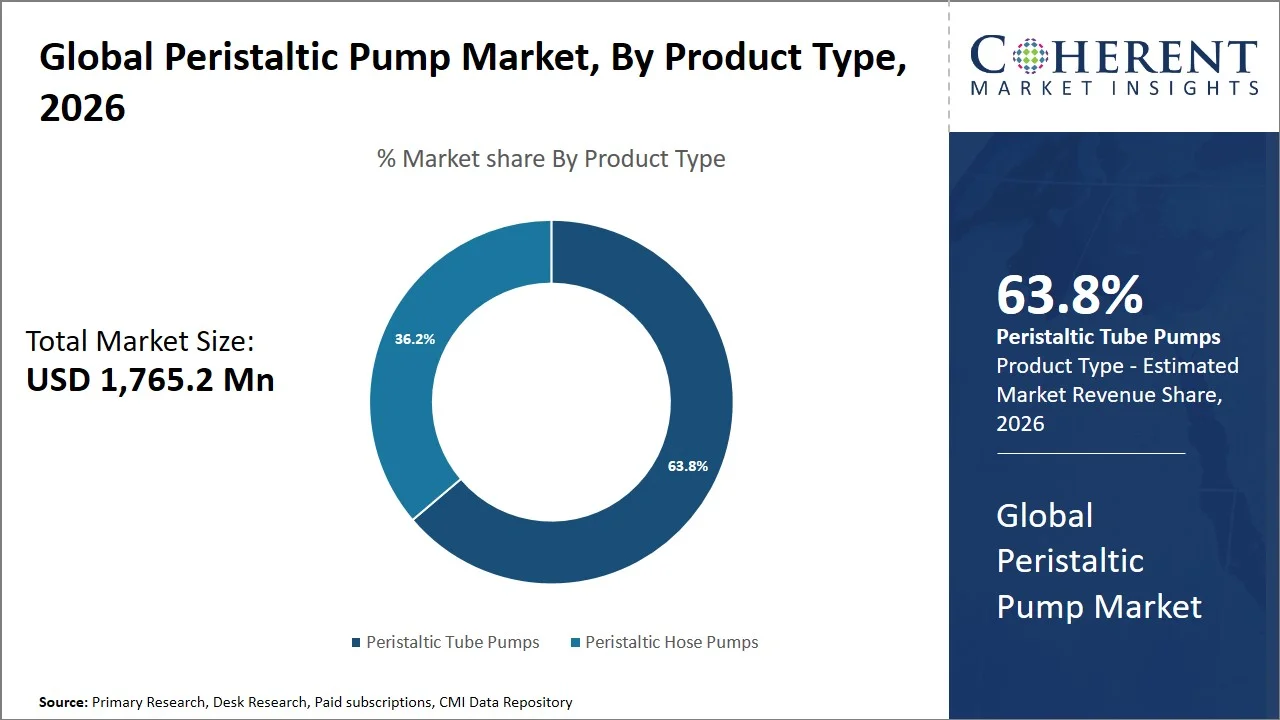
Why Do Peristaltic Tube Pumps Dominate the Global Peristaltic Pump Market?
Peristaltic tube pumps are expected to dominate the global peristaltic pump market with 63.8% share in 2026. They are associated with high adoption when the application involves controlled liquid transfer, requiring the user to change over the tube quickly, with a minimal product hold-up and reduced cleaning requirements versus a more complex wetted parts type of pump. Demand is particularly strong in pharmaceutical, biotechnology, diagnostic, laboratory, and food-grade dosing applications where the fluid pathway must remain isolated and easy to validate. On the supply side, advancements in tubing materials are improving chemical compatibility, sterilization stability, and lifecycle performance, strengthening tube pump adoption in high-value processes. In March 2026, Cole-Parmer advanced DEHP-free, gamma-stable PVC tubing for cell and gene therapy fluid pathways, supporting closed-system fluid transfer and single-use workflow integration. (Source: Cole-Parmer)
- Current Industry Events of 2026
- Market Size Estimation
- Regional Breakdown
- Competitive Landscape
- Customer Intelligence
- Segmental Analysis
- Pricing Analysis
- Key Market Drivers, Challenges & Future Trends
- Customized Insights Section
Why Does the 100 to 1,000 mL per min Segment Represent the Largest Flow Rate Segment in the Global Peristaltic Pump Market?
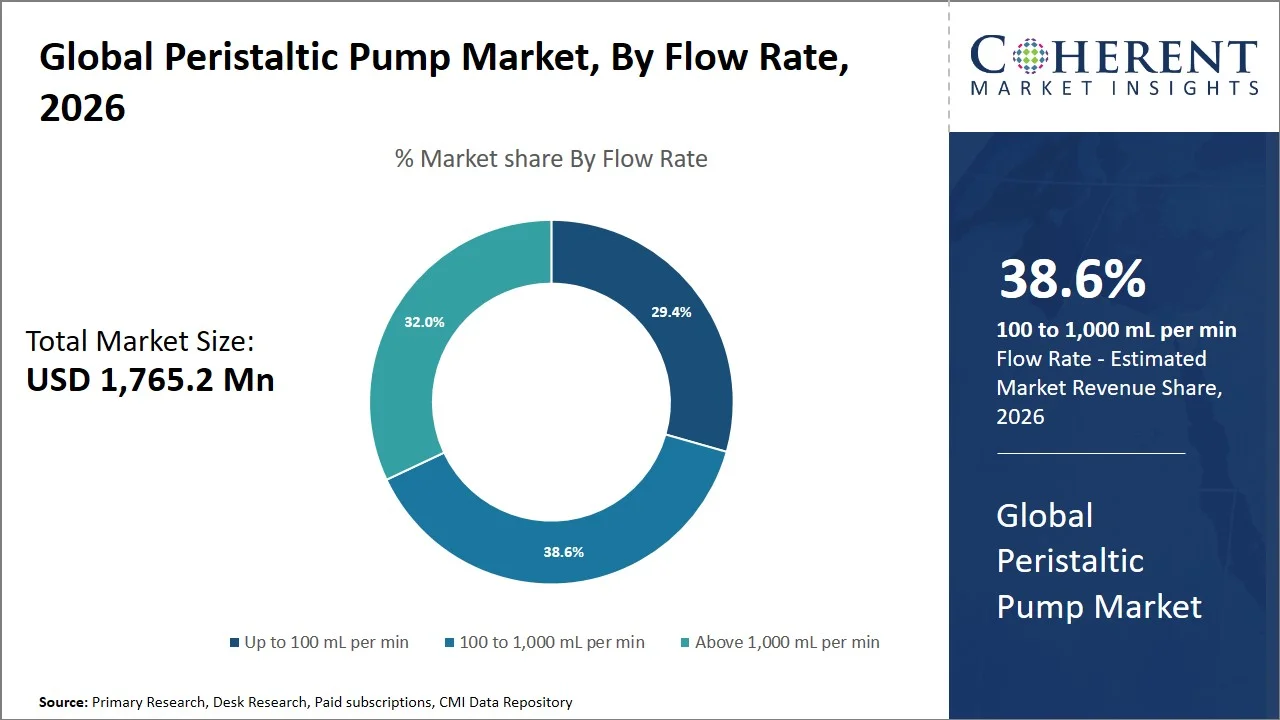
100 to 1,000 mL per min is expected to represent the largest flow rate segment with 38.6% share in 2026. This range fits the most commercially relevant operating window between laboratory-scale precision and industrial batch transfer, making it suitable for reagent dosing, media transfer, chemical feed, sample preparation, and small filling lines. Demand is supported by users that need measurable throughput without moving to oversized high-flow systems that increase tubing wear, footprint, and validation complexity. Suppliers are responding with modular pump heads, multiple tube-size compatibility, and OEM-ready integration for compact equipment. In May 2026, Lead Fluid launched the KJ2532 ODM peristaltic pump head, offering multi-tube compatibility and integration use cases across commercial dishwashers, central kitchens, pool disinfectant dosing, and water-treatment systems. (Source: Lead Fluid)
Why Do Variable Speed Pumps Dominate the Global Peristaltic Pump Market?
Variable speed pumps are expected to dominate the global peristaltic pump market with 47.6% share in 2026. Their dominance reflects the need for adjustable flow control across processes where fluid viscosity, batch size, dosing interval, and operating pressure vary during production. Demand is strong in water treatment, chemical dosing, food processing, and biotechnology because operators can fine-tune output without changing the entire pump system. Technologically, stepper motors, digital controls, remote monitoring, and Programmable Logic Controller (PLC) connectivity are making variable speed pumps more attractive for automated facilities. In January 2026, EMEC introduced VELON, a compact next-generation peristaltic dosing pump with a high-precision multifunction stepper motor, real-time dosing modulation, and app or web-based remote management for connected installations.
Global Peristaltic Pump Market Dynamics
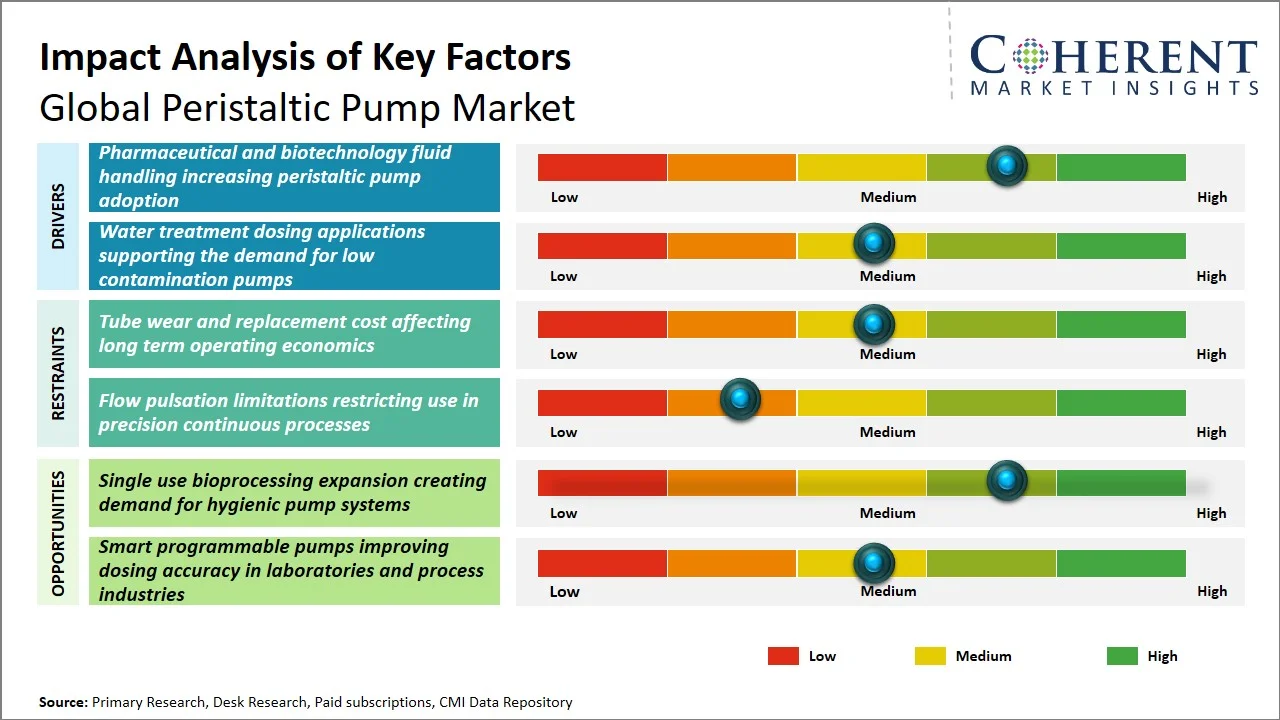
Key Market Drivers
Pharmaceutical and Biotechnology Fluid Handling Increasing Peristaltic Pump Adoption
Pharmaceutical and biotechnology manufacturers increasingly rely on peristaltic pumps because the product contacts only the tube, reducing contamination risk and simplifying cleaning validation in regulated environments. This is commercially important for biologics, vaccines, diagnostics, cell culture media transfer, buffer handling, and small-volume filling, where accuracy and product recovery directly affect batch economics. The driver is also supported by the shift toward single-use fluid paths and smaller, high-value drug batches that require gentle, repeatable, and scalable pumping. In October 2025, Scientific Data released an industrial pharmaceutical peristaltic pump dosing dataset comprising 149,847 measurements, underscoring the critical role of dosing precision, operational stability, and compensation methods in pharmaceutical filling operations.
Water Treatment Dosing Applications Supporting Demand for Low-Contamination Pumps
Water and wastewater treatment facilities are adopting peristaltic pumps for chemical feed, pH adjustment, disinfection, coagulant dosing, and reagent injection because these pumps handle aggressive or gas-forming chemicals without valves, seals, or complex wetted components. Demand is supported by utilities’ need for reliable dosing systems that reduce clogging, vapor lock, and maintenance downtime. Peristaltic technology also fits decentralized and municipal installations where operators need simple calibration, controlled chemical use, and safer handling of treatment chemicals. In June 2025, Blue-White reported that a Utah water plant launched a CHEM-FEED dual skid featuring FLEXFLO M4 peristaltic pumps at a water recycle facility, reflecting real-world municipal adoption of integrated chemical dosing systems. (Source: Blue-White Industries)
Emerging Market Trends
Shift Toward Connected and Programmable Dosing Architectures
Peristaltic pump adoption is moving beyond standalone transfer equipment toward connected dosing platforms that integrate with plant control systems, batch records, and automated process lines. This trend is particularly relevant in pharmaceutical, water treatment, chemical processing, and food applications where operators need repeatable flow control, alarm-based maintenance, and process traceability. Programmable and digitally controlled pumps improve operating discipline by reducing manual intervention, lowering dosing variability, and supporting faster process changeovers. For suppliers, this creates opportunities to differentiate through software interfaces, connectivity protocols, user-friendly displays, and predictive service features. For end users, connected peristaltic systems help convert fluid handling from a maintenance-heavy utility function into a controlled process variable that supports quality, cost efficiency, and compliance.
Rising Preference for Single-Use and Low-Hold-Up Fluid Paths
End users are increasingly prioritizing pump configurations that reduce product loss, cleaning time, and cross-batch contamination risk. This is especially important in biotechnology, diagnostics, high-purity chemicals, and specialty food processing, where the value of the transferred material can be high and production runs may be smaller or more customized. Peristaltic pumps align well with this trend because tubing can be replaced quickly and the pump mechanism remains isolated from the fluid. The business impact is stronger adoption in flexible manufacturing environments where rapid turnaround, lower cleaning validation burden, and simplified changeover directly improve asset utilization. Suppliers that offer broader tubing compatibility, certified materials, and application-specific pump heads are better positioned to capture premium demand.
Current Events and their Impact
Current Events | Description and its Impact |
FDA Quality Management System Regulation Effective February 2026 |
|
EU Revised Urban Wastewater Treatment Directive Entered into Force in January 2025 |
|
EPA Final PFAS Drinking Water Standard Issued in April 2024 |
|
Regional Insights
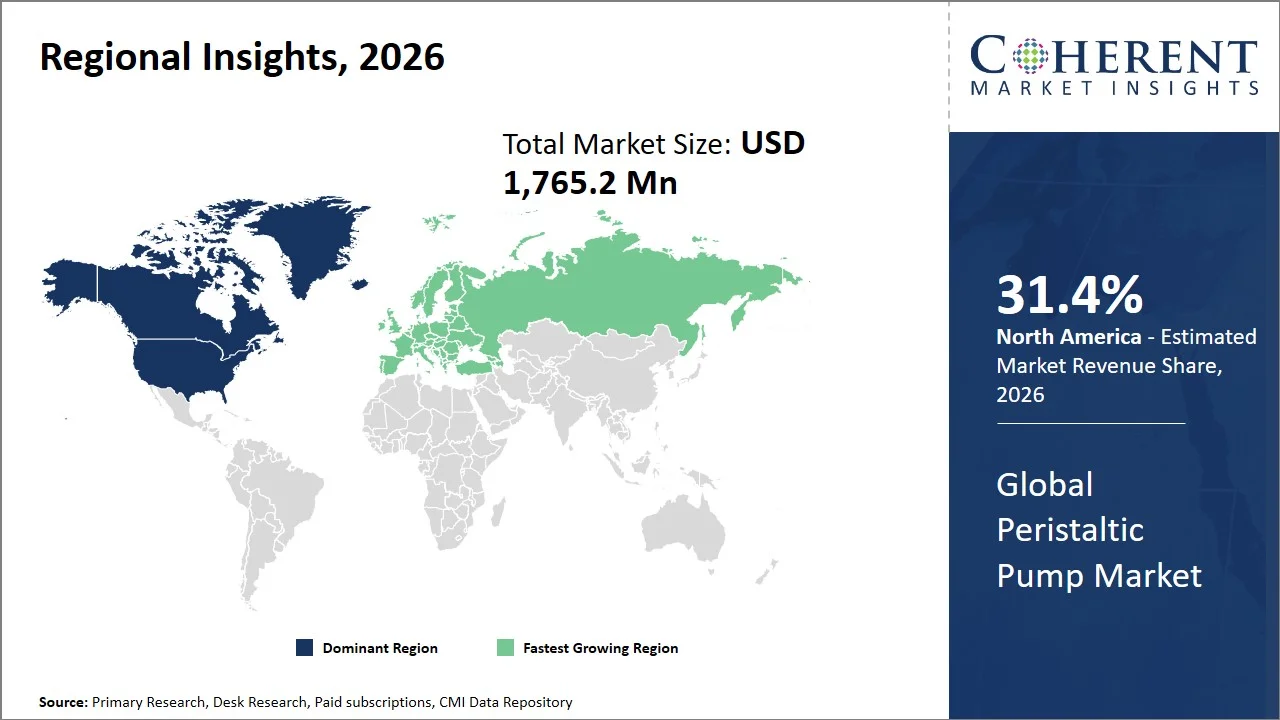
Why Does North America Dominate the Global Peristaltic Pump Market?
North America is expected to dominate the global peristaltic pump market with 31.4% share in 2026, supported by advanced pharmaceutical manufacturing, strong biotechnology scale-up, strict quality requirements, and high adoption of automated fluid-handling systems. The region’s demand is concentrated in sterile drug production, diagnostics, municipal water treatment, specialty chemicals, and laboratory automation, where peristaltic pumps offer controlled transfer with reduced contamination risk. Strong regulatory oversight also encourages documented, repeatable, and validated pumping systems. In June 2026, the U.S. FDA selected seven companies for its PreCheck Pilot Program to expand domestic pharmaceutical manufacturing capacity and support early facility-readiness engagement, strengthening demand for compliant process equipment and fluid-handling infrastructure. (Source: U.S. Food and Drug Administration)
Why is Europe Emerging as the Fastest-Growing Region in the Peristaltic Pump Market?
Europe is expected to emerge as the fastest-growing region with 29.6% share in 2026, supported by wastewater modernization, sustainability-led processing, pharmaceutical supply resilience, and strong demand for precision dosing in hygienic manufacturing. European industries are increasingly prioritizing chemical-use optimization, contamination control, and energy-efficient process equipment, which supports adoption of variable-speed and programmable peristaltic pumps. Water treatment, food and beverage, biotechnology, and specialty chemical production remain key demand pockets. In July 2025, the European Investment Bank stated that its Water Resilience Programme would increase water investment to USD 17.13 billion during 2025–2027, supporting treatment plants, pollution control, digital water management, and water-technology competitiveness.
Global Peristaltic Pump Market Outlook for Key Countries
Why is the U.S. a Key Market for Peristaltic Pumps?
The U.S. is a key market due to its large biopharmaceutical manufacturing base, strong clinical development ecosystem, advanced laboratory network, and major municipal water-treatment requirements. Peristaltic pumps are widely relevant in sterile transfer, buffer handling, biologics processing, injectable filling, chemical dosing, and analytical workflows where repeatability and contamination control are essential. The country also supports premium pump adoption through demand for validated equipment, automation-ready systems, and robust aftermarket tubing supply. In October 2025, Merck started construction of a USD 3 billion, 400,000-square-foot pharmaceutical manufacturing facility in Elkton, Virginia, covering API and drug-product manufacturing and testing, reinforcing the country’s long-term need for high-quality process equipment.
Why is India Important in the Global Peristaltic Pump Market?
India is important in the global peristaltic pump market because its pharmaceutical, biotechnology, diagnostics, specialty chemical, and wastewater-treatment industries are expanding simultaneously. The country’s strong formulations base, rising API self-reliance, export-oriented production, and cost-competitive manufacturing ecosystem create demand for pumps used in dosing, media transfer, effluent treatment, sampling, and small-volume filling. Adoption is also supported by the need to improve process consistency and meet international quality expectations across regulated manufacturing sites. In March 2026, India’s Press Information Bureau (PIB) reported that the PLI Scheme for Pharmaceuticals supported high-value biopharmaceuticals and complex generics, with investment of USD 428.80 Mn against a target of USD 181.15 Mn as of September 2025.
Why Does China Support Growth in the Peristaltic Pump Market?
China supports growth through its large manufacturing base, broad pharmaceutical production network, expanding water-treatment infrastructure, and strong domestic equipment ecosystem. Peristaltic pumps are relevant for chemical dosing, reagent transfer, laboratory automation, bioprocessing, industrial wastewater treatment, and controlled liquid handling across large-scale plants. The country’s industrial clusters enable cost-efficient pump production and rapid customization for OEM users, while rising environmental and quality requirements are pushing users toward more accurate dosing and automated fluid-control systems. In September 2025, the International Trade Administration reported that China targeted more than 95% sewage treatment in county-level areas by 2025, with additional recycled-water and sewage-network expansion goals, supporting the demand for dosing and treatment equipment.
Why is Germany a Strategic Country in the Peristaltic Pump Market?
Germany is strategic because it combines Europe’s leading pharmaceutical market, a strong chemical-processing base, high-quality machinery expertise, and strict environmental compliance culture. Peristaltic pumps are used across German pharma, laboratory, wastewater, food-grade, and specialty chemical applications where dosing precision, cleanability, material compatibility, and reliability are critical purchase criteria. The country’s emphasis on engineering quality also supports adoption of premium pump systems with advanced controls, validated tubing, and long service life. Germany’s industrial customers typically prioritize lifecycle cost over upfront price, creating space for differentiated products. Germany Trade & Invest reports that Germany is Europe’s largest pharmaceutical market and the fourth largest worldwide, with pharmaceutical industry sales reaching USD 68.29 billion in 2023.
Why is Japan an Important Growth Market for the Peristaltic Pump Market?
Japan is an important growth market due to its advanced pharmaceutical sector, aging population, sophisticated healthcare system, and strong demand for precision medical and laboratory equipment. Peristaltic pumps are relevant in biopharmaceutical production, regenerative medicine, diagnostics, analytical instruments, and high-purity fluid handling, where gentle pumping and contamination control support product integrity. Japan’s focus on digital health, biopharma innovation, and quality-led manufacturing favors compact, automated, and validated pumping platforms. In November 2025, the International Trade Administration stated that Japan is the world’s third-largest pharmaceutical market and reported 2023 prescription and nonprescription pharmaceutical shipment value of USD 0.076 trillion, highlighting a strong end-use base for fluid-handling equipment.
Technology Adoption Landscape in the Global Peristaltic Pump Market
Technology | Adoption Level | Key Application Area | Business Impact |
Variable Speed Drive Control | High | Dosing, metering, chemical feed, laboratory transfer | Improves flow accuracy, supports process flexibility, and reduces the need for multiple pump sizes. |
Programmable Pump Controllers | Medium | Pharma filling, water treatment, automated dosing lines | Enables repeatable recipes, batching, alarms, and easier integration with controlled workflows. |
Single-Use Tubing Assemblies | High | Biopharma, diagnostics, sterile transfer | Reduces cleaning burden, contamination risk, and validation time across high-value fluid handling. |
Tube Failure Detection Systems | Medium | Water treatment, chemical processing, hazardous fluid dosing | Limits leakage risk, protects operators, and reduces downtime from tube rupture incidents. |
Industrial Communication Protocols | Medium | Municipal plants, automated production lines, OEM equipment | Supports remote monitoring, PLC connectivity, and centralized process control. |
Advanced Tubing Materials | High | High-purity chemicals, biologics, food-grade transfer | Improves chemical compatibility, sterility assurance, pump life, and application-specific performance. |
How are Single-Use Bioprocessing and Automated Chemical Dosing Creating New Growth Opportunities in the Global Peristaltic Pump Market?
Single-use bioprocessing and automated chemical dosing are creating strong commercial opportunities for peristaltic pump manufacturers because both applications require clean, repeatable, and low-maintenance fluid movement. In biopharma, manufacturers are shifting toward flexible production lines, smaller batch sizes, and high-value biologic formulations, making disposable tubing-based pumping attractive for reducing cleaning validation and cross-contamination risk. In water treatment and chemical processing, automation is increasing the need for pumps that deliver accurate dosing while integrating with sensors, controllers, and plant monitoring systems. This opportunity supports premiumization through programmable controls, certified tubing, compact OEM formats, and service-ready pump platforms. Suppliers that combine pump hardware with application-specific tubing, digital monitoring, and compliance documentation can strengthen customer lock-in and command higher margins. The most attractive opportunity lies in positioning peristaltic pumps as controlled fluid-handling systems rather than simple transfer devices.
Market Players, Key Development, and Competitive Intelligence
Key Developments
- In September 2025, Watson-Marlow Fluid Technology Solutions launched the Bredel CIP pump for hygienic clean-in-place processes in food, beverage, pharmaceutical, and cosmetics production. The pump is designed to achieve CIP cleaning velocity requirements of more than 2 m/sec, reduce maintenance downtime, extend hose life, and improve energy efficiency in high-changeover processing environments.
- In April 2025, Longer Pump introduced its Mini Series Peristaltic Pump, targeting laboratory and compact industrial fluid-transfer applications. The pump offers a compact stackable design, speed resolution of 0.01 rpm, multiple control options including RS485/Modbus RTU, and use cases across cell culture, microbial fermentation, filtration, chromatography, sterile medicine transfer, water-treatment reagent dosing, and food additive transfer.
Competitive Landscape
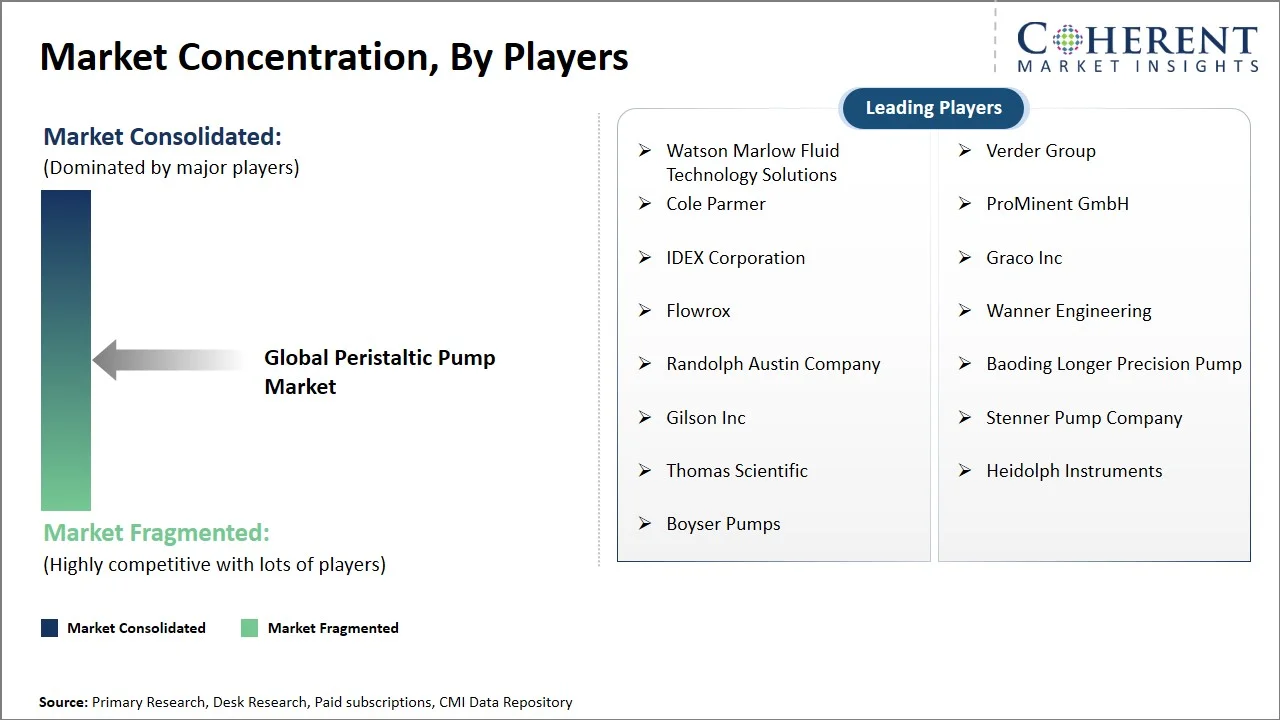
The global peristaltic pump market is moderately fragmented, with competition between global pump manufacturers, specialized dosing pump suppliers, OEM pump-head producers, and application-focused fluid-handling companies. Players compete on dosing accuracy, tubing compatibility, digital control, chemical resistance, lifecycle cost, service support, and ability to meet regulated end-use requirements.
Key focus areas include
- Product quality and differentiation through accuracy, tube life, flow stability, and reduced pulsation.
- Technology adoption and process efficiency through variable speed drives, programmable controls, and connectivity.
- Pricing and cost competitiveness for laboratory, municipal, and industrial customers with different budget levels.
- Supply reliability and service support for replacement tubing, pump heads, and maintenance parts.
- Certifications and quality control for pharma, food-grade, water, and medical-adjacent applications.
- Distribution network and customer reach across laboratories, municipal utilities, OEMs, and industrial users.
- Application-specific product formats including compact OEM pumps, tube pumps, hose pumps, and skid-mounted systems.
- Supplier partnerships and system integration to serve automated dosing, bioprocessing, and treatment plant upgrades.
Market Report Scope
Peristaltic Pump Market Report Coverage
| Report Coverage | Details | ||
|---|---|---|---|
| Base Year: | 2025 | Market Size in 2026: | USD 1,765.2 Mn |
| Historical Data for: | 2020 To 2024 | Forecast Period: | 2026 To 2033 |
| Forecast Period 2026 to 2033 CAGR: | 7.2% | 2033 Value Projection: | USD 2,871.8 Mn |
| Geographies covered: |
| ||
| Segments covered: |
| ||
| Companies covered: | Watson Marlow Fluid Technology Solutions, Verder Group, Cole Parmer, ProMinent GmbH, IDEX Corporation, Graco Inc, Flowrox, Wanner Engineering, Randolph Austin Company, Baoding Longer Precision Pump, Gilson Inc, Stenner Pump Company, Thomas Scientific, Heidolph Instruments, and Boyser Pumps | ||
| Growth Drivers: |
| ||
| Restraints & Challenges: |
| ||
Analyst Opinion (Expert Opinion)
- The global peristaltic pump market is expected to maintain healthy growth as end users prioritize low-contamination fluid transfer, dosing accuracy, and reduced maintenance across regulated and process-intensive industries. The strongest demand pockets are expected in pharmaceutical and biotechnology, water and wastewater treatment, variable speed pumps, and mid-flow systems used in scalable process environments.
- North America remains commercially important due to its strong biopharma, diagnostics, municipal water, and specialty chemical base, while Europe offers attractive upside from wastewater compliance, sustainability-driven plant modernization, and hygienic processing requirements. Peristaltic tube pumps should continue to lead where product isolation, tubing replacement, and process cleanliness matter more than high-pressure pumping.
- Key risks include tubing wear, flow drift, pressure limitations, and price competition from diaphragm, gear, and syringe pump alternatives. Market players should focus on advanced tubing materials, programmable controls, application-specific certifications, and bundled service models. Companies that combine pump reliability with digital monitoring, validation support, and strong aftermarket availability will be better positioned to defend margins and win long-term customer relationships.
Speak to the analyst
Want personalized insights?
Take the findings above to one of our principal consultants, or have the report rebuilt around the segments, geographies and competitors you actually track.
Market Segmentation
- Product Type Insights (Revenue, USD Mn, 2021 - 2033)
- Peristaltic Tube Pumps
- Peristaltic Hose Pumps
- Flow Rate Insights (Revenue, USD Mn, 2021 - 2033)
- Up to 100 mL per min
- 100 to 1,000 mL per min
- Above 1,000 mL per min
- Operation Mode Insights (Revenue, USD Mn, 2021 - 2033)
- Fixed Speed Pumps
- Variable Speed Pumps
- Programmable Pumps
- Application Insights (Revenue, USD Mn, 2021 - 2033)
- Fluid Transfer
- Dosing and Metering
- Sampling
- Filtration and Chromatography
- Dispensing and Filling
- Others
- End-use Industry Insights (Revenue, USD Mn, 2021 - 2033)
- Pharmaceutical and Biotechnology
- Water and Wastewater Treatment
- Food and Beverages
- Chemical Processing
- Mining and Mineral Processing
- Laboratories and Research Institutes
- Others
- Regional Insights (Revenue, USD Mn, 2021 - 2033)
- North America
- U.S.
- Canada
- Latin America
- Brazil
- Argentina
- Mexico
- Rest of Latin America
- Europe
- Germany
- U.K.
- Spain
- France
- Italy
- Russia
- Rest of Europe
- Asia Pacific
- China
- India
- Japan
- Australia
- South Korea
- ASEAN
- Rest of Asia Pacific
- Middle East
- GCC Countries
- Israel
- Rest of Middle East
- Africa
- South Africa
- North Africa
- Central Africa
- North America
Source
Primary Research Interviews
- Peristaltic pump manufacturers producing tube, hose, laboratory, industrial, OEM pump heads, dosing, metering, and programmable systems
- Pump component suppliers offering tubing, hoses, rollers, pump heads, drive units, motors, seals, connectors, fittings, and fluid-path assemblies
- Pharmaceutical and biotechnology companies using pumps for sterile transfer, dosing, filtration, chromatography, and filling
- Water and wastewater operators for chemical dosing, pH control, disinfection, sludge handling, and sampling
- Chemical processors handling corrosive, viscous, and abrasive fluids with controlled dosing
- Food and beverage manufacturers for ingredient dosing, flavor transfer, dairy fluids, and hygienic filling
- Mining companies for slurry transfer, reagent dosing, and tailings handling
- Laboratories, research institutes, and diagnostic labs using precision pumps
- OEMs integrating pumps into analyzers, bioprocessing systems, and automation platforms
- System integrators, distributors, service providers, and automation solution providers
- QA consultants, engineers, and regulatory compliance specialists
Stakeholders
- Key manufacturers: Watson-Marlow, Verder, Cole-Parmer, ProMinent, IDEX, Graco, Flowrox, Valmet, Wanner, Randolph Austin, Baoding Longer, Gilson, Stenner, Thomas Scientific, Heidolph, Boyser, Albin, Blue-White, Lutz-Jesco, EMEC, Lead Fluid, Ismatec, Masterflex
- Tubing and component suppliers: Saint-Gobain, Trelleborg, DuPont, Freudenberg, AdvantaPure, NewAge Industries
- Pharma and biotech ecosystem: biologics, vaccines, APIs, CDMOs, diagnostics, and equipment suppliers
- Water treatment ecosystem: utilities, desalination, testing labs, and engineering firms
- Industrial users: chemicals, pulp & paper, coatings, lubricants, and wastewater operators
- Food & beverage ecosystem: dairy, beverages, bakery, sauces, and equipment suppliers
- Mining ecosystem: mineral processors, slurry operators, and equipment distributors
- Laboratory ecosystem: research labs, testing labs, and instrument OEMs
- Automation ecosystem: PLC, sensors, IoT, and control system providers
- Distribution ecosystem: distributors, service providers, and maintenance contractors
Databases
- UN Comtrade, ITC Trade Map – global trade analysis for pumps and fluid systems
- Eurostat, U.S. Census Bureau – manufacturing and industrial data
- USITC DataWeb, BLS – trade and pricing trends
- U.S. FDA, EMA, EudraGMDP – pharma manufacturing and compliance data
- U.S. EPA, EEA – water quality and environmental data
- OECD, World Bank – infrastructure and industrial indicators
- Company reports, brochures, and technical documentation
Magazines / Industry Publications
- Pumps & Systems, World Pumps, Processing Magazine, Chemical Processing, Chemical Engineering
- Pharmaceutical Manufacturing, BioProcess International, GEN, Pharmaceutical Technology, BioPharma Dive
- WaterWorld, Water & Wastes Digest, Water Technology
- Food Engineering, Food Processing, Dairy Foods, Beverage Industry
- Lab Manager, Laboratory Equipment
- Mining Technology, International Mining, Process Worldwide, Manufacturing Chemist, Control Engineering
Journals
- Chemical Engineering Research and Design, Chemical Engineering Science, Journal of Process Control
- Biotechnology and Bioengineering, Biotechnology Progress, Bioengineering & Translational Medicine
- Journal of Pharmaceutical Innovation, PDA Journal, Pharmaceutical Engineering
- Water Research, Water Environment Research, Journal of Water Process Engineering
- Separation and Purification Technology, Journal of Cleaner Production
- Minerals Engineering, International Journal of Mineral Processing
- Food and Bioprocess Technology, Journal of Food Engineering, Food Control
- Sensors and Actuators A, Precision Engineering, Journal of Manufacturing Processes
Credible News Sources
- BioPharma Dive, Fierce Pharma Manufacturing, Pharmaceutical Technology
- WaterWorld, Water Technology
- Pumps & Systems, World Pumps, Chemical Processing
- Food Engineering, Mining.com, International Mining, Lab Manager
Associations
- Hydraulic Institute, Europump, British Pump Manufacturers Association, Pump Centre
- Water Environment Federation, AWWA, International Water Association, Water Europe
- ISPE, PDA, BioPhorum, Bio-Process Systems Alliance
- ISA, American Chemistry Council, Cefic
- EHEDG, 3-A Sanitary Standards, Food Processing Suppliers Association
- Mining Association of Canada, SME, Water Quality Association, NSF International
Public Domain Sources
- U.S. FDA, U.S. EPA – pharma and water regulations
- European Commission, ECHA, EEA – environmental and chemical compliance
- UK agencies – environmental and healthcare regulation
- EMA – pharmaceutical compliance
- India CPCB, Ministry of Chemicals – pollution and pharma data
- China MEE, NMPA – environmental and pharma regulation
- Japan MHLW, Ministry of Environment – healthcare and environmental data
- ISO, ASTM, NSF/ANSI, ASME – standards for equipment and materials
- USP – pharmaceutical material standards
- OSHA – workplace safety regulations
Proprietary Elements
- CMI Data Analytics Tool
- Proprietary CMI Existing Repository of information for last 10 years.
Get access to 250+ pages report
Every segment, forecast, competitor profile and data table behind the analysis above — available for instant download.
- ESOMAR Member
- ISO 9001:2015 Certified
- D-U-N-S Registered
- GDPR & CCPA Compliant
Missing comfort of reading report in your local language? Find your preferred language:
Transform your Strategy with Exclusive Trending Reports
Frequently Asked Questions
The CAGR of the global peristaltic pump market is projected to be 7.2% from 2026 to 2033.
The global peristaltic pump market is estimated to be valued at USD 1,765.2 Mn in 2026 and is expected to reach USD 2,871.8 Mn by 2033.
Europe is expected to be the fastest-growing region in the global peristaltic pump market, supported by wastewater treatment upgrades, pharmaceutical manufacturing, and rising demand for precision dosing systems.
The 100 to 1,000 mL per min segment is expected to lead the market, as it is widely used in laboratory, pharmaceutical, water treatment, and chemical dosing applications.
The pharmaceutical and biotechnology industry is expected to dominate the global peristaltic pump market due to strong demand for contamination-free fluid transfer, dosing, sampling, and sterile processing applications.
Pharmaceutical and biotechnology fluid handling increasing peristaltic pump adoption and water treatment dosing applications supporting demand for low contamination pumps are the major factors driving the growth of the global peristaltic pump market.
Tube wear and replacement cost affecting long term operating economics and flow pulsation limitations restricting use in precision continuous processes are the major factors hampering the growth of the global peristaltic pump market.