

Fluid Management System Market Size and Forecast — 2026-2033
The Global Fluid Management System Market size is estimated to be valued at USD 9.43 billion in 2026 and is expected to reach USD 16.59 billion by 2033, exhibiting a compound annual growth rate (CAGR) of 8.4% from 2026 to 2033.
Overview
Fluid management systems are specialized assemblies used to control, measure, and transfer liquids and gases in healthcare, industrial, and laboratory settings. In medical applications, these systems are vital for surgical irrigation, dialysis, transfusion, and fluid replacement procedures. Core components include pumps, reservoirs, filters, valves, and flow sensors that ensure precise delivery and removal of fluids under controlled conditions. Advanced systems now feature automation, touchscreen interfaces, and real-time monitoring to minimize human error and improve patient safety.
Key Takeaways
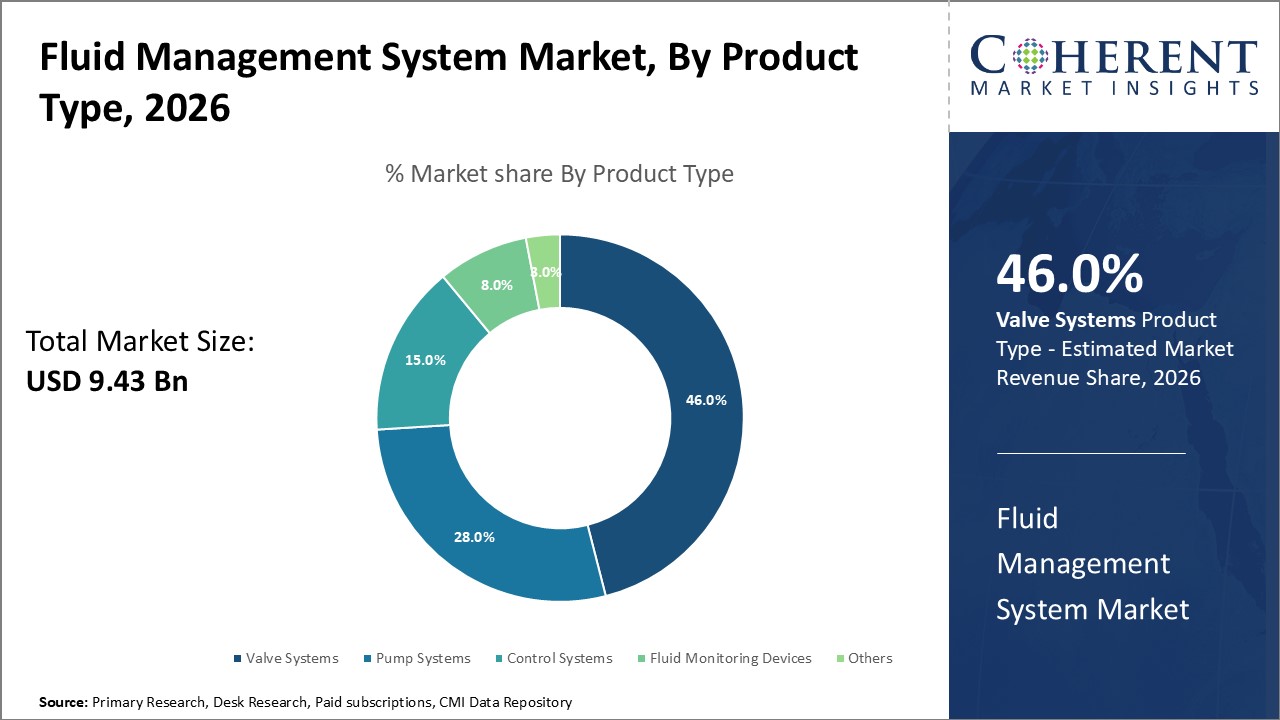
The Valve Systems segment, commanding a 46% share, continues to lead due to superior control precision and compatibility with automation trends.
The Healthcare sector demonstrates the fastest growth, driven by stringent quality control and regulatory needs demanding sophisticated fluid systems.
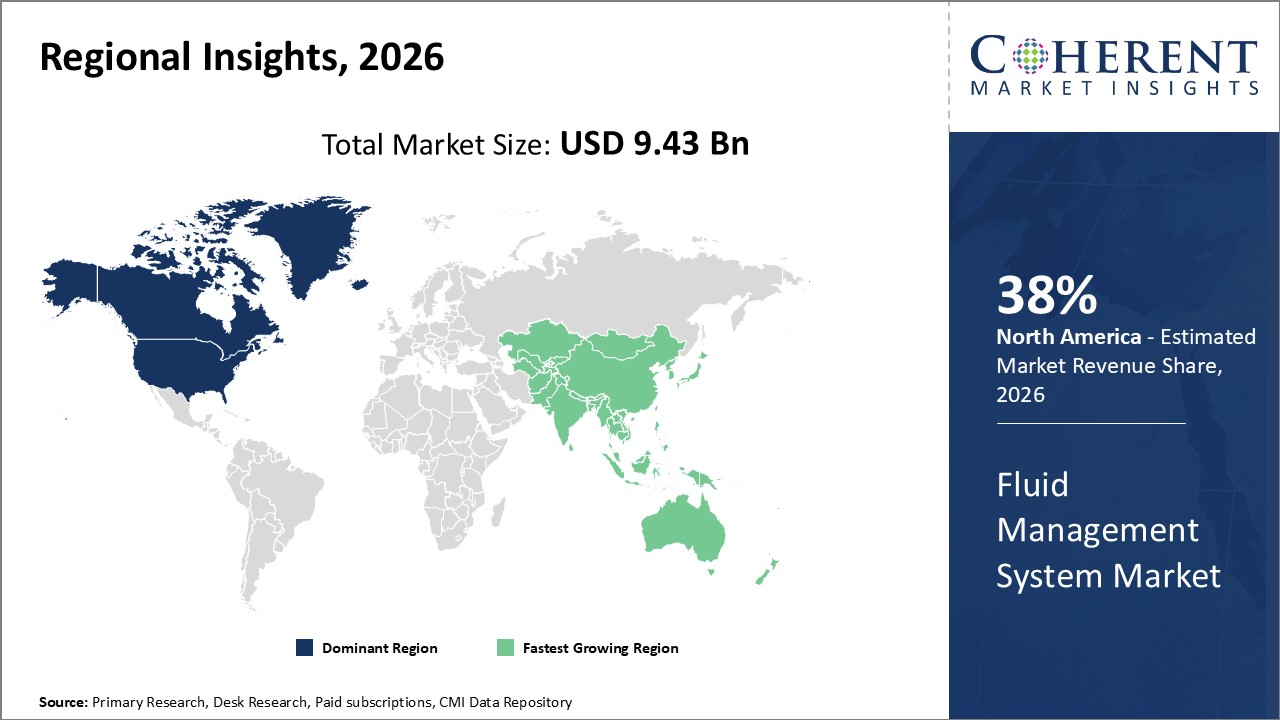
Regionally, North America, accounting for 38% of the market share, benefits from a robust industrial ecosystem and early adoption of smart technologies, while Asia Pacific shows the fastest CAGR at 9.5%, fueled by escalating industrialization and infrastructure investment in countries like China and India.
Fluid Management System Market Segmentation Analysis
Fluid Management System Market Insights, By Product Type
Valve Systems dominate the market share with 46%. Valve Systems are the primary drivers due to their critical role in precise fluid flow regulation and compatibility with automated operations, expanding their usage across healthcare, oil & gas, and manufacturing sectors. The fastest-growing subsegment is Fluid Monitoring Devices, which enable real-time data acquisition and predictive maintenance, favored by technology-intensive industries seeking to reduce operational downtime.
Fluid Management System Market Insights, By End-Use Industry
Healthcare leads in terms of growth rate, propelled by stringent quality controls and the rising need for aseptic fluid delivery systems in diagnostics and pharmaceuticals. Oil & Gas remains a dominant revenue contributor, driven by large-scale infrastructure and safety-related retrofits requiring advanced fluid control solutions. The Semiconductor industry, growing rapidly in Asia Pacific and North America, demands ultra-precise fluid management for wafer fabrication, boosting demand for automated and IoT-enabled systems.
Fluid Management System Market Insights, By Technology
IoT-Enabled Systems represent the dominant technology segment due to their ability to provide real-time monitoring, data analytics, and predictive alerts, which are transforming maintenance and operational protocols globally. Automated Systems, growing rapidly as the fastest subsegment, facilitate seamless integration into Industry 4.0 setups, significantly enhancing process reliability and efficiency. Manual Systems still hold relevance in smaller-scale applications that require cost-effective solutions, while Hybrid Systems combine manual overrides with automation to offer flexible control options.
Fluid Management System Market Trends
The Fluid Management System market continues to demonstrate a robust shift towards digitalization and sustainability.
The adoption of IoT-enabled systems in manufacturing and healthcare sectors has enhanced operational efficiency and reduced downtime, with companies reporting a 21% increase in predictive maintenance accuracy in 2025.
Moreover, environmental regulations, especially stringent in Europe and North America, are accelerating the transition to energy-efficient and low-emission fluid control devices, supporting business growth aligned with global carbon reduction goals.
Finally, the emergence of blockchain-based supply chain verification is an innovative step being piloted in Asia Pacific to enhance fluid resource tracking and reduce losses, influencing market players to rethink their data management strategies.
Fluid Management System Market Insights, By Geography
North America Fluid Management System Market Analysis and Trends
In North America, the dominance in the Fluid Management System market is propelled by a mature industrial base, early adoption of smart technologies, and significant R&D investments. The U.S., in particular, accounts for the majority of the 38% market share with notable market companies like Emerson Electric and Honeywell pioneering innovations in predictive analytics and IoT integration. Supportive government policies and growing automation in healthcare and oil & gas sectors further cement this market leadership.
Asia Pacific Fluid Management System Market Analysis and Trends
Meanwhile, Asia Pacific exhibits the fastest growth with a CAGR of 9.5%, primarily driven by rapid industrialization in China and India, expanding infrastructure projects, and increased foreign investments. The region benefits from developing manufacturing hubs and government incentives to improve efficiency and environmental performance, attracting key market players to establish local production and R&D facilities.
Fluid Management System Market Outlook for Key Countries
USA Fluid Management System Market Analysis and Trends
The U.S. maintains its leading role supported by advanced technological infrastructure and a broad industrial base. Leading market companies have increased their R&D budgets by 15% in 2025, focusing on AI-driven fluid management solutions that reduce operational costs and downtime. Regulatory frameworks demanding sustainable solutions also encourage adoption across sectors like pharmaceuticals and energy. The prevalence of smart manufacturing ecosystems has resulted in a 25% increase in demand for automated fluid management systems in the U.S. throughout 2026.
China Fluid Management System Market Analysis and Trends
China’s market has seen unprecedented growth fueled by ambitious infrastructure projects, extensive government support, and escalating industrial output. In 2026, China accounted for over 30% of Asia Pacific’s fluid management revenue, driven by local players adopting advanced sensor and valve technologies to optimize resource utilization. Strategic partnerships between Chinese manufacturers and international entities enhance production capabilities and technology transfer, accelerating business growth and market dynamics in this crucial market.
Analyst Opinion
Precision in fluid control components continues to expand market share: Enhanced sensor technology and IoT integration have improved the accuracy and real-time monitoring capabilities of fluid management systems. For instance, in 2025, over 61% of new installations in the pharmaceutical sector integrated advanced sensors, contributing directly to a 13% improvement in operational efficiency.
Industry 4.0’s influence boosts demand-side dynamics: The shift toward automation and connected devices has driven up demand for fluid management systems capable of remote operations and predictive maintenance. Case in point, robotics-assisted manufacturing plants reported a 16% decrease in fluid wastage in 2026 by deploying these systems.
Rising market revenue is supported by increased export volumes: Leading manufacturers expanded export activities by 18% in 2025, particularly targeting emerging markets with expanding production capabilities, unlocking additional growth avenues in Latin America and Asia Pacific.
Fragmented end-use applications stimulate diverse market dynamics: From water treatment facilities to semiconductor fabs, the wide range of unique fluid properties necessitates specialized systems, driving market segmentation and custom solutions development, with bespoke systems gaining 21% market share amongst high-value deployments in 2026.
- Current Industry Events of 2026
- Market Size Estimation
- Regional Breakdown
- Competitive Landscape
- Customer Intelligence
- Segmental Analysis
- Pricing Analysis
- Key Market Drivers, Challenges & Future Trends
- Customized Insights Section
Market Scope
| Report Coverage | Details | ||
|---|---|---|---|
| Base Year: | 2025 | Market Size in 2026: | USD 9.43 billion |
| Historical Data for: | 2020 To 2024 | Forecast Period: | 2026 To 2033 |
| Forecast Period 2026 to 2033 CAGR: | 8.4% | 2033 Value Projection: | USD 16.59 billion |
| Geographies covered: |
| ||
| Segments covered: |
| ||
| Companies covered: | Emerson Electric Co., Honeywell International Inc., Siemens AG, Parker Hannifin Corporation, Schneider Electric SE, Alfa Laval AB, Eaton Corporation plc, Danaher Corporation, ABB Ltd., Grundfos Holding A/S. | ||
| Growth Drivers: |
| ||
Fluid Management System Market Growth Factors
Technological integration, such as IoT and AI is a primary growth driver, enabling systems to provide enhanced real-time data analytics and predictive maintenance, as seen in smart manufacturing hubs adopting these at scale since early 2025. Increasing industrial automation across manufacturing and healthcare sectors necessitates robust fluid management, significantly expanding market scope and revenue. Regulatory pressure on sustainability and reduced fluid wastage compels industries, especially chemicals and oil & gas, to upgrade to advanced systems, leading to increased adoption rates. Additionally, rapid urbanization and infrastructure expansion in emerging markets have escalated demand for fluid management in utilities and water treatment facilities, enhancing the overall market growth trajectory.
Fluid Management System Market Development
In September 2026, Nuwellis, Inc. introduced a new 24-Hour Aquadex™ circuit, expanding its outpatient ultrafiltration therapy offering for hospital-based, single-day fluid-management sessions. The circuit is designed to support scheduled outpatient treatments for patients requiring fluid removal without full hospital admission, aligning supply to setting while maintaining the therapy experience.
In June/July 2026, Castrol (a subsidiary of BP plc) launched a new fluid-management service for data-center liquid-cooling systems, designed to support operators transitioning from air-cooling to liquid-based thermal management. The service covers four lifecycle phases—system start-up/installation, ongoing maintenance and monitoring, break-fix support, and fluid disposal.
Key Players
Leading Companies of the Market
Emerson Electric Co.
Honeywell International Inc.
Siemens AG
Parker Hannifin Corporation
Schneider Electric SE
Alfa Laval AB
Eaton Corporation plc
Danaher Corporation
ABB Ltd.
Grundfos Holding A/S
Leading companies focus on strategic collaborations and technology innovations. For example, Emerson Electric’s partnership with leading semiconductor manufacturers resulted in a 11% increase in precision fluid control performance in 2025, boosting market share in this niche. Meanwhile, Honeywell accelerated its growth by implementing AI-powered predictive maintenance platforms, reducing downtime by roughly 26% for clients in oil & gas industries.
Fluid Management System Market Future Outlook
Future fluid management systems will emphasize automation, digital integration, and sustainability. Smart sensors coupled with IoT connectivity will enable remote monitoring, predictive maintenance, and automated calibration. Artificial intelligence will assist in optimizing fluid delivery and detecting abnormalities in real time, enhancing patient safety and process efficiency. In healthcare, the trend toward minimally invasive surgeries will drive demand for compact and portable fluid systems with closed sterile pathways. Meanwhile, industrial and laboratory models will focus on waste minimization, data analytics, and compliance with environmental standards to support sustainable manufacturing practices.
Fluid Management System Market Historical Analysis
Fluid management systems began as basic assemblies of manual pumps and tubes for surgical and laboratory applications. With medical technology advancements, these systems evolved into automated, closed-loop solutions ensuring precise control over fluid flow, pressure, and volume. In healthcare, fluid management systems became critical for surgical irrigation, dialysis, and transfusion procedures, while industrial versions supported chemical handling and manufacturing. Integration of sensors and digital displays enhanced real-time monitoring and safety, minimizing contamination risks. Disposable components and modular designs also gained popularity for maintaining sterility and operational efficiency across diverse applications.
Sources
Primary Research Interviews:
Biomedical Engineers
Hospital Procurement Managers
Surgical Equipment Specialists
Laboratory Technicians
Databases:
WHO Medical Device Data
GlobalData Surgical Device Reports
U.S. FDA Medical Device Listings
Magazines:
Medical Design & Outsourcing
Surgical Products Magazine
HealthTech Insider
Clinical Engineering Journal
Journals:
Journal of Biomedical Engineering
Surgical Innovation
IEEE Transactions on Medical Systems
ASAIO Journal
Newspapers:
The Wall Street Journal (Health)
The Guardian (Science)
The Hindu (Health)
USA Today (Medical Technology)
Associations:
Association for the Advancement of Medical Instrumentation (AAMI)
International Federation for Medical and Biological Engineering (IFMBE)
MedTech Europe
American Society for Artificial Internal Organs (ASAIO)
Get access to 250+ pages report
Every segment, forecast, competitor profile and data table behind the analysis above — available for instant download.
- ESOMAR Member
- ISO 9001:2015 Certified
- D-U-N-S Registered
- GDPR & CCPA Compliant
Missing comfort of reading report in your local language? Find your preferred language:
Transform your Strategy with Exclusive Trending Reports
Frequently Asked Questions
The industry’s landscape is led by Emerson Electric Co., Honeywell International Inc., and Siemens AG, all focusing on technology-driven competitive advantages.
The market is forecasted to reach USD 16.59 billion by 2033, growing at a CAGR of 8.4% from 2026, driven by automation and IoT integration.
Healthcare is the fastest-growing end-use segment given the increasing need for precision fluid control in diagnostics and drug manufacturing.
Emerging trends include AI-based predictive maintenance, digital twin simulations, and blockchain for supply chain transparency, significantly impacting industry standards.
The landscape is highly competitive with technology innovation as a key differentiator; challenges revolve around high capital expenditure and integration complexity.
Market players commonly leverage strategic alliances, technology partnerships, and regional expansion to capture market share and drive business growth.