

Global Plug Valves Market Size and Forecast – 2026 To 2033
The Global Plug Valves Market is estimated to be valued at USD 4.89 Bn in 2026 and is expected to reach USD 7.54 Bn by 2033, growing at a compound annual growth rate (CAGR) of 6.4% from 2026 to 2033. Market expansion is supported by continued investment in oil & gas processing, petrochemical facilities, water infrastructure, and power generation, where plug valves are required for reliable isolation and flow control under demanding operating conditions.
Capacity additions in chemicals and downstream processing are also creating new requirements for corrosion-resistant, high-pressure, and automated valve systems. In January 2025, CNOOC and Shell Petrochemicals Company approved an expansion of their Daya Bay petrochemical complex in China, including a new 1.6 million-tons-per-year ethylene cracker and associated downstream chemical units, expanding the installed base of process equipment requiring industrial flow-control valves.
Key Takeaways of the Global Plug Valves Market
- Lubricated plug valves are expected to lead the valve-type segment with a 38.6 % share in 2026, supported by dependable shutoff, pressure-balancing capability, and suitability for high-pressure oil, gas, and refinery service where sealing integrity is critical. In November 2024, SCV Valve detailed API 6D pressure-balanced lubricated plug valves across lever- and gear-operated configurations, reinforcing their continued use in demanding pipeline applications.
- Cast iron is expected to account for 27.4 % of the global plug valves market in 2026 because it offers an attractive balance of structural strength, manufacturability, and cost for water, wastewater, utility, and moderate-pressure industrial systems. In November 2025, Henry Pratt updated its Ballcentric plug-valve literature specifying ASTM A126 Class B cast-iron bodies for multiple eccentric plug-valve configurations used in fluid-handling infrastructure.
- Manual operation is expected to retain a 54.2 % share in 2026 as many isolation duties do not require continuous automation, while hand- or wrench-operated designs offer lower acquisition cost, simpler maintenance, and dependable local control. In January 2026, Axegic Group’s industrial plug-valve specification listed its DN50–DN300 range as wrench operated, illustrating continued commercial availability of manually operated plug-valve solutions.
- Asia Pacific is expected to dominate the global plug valves market with a 34.6 % share in 2026, reflecting its large refining base, expanding pipeline networks, municipal infrastructure buildout, and continuing investment in process industries. In February 2026, IndianOil reported record nine-month refinery throughput and higher cross-country pipeline throughput, indicating intensive utilization of flow-control infrastructure across one of the region’s largest energy markets.
- North America is expected to hold 27.4 % of the market in 2026 and remain the fastest-growing region, supported by pipeline modernization, LNG-linked infrastructure, utility capacity additions, and regulated reliability investment. In April 2026, Enbridge announced Canadian federal approval for its Sunrise Expansion Program in British Columbia, involving new pipeline segments, compression capacity, and facility upgrades that broaden the addressable requirement for industrial valves.
Segmental Insights
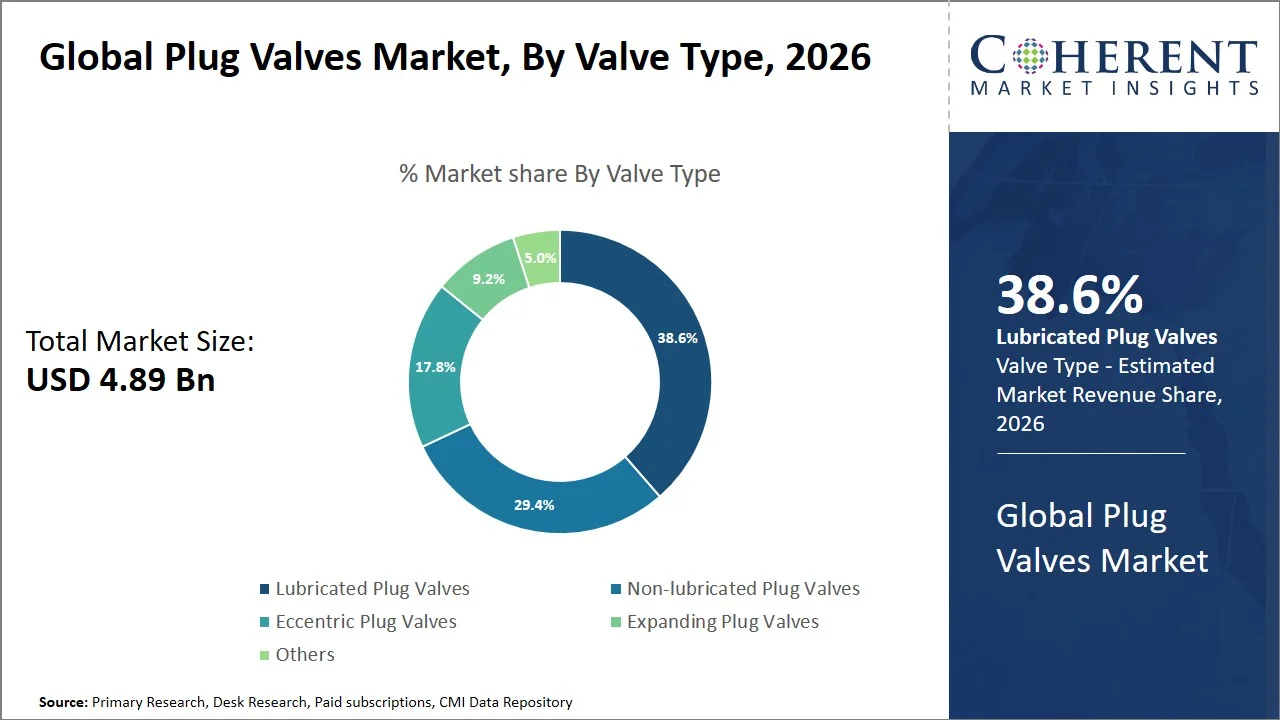
Why Do Lubricated Plug Valves Dominate the Global Plug Valves Market?
Lubricated plug valves are expected to lead the valve-type category with a 38.6% share in 2026 because their injected sealant system creates a renewable sealing interface between the plug and valve body, allowing operators to restore sealing performance without replacing the primary closure element. This characteristic is valuable in natural-gas, petroleum, fuel-transfer, and process lines where service continuity and field maintainability influence valve selection. Standardized tapered designs, established sealant-injection practices, and broad availability in larger nominal sizes reinforce supplier familiarity and replacement demand. Commercially, manufacturers can support the installed base through sealants, fittings, maintenance kits, and refurbishment services alongside new valve sales. In April 2024, the University of Michigan’s valve master specification designated lubricated plug valves for natural-gas isolation on lines 2.5 inches and larger, demonstrating continued institutional specification of the design for gas service.
- Current Industry Events of 2026
- Market Size Estimation
- Regional Breakdown
- Competitive Landscape
- Customer Intelligence
- Segmental Analysis
- Pricing Analysis
- Key Market Drivers, Challenges & Future Trends
- Customized Insights Section
Why Does Cast Iron Represent the Largest Material Segment in the Global Plug Valves Market?
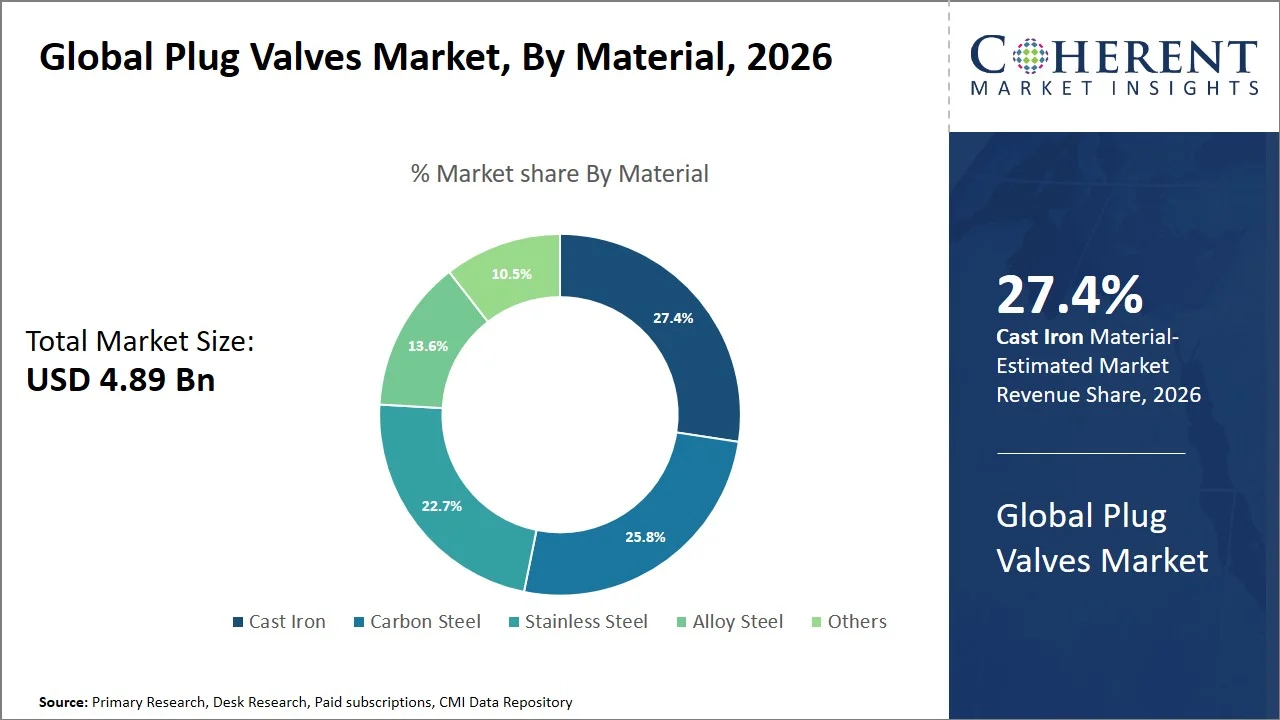
Cast iron is expected to lead the material category with a 27.4% share in 2026, reflecting its strong fit with the large installed base of municipal and utility piping that already uses iron-bodied flow-control equipment. The material can be cast economically into larger valve bodies and readily matched with standardized flanged connections, simplifying replacement engineering and contractor procurement. Suppliers can pair cast-iron bodies with resilient facings, stainless-steel shafts, nickel seats, and protective coatings to improve wetted-component durability without moving the entire valve to higher-cost alloys. This configuration is particularly practical in sewage pumping, wastewater treatment, drainage, and general water-handling systems where large-bore isolation is common. In June 2025, Southwest Middlesex Victoria Street Pump Station Upgrade specified a 100% port eccentric plug valve with an ASTM A126 Class B cast-iron body and cover, confirming continued project-level specification in wastewater infrastructure.
Why Does Manual Operation Dominate the Operation Category of the Global Plug Valves Market?
Manual operation is expected to hold leading 54.2% share in 2026 because a large portion of plug valves function as normally open or normally closed isolation devices rather than continuously modulating equipment. Where operating cycles are infrequent, buyers can avoid actuator sizing, power supplies, instrument wiring, control panels, and integration work while retaining positive local operation through levers, handwheels, or geared mechanisms. This operating model is well suited to valve chambers, wastewater plants, utility networks, and secondary process lines where periodic inspection already requires personnel access. For manufacturers, standardized manual gear packages support broad size coverage and commercially efficient project supply, while powered actuation can remain concentrated in remote or high-cycle duties. In March 2024, Macon Water Authority specified eccentric plug valves with totally enclosed geared manual operators using handwheels or 2-inch operating nuts for its Lower Poplar Water Reclamation Facility procurement.
Current Events and their Impact
Current Event | Description and Its Impact |
June 2024 – PHMSA Updates Pipeline Rupture-Mitigation Valve Requirements |
|
August 2024 – EU Methane Regulation Begins Applying to the Energy Sector |
|
Global Plug Valves Market Dynamics
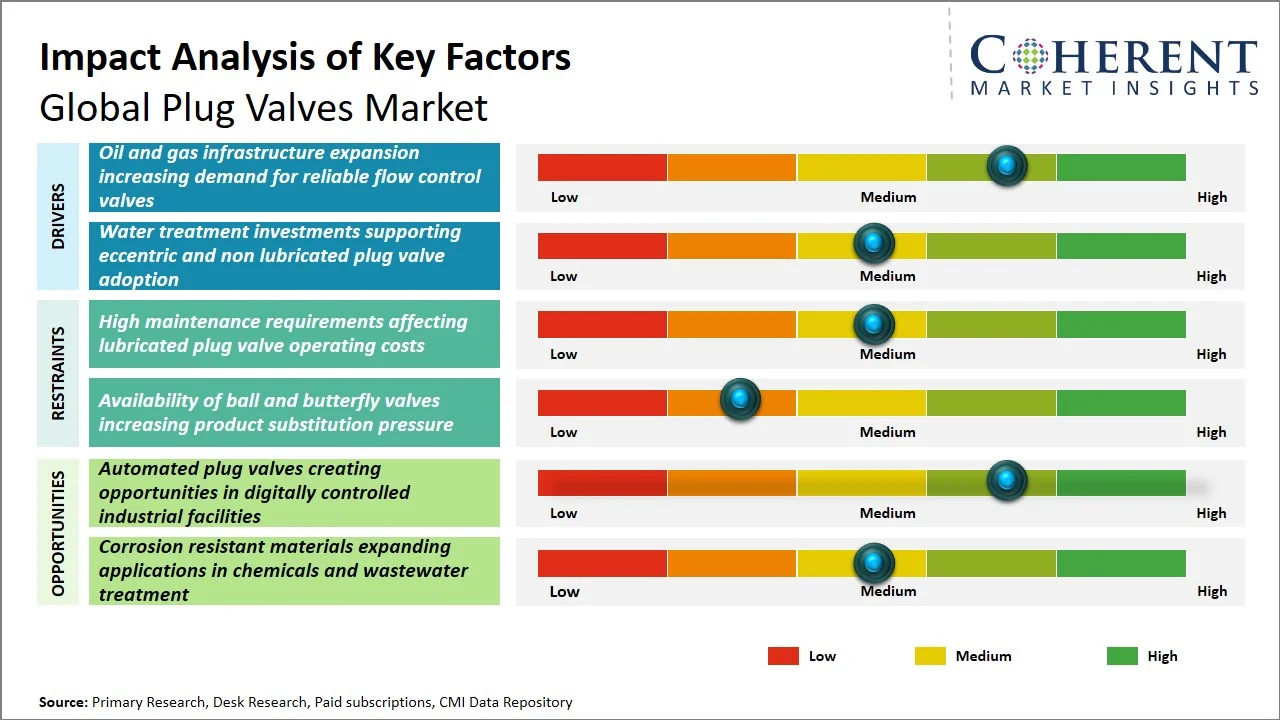
Key Market Drivers
- Oil and Gas Infrastructure Expansion Increasing Demand for Reliable Flow Control Valves: Oil and gas infrastructure expansion is increasing requirements for plug valves that can provide dependable isolation across gas processing, transmission, storage, refinery, and terminal systems. Project owners value robust shutoff, pressure capability, maintainability, and compatibility with manual or powered actuation because valve failure can interrupt high-value process trains or pipeline sections. This creates opportunities for manufacturers supplying lubricated, expanding, and severe-service plug valves, while EPC contractors and aftermarket service providers benefit from specification, commissioning, and maintenance work. Large gas-processing projects are particularly relevant because they add multiple isolation points across inlet, treatment, compression, sulfur-recovery, and export systems. In April 2024, Aramco awarded EPC contracts worth US$ 7.7 billion for the Fadhili Gas Plant expansion, designed to raise processing capacity from 2.5 to as much as 4 billion standard cubic feet per day. The project illustrates how new gas infrastructure broadens demand for high-integrity flow-control equipment.
- Water Treatment Investments Supporting Eccentric and Non-Lubricated Plug Valve Adoption: Water and wastewater investment is supporting plug-valve demand because treatment plants require dependable isolation and throttling across raw-water, sludge, sewage, aeration, pumping, and treated-effluent systems. Eccentric plug valves are commercially attractive in solids-bearing service because their offset motion reduces rubbing during opening and closing, while non-lubricated designs avoid dependence on injected sealing compounds in municipal operating environments. Utilities also favor equipment that can tolerate infrequent operation, corrosive media, and long maintenance cycles. This benefits valve manufacturers with resilient-seated, corrosion-protected, large-diameter portfolios and distributors able to support project specifications and replacement parts. In June 2025, the World Bank approved the Karnataka Water Security and Resilience Program for Bengaluru, including financing for nine sewage-treatment plants and expanded wastewater reuse infrastructure. Such projects enlarge the installed base of pumping and treatment assets where plug valves can be specified for isolation, diversion, and flow control.
Emerging Market Trends
- Lifecycle Serviceability Becoming a Core Procurement Criterion: Lifecycle serviceability is becoming increasingly important as operators seek to reduce maintenance costs and plant downtime. Buyers are favoring replaceable sleeves, accessible packing systems, standardized actuator interfaces, and field-serviceable components. This shifts purchasing decisions from upfront price toward total lifecycle cost, spare-parts availability, and maintenance efficiency. Manufacturers with strong aftermarket support and repair capabilities are therefore better positioned to build recurring customer relationships.
- Application-Specific Sealing and Material Engineering: Plug valve selection is becoming more application-specific as operators consider corrosion, abrasion, temperature, solids content, cleanliness, and emission risks. This is increasing the use of specialized sleeves, linings, coatings, alloys, and metal-seated designs. Suppliers with configurable products and strong material expertise can support premium applications, while standardized low-cost portfolios are likely to remain concentrated in less demanding services.
Regional Insights
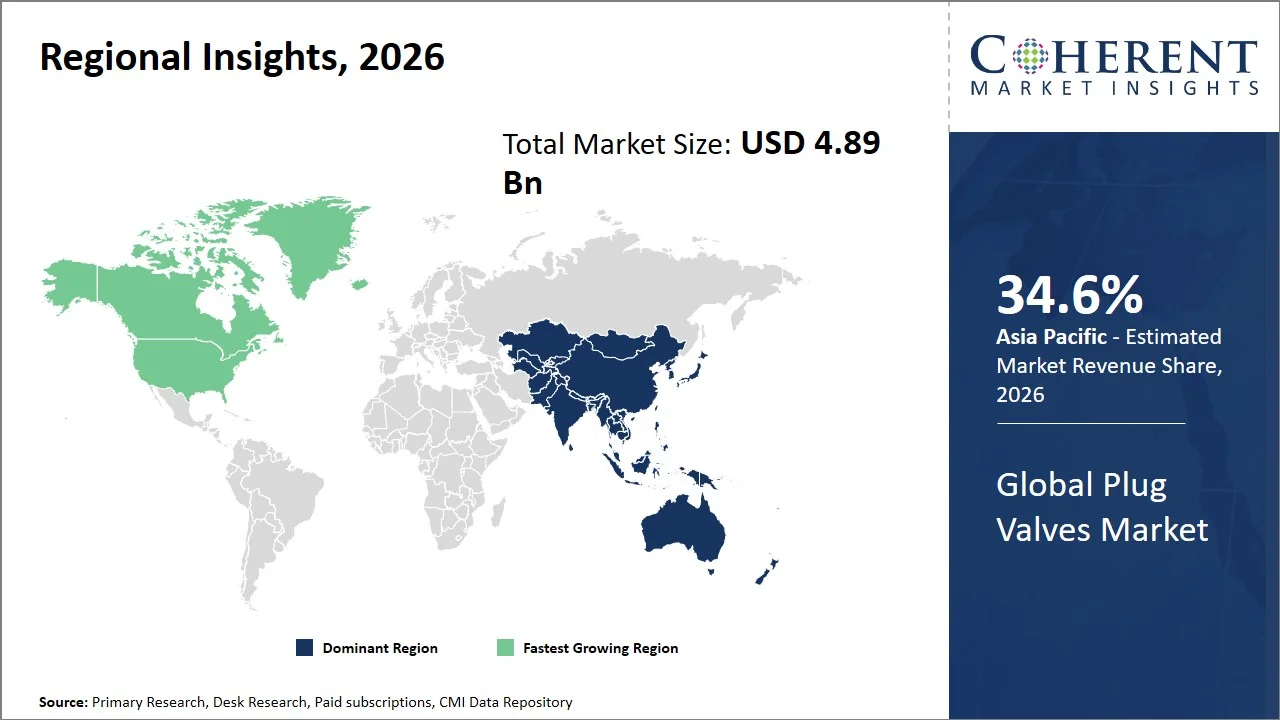
Why Does Asia Pacific Dominate the Global Plug Valves Market?
Asia Pacific is expected to emerge as the dominating region while accounting for 34.6% of the market in 2026. Expansion is supported by continuing investment in upstream developments, long-distance pipelines, refining and petrochemical complexes, municipal water systems, and industrial utilities. Compared with mature replacement-led markets, a larger portion of regional demand is linked to new capacity, creating opportunities for both standard and application-specific plug valves. Local manufacturing expansion also improves product availability and price competitiveness, while operators increasingly prioritize corrosion resistance, automation readiness, and lower lifecycle maintenance. In August 2025, PETRONAS Carigali announced first hydrocarbon production from Malaysia’s Bindu field, developed with a new wellhead platform connected to the Guntong E production hub through a 62-kilometre pipeline. Projects of this type broaden demand for reliable isolation and flow-control equipment across upstream and transmission assets.
Why Is North America Emerging as the Fastest-Growing Region in the Global Plug Valves Market?
North America is designated the fastest growing region with a 27.4% share in 2026, supported by its extensive oil and gas pipeline network, large refining and petrochemical base, mature municipal water infrastructure, and recurring replacement demand from aging flow-control assets. Plug valves remain relevant where operators require dependable isolation, compact quarter-turn operation, and compatibility with hydrocarbon, chemical, and utility service. Procurement is also shaped by stringent pressure, fugitive-emission, fire-safety, and maintenance requirements, favoring engineered valves with documented lifecycle performance. In August 2025, Kinder Morgan SFPP launched a binding open season for an East Line expansion from El Paso, Texas, to Tucson, Arizona, targeting additional refined-product transportation capacity. Such pipeline additions create incremental requirements for isolation, sectionalizing, terminal, and maintenance valves across North American liquid-handling systems.
Global Plug Valves Market Outlook for Key Countries
Why Is the U.S. a Key Market for the Global Plug Valves Market?
The U.S. is a key country for the global plug valves market because it combines large shale production, extensive midstream infrastructure, LNG export capacity, refining, petrochemicals, power generation, and one of the world’s most developed industrial maintenance ecosystems. Demand is therefore created by both greenfield projects and the continuous replacement of valves installed across pipelines, terminals, processing trains, storage facilities, and utility networks. Buyers place strong emphasis on API and ASME conformity, fire-safe performance, fugitive-emission control, actuator compatibility, and dependable aftermarket support. LNG investment is particularly relevant because liquefaction and associated pipeline systems require numerous isolation points. In July 2025, Venture Global reached final investment decision and financial close for Phase 1 of CP2 LNG and its associated CP Express Pipeline, supported by US$15.1 billion in project financing, reinforcing future equipment demand across U.S. gas-processing and transport infrastructure.
Why Is India Important in the Global Plug Valves Market?
India is important to the global plug valves market because natural gas grid expansion, refinery modernization, city-gas distribution, chemicals, fertilizers, power generation, and water infrastructure are creating a broader installed base of flow-control equipment. The country also combines cost-sensitive procurement with increasingly demanding specifications for pressure integrity, corrosion resistance, maintainability, and actuator integration. Large trunk pipelines are especially significant because they require isolation valves at stations, interconnections, metering points, compressor facilities, and sectionalizing locations. In September 2025, GAIL reported that its 1,707-kilometre Mumbai-Nagpur-Jharsuguda Pipeline was nearing completion, with 1,440 kilometres ready for gas-in and the project intended to serve city-gas and industrial demand across multiple states. Continued build-out of the National Gas Grid strengthens the addressable market for robust plug valves used in transmission and associated industrial infrastructure.
How Does China Support Growth in the Global Plug Valves Market?
China supports growth in the global plug valves market through the scale of its oil and gas transmission system, refining and petrochemical clusters, industrial manufacturing base, water infrastructure, and domestic valve-production ecosystem. Demand spans high-pressure pipeline isolation, process applications, utilities, storage, and chemical handling, while national emphasis on equipment localization encourages domestic suppliers to improve metallurgy, sealing systems, automation compatibility, and qualification standards. Expansion of cross-regional gas infrastructure remains particularly important because every new trunk line adds valve stations, sectionalizing points, compressor connections, and maintenance requirements. In June 2025, the West-East Gas Pipeline Line 4 section from Turpan to Zhongwei became fully operational. China’s National Energy Administration reported that the 1,745-kilometre project has annual transmission capacity of 15 billion cubic metres, illustrating the continuing scale of pipeline construction supporting demand for high-integrity flow-control equipment.
Why Is Germany a Strategic Country in the Global Plug Valves Market?
Germany is a strategic country for the global plug valves market because its chemical, specialty materials, pharmaceutical, energy, and advanced manufacturing sectors require high-specification flow-control equipment rather than purely price-led valve procurement. German process plants frequently operate with corrosive, hazardous, high-purity, or temperature-sensitive media, supporting demand for stainless-steel and alloy plug valves with reliable sealing, low leakage, precise material traceability, and automation compatibility. Retrofit activity is equally important as producers modernize plants for efficiency, digital monitoring, and stricter environmental performance. High-purity chemical investment provides a useful indicator of this requirement. In April 2025, BASF announced an expansion of semiconductor-grade sulfuric acid capacity at Ludwigshafen, with a new production facility designed around advanced purity requirements. Such specialized chemical capacity additions support demand for corrosion-resistant, tightly controlled isolation equipment across German process facilities.
Why Is Brazil an Important Growth Market for the Global Plug Valves Market?
Brazil is an important growth market for the Global Plug Valves Market because offshore oil production, refinery upgrades, natural gas infrastructure, petrochemicals, mining, pulp and paper, and water systems create diverse demand for industrial isolation valves. The country’s large pre-salt development pipeline is particularly significant, as offshore production systems require reliable valves across topsides, processing modules, export lines, and supporting onshore infrastructure. Refinery modernization also expands opportunities for high-temperature, hydrocarbon-service, and low-leakage valve configurations. In November 2025, Petrobras approved its 2026–2030 Business Plan, allocating US$69.2 billion to exploration and production projects and US$15.8 billion to refining, transportation, marketing, petrochemicals, and fertilizers. The plan also targets expansion of installed refining capacity, reinforcing a multi-year project pipeline where engineered plug valves can participate in both new installations and replacement programs.
Technology Adoption Landscape in the Global Plug Valves Market
Technology | Adoption Level | Key Application Area | Business Impact |
PTFE/PFA Sleeved and Lined Sealing Systems | High | Corrosive chemical, petrochemical, fertilizer, and specialty-process lines | Reduces media contact with metallic surfaces, limits cavity contamination, and enables non-lubricated operation in corrosive services. |
Low-Emission Live-Loaded Stem Packing | High | Refineries, gas processing, chemical plants, hydrocarbon storage | Improves atmospheric sealing consistency and helps users address increasingly stringent fugitive-emission management requirements. |
Quarter-Turn Pneumatic and Electric Actuation with Position Feedback | High | Remote pipeline isolation, automated process units, terminal systems | Enables centralized operation, interlocking, position verification, and faster isolation while increasing actuator and control-system value per installation. |
Digital Valve Condition and Position Monitoring | Medium | Critical automated plug valves in pipelines and continuous-process facilities | Supports condition-based maintenance, early fault identification, remote asset visibility, and more planned intervention strategies. |
Precision Hardfacing and CNC Seat/Plug Finishing | Medium | Severe-service eccentric and metal-seated plug valves | Improves geometric consistency, wear resistance, shutoff repeatability, and manufacturing capability for abrasive or erosive applications. |
Automated Hydrostatic, Seat-Leak and Fugitive-Emission Testing | High | Factory quality assurance and project qualification | Strengthens traceability, accelerates inspection documentation, improves production consistency, and lowers the risk of field rejection or leakage failures. |
How Are Hydrogen, Ammonia, and Carbon-Management Networks Creating New Growth Opportunities in the Global Plug Valves Market?
Hydrogen, ammonia, and carbon-management infrastructure create an underdeveloped opportunity for plug-valve suppliers able to qualify products for new media and operating conditions. These networks require careful control of leakage, material compatibility, sealing behavior, pressure cycling, and emergency isolation, creating room for purpose-engineered products rather than straightforward transfer of conventional hydrocarbon designs. Pipeline developers, storage operators, electrolyzer projects, ammonia facilities, terminals, and carbon-capture hubs represent potential customer groups. Suppliers can capture this opportunity through metallurgy testing, validated sealing systems, low-emission qualification, fire-safe engineering, actuator integration, and application-specific documentation. Partnerships with EPC contractors and packaged-equipment manufacturers can help secure specification positions before projects move into procurement. Participation will require investment in testing capability, engineering talent, certification pathways, and specialist aftermarket support. Established severe-service manufacturers should benefit from existing qualification infrastructure, but focused specialists can compete by solving difficult media-specific problems quickly. Companies should prioritize validated performance and project engineering rather than launching broad new-energy product ranges without sufficient service evidence.
Market Players, Key Development, and Competitive Landscape
Key Developments
- In March 2026, AZ Armaturen announced that its new CA2A sealing system for lined plug valves had obtained ISO 15848-1 certification. The certification applies to lined two-way and multiport plug valves and confirms performance under defined leakage and endurance testing conditions. This is important for the global plug valves market because it strengthens the commercial positioning of lined plug valves in applications where fugitive-emission control and documented stem-sealing performance increasingly influence technical qualification.
- In October 2025, Fluid Controls Limited received a DNV Statement of Conformity covering its quality system for the manufacture and testing of pressure-accessory valves and manifolds, with plug valves included among the covered products under ASME B16.34. This is important for the global plug valves market because independently assessed manufacturing and testing systems improve supplier credibility in specification-led industrial applications where documentation, conformity, and traceable quality processes influence procurement qualification.
- In December 2024, Newsway Valve announced commercial availability of its Class 600 plug valve, positioning the product for high-pressure pipeline and industrial shutoff applications. This is important for the global plug valves market because broader availability of higher-pressure configurations increases supplier competition in oil and gas, petrochemical, power, and process applications where pressure rating and dependable isolation are key purchasing criteria.
Competitive Landscape
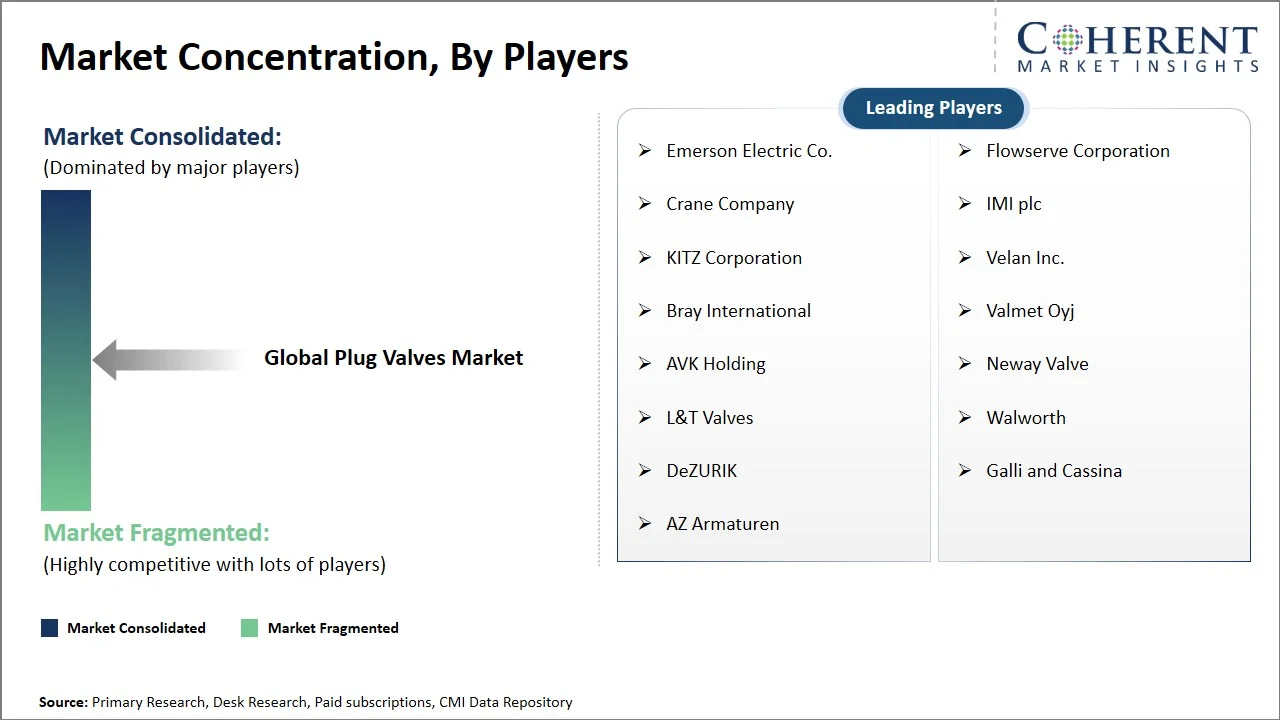
The global plug valves market is fragmented, comprising diversified international flow-control manufacturers, dedicated plug-valve specialists, regional industrial valve producers, foundry-integrated suppliers, automation providers, and local distributors. Competition varies considerably by service severity: standardized water and utility applications remain price- and delivery-sensitive, whereas refinery, chemical, gas transmission, and hazardous-fluid applications place greater weight on engineering qualification and documented performance. Regional suppliers can compete effectively through local lead times and project relationships, while internationally established vendors benefit from wider certification portfolios, EPC approvals, service networks, and cross-border project support.
Key focus areas include
- Approved-vendor and EPC qualification: Inclusion in owner and engineering-contractor vendor lists materially influences access to large process and infrastructure projects.
- Application engineering capability: Suppliers able to configure pressure class, port design, metallurgy, lining, sealing, and operator type for specific media can defend higher-value positions.
- Testing and documentation: Traceable pressure testing, leakage verification, material certificates, fire-safe evidence, and quality records increasingly differentiate qualified suppliers.
- Manufacturing control: In-house casting, machining, coating, lining, and final assembly can improve delivery predictability and reduce dependence on external suppliers.
- Actuator interoperability: Easy integration with pneumatic, electric, hydraulic, gearbox, and feedback packages improves competitiveness in automated plant projects.
- Regional supply and service coverage: Local inventories, repair capability, spare-parts access, and technical personnel can be decisive where plant downtime carries high costs.
- Commercial discipline: Manufacturers must balance upfront pricing with durability, maintenance frequency, engineering support, and total lifecycle economics rather than pursue volume at unsustainable margins.
Market Report Scope
Plug Valves Market Report Coverage
| Report Coverage | Details | ||
|---|---|---|---|
| Base Year: | 2025 | Market Size in 2026: | USD 4.89 Bn |
| Historical Data for: | 2020 To 2024 | Forecast Period: | 2026 To 2033 |
| Forecast Period 2026 to 2033 CAGR: | 6.4% | 2033 Value Projection: | USD 7.54 Bn |
| Geographies covered: |
| ||
| Segments covered: |
| ||
| Companies covered: | Emerson Electric Co., Flowserve Corporation, Crane Company, IMI plc, KITZ Corporation, Velan Inc., Bray International, Valmet Oyj, AVK Holding, Neway Valve, L&T Valves, Walworth, DeZURIK, Galli and Cassina, AZ Armaturen | ||
| Growth Drivers: |
| ||
| Restraints & Challenges: |
| ||
Analyst Opinion (Expert Opinion)
- The competitive structure is likely to polarize between globally qualified suppliers embedded in EPC and asset-owner procurement frameworks and specialist manufacturers that dominate narrowly defined severe-service applications. Market leadership will increasingly depend on shortening technical qualification cycles, responding quickly to engineered specifications, and maintaining consistency across multiple manufacturing locations. Suppliers positioned only around broad catalog availability may find it harder to defend margins as buyers separate commodity isolation duties from applications where engineering assurance justifies premium procurement.
- Digital engineering could fundamentally change how industrial valves are selected and purchased. EPC contractors and asset owners are moving toward richer digital plant models, structured equipment data, machine-readable documentation, and configuration-led engineering workflows. As this progresses, valve manufacturers may need digital product models, standardized engineering data, automated configuration tools, traceable certificates, and seamless integration into customer design environments. Traditional distributor models based primarily on catalog access could face pressure, while manufacturers that make specification, documentation, and configuration digitally accessible can enter project decisions earlier.
- Suppliers should prioritize qualification capabilities for difficult media, localized machining and repair, dependable sealing technologies, actuator compatibility, and rapid engineering support. Investment should be concentrated in applications where technical differentiation protects margins rather than pursuing every commodity project. Material and fluoropolymer supply exposure should be actively managed through qualified alternative sources. Companies should also avoid overengineering low-cycle isolation duties where customers remain highly price-sensitive, while using partnerships with EPCs, automation specialists, and regional service organizations to strengthen access to specification-led opportunities.
Speak to the analyst
Want personalized insights?
Take the findings above to one of our principal consultants, or have the report rebuilt around the segments, geographies and competitors you actually track.
Market Segmentation
- Valve Type Insights (Revenue, USD Bn, 2021 - 2033)
- Lubricated Plug Valves
- Non lubricated Plug Valves
- Eccentric Plug Valves
- Expanding Plug Valves
- Others
- Material Insights (Revenue, USD Bn, 2021 - 2033)
- Cast Iron
- Carbon Steel
- Stainless Steel
- Alloy Steel
- Others
- Operation Insights (Revenue, USD Bn, 2021 - 2033)
- Manual
- Pneumatic
- Electric
- Hydraulic
- End User Industry Insights (Revenue, USD Bn, 2021 - 2033)
- Oil and Gas
- Water and Wastewater
- Chemicals and Petrochemicals
- Power Generation
- Mining and Minerals
- Food and Beverage
- Others
- Regional Insights (Revenue, USD Bn, 2021 - 2033)
- North America
- U.S.
- Canada
- Latin America
- Brazil
- Argentina
- Mexico
- Rest of Latin America
- Europe
- Germany
- U.K.
- Spain
- France
- Italy
- Russia
- Rest of Europe
- Asia Pacific
- China
- India
- Japan
- Australia
- South Korea
- ASEAN
- Rest of Asia Pacific
- Middle East
- GCC Countries
- Israel
- Rest of Middle East
- Africa
- South Africa
- North Africa
- Central Africa
- North America
- Key Players Insights
- Emerson Electric Co.
- Flowserve Corporation
- Crane Company
- IMI plc
- KITZ Corporation
- Velan Inc.
- Bray International
- Valmet Oyj
- AVK Holding
- Neway Valve
- L&T Valves
- Walworth
- DeZURIK
- Galli and Cassina
- AZ Armaturen
Sources
Primary Research Interviews
- Plug valve, industrial valve, pipeline valve, and flow-control equipment manufacturers
- Steel, cast iron, lining, seal, coating, packing, and actuator suppliers
- Oil & gas, water & wastewater, chemical, power, mining, and food & beverage operators
- Distributors, EPC contractors, system integrators, MRO providers, and industry experts
Stakeholders
- Lubricated, non-lubricated, eccentric, and expanding plug valve manufacturers
- Foundries, machining companies, sealing, lining, and actuator suppliers
- EPC contractors, distributors, valve service centers, and maintenance companies
- Pipeline operators, refineries, utilities, chemical plants, power plants, and mining companies
End-use Sectors
- Oil & gas production, pipelines, LNG, refineries, and terminals
- Water supply, wastewater treatment, sewage, and pumping stations
- Chemical, petrochemical, fertilizer, and specialty chemical plants
- Power generation, mining, mineral processing, and industrial utilities
- Food & beverage and other process industries
Regulatory and Government Bodies
- U.S. PHMSA, OSHA, EPA, DOE, Census Bureau, and USITC
- European Commission, ECHA, Eurostat, and national regulatory authorities
- UK HSE, OPSS, and Department for Business and Trade
- China SAMR, MIIT, National Energy Administration, Customs, and NBS
- India BIS, PESO, PNGRB, MoPNG, DGFT, and MOSPI
- Brazil ANP, INMETRO, and Ministry of Mines and Energy
- ISO, API, ASME, AWWA, MSS, and accredited testing laboratories
Databases
- UN Comtrade, ITC Trade Map, WTO, Eurostat, USITC DataWeb, World Bank, and OECD
- EIA, IEA, national energy, pipeline, refinery, water, and industrial databases
- Customs, government procurement, infrastructure project, and investment databases
- Company filings, product catalogues, technical specifications, pricing records, WIPO, and Espacenet
Magazines and Journals
- Valve Magazine, Valve World, Valve User, Pumps & Systems, and World Pipelines
- Hydrocarbon Processing, Oil & Gas Journal, Chemical Engineering, and WaterWorld
- Corrosion Science, Engineering Failure Analysis, and Journal of Loss Prevention in the Process Industries
Associations
- Valve Manufacturers Association of America
- American Petroleum Institute
- American Society of Mechanical Engineers
- American Water Works Association
- Manufacturers Standardization Society
- British Valve & Actuator Association
- CEIR – European Association for the Taps and Valves Industry
- VDMA Industrial Valves
Public Domain Sources
- Product catalogues, technical datasheets, installation and maintenance manuals
- Pressure class, size, material, sealing, flow, torque, leakage, and actuator specifications
- Hydrostatic, fire-safe, fugitive-emission, and performance testing data
- Pipeline, refinery, petrochemical, wastewater, power, and mining project documents
- Import-export data, tenders, annual reports, patents, investments, and product developments
Key Standards and Regulations
- API 6D – Pipeline and piping valves
- ISO 14313 – Pipeline valves
- ASME B16.34 – Industrial valve design and pressure ratings
- API 598 and ISO 5208 – Valve inspection and testing
- ISO 15848 – Fugitive-emission testing
- AWWA C517 – Resilient-seated eccentric plug valves
- ISO 15156 / NACE MR0175 – Sour-service material requirements
- ASME B31.3, B31.4, and B31.8 – Process and pipeline piping
- API 607 / API 6FA – Fire-safe testing
- EU Pressure Equipment Directive 2014/68/EU
- U.S. PHMSA pipeline-safety and OSHA process-safety requirements
Proprietary Elements
- CMI Data Analytics Tool, Proprietary CMI Existing Repository of information for last 10 years.
Get access to 250+ pages report
Every segment, forecast, competitor profile and data table behind the analysis above — available for instant download.
- ESOMAR Member
- ISO 9001:2015 Certified
- D-U-N-S Registered
- GDPR & CCPA Compliant
Missing comfort of reading report in your local language? Find your preferred language:
Transform your Strategy with Exclusive Trending Reports
Frequently Asked Questions
The CAGR of global plug valves market is projected to be 6.4% from 2026 to 2033.
The global plug valves market is estimated to be valued at USD 4.89 billion in 2026 and is expected to reach USD 7.54 billion by 2033.
Oil and gas, water and wastewater, chemicals and petrochemicals, power generation, mining, and food and beverage are key end-use industries for plug valves.
Cast iron, carbon steel, stainless steel, and alloy steel are commonly used materials depending on pressure, corrosion resistance, and application requirements.
Plug valves are commonly available with manual, pneumatic, electric, and hydraulic operation depending on automation needs and operating conditions.
Oil and gas infrastructure expansion increasing demand for reliable flow control valves and Water treatment investments supporting eccentric and non lubricated plug valve adoption are the major factor driving the growth of global plug valves market.
High maintenance requirements affecting lubricated plug valve operating costs and Availability of ball and butterfly valves increasing product substitution pressure are the major factor hampering the growth of global plug valves market.