

Global Post-Quantum Cryptography Migration Platform Market Size and Forecast – 2026 To 2033
The global post-quantum cryptography migration platform market is expected to grow from USD 2.20 Bn in 2026 to USD 20.50 Bn by 2033, registering a compound annual growth rate (CAGR) of 37.8% from 2026 to 2033. The global post-quantum cryptography migration platform market is driven by rising adoption of quantum-safe encryption across financial institutions. On February 12, 2025, Banco Santander highlighted its post-quantum cryptography preparations. The bank participates in the Quantum Safe Financial Forum, which brings together financial institutions across Europe, the U.K., and the U.S.
Key Takeaways of the Global Post-Quantum Cryptography Migration Platform Market
- The Cryptographic Discovery and Inventory Platforms segment is expected to account for 37.0% of the global post-quantum cryptography migration platform market share in 2026. Increasing demand for automated cryptographic discovery and inventory management is driving the growth of the segment. On February 5, 2026, Encryption Consulting launched CBOM Secure. The product creates continuous inventories of cryptographic assets, including algorithms, keys, certificates, libraries, source code, binaries, and runtime environments.
- The Cloud-Based segment is estimated to capture 48.0% of the market share in 2026. Growing investments in cloud security and digital infrastructure is majorly driving the growth of the segment. On October 7, 2025, Google Cloud announced preview support for post-quantum key encapsulation mechanisms in Cloud Key Management Service.
- The Assessment and Advisory segment is estimated to capture 34.0% of the market share in 2026. Rising need to protect sensitive information against harvest-now-decrypt-later attacks is driving the growth of the segment. On June 9, 2025, Commvault announced enhancements to its post-quantum cryptography capabilities. The company added support for the Hamming Quasi-Cyclic algorithm to its Commvault Cloud platform
- North America is expected to dominate the post-quantum cryptography migration platform market in 2026 with a market share of 38.0%. Integration of quantum-resistant encryption into cloud platforms in North America is driving the growth of the regional market. On April 7, 2025, Amazon Web Services announced hybrid post-quantum key agreement support across three services, Amazon Key Management Service, Amazon Certificate Manager, and Amazon Secrets Manager
- Asia Pacific is expected to account for 26.0% share in 2026. Expansion of post-quantum cybersecurity solutions across telecommunications in Asia Pacific is driving the growth of the regional market. On September 30, 2025, Maxis partnered with Nokia to introduce Malaysia's first Quantum Safe Networking service. The managed service encrypts enterprise data directly at the optical layer.
Segmental Insights
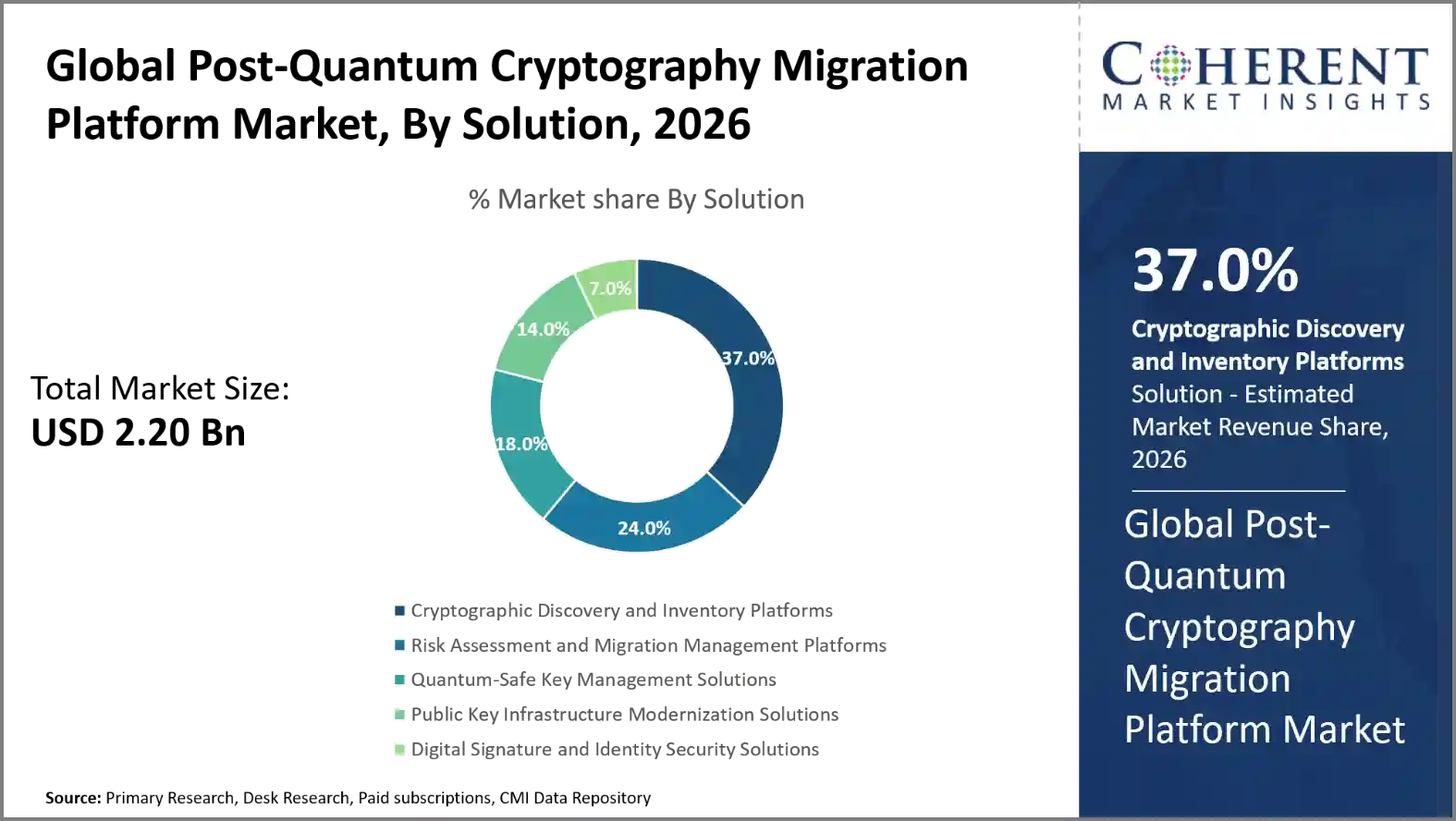
Why Does Cryptographic Discovery and Inventory Platforms Dominate the Global Post-Quantum Cryptography Migration Platform Market?
The cryptographic discovery and inventory platforms segment is expected to account for 37.0% of the global post-quantum cryptography migration platform market share in 2026. Cryptographic discovery and inventory platforms dominate because enterprises need to know what cryptographic assets exist before they can be migrated. These tools discover techniques for encryption, digital certificates, cryptographic keys and susceptible protocols across organizational contexts. They assist security teams to detect quantum-vulnerable cryptographic implementations and prioritize important infrastructure. Growing regulatory focus on quantum-resistant security further drives demand. Organizations also need to continuously monitor in an effort to manage cryptographic dependencies and to avoid outdated algorithms being unnoticed. These characteristics make detection and inventory of cryptography critical for a successful migration to post-quantum cryptography.
On April 1, 2025, CryptoNext Security introduced its COMPASS Discovery products. The first products were COMPASS Analytics and COMPASS Network Probe. They identify cryptographic assets in information technology, operational technology, applications and communication protocols.
- Current Industry Events of 2026
- Market Size Estimation
- Regional Breakdown
- Competitive Landscape
- Customer Intelligence
- Segmental Analysis
- Pricing Analysis
- Key Market Drivers, Challenges & Future Trends
- Customized Insights Section
Why is Cloud-Based the Most Preferred Deployment Type?
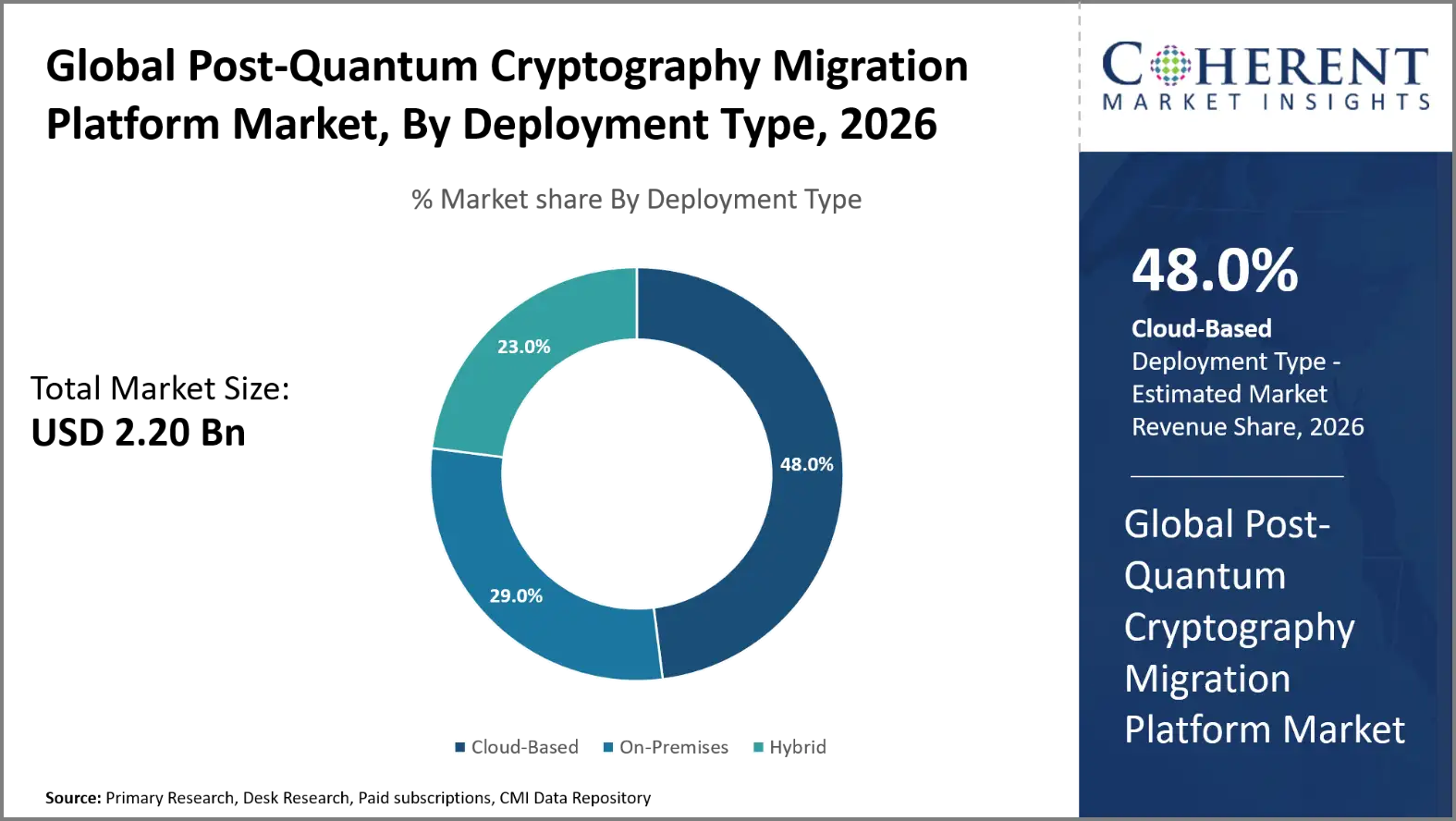
The cloud-based segment is expected to account for 48.0% of the global post-quantum cryptography migration platform market share in 2026. Cloud-based deployment is leading the way as enterprises need scalable and flexible infrastructure for enterprise-wide cryptographic transformation. Cloud systems provide centralized detection, risk assessment, and migration of cryptographic assets in distributed contexts. They lessen the need for maintenance of infrastructure and enable speedier software updates. Integration with cloud security services also enhances visibility into apps, workloads and digital identities. Demand for centralized cryptography management is driven by the growing adoption of hybrid and multi-cloud settings. Keeping these advantages in mind, the cloud-based deployment is the preferable solution for enterprises implementing post-quantum cryptography techniques.
On August 11, 2026, Google Cloud presented an updated post-quantum cryptography roadmap. The company outlined its target of achieving full post-quantum readiness by 2029. Its strategy covers cloud infrastructure, customer-facing services, sovereign cloud environments, and artificial intelligence workloads.
Assessment and Advisory Dominates the Global Post-Quantum Cryptography Migration Platform Market
The assessment and advisory segment is expected to account for 34.0% of the global post-quantum cryptography migration platform market share in 2026. Assessment and advisory services dominate because organizations require expert guidance before replacing existing cryptographic systems. These services assess cryptographic weaknesses, identify quantum-sensitive infrastructure, and prioritize migration. They also help companies understand compatibility requirements across apps, hardware, networks and security protocols. As knowledge of quantum computing dangers increases, corporations are performing cryptographic risk assessments. Advisory services assist with algorithm selection, migration roadmaps, compliance readiness and implementation planning. Given their strategic importance, assessment and advising services are a vital component of corporate post-quantum cryptography migration projects.
On March 27, 2025, Unisys introduced the first of several new Post-Quantum Cryptography (PQC) capabilities and services that are part of its cybersecurity offering. The cryptographic posture assessment is part of a steady rollout of comprehensive offerings designed to help organizations prepare for and defend against future quantum threats.
Current Events and their Impact
Current Events | Description and its Impact |
U.S. Executive Order 14412 - Securing the Nation Against Advanced Cryptographic Attacks |
|
Canada Security Policy Implementation Notice – Migrating the Government of Canada to Post-Quantum Cryptography |
|
Post-Quantum Cryptography Migration Platform Market Dynamics
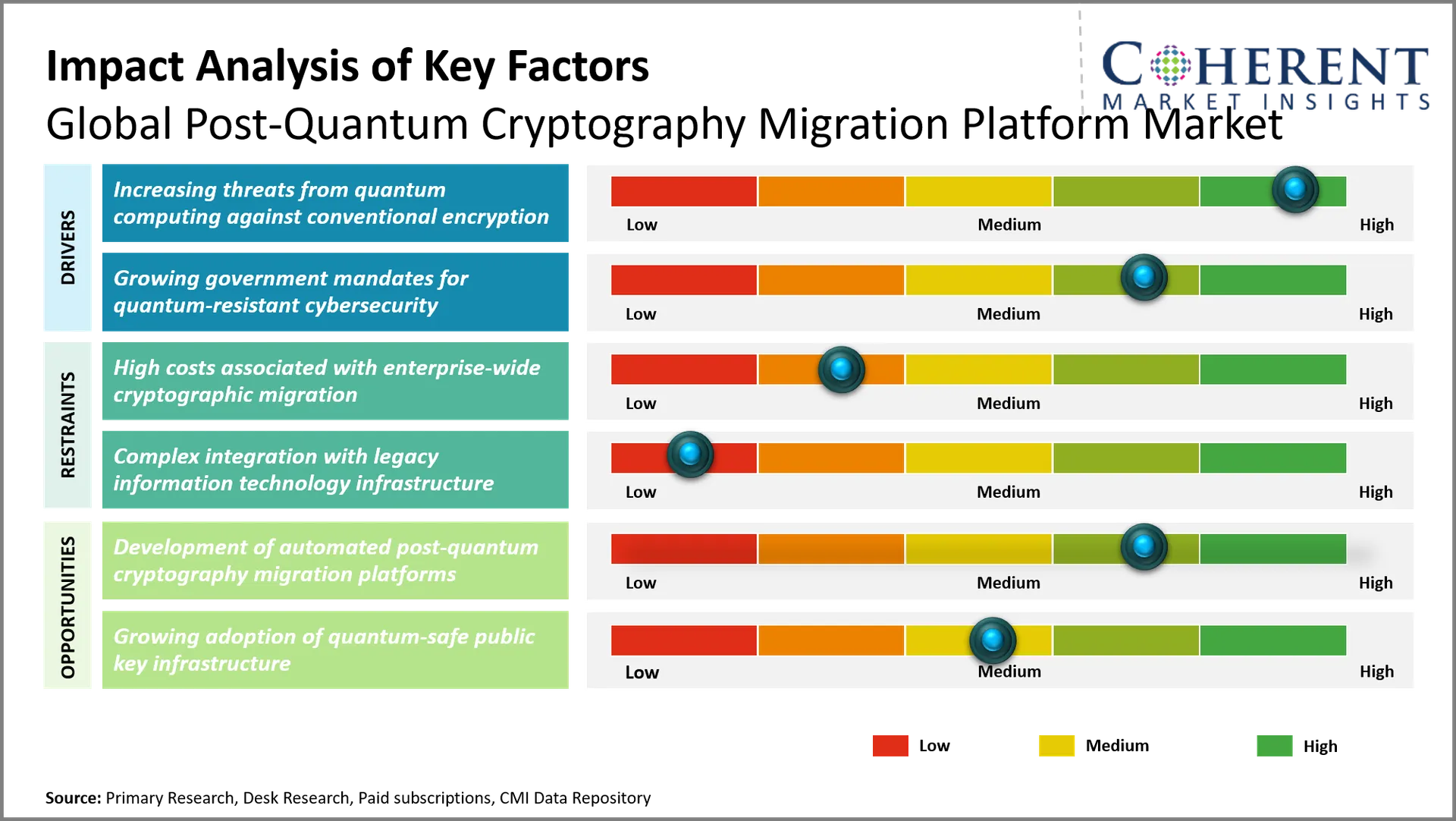
Market Drivers
Increasing threats from quantum computing against conventional encryption
Advances in quantum computation are threatening the long-term security of traditional cryptographic systems. Eventually powerful quantum computers could break widely used Rivest-Shamir-Adleman and Elliptic Curve Cryptography techniques. Organizations are looking at their encryption infrastructure in light of the probable advent of cryptographically relevant quantum computers. Attackers can also capture encrypted data, to decrypt later, increasing hazards to sensitive financial, healthcare and government data. Such dangers drive the need for cryptographic discovery tools to identify susceptible algorithms, analyze encryption dependencies and prioritize replacement actions. As such, companies are investing in post-quantum cryptography migration systems to improve long-term data security and cryptographic resiliency.
On January 22, 2025, Accenture made a strategic investment in QuSecure, a leader in post-quantum cybersecurity. Together, Accenture and QuSecure offer full post-quantum crypto agility solutions to help government agencies and private sector organizations address growing quantum risks.
Growing government mandates for quantum-resistant cybersecurity
National cybersecurity policies, migration guidelines and technical standards are being used by governments to speed up the adoption of post-quantum cryptography. The U.S. National Institute of Standards and Technology (NIST) released Federal Information Processing Standards 203, 204, and 205 in August 2024. These standards specify accepted post-quantum methods for key establishment, and for electronic signatures. The European Commission and the UK National Cyber Security Center have also issued coordinated recommendations on migration. These programs encourage government agencies, critical infrastructure operators and regulated businesses to detect quantum-vulnerable cryptographic technologies. Organizations are facing rising needs for automated inventory management, vulnerability assessment, migration planning and compliance monitoring. That, in turn, will boost demand for specialized post-quantum cryptography migration systems.
On July 11, 2025, SISA collaborated with the Ministry of Electronics and Information Technology and the Indian Computer Emergency Response Team. The partners published the whitepaper Transitioning to Quantum Cyber Readiness. The article calls on public and commercial entities to detect cryptographic vulnerabilities and plan for migration.
Emerging Trends
- Automated Cryptographic Discovery and Continuous Inventory Management: Organizations are using automated cryptographic discovery tools to find susceptible algorithms, certificates, keys and encryption dependencies inside complicated information technology landscapes.
- Impact: Automation cuts down on human assessment effort, enhances visibility of vulnerabilities, and accelerates migration planning across enterprise applications, cloud infrastructure, and associated networks.
- Relevance to the market: Platforms like Keyfactor Command and IBM Guardium offer relevant cryptographic visibility and security management capabilities, driving the demand for integrated discovery and migration solutions.
- Integration of Post-Quantum Cryptography with Cloud Security Infrastructure: Cloud security vendors are progressively embedding quantum-resistant cryptographic capabilities in identity management, application security, and corporate encryption infrastructures.
- Impact: Cloud integration provides centralized cryptography administration, enhances scalability, and facilitates post-quantum migration across distributed workloads and hybrid infrastructure for enterprises.
- Relevance to the market: Amazon Web Services, Microsoft Azure and Google Cloud are leading the way in post-quantum cryptography support, driving migration platform vendors to create evaluation and orchestration capabilities for cloud compatibility.
Regional Insights
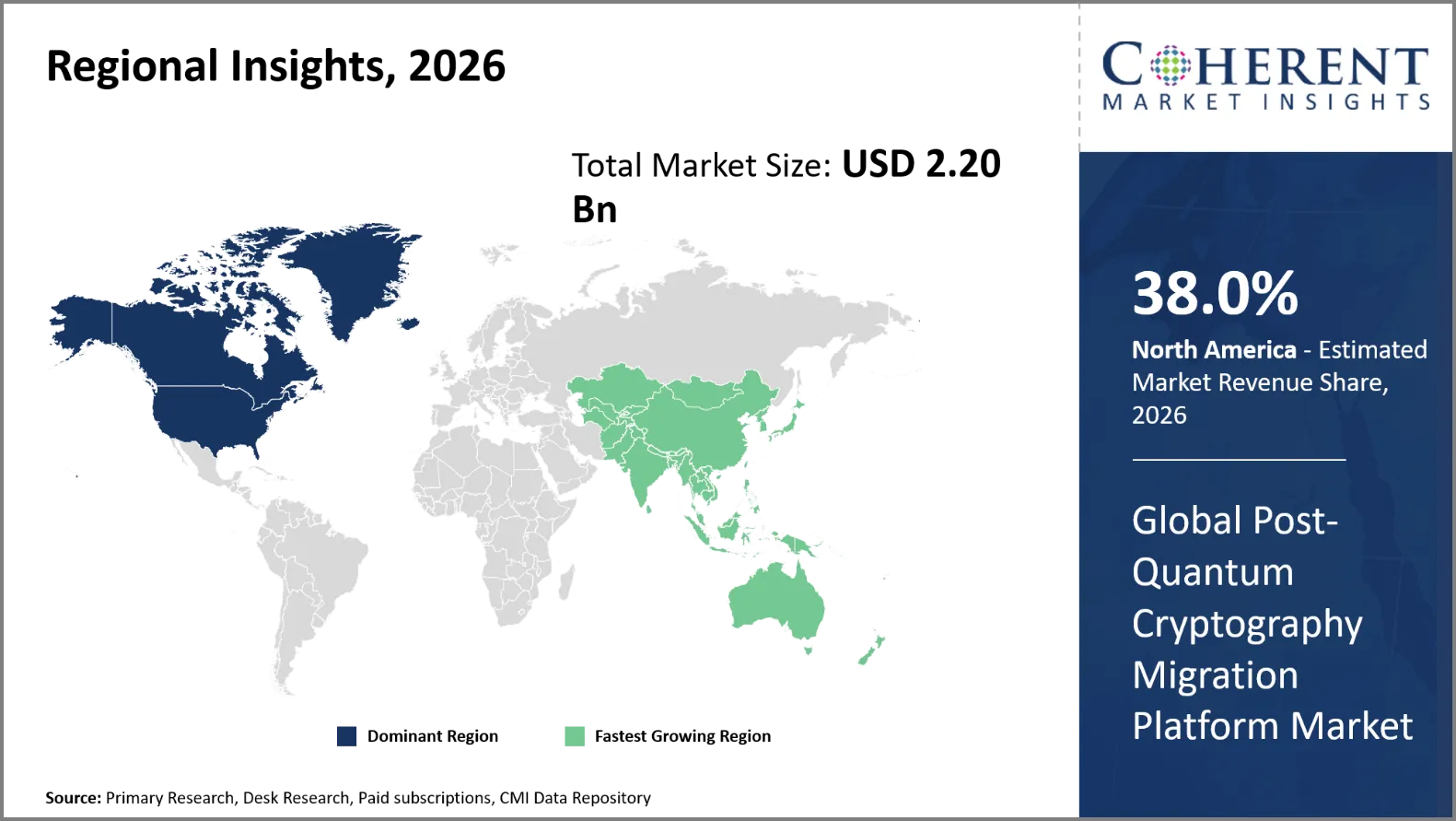
Why is North America a Strong Market for Post-Quantum Cryptography Migration Platform?
North America is expected to account for a market share of 38.0% in 2026. North America benefits from advanced cybersecurity research, federal cryptographic modernization, and strong collaboration between technology developers and government institutions. The U.S. National Institute of Standards and Technology published NISTIR 8547 in October 2026. This report provides technical migration guidance for replacing vulnerable cryptographic standards. The National Cybersecurity Center of Excellence is also demonstrating practical migration approaches with industry participants. These objectives drive companies to use technologies for cryptography discovery, dependency mapping and migration assessment. The Cyber Center of Canada is producing implementation guidance for departmental IT systems. Cross-border financial services and defense supply chains further encourage compatible cryptographic migration strategies.
Why Does Asia Pacific Post-Quantum Cryptography Migration Platform Market Exhibit High Growth?
Asia Pacific is expected to register the fastest growth with a CAGR of 38.0% over the forecast period. Asia Pacific is projected to account for 26.0% of the global post-quantum cryptography migration platform market in 2026. Asia Pacific is gaining momentum with government-backed quantum-safe infrastructure initiatives and indigenous cryptographic technology development. Singtel, SP Telecommunications and SpeQtral are participating in the National Quantum-Safe Network Plus in Singapore. The project allows enterprises to deploy quantum-safe technologies into national communications infrastructure. In January 2026, China’s National Cryptography Administration stated that it was providing financing for research on quantum-resistant cryptographic migration agility. Its program comprises automated vulnerability detection and dynamically customizable cryptography modules. Australia’s cybersecurity authorities are also developing practical migration recommendations for businesses. These developments encourage regional demand for platforms supporting algorithm compatibility, infrastructure discovery, and migration validation across telecommunications, financial services, and government networks.
Global Post-Quantum Cryptography Migration Platform Market Outlook for Key Countries
Why is U.S. Emerging as a Major Hub in the Post-Quantum Cryptography Migration Platform Market?
Federal cybersecurity modernization and technology development are ubiquitous across the U.S. market in critical infrastructure sectors. The National Institute of Standards and Technology’s National Cybersecurity Center of Excellence is collaborating with business partners to showcase practical approaches to transitioning to new cryptography. Its migration program tackles the problems of asset discovery, vulnerability prioritization, interoperability and implementation. The Cybersecurity and Infrastructure Security Agency is also providing procurement awareness using post-quantum cryptography product guidelines. Federal contractors, cloud service providers and defense technology suppliers are under increased pressure to demonstrate cryptography capability. These criteria drive the deployment of centralized inventory platforms, automated compliance assessment, and cryptographic lifecycle management solutions.
Is Japan the Next Growth Engine for the Post-Quantum Cryptography Migration Platform Market?
Japan is making progress on post-quantum cryptography preparation through national cybersecurity planning and domestic cryptographic evaluation efforts. The National Cybersecurity Office’s interim review in November 2025 suggested that government migration be completed by 2035. It also intends to create a detailed migration strategy throughout the fiscal year 2026. The Cryptography Research and Evaluation Committees are reviewing post-quantum algorithms for possible inclusion in government cryptographic recommendations. At the same time, Japan’s industrial robotics, automotive electronics and semiconductor supply chains have considerable cryptographic integration requirements. These sectors need systems that can examine embedded cryptographic elements, firmware dependencies and long-life-cycle equipment before quantum-resistant security methods are deployed.
U.K. Post-Quantum Cryptography Migration Platform Market Analysis and Trends
The U.K. market is gaining momentum with government led migration timelines and increasing enterprise cybersecurity demands. The National Cyber Security Center recommends that by 2028 cryptographic discovery and migration planning should be completed. Priority migration efforts must be finished by 2031 and full migration must be achieved by 2035. Key industries of demand are financial services, telecommunications, defense and critical infrastructure. These sectors need cryptographic inventory, quantum vulnerability evaluations, algorithm replacement, and ongoing lifecycle management. In 2025 the National Cyber Security Center began a prototype consultancy system, with eight providers joining the initiative.
Canada Post-Quantum Cryptography Migration Platform Market Analysis and Trends
Canada’s advantage is the government information technology upgrading and infrastructure management is coordinated. Shared Services Canada is preparing migration plans for systems under its control. Its coordinating function helps departments identify common dependencies and interoperability requirements before replacing cryptographic technology. The Canadian Center for Cyber Security also released ITSM.40.001, which provides recommendations on execution and departmental migration milestones. Federal agencies must address encryption in network services, operating systems, application environments, and development pipelines. Such requirements provide opportunity for systems that enable enterprise-wide asset classification, shared infrastructure mapping, departmental reporting, and tracking of migration dependencies.
Germany Post-Quantum Cryptography Migration Platform Market Analysis and Trends
Germany has a technical lead in the area of cryptographic standardization and stringent cybersecurity requirements across industrial infrastructure. In January 2025, the Federal Office for Information Security published its amended Technical Guideline TR-02102-1. The guideline includes updated post-quantum guidelines considering worldwide standardization progress. German cybersecurity authorities also stressed hybrid cryptographic implementation in June 2025. The proposed solution is to integrate existing algorithms with quantum-resistant alternatives during the migration. Automotive manufacturing, industrial automation and machinery in Germany need secure firmware updates and long-term authentication of devices. Consequently, cryptographic migration platforms offering hybrid compatibility testing, embedded asset discovery, and certificate lifecycle assessment have strong application potential.
Global Post-Quantum Cryptography Migration Platform Market - Algorithm Lifecycle Management Data
Lifecycle stage | Cryptographic activity | Relevant algorithms / standards |
Cryptographic discovery | Identify cryptographic assets across applications and infrastructure | RSA, ECC, Diffie-Hellman, TLS, X.509 |
Asset classification | Classify algorithms, keys, certificates, protocols, and dependencies | RSA, ECC, AES, SHA-2, SSH, Public Key Infrastructure |
Quantum vulnerability assessment | Identify quantum-vulnerable cryptographic implementations | RSA, ECC, Diffie-Hellman, ML-KEM, ML-DSA, SLH-DSA |
Risk prioritization | Prioritize assets based on exposure, data sensitivity, and retention requirements | RSA, ECC, ML-KEM, ML-DSA, SLH-DSA |
Algorithm selection | Select approved post-quantum or hybrid cryptographic algorithms | ML-KEM, ML-DSA, SLH-DSA, NIST FIPS 203, 204, 205 |
How is Development of Automated Post-Quantum Cryptography Migration Platforms Creating New Growth Opportunities in the Post-Quantum Cryptography Migration Platform Market?
The development of automated post-quantum cryptography migration platforms creates opportunities through automated code analysis, cryptographic dependency mapping, and algorithm replacement validation. For example, IBM’s Quantum Safe Transformation Services automate cryptographic discovery and application assessment to identify vulnerable implementations. SandboxAQ’s AQtive Guard identifies cryptographic assets and assesses risk across enterprise contexts. These features handle migration challenges such as deeply embedded encryption libraries, expired certificates and interdependent apps. Automation also allows firms to prioritize at-risk systems according to data sensitivity and operational interdependence. Vendors creating application-level scanning, automated repair and migration orchestration capabilities can thereby capture demand from financial institutions, telecommunications operators and cloud infrastructure providers.
On May 19, 2026, the UAE Cyber Security Council partnered with QuantumGate on the national Crypto Discovery Tool (CDT), an Abu Dhabi-developed solution that supports the country’s move to quantum-safe security through end-to-end cryptographic discovery, inventory management and ongoing monitoring across critical national infrastructure.
Market Players, Key Development, and Competitive Landscape
Key Developments
- On September 24, 2026, DigiCert, a global leader in intelligent trust, announced the general availability of DigiCert Quantum Central, part of the DigiCert ONE platform, that helps organizations manage and demonstrate progress toward post-quantum cryptography (PQC) readiness.
- On April 9, 2026, TOPPAN Holdings Inc., the National Institute of Information and Communications Technology (NICT), and ISARA Corporation (ISARA) have successfully conducted a proof of concept confirming the effectiveness of technology for seamless migration from current cryptography to Post-Quantum Cryptography (PQC) for certificate authority frameworks that form the base of the security infrastructure of internet communications.
- On January 22, 2026, Arqit announced the full commercial launch of Encryption Intelligence (EI), a product that delivers a complete cryptographic inventory, alongside continuous discovery and risk prioritization to help enterprises plan and execute migration to post-quantum cryptography (PQC) efficiently and with minimal disruption.
Competitive Landscape
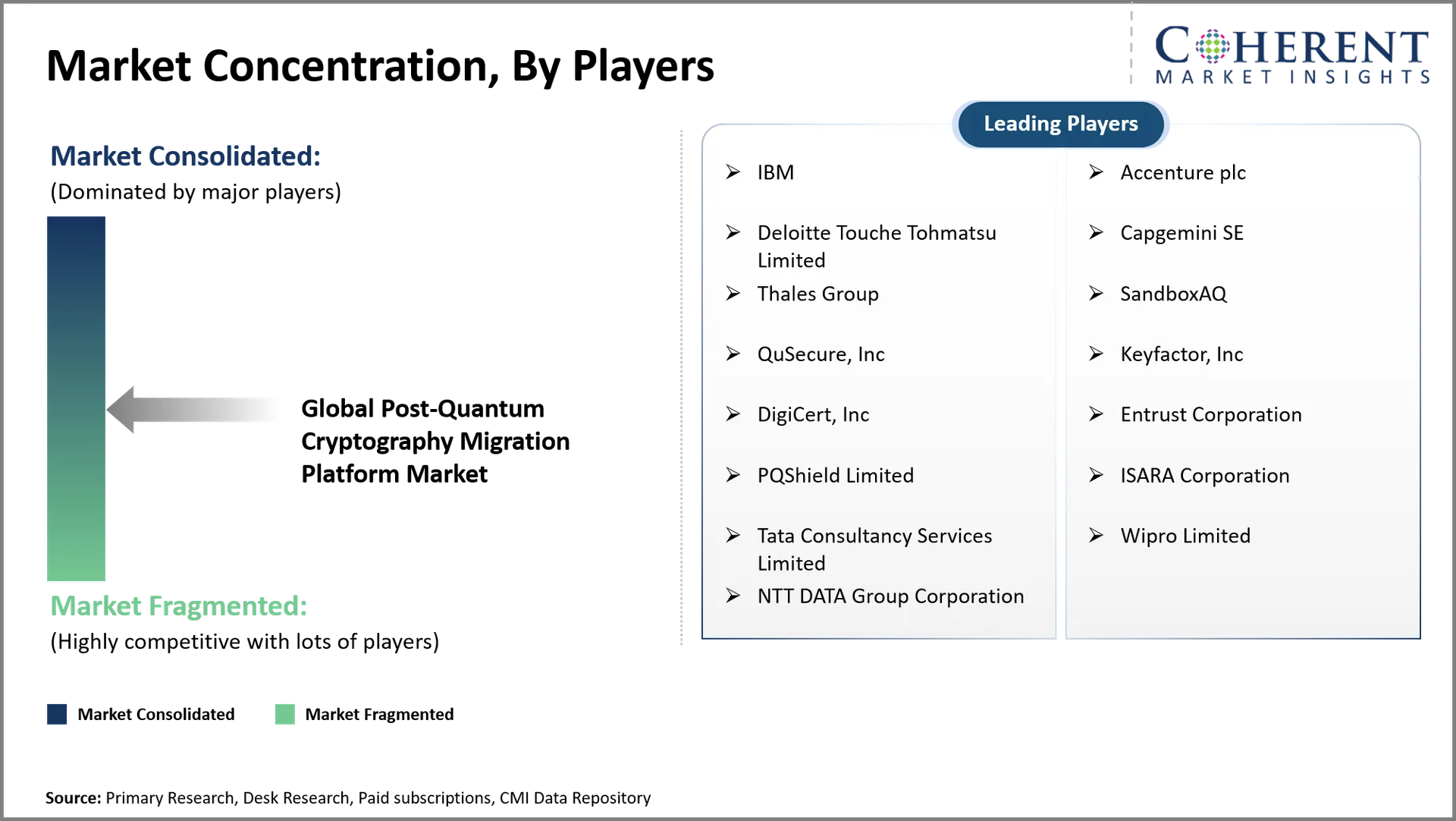
The global post-quantum cryptography migration platform market contains rivalry between enterprise cybersecurity organizations and specialist quantum-safe technology vendors. International Business Machines Corporation increases its dominance by IBM Quantum Safe, announced in October 2026. The suite covers cryptography discovery, contextual evaluation, remediation, migration planning and ongoing governance. SandboxAQ focuses on automated cryptographic discovery with AQtive Guard, which discovers cryptographic assets, maps dependencies, and offers remediation. Keyfactor is focused on cryptographic lifecycle management and enterprise certificate security. QuSecure focuses on crypto-agility and quantum-resistant protection over current infrastructure. The National Institute of Standards and Technology's migration project also brings together technology vendors, financial organizations, and infrastructure specialists.
Top Manufacturers and Notable Products in the Post-Quantum Cryptography Migration Platform Market
Manufacturer | Notable Product | Key features |
IBM | Guardium Cryptography Manager | Cryptographic asset discovery, dependency mapping, quantum risk assessment, automated key and certificate lifecycle management, audit reporting |
SandboxAQ | AQtive Guard | Network, application and filesystem analysis, cryptographic inventory, risk assessment, policy enforcement, remediation support |
Keyfactor | Keyfactor Command | Continuous certificate and key discovery, centralized inventory, automated renewals, hybrid and post-quantum certificate visibility, policy governance |
Entrust | Cryptographic Security Platform | Integrated PKI and HSM management, key and certificate lifecycle automation, compliance monitoring, cryptographic governance, post-quantum readiness |
ISARA Corporation | ISARA Advance | Agentless cryptographic discovery, algorithm and certificate inventory, risk scoring, vulnerability assessment, prioritized migration recommendations |
Post-Quantum Cryptography Migration Platform Market | |||
Report Coverage | Details | ||
Base Year | 2025 | Market Size in 2026: | USD 2.20 Bn |
Historical Data For: | 2020 To 2024 | Forecast Period: | 2026 To 2033 |
Forecast Period 2026 To 2033 CAGR: | 37.8% | 2033 Value Projection: | USD 20.50 Bn |
Geographies covered: |
| ||
Segments covered: |
| ||
Companies covered: | IBM, Accenture plc, Deloitte Touche Tohmatsu Limited, Capgemini SE, Thales Group, SandboxAQ, QuSecure, Inc, Keyfactor, Inc, DigiCert, Inc, Entrust Corporation, PQShield Limited, ISARA Corporation, Tata Consultancy Services Limited, Wipro Limited, NTT DATA Group Corporation | ||
Growth Drivers: |
| ||
Restraints & Challenges: |
| ||
Analyst Opinion (Expert Opinion)
- The future of this industry will depend on automated cryptographic inventory, continuous vulnerability assessment, and enterprise-wide migration orchestration. Organizations will increasingly move beyond standalone discovery tools toward integrated platforms connecting identification, prioritization, remediation, and compliance monitoring. Cryptographic agility will become an important purchasing requirement because organizations must accommodate evolving algorithms without repeatedly rebuilding applications. Platforms supporting legacy infrastructure, hybrid encryption, and certificate lifecycle automation will gain stronger commercial relevance. Vendors connecting migration workflows directly with existing security operations will establish more defensible competitive positions.
- The maximum opportunity will emerge in cryptographic discovery and inventory platforms, particularly for financial services, telecommunications, defense, and government applications. The U.S. offers strong opportunities through federal cybersecurity procurement and large enterprise technology modernization programs. Japan presents opportunities in automotive electronics, industrial automation, and embedded device security. Germany offers attractive applications across automotive manufacturing and industrial control infrastructure. Cloud-based platforms with application-level scanning and automated dependency mapping should attract substantial enterprise interest. Assessment and advisory solutions will also benefit organizations requiring customized migration roadmaps.
- Market participants must focus on automated cryptography discovery, application dependence analysis and direct integration with certificate management systems. Connecting the platform to ServiceNow, Microsoft Azure, Amazon Web Services and enterprise public key infrastructure environments help increase platform adoption. Vendors also need to enable hybrid deployment options for customers with sensitive government and financial workloads. Working with enterprise software vendors and hardware security module makers helps speed migration deployment. Companies could differentiate themselves by demonstrating demonstrable remedial capabilities, clear vulnerability prioritizing, and compatibility testing. Cryptographic monitoring on a continual basis, rather than as a one-time review, can help cement ongoing revenue prospects and customer retention.
Speak to the analyst
Want personalized insights?
Take the findings above to one of our principal consultants, or have the report rebuilt around the segments, geographies and competitors you actually track.
Market Segmentation
- Solution Insights (Revenue, USD Billion, 2021 - 2033)
- Cryptographic Discovery and Inventory Platforms
- Risk Assessment and Migration Management Platforms
- Quantum-Safe Key Management Solutions
- Public Key Infrastructure Modernization Solutions
- Digital Signature and Identity Security Solutions
- Deployment Type Insights (Revenue, USD Billion, 2021 - 2033)
- Cloud-Based
- On-Premises
- Hybrid
- Service Type Insights (Revenue, USD Billion, 2021 - 2033)
- Assessment and Advisory
- Cryptographic Discovery and Inventory
- Algorithm Integration and Implementation
- Migration and Remediation
- Testing and Validation
- Managed Crypto-Agility Services
- Cryptographic Layer Insights (Revenue, USD Billion, 2021 - 2033)
- Network Security
- Application Security
- Data Encryption
- Public Key Infrastructure
- Digital Certificates and Identity Management
- Hardware Security Modules
- End User Insights (Revenue, USD Billion, 2021 - 2033)
- BFSI
- Government and Defense
- IT and Telecommunications
- Healthcare
- Energy and Utilities
- Manufacturing
- Automotive
- Others
- Regional Insights (Revenue, USD Billion, 2021 - 2033)
- North America
- U.S.
- Canada
- Latin America
- Brazil
- Argentina
- Mexico
- Rest of Latin America
- Europe
- Germany
- U.K.
- Spain
- France
- Italy
- Russia
- Rest of Europe
- Asia Pacific
- China
- India
- Japan
- Australia
- South Korea
- ASEAN
- Rest of Asia Pacific
- Middle East
- GCC Countries
- Israel
- Rest of Middle East
- Africa
- South Africa
- North Africa
- Central Africa
- North America
- Key Players Insights
- IBM
- Accenture plc
- Deloitte Touche Tohmatsu Limited
- Capgemini SE
- Thales Group
- SandboxAQ
- QuSecure, Inc
- Keyfactor, Inc
- DigiCert, Inc
- Entrust Corporation
- PQShield Limited
- ISARA Corporation
- Tata Consultancy Services Limited
- Wipro Limited
- NTT DATA Group Corporation
Sources
Primary Research Interviews
- Chief Information Security Officers (CISOs) & Cybersecurity Executives
- Cryptography Solution Providers & Technology Vendors
- Government & Defense Sector IT Security Officials
- Cloud Infrastructure & Enterprise IT Architects
Magazines
- SC Magazine (Cybersecurity)
- Dark Reading – Information Security Magazine
- MIT Technology Review
- Wired – Technology & Cryptography Editions
Journals
- Journal of Cryptology (Springer)
- IEEE Transactions on Information Forensics and Security
- ACM Transactions on Privacy and Security
Associations
- National Institute of Standards and Technology (NIST) – Post-Quantum Cryptography Standardization Program
- Cloud Security Alliance (CSA)
- International Association for Cryptologic Research (IACR)
- Internet Engineering Task Force (IETF)
Public Domain Sources
- NIST Post-Quantum Cryptography Project (csrc.nist.gov)
- European Union Agency for Cybersecurity (ENISA) – Quantum Cryptography Reports
- U.S. Cybersecurity and Infrastructure Security Agency (CISA) Publications
- National Security Agency (NSA) – Cybersecurity Advisory on Quantum-Resistant Algorithms
Proprietary Elements
- CMI Data Analytics Tool
- Proprietary CMI Existing Repository of Information for the Last 10 Years
Get access to 250+ pages report
Every segment, forecast, competitor profile and data table behind the analysis above — available for instant download.
- ESOMAR Member
- ISO 9001:2015 Certified
- D-U-N-S Registered
- GDPR & CCPA Compliant
Frequently Asked Questions
The global post-quantum cryptography migration platform market is expected to stand at USD 2.20 Bn in 2026 and is expected to reach USD 20.50 Bn by 2033.
The CAGR of the global post-quantum cryptography migration platform market is projected to be 37.8% from 2026 to 2033.
Increasing threats from quantum computing against conventional encryption and Growing government mandates for quantum-resistant cybersecurity are the major factors driving the growth of the global post-quantum cryptography migration platform market.
High costs associated with enterprise-wide cryptographic migration and Complex integration with legacy information technology infrastructure are the major factors hampering the growth of the global post-quantum cryptography migration platform market.
In terms of solution, cryptographic discovery and inventory platforms segment is estimated to dominate the market revenue share in 2026.
A post-quantum cryptography migration platform helps organizations identify vulnerable encryption systems and transition toward quantum-resistant cryptographic algorithms.
They identify encryption algorithms, certificates, keys, and cryptographic implementations requiring replacement or modernization.