

Global Powder Metallurgy Market Size and Forecast – 2026 To 2033
The Global Powder Metallurgy Market is estimated to be valued at USD 3.68 Bn in 2026 and is expected to reach USD 9.85 Bn by 2033, growing at a compound annual growth rate (CAGR) of 15.10% from 2026 to 2033. This robust growth is driven by increasing demand from automotive and aerospace industries, coupled with advancements in powder metallurgy processes enhancing material properties and production efficiency. Further, the market is gaining momentum as industries increasingly adopt powder-based manufacturing for complex geometries, material optimization, and localized production of high-performance components.
The expansion of metal additive manufacturing ecosystems is strengthening demand for specialized powders such as titanium, nickel, and alloy-based feedstocks. In January 2025, according to Ministry of Defence the DRDO–Industry–Academia Centre of Excellence at IIT Hyderabad demonstrated a Large Area Additive Manufacturing system based on powder-based Directed Energy Deposition technology for fabricating rocket components, highlighting the growing industrial relevance of metal powders in strategic aerospace and defense applications.
Key Takeaways: Global Powder Metallurgy Market
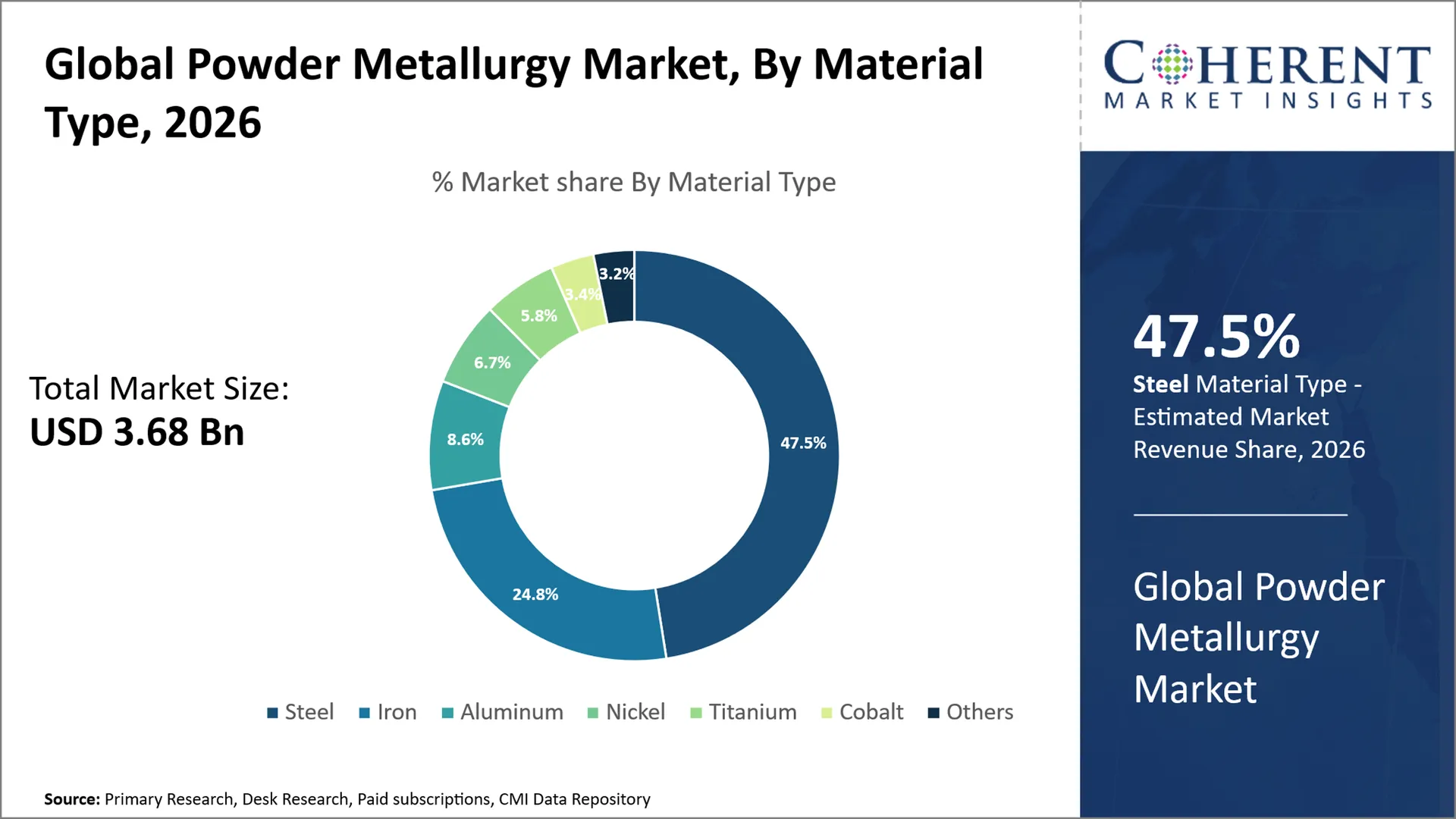
- Steel is estimated to register a CAGR of 14.5% during 2026–2033 and is expected to hold 47.5% of the global powder metallurgy market in 2026. Its leadership reflects broad use in structural parts where strength, machinability, alloy flexibility, and cost efficiency support high-volume production. In June 2025, Höganäs launched re-Astaloy 85 Mo, a water-atomized steel powder offering lower product carbon footprint without changing core processing performance.
- Metal Injection Molding is estimated to expand at a CAGR of 14.2% during 2026–2033 and is expected to account for 46.0% of the global powder metallurgy market in 2026. MIM retains commercial scale where buyers require intricate geometries, tight tolerances, material consistency, and repeatable high-volume output with limited secondary machining. In May 2025, INDO-MIM acquired PDV MedTech, strengthening its precision-manufacturing reach into regulated medical-device programs and broader production services.
- Aerospace and Defense is estimated to grow at a CAGR of 15.7% during 2026–2033 and is expected to represent 31.8% of the global powder metallurgy market in 2026. Powder-based routes suit mission-critical components requiring high strength-to-weight ratios, complex shapes, traceable alloys, and reduced material waste. In July 2026, Tekna reported titanium powder orders from a U.S. defense contract manufacturer exceeding CAD 3 million, more than six times its 2025 demand.
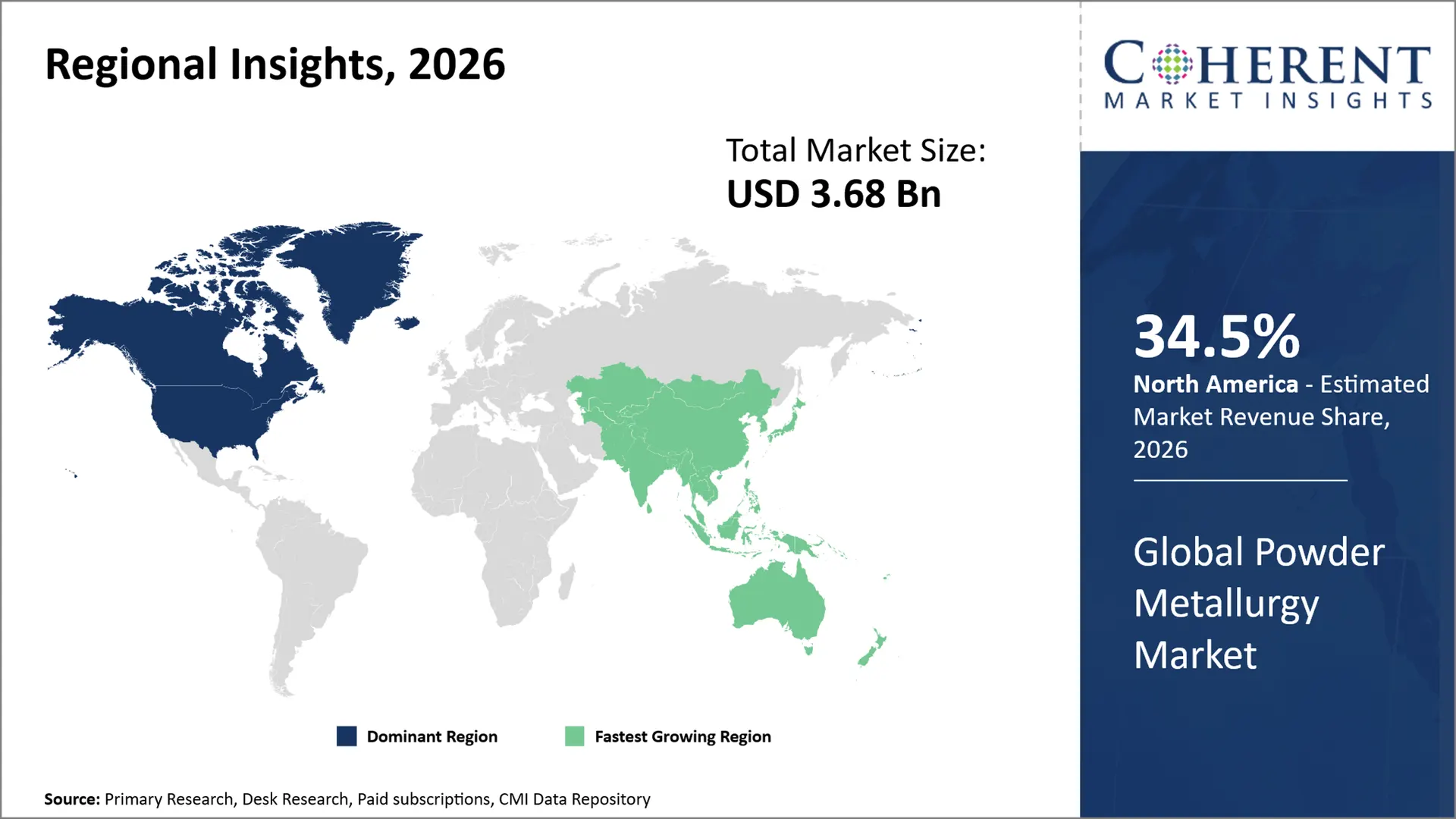
- North America is estimated to advance at a CAGR of 14.4% during 2026–2033 and is expected to capture 34.5% of the global powder metallurgy market in 2026. The region combines automotive and aerospace production with qualified powder suppliers, engineering standards, and expanding adoption of MIM and metal additive manufacturing. In June 2026, MPIF reported improving North American powder conditions, with MIM and AM shipments recovering as inventories normalized and end-market orders strengthened.
- Asia Pacific is estimated to post a CAGR of 16.8% during 2026–2033 and is expected to account for 28.8% of the global powder metallurgy market in 2026. Faster growth is supported by expanding advanced-manufacturing capacity, electronics production, automotive localization, and investment in strategic metal-powder supply. In April 2026, Sumitomo Electric announced a major Japanese investment to expand tungsten and tungsten-carbide powder capacity, strengthening regional supply for tooling, electronics, and industrial applications.
Segmental Insights
Why Does Steel Dominate the Global Powder Metallurgy Market?
Steel is expected to lead the material category with 47.5% share in the global powder metallurgy market because ferrous powder grades combine mature atomization supply, broad alloy tunability, predictable sintering behavior, and economical conversion into repeatable near-net-shape components. This makes steel particularly suitable for gears, structural parts, transmission components, machinery hardware, and other medium-to-high-volume applications where dimensional consistency matters more than extreme weight reduction. Suppliers also benefit from established heat-treatment, machining, and finishing infrastructure, lowering qualification barriers for OEM programs. In May 2025, Outokumpu began delivering a newly developed stainless-steel powder grade for an aerospace 3D-printed heat-exchanger application, demonstrating how steel powder portfolios are moving into higher-specification additive uses beyond conventional press-and-sinter production. For powder producers, this widens the addressable mix toward engineered grades with stronger margin potential.
- Current Industry Events of 2026
- Market Size Estimation
- Regional Breakdown
- Competitive Landscape
- Customer Intelligence
- Segmental Analysis
- Pricing Analysis
- Key Market Drivers, Challenges & Future Trends
- Customized Insights Section
Why Does Metal Injection Molding Represent the Largest Process Segment in the Global Powder Metallurgy Market?
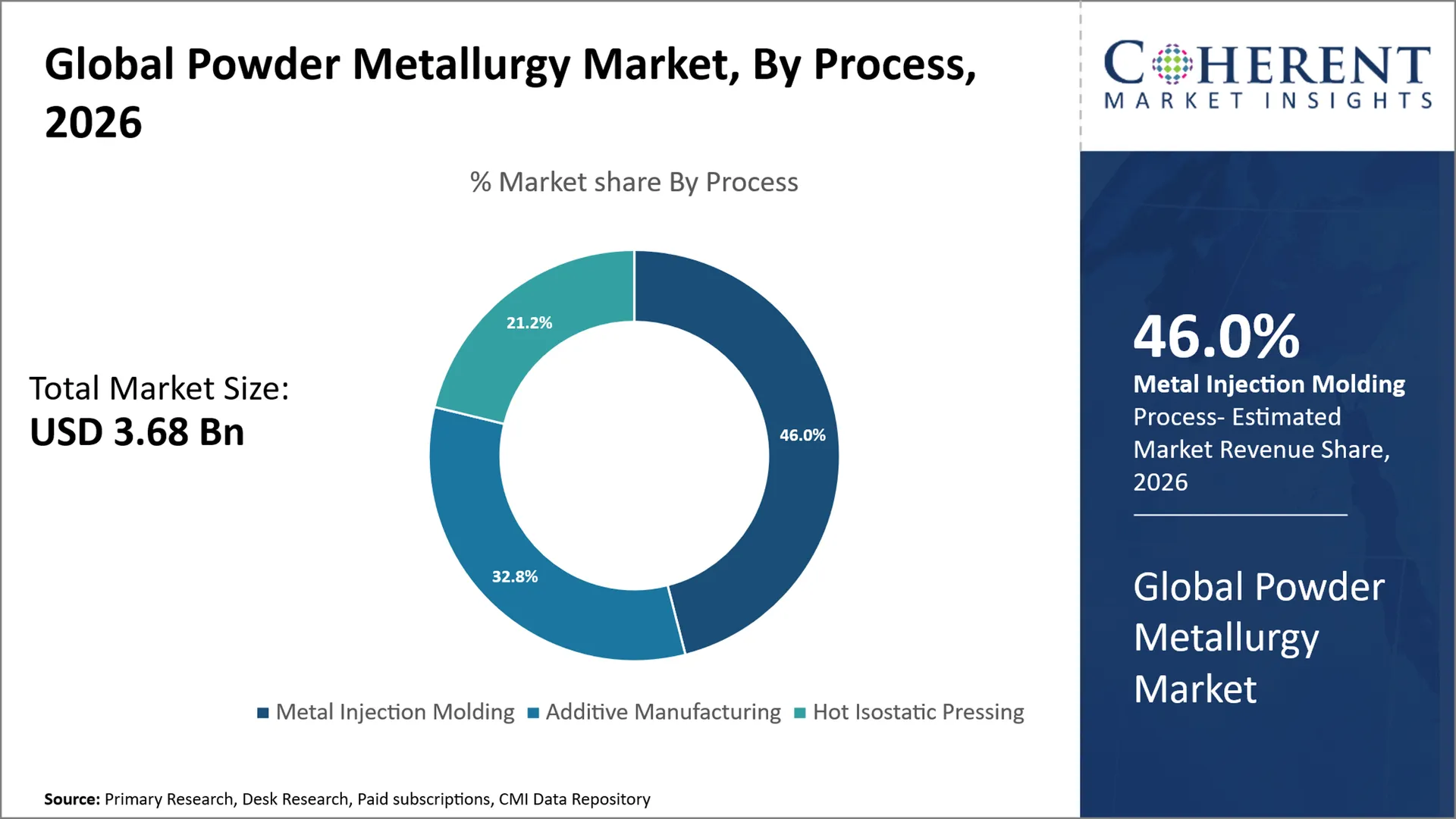
Metal Injection Molding is expected to remain the largest process with 46.0% share in the global powder metallurgy market because it converts fine metal powders into complex small parts at production volumes that are difficult to match with machining or many additive routes. Multi-cavity tooling, repeatable molding cycles, debinding, and sintering allow manufacturers to consolidate features, reduce assembly steps, and control unit economics once volumes scale. Medical devices, electronics, automotive systems, industrial equipment, and aerospace hardware particularly value MIM when components contain thin walls, internal features, or tight dimensional requirements. In April 2025, OptiMIM and Vasantha Tool Crafts announced OptiMIM Global, combining MIM processing with high-precision mold design and multi-cavity tooling capabilities for customers across automotive, medical, electronics, industrial, defense, and aerospace markets. This strengthens MIM’s commercial case as an integrated serial-production platform.
Why Do Aerospace and Defense Dominate the Application Segment of the Global Powder Metallurgy Market?
Aerospace and Defense is expected to lead the application category with 31.8% share in the global powder metallurgy market because powder-based manufacturing can reduce buy-to-fly material losses, enable geometries that are costly to machine, and support lightweight or thermally optimized components where performance justifies tighter material and process control. Adoption also benefits from qualification frameworks covering powder chemistry, particle characteristics, build parameters, post-processing, and traceability, which favor suppliers capable of maintaining repeatable aerospace-grade quality. In July 2025, Airbus detailed its use of titanium powder-bed fusion within additive layer manufacturing to produce aircraft parts with materially lower raw-material waste than subtractive routes. This reinforces the role of metal powders in aircraft production programs where material utilization, part integration, and lifecycle manufacturing efficiency directly influence procurement decisions and supplier qualification.
Current Events and their Impact
Current Event | Description and Its Impact |
UK Defence Advanced Manufacturing Strategy – March 2025 |
|
EU Critical Raw Materials Act Enters into Force – May 2024 |
|
India TDB Call for Metal and Ceramic 3D Printing – July 2025 |
|
Global Powder Metallurgy Market Dynamics
Key Market Drivers
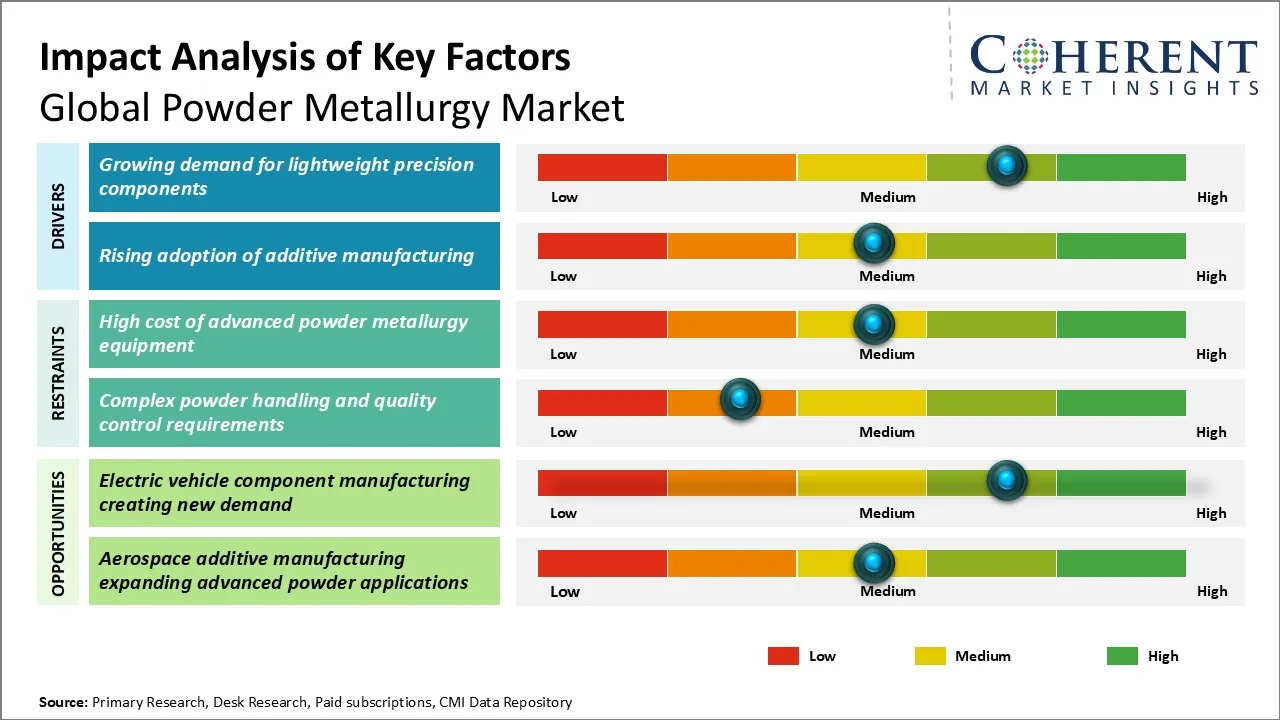
- Growing Demand for Lightweight Precision Components: Growing demand for lightweight precision components is expanding powder metallurgy use where conventional machining creates excessive material loss or limits geometry. Aerospace, propulsion, medical, and mobility OEMs increasingly value near-net-shape routes that combine low mass with thin walls, internal channels, and repeatable mechanical performance. This benefits powder producers and precision-component suppliers capable of qualifying demanding alloys. In April 2025, Fraunhofer ILT highlighted laser powder bed fusion and laser material deposition for lightweight, high-performance aerospace components, including reduced-material structural parts and optimized rocket-nozzle geometries.
- Rising Adoption of Additive Manufacturing: Rising adoption of additive manufacturing is increasing demand for powders engineered around flowability, particle-size distribution, chemistry control, and machine-specific process windows rather than generic metal feedstock. As OEMs move from prototyping toward serial production, suppliers that shorten qualification cycles gain commercial advantage. This favors high-purity titanium, nickel, and specialty-alloy producers with traceable production systems. In April 2025, TRUMPF qualified 6K Additive titanium powder for TruPrint systems, providing users with a pre-evaluated feedstock option and reducing a key barrier between material selection and production qualification.
Emerging Market Trends
- Shift Toward Application-Qualified Powder Portfolios: Application-qualified powder portfolios are becoming more important than broad catalog breadth. Buyers increasingly expect feedstock suppliers to provide repeatable chemistry, morphology, oxygen control, lot traceability, test data, and parameter guidance connected directly with a defined printing or consolidation route. This changes competition from selling kilograms of powder to supporting validated manufacturing outcomes. Suppliers with materials laboratories, application engineers, and digital batch records should gain stronger customer retention, while producers competing mainly on spot pricing may face pressure in aerospace, medical, and defense programs.
- Closed-Loop Powder Management Is Becoming a Procurement Requirement: Powder recovery and reuse are moving from shop-floor housekeeping into procurement strategy. Expensive titanium, nickel, and refractory alloys create a strong economic case for sieving, reclaiming, and reprocessing unused powder, support structures, and qualified scrap while maintaining contamination limits. Buyers are likely to place greater value on closed-loop material programs, lifecycle documentation, and recovery yields. This shift can favor vertically integrated powder producers and specialist recyclers, while suppliers unable to document recycled-content quality or preserve batch consistency may lose access to sustainability-sensitive industrial accounts.
Regional Insights
Why Does North America Dominate the Global Powder Metallurgy Market?
North America is expected to account for 34.5% of the global powder metallurgy market in 2026, supported by its concentration of aerospace, defense, medical-device, automotive, and energy manufacturers that purchase high-specification metal powders and powder-processed components. The region benefits from established atomization capacity, qualification infrastructure, domestic specialty-alloy production, and strong adoption of laser powder bed fusion and other advanced powder routes. Defense localization is also increasing the strategic value of domestically produced powders for mission-critical components. In September 2025, Velo3D and Linde Advanced Material Technologies agreed to establish a U.S.-based copper-nickel powder and additive-manufacturing supply chain supporting U.S. Navy shipbuilding, using Linde AMT’s expanded Indianapolis powder facility. The initiative illustrates how defense procurement is reinforcing regional powder production, qualification, and downstream manufacturing capabilities.
Why Is Asia Pacific Emerging as the Fastest-Growing Region in the Global Powder Metallurgy Market?
Asia Pacific is expected to hold 28.8% of the global powder metallurgy market in 2026 while recording the fastest expansion as metal powder supply scales alongside electronics, electric mobility, aerospace, industrial machinery, tooling, and additive manufacturing. China, Japan, and India are developing different parts of the value chain, ranging from powder atomization and standards to application engineering and large-format metal printing. This broadens regional demand beyond conventional pressed components toward higher-value engineered powders. In January 2026, CNPC Powder announced a new financing round and construction of an expanded manufacturing hub designed to increase high-value metal powder production and strengthen storage and logistics capacity. The investment demonstrates how Asian suppliers are adding industrial-scale capability to serve both domestic advanced manufacturing and export-oriented additive manufacturing customers.
Global Powder Metallurgy Market Outlook for Key Countries
Why Is the U.S. a Key Market for the Global Powder Metallurgy Market?
The U.S. is a key powder metallurgy market because aerospace engines, defense systems, medical implants, energy equipment, and advanced industrial components require tightly controlled powder chemistry and repeatable material properties. Domestic users increasingly value suppliers capable of linking atomization, powder characterization, qualification, and finished-part production, particularly where supply security is important. The country also has an established base of specialty-alloy producers serving powder-bed fusion, hot isostatic pressing, and other powder-processing routes. A clear commercial signal comes from premium-material producers shifting capacity toward complex applications. In July 2025, Carpenter Technology reported stronger sales from aerospace and defense end markets while its Performance Engineered Products segment continued to include Carpenter Additive and titanium operations. This supports continued U.S. demand for higher-value powder and specialty-material solutions rather than commodity powder volumes alone.
Why Does China Support Growth in the Global Powder Metallurgy Market?
China supports in the powder metallurgy market growth through its large manufacturing base for automotive systems, industrial machinery, electronics, tooling, aerospace components, and additive-manufacturing equipment. Its commercial advantage is increasingly extending from production scale toward process standardization and qualification, which can reduce adoption barriers for metal powder users entering serial manufacturing. Domestic powder suppliers also benefit from proximity to extensive downstream machining, heat-treatment, and component-production clusters. The regulatory framework is becoming more specific to additive metal powders and powder-bed processes. In June 2025, China published national standard GB/T 45766-2025 covering silver and silver-alloy powders for additive manufacturing, with implementation beginning January 2026. The standard illustrates China’s move toward formal material specifications, supporting more consistent powder quality, procurement requirements, and industrial acceptance of powder-based manufacturing technologies.
Why Is Japan Important in the Global Powder Metallurgy Market?
Japan is important in the global powder metallurgy market because its automotive, precision machinery, electronics, robotics, and aerospace industries emphasize dimensional control, material consistency, and low-defect manufacturing, creating a strong fit for advanced powder metallurgy processes. The country’s opportunity is increasingly linked to converting established materials expertise into industrial metal additive manufacturing, particularly for complex parts, repair applications, and high-value low-volume production. Japanese equipment developers are also building application-development infrastructure that can shorten customer qualification cycles. In February 2025, Nikon opened the Nikon AM Technology Center Japan in Saitama with large-format laser powder bed fusion and directed energy deposition systems. The center provides metal AM development, prototyping, design support, and processing services for Japanese and Asian customers, strengthening the domestic ecosystem connecting powder feedstock, printing technology, inspection, and production engineering.
Why Is India an Important Growth Market for the Global Powder Metallurgy Market?
India is becoming an important powder metallurgy market as defense, space, automotive, tooling, and engineering companies seek domestic routes for complex metal components and reduced dependence on imported high-value manufacturing technologies. The country combines cost-competitive engineering talent with expanding government-backed advanced-materials research, making powder-based additive manufacturing particularly relevant for strategic components that would otherwise require lengthy machining or imported forgings. Public R&D is now moving into larger component formats. In January 2025, India’s Ministry of Defence reported that the DRDO-Industry-Academia Centre of Excellence at IIT Hyderabad demonstrated a large-area additive manufacturing system using blown-powder directed energy deposition for rocket components. The development shows India moving from laboratory-scale metal printing toward larger strategic parts, increasing future requirements for qualified powders, process control, and domestic materials capability.
Why Is Germany a Strategic Country in the Global Powder Metallurgy Market?
Germany remains strategically important because its automotive, industrial machinery, tooling, medical technology, and aerospace sectors support demand for tightly specified metal powders and production processes with strong quality assurance. German manufacturers increasingly evaluate powder metallurgy not only for part consolidation but also for material efficiency, customized alloys, and industrial-scale additive production. The country’s established machine-building and materials-engineering ecosystem allows powder suppliers to work closely with equipment developers and end users during qualification. In April 2026, Germany-based EOS announced the acquisition of Metalpine, adding specialist titanium-powder capability to its industrial additive-manufacturing portfolio. EOS stated that the integration would expand access to high-quality titanium powders and improve process stability and scalability. The transaction strengthens Germany’s position in combining powder development, printing systems, and application qualification within one advanced-manufacturing ecosystem.
Technology Adoption Landscape - Innovation, Production & Manufacturing
Technology | Role in Powder Metallurgy | Adoption Focus | Commercial Implication |
Vacuum Inert Gas Atomization VIGA | Produces spherical metal powders under controlled atmosphere | Titanium nickel superalloys copper alloys and specialty grades | Supports premium pricing where chemistry cleanliness morphology and repeatability are qualification-critical |
Plasma Atomization | Converts metallic feedstock into highly spherical fine powders | Titanium refractory metals aerospace and medical applications | Expands high-value powder supply for demanding additive routes where low contamination is essential |
Laser Powder Bed Fusion LPBF | Selectively melts thin powder layers into complex near-net-shape parts | Aerospace medical tooling defense and thermal-management components | Increases demand for narrowly specified powders and creates recurring qualification-linked feedstock sales |
Binder Jetting | Deposits binder into powder beds before debinding and sintering | Higher-volume industrial automotive and complex small-component manufacturing | Creates a route for scaling powder-based manufacturing where LPBF economics remain challenging |
Powder Metallurgy Hot Isostatic Pressing PM-HIP | Consolidates powder under simultaneous temperature and isostatic pressure | Large critical aerospace energy nuclear and industrial parts | Allows suppliers to address components traditionally produced through large forgings and castings |
How Are Digital Spare-Part Manufacturing Models Creating New Growth Opportunities in the Global Powder Metallurgy Market?
Legacy-part and low-volume spare manufacturing represents an underdeveloped opportunity because aerospace, defense, energy, and industrial operators often manage aging equipment whose original tooling is unavailable or uneconomic to reproduce. Powder-based additive manufacturing and PM-HIP can convert digital part data into short production runs without rebuilding complete conventional tooling chains. Suppliers can capture this opportunity by combining reverse engineering, powder selection, process development, inspection, post-processing, and qualification into one service package. The strongest commercial model is likely to be a validated powder-to-part platform rather than stand-alone powder sales. Success will require secure digital workflows, material traceability, non-destructive testing, application engineering, and customer-specific certification. Specialist service providers can enter selected niches, but vertically integrated suppliers should hold an advantage where customers want one accountable partner for feedstock, manufacturing, and documentation. Margin potential is particularly attractive in obsolete, safety-critical, and downtime-sensitive components where shortening replacement lead times has measurable operational value.
Market Players, Key Development, and Competitive Intelligence
Key Developments
- In June 2026, Sandvik launched Osprey GRCop-42 copper-chromium-niobium powder for additive manufacturing of demanding space components. The alloy targets applications such as injector faces and combustion-chamber linings, strengthening the market for tightly controlled and traceable powders designed around thermal performance and qualification requirements.
- In July 2025, PyroGenesis received its first commercial order from a European additive-manufacturing customer for Ti64 powder produced through its NexGen plasma atomization process. The order followed customer testing and qualification, illustrating how application approval and repeatable powder quality can convert technical validation into commercial demand.
- In October 2024, GKN Powder Metallurgy launched a high-performance porous transport layer for PEM electrolysis using powder-metal technology and a fine titanium powder structure. The development extends powder metallurgy into hydrogen equipment, showing how engineered porosity can create higher-value applications beyond conventional structural components.
Competitive Landscape
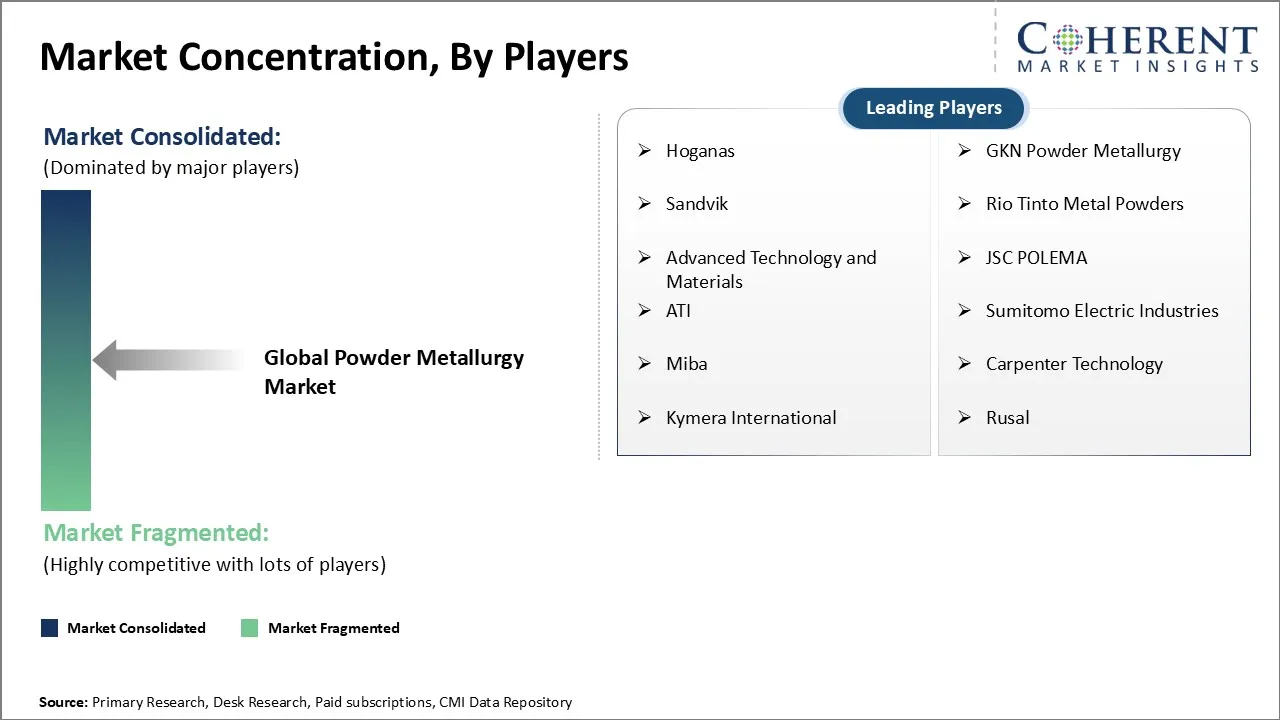
The global powder metallurgy market is moderately fragmented, combining large metal-powder producers, integrated component manufacturers, additive-manufacturing specialists, MIM suppliers, and regional sintering companies. Competitive advantage increasingly depends on matching powder characteristics to a specific manufacturing route and customer qualification requirement. Regional players remain relevant in standardized components, while specialist suppliers can defend premium positions through alloy expertise, traceability, engineering support, and reliable batch-to-batch performance.
Key focus areas include
- Powder consistency: Chemistry particle morphology size distribution and oxygen content directly affect production repeatability.
- Application engineering: Customers increasingly value suppliers that assist with alloy selection process windows and part qualification.
- Supply reliability: Dual sourcing regional inventory and secured raw-material access are becoming important in aerospace defense and energy programs.
- Customization: Application-specific powder grades and particle-size cuts provide stronger differentiation than broad commodity portfolios.
- Quality assurance: Aerospace medical and defense customers reward suppliers with documented traceability and rigorous process control.
- Manufacturing economics: Yield atomization efficiency powder recyclability and post-processing requirements influence total component cost.
- Customer integration: Long qualification cycles favor suppliers that establish early technical relationships with OEM engineering and procurement teams.
Market Report Scope
Global Powder Metallurgy Market Report Coverage | |||
Report Coverage | Details | ||
Base Year | 2025 | Market Size in 2026: | USD 3.68 Bn |
Historical Data For: | 2020 To 2024 | Forecast Period: | 2026 To 2033 |
Forecast Period 2026 To 2033 CAGR: | 15.10% | 2033 Value Projection: | USD 9.85 Bn |
Geographies covered: |
| ||
Segments covered: |
| ||
Companies covered: | Hoganas, GKN Powder Metallurgy, Sandvik, Rio Tinto Metal Powders, Advanced Technology and Materials, JSC POLEMA, ATI, Sumitomo Electric Industries, Miba, Carpenter Technology, Kymera International, Rusal | ||
Growth Drivers: |
| ||
Restraints & Challenges: |
| ||
Analyst Opinion (Expert Opinion)
- The global powder metallurgy market leadership is likely to shift from companies offering isolated powders or components toward suppliers that can participate earlier in customer design decisions and remain involved through industrialization. Buyers will increasingly favor partners able to translate performance requirements into material selection manufacturing routes inspection protocols and repeatable production economics. This could make engineering integration and long-term program participation more valuable than simply expanding powder capacity.
- Distributed production could materially alter aftermarket economics. Once validated digital part files and controlled manufacturing instructions become transferable across approved production locations customers may reduce dependence on centralized inventories of slow-moving physical spares. This would pressure traditional stocking models while increasing the value of secure digital manufacturing networks local production cells and organizations capable of maintaining consistent quality across multiple sites.
- Suppliers should prioritize difficult-to-substitute alloy grades application engineering and qualification capabilities rather than overinvesting in undifferentiated powder capacity. Strong positions are likely to come from customers where material failure carries high operational cost. Companies should also diversify critical feedstock sources strengthen regional processing options and maintain disciplined capacity additions because commoditization and equipment productivity improvements could pressure margins in standard powder grades.
Speak to the analyst
Want personalized insights?
Take the findings above to one of our principal consultants, or have the report rebuilt around the segments, geographies and competitors you actually track.
Market Segmentation
- Material Type Insights (Revenue, USD Bn, 2021 - 2033)
- Steel
- Iron
- Aluminum
- Nickel
- Titanium
- Cobalt
- Others
- Process Insights (Revenue, USD Bn, 2021 - 2033)
- Metal Injection Molding
- Additive Manufacturing
- Hot Isostatic Pressing
- Application Insights (Revenue, USD Bn, 2021 - 2033)
- Aerospace and Defense
- Automotive
- Industrial Machinery
- Medical and Dental
- Electrical and Electronics
- Oil and Gas
- End User Insights (Revenue, USD Bn, 2021 - 2033)
- OEMs
- Additive Manufacturing Operators
- Distribution Channel Insights (Revenue, USD Bn, 2021 - 2033)
- Direct Sales
- Indirect Sales
- Regional Insights (Revenue, USD Bn, 2021 - 2033)
- North America
- U.S.
- Canada
- Latin America
- Brazil
- Argentina
- Mexico
- Rest of Latin America
- Europe
- Germany
- U.K.
- Spain
- France
- Italy
- Russia
- Rest of Europe
- Asia Pacific
- China
- India
- Japan
- Australia
- South Korea
- ASEAN
- Rest of Asia Pacific
- Middle East
- GCC Countries
- Israel
- Rest of Middle East
- Africa
- South Africa
- North Africa
- Central Africa
- North America
Sources
Primary Research Interviews
- Powder metallurgy manufacturers, metal powder producers, component manufacturers, additive manufacturing service providers, and contract manufacturers
- Aerospace, automotive, medical, electronics, industrial machinery, and defense procurement professionals
- Materials engineers, manufacturing specialists, product designers, and application development experts
Stakeholders
- Metal powder producers and alloy suppliers
- Powder metallurgy component manufacturers and sintering companies
- Additive manufacturing equipment providers and service bureaus
- OEMs across automotive, aerospace, medical, defense, and industrial sectors
- Raw material suppliers, distributors, and technology solution providers
End-use Sectors
- Automotive and transportation components
- Aerospace and defense applications
- Medical devices and implants
- Industrial machinery and tooling
- Electrical and electronics components
- Energy and specialized engineering applications
Regulatory and Industry Bodies
- International Organization for Standardization ISO
- ASTM International
- Metal Powder Industries Federation MPIF
- European Powder Metallurgy Association EPMA
- National Institute of Standards and Technology NIST
- Aerospace and defense material qualification authorities
Databases
- Company annual reports and investor presentations
- Metal powder production and manufacturing databases
- Additive manufacturing industry databases
- Trade statistics and import export datasets
- Patent and technology development databases
- Manufacturing capacity and production databases
Magazines and Journals
- Powder Metallurgy
- International Journal of Powder Metallurgy
- Additive Manufacturing Journal
- Materials Science and Engineering
- Journal of Materials Processing Technology
Associations
- Metal Powder Industries Federation MPIF
- European Powder Metallurgy Association EPMA
- Additive Manufacturing Users Group AMUG
- ASTM Additive Manufacturing Center of Excellence
- International Titanium Association
Public Domain Sources
- Metal powder production and technology developments
- Additive manufacturing adoption updates
- Manufacturing investment and capacity expansion activities
- Material innovation and alloy development trends
- Industry standards and qualification updates
Key Standards and Regulations
- Metal powder quality and characterization standards
- Additive manufacturing material qualification requirements
- Aerospace and medical component certification standards
- Powder handling safety and workplace regulations
- Environmental and material recycling requirements
Proprietary Elements
- CMI Data Analytics Tool
- proprietary CMI repository containing 10+ years of powder metallurgy, metal materials, advanced manufacturing, and industrial technology market intelligence.
Get access to 250+ pages report
Every segment, forecast, competitor profile and data table behind the analysis above — available for instant download.
- ESOMAR Member
- ISO 9001:2015 Certified
- D-U-N-S Registered
- GDPR & CCPA Compliant
Frequently Asked Questions
The CAGR of global powder metallurgy market is projected to be 15.10% from 2026 to 2033.
The global powder metallurgy market is estimated to be valued at USD 3.68 Bn in 2026 and is expected to reach USD 9.85 Bn by 2033.
The growth of the global powder metallurgy market is primarily driven by increasing demand for lightweight precision components and the rising adoption of additive manufacturing technologies across various industries.
High cost of advanced powder metallurgy equipment and Complex powder handling and quality control requirements are the major factors hampering the growth of global powder metallurgy market.
In terms of material type, steel is estimated to dominate the market revenue share in 2026.
Hoganas, GKN Powder Metallurgy, Sandvik, Rio Tinto Metal Powders, Advanced Technology and Materials, JSC POLEMA, ATI, Sumitomo Electric Industries, Miba, Carpenter Technology, Kymera International, Rusal are the major players.
North America is expected to lead the global powder metallurgy market in 2026.