

Global Pozzolan Market Size and Forecast – 2026 To 2033
The Global Pozzolan Market is estimated to be valued at USD 60.81 Bn in 2026 and is expected to reach USD 92.65 Bn by 2033, exhibiting a compound annual growth rate (CAGR) of 6.2% from 2026 to 2033. Increasing demand for sustainable building materials, investment in infrastructure in emerging markets and greater adoption of pozzolans in cement and concrete for durability, and reduced clinker-emissions are all boosting the market growth.
The development of calcined clay and engineered supplementary cementitious materials are also diversifying supply beyond conventional fly ash and slag. In November 2025, the European Commission identified NeoCem’s LCSCM project, which aims to produce low-carbon supplementary cementitious material from abundant clay resources using an energy-efficient calcination process and establish a circular European supply chain. This highlights increasing institutional support for scalable, locally sourced pozzolan alternatives.
Key Takeaways of the Global Pozzolan Market
- Fly ash based pozzolan is expected to hold 37.6 % of the market share in 2026, owing to its established availability, cost efficiency, and ability to improve concrete durability while reducing clinker consumption. In September 2025, Cement Roadstone Holdings (CRH) completed its USD 2.1 billion acquisition of Eco Material Technologies, strengthening access to fly ash and supplementary cementitious materials.
- Powder is projected to dominate the form segment with 68.4 % of the market share in 2026, supported by accurate dosing, rapid dispersion, efficient bulk transportation, and compatibility with cement grinding and ready-mix systems. In May 2025, Heidelberg Materials commenced production at the world’s largest calcined clay plant in Ghana, expanding industrial-scale availability of powdered clinker substitutes.
- Cement and concrete are expected to account for 58.7 % of the market share in 2026, as pozzolans reduce clinker requirements while enhancing long-term strength, permeability resistance, and durability in structural applications. In January 2025, the U.S. Department of Energy awarded Brimstone nearly USD 8.7 million to advance a commercial plant producing low-carbon cement and supplementary cementitious materials.
- Asia Pacific is expected to dominate the global pozzolan market with 38.4 % share in 2026, supported by large cement output, extensive infrastructure construction, and established fly ash utilization across major Asian economies. In September 2025, UltraTech Cement reported using 44.15 million tons of recycled and alternative raw materials, including fly ash, slag, and gypsum, during FY 2024–25.
- Europe is expected to be the fastest-growing region, representing 25.8 % of the market share in 2026, as carbon pricing, low-clinker cement strategies, and green procurement accelerate alternative pozzolan adoption. In October 2025, Holcim reported selling half a million tons of calcined clay-based cement during the first half of 2025 while expanding production across multiple European facilities.
- Alternative Feedstocks Gain Strategic Importance: Declining long-term availability of conventional fly ash is encouraging cement producers to evaluate calcined clay, natural volcanic materials, agricultural ash, and processed mineral waste. This transition will diversify sourcing, reduce exposure to coal-fired power generation closures, and create opportunities for regional beneficiation facilities capable of converting locally available materials into consistent, specification-compliant pozzolans.
- Performance-Based Specifications Broaden Adoption: Construction markets are gradually moving from prescriptive cement compositions toward performance-based standards focused on strength, durability, and embodied carbon. This shift can enable higher pozzolan substitution rates and accelerate the adoption of novel materials. Suppliers with robust reactivity testing, quality control, environmental declarations, and application engineering capabilities will be better positioned to qualify products for infrastructure and commercial construction projects.
Segmental Insights
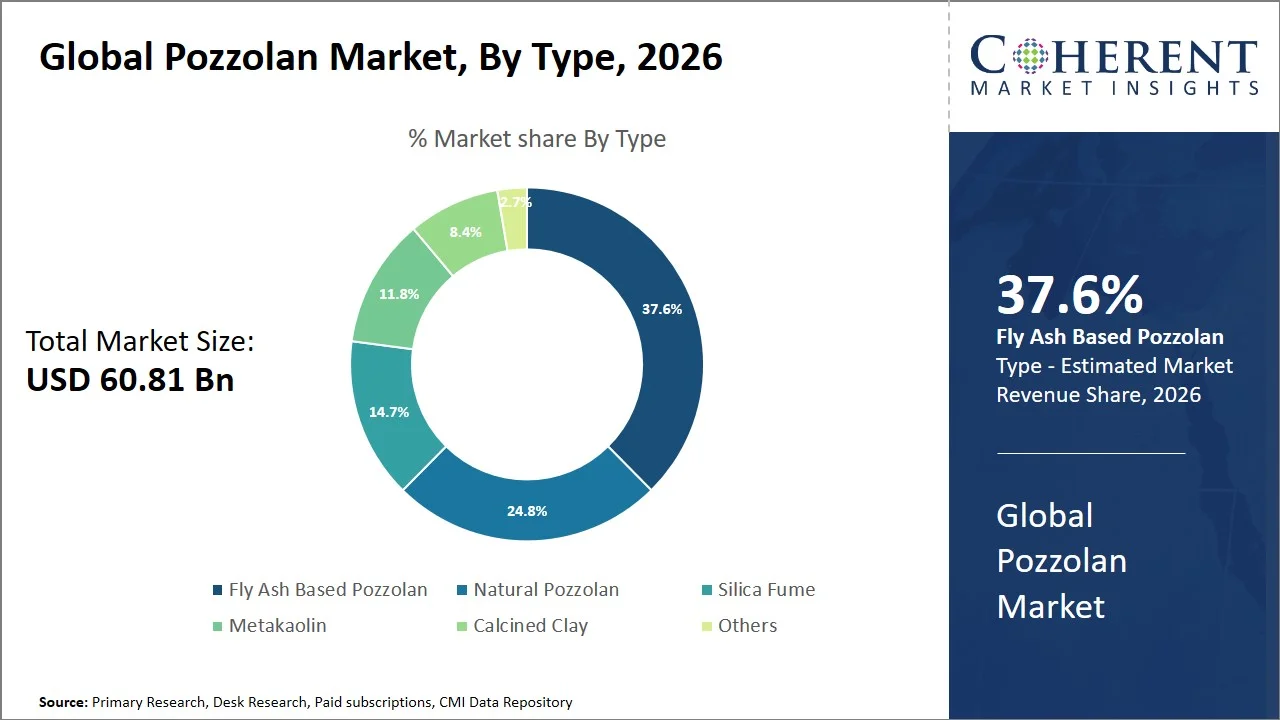
Why Does Fly Ash Based Pozzolan Dominate the Global Pozzolan Market?
Fly ash based pozzolan is expected to hold 37.6% of the global pozzolan market in 2026. Its leadership is anchored in mature procurement channels linking thermal power plants, ash processors, cement mills, and major civil contractors. Demand is the strongest where public works require large, repeatable volumes for highways, embankments, precast components, blended cement, and mass concrete. On the supply side, classification, beneficiation, drying, and rail-based movement allow producers to convert variable ash streams into specification-grade material suitable for continuous batching. The segment also benefits from established engineering familiarity and recognized test methods, reducing qualification time compared with newer supplementary cementitious materials. In August 2025, India’s Ministry of Railways and NTPC convened a national fly ash utilization conference after 332.63 million tons of the country’s 340.11 million tons generated in 2024–25 were utilized, highlighting the institutional collection, transportation, and end-use infrastructure supporting the segment.
- Current Industry Events of 2026
- Market Size Estimation
- Regional Breakdown
- Competitive Landscape
- Customer Intelligence
- Segmental Analysis
- Pricing Analysis
- Key Market Drivers, Challenges & Future Trends
- Customized Insights Section
Why Does Powder Represent the Largest Form Segment in the Global Pozzolan Market?
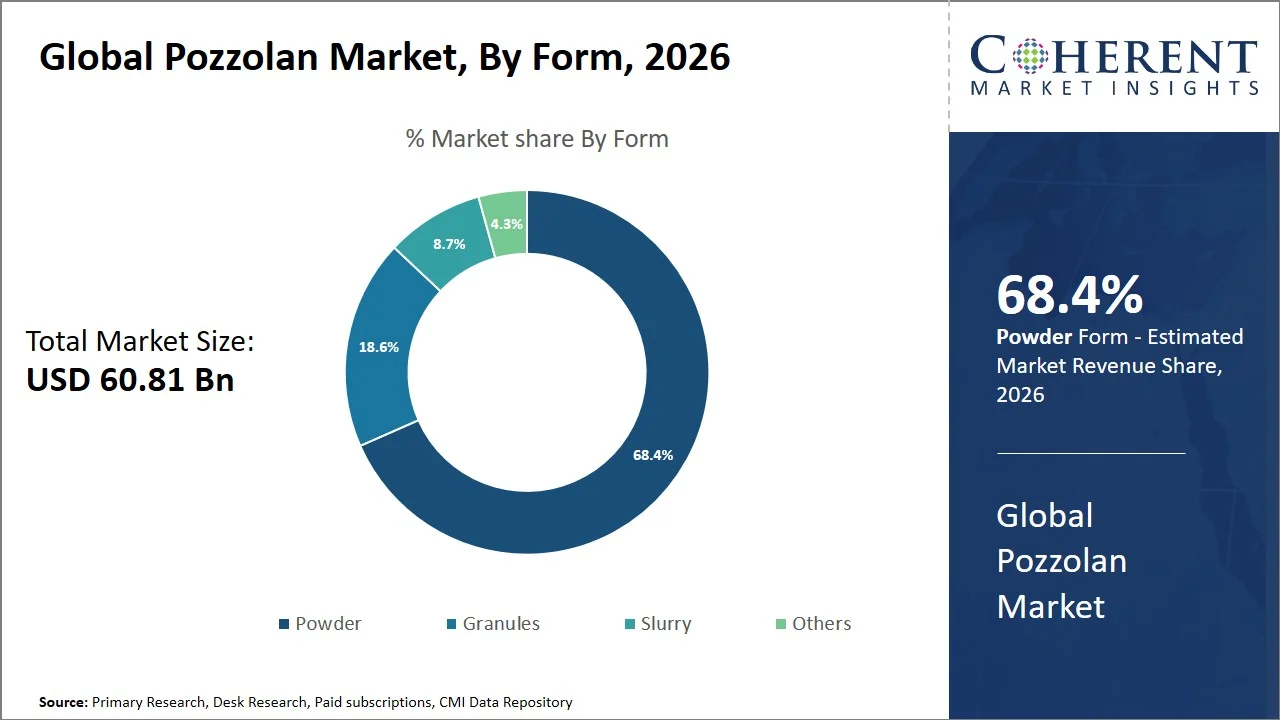
Powder is projected to represent 68.4% of the global pozzolan market in 2026. This form leads because pozzolanic performance depends heavily on particle size, surface area, mineral activation, and uniform distribution within cementitious systems. Milling and classification allow suppliers to tailor fineness and reactivity for blended cement, dry-mix mortar, repair compounds, precast concrete, and geopolymer binders. Powdered materials can also be tested against standardized chemical and physical specifications before shipment, helping contractors control setting behavior and batch consistency across large projects. Separate storage silos enable ready-mix and cement plants to adjust replacement ratios without redesigning their core production infrastructure. In June 2025, RMIT University announced a co-calcination process that converts low-grade illite and kaolin into a reactive powdered cement supplement capable of replacing 20% of cement while improving concrete performance, demonstrating how particle and thermal processing can broaden commercially usable pozzolan feedstocks.
Why Does the Cement and Concrete Segment Dominate the Global Pozzolan Market?
Cement and concrete are expected to dominate pozzolan applications with 58.7% of the market share in 2026 because they provide the largest scalable route for incorporating reactive mineral additions into construction. Cement producers use pozzolans in blended binders, while ready-mix and precast operators dose them directly to meet project-specific workability, heat evolution, strength-development, and exposure requirements. Adoption is particularly relevant in airports, bridges, marine structures, foundations, pavements, and high-volume pours where lifecycle performance and embodied-carbon requirements increasingly influence material selection. Existing batching plants, silos, laboratory controls, and contractor practices provide an established deployment platform, allowing qualified pozzolans to move rapidly from specification to site use. In September 2025, Noida International Airport became India’s first large-scale infrastructure project to build with limestone calcined clay cement, confirming that pozzolan-rich cement systems are progressing from demonstration projects into major commercial construction.
Global Pozzolan Market Dynamics
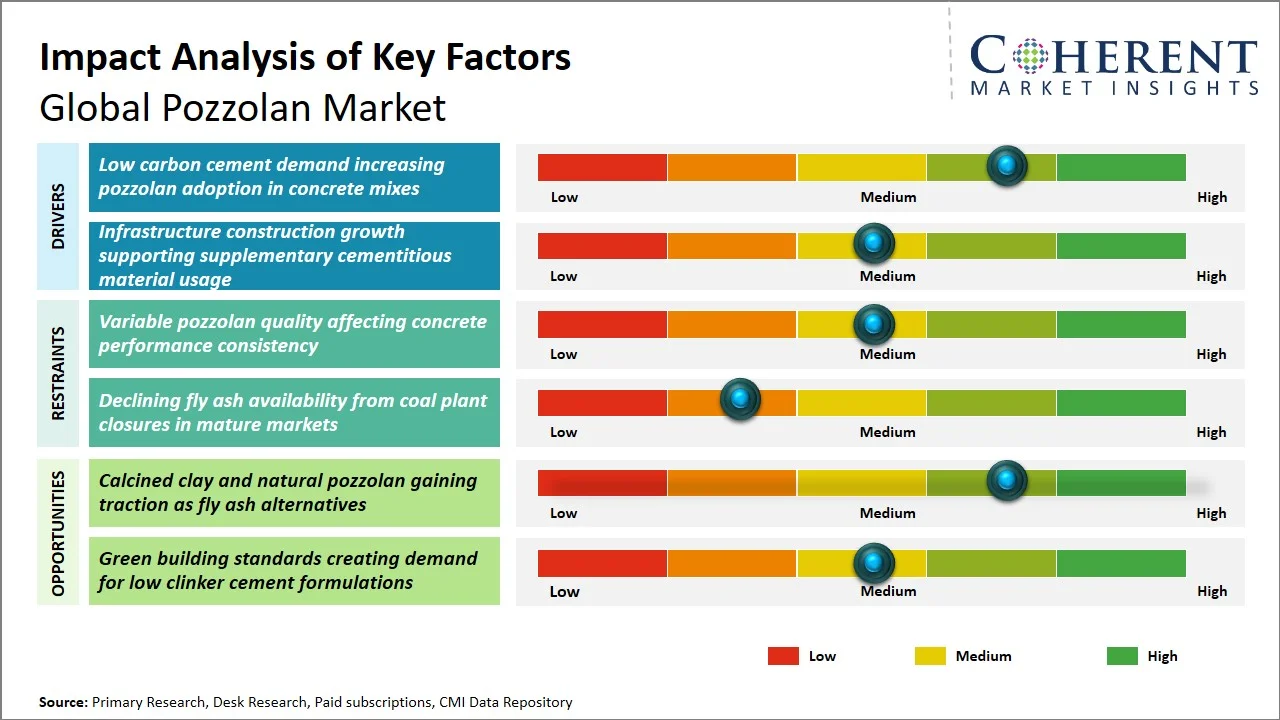
Key Market Drivers
- Low-Carbon Cement Demand is Increasing Pozzolan Adoption in Concrete Mixes: Low-carbon cement demand is converting pozzolan use from a cost-saving blend component into a strategic decarbonization lever. Cement and ready-mix producers can reduce clinker intensity by increasing fly ash, natural pozzolan, calcined clay, metakaolin, and silica-fume content while preserving strength and durability through optimized mix design. Demand is reinforced by embodied-carbon procurement criteria, environmental product declarations, and developer commitments that increasingly compare concrete on lifecycle emissions rather than cement price alone. This raises the value of consistent reactivity, traceable sourcing, and technical support, allowing qualified pozzolan suppliers to secure longer-term contracts. In February 2026, CEMEX reported that its consolidated gross carbon dioxide emissions declined during 2025, primarily because of further reductions in clinker factor. The disclosure demonstrates that clinker substitution is becoming an operating priority for major cement producers and is supporting demand for dependable supplementary cementitious materials.
- Infrastructure Construction Growth is Supporting Supplementary Cementitious Material Usage: Infrastructure construction supports pozzolan consumption because transport, energy, water, industrial, and public-building projects require large concrete volumes with controlled heat generation, long service life, and resistance to aggressive exposure. Pozzolans are particularly relevant in mass pours, bridge decks, marine structures, pavements, foundations, and precast elements, where later-age strength and lower permeability can outweigh rapid early strength. Public procurement also favors suppliers capable of documenting mix consistency and embodied-carbon performance across multiple project sites. This encourages investment in drying, grinding, storage, and regional distribution capacity so cement producers can serve infrastructure customers reliably. In May 2025, Cementos Argos reported progress on a pozzolan-drying project intended to enable the production of general-purpose cement with a 49% clinker content. The development illustrates how manufacturers are adapting processing assets to supply lower-clinker cement for construction demand while strengthening the commercial role of pozzolanic materials.
Emerging Market Trends
- Diversification Beyond Conventional Fly Ash and Slag: The pozzolan market is moving toward diversified portfolios as coal-fired power retirement and changes in steelmaking reduce the long-term availability of conventional fly ash and slag in several developed markets. Producers are increasingly qualifying calcined clay, natural volcanic materials, reclaimed ash, recycled glass powder, mine tailings, and agricultural residues as regional substitutes. This transition is not a simple feedstock change, as each material requires tailored activation, grinding, admixture selection, and durability validation. Suppliers able to blend multiple sources can stabilize chemistry and maintain year-round specification compliance despite variable raw materials. The trend will support investment in regional preprocessing hubs rather than dependence on single-source industrial byproducts transported over long distances. It will also create premium opportunities for materials with verified reactivity, environmental declarations, and performance data, while weakening the competitive position of untreated pozzolans sold without application engineering or rigorous quality assurance.
- Performance-Based Specifications are Broadening Material Qualification: Performance-based specifications are gradually replacing rigid prescriptive limits on cement composition, creating a more favorable route for higher pozzolan substitution and novel supplementary cementitious materials. Instead of approving concrete solely by ingredient type or fixed replacement percentage, project owners increasingly evaluate compressive strength, durability, permeability, heat evolution, exposure resistance, and embodied carbon. This allows producers to optimize local pozzolan combinations according to project conditions and raw-material availability. However, market access will depend on accelerated reactivity tests, long-term durability evidence, digital batch records, and product-specific environmental declarations. The transition should shorten commercialization pathways for calcined clay, reclaimed ash, and engineered mineral products once performance equivalence is demonstrated. It will also shift value toward laboratories, admixture specialists, and formulation platforms that can translate variable mineral inputs into predictable concrete performance, reducing the technical risk faced by engineers, contractors, infrastructure authorities, and project financiers.
Current Events and their Impact
Current Events | Description and its Impact |
May 2026 – U.K. Government Confirms Low-Carbon Industrial Product Framework |
|
January 2026 – India Publishes Draft Amendments to the Ash Utilization Notification |
|
December 2024 Onward – U.S. EPA Advances Cleaner Construction Material Criteria |
|
Regional Insights
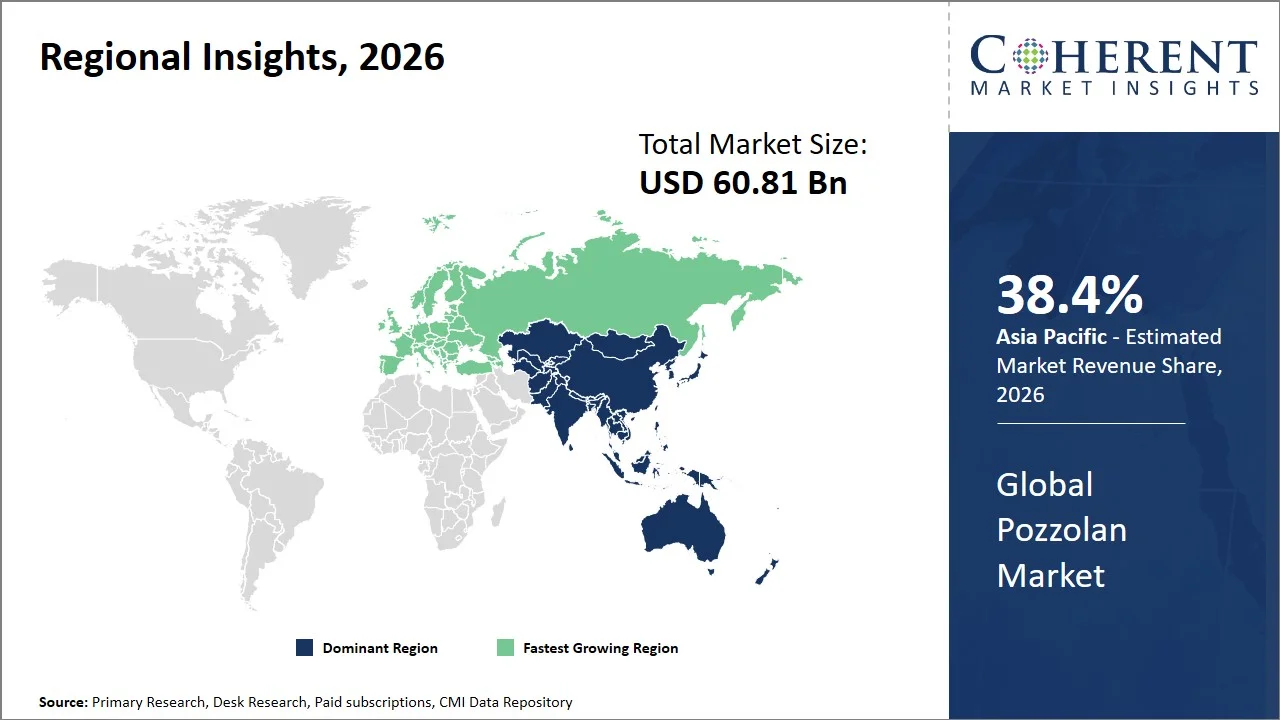
Why Does Asia Pacific Dominate the Global Pozzolan Market?
Asia Pacific will have the largest presence in the global pozzolan market in 2026, accounting for 38.4% of the total market share. The high consumption of cement and the construction of extensive infrastructure, the large ready-mix and precast industries, and the availability of fly ash, volcanic materials, and clay-based feedstocks are all indicators of regional leadership. The existing grinding, blending, silo and batching facilities of the cement industry can be utilized to incorporate pozzolans for commercial application, in highways, ports, rail systems, housing, and industrial facilities. The area also has policy initiatives to minimize embodied carbon and to turn industrial by-products into building materials. In April 2025, the New South Wales Government published guidance on low-carbon concrete, identifying reduced cementitious content and supplementary cementitious materials as practical routes for lowering concrete emissions. This supports wider specification of pozzolan-rich mixes and strengthens demand for locally processed, quality-controlled materials across Asia Pacific construction markets.
Why is Europe Emerging as the Fastest-Growing Region in the Pozzolan Market?
Europe is projected to be the fastest-growing pozzolan market, accounting for 25.8% of the market share in 2026. Growth is being shaped by carbon pricing, environmental product declarations, green public procurement, and building-level lifecycle assessment, all of which increase the commercial value of reducing clinker content. At the same time, coal phase-outs are tightening conventional fly ash supply, encouraging cement companies to scale calcined clay, natural pozzolans, metakaolin, recycled mineral fines, and other alternative supplementary cementitious materials. Adoption is strongest in infrastructure renovation, commercial buildings, precast products, and low-carbon cement portfolios requiring verified environmental performance. In December 2025, the European Commission published a common framework for calculating the lifecycle global warming potential of new buildings, with disclosure requirements beginning for large new buildings in 2028. The framework should strengthen the demand for traceable pozzolans supported by product-specific emissions data and reliable technical documentation.
Global Pozzolan Market Outlook for Key Countries
Why is the U.S. a Key Market for the Pozzolan Market?
The U.S. is a key pozzolan market because it combines a large ready-mix concrete industry with extensive federal, state, and municipal infrastructure procurement. Fly ash remains established in pavements, bridges, dams, foundations, and precast products, while supply constraints are increasing interest in reclaimed ash, natural pozzolans, calcined clay, and finely processed glass-based materials. State transportation departments and engineering firms provide mature qualification pathways, but suppliers must demonstrate consistent chemistry, fineness, strength activity, and durability performance. Federal purchasing criteria are also shifting competition toward verified low-embodied-carbon products. In April 2025, the U.S. General Services Administration updated its requirements for low-embodied-carbon concrete and cement, establishing global-warming-potential limits and requiring product-specific, third-party-verified environmental product declarations. These rules increase the strategic value of pozzolans that reduce cement-related emissions while meeting structural performance and domestic procurement requirements.
Why is China Important in the Global Pozzolan Market?
China supports global pozzolan market growth through its enormous cement, concrete, prefabricated construction, and transport-infrastructure base. Large volumes of coal combustion ash and other industrial mineral residues create feedstock opportunities, while integrated power, cement, logistics, and construction clusters enable collection, processing, blending, and end-use deployment at scale. Demand is increasingly linked to urban renewal, rail transit, sponge-city projects, precast buildings, and certified green construction products. Producers that can standardize variable industrial residues and document environmental performance are positioned to serve domestic projects and export-oriented cement supply chains. In November 2025, China’s State Council published a white paper reporting that green-building-material certifications exceeded 10,000 products by June 2025 and that new prefabricated projects under construction reached 672 million square meters in 2024. This certification and construction ecosystem supports broader commercialization of pozzolan-containing cement and concrete products.
Why Does India Support Growth in the Pozzolan Market?
India is important to the global pozzolan market because infrastructure spending and cement demand coincide with substantial fly ash generation and growing interest in calcined-clay binders. Portland pozzolana cement is already familiar to contractors and consumers, supporting use across roads, housing, railways, urban infrastructure, and commercial construction. Cement plants located near thermal power stations can benefit from established ash movement networks, while India’s clay resources create a pathway to diversify supply as coal-based ash availability changes over time. The next expansion phase will depend on performance-based standards, beneficiation, reactivity testing, and reliable logistics. In January 2026, NITI Aayog’s cement-sector decarbonization roadmap recommended exploring calcined-clay deposits, permitting greater fly ash use in blended cement, and moving toward performance-based standards. The roadmap links these measures to lower emissions and operating savings, strengthening the investment case for domestic pozzolan processing.
Why is Saudi Arabia a Strategic Country in the Pozzolan Market?
Saudi Arabia is a strategic pozzolan market because its large infrastructure pipeline requires durable concrete for transport, tourism, industrial, residential, and urban-development projects. High-volume construction creates demand for cement substitutes that can reduce clinker dependence, improve resistance to aggressive exposure conditions, and support project-level sustainability commitments. However, limited domestic availability of traditional fly ash and slag increases the importance of locally produced calcined clay and other mineral alternatives. Suppliers combining regional feedstocks with controlled calcination and technical support can reduce import exposure and serve ready-mix producers near major development corridors. In September 2024, Next Generation SCM and City Cement’s subsidiary, Nizak Mining announced a joint venture to establish Saudi Arabia’s first premium calcined-clay supplementary cementitious material plant in Riyadh, targeting initial production of 350,000 tons annually. The project is designed to create a scalable domestic source of low-carbon pozzolan for concrete.
Why is South Africa an Important Growth Market for the Pozzolan Market?
South Africa is an important growth market for pozzolans because its construction sector has established experience with fly ash, composite cement, and performance-engineered concrete. Coal-fired power generation provides an industrial byproduct stream that can be upgraded for cementitious use, while carbon-related costs encourage producers and contractors to lower clinker intensity. Demand is concentrated in roads, bridges, water infrastructure, mining facilities, commercial projects, and affordable housing, where durability and lifecycle cost are critical. Market expansion depends on consistent ash classification, reliable transport from power stations, standards compliance, and broader qualification of calcined clay as conventional ash supply evolves. In March 2024, AfriSam reported that the Tshoxa 1 Bridge used fly ash as a supplementary cementitious material in its concrete mix, reducing the project’s carbon footprint while meeting structural requirements. The deployment demonstrates practical adoption of pozzolan-rich concrete in South African infrastructure.
Technology Adoption Landscape in the Global Pozzolan Market
Technology | Adoption Level | Key Application Area | Business Impact |
Fly ash beneficiation and carbon removal | High | Reclaimed and landfilled fly ash | Reduces unburned carbon and variability, converting legacy ash into specification-grade cement and concrete inputs. |
Controlled clay and flash calcination | Medium | Calcined clay and metakaolin | Activates locally available clay resources, diversifies SCM supply, and enables lower clinker ratios. |
Ultrafine grinding and mechanical activation | High | Natural pozzolans, ash, glass powder, and mineral residues | Increases surface area and reactivity, supporting better early strength and higher replacement levels. |
Carbon dioxide mineralization | Medium | Ash, tailings, and industrial mineral fines | Produces carbon-enhanced cementitious materials while embedding captured carbon and upgrading low-value residues. |
Digital mix-design and predictive reactivity tools | Medium | Ready-mix, precast, and blended cement formulation | Shortens qualification cycles and optimizes strength, durability, cost, and embodied-carbon performance. |
Automated XRF, XRD, and online quality control | High | Feedstock characterization and batch certification | Stabilizes chemical composition, detects variability, and improves compliance with cement and concrete specifications. |
How are Regional Alternative Pozzolans Creating New Growth Opportunities in the Global Pozzolan Market?
The largest opportunity lies in closing the supply gap created by declining fresh fly ash and uneven slag availability. Calcined clay, reclaimed pond ash, natural volcanic materials, recycled glass, mine tailings, and selected agricultural ashes can provide regionally available substitutes, but commercial value will depend on upgrading them into consistent, specification-ready products. Beneficiation, controlled calcination, fine grinding, blending, and chemical activation allow suppliers to engineer reactivity rather than sell untreated mineral feedstock. This creates opportunities for preprocessing hubs located near cement plants and infrastructure corridors, reducing freight exposure and improving supply assurance. Producers can also preimmunize offerings through application-specific grades for mass concrete, precast products, mortars, geopolymers, and well cementing. Product-specific environmental declarations, durability evidence, and digital batch traceability will improve acceptance in low-carbon procurement and export markets. Companies combining feedstock access with formulation support and long-term offtake agreements can build defensible regional positions while helping cement customers lower clinker use without major plant redesign.
Market Players, Key Development, and Competitive Landscape
Key Developments
- In May 2026, Terra reported that the construction of its first full-scale facility in Cleburne, Texas, remained on schedule, with planned annual production of 240,000 tons of engineered supplementary cementitious materials from mid-2027. Terra also stated that OPUS SCM was commercially ready. This is important for the pozzolan market because it supports the scale-up of manufactured SCMs based on abundant silicate rocks rather than scarce conventional industrial byproducts.
- In May 2026, a consortium comprising Ecocem, Cairn, University College Dublin, and Kilsaran secured funding for Ireland’s first full-scale ACT low-carbon cement demonstration and independent technical assessment. This is important for the pozzolan market because field validation can provide contractors and specifiers with evidence of buildability, performance, and carbon reduction, supporting the transition of high-SCM binders from technical development to commercial construction.
- In June 2025, Carbon Upcycling and TITAN Group entered into a memorandum of agreement to conduct technical feasibility studies at two TITAN cement plants. The work will assess production of carbon dioxide-enhanced supplementary cementitious products using captured emissions and locally available materials. This is important for the pozzolan market because it links carbon utilization with regional SCM production and could reduce dependence on long-distance raw-material supply chains.
Competitive Landscape
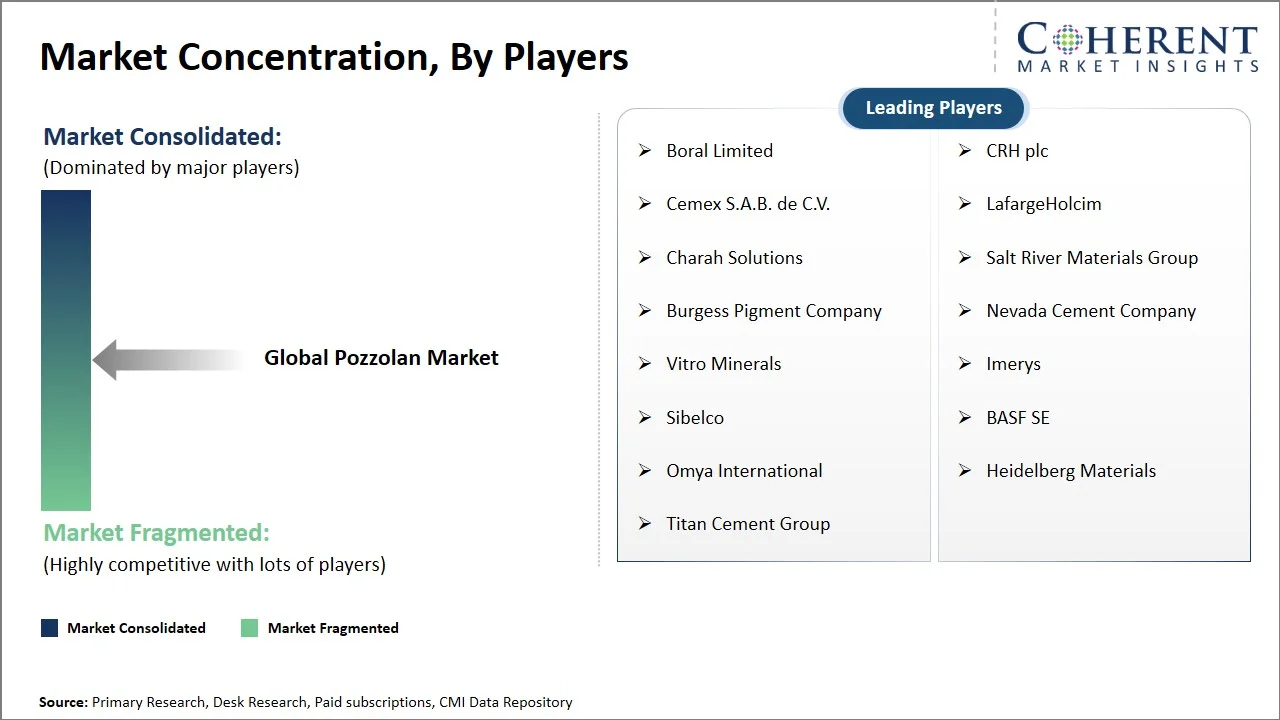
The global pozzolan market is moderately fragmented, comprising integrated cement manufacturers, specialist fly ash processors, natural pozzolan quarry operators, calcined-clay producers, mineral-technology companies, and regional distributors. Competition is strongly influenced by feedstock location and transportation economics, while emerging suppliers differentiate themselves through material activation, carbon performance, and application engineering.
Key focus areas include
- Product performance: Suppliers compete on pozzolanic reactivity, strength development, permeability, chemical resistance, and durability.
- Processing efficiency: Beneficiation, calcination, drying, classification, and grinding economics determine production cost and scalability.
- Pricing and logistics: Delivered cost is critical because pozzolans are bulk materials with significant freight exposure.
- Feedstock security: Long-term ash rights, mineral reserves, industrial residue agreements, and diversified sourcing strengthen supply reliability.
- Quality and compliance: Continuous testing, product certification, environmental declarations, and batch traceability support project qualification.
- Grade differentiation: Companies provide tailored fineness, chemistry, moisture, loss-on-ignition, and reactivity specifications for different applications.
- Application engineering: Laboratory trials, admixture compatibility, durability testing, and mix optimization improve customer conversion and retention.
- Strategic agreements: Offtake contracts, utility partnerships, logistics arrangements, and cement-producer collaborations support capacity utilization and market reach.
Market Report Scope
Pozzolan Market Report Coverage
| Report Coverage | Details | ||
|---|---|---|---|
| Base Year: | 2025 | Market Size in 2026: | USD 60.81 Bn |
| Historical Data for: | 2020 To 2024 | Forecast Period: | 2026 To 2033 |
| Forecast Period 2026 to 2033 CAGR: | 6.2% | 2033 Value Projection: | USD 92.65 Bn |
| Geographies covered: |
| ||
| Segments covered: |
| ||
| Companies covered: | Boral Limited, CRH plc, Cemex S.A.B. de C.V., LafargeHolcim, Charah Solutions, Salt River Materials Group, Burgess Pigment Company, Nevada Cement Company, Vitro Minerals, Imerys, Sibelco, BASF SE, Omya International, Heidelberg Materials, Titan Cement Group | ||
| Growth Drivers: |
| ||
| Restraints & Challenges: |
| ||
Analyst Opinion (Expert Opinion)
- The market is likely to separate into two competitive tiers. Conventional fly ash will remain a volume material where supply and freight costs determine competitiveness, while engineered calcined clay, reclaimed ash, activated natural pozzolan, and mineral-residue products will form a higher-value tier supported by controlled performance and carbon documentation. The latter category could have the greatest transformative effect on future supply structures.
- Digital qualification and performance-based procurement will reshape how new pozzolans reach the market. Predictive formulation, rapid reactivity testing, automated mineral characterization, and verified environmental declarations can reduce the time required to approve unfamiliar feedstocks. Suppliers owning both processing technology and application-performance data will gain an advantage over companies competing only through raw-material access.
- Feedstock inconsistency, transport costs, slower early-strength development, and conservative construction specifications remain key barriers. Market participants should establish regional processing hubs, secure multiple feedstock sources, develop application-specific grades, and participate actively in standards development. Investment in customer trials and long-term supply contracts will be essential for converting technical suitability into recurring commercial demand.
Speak to the analyst
Want personalized insights?
Take the findings above to one of our principal consultants, or have the report rebuilt around the segments, geographies and competitors you actually track.
Market Segmentation
- Type Insights (Revenue, USD Bn, 2021 - 2033)
- Fly Ash Based Pozzolan
- Natural Pozzolan
- Silica Fume
- Metakaolin
- Calcined Clay
- Others
- Form Insights (Revenue, USD Bn, 2021 - 2033)
- Powder
- Granules
- Slurry
- Others
- Application Insights (Revenue, USD Bn, 2021 - 2033)
- Cement and Concrete
- Mortars and Plasters
- Geopolymer Materials
- Oil and Gas Well Cementing
- Waste Stabilization
- Others
- End User Insights (Revenue, USD Bn, 2021 - 2033)
- Residential Construction
- Commercial Construction
- Infrastructure
- Industrial Construction
- Oil and Gas
- Others
- Regional Insights (Revenue, USD Bn, 2021 - 2033)
- North America
- U.S.
- Canada
- Latin America
- Global
- Argentina
- Mexico
- Rest of Latin America
- Europe
- Germany
- U.K.
- Spain
- France
- Italy
- Russia
- Rest of Europe
- Asia Pacific
- China
- India
- Japan
- Australia
- South Korea
- ASEAN
- Rest of Asia Pacific
- Middle East
- GCC Countries
- Israel
- Rest of Middle East
- Africa
- South Africa
- North Africa
- Central Africa
- North America
- Key Players Insights
- Boral Limited
- CRH plc
- Cemex S.A.B. de C.V.
- LafargeHolcim
- Charah Solutions
- Salt River Materials Group
- Burgess Pigment Company
- Nevada Cement Company
- Vitro Minerals
- Imerys
- Sibelco
- BASF SE
- Omya International
- Heidelberg Materials
- Titan Cement Group
Sources
Primary Research interviews
- Pozzolan Manufacturing Company Executives
- Raw Material Suppliers
- Industry Experts and Consultants
- Construction and Cement Industry Buyers
Magazines
- Concrete Monthly
- Cement Americas
- International Cement Review
- Construction World
Journals
- Cement and Concrete Research
- Journal of Materials Science
- Construction and Building Materials
Newspapers
- The Economic Times
- Financial Times
- The Wall Street Journal
- The Hindu Business Line
Associations
- American Concrete Institute (ACI)
- World Cement Association (WCA)
- National Ready Mixed Concrete Association (NRMCA)
- International Cement Review (ICR)
Public Domain sources
- United States Geological Survey (USGS)
- International Energy Agency (IEA)
- World Bank - Construction Sector Data
- United Nations Industrial Development Organization (UNIDO)
Proprietary Elements
- CMI Data Analytics Tool, Proprietary CMI Existing Repository of information for last 10 years
Get access to 250+ pages report
Every segment, forecast, competitor profile and data table behind the analysis above — available for instant download.
- ESOMAR Member
- ISO 9001:2015 Certified
- D-U-N-S Registered
- GDPR & CCPA Compliant
Missing comfort of reading report in your local language? Find your preferred language:
Transform your Strategy with Exclusive Trending Reports
Frequently Asked Questions
The CAGR of the global pozzolan market is projected to be 6.2% from 2026 to 2033.
Pozzolans improve concrete durability, reduce permeability and heat generation, and can lower the amount of clinker required in cementitious mixes.
Pozzolans partially replace carbon-intensive Portland cement clinker, reducing the embodied emissions associated with concrete production.
Pozzolans are widely used in cement and concrete, mortars and plasters, geopolymer materials, oil and gas well cementing, and waste stabilization.
The global pozzolan market is estimated to be valued at USD 60.81 billion in 2026 and is expected to reach USD 92.65 billion by 2033.
Low carbon cement demand increasing pozzolan adoption in concrete mixes and infrastructure construction growth supporting supplementary cementitious material usage are the major factors driving the growth of the global pozzolan market.
Variable pozzolan quality affecting concrete performance consistency and declining fly ash availability from coal plant closures in mature markets are the major factors hampering the growth of the global pozzolan market.