

Global Propionic Acid Market Size and Forecast – 2026 To 2033
The Global Propionic Acid Market is estimated to be valued at USD 1.25 Bn in 2026 and is expected to reach USD 1.75 Bn by 2033, growing at a compound annual growth rate (CAGR) of 6.9% from 2026 to 2033. Market expansion is supported by propionic acid’s established role in food preservation, animal feed protection, pharmaceuticals, and chemical intermediates, alongside improvements in manufacturing and formulation technologies.
Animal feed remains an important demand base, as propionic acid helps control mold and preserve feed quality during storage. In April 2025, Alltech reported that global feed production reached approximately 1.396 billion metric tons in 2024, increasing by 1.2% from 2023, indicating the expanding scale of the downstream feed industry that supports demand for effective organic-acid preservation solutions.
Key Takeaways of the Global Propionic Acid Market
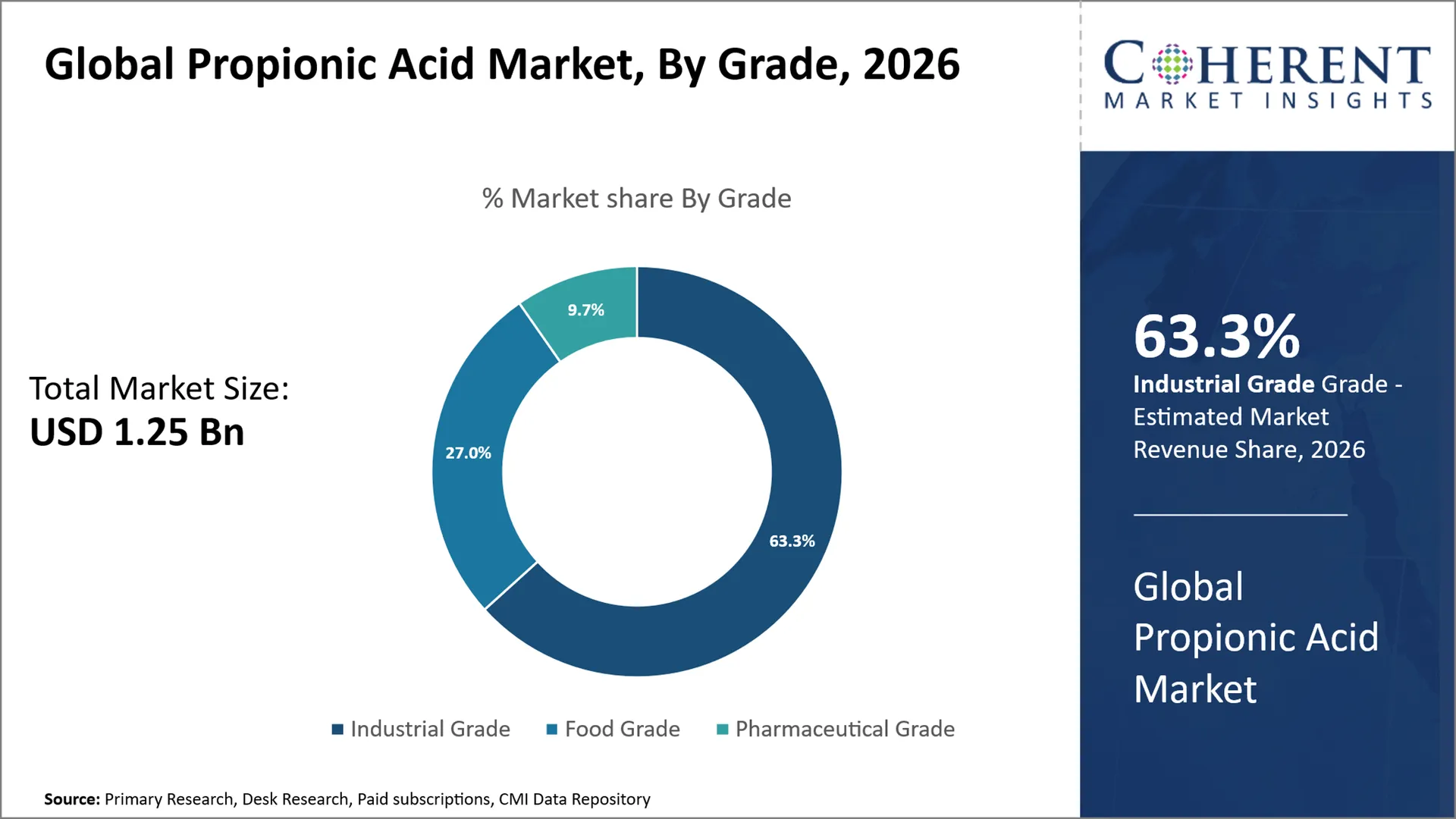
- Industrial Grade is estimated to grow at a 4.6% CAGR during 2026–2033 and account for 63.3% of the global propionic acid market in 2026, reflecting its broad role in high-volume chemical intermediates, agrochemicals, solvents, and related industrial formulations where purity, dependable supply, and production economics are critical. In May 2026, BASF reported 210 thousand metric tons of annual propionic acid nameplate capacity.
- Food and Beverage Preservation is estimated to expand at a 5.3% CAGR during 2026–2033 and hold 39.8% of the global propionic acid market in 2026, supported by recurring use of propionic acid and propionates to control mold and extend shelf life in bakery and cheese products. In October 2025, Health Canada retained propionic acid and calcium and sodium propionate in its permitted preservatives list for food applications.
- Chemical Synthesis is estimated to register a 4.7% CAGR during 2026–2033 and represent 91.6% of the global propionic acid market in 2026, as established petrochemical routes provide high purity, continuous output, and scale advantages that fermentation has not yet matched commercially. In October 2025, the European Commission renewed authorization for propionic acid produced by chemical synthesis at least 99.5% purity for terrestrial animal feed uses.
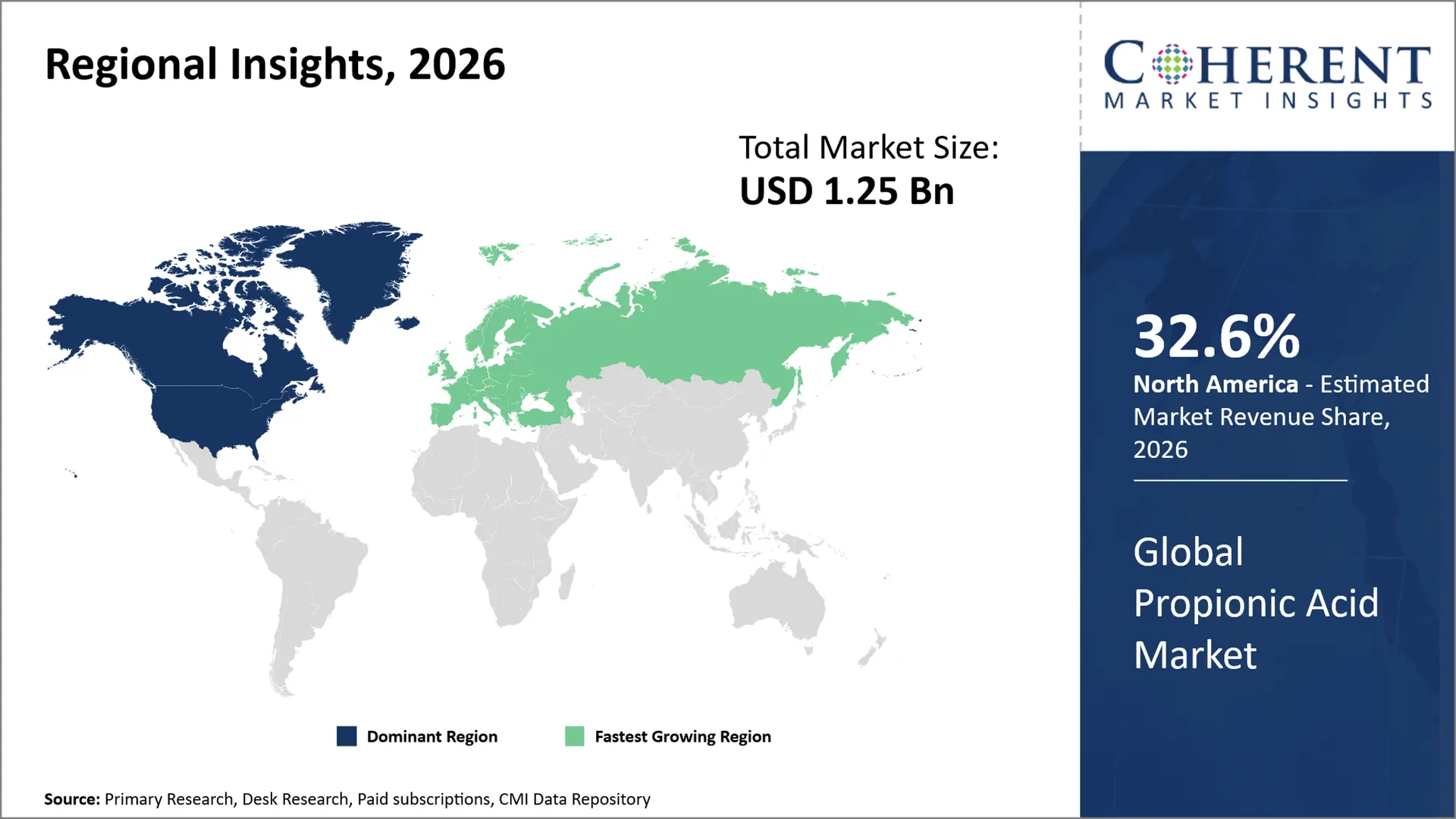
- North America is estimated to grow at a 4.5% CAGR during 2026–2033 and account for 32.6% of the global propionic acid market in 2026, supported by established chemical production, mature food and feed processing, and broad availability through industrial supply networks. In April 2026, Eastman announced a North American price increase for all grades and packages of propionic acid, indicating active regional demand and disciplined commercial pricing.
- Europe is estimated to expand at a 5.6% CAGR during 2026–2033 and hold 30.4% of the global propionic acid market in 2026, making it the fastest-growing region as established food and feed uses combine with clear additive regulation and preservation requirements. In April 2025, the UK Food Standards Agency updated its authorization entry for propionic acid, retaining E280 as an approved food additive in Great Britain.
Segmental Insights
Why Does Industrial Grade Dominate the Global Propionic Acid Market?
Industrial Grade is expected to account for 63.3% of the global propionic acid market in 2026, leading the grade category because the largest purchasing programs are built around bulk industrial specifications rather than the tighter documentation and purification requirements of food or pharmaceutical grades. Chemical formulators use the acid as an intermediate or processing input in pesticides, plasticizers, coatings, rubber auxiliaries, textile chemicals, and other synthesis chains. Suppliers can therefore move larger lots through tank storage, road tankers, and contract distribution, improving asset utilization and lowering handling cost per ton. In February 2025, Sasol South Africa’s renewed Secunda Operations Solvents atmospheric-emission licence documented three dedicated propionic acid tanks within its chemical work-up infrastructure. The installation illustrates the specialized storage and transfer systems that support industrial-scale acid handling and favor suppliers with established bulk logistics.
- Current Industry Events of 2026
- Market Size Estimation
- Regional Breakdown
- Competitive Landscape
- Customer Intelligence
- Segmental Analysis
- Pricing Analysis
- Key Market Drivers, Challenges & Future Trends
- Customized Insights Section
Why Do Food and Beverage Preservation Represent the Largest Application in the Global Propionic Acid Market?
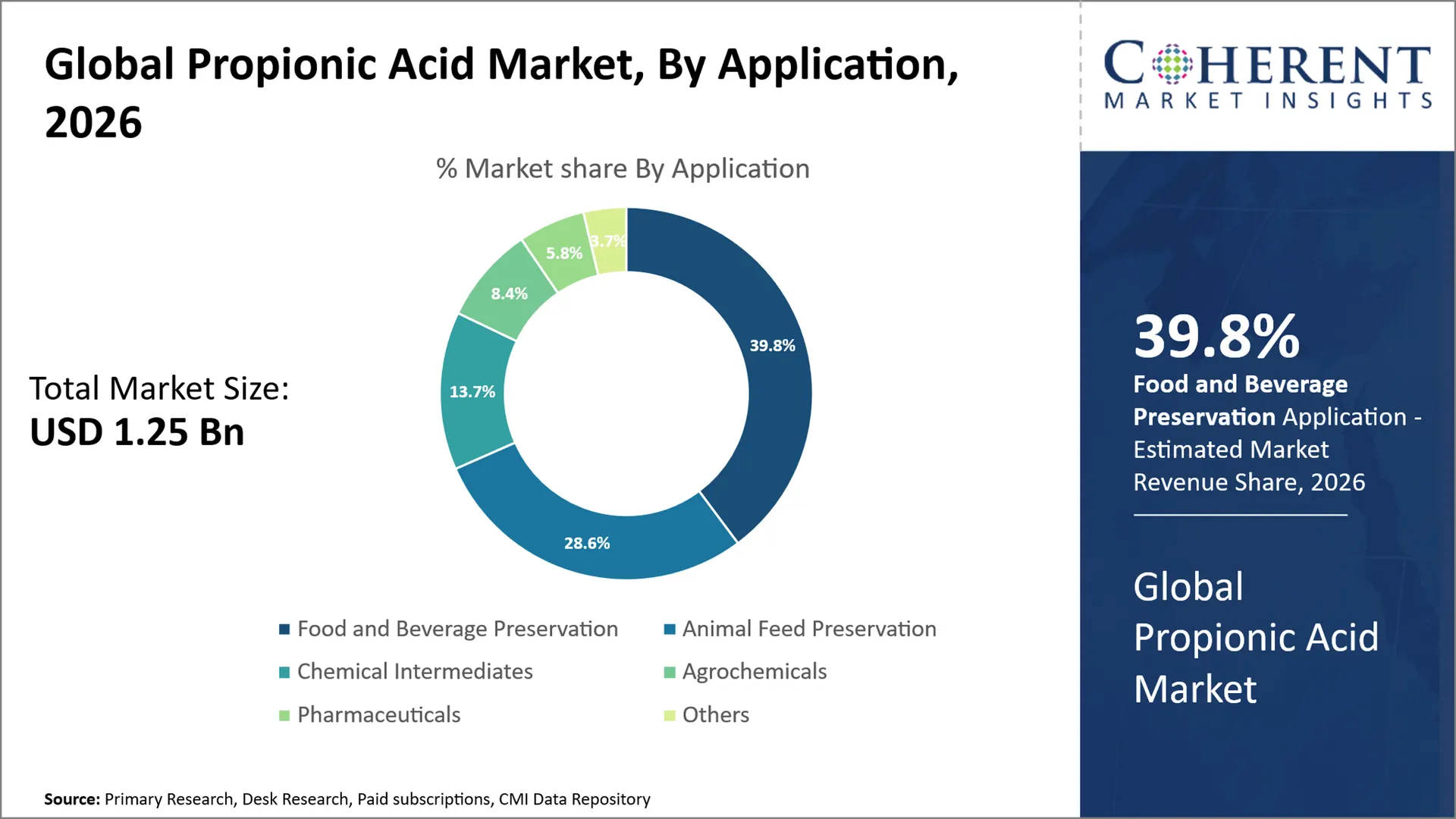
Food and Beverage Preservation is expected to represent 39.8% of the global propionic acid market in 2026, making it the largest application because propionates fit directly into established bakery processing without requiring major changes to production lines. Bakers use calcium or sodium propionate to suppress mold and rope spoilage while maintaining product integrity across manufacturing, warehousing, and retail distribution. This makes preservation demand closely tied to repeat production volumes and shelf-life targets rather than discretionary capital spending. Ingredient suppliers benefit from recurring orders, while processors gain greater flexibility in distribution distance and inventory rotation. In May 2025, J&K Ingredients published bakery guidance explaining that synthetic calcium propionate is typically added directly to flour during bread production and functions as an antimicrobial mold inhibitor. The guidance highlights the operational compatibility that keeps propionate-based preservation commercially relevant in high-throughput bakery manufacturing.
Why Does Chemical Synthesis Dominate the Production Method of the Global Propionic Acid Market?
Chemical Synthesis is expected to account for 91.6% of the global propionic acid market in 2026, reflecting the advantage of an already-installed production ecosystem built around petrochemical feedstocks, continuous reactors, separation equipment, and established derivative chains. Producers using chemical routes can procure standardized feedstocks, run large campaigns, and direct output into industrial, food, feed, or intermediate markets without building a biological fermentation platform. Fermentation still requires tighter control of microbial productivity, product inhibition, by-product formation, and acid recovery, which raises scale-up and purification complexity. In March 2024, as per springer nature publication, peer-reviewed Microbial Cell Factories study reported that industrial propionic acid production is mainly conducted through chemical synthesis using fossil-derived ethylene as a starting material. The study also identified productivity and final concentration as constraints on microbial production, reinforcing the installed-process advantage of conventional synthesis.
Current Events and their Impact
Current Event | Description and Its Impact |
June 2026 – Canada updates the Canadian Feed Ingredients Table under the Feeds Regulations 2024 |
|
February 2025 – China's GB 2760-2024 food additive standard enters into force |
|
December 2024 – India establishes SION A-3683 for propionic anhydride exports |
|
Global Propionic Acid Market Dynamics
Key Market Drivers
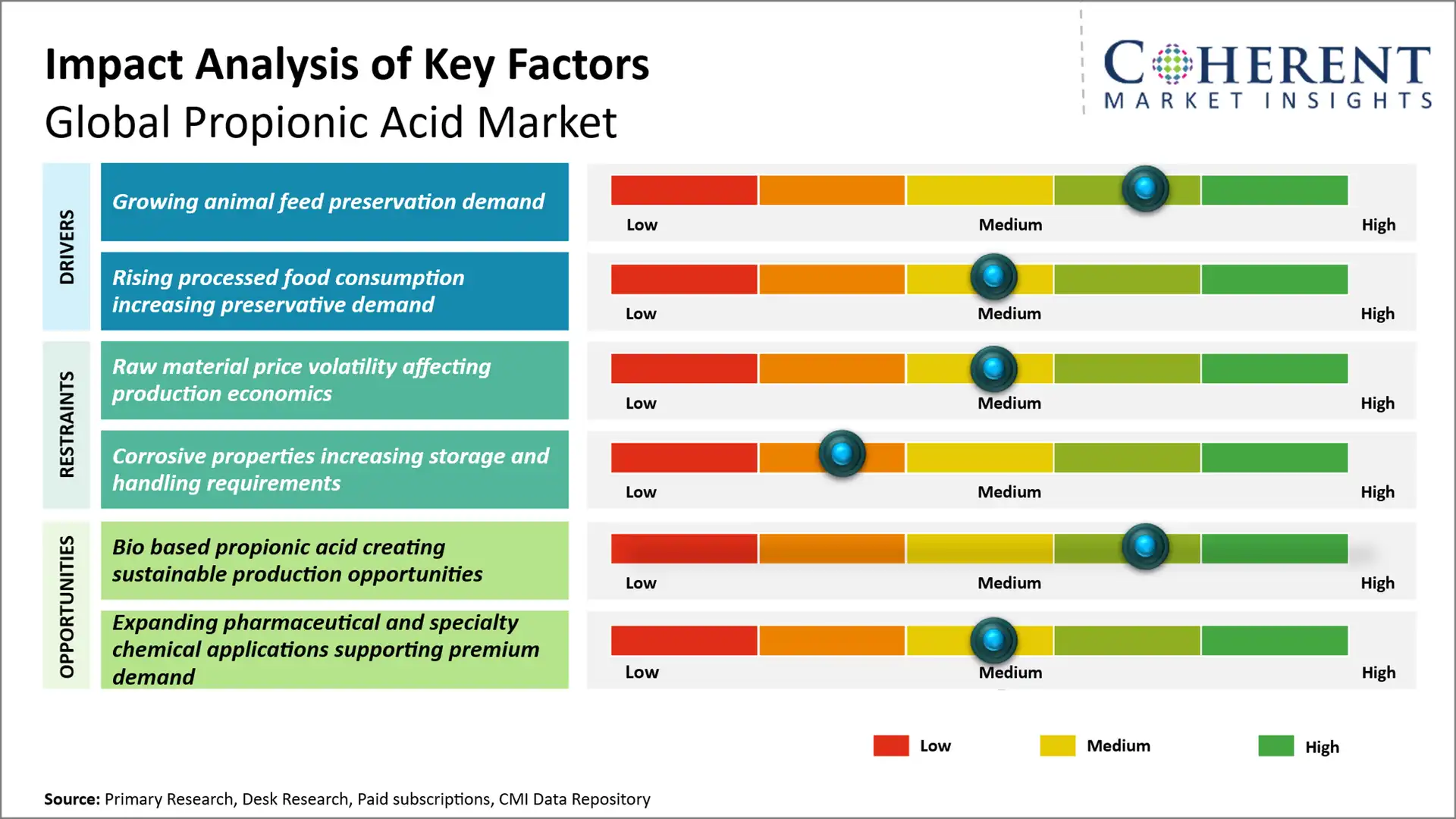
- Growing animal feed preservation demand: Growing animal feed preservation demand is increasing the commercial need for propionic acid because feed mills, integrators, and livestock producers must protect compound feed and stored grains against mold-related quality losses across longer storage and distribution cycles. This favors acid producers, feed-additive formulators, and dosing-system suppliers that can deliver consistent preservation performance and safer handling. In February 2026, Cargill opened a 400,000-ton-per-year dairy feed plant in Punjab, India, expanding industrial feed production and the addressable base for preservation inputs used in large-scale feed operations.
- Rising processed food consumption increasing preservative demand: Rising processed food consumption increasing preservative demand is strengthening propionic acid use in packaged bakery applications, where manufacturers need reliable mold control to protect shelf life, reduce returns, and support wider retail distribution. Calcium and sodium propionate suppliers benefit particularly when high-throughput bakeries prioritize predictable performance and formulation compatibility. In July 2025, Kerry highlighted ProBake Calcium Propionate as a conventional mold-inhibition technology for bakery while emphasizing the commercial importance of shelf-life extension and waste reduction, reinforcing the continuing role of propionate-based preservation in processed baked foods.
Emerging Market Trends
- Shift from Molecule Purchasing to Performance-Based Preservation Procurement: Preservation procurement is shifting from buying a single acid toward qualifying application performance across the full production process. Feed mills and food processors increasingly evaluate dose efficiency, dispersion, worker handling, corrosion exposure, sensory effects, and technical support alongside the purchase price of propionic acid. This favors suppliers capable of formulation support, dosing guidance, and application troubleshooting, while purely transactional sellers face greater pressure. Over the forecast period, supplier differentiation is likely to move toward measurable preservation outcomes and total cost-in-use rather than molecule-level pricing alone.
- Regional Stocking and Supply Assurance Becoming Procurement Differentiators: Regional inventory positioning is becoming a more important competitive tool as propionic acid buyers seek shorter lead times and lower exposure to freight, energy, and feedstock disruptions. Because the product requires controlled storage and transport, local terminals, qualified distributors, and predictable contract structures can materially influence supplier selection. Producers with flexible allocation and regional stocking are likely to gain resilience advantages, while import-dependent sellers may face greater volatility. During the forecast period, procurement strategies should increasingly balance spot pricing against continuity, safety stock, and contractual supply assurance.
Regional Insights
Why Does North America Dominate the Global Propionic Acid Market?
North America is expected to account for 32.6% of the global propionic acid market in 2026, supported by its large animal-feed industry, established bakery and processed-food manufacturing base, and mature chemical distribution infrastructure. Propionic acid demand is reinforced by its use in mold control, feed preservation, pH adjustment, and downstream chemical synthesis. The region also benefits from bulk-storage capability, reliable road and rail logistics, and direct contracting between acid producers and large food or feed processors, which support consistent industrial consumption. Regulatory clarity further lowers adoption barriers for approved food applications. In May 2026, the U.S. FDA updated its propionic acid inventory entry, identifying the substance for antimicrobial, flavoring or adjuvant, and pH-control functions under applicable food-additive and GRAS regulations. This regulatory recognition supports continued use across relevant U.S. food-processing applications.
Why Is Europe Emerging as the Fastest-Growing Region in the Global Propionic Acid Market?
Europe is expected to hold 30.4% of the global propionic acid market in 2026 and emerge as the fastest-growing region as feed preservation, food safety, manufacturing efficiency, and lower-carbon chemical pathways receive greater commercial attention. The region has a dense network of compound-feed producers, livestock operations, bakeries, and specialty chemical users that require controlled preservation and consistent product specifications. European buyers also place strong emphasis on traceability, occupational safety, formulation efficiency, and environmental performance, encouraging suppliers to differentiate beyond bulk price. This creates room for higher-purity grades, optimized acid blends, and renewable production routes. In May 2026, FEFAC forecast EU27 industrial compound-feed production at 152 million tons for the year, including continued poultry-feed growth. The scale of this feed-processing base sustains a broad addressable market for organic-acid preservation solutions across Europe.
Global Propionic Acid Market Outlook for Key Countries
Why Is the U.S. a Key Market for the Global Propionic Acid Market?
The U.S. is estimated to account for 25.8% of the global propionic acid market in 2026, making it the largest individual country market within the supplied regional structure. Demand is anchored by large-scale animal-feed manufacturing, commercial bakery production, grain storage, and chemical-intermediate consumption. U.S. buyers typically procure through established bulk-chemical networks, favoring suppliers that can provide dependable volumes, certified quality, technical documentation, and safe handling support. The country also has a sizeable feed-export ecosystem, which indirectly reinforces demand for preservation and quality-control inputs used across animal nutrition manufacturing. In September 2026, the American Feed Industry Association reported that U.S. animal-food exports reached USD 7.8 billion in 2025 and highlighted the industry's extensive domestic manufacturing network. That scale strengthens the commercial base for propionic acid used in feed preservation and related formulations.
Why Is India Important in the Global Propionic Acid Market?
India is estimated to represent 4.8% of the global propionic acid market in 2026, supported by expanding food processing, packaged bakery consumption, dairy value addition, and gradual modernization of commercial animal-feed production. The country's warm climatic conditions also increase the operational importance of shelf-life management and mold control during storage and distribution, particularly for bakery products and feed materials. Demand therefore extends beyond bulk industrial use toward food-grade propionic acid and propionate preservatives. Domestic users remain price sensitive, so suppliers that combine competitive landed cost with regulatory documentation and smaller packaging options can address a wider customer base. In August 2025, India's Ministry of Food Processing Industries reported that food processing had grown at an average annual rate of around 6.55% over the previous nine years ending 2023-24, reinforcing the expanding downstream base for food-preservation ingredients.
Why Does China Support Growth in the Global Propionic Acid Market?
China is estimated to hold 13.4% of the global propionic acid market in 2026, reflecting its extensive chemical-manufacturing base, large feed and food-processing industries, and ability to integrate upstream raw materials with downstream preservative and intermediate production. Domestic demand is supported by animal nutrition, bakery and packaged foods, agrochemicals, pharmaceuticals, and other fine-chemical applications. China also has a strong incentive to localize supply because propionic acid is strategically linked to multiple downstream formulations and import exposure can affect procurement economics. Capacity development therefore remains important to both cost competitiveness and supply security. In July 2026, the Huaihua municipal government listed a Mayang County propionic acid project involving five production lines, an approximately 8,000-square-meter factory, and planned investment of USD 17.92 million. The project illustrates continued interest in adding domestic propionic acid manufacturing capacity.
Why Is Germany a Strategic Country in the Global Propionic Acid Market?
Germany is estimated to account for 7.2% of the global propionic acid market in 2026, supported by a technically advanced animal-feed sector, strong food manufacturing, and a sophisticated chemical-processing ecosystem. Propionic acid is commercially relevant to German feed producers because mold control, silage stability, storage quality, and precise formulation are important in intensive livestock production. German customers also place high value on documented purity, worker-safety practices, traceability, and consistent specifications, which favors established suppliers and technically supported grades rather than purely price-led procurement. In March 2026, the German Feed Association reported that compound-feed production increased to 22.5 million tons in 2025, with gains across cattle, calves, laying hens, and pigs. This broad-based feed output supports continuing demand for preservation additives and strengthens Germany's role as a high-value propionic acid consumption market.
Why Is Brazil an Important Growth Market for the Global Propionic Acid Market?
Brazil is estimated to account for 3.4% of the global propionic acid market in 2026, with growth supported primarily by its large livestock, poultry, dairy, and feed-processing economy. Feed preservation is particularly relevant because high production volumes, warm and humid conditions in several producing regions, and long storage or transport chains increase the importance of controlling mold and maintaining nutritional quality. Propionic acid and propionate-based solutions therefore have a clear role in grain, compound-feed, and silage management, while food and chemical applications provide additional demand. In February 2025, Brazil's animal-feed industry association Sindirações projected approximately 90 million tons of feed and concentrates plus almost 4 million tons of supplements for 2025. That scale creates a sizeable downstream customer base for organic-acid preservation products and supports Brazil's importance within Latin America.
Innovation, Production & Manufacturing Landscape
Technology / Process | Adoption Stage | Role in Propionic Acid Production | Commercial and Strategic Outlook |
Continuous Catalytic Petrochemical Synthesis | Mature and commercial | Enables high-throughput production with consistent purity and supports large industrial, food, and feed customers. | Scale economics, catalyst efficiency, upstream integration, and energy optimization will remain central to competitiveness for bulk producers. |
High-Cell-Density Fermentation with Cell Recycle | Emerging | Uses concentrated microbial cultures and cell recycling to address productivity limitations associated with conventional fermentation. Recent peer-reviewed work identifies high-cell-density sequential fermentation as a promising pathway toward industrialization. | Commercial relevance depends on improving productivity, final acid concentration, substrate economics, and downstream recovery sufficiently to narrow the cost gap with chemical synthesis. |
Metabolic and Strain Engineering | Research to early commercialization | Optimizes acid-producing microorganisms for higher tolerance, selectivity, substrate utilization, and lower unwanted by-product formation. | Stronger strains could improve bio-process economics and widen the range of renewable or residual feedstocks that can be economically converted. |
Membrane and Electrodialysis-Assisted Product Recovery | Pilot and emerging | Removes accumulated organic acid from fermentation broth and can reduce product inhibition while concentrating recoverable propionate streams. | Progress in membrane durability, selectivity, fouling control, and energy efficiency will determine whether these systems become viable at industrial scale. |
Energy-Integrated Distillation and Purification | Mature but continuously improving | Supports grade consistency and removal of water, unreacted inputs, and process impurities while recovering usable process streams. | Heat integration and better separation efficiency can lower variable manufacturing costs while improving the economics of higher-purity product grades. |
Advanced Process Analytics and Automated Control | Growing adoption | Online measurement, automated dosing, process alarms, and closed-loop controls improve consistency across reaction, separation, storage, and loading operations. | Greater automation should support tighter specifications, lower off-specification output, safer plant operation, and more flexible grade manufacturing. |
How Are High-Purity and Traceable Specialty Grades Creating New Growth Opportunities in the Global Propionic Acid Market?
High-purity and fully traceable propionic acid grades create an underdeveloped value pool beyond bulk preservation applications. Pharmaceutical intermediate manufacturers, specialty chemical formulators, agrochemical producers, and other tightly specified users can place greater value on impurity control, batch consistency, documentation, and smaller-volume packaging than on the lowest bulk price. Suppliers can capture this opportunity by establishing dedicated purification and finishing capability, validated analytical testing, segregated storage, lot-level traceability, and technical documentation suited to customer qualification processes. Commercial success will also require reliable small-lot logistics and the ability to maintain specifications across repeated batches. These capabilities support premium positioning and longer customer qualification cycles that can reduce supplier switching once material is approved. The opportunity is therefore likely to favor integrated producers with flexible finishing assets and specialist distributors with strong quality systems, while commodity-only traders may struggle to defend margins. Companies should prioritize applications where specification complexity and supply assurance justify differentiated pricing rather than pursuing volume alone.
Market Players, Key Development, and Competitive Landscape
Key Developments
- In September 2026, Perstorp announced a global propionic acid price increase, citing higher raw-material and energy costs. This matters for the global propionic acid market because it shows how upstream cost shocks can quickly affect contract pricing, procurement negotiations, and margin management across food, feed, and industrial customers.
- In December 2025, AFYREN partnered with Esse Skincare to introduce bio-based propionic acid for skincare, produced through fermentation at AFYREN NEOXY. This matters for the global propionic acid market because it opens a premium personal-care application and demonstrates differentiation through renewable origin, certification, and specialized end-use positioning.
- In July 2024, BioVeritas announced a clean-label mold inhibitor designed as a one-for-one replacement for petrochemical calcium propionate in bakery applications. This matters for the global propionic acid market because it signals substitution pressure in a core preservation use and raises the importance of label positioning, sustainability, and application performance.
Competitive Landscape
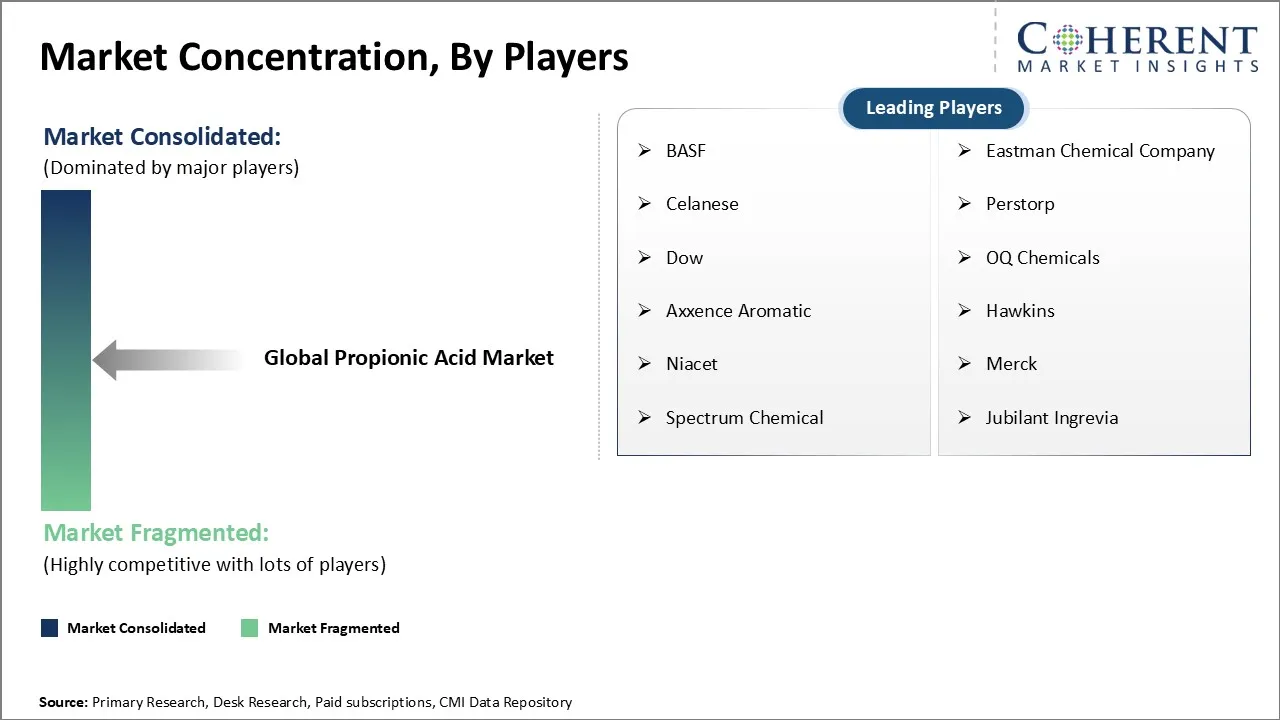
The global propionic acid market is moderately consolidated at the bulk-production level, while downstream formulation and regional distribution remain more fragmented. Large integrated chemical producers compete on feedstock economics, plant efficiency, grade consistency, and supply reliability, whereas specialist formulators and distributors compete through application support, localized inventory, packaging flexibility, and regulatory documentation. Customer qualification and safe-handling capabilities strengthen relationships beyond headline price competition.
Key focus areas include
- Feedstock integration: Access to competitive upstream intermediates and utilities supports manufacturing-cost stability.
- Process efficiency: Yield improvement, energy optimization, and plant utilization directly influence producer margins.
- Grade differentiation: Industrial, food, feed, and higher-purity specifications require different quality-control capabilities.
- Supply reliability: Buyers increasingly value assured availability, lead-time consistency, and contingency supply planning.
- Regulatory assurance: Documentation, traceability, certificates of analysis, and market-specific compliance strengthen supplier qualification.
- Technical service: Application troubleshooting and customer formulation support create differentiation beyond commodity pricing.
- Distribution capability: Bulk handling, regional storage, suitable packaging, and corrosion-safe logistics determine effective customer reach.
Market Report Scope
Propionic Acid Market Report Coverage | |||
Report Coverage | Details | ||
Base Year | 2025 | Market Size in 2026: | USD 1.25 Bn |
Historical Data For: | 2020 To 2024 | Forecast Period: | 2026 To 2033 |
Forecast Period 2026 To 2033 CAGR: | 6.9% | 2033 Value Projection: | USD 1.75 Bn |
Geographies covered: |
| ||
Segments covered: |
| ||
Companies covered: | BASF, Eastman Chemical Company, Celanese, Perstorp, Dow, OQ Chemicals, Axxence Aromatic, Hawkins, Niacet, Merck, Spectrum Chemical, Jubilant Ingrevia | ||
Growth Drivers: |
| ||
Restraints & Challenges: |
| ||
Analyst Opinion (Expert Opinion)
- The market is likely to split more clearly between scale-led commodity supply and qualification-led specialty supply. Future leaders should be those that can switch efficiently among grades, packaging formats, and customer specifications while supporting buyers with technical documentation and application service. This would make commercial flexibility and account retention more important than simply maximizing annual tonnage.
- Product carbon information could become a commercial specification rather than a sustainability add-on. If major industrial and food customers increasingly screen acids by verified production footprint, suppliers may need auditable process data, energy transparency, and traceable feedstock records to remain qualified. This would pressure producers that compete only on price and purity while rewarding those able to substantiate lower-impact manufacturing without sacrificing consistency.
- Market participants should prioritize flexible purification, quality assurance, corrosion-safe logistics, and disciplined contract structures that protect margins against feedstock and energy swings. Partnerships with application specialists can expand access to higher-value uses without requiring every producer to build downstream formulation capability internally. Overinvestment in single-application bulk capacity should be avoided where substitution risk or customer reformulation can weaken long-term utilization.
Speak to the analyst
Want personalized insights?
Take the findings above to one of our principal consultants, or have the report rebuilt around the segments, geographies and competitors you actually track.
Market Segmentation
- Grade Insights (Revenue, USD Bn, 2021 - 2033)
- Industrial Grade
- Food Grade
- Pharmaceutical Grade
- Application Insights (Revenue, USD Bn, 2021 - 2033)
- Food and Beverage Preservation
- Animal Feed Preservation
- Chemical Intermediates
- Agrochemicals
- Pharmaceuticals
- Others
- Production Method Insights (Revenue, USD Bn, 2021 - 2033)
- Chemical Synthesis
- Fermentation
- End Use Industry Insights (Revenue, USD Bn, 2021 - 2033)
- Agriculture and Animal Feed
- Food and Beverage
- Chemical Manufacturing
- Pharmaceuticals
- Personal Care
- Others
- Distribution Channel Insights (Revenue, USD Bn, 2021 - 2033)
- Direct Sales
- Indirect Sales
- Regional Insights (Revenue, USD Bn, 2021 - 2033)
- North America
- U.S.
- Canada
- Latin America
- Brazil
- Argentina
- Mexico
- Rest of Latin America
- Europe
- Germany
- U.K.
- Spain
- France
- Italy
- Russia
- Rest of Europe
- Asia Pacific
- China
- India
- Japan
- Australia
- South Korea
- ASEAN
- Rest of Asia Pacific
- Middle East
- GCC Countries
- Israel
- Rest of Middle East
- Africa
- South Africa
- North Africa
- Central Africa
- North America
- Key Players Insights
- BASF
- Eastman Chemical Company
- Celanese
- Perstorp
- Dow
- OQ Chemicals
- Axxence Aromatic
- Hawkins
- Niacet
- Merck
- Spectrum Chemical
- Jubilant Ingrevia
Sources
Primary Research Interviews
- Propionic acid manufacturers, chemical producers, distributors, traders, and specialty chemical suppliers
- Food preservative formulators, animal feed manufacturers, agrochemical producers, pharmaceutical companies, and procurement professionals
Stakeholders
- Propionic acid and propionate manufacturers
- Raw material suppliers, distributors, importers, exporters, and logistics providers
- Food processors, bakeries, feed mills, chemical manufacturers, pharmaceutical companies, and agrochemical producers
End-use Sectors
- Animal feed and grain preservation
- Food and beverage preservation
- Chemical intermediates and specialty chemicals
- Agrochemicals and pharmaceuticals
- Personal care and industrial applications
Regulatory and Industry Bodies
- U.S. Food and Drug Administration FDA
- European Food Safety Authority EFSA
- European Chemicals Agency ECHA
- U.S. Environmental Protection Agency EPA
- National food safety and animal feed regulatory authorities
Databases
- Company annual reports, investor presentations, and regulatory filings
- UN Comtrade and ITC Trade Map
- Eurostat and USITC trade databases
- FAOSTAT and animal feed production databases
- FDA, EFSA, and ECHA regulatory databases
- Chemical production, pricing, import-export, and capacity databases
Magazines and Journals
- Chemical engineering and industrial chemistry journals
- Food preservation and food science publications
- Animal nutrition and feed technology journals
- Biotechnology and fermentation journals
- Specialty chemical and process manufacturing publications
Associations
- European Chemical Industry Council Cefic
- International Feed Industry Federation IFIF
- American Feed Industry Association AFIA
- European Feed Manufacturers Federation FEFAC
- National chemical and food processing industry associations
Public Domain Sources
- Propionic acid production and capacity developments
- Food preservative and animal feed consumption trends
- Livestock and compound feed production data
- Chemical trade and pricing developments
- Bio-based propionic acid and fermentation technology developments
Key Standards and Regulations
- Food additive and preservative regulations
- Animal feed additive and preservative requirements
- REACH and CLP chemical compliance requirements
- Chemical labeling, storage, handling, and transportation regulations
- Occupational safety and environmental emission requirements
Proprietary Elements
- CMI Data Analytics Tool and proprietary CMI repository containing 10+ years of chemical, food ingredients, animal feed, specialty chemicals, and industrial market intelligence
Get access to 250+ pages report
Every segment, forecast, competitor profile and data table behind the analysis above — available for instant download.
- ESOMAR Member
- ISO 9001:2015 Certified
- D-U-N-S Registered
- GDPR & CCPA Compliant
Missing comfort of reading report in your local language? Find your preferred language:
Frequently Asked Questions
The CAGR of global propionic acid market is projected to be 6.9% from 2026 to 2033.
The global propionic acid market is estimated to be valued at USD 1.25 billion in 2026 and is expected to reach USD 1.75 billion by 2033.
Propionic acid is widely used in food preservation, animal feed preservation, chemical intermediates, agrochemicals, pharmaceuticals, and personal care formulations. Its antimicrobial properties make it particularly important in applications requiring mold control, shelf-life extension, and product stability.
Propionic acid is primarily produced through petrochemical synthesis using hydrocarbon-based feedstocks, while fermentation-based production using renewable or biological feedstocks is also being explored. Feedstock availability, energy costs, process efficiency, and purification requirements influence overall production economics.
Buyers typically evaluate product purity, grade consistency, regulatory compliance, supply reliability, packaging options, storage and handling support, delivery lead times, technical assistance, and pricing stability. For food, feed, and pharmaceutical applications, documentation, traceability, and quality certifications are especially important during supplier qualification.
Propionic acid manufacturers and users must comply with food, feed, chemical handling, occupational safety, transportation, storage, and environmental regulations applicable in each country. Its corrosive nature requires suitable containers, controlled storage conditions, worker protection measures, accurate labeling, and adherence to application-specific purity and usage requirements.
The global propionic acid market is primarily driven by the growing need for effective animal feed preservation and the increasing consumption of processed foods, which is strengthening demand for reliable preservative solutions.