

Global Quinclorac Market Size and Forecast – 2026 To 2033
The Global Quinclorac Market is estimated to be valued at USD 408.5 Mn in 2026 and is expected to reach USD 626.5 Mn by 2033, growing at a compound annual growth rate (CAGR) of 6.3% from 2026 to 2033. This growth reflects increasing demand for effective herbicides in agricultural practices, driven by rising crop production needs and the necessity to manage resistant weed species, ensuring higher yield and food security globally.
In November 2025, a peer-reviewed Weed Technology study on Texas rice production reported widespread herbicide resistance in junglerice populations and noted that quinclorac continues to be widely used because of its activity across grasses, broadleaf weeds, and sedges, as well as its residual weed-control capability. The findings reinforce the need for effective quinclorac-based products within resistance-management and integrated rice weed-control programs.
Key Takeaways of the Global Quinclorac Market
- Liquid Formulations are estimated to grow at a 6.6% CAGR during 2026–2033 and are expected to hold 56.8% of the global quinclorac market in 2026. Their leadership reflects easy dilution, accurate field dosing, uniform spray coverage, and compatibility with standard agricultural equipment. In January 2024, the U.S. EPA accepted an updated QUINCLORAC 4L AG label describing the product as a liquid flowable for water dilution and spraying.
- Rice Cultivation is estimated to expand at a 6.4% CAGR during 2026–2033 and is expected to account for 62.8% of the global quinclorac market in 2026. Quinclorac fits rice programs because it targets barnyardgrass and supports flexible field application across different growth stages. In April 2026, the University of Arkansas Rice Update detailed labeled rate ranges for Facet L, Zurax L, Quinstar 4L, and Prize quinclorac products.
- Rice is estimated to advance at a 6.3% CAGR during 2026–2033 and is expected to represent 64.6% of the global quinclorac market in 2026 within the crop-type segmentation. Persistent Echinochloa pressure sustains crop-specific weed-control spending, although resistance requires stronger stewardship. In January 2026, Frontiers in Agronomy reported quinclorac testing on junglerice populations collected from five rice-producing regions in Colombia
- Asia Pacific is estimated to grow at a 6.1% CAGR during 2026–2033 and is expected to command 47.8% of the global quinclorac market in 2026. The region’s scale reflects intensive rice cultivation, recurring grass-weed pressure, and established herbicide use across major Asian production systems. In August 2025, an ACS study from Hainan, China documented metabolically quinclorac-resistant barnyardgrass populations in rice fields, highlighting continuing resistance-management needs.
- North America is estimated to record a 7.3% CAGR during 2026–2033 and is expected to hold 24.8% of the global quinclorac market in 2026. Faster expansion is supported by demand extending beyond rice into professional turf and lawn weed management, widening the commercial user base. In September 2025, Penn State Extension updated its goosegrass guidance and included quinclorac among post-emergence herbicide options used in turfgrass management.
Segmental Insights
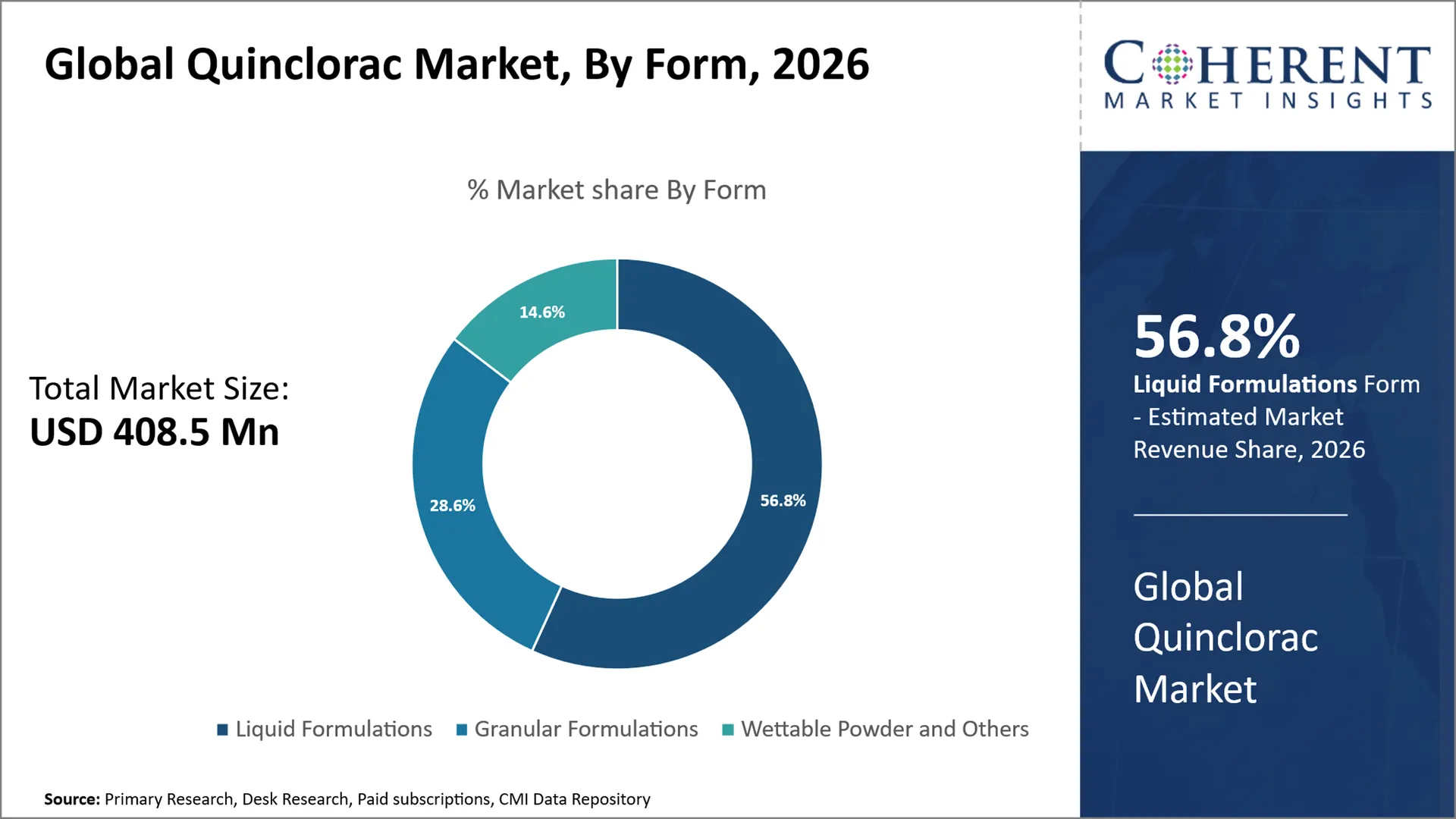
Why Do Liquid Formulations Dominate the Global Quinclorac Market?
Liquid Formulations are expected to hold 56.8% of the global quinclorac market in 2026, leading the form category because they simplify dosing, dilution, tank mixing, and uniform spray delivery across commercial applications. Suspension concentrates and liquid concentrates also fit existing farm and turf spraying equipment, reducing preparation complexity compared with dry products that require more careful dispersion. For manufacturers, liquid products create room for performance-oriented additives and formulation differentiation rather than competition on active ingredient alone. Turf managers and agricultural applicators particularly value consistency under changing field conditions. In June 2026, Albaugh updated its Quintessential product listing, identifying the product as a liquid quinclorac concentrate using H Value Technology to improve plant absorption, rainfastness, and performance under drought stress. This illustrates how formulation engineering is adding commercial value to liquid quinclorac products.
- Current Industry Events of 2026
- Market Size Estimation
- Regional Breakdown
- Competitive Landscape
- Customer Intelligence
- Segmental Analysis
- Pricing Analysis
- Key Market Drivers, Challenges & Future Trends
- Customized Insights Section
Why Does Rice Cultivation Represent the Largest Application in the Global Quinclorac Market?
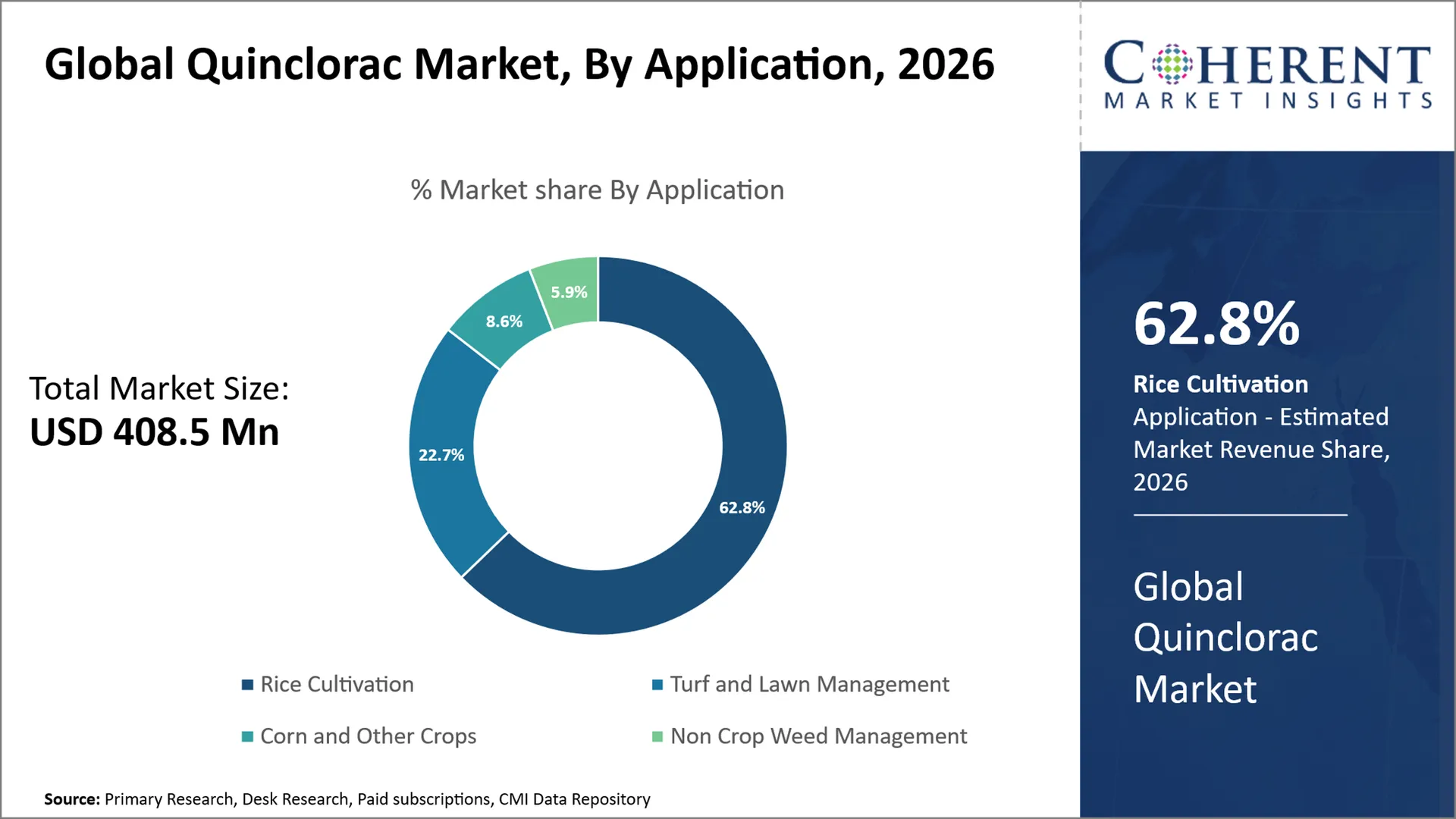
Rice Cultivation is expected to account for 62.8% of the global quinclorac market in 2026, reflecting the herbicide’s strong fit with weed-control programs where barnyard grass and other competitive grasses threaten crop establishment. Quinclorac can be positioned within crop-stage-specific spray programs, allowing growers and contractors to address grass pressure while maintaining selective use in rice. This application concentration gives agrochemical suppliers a clear route to market through rice-focused distributors, agronomists, and seasonal input programs, while also encouraging crop-specific label support and stewardship. In March 2024, India’s Directorate of Plant Protection, Quarantine and Storage listed quinclorac 250 g/L suspension concentrate for rice against Echinochloa species and Panicum repens, with a recommended formulation rate of 750–1,000 ml per hectare. The listing demonstrates quinclorac’s formal integration into practical rice weed-management programs.
Why Does Rice Dominate the Crop Type Segment of the Global Quinclorac Market?
Rice is expected to represent 64.6% of the global quinclorac market in 2026, leading the crop-type category because quinclorac combines activity against difficult grass weeds with crop selectivity that supports repeated use in rice-focused herbicide programs. This biological fit attracts formulation research, residue studies, resistance-management work, and product-development spending toward rice rather than crops where quinclorac has narrower commercial relevance. Suppliers therefore benefit from a deeper technical ecosystem and clearer buyer familiarity in rice production. In April 2026, according to the Chemistry Europe from China Pharmaceutical University published a quinclorac-based herbicidal ionic-liquid study for rice protection. The new formulations improved solubility, wetting, and herbicidal activity, while greenhouse tests achieved more than 80% barnyardgrass inhibition at 225 g active ingredient per hectare without phytotoxic effects on rice. The study shows why rice remains the principal innovation platform for quinclorac chemistry.
Current Events and their Impact
Current Event | Description and Its Impact |
EU Revises Quinclorac Maximum Residue Limits – May 2024 |
|
California Registers LESCO Quin-Way Ultra Herbicide – April 2025 |
|
Global Quinclorac Market Dynamics
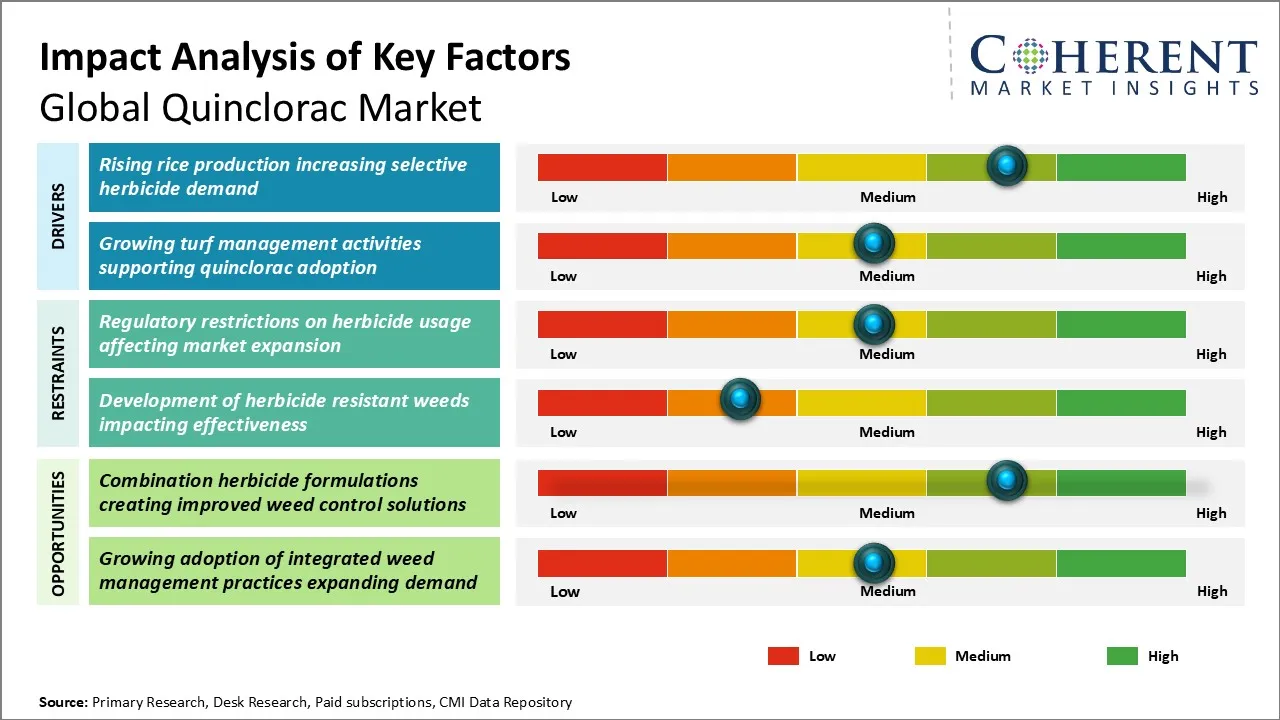
Key Market Drivers
- Rising rice production increasing selective herbicide demand: Rising cereal production increasing selective herbicide demand is widening the acreage on which growers must protect yield from competitive weeds while preserving crop safety. Higher rice output raises the value of timely grass control, supporting purchases of selective pre- and post-emergence tools by commercial farms, distributors, formulators, and crop-protection suppliers. In May 2025, USDA Foreign Agricultural Service projected global rice production at a record 538.7 million tons for 2025/26, with India and China together contributing more than half of output, reinforcing the commercial need for scalable weed-control programs.
- Growing turf management activities supporting quinclorac adoption: Growing need for effective grass weed management solutions is increasing quinclorac’s importance in programs targeting barnyardgrass and other difficult annual grasses. Growers increasingly require products combining field performance with rotational flexibility and resistance-management compatibility, creating opportunities for formulation specialists, rice-input suppliers, and agronomic distributors. In June 2024, ADAMA documented FullScript, an imazamox-plus-quinclorac liquid premix for FullPage rice, as targeting barnyardgrass and resistant weed pressure while providing early preflood application flexibility and an advanced liquid formulation for growers.
Emerging Market Trends
- Shift Toward Multi-Active and Compatibility-Engineered Formulations: Multi-active formulation engineering is shifting quinclorac from a stand-alone herbicide toward broader weed-control systems designed around complementary modes of action. Premixes can reduce mixing complexity, widen the target spectrum, and help distributors position one product against multiple grass and broadleaf problems. Over the forecast period, formulation stability, tank compatibility, crop tolerance, and application-window flexibility are likely to become stronger purchase criteria. Suppliers with formulation expertise should gain differentiation, while undifferentiated technical-grade sellers may face greater pricing pressure and weaker channel loyalty.
- Precision and Site-Specific Herbicide Application: Precision application is moving quinclorac use toward more targeted treatment of weed patches rather than uniform blanket spraying in every managed area. GPS-guided equipment, variable-rate sprayers, drone-assisted scouting, and digital field mapping can help applicators match treatment intensity to weed distribution while improving recordkeeping and reducing unnecessary exposure. This shift is especially relevant to professional turf, contract application, and large commercial farms. Suppliers will increasingly need labels, formulations, and technical support that fit calibrated low-volume and site-specific application workflows at scale.
Regional Insights
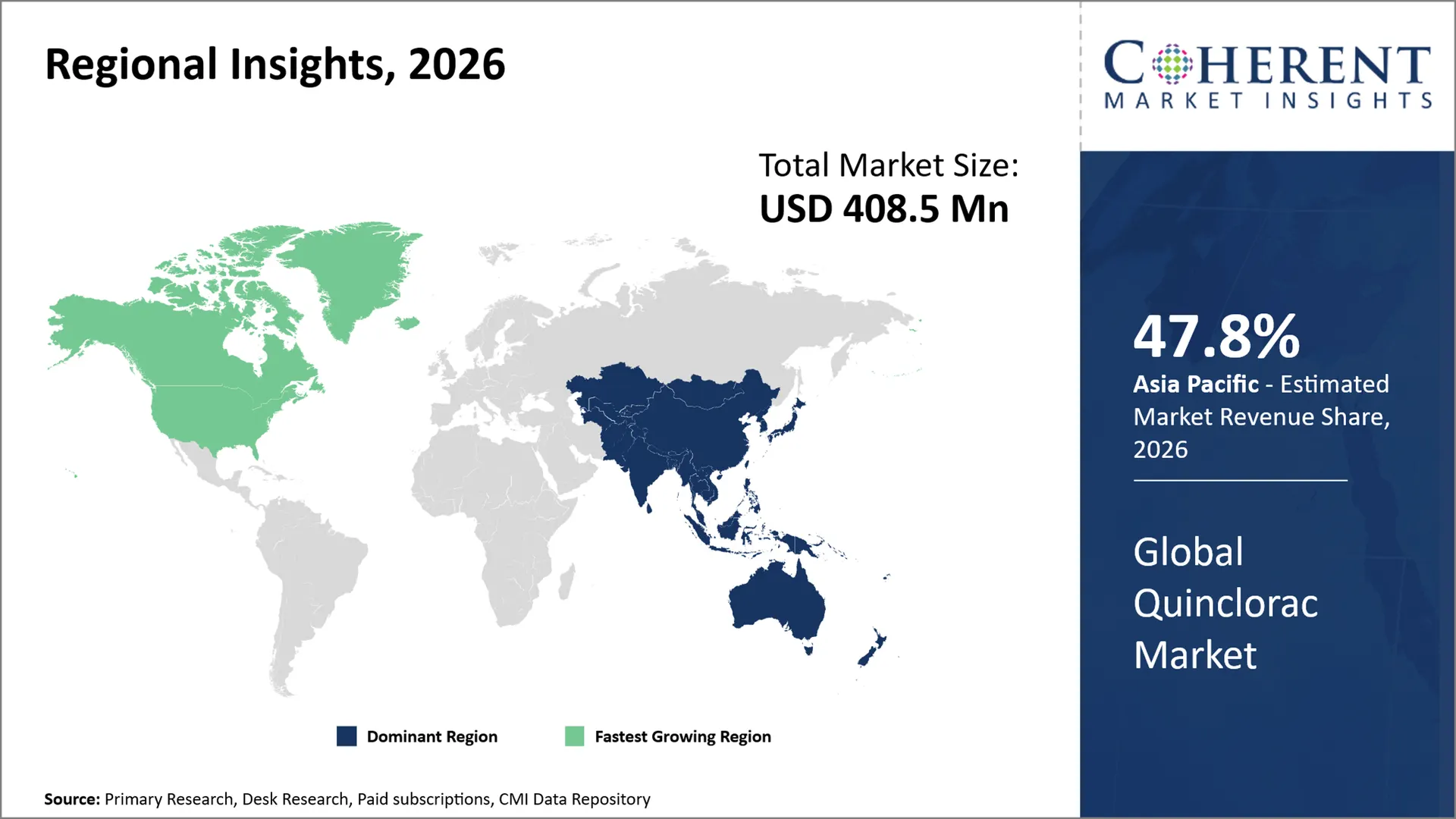
Why Does Asia Pacific Dominate the Global Quinclorac Market?
Asia Pacific is expected to account for 47.8% of the global quinclorac market in 2026, supported by the region’s concentration of rice cultivation, intensive grass-weed management requirements, and extensive use of selective herbicides in paddy systems. Quinclorac is particularly relevant where barnyardgrass and related Echinochloa species compete aggressively with rice during early crop establishment. The shift toward direct-seeded rice also increases the need for timely chemical weed control because crop and weeds emerge together, reducing the suppressive advantage created by transplanting. This favors liquid formulations, integrated herbicide programs, and distributor-led agronomic support. In February 2025, the International Rice Research Institute reported the Phase III launch of its Direct Seeded Rice Consortium to scale mechanized DSR across Asia and identified complex weed management and access to weed-control solutions as continuing adoption constraints.
Why Is North America Emerging as the Fastest-Growing Region in the Global Quinclorac Market?
North America is expected to hold 24.8% of the global quinclorac market in 2026 and emerge as the fastest-growing region because quinclorac demand extends beyond rice into professional turf and potentially broader specialty-crop weed management. The region benefits from commercially sophisticated applicators, high adoption of calibrated spraying, strong extension support, and active residue-data programs that can widen labeled use opportunities. Growth is therefore tied less to acreage expansion and more to higher-value applications, product combinations, and additional crop registrations. In September 2025, the IR-4 Project’s scheduled studies report showed quinclorac residue and crop-safety work across peach, plum, and cherry, with ongoing trials supporting possible specialty-crop uses. The program identified field bindweed, Canada thistle, barnyardgrass, and crabgrass among the target weeds, indicating potential diversification beyond established rice and turf applications.
Global Quinclorac Market Outlook for Key Countries
Why Is the U.S. a Key Market for the Global Quinclorac Market?
The U.S. is estimated to represent about 20.1% of the global quinclorac market in 2026, making it the principal North American demand center within the supplied country scope. Its importance comes from intensive weed-management programs in southern rice, established professional application practices, and the use of quinclorac within both stand-alone and multi-active herbicide strategies. Growers value flexible pre- and post-emergence options where barnyardgrass, red rice, broadleaf signalgrass, and sedges can materially reduce field performance. The country also has a strong extension network that translates label requirements into practical application programs, supporting repeat use and stewardship. LSU AgCenter’s 2026 Rice guide lists quinclorac-containing FullScript and Clearpath programs for herbicide-tolerant rice and provides crop-stage, rate, and weed-spectrum guidance. This reflects continued integration of quinclorac into structured U.S. rice-production systems rather than purely price-led herbicide purchasing.
Why Is India Important in the Global Quinclorac Market?
India is estimated to account for about 14.5% of the global quinclorac market in 2026, supported by its very large rice economy and the commercial need to protect yields across diverse irrigated and rain-fed production systems. Quinclorac demand is most relevant where annual grass weeds require selective post-emergence control and where farmers need products compatible with established rice-management practices. The country’s fragmented grower base also gives agricultural distributors, local dealers, and crop advisers a central role in product recommendation, pack-size selection, and application guidance. In May 2026, India’s Ministry of Agriculture and Farmers Welfare estimated 2025–26 rice production at a record 154.024 million tonnes. That production scale creates a broad recurring weed-control requirement and supports demand for cost-effective selective herbicides, while competition among generic and branded formulations is likely to keep pricing, availability, and field-level technical support central to supplier positioning.
Why Does China Support Growth in the Global Quinclorac Market?
China is estimated to hold about 19.3% of the global quinclorac market in 2026, reflecting the combination of a major rice-production base, domestic agrochemical manufacturing capability, and highly developed local procurement and distribution networks. The market is commercially important not only for technical quinclorac but also for suspension concentrates and multi-active formulations tailored to rice-field grass control. Local purchasing systems can accelerate competition on formulation, registration status, price, and delivery reliability, giving domestic manufacturers and distributors substantial influence over product selection. In May 2025, the Sheyang County Government in Jiangsu published a centralized zero-markup pesticide procurement tender for rice protection that included 250 g/L quinclorac suspension concentrate, 25% quinclorac suspension concentrate, and several quinclorac-containing combination herbicides. The procurement demonstrates active institutional purchasing across multiple quinclorac formats and highlights China’s depth of formulation choice in rice weed management.
Why Is Japan a Strategic Country in the Global Quinclorac Market?
Japan is estimated to account for about 2.1% of the global quinclorac market in 2026 within the supplied country scope. Its strategic importance is shaped less by bulk herbicide volume and more by strict residue compliance, food-safety controls, precision agriculture, and the premium value attached to rice quality. For suppliers, this makes analytical capability, traceability, label discipline, and alignment with Japanese maximum-residue requirements commercially important. Japan also provides a demanding reference market for exporters whose rice may carry residues from quinclorac use outside the country. In October 2025, Japan’s Ministry of Agriculture, Forestry and Fisheries published imported-rice safety inspection results showing that 118 Thailand-origin rice samples tested for quinclorac were within the applicable maximum residue limit, with one sample above the quantification threshold. This illustrates how residue compliance and laboratory verification shape quinclorac-linked trade access into Japan.
Why Is Brazil an Important Growth Market for the Global Quinclorac Market?
Brazil is estimated to represent about 5.4% of the global quinclorac market in 2026, supported by commercial irrigated rice production and recurring grass-weed control requirements in the country’s southern growing areas. Quinclorac has practical relevance where growers manage barnyardgrass and other competitive weeds under intensive production, while local distributors and agronomists influence product selection, mixtures, application timing, and resistance-management decisions. Brazil’s established agricultural-input distribution network also provides commercial farms with access to specialized crop-protection programs rather than relying solely on commodity herbicide purchasing. In January 2026, an official environmental license published by the Municipality of São Borja in Rio Grande do Sul for a 36.6-hectare irrigated rice operation explicitly listed quinclorac among the agrochemicals used. The record provides direct evidence of field-level quinclorac deployment in a core Brazilian rice-producing area.
Formulation and Application Technology Adoption Landscape in the Global Quinclorac Market
Technology / Approach | Current Role in Quinclorac Products | Commercial Value | Adoption Outlook |
High-load suspension concentrate formulation | Maintains quinclorac in a stable liquid dispersion suited to measured spray preparation | Improves handling convenience, dosing consistency, packaging efficiency, and distributor differentiation | High – likely to remain important where growers prefer liquid products over dry formulations |
Multi-active co-formulation systems | Combines quinclorac with herbicides having complementary weed spectra or modes of action | Expands target coverage and simplifies complex tank-mix programs for growers and contractors | High – resistance-management needs should support continued formulation development |
Water-dispersible and wettable granule engineering | Provides concentrated dry formulations that disperse in spray water before application | Supports storage stability, transportation efficiency, and markets where dry agrochemical formats remain established | Moderate – retained relevance despite increasing preference for convenient liquids |
Adjuvant-enhanced foliar delivery | Uses compatible surfactant or oil-based systems to improve spray coverage and herbicide uptake | Helps applicators achieve more consistent performance under variable weed and field conditions | High – technical guidance around adjuvant selection should become more commercially important |
GPS-guided spot and variable-rate spraying | Links weed mapping with localized herbicide application rather than uniform field treatment | Can improve application precision and strengthen treatment documentation while limiting unnecessary use | Emerging – adoption should increase first among large farms and professional applicators |
Drone-assisted scouting and calibrated aerial delivery | Supports rapid weed detection and targeted application where product labels and local regulations permit | Improves access to difficult areas and enables faster intervention during narrow treatment windows | Emerging – regulatory permissions, spray calibration, drift management, and label compatibility will determine adoption |
How Are Resistance-Diagnostic Services and Stewardship-Led Weed Management Creating New Growth Opportunities in the Global Quinclorac Market?
Resistance-diagnostic services and stewardship-led product programs are creating an underdeveloped opportunity for quinclorac suppliers to compete beyond herbicide volume. As grass-weed sensitivity becomes less predictable across fields, growers and agricultural contractors need better guidance on whether quinclorac should be applied alone, rotated, or combined with other modes of action. Suppliers can capture this opportunity by linking products with field scouting protocols, resistance screening, application-timing advice, digital treatment records, and distributor training. The model is relevant to rice producers, professional applicators, and turf managers that face repeated weed-control failures or costly retreatment. Commercial success will require agronomic expertise, regional trial capability, regulatory discipline, and partnerships with laboratories, universities, or service providers. Established crop-protection companies can integrate stewardship into existing channels, while specialist formulators may differentiate through faster local support. New entrants without technical service capacity are less advantaged because credibility, field evidence, and recommendation quality become part of the purchasing decision.
Market Players, Key Development, and Competitive Landscape
Key Developments
- In September 2026, SIRO Group introduced its clomazone, propanil, and quinclorac oil-dispersion herbicide concept for rice, combining complementary weed-control mechanisms in one formulation. The development broadens quinclorac's role within multi-active products aimed at grass, broadleaf, and sedge management rather than stand-alone treatment.
- In September 2024, Nufarm announced U.S. EPA registration of Allstar Herbicide for cool-season turfgrass, combining quinclorac with 2,4-D, sulfentrazone, and triclopyr. The registration expands quinclorac's commercial relevance in professional turf by embedding it within a multi-active solution for grassy, broadleaf, and sedge weeds.
- In May 2023, BASF launched Facet herbicide in India for rice growers, using quinclorac in a specialized formulation targeting Echinochloa species. The launch strengthened quinclorac's presence in a major rice-producing market while giving growers a flexible tank-mix option for direct-seeded and transplanted rice weed-management programs.
Competitive Landscape
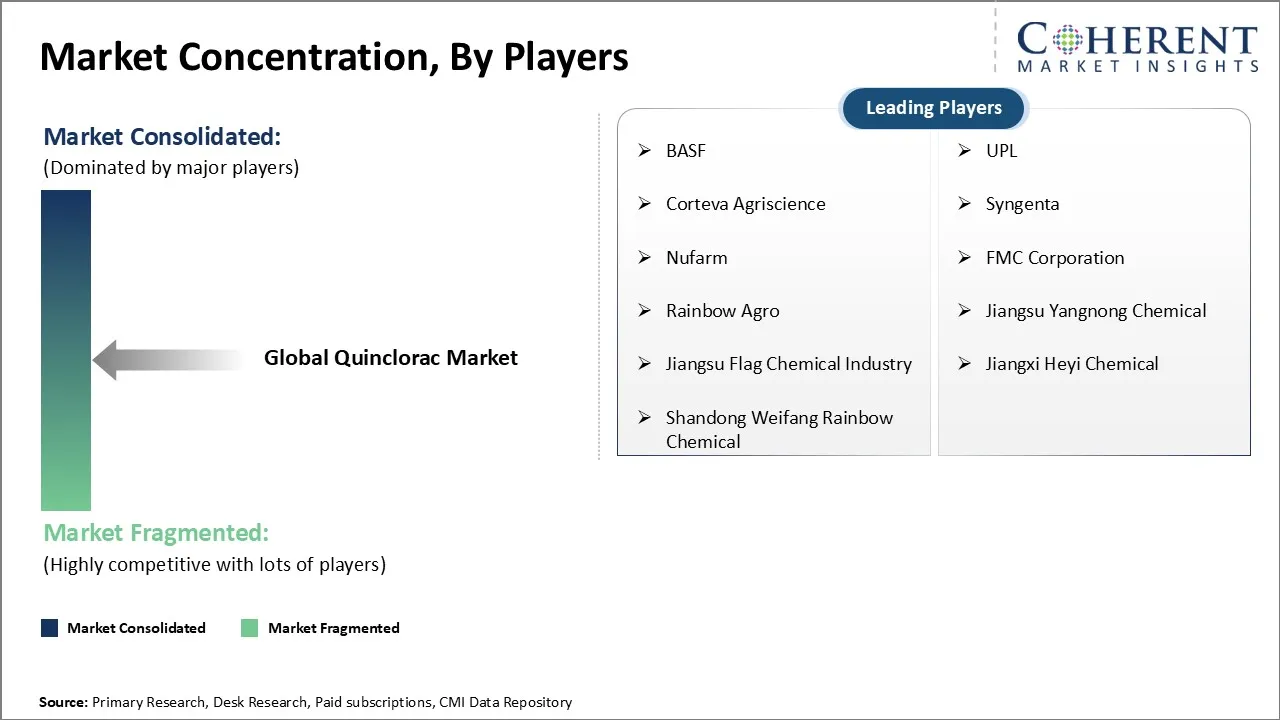
The global quinclorac market is moderately fragmented, combining multinational crop-protection suppliers, regional formulators, technical-active manufacturers, and turf-focused specialists. Competition centers on formulation consistency, registered use patterns, price, supply continuity, label breadth, and agronomic support rather than molecule ownership alone. Regional companies remain relevant where local registrations, distributor relationships, and responsive technical service influence purchasing and repeat use.
Key focus areas include
- Formulation performance: Liquid stability, dispersibility, tank compatibility, and application convenience provide differentiation beyond active-ingredient concentration.
- Regulatory coverage: Wider crop, turf, and use-site registrations increase the addressable customer base but require continuous compliance investment.
- Resistance-management positioning: Suppliers able to integrate quinclorac into rotation and multi-mode programs can defend value more effectively than commodity sellers.
- Pricing and technical-grade economics: Generic availability creates price pressure, particularly where distributors can switch among technically comparable products.
- Supply reliability: Consistent access to technical quinclorac and formulation inputs is important during narrow seasonal procurement and application periods.
- Distribution reach: Local agricultural dealerships, turf distributors, contractors, and agronomic advisers remain important for product selection and repeat purchasing.
- Technical support: Field troubleshooting, application guidance, crop-safety knowledge, and stewardship advice can strengthen customer retention and reduce purely price-led competition.
Market Report Scope
Quinclorac Market Report Coverage | |||
Report Coverage | Details | ||
Base Year | 2025 | Market Size in 2026: | USD 408.5 Mn |
Historical Data For: | 2020 To 2024 | Forecast Period: | 2026 To 2033 |
Forecast Period 2026 To 2033 CAGR: | 6.3% | 2033 Value Projection: | USD 626.5 Mn |
Geographies covered: |
| ||
Segments covered: |
| ||
Companies covered: | BASF, UPL, Corteva Agriscience, Syngenta, Nufarm, FMC Corporation, Rainbow Agro, Jiangsu Yangnong Chemical, Jiangsu Flag Chemical Industry, Jiangxi Heyi Chemical, Shandong Weifang Rainbow Chemical | ||
Growth Drivers: |
| ||
Restraints & Challenges: |
| ||
Analyst Opinion (Expert Opinion)
- Quinclorac competition is likely to move progressively away from selling an interchangeable active ingredient toward delivering complete weed-management programs. Market leadership should increasingly depend on formulation reliability, crop-stage guidance, resistance stewardship, field troubleshooting, and distributor education. Suppliers that can convert agronomic knowledge into repeatable customer outcomes will be better positioned to protect margins than companies competing primarily through technical-grade pricing.
- The arrival of herbicides with alternative modes of action for difficult rice grasses could materially reposition quinclorac from a default treatment toward a more deliberate rotational and combination chemistry. This would pressure suppliers whose portfolios depend heavily on stand-alone quinclorac products. Formulation compatibility, complementary mode-of-action positioning, local weed-sensitivity knowledge, and the ability to integrate quinclorac into broader programs could therefore become essential competitive capabilities.
- Market participants should prioritize differentiated formulations, strong regulatory dossiers, local field-support capability, and diversified technical sourcing. Additional attention should go to professional application channels and use cases where formulation convenience and technical service support premium positioning. Companies should avoid excessive investment in undifferentiated technical capacity without secured channels, as price competition, resistance concerns, regulatory changes, and alternative herbicide chemistries could weaken returns on commodity-oriented expansion.
Speak to the analyst
Want personalized insights?
Take the findings above to one of our principal consultants, or have the report rebuilt around the segments, geographies and competitors you actually track.
Market Segmentation
- Form Insights (Revenue, USD Mn, 2021 - 2033)
- Liquid Formulations
- Granular Formulations
- Wettable Powder and Others
- Application Insights (Revenue, USD Mn, 2021 - 2033)
- Rice Cultivation
- Turf and Lawn Management
- Corn and Other Crops
- Non Crop Weed Management
- Crop Type Insights (Revenue, USD Mn, 2021 - 2033)
- Rice
- Turfgrass
- Corn
- Other Crops
- End User Insights (Revenue, USD Mn, 2021 - 2033)
- Commercial Farmers
- Turf Management Companies
- Agricultural Contractors
- Others
- Distribution Channel Insights (Revenue, USD Mn, 2021 - 2033)
- Direct Sales
- Agricultural Distributors
- Online Retail
- Regional Insights (Revenue, USD Mn, 2021 - 2033)
- North America
- U.S.
- Canada
- Latin America
- Brazil
- Argentina
- Mexico
- Rest of Latin America
- Europe
- Germany
- U.K.
- Spain
- France
- Italy
- Russia
- Rest of Europe
- Asia Pacific
- China
- India
- Japan
- Australia
- South Korea
- ASEAN
- Rest of Asia Pacific
- Middle East
- GCC Countries
- Israel
- Rest of Middle East
- Africa
- South Africa
- North Africa
- Central Africa
- North America
- Key Players Insights
- BASF
- UPL
- Corteva Agriscience
- Syngenta
- Nufarm
- FMC Corporation
- Rainbow Agro
- Jiangsu Yangnong Chemical
- Jiangsu Flag Chemical Industry
- Jiangxi Heyi Chemical
- Shandong Weifang Rainbow Chemical
Sources
Primary Research Interviews
- Herbicide manufacturers, agrochemical formulators, distributors, agricultural retailers, rice growers, turf management companies, and crop protection specialists
- Agronomists, weed scientists, procurement managers, regulatory professionals, and agricultural consultants
Stakeholders
- Quinclorac manufacturers, formulators, crop protection companies, distributors, and agricultural input suppliers
- Commercial farmers, rice producers, turf managers, agricultural contractors, and professional applicators
- Technical-grade suppliers, packaging companies, logistics providers, and channel partners
End-use Sectors
- Rice cultivation and crop protection
- Turf and lawn management
- Corn and other crop applications
- Non-crop weed management
Regulatory and Industry Bodies
- U.S. Environmental Protection Agency EPA
- European Commission and EU pesticide regulatory authorities
- Government agricultural and pesticide regulatory agencies
- National plant protection and crop safety authorities
Databases
- Company annual reports, investor presentations, and regulatory filings
- Pesticide registration and product-label databases
- Agricultural production and crop statistics databases
- Import-export and agrochemical trade databases
- Product portfolio, pricing, and competitive intelligence databases
Magazines and Journals
- Weed science and agronomy journals
- Crop protection and pesticide science publications
- Agricultural chemistry and formulation journals
- Rice production and turf management publications
Associations
- Weed Science Society of America WSSA
- International Rice Research Institute IRRI
- National crop protection associations
- Agricultural and turf management associations
Public Domain Sources
- Rice production and cultivated-area trends
- Herbicide resistance and weed-management developments
- Quinclorac registration and label updates
- Crop protection practices and application technologies
- Turf and agricultural herbicide usage developments
Key Standards and Regulations
- Herbicide registration and pesticide approval requirements
- Maximum Residue Limit MRL regulations
- Product labeling and application-rate requirements
- Environmental safety and residue compliance standards
- Agrochemical import-export and trade regulations
Proprietary Elements
- CMI Data Analytics Tool and proprietary CMI repository containing 10+ years of agrochemicals, crop protection, herbicides, agriculture, and related market intelligence.
Get access to 250+ pages report
Every segment, forecast, competitor profile and data table behind the analysis above — available for instant download.
- ESOMAR Member
- ISO 9001:2015 Certified
- D-U-N-S Registered
- GDPR & CCPA Compliant
Missing comfort of reading report in your local language? Find your preferred language:
Frequently Asked Questions
The CAGR of global quinclorac market is projected to be 6.3% from 2026 to 2033.
The global quinclorac market is estimated to be valued at USD 408.5 million in 2026 and is expected to reach USD 626.5 million by 2033.
The report covers key agricultural and non-agricultural applications of quinclorac, including crop protection, rice weed management, turf management, and other approved weed-control uses.
The report includes market dynamics, competitive landscape, regional analysis, company profiles, regulatory developments, product trends, distribution analysis, and strategic growth opportunities.
The report analyzes major quinclorac markets across Asia Pacific, North America, Europe, Latin America, the Middle East, and Africa, with country-level coverage of key markets such as China, India, the U.S., Japan, and Brazil.
The report is useful for agrochemical manufacturers, herbicide formulators, distributors, agricultural input suppliers, investors, consultants, procurement teams, and companies evaluating expansion or competitive opportunities in the quinclorac industry.
The global quinclorac market is mainly driven by increasing rice production, which supports demand for selective herbicides, and expanding turf management activities, which are creating additional opportunities for quinclorac-based weed control solutions.