

Global Rainwater Filters Market Size and Forecast – 2026 To 2033
The global rainwater filters market is expected to grow from USD 430.5 Mn in 2026 to USD 510.0 Mn by 2033, registering a compound annual growth rate (CAGR) of 6.3% from 2026 to 2033. The global rainwater filters market is driven by rising municipal water costs. From January 1, 2026, The City of San Diego in California, U.S., increased water rates by 14.7%. The City Council approved the adjustment in October 2025.
Key Takeaways of the Global Rainwater Filters Market
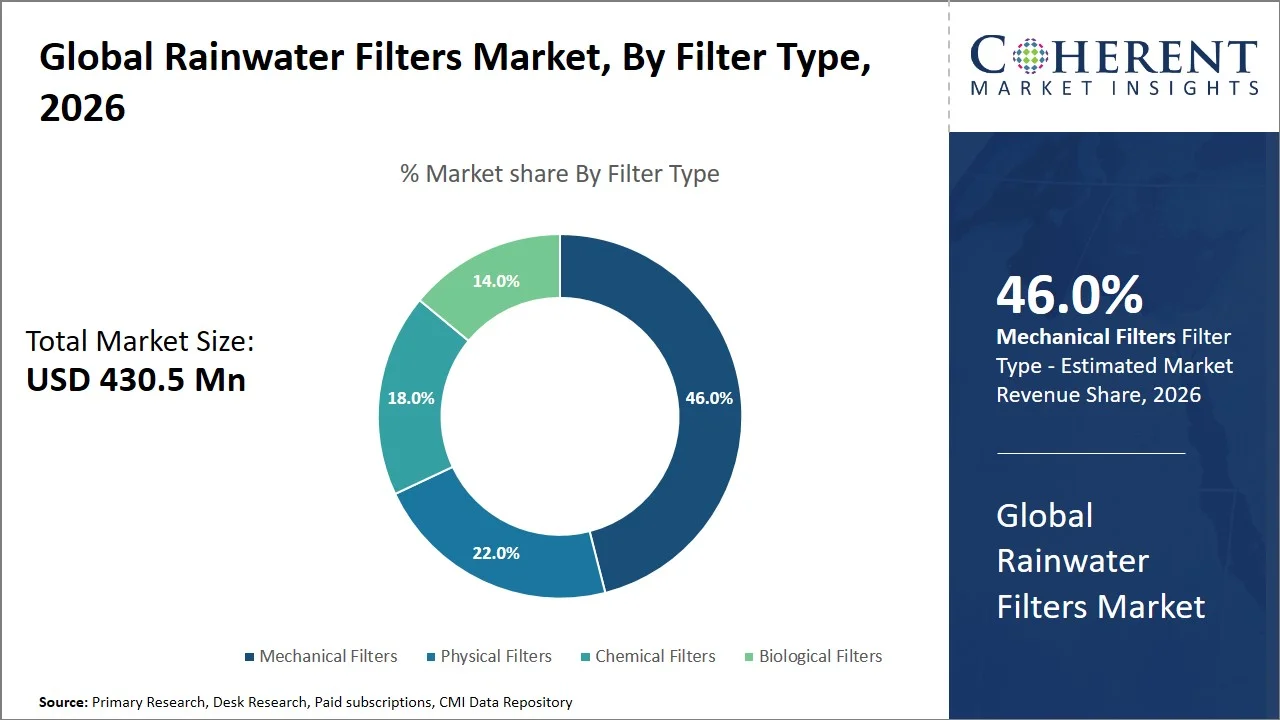
- The Mechanical Filters segment is expected to account for 46.0 % of the global rainwater filters market share in 2026. Increasing urban water demand is driving the growth of the segment. On March 9, 2026, Singapore’s National Water Agency reported water demand of about 440 million gallons daily. Demand could almost double by 2065, with non-domestic users becoming the dominant demand source.
- The Standalone Filters segment is estimated to capture 53.0 % of the market share in 2026. Government support for decentralized water management is majorly driving the growth of the segment. On June 1, 2025, The Ministry of Jal Shakti, India, launched JSJB 2.0. The initiative supported community-led recharge pits, shafts, borewells, and other low-cost rainwater structures.
- The Mesh Filters segment is estimated to capture 38.0 % of the market share in 2026. Expansion of sustainable irrigation is driving the growth of the segment. On March 15, 2025, The Food and Agriculture Organization launched a smart irrigation project in India. The project focuses on improving water-use efficiency through smart irrigation technologies.
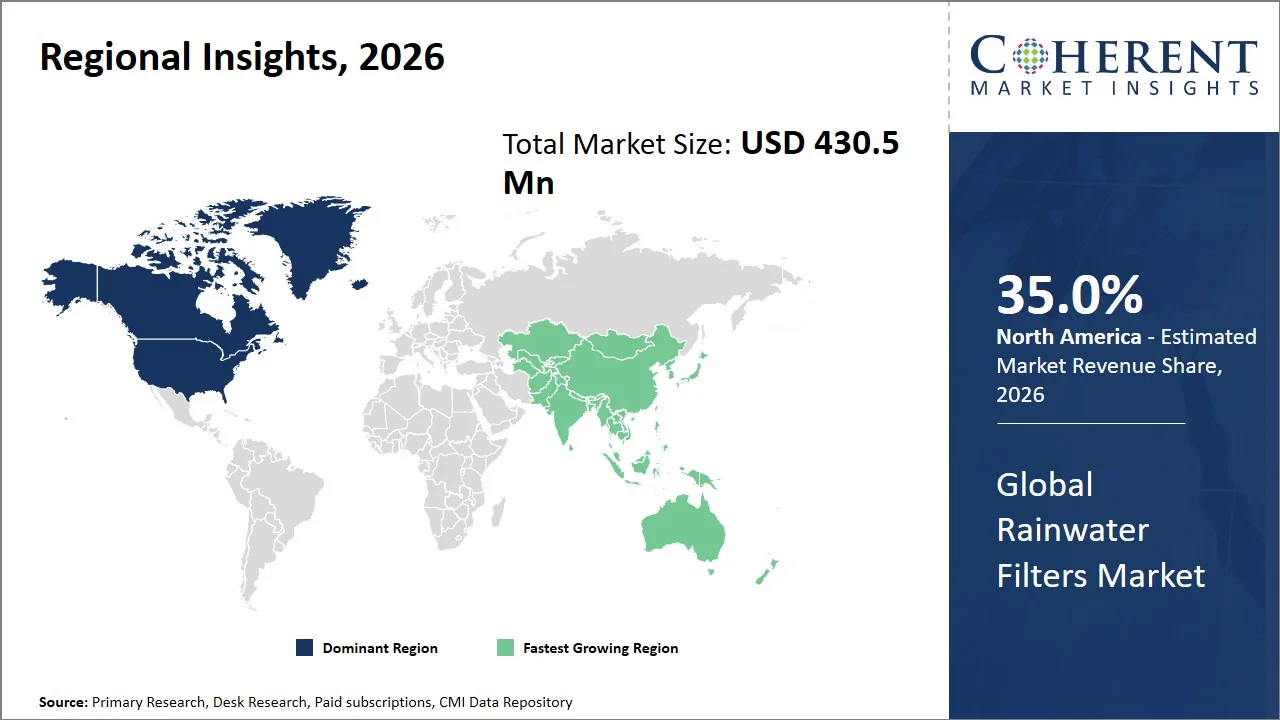
- North America is expected to dominate the rainwater filters market in 2026 with a market share of 35.0 %. Development of self-cleaning filter technologies in North America is driving the growth of the regional market. On February 26, 2026, Tekleen announced full-flow filtration developments targeting water-intensive facilities. Its automatic filters use self-cleaning mechanisms for continuous operation.
- Asia Pacific is expected to account for 29.0 % share in 2026. Greater consumer awareness of water conservation in Asia Pacific is driving the growth of the regional market. On January 27, 2026, Shanghai introduced updated water conservation regulations. The rules require focused awareness campaigns around World Water Day and Water Conservation Awareness Week.
Segmental Insights
Why Does Mechanical Filters Dominate the Global Rainwater Filters Market?
The mechanical filters segment is expected to account for 46.0% of the global rainwater filters market share in 2026. Mechanical filter is the most popular choice for removing leaves, sediment, insects and other physical waste from rainwater harvesting. Its simple screening system enables efficient pre-treatment without the need for sophisticated processing equipment. Mechanical filters are also reasonably easy to clean and maintain, and hence can be used often in home and commercial systems. They are also more applicable in practice due to flexibility with different tank types and harvesting systems. Such properties make mechanical filtration a cost effective and reliable first stage solution for rainwater treatment. For example, in 2025, Rainy Filters heavily promoted its FL series. The FL 250 uses mechanical screening for rooftop runoff and emphasizes self-cleaning operation. The company specifically positions the product for residential and commercial rainwater harvesting.
- Current Industry Events of 2026
- Market Size Estimation
- Regional Breakdown
- Competitive Landscape
- Customer Intelligence
- Segmental Analysis
- Pricing Analysis
- Key Market Drivers, Challenges & Future Trends
- Customized Insights Section
Why is Standalone Filters the Most Crucial Product Type?
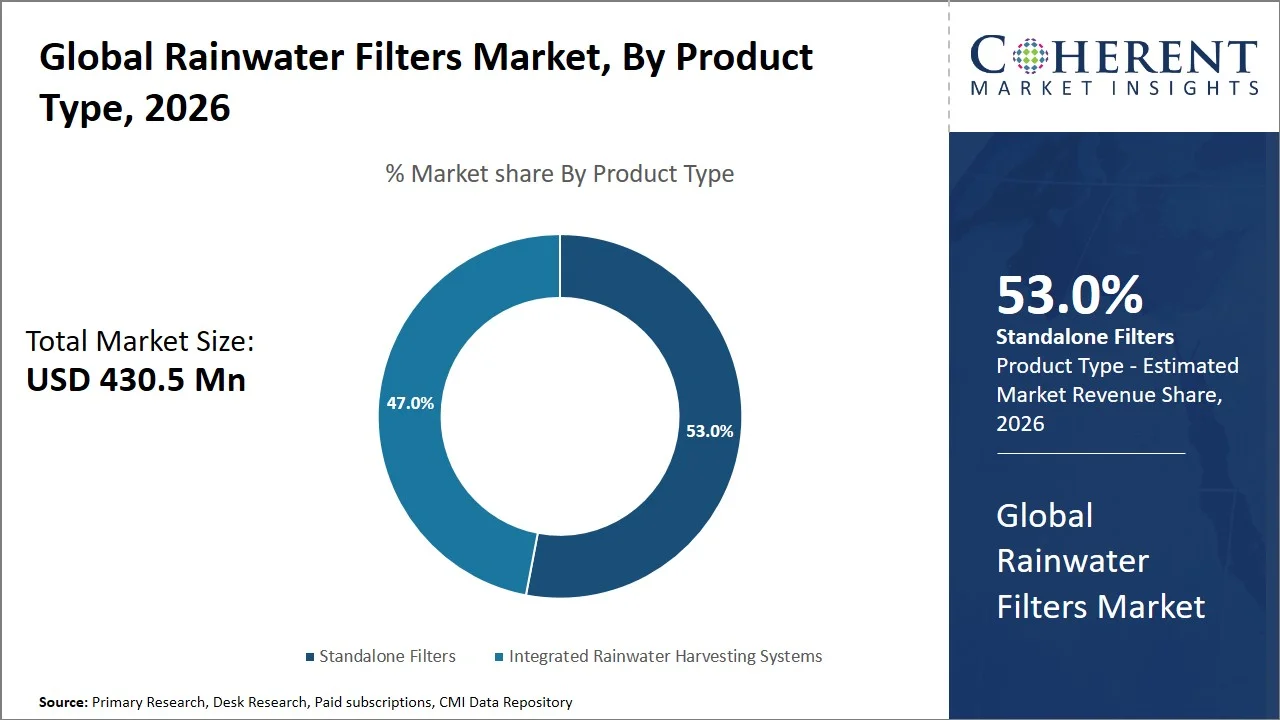
The standalone filters segment is expected to account for 53.0% of the global rainwater filters market share in 2026. Standalone filters can be installed directly within existing rooftop rainwater collection arrangements. This allows users to increase filtration without having to replace the entire harvesting infrastructure. They are also suitable for buildings with limited installation space due to their small design. Good access for inspection and cleaning to provide consistent filtration performance during wet times. These features make stand-alone filters especially useful for household retrofits and smaller localized rainwater systems. In 2025, GRAF has introduced a DN150 connector for its internal XL-filters. The filter is integrated directly into the domes of underground tanks, without the need for additional filter shafts. It supports roof areas up to 750 square meters and reduces installation space requirements.
Mesh Filters Dominates the Global Rainwater Filters Market
The mesh filters segment is expected to account for 38.0% of the global rainwater filters market share in 2026. Mesh filtration provides an effective first barrier against leaves, insects, sediment, and other rooftop debris. Fine mesh screens are suitable filtration components of rainwater collecting systems as per government guidance. The basic design allows fast debris removal while maintaining a high flow of water during rainy events. Mesh screens are designed for ease of cleaning, which simplifies maintenance for the user. The combination of excellent screening, ease of maintenance and compatibility with harvesting systems, has led to strong acceptance. In April 2026, the Bengaluru Water Supply and Sewerage Board launched a new rainwater harvesting system that features an SS316 mesh with an anti-choke weave. The system uses internal flow acceleration and automatic waste-expulsion windows. The board had already implemented the system at 75 locations and planned wider deployment. The development directly demonstrates increased use of advanced mesh filtration for decentralized rainwater harvesting.
Current Events and their Impact
Current Events | Description and its Impact |
United Kingdom - National Standards for Sustainable Drainage Systems, 2025 |
|
Singapore - Guidance Notes for Rainwater Harvesting Systems, Revision 3, 2025 |
|
Rainwater Filters Market Dynamics
Market Drivers
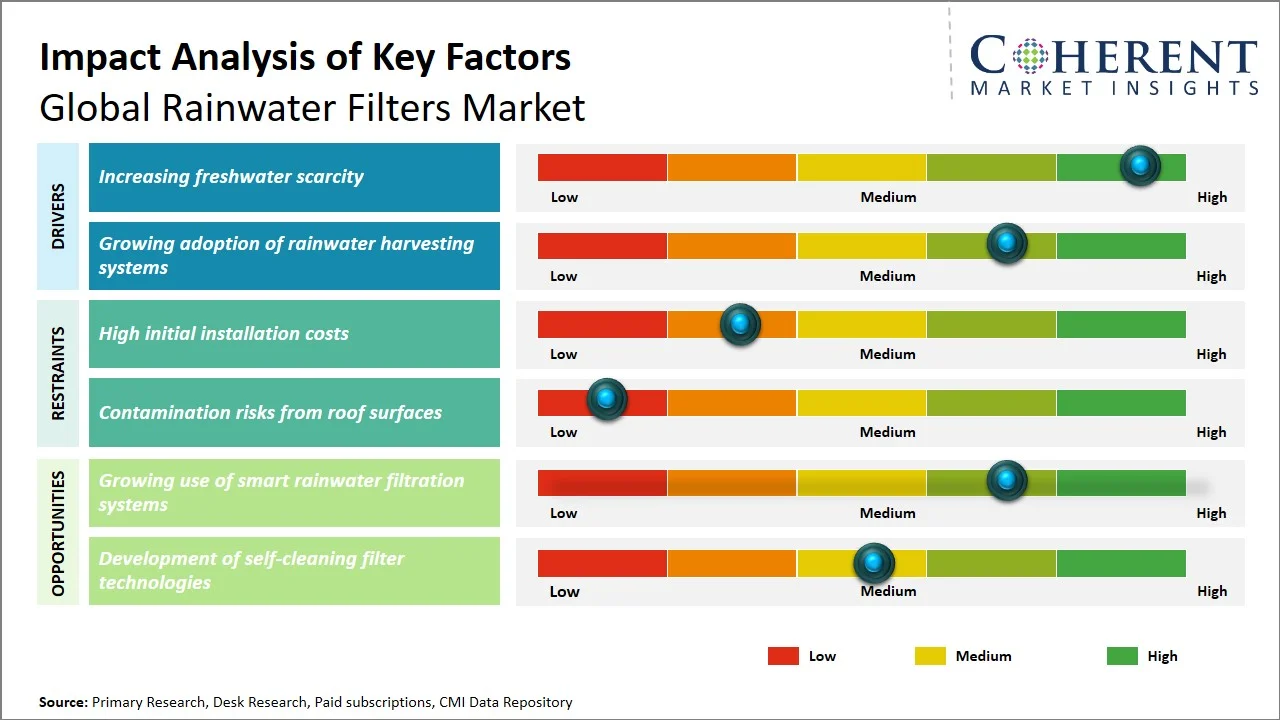
- Increasing freshwater scarcity: Governments, industries and families are seeking alternative sources of water to combat growing scarcity of freshwater. Rainwater collecting provides an alternate supply of water for agriculture, cleaning, toilet flushing and other non-potable uses. More water stress also leads to the development of filtration technologies that enhance the quality of harvested rainwater. This results in a continuous need for efficient filters that remove sediment, debris and other impurities. Water scarcity hence encourages more uptake of rainwater filtering systems in water-stressed places. On August 28, 2026, NextDC reported higher water consumption across its Australian data-centre operations. Increased cooling requirements and increased computation demand were paired with the commissioning of new capacity. This phenomenon underscores the increasing struggle for freshwater between digital infrastructure and other urban users.
- Growing adoption of rainwater harvesting systems: Increasing adoption of rainwater harvesting systems is directly driving the demand for effective filtering equipment. Harvested water often requires filtering prior to storage or use to eliminate roof debris, sediment and other pollutants. Rainwater harvesting equipment is progressively being integrated into residential homes, business properties, farms and industrial sites. Every new installation increases the demands on pre-filters, mesh filters, first-flush devices and other filtration components. This growth complements the demand for rainwater filters in decentralized water management applications. On March 27, 2025, Hitachi Energy completed rainwater harvesting project at Halol Transformer Factory. The system collects runoff and sends it underground to replenish ground water. The project made the Halol factory Hitachi Energy’s first water-positive factory.
Emerging Trends
- Smart Filtration Systems: As rainwater harvesting becomes increasingly automated, smart filtration systems are attracting interest. Sensors monitor water purity, filter status, flow and storage conditions. This allows for timely repair and enhances the overall reliability of the system.
- Self-Cleaning Filtration Technologies: Residential and commercial installations are seeing the emergence of self-cleaning filtration technologies. Manual maintenance and filter clogging are minimized by automatic cleaning devices. They also help provide constant water flow in high debris and frequent rains.
- Compact Modular Filtration Systems: Compact modular filtration systems are increasingly being seen in space-constrained structures and retrofit projects. Modular designs facilitate installation, replacement and growth. They also allow for integration with existing rain water collection and storage equipment.
- Digital Water Management Integration: Advanced filtration is increasingly being integrated with digital water management Connected systems track collected water volumes, filter efficiency, maintenance needs and usage patterns. This allows for more decentralized water management in business and residential property.
Regional Insights
Why is North America a Strong Market for Rainwater Filters?
North America is expected to account for a market share of 35.0% in 2026. North America rainwater filters market is driven by decentralized water conservation regulations and stormwater management programs. California’s Water Code provides a framework for encouraging rainwater capture, and Texas has particular advice for rainwater collecting systems. Colorado also authorizes residential users to collect limited amounts of rainwater, under certain restrictions. The U.S. Environmental Protection Agency has information on rainwater collection restrictions and water reuse by state. Such regulatory variances create a demand for filtration systems designed for irrigation, landscape management and non-potable uses. Commercial buildings increasingly combine rainwater collection with stormwater controls. This supports demand for roof filters, first-flush devices, sediment filters, and compact treatment units across North America.
Why Does Asia Pacific Rainwater Filters Market Exhibit High Growth?
Asia Pacific is expected to register the fastest growth with a CAGR of 6.9% over the forecast period. It is projected to account for 29.0% of the global rainwater filters market in 2026. Asia Pacific is benefitted from government-driven water conservation schemes, urban water scarcity and wide-scale rainwater gathering systems. In Singapore, construction of rainwater harvesting system is subject to approval from Public Utilities Board. Singapore also controls non-potable applications, such as toilet flushing and landscaping watering In Japan, Tokyo wards provide subsidies as part of municipal programs to encourage households to save rainwater. India has intensified rainwater gathering through the Catch The Rain initiative and groundwater recharge programs. The Building Sustainability Index has a list of home sustainability requirements, and rainwater systems are one of them in Australia. These country-specific policies create distinct demand for residential filters, commercial filtration systems, recharge filters, and advanced treatment equipment.
Global Rainwater Filters Market Outlook for Key Countries
Why is U.S. Emerging as a Major Hub in the Rainwater Filters Market?
Factors such as state-specific water conservation requirements and regional drought circumstances influence the U.S. rainwater filters market. Texas has already finalized design and application guidance for rainwater harvesting systems. Colorado allows for residential collection under strict statutory requirements, especially for small rooftop installations. California encourages the capture of rain water as part of a bigger water conservation effort. State-specific regulation information on rainwater gathering and water reuse from the U.S. Environmental Protection Agency. Western states have particularly significant applications for irrigation and landscape water delivery. This geographical need drives demand for first-flush diverters, mesh filters, sediment filters and storage tank filtration.
Is Japan the Next Growth Engine for the Rainwater Filters Market?
The Japanese market for rainwater filters is intimately tied to urban flood management and disaster preparedness. Tokyo municipalities promote storage tanks and infiltration facilities for rainwater at residential homes. Financial support is available for rainwater storage facilities for qualified households in Kita Ward. Tokyo’s sewerage agency also supports rainwater infiltration programs in participating wards. The devices aim to limit stormwater runoff and keep water nearby for gardening and emergency use. With dense residential growth, the demand for compact filtration equipment with minimal maintenance requirements is growing. There are therefore potential for manufacturers to produce compact footprint filters for rooftop collection, storage tanks, infiltration systems and domestic rainwater reuse.
Australia Rainwater Filters Market Analysis and Trends
The necessity of water conservation and the growing use of rainwater collecting in households are driving the demand for rainwater filters in Australia. New South Wales’ Building Sustainability Index for new residential buildings includes rainwater collecting. The framework encourages alternative water sources and reductions in potable water consumption. Government assessments have found rainwater tanks installed across a large proportion of new single dwellings. Hunter Water inspections also identified maintenance and equipment faults within examined rainwater systems. The results demonstrate the need of reliable filtering and maintainability. Hence there is a demand for robust filters, convenient cleaning systems, replacement cartridges and monitoring equipment for residential rainwater installations.
Germany Rainwater Filters Market Analysis and Trends
Mature decentralized water management and advanced building infrastructure support Germany’s rainwater filters business. Some German manufacturers like WISY and GRAF have unique filtration technology for rainwater harvesting systems. Rainwater is often collected for flushing toilets, irrigating gardens and other non-potable uses. Building-level rainwater management can also be used for stormwater retention and controlled discharge. Filtration solutions are needed for underground storage systems to protect tanks from leaves, sediment and organic matter. The high standards of engineering in Germany result in lasting components that deliver consistent hydraulic performance. This allows for vortex filters, subsurface filters, self-cleaning systems, and integrated filter systems for residential and commercial structures.
India Rainwater Filters Market Analysis and Trends
The Indian rainwater filters industry is backed by national policies for promoting water conservation and ground water recharging. In 2025, the Ministry of Jal Shakti ran the Catch the Rain program in all districts. The program was on rainwater gathering, ground water recharging and community participation. Maharashtra recorded thousands of completed water conservation and rainwater harvesting works under government programs. Nagpur also reported hundreds of completed conservations works during the campaign period. Decentralized rainwater collection structures are being taken forward under the Jal Sanchay Jan Bhagidari project. These programs generate demand for rooftop filters, recharge filters, first-flush systems, sediment screens and filtration equipment ideal for community installations.
Global Rainwater Filters Market - Filter Installations: New Construction and Retrofit Projects by Region (2025)
Region | New Construction Installations | Retrofit Installations |
Asia Pacific | 62% | 38% |
Europe | 54% | 46% |
North America | 47% | 53% |
Latin America | 65% | 35% |
Middle East and Africa | 69% | 31% |
How is Growing Use of Smart Rainwater Filtration Systems Creating New Growth Opportunities in the Rainwater Filters Market?
Increased interest in smart rainwater filtering presents prospects for sensor-linked filters, automatic diversion devices and connected maintenance systems. Research at Telkom University showed remote monitoring by using pH, turbidity, Total Dissolved Solid and ultrasonic level sensors. Another Sri Lankan study in 2026 indicated that automated valves might be used to deflect contaminated runoff prior to storage. Such systems create a demand for filters combining filtering with real-time water quality monitoring and automatic flow regulation. So, manufacturers may build quality filtering packages for homes, universities, farms and commercial structures. Smart notifications also show clogged filters, high turbidity and needed maintenance, generating recurring revenue from replacement cartridges and service contracts. For example, Supreme Industries’ Aquasource Smart Rainwater Filtration System was in B2B Purchase Magazine’s June 2026 issue. The system has been designed in cooperation with HSGF design professionals and has been installed in several projects. It is specifically positioned as a technologically advanced surface-water filtration solution.
Market Players, Key Development, and Competitive Landscape
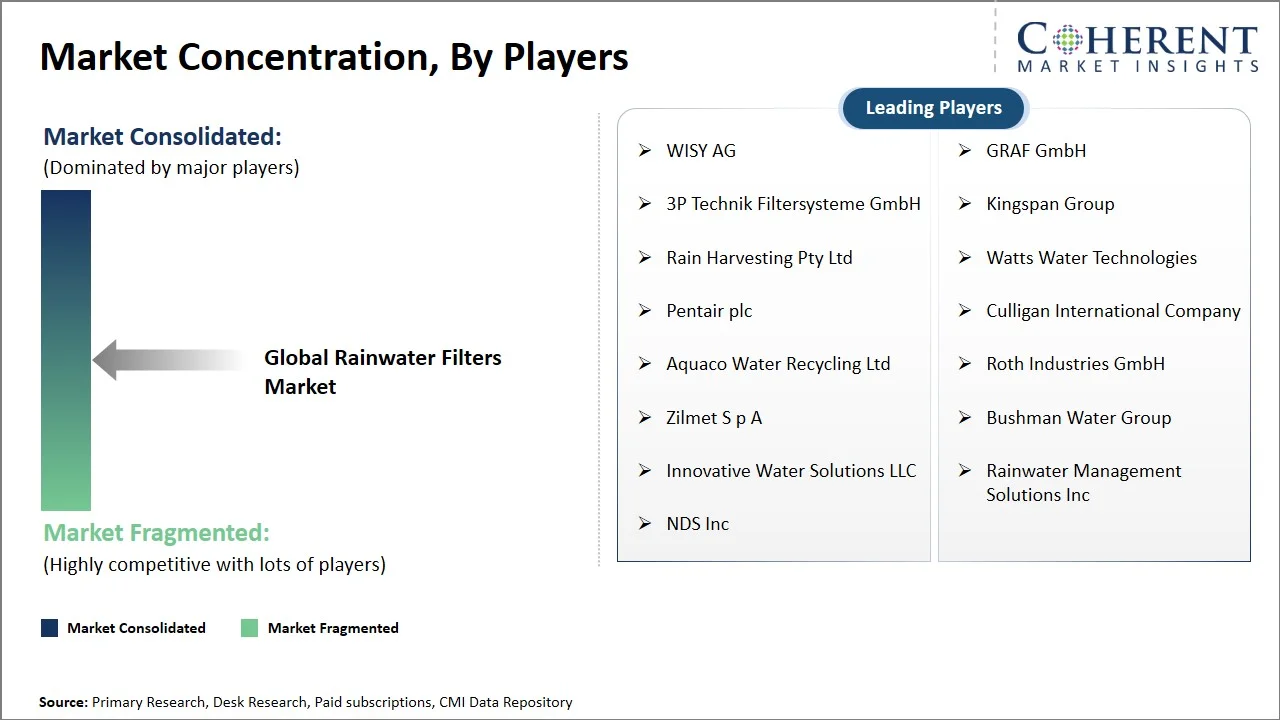
Key Developments
- On March 31, 2026, NeeRain announced registration of more than 30,000 installations. NeeRain saved 300+ crore litres of water at 500+ habitats across India, Asia, Africa and America. Neerain is not only raising water in borewells but also improving the quality ground water.
- On October 11, 2024, Supreme Industries introduced the Raingain rainwater harvesting filter. The product uses a stainless-steel fine-mesh strainer and centrifugal filtration. It includes a self-cleaning mechanism and supports roof areas up to 2,500 square feet.
Competitive Landscape
The competitive landscape is led by manufacturers combining filtration hardware with complete rainwater management systems. WISY AG focuses on self-cleaning stainless-steel filtration. Its Vortex Fine Filter range covers residential, commercial, and industrial applications. The WFF 300 handles roof areas up to 3,000 square metres. GRAF GmbH focuses on scalable filtration integrated with underground storage infrastructure. Its Optimax-Pro XXL targets roof areas reaching 10,000 square metres. Kingspan Group competes by integrating rainwater harvesting with broader water management solutions. Rain Harvesting Pty Ltd focuses on first-flush diversion, filtration, and water-quality protection for Australian residential systems. Competition is therefore shifting toward low-maintenance filters, larger catchment capacity, retrofit compatibility, and complete water-management packages.
Market Report Scope
Rainwater Filters Market Report Coverage
| Report Coverage | Details | ||
|---|---|---|---|
| Base Year: | 2025 | Market Size in 2026: | USD 430.5 Mn |
| Historical Data for: | 2020 To 2024 | Forecast Period: | 2026 To 2033 |
| Forecast Period 2026 to 2033 CAGR: | 6.3% | 2033 Value Projection: | USD 510.0 Mn |
| Geographies covered: |
| ||
| Segments covered: |
| ||
| Companies covered: | WISY AG, GRAF GmbH, 3P Technik Filtersysteme GmbH, Kingspan Group, Rain Harvesting Pty Ltd, Watts Water Technologies, Pentair plc, Culligan International Company, Aquaco Water Recycling Ltd, Roth Industries GmbH, Zilmet S p A, Bushman Water Group, Innovative Water Solutions LLC, Rainwater Management Solutions Inc, NDS Inc | ||
| Growth Drivers: |
| ||
| Restraints & Challenges: |
| ||
Analyst Opinion (Expert Opinion)
- The future of the industry will be shaped by filtration systems that reduce maintenance without sacrificing water recovery. Self-cleaning vortex and vertical-mesh filters are positioned strongly because they continuously remove debris before storage. The strongest opportunity should emerge from commercial buildings, industrial facilities, and large residential developments. These applications provide larger roof catchments and require dependable filtration performance.
- Asia Pacific should provide particularly strong opportunities for manufacturers targeting compact filtration and retrofit installations Rooftop collection is deserving of dedicated consideration because of its specific residential and institutional applications in India and Australia. The manufacturers should design modular systems for diverse roof areas and pipe combinations. They can improve product differentiation with digital maintenance alerts, changeable filtering elements and automatic first-flush control.
- Players looking for an edge should combine filtration with comprehensive rainwater system components. WISY exhibits this using filtration, pumps, controllers and floating suction filters. GRAF also links filtration to subsurface tanks and larger rainwater management systems. Manufacturers should therefore prioritize system compatibility, simplified installation, long service intervals, and scalable filtration capacity.
Speak to the analyst
Want personalized insights?
Take the findings above to one of our principal consultants, or have the report rebuilt around the segments, geographies and competitors you actually track.
Market Segmentation
- Filter Type Insights (Revenue, USD Million, 2021 - 2033)
- Mechanical Filters
- Physical Filters
- Chemical Filters
- Biological Filters
- Product Type Insights (Revenue, USD Million, 2021 - 2033)
- Standalone Filters
- Integrated Rainwater Harvesting Systems
- Filtration Technology Insights (Revenue, USD Million, 2021 - 2033)
- Mesh Filters
- Activated Carbon Filters
- Sand Filters
- Ceramic Filters
- Membrane Filters
- Ultraviolet Filters
- Application Insights (Revenue, USD Million, 2021 – 2033)
- Drinking Water
- Irrigation
- Industrial Process Water
- Domestic Use
- Regional Insights (Revenue, USD Million, 2021 - 2033)
- North America
- U.S.
- Canada
- Latin America
- Brazil
- Argentina
- Mexico
- Rest of Latin America
- Europe
- Germany
- U.K.
- Spain
- France
- Italy
- Russia
- Rest of Europe
- Asia Pacific
- China
- India
- Japan
- Australia
- South Korea
- ASEAN
- Rest of Asia Pacific
- Middle East
- GCC Countries
- Israel
- Rest of Middle East
- Africa
- South Africa
- North Africa
- Central Africa
- North America
- Key Players Insights
- WISY AG
- GRAF GmbH
- 3P Technik Filtersysteme GmbH
- Kingspan Group
- Rain Harvesting Pty Ltd
- Watts Water Technologies
- Pentair plc
- Culligan International Company
- Aquaco Water Recycling Ltd
- Roth Industries GmbH
- Zilmet S p A
- Bushman Water Group
- Innovative Water Solutions LLC
- Rainwater Management Solutions Inc
- NDS Inc
Sources
Primary Research Interviews
- Rainwater Harvesting System Manufacturers
- Water Treatment Equipment Distributors & Suppliers
- Environmental Engineers & Consultants
- Municipal Water Management Authorities
Magazines
- Water & Wastes Digest
- WaterWorld Magazine
- Flow Control Magazine
- Water Quality Products Magazine
Journals
- Journal of Water Supply: Research and Technology – AQUA
- Journal of Environmental Management
- Water Resources and Industry Journal
Associations
- American Rainwater Catchment Systems Association (ARCSA)
- Water Quality Association (WQA)
- International Rainwater Harvesting Alliance (IRHA)
- Water Research Foundation (WRF)
Public Domain Sources
- U.S. Environmental Protection Agency (EPA) – Water Resources Division
- World Health Organization (WHO) – Drinking Water Quality Guidelines
- United Nations Water (UN-Water) Reports
- European Environment Agency (EEA) – Water Resources Data
Proprietary Elements
- CMI Data Analytics Tool
- Proprietary CMI Existing Repository of information for last 10 years
Get access to 250+ pages report
Every segment, forecast, competitor profile and data table behind the analysis above — available for instant download.
- ESOMAR Member
- ISO 9001:2015 Certified
- D-U-N-S Registered
- GDPR & CCPA Compliant
Missing comfort of reading report in your local language? Find your preferred language:
Frequently Asked Questions
The global rainwater filters market is expected to stand at USD 430.5 Mn in 2026 and is expected to reach USD 510.0 Mn by 2033.
The CAGR of the global rainwater filters market is projected to be 6.3% from 2026 to 2033.
A rainwater filter removes leaves, sediment, insects, and other contaminants before collected water enters storage tanks.
First-flush filters divert initial roof runoff containing concentrated dust, bird droppings, and accumulated pollutants.
Filtration protects storage tanks, pumps, plumbing systems, and downstream treatment equipment from physical contaminants.
Yes, self-cleaning designs are gaining attention because they reduce manual maintenance requirements.
Vortex filters use controlled water movement to separate suspended particles before filtered water reaches storage.