

Global Reactive PEI 3D Printing Powders Market Size and Forecast – 2026 to 2033
The global Reactive PEI 3D Printing Powders Market is estimated to grow from USD 0.25 Mn in 2026 to USD 10.00 Mn by 2033, while exhibiting a staggering compound annual growth rate (CAGR) of 69.38%. The outlook imposes successful progression from kilogram-scale pilot production to repeat industrial purchasing, followed by qualification for high-temperature aerospace, electronics, industrial fluid-handling, and precision engineering applications.
Besides, the emergence of reactive polyetherimide (PEI) addresses a technical limitation associated with conventional high-temperature amorphous polymers. Their elevated melt viscosity can restrict interlayer fusion during selective laser sintering. As evidence, a study published on August 13, 2026, reported that the investigated PEI grade exhibited approximately 5.36 times the melt viscosity of the investigated PEEK grade under identical test conditions.
Opportunities in this sector lies within the broader 3D printing materials industry, as reactive PEI formulations aim to provide improved processability before thermal treatment, followed by increased heat resistance once the printed component is post-cured. This help enable adequate manufacturing geometries that would otherwise require extensive machining or multiple-part assemblies.
Key Takeaways of the Global Reactive PEI 3D Printing Powders Market
- By powder formulation, unfilled reactive PEI powders are provisionally allocated the largest share of 72.0% in 2026, reflecting their expected suitability for initial processing trials and material characterization. A July 2025 study investigated selective laser sintering (SLS) using unfilled polyamide 12 (PA12) and carbon-fiber-reinforced formulations. It was found that carbon-fiber reinforcement created significant interlayer adhesion inconsistencies in vertically printed specimens, while unfilled polymer specimens provided a useful reference for evaluating material performance.
- By application, aerospace and defense is assigned a leading 40.0% share in the preliminary scenario, driven by potential demand for lightweight, heat-resistant ducting, enclosures, and specialty components. A 2025 research report from Old Dominion University and Virginia Tech identifies PEI as an established aerospace thermoplastic, as it causes 40% weight reduction in aircraft catering trolleys, which offers an annual fuel savings of approximately USD 65 thousand per commercial aircraft.
- By end user, industrial additive manufacturing service providers and prototyping organizations are expected to acquire 46.0% of initial demand, as early purchases have greater chances of involving trials and process validation than high-volume production. The National Defense Industrial Association (NDIA), in its Vital Signs 2026 report, surveyed 1,646 government and industry respondents between September and November 2025. Its findings indicate that R&D & experimentation (37%) and Prototyping & design optimization (37%) were the top two applications of additive manufacturing, almost 5.3 times the 7% reporting high-volume production.
- By distribution channel, direct supplier relationships are predicted to hold 70.0% revenue share, owing to the technical support and application engineering required for material adoption.
- North America is expected to account for 51.0% share of the 2026 market, as the center of the initial reactive xPEI development consortium and associated early testing capabilities. A December 2025 interagency report prepared by NASA and other U.S. government agencies examined qualification and certification challenges associated with additive manufacturing. It identified 54 high-priority standardization gaps across the evaluated categories, emphasizing the need for improved material controls, process qualification, and technical coordination.
- Asia Pacific is anticipated to become the fastest-growing region due to its strong performance in longer-term manufacturing expansion, particularly where electronics, semiconductor, and specialty polymer processing capabilities intersect. China (USD 32.9 billion), South Korea (USD 12 billion), and Chinese Taipei (USD 9.94 billion) being the top 3 global importers of semiconductor manufacturing equipment in 2024 justifies the same, as per the Observatory of Economic Complexity (OEC).
Segmental Insights
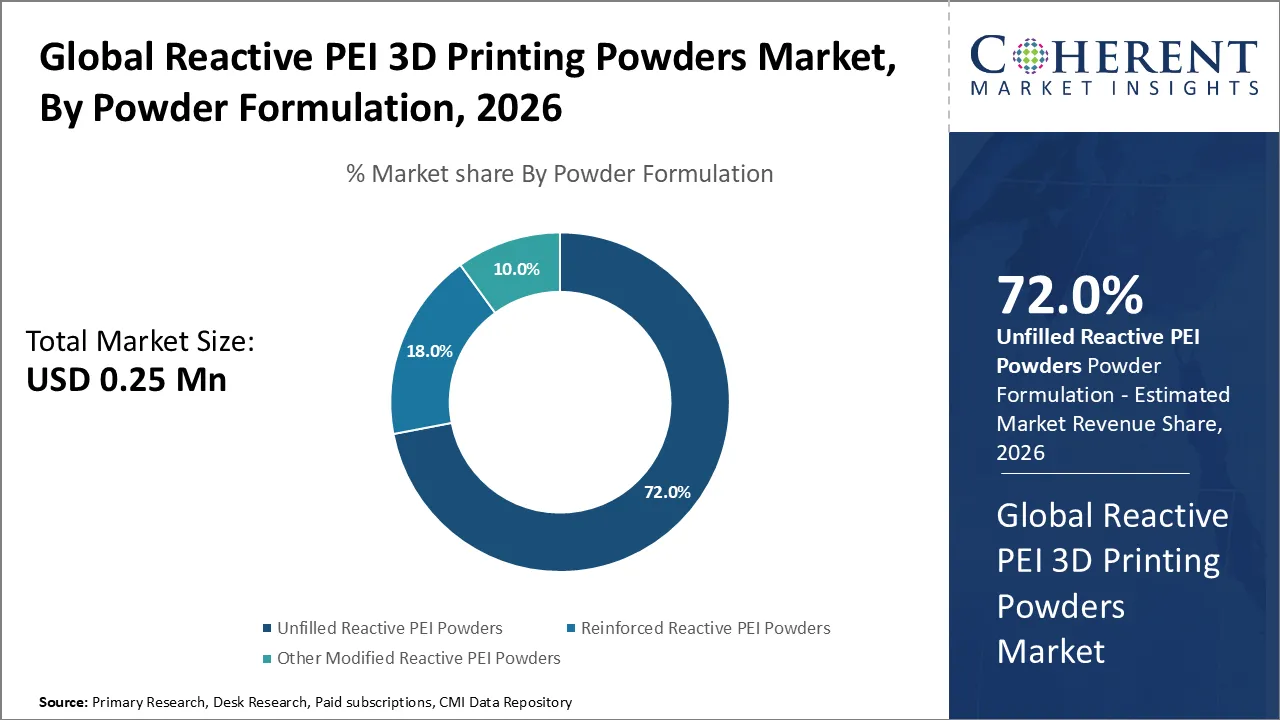
Why Are Unfilled Reactive PEI Powders Expected to Lead Initial Commercialization?
On the basis of powder formulation, unfilled reactive PEI powders are predicted to lead the of the global reactive PEI 3D printing powders market with a 72.0% share in 2026. This positioning is closely linked to the majority early users preferring to understand the base polymer's behavior first, before introducing reinforcing fillers, pigments, or other modifiers, as it could complicate laser absorption, powder spreading, and post-curing otherwise.
Subsequently, over the past years, reinforcement of agents and application-specific additives have become more important for manufacturers evaluating higher stiffness, dimensional stability, wear resistance, and dielectric performance. As evidence, in October 2026, BlueSky Polymers, Insight Polymers, and ALM announced their jointly developed reactive xPEI material. The collaboration combines reactive polymer design, compounding, and laser-sintering expertise, making it the most directly relevant corporate development for this segment.
- Current Industry Events of 2026
- Market Size Estimation
- Regional Breakdown
- Competitive Landscape
- Customer Intelligence
- Segmental Analysis
- Pricing Analysis
- Key Market Drivers, Challenges & Future Trends
- Customized Insights Section
Why is Aerospace and Defense Expected to Become the Leading Application?
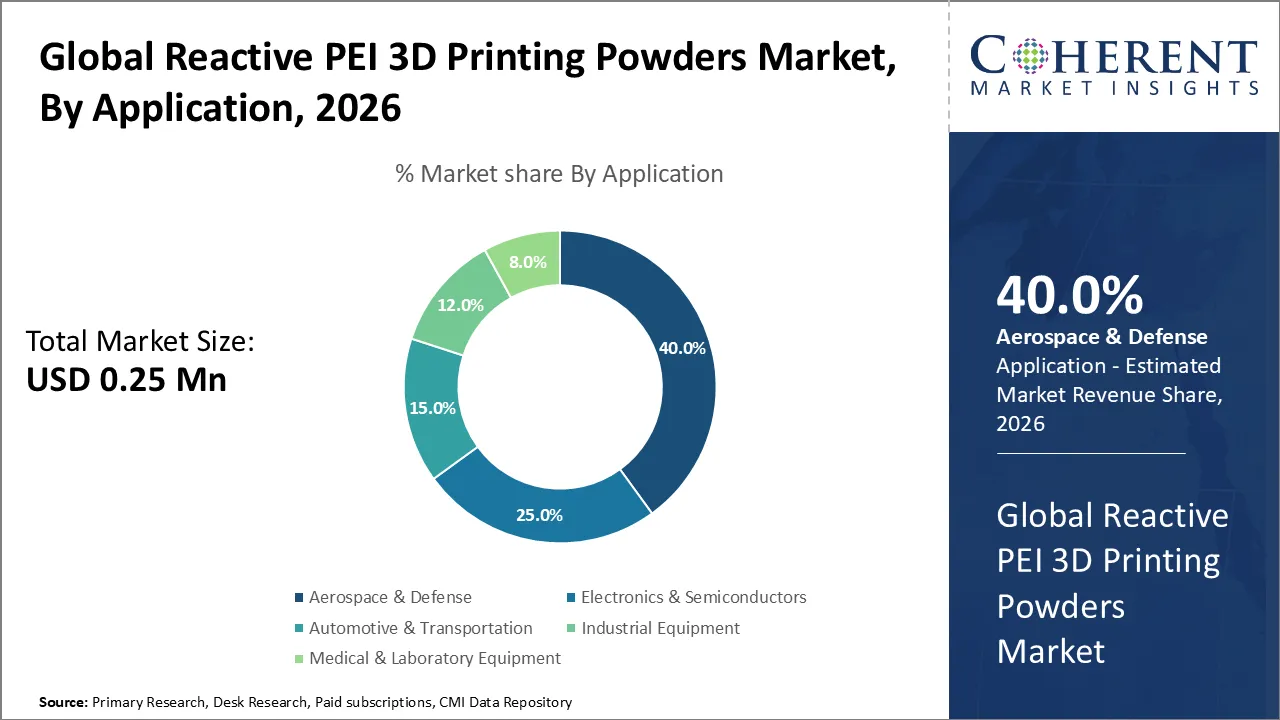
Aerospace and defense are poised to receive an illustrative 40.0% share in 2026 because reactive can possibly address demanding thermal, chemical, and mechanical requirements in components where conventional polymer powders have limitations. The potential use cases include aircraft ducting, unmanned aerial vehicle (UAV) enclosures, thermal-management housings, and low-volume specialized replacement parts.
The wider aerospace opportunity is supported by the established high performance plastics industry, as it indicates substantial commercial demand for advanced polymer materials across multiple manufacturing technologies. Moreover, it attracts substantial capital influx from consumers spread across the aerospace and defense industry. For instance, in June 2026, EOS reported that demand for Beehive Industries' 3D-printed jet-engine technology had led to an investment of more than USD 50 million in EOS equipment.
How Will Additive Manufacturing Service Providers Shape Early Powder Demand?
Industrial additive manufacturing service providers are provisionally to become the dominant end-users of the global reactive PEI 3D printing powders market by capturing a 46.0% share in 2026. Their multi-material process capabilities make them plausible first adopters of new reactive PEI powders, as they seek solutions to conduct material screening, build-parameter development, and application testing for multiple customers.
From the corporate perspective, TPM3D's March 2026 introduction of additional SLS systems and an upgraded powder-processing workstation illustrates continued development of professional powder-based production infrastructure. While these systems are the indicators of wider reactive PEI use, equipment improvements create potential integration opportunities for new powders once their operating requirements are established.
Current Events and Their Impact on the Reactive PEI 3D Printing Powders Market
Current Event | Description and its Impact |
U.S. DOE Polymer Additive Manufacturing Activity – July 2026 |
|
European Commission 3DoP Initiative – July 2026 |
|
Reactive PEI 3D Printing Powders Market Dynamics
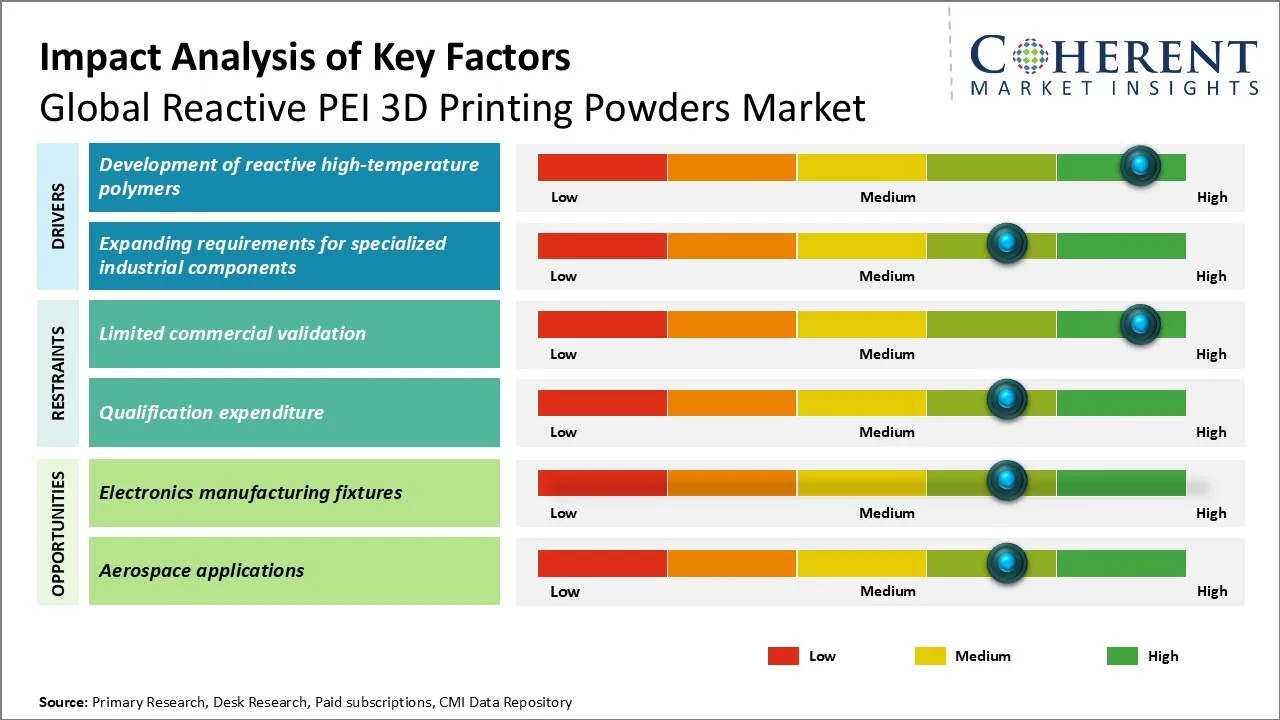
Market Drivers
- Overcoming the Processing Limitations of Conventional High-Temperature Polymers: One of the central drivers of the global reactive PEI 3D printing powders market is its potential in improving the processability of amorphous engineering thermoplastics during laser sintering. Conventional PEI often exhibits restricted particle coalescence, leading to insufficient interlayer bonding, whereas reactive PEI introduces a different processing sequence to achieve the intended final properties. This approach could make it possible to combine greater design freedom with high-temperature polymer performance.
- A June 2026 study investigated modifications to conventional PEI using polyethylene terephthalate (PET) and recorded substantial improvement in melt flow, signaling progressive future of this sector across various processing-related applications.
Material composition | Melt Flow Index (g/10 min) | Increase vs. pure PEI |
Pure PEI | 65 | Baseline |
PEI/PET (90/10) | 124 | 90.80% |
PEI/PET (70/30) | 312 | 380.00% |
PEI/PET (50/50) | 358 | 450.80% |
- Increasing Demand for High-Value, Low-Volume Components: Producing small quantities of specialized electrical housings, precision fixtures, and thermal-management components through traditional machining methods can be expensive. Thus, manufacturers are exploring alternatives to traditional machining, where powder-based 3D printing have become a cost-effective option due to helping reduce the number of parts required to be assembled, minimize the need for specialized tools, and lower material waste during production. Therefore, reactive PEI powders are also becoming useful particularly for manufacturing complex components where design requirements are more important than the cost of raw materials.
- While documenting the commercialization of large-format polymer additive manufacturing by Additive Engineering Solutions (AES) in 2025, the Oak Ridge National Laboratory (ORNL) recorded 10–40% reduction in tooling manufacturing costs and 50% increase in production speed, compared to traditional methods.
Emerging Trends
- Greater Attention to Powder Circularity: Manufacturers are prioritizing the reuse of unfused SLS powder, as specialty engineering polymers can represent a substantial portion of operating costs. A 2024 research review reported that producing 10 kg of finished SLS components can leave approximately 23 kg of unused powder, representing a material value of around €2,300 based on an average PA12 powder price of €100/kg.
- Expansion of Materials Qualification Partnerships: Manufacturers of emerging powders are showing interest in working more closely with machine suppliers, industrial laboratories, and component manufacturers to establish suitable build parameters and generate application-specific evidence before committing to commercial-scale production. For instance, in February 2026, Stratasys launched an industry-led qualification program for SAF PA12, involving aerospace manufacturers and additive manufacturing service providers to validate material performance, consistency, and traceability.
- Increasing Focus on Digital Process Traceability: Industrial customers may require continuous documentation of powder batches, build conditions, curing temperatures, and finished-part inspections, favoring suppliers providing a complete material processing specification rather than simply delivering powder. A June 2026 study jointly conducted by the Aerospace Industries Association (AIA) and EY surveyed 57 aerospace and defense industry leaders, where 75% of them already implemented digital thread technologies.
Regional Insights
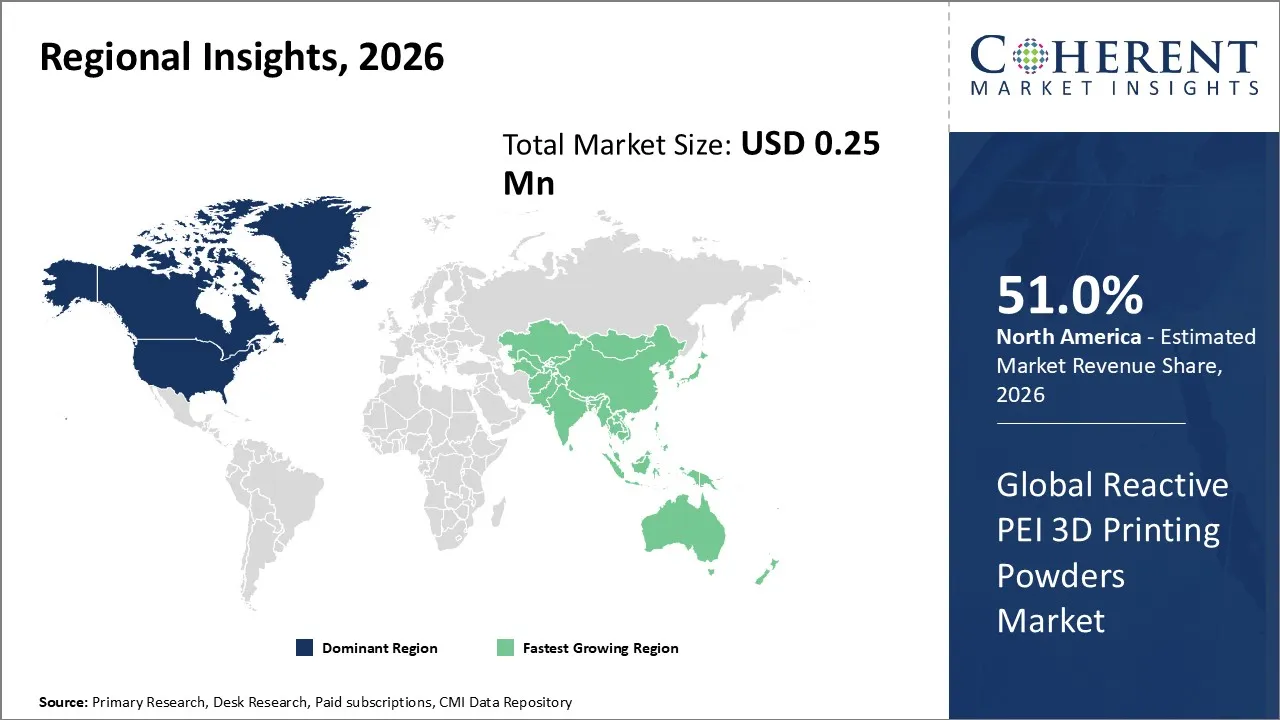
North America to Account for the Largest Reactive PEI 3D Printing Powders Market Share of 51.0% in 2026
The region's leadership in this sector reflects its proximity to the original xPEI development partnership, established polymer engineering capabilities, and manufacturing customers seeking high-value customized components. Besides, investment in process monitoring is relevant to emerging specialty powders, where production repeatability and defect detection are important qualification requirements, is also consolidating the position. One of such notable funding events is the U.S. additive manufacturing quality-control specialist, Phase3D, securing USD 2.9 million in investment in June 2026, as reported by the U.S. Department of Energy (DOE).
Furthermore, North America's early commercialization prospects are particularly connected to defense-related hardware, electronics manufacturing, energy systems, and specialized industrial components. The region is also showing potential to play an important role in establishing performance specifications and repeatable thermal post-processing practices.
Asia Pacific to Emerge as the Fastest-growing Region in 2026, While Presenting Strong Long-Term Manufacturing Expansion Opportunities
Asia Pacific is thriving in the reactive PEI 3D printing powders market with the bolstering polymer additive manufacturing (AM) capabilities of China, Japan, India, and South Korea. This surge specifically originates from the growing industrial interest in precision manufacturing for electronics, transportation, automation, and advanced materials processing. For instance, as of October 2026, the AM ecosystem of India had more than 1.54 lakh people trained, 56 start-ups supported, and 65 India-specific technologies developed under the National Strategy for Additive Manufacturing (NSAM).
Besides, the development of advanced printable polymer materials is gaining traction and is largely contributing to APAC’s accelerated progress in this sector. Following this trail of portfolio expansion, in September 2026, Sumitomo Chemical, in collaboration with Gutenberg, developed liquid crystal polymer filament technology for semiconductors, communications, and next-generation mobility applications. This development also demonstrates regional interest in higher-performance additive manufacturing feedstocks.
Global Reactive PEI 3D Printing Powders Market Outlook for Key Countries
How Is the U.S. Positioned to Lead Initial Reactive PEI Powder Development
The U.S. is currently the most directly identifiable center for reactive xPEI commercialization activity, where the original development partnership brings together companies with relevant polymer formulation, compounding, and powder-processing expertise. Exemplifying the same, in April 2026, 3D Systems launched its SLA 825 Dual industrial platform and AddiTrak factory software, amplifying its capacity in additive manufacturing and monitoring.
Besides, the U.S. government pushing for documentation of polymer additive manufacturing activities at provides an additional indication of the country’s institutional capabilities, supporting extensive process research and alignment with current trends. However, actual reactive PEI adoption will require application-specific validation and cannot be inferred from general government research activity alone.
Why Is Germany Important to the Development of High-Performance SLS Materials?
Germany is expected to be a future customer-development location for reactive PEI powder producers due to its engineering-intensive manufacturing base and established industrial additive manufacturing ecosystem. Its focus on overcoming the gap between technology development and commercial production is particularly pertinent to emerging specialty polymer materials industry.
As evidence, Germany-headquartered EOS continued expanding industrial AM partnerships and materials-related collaborations through its July 2026 participation in the MAT-H2 consortium, which illustrates its involvement in developing materials and manufacturing approaches for demanding applications. Such activity also supports a potential revenue-generating ecosystem for advanced polymer powders.
How Is China's Polymer Additive Manufacturing Infrastructure Creating Future Opportunities?
China's growth prospects in the reactive PEI 3D printing powders market are closely linked to massive public and private investments in industrial SLS machinery, powder-processing equipment, and domestic manufacturing of engineering polymer components. Evidencing the same, the country recorded a 52.5% year-on-year increase in 3D printing device output over 2024, according to its National Bureau of Statistics. This also signals expanding equipment production across multiple 3D printing technologies.
Inspired by such nationwide progress, in August 2026, Chinese manufacturer TPM3D unveiled its upgraded CF250 and PPS250 professional SLS solution at Formnext Asia Shenzhen. This pipeline of industrial polymer-printing equipment is crafted to create future testing opportunities for specialty powders if thermal and processing compatibility can be demonstrated by featuring a larger build volume and increased production capacity.
How Is Japan's Advanced Polymer Expertise Supporting New Printing Materials?
Japan has established capabilities in polymer engineering, precision manufacturing, and specialty component development, which collectively support wider reactive PEI applications, specifically those requiring dimensional accuracy and thermal resistance. Adding government support, in May 2026, Japan's Ministry of Economy, Trade and Industry (METI) released its updated Manufacturing Industries report, outlining government measures supporting core manufacturing technologies. This policy framework provides broader context for research and development in advanced processing methods.
Furthermore, a corporate development portraying Japan's materials innovation came in April 2026, when SOLIZE PARTNERS and Daicel began collaboratively started developing a liquid crystal polymer 3D printing technology and related manufacturing support services. This reflects the growing commercial-scale efforts to make difficult-to-process engineering polymers suitable for AM advances.
Why Is India Emerging as a Potential Future Market for Reactive PEI 3D Printing Powders?
India is presenting longer-term opportunities for global leaders operating across the reactive PEI 3D printing powders market by enabling domestic programs supporting advanced manufacturing materials, which then leads to increased local AM capability and greater precision engineering needs. According to the Government of India's October 2026 update, the National Strategy for Additive Manufacturing had supported 56 startups and training for more than 154,000 individuals. It also reported progress toward NSAM 2.0, with a greater emphasis on commercialization and domestic technology development.
Under such influence, in August 2026, Lohia Aerospace Systems and Massivit jointly started setting a planned commercial large-format AM facility in Kanpur, with an investment outlay of USD 8-10 million over two years. The shows the growing interest in specialized AM applications across the country, attracting more capital influx and strategic partnerships.
How Could High-Temperature Electronics and Data Center Cooling Create New Opportunities in the Reactive PEI 3D Printing Powders Market?
Pioneers of the reactive PEI 3D printing powders market is now exploring extensive applications in electrical and electronic components where heat resistance, dielectric behavior, chemical stability, and complex geometries are critical. Potential applications include semiconductor testing fixtures, precision electrical housings, fluid-handling manifolds, and cooling-system components, where the material's ability to produce complex geometries without additional subtractive machining could be particularly useful for internal channels and intricate housings.
However, the underlying technical suitability requires application-specific validation. Addressing this gap, SABIC's conventional ULTEM powder documentation established PEI's high glass transition temperature (Tg) of 217°C and superior electrical performance characteristics. This makes the sector relevant and adjacent to the thermally conductive polymers industry.
Market Players, Key Developments, and Competitive Intelligence
Key Developments
- In May 2026, CISKO New Material expanded its product portfolio by including the full range of Valiant PEI, covering from AM and compression molding to rotational molding and ceramic injection molding binders. The new stock of PEI powder grades had four additions, such as VAT002P50, VAT002P100, VAT002P200, and VAT002P350.
- In April 2026, BigRep signed a new reseller partnership with 3DXTECH for its high-temperature industrial 3D printing systems in the USA. The partnership combines BigRep's IPSO 105 and ALTRA 280 platforms with 3DXTECH's portfolio of high-performance materials, including PEI, PEEK, and PEKK.
- In February 2026, Toray introduced a truly spherical PA12 powder, Toraypearl polyamide (PA) 12, which is widely compatible with PBF-type 3D printers. The new material enables both excellent surface smoothness and high impact strength in 3D-printed parts, demonstrating continued innovation in competing thermoplastic powder materials and particle engineering.
Competitive Landscape
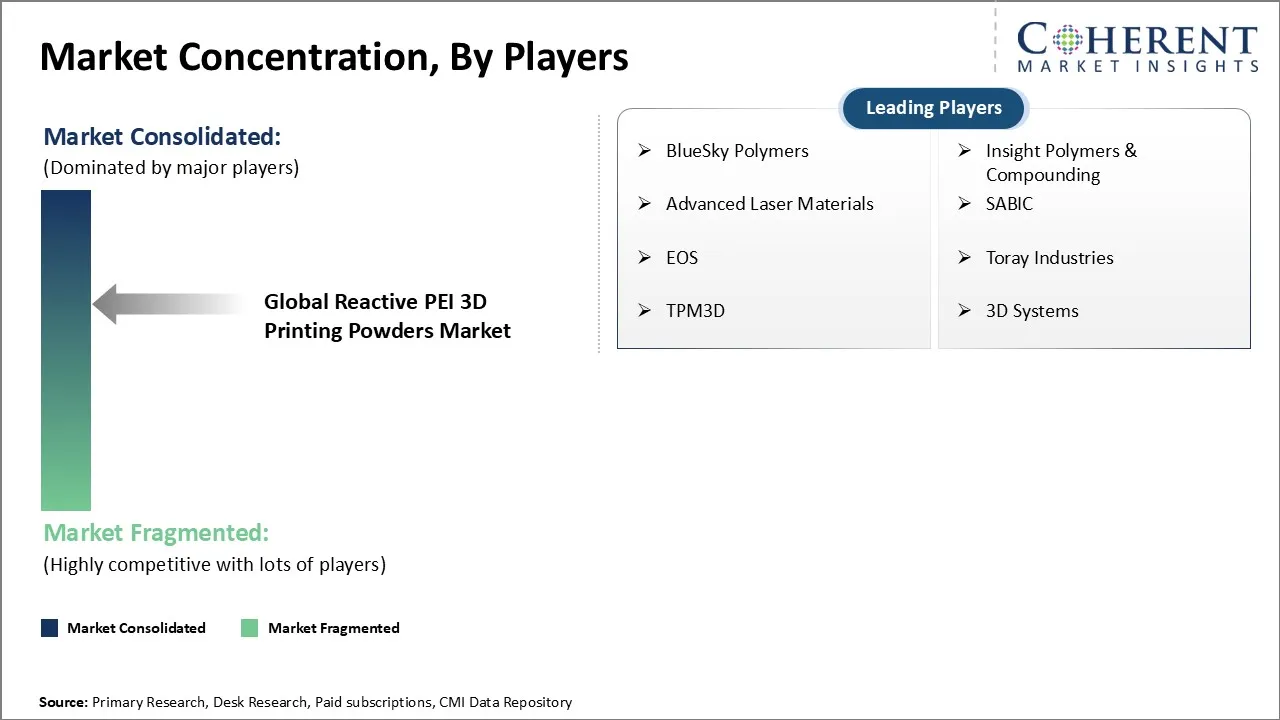
The global reactive PEI 3D printing powders market is currently characterized by an emerging supply network rather than a mature competitive structure with established market-share leaders. The strongest direct evidence of this highly consolidated business atmosphere can be defined by the increasing activities in forms of development partnerships, acquisitions, and mergers. For instance, in January 2026, ADDMAN completed the acquisition of Forecast 3D to expand its polymer additive manufacturing operations by adding SLS and Multi Jet Fusion capacity.
The competitive environment is therefore evolving around reactive polymer intellectual property, powder production expertise, application qualification, manufacturing partnerships, and access to industrial buyers. Participating in this wave of product development, in November 2024, Evonik and HP jointly introduced a halogen-free flame-retardant polymer powder, 3D HR PA12 FR, for AM. The material offers 50% powder reusability, demonstrating the importance of material circularity and specialized performance characteristics in industrial polymer 3D printing.
Leading Manufacturers and Notable Products in the Reactive PEI 3D Printing Powders Market
Company | Relevant Products / Capabilities | Strategic Relevance |
BlueSky Polymers | Reactive xPEI polymer chemistry | Direct technology developer associated with the 2026 xPEI introduction. |
Insight Polymers & Compounding | Reactive polymer compounding and xPEI development | Direct collaborator supporting formulation and material production. |
Advanced Laser Materials (ALM) | Polymer powder processing and SLS application development | Direct collaborator supporting qualification of reactive PEI for laser sintering. |
SABIC | ULTEM polyetherimide powder grades | Relevant upstream high-performance polymer producer; its existing powder products are not evidence of reactive xPEI sales. |
EOS GmbH | Industrial additive manufacturing systems and materials ecosystem | Adjacent equipment and materials participant; separate reactive xPEI powder sales not established. |
Toray Industries | Engineered polymer powder technologies | Adjacent supplier of competing polymer powder technology, notably PA12. |
TPM3D | Industrial selective laser sintering systems | Potential equipment ecosystem participant, subject to material compatibility testing. |
3D Systems | Industrial additive manufacturing technologies | Adjacent technology provider; no confirmed reactive xPEI powder offering identified in the sources reviewed. |
Market Report Scope
Global Reactive PEI 3D Printing Powders Market Report Coverage | |||
Report Coverage | Details | ||
Base Year | 2025 | Market Size in 2026: | USD 0.25 Mn |
Historical Data For: | 2021 To 2024 | Forecast Period: | 2026 To 2033 |
Forecast Period 2026 To 2033 CAGR: | 69.38% | 2033 Value Projection: | USD 10.00 Mn |
Geographies covered: |
| ||
Segments covered: |
| ||
Companies covered: | BlueSky Polymers; Insight Polymers & Compounding; Advanced Laser Materials; SABIC; EOS; Toray Industries; TPM3D; 3D Systems | ||
Growth Drivers: |
| ||
Restraints & Challenges: |
| ||
Key Takeaways from Analyst
- The global reactive PEI 3D printing powders market represents a developing specialty materials opportunity centered on overcoming the limitations of conventional high-temperature amorphous polymers in SLS. Consequently, commercial success will depend on whether reactive polymer chemistry delivers repeatable mechanical properties and reliable thermal performance under real industrial production conditions.
- Early demand is expected to be concentrated among research institutions, material qualification laboratories, additive manufacturing service providers, and specialized component manufacturers. Thus, countable commercial opportunities could emerge after successful process certification, production-scale powder manufacturing, and qualification for demanding end-use environments.
- Overall, competitive differentiation in this sector will be influenced by intellectual property, powder consistency, processing compatibility, material reuse, and the cost of post-print curing. As a result, suppliers offering complete, reproducible processing specifications may be better positioned than those supplying experimental powders without validated manufacturing guidance.
Market Segmentation
- Powder Formulation Insights (Revenue, USD Mn, 2021 - 2033)
- Unfilled Reactive PEI Powders
- Reinforced Reactive PEI Powders
- Other Modified Reactive PEI Powders
- Application Insights (Revenue, USD Mn, 2021 - 2033)
- Aerospace & Defense
- Electronics & Semiconductors
- Automotive & Transportation
- Industrial Equipment
- Medical & Laboratory Equipment
- End User Insights (Revenue, USD Mn, 2021 - 2033)
- Additive Manufacturing Service Providers
- Aerospace & Defense Manufacturers
- Electronics & Semiconductor Manufacturers
- Automotive Manufacturers
- Other Industrial Manufacturers
- Distribution Channel Insights (Revenue, USD Mn, 2021 - 2033)
- Direct Sales
- Distributors & Specialized Material Suppliers
- Regional Insights (Revenue, USD Mn, 2021 - 2033)
- North America
- U.S.
- Canada
- Latin America
- Brazil
- Argentina
- Mexico
- Rest of Latin America
- Europe
- Germany
- U.K.
- Spain
- France
- Italy
- Russia
- Rest of Europe
- Asia Pacific
- China
- India
- Japan
- Australia
- South Korea
- ASEAN
- Rest of Asia Pacific
- Middle East
- GCC Countries
- Israel
- Rest of Middle East
- Africa
- South Africa
- North Africa
- Central Africa
- North America
- Key Players Insights
- BlueSky Polymers
- Insight Polymers & Compounding
- Advanced Laser Materials
- SABIC
- EOS
- Toray Industries
- TPM3D
- 3D Systems
Sources
Primary Research Interviews
- Reactive polyetherimide (PEI) polymer developers and formulation specialists
- High-temperature thermoplastic manufacturers and compounders
- Polymer powder processing and micronization specialists
- Selective laser sintering (SLS) equipment manufacturers
- Industrial additive manufacturing service providers
- Aerospace and defense material qualification specialists
- Semiconductor and electronics manufacturing engineers
- Industrial component designers and procurement professionals
- Polymer testing, thermal analysis, and characterization laboratories
- Additive manufacturing business development and technical sales executives
Stakeholders
- Specialty engineering polymer manufacturers
- Reactive polymer chemistry and material development companies
- Polymer powder production and processing companies
- Industrial SLS and powder bed fusion equipment manufacturers
- Aerospace and defense component manufacturers
- Semiconductor and electronics equipment manufacturers
- Automotive and transportation component suppliers
- Industrial thermal-management and fluid-handling equipment manufacturers
- Additive manufacturing research institutions
- Advanced materials testing and certification organizations
Databases
- NIST Additive Manufacturing Research Resources
- NASA Technical Reports Server (NTRS)
- European Commission CORDIS
- European Patent Office (EPO) – Espacenet
- WIPO PATENTSCOPE
- Observatory of Economic Complexity (OEC)
- UN Comtrade
- U.S. International Trade Commission (USITC)
Magazines and Industry Publications
- VoxelMatters
- 3D Printing Industry
- TCT Magazine
- 3D ADEPT Media
- DEVELOP3D
- Additive Manufacturing Media
- Plastics Technology
- CompositesWorld
Journals and Technical Research Publications
- Additive Manufacturing
- Polymer Testing
- Materials & Design
- Progress in Additive Manufacturing
- Journal of Materials Processing Technology
- Rapid Prototyping Journal
- International Journal of Advanced Manufacturing Technology
- High Performance Polymers
- Polymers
- PubMed
- PubMed Central (PMC)
Associations and Industry Organizations
- ASTM International – Committee F42 on Additive Manufacturing Technologies
- International Organization for Standardization (ISO)
- Additive Manufacturing Users Group (AMUG)
- Additive Manufacturer Green Trade Association (AMGTA)
- European Powder Metallurgy Association (EPMA)
- VDMA – Additive Manufacturing Working Group
- Society of Plastics Engineers (SPE)
- Society for the Advancement of Material and Process Engineering (SAMPE)
- National Defense Industrial Association (NDIA)
- Aerospace Industries Association (AIA)
Public Domain Sources
Government policies, technical reports, and industry statistics
- NASA – Gaps in AM Standards and Specifications – Qualification, certification, material specifications, and process-control challenges.
- NDIA Vital Signs 2026 – Additive manufacturing adoption across R&D, experimentation, prototyping, and production.
- Government of India – Additive Manufacturing and NSAM 2.0, October 2026 – Startup support, workforce training, technology development, and commercialization.
- European Commission – 3D Printing Optimised Production (3DoP), July 2026 – Industrial additive manufacturing commercialization and investment.
- AIA and EY – Digital Thread in Aerospace and Defense, June 2026 – Manufacturing traceability and digital process integration.
- U.S. Department of Energy – Advanced Manufacturing and Phase3D Investment Updates – Industrial additive manufacturing quality control and process monitoring.
- Oak Ridge National Laboratory (ORNL) – Polymer Additive Manufacturing Research – Large-format polymer additive manufacturing and manufacturing productivity.
- Observatory of Economic Complexity – Semiconductor Manufacturing Equipment Trade Data – International semiconductor equipment trade flows.
Corporate announcements, product launches, acquisitions, and partnerships
- BlueSky Polymers, Insight Polymers and ALM – Reactive xPEI Development, October 2026 – Reactive PEI technology for selective laser sintering.
- CISKO New Material – Valiant PEI Powder Portfolio, May 2026 – PEI powder grade development.
- BigRep and 3DXTECH – High-Temperature 3D Printing Partnership, April 2026 – Industrial printing systems and high-performance polymer materials.
- Toray Industries – Toraypearl PA12 Powder Development, February 2026 – Specialty powder engineering for powder-bed fusion.
- Sumitomo Chemical and Gutenberg – LCP Filament Development, September 2026 – Advanced polymer feedstock development for 3D printing.
- SOLIZE PARTNERS and Daicel – LCP 3D Printing Technology, April 2026 – Joint technology development and manufacturing support.
- EOS and Beehive Industries – USD 50 Million Additive Manufacturing Investment, June 2026 – Aerospace production capacity expansion.
- TPM3D – CF250 and PPS250 SLS System Launch, August 2026 – Industrial SLS equipment and powder-processing infrastructure.
- ADDMAN – Forecast 3D Acquisition, 2026 – Expansion of polymer additive manufacturing services.
- Stratasys – SAF PA12 Qualification Program, February 2026 – Industrial polymer material qualification.
- Victrex – LMPAEK Powder Commercial Availability, October 2024 – High-performance polymer powders.
- Evonik and HP – 3D HR PA12 FR Product Launch, November 2024 – Flame-retardant polymer powder development.
- 3DChimera and Evonik – INFINAM SLS Powder Distribution Partnership, 2025 – Industrial polymer powder distribution.
- Lumas Polymers – Acquisition of Jabil Engineered Materials Assets, 2025 – Specialty polymer formulation and manufacturing capabilities.
- HP – Industrial Filament 3D Printer 600 High Temperature, April 2026 – High-temperature polymer additive manufacturing equipment.
Proprietary Elements
- CMI Data Analytics Tool
- Proprietary CMI Existing Repository of Information for the Last 10 Years
Get access to 250+ pages report
Every segment, forecast, competitor profile and data table behind the analysis above — available for instant download.
- ESOMAR Member
- ISO 9001:2015 Certified
- D-U-N-S Registered
- GDPR & CCPA Compliant
Frequently Asked Questions
Under the illustrative commercialization scenario, the market records a calculated CAGR of 69.38% from 2026 to 2033.
The principal drivers include improved processability of high-temperature polyetherimide, increasing requirements for complex industrial components, and the development of specialized materials for laser-sintering applications.
Limited commercial production data, high material qualification costs, specialized processing requirements, powder reuse validation, and the need for controlled thermal post-treatment are the major challenges.
Unfilled reactive PEI powders are assigned a 72.0% share of the preliminary 2026 model, reflecting their expected importance in early development and testing.
BlueSky Polymers, Insight Polymers & Compounding, and Advanced Laser Materials are the principal publicly documented participants in the development of reactive xPEI powder technology.
North America is assigned a 51.0% share in the illustrative 2026 regional model, reflecting the location of early xPEI development activities.
Potential applications include aerospace ducting, semiconductor testing fixtures, specialized industrial housings, high-temperature fluid-handling parts, and precision equipment components, subject to relevant material qualifications.