

3D Printing Materials Market Size and Trends - 2026 to 2033
3D Printing Materials Market is estimated to be valued at USD 1,930.7 Mn in 2026 and is expected to reach USD 3,958.1 Mn in 2033, exhibiting a compound annual growth rate (CAGR) of 10.8% from 2026 to 2033.
Key Takeaways
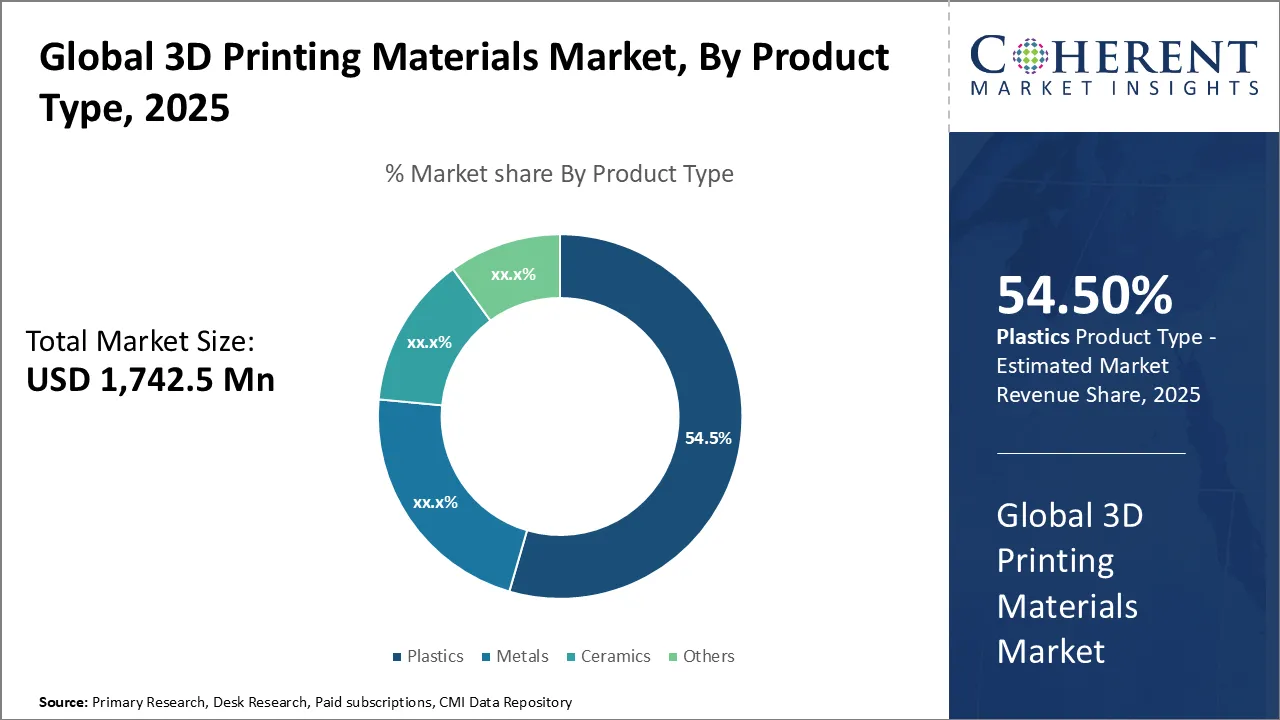
- Based on Product Type, the plastics segment is expected to lead in 2026 with around 55.5% share of the global 3D printing materials market.
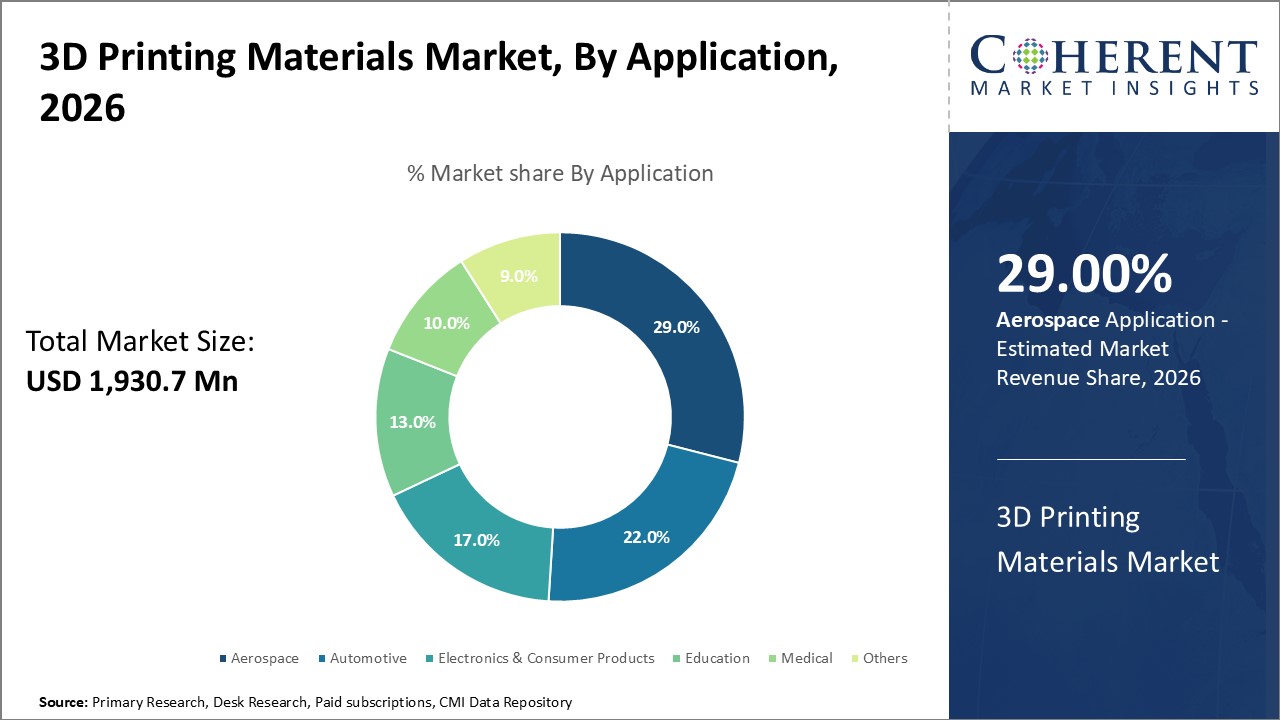
- Based on Application, the aerospace & defence segment is estimated to hold 29% share in 2026.
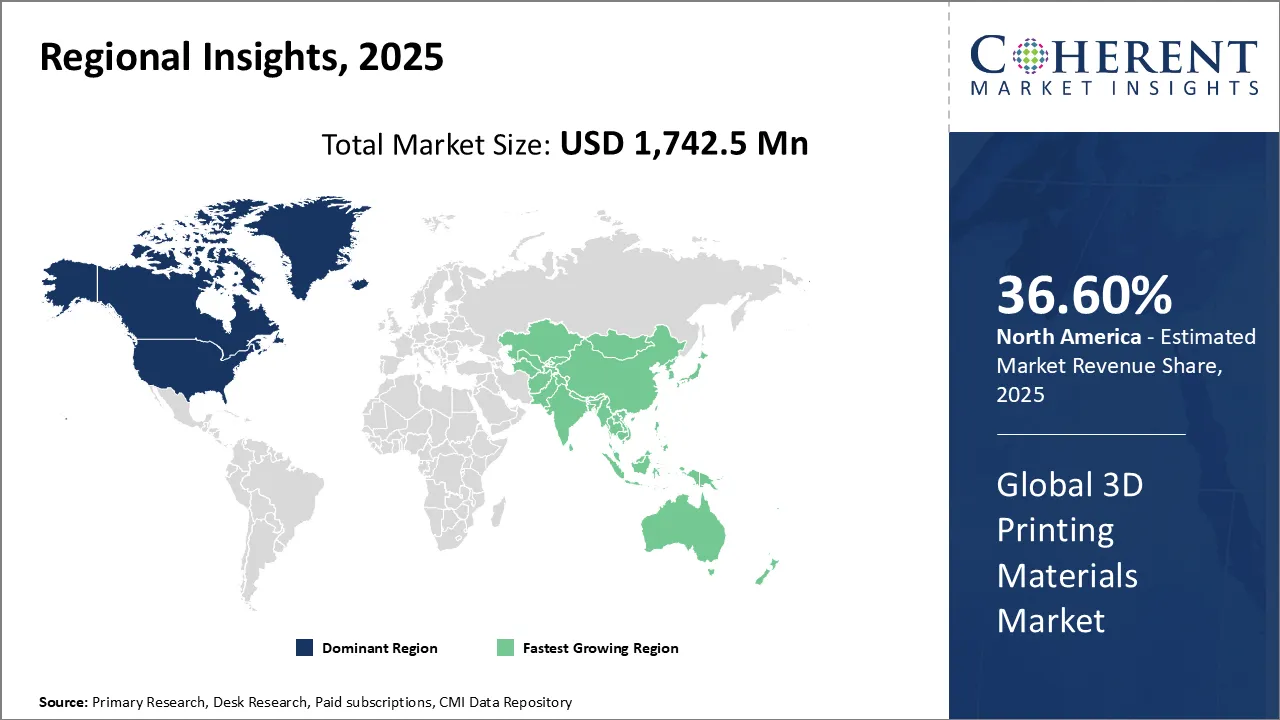
- Based on Region, North America is set to lead the global 3d printing materials market with 36.60% share in 2026. While, Asia Pacific is anticipated to be the fastest growing region.
Market Overview
The global 3D printing materials market is experiencing rapid growth, driven by technological advancements, material innovation, and expanding industrial adoption across aerospace, automotive, medical, and electronics sectors. Polymers remain the largest segment due to their versatility in prototyping and production, while metals and high-performance materials are growing rapidly for production-grade applications. Aerospace and automotive are major application areas, with medical and healthcare also contributing significantly through patient-specific implants and surgical guides. Growth is further supported by sustainability initiatives, recycled feedstocks, and bio-based materials, though high costs, supply-chain constraints, and standardization challenges persist. North America and Europe currently lead the market, while Asia-Pacific is emerging as the fastest-growing region due to increasing manufacturing infrastructure and government incentives.
Current Events and their Impact on the 3D Printing Materials Market
Current Events | and its impact |
US-China Trade Relations and Technology Export Controls |
|
European Union Regulatory Framework Evolution |
|
Supply Chain Disruptions and Raw Material Shortages |
|
Segmental Insights
- Current Industry Events of 2026
- Market Size Estimation
- Regional Breakdown
- Competitive Landscape
- Customer Intelligence
- Segmental Analysis
- Pricing Analysis
- Key Market Drivers, Challenges & Future Trends
- Customized Insights Section
3D Printing Materials Market Insights, By Product Type: Plastics Lead Due to Versatility, Cost-Effectiveness, and Broad Industrial Use
In terms of product type, the plastics segment is expected to hold approximately 55.5% share of the global 3D printing materials market in 2026. Plastics, including PLA, ABS, PETG, and high-performance polymers, are widely used across prototyping and production applications due to their versatility, ease of processing, and cost-effectiveness. These materials enable lightweight, durable, and functional components for industries such as automotive, aerospace, electronics, and consumer goods. Advances in composite filaments, flexible polymers, and bio-based resins are further enhancing performance, heat resistance, and environmental sustainability, driving broader adoption.
For instance, in September 2025, 3D‑Fuel introduced a new bio-based PETG filament line designed for industrial-grade additive manufacturing, offering improved mechanical performance, lower environmental impact, and consistent print quality. This innovation reflects the growing demand for high-performance, eco-friendly plastics in the 3D printing materials market, supporting diverse industrial applications.
3D Printing Materials Market Insights, By Application: Aerospace & Defence Lead Due to Light weighting and Complex Geometry Requirements
In terms of application, the aerospace & defence segment is estimated to hold around 29% share of the market in 2026. Growth in this segment is fueled by the increasing use of 3D printing for lightweight, high-strength components, complex geometries, and rapid prototyping in aircraft, satellites, and defense systems. 3D printing enables significant weight reduction, part consolidation, and faster iteration cycles, making it an essential technology for performance-critical aerospace applications.
For instance, in October 2026, Airbus highlighted the use of advanced 3D printed titanium and high-performance polymer components in commercial aircraft interiors and structural assemblies. These materials contribute to weight savings, improved fuel efficiency, and shorter production timelines, underscoring the strategic importance of 3D printing in the aerospace and defence sector.
Regional Insights
North America 3D Printing Materials Market Analysis & Trends
North America is set to lead the global 3d printing materials market with 36.60% share in 2026, driven by strong demand from hospitals, clinics, and home care settings. The region benefits from well-established healthcare infrastructure, high patient volumes, and advanced manufacturing facilities of key medical tape producers. Increasing awareness of infection control, stringent regulatory standards, and adoption of innovative skin-friendly and waterproof tapes are further fueling market growth. Meanwhile, Asia Pacific is anticipated to be the fastest-growing region, supported by rising healthcare expenditure, growing surgical procedures, and expanding medical infrastructure across emerging economies.
Asia Pacific 3D Printing Materials Market Analysis & Trends
Asia Pacific has emerged as the fastest-growing regional market for 3D printing materials in 2026. Rapid industrialization, technological adoption, and rising manufacturing activities in countries such as China, India, Japan, and South Korea are driving the demand for 3D printing plastics, metals, and high-performance materials. The expanding industrial base, coupled with increasing investments in aerospace, automotive, healthcare, and electronics sectors, is fueling the uptake of additive manufacturing. Local manufacturers are upgrading production capabilities, introducing advanced filaments and powders, and establishing robust supply chains. Additionally, cross-border trade and export of 3D-printed components are boosting material consumption, making the region a key growth hub for global 3D printing materials.
For instance, in May 2026 , Singapore unveiled the national standard “SS 708 Additive Manufacturing for Aerospace, Filament Layer Manufacturing Process Specifications”, aimed at filament layer manufacturing of thermoplastic materials in aerospace component.
3D Printing Materials Market Outlook Country-Wise
U.S.3D Printing Materials Market Trends
The United States is a global leader in the 3D printing materials market, driven by a highly mature manufacturing sector, strong R&D capabilities, and early adoption of additive manufacturing technologies. The U.S. market benefits from significant investments in high-value industries such as aerospace, defense, automotive, and healthcare, where advanced 3D printing materials like metal powders, photopolymers, and high-performance thermoplastics are extensively used for both prototyping and end-use components. Regulatory support for medical devices and aerospace applications further accelerates the adoption of innovative materials. The presence of major 3D printer and material manufacturers, coupled with robust academic and research institutions, fosters continuous development of next-generation polymers, composites, and alloys. North America, led by the U.S., accounted for a substantial share of the global 3D printing materials market in 2024, and the country’s market is projected to continue growing due to ongoing technological innovation, government incentives, and increasing industrial demand.
For instance, in October 2026, 3D‑Fuel (USA) announced that it expanded its USA production capacity and permanently lowered prices for its filament lines in the U.S. market, enhancing accessibility of domestically‑manufactured 3D printing plastics.
China 3D Printing Materials Market Trends
China has emerged as one of the fastest-growing and most influential markets for 3D printing materials, driven by rapid industrialization, a large manufacturing base, and government initiatives supporting additive manufacturing adoption. The country leverages 3D printing materials such as plastics, metal powders, and resins to serve diverse sectors including automotive, electronics, aerospace, and consumer goods. The market in China is witnessing strong growth due to rising demand for rapid prototyping, lightweight and complex components, and cost-efficient manufacturing solutions. Local material suppliers and startups are actively innovating to produce high-quality polymers and metal powders suitable for industrial-grade additive manufacturing. Furthermore, strategic government investments and supportive policies in regions like Shanghai, Shenzhen, and Beijing encourage research, production, and application of 3D printing materials, making China a leading player in the Asia-Pacific and global markets. With high CAGR projections, China is poised to further expand its footprint in the global 3D printing materials industry.
For instance, in September 2026, Deep Material, an AI‑driven Chinese company, launched multiple metal 3D‑printing powder materials with independent intellectual property rights and released its “DM Agent” hardware‑software integrated material intelligence system. The development marks a step forward in China’s metal AM materials innovation
Market Report Scope
3D Printing Material Market Report Coverage
| Report Coverage | Details | ||
|---|---|---|---|
| Base Year: | 2025 | Market Size in 2026: | USD 1,930.7 Mn |
| Historical Data for: | 2020 To 2024 | Forecast Period: | 2026 To 2033 |
| Forecast Period 2026 to 2033 CAGR: | 10.8% | 2033 Value Projection: | USD 3,958.1 Mn |
| Geographies covered: |
| ||
| Segments covered: |
| ||
| Companies covered: | 3D Systems, Inc., Arcam AB, Concept Laser GmbH, EOS GmbH Electro Optical Systems, ExOne GmbH, Solidscape, Inc., Optomec, SLM Solutions GmbH, and Stratasys, Ltd. | ||
| Growth Drivers: |
| ||
| Restraints & Challenges: |
| ||
3D Printing Material Market Drivers
Growing End User Demand for 3D Printing to Fuel Market Growth
The rising demand from numerous end users is one of the main drivers for 3D printing materials. As 3D printed parts are increasingly used in military, automotive, and aerospace applications, the industry is anticipated to grow. For producing components with complex patterns, 3D printing technology has shown to be quite beneficial. Designers can easily and affordably produce complicated pieces thanks to 3D printing. Since titanium has excellent mechanical qualities and high dimensional precision, aerospace industry parts manufactured of it are frequently 3D printed. The aforementioned elements should accelerate market expansion. For instance, in 2021, Porsche, has relied on the competence of Mahle in the development of the 3D-printed pistons, just as it did for the production forged pistons in the 911 GT2 RS. The technology company has developed a weldable powder for additive manufacturing from their proprietary Mahle aluminum alloy M174+.
3D printing is widely used in the aerospace industry
One of the major markets for 3D printing materials is the aircraft sector. Traditional technologies cannot be utilized to prototype and produce complicated geometrical pieces or specialized low-volume parts, but 3D printing can. In component production, it cuts down on lead time. For instance, in 2022, according to the most recent market trends for 3D printing materials, the aerospace application category will have a significant proportion of 26.8% in 2022.
Global 3d Printing Material Market Opportunities
The 3D printing materials market presents significant growth opportunities driven by increasing adoption across aerospace, automotive, healthcare, and consumer goods industries. Rising demand for lightweight, durable, and customized components fuels the need for advanced polymers, metal powders, and composite materials. Emerging applications in medical implants, electronics, and sustainable manufacturing further expand market potential. Additionally, innovations in bio-based plastics, high-performance alloys, and multi-material printing open avenues for environmentally friendly and cost-efficient production solutions, attracting both established manufacturers and startups globally.
Analyst Opinion (Expert Opinion)
The 3D printing materials market is experiencing a pronounced transformation driven by performance optimization and material diversification rather than just adoption rates. Polymers, particularly high-performance engineering plastics such as PEEK and ULTEM, are rapidly outpacing commodity filaments, with reported industrial usage in aerospace components increasing by over 35% year-on-year in 2024, according to additive manufacturing industry reports.
Metal powders, especially titanium and Inconel alloys, are becoming critical for high-value applications in aerospace and defense, where weight reduction and part consolidation directly translate into operational savings; Airbus has reported a 20% decrease in assembly time using titanium 3D printed brackets. Furthermore, the surge in demand for sustainable materials, including bio-based PETG and recycled filaments, is shaping supplier strategies, with companies like 3D-Fuel expanding production capacity to meet this trend. The market is no longer purely technology-driven but increasingly value-driven, where material innovation, reliability, and performance consistency are decisive for industrial uptake.
Firms failing to offer advanced, application-ready materials risk ceding ground to innovators prioritizing multi-material compatibility and lifecycle efficiency. Ultimately, the competitive edge will hinge on delivering materials that combine structural performance, environmental sustainability, and regulatory compliance, reflecting the sector’s shift toward industrial-grade, high-value applications.
Speak to the analyst
Want personalized insights?
Take the findings above to one of our principal consultants, or have the report rebuilt around the segments, geographies and competitors you actually track.
3D Printing Material Industry News
- In March 2025, EOS GmbH Electro Optical Systems announced expansion of industrial 3D printing solutions for oil & gas & semiconductor with two new metal materials (NickelAlloy IN718 API, Nickel NiCP) and also announced sustainability standard for AlSi10Mg with 100 % recycled feedstock.
- In August 2025, SLM solutions gmbh signed letter of intent with RINA to launch “H2AM Open Lab” for hydrogen applications (materials & process innovation) in additive manufacturing.
- In September 2025, SLM Solutions GmbH announced acquisition of Adira AddCreative’s large‑format PBF‑LB technology (which enables new material formats / build formats) and thus expands material/application capability.
Market Segmentation
- Product Type Insights (Revenue, USD Mn & KT, 2026 - 2033)
- Ceramics
- Plastics
- Metals
- Others
- Application Insights (Revenue, USD Mn & KT, 2026 - 2033)
- Electronic & Consumer Products
- Automotive
- Medical
- Education
- Aerospace
- Others (Military, Architectural, Government, etc.)
- Regional Insights (Revenue, USD Mn & KT, 2026 - 2033)
- North America
- U.S.
- Canada
- Latin America
- Brazil
- Argentina
- Mexico
- Rest of Latin America
- Europe
- Germany
- U.K.
- Spain
- France
- Italy
- Russia
- Rest of Europe
- Asia Pacific
- China
- India
- Japan
- Australia
- South Korea
- ASEAN
- Rest of Asia Pacific
- Middle East & Africa
- GCC Countries
- Israel
- Rest of Middle East & Africa
- North America
- Key Players Insights (Revenue, USD Mn, 2021 - 2033)
- 3D Systems
- Arcam AB
- Concept Laser GmbH
- EOS GmbH Electro Optical Systems
- ExOne GmbH
- Solidscape Inc.
- Optomec
- SLM Solutions GmbH
- Stratasys, Ltd.
Sources
Primary Research Interviews from the following stakeholders
Stakeholders
- Interviews with 3D printer manufacturers, filament and resin suppliers, additive manufacturing service providers, R&D heads in automotive, aerospace, and healthcare, and sustainability officers across major regional markets.
Specific stakeholders
- R&D and innovation heads at leading automotive and aerospace companies (e.g., BMW, Airbus, Boeing)
- Sourcing and procurement managers at healthcare and dental companies (e.g., Medtronic, 3M, Straumann)
- Operations and production managers at filament and resin manufacturers (e.g., BASF 3D Printing Solutions, Covestro, Formlabs)
- Sustainability and circular economy leads at 3D printing associations and technology alliances (e.g., ASTM Additive Manufacturing, America Makes)
- Engineers specializing in additive manufacturing processes and material development at equipment manufacturers (e.g., Stratasys, EOS, HP 3D Printing)
- Procurement and innovation officers from industrial and consumer goods companies focusing on 3D printed components (e.g., Siemens, GE Additive, Procter & Gamble)
- Quality control and materials testing teams in healthcare, aerospace, and automotive sectors (e.g., Johnson & Johnson, Airbus, Ford)
Databases
- United Nations Comtrade Database
- World Trade Organization (WTO) Trade Statistics
- Eurostat – Material Flow and Waste Statistics
- U.S. Census Bureau – Manufacturing and Materials Data
- China Customs Statistics
- Directorate General of Commercial Intelligence and Statistics (DGCIS), India
- Japan External Trade Organization (JETRO)
- Korea Customs Service Data Portal
- Food and Drug Administration (FDA) – Medical Device and Materials Section
- Indian Ministry of Commerce & Industry – Industrial Material Export Data
- European Environment Agency (EEA) – Waste and Recycling Statistics
Magazines
- 3D Printing Industry
- TCT Magazine
- Additive Manufacturing Media
- 3D Printing Business Directory
- Rapid News
- 3D Printing Review
- Plastics Today – Additive Manufacturing Section
- Manufacturing Global – 3D Printing Insights
- SME Media – Additive Manufacturing Reports
- 3D Printing & Additive Manufacturing Journal
Journals
- Additive Manufacturing (Elsevier)
- Journal of Materials Processing Technology (Elsevier)
- Journal of Manufacturing Processes (Elsevier)
- Rapid Prototyping Journal (Taylor & Francis)
- Journal of Applied Polymer Science
- Materials & Design (Elsevier) – 3D Printing Section
- Progress in Additive Manufacturing (Springer)
- Journal of Cleaner Production – Sustainable Materials Section
Newspapers:
- The Wall Street Journal – Technology & Manufacturing
- The Economic Times – Industrial & Materials Sector
- Business Standard – Manufacturing & Technology
- Financial Times – Technology and Sustainability
- Nikkei Asia – Materials and Industrial Innovatio
- The Hindu Business Line – Manufacturing & Materials
- South China Morning Post – Industrial Materials and 3D Printing
- The Guardian – Sustainable Technology & Materials
Associations
- ASTM International – Additive Manufacturing Committee
- America Makes – Additive Manufacturing Innovation Institute
- European Powder Metallurgy Association (EPMA) – 3D Printing Section
- Additive Manufacturing Users Group (AMUG)
- Society of Manufacturing Engineers (SME) – Additive Manufacturing Division
- British 3D Printing Association (B3DPA)
- India Additive Manufacturing Association (IAMA)
- European 3D Printing Association (E3DPA)
- International Organization for Standardization (ISO) – Additive Manufacturing Standards
- National Additive Manufacturing Innovation Hub (NAMIH)
Public Domain Sources
- U.S. Environmental Protection Agency (EPA) – Additive Manufacturing Materials Reports
- European Environment Agency (EEA) – Materials & Recycling Statistics
- Ministry of Economy, Trade and Industry (METI), Japan – 3D Printing Policy Data
- Organisation for Economic Co-operation and Development (OECD) – Additive Manufacturing and Circular Economy Reports
- Central Pollution Control Board (CPCB), India – Industrial Material Reports
- European Commission – Materials and Additive Manufacturing Reports
- United Nations Environment Programme (UNEP) – Global Industrial Materials Reports
- Reserve Bank of India (RBI) – Industrial Output & Materials Sector Reports
- Department for Promotion of Industry and Internal Trade (DPIIT), India – Additive Manufacturing Sector Initiatives
Proprietary Elements
- CMI Data Analytics Tool
- Proprietary CMI Existing Repository of information for last 8 years
Get access to 250+ pages report
Every segment, forecast, competitor profile and data table behind the analysis above — available for instant download.
- ESOMAR Member
- ISO 9001:2015 Certified
- D-U-N-S Registered
- GDPR & CCPA Compliant
Missing comfort of reading report in your local language? Find your preferred language:
Transform your Strategy with Exclusive Trending Reports
Frequently Asked Questions
The 3D Printing Materials Market is estimated to be valued at USD 1,930.7 Mn in 2026, and is expected to reach USD 3,958.1 Mn by 2033.
The CAGR of the 3d printing materials market is projected to be 10.8% from 2026 to 2033.
Growing End-User Demand for 3D printing to Fuel Market Growth and 3D printing is widely used in the aerospace industry.
The market is anticipated to be hampered by 3D printing materials' high production costs.
Major players operating in the market include 3D Systems, Inc., Arcam AB, Concept Laser GmbH, EOS GmbH Electro Optical Systems, ExOne GmbH, Solidscape, Inc., Optomec, SLM Solutions GmbH, and Stratasys, Ltd.
North America is expected to lead the global 3d printing materials market.