

Global Recycled PU Boards Market Size and Forecast – 2026 To 2033
The global recycled PU boards market is expected to grow from USD 7.20 Bn in 2026 to USD 10.60 Bn by 2033, registering a compound annual growth rate (CAGR) of 8.4% from 2026 to 2033. The global recycled PU boards market is driven by expansion of energy-efficient building construction. On July 9, 2026, SAINT-GOBAIN UK announced a major investment in low-carbon manufacturing in the UK with plans for a new multi-million pound low-carbon stone wool insulation manufacturing factory at the former Holwell Foundry Works, Melton Mowbray.
Key Takeaways of the Global Recycled PU Boards Market
- The Recycled Rigid Polyurethane Boards segment is expected to account for 43.0% of the global recycled PU boards market share in 2026. Increasing demand for lightweight insulation boards is driving the growth of the segment. On July 28, 2026, Knauf Insulation commissioned its electric melting production line at Novi Marof, Croatia. The investment adds manufacturing capacity for flat-roof products and sandwich panel boards.
- The Mechanical Recycling segment is estimated to capture 37.0% of the market share in 2026. Growing investment in circular construction materials is majorly driving the growth of the segment. On March 10, 2026, Covestro and the Fraunhofer Institute for Environmental, Safety and Energy Technology signed an agreement to develop a smart pyrolysis pilot plant for rigid polyurethane foam waste.
- The Building and Construction segment is estimated to capture 35.0% of the market share in 2026. Development of high-performance recycled insulation products is majorly driving the growth of the segment. On December 12, 2025, BASF launched WALLTITE RSB, a closed-cell spray polyurethane foam incorporating recycled and renewable raw materials. The formulation combines insulation performance with reduced embodied carbon.
- Asia Pacific is expected to dominate the recycled PU boards market in 2026 with a market share of 41.0%. Increasing emphasis on construction waste recycling in Asia Pacific is driving the growth of the regional market. On July 29, 2025, YTL Cement and the Construction Research Institute of Malaysia launched Malaysia’s pilot recycled concrete aggregate facility. The project processes returned concrete into reusable aggregates, reducing disposal requirements and demand for virgin materials.
- North America is expected to account for 27.0% share in 2026 and is projected to record the fastest growth over the forecast period. Development of recycled polyurethane composite technologies in North America is driving the growth of the regional market. On September 3, 2025, Dow announced progress with Italian automotive recycler Gruppo Fiori on recovering polyurethane foam from end-of-life vehicles without dismantling their components.
Segmental Insights
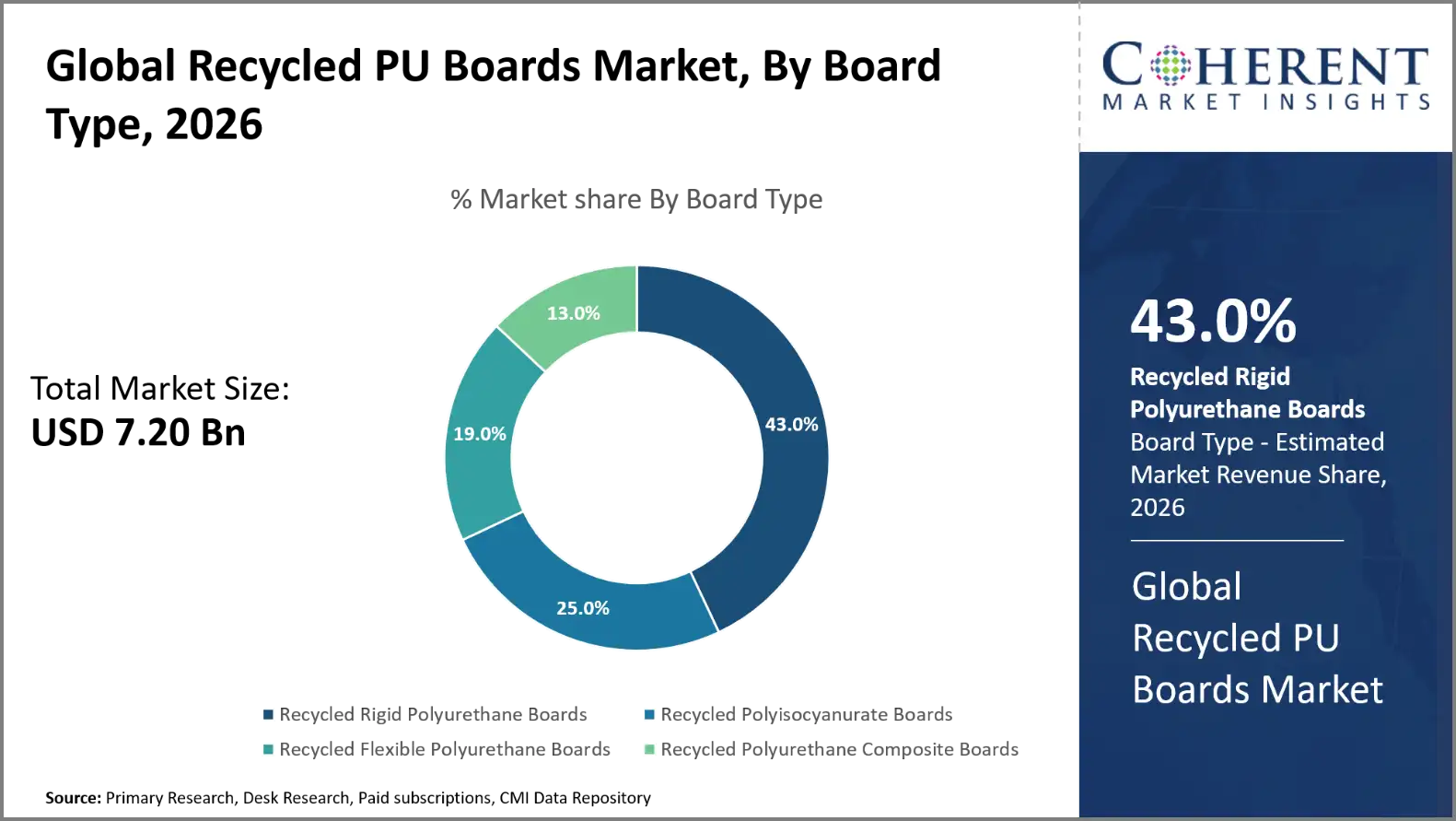
Why Does Recycled Rigid Polyurethane Boards Dominate the Global Recycled PU Boards Market?
The recycled rigid polyurethane boards segment is expected to account for 43.0% of the global recycled PU boards market share in 2026. The most popular are recycled rigid polyurethane boards, as the construction industry requires durable, lightweight and thermally efficient insulating materials. These boards are made using reclaimed scrap polyurethane, which helps save resources and reduce landfill discharge. They have closed cells which are good for thermal insulation and dimensional stability. Rigid polyurethane boards made from recycled materials can help to produce energy-efficient building envelopes, roofing systems and insulation panels. Their high performance in harsh building settings promotes their use. The increasing interest in circular construction materials will further boost their market domination.
On September 24, 2026, puren and Covestro Covestro announced that they will continue to jointly develop the functional material purenit. With the launch of a new production line at its location in Obermarchtal, Germany, puren has now certified its whole purenit production according to ISCC PLUS. This accreditation creates the foundation for puren to employ Desmodur CQ MS from Covestro as a binder, which is the basis for the next step in improving the environmental impact of pureni
- Current Industry Events of 2026
- Market Size Estimation
- Regional Breakdown
- Competitive Landscape
- Customer Intelligence
- Segmental Analysis
- Pricing Analysis
- Key Market Drivers, Challenges & Future Trends
- Customized Insights Section
Why is Mechanical Recycling the Most Preferred Recycling Technology?
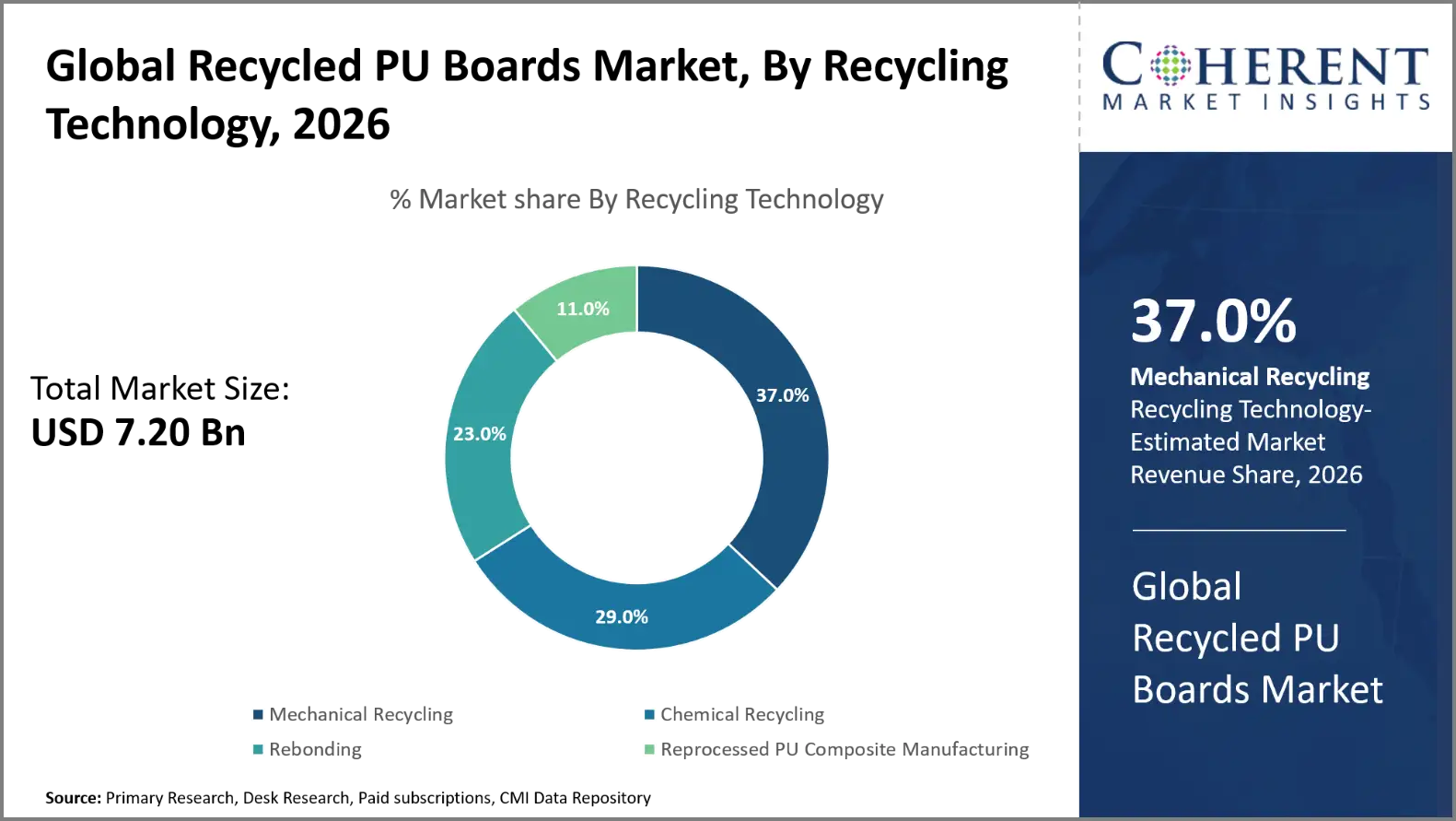
The mechanical recycling segment is expected to account for 37.0% of the global recycled PU boards market share in 2026. Mechanical recycling is heavily used since it is a relatively simple way to treat polyurethane waste. The technology consists of the collection, sorting, shredding, grinding and conversion of appropriate materials into reusable particles. The recovered materials can be used in manufacturing applications without having to be chemically broken down to any large extent. Mechanical processing can reduce the need for disposal and increase the recovery of materials. Recyclers are encouraged to embrace it because of its reasonably established equipment and processing procedures. Accessible feedstock is also provided by industrial polyurethane offcuts. But the quality of recycled material depends on the mix of trash, contaminants and processing conditions.
On October 14, 2026, BASF India in association with Green Worms and the Indian Polyurethane Association, launched a polyurethane waste recycling plant in Manjeri, Kerala. The facility collects and segregates post-industrial polyurethane waste generated by footwear manufacturers. Its mechanical recycling process converts recovered waste into useful products, including indoor floor mats for rural schools.
Building and Construction Dominates the Global Recycled PU Boards Market
The building and construction segment is expected to account for 35.0% of the global recycled PU boards market share in 2026. A dominant use case for polyurethane boards is building and construction, providing insulation, structural strength and material efficiency for a range of applications. Recycled polyurethane board provides thermal insulation support for walls, roofs and floors in commercial structures. They are modest in weight, which makes them easy to move and install. They have insulating performance that cuts down on heating and cooling. Resource efficiency and waste reduction are leading more construction makers to consider recycled materials. Demand is supported by building rehabilitation, energy-efficient infrastructure and sustainable construction techniques. These uses generate a constant need for recycled polyurethane boards in residential, commercial and industrial buildings.
On September 22, 2026, LANXESS launched its Purventis platform for flame retardants in insulating materials. Its first product, Purventis Core, is a reactive, halogen-free phosphorus flame retardant designed for rigid polyurethane and polyisocyanurate foams. The technology chemically bonds into the polyurethane matrix rather than functioning as a conventional additive.
Current Events and their Impact
Current Events | Description and its Impact |
European Union Construction Products Regulation (EU) 2024/3110 |
|
European Union Waste Framework Directive 2008/98/EC, amended by Directive (EU) 2018/851 and Directive (EU) 2025/1892 |
|
Recycled PU Boards Market Dynamics
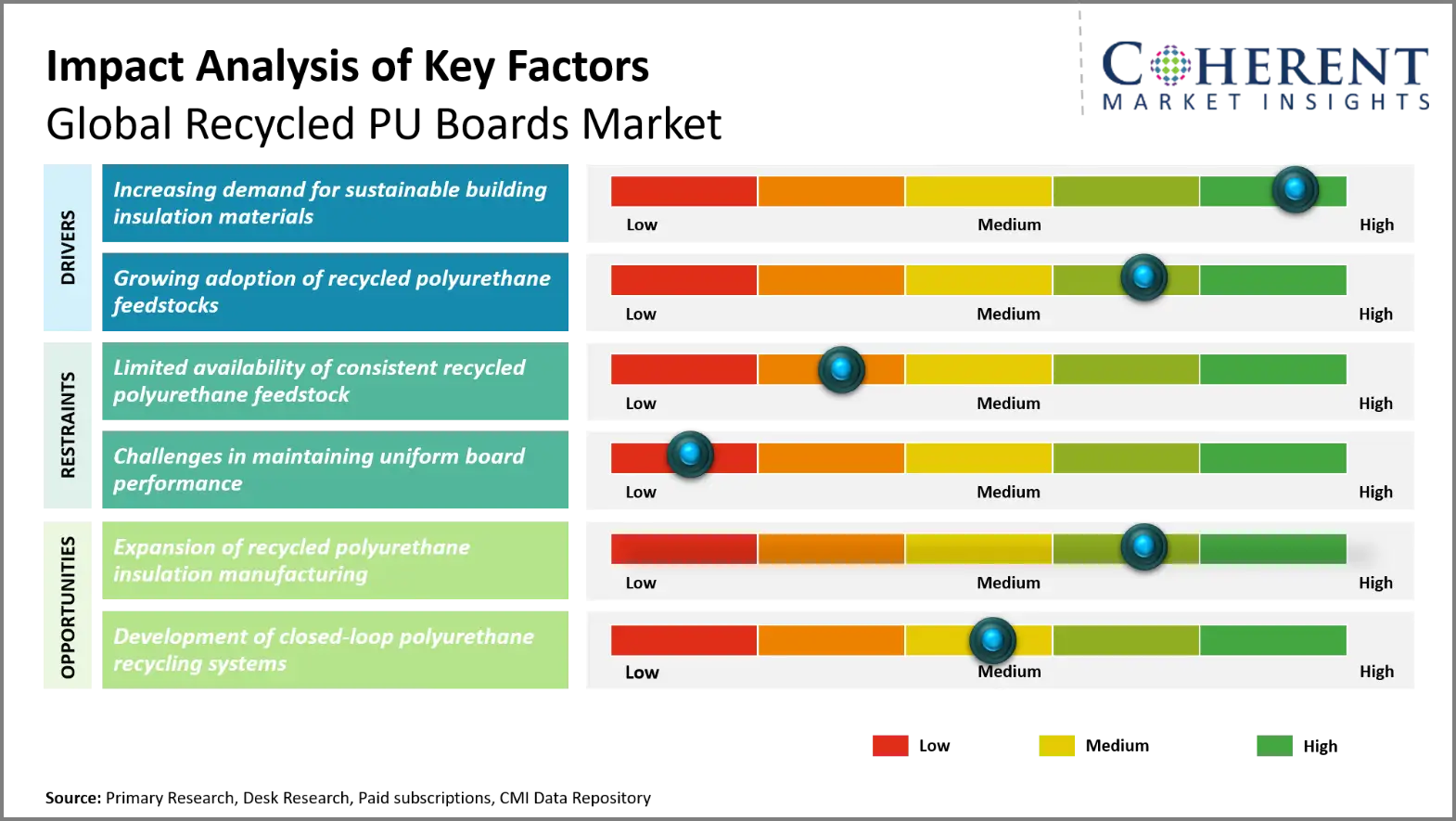
Market Drivers
- Increasing demand for sustainable building insulation materials: Growing focus on energy efficient buildings is driving demand for sustainable insulation materials. Recycled polyurethane boards provide thermal insulation using recovered industrial and post-consumer materials. Owing to its insulating capabilities, they help to reduce the need for heating and cooling in residential, commercial and industrial structures. Green building initiatives are prompting manufacturers to analyze recycled content and environmental performance. Building restoration projects often offer a chance to increase insulation. These advancements increase the interest in PU boards from recycled materials as resource-efficient building materials.
- On May 15, 2025, Carlisle Companies Incorporated announced that it has signed a final deal to acquire certain assets of Bonded Logic, Inc. and Phoenix Fibers, LLC. Bonded Logic is a U.S. manufacturer of sustainable thermal and acoustical insulation products. The acquisition of Bonded Logic is consistent with Carlisle’s Vision 2030 strategy and its strategic pivot to a pure play building products company.
- Growing adoption of recycled polyurethane feedstocks: The growing amount of polyurethane waste is leading producers to look at recycled feedstocks. Offcuts from industrial manufacture, insulation waste and recovered polyurethane are potential secondary raw materials. Suitable garbage can be transformed into useful particles by mechanical recycling. When the quality of these particles fits the production criteria, they can enter board manufacture. Using recycled feedstocks can lessen dependence on virgin polyurethane resources. Their adoption also helps divert waste and circularly use materials. However, contaminants, irregular composition and processing constraints affect the usability of the feedstock.
- On October 13, 2026, Evonik, Toyotsu Chemiplas Corporation and Sanyo Chemical Industries jointly developed a polyurethane recycling model in Japan. The partnership is built on post-consumer foam and post-industrial polyurethane manufacturing waste.
Emerging Trends
- Development of High-Performance Recycled Polyurethane Insulation Boards: Manufacturers are developing recycled polyurethane boards that offer superior thermal insulation, dimensional stability, and mechanical strength. These efforts are directed toward the extension of applications to energy efficient buildings, roofing systems, insulated panels and industrial construction projects.
- Impact: Increased product performance can lead to greater acceptability by construction builders and insulation producers. Improved uniformity also lets recycled boards compete with traditional polyurethane insulation solutions in demanding building applications.
- Relevance to the market: Recycled rigid polyurethane boards may be used as insulation cores in prefabricated building panels. By mixing recycled polyurethane particles with suitable binders, producers can aim at construction uses where dependable insulating performance is essential.
- Increasing Integration of Recycled Polyurethane into Circular Construction Supply Chains: Suppliers of construction materials are teaming up to collect and recycle waste polyurethane. These activities help ensure the availability of recovered feedstock and encourage producers to use recycled materials in the production of insulation boards.
- Impact: Improved recycling networks can stabilize feedstock supply and reduce material disposal. Better cooperation between recyclers and board makers can enhance processing efficiency and help to commercial production.
- Relevance to the market: European recovery activities for construction materials generate prospects for producers of recycled polyurethane insulation. Partnerships between demolition contractors, waste processors and insulation manufacturers could provide reliable secondary feedstock pathways.
Regional Insights
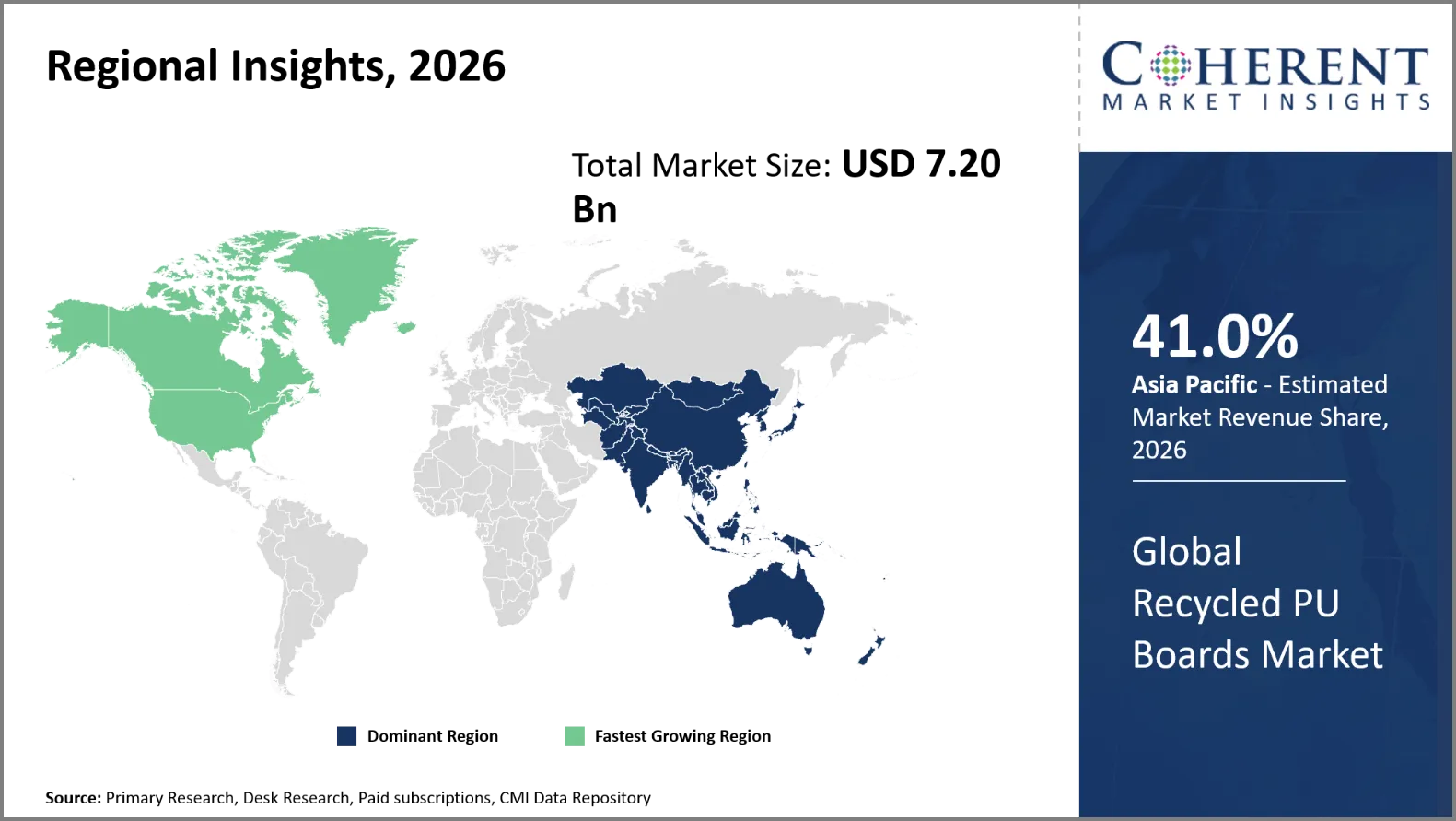
Why is Asia Pacific a Strong Market for Recycled PU Boards?
Asia Pacific is expected to account for a market share of 41.0% in 2026. Growing polyurethane manufacture, need for construction insulation, and industrial waste recovery operations benefit Asia Pacific. China, India, Japan and South Korea present unique potential for the production of recycled polyurethane board. China's massive appliance production produces hard polyurethane foam trash from refrigeration equipment. There are prospects for recycled insulation panels in the growing industrial roofing and prefabricated construction segments of India. Japan’s study on polyurethane recycling is finding better ways to reclaim discarded foam. In Asian economies, the Organization for Economic Co-operation and Development highlights building as a prominent application for plastics. However, regional recycling infrastructure and polyurethane waste segregation require further development.
Why Does North America Recycled PU Boards Market Exhibit High Growth?
North America is expected to register the fastest growth with a CAGR of 8.5% over the forecast period. It is projected to account for 27.0% of the global recycled PU boards market in 2026. The region benefits from the presence of polyurethane production, industrial insulation uses and a growing interest in material recovery. The U.S. has prospects in commercial building rehabilitation, industrial insulation replacement and recovered foam utilization. A material flow study predicted U.S. polyurethane usage to be 3.7 million tons in 2016. Close to 390,000 tons entered the recycling processes, largely as carpet padding. This shows the possibilities to extend the recycling of polyurethanes to other fields. The Canadian construction insulation industry also has the potential to provide feedstock from offcuts from manufacturing and restoration projects. Improved sorting and processing infrastructure could bolster regional recycled paperboard manufacturing.
Global Recycled PU Boards Market Outlook for Key Countries
Why is China Emerging as a Major Hub in the Recycled PU Boards Market?
China has a large ecosystem of polyurethane manufacturers and a significant need for insulated construction materials. The remnants of rigid polyurethane foam, generated in the manufacture of refrigeration equipment, are ideal for recycling assessment. Polyurethane offcuts are also produced during the manufacture of insulation panels in industrial plants. These materials offer prospective feedstock prospects for reclaimed board makers. In China, applications in the prefabricated construction industry include insulated wall panels, roofing systems and industrial building envelopes. The country's circular economy programs promote the recovery of industrial resources and the use of trash from industry. Those household recyclers can expand their market share by creating strong collection partnerships with appliance makers. Consistent separation of feedstock is still needed to produce construction-grade recycled polyurethane board.
Is U.S. the Next Growth Engine for the Recycled PU Boards Market?
The U.S. market benefits from commercial roof renovations, industrial insulation replacement and existing polyurethane waste recovery operations. Insulation retrofit potential in aging warehouses, manufacturing facilities and commercial buildings. The EPA’s sustainable materials management approach promotes conservation of resources and reduction of waste. Published material flow analysis predicted over two million tons of post-consumer waste of polyurethane in 2016. Only a small fraction returned to manufacturing uses, indicating significant recovery prospects. Recycled polyurethane boards could be aimed at industrial insulation and building renovation applications. Manufacturers can build dependable collection systems for wasted rigid foam to enhance the availability of domestic feedstock.
Germany Recycled PU Boards Market Analysis and Trends
Germany has built up polyurethane manufacturing, industrial recycling capacities and a robust circular economy infrastructure. Germany handled almost 12.8 million tons of plastics in 2023, said the Federal Environment Agency. Processed and recycled by-products made up about 15% of the processed plastic materials. Construction applications dominated domestic plastics processing, accounting for 23.7%. These data indicate the opportunity for recycled materials in construction goods. Germany also produces a lot of construction and demolition debris, which provides incentives for enhanced material recovery. Covestro and Fraunhofer Institute for Environmental, Safety and Energy Technology are developing a pyrolysis pilot plant targeting rigid polyurethane foam waste.
Japan Recycled PU Boards Market Analysis and Trends
Japan offers opportunities through advanced polyurethane processing, industrial waste management, and research into foam recycling technologies. Refrigeration equipment manufacturing provides an important source of rigid polyurethane insulation waste. Construction renovation activities also generate discarded insulation materials requiring appropriate recovery methods. Japanese industry research has examined construction-site polyurethane waste and alternative recovery pathways. A significant Japanese document on recycling of polyurethane noted a long history of reclamation and cremation. It also identified prospects for converting acceptable polyurethane waste into refuse derived gasoline. Mechanical processing and enhanced material separation could enable greater value applications. Recovered foam feedstocks developed by manufacturers can be targeted toward insulation boards and industrial applications.
India Recycled PU Boards Market Analysis and Trends
India offers chances in industrial construction, warehouse growth and growing demand for insulated building materials. Manufacturing facilities, cold storage warehouses, and pharmaceutical infrastructure need excellent thermal insulation solutions. The applications offer potential demand for recycled polyurethane boards. The Environment (Construction and Demolition) Waste Management Rules, 2025 came into force on April 1, 2026. These guidelines enhance requirements for construction waste management and recycling. The expanding prefabricated construction industry in India also opens up potential for insulation panel makers. Furniture, appliance and insulation makers can team together with domestic processors of polyurethane. Such partnerships can improve production scrap collection and establish more consistent recycled feedstock supplies.
Global PU Boards Market - Quantified Polyurethane Recycling Performance
Technology / process | Recovery or recycling | Reported value (%) | Feedstock |
Rebonding | PU scrap content in recycled foam formulation | 90 | Flexible PU foam scrap |
Rebonding | Binder content in recycled foam formulation | 10 | Flexible PU foam scrap and binder |
Split-phase glycolysis | Recovered polyol yield | 93.9 | Flexible PU foam waste |
Maleic acid acidolysis | Isolated recycled polyol yield | 95 | Flexible PU foam |
Maleic acid acidolysis | Total recovered material share | 80 | Flexible PU foam |
Glycolysis followed by hydrolysis | Amine production yield | 29 | PU model substrate |
Glycolysis followed by hydrolysis | Amine production yield | 33 | Dicarbamate model substrate |
Glycolysis followed by hydrolysis | Amine production yield | 41 | Dicarbamate model substrate |
Ionolysis using ionic liquids | Depolymerization yield | 94 | Flexible PU foam waste |
Ionolysis using ionic liquids | Recovered polyol yield | 73 | Flexible PU foam waste |
How is Expansion of Recycled Polyurethane Insulation Manufacturing Creating New Growth Opportunities in the Recycled PU Boards Market?
Expansion of recycled polyurethane insulation manufacturing is creating growth opportunities by converting recovered rigid foam waste into commercially usable board products. Producers can buy production waste, discarded refrigerator insulation material and recovered building foam for processing into recycled insulation materials. This makes it possible to develop specialized board manufacturing lines near the plants where polyurethane is processed. Germany’s developing chemical recycling work with Covestro and the Fraunhofer Institute, for instance, shows efforts to reclaim valuable ingredients from discarded stiff polyurethane foam. In India, the growth of cold storage and industrial warehouse development provides opportunities for the usage of recycled insulation boards. Companies that invest in technologies for feedstock separation, particle processing and appropriate binders might produce products for specialized applications in roofing, wall insulation and pre-fabricated construction panels.
On February 26, 2026, Rogers Corporation announced the introduction of PORON ReSource30 polyurethane material. An innovative formulation containing post-industrial recycled and renewable bio-based content, PORON ReSource30 polyurethane is engineered for customers for whom sustainability is a key part of their mission statement.
Market Players, Key Development, and Competitive Intelligence
Key Developments
- On May 13, 2026, Recticel Group announced the opening of its new industrial-scale recycled polyol plant in Wevelgem, Belgium. This milestone marks a significant step in the Group’s sustainability roadmap and a decisive move toward circularity in the insulation boards, manufactured by Recticel Insulation.
- On March 6, 2025, BASF announced it will showcase its leadership in polyurethanes (PU) through various innovations at CHINAPLAS 2025. The progress of its innovative PU recycling technology comes as a flagship solution at the event. With Loop, BASF introduces a range of PU solutions incorporating recycled content, market-ready and tailored for the footwear, automotive and synthetic leather industries.
Competitive Landscape
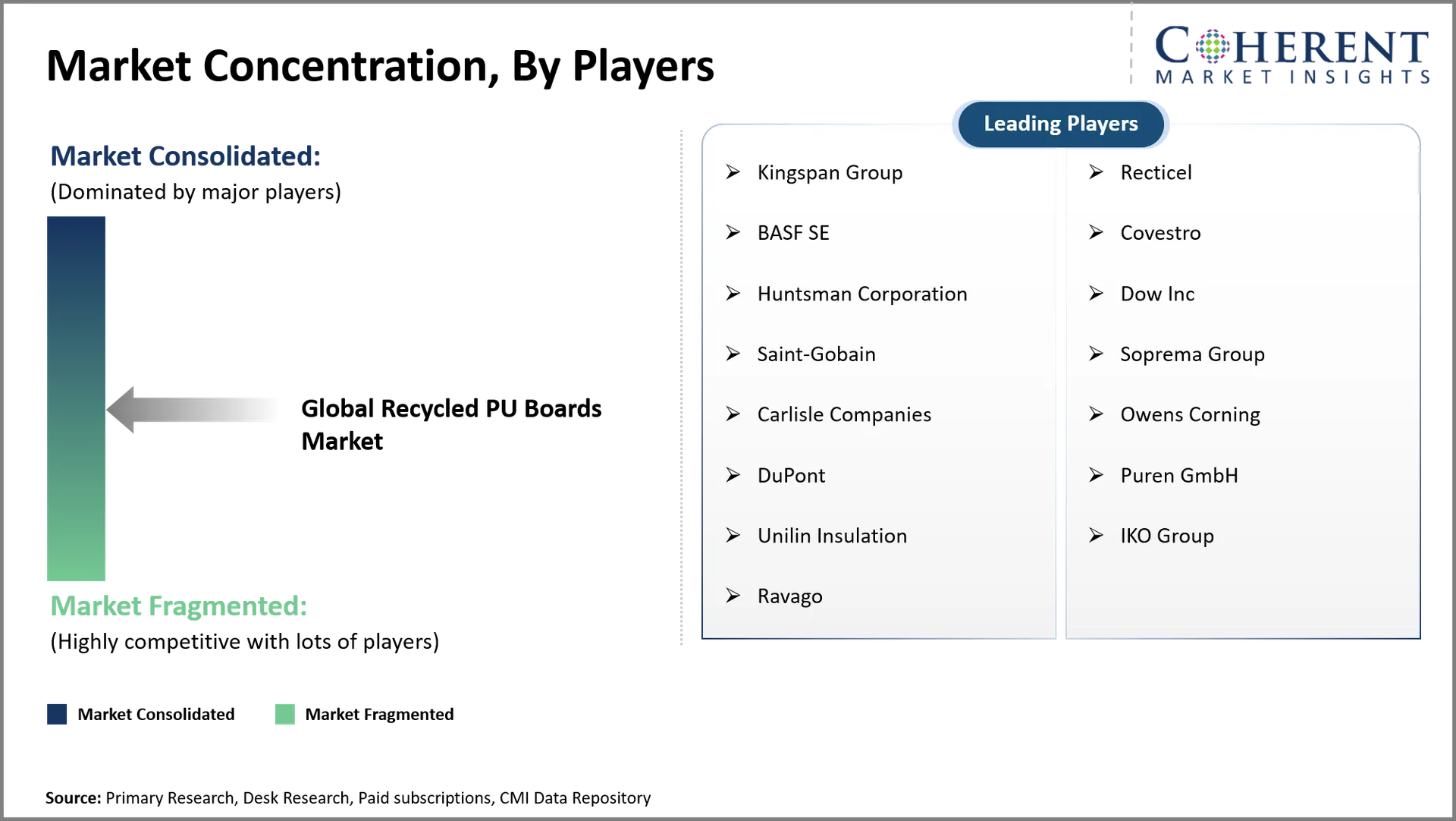
The global recycled PU boards market features insulation manufacturers, polyurethane chemical producers, and specialized recycling technology developers. Unilin Insulation strengthens its competitive position through polyurethane recycling and circular insulation board development. Its Rezillo product range focuses on moisture-resistant recycled PIR insulation materials. The company operates recycling initiatives covering manufacturing, construction-site, and end-of-life waste. Covestro AG focuses on chemical recycling technologies for recovering valuable raw materials from rigid polyurethane foam. Its collaboration with Fraunhofer Institute for Environmental, Safety and Energy Technology enables the development of smart pyrolysis. BASF SE provides polyurethane chemical innovations and circular insulating material solutions. Kingspan Group is focused on sustainable goods and high-performance insulated building solutions. Recticel NV emphasizes engineered foam technologies and insulation applications. Competitive differentiation increasingly depends on recycled feedstock quality, thermal performance, processing efficiency, and construction product certification.
Top Manufacturers and Notable Products in the Recycled PU Boards Market
Manufacturer | Notable Product | Key features |
Unilin Insulation | Rezillo | Uses PIR production scraps and cuttings, durable construction board, supports material circularity |
Warmotech | Warmotech 550 and 700 | 550 and 700 kg/m3 densities, 10–80 mm thickness, moisture resistance, high compressive strength |
KOPUR | Rebonded PU foam products | 96% verified recycled content, 100–350 kg/m3 density, acoustic and thermal insulation |
Obiform | Rebonded polyurethane sheets | 60–250 kg/m3 density, 2000 × 1000 mm standard format, compression resistance, impact absorption |
AS Rubber | AS704 Reconstituted Foam | 100% recycled material, 90 kg/m3 density, high durability and resilience |
Market Report Scope
Global Recycled PU Boards Market Report Coverage | |||
Report Coverage | Details | ||
Base Year | 2025 | Market Size in 2026: | USD 7.20 Bn |
Historical Data For: | 2020 To 2024 | Forecast Period: | 2026 To 2033 |
Forecast Period 2026 To 2033 CAGR: | 8.40% | 2033 Value Projection: | USD 10.60 Bn |
Geographies covered: |
| ||
Segments covered: |
| ||
Companies covered: | Kingspan Group, Recticel, BASF SE, Covestro, Huntsman Corporation, Dow Inc, Saint-Gobain, Soprema Group, Carlisle Companies, Owens Corning, DuPont, Puren GmbH, Unilin Insulation, IKO Group, Ravago | ||
Growth Drivers: |
| ||
Restraints & Challenges: |
| ||
Analyst Opinion (Expert Opinion)
- The future of the recycled PU boards industry will depend on converting polyurethane waste into consistent, construction-grade insulation products. Mechanical recycling should remain important for manufacturers processing clean production scrap and rigid foam offcuts. Chemical recycling could complement mechanical processes when contaminated or complex polyurethane waste requires alternative recovery methods. Recycled rigid polyurethane boards should attract stronger interest from manufacturers targeting lower-waste construction materials. Product developers have to keep insulation performance, dimensional stability, moisture resistance and fire safety. Commercial success will be found in showing the viability of recycled materials for certain building applications.
- The strongest potential will be in recycled stiff polyurethane boards for industrial buildings, cold storage warehouses, commercial roofs and prefabricated wall panels. China and India have growing industrial infrastructure and construction activities, which are attractive manufacturing prospects. Germany is a market for sophisticated recycling technology and high-quality insulating applications. The U.S. has an opportunity with commercial building retrofits and industrial insulation replacement. Manufacturers should focus on boards made from recovered rigid polyurethane foam, rather than on fighting for recycled content claims. A particularly enticing product distinction may be specialized insulating panels for temperature-controlled facilities.
- Market participants should create direct feedstock relationships with appliance manufacturers, demolition contractors, insulation manufacturers, and polyurethane processing facilities. These agreements can also result in cleaner waste streams and less procurement inconsistencies. Companies should invest in sorting technologies, particle size control, binder compatibility and automated board making. Prioritize quantifiable thermal conductivity, compressive strength, moisture resistance and fire performance in product development. Manufacturers should also establish application-specific testing and transparent documentation of recycled material. Strategic alliances with construction panel manufacturers can speed commercial uptake. Companies combining reliable feedstock sourcing with certified product performance will establish stronger competitive positions.
Speak to the analyst
Want personalized insights?
Take the findings above to one of our principal consultants, or have the report rebuilt around the segments, geographies and competitors you actually track.
Market Segmentation
- Board Type Insights (Revenue, USD Billion, 2021 - 2033)
- Recycled Rigid Polyurethane Boards
- Recycled Polyisocyanurate Boards
- Recycled Flexible Polyurethane Boards
- Recycled Polyurethane Composite Boards
- Recycling Technology Insights (Revenue, USD Billion, 2021 - 2033)
- Mechanical Recycling
- Chemical Recycling
- Rebonding
- Reprocessed PU Composite Manufacturing
- Application Insights (Revenue, USD Billion, 2021 - 2033)
- Building and Construction
- Refrigeration and Cold Chain
- Industrial Insulation
- Transportation
- Industrial Modeling and Tooling
- Packaging
- Others
- End User Insights (Revenue, USD Billion, 2021 - 2033)
- Residential Construction
- Commercial Construction
- Industrial Facilities
- Cold Storage Warehouses
- Others
- Regional Insights (Revenue, USD Billion, 2021 - 2033)
- North America
- U.S.
- Canada
- Latin America
- Brazil
- Argentina
- Mexico
- Rest of Latin America
- Europe
- Germany
- U.K.
- Spain
- France
- Italy
- Russia
- Rest of Europe
- Asia Pacific
- China
- India
- Japan
- Australia
- South Korea
- ASEAN
- Rest of Asia Pacific
- Middle East
- GCC Countries
- Israel
- Rest of Middle East
- Africa
- South Africa
- North Africa
- Central Africa
- North America
- Key Players Insights
- Kingspan Group
- Recticel
- BASF SE
- Covestro
- Huntsman Corporation
- Dow Inc
- Saint-Gobain
- Soprema Group
- Carlisle Companies
- Owens Corning
- DuPont
- Puren GmbH
- Unilin Insulation
- IKO Group
- Ravago
Sources
Primary Research Interviews
- Recycled PU Board Manufacturers
- Raw Material Suppliers (Recycled Polyurethane Foam Processors)
- End-Use Industry Representatives (Construction & Furniture Sectors)
- Distributors & Traders of Recycled PU Boards
Magazines
- Plastics Technology Magazine
- Urethanes Technology International
- Construction Materials & Recycling Magazine
- Foam & Polyurethane Industry Review
Journals
- Journal of Cleaner Production (Elsevier)
- Resources, Conservation and Recycling (Elsevier)
- Journal of Polymer Science & Engineering
Associations
- European Diisocyanate & Polyol Producers Association (ISOPA)
- Centre Européen des Silicones (CES) / Polyurethanes Sector
- American Chemistry Council (ACC) - Polyurethanes Division
- Plastics Recyclers Europe (PRE)
Public Domain Sources
- U.S. Environmental Protection Agency (EPA) - Recycling & Waste Management Data
- European Environment Agency (EEA) - Circular Economy Reports
- United Nations Environment Program (UNEP) - Sustainable Materials Reports
- World Bank – Green Economy & Recycling Statistics
Proprietary Elements
- CMI Data Analytics Tool
- Proprietary CMI Existing Repository of Information for Last 10 Years
Get access to 250+ pages report
Every segment, forecast, competitor profile and data table behind the analysis above — available for instant download.
- ESOMAR Member
- ISO 9001:2015 Certified
- D-U-N-S Registered
- GDPR & CCPA Compliant
Frequently Asked Questions
The global recycled PU boards market is expected to stand at USD 7.20 Bn in 2026 and is expected to reach USD 10.60 Bn by 2033.
The CAGR of the global recycled PU boards market is projected to be 8.4% from 2026 to 2033.
Increasing demand for sustainable building insulation materials and Growing adoption of recycled polyurethane feedstocks are the major factors driving the growth of the global recycled PU boards market.
Limited availability of consistent recycled polyurethane feedstock and Challenges in maintaining uniform board performance are the major factors hampering the growth of the global recycled PU boards market.
In terms of board type, recycled rigid polyurethane boards segment is estimated to dominate the market revenue share in 2026.
Recycled PU boards are insulation or construction boards manufactured using recovered polyurethane materials.
Manufacturers use recovered rigid polyurethane foam, industrial offcuts, insulation waste, and processed polyurethane particles.