

Global Recycling Technologies Market Size and Forecast – 2026 To 2033
The Global Recycling Technologies Market is estimated to be valued at USD 45.92 Bn in 2026 and is expected to reach USD 78.19 Bn by 2033, expanding at a compound annual growth rate (CAGR) of 7.90% during 2026–2033. Market expansion is supported by investments in waste processing infrastructure, regulatory measures promoting resource recovery, and manufacturers' increasing use of recycled raw materials.
In December 2025, the U.S. Environmental Protection Agency (EPA) selected 16 local-government applicants to receive approximately USD 62 million through its Solid Waste Infrastructure for Recycling grant program. This initiative highlights how public funding can support recycling infrastructure modernization and create opportunities for sorting equipment, material recovery systems, and advanced recycling technologies.
Key Takeaways of the Global Recycling Technologies Market
- Mechanical Recycling Technologies are estimated to expand at a CAGR of 7.0% through 2033 and hold 59.4% of the global recycling technologies market in 2026. Established collection networks and commercially proven material recovery processes favor this route for scalable operations. In July 2025, LyondellBasell reported FDA no-objection letters for its Chinese joint venture’s mechanically recycled polypropylene and high-density polyethylene processes.
- Recycling Equipment and Machinery is projected to register a CAGR of 7.4% through 2033 and represent 67.8% of global recycling technologies market revenue in 2026. Capital spending concentrates on hardware that determines throughput, material purity, and recovery yield across recycling plants. In April 2026, TOMRA launched its redesigned FINDER metal-sorting platform, featuring configurable sensors for recovering metals from vehicle scrap and electronic waste.
- Plastic Waste recycling is forecast to achieve a CAGR of 9.0% through 2033 and account for 32.4% of the global recycling technologies market in 2026. Mixed polymer streams and demand for reusable feedstocks make plastics a priority for differentiated processing technologies. In March 2025, BASF signed an agreement to source pyrolysis-derived feedstock from Braven Environmental’s planned Texas facility for use in chemical production.
- Europe recycling technologies market is expected to expand at a CAGR of 6.7% through 2033, following a leading 34.2% share of global revenue in 2026. Established collection systems and compliance-led infrastructure spending support technology purchases across the region. In February 2025, the European Commission confirmed that its Packaging and Packaging Waste Regulation had entered into force, strengthening the framework for recyclable packaging and secondary materials.
- Asia Pacific recycling technologies market is anticipated to deliver the fastest CAGR of 9.8% through 2033, while accounting for 32.6% of global revenue in 2026. Expanding formal collection and processing systems creates opportunities for new equipment installations across major urban markets. In January 2026, India notified Solid Waste Management Rules requiring source segregation and formally recognizing material recovery facilities as sorting infrastructure.
Segmental Insights
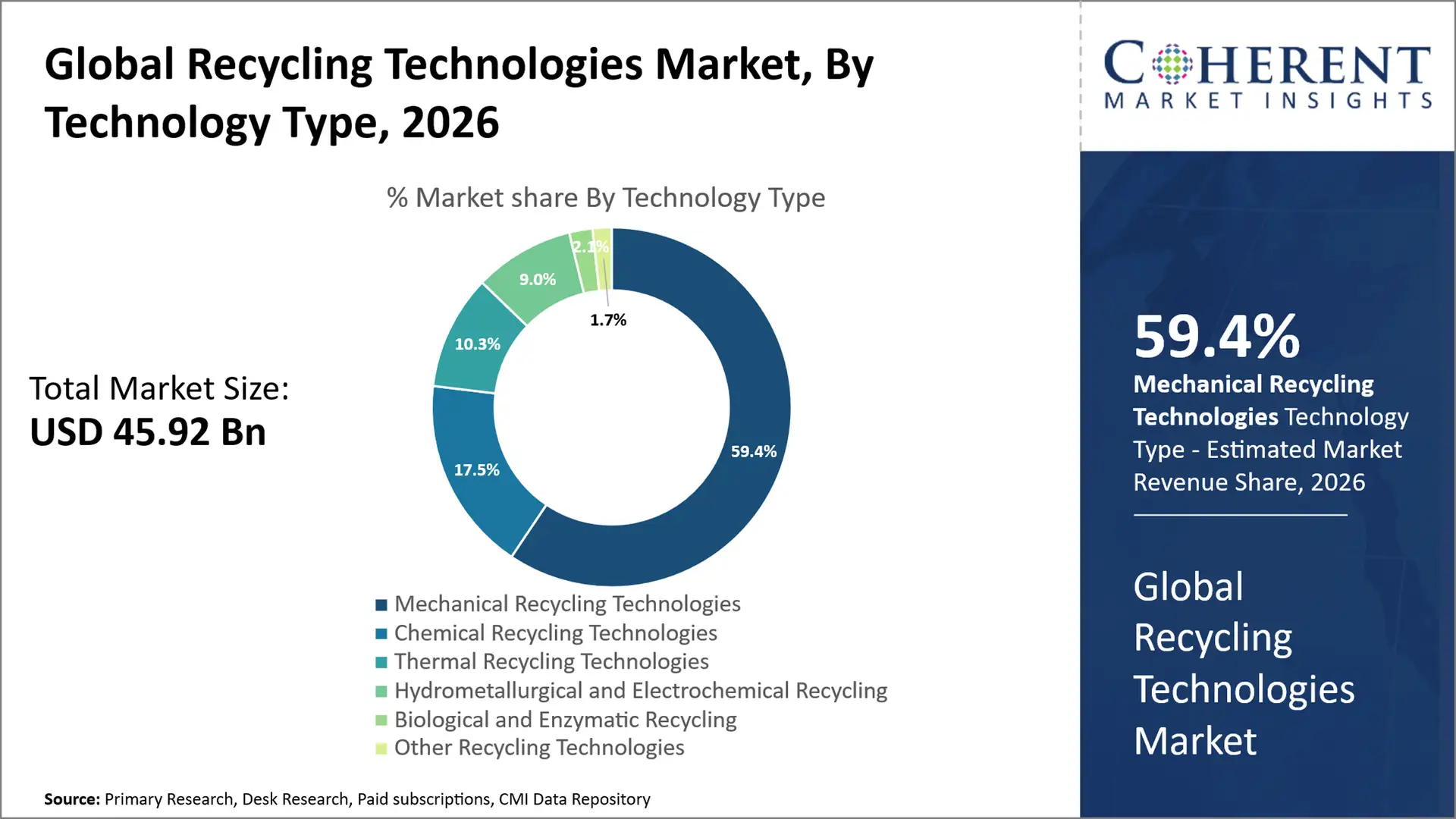
Why Do Mechanical Recycling Technologies Dominate the Global Recycling Technologies Market?
Mechanical Recycling Technologies are expected to command 59.4% of the global recycling technologies market by technology type in 2026. Their leading position reflects the ability to recover marketable fractions through physical separation without altering the underlying material chemistry. This is especially valuable for non-ferrous metals trapped in incinerator bottom ash, where electromagnetic and sensor-based sorting can isolate saleable grades from highly variable residues. Recycling operators benefit because physical processing configurations can be adapted to different particle sizes and metal compositions, creating revenue from materials otherwise discarded. In August 2025, STEINERT reported that MDSU's Magdeburg facility in Germany was using eddy-current and X-ray sorting systems to recover non-ferrous metal concentrates from bottom ash. The project illustrates how targeted mechanical recovery can improve the economics of difficult secondary-resource streams.
- Current Industry Events of 2026
- Market Size Estimation
- Regional Breakdown
- Competitive Landscape
- Customer Intelligence
- Segmental Analysis
- Pricing Analysis
- Key Market Drivers, Challenges & Future Trends
- Customized Insights Section
Why Do Recycling Equipment and Machinery Represent the Largest Offering in the Global Recycling Technologies Market?
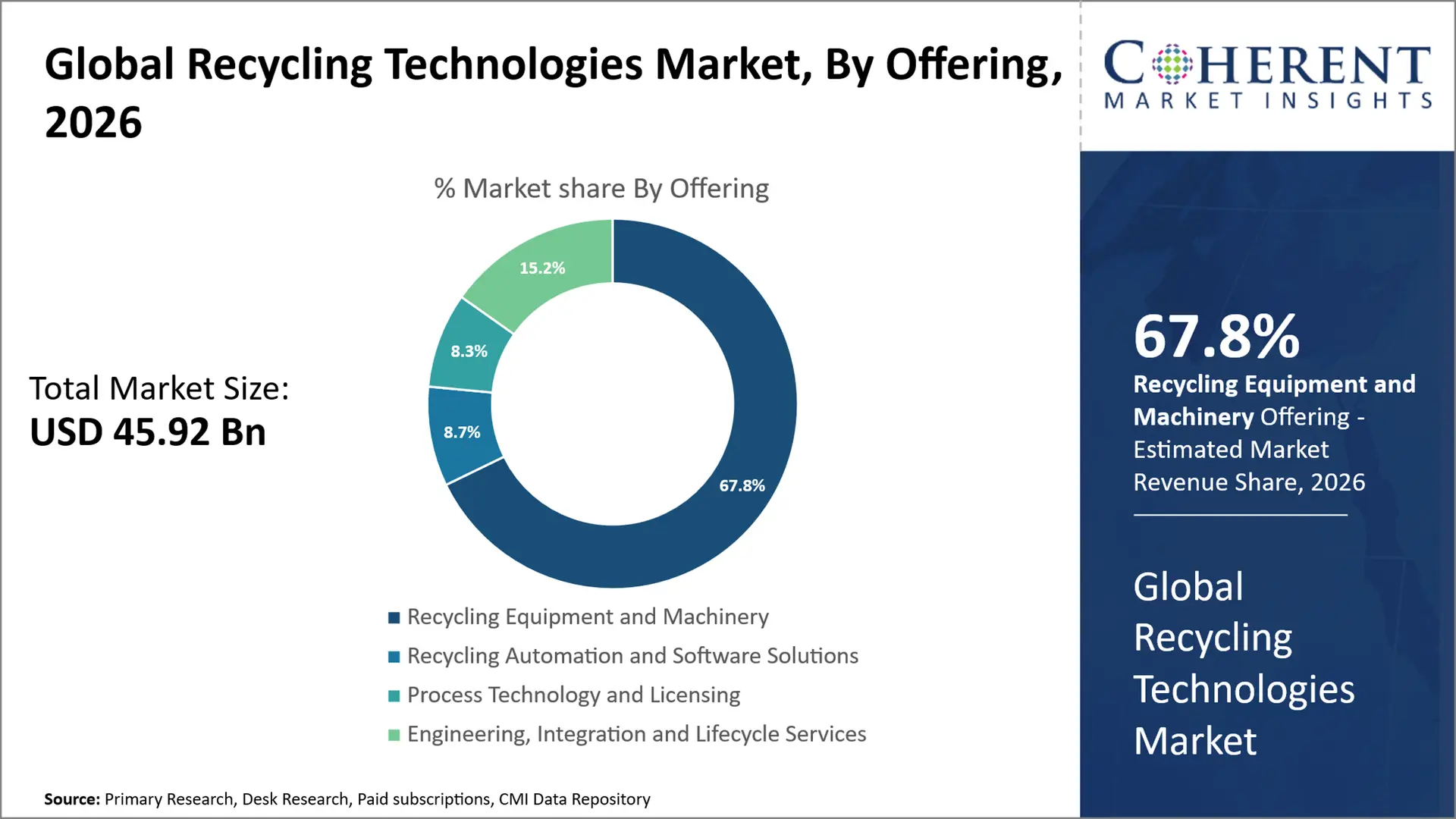
Recycling Equipment and Machinery is projected to account for 67.8% of the global recycling technologies market by offering in 2026. Equipment represents the largest spending component because an operating material recovery facility must physically feed, screen, convey, segregate, and discharge waste before software or engineering services can deliver value. Private operators purchase integrated machinery lines to handle changing commercial waste mixtures, while municipalities prioritize equipment that limits manual handling and protects downstream product quality. For manufacturers, the advantage lies in designing durable, interoperable systems that customers can expand over time. In June 2026, CP Group reported that it had engineered, manufactured, and commissioned a new commercial processing line at Mid-Valley Recycling's Fresno facility in California. Its combination of screens, separators, and optical sorters demonstrates the breadth of hardware required for modern multi-material processing.
Why Does Plastic Waste Lead the Waste Stream Segment of the Global Recycling Technologies Market?
Plastic Waste is expected to lead the global recycling technologies market by waste stream with a 32.4% share in 2026. Its position reflects the technical diversity of discarded polymers: recyclers must separate resins and remove labels, residues, and color contamination before recovered material can satisfy manufacturing specifications. Unlike metal scrap, many recycled plastics are sold into applications where appearance, odor, and consistent melt properties directly influence acceptance. These requirements create recurring demand for dedicated washing, purification, and pelletizing capacity close to major packaging production hubs. In November 2024, ALPLA opened a PET recycling plant in Ballito, South Africa, designed to produce recycled PET flakes and food-safe pellets for subsequent packaging manufacture. The investment illustrates why waste-specific processing capabilities and secure industrial outlets matter for plastic recycling economics.
Current Events and their Impact
Current Event | Description and Its Impact |
May 2026 – California Approves Permanent Regulations Under SB 54 |
|
January 2025 – Basel Convention E-Waste Amendments Take Effect |
|
June 2025 – UK Confirms Packaging EPR Fees and Modulation Framework |
|
Global Recycling Technologies Market Dynamics
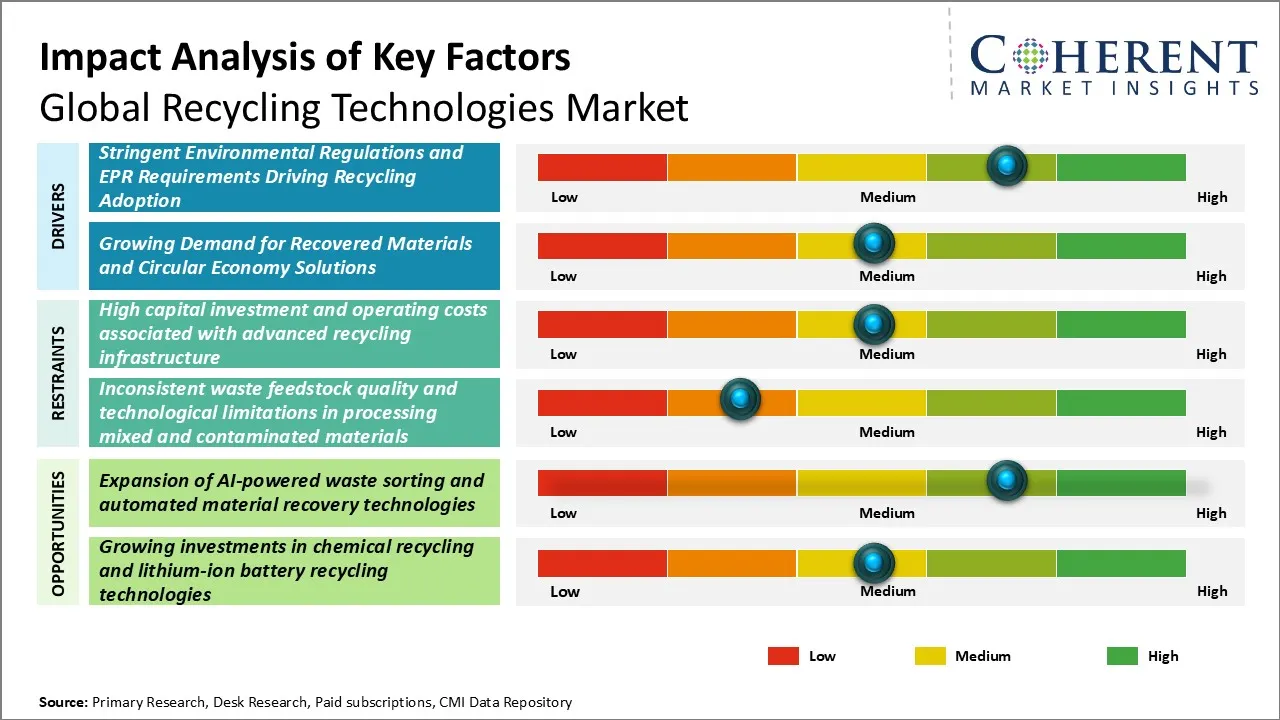
Key Market Drivers
- Stringent Environmental Regulations and EPR Requirements Driving Recycling Adoption: Extended producer responsibility (EPR) is changing recycling infrastructure investment from discretionary spending into a more structured compliance requirement. Producer-funded collection and processing programs provide municipalities and recycling operators with additional resources for facility modernization, material sorting, and recovery operations. This creates commercial opportunities for equipment manufacturers and technology integrators. In July 2025, Oregon's Department of Environmental Quality implemented its Plastic Pollution and Recycling Modernization Act program, directing producer funding toward expanded collection and improved sorting infrastructure. Such financing mechanisms can improve investment certainty for recycling technology providers.
- Growing Demand for Recovered Materials and Circular Economy Solutions: Manufacturers' recycled-content requirements are reshaping procurement decisions across electronics, automotive components, and industrial materials. Recycling companies capable of delivering consistent material purity, verified provenance, and reliable supply can establish stronger relationships with downstream manufacturers. This creates opportunities for advanced separation, purification, and metal recovery technologies. In April 2026, Apple reported achieving fully recycled cobalt content in its Apple-designed batteries and recycled rare earth elements in its magnets. Such manufacturing requirements strengthen the commercial case for recycling systems that produce materials meeting demanding industrial specifications.
Emerging Market Trends
- Performance-Based Contracts Are Reshaping Recycling Equipment Procurement: Recycling plant buyers are evaluating technology bids against verified cost per processed ton, equipment availability, and recoverable output rather than acquisition price alone. This can shift purchasing toward guaranteed-performance contracts and service arrangements that share operating risk between equipment providers and facility operators. Systems capable of continuous monitoring and transparent reporting should gain an advantage, while smaller machinery vendors may need specialist partners to meet demanding service commitments. Through the forecast period, procurement teams are likely to treat dependable operating economics as a more meaningful differentiator than machine specifications.
- Hybrid Recycling Processes Are Expanding Treatment Options for Complex Waste: Facilities handling laminated packaging, contaminated polymers, or complex scrap increasingly need more than a single recycling method. A staged configuration can first isolate reusable fractions mechanically before sending residual material to targeted chemical or thermal processes. The commercial shift lies in matching processing intensity to feedstock value, limiting unnecessary energy use and preserving profitable material streams. Technology licensors and plant integrators may benefit from interoperability, while narrowly designed systems risk losing bids. Adoption should progress selectively where sufficient volumes and secure downstream buyers justify process complexity.
Regional Insights
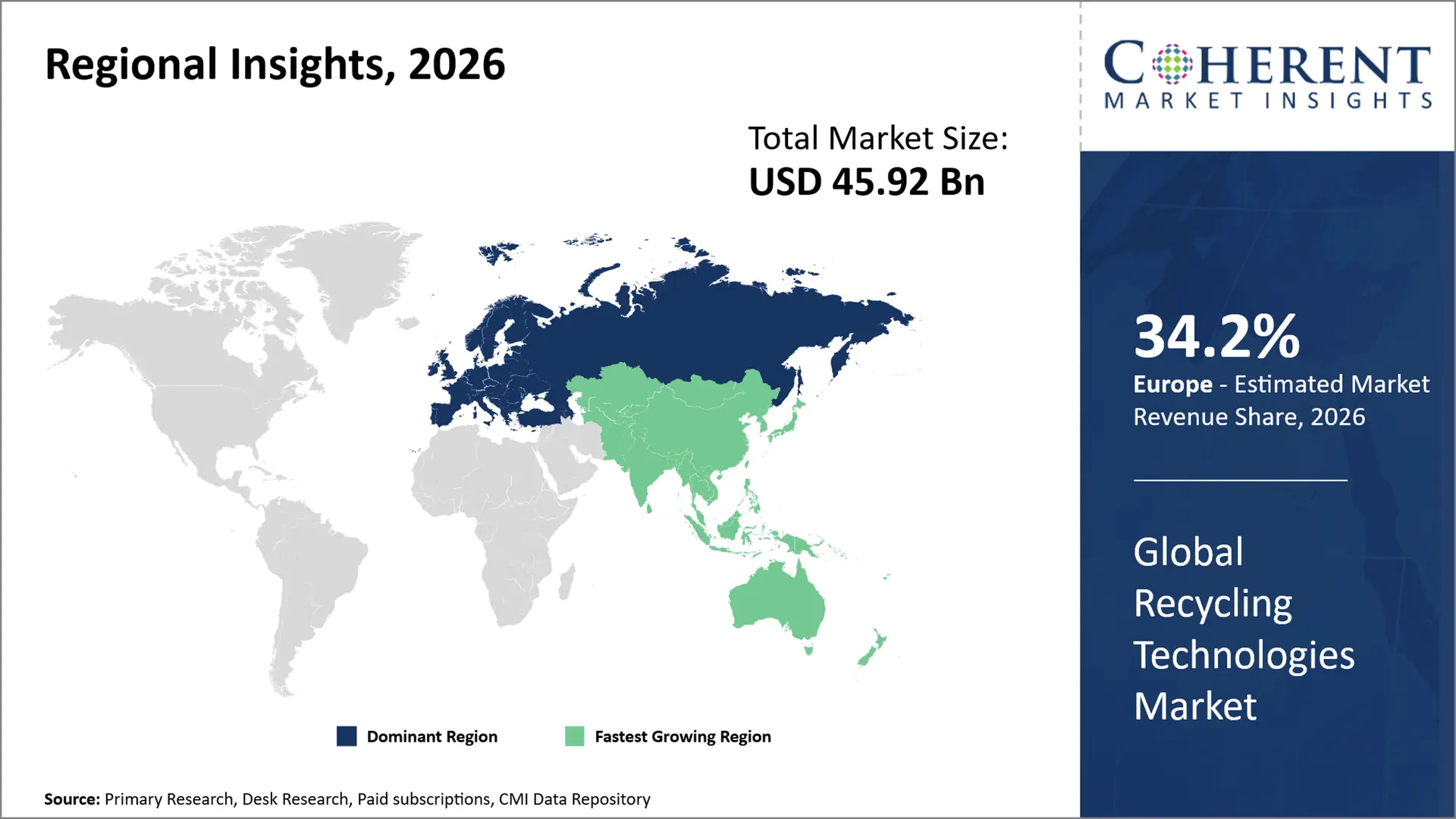
Why Does Europe Dominate the Global Recycling Technologies Market?
Europe is expected to lead the global recycling technologies market with a 34.2% share in 2026, supported by an established network of specialist recyclers, industrial buyers, and technology engineering firms. Its competitive advantage extends beyond conventional collection, as manufacturers increasingly need facilities capable of extracting usable chemicals and materials from residual waste that existing sorting lines cannot recover economically. Long-term project financing is important because such plants require substantial capital before sales of recovered products begin. In July 2025, the European Investment Bank and Santander agreed to finance Greene Enterprise's development of five waste-conversion facilities in Spain through a USD 250.97 million financing package. The planned plants use advanced pyrolysis to turn difficult residual waste into industrial feedstocks. This demonstrates how institutional financing can help European technology developers pursue commercial-scale recycling projects rather than remain limited to pilot installations.
Why Is Asia Pacific Emerging as the Fastest-Growing Region in the Global Recycling Technologies Market?
Asia Pacific is projected to be the fastest-growing regional global recycling technologies market, representing 32.6% of global revenue in 2026. Its growth opportunity lies in the transition from fragmented waste handling to professionally managed collection, sorting, and treatment systems. Across rapidly expanding cities, inconsistent segregation and limited municipal processing capacity can restrict the economics of installing advanced recycling equipment. Better-funded local services should therefore create an addressable market for modular material recovery facilities and operational support. In December 2025, the World Bank approved a US$350 million project in Indonesia to strengthen solid waste infrastructure and services, initially working with local governments. The program includes performance-based financing and measures to improve waste diversion. This approach can make recycling technology projects more financially viable by connecting equipment investment with collection quality and service accountability.
Global Recycling Technologies Market Outlook for Key Countries
Why Is the U.S. a Key Market for the Global Recycling Technologies Market?
The United States is a key recycling technologies market because its large chemical and packaging industries offer downstream manufacturing outlets for recovered feedstocks. Industrial operators are increasingly interested in processing materials that cannot meet conventional recycling specifications, particularly colored or contaminated polyester. Integration with chemical production is commercially valuable, as recovered molecular building blocks can enter established manufacturing lines rather than depend on a separate market for lower-grade recycled products. In March 2024, Eastman's Kingsport, Tennessee, molecular recycling facility began producing commercial-specification materials using methanolysis technology. The plant demonstrates a domestic route for upgrading difficult polyester waste into new material inputs. For equipment suppliers and technology licensors, the U.S. opportunity therefore extends to feedstock preparation, continuous process control, and integration between waste suppliers and manufacturers willing to qualify recycled intermediates.
Why Does China Support Growth in the Global Recycling Technologies Market?
China is important to the global recycling technologies market because its extensive solar manufacturing and installation base is creating a new industrial end-of-life processing challenge. Retired photovoltaic modules contain glass, aluminum, silicon, and metals, but adhesive layers make clean separation technically difficult. Recyclers must develop economical delamination and component extraction processes that serve the country's established smelting and materials industries. In March 2026, China's Ministry of Industry and Information Technology and five other departments issued guidelines to strengthen comprehensive recycling of retired photovoltaic modules. The guidelines call for improved dismantling technology, separation standards, and industrial reuse of recovered components. This provides a clearer development pathway for equipment manufacturers specializing in laminated waste, while encouraging manufacturers and recyclers to coordinate product design, collection logistics, and downstream material acceptance.
Why Is India Important in the Global Recycling Technologies Market?
India is becoming an important global recycling technologies market as electric mobility and stationary energy storage create a need to recover valuable battery materials domestically. End-of-life batteries and production scrap require controlled dismantling, black mass preparation, and chemical purification, making process expertise as important as equipment availability. Local recovery can reduce dependence on imported refined materials, although commercial success depends on securing consistent feedstock and meeting battery-grade quality requirements. In June 2025, India's Technology Development Board announced support for BatX Energies to commercialize an indigenous hydrometallurgical process designed to recover lithium, cobalt, nickel, and manganese from used lithium-ion batteries. The project illustrates opportunities for Indian engineering suppliers and process developers to move beyond basic scrap handling toward higher-value refining and materials qualification.
Why Is Germany a Strategic Country in the Global Recycling Technologies Market?
Germany holds a strategic position in the global recycling technologies market through its precision engineering capabilities and demanding industrial requirements for safe waste treatment. Battery recyclers face particular challenges when handling damaged cells, as conventional crushing can increase contamination and requires careful control of thermal and fire risks. Technologies that make early-stage material separation safer and cleaner can therefore attract specialist equipment investment. In July 2026, Fraunhofer IWKS reported that its spin-off Viridis Recycling had received an environmental operating permit for a battery recycling site in Hanau. Its Hydropulse process uses shockwaves in water to break down battery cells, while the company was still operating a pilot-scale system and pursuing further certification. The development illustrates Germany's ability to translate applied research into permitted recycling infrastructure without assuming that full commercial operations have already begun.
Why Is Japan an Important Growth Market for the Global Recycling Technologies Market?
Japan is an important market for recycling technologies because its electronics manufacturing ecosystem combines valuable recoverable materials with demanding expectations for processing safety and consistency. Small consumer devices are difficult to dismantle efficiently, as product designs vary, embedded batteries create operational hazards, and manual sorting can constrain throughput. Automated identification and selective dismantling therefore offer a commercial route to safer recovery of copper, precious metals, and rare metals. In September 2025, Japan's New Energy and Industrial Technology Development Organization began demonstrating an unmanned sorting system for used small appliances with industrial and research partners. The system uses artificial intelligence to identify device types and select suitable crushing and separation routes. Its demonstration status highlights a technology development pathway rather than completed nationwide deployment, but it signals opportunities for robotics and sensor suppliers.
Recycling Technology Adoption and Commercial Application Landscape
Technology | Adoption Landscape | Key Applications | Commercial Implications |
Mechanical Recycling Technologies | Established commercial adoption across conventional recyclable waste streams | Plastic shredding, washing and extrusion, metal separation, and paper recovery | Offers proven processing infrastructure, although material contamination and polymer degradation can limit output quality |
Chemical Recycling Technologies | Commercial adoption remains selective and dependent on feedstock chemistry and project economics | Polymer depolymerization, solvent-based separation, and chemical feedstock recovery | Expands treatment options for difficult polymers but requires dependable feedstock supply, process control, and downstream buyers |
Thermal Recycling Technologies | Applied selectively where thermal conversion supports material or chemical feedstock recovery | Pyrolysis and gasification of suitable waste streams | Can recover valuable chemical intermediates, but energy requirements, emissions controls, and product specifications affect profitability |
Hydrometallurgical and Electrochemical Recycling | Established in selected metal recovery processes and developing across complex battery materials | Battery black mass, electronic scrap, and selective metal recovery | Enables targeted recovery of valuable metals, with reagent management, wastewater treatment, and purification costs influencing adoption |
Biological and Enzymatic Recycling | Emerging commercial adoption, particularly for selected polymer applications | Enzymatic PET depolymerization and biological recovery processes | Offers material-selective processing opportunities, although reaction efficiency, feedstock pretreatment, and industrial scaling remain important barriers |
AI-Enabled Optical and Robotic Sorting | Increasing integration into advanced material recovery facilities | Polymer identification, mixed-waste separation, quality control, and automated sorting | Improves material identification and process monitoring, while creating opportunities for software integration and equipment modernization |
How Are Fibre-to-Fibre Recycling Technologies Creating New Growth Opportunities in the Global Recycling Technologies Market?
Blended textiles create new opportunities for recycling technology providers because materials such as polyester, cotton, and elastane are difficult to separate and recover. Advanced sorting, fibre separation, and chemical recycling processes can help recover valuable materials from discarded clothing and textile waste.
Apparel manufacturers, textile producers, and waste management companies are potential customers seeking alternatives to conventional textile disposal. Technology suppliers can benefit by offering specialized recycling equipment, modular processing systems, and licensed recovery technologies. Establishing recycling facilities near textile manufacturing hubs could also reduce transportation costs and improve feedstock availability.
However, commercial adoption depends on consistent waste supply, affordable processing costs, and the quality of recovered fibres. Manufacturers require recycled materials that meet spinning, strength, and fabric performance standards. Companies that develop cost-effective recycling solutions and secure long-term supply agreements with textile manufacturers will be better positioned to capture this emerging opportunity.
Market Players, Key Development, and Competitive Intelligence
Key Developments
- In April 2026, AMP announced that its Portsmouth, Virginia, mixed-waste facility had increased processing capacity to 108,000 tons annually following completed upgrades and acceptance testing. The development illustrates how AI-enabled sorting can be expanded within existing operations, offering municipal customers a pathway to greater material recovery.
- In September 2025, ANDRITZ reported the successful start-up of its Steam-Ex-based industrial fiberboard recycling line at Sonae Arauco's Portuguese mill. The installation demonstrates a practical route for recovering reusable fibres from discarded fiberboard, giving wood-panel manufacturers another option to reduce dependence on virgin raw material.
- In June 2025, EREMA Group previewed its TwinPro twin-screw recycling system and AGGLOREMA feedstock preparation technology ahead of their planned debut at K 2025. The developments broaden potential processing options for challenging plastic waste and support suppliers seeking differentiated equipment for mechanically and chemically oriented recycling lines.
Competitive Landscape
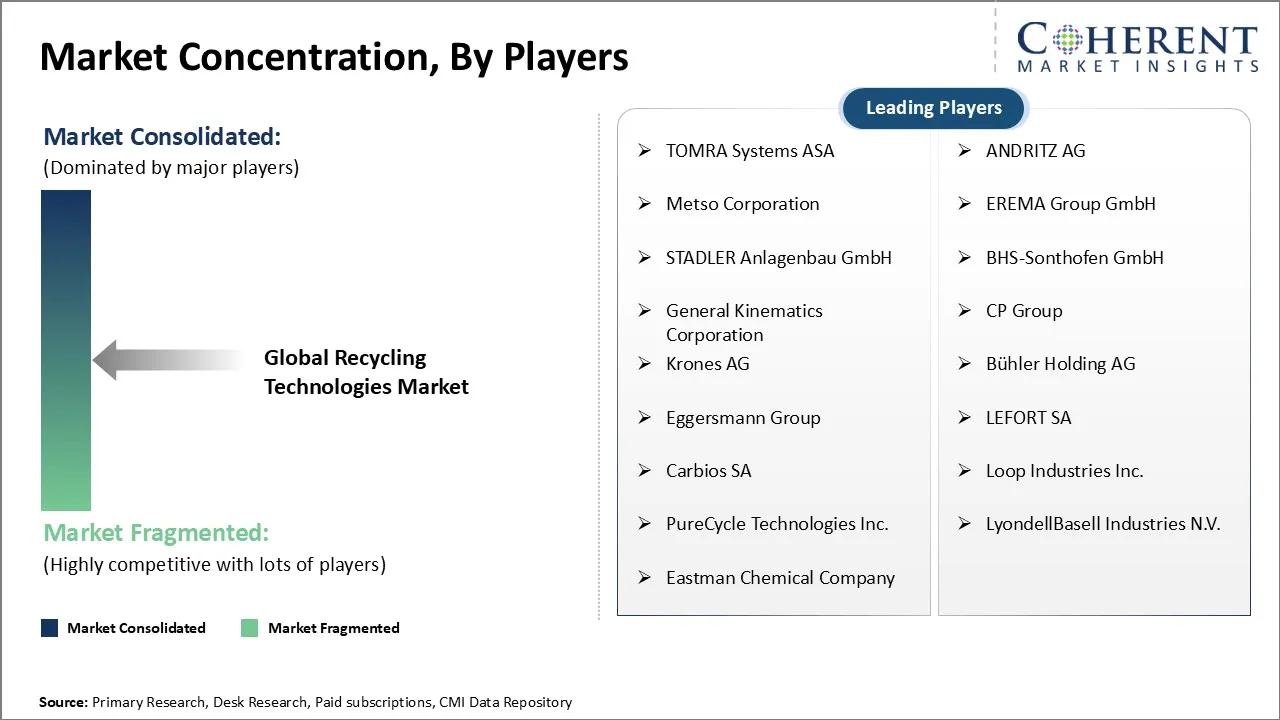
The global recycling technologies market is fragmented, combining diversified engineering groups, specialized machinery manufacturers, sensor developers, and process licensors. Competition centers on throughput reliability, material recovery quality, lifecycle cost, and project execution. Regional suppliers remain influential through local installation expertise and service coverage, while niche specialists compete through proprietary separation methods. Long equipment lifecycles make reference projects, spare-parts availability, and customer relationships decisive.
Key focus areas include
- Recovery Efficiency and Output Purity: Suppliers compete on material separation accuracy, recovery yields, and contamination control.
- Technology Customization: Application-specific configurations help suppliers address differences in waste composition and processing conditions.
- Total Cost of Ownership: Energy consumption, consumables, maintenance, and equipment availability influence procurement decisions.
- Proprietary Process Technology: Patented separation methods and specialized equipment designs can support differentiation.
- Equipment Reliability: Proven performance under variable feedstock conditions remains important for industrial buyers.
- Local Service Capabilities: Installation support, replacement parts, and technical servicing strengthen regional competitiveness.
- System Integration Expertise: Compatibility with existing conveyors, separation equipment, and plant control systems affects supplier selection.
Market Report Scope
Global Recycling Technologies Market Report Coverage | |||
Report Coverage | Details | ||
Base Year | 2025 | Market Size in 2026: | USD 45.92 Bn |
Historical Data For: | 2020 To 2024 | Forecast Period: | 2026 To 2033 |
Forecast Period 2026 To 2033 CAGR: | 7.90% | 2033 Value Projection: | USD 78.19 Bn |
Geographies covered: |
| ||
Segments covered: |
| ||
Companies covered: | TOMRA Systems ASA, ANDRITZ AG, Metso Corporation, EREMA Group GmbH, STADLER Anlagenbau GmbH, BHS-Sonthofen GmbH, General Kinematics Corporation, CP Group, Krones AG, Bühler Holding AG, Eggersmann Group, LEFORT SA, Carbios SA, Loop Industries Inc., PureCycle Technologies Inc., LyondellBasell Industries N.V., Eastman Chemical Company | ||
Growth Drivers: |
| ||
Restraints & Challenges: |
| ||
Analyst Opinion (Expert Opinion)
- The recycling technologies market is expected to shift toward specialized recovery solutions and integrated processing systems. Standard equipment manufacturers may face pricing pressure, while providers of advanced separation and material purification technologies could secure stronger margins through application-specific expertise and proven recovery performance.
- Product refurbishment and component reuse could reshape recycling economics by diverting valuable materials from conventional waste streams. This transition may challenge mixed-waste processors while creating opportunities for technology providers specializing in automated dismantling, component inspection, and selective material recovery.
- Recycling technology providers should prioritize feedstock testing, energy-efficient processing, and reliable maintenance services. Investment decisions must consider scrap price volatility, material contamination, and operating costs. Securing feedstock supply agreements and local technical partnerships will be essential, while large-scale investment in commercially unproven processes should remain limited.
Speak to the analyst
Want personalized insights?
Take the findings above to one of our principal consultants, or have the report rebuilt around the segments, geographies and competitors you actually track.
Market Segmentation
- Technology Type Insights (Revenue, USD Bn, 2021 - 2033)
- Mechanical Recycling Technologies
- Chemical Recycling Technologies
- Thermal Recycling Technologies
- Hydrometallurgical and Electrochemical Recycling
- Biological and Enzymatic Recycling
- Other Recycling Technologies
- Offering Insights (Revenue, USD Bn, 2021 - 2033)
- Recycling Equipment and Machinery
- Recycling Automation and Software Solutions
- Process Technology and Licensing
- Engineering, Integration and Lifecycle Services
- Waste Stream Insights (Revenue, USD Bn, 2021 - 2033)
- Plastic Waste
- Metal Scrap
- Paper and Cardboard Waste
- Electronic Waste
- Battery Waste
- Construction and Demolition Waste
- Glass Waste
- Other Waste Streams (Rubber, Textiles, Organic Waste, etc.)
- End User Insights (Revenue, USD Bn, 2021 - 2033)
- Private Recycling and Material Recovery Companies
- Municipalities and Public Waste Management Authorities
- Industrial Manufacturers with Captive Recycling Facilities
- Research, Demonstration and Other Institutional Facilities
- Project Type Insights (Revenue, USD Bn, 2021 - 2033)
- New Recycling Facility Installations
- Existing Facility Upgrades and Retrofits
- Distribution Channel Insights (Revenue, USD Bn, 2021 - 2033)
- Direct Manufacturer and Technology Provider Sales
- EPC Contractors and System Integrators
- Industrial Distributors and Authorized Dealers
- Regional Insights (Revenue, USD Bn, 2021 - 2033)
- North America
- U.S.
- Canada
- Latin America
- Brazil
- Argentina
- Mexico
- Rest of Latin America
- Europe
- Germany
- U.K.
- Spain
- France
- Italy
- Russia
- Rest of Europe
- Asia Pacific
- China
- India
- Japan
- Australia
- South Korea
- ASEAN
- Rest of Asia Pacific
- Middle East
- GCC Countries
- Israel
- Rest of Middle East
- Africa
- South Africa
- North Africa
- Central Africa
- North America
Sources
Primary Research Interviews
- Recycling equipment manufacturers, technology developers, and process licensors
- Mechanical, chemical, thermal, and metal recovery technology providers
- Recycling facility operators, waste management companies, and industry experts
Stakeholders
- Recycling machinery manufacturers and automation suppliers
- Private recycling companies and municipal waste authorities
- EPC contractors, system integrators, and technology licensors
- Industrial manufacturers and recovered material buyers
End-use Sectors
- Plastic packaging, paper, and metal processing industries
- Automotive, electronics, and battery manufacturing
- Construction, demolition, and glass recycling
- Textile recycling and industrial material recovery
Regulatory and Industry Bodies
- U.S. Environmental Protection Agency (EPA)
- European Commission and European Environment Agency (EEA)
- United Nations Environment Programme (UNEP)
- Central Pollution Control Board (CPCB), India
- Basel Convention Secretariat
- International Organization for Standardization (ISO)
Databases
- Company annual reports and investor presentations
- Eurostat waste generation and recycling statistics
- U.S. EPA material recovery and waste management datasets
- UN Comtrade recycling machinery and recovered material trade data
- WIPO and Espacenet recycling technology patent databases
Magazines and Journals
- Recycling International
- Recycling Today
- Waste Management World
- Resources, Conservation & Recycling
- Waste Management
- Journal of Cleaner Production
Associations
- Bureau of International Recycling (BIR)
- Recycled Materials Association (ReMA)
- Plastics Recyclers Europe (PRE)
- Association of Plastic Recyclers (APR)
- European Recycling Industries' Confederation (EuRIC)
Public Domain Sources
- Waste generation, collection, and recycling rate statistics
- Recycling equipment capacity, pricing, and technology developments
- Recovered material production, quality, and trade statistics
- Government recycling infrastructure and circular economy initiatives
- Recycling facility investments, partnerships, and technology launches
Key Standards and Regulations
- EU Waste Framework Directive 2008/98/EC
- EU Packaging and Packaging Waste Regulation (EU) 2025/40
- EU Waste Electrical and Electronic Equipment (WEEE) Directive 2012/19/EU
- Basel Convention – Transboundary Movement of Hazardous and Other Wastes
- ISO 15270:2008 – Plastics Waste Recovery and Recycling Guidelines
- India's Plastic Waste Management Rules, 2016, as amended
Proprietary Elements
- CMI Data Analytics Tool
- Proprietary CMI research repository containing 10+ years of industry intelligence, including recycling equipment pricing, technology adoption, waste processing capacity, recovered material trends, regulatory developments, investment activities, and competitive intelligence.
Get access to 250+ pages report
Every segment, forecast, competitor profile and data table behind the analysis above — available for instant download.
- ESOMAR Member
- ISO 9001:2015 Certified
- D-U-N-S Registered
- GDPR & CCPA Compliant
Frequently Asked Questions
The CAGR of global recycling technologies market is projected to be 7.90% from 2026 to 2033.
The global recycling technologies market is estimated to be valued at USD 45.92 Bn in 2026 and is expected to reach USD 78.19 Bn by 2033
Businesses should evaluate waste composition, processing capacity, recovery efficiency, operating costs, and regulatory compliance before investing in recycling technologies.
Companies should assess proven project experience, equipment reliability, processing performance, customization capabilities, and after-sales technical support.
The report provides market forecasts, competitive analysis, technology developments, regulatory insights, investment opportunities, and strategic information for business decision-making.
Recycling facilities can improve profitability through better material recovery, lower energy consumption, reduced downtime, efficient maintenance, and reliable sales agreements for recovered materials.
Stringent environmental regulations, extended producer responsibility (EPR) requirements, and growing demand for recovered materials and circular economy solutions are the major factors driving growth in the global recycling technologies market.