

Global RegTech Market Size and Forecast – 2026 To 2033
The global RegTech market is expected to grow from USD 29.00 Bn in 2026 to USD 112.00 Bn by 2033, registering a compound annual growth rate (CAGR) of 12% from 2026 to 2033. The global RegTech market is driven by growing financial crime, fraud, and money laundering risks. On February 13, 2025, Mastercard officially announced the launch of TRACE (Trace Financial Crime) in Asia Pacific, a sophisticated network-level solution that harnesses artificial intelligence to identify and prevent money laundering and financial crime.
Key Takeaways of the Global RegTech Market
- The Solutions segment is expected to account for 58.0% of the global RegTech market share in 2026. Increasing adoption of artificial intelligence for risk detection is driving the growth of the segment. In May 2025, Fenergo launched its FinCrime Operating System with an agentic artificial intelligence layer. The platform combines customer onboarding, know-your-customer checks, screening, identity verification, and transaction monitoring.
- The Cloud-Based segment is estimated to capture 63.0% of the market share in 2026. Rising demand for real-time transaction monitoring and identity verification is majorly driving the growth of the segment. In January 2026, SEON launched an identity verification solution integrated with its real-time fraud intelligence platform. The product combines document verification, liveness detection, and proof-of-address checks.
- The Anti-Money Laundering segment is estimated to capture 29.0% of the market share in 2026. Introduction of regulatory intelligence tools for emerging digital financial services is driving the growth of the segment. In April 2025, CUBE launched RegPlatform Intel for mid-market financial services companies. The platform combines artificial intelligence with regulatory summaries and analysis from subject matter experts.
- North America is expected to dominate the RegTech market in 2026 with a market share of 41.0%. Growing adoption of cross-border regulatory reporting and compliance standardization in North America is driving the growth of the regional market. In June 2026, the U.S. Federal Reserve Board and other federal financial regulators published a combined final rule under the Financial Data Transparency Act of 2022. The rule establishes common data standards for selected regulatory information collections, including legal entity identifiers and other data elements.
- Asia Pacific is expected to account for 24.0% share in 2026. Growing emphasis on Automated anti-money laundering and fraud detection in Asia Pacific is driving the growth of the regional market. In May 2026, the Monetary Authority of Singapore announced an artificial intelligence and machine learning proof-of-value initiative with banks, the Government Technology Agency of Singapore, and the Singapore Police Force.
Segmental Insights
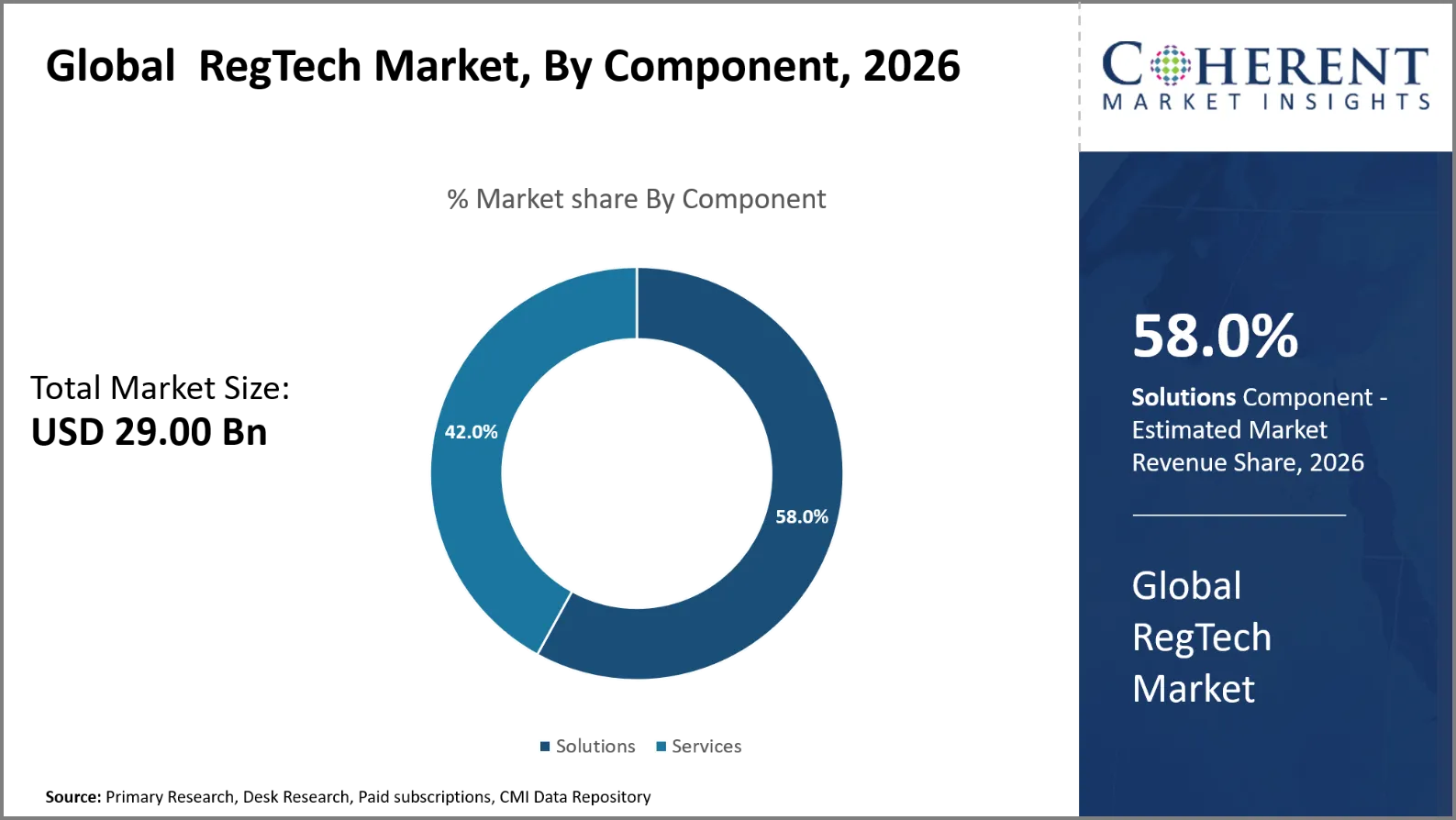
Why Does Solutions Dominate the Global RegTech Market?
The solutions segment is expected to account for 58.0% of the global RegTech market share in 2026. Financial institutions need specialized tools to automate compliance operations and to reduce regulatory risk. This is the primacy cause for the dominance of solutions. These technologies also aid with regulatory reporting, transaction monitoring, identity verification, fraud detection and risk assessment. As legislation becomes more complex, financial institutions are searching for integrated solutions to help them better control operational correctness. Automating workflows cuts down on manual work, decreases errors in reporting and accelerates compliance processes. Frequent regulatory changes also encourage organizations to upgrade existing compliance systems.
On February 23, 2026, Alloy announced the launch of the Alloy AI Assistant, a native, context-aware agentic AI solution to help organizations make faster, more confident decisions. The AI Assistant is embedded directly within Alloy’s risk and identity infrastructure and is able to understand and synthesize data to recommend a decision that a human can approve or configure to automatically accept.
- Current Industry Events of 2026
- Market Size Estimation
- Regional Breakdown
- Competitive Landscape
- Customer Intelligence
- Segmental Analysis
- Pricing Analysis
- Key Market Drivers, Challenges & Future Trends
- Customized Insights Section
Why is Cloud-Based the Most Preferred Deployment Type?
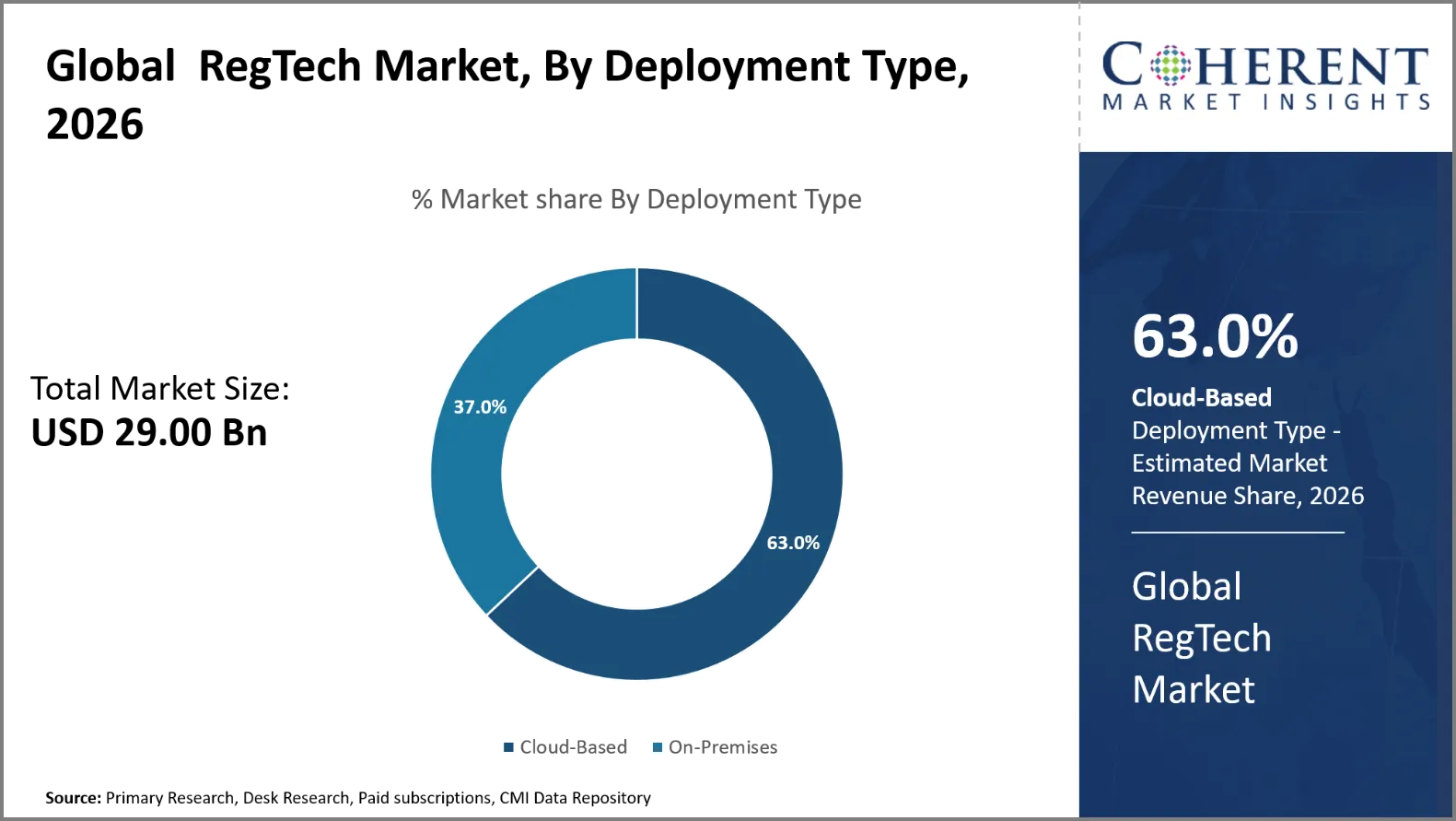
The cloud-based segment is expected to account for 63.0% of the global RegTech market share in 2026. Scalability, speed of implementation and fewer infrastructure requirements make cloud deployment the favored option. Financial institutions don’t have to store a lot of hardware at their premises to use compliance solutions. Cloud solutions provide for continual software updates, enabling enterprises to respond to changing regulatory requirements easily. They also offer centralized oversight of geographically spread processes. Subscription pricing is making sophisticated compliance technology available to smaller financial businesses. Encryption, access control and professional security capabilities can facilitate adoption. However, before deployment firms must consider data residency, privacy and legal requirements.
On September 16, 2025, Quantexa announced the general availability of its Cloud AML offering, a SaaS product delivered on Microsoft Azure, designed specifically for U.S. mid-size and community banks. Quantexa Cloud AML provides the proven capabilities used by global Tier 1 banks, to deliver ROI, competitive advantage and preserve the trusted relationships at the heart of mid-size and community banks.
Anti-Money Laundering Dominates the Global RegTech Market
The anti-money laundering segment is expected to account for 29.0% of the global RegTech market share in 2026. Anti-money laundering dominates because financial institutions face strict obligations to detect and report suspicious financial activities. More and more banks and payment providers are adopting automated systems to monitor transactions, vet consumers and track suspicious patterns of activity. Compliance teams utilize these tools to look at alarms and to improve client due diligence. The development of digital payments and increasingly complex financial crime demands greater surveillance. Big transaction data sets can also be used to uncover trends using machine learning and artificial intelligence resulting to an improved detection accuracy. Incentives for institutions to invest in effective anti-money laundering systems can exist, for example, in the form of regulatory enforcement and the repercussions of noncompliance.
On July 22, 2025, Experian made a significant investment in Resistant AI, a premier provider of AI-driven financial crime prevention and detection, to enhance its innovative and transformative fraud and financial crime solution. The partnership brings together the data, data technology and experience of Experian with the sophisticated modeling and anomaly detection of Resistant AI.
Current Events and their Impact
Current Events | Description and its Impact |
European Union Anti-Money Laundering Regulation (EU) 2024/1624 |
|
European Union Digital Operational Resilience Act Regulation (EU) 2022/2554 |
|
RegTech Market Dynamics
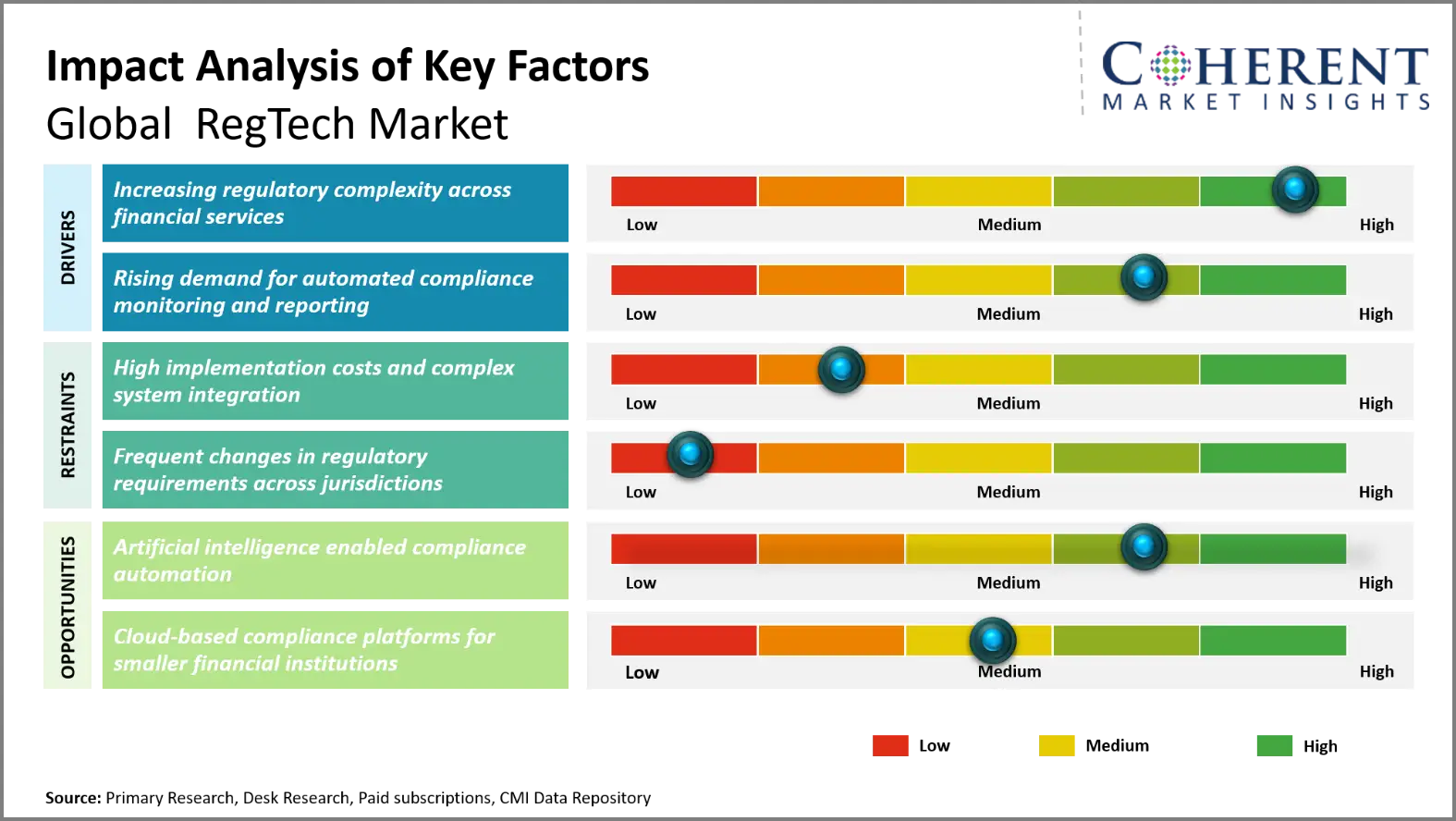
Market Drivers
Increasing regulatory complexity across financial services
Financial institutions face challenges in managing ever-changing compliance requirements across numerous jurisdictions, fueling demand for RegTech solutions in light of rising regulatory complexity across financial services. Anti-money laundering legislation, data protection regulations and operational resilience standards must be continually assessed and applied in a timely way. Banks, insurers and payment companies need to preserve accurate records and show compliance during regulatory examinations. By harnessing automated regulatory intelligence technology, organizations can identify key developments, evaluate compliance gaps and recalibrate internal controls. These features reduce administrative expenses and help assure consistent compliance in increasingly interconnected financial markets.
On September 26, 2025, EY India launched EY India Automated Regulatory Tool (EY India ART). It is a cloud-native solution that will assist regulated sectors such as banks and financial institutions in India to streamline regulatory reporting and strengthen compliance with regulations laid down by governing bodies such as the Reserve Bank of India (RBI) and the Securities and Exchange Board of India (SEBI).
Rising demand for automated compliance monitoring and reporting
The rising requirement for automated compliance monitoring and reporting is driving the use of RegTech in banking, insurance, and payment services. Financial organizations produce vast numbers of transactions and client data, making the manual monitoring of compliance processes an increasing difficulty. Automation helps in identification of questionable transactions, customer screening, preparation of regulatory reports and ongoing surveillance of risk. Machine learning and artificial intelligence can help to discover irregular transaction patterns and prioritize alarms for inquiry. They increase operational efficiency, tighten audit trails and eliminate reporting errors. The increasing need for timely and correct regulatory submissions forces institutions to enhance their compliance infrastructure.
On March 3, 2026, FactSet announced the launch of integrated AI-powered financial crime risk management capabilities within Factset’s workstation. The new capabilities are intended to revolutionize the compliance and onboarding operations of mid-level professionals working at mid-market and regional boutique corporate banks.
Emerging Trends
- AI-Powered Regulatory Compliance: Financial institutions are increasingly utilizing artificial intelligence to evaluate regulatory changes, detect suspicious activities and automate compliance checks. Machine learning offers enhanced risk classification across complex data sets. These tools help compliance teams to prioritize investigations and respond more quickly to shifting financial crime concerns.
- Cloud-Based Compliance Platforms: Cloud-based RegTech solutions have been gaining traction owing to their scalable architecture, centralized monitoring and fast software updates. Financial institutions are able to do compliance tasks in more than one location. Improved integration capabilities enable businesses to integrate procedures for regulatory reporting, consumer verification and risk management.
- Real-Time Transaction Monitoring and Financial Crime Detection: RegTech providers are implementing real-time systems to monitor transactions to identify suspicious transactions and possible financial crime patterns. Advanced analytics link transaction histories, consumer profiles and behavioral indicators. Such tools allow financial institutions to investigate suspected activities more rapidly and tighten anti-money laundering efforts.
- Integrated Regulatory Intelligence and Reporting: Financial firms are rolling out integrated regulatory intelligence platforms to monitor legislative changes and reduce reporting requirements. These solutions are a bridge between regulatory changes and internal controls, control systems, and compliance operations. Automated evidence collection also enhances audit readiness and helps organizations uncover regulatory gaps with greater regularity.
Regional Insights
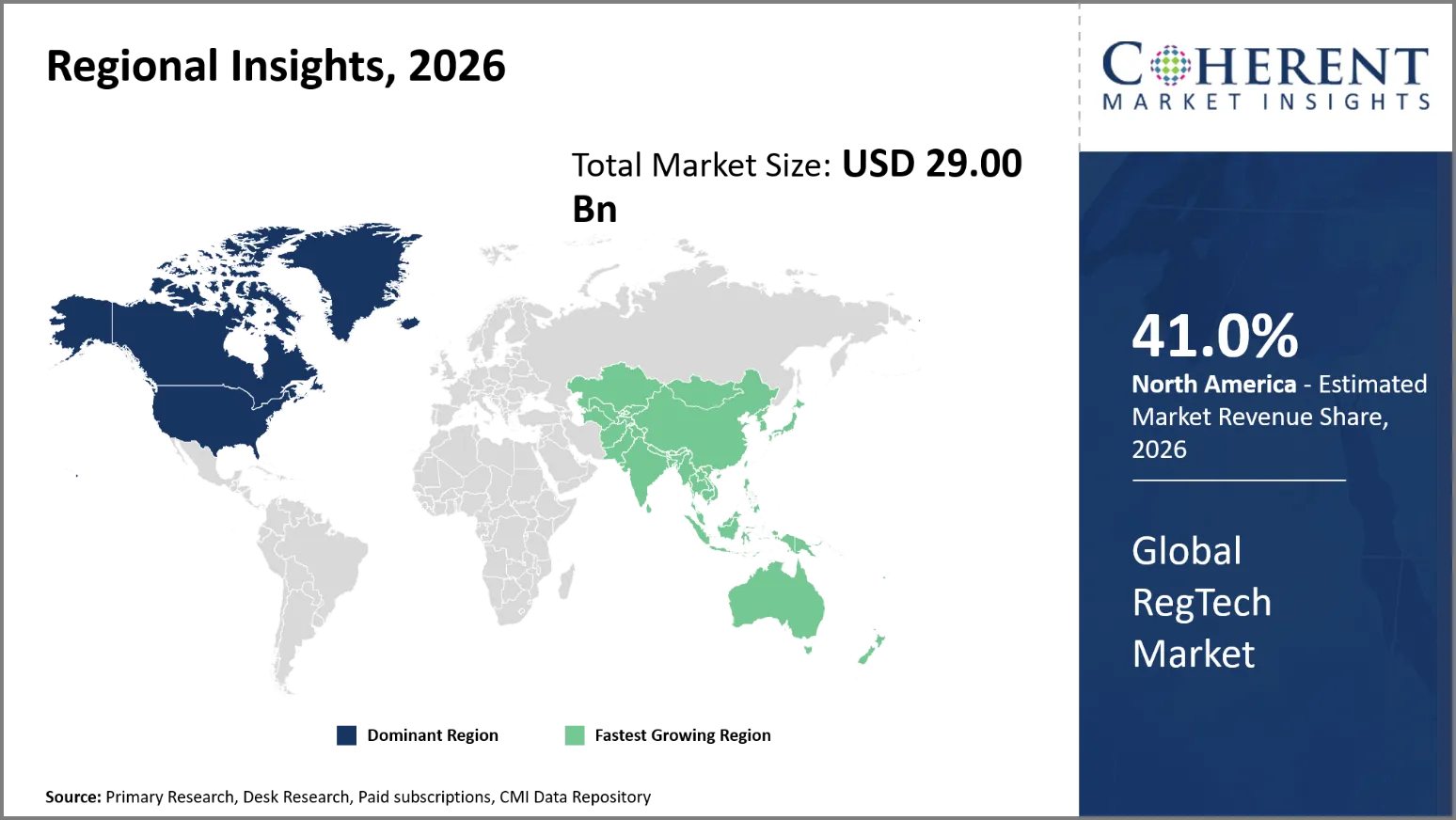
Why is North America a Strong Market for RegTech?
North America is expected to account for a market share of 41.0% in 2026. It has complex financial reporting requirements, large securities markets and sophisticated financial crime investigations. The U.S. Securities and Exchange Commission said it took 456 enforcement actions in fiscal 2025, indicating the significance of regulatory oversight. Financial institutions need automated surveillance, evidence management, sanctions screening and suspicious transaction reporting. Canada offers unique demand with the federally regulated financial institutions that are governed by the Office of the Superintendent of Financial Institutions and anti-money laundering oversight by the Financial Transactions and Reports Analysis Center of Canada. Cross-border institutions also need tools that reconcile differing reporting formats, retention rules, and supervisory expectations.
Why Does Asia Pacific RegTech Market Exhibit High Growth?
Asia Pacific is expected to register the fastest growth with a CAGR of 12.7% over the forecast period. It is projected to account for 24.0% of the global RegTech market in 2026. Growth in Asia Pacific reflects the rise of digital payments, cross-border finance and regulatory control of fintech enterprises. Consider Singapore, where the Monetary Authority of Singapore requires financial institutions to identify their customers and the beneficial owners, to analyze accounts and watch for unusual activity. Such obligations increase demand for automated consumer due diligence, transaction surveillance and financial intelligence activities. Given the varied languages, payment methods and national regulations across the area, there are abundant potential for platforms that localize screening rules and aggregate compliance data. Digital wallets, internet loans and rapid payments are driving transaction volumes and demanding greater scrutiny from regional banks.
Global RegTech Market Outlook for Key Countries
Why is U.S. Emerging as a Major Hub in the RegTech Market?
Securities surveillance, sanctions compliance and sophisticated financial crime investigations are shaping the U.S. RegTech business. The Securities and Exchange Commission recorded 456 enforcement actions in fiscal year 2025, highlighting the importance of reliable evidence collecting and surveillance systems. The Financial Crimes Enforcement Network revised the rules for reporting on beneficial ownership in 2025, and finalized further adjustments in August 2026. Such reporting obligations do not apply to domestic firms and U.S. citizens, while some international entities are still subject to reporting. Such changes create a need for regulatory change management solutions that can update compliance workflows rapidly and make sure institutions don’t rely on obsolete laws.
Is China the Next Growth Engine for the RegTech Market?
In China, the RegTech sector is driven by centralized financial regulation, widespread digital payment transactions and changing anti-money laundering requirements. In 2025, the People’s Bank of China released Order No. 10, revising financial norms to follow the amended Anti-Money Laundering Law. The modifications came into force in December 2025 and modified the procedures for reporting large and suspicious transactions. Banks and other financial institutions require systems that can sort transactions, assess the risk of their customers, and keep records for regulatory inspection. Demand for high volume surveillance is also created by Chinese payment networks and major digital platforms. Chinese language processing and adaptation to local reporting formats continue to be key criteria for compliance technology vendors.
Germany RegTech Market Analysis and Trends
European Union financial regulation and rigorous supervisory reporting requirements are shaping the RegTech business in Germany significantly. The Digital Operational Resilience Act entered into force on 17 January 2025, increasing the regulations on IT risk, incident reporting and technology service providers. The Federal Financial Supervisory Authority is the national reporting point in Germany for incidents related to information and communication technology. Notifications about third-party technological hazards are also sent to this authority. These duties have led to the demand for incident management software, supplier risk registers, evidence repositories and automated reporting workflows. Reliable data validation is also required in German institutions since the national supervisory reports are subject to automatic and plausibility inspections.
U.K. RegTech Market Analysis and Trends
Regulatory initiatives focusing on disclosing securities transactions, tax transparency and preventing financial crime help the U.K. RegTech market. In August 2026, the Financial Conduct Authority published Policy Statement PS26/15 detailing the final guidelines to streamline transaction reporting under the U.K. structure. These changes lead to a demand for flexible reporting systems that can adapt to altered data requirements without considerable human reconstruction. His Majesty’s Revenue and Customs announced new Common Reporting Standard requirements in June 2025. The reforms also include extending the reporting obligations to electronic money institutions and some electronic money products. Providers can assist with classifying accounts, collecting tax data and facilitating automated transmission of information.
Australia RegTech Market Analysis and Trends
Anti-money laundering regulations are reshaping Australia’s RegTech market, bringing with them regulatory duties for a wider range of entities than the conventional financial institutions. Existing regulated businesses transitioned into the updated framework on March 31, 2026, while newly regulated industries transitioned on July 1, 2026. The expansion includes jewelers, legal and accountancy professionals, and real estate enterprises. The Australian Transaction Reports and Analysis Center has underlined the significance of risk assessments, compliance officers, staff training and suspicious activity reporting. The reforms extend the regulatory regime to another 80,000 or so firms. This growth gives room for affordable onboarding, customer verification, staff training and reporting tools catering to smaller firms.
Global RegTech Market – Investments on Risk Assessment and Threat Detection Technology (2025)
Compliance Function | Organizations Using Technology and Planning Further Investment |
Risk Assessment | 41% |
Fraud Detection | 40% |
Regulatory Disclosures and Reporting | 32% |
Compliance and Transaction Monitoring | 38% |
Customer Due Diligence and Know Your Customer | 37% |
Training | 41% |
Third-Party and Vendor Assessments | 32% |
Controls Testing | 32% |
Policy and Procedure Management | 27% |
Media Monitoring and Screening | 25% |
How is Artificial Intelligence Enabled Compliance Automation Creating New Growth Opportunities in the RegTech Market?
The RegTech business is seeing new development opportunities as AI-driven compliance automation is changing the game in regulatory interpretation and transaction surveillance and investigative operations. Large language models can detect duties in regulatory circulars and relate them to firm rules, procedures and reporting dates. Machine learning algorithms can detect aberrant transaction links, prioritize notifications of problematic activity and reduce recurring inquiry. For example, banks may use client due diligence data together with payment history data to detect anomalies that rule-based systems may miss. Another advantage of retrieval-based systems is the potential to link compliance decisions to specific regulatory clauses, boosting traceability in audits. Vendors delivering explainable artificial intelligence, human review controls and more secure deployment options can help financial institutions handle complicated compliance tasks while meeting tighter standards of governance.
On September 16, 2025, ACA Group announced the launch of Encore AI, the firm’s unique artificial intelligence (AI) engine created for regulatory compliance. Encore AI is the next evolution of ACA’s original platform, Encore Compliance. It formalizes the next step in ACA’s ambition to deliver better, AI-powered solutions to meet the increasing needs of regulators and clients.
Market Players, Key Development, and Competitive Landscape
Key Developments
- On April 22, 2026, Comply announced the launch of ComplyAI MCP Server, RegTech’s first enterprise-grade Model Context Protocol (MCP) server built specifically for financial services compliance. The ComplyAI MCP Server connects Comply’s compliance intelligence to any major AI platform. This enables authorized compliance officers, advisors, and operations teams to build custom AI compliance agents using AI orchestrators like Claude Cowork, Microsoft Copilot, or ChatGPT, without developers, without IT projects, and without waiting.
- On April 9. 2026, Oracle continued to strengthen its financial crime and compliance portfolio with new AI capabilities that accelerate investigations, insights, and results. By securing rights to technology from Lucinity, Oracle will further enhance its industry-leading Financial Crime and Compliance Management (FCCM) portfolio with a new generation of AI agent-driven capabilities.
Competitive Landscape
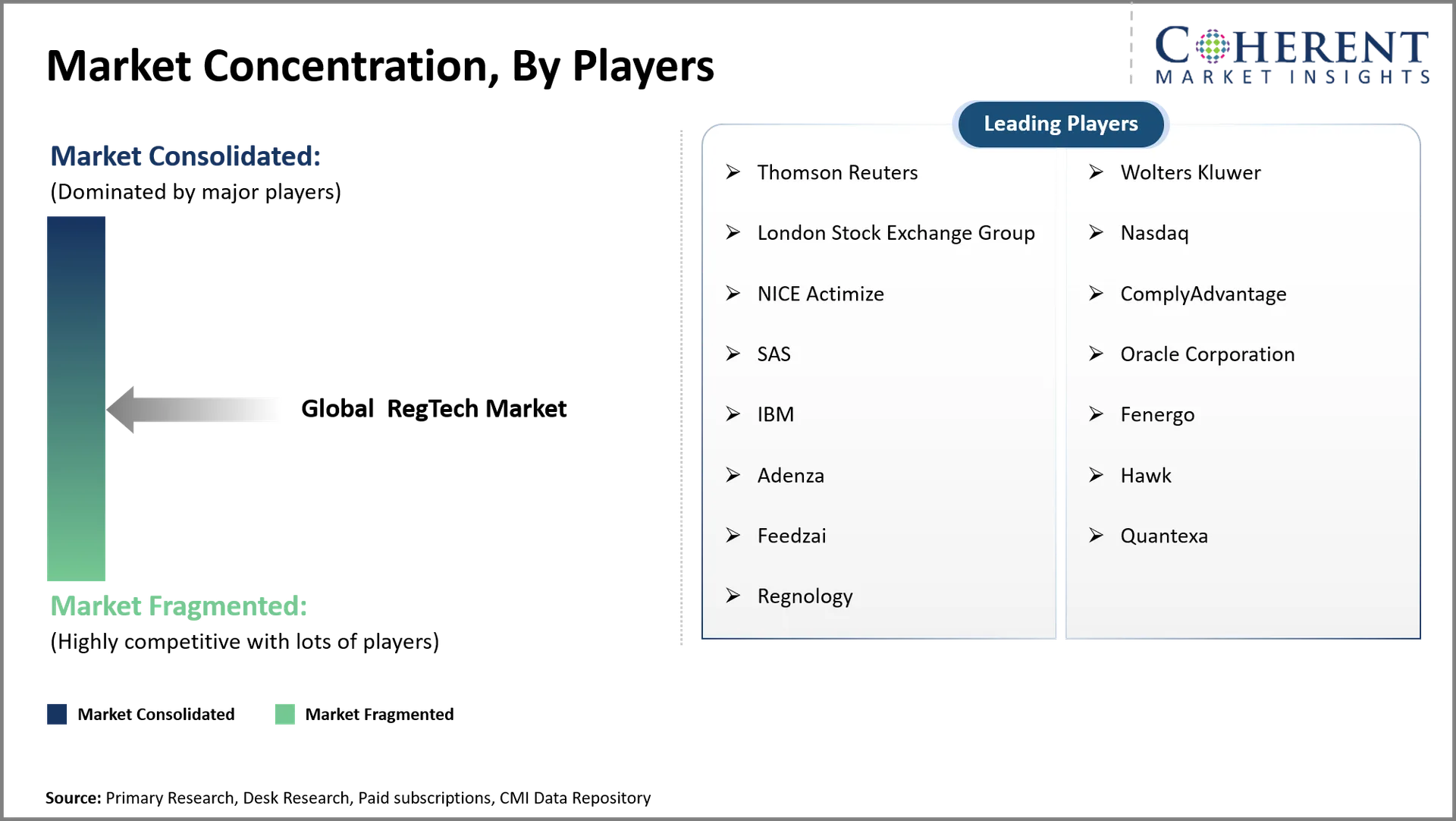
The global RegTech market is a battleground for established technology suppliers and specialized compliance organizations, competing with artificial intelligence, cloud platforms and financial crime prevention capabilities. Nasdaq has Verafin combining transaction monitoring, fraud detection and anti-money laundering investigations for financial institutions. London Stock Exchange Group provides World-Check risk information and screening data to help customers with due diligence and sanctions compliance. NICE Actimize specializes in financial crime management, detection of suspicious activity and automation of case investigation. ComplyAdvantage delivers AI-driven financial criminal intelligence solutions for sanctions, politically exposed persons and unfavorable media screening. These organizations fortify their competitive positions through data integration, customizable compliance protocols, strategic alliances, and constant product development.
Top Market Players and Notable Products/ Solutions in the RegTech Market
Market Player | Notable Product/Solution | Key features |
LexisNexis Risk Solutions | Firco Compliance Link | Real-time sanctions and watchlist screening, automated risk decisions, transaction and trade compliance, alert management, audit trails |
NICE Actimize | X-Sight Enterprise | Cloud-enabled financial crime management, artificial intelligence analytics, transaction monitoring, entity risk scoring, investigation workflows |
Quantexa | Decision Intelligence Platform | Entity resolution, graph analytics, contextual transaction monitoring, hidden relationship detection, financial crime investigations |
Fenergo | Client Lifecycle Management powered by Fen-AI | Automated customer onboarding, Know Your Customer checks, anti-money laundering controls, regulatory rules management, continuous customer reviews |
WorkFusion | WorkFusion AI Agents | Automated sanctions alert reviews, adverse media monitoring, document processing, financial crime investigations, reduced manual workloads |
Market Report Scope
Report Coverage | Details | ||
Base Year | 2025 | Market Size in 2026: | USD 29.00 Bn |
Historical Data For: | 2020 To 2024 | Forecast Period: | 2026 To 2033 |
Forecast Period 2026 To 2033 CAGR: | 12% | 2033 Value Projection: | USD 112.00 Bn |
Geographies covered: |
| ||
Segments covered: |
| ||
Companies covered: | Thomson Reuters, Wolters Kluwer, London Stock Exchange Group, Nasdaq, NICE Actimize, ComplyAdvantage, SAS, Oracle Corporation, IBM, Fenergo, Adenza, Hawk, Feedzai, Quantexa, Regnology | ||
Growth Drivers: |
| ||
Restraints & Challenges: |
| ||
Analyst Opinion (Expert Opinion)
- The future of the RegTech industry will depend on systems that translate regulatory changes into operational controls with minimal manual intervention. Generative artificial intelligence can help interpret regulatory documents, while machine learning can improve transaction monitoring and investigative prioritization. Vendors should combine these capabilities with explainable decisions, traceable evidence, and human approval mechanisms. Standalone compliance dashboards will be less feasible than solutions that link regulatory duties directly to company policies, testing methods, and reporting deadlines.
- The most promising prospects are in anti-money laundering, sanctions screening, regulatory reporting and artificial intelligence governance. Cloud-based solutions will appeal to smaller financial institutions since they are faster to install and have predictable infrastructure expenses. Big banks need integrated solutions that link customer onboarding, payment tracking, investigations and audit documents. The U.S. provides prospects in complicated financial crime compliance, while the U.K presents possibilities for transaction reporting and monitoring of financial services. Australia also has scope if the mandates for combating money laundering are extended to more professional service sectors.
- Players should design products around specific regulatory workflows rather than make broad promises of automation. Providers should have jurisdiction-specific regulatory libraries, versioned regulations, and unambiguous linkages between obligations and compliance proofs. Partnerships with banking software vendors can simplify deployment and reduce integration costs. There should also be measurable improvements in alert quality, investigation time and reporting accuracy in customer-specific validation. Strong data protection, transparent artificial intelligence controls, and flexible deployment options are how providers may win over regulated customers.
Speak to the analyst
Want personalized insights?
Take the findings above to one of our principal consultants, or have the report rebuilt around the segments, geographies and competitors you actually track.
Market Segmentation
- Component Insights (Revenue, USD Billion, 2021 - 2033)
- Solutions
- Services
- Deployment Type Insights (Revenue, USD Billion, 2021 - 2033)
- Cloud-Based
- On-Premises
- Application Insights (Revenue, USD Billion, 2021 - 2033)
- Anti-Money Laundering
- Know Your Customer Verification
- Fraud Detection
- Sanctions Screening
- Regulatory Reporting
- Risk and Compliance Management
- Data Privacy Management
- End User Insights (Revenue, USD Billion, 2021 - 2033)
- Banks
- Insurance Companies
- Investment and Asset Management Firms
- Financial Technology Companies
- Credit Unions
- Others
- Regional Insights (Revenue, USD Billion, 2021 - 2033)
- North America
- U.S.
- Canada
- Latin America
- Brazil
- Argentina
- Mexico
- Rest of Latin America
- Europe
- Germany
- U.K.
- Spain
- France
- Italy
- Russia
- Rest of Europe
- Asia Pacific
- China
- India
- Japan
- Australia
- South Korea
- ASEAN
- Rest of Asia Pacific
- Middle East
- GCC Countries
- Israel
- Rest of Middle East
- Africa
- South Africa
- North Africa
- Central Africa
- North America
- Key Players Insights
- Thomson Reuters
- Wolters Kluwer
- London Stock Exchange Group
- Nasdaq
- NICE Actimize
- ComplyAdvantage
- SAS
- Oracle Corporation
- IBM
- Fenergo
- Adenza
- Hawk
- Feedzai
- Quantexa
- Regnology
Sources
Primary Research Interviews
- Chief Compliance Officers (CCOs) at Financial Institutions
- RegTech Solution Providers & Vendors
- Risk Management Executives at Banking & Insurance Firms
- Regulatory Affairs Specialists & Legal Consultants
Magazines
- FinTech Magazine
- Compliance Week
- Risk & Compliance Magazine
- RegTech Analyst
Journals
- Journal of Financial Regulation
- Journal of Risk and Financial Management
- Journal of Compliance in Finance and Banking
Associations
- International RegTech Association (IRTA)
- Financial Industry Regulatory Authority (FINRA)
- Global Financial Innovation Network (GFIN)
- Association of Certified Anti-Money Laundering Specialists (ACAMS)
Public Domain Sources
- Financial Stability Board (FSB) Publications
- Bank for International Settlements (BIS) Reports
- European Banking Authority (EBA) Official Portal
- U.S. Securities and Exchange Commission (SEC) Regulatory Filings
Proprietary Elements
- CMI Data Analytics Tool
- Proprietary CMI Existing Repository of Information for the Last 10 Years
Get access to 250+ pages report
Every segment, forecast, competitor profile and data table behind the analysis above — available for instant download.
- ESOMAR Member
- ISO 9001:2015 Certified
- D-U-N-S Registered
- GDPR & CCPA Compliant
Frequently Asked Questions
The global RegTech market is expected to stand at USD 29.00 Bn in 2026 and is expected to reach USD 112.00 Bn by 2033.
The CAGR of the global RegTech market is projected to be 12% from 2026 to 2033.
Increasing regulatory complexity across financial services and Rising demand for automated compliance monitoring and reporting are the major factors driving the growth of the global RegTech market.
High implementation costs and complex system integration and Frequent changes in regulatory requirements across jurisdictions are the major factors hampering the growth of the global RegTech market.
In terms of component, solutions segment is estimated to dominate the market revenue share in 2026.
The RegTech market comprises technologies that help organizations manage regulatory compliance, financial crime prevention, risk monitoring, and reporting obligations.
Machine learning analyzes transaction histories and customer behavior to identify potential risks that predefined monitoring rules may overlook.