

Global Renewable Diesel Market Size and Forecast – 2026 To 2033
The Global Renewable Diesel Market is estimated to be valued at USD 32.54 Bn in 2026 and is expected to reach USD 57.23 Bn by 2033, growing at a CAGR of 8.4% from 2026 to 2033. Market expansion is supported by the need to reduce transportation carbon intensity, government-backed clean-fuel incentives, and the increasing commercial deployment of refinery-based renewable diesel production. Renewable diesel also benefits from its compatibility with existing diesel engines and fuel distribution infrastructure, enabling fleet operators to pursue decarbonization without extensive equipment replacement.
In May 2026, Marathon Petroleum reported that its renewable diesel segment generated USD 38 million in adjusted EBITDA during the first quarter of 2026, compared with a USD 42 million loss during the same period in 2025. The company attributed the improvement partly to stronger margins and the recognition of clean-fuel production tax credits following greater clarity regarding Section 45Z regulations. This development demonstrates how regulatory incentives can directly influence renewable diesel project economics and commercial viability.
Key takeaways of the Global Renewable Diesel Market
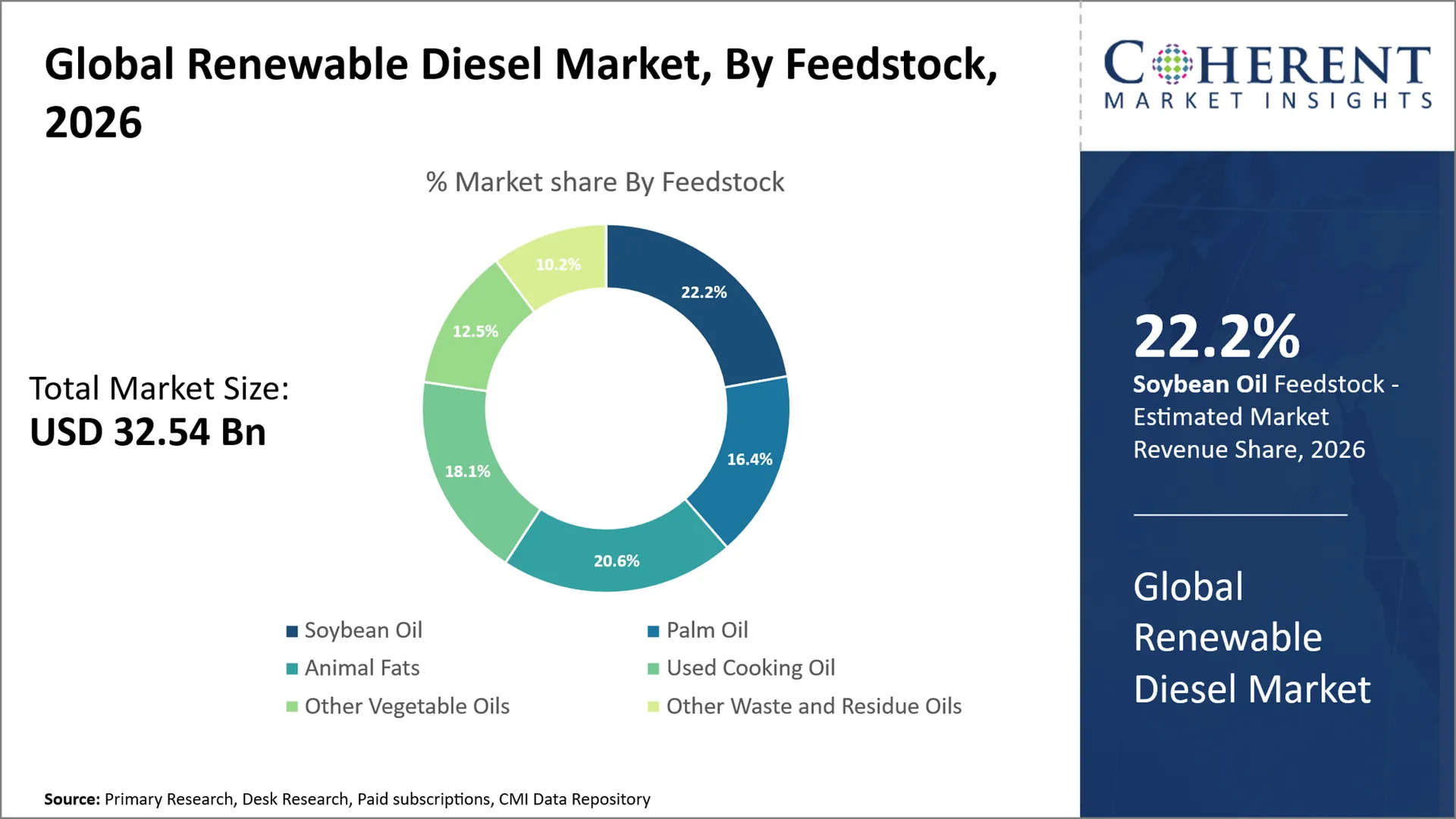
- Soybean Oil is estimated to expand at a 7.8% CAGR during 2026–2033 and hold 22.2% of the global renewable diesel market in 2026. Its established crushing infrastructure, dependable North American supply, and compatibility with hydrotreating make it a scalable feedstock despite competition from lower-carbon wastes. In September 2026, the U.S. EIA reported July soybean-oil inputs at renewable diesel plants of 871 million pounds.
- Hydrotreated Vegetable Oil HVO is estimated to grow at an 8.7% CAGR during 2026–2033 and account for 91.6% of the global renewable diesel market in 2026. HVO leads because commercial refiners can use proven hydrotreating infrastructure, process multiple lipid feedstocks, and produce a high-quality drop-in diesel. In September 2025, Eni advanced a Sannazzaro biorefinery project centered on Ecofining technology and HVO diesel production.
- Road Transportation is estimated to grow at an 8.1% CAGR during 2026–2033 and represent 63.8% of the global renewable diesel market in 2026. The segment benefits from diesel-fleet compatibility, existing fueling networks, and near-term decarbonization needs in freight and logistics without wholesale vehicle replacement. In February 2025, Neste and DHL agreed to evaluate renewable diesel HVO100 for reducing emissions across DHL road transportation operations.
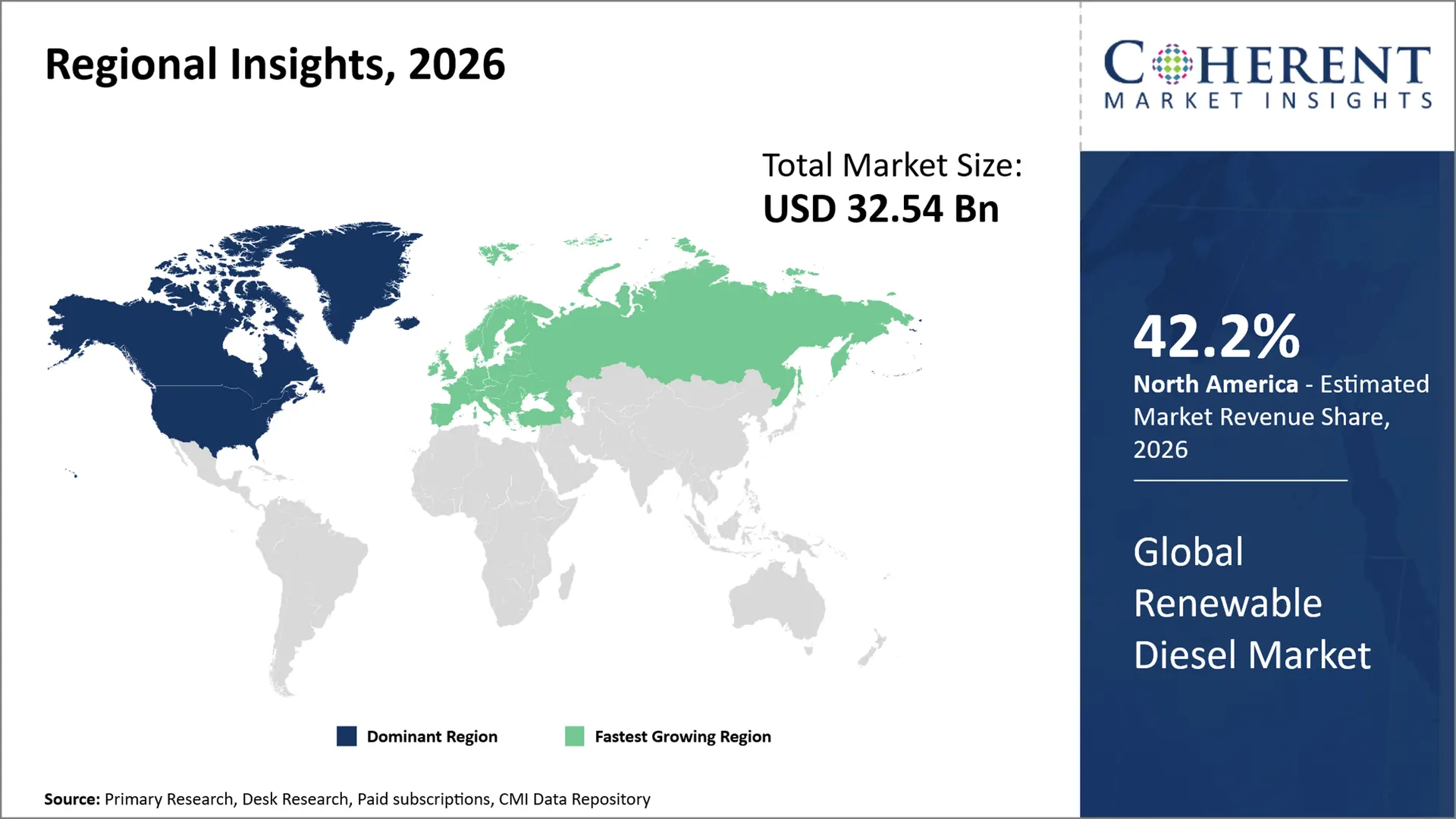
- North America is estimated to expand at a 7.9% CAGR during 2026–2033 and capture 42.2% of the global renewable diesel market in 2026. Its leadership reflects large conversion projects, established diesel consumption, supportive low-carbon fuel programs, and integrated feedstock logistics. In June 2024, Phillips 66 reported its California Rodeo Renewable Energy Complex had reached approximately 50,000 barrels per day of renewable-fuel processing capacity.
- Europe is estimated to grow at a 10.2% CAGR during 2026–2033 and account for 27.8% of the global renewable diesel market in 2026. Faster growth is supported by transport decarbonization mandates, broad diesel-fleet compatibility, expanding HVO availability, and refinery conversion investment. In April 2024, Repsol began large-scale renewable-fuel production at Cartagena, Spain, with capacity of 250,000 tons per year for renewable diesel and SAF.
Segmental Insights
Why Does Soybean Oil Dominate the Feedstock Category of the Global Renewable Diesel Market?
Soybean Oil is expected to account for 22.2% of the global renewable diesel market in 2026, leading the feedstock category because its economics are supported by the broader soybean crushing value chain. Processors can monetize both oil and protein meal, supporting large-scale crushing investments and providing renewable fuel producers with standardized lipid volumes from established agricultural processing hubs.
For refiners, consistent feedstock specifications can simplify pretreatment planning and long-term contracting, while proximity to rail, river, and Gulf Coast logistics supports continuous plant utilization. This structure makes soybean oil particularly relevant for high-throughput renewable diesel facilities serving transportation customers. In March 2024, Bunge Chevron Ag Renewables approved the construction of a new oilseed processing plant in Destrehan, Louisiana. The facility is designed to process soybeans and other oilseeds and expand feedstock availability for renewable fuel production. The project illustrates how oilseed processing capacity is increasingly being aligned with renewable fuel requirements.
- Current Industry Events of 2026
- Market Size Estimation
- Regional Breakdown
- Competitive Landscape
- Customer Intelligence
- Segmental Analysis
- Pricing Analysis
- Key Market Drivers, Challenges & Future Trends
- Customized Insights Section
Why Does Hydrotreated Vegetable Oil HVO Represent the Largest Production Technology in the Global Renewable Diesel Market?
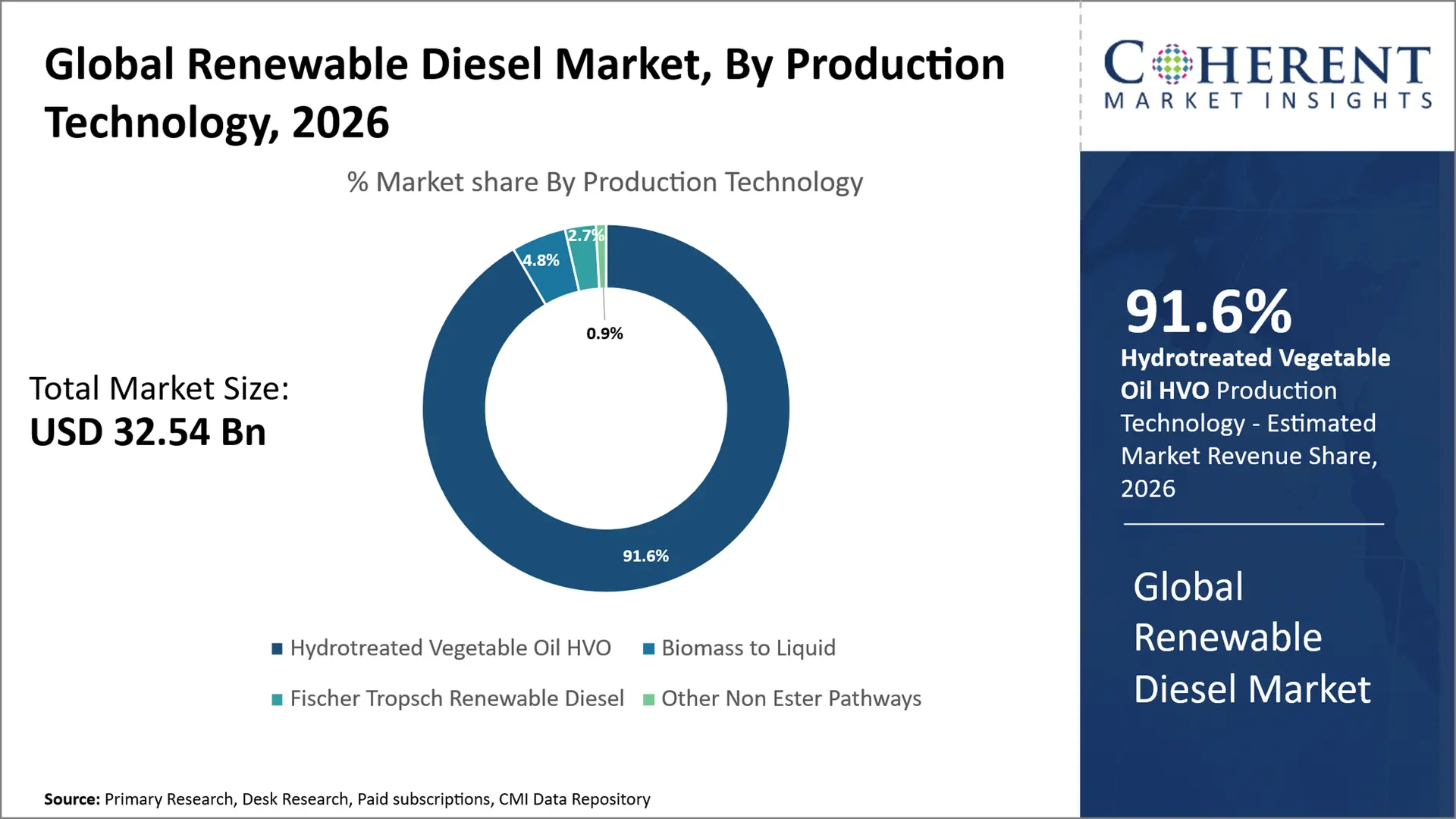
Hydrotreated Vegetable Oil HVO is expected to represent 91.6% of the global renewable diesel market in 2026, making it the largest production technology because it provides a commercially proven refinery pathway rather than an experimental conversion route. HVO projects can use established catalysts, hydrogen systems, hydroprocessing equipment, and refinery engineering practices, reducing execution risk for both brownfield conversions and new renewable fuel units.
The same processing platform can also be configured for different lipid feedstocks and, in suitable designs, support both renewable diesel and sustainable aviation fuel production. This flexibility improves asset utilization and is commercially important for refiners seeking to repurpose existing infrastructure while maintaining consistent fuel specifications. In August 2024, Topsoe was selected by HOLBORN to provide HydroFlex technology for its Hamburg renewable fuels complex, which is planned to produce renewable diesel and sustainable aviation fuel from waste and residue feedstocks. The project demonstrates continued industrial deployment of hydrotreating-based renewable fuel technology.
Why Does Road Transportation Dominate the Application Category of the Global Renewable Diesel Market?
Road Transportation is expected to capture 63.8% of the global renewable diesel market in 2026, leading the application category because road fleets generate recurring, high-volume fuel demand that can be aggregated through centralized procurement. Freight operators, parcel networks, intermodal carriers, and commercial fleets consume fuel continuously across predictable routes, allowing suppliers to structure depot delivery, bulk contracts, and multi-site fueling programs around measurable consumption.
This purchasing model can accelerate renewable diesel adoption without requiring complete fleet replacement. It is particularly relevant where payload requirements, driving range, or charging downtime complicate rapid electrification. Suppliers benefit from repeat offtake and improved volume planning, while fleet operators can introduce lower-carbon fuel within existing operating schedules. In October 2025, FS Logistix added 12 IVECO S-Way trucks powered by HVO for first- and last-mile intermodal services in Italy. The deployment demonstrates how renewable diesel can be incorporated directly into active freight and logistics operations.
Current Events and Their Impact
Current Event | Description and Its Impact |
U.S. EPA Finalizes 2026–2027 Renewable Fuel Standards – March 2026 |
|
IRS Issues Updated Section 45Z Clean Fuel Guidance – September 2026 |
|
EU Renewable Energy Directive Sectoral Transposition Deadline – May 2025 |
|
Global Renewable Diesel Market Dynamics
Key Market Drivers
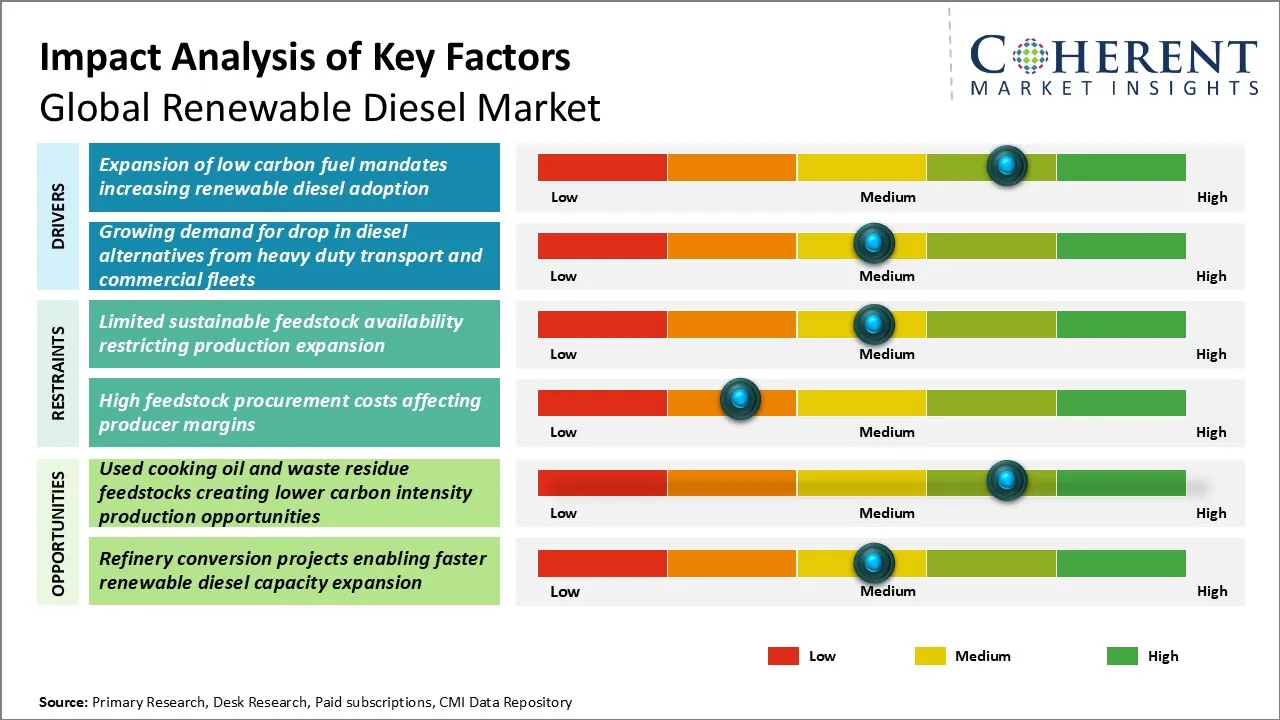
- Expansion of low carbon fuel mandates increasing renewable diesel adoption: Low-carbon fuel standards convert lifecycle emissions performance into compliance value, making renewable diesel commercially attractive to obligated fuel suppliers because lower-carbon-intensity gallons can reduce compliance deficits without requiring replacement of existing diesel infrastructure. The mechanism favors producers with certified pathways, strong feedstock traceability, and the ability to optimize carbon-intensity scores, while distributors gain access to a broader compliance-fuel portfolio. In January 2026, New Mexico adopted its Clean Transportation Fuel Program rule, which became effective on April 1, 2026, and explicitly covers renewable diesel within the state's carbon-intensity framework.
- Growing demand for drop in diesel alternatives from heavy duty transport and commercial fleets: Heavy-duty fleets value renewable diesel because it reduces transition barriers. Operators can use compatible fuel across existing diesel vehicles, storage systems, and service networks while pursuing near-term emissions reduction goals. This is commercially important for freight, construction, drayage, and other high-utilization fleets where premature vehicle replacement can be capital intensive. Fuel suppliers, fleet operators, OEMs, and distributors therefore gain an additional decarbonization pathway alongside electrification. In April 2024, Volvo Trucks North America began fueling newly assembled trucks leaving its New River Valley plant with HVO, demonstrating operational use without dedicated new fueling infrastructure.
Emerging Market Trends
- Feedstock Portfolios Are Moving Toward Carbon-Intensity-Managed Flexibility: Renewable diesel producers are moving from dependence on a narrow set of vegetable oils toward feedstock portfolios managed for carbon intensity, availability, pretreatment difficulty, and delivered cost. Waste oils, animal fats, residues, and regionally available lipids can improve commercial resilience, but they also increase requirements for impurity removal, segregation, traceability, and flexible process control. Producers with adaptable pretreatment systems and diversified supplier networks should gain procurement leverage, while facilities designed around a limited feedstock slate may face greater margin volatility as sustainability criteria tighten.
- Renewable Diesel Procurement Is Becoming a Verified Carbon-Performance Contract: Renewable diesel procurement is shifting from a simple fuel-volume transaction toward contracts incorporating lifecycle emissions documentation, feedstock origin, certification status, delivery reliability, and customer-specific decarbonization requirements. This changes supplier selection because buyers increasingly require auditable environmental attributes alongside the physical fuel. Producers and distributors that can integrate chain-of-custody documentation, carbon accounting, and multi-site logistics should strengthen long-term customer relationships. During the forecast period, differentiated contracting could reduce pure price competition and reward suppliers capable of demonstrating both fuel quality and verified carbon performance.
Regional Insights
Why Does North America Dominate the Global Renewable Diesel Market?
North America is expected to hold 42.2% of the global renewable diesel market in 2026 because the region combines large-scale refining assets, mature diesel demand, established low-carbon fuel programs, and extensive agricultural and waste-fat supply chains. U.S. and Canadian producers can also move renewable diesel through existing storage terminals, pipelines, rail networks, and truck distribution infrastructure, improving commercialization compared with fuels requiring dedicated distribution systems.
State, provincial, and federal carbon-intensity programs further create monetizable compliance value for lower-carbon fuels and support long-term offtake by refiners and fleet suppliers. In January 2026, Natural Resources Canada opened its Biofuels Production Incentive, providing per-liter support for eligible biodiesel and renewable diesel produced in 2026 and 2027, with priority given to North American feedstocks and Canadian sales. This initiative strengthens regional production economics while reinforcing feedstock integration and domestic supply resilience.
Why Is Europe Emerging as the Fastest-Growing Region in the Global Renewable Diesel Market?
Europe is expected to account for 27.8% of the global renewable diesel market in 2026 and emerge as the fastest-growing region because transportation decarbonization is increasingly translating into refinery conversions, HVO capacity investments, and lower-carbon fuel procurement.
The region also benefits from dense cross-border fuel logistics, established diesel fleets, and sustainability regulations that favor certified waste and residue feedstocks. Growth is therefore progressing beyond imported renewable diesel toward additional European production and integrated hydrogen-based refining.
In February 2025, OMV Petrom began constructing a renewable diesel HVO and sustainable aviation fuel unit at its Petrobrazi refinery in Romania. The project is designed for 250,000 tons of sustainable fuels annually from 2028 and will be integrated with green hydrogen facilities. This investment illustrates how European refiners are rebuilding conventional assets around flexible renewable-fuel production rather than relying solely on distribution-led adoption.
Global Renewable Diesel Market Outlook for Key Countries
Why Is the U.S. a Key Market for the Renewable Diesel Market?
The U.S. is a key renewable diesel market because federal clean-fuel incentives, sophisticated environmental credit trading, and large institutional fuel procurement programs create multiple revenue streams beyond the physical sale of diesel. Producers can monetize qualifying low-carbon output while supplying freight, municipal, industrial, and other high-utilization customers through established wholesale fuel channels.
This makes carbon accounting, tax-credit eligibility, and feedstock documentation central to commercial performance rather than merely compliance functions.
In September 2025, Darling Ingredients announced an agreement to sell approximately USD 125 million in production tax credits generated by its Diamond Green Diesel joint venture. The transaction demonstrates how U.S. renewable diesel economics increasingly combine fuel margins with monetized policy attributes. Companies capable of managing production, carbon intensity, documentation, and credit realization together are better positioned to protect returns when feedstock costs or conventional diesel spreads weaken.
Why Does China Support Growth in the Renewable Diesel Market?
China supports growth in the renewable diesel market through its large refining system, extensive industrial fuel demand, waste-resource recovery ecosystem, and technical capabilities in hydrotreating and petrochemical processing. These strengths create a foundation for HVO production from used oils, animal fats, and other lipid feedstocks as domestic standards and carbon-accounting requirements mature.
China's advantage is therefore less dependent on current road-fuel penetration and more closely linked to its ability to industrialize production technology, processing equipment, and feedstock conversion at scale.
In December 2024, China's national standards platform registered a recommended national standard project covering greenhouse gas product carbon-footprint quantification for renewable fuel HVO fractions. The project specifically addresses HVO produced through the hydrogenation of plant oils, animal fats, and waste oils. Standardized lifecycle carbon measurement can improve certification consistency, investment confidence, and future acceptance of Chinese renewable diesel in regulated domestic and export markets
Why Is France Important in the Global Renewable Diesel Market?
France is important in the global renewable diesel market because domestic HVO production is already connected with professional fuel users rather than remaining limited to pilot-scale activity. Truck fleets, public transport operators, agricultural machinery, construction equipment, and other diesel-intensive applications provide practical demand where immediate vehicle replacement remains difficult.
France also benefits from established fuel distribution and waste-oil collection systems that support circular feedstock use and repeat commercial deliveries.
In February 2026, TotalEnergies reported that its La Mède biorefinery remained the only source of French-produced HVO and that more than 1,100 professional HVO100 customers were served across France during 2025. This customer penetration demonstrates an established business-to-business market for renewable diesel and creates incentives for suppliers to expand feedstock sourcing, bulk delivery, storage, and contract-based fleet solutions.
Why Is India Important in the Global Renewable Diesel Market?
India is an important emerging renewable diesel market because its large diesel-consuming logistics, construction, agricultural, industrial, and backup-power sectors create applications where drop-in low-carbon fuels can complement electrification. The country also generates substantial agricultural residues and agro-processing waste, creating opportunities to develop renewable diesel pathways that do not depend entirely on edible vegetable oils.
Domestic engineering capabilities can further reduce technology import dependence as commercial projects mature.
In June 2026, India's Technology Development Board under the Department of Science and Technology supported Greenjoules Private Limited in commercializing an indigenous second-generation diesel-equivalent biofuel technology using agricultural waste and agro-processing residues. The proposed greenfield facility is strategically relevant because it connects residue management with domestically developed fuel technology and industrial-scale production, creating a pathway for renewable diesel growth aligned with India's raw-material base and energy-security priorities.
Why Is Germany a Strategic Country in the Renewable Diesel Market?
Germany is a strategic country for renewable diesel because its freight, logistics, bus, construction, and industrial-equipment sectors contain a large installed base of diesel engines that cannot all be replaced immediately. HVO100 can therefore serve high-utilization fleets that need near-term emissions reductions while continuing to use compatible vehicles and familiar fueling practices. Germany’s dense commercial fueling network and fleet-card infrastructure also lower the access barrier once renewable diesel is stocked at retail and truck-oriented sites. In December 2024, Shell began selling Shell Renewable Diesel HVO100 at its Hermsdorf station in Thuringia and stated that additional stations would follow. The product was positioned for truck and vehicle fleets using compatible diesel engines without requiring investment in new vehicle technology. This illustrates why Germany’s near-term opportunity is closely tied to distribution availability and fleet accessibility rather than production capacity alone.
Technology Deployment and Infrastructure Landscape for the Global Renewable Diesel Market
Technology or Infrastructure | Adoption Position | Commercial Role | Strategic Implication |
Flexible Feedstock HVO Hydro processing | Commercially established | Converts vegetable oils, waste oils, fats, and residues into paraffinic renewable diesel through hydrotreating | Multi-feedstock capability improves refinery utilization and allows producers to respond to changes in feedstock cost and carbon intensity |
Advanced Feedstock Pretreatment Systems | High and expanding | Removes metals, phosphorus, chlorides, moisture, solids, and other contaminants before hydrotreating | Better pretreatment widens the usable feedstock pool and allows greater use of lower-cost or lower-carbon waste materials |
High-Selectivity Deoxygenation and Isomerization Catalysts | Established but continuously optimized | Improves hydrocarbon conversion, cold-flow characteristics, cetane performance, and product yield | Catalyst performance increasingly influences hydrogen consumption, operating cost, product quality, and refinery margin |
Low-Carbon Hydrogen Integration | Emerging to scaling | Replaces higher-emission hydrogen used in hydrodeoxygenation and saturation processes | Reducing hydrogen-related lifecycle emissions can improve fuel carbon intensity and strengthen eligibility for performance-based incentives |
Biomass-to-Liquid and Fischer-Tropsch Renewable Diesel | Early commercial development | Converts lignocellulosic biomass and other non-lipid resources into synthetic diesel-range hydrocarbons | These pathways can diversify the market beyond constrained oils and fats but require higher capital intensity and greater process integration |
Digital Carbon-Intensity and Chain-of-Custody Systems | Rapidly scaling | Tracks feedstock origin, certification, lifecycle emissions, inventory movement, and compliance attributes | Strong digital verification can support regulatory eligibility, premium contracting, audit readiness, and differentiation among physically similar renewable diesel products |
How Are Off-Road Industrial and Distributed Power Applications Creating New Growth Opportunities in the Global Renewable Diesel Market?
Off-road industrial equipment and distributed power applications offer an attractive growth pathway for renewable diesel beyond conventional fleet demand. Mining sites, construction operations, ports, remote facilities, data centers, and temporary power users often rely on diesel engines where rapid electrification can be constrained by duty cycles, charging access, uptime requirements, or grid limitations.
Renewable diesel suppliers can capture this opportunity through bulk-delivery contracts, OEM-compatible fuel specifications, reliable cold-weather performance, and verified chain-of-custody documentation. Success will require regional storage, dependable last-mile logistics, technical support, and procurement models that quantify lifecycle emissions benefits without disrupting equipment availability.
Producers with flexible feedstock processing can match customers with lower-carbon pathways suited to specific contract requirements, while distributors can create value through inventory management and multi-site supply. The opportunity should favor vertically integrated suppliers and specialist fuel marketers capable of combining certified products, reliable logistics, and account-level emissions reporting rather than competing solely on commodity fuel prices.
Market Players, Key Development, and Competitive Landscape
Key Developments
- In April 2024, St1 and SCA opened their Gothenburg biorefinery to produce HVO renewable diesel and other renewable fuels from flexible feedstocks. This strengthens the global renewable diesel market by adding European processing capacity and widening commercial use of waste oils, animal fats, and forestry-derived residues.
- In April 2025, Preem launched Preem Redefine HVO100, a fully renewable diesel carrying the Nordic Swan Ecolabel and produced at its Gothenburg refinery. This strengthens the global renewable diesel market by combining fuel certification, branded product differentiation, and distribution through established retail infrastructure.
- In February 2024, Braya Renewable Fuels reached commercial operation at its converted Come By Chance refinery in Newfoundland and Labrador, producing renewable diesel from multiple lipid feedstocks. This strengthens the global renewable diesel market by showing how brownfield refinery conversion can add scalable supply while reusing refining infrastructure.
Competitive Landscape
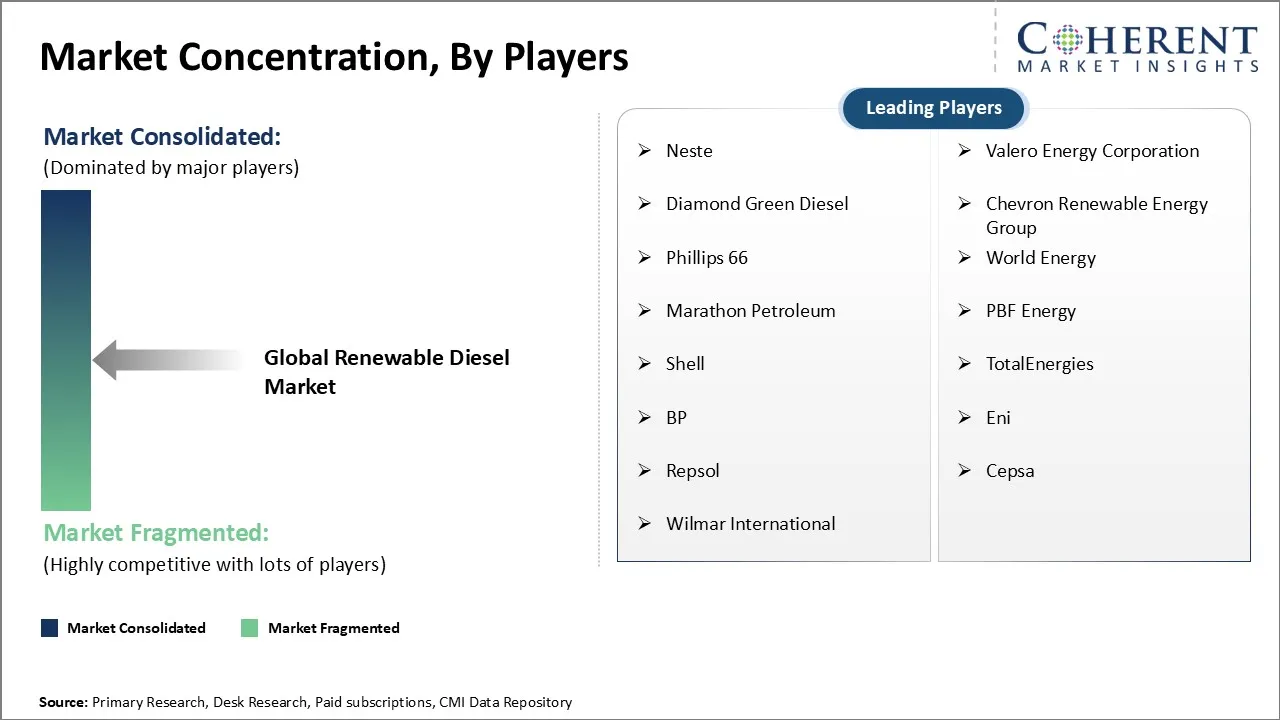
The global renewable diesel market is moderately consolidated because large integrated refiners and specialist biofuel producers control substantial processing capacity, yet regional suppliers and distributors remain important in local credit and end-use markets. Competition centers on feedstock economics, carbon-intensity performance, plant utilization, supply reliability, regulatory qualification, logistics reach, and the ability to secure long-term customer contracts without sacrificing margins.
Key focus areas include
- Feedstock procurement economics: Long-term access to suitable oils, fats, and residues directly affects production cost and utilization.
- Carbon-intensity performance: Lower lifecycle emissions can improve regulatory value and strengthen positioning with decarbonization-focused customers.
- Pretreatment capability: Facilities able to handle variable or contaminated feedstocks can access a wider sourcing pool.
- Plant utilization and operating efficiency: High throughput and disciplined hydrogen and catalyst management are essential for competitive conversion costs.
- Regulatory and certification readiness: Compliance documentation increasingly determines whether renewable diesel can qualify for credits and mandated-fuel programs.
- Distribution reliability: Terminal access, storage capacity, bulk delivery, and multi-region customer coverage influence contract wins.
- Customer relationship depth: Multi-year supply agreements and tailored sustainability reporting can reduce exposure to volatile spot-market pricing.
Market Report Scope
Renewable Diesel Market Report Coverage | |||
Report Coverage | Details | ||
Base Year | 2025 | Market Size in 2026: | USD 32.54 Bn |
Historical Data For: | 2020 To 2024 | Forecast Period: | 2026 To 2033 |
Forecast Period 2026 To 2033 CAGR: | 8.4% | 2033 Value Projection: | USD 57.23 Bn |
Geographies covered: |
| ||
Segments covered: |
| ||
Companies covered: | Neste, Valero Energy Corporation, Diamond Green Diesel, Chevron Renewable Energy Group, Phillips 66, World Energy, Marathon Petroleum, PBF Energy, Shell, TotalEnergies, BP, Eni, Repsol, Cepsa, Wilmar International | ||
Growth Drivers: |
| ||
Restraints & Challenges: |
| ||
Analyst Opinion (Expert Opinion)
- Market leadership is likely to shift from simple nameplate-capacity advantage toward integrated carbon-margin management. Producers that coordinate feedstock sourcing, pretreatment, certification, logistics, credit monetization, and customer contracting as one commercial system should outperform operators focused mainly on production volume. Buyers will increasingly value predictable delivered economics and auditable emissions performance, making commercial integration as important as refining scale.
- Accelerating electrification in lighter and more predictable road-duty cycles could gradually weaken renewable diesel’s role in some conventional transport applications. The more durable opportunity is likely to migrate toward heavy-duty, remote, industrial, marine, and resilience-oriented uses where liquid-fuel energy density and rapid refueling retain operational advantages. Suppliers that reposition early around these harder-to-electrify demand pools should protect asset relevance.
- Producers should prioritize broader raw-material processing capability, high-performance impurity removal, lower-emission hydrogen, rigorous traceability, and contract structures that protect margins against feedstock and credit volatility. Distribution partnerships should concentrate on customers with high utilization and limited near-term electrification options. Companies should avoid overcommitting capital to single-feedstock configurations or projects dependent on one policy credit, one geography, or one customer class.
Speak to the analyst
Want personalized insights?
Take the findings above to one of our principal consultants, or have the report rebuilt around the segments, geographies and competitors you actually track.
Market Segmentation
- Feedstock Insights (Revenue, USD Bn, 2021 - 2033)
- Soybean Oil
- Palm Oil
- Animal Fats
- Used Cooking Oil
- Other Vegetable Oils
- Other Waste and Residue Oils
- Production Technology Insights (Revenue, USD Bn, 2021 - 2033)
- Hydrotreated Vegetable Oil HVO
- Biomass to Liquid
- Fischer Tropsch Renewable Diesel
- Other Non Ester Pathways
- Application Insights (Revenue, USD Bn, 2021 - 2033)
- Road Transportation
- Marine Transportation
- Industrial Equipment
- Power Generation
- Agricultural Equipment
- End User Insights (Revenue, USD Bn, 2021 - 2033)
- Commercial Fleets
- Logistics and Freight Operators
- Industrial Companies
- Utilities and Power Operators
- Marine Operators
- Agricultural Operators
- Distribution Channel Insights (Revenue, USD Bn, 2021 - 2033)
- Direct Supply Contracts
- Fuel Distributors
- Retail Fuel Stations
- Other Channels
- Regional Insights (Revenue, USD Bn, 2021 - 2033)
- North America
- U.S.
- Canada
- Latin America
- Brazil
- Argentina
- Mexico
- Rest of Latin America
- Europe
- Germany
- U.K.
- Spain
- France
- Italy
- Russia
- Rest of Europe
- Asia Pacific
- China
- India
- Japan
- Australia
- South Korea
- ASEAN
- Rest of Asia Pacific
- Middle East
- GCC Countries
- Israel
- Rest of Middle East
- Africa
- South Africa
- North Africa
- Central Africa
- North America
- Key Players Insights
- Neste
- Valero Energy Corporation
- Diamond Green Diesel
- Chevron Renewable Energy Group
- Phillips 66
- World Energy
- Marathon Petroleum
- PBF Energy
- Shell
- TotalEnergies
- BP
- Eni
- Repsol
- Cepsa
- Wilmar International
Sources
Primary Research Interviews
- Renewable diesel and HVO producers and refiners
- Feedstock suppliers including soybean oil used cooking oil and animal fats
- Fuel distributors fleet operators logistics companies and industrial fuel buyers
Stakeholders
- Renewable diesel and HVO manufacturers
- Oilseed crushers waste oil collectors and animal fat processors
- Refiners technology licensors catalyst suppliers EPC contractors and distributors
- Commercial fleets freight operators utilities marine and agricultural users
End-use Sectors
- Road transportation and commercial fleets
- Logistics and freight transportation
- Industrial equipment and power generation
- Marine transportation
- Agricultural equipment
Regulatory and Industry Bodies
- U.S. Environmental Protection Agency EPA
- U.S. Department of Energy DOE
- U.S. Department of Agriculture USDA
- California Air Resources Board CARB
- European Commission
- International Energy Agency IEA
- Natural Resources Canada
- Ministry of Petroleum and Natural Gas India
Databases
- U.S. EIA renewable fuels production and feedstock data
- U.S. EPA Renewable Fuel Standard RFS databases
- CARB Low Carbon Fuel Standard LCFS data
- Eurostat energy and transport databases
- IEA biofuel and renewable transport databases
- USDA oilseed and vegetable oil databases
- UN Comtrade renewable fuel and feedstock trade data
- Company annual reports and investor presentations
Magazines and Journals
- Fuel
- Applied Energy
- Biomass and Bioenergy
- Bioresource Technology
- Renewable and Sustainable Energy Reviews
- Energy & Environmental Science
Associations
- Clean Fuels Alliance America
- Advanced Biofuels Association
- European Waste-based & Advanced Biofuels Association EWABA
- FuelsEurope
- International Renewable Energy Agency IRENA
- Regional biofuel and renewable fuel associations
Public Domain Sources
- Renewable diesel production capacity and refinery conversion data
- Vegetable oil animal fat and used cooking oil supply data
- Renewable fuel consumption and transport fuel statistics
- HVO plant investments and capacity additions
- Renewable diesel pricing and feedstock cost trends
- Carbon intensity and lifecycle emissions data
- Renewable fuel policy and regulatory updates
Key Standards and Regulations
- U.S. Renewable Fuel Standard RFS
- U.S. Section 45Z Clean Fuel Production Credit
- California Low Carbon Fuel Standard LCFS
- EU Renewable Energy Directive RED III
- Canada Clean Fuel Regulations
- ASTM D975 diesel fuel specification
- EN 15940 paraffinic diesel fuel standard
- India National Policy on Biofuels
Proprietary Elements
- CMI Data Analytics Tool and proprietary CMI repository containing 10+ years of renewable diesel demand production capacity feedstock availability HVO technology adoption pricing carbon intensity regulatory credits refinery conversions regional deployment customer adoption and competitive intelligence.
Get access to 250+ pages report
Every segment, forecast, competitor profile and data table behind the analysis above — available for instant download.
- ESOMAR Member
- ISO 9001:2015 Certified
- D-U-N-S Registered
- GDPR & CCPA Compliant
Frequently Asked Questions
The CAGR of global renewable diesel market is projected to be 8.4% from 2026 to 2033.
The global renewable diesel market is estimated to be valued at USD 32.54 billion in 2026 and is expected to reach USD 57.23 billion by 2033.
The major factors driving growth in the global renewable diesel market are the expansion of low-carbon fuel mandates and the growing adoption of drop-in diesel alternatives across heavy-duty transportation and commercial fleets.
Limited sustainable feedstock availability restricting production expansion and High feedstock procurement costs affecting producer margins are the major factor hampering the growth of global renewable diesel market.
In terms of feedstock, soybean oil is estimated to dominate the market revenue share in 2026.
Neste, Valero Energy Corporation, Diamond Green Diesel, Chevron Renewable Energy Group, Phillips 66, World Energy, Marathon Petroleum, PBF Energy, Shell, TotalEnergies, BP, Eni, Repsol, Cepsa, Wilmar International are the major players.
North America is expected to lead the global renewable diesel market in 2026.