

Clean Diesel Market Size and Forecast — 2026 - 2033
The Global Clean Diesel Market size is estimated to be valued at USD 45.3 billion in 2026 and is expected to reach USD 81.4 billion by 2033, exhibiting a compound annual growth rate (CAGR) of 8.7% from 2026 to 2033.
Overview
The Clean Diesel market encompasses a range of products designed to reduce emissions and improve fuel efficiency in diesel engines. Key product categories include ultra-low sulfur diesel (ULSD), biodiesel blends, diesel exhaust fluid (DEF), and advanced fuel additives that enhance combustion and reduce pollutants. These products cater to on-road and off-road vehicles, including commercial trucks, passenger cars, construction equipment, and industrial machinery. Innovations focus on meeting stringent environmental regulations while maintaining engine performance. The market also includes lubricants and emission control technologies that complement clean diesel fuels. Growing environmental awareness, regulatory compliance, and demand for fuel-efficient solutions are driving the adoption of clean diesel products globally.
Key Takeaways
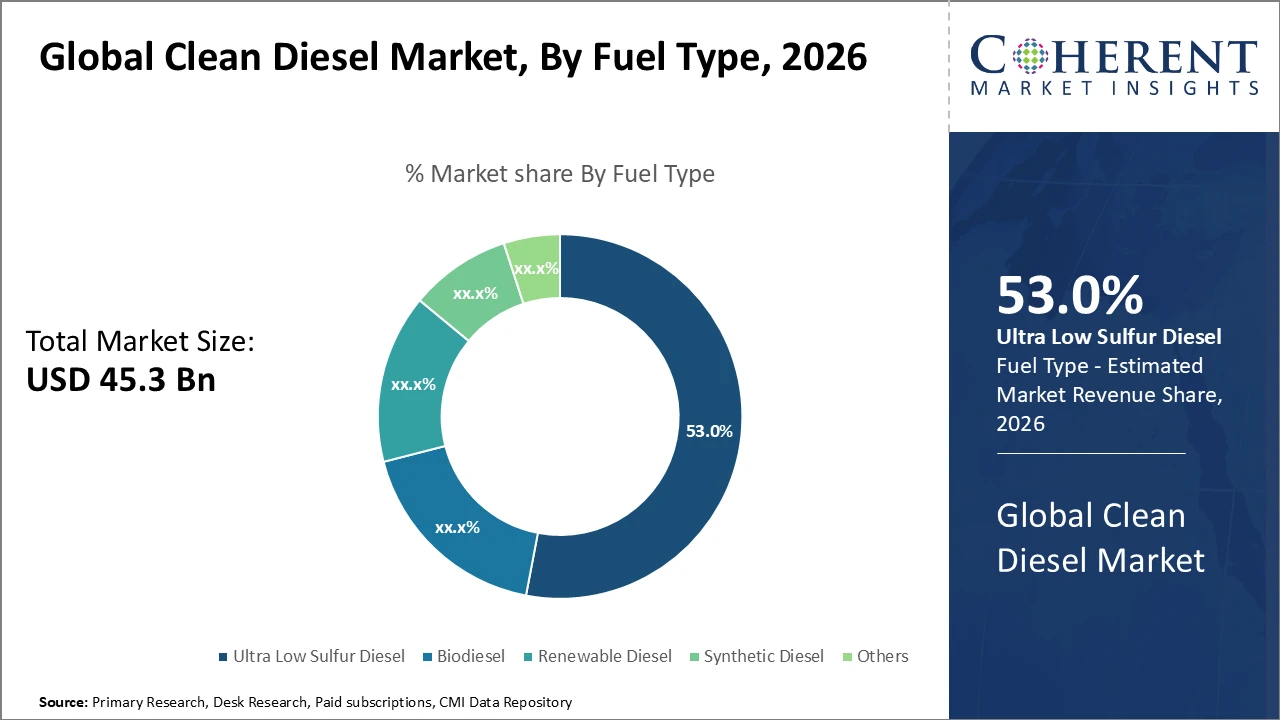
The Ultra Low Sulfur Diesel (ULSD) segment dominates the fuel type category, accounting for over 53% of the industry share due to regulatory compliance and widespread availability.
Transportation is the largest application segment, contributing approximately 45% to market revenue, reflecting the shift toward cleaner heavy-duty vehicles.
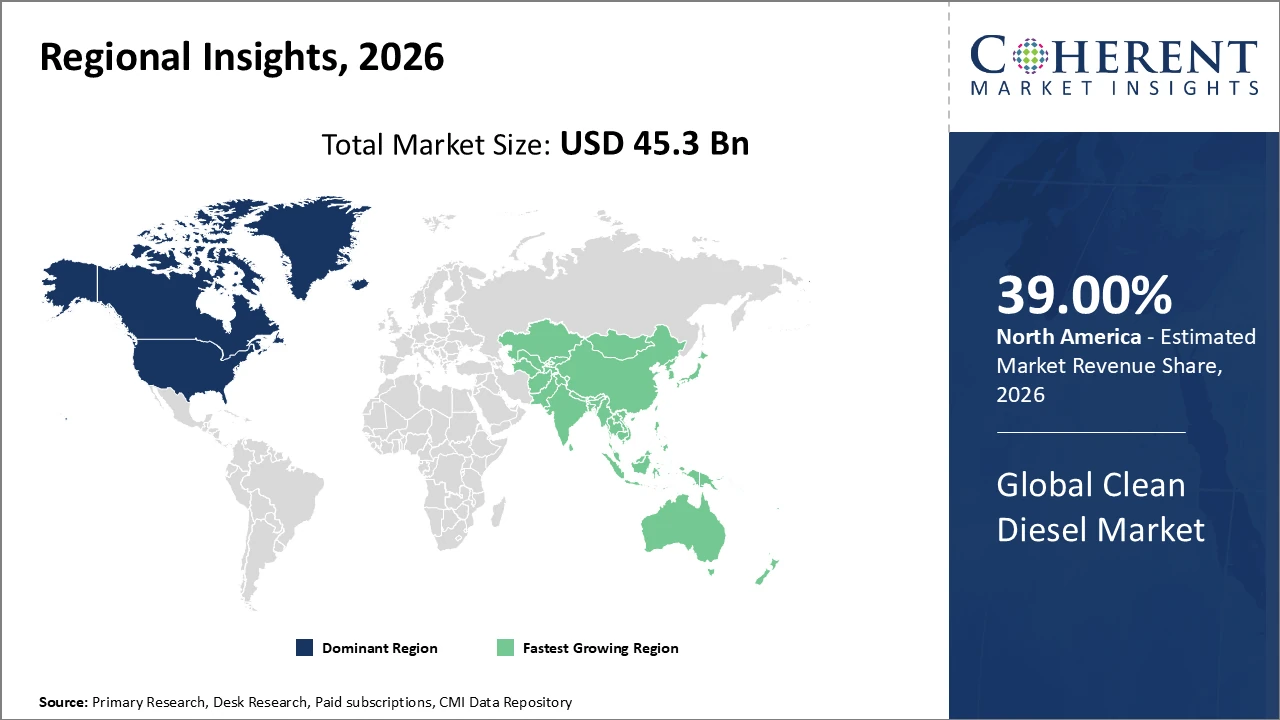
North America holds the leading regional market share, supported by stringent emissions regulations and strong R&D infrastructure driving industry innovations.
Asia Pacific is the fastest-growing region, with a projected CAGR exceeding 10%, driven by expanding automotive and industrial sectors in countries such as China and India.
Clean Diesel Market Segmentation Analysis
Clean Diesel Market Insights, By Fuel Type
Ultra Low Sulfur Diesel (ULSD) dominates the clean diesel market with a 53% share, driven by compliance with global emission standards and broad adoption in commercial transportation. Its low sulfur content significantly reduces SOx emissions, supporting urban and industrial air quality management. Renewable Diesel is the fastest-growing subsegment, favored for its high energy content and compatibility with existing diesel engines. Biodiesel remains common in rural and agricultural sectors due to easy blending and lower production costs. Synthetic Diesel, produced via gas-to-liquid or coal-to-liquid methods, serves niche power backup applications. Other specialty blends cater to specific industrial requirements, contributing modestly to the market.
Clean Diesel Market Insights, By Application
Transportation accounts for 45% of the clean diesel market, driven by widespread use in commercial vehicles, heavy-duty trucks, and public transport, supported by strict emission regulations and fuel efficiency requirements. Initiatives to replace older fleets with clean diesel vehicles have further fueled growth. The power generation segment is the fastest-growing application, driven by demand for cleaner backup power and off-grid solutions in emerging markets. Marine applications, particularly in inland and coastal shipping, show moderate adoption due to maritime emission standards. The industrial segment, including construction, mining, and agricultural equipment, maintains steady relevance but grows slower compared to transportation and power generation sectors.
Clean Diesel Market Insights, By Technology
Selective Catalytic Reduction (SCR) dominates the clean diesel after-treatment market due to its ability to reduce NOx emissions by up to 90%, complying with the strictest global emission standards. SCR systems are increasingly installed in heavy-duty vehicles and industrial diesel engines as regulatory requirements tighten. Exhaust Gas Recirculation (EGR) is the fastest-growing segment, valued for its cost-effectiveness and ability to lower combustion temperatures, limiting NOx formation. Diesel Particulate Filters (DPF) are essential for reducing particulate emissions but face challenges such as maintenance complexity and pressure drop. Catalytic reduction technologies remain widely used, particularly for retrofits, though newer solutions are gaining traction in new installations.
Clean Diesel Market Trends
The clean diesel market is shifting toward renewable diesel blends and hybrid fuels, driven by stringent global emission regulations.
Companies are increasingly adopting waste-to-fuel technologies; for example, Europe converted waste vegetable oils into renewable diesel, increasing production by 15% in 2025.
Digitalization in emission monitoring is gaining prominence, with IoT-enabled exhaust treatment systems enhancing compliance accuracy.
These smart systems also help reduce operational costs by providing real-time data on engine performance and emissions.
Overall, innovation in fuel sources and technology integration is shaping the future growth of the clean diesel market.
Clean Diesel Market Insights, By Geography
North America Clean Diesel Market Analysis and Trends
In North America, the clean diesel market is dominated by strong regulatory frameworks, including the U.S. Environmental Protection Agency’s Tier 4 standards, which enforce stringent emission limits. The region benefits from major industry players such as Chevron and Valero, investing heavily in refining capacity upgrades and renewable diesel production projects. Accelerated infrastructure development, coupled with enhanced research and development initiatives, supports technological innovation and product efficiency. Government subsidies and incentives further strengthen market adoption, contributing to approximately 39% of the global market share. These factors collectively foster sustained growth, positioning North America as a leading region in the global clean diesel industry.
Asia Pacific Clean Diesel Market Analysis and Trends
The Asia Pacific clean diesel market is experiencing the fastest growth, with a CAGR exceeding 10%, fueled by rapid industrialization, urbanization, and rising demand for cleaner fuels in transportation. Countries such as China and India are actively expanding clean diesel infrastructure and implementing incentive programs to encourage adoption. Domestic companies, including Reliance Industries and Indian Oil Corporation, are increasing renewable diesel production to meet growing demand. Supportive government policies, environmental regulations, and rising awareness of air pollution and sustainable energy solutions further drive market expansion. These factors collectively position Asia Pacific as a highly dynamic and rapidly evolving region in the global clean diesel industry.
Clean Diesel Market Outlook for Key Countries
USA Clean Diesel Market Analysis and Trends
The U.S. clean diesel market is strongly shaped by stringent emission regulations and increasing focus on renewable diesel production. Policy measures under the Inflation Reduction Act 2024 offered substantial incentives for renewable fuels, boosting investments and adoption rates. Key companies such as Renewable Energy Group, Inc., and Phillips 66 expanded production capacities by over 25% between 2024 and 2026, strengthening the U.S. market leadership. The ongoing transition to ultra-low sulfur diesel and advanced emission control technologies has contributed to environmental improvements, with NOx emissions in transportation applications estimated to decline by 17%. These factors collectively drive market growth and innovation.
Germany Clean Diesel Market Analysis and Trends
The Germany clean diesel market is witnessing steady growth, driven by strict European emission regulations and strong environmental policies promoting low-sulfur and renewable diesel usage. The transportation sector, particularly commercial vehicles and public transport, remains the largest consumer, while industrial and power generation applications are gradually expanding. Key players like TotalEnergies, BP, and Shell are investing in refining capacity upgrades and renewable diesel production to meet growing demand. Technological innovations, including advanced emission control systems and digital monitoring solutions, enhance compliance and efficiency. Rising environmental awareness, government incentives, and the shift toward sustainable fuels are expected to sustain Germany’s clean diesel market growth.
Analyst Opinion
Production capacity for clean diesel fuels expanded significantly, with manufacturers increasing output by nearly 12% in 2025 to meet rising global demand. The U.S. Energy Information Administration reported a 13% growth in renewable diesel production in 2025, highlighting a key supply-side factor driving market expansion.
Pricing dynamics have remained resilient despite crude oil fluctuations, supported by stable refining margins and government mandates. In 2024, average clean diesel prices varied by only 3%, aided by European subsidy policies, reflecting demand-side pricing stability.
Clean diesel imports increased in emerging economies, with India and Brazil seeing 15% and 18% year-on-year growth in 2025, indicating expanding adoption.
Market demand spans transportation, power generation, and industrial sectors, with commercial vehicles accounting for over 40% of total market revenue in 2026, driven by emission control regulations.
- Current Industry Events of 2026
- Market Size Estimation
- Regional Breakdown
- Competitive Landscape
- Customer Intelligence
- Segmental Analysis
- Pricing Analysis
- Key Market Drivers, Challenges & Future Trends
- Customized Insights Section
Market Scope
| Report Coverage | Details | ||
|---|---|---|---|
| Base Year: | 2025 | Market Size in 2026: | USD 45.3 billion |
| Historical Data for: | 2020 To 2024 | Forecast Period: | 2026 To 2033 |
| Forecast Period 2026 to 2033 CAGR: | 8.7% | 2033 Value Projection: | USD 81.4 billion |
| Geographies covered: |
| ||
| Segments covered: |
| ||
| Companies covered: | Neste Oyj, Philips 66, Eni S.p.A., Preem AB, Puma Energy, Ricor Group, TotalEnergies, Chevron Corporation, Shell plc, REG Life Sciences | ||
| Growth Drivers: |
| ||
Clean Diesel Market Growth Factors
Global regulatory pressures are a major driver of the clean diesel market, with measures such as the U.S. Clean Air Act amendments in 2025 mandating reduced sulfur content. Alongside regulations, growing interest in bio-based and renewable diesel fuels is fueled by carbon neutrality goals, with U.S. renewable diesel production doubling between 2024 and 2026. Expansion of commercial vehicle fleets in Asia Pacific, supported by urbanization and industrial growth, has further increased clean diesel consumption. Technological advancements in emission control systems, including Selective Catalytic Reduction (SCR) and Diesel Particulate Filters (DPF), have improved engine efficiency and lowered environmental impact, encouraging broader market adoption.
Clean Diesel Market Development
In September 2025, Power Service introduced Diesel Injector & DPF Flush, the industry’s first single-tank solution designed to clean the entire diesel fuel system—including injectors, turbo, EGR, and DPF—in one treatment.
Key Players
Leading Companies of the Market
Neste Oyj
Philips 66
Eni S.p.A.
Preem AB
Puma Energy
TotalEnergies
Chevron Corporation
Shell plc
REG Life Sciences
Ricor Group
Competitive strategies in the clean diesel market are heavily focused on mergers, acquisitions, and technological innovation. For example, TotalEnergies expanded its market presence in 2025 by acquiring stakes in renewable diesel ventures, resulting in a 7% increase in market share and diversifying its product portfolio. Simultaneously, investments in advanced catalyst technologies have enhanced fuel efficiency and reduced emissions, exemplified by Shell’s launch of next-generation diesel catalysts that cut NOx emissions by 30%. These strategic moves not only strengthen companies’ competitive positioning but also drive innovation and sustainability within the global clean diesel industry.
Clean Diesel Market Future Outlook
The clean diesel market is expected to experience robust growth over the coming years, driven by stringent global emission regulations, increasing adoption of renewable diesel, and rising demand for low-emission transportation solutions. Technological advancements in emission control systems, such as Selective Catalytic Reduction (SCR) and Diesel Particulate Filters (DPF), will continue to enhance fuel efficiency and reduce environmental impact. Expansion of commercial vehicle fleets, urbanization in emerging markets, and government incentives for sustainable fuels will further support market growth. Additionally, investments in bio-based diesel production and digital monitoring technologies are anticipated to create new opportunities, reinforcing the market’s long-term positive outlook.
Clean Diesel Market Historical Analysis
The historical analysis of the clean diesel market shows steady growth driven by increasing environmental awareness and stricter emission regulations over the past decade. Early adoption focused on ultra-low sulfur diesel (ULSD) to comply with international air quality standards, particularly in North America and Europe. The transportation sector, especially commercial vehicles and public transport, was the primary driver of demand, while industrial and power generation applications gradually expanded. Investments in emission control technologies, such as Selective Catalytic Reduction (SCR) and Diesel Particulate Filters (DPF), supported cleaner operations. Additionally, the emergence of renewable diesel and bio-based fuels set the stage for current market innovations and sustainable growth trends.
Sources
Primary Research Interviews:
Automotive and commercial vehicle manufacturers
Diesel fuel refiners and renewable diesel producers
Distribution companies and fuel retailers
Industrial and power generation operators using clean diesel
Fleet managers and transportation planners
Magazines:
Diesel Progress – Industry Updates & Technology Innovations
Fuel Oil News – Diesel Market and Regulatory Trends
Biofuels International – Renewable Diesel & Sustainability Coverage
Fleet Owner – Commercial Vehicle Diesel Usage and Trends
Journals:
Journal of Cleaner Production – Diesel Emissions and Sustainability
Energy Policy – Regulations and Market Impacts
Transportation Research Part D: Transport and Environment – Diesel Applications
Applied Energy – Diesel Engine Efficiency and Emission Technologies
Newspapers:
The Wall Street Journal – Clean Diesel & Energy Developments
Financial Times – Fuel Markets and Renewable Diesel Industry
Reuters – Diesel Fuel Market Updates
Bloomberg – Clean Diesel Innovations and Market Trends
Nikkei Asia – Diesel Refining & Industrial Adoption
Associations:
American Petroleum Institute (API) – Diesel Fuel Guidelines and Market Data
European Biodiesel Board (EBB) – Renewable Diesel Policies and Market Insights
Renewable Energy Association (REA) – Sustainable Diesel Initiatives
Get access to 250+ pages report
Every segment, forecast, competitor profile and data table behind the analysis above — available for instant download.
- ESOMAR Member
- ISO 9001:2015 Certified
- D-U-N-S Registered
- GDPR & CCPA Compliant
Missing comfort of reading report in your local language? Find your preferred language:
Transform your Strategy with Exclusive Trending Reports
Frequently Asked Questions
Dominant players include Neste Oyj, TotalEnergies, Chevron Corporation, and Shell plc, noted for their expansive production capacities and technological advancements in clean diesel technologies.
The market size is expected to grow from USD 45.3 billion in 2026 to USD 81.4 billion by 2033, reflecting a strong CAGR of 8.7%, driven by regulatory and technological advancements.
The transportation sector holds the largest growth opportunity, accounting for around 45% of market revenue, propelled by emission regulations and fleet modernization.
Trends toward renewable diesel blends, smart emission control technologies, and the circular economy model will redefine market dynamics and growth strategies.
The market is competitive with continuous innovation in fuel technologies and emission control, but challenges such as feedstock availability and pricing pressures persist.
Strategies include mergers and acquisitions, investments in R&D for advanced fuel formulations, and expansion into emerging markets to capture growing demand.