

Dyestuff Market Size and Forecast — 2026-2033
The Global Dyestuff Market size is estimated to be valued at USD 16.11 billion in 2026 and is expected to reach USD 21.8 billion by 2033, exhibiting a compound annual growth rate (CAGR) of 6.0% from 2026 to 2033.
Overview
Dyestuffs are complex organic colorants designed to impart color to textiles, leather, paper, plastics, and various industrial materials through absorption or chemical bonding. They are formulated to provide high color strength, strong fastness properties, and resistance to washing, light, and heat. Dyestuffs include classes such as acid dyes, reactive dyes, vat dyes, disperse dyes, and basic dyes—each suited for specific fibers like cotton, wool, nylon, polyester, and acrylic. Modern dyestuffs often incorporate eco-friendly chemistries, low-salt formulations, and high fixation efficiencies to meet sustainability targets. They play a crucial role in the textile finishing process, enabling vibrant hues, functional dyeing (UV-protection, antimicrobial properties), and customized coloration for apparel, home furnishings, and technical textiles.
Key Takeaways
The reactive dyes segment dominates due to its versatile application across diverse textiles, capturing over 43% industry share.
The textile application subsegment remains central to market demand, accounting for approximately 53% of overall market revenue, driven by global apparel manufacturing.
From a regional perspective, the Asia Pacific leads the dyestuff market share with over 48%, owing to its massive textile production ecosystem and supportive government policies.
Meanwhile, North America exhibits steady growth supported by investments in functional and specialty dye markets and sustainable product innovations.
Europe also offers promising growth, propelled by environmental guidelines pushing demand for bio-based dyes.
Dyestuff Market Segmentation Analysis
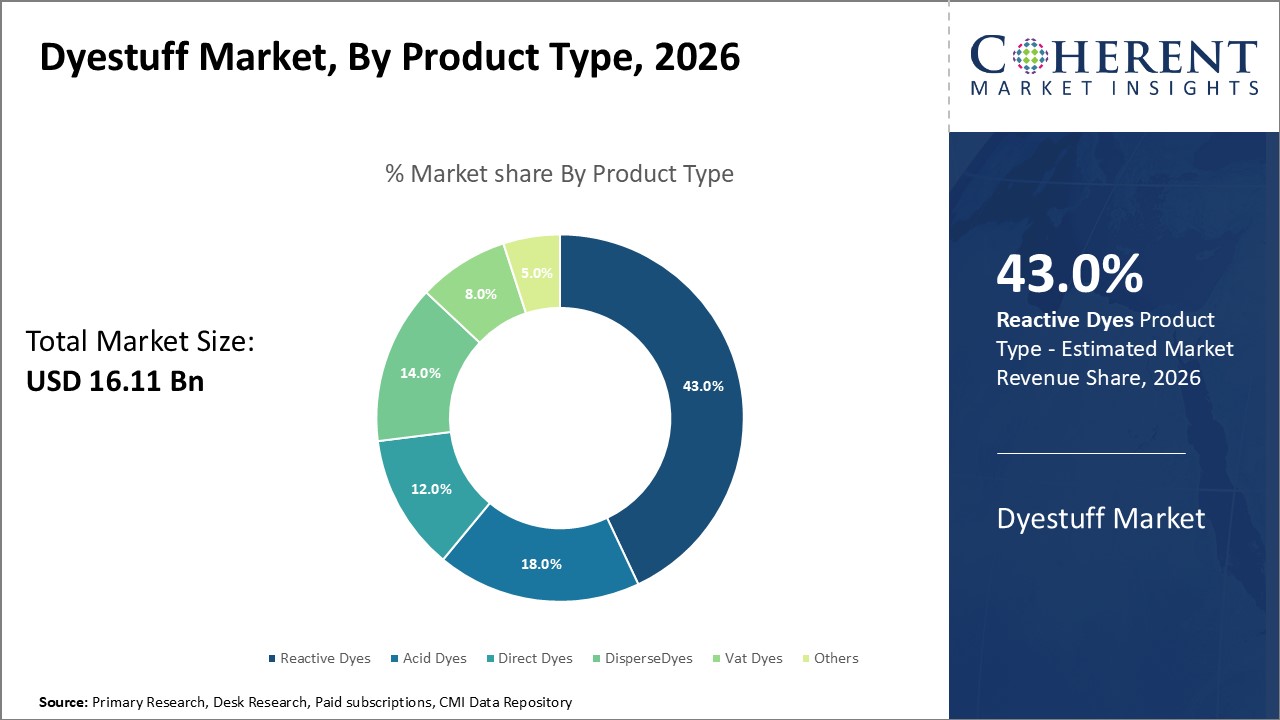
Dyestuff Market Insights, By Product Type
Reactive Dyes dominate the market share. Reactive Dyes are preferred for their excellent wash-fastness and vibrant color profiles, widely adopted in textile dyeing owing to their high fixation rates and eco-friendly properties. Acid Dyes represent the fastest-growing subsegment due to their increasing use in protein fibers such as silk and wool, capitalizing on growing demand in luxury textiles and leather finishing.
Dyestuff Market Insights, By Application
Textiles are the largest market contributor. Textile applications drive market revenue due to the ever-expanding apparel and home furnishing sectors globally and rising consumer preferences for sustainable dyeing techniques. Leather applications are growing, driven by fashion and automotive interiors employing environment-conscious dyeing methods. Paper dyeing is a niche but stable segment increasingly incorporating safer pigments. The Food and Cosmetic sectors represent emerging uses for natural and synthetic edible dyes, enhancing product appeal and safety compliance.
Dyestuff Market Insights, By End-Users
Textile Manufacturing is the dominant end user segment, owing to its vast volume consumption and critical role in driving innovation, such as low-impact dyes. The Automotive subsegment exhibits the highest growth rate as advanced coatings and pigment incorporation demand rise for vehicle aesthetics and durability. Construction utilizes decorative and functional dyes in building materials, while Electronics increasingly adopt specialized dyes for PCB coatings and display technologies. The Others segment encompasses niche industrial applications reflecting steady, albeit smaller volume, demand.
Dyestuff Market Trends
Recent market trends highlight the accelerated adoption of bio-based and environmentally friendly dyes, particularly in developed regions such as Europe and North America, where regulatory frameworks mandate lowered chemical footprints.
Another significant trend is the digitalization of the dyeing process, which improves operational efficiency and sustainability—this is notably prevalent in technologically advanced textile hubs such as Germany and the U.S.
Dyestuff Market Insights, By Geography
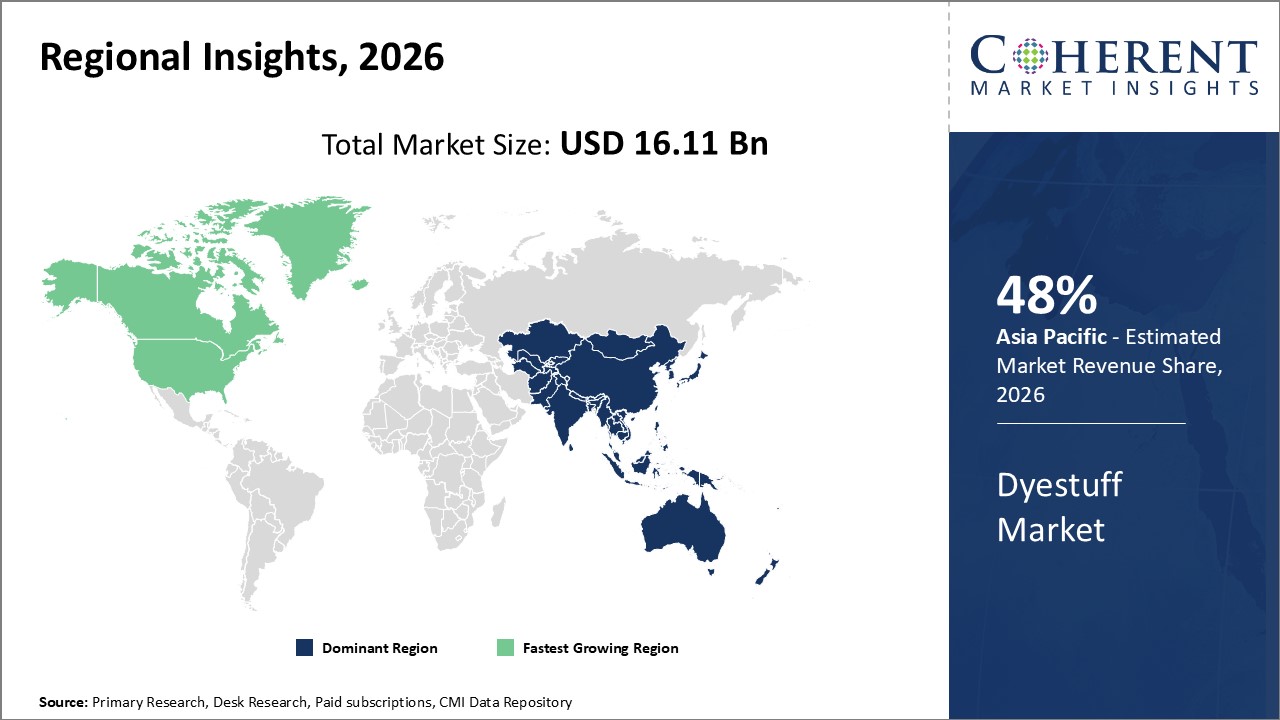
Asia Pacific Dyestuff Market Analysis and Trends
In the Asia Pacific, the Dyestuff market leads globally by comprising nearly 48% of the total industry share. The region’s dominance is underpinned by the vast textile manufacturing base in countries like India and China, where abundant labor and government incentives drive sustained production. Moreover, increasing environmental regulations have prompted local manufacturers to adopt innovative sustainable dyes, supporting business growth and market revenue expansion.
North America Dyestuff Market Analysis and Trends
Meanwhile, North America exhibits the fastest growth with a CAGR of approximately 6.3%, fueled by rising demand for specialty and functional dyes, especially in automotive coatings and high-performance textiles. Government initiatives promoting green manufacturing and product sustainability incentivize investment in dye technology innovation, with major players such as BASF SE and Clariant AG expanding R&D operations in the U.S.
Dyestuff Market Outlook for Key Countries
USA Dyestuff Market Analysis and Trends
The USA’s dyestuff market is distinguished by technological innovation and stringent environmental standards that drive the development of sustainable dyeing solutions. The automotive and protective textiles sectors are prominent demand drivers; for instance, specialty dyes used in UV protective fabrics increased by nearly 20% in 2025 alone. Companies such as Huntsman Corporation and Clariant AG maintain a strong domestic presence, investing heavily in bio-based product lines and digital dyeing technology.
India Dyestuff Market Analysis and Trends
India's dyestuff market thrives on its vast textile manufacturing industry which is among the largest worldwide. The country’s emerging economy coupled with policy measures promoting eco-friendly chemicals has led to a significant increase in sustainable dye use. Indian manufacturers rapidly scaled production capacities by over 10% in 2025, aiming to meet growing exports demand in Asia and Europe. Market players like Zhejiang Longsheng Group and Jiangsu Yabang Dyestuff have established strategic partnerships with local entities to enhance supply chain integration and product innovation.
Analyst Opinion
Production capacity expansion remains a key supply-side indicator influencing the dyestuff market. Leading chemical manufacturing plants reported nearly 8% capacity augmentation in India and China during 2025, underpinning the rapid scaling of market supply. This increase facilitates meeting escalating demand particularly in Asia Pacific and North America, reinforcing global market revenue growth.
Pricing dynamics reveal a fluctuating trend shaped by raw material availability, primarily petrochemical derivatives. In 2026, azo dye precursors witnessed a 7% price elevation compared to 2023 levels, driven by supply constraints and logistic inflation. This pricing behavior directly correlates with market share shifts toward players capable of integrating backward operations or resorting to alternative feedstocks.
Diverse use cases across industries such as cosmetics pigmenting, paper coloration, and food packaging revolutionize market growth strategies. Notably, demand from the automotive sector’s paint and coating formulations increased by 14% in 2025, demonstrating how emerging application domains significantly contribute to dyestuff market expansion.
Import-export flows have evolved with the strengthening of trade partnerships in Southeast Asia, specifically Vietnam and Indonesia. These nations’ dyestuff import volumes surged by over 15% in 2025 compared to 2022, reflecting the increasing regional manufacturing footprint and consumption patterns that are dictating global market analysis.
- Current Industry Events of 2026
- Market Size Estimation
- Regional Breakdown
- Competitive Landscape
- Customer Intelligence
- Segmental Analysis
- Pricing Analysis
- Key Market Drivers, Challenges & Future Trends
- Customized Insights Section
Market Scope
| Report Coverage | Details | ||
|---|---|---|---|
| Base Year: | 2025 | Market Size in 2026: | USD 16.11 billion |
| Historical Data for: | 2020 To 2024 | Forecast Period: | 2026 To 2033 |
| Forecast Period 2026 to 2033 CAGR: | 6.0% | 2033 Value Projection: | USD 21.8 billion |
| Geographies covered: |
| ||
| Segments covered: |
| ||
| Companies covered: | Guangdong Yipai Chemical, Zhejiang Jiafeng Chemical Industry, Jiangsu Yabang Dyestuff, Nitta Gelatin Inc., Kiri Industries Ltd., DyStar Group, Boleron Industries, Sumitomo Chemical, Atul Ltd., Zhejiang Juhua Co. | ||
| Growth Drivers: |
| ||
Dyestuff Market Growth Factors
The escalating demand for sustainable and biodegradable dyes across textiles and packaging sectors is a critical growth driver. Textile mills globally reported a 20% increase in eco-friendly reactive dye usage by the end of 2025, spurred by stringent environmental regulations. Another growth impetus arises from the rapid industrialization of emerging economies, notably India and China, expanding their textile manufacturing infrastructure which consumes vast volumes of dyestuffs. Technological innovations such as digital dyeing and pigment printing foster market dynamics by enhancing dye efficiency and reducing water consumption; recent adoption rates in Asia Pacific manufacturers reached 35% in 2025. Additionally, increased investment in automotive coatings—characterized by durable and weather-resistant dyes—contributed to sectoral market revenue growth by over 10% year-on-year in 2026.
Dyestuff Market Development
In 2025, Archroma launched its new “EarthColors Reactive” line, featuring 93% bio-based reactive dyes for cotton. The launch expanded Archroma’s sustainable dye portfolio by offering high-performance, plant-derived colorants designed to significantly reduce dependence on petroleum-based chemicals.
In 2025, Huntsman Corporation launched its “Innovance Smart Shade” dye line, integrated with digital software to enable precise shade matching in textile digital printing. The solution provides real-time correction capabilities, helping manufacturers minimize waste, reduce downtime, and consistently achieve exact color targets.
Key Players
Leading Companies of the Market
Guangdong Yipai Chemical
Zhejiang Jiafeng Chemical Industry
Jiangsu Yabang Dyestuff
Nitta Gelatin Inc.
Kiri Industries Ltd.
DyStar Group
Boleron Industries
Sumitomo Chemical
Atul Ltd.
Zhejiang Juhua Co.
Several market players have adopted aggressive growth strategies, including mergers and acquisitions to consolidate raw material supplies and technological innovation. For instance, BASF SE’s acquisition of specialty dye segments in Asia Pacific led to a strategic 16% revenue uplift in 2025, enhancing its market share globally. Similarly, Clariant AG’s investment in green chemistry labs has translated into new eco-certified dye lines generating over USD 120 million in revenue within the first two years.
Dyestuff Market Future Outlook
In the coming years, the dyestuff market is expected to undergo major transformation driven by sustainability mandates, stricter wastewater regulations, and rising demand for eco-friendly and bio-based colorants. Digital textile printing will continue to expand rapidly, increasing the need for high-performance inkjet dyes with superior dispersion and fastness properties. Growth in automotive and technical textiles, sportswear, and home furnishings will also contribute to demand for specialty dye categories. Additionally, innovation in low-water and waterless dyeing technologies is expected to reshape purchasing patterns among textile manufacturers seeking improved efficiency and reduced environmental impact. As brands increasingly commit to green supply chains and transparent sourcing, producers of environmentally compliant dyes are expected to experience accelerated growth.
Dyestuff Market Historical Analysis
Historically, the dyestuff market evolved from traditional natural dyes to large-scale synthetic dye production as industrialization accelerated globally. In the 20th century, advances in organic chemistry enabled the creation of a wide spectrum of dye classes, leading to increased efficiency, improved brightness, and better fastness properties. Growth in global textile production, the explosion of fast fashion, and rising demand for colorfast apparel significantly boosted consumption of reactive, disperse, vat, and acid dyes. Technological advancements also facilitated the adoption of dyes for paper, leather, plastics, and specialty applications. Environmental regulations drove shifts in production methods, pushing manufacturers to reduce effluent loads and transition to more sustainable formulations.
Sources
Primary Research Interviews:
Textile Dyehouses
Color Chemists
Printing Ink Manufacturer
Leather Tanners
Textile Mill Managers
Databases:
Colour Index International
ChemOrbis Dyes Data
UN Comtrade Colorant Trade Data
Magazines:
Textile World
Dyes & Pigments Magazine
Chemical & Engineering News
Indian Textile Journal
Journals:
Dyes and Pigments Journal
Textile Research Journal
Journal of Color Science
Journal of Industrial Chemistry
Journal of Cleaner Production
Newspapers:
The Hindu Business Line (Textiles)
Business Standard (Industry)
The Guardian (Business)
South China Morning Post (Manufacturing)
Financial Express (Trade)
Associations:
Society of Dyers and Colourists (SDC)
American Association of Textile Chemists and Colorists (AATCC)
CEFIC
International Textile Manufacturers Federation (ITMF)
European Printing Ink Association (EUPIA)
Get access to 250+ pages report
Every segment, forecast, competitor profile and data table behind the analysis above — available for instant download.
- ESOMAR Member
- ISO 9001:2015 Certified
- D-U-N-S Registered
- GDPR & CCPA Compliant
Missing comfort of reading report in your local language? Find your preferred language:
Transform your Strategy with Exclusive Trending Reports
Frequently Asked Questions
Leading companies include Archroma, Huntsman Corporation, DIC Corporation, Clariant AG, BASF SE, and Lanxess AG, who collectively hold significant market share through continuous innovation and expansion strategies.
The Dyestuff market size is expected to increase from USD 16.11 billion in 2026 to USD 21.8 billion by 2033, exhibiting a compound annual growth rate (CAGR) of 6.0% during this period.
The textile industry holds the largest opportunity thanks to the expanding global apparel production and rising demand for sustainable dye solutions.
The market will see increased adoption of functional and eco-friendly dyes, digital dyeing technologies, and regional production localization as key trends driving growth.
The market is highly competitive, marked by continuous innovation and vertical integration; challenges include raw material price volatility and environmental regulatory compliance.
Strategies include product portfolio diversification, strategic acquisitions, sustainability-driven innovation, and targeted regional expansion to optimize market presence and revenue streams.